
by Miguel E. Rodriguez
DIRECTOR: Luis Buñuel
CAST: Silvia Pinal, Jacqueline Andere, José Baviera
MY RATING: 9/10
ROTTEN TOMATOMETER: 94% Fresh
PLOT: The guests at an upper-class dinner party find themselves unable to leave the drawing room in Buñuel’s famous, none-too-subtle satire.
Buñuel’s The Exterminating Angel has many moods. On the one hand, it’s a dark comedy of manners railing against the entitlements of the upper classes, much like the more recent Triangle of Sadness (2022), which owes much to this film. On the other, it’s a Serling-esque horror story mining a common occasion for unexpected suspense, like The Ruins (2008) or Open Water (2003). On a deeper level, perhaps it’s a Lynchian exploration of the human psyche, regardless of class, like Mulholland Drive (2001) or…well, with Lynch, you can probably just take your pick.
I experienced all of those moods while watching The Exterminating Angel. I haven’t seen such an effective juxtaposition of tone since Everything Everywhere All at Once (2022).
The weirdness starts right away, in scenes that seem to be setting the stage for a Marx Brothers comedy. Edmundo Nobile (“Nobile”, “noble”, get it, wink, wink?) has invited a large number of his posh friends to his mansion for dinner following an opera. The moment they arrive, Nobile notes that his servants are not stationed at the door to take the visitors’ coats. This is because most of the servants felt the sudden need to take the night off and left, being careful to avoid their employer. He makes a statement about his servants, then everyone troops up the grand staircase to the dining room.
Moments later, this scene literally repeats itself, not by re-using the same footage, but in a separate take. This kind of repetition occurs multiple times during the actual dinner scene, as well. If there’s a deeper meaning to this device, I’ll have to leave it to film scholars to analyze. For myself, it simply added a layer of oddness to the proceedings, but not in a bad way.
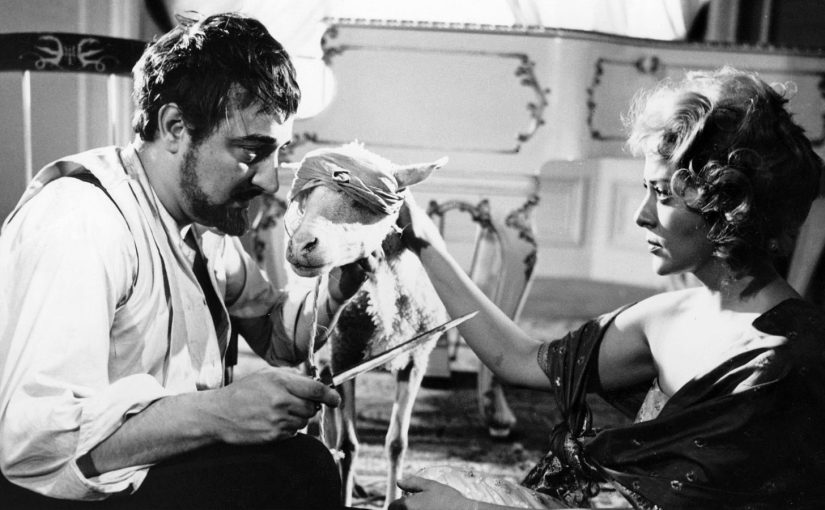
The dinner scene contains pratfalls, repeated conversations, and a visit to a side room containing three or four lambs and a bear on a leash. What the WHAT…? I remember thinking, okay, so this is going to a broad comedy turning upper-class manners into slapstick. Seen it before, so I hope this movie executes it well.
The weirdness escalates when everyone retreats to a drawing room just off the dining room, where one of Nobile’s guests entertains everyone with a piano solo. But when one of them tries to leave, he finds he can’t. Not physically, like there’s suddenly an invisible wall, but one by one the guests discover they’re simply unable to leave the room.
They slowly realize the logistics of this bizarre situation. The drawing room has no food. Water runs low. The one servant who remained outside manages to bring in a tray of water and coffee, but when he tries to leave to bring food…he can’t. There’s no phone for them to call anyone about their predicament.
Outside the house, people find themselves unable to enter the grounds, so no one can tell what has happened to the people inside. Curious crowds gather. Inside, social structure starts to degenerate. There are no restrooms, but one quick shot reveals a closet full of nothing but vases, and we see people entering and exiting these rooms repeatedly. Ick. Arguments are started with the drop of a hat. One couple finds a unique, but undesirable, method of escaping their prison.
I responded to this material very unexpectedly, due mostly to its unpredictability. I wasn’t cheering at the sight of upper-class twits being brought low when faced with bizarre circumstances, but I was more in tune with the horrific aspects of this story. Buñuel has stated in interviews that he regretted not being able to take the story even further by including cannibalism, which is honestly where I thought things were headed. It would have made a marvelous satirical statement, hearkening all the way back to Jonathan Swift.
(So, what DO they eat, you may be asking yourself? Wouldn’t EWE like to know?)
I realize this review of the film hasn’t been much more than just a summary of its events, minus the surprising, “circular” ending. A more detailed analysis might require listening to the commentary or reading Roger Ebert’s review or something. But I hope I’ve conveyed how much I enjoyed The Exterminating Angel. It was weird and surreal and absurd, and comic and horrific, and slapstick and satiric, and totally unpredictable all the way to the final frame.
P.S. Now that I’ve seen this movie, the Woody Allen film Midnight in Paris (2011) has even deeper resonance when Gil meets Buñuel at a party and gives him the idea for The Exterminating Angel, and even Buñuel can’t understand it: “But I don’t get it. Why don’t they just walk out of the room?” Funny stuff.
 2 UNPAID MOVIE CRITICS!!!!