
by Miguel E. Rodriguez
DIRECTOR: Vittorio De Sica
CAST: Carlo Battisti, Maria Pia Casilio, Lina Gennari
MY RATING: 8/10
ROTTEN TOMATOMETER: 98% Certified Fresh
PLOT: An elderly man and his beloved pet dog struggle to survive on his government pension in Rome.
The greatness of Vittorio De Sica’s Umberto D. is something I was only able to appreciate after it was over. As the film plays out, I was waiting for something more to happen, something to add to the paper-thin plot of an elderly man struggling to make ends meet in a city whose government has forsaken him and thousands or millions like him. When the screen faded to black at the end, my first thought was, “That’s it??? Well, what happens next?” The fact that the film prompted me, not only to ask the question, but to attempt to come up with an answer, is probably one of the reasons why this film is widely regarded as a classic. Not many films can claim to keep the story running forward in your head after it’s over.
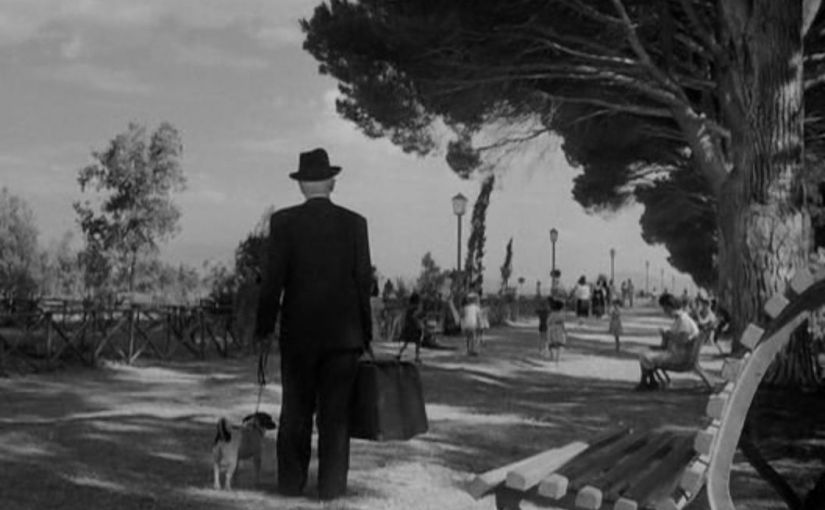
Umberto Domenico Ferrari is an elderly man living in post-war Rome. The film opens with him joining a crowd protesting the city government’s policy of cutting their pensions. Umberto is in dire straits. He’s behind on his rent, low on cash, his landlady threatens eviction, and he must somehow still feed his beloved dog, Flike (rhymes with “like”). The film will follow Umberto’s tribulations over the course of several days as he berates his landlady, tries to get some cash by selling some of his books and other possessions, dines at a soup kitchen while furtively feeding scraps to Flike, and befriends the young maid in his building who has problems of her own.
Umberto D. is as good an example as any, and better than most, of Italian post-war neo-realism, a cinematic movement in which Italian film directors aimed to paint the silver screen with portraits of everyday life in their country, which was wracked with poverty and unemployment at the time. Rather than provide an escape from such hardships, these directors felt it was their civic duty to bring the everyman (or everywoman) into the spotlight, to remind the audience that movies could be more than escapist entertainment. They felt obliged to say, “There are more stories of despair and hardship ten feet out your front door than can be imagined by any Hollywood screenwriter.”
There are pros and cons to this approach, at least in my opinion. On one hand, the neo-realist movement created such immortal classics as La strada [1954], Bicycle Thieves [1948, also directed by De Sica], and a little later, Rocco and His Brothers [1960]; these are films that have stood the test of time and will continue to do so for decades to come.
On the other hand, a quote from Roger Ebert comes to mind: “A man goes to the movies; the critic must admit that he is this man.” In other words, learn to say exactly what you think about a film as opposed to what you think you should think. And when it comes to Italian neo-realism, I’ll say this: give me a choice between a De Sica retrospective and a Christopher Nolan marathon, and it’s the Nolan marathon seven days a week and twice on Sunday. Yes, I am aware of the place that neo-realism films have in cinematic history, and I can appreciate their greatness on a cerebral level. However, on a gut level, I can usually only watch them once or twice, with very few exceptions. La strada, for example, is heart-wrenching, but in such a way that I want to revisit it just to relive those emotional gut-punches at the end.
Umberto D. didn’t quite deliver those gut-punches, at least not during its running time. …okay, there IS a moment when Flike runs away, and the possibility arises that he may or may not have been put down by the local pound. There is a cringe-inducing scene when we watch hardened men roll a cage full of stray dogs into a large box where the dogs will be gassed; we are spared the sight of the actual procedure, but we see enough of it to get the picture. Umberto watches the box with fear in his eyes. Another man wants to retrieve his captured pet, but he falters when he lacks the money to pay for his return. The look on his face as he repeatedly asks, “So, if I don’t take him, you’ll kill him?” THAT is a scene where my emotional juices where stirred up.
(Okay, there is ONE other scene that got me a little riled up emotionally, but it happens near the film’s climax, so I can’t describe it without spoiling something.)
Aside from those very rare moments of heightened emotion, the film is mostly pedestrian, giving us more details of Umberto’s daily life as he tries and tries to find a way to get enough cash to pay his rent. In one pathetic scene, he debates whether he should resort to panhandling like so many other men he sees on the streets. At first, he tries it himself, practicing holding out his hand on a street corner, but when someone actually turns to give him some money, Umberto pretends he was just stretching – he just can’t bring himself to accept handouts from a stranger. He tries to enlist Flike instead, getting him to hold his hat while sitting on his hind legs, but that doesn’t work out either. He reaches out to former friends, to no avail.
As I’ve said before, DURING the film, these scenes, and others like them, didn’t stir me up the way I felt the director was shooting for. It was only afterwards that I found myself pondering those scenes and Umberto’s actions. I used to own a dog, a very long time ago. If my dog were my only remaining connection, with no family or friends to reach out to in times of need, how would I feel if I learned he might have been captured and put down? If I suddenly had no means of income, no way to pay the rent/mortgage/whatever, and nowhere to go if I got kicked out of my apartment/house/whatever, how would I manage? Would I manage? Late in the film, Umberto makes a couple of hard choices. Would I make the same choices in his position?
As FINE appears on the screen, Umberto D. invites us to wonder about Umberto’s fate. The last scene is, on the surface, a happy one, but somber music plays over it, and the scene does not address or solve Umberto’s situation. This is in the neo-realist tradition. If De Sica were asked, “But what happened to him at the end?”, I can imagine him saying, “The same thing that happens to all such men.” If he was told, “But I don’t know what happens to such men,” De Sica might say, “Well, now you have something to think about.” Q.E.D.
[Trivia: The lead actor, Carlo Battisti, was not a professional actor, but a professor of linguistics. Umberto D. would be his only film, and not many people can claim that kind of legacy with just one film.]
 2 UNPAID MOVIE CRITICS!!!!