FRANKENSTEIN (2025)

by Miguel E. Rodriguez

DIRECTOR: Guillermo del Toro
CAST: Oscar Isaac, Jacob Elordi, Christoph Waltz, Mia Goth, Charles Dance, David Bradley
MY RATING: 8/10
ROTTEN TOMATOMETER: 86% Certified Fresh

PLOT: A brilliant but egotistical scientist brings a creature to life in a monstrous experiment that threatens to undo both the creator and his tragic creation.


Having never read the original novel by Mary Shelley, I have no idea if Guillermo del Toro’s rendition of Frankenstein is any more or less faithful to the source material.  What’s interesting about this version is that it feels like it is.  There are long passages of dialogue and even some monologuing on the nature of life, death, and the creator’s responsibility to their creation.  del Toro is smart enough to balance these cerebral discussions with enough gothic (and gory) horror to satisfy any fan of the genre.  Call it a good example of a thinking man’s horror film.

Oscar Isaac’s performance as Victor Frankenstein puts a new spin on the stereotypical mad scientist.  He’s no less obsessed than previous versions, but del Toro and Isaac went for a slightly different vibe in his personal appearance.  Rather than a cackling lunatic with a god complex, Isaac’s doctor looks and sometimes behaves more like a self-absorbed rock star…with a god complex.  (I learn on IMDb that this was by design; del Toro wanted Victor to evoke David Bowie, Mick Jagger, and Prince…mission accomplished.)

Jacob Elordi as The Creature does an admirable job of generating sympathy and empathy for perhaps the greatest misunderstood monster of all time.  The unique makeup (which took up to 10 hours to apply!) allows Elordi to emote and lend humanity to the Creature in the second half of the film, especially during his encounter with the blind man.  There is a subtle but ingenious effect where one of his eyes will sometimes glow orange with reflected light as a reminder that, when push comes to shove, this Creature is not to be trifled with.

Mia Goth is a welcome presence as Elizabeth, who is not Victor’s love interest this time around, but fiancé to Victor’s younger brother, William.  I supposed I could quibble that the screenplay does not give Elizabeth much to do.  She comes across as the intellectual equal of Victor in a few well-written scenes, but her encounter with the chained Creature felt a little trope-y, and her character’s payoff left me wanting more.

The visual style of the film is crammed with del Toro’s signature fingerprints: huge gothic structures, elaborate costume designs (loved Victor’s mother’s red outfits near the start of the film), startling dream sequences, and lots of practical effects…well, more than there were in Pacific Rim (2013) and Crimson Peak (2015), anyway.  One image that really struck me was the unique design of two coffins seen in the film.  They looked more like futuristic cryogenic chambers than Victorian-era caskets.  Watch the movie and you’ll see what I mean.

Other things I loved:

  1. Victor’s early presentation of his theories to a disciplinary board, in which we get an echo of that creepy dead guy resurrected by Ron Perlman in del Toro’s Hellboy (2004).
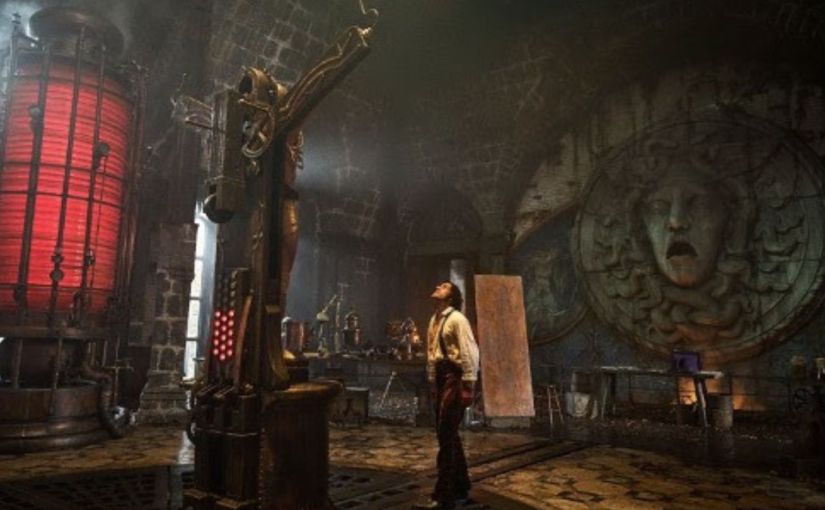
  2. The towering set for Frankenstein’s laboratory.  What it lacks in the whirring, crackling machinery we normally associate with his lab, it makes up for in scale, including a yawning pit several feet across that really should have had a guardrail.
  3. Being able to get inside the Creature’s head this time around.  There have no doubt been other variations where the Creature speaks, but I haven’t seen one where he is this eloquent, expressing his pain and anguish over his unwanted existence and apparent immortality (his wounds are self-healing).  This is another factor that makes this movie feel more faithful to Shelley’s novel, even if it isn’t.
  4. The no-holds-barred aspect to the violence and gore, which can be quease-inducing, but which never feels overdone or exploitative.  In fact, the moment that scared me the most in the film had nothing to do with the gore or violence at all, but with one of the doctor’s early experiments that comes to life in a most surprising manner.

Above all, there’s the tragic nature of the poor Creature’s existence, the misunderstood monster that has been so often satirized or spoofed, and the deeper questions the story raises about our own lives.  It might be tempting to listen to the closing passages of the film and dismiss them as trite and sentimental, but Frankenstein earns those moments, in my opinion.  More than any other Frankenstein movie I’ve seen, this one made me think, and jump a little, in equal measures.  Tricky stuff.
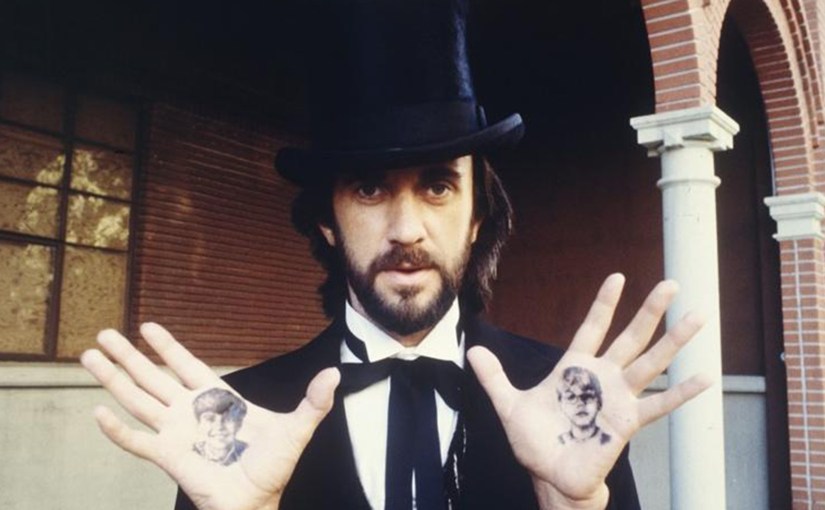
SOMETHING WICKED THIS WAY COMES (1983)

by Miguel E. Rodriguez

DIRECTOR: Jack Clayton
CAST: Jason Robards, Jonathan Pryce, Vidal Peterson, Shawn Carson, Royal Dano, Diane Ladd, Pam Grier(!)
MY RATING: 5/10
ROTTEN TOMATOMETER: 62%

PLOT: In a small American town, a diabolical circus and its demonic proprietor grant wishes to the townsfolk…for a price.


Something Wicked This Way Comes answers the question: What would the Disney version of Needful Things (1993) look like?  Instead of the Devil opening a curio shop in the middle of town, we get a malevolent carnival impresario, Mr. Dark, and his devilish carnival that promises delights beyond your wildest dreams.  But beware, for the price of having your wish granted comes straight out of The Twilight Zone.

And no wonder, the screenplay was written by Ray Bradbury, based on his novel.  Too bad the movie fell victim to studio interference, resulting in jarring tonal shifts, some awkward edits, and two re-shot scenes where the two child stars are clearly a year older and a year taller than they appear elsewhere in the film.

The movie starts out as feel-good Americana, right out of Normal Rockwell: a small midwestern town in what looks like the late 19-teens or early ‘20s, complete with a town square, a general store with the obligatory cigar-store Indian out front, and a friendly bartender with one arm and one leg.  We are introduced to Will and Jim, our two child protagonists, and Will’s father, Charles (Jason Robards), who looked to old to have an 11-year-old son in 1968, let alone 1983, but whatever.

So, there’s that part of the movie, where it looks like it’s going to be a gentle fantasy like Field of Dreams (1989) or something, with the background score to match…but then really weird things start happening.  A local eccentric vanishes after seeing a ghostly woman inside a funeral parlor.  Mister Dark’s Pandemonium Carnival opens just outside of town.  We watch as the local miser takes a ride on the Ferris Wheel with a beautiful woman…but she’s the only one who gets off the ride at the end.  The disabled bartender sees a marvelous reflection in the House of Mirrors and walks in…but never comes out.  Our two heroes, Will and Jim, witness something incredible when they peek under the big top at a broken-down carousel that only runs in reverse…

And so on.  I’ve seen umpteen versions of this story, and so have you.  It can be done well, but it takes a singular vision.  Watching this movie felt like someone spliced two films together and hoped no one would notice.  First of all, who in their right minds casts Pam Grier as a non-speaking character called The Dust Witch?  Granted, she’s a looker, but you don’t cast Pam Grier in a movie just because she’s beautiful.  You gotta give her something to do besides seduce men and stare menacingly, which, granted, she does better than most, but what a waste!  I wanted to hear her vow to bring the powers of darkness down upon your village in a fiery rage, or something, I dunno, anything.

But that’s a side point compared to the horrors awaiting our heroes.  In a scene right out of your nightmares, our two heroes are faced with an army of tarantulas in their bedrooms in the middle of the night.  So many tarantulas, in fact, that in one horrifying moment, you can see the bedsheets moving from the sheer numbers of arachnids under the covers.  (This was one of those re-shot scenes where the kids are a year older.)  Much later in the film, Mr. Dark grips someone’s hand so hard that we see the victim’s hand literally splitting open – in a VERY brief shot, mind you, but there is no question of what has happened, as the victim wears a bandage on that hand for the rest of the movie.

What is this horrific material doing in a Disney movie, for crying out loud?  Something Wicked This Way Comes arrived during a transitional period for Disney, when they were testing the waters with more adult-themed fare – The Watcher in the Woods had been released a few years earlier, and Touchstone Pictures was on the brink of breaking out with Splash (1984).  But when it came to this weird hybrid family/horror movie, they got a little gun shy.

According to the invaluable IMDb, after a poorly-received test screening, Disney execs delayed the film’s release for a year so the film could be re-edited, an opening narration could be added, additional scenes could be shot and old ones replaced, and an entirely new score could be composed by maestro James Horner.  In their attempts to make the movie more family-friendly, they were the embodiment of the axiom “too many cooks in the kitchen.”  On an early laserdisc commentary, Ray Bradbury stated that much of his original intention for the film was destroyed as a result of these after-market edits.

There is a really, REALLY good movie trapped inside the existing version of Something Wicked This Way Comes.  Watch the movie, and you can see that really good version peeking through here and there (it feels like there was a LOT more that could’ve been done with Jonathan Pryce’s rendition of Mr. Dark).  As it is now, the movie is little more than an object lesson on why so many directors dream of getting “final cut” in their contract…so something like THIS doesn’t happen.

BRING HER BACK (2025)

by Miguel E. Rodriguez

DIRECTORS: Danny Philippou & Michael Philippou
CAST: Billy Barratt, Sally Hawkins, Jonah Wren Phillips, Sora Wong
MY RATING: 9/10
ROTTEN TOMATOMETER: 89% Certified Fresh

PLOT: A brother and sister uncover a terrifying ritual at the secluded home of their new foster mother.


Bring Her Back is a supremely disturbing modern horror film from the two directors of 2022’s celebrated debut film Talk to Me; it’s right up there with Hereditary [2018] and The Babadook [2014].  It brazenly opens with creepy black and white footage of…something…then appears to drop into “Lifetime-movie” mode, lulling us along until WHAM, something truly unbelievable occurs, and it’s just a roller-coaster ride the rest of the way.  It’s bloody ingenious.  (Emphasis on the “bloody.”)

Andy (Billy Barratt) and the visually-impaired Piper (Sora Wong) are step-siblings who experience an early tragedy, resulting in the two of them being assigned as foster children to Laura (Sally Hawkins), a single mother who has experienced a tragedy of her own.  Her child is Oliver (Jonah Wren Phillips), a 10-year-old boy who has been voluntarily mute since his sister, Laura’s daughter, drowned in their pool, now kept empty.

Ominous signs abound.  Laura’s house is completely encircled by a strip of white paint.  She locks Oliver in his room whenever she leaves the house.  At a funeral, Laura surreptitiously clips some hairs from the body in the casket.  Andy discovers he has started wetting the bed, but he’s 17 years old; Laura ascribes it to stress, but the real reason is far more…invasive.  And over everything is the mute Oliver, lurking in the background, occasionally banging on doors and windows, and more.

Another superb element to the story is the character of Piper, Andy’s visually-impaired sister.  I mention this because the filmmakers deliberately held a casting call for actual visually-impaired actresses, settling on the completely non-professional Sora Wong.  This aspect of her character is utilized to the hilt throughout the movie, in ways I can’t even hint at without spoiling any surprises.  (Okay, I’ll mention one moment…where she knows someone is front of her, feels their head, then turns and asks someone else, “Who is this?”  BRRRRR…)

When the Philippou brothers do drop the hammer and get started with the real horror elements, they do not hold back.  There are scenes here as terrifying and as off-putting (in a good way, I guess?) as anything in [insert your favorite horror film here].  There are images here that I will not soon forget.  In a perfect world, this movie would become so popular among horror fans that those scenes would become part of a pop-culture shorthand.  “The knife scene.”  “The table scene.”  “The Russian videos.”  “The ‘self-snacking’ shot.”

I initially had an issue with the very ending, which felt more, shall we say, heartfelt than the rest of the movie implied was coming.  However, I learn from IMDb that the Philippous had a much grander ending planned.  But everything changed when a close friend of theirs passed away unexpectedly during production; the film is dedicated to him in the closing credits.  Danny Philippou is quoted: “[The film’s ending] goes against the conventions a little bit, but it feels more true to life.”  Watch the film and judge for yourself if he’s right.  As for me, now that I know that piece of trivia, the film’s ending is easier for me to accept.

Here’s hoping that Bring Her Back becomes at least a cult classic.  For someone like me, who’s a bit picky with this genre, it’s an easy pick for a new movie to throw into my annual Halloween rotation.  I enjoyed the hell out of this movie.

SINNERS (2025)

by Miguel E. Rodriguez

DIRECTOR: Ryan Coogler
CAST: Michael B. Jordan, Miles Caton, Delroy Lindo, Hailee Steinfeld, Wunmi Mosaku, Jack O’Connell
MY RATING: 9/10
ROTTEN TOMATOMETER: 98% Certified Fresh

PLOT: Trying to leave their troubled lives behind, twin brothers return to their hometown to start again, only to discover that even greater troubles are waiting to welcome them back home.


“You keep dancin’ with the devil…one day he’s gonna follow you home.” – Jedidiah in Sinners

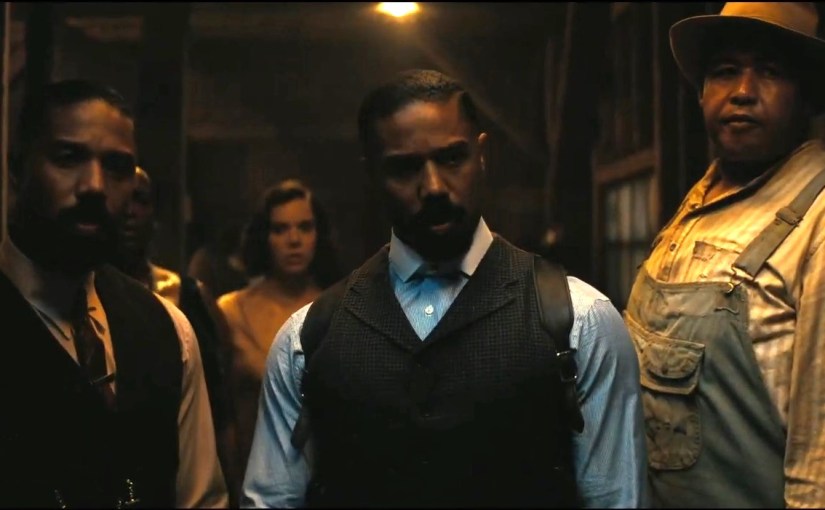
Ryan Coogler’s Sinners pulls one of the best head-fakes I’ve seen in a long time.  The initial trailers would have had you believe the film was basically a character study (albeit an intense one) of identical twin brothers trying to run an illegal business in 1932 Mississippi.  Since both brothers are being played by the excellent Michael B. Jordan, aided by a stellar supporting cast, I got the impression it would be a hybrid of Heat, The Cotton Club, and Michael Mann’s Public Enemies.

Sinners does cover much of that fertile ground…for its first half.  Read no further if you’ve been lucky enough not to have seen what the main attraction is, plot-wise, for the film.

We first get a prologue depicting a bloodied young black man bursting into a Sunday church service while holding the top half of a broken guitar neck.  This is Sammie Moore, played by Miles Caton in his film debut.  The rest of the film is a flashback to the previous day.

The Smokestack brothers have returned home.  Smoke and Stack are identical twins, although one of them (Smoke, I think?) has some visible gold in his smile, so that helps distinguish them from each other.  They are both sharply dressed, having returned from Chicago after working for Al Capone for a spell.  They plan to open a juke joint in a building they purchased from a smarmy character named Hogwood, a white man who grins and assures them they won’t have any trouble from the Klan ‘round here.

This whole first half of the movie is masterfully told.  We are presented with fully drawn characters, not generic placeholders to be shuffled randomly later on.  We find out that Sammie is cousin to Smoke and Stack.  We meet Mary (Hailee Steinfeld), a mixed-race woman who was left high and dry romantically when Smoke left for Chicago.  There’s Delta Slim (Delroy Lindo), a nearly-ancient man who plays a mean blues harmonica, whom the brothers want to hire to play in their new joint.  There are the Asian owners of a grocery store, hired to cater their grand opening.

And then there’s actress Wunmi Mosaku, who gives a luminous, heartbreaking performance as Annie, a woman who bore Smoke a child that died as an infant.  One of the highlights of the film shows Smoke reconnecting with Annie in a scene that at first invites some crude jokes, but which later provides a deep emotional resonance in the movie’s closing passages.  I only remember Mosaku as a sizable presence in the one-and-done HBO series Lovecraft Country (2020), but she was also apparently in Deadpool and Wolverine (2024), so now I gotta go back and watch THAT again.  Twist my arm.

The movie plays more like a really good Stephen King novel than any other movie I can think of since Pan’s Labyrinth (2006).  The film’s canvas is painted beautifully and crisply, moving smartly without rushing.  I would hope Sinners gets nominated for its film editing (provided by Michael P. Shawver), not because of the thrilling later sections, but because of how economically the first half of the film provides us with the perfect amount of information to understand everyone’s motivations when the second half arrives, when all hell breaks loose.

I must also mention the film’s, I guess, “mystical” content when it comes to African American history.  Early on, Annie, who is a “hoodoo” practitioner (I don’t think “witch” is the right word here), tells a lovely story about how, every once in a while, a musician comes along who can play so beautifully that their music “pierces the veil” between past, present, and future, inviting the spirits of all three to come together and enjoy the music as one.  There is a magnificent sequence where we get a visual representation of exactly that when Sammie starts to play the blues in the juke joint.  Trying to describe it in print is a fool’s errand, but it is one of the film’s many visual highlights.  Trust me.  You’ll know it when you see it.  It’s as elegant a representation of Black history as I’ve ever seen, and I don’t know how anyone will be able to top it in the future.

All of that, though, is just prologue for the main event: the vampires.  If you’ve read this long and didn’t know that was coming, I’m sorry I spoiled that for you, but you were warned.

The whole second half of Sinners flirts with becoming a straight-up genre picture, which is not a bad thing in itself, but which would have been almost disappointing when stacked against what came before.  However, because we have been given such a thorough grounding in all the characters beforehand, there are real stakes involved in trying to predict who will live and who will die.  Some deaths are almost foregone conclusions, but even those are more affecting than they would have been in other similar films.

Traditional vampire lore is very much at play, especially the bit about having to be invited into a house.  But the filmmakers did add one new bit, which I thought was EXTREMELY effective.  As a vampire is about to feed (or thinks it’s about to), it begins to drool…a thick, gooey saliva that drips from its mouth like ectoplasm.  This is a cool touch, and it makes perfect sense, a Pavlovian response to an imminent meal.  Don’t be surprised if another vampire film in the future steals that from Sinners.  I’d steal it.  Wouldn’t think twice about it.

Sinners undoubtedly has some deeper meanings that I am not qualified to unpack, and I leave it to you to find them.  This is one of the best films I’ve seen this year, and it is deservedly making bank at the box office.  (Over $200 million globally as of May 3rd, 2025.)  It is surprising, it is dramatic, it is thrilling, and it is worth seeing on the big screen.  Trust me.

VAMPYR (Germany, 1932)

by Miguel E. Rodriguez

DIRECTOR: Carl Th. Dreyer
CAST: Julian West, Maurice Schutz, Rena Mandel, Sybille Schmitz
MY RATING: 8/10
ROTTEN TOMATOMETER: 98% Certified Fresh

PLOT: A drifter obsessed with the supernatural stumbles upon an inn where a severely ill adolescent girl is slowly becoming a vampire.


Carl Th. Dreyer’s Vampyr [pronounced “vom-PEER” in this German version] is not the scariest vampire film I’ve ever seen, but it is definitely one of the creepiest.  There’s a difference.  Dreyer’s film doesn’t move with the pacing seen in more standard horror fare.  Instead, it forsakes typical plot development for scenes that linger on the horrific or the unexplained.  In its own way, it is more directly related to the films of David Lynch than to any other contemporary monster movies of the time (Dracula or Frankenstein, for example, both 1931).

The story is fairly simple, but it belies the complex imagery that awaits the viewer.  A young drifter, Allan Grey, happens upon an inn from which he thinks he can hear animal sounds, or perhaps a young woman screaming.  The village doctor, who looks like a bespectacled long-lost relative of Doc Brown from Back to the Future, vehemently denies the presence any animals or young women on the property.  The innkeeper invites Allan to stay the night.  In the middle of the night, Allan’s sleep is interrupted by a mysterious visitor to his room who intones, “The girl must not die!”  The gentleman then leaves a package on Allan’s desk and writes a most portentous message: “TO BE OPENED ONLY UPON MY DEATH.”

What is this book?  What did Allan hear?  And how do you explain the shadows he saw on his way to the inn?  Shadows of people running along the lane – with no corresponding people attached to them?  Wouldn’t YOU like to know.

Vampyr is positively drowning in atmosphere.  Dreyer apparently shot many scenes with a piece of thin gauze over the lens, creating a misty layer that makes everything feel like a dream, even when Allan is awake.  Allan goes on frequent excursions around the inn and the surrounding property, and it’s here where most of the fantastical imagery is seen, especially when it comes to disembodied shadows.  In one mildly unsettling sequence, a shadow of a man with a peg leg descends a ladder and appears to sit on a bench…re-joining itself to a peg-legged man already sitting on the same bench.

There’s a lot more, but I don’t want to just write a list.  However, I am compelled to mention one sequence in particular that exudes as much creepiness as anything I’ve ever seen from this cinematic era.

It turns out there is, not one young woman at the inn, but two: Gisèle and Léone.  Léone is seen early on, confined to her bed with a mysterious illness, which we later learn has been brought on by her contact with a seldom-seen old woman who lurks somewhere on the property.  And there are some odd injuries on her neck…UH oh.

At one point, Léone awakes while Gisèle is alone with her.  I don’t remember what they discuss, but Léone goes into this weird sort of trance.  Without the use of any strange Chaney-esque makeup or camera tricks, Léone’s face becomes an object lesson in creepiness.  Her eyes open wide, her face breaks into a creepy grin, and she slowly moves her head from side to side, while Gisèle backs away in terror.  It might be the scariest sequence in the film, one which could easily compare to any subsequent monster or vampire movie.

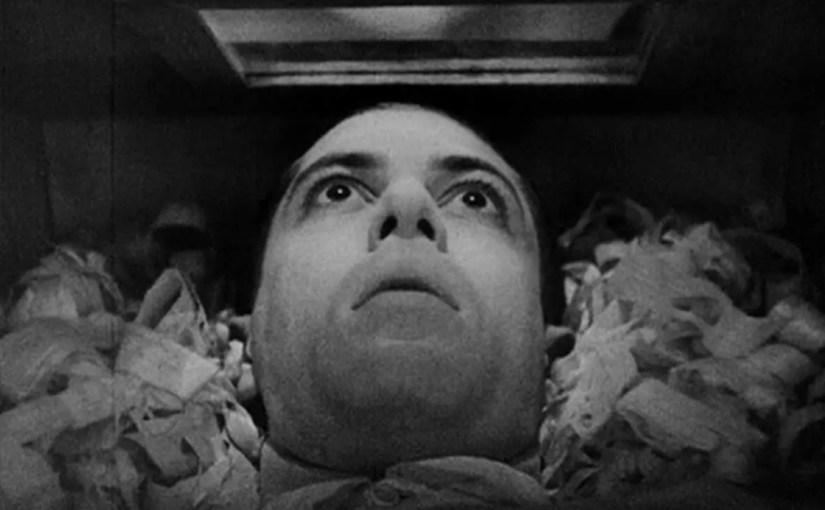
Later, Dreyer throws more camera tricks at us in increasingly imaginative ways.  Allan dreams of a skeleton handing him a bottle of poison.  A dead man’s face appears in the sky during a sudden thunderstorm.  Dreyer includes camera moves that would fit right into any modern film.  And in a sequence that reminded me of Wes Craven’s The Serpent and the Rainbow (1988), Allan watches as his own body is sealed inside a coffin with a tiny square window for his apparently dead eyes to look out of.

If nothing else, Vampyr is an interesting artifact of cinema’s transitional era from silent to sound.  Even though there is a conventional soundtrack and we hear people’s voices as they speak, a lot of expository information is provided via title cards and long looks at passages from a book of vampire lore.  Given that the vampire mythology was then not as popular as it is today, I can forgive these beats that tend to bring the momentum to a halt.

While Nosferatu (1922) and the Bela Lugosi Dracula are much more famous, Vampyr is worth a look if you’re a horror fan.  While it doesn’t involve the kind of fear factor I tend to expect as a child of the 1970s and ‘80s, it is nevertheless creepy as hell. 

MAXXXINE (2024)

by Miguel E. Rodriguez

DIRECTOR: Ti West
CAST: Mia Goth, Elizabeth Debicki, Michelle Monaghan, Bobby Cannavale, Giancarlo Esposito, Kevin Bacon
MY RATING: 8/10
ROTTEN TOMATOMETER: 72% Certified Fresh

PLOT: In 1985 Hollywood, adult film star and aspiring actress Maxine Minx finally gets her big break. But as a mysterious killer stalks the starlets of Hollywood, a trail of blood threatens to reveal her sinister past.


When I started posting my blissful reviews of X and Pearl [both 2022], I got one response more than any other: “Wait till you get to MaXXXine; it’s the weakest of the trilogy.”  Having just watched it, I would say that calling MaXXXine the weakest film in this trilogy is like calling Return of the Jedi [1983] the weakest film in the original Star Wars trilogy.  You may be technically correct, but it’s still a great ride and a better film than many others in this genre.

Six years after the bloody events of X, we pick up the story of Maxine Minx (Mia Goth) as she auditions for a film role in Los Angeles.  She’s been signed by a devoted but semi-skeevy agent, Teddy (Giancarlo Esposito in a fabulously bad hairpiece), and she has experienced modest success as a porn star.  But she longs to spread her wings in “legitimate” films, because as we all remember, Maxine craves fame more than anything in the world.  As she never tires of repeating: “I will not accept a life I do not deserve.”

Just as things start looking up for Maxine’s career, a package is left on her doorstep…a VHS tape labeled ominously, “For Maxine.”  When she pops it into her VCR, she’s treated to a shot from her filmed but unfinished porn movie from six years ago…evidence which would link her to those horrific murders and endanger her newfound success.  Meanwhile, the infamous real-life serial killer Richard Ramirez, aka “The Night Stalker”, terrorizes Los Angeles at night, not to mention a copycat killer who is branding his victims with pentagrams.  How these murders are linked to Maxine, and when and where John Labat (Kevin Bacon) comes into play, is not for me to divulge.  And one by one, Maxine’s friends and co-workers are turning up dead…

The plot of MaXXXine is nothing new, let’s face it.  What makes it sparkle is the wit and TLC provided by director Ti West and his collaborators.  For anyone who was alive in 1985, this film is like a stroll down memory lane.  I found myself thinking about Quentin Tarantino’s Once Upon a Time…in Hollywood [2019], with its loving recreation of late-1960s Los Angeles and serial-killer-related plotline.  That’s not to say MaXXXine is ripping off Q.T.’s film, not at all.  Both films have an immense affection for their respective timeframes and have gone to great lengths to immerse us in that culture.

Another filmmaker that came to mind during MaXXXine was Jordan Peele, director of his own trio of horror neo-classics: Get Out [2017], Us [2019], and Nope [2022].  Ti West’s films share a lot of characteristics with Peele’s films.  The Maxine trilogy looks like a million bucks on screen, despite what must have been very limited budgets.  The plots and screenplays are airtight with one or two minor exceptions.  (Peele’s plots are more Twilight Zone than reality, so they get a bit of a pass on plausibility.)  And the characters are intelligent, sharply drawn, and rarely fall into cliched behavior.

If MaXXXine is not quite as terrifying as its predecessors, I’m prepared to forgive it.  Whatever it lacks, it makes up for in its besottedness with Hollywood.  There is a scene where one character chases another through a Universal backlot (oddly deserted, but whatever); they run through various movie sets, including the town square featured in Gremlins [1984] and Back to the Future [1985], winding up at – and I almost could not believe this – the Bates Motel and even inside the Bates house behind it.  Only a director/screenwriter deeply in love with the movies, and horror films specifically, would dare to write a scene like that into their script, and I loved it.  (Trivia note: they had to get permission from the Hitchcock estate first…awesome.)

I haven’t even mentioned the movie’s subtext.  The movie Maxine has gotten a part for is being directed by a woman, Elizabeth Bender (the pleasingly towering Elizabeth Debicki), who believes The Puritan II is her chance to prove that her voice is worth listening to in an industry dominated by male voices, especially in 1985.  If the only way to get people to listen is to make a B-list horror movie with A-list concepts/ideas, so be it.  Two of the best horror movies I’ve seen in recent years were directed by women: The Babadook [2014] and Saint Maud [2019].  And yet, out of over 1,850 movies in my personal collection, only 70 were directed by women.  I guess things haven’t changed that much in the movie industry in forty years.  Discuss.

MaXXXine begins with a quote from Bette Davis.  I won’t recite the quote here, but it implies that an actor isn’t a star until they’re considered a monster.  I hope that’s not true.  But for Maxine Minx…if that’s what it takes, well, then…that’s what it takes.

NOSFERATU (2024)

by Miguel E. Rodriguez

DIRECTOR: Robert Eggers
CAST: Lily-Rose Depp, Nicholas Hoult, Bill Skarsgård, Aaron Taylor-Johnson, Willem Dafoe
MY RATING: 8/10
ROTTEN TOMATOMETER: 85% Certified Fresh

PLOT: The true OG vampire movie gets a fresh coat of paint in this gothic tale of obsession between a haunted young woman and the terrifying vampire infatuated with her.


Allow me to begin, as so many great films do, with a couple of flashbacks.

2018: The indie band Weezer records and releases their polarizing cover of Toto’s stone-cold classic “Africa.”  While recorded and produced with all the modern techniques at their disposal, fans of both bands say, correctly, that this new version is virtually identical to the original…so what was the point?  Couldn’t they have put some kind of new spin on it, like (for better or worse) UB40 and their cover of “Can’t Help Falling in Love”?  Why bother?

1991: Orion Pictures releases The Silence of the Lambs, an adaptation of Thomas Harris’s terrifying psychological thriller.  It goes on to win the coveted “Big Five” at the Oscars: Best Picture, Director, Actor, Actress, and Screenplay (Adapted).  Having devoured the book during one summer vacation, I go to a screening expecting to be wowed.  But…because the filmmakers stuck SO closely to the book (with some minor exceptions), there is little to no suspense for me.  While I am genuinely floored by how well-made and well-acted the film is, I do not experience any of the thrills and chills felt by those viewers who had NOT read the book.  I knew ahead of time what they would find in the corpse’s throat in the funeral parlor, how Lecter would escape from the courthouse, and how Starling would stumble upon Buffalo Bill’s house.  Don’t get me wrong, it’s a stellar movie.  But it was never truly scary for me.

Which brings me to Robert Eggers’s long-gestating remake of THE original vampire movie, Nosferatu.  Based on the immortal silent classic of the same name from 1922, directed by F.W. Murnau, the story will be familiar to any serious film/horror buffs, especially since Murnau “borrowed” liberally from Bram Stoker’s novel, Dracula, without first obtaining legal permission from Stoker’s estate.  How liberally?  Here’s a quote from IMDb: “All known prints and negatives were destroyed under the terms of settlement of a lawsuit by Bram Stoker’s widow.”  The only way the film survived was via 2nd-generation copies from other countries around the world.  Plagiarism?  Or homage?  I would normally say here, “You be the judge,” but the courts seem to have answered that question pretty definitively.

I mention this because every version of the Dracula mythology, starting with Nosferatu all the way through the semi-campy Hammer films to Coppola’s famous “low-tech” version and beyond – all of them tell the same story with only minor changes.  Consequently, the thing I look for in those films is not WHAT they’re telling me, but HOW they’re telling it.  Any student of pop culture knows Bruce Wayne’s origin story, so Batman Begins [2005] holds no surprises there, but the story is told extremely well, and so you roll with it, you know what I mean?

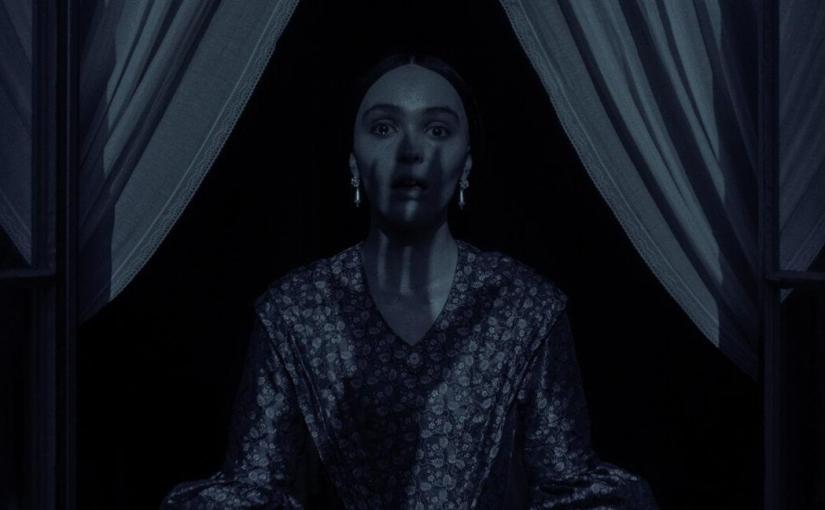
With Eggers’s Nosferatu, the production values on display are magnificent.  Eggers gets the mood and tone of a genuinely gothic horror story exactly right, as I knew he would, based on his previous films, especially The VVitch [2015].  The colors are muted to recreate the vibe of a black-and-white film, which paradoxically makes some of the scarier scenes even scarier.  The performances all around are top notch.  Poor Nicholas Hoult is saddled with the thankless Thomas Hutter role, stuck in straight-man mode the entire film; but Lily-Rose Depp had me thunderstruck with her performance as Ellen, Thomas’s wife, and the dependable Bill Skarsgård delivers the goods as Count Orlok, with a proper Transylvanian moustache (right out of the history books, haters) and an accent thick enough to tar ten miles of a country road with.

But let’s think about this for a second.  Those of you unfamiliar with the story of Nosferatu might be thinking to yourselves, “Who’s Thomas Hutter?  Who’s Ellen?  Don’t you mean Jonathan Harker and Mina?”  Well, naturally, those are the names the vast majority of filmgoers are going to be familiar with, not Thomas and Ellen and Count Orlok (which for my money is a much creepier name than “Dracula,” but I digress).

And therein lies part of the problem with this film.  I was so thoroughly familiar with the Dracula story that, even though this new film is a wonder to behold, it held very little suspense for me, since I knew exactly what was going to happen next, beat for beat.  There are, of course, cosmetic differences here and there: Thomas’s visit to a Romani village before he arrives at Orlok’s castle…Orlok’s straight-up possessions of Ellen…the highly effective jump-scares with the dogs here and there.  But I’ve seen it all before, MANY times.

(By contrast, I just recently watched one of the greatest slasher movies I’ve ever seen, X [2022], and it has virtually every slasher-movie-trope imaginable, and yet it somehow managed to transcend its own genre and become some kind of crazy masterpiece.)

In fact, in a very unexpected twist, there actually were two genuinely scary/creepy moments for me, and neither of them featured Count Orlok himself, at least not in the flesh.  They both involved Ellen, Thomas’s new wife, who becomes literally possessed by Orlok’s influence in scenes that legitimately give The Exorcist [1973] a run for its money.  Ellen thrashes about, rolls her eyes into the back of her head, speaks in an unnaturally guttural croak, bends backwards impossibly far – is Lily-Rose Depp a contortionist on the side? – and generally scares the bejeezus out of her husband and the audience.  On the strength of these two scenes alone, in addition to the general excellence of filmmaking craft on display, I would have no hesitation in recommending Nosferatu to moviegoers.

So, yes, despite my disappointments at the story level, given there were virtually no surprises plot-wise, I still give the movie a favorable rating just because it’s so well made.  If it had been created in a vacuum, if there had never been a vampire movie before this one, I believe I would have been creeped out to a much greater degree than I was, and this would have been hailed as an instant masterpiece.  But it is darkly beautiful to look at and wonderfully moody; there are many shots that are very nearly duplicates of shots from the original, which I enjoyed on a film-geek level.  I look forward to Robert Eggers tackling purely original material again.  He knows what he’s doing.

PEARL (2022)

by Miguel E. Rodriguez

DIRECTOR: Ti West
CAST: Mia Goth, David Corenswet, Tandi Wright, Emma Jenkins-Purro
MY RATING: 10/10
ROTTEN TOMATOMETER: 93% Certified Fresh

PLOT: In 1918, a young Texas woman on the brink of madness pursues stardom in a desperate attempt to escape the drudgery, isolation, and lovelessness of life on her parents’ farm.


I originally gave Pearl a rating of 9 out of 10 because it was not quite as terrifying as its predecessor, X [2022], but I have decided to amend that to a 10 out of 10 based solely on the performance by Mia Goth in the title role.  If her performance had appeared in anything other than an indie horror film, I firmly believe she would have been nominated for an Oscar, or at least a Golden Globe.  But I’ll get to that in a second.

Pearl is a prequel to the acclaimed horror flick X, in which most of a porno film crew is stalked and murdered by an insane old woman, Pearl, and her equally insane old husband, Howard, in Texas in 1979.  It starred Mia Goth as Maxine, a stripper who was convinced she was meant for bigger and better things.  This time, in the prequel, Goth plays Pearl as a young woman growing up in Texas, but this time it’s 1918.  World War I is on the verge of ending, but the Spanish Flu pandemic is in full swing; folks in town don’t go anywhere or do anything in town without wearing a cloth mask over their nose and mouth.  (Sound familiar?)

Pearl’s home life is not quite functional.  In her first scene, over a lush score that sounds as if it were imported from the 1940s, Pearl dances in the barn and talks to a cow and a goat and a horse, like Snow White, about how she’s going to become famous and leave town, and everyone will know her name.  Then a goose waddles in from outside and interrupts her conversation; Pearl gets an odd look in her eye, grabs a pitchfork, sidles up to the goose, aaaand you can probably guess the rest.  (The gator from X makes a nice cameo shortly thereafter.)  Meanwhile, that ‘40s musical score punctuates the action like a Disney movie.  The effect is profoundly odd, but compelling.

We learn more about Pearl’s home life with her invalid father and domineering mother, Ruth (Tandi Wright).  She married young, but her husband, Howard, was called off to war in Europe, leaving her alone with her less-than-ideal parents.  She dreams of fame, but Ruth, with her strong German accent, sternly reminds Pearl of her responsibilities to her father and the farm.  One day, Pearl rides her bicycle to town to buy medicine for her father (sounds like the beginning of a fairy tale) and decides to go to the movies, which were very different in 1918.  She meets the strikingly handsome projectionist (David Corenswet, aka the new Superman) who encourages her to take the time to live her own life before it’s too late.  On her way home, Pearl stops in a cornfield, finds a scarecrow, and engages in a charming little song and dance with him…until her mind plays tricks on her and the encounter turns into something altogether different.

The whole movie is like that.  Shot in vivid colors and featuring an evocative soundtrack, it alternates between The Wizard of Oz and Joker.  (In fact, IMDb trivia notes that female fans of this movie call it “the female Joker.”)  It keeps you off balance in all the best ways, threatening to fly apart, but Ti West’s direction and Mia Goth’s performance manage to hold everything together in a satisfying, but disturbing, whole.  As with X, I can acknowledge the achievement, but I’m damned if I can explain how it was done.

There are many highlights in Pearl: her audition for a traveling dance show.  Pearl wheeling her father to the edge of the lakeside dock.  The scarecrow.  The tipping point between Pearl and her mother.  The pig on the porch.  (Gross.)  The look on her father’s face when Pearl dresses him up for a gentleman caller.  But the pièce de résistance of the entire film is, without question, Pearl’s monologue.

In a movie in which Mia Goth teeters on overkill in several scenes, the screenplay (co-written by Goth and Ti West) provides Pearl with a heart-rending soliloquy that should be more famous than it is.  Pearl’s sister-in-law, Mitsi (Emma Jenkins-Purro), sensing that Pearl is troubled, encourages her to indulge in a little play-acting: “Pretend I’m Howard.  What do you want to say to me?”  What follows is a 7-minute speech, most of it captured in an unbroken 5-minute take that must be seen to be believed.  In it, Goth expresses virtually every emotion imaginable as she unburdens herself, purges herself of all her repressed rage at her husband for leaving her alone, at her mother for holding her back from her dreams, at her father for having the temerity to fall ill and causing her to remain home for his sake.

Does this speech excuse her violent behavior?  Not at all.  But it explains it as well as any other serial killer movie I’ve ever seen.  I was reminded a little bit of Charlize Theron in Monster [2003], who also played a woman who committed terrible crimes, yes, but who was pushed into making those choices by her family and a society who little noticed or cared about her situation.  That’s how stirring Goth’s performance is, that I would compare it to one of the greatest performances ever captured on film.  In a movie that flirts with parody a couple of times, this last speech grounds it and the main character firmly in the real world.  It’s truly astonishing.

I’m almost sorry I saw Pearl AFTER watching X.  Almost.  It kind of makes me want to go back and watch X again, armed with all this new information on Pearl’s backstory.  It also solidifies the psychic connection between Pearl and Maxine, which was touched on several times in X, and which I imagine will be revisited in some way in Maxxxine [2024]…but I’m just speculating.  Pearl is good enough to stand with any of the best serial-killer-origin stories ever made.

(P.S.  As with X, you’ll want to make sure you watch the credits, except this time you want to stay with it until the last image fades to black…you’ll know what I mean.  IMDb informs me this crazy, creepy moment happened because after the last line, director Ti West refused to yell “Cut” and just let the camera run, and the actor in question, being a professional, simply stayed in character.  It’s remarkably unsettling.)

X (2022)

by Miguel E. Rodriguez

DIRECTOR: Ti West
CAST: Mia Goth, Jenna Ortega, Brittany Snow, Kid Cudi
MY RATING: 10/10
ROTTEN TOMATOMETER: 94% Certified Fresh

PLOT: In 1979, a group of young filmmakers set out to make an adult film on a rural Texas farm, but when their elderly hosts catch them in the act, the crew find themselves fighting for their lives.


I like great horror, but I have never enjoyed slasher films, with the clear exceptions of Halloween [1978] and Psycho [1960].  They tend to fall too easily into the formulas lampooned in Scream [1996] and The Cabin in the Woods [2011] and lose all suspense when the stories cave in to ancient tropes and traditions.  You’ve seen one bloodthirsty masked strangler/slasher/axe-murderer jump from behind a tree at night, you’ve seen them all.

So, how do I explain my delight and gushing praise for X, the indie horror phenomenon that turned Mia Goth and director Ti West into industry darlings?  I can only report that, despite following timeworn traditions of the genre, this film somehow found a way to ratchet up the tension to almost unbearable levels.  I’m not exaggerating.  The night I finished watching it, I found it impossible to fall asleep right away.  My mind was racing and rehashing what I had just seen.  It is the creepiest, scariest horror film I’ve seen since Hereditary [2018], and I freaking LOVE Hereditary.

The plot is right out of Slasher Films 101.  The year is 1979.  An aspiring group of wannabe porn stars pile into a van and head to a rural Texas farm where the crusty owner has agreed to rent out his barn and guesthouse, ignorant of this motley crew’s true motives.  The composition of the group reads like the beginning of a dirty joke: a cowboy, a film school graduate, his mousy girlfriend, two strippers, and a black guy (Kid Cudi…yes, that Kid Cudi).

Upon their arrival on the farm, ominous music and occasional breathy noises on the soundtrack tip us off that something just ain’t right…not to mention the blood-soaked prologue.  The elderly farmer, Howard, has an elderly wife, Pearl, but we don’t see much of her at first.  There’s a magnificently tense scene when one of the strippers, Maxine (Mia Goth), skinny dips in the lake behind the farm, unaware of the gator eyeing her from the opposite bank.  It slithers into the lake just as Maxine starts to swim back to the dock.  An overhead shot shows Maxine swimming leisurely, and the gator getting closer and closer, and…I mean, I’ve seen scores, if not hundreds of movies with similar scenes, and very few of them evoked the kind of terror I felt as that gator closed in on Maxine.

Why?  This isn’t even a monster movie about a killer gator, it’s a – let’s be honest – formulaic movie with creepy old people and a slew of young people just waiting to be dispatched in hopefully creative ways.  But something about how Ti West directed this film got right under my skin, in a good way.  Even in the gloriously retro scenes when the ersatz film crew is shooting a sex scene, there is still an undercurrent of unease over the whole enterprise.  (And by the way, if I were to make a list of things I didn’t think I’d ever see in a movie, a topless Brittany Snow in a brief-but-raunchy sex scene would be really close to the top.)

It’s hard for me to describe the intensely creepy atmosphere in writing, especially because I want to preserve the film’s surprises for anyone who hasn’t seen it yet…and boy, I wish I could be there to watch it with you.  There’s the scene in the farmhouse between Maxine and the farmer’s elderly wife, Pearl, where you have absolutely every reason to believe it’s about to turn all Texas-Chainsaw, and then the scene abruptly pivots.  Pearl looks like your stereotypical crazy old lady; that’s the best way I can put it.  I seem to remember a few characters who looked like her in the background of Shutter Island [2010].  We learn a little bit about Pearl’s past, and we can see that she’s sharper than she looks…or maybe she’s just crazy.  I’m not sayin’.

When things heat up around the halfway mark, the tension factor skyrockets.  I learned a phrase a while ago that captures it perfectly: the film becomes a stress sandwich.  Situations arise that we’ve all seen before, but in this movie I was on the edge of my seat waiting to see what would happen next.  When Jackson (Cudi) searches the lake at night and makes a creepy discovery right out of Hitchcock.  When “Don’t Fear the Reaper” plays at a critical moment.  When Lorraine (Jenna Ortega…yes, that Jenna Ortega) goes to the cellar looking for a flashlight.  When a soundly sleeping Maxine gets some unwanted physical contact from a nocturnal visitor.  (That sound you just heard is me shuddering.)

I could write more about the plot, but I would give something away, I’m sure.  To call the film’s finale satisfying is a vast understatement, right down to the very last line that, in my book, is as perfect as “Nobody’s perfect!” or “Tomorrow is another day!”  Ti West has created a slasher movie for people who hate slasher movies, and it’s one of the best modern examples of the genre that has ever been made.

(P.S.  Don’t spoil this for yourself by Googling it or anything if you don’t already know, but make sure you watch the closing credits.  When I saw the name of the performer who plays “Pearl”, my jaw dropped.)