
by Miguel E. Rodriguez
DIRECTOR: William Wyler
CAST: Walter Huston, Ruth Chatterton, Mary Astor, David Niven
MY RATING: 10/10
ROTTEN TOMATOMETER: 91% Fresh
PLOT: A retired auto manufacturer and his wife take a long-planned European vacation only to find that they want very different things from life.
Melodrama. It gets a bad rap in some circles. Synonymous with “soap opera.” Do it right and you get masterpieces like Terms of Endearment (1983) or fan favorites like Beaches (1988). Do it wrong and you’ve got a sappy, soppy, shamelessly manipulative mess like [too many to mention]. In days past, I would take what I thought was the high road and say it’s not my favorite genre at all, too schmaltzy, blech.
But then I started expanding my viewing habits a little and started watching some older films. I discovered hidden jewels like Peter Ibbetson (1935), a shameless weepie about separated lovers who connect in the spirit world. I finally watched The Blue Angel (1930) with Marlene Dietrich as the semi-willing agent of a snobbish professor’s emotional and professional destruction. Soap opera, but done right and very effectively.
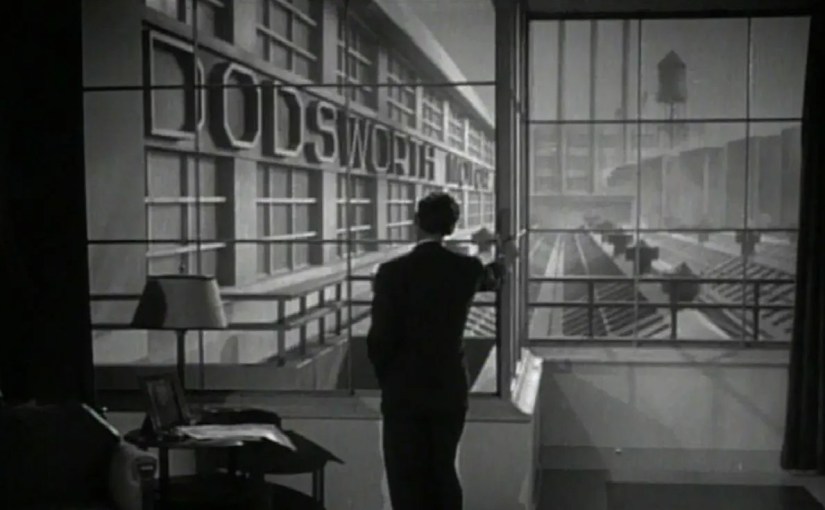
And now here’s Dodsworth, a domestic drama about a middle-aged couple where the husband, Sam (Walter Huston), has just retired from running his immensely successful car company. He’s looking forward to relaxing with his rod and reel, his golf clubs, “with nothing more important to worry about than the temperature of the beer…if there is anything more important.” But first, his wife, Fran (Ruth Chatterton), who is tired of spending her life in society circles, wants to see the world on a transatlantic cruise – on the Queen Mary, no less – to London, Paris, and wherever the spirit moves them. “In Europe,” she says, “a woman of my age is just to the point where men begin to take a serious interest in her.”
At this stage, I felt like I was in the grip of a fairly standard plot whose signposts I could see a mile away: married couple on European vacation, wife going through midlife crisis is courted by a dashing young man who believes her husband is ignoring her, husband finds out, wife denies it, does some self-reflection, slightly farcical situations, some touching speeches on a moonlit balcony, and the married couple return home stronger than ever. Even if this was going to be a well-made movie, I was pretty sure I would be bored.
Oh, how I do love being wrong. Dodsworth takes this trope-ridden plot and drives it down some roads where I never expected a movie from the ‘30s to go, at least not when dealing with the sacrosanct institution of marriage. Fran doesn’t get hit on when she gets to Europe, she gets hit on while still in transit in the Atlantic, by a British cad played by an indescribably young David Niven. He makes no secret of his attraction to Fran, though later on it seems possible he was trying to take advantage of Fran’s situation. He even kisses Fran, who offers no more than token resistance…after the fact.
During this semi-tryst, Sam is above deck enjoying the sea air when he has a kind of adult meet-cute with Edith Cortright (Mary Astor), an American divorcee who is younger than Sam by, oh, let’s say at least fifteen years, maybe more. They have two conversations, and then circumstances send them on their separate ways, Sam to France with his wife and Edith to Naples.
A word about their two conversations. This is some of the best adult, mature dialogue I’ve ever heard in a film, let alone one from the 1930s. These are two mature adults who are speaking to each other, neither one with an agenda, but there is something intangible in the language and how the actors play it and how Wyler directed it. The scene is pregnant with subtext, not sexual, but a sense of connection without being obvious about it. I found myself starting to root for Sam and Edith to get together before their ship docked, but the movie played around with my own expectations multiple times.
In Paris, Fran and Sam’s relationship deteriorates. Sam makes plans to sightsee, but Fran has made hair appointments and lunch appointments with her new French acquaintances, so he goes alone. In her frantic desire to prove how cosmopolitan she is, as opposed to being a middle-aged woman from middle-America, Fran wants to spend more time on the town than being a tourist. She meets another dashing European gentleman, this one a Frenchman named Arnold Iselin. It seems as if Fran wants to have her cake and eat it, too: remain married to Sam while indulging in flirtations – flings? – with handsome men with foreign accents.
It all comes to a head one night when Fran suggests that Sam return to America without her. She wants a “break.” Sam fights for her, but in the end…but I’m not going to tell you what Sam decides. Again, your predictions may or not be correct, but there are some deliciously written curveballs up this movie’s sleeve.
I should also mention the delightful discovery of Walter Huston as an actor. Oh, sure, we’ve all seen him in The Treasure of the Sierra Madre, made twelve years later, featuring his deserving Oscar-winning performance as the prototypical prospector with his little jig and his forever-imitated accent, but that’s how I ALWAYS pictured him. In Dodsworth, Huston is, quite frankly, a revelation. His performance is as far removed from Sierra Madre as it’s possible to be. Sam Dodsworth is a respectable man of business, especially handsome when he’s dressed to the nines, congenial, and smarter than the average bear. He is what they call, dare I say, a silver fox, the kind of man other women might willingly set their cap for, whether they’re his age or not. Huston’s delivery and portrayal of this character make Dodsworth immediately likable, which is important in later stages of the movie when he seems on the verge of making a questionable decision.
Then there’s Ruth Chatterton as Fran Dodsworth. Chatterton was in a strange predicament as an actress for this film. At the time, she was desperately trying to revive her career at an age when, unfortunately, Hollywood (and society) was ready to put her out to pasture…by which I mean early forties. And she’s playing a character who is also desperately trying to hang on to her youth. So, there is a layer of authenticity, and courage, to her performance that cannot be overstated. Even when she engages in some questionable behavior, I was still able to empathize with her. She isn’t doing anything out of pure spite. She is responding to impulses she can’t explain or ignore.
Dodsworth is one of the best films from Hollywood’s first golden age that I’ve ever seen, and yet I don’t hear too many people mention it in their lists of favorite films from the ‘30s. It deserves to be mentioned alongside the greats, because it IS one of the greats. And it’s melodramatic as hell, in the beginning, the middle, and especially that shamefully schmaltzy final shot…but you know what? Dodsworth makes it work. Soap opera? Meh, who cares?
 2 UNPAID MOVIE CRITICS!!!!