THE EXTERMINATING ANGEL (Mexico, 1962)

by Miguel E. Rodriguez

DIRECTOR: Luis Buñuel
CAST: Silvia Pinal, Jacqueline Andere, José Baviera
MY RATING: 9/10
ROTTEN TOMATOMETER: 94% Fresh

PLOT: The guests at an upper-class dinner party find themselves unable to leave the drawing room in Buñuel’s famous, none-too-subtle satire.


Buñuel’s The Exterminating Angel has many moods.  On the one hand, it’s a dark comedy of manners railing against the entitlements of the upper classes, much like the more recent Triangle of Sadness (2022), which owes much to this film.  On the other, it’s a Serling-esque horror story mining a common occasion for unexpected suspense, like The Ruins (2008) or Open Water (2003).  On a deeper level, perhaps it’s a Lynchian exploration of the human psyche, regardless of class, like Mulholland Drive (2001) or…well, with Lynch, you can probably just take your pick.

I experienced all of those moods while watching The Exterminating Angel.  I haven’t seen such an effective juxtaposition of tone since Everything Everywhere All at Once (2022).

The weirdness starts right away, in scenes that seem to be setting the stage for a Marx Brothers comedy.  Edmundo Nobile (“Nobile”, “noble”, get it, wink, wink?) has invited a large number of his posh friends to his mansion for dinner following an opera.  The moment they arrive, Nobile notes that his servants are not stationed at the door to take the visitors’ coats.  This is because most of the servants felt the sudden need to take the night off and left, being careful to avoid their employer.  He makes a statement about his servants, then everyone troops up the grand staircase to the dining room.

Moments later, this scene literally repeats itself, not by re-using the same footage, but in a separate take.  This kind of repetition occurs multiple times during the actual dinner scene, as well.  If there’s a deeper meaning to this device, I’ll have to leave it to film scholars to analyze.  For myself, it simply added a layer of oddness to the proceedings, but not in a bad way.

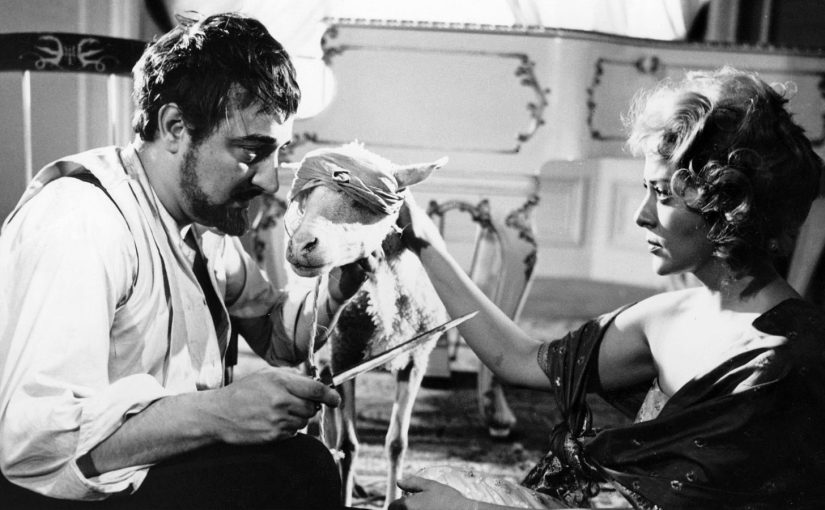
The dinner scene contains pratfalls, repeated conversations, and a visit to a side room containing three or four lambs and a bear on a leash.  What the WHAT…?  I remember thinking, okay, so this is going to a broad comedy turning upper-class manners into slapstick.  Seen it before, so I hope this movie executes it well.

The weirdness escalates when everyone retreats to a drawing room just off the dining room, where one of Nobile’s guests entertains everyone with a piano solo.  But when one of them tries to leave, he finds he can’t.  Not physically, like there’s suddenly an invisible wall, but one by one the guests discover they’re simply unable to leave the room.

They slowly realize the logistics of this bizarre situation.  The drawing room has no food.  Water runs low.  The one servant who remained outside manages to bring in a tray of water and coffee, but when he tries to leave to bring food…he can’t.  There’s no phone for them to call anyone about their predicament.

Outside the house, people find themselves unable to enter the grounds, so no one can tell what has happened to the people inside.  Curious crowds gather.  Inside, social structure starts to degenerate.  There are no restrooms, but one quick shot reveals a closet full of nothing but vases, and we see people entering and exiting these rooms repeatedly.  Ick.  Arguments are started with the drop of a hat.  One couple finds a unique, but undesirable, method of escaping their prison.

I responded to this material very unexpectedly, due mostly to its unpredictability.  I wasn’t cheering at the sight of upper-class twits being brought low when faced with bizarre circumstances, but I was more in tune with the horrific aspects of this story.  Buñuel has stated in interviews that he regretted not being able to take the story even further by including cannibalism, which is honestly where I thought things were headed.  It would have made a marvelous satirical statement, hearkening all the way back to Jonathan Swift.

(So, what DO they eat, you may be asking yourself?  Wouldn’t EWE like to know?)

I realize this review of the film hasn’t been much more than just a summary of its events, minus the surprising, “circular” ending.  A more detailed analysis might require listening to the commentary or reading Roger Ebert’s review or something.  But I hope I’ve conveyed how much I enjoyed The Exterminating Angel.  It was weird and surreal and absurd, and comic and horrific, and slapstick and satiric, and totally unpredictable all the way to the final frame.

P.S.  Now that I’ve seen this movie, the Woody Allen film Midnight in Paris (2011) has even deeper resonance when Gil meets Buñuel at a party and gives him the idea for The Exterminating Angel, and even Buñuel can’t understand it: “But I don’t get it. Why don’t they just walk out of the room?”  Funny stuff.

ASHES AND DIAMONDS (Poland, 1958)

by Miguel E. Rodriguez

DIRECTOR: Andrzej Wajda
CAST: Zbigniew Cybulski, Ewa Krzyzewska, Waclaw Zastrzezynski
MY RATING: 7/10
ROTTEN TOMATOMETER: 96% Fresh

PLOT: Against a backdrop of internal political turmoil at the end of World War II, a Polish resistance fighter faces a crisis of conscience when ordered to assassinate a Soviet official.


The Polish film Ashes and Diamonds is reportedly Francis Ford Coppola’s favorite movie, and Martin Scorsese has stated in interviews that he used it as an answer for one of his finals at film school.  From a technical standpoint, I can see why.  Echoes of this film (and perhaps others from director Andrzej Wajda’s filmography) are overwhelmingly evident in the bodies of work of both directors, from the mobile camera to the shocking moments of violence to the psychological makeup of the characters themselves.  As an emotional experience, I confess I didn’t get “worked up” over it, but it was interesting to see where two of the greatest American film directors got a healthy dose of inspiration.

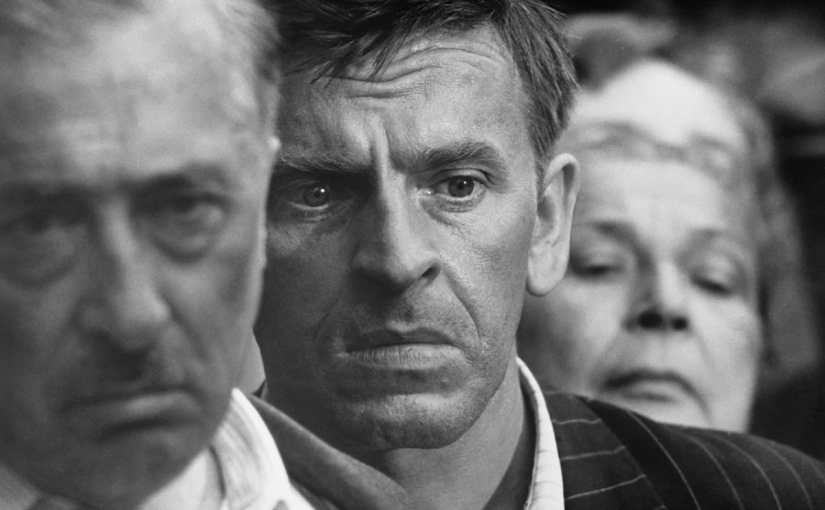
Ashes and Diamonds opens on May 8, 1945, with an idyllic scene outside a country church that quickly degenerates into a brutal double murder.  The killers are the calm, detached Andrzej and the flighty, charismatic Maciek, who spends most of the movie behind dark sunglasses.  We quickly learn their victims are not who they thought they would be.  Instead of killing two Soviet/Communist officials, they have killed two innocent factory workers.  War is hell.

Later, through circumstances that feel very Hitchcockian, Andrzej and Maciek hole up in a hotel bar, only to discover that one of their real targets, Szczuka, has booked a room in the very same hotel.  Maciek books a room directly below Szczuka’s, and the rest of the film plays out with that element of suspense hanging in the background, leaving us to wonder when and how Maciek will complete his assignment.

Complications arise when Maciek becomes infatuated with the hotel bartender, Krystyna, a blond beauty who rebuffs Maciek’s advances at first.  Later, they connect, but she doesn’t want to get involved with someone when it will eventually have to end: “I don’t want bad memories when memories are all I have left.”  Maciek falls for her so hard that he starts to doubt his resolve to kill his target.  “Will he or won’t he?” becomes the movie’s prime conflict.

Where to begin with the comparisons to Coppola and Scorsese?  The most obvious one is the unblinking attitude towards violence.  The two killings at the beginning of the film are done with very few cutaways as we see the multiple bullet hits on each victim, with one of them getting hit in the eye and another shot in the back at point blank range with such force his shirt catches fire.  (Malfunctioning squib?  Possibly, but it’s still effective.)  It’s interesting that this movie predates Bonnie and Clyde (1967) by almost a decade, but its depiction of onscreen violence feels very modern, even by today’s standards.

Then you’ve got the moral struggle of the main character, a man of action capable of casual murder who is suddenly given a reason to make something different with his life.  This reminded me of Scorsese’s The Departed (2006), with DiCaprio’s character undergoing the same internal conflict.  Maciek has multiple opportunities to kill Szczuka throughout the film, but something always pulls him back from the brink.  His partner, Andrzej, becomes impatient and reminds him what happens when soldiers let personal feelings interfere with their duties.  I had a vivid flashback of Michael Corleone’s credo: “It’s not personal, Sonny.  It’s just business.”

(I also felt that the dynamic between Maciek and his more level-headed partner Andrzej were evoked in Scorsese’s Mean Streets [1973], with De Niro’s Johnny Boy and his more level-headed partner Charlie, played by Harvey Keitel.)

But, cinematic comparisons aside, I didn’t find Ashes and Diamonds to be as gripping as other war or crime dramas of that era, such as Elevator to the Gallows, Touch of Evil (both 1958), or Rififi (1955), to name a few.  It’s a little weird to me, because all the pieces are there for a first-rate thriller.  I’m not asking that every drama pack the exact same kind of emotional gut punch every single time because I know that’s unrealistic.  But the fact remains: Ashes and Diamonds, while clearly very influential on future filmmakers, did not get me as involved as I would like to have been.  I was never bored, but neither was I over the moon.  It was…average.  Perhaps one day I’ll watch it again with a fresh eye to maybe see what I missed the first time around.

À NOUS LA LIBERTÉ (1931)

by Miguel E. Rodriguez

DIRECTOR: René Clair
CAST: Henri Marchand, Raymond Cordy, Paul Ollivier, Germaine Aussey
MY RATING: 7/10
ROTTEN TOMATOMETER: 100% Fresh

PLOT: A convict escapes prison and becomes a wealthy industrialist, but his life of leisure is threatened when his former cellmate turns up unexpectedly.


À nous la liberté (rough translation: “freedom for all”) is a charming, if slight, romantic farce from celebrated French director René Clair, who would later make his mark in Hollywood films with I Married a Witch (1942) and And Then There Were None (1945) before returning to French cinema for the rest of his career.  It won’t go down as my favorite French film, or classic film, or anything like that, but as a snippet of cinema’s early years, along with some mildly scandalous history of its own, it’s worth a look for cineastes.

Louis and Émile are cellmates in a French prison.  Their daily routines are marked by hours and hours of assembling children’s toys on an assembly line that looks and feels a lot like the one from Chaplin’s Modern Times (1936) or even that one at a chocolate factory in a famous episode of I Love Lucy – but we’ll come back to that.  They sing, too, while toiling.  There’s a LOT of singing in À nous la liberté, not all of it clearly motivated, but serving as a kind of punctuation mark or accent piece to various scenes.

Émile and Louis attempt to escape their prison, but through no one’s fault, only Louis gets away, while Émile remains behind.  After some amusing episodes involving Louis trying to blend unobtrusively back into society, he lands a job hawking phonographs to pedestrians for a department store.  He gets so good at it that eventually he’s running the store…and eventually, improbably, he becomes the owner of the factory that BUILDS the phonographs, making him rich beyond his wildest dreams.

Trouble arrives in paradise when Louis’ cellmate, Émile, unexpectedly shows up, recently released from prison.  But he’s not looking for a job or to “touch” an old wealthy friend.  He’s in love with a girl who works at Louis’ factory, and getting a job there is the easiest way to stay close to her.  (I don’t THINK her name is ever said aloud, but she’s listed on IMDb as “Maud”, so that’s what I’ll call her.)  If Émile’s behavior sounds mildly stalker-y, well, it is, but what are you gonna do, love is love, and I’m sure I could dig up a modern rom-com or two that feature stalking as a romantic element.  Somehow.

Plus, there’s this whole ironic subtext that shows how the assembly lines at Louis’ phonograph factories are no different from the assembly lines at the prison.  The movie is not subtle about their similarities, but how could it be?  This fluffy material is corny as all hell, but the movie never gets too schmaltzy.  And if you think you know how the romantic subplot plays out in a romantic comedy from the 1930s, check your assumptions.

The centerpiece of the film is an assembly line sequence at the phonograph factory, a scene that has been imitated many times.  More modern movies and TV shows may have improved it, but having seen this movie, it’s clear where their inspiration came from.  In fact, the most interesting backstory of À nous la liberté is the fact that, after Charlie Chaplin released Modern Times in 1936, the producers of the French film sued Chaplin for plagiarism.  Both films feature bumbling but charming protagonists who wind up working on, and screwing up, assembly lines, and both films were making a point about the increased mechanization and dehumanization of the labor force.  After dragging on for ten years, Chaplin ultimately settled (without admitting guilt), but remained friends with René Clair for years afterward.

Having seen both films now, my opinion is that the similarities between the two films are purely incidental.  You might as well say that Star Wars plagiarized Star Trek because they both have “Star” in the title.  Modern Times is funnier and faster-paced, while the most farcical scenes in À nous la liberté are played, not for laughs, but smiles, if that makes sense.  It does to me, so I’m sticking with it.

It’s also interesting to observe how Clair used sound in this film from sound’s early years.  As I said before, there’s a lot of singing, but scenes with dialogue are few and far between.  Ambient sound is almost non-existent.  Where you might expect to hear lots of noises – scenes on the assembly line, for example – we only hear background score.  It’s almost startling when one scene plays street noises during an outdoor shot.  It’s almost as if Clair – like Chaplin – was reluctant to completely abandon silent storytelling in favor of this new sonic “trend.”  As a result, while it’s not a laugh riot, the film does have a quaint likability that is hard for me to describe.

À nous la liberté is an interesting peek backwards in time to when many of the film tropes we take for granted today were shiny and new.  It didn’t get me all “riled up” at an emotional level, but it wasn’t a waste of time.  And, like I said, there are one or two surprises story-wise.  That’s never a bad thing.

IPHIGENIA (Greece, 1977)

by Miguel E. Rodriguez

DIRECTOR: Michael Cacoyannis
CAST: Irene Papas, Kostas Kozakos, Tatiana Papamoschou
MY RATING: 9/10
ROTTEN TOMATOMETER: [Not scored]

PLOT: In ancient Greece, King Agamemnon, in order to appease the gods, is told he must sacrifice his favorite daughter, Iphigenia, before his troops can march to war.


To my mental library of favorite closing shots in cinema, I must now add the final image of the engrossing Greek film Iphigenia.  I won’t spoil it, but the hatred in the eyes, the set expression of the face, spell out exactly what will follow in the years to come without saying a word.  It’s cinematic, yes, but it’s also theatrical, expressing oceans of passion (good or bad) with a stare instead of a monologue.

Director Michael Cacoyannis’ filmed adaptation of an ancient Greek tragedy by Euripides (Iphigenia in Aulis) does not immediately seem like the kind of film I would cotton to.  I’ve never read any of the ancient Greek plays, nor have I ever read the Iliad or the Odyssey, though I am familiar with their plots…barely.  This is not the kind of literature I have traditionally sought out, and I am content in my decisions.  But a weird thing happened while watching Iphigenia.  After a somewhat rocky start, I became enthralled with the language these characters were using.  I don’t mean the Greek language itself, but the subtitles used in the English translation.  I cannot say with any certainty how closely the subtitles mirror what is actually being said, but if they’re even just fairly accurate, then I now understand, at least to a small degree, why these plays have endured for millennia.

The story itself is one that has undergone countless interpretations and revisions over the course of history.  King Agamemnon (Kostas Kozakos) and his vast army are ready to set sail for war against the kingdom of Troy, but their ships are stranded by a lack of wind.  The seer Calchas informs Agamemnon that the winds will not blow until he sacrifices his eldest and favorite daughter, Iphigenia, to the goddess Artemis, who is withholding the winds because his men have offended her by killing a sacred deer.  (And now I know where the title of The Killing of a Sacred Deer [2017] comes from…knowledge really IS power!)

Agamemnon agonizes over this decision, but his hand is forced by the eagerness of his troops to sack Troy; he’s afraid they’ll mutiny if he doesn’t go through with the sacrifice.  He invents a pending marriage of Iphigenia to the great warrior Achilles to get Iphigenia to the encampment, but Clytemnestra (Irene Papas), her mother and Agamemnon’s queen, tags along unexpectedly.  The rest of the movie churns with gloriously over-the-top melodrama, as Clytemnestra rages at Agamemnon, Iphigenia pleads for her life, and Achilles swears to defend Iphigenia at all costs.  Agamemnon also argues with his brother, Menelaus, in a terrific scene during which they both change each other’s minds just a little too late.  In the meantime, the winds never blow, the Greek troops grow restless, and the seer waits a little too eagerly for the chance to carry out the impending sacrifice.

It was during Agamemnon’s argument with Menelaus that I really started to perk up.  This is not an easy scene to write or act out.  Even with English subtitles, the sentence construction and syntax were occasionally overworked.  I remember thinking at one point, “Huh…this is almost Shakespearean.”  Except these scenes were written roughly two thousand years before Shakespeare was born.  When that concept smacked me in the face, I started paying attention a little more to the style and the passion of the words.  And I can’t explain it, but everything acquired a new dimension.  It started to feel more like a play than a film.  It became – at the risk of sounding a tad abstract – poetic.

That feeling permeated everything after that scene.  Throwaway scenes felt more immediate, and really important scenes felt monumental.  Sure, there is some overacting, particularly from the actor playing Achilles, but really, it’s called for in this scenario.  When Clytemnestra promises her husband that, if he goes through with the sacrifice, she will accept his will but hate him for the rest of her life…I really felt it.  And it’s not just the language, but the zealotry of the acting on display, especially from Irene Papas, who must have salivated at the chance to play this fiery woman, a proto-feminist who accepts her duty as a queen but never lets the king forget who truly rules the roost.

And then there’s Iphigenia herself, played by a waifish, almost elvish actress I’d never heard of before seeing this movie, Tatiana Papamoschou.  In her first scenes, she’s almost too innocent to be taken seriously.  It’s only when Iphigenia learns of her father’s plans to murder her for the sake of war that Papamoschou’s acting style allows her to really embody the character, and she delivers a speech late in the film that is, for lack of a better word, biblical.  She accepts her fate and shames the men around her with the same surgical precision that can be found in the Gospels when Jesus accepts His own fate while dismantling the Pharisees with His words.  There are monumental themes at play behind the scenes, and “normal” dialogue just would not feel adequate.

And then there’s that final shot.  I did a tiny bit of research on the original play, and when you learn what historically happened to the main characters after the play’s events, that last look carries even more weight, foretelling decades of death and tragedy without saying a word.  That a foreign film of a 2,200-year-old play was able to affect me this greatly was very pleasantly surprising to me.  I doubt any newer version with today’s technology or modernized dialogue would affect me the same way.  Iphigenia was a very pleasant, surprisingly effective discovery.

THE MAGIC FLUTE (Sweden, 1975)

by Miguel E. Rodriguez

DIRECTOR: Ingmar Bergman
CAST: Josef Köstlinger, Irma Urrila, Håkan Hagegård, Birgit Nordin
MY RATING: 8/10
ROTTEN TOMATOMETER: 91% Fresh

PLOT: Valiant prince Tamino and his zestful sidekick Papageno are recruited by the Queen of the Night to save her daughter from the clutches of evil.


Here lies the noble, magical illusion of the theater.  Nothing is; everything represents. – Ingmar Bergman

Ingmar Bergman’s whimsical staging of Mozart’s opera The Magic Flute is a movie made by a theater fan, for theater fans…and to a certain degree, it’s about theater fans.  I use the word “staging” instead of “film of” because, throughout the movie, Bergman never once lets us forget that we’re watching a staged production.  The opera’s overture plays over shots of the audience members, and at intermission we watch actors passing the time by playing chess or smoking where they shouldn’t be.  Once or twice, we see the hands of the stage crew as they move from one “cue card” to the next.  Fishing wire is clearly visible when objects “float.”  But the very artificiality of the production is what makes it so charming.  It celebrates artifice and scorns reality.  It wouldn’t surprise me if this were one of the favorite films of Tim Burton or Terry Gilliam.

Since my only previous knowledge of the story of The Magic Flute comes from a precious few scenes in the film Amadeus (1984), here’s a brief summary for anyone else who knows as much about opera as I do.  The brave, handsome prince Tamino and his enthusiastic sidekick Papageno are recruited by the Queen of the Night to rescue her beautiful daughter, Pamina, from the clutches of the evil Sarastro.  Before the opera is over, there will be revelations, separations, reunions, laughter, tears, semi-divine intervention, and even an operatic strip-tease.  There are monsters, woodland creatures, villains, three angelic young boys in a hot air balloon, and, of course, a magic flute.  And it’s all portrayed as it might be seen if we were watching it on a real stage in a real theater, with some obvious cinematic licenses taken with time and space.

I’m gonna be brutally honest: having never seen an opera, I had moderate-to-low expectations of how much I would enjoy it, even if the music is by my second-favorite classical composer of all time.  (Beethoven is the king, and that is that.)  But Bergman’s film sidestepped my expectations by not trying to present anything in a realistic way, or by simply staging a live production and just filming it from multiple cameras.  By keeping everything clearly artificial, clearly staged, and occasionally using clever movie tricks, The Magic Flute held my attention, making me curious about what other tricks Bergman might have up his sleeve.

For example, he’ll start a scene with a wide shot, showing the entire stage with the flats and fake backdrops, then cut to a medium shot, making us think we’re in the space we just were, then panning over to reveal a completely separate set that was invisible before.  But because it’s been established that we’re in the realm of theater, this kind of spatial paradox isn’t jarring, it’s almost expected.  You can get away with certain things in theater, especially opera, especially in a fantasy, that would never fly in a regular movie.  In The Magic Flute, a person’s face can be completely made over with a simple edit.  A picture in a locket can come to life.  A journey through a fantastic hellscape can be suggested by clever editing and careful camera placement.

But what if you simply don’t like opera?  Is The Magic Flute enough to convert you?  I mean…maybe?  If you’re a fan of the films of Terry Gilliam, particularly Brazil (1985) and The Adventures of Baron Munchausen (1988), then this movie is going to be right up your alley.  They share the same visual strategies and production design sensibilities.  Even if you believe you don’t like opera, The Magic Flute could still win you over for at least this one movie, simply because it’s such fun to look at.

Looking back over what I’ve written so far, I don’t believe I’ve accurately conveyed how the deliberate “fakeness” of the film enhances its effectiveness.  Live theater has the ability to get audiences to suspend their disbelief in a way that film cannot always achieve.  I’ve seen community theater productions where, for example, the walls of a café are supposed to “fly” off the stage revealing a night sky, and the effect was accomplished by simple lighting tricks.  A clubhouse foyer can be magically transformed into a golf course with a green carpet and some more selective lighting.  In live theater, the audience is constantly aware that it’s fake, but when they’re in the grip of a good story, their mind fills in the blanks.  That’s the effect Bergman is going for in The Magic Flute, and it works.

So, in the end, what you have here is a love letter to the stage, to opera, to Mozart, to fantasy.  Throughout the film, Bergman will cut to the face of young girl, an audience member, who watches with rapt attention and an almost Mona Lisa-esque smile.  Not only is he reminding us, the viewer, that this is a staged production, but maybe he’s also sending a reminder to filmmakers to never forget that, for a movie or play or opera to work, you have to remember who you’re making it for: the paying audience.  Speaking as an occasional audience member myself, I know that, when I buy a ticket, I want to be taken out of myself.  I want to believe that a man can fly, or that a wooden puppet can come to life, or that a valiant prince can overcome three tasks to win the heart of his beloved.  The Magic Flute is a tribute to the magic-makers and the storytellers, to the genius of Mozart, and to the people out there in the dark who make it all possible.

WEEKEND (France, 1967)

by Miguel E. Rodriguez

DIRECTOR: Jean Luc Godard
CAST: Mireille Darc, Jean Yanne
MY RATING: 8/10
ROTTEN TOMATOMETER: 93% Fresh

PLOT: A married couple go on the road trip from hell to visit the wife’s parents, intending to kill them for her inheritance.


You don’t risk the time it takes to do this…unless the act itself has meaning. – Detective Somerset, Se7en (1995)

In my personal opinion, there are few things more dangerous than a skilled director who genuinely has something to say.  Oliver Stone.  Stanley Kubrick.  Martin Scorsese.  Spike Lee.  Even Kevin Smith (Dogma, 1999), among many others you or I could name.  Give these guys a finished script and a camera and watch the fireworks from a safe distance.

In 1967, iconoclastic filmmaker Jean Luc Godard became disgusted or disillusioned or just plain pissed off about the class division in France and around the world, especially with how the middle class/bourgeoisie had forsaken human connection for the accumulation of material wealth.  So, he dashed off a screenplay, gathered up a crew and some actors (including a lead actress that he specifically did not like, because he needed her to play a CHARACTER he did not like), and made a film that defies classification or genre.  Is it a comedy?  A drama?  Satire?  I’m still not sure.  All of the above?  None of the above?  Weekend stands stubbornly apart from anything I’ve ever seen, thumbing its nose at the world with one hand while flipping the bird with the other.  It is many things, but timid it is not.

The movie begins with a simple enough scene, interrupted by title cards that say things like, “A FILM FOUND IN A DUMP”.  A husband and wife calmly discuss their plans to murder her parents so she can get her inheritance.  They might as well be talking about what movie to see tonight.  When the husband leaves the room, the wife takes a call from her lover.  In the driveway of their house, a fight breaks out among three people about…what?  Doesn’t matter, they’re never seen again, and the husband and wife observe the fight without commenting on it or making any attempt to stop it.

This is followed by an extraordinary scene, in a film full of extraordinary scenes, in which the wife, apparently speaking to her analyst, describes, in graphic detail, a sexual encounter she had with a strange man and his other mistress.  Meanwhile, Godard’s camera does a slooow zoom in to the woman’s face, then a slooow zoom out to reveal she’s in her bra and panties, then another slooow zoom in, and out, and in, and out, and you get the idea, right, wink, wink, nudge, nudge?

Is Godard being too obvious in this scene?  Clearly.  So, what is he trying to say here?  By being so blatantly obvious, is he parodying earlier French New Wave and Italian neo-realist films, some of which invested a lot of screen time in long conversations about nothing?  Sure, let’s go with that.  What’s with that in-and-out camera move that I read someone describe as “masturbatory” that occurs during the explicit discussion?  Is he also poking fun at other filmmakers who lack subtlety?  Yep, that works, too.  In a weird way, I was reminded of Tarantino’s Kill Bill cycle, movies that took every kung fu trope imaginable, turned the volume up to eleven, and then turned it up some more.  That’s what Godard is doing here.  Why?  As Robin Williams once said, “Because we’re French.”

That’s just the first two scenes.  Later, there is a justly famous tracking shot (really two or three that are spliced together) that lasts for nine minutes and covers 300 meters of ground.  It tracks past an endless traffic jam as our “heroes” try to get around them on their way to kill her parents.  The camera passes cars, convertibles, trailer trucks, a flatbed with two caged lions and a monkey on a leash, horns honking, people yelling at each other.  THIS part reminded me of some of the best “Family Guy” gags where something is spun out for a ridiculously long time, where the duration of the event becomes the gag, instead of the gag itself.  In the film, it actually did become kind of funny…until finally, nine minutes later, we see the cause of the traffic jam, and my jaw dropped.

Car accidents are a recurring motif throughout the film.  Perhaps they represent Godard’s assertion that his country was, at the time, more or less a trainwreck.  With other filmmakers, showing just one or two car wrecks would get the point across.  Not Godard.  They’re everywhere.  And you don’t get just twisted and burning metal; there’s also broken and bloody bodies adorning the wrecks and the roadside.  And through all of this (and more), our main characters walk or drive, apathetic to the chaos, asking everyone – even the dead bodies – how to get back to the main road, blind to the madness around them.

Godard adds intertitles at random intervals, some of which are laden with French cultural references that escaped me.  Some of them didn’t even get translations on my Blu Ray.  One of them says “THE EXTERMINATING ANGEL”, which is the title of a famous film by Luis Buñuel…sly wink to the cinemaniacs in the audience.  Go Godard, celebrating geek culture before it was cool.  Some of them are repeated while the film backtracks as if the projectionist is having a spasm.  At one point, the film jumps and skips forward as if there was a bad splice in the reel. At another, a scene occurs in a field full of abandoned cars. Then, JUMP CUT, and the cars are now a flock of sheep. Take THAT, audience expectations!

At every stage, Godard is constantly reminding the viewer that they’re watching a movie.  One of the characters even says, “What a rotten film, all we meet are crazy people.”  Later there are scenes that approximate some kind of revolution.  Battles are fought.  The gunplay looks curiously amateurish.  There’s a scene with a pig.  I don’t want to give too much away, but let’s just say that it was definitely harmed in the making of this movie.  Same with the chicken.

The chaotic nature of the movie was mesmerizing, like…a car accident that you can’t turn away from.  To fully analyze every historical, literary, and cinematic reference would be like trying to catalog every single pop culture reference in Ready Player One [2018], and that’s something for which I have neither the time, the inclination, the education, nor the space to do.  Weekend is not for everyone, he said, blatantly stating the obvious.  But I ultimately enjoyed it because it’s not that often I get to listen to the voice of a really angry filmmaker.  I may only understand the basics of what Godard is angry about, but that doesn’t diminish the power of his statement.