
by Miguel E. Rodriguez
DIRECTOR: František Vláčil
CAST: Josef Kemr, Magda Vášáryová, Frantisek Velecký
MY RATING: 5/10
ROTTEN TOMATOMETER: 100% Fresh
PLOT: In medieval central Europe, a young virgin promised to God is kidnapped and raped by a marauder whom her religious father seeks to kill in return.
In an interview on the Criterion Blu-ray of Marketa Lazarová, a British scholar of Czech film history acknowledges the film’s density and purposely obscure/unclear editing. In so many words, he says, “But it’s unique, and you don’t always have to understand something unique.”
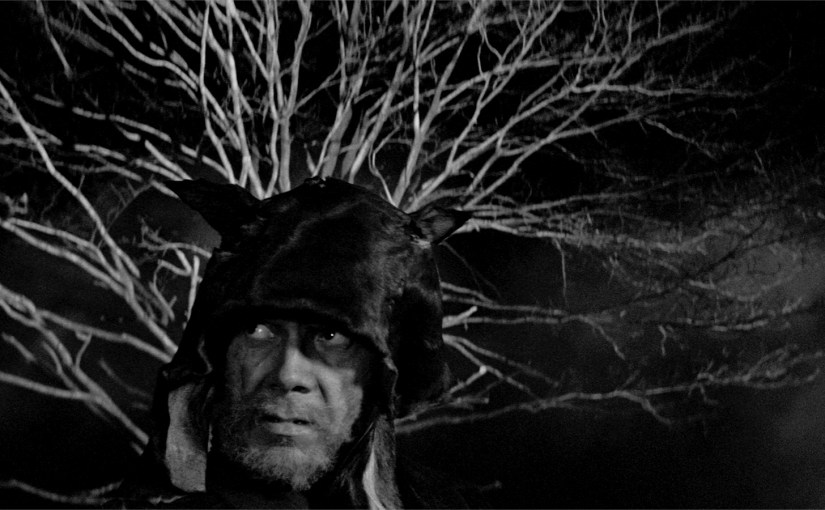
I mean…maybe not, but it couldn’t hurt. Marketa Lazarová was named the best Czech film of all time in 1998, sports a 100% rating at Rotten Tomatoes, and is included in the invaluable compendium 1,001 Movies You Must See Before You Die. It is loaded with visual style and inarguable beauty in widescreen black-and-white. The production and costume designs are utterly convincing, placing us firmly in medieval Europe with a degree of authenticity I’ve rarely seen even in modern films set in that era. But a model of storytelling it is not. This movie further reinforces my tendency to shy away from “avant-garde” films of the ‘60s and ‘70s.
(And yet I really enjoyed watching Godard’s Weekend…go figure that one out.)
In broad strokes, the story begins with marauders raiding a traveling party and kidnapping the son of a nobleman. The marauders are all the sons of a battle-scarred local lord, Kozlík, who rules his territory from a medieval castle and treats his sons barely better than he treats his prisoners. Word of the kidnapping reaches the King, so Kozlík sends his eldest son, Mikolás, to pressure their neighbor, Lazar, to join forces with Kozlík in case the King decides to retaliate. Lazar refuses, so Mikolás kidnaps Lazar’s virginal daughter, Marketa, just as she was about to join a convent.
Seems pretty straightforward, right? “A” leads to “B”, “B” leads to “C”, and the gears of a bloody revenge story are set in motion. But, man, I don’t know if I was in the wrong headspace or what, but I was unable to follow what was going in. We’re presented with shots that, even with subtitles, don’t clue us in on who we’re looking at, or why. Some of these shots are straight-up visions/dreams, intermixed with shots in the present, going to a flashback, then to a flashback IN the flashback, then back again and round and round. Honestly, I felt like I was failing some kind of test. I had to watch the special features to realize that one of the film’s sequences showed someone having sex with his sister…but even now, I’m not sure they meant with his OWN sister or someone ELSE’S sister. When I need a flow-chart to follow a film’s progress, I’m not inclined to keep watching.
But I did. Because, doggone it, there are striking cinematic flourishes that qualify this film as a visual tour de force. The theme of hunting is referenced right from the start with a pack of wolves (or at least wild dogs) running through the snow toward an unseen quarry. More than once, we see shots of antagonists and protagonists creeping stealthily through tall grass or tree branches either towards their prey or away from their tormentors. Two particularly arresting shots look like they were taken from the Stanley Kubrick playbook; you’ll know them when you see them.
Which brings me to something I was thinking about while watching this movie: Kubrick’s 2001: A Space Odyssey. There is no denying 2001’s place in cinema history as a genuinely important film. But show it to someone who’s never read the book or the infinite number of essays on the film, and give me odds on whether they will correctly interpret the last twenty minutes, at least in terms of the novel’s explanation.
Marketa Lazarová is not quite as cryptic as 2001, but it is definitely the same species. In a movie that runs two hours forty-two minutes, I finally got a grasp on the basic nuts and bolts of who was who around the 90-minute mark. The style and cinematography are stellar, but they were not enough to keep me as interested as I would have been had it been edited more conventionally. I could go into more details about the story, about the girl Marketa’s plight, how she falls in love with her captor/rapist, the gritty battle scene, the film’s elaborate intertitles separating discrete sections of the film from one another, but it would feel false, because, ultimately, the film’s storytelling method left me not caring what happened one way or the other.
There are plenty of other films that broke new cinematic ground and still managed to be engaging and compelling, so many that I won’t even try to list any here…you know what they are. One day, I will watch Marketa Lazarová again, perhaps with my Cinemaniac buddies, to maybe catch what I missed the first time around. On that day, I will welcome a lively discussion of my rightness and/or wrongness of my first experience with this film. For now, my opinion is that uniqueness alone is not enough to make a film enjoyable.
 2 UNPAID MOVIE CRITICS!!!!