MISSION: IMPOSSIBLE II

By Marc S. Sanders

Mission: Impossible II is undoubtedly the weakest installment of Tom Cruise’s series, adapted from the classic tv show. Action Director John Woo is normally regarded as “ACTION DIRECTOR JOHN WOO” because he can only direct action. He hardly ever directs story. There’s no dimension to his characters and nothing intriguing. It’s all just glitz and neon colors in his cinematography. No weight at stake in Action Director John Woo’s action.

A third act fist fight between Cruise’s Ethan Hunt and a very, very uninteresting villain played by Dougray Scott gets very tiresome, very, very quickly. Punch, kick, tackle, twirl, take off your jacket, get up in very slowwwwww motion, throw off your sunglasses, and do it again and again and one more time.

The MacGuffin of the picture is a virus and the anti-virus. Hunt recruits a sexy thief played by Thandie Newton to infiltrate Dougray Scott, her ex-boyfriend seeking to cash in on the prize at hand. Somewhere, lost in Robert Towne’s script, Scott’s character gets wise to the fact that of all the “M:I” agents out there, Ethan Hunt is the one onto him even though they never come in contact with one another until the middle section of the film is complete. So, the bad guy, at times, disguises himself as Hunt. Screenwriter Robert Towne thought he’d get one over on the audience with the disguise twists that the M:I franchise is known for. Sadly, it’s not subtle enough in this picture. All twists can be foreshadowed as early as the opening credits actually.

Action Director John Woo really fails with this effort. He makes a terrible habit of amping up the gloss of his film with an abundance of slowwwwww motion actions and reactions to accompany a mostly mandolin soundtrack from Hans Zimmer. Beautiful set pieces of music. Though none of it belongs in this film. Zimmer’s work here is better suited for something more genuinely romantic and exotic, without the revving motorcycle rides and bare-knuckle brawls in the final act of the film.

In addition, Action Director John Woo is not given much action to “action direct.” There’s a lot of bland talking in Towne’s script. So much so that we finally arrive at what the film promises, only it’s very late in Act 2, and then drags on very slowwwwwwwly in Act 3.

For a brief stint early on, you get the impression that Cruise is adopting a flirtatious James Bond approach with Newton’s character. They hide away cuddled in an empty bathtub and quickly bed one another, but Towne writes no sexual innuendo to go with Cruise & Newton’s grins, or their shiny, moisturized complexions.

There’s no humor either. There’s really no reason to like Ethan Hunt here. He has nothing to say. All he does is walk in slowwwww motion in response to Action Director John Woo.

Cruise, again as producer, makes the mistake of only allowing his hand in the cookie jar. No one gets to do anything of great importance except him. A team is assembled to just watch Tom Cruise play and walk slowwwwwly. Cruise hired his own fan club for this film, including Anthony Hopkins. Now here’s a charming chap playing Hunt’s supervisor. You see him appear for the first time early on. He returns in the epilogue, and when the film has concluded you realize that Oscar winner Anthony Hopkins next to nothing to do, really. He doesn’t debate or joke with Cruise. He, like most of the cast of the first two M:I films, just tells Hunt who to meet next. What potential for a great character played by a marvelous character actor and it’s regrettably squandered away.

Fortunately, the approach of the subsequent M:I films went in different direction following Action Director John Woo’s contribution. All elements of this short-changed story were abandoned for better material from better directors to later come.
AIRPLANE!

By Marc S. Sanders

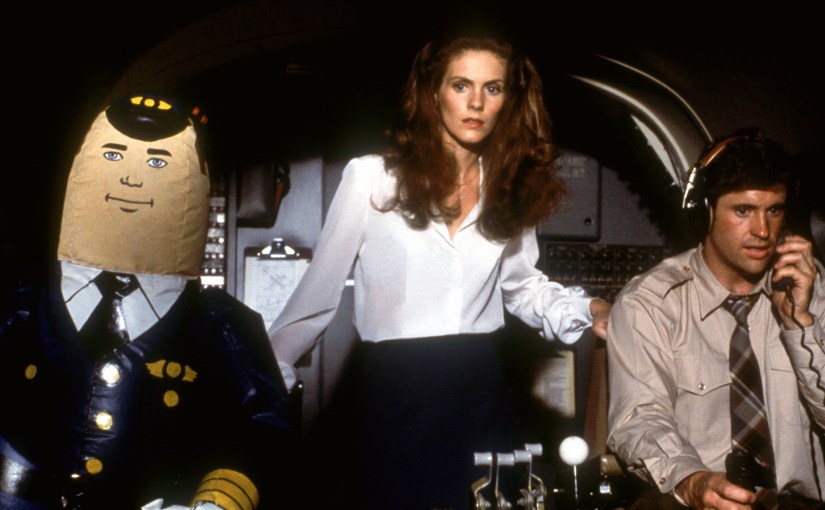
Having finally shown my 12-year-old daughter one of the greatest comedies of all time, the disaster film spoof, Airplane!, lo and behold, what do I realize? I uncover gags that I had never noticed in the zillions of times I had seen the movie before. Did any of you notice the ice cream cone amid all of the reporters’ microphones, or that Captain Ouever (a very straight-maybe not so straight-Peter Graves) flipping through a men’s magazine called “Men’s Sperm Monthly” from the “Whacker Material” section of an airport magazine rack?

That’s the beauty of this film. You see something new every single time. EVERY SINGLE TIME!!!! I swear Jerry Zucker, Jim Abrahams and David Zucker are secretly editing my DVD copy and inserting new gags into the film. Nothing comes close to matching the slapsticky, spoof magic of Airplane! Countless films were skewered to ridiculous levels of far-reaching hilarity ranging from Airport, (of course) to From Here To Eternity and Saturday Night Fever. Steven Spielberg’s Jaws is the film’s first casualty.

The picture is stitched together with former fighter pilot Ted Stryker (Robert Hays) pining to rekindle his romance with airline stewardess Elaine Dickinson (Julie Hagerty). Ted buys a literal “smoking” ticket on Elaine’s next flight to mend things with her (my god, I’m hearing the deliberately sappy string music in my head as I write this), but unfortunately many of the passengers and the pilots ate fish for dinner and now the plane is destined for doom. (Cue the “doom music.”)

The beauty of the film is that no one aims to announce the joke. Every cast member, including Leslie Nielsen, Robert Stack, Lloyd Bridges and Kareem Abdul Jabbar, plus Otto The Automatic Pilot plays it straight, never announcing the joke and sending the punchline into the rafters. If you’re serious while looking ridiculous to everyone else…well then that’s funny. Surely, a film like Airplane! can’t be serious, only don’t call me Shirley.

Airplane! still holds up after forty years. It had such a way about it that had never been done before. Disaster films were in abundance by the end of the ‘70s. Disco music was becoming cheesy to the greater populace. Zucker, Abrahams and Zucker had to respond to these trappings. Airplane! upended everything done before.

Heck you could be bed ridden in a big building with patients and die laughing at Airplane! but that’s not important right now.

NOTE: Ever notice the propeller sound of the multi engine plane or have you truly figured out where some of the film’s all time classic lines come from? If not, then find the disaster flick Zero Hour! You’ll be amazed at the inspiration that film gifted to “Airplane!”

Zero Hour! is sometimes shown on Turner Classics. Be sure to check it out.

ROMANCING THE STONE

By Marc S. Sanders

Robert Zemekis’ Romancing The Stone is one of those perfect Saturday afternoon rainy day movies. Since it focuses on best-selling author Joan Wilder (Kathleen Turner), it seems apropos that the movie feels like curling up with a good book.

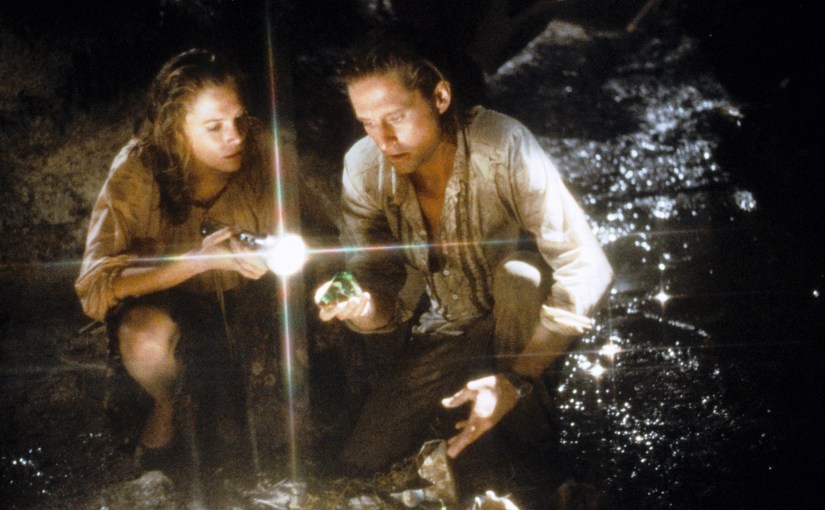
Upon discovering that her New York apartment has been ransacked, Joan gets a call from her terrified sister who has been kidnapped in Columbia. Joan is instructed to deliver a treasure map in exchange for her sister’s safe return. However, Joan is not as romanticized or adventurous as the characters in her novels. So, her three-piece suit and heels won’t serve well in the wet jungles in which she ends up completely lost. Fortunately, she meets a heroic, handsome guy in the form of Jack T. Colton (Michael Douglas). Together, they flee from the parties interested in the map, while trying to find the titled priceless gem.

Zemekis might have been taking an Indiana Jones route with this picture, but it finds its own identity, nonetheless. The fun comes with how Joan adapts to the outdoor elements and escapes the safe and lonely concrete jungles of city life. Turner is great as the one with no clue for travel or the instinct to stay out of a bad situation. It’s amusing to see her encounter and respond to one approaching cliffhanger after another.

There are great scenes here with mud slides, vine swinging, shoot outs and car chases. The best adventures never rely on CGI. A favorite sequence involves a meet up with a Columbian drug runner who helps the pair evade the bad guys in his 4 x 4 truck. That’s one of the many unexpected and wild moments offered here.

A third star is Danny DeVito fast on the trail of Joan and Jack. He’s here as the stooge more or less but he’s added comedy.

The one sad thing about Romancing The Stone is that it’s screenwriter Diane Thomas passed away shortly after her script was sold. Imagine what she could have done based on the promise of this film. This script has focus, fun and outstanding action sequences.

Romancing The Stone is just great escapism.

DAREDEVIL

By Marc S. Sanders

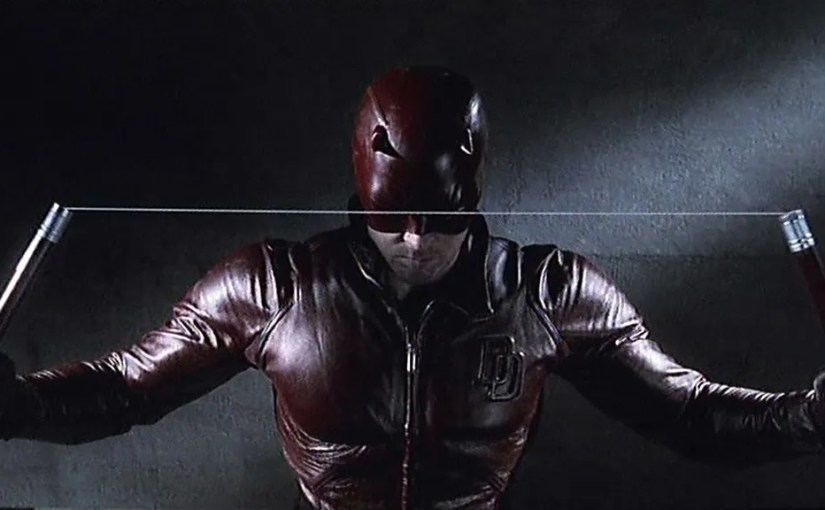
Mark Steven Johnson is probably a director you never heard of. He made two very bad movies based on Marvel’s character Ghost Rider featuring Nicholas Cage. Still Johnson has one redeeming quality and that is the very underappreciated Daredevil featuring Ben Affleck in the title role.

It’s not so much that Affleck is good in the role as blind lawyer/vigilante Matt Murdock aka the title character. More so, is that Johnson writes and directs a solid film very faithful to the source material. So, reader, what if you tell me you never read the comic books? My reply, so what! There’s still a lot of fun and colorful characters to get caught up in and you should have no trouble getting the hang of it.

Michael Clarke Duncan’s hulking physique was always his best attribute and serves him well as the crime warlord Kingpin aka Wilson Fisk, the puppet master of Hell’s Kitchen and the man responsible for the death of Murdock’s washed up boxer father. Colin Farrell chews the scenery (maybe little too much on my repeat viewing many years later) as Bullseye, a mercenary villain who can use any object as a precise throwing weapon, whether it be a card, a pencil, or shards of glass. It’s a ridiculous and unlikely talent but Farrell makes the most of it and the character serves as a perfect foil to the blind vigilante hero who uses his remaining four senses to skillfully fight and dodge and acrobat his way through rooftops over the city at night.

Jon Faverau (before directing Iron Man) is welcome relief as Murdock’s legal partner with some good humor material. Jennifer Garner is filler in the role of Elektra, a skilled fighter with trident weapons in each hand and the film’s standard love interest looking for revenge. Garner is nothing special. I’ll say it. She’s here based on her looks and her body and at the time she was the action go to gal (thanks to her TV show Alias) when Angelina Jolie was not available.

Affleck is fine in the part. He’s got the looks and physique. You can easily believe he’s a lawyer. If anything, I could have done without his voiceover narration. I think the film narrates itself fine without additional instructions. I’d argue that Affleck and Johnson could have taken this franchise further. At the time, it actually got good reviews. What did not help were the published exploitations of Affleck with his girlfriend at the time (now new bride), Jennifer Lopez (and later Garner), as well as his other poor choices of roles like Gigli and the insultingly embarrassing Pearl Harbor. (Main character Raif McCauley I have not yet forgotten!!!!)

Years later, some of the fight scenes look clunky. Some of the mid 2000’s alt rock is a little much (but Evanescence is always welcome, especially during a nicely dramatic rainy funeral scene). However, Johnson still has some tricks up his sleeve that work really well. He uses a great filming technique where Daredevil can see by means of sonic waves of sound thus making him more attuned to the trajectory of a bullet or where to find his adversaries. So, to pit a blind guy against the greatest marksman…yeah that’s a dual worth seeing. This gimmick was invented in the comics by Stan Lee and John Romita, yet very well captured in the medium of film. Another great bit is to translate how Daredevil can tell if a person is lying, a great skill for any lawyer to have. He can hear their heartbeat. Duh! Especially well done is how Murdock can see the facial features of Elekra during a brief escapade in the rain. Johnson CGIs it in midnight blue to leave an impression. Yes, Garner’s best moment comes when she’s animated in CGI blue.

The film offers a great theme of superimposing the devil image of the vigilante against the backdrop of the catholic church and other opportunities for a cross to intrude a scene. It hints that Matt Murdock is a religious catholic, but not enough. It seemingly questions the actions of its hero. Affleck even asks himself at one point “Am I the bad guy?” It’s a good additional dimension to the character; one I wish Johnson capitalized on a little more. When is a vigilante truly crossing over into the realm of sin?

Daredevil is worth watching and not worth comparing to the Netflix series. The product is served in two different mediums, one of which has the luxury of telling its story over a span of 10 hours each year. The original film, though, is condensed quite well in origin and character. Live with that and feel forsaken.

GONE GIRL

By Marc S. Sanders

David Fincher is best when he builds tension in dark cinematography. It’s eerie and moody, but it all seems to make appropriate sense.

A skilled director like him proves that even with Lifetime television soap opera material, if delivered with care for detail and with genuine acting he can hold on to the attention of a scrupulous movie going audience. Haunting filmmaking, like Fincher is known for with movies like Seven or Panic Room, can also work in sensational material that at first might draw the attention of lonely housewives pigging out on Rocky Road ice cream while watching hours upon hours of scorned victim gossip material on the WE Channel. Gone Girl adapted from the best-selling novel by Gillian Flynn, who also wrote the screenplay, is a thrilling cinematic piece even if the story’s ending is a little disappointing.

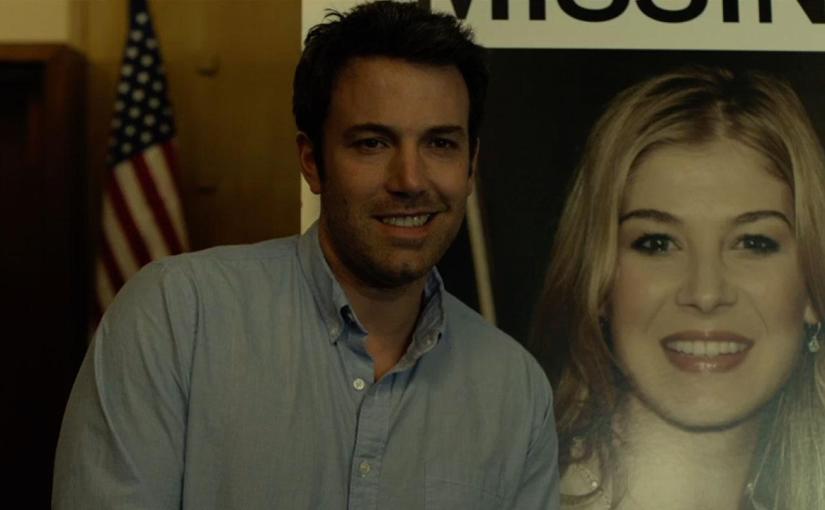
Ben Affleck plays Nick Lowe who discovers a broken glass coffee table in his home and realizes his wife of 5 years is missing. Rosumund Pike is Amy, who seemingly vanished without a trace.

Fincher closely shoots Flynn’s story with developments you might expect or have experienced with various news stories and documented investigations by sensational legal journalists like Nancy Grace. Nick, with Amy’s parents (Lisa Banes, David Clennon), initially form a united front for the press but that falls apart when it’s uncovered that Nick has had an affair. Amy had a close neighbor who expresses tearful concern that cameras latch on to for ratings. The cops (Kim Dickens, Patrick Fugit) grow more and more suspicious of Nick. Nick eventually hires a high-priced lawyer (Tyler Perry). Nick is eventually considered to be an abusive husband as well. It all adds up.

These are the steps you’d expect from a missing persons case. You might also suspect murder, but no one can claim that out loud if there’s no body to be found. So, toe the line carefully detectives, journalists, & gossip mongers!

What is not expected in Gone Girl are the surprises that open up midway through the picture, and the book. Flynn is a really inventive storyteller, and Fincher as director gives ample opportunity to answer for every surprise up the writer’s sleeve. Gone Girl plays with a lot of internal character thought to process its details.

I had read the novel long before the movie was even cast, and I couldn’t put it down. That being said, I was frustrated when the conclusion arrived. I can say the same for the faithful film adaptation. It’s an ending that could happen but, wow, is it a long shot.

Rosamund Pike was Oscar nominated as Amy, the complicated wife in this marriage. She’s good at occupying the complexity of her past shown in flashback. She’s likable in many moments, but then Amy is also a character that we are reluctant to trust based on her relationship to Nick, as well as her own parents.

Affleck remains a good actor with this picture. I think it takes an honest actor, writer and director to accurately show a man who might not be responding to this crisis like a general public expects. I think much of Affleck’s personal issues of infidelity and alcoholism in the public eye lend credence to how genuine he makes Nick out to be. Could this guy be handsome enough to think he could harm or actually murder a woman as beautiful as Amy; the “Amazing Amy” as she’s widely known in her mother’s series of best-selling children’s books? Is Nick that good at hiding his evil side? On the other hand, is Nick simply innocent, despite all the skeletons that are gradually uncovered? That’s a fair question as well.

Again, Gone Girl is superb in its delivery. It’s ending, though, is the setback. At least I felt that way. For every reader, like me who considers it dubious, I’m sure there are readers who applaud the inventiveness of Gillian Flynn’s gripping and modern mystery.

I guess if a good story prompts a group discussion on a Saturday night, then a really good novel or a great movie has achieved its purpose. At the very least, I consider that a great compliment for an outstanding cast, director and writer.

SEVEN

By Marc S. Sanders

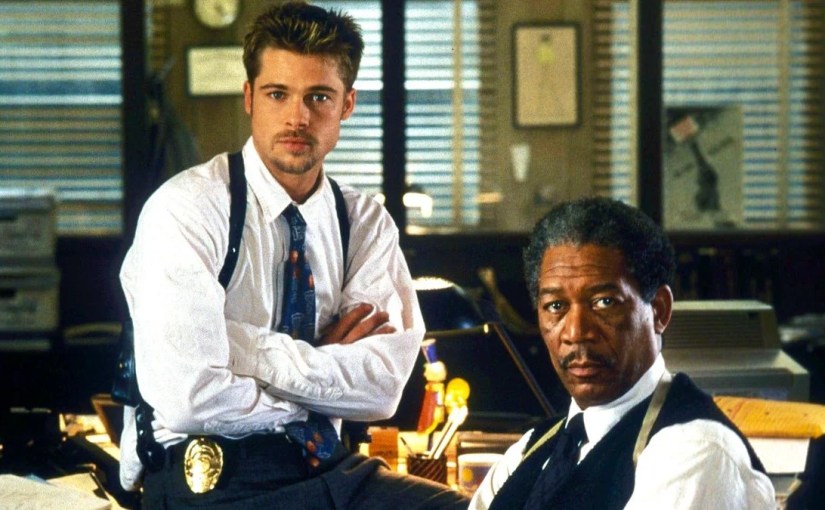
There’s an interesting dynamic to David Fincher’s Seven that is not touched upon often enough.  Beyond the clever and grisly murders set to a theme of the Seven Deadly Sins, the two police detective protagonists are carved from completely different molds.  The spine of Fincher’s film, written by Andrew Kevin Walker, focuses on how these men approach the craft of the killer’s accomplishments.  One man wants to cut to the chase, find the criminal and cuff him.  The other wants to study the nature of this mystery man, and only then will it lead to the suspect’s true identity.

Detective William Somerset (Morgan Freeman) stems from a time gone by for the cinematic detective.  He’s the trench coat wearing investigator who examines and connects dots, never resorting to fists or police intimidation with a gun.  Newly assigned Detective David Mills (Brad Pitt) dons the leather jacket with the cute goatee and boy blond haircut.  He’s more apt to making fun of the sick weirdo they are chasing, hardly lending any valuable insight or observations.  Somerset will approach with respect for the killer and his work.  Mills, with nowhere near the experience of his new partner, will disguise his loss of where to begin with this case by resorting to cheap shots at the killer’s expense, calling him Yoda and surmising this guy must be pleasuring himself in peanut butter, perhaps.

Fincher is widely recognized for the dark photography of his films, like the cherry wood hallways of Harvard in The Social Network or the lurid neighborhoods in movies like Zodiac and Gone Girl.  In Seven, the setting is very much a character in and of itself, but other than the fact that it is a California (thanks to a throw away piece of dialogue) metropolitan area, we never know the name of this city.  It is a dreary, ongoing rain-soaked environment that hinders the police officers and keeps everyone contained in the film, especially David’s wife Tracy (Gwyneth Paltrow), unsettled.  The city has no name or identity.  Therefore, the police officers who occupy it are not the stereotypical cops designed for this place.  One works as a tired, wise and experienced Colombo figure, minus the sarcasm.  The other is an aggressive hot shot who is over trying to prove himself to peers and superiors.  Now he wants to be in charge.  They both follow the footsteps of the mystery together.  Yet, they are reading different roadmaps.

With seven days left before retirement, Somerset meets newly arrived Mills.  They are quickly dispatched to a filthy apartment for an ugly murder scene of an odd nature.  It is a scene labeled as Gluttony by the killer.  Greed follows shortly thereafter, and Somerset knows none of this random.  Whoever has orchestrated these two executions is methodical and resourceful, with a point to prove.  The artistic measure and inspiration are too creative, far from the sloppiness of a standard stabbing or gunshot to the head.  Somerset already knows five more murders will likely turn up and doesn’t want to get involved.  He’s seen enough.  Mills has the cavalier attitude.  Find the freak, and maybe take him out in a blazing shootout.  It’s reckless. 

Could Seven be an answer to how cop movies performed at one time and how they act now?  Seven may be the closest outline of pairing Humphrey Bogart’s Sam Spade with Mel Gibson’s Martin Riggs.  Sure, the murder scenes are hard to look away from, as deliberately repulsive as they are.  Even after multiple views of the film, I still get curious with how the killer planned all of this out to the absolute most minute detail.  However, ninety percent of the dialogue is exchanged only between Freeman and Pitt. Paltrow has a couple of scenes that help paint the sad picture of life in this city, but ultimately the film belongs exclusively to the two cop characters.  Seven has one action scene, but it primarily covers how the two men respond to the nature of what they come upon.  Mills will crack jokes that maybe his college pals would snicker at.  Somerset asks the young man to just be quiet while he explores the scene.  Mills gets grossed out by a bucket of vomit.  Procedurally, Somerset will ask Mills if there was any blood in it.  Mills will resort to Cliff’s Notes on the Seven Deadly Sins.  Somerset will spend his evening in the library, digging through the original source.  Mills will kick down a door without authority.  Somerset will protest against that action without following the standards of procedure.  It’s a dichotomy of impatience versus patience.

The two men actually don’t come to a common platform until the third act of the picture, when the rain has subsided, the sun comes out, and the killer opts to surrender himself.  Still, the mystery of his purpose remains and there’s an unknown element of what to expect next.  So, while the partners may agree that there’s more to come, they still respond to the killer, in person, differently.  Mills can only yell at the deranged suspect and call him names.  Somerset interviews the gruesome and imaginative architect with questions. 

Seven is a sensational crime drama.  It’s eerie, creepy and appreciatively sickening in its crimes.    The outline of some of the killer’s actions might seem conveniently questionable or far-fetched.  Some of the crime scenes were planned over a year’s time. Others were not meant to be revealed until a certain point within these particular seven days.  So, the writing might be a little too overly precise.  However, that should not be dwelled upon.  Rather, one kind of cinematic cop is not the standard in Hollywood films anymore.  Another kind of cop has filled that void in its stead. 

Andrew Kevin Walker’s script follows a very structured outline.  It’s not until the story’s infamous end does the film divert itself, as it is almost unfathomable that it could have actually happened. 

It is fortunate that David Fincher was allowed vast liberties with the production of only his second film, following the abysmal Alien 3 which famously took away any of the personal oversight he depended on as a rookie filmmaker.  With Seven, Walker and Fincher draw out four characters quite well – Somerset, Mills, the city with Tracy as its spokesperson, and the killer’s actions.  Blend these elements together and see if they make for a good product.  Fact is they couldn’t be any more disagreeable, but the chemistry works perfectly. 

Seven is a sensational movie and will likely always remain as one of David Fincher’s best films.

NOMADLAND (2020)

by Miguel E. Rodriguez

Director: Chloé Zhao
Cast: Frances McDormand, David Strathairn, and a cast of non-professionals/actual “nomads”
My Rating: 8/10
Rotten Tomatometer: 93% Certified Fresh

PLOT: A woman in her sixties, after losing everything in the Great Recession, embarks on a journey through the American West, living as a van-dwelling modern-day nomad.


Nomadland is one of the most visually beautiful films I’ve seen recently.  It mostly reminded me of Brokeback Mountain (2005) with its sprawling vistas of distant mountains, lonely country roads against a looming sky, and desert badlands illuminated by that elusive light that appears only during the “magic hour” so coveted by cinematographers and photographers alike.  It’s beautiful and well-made.  As a message film that won the Academy Award for Best Picture of 2020…I mean…it’s good and admirable, but it didn’t quite get to me like it was clearly trying to.

As a piece of propaganda (intentional or not), I can see Nomadland being effective for anyone who has been disillusioned of the American Dream by financial troubles.  Set in 2011, the film follows Fern (McDormand) as she hits the road in a van after the gypsum mining company her deceased husband worked for folded, displacing an entire town, Empire.  Even the town’s zip code was discontinued.  Fern literally lives out of her van, which doubles as living quarters, bedroom, dining room, and (revealed in a shot that I was stunned to learn was real) bathroom.  She works seasonal jobs throughout the American West at various parks, restaurants, and even an Amazon warehouse during the holidays.

On her travels, she encounters a large community of fellow nomads.  Periodically (I think annually), they gather at a location in the middle of the desert to trade goods, share stories and nomadic tips, and basically support each other for a week or a month or whatever…it’s not made clear exactly how long everyone stays before they go their separate ways once more.  On this occasion, she meets a fellow traveler named Dave (Strathairn) who trades her for a can opener.  Over the course of the film, Fern’s and Dave’s paths will intersect again and again.  I thought we were getting the kernel of a corny love story, but not quite.  The purpose of their relationship is pragmatic, not romantic.

Another traveler Fern meets is Swankie, a lively woman in her seventies who hangs a skull-and-crossbones flag from her van when she wants no visitors.  Honestly, it made me wish I had a similar flag to hang from my neck to communicate the same thing in public.  Anyway, Swankie reinforces Fern’s commitment to this way of living by describing trips to Alaska, a visit to a large community of swallows nesting on a cliff while on a canoe trip, and by revealing one of the real reasons Swankie has adopted this lifestyle in the first place.  All with no bills to pay, other than gas, food, and vehicular upkeep.

The movie follows Fern from one place to another over the course of a little over a year.  We see her working, driving, talking with people she meets, cooking on her tiny gas stove inside her van, dealing with the cold in the winter, reminiscing over old photos and slides.  There are two interesting side trips when she can’t avoid reaching out to…well, I guess “civilization” is the right word.  One occurs because her beloved van breaks down and she has to get to her sister’s to ask her for repair money.  Another occurs when she takes Dave up on an offer to…no, won’t spoil it.

At times, I found myself comparing Nomadland to Cast Away, Robert Zemeckis’ 2000 film where Chuck Noland (Tom Hanks) finds himself stranded on a desert island after a plane crash.  In both situations, the heroes find themselves isolated from civilization.  They must both learn to deal with an alternate way of life, and there is no alternative.  Adapt or die.  (When Swankie learns Fern doesn’t even know how to change a tire, she reprimands her.  “You can die out here.  You’re out in the wilderness, far away from anybody.  You can die out here.  Don’t you understand that?  You have to take it seriously.  You have to have a way to get help.  You have to be able to change your own tire!”  It’s a sobering reminder that, even though she has a cell phone (how she pays the bill is a mystery to me), Fern must be self-sufficient in order to survive.)

Furthering the similarities to Cast Away, there’s even a moment where Fern has an opportunity to sleep in a real bed.  We see her crawl underneath the covers…but in the middle of the night, she creeps back out to her faithful van to get a real night’s sleep, just like Chuck Noland sleeping on the floor of his hotel room.

But what does it all mean?  What is Nomadland trying to say?  I couldn’t shake the idea that Zhao’s film, based on a book of the same name, was an attempt, like Into the Wild (2007), to romanticize the concept of shedding our material needs, stripping ourselves down to the necessities, and getting back in touch with nature.  I have no doubt this notion appeals to many people.  Well, that much is clear because nearly everyone in the film besides McDormand and Strathairn are non-actors who are playing themselves, and they’re all nomads, too.  But is the movie simply showing me how and why a person makes this decision?  Or is it trying to convince me that I should do the same thing?  Is this one of Ebert’s “empathy machines” that allows me to live in someone else’s shoes for 107 minutes and experience life through their eyes, or, like Into the Wild, is it making the case that folks who haven’t made this decision themselves are slaves to a corporate system?

At one point, a gentleman named Bob, who is a real person and is one of the main coordinators of the community that meets once a year in the desert, makes a speech to the nomads who have gathered:

I think of an analogy as a work horse. The work horse that is willing to work itself to death, and then be put out to pasture. And that’s what happens to so many of us. If society was throwing us away and sending us as the work horse out to the pasture, we work horses have to gather together and take care of each other. And that’s what this is all about. The way I see it is that the Titanic is sinking, and economic times are changing. And so my goal is to get the lifeboats out and get as many people into the lifeboats as I can.

I’d be lying if I said his notion wasn’t appealing.  Who wouldn’t want to live a life of seeing the country, parts of which many of us may never see in our lifetimes?  Never being tied down to a job, to familial obligations, bills, taxes, the eternal quest for the almighty Dollar?  I get it.  But…if I didn’t have a job, didn’t earn a living, didn’t pay my bills, and have enough left over to buy a home entertainment system including the Blu-ray of Nomadland…I would never have seen this lovely film in the first place.

So, no, the concept of living as a nomad is not something I would seriously embrace…yet.  Life is good.  I have a job.  I have family.  I have friends who are as good as family.  I have the woman I love beside me.  I’ve seen Alaska, England, Greece, New York, Miami, and Key West.  Nomadland argues that, if any of that would ever change, there is an alternative to depression and slaving away and eking out a living in my retirement years in a 1-bedroom apartment.  Perhaps, on that day, I might re-evaluate my opinion of nomadic living.

But that day is not today.

Tomorrow is not looking good, either.

TRON

By Marc S. Sanders

I was not raised on video games.  My father refused to allow us to have them in the house. While I was envious of every kid that owned an Atari 2600, dad didn’t want us to get addicted to them.  I wouldn’t know until later on how thankful I was for that rule he stood by.  I like arcade games for a once and a while escape, but once I reach the banana board (which isn’t often) on Ms. Pac Man, I’ve had my fill.

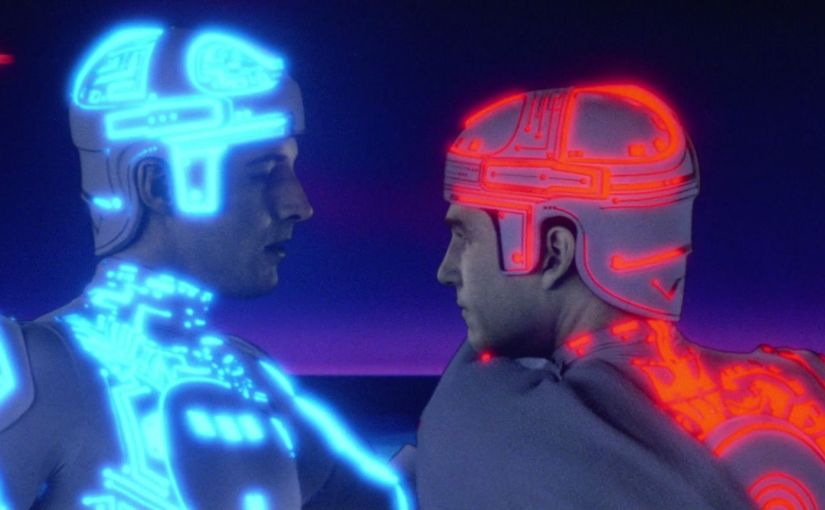
I recall seeing at least a few scenes of Walt Disney Studios’ Tron back when it was released on VHS.  Way back then, just like now, I just was never so impressed by it.  I can forgive the thin characterizations of really the only 5-7 actors with speaking roles.  Yet, the visuals and sound really do nothing for me.  What am I looking at?  Grids!  Just grids or endless squares.  A blank chess board looks more exciting to me.  The players in the film are dressed in what are presumed to be digitized armor that have carved out glowing blue and red lights.  Their human faces are grainy grays.  It all seems so flat to me, like that awful Pac Man adaptation Atari developed for their game consoles. 

Jeff Bridges plays Flynn, a game software developer done dirty by a corporate conglomerate led by a man named Dillinger (David Warner, the bad guy with the British accent).  Dillinger, along with a super computer intelligence known as the Master Control Program, have stolen Flynn’s intellectual property for dynamic new video games.  Since that time, Flynn has been making efforts to hack into the computer system and steal back what was originally his to begin with.  Master Control Program always fends him off, though.

A side story involves Bruce Boxleitner as Flynn’s colleague, Alan, working for the corporation. Alan has just developed a new security system known as TRON.  Dillinger puts a stop on the TRON program however.  Flynn, Alan and a third colleague named Lora (Cindy Morgan) break into the corporate computer lab one night, and before you know it, while attempting to hack in, Flynn is zapped right into the computer system, where he finds himself ensconced in a series of gladiator like games that were part of his original program write ups.

Master Control Program has the capability to erase Flynn from existence but insists on having him compete in the games that involve frisbees that deflect lasers and drive colorful racing cycles.  All of these games occur on this boring grid.

The actors mentioned above are utilized in the film much like The Wizard Of Oz.  They are introduced in the real world for the brief exposition portion of the film, and then later used to represent the TRON program (Boxleitner), as well as other elements that serve or perform under the eye of Master Control Program in the digital computer world.  The only real entity is known as a “user,” and that is Flynn.

I got sleepy watching Tron.  I think it is because like many video games it does not challenge me to figure things out or solve the dilemma. How can I envision Flynn escaping this world before he’s zapped out of existence?  I have no idea, because I’ve not been shown anything that demonstrates how this computer world functions.  Basic video games, at least from the early 1980s, were primarily about timing your button pushes and jerking the joystick accurately and timely.  Like the film Tron, they were never about application of the mind. 

No.  Movies are not meant for me to solve their riddles all the time.  Often, if I’m not trying to figure out how to resolve a story’s conflict, then I’m at least absorbed in the writing and performances of the cast.  The music might heighten the adventure or suspense.  The set designs will dazzle me.  Don’t get me wrong.  This Star Wars fanatic loves visual effects, but without any kind of story or suspense for the players and their outcome, what’s left to watch?  Tron is as dimensional as a blank index card for me. All these grids and lines are no more exciting than office stationery.

Tron from 1982 may seem very outdated, forty years later, but as a ten-year-old, I recall not being impressed either.  The sound design is annoying as when the digital players walk with clunk, clunk footsteps.  The objects on film are just sketched out, geometric glowing, colored lines on a black background. There is no depth, at all, to Flynn, Lora, Alan, Dillinger, or their computer counterparts.  In 1982, this might have been groundbreaking. For the Atari lovers this may have been the answer to many of their prayers.  I dunno.  Maybe I couldn’t relate or understand back then because my tyrant for a father denied me of an Atari game console.  I certainly don’t understand the fascination now. 

I have a 100-sheet pad of graph paper, here in my desk.  I’ll stand my Darth Vader action figure on a page and just stare at it for five minutes.  There!  Now, I can say I’ve watched Tron for a third time.

THE OMEN (1976)

By Marc S. Sanders

The best horror films don’t have to splash blood all over my popcorn.  I’m flattered that at times, a schlock monster fest will tantalize me with a half alive victim’s laced up intestines hanging out of the belly as they walk towards the camera.  Oh, my how long and endless and bloody they are.  Thank you so much for the garage sale autopsy.  Still, I hardly get impressed with that kind of junk.  Terror is most effective for me when the scares come from the mind of the characters and who occupies the surroundings. 

One of the best ways to scare the bejezzus outta me is when you make a child the monster.  Six year old Damien is a monster.  He’s no kind of kid that I would welcome in my house, and I’d think twice before throwing the little devil a birthday party or taking him to the zoo.  Damien may just be the Antichrist of Richard Donner’s 1976 film The Omen.

Gregory Peck made a long-awaited return to the cinematic screen as Robert Thorn, an American Ambassador to Great Britain.  His wife Katherine, played by Lee Remick, have a son named Damien, delivered on June 6, at 6pm.  Think about that point in time for a second and then maybe you’ll have an idea of where this film is going.  Think about the name Damien.  Does it perhaps sound like another word that’ll send shivers up your spine?

Robert and Katherine are a happy couple.  They feel blessed to have a child of their own and after Damien’s sixth birthday has arrived, odd trappings seem to occur.  Their nanny seems to know how to put a damper on the birthday party.  Rottweilers don’t take too friendly to the Thorns, and the replacement nanny, Mrs. Baylock (Billie Whitelaw), is…well…just watch the movie and you’ll see what Mrs. Baylock is like.  (I shudder just typing her name, Mrs. Baylock….gah!!!!!  I must forge ahead.)  As well, there is a priest who keeps visiting Mr. Thorn insisting he knows something about Damien that cannot be ignored.

What works to put the scare into The Omen is that it does not rely so much on supernatural stunts or effects.  It should never be so easy to presume that an angelic child could actually be the son of Satan.  Leave the clues, but don’t be so overt.  If it’s too obvious, then the film fails.  In order for the film to work successfully, put some doubt into what is or isn’t possible.

Lee Remick is quite good as the wholesome loving mother and wife gradually turning into a woman disturbed by her own child.  Try to imagine that dynamic for second.  It’s perfect movie material.  It’s been done before in films like The Bad Seed or in later years with the dreadful The Good Son.  To pull it off, to be disturbed and frightened of your own six year old boy, requires pacing in the script and a range of performance to get to that point and understand what the maternal character is going through. 

Gregory Peck is a seemingly likable politician.  Unheard of, I know.  I think Peck’s reputation contributes here.  He’s not so quick to accept that these odd occurrences add up to something supernatural.  If it is the case, he’ll find out for himself. 

Richard Donner, in his first cinematic film, sets up magnificent scenes.  There’s that birthday party I mentioned before.  So wholesome, and innocent, and eventually it becomes unforgettably tainted.  A trip to a cemetery at night never bodes well.  Of course, our experience with scary movies heightens our alertness when a tomb or a grave is investigated, but still, while we can expect something to happen, it’s the not knowing what happens that leaves us on edge. 

As I watched The Omen, with goosebumps all over, I was challenged with reasoning out how the film would resolve itself.  Thankfully, it leaves you thinking and perhaps trembling a little bit.  At least it did for me.  So much so, that before turning in for bed, I had to turn on an episode of Seinfeld to remind myself that though the devil or his offspring might be nearby, at the very least I can be amused by the ongoing sins of George Costanza.

DICK JOHNSON IS DEAD (2020)

by Miguel E. Rodriguez

Director: Kirsten Johnson
Cast: Dick Johnson, Kirsten Johnson
My Rating: 7/10
Rotten Tomatometer: 100% Certified Fresh

PLOT: A documentary filmmaker helps her father (and herself) prepare for the end of his life.


It’s been said that, to understand what a movie is really about, examine how the main characters have changed, and there you go.  When it comes to knowing exactly what a documentary is about, I would say: describe what you’ve learned after it’s over, and that’s what it’s about.

So, what did I learn when Dick Johnson Is Dead was over?

…that’s not so easy to describe.  Several years ago, documentary filmmaker Kirsten Johnson lost her mother to Alzheimer’s.  Not long after that, her aging father, Dick, started to show signs of memory loss.  She realized she was unprepared for how to deal with the reality that, one day, her father would die.  In the film, she describes how important he is to her daily life how the concept of losing him is “unimaginable.”  To help her process this looming fact of life, she decided to make a film about it.

But not just any film.  Aside from the expected footage of conversations with her father and her children and friends and family, Kirsten Johnson stages fictional scenes depicting her father dying or being killed.  Several times.  Starring Dick Johnson himself.  (And the occasional stuntman.)  In one scene, an air conditioner falls from an apartment building onto his head.  In another, he trips down a staircase, winding up at the bottom with a broken leg and blood pooling on the floor.  My personal favorite, adding a nice mystical touch, shows Dick napping in his favorite chair and ottoman…and he simply rises off the ground and out of the frame, chair and all.

What is going on here?  Kirsten’s father is naturally willing to go along with nearly anything his daughter asks him because, you know, it’s his daughter.  But how is this helping Kirsten?  How is this helping her father?  What am I, the viewer, supposed to get out of watching those scenes staging his death?

Most of them are clearly fake.  Kirsten sometimes leaves the camera and sound running while she shouts direction from just off camera; when the scene is over, you’ll often see assistants run on and help Dick stand up and clean the blood off him, or remove his costume, or help him back to his favorite chair between takes.  But a couple of them took me by surprise and were mildly unsettling.

This is hard for me to explain.  I felt as if Kirsten was somehow taking advantage of her father’s developing dementia to help her deal with his passing.  It seemed…unseemly.  Of course, he is a volunteer, and he was never put in any danger or forced to do anything uncomfortable.  But…something about it felt wrong.  It felt self-indulgent in a way.  “I am having a problem dealing with your death, so let me put you in a coffin in a church so I can feel what it’s going to be like when it’s for real.  This will help me with my process when you die.”  I am probably being completely unfair with that analysis, but I would be wrong to omit how I felt at times during this film.

But.  On the other hand…

There are scenes of such lyrical beauty that I was glued to the screen.  One scene Kirsten stages is her father arriving in heaven.  Dick finds himself surrounded by actors wearing big black-and-white cutout masks of people like Bruce Lee, Farrah Fawcett, and Sigmund Freud.  (One wonders if she asked Dick who he would like to meet in heaven.)  And then, in a wonderful moment, a door opens, and in walks his wife, Kirsten’s mother…again, just an actress wearing a big cutout mask, but the picture is of her from when she and Dick first met.  And they dance together.  (With the help of some fancy editing because Dick is not as nimble as he used to be.)

Dick was born with deformed toes, a fact of which he was ashamed for his entire life.  In another wonderful fantasy scene, Jesus Himself anoints Dick’s feet, and presto, his toes are normal again.  The look of shocked delight on Dick’s face is priceless.  …even though, you know, it’s not real, but still.


Interspersed with all this are scenes showing Dick’s slow decline in the real world.  He was once a successful psychiatrist, but he was finally forced to retire when he kept double-booking clients and not showing up for appointments.  He closes his office in Seattle, packs up, and moves in with Kirsten in her New York apartment, which is just a few doors down from the apartment where her two children live with their father and his husband.  (That scenario deserved, I thought, more explanation, but I got none…sounds like the setup for a long-running sit-com.)  Kirsten hires a caretaker with experience in caring for patients in their last stages of life.  Dick starts waking up in the middle of the night thinking he has to catch a train to work.  Multiple times.

These scenes are undeniably powerful because of the extraordinary access we get via Kirsten’s camera.  We see the amused confusion on Dick’s face when she asks him if he remembers getting up in the middle of the night…he doesn’t.  But he laughs.  “Oh, my, your father’s a wreck, sweetheart.”  It’s all doubly poignant because of how his wife succumbed to Alzheimer’s.  And here he goes down a similar road at the far end of his own life.  Powerful stuff.

…and then two extraordinary scenes occur.  I won’t spoil them.  They’re not exactly “extraordinary”, I guess, but the manner in which they occur and what we discover after they happen makes them extraordinary, to me.  And it’s here at the end of the movie that I really started feeling torn.  Yes, it’s a somber, effective look at Death with a capital “D” and how we choose to deal with it.  But…but…a part of me felt like it was shamelessly manipulative, especially those last two scenes.

Perhaps I’m the wrong audience for this movie.  Both of my parents are still alive.  I have not yet experienced that kind of loss.  I’m fifty-one years old as of this writing.  To paraphrase Indiana Jones, I’ve reached the point where life stops giving and starts taking away.  I’ve lost both sets of grandparents, two uncles, and more theatre friends and acquaintances I’d care to think about.  But I still have Mami and Papi.  I am blessed.  And I cannot for one second imagine how my ability to deal with either of their deaths would be improved by filming my mother in a coffin in a church, or by filming a scene where my father is killed after a fall.

I dunno.  It was profound and well made, and it clearly resonated with critics.  Maybe I’ll watch it again in ten or twenty or whatever years when I’ve lost at least one of my parents.  Maybe then I’ll be more in tune with Kirsten’s frame of mind.  Until then…I recommend Dick Johnson Is Dead if for no other reason than it’s one of the most unique documentaries I’ve ever seen.