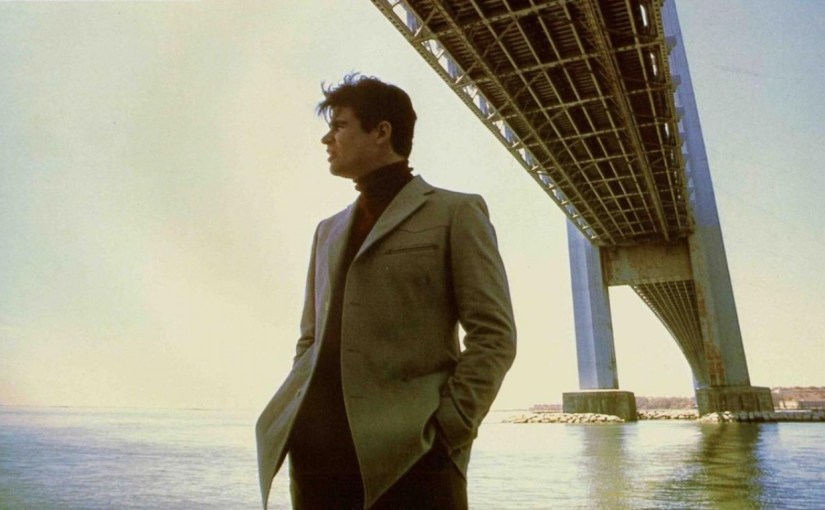
EVE’S BAYOU [Director’s Cut] (1997)

by Miguel E. Rodriguez

DIRECTOR: Kasi Lemmons
CAST: Jurnee Smollett, Samuel L. Jackson, Lynn Whitfield, Debbi Morgan
MY RATING: 9/10
ROTTEN TOMATOMETER: 83% Certified Fresh

PLOT: What did little Eve see–and how will it haunt her? Husband, father, and womanizer Louis Batiste is the head of an affluent family, but it’s the women who rule this gothic world of secrets, lies, and mystic forces.

[Author’s note: this review ended up being vaguer than I intended, due to a pivotal moment that, the more unexpected it is, the more effective it becomes.  Apologies in advance.]


Eve’s Bayou is one of the most self-assured, naturalistic directorial debuts I’ve ever seen.  Director Kasi Lemmons (you may remember her as Ardelia, Clarice Starling’s roommate at the FBI Academy in The Silence of the Lambs) has created a movie that feels less like a movie and more like a recreation of someone’s memories, not quite like a documentary, exactly, but it feels…real.  It’s melodramatic, but it’s not pumped up with overwrought hand-wringing and dramatic close-ups.  It’s fiction, but with a ring of truth that I usually only see in the best biopics.  I was delightfully and unexpectedly engrossed from beginning to end.

Let’s talk about that beginning, to start with.  The time is 1962, in a little Louisiana town called Eve’s Bayou.  (There may be white folk in this town, but the movie stars no Caucasian actors whatsoever, kind of like the Black Cinema equivalent of the Bechdel test; it’s just one more surprising and refreshing quality of this wonderful movie.)  Over the course of a lively evening party hosted at their house, we meet and learn a little bit about each member of the Batiste family, just like the opening sequence of The Godfather, which I didn’t realize until just this moment…neat.  There’s Louis (Samuel L. Jackson), the town doctor and rakish charmer, husband to the gorgeous Roz (Lynn Whitfield) and father to three children, 9-year-old Poe (Jake Smollett), 14-year-old Cisely (Meagan Good), and 10-year-old Eve (Jurnee Smollett [Black Canary in Birds of Prey, my GOD, I’m old!]), named after her hometown.  This opening scene establishes that very specific tone I mentioned earlier, one of matter-of-fact realism somehow combined with entertaining cinema.

There’s also Roz’s sister, Mozelle (Debbi Morgan), a woman twice widowed at the top of the film, and who later worries she may be cursed by God.  In an emotional monologue later on, she wonders why God has seen fit to bring so much misfortune to her life, and also wonders how terrible it might be to discover there was no purpose to it at all.  Mozelle has a side business in telling fortunes, and she is quite good at it.  (This will come in handy later, but no spoilers.)

In a nutshell: Eve wanders out to the toolshed late that night and witnesses her father being WAY too friendly with another man’s wife.  The protective Cisely urges Eve not to tell anyone what she saw.  A local voodoo priestess, Elzora (Diahann Carroll), tells Roz to “look to your children”, so she forbids her children from leaving the house unattended for weeks.  Louis continues his womanizing ways as the town doctor.  Roz finally lets her kids out of the house when…well, again, no spoilers.  Life continues at a leisurely pace without ever being boring.

I love how the setting is established and mined for its mood in Eve’s Bayou.  I know there have been countless other films set in and around swamps, Louisiana and otherwise.  But Eve’s Bayou is one for the books.  There is something about the way the cypress trees and dark waters and Spanish moss are photographed that made me almost smell the swamp.  Maybe the intent was to give a visual hint or cue to the secrets being kept in the Batiste family, especially later in the film.  I don’t want to get all “film theory” on this topic, but it’s just something I noticed specifically as the movie progressed.  It’s masterfully done.

I enjoyed the little details that, again, made everything feel like real memories of a real family.  What does a kid do in a large house in the early ‘60s when they can’t leave?  No Nintendo, no Netflix.  Just bouncing a ball against the wall.  Or teasing your siblings.  Or getting mad when someone won’t get out of the damn bathroom.  The Batiste house has a large spreading tree in their front lawn, and one of its huge branches grows just low and long enough for Eve to use as a makeshift hammock.  I liked that.  There could just as easily have been a bench or a chair, but no, she sits on the tree branch, and that feels exactly right.

Mirrors are put to interesting and innovative use in Eve’s Bayou.  Mozelle tells Eve a story about how she once took a lover, and he confronted her husband with a gun.  As she tells the story, she approaches the mirror, and in its reflection, behind her, we see pieces of the story taking place, all done practically with no fancy special effects.  It’s simple, and it may have been done before or since, but I can’t recall this effect ever being so…effective.  It was downright spooky at times.  At one point, she even walks into the scene that we are watching in the mirror, an elegant visual representation of someone getting lost in their memories.

The opening narration gives us a hint of what must, or may, eventually happen in Eve’s Bayou: “The summer I killed my father, I was 10 years old.”  There is a key moment later in the film when, because of that narration, the inevitable outcome of a particular situation is perhaps easy to see, but the film is so effectively constructed and edited that I was still wondering how it would happen.  That’s not easy to do.  Kudos to the screenplay and the director once again.

Eve’s Bayou was an exceedingly pleasant surprise, a movie told from an unfamiliar perspective that still feels familiar in many ways, because human emotion is universal.  When Roz and Louis fight downstairs, and Eve can hear them through her upstairs door, and she covers her head with her pillow, I was taken back to memories of my own parents’ divorce and their heated arguments, things I never really talk or even think about, but this movie captured that vibe perfectly.  While the movie does have its own mission and ultimate destination, it remembers something very important: the more specific you make a scene with its details, the more universal the appeal, regardless of your race, color, or creed.

EMILY THE CRIMINAL

By Marc S. Sanders

Aubrey Plaza becomes Emily The Criminal, a woman down on her luck with mounting debts, who resorts to credit card fraud with some low level hoods in the Los Angeles underground in order to make ends meet. 

This movie popped out at me while searching through Netflix.  It’s a little over a brisk ninety minutes, made on a shoestring budget, but it has twice the intelligence of whatever crumb of a story Avatar: The Way Of Water has with the two billion dollars spent to make big screen exhausting blue junk.  Goes back to what I always say. If you have an intelligent script, the movie will more than likely be worth watching.  Emily The Criminal is worth watching.

Normally, I don’t look at the running time of a movie before seeing it.  However, this happened to catch my eye in the screen summary just as I was about to hit play.  It’s an hour and 37 minutes.  Once the movie starts, there is a lot piled on to Emily.  First her excessive bills are established. She also has a proclivity for flying off the handle when she’s questioned about her prior arrests for assault and DUI.  Then, she is recruited with a group of others to take a fake credit card and driver’s license into a store and buy a flat screen TV.  A fast two hundred dollars is made.  The ringleader behind this scam is a guy named Youcef (Theo Rossi) who entices Emily with a more complex transaction the next day that’ll earn her two grand.  That works out, but frightening complications intersect.  Still, the cash was better, quicker, and easier to come by than her day job delivering UBER meals.  Eventually, Youcef and Emily connect with one another and she’s learning the tricks to manufacturing the cards and pulling off her own scams.  She’s good at it but not perfect, and when she trips up, a rift in trust between Youcef and his partner comes into play.  Emily is compelled to protect Youcef.

On the side, Emily also reunites with a high school friend (Megalyn Echikunwoke) who offers a line on a professional day job that could use her talents for graphic art.  Emily’s personality might not be suitable for that environment though, and the criminal underworld seems more attractive, despite the danger and risks involved.

I was never looking at my watch but as the movie progressed, I knew I had covered a lot of mileage and there still seemed to be a lot of road left to travel.  My expectations were that some questions will be left unanswered as the ending is approaching.  The cops have yet to make an appearance.  Will Emily be able to go legitimate, or does she even want to?  Most importantly, will her new friend Youcef survive his strained relationship with his business partner?  Thankfully, everything does conclude satisfyingly, and the ending ties together believably, even if there are a few conveniences that enter the frame.

I’m not familiar with Aubrey Plaza’s work prior to this film.  (I’m one of the few who didn’t get into her TV show Parks & Recreation.  My colleague Miguel refuses to let me live that down.)  However, she’s a good actor with lots of range, going from quick bursts of anger to showing mental toughness on screen against some scary people she encounters.  When she meets with a criminal in an empty parking lot who is twice her size and says a flat screen is $600, but the thug insists he’s taking it for $300, I was wondering how she’s going to get out of this one.  Plaza shows her character’s inexperience with such entanglements, but what opportunity will rescue her?  An even scarier episode happens later when Emily is getting robbed.  Plaza is sensational in both scenes.  First time writer/director John Patton Ford sets up these acts, but Aubrey Plaza always delivers it believably.  She’s brash, tough, and smart.

Ford’s film and script work because it doesn’t get too grand with itself.  The criminal world does not open itself up to the highest and wealthiest on the food chain.  Ford was smart to keep the complications of his story within this low-level demographic of delinquent offenders.  Other films would have taken the new student who quickly capitalizes over to the highest mansion on the highest mountain to where the kingpin of everything sits in his hot tub throne on the thirtieth floor overlooking a city.  Ford’s script is wise not to go beyond its reach and mire itself in flashy bloodbath violence.  Also, the window of time from when Emily first dabbles in this shady activity toward the film’s conclusion and epilogue is succinct, not spanning years or decades.  The contained routes that Ford takes with his debut film allow the misdeeds and outcomes to be convincing.

I especially took great pleasure with how the ending of Emily The Criminal circles back on itself to the beginning.  That tells me that John Patton Ford thought this storyline and his protagonist all the way through with good insight. 

Emily The Criminal is an under the radar film to look out for.

ANT-MAN AND THE WASP: QUANTUMANIA

By Marc S. Sanders

Ant-Man And The Wasp: Quantumania is a fun frolic through the Quantum Realm, another dimension that was uncovered in previous chapters within the Ant-Man series of films.  I’m not watching a potential Best Picture nominee for 2023.  I’m watching a glorious kaleidoscope of colors and visual effects with likable characters, and the setup of a new big bad villain for upcoming installments for the Marvel Cinematic Universe.  It’s not a perfect movie.  It’s corny and hokey at times, but I was with the picture the whole way.

I do believe these sci fi superhero franchise films are getting way too diluted.  I think there are more Marvel films now, all working within a shared universe, then there are episodes of single seasons of television shows.  A lot of these films do not stand apart any longer and hinge on events or hanging threads that occur in prior installments.  It makes for a lot of homework and time spent on the consumer to keep track of everything, and where everyone was last left off.  With Disney + adding in multiple Marvel streaming series to watch as well, I’m sorry but my days feel like they need to be extended beyond the standard 24 hours.  The economic term known as “The Law Of Diminishing Marginal Utility” hearkens back to me at this point, all these years later after we first met Robert Downey Jr. as Iron Man in 2008.  Are viewers getting tired of the superhero phenomenon?  Superhero movies rule the box office these days.  Westerns did it four or five generations ago.  How many new westerns do you now see each year?

The blessing of Quantumania is that it does not rely abundantly on other material in the Marvel Cinematic Universe.  Scott Lang (Paul Rudd) reintroduces himself in a very adoring Paul Rudd-like way with a voiceover and thereafter, he is unexpectedly sucked into the Quantum Realm, along with his daughter Cassie (Kathryn Newton), his current partner Hope Van Dyne (Evangeline Lilly), aka The Wasp, and his mentors Hank Pym and Janet Van Dyne (Michael Douglas, Michelle Pfeiffer).  The gang must primarily depend on Janet to navigate them through this world of inconsistency and oddball inhabitants where no two characters seem to look alike.  Janet was marooned in the Quantum Realm for thirty years before finally being rescued.  What concerns her the most is one who is first referred to as “The Conqueror,” and later identified as the frightening superman known as Kang (Jonathan Majors), who was mysteriously exiled to this place.  As Janet describes, Kang has made the prison of the Quantum Realm his empire and now he wants to use the technology that our heroes possess to break free of this dimension and cause all kinds of chaos in the real world and other parallel universes.

The best assets to the film are the scenes between Jonathan Majors and Michelle Pfeiffer.  Granted, their dialogue could apply to any other kind of movie.  A lot of ping pong arguments between the villain and hero, which if I remember correctly go something like “You don’t understand.” and “I’ll never let that happen.”  This verbiage could also be suitable in a Meryl Streep tearjerker or a courtroom drama.  It’s pretty standard.  We’ve seen discussions like this a million times before.  Fortunately, my state of mind was not demanding of thought-provoking conversation.  The magnetism of their acting in front of the expansive CGI environment kept me hooked.   Jonathan Majors simply looks like a very frightening threat.  He’s calm at one point and later raging like a lunatic.  The man has levels.  If he were reciting the ingredients of chocolate chip cookies, I’d be on pins and needles. 

I do not think Quantumania is going to wow most audiences.  In fact, it’ll be a divisive film.  It’ll go half and half.  Though I really do not like to rank films any longer because it feels so pointless, I got into a debate with my wife and daughter about which one was better.  Quantumania or Wakanda Forever.  Both films have their merits, but I left the latest Black Panther film feeling a little depressed and exhausted.  That was a long time to feel morose for a superhero film.  The ladies, however, appreciated the story of that film over this one.  (I wanted to see the Black Panther suit a lot sooner.  I wanted a handful of people to be cut from the film, and I thought the Namor character was very boring.  Look for my review on this site.)

With Quantumania, audiences are either going to like the weirdness that is splashed all over the screen.  Splashed is not a strong enough word.  Try SPLATTERED!!!! Everywhere you look there is something abnormal to see from one corner to the next.  On the other hand, viewers will think the Quantum Realm and its inhabitants are just too bizarre, and the Marvel filmmakers are scraping the bottom of the barrel in imagination.  Sorry, but I got a kick out of the tall stilt guy with a spot light lamp for a head.  I thought the pink goo guy was cute.  I also giggled at the fat head henchman, with scrawny arms and legs, known as M.O.D.O.K. (with Corey Stall, making an MCU return).  The functionality of this character is deliberately lacking and comes off like Looney Tunes cutting room material, but that’s also why he is here.  If there was anything looking remotely normal in the Quantum Realm, well then it isn’t the Quantum Realm, I guess.  Bill Murray even shows up, but if you need a bathroom break, this is when you should go.  All of this looks way too stupid, yes!  Then again, stupid can be entertaining and stupid is often taken with subjectivity. So, I’m just one guy’s opinion. 

Quantumania is maybe the most unsophisticated of all the Marvel films.  More so than the Guardians movies, or the most recent Thor installment.  With a happy go lucky Paul Rudd, an army of ants and some of the most bizarre CGI extras found anywhere it proudly stands tall on that pedestal of ultra, ultra, ULTRA weird.  I think director Peyton Reed accomplished what he set out to do with this film.  The question is will the film win majority of approval within the nerd land of keyboard warriors like myself, who share their perspectives on the internet.  Well, the movie gets my vote at least.

SOUTH PARK: BIGGER, LONGER & UNCUT (1999)

by Miguel E. Rodriguez

DIRECTOR: Trey Parker
CAST: Trey Parker, Matt Stone, Mary Kay Bergman, Isaac Hayes
MY RATING: 9/10
ROTTEN TOMATOMETER: 80% Certified Fresh
Everyone’s a Critic Category: “Watch a Movie Based on a TV Series”

PLOT: When the overprotective mothers of South Park convince America to go to war with Canada over a Canadian R-rated cartoon (wink, wink), they unwittingly set off a chain of events that could lead to global apocalypse.


I sat down and watched South Park: Bigger, Longer & Uncut for perhaps the fifteenth or twentieth time in my life.  My mind went back to the first time seeing it in movie theaters in 1999, one of the single greatest years of American cinema since 1939.  [Fight Club, The Insider, American Beauty, The Sixth Sense, The Iron Giant, Galaxy Quest, Three Kings, need I go on?]  I recall laughing and laughing and laughing, then forcing myself to be quiet so I could hear the next joke, and then laughing some more.  I recall being shocked, yes, SHOCKED to hear such salty language coming from the mouths of animated children.  I had seen the first season or so of the TV series, especially the pilot featuring the battle between Santa Claus and Jesus, and the aliens who force Cartman to sing, so I was not unfamiliar with the formula.

And yet, as transgressively funny as the TV show was, here comes the movie, which featured, among other things I’m sure I’m forgetting:

  • Several uses of the “F” word.  (Not THAT one, the OTHER one.)
  • A socially unacceptable use of the word “retard.”
  • A very brief glimpse of a white character in blackface.
  • A character who uses very naughty language to describe God.
  • Satan and Saddam Hussein having conjugal relations in Hell.
  • A song with a passage containing musical farts.

…the list goes on.  (One of my favorite exchanges: “Haven’t you heard of the Emancipation Proclamation?!”  “…I don’t listen to hip-hop.”)

These are the kinds of jokes you only repeat to your friends when you’re certain there are no eavesdroppers.  Heck, some of them I wouldn’t repeat to my best friend on a desert island.  But I must be honest: I laughed and laughed again.

Naturally, the satirical elements are bloody ingenious.  The story revolves around our lovable heroes – Stan, Kyle, Cartman, and Kenny – sneaking into a Canadian R-rated film based on one of their favorite television shows, “Terrance and Phillip.”  The aptly named Asses of Fire seems to contain three hours of nothing but two goofy-looking characters farting, making fart jokes, and singing songs about farting and having carnal relations with your mother’s brother.  Our heroes walk out of the movie thoroughly entertained and sporting a new profanity-laden vocabulary that would be right at home in The Aristocrats.  When their mothers hear where their precious children heard such foul language, they form a protest group against Canada and sing the Oscar-nominated song (true story!) “Blame Canada,” which contains this revealing line: “We’ve got to blame Canada, we’ve got to make a fuss / Before someone thinks of blaming us!”

To everyone’s great surprise, it turns out these events might bring about a Biblical apocalypse in which Satan will escape Hell and cleanse the Earth, with Saddam Hussein by his side.  Because, you know, why not?  How this crisis is averted, and how it involves a Clockwork Orange-esque “V-chip” implanted in Cartman’s brain, I would not dream of revealing.

The cleverness of this plot is breathtaking, skewering the concept of forced morality with wit and poop jokes, but something tells me they’re preaching to the choir.  The folks who most need to see this film are clearly the ones who will stay the farthest away from it.  (In one of Hollywood’s supreme ironies, since “Blame Canada” was Oscar-nominated, that meant it was to be performed at the Oscar ceremony, but the network censors would not allow the singer, Robin Williams [!], to sing the word “fart” on national television.  How they got around that absurd logic, I leave it to you and Google to discover.)

This is one of those “review-proof” films, like the Jackass or Scary Movie franchises.  You could line up established critics around the block, telling everyone how juvenile and crude and offensive this movie is, and it will not matter a tiny, tiny bit; they made money, and lots of it.  I might even agree with those critics to a certain degree.  But I cannot deny the fact that tears of laughter rolled down my face when Cartman sang “Kyle’s Mom Is a Big Fat Bitch.”  I cannot deny that watching Saddam Hussein’s idea of foreplay made me first recoil, then cackle with more laughter.  I cannot deny that my best friend and I still laugh today if one of us starts singing, “Shut your ******* face, uncle ****** / You’re a *****-biting bastard, uncle ******.”

It’s juvenile.  It’s rude.  It’s socially unacceptable.  But sweet baby Jeebus, it is funny.


QUESTIONS FROM EVERYONE’S A CRITIC

Best line or memorable quote?
[I already said what my favorite exchange was, but what the heck I’ll double-dip:]
“Remember what the MPAA says: Horrific, deplorable violence is okay, as long as people don’t say any naughty words! That’s what this war is all about!”

If you have seen the television series, do you prefer the movie or the TV version?  Why?
Another moment of full disclosure: I haven’t watched the South Park TV series since shortly after they introduced “Mr. Hanky, the Christmas Poo.”  Honestly, the show’s style of humor started wearing thin, at least for something that aired weekly.  I thoroughly enjoyed 80 minutes or so of the movie, but the show itself just got tiresome.  (You can’t see it, but I just shrugged.)  Even Parker and Stone’s next movie project, Team America: World Police, had its laugh-out-loud moments, but the pinpoint satirical accuracy was missing, and it just seemed mean-spirited compared to the South Park movie.  Apparently, my taste for fart jokes and pervasive profanity does have its limits.  Who knew?

TITANIC (1997)

By Marc S. Sanders

James Cameron’s Titanic will always remain a timeless piece.  Audiences adore the relationship between the two lovers from different worlds, Jack and Rose, who meet aboard the maiden, and final, voyage of the doomed cruise liner.  Maybe more importantly, the craftsmanship of this film is still beyond compare.  Many know that when this picture was in the making, its budget ran way over and endless rumors of waterlogged technical challenges were rampant through media reports.  Titanic was predicted to sink James Cameron’s career.  Instead, it was the grand Hollywood underdog that no one expected.

I recall seeing the film twice in theaters during the Christmas season of 1997.  I was not so enamored with the script or the fictional love story that Cameron conjured as the central narrative for the real-life tragedy that took approximately fifteen hundred lives on April 15, 1912.  The visual effects were the marvel to watch, and what I patiently waited for, during the second half of the picture.  I had to tread water through the first half though.

A hardly known, but already Oscar nominated (What’s Eating Gilbert Grape?),  Leonardo DiCaprio portrays Jack Dawson, the poor member of the ship’s steerage company who falls in love with an aristocratic young woman named Rose Dewitt Bukater.  Rose is played by Kate Winslet, who’s uncomfortable with the snobbishly wealthy first class section of people she’s forced to associate with by mandate of her possessively cruel, and supercilious fiancée named Cal (Billy Zane) and her mother, Ruth (Frances Fisher).  Call it a Romeo & Juliet love story.  Two lovers are forbidden to be with one another.  Yet, they are going to do it anyway.  It’s simple and nothing dimensional.  It seems to have parallels to Disney’s rated G interpretation of Beauty & The Beast.  Fortunately, what saves the storyline are the performances and chemistry of DiCaprio and Winslet.  These are not even the best roles of either actor’s storied careers.  Yet, they are anything but unlikable. 

The relationship they share aboard Titanic, as it makes its way from Europe to the United States, is told in flashback by a 101 year old woman (Gloria Stuart) to a marine exploration crew who have been meticulously searching through submerged remains of the ship on the ocean floor of the Atlantic.  The most important element to come from this section is a wise choice by Cameron to include an informatively brief analysis of how exactly the ship took on an overabundance of ocean water following a collision with an iceberg, and how it gradually began to sink, weigh down, and split apart before finally concluding with a straight dive down into the murky, cold depths.  I must note that film critic Gene Siskel acknowledged this storytelling device upon the film’s initial release. He hailed this sequence because it offered an early “blueprint” of what audiences could expect to happen and witness during the film’s second half.  We all know the ending to the film, but how exactly did it happen?  The quick breakdown helps.

Ahead of the tragedy, Cameron and his set designers offer a grand, functioning piece of machinery that is absolutely impressive to modern audiences, even over a century later.  The decks and hallways are wonderous.  The forward and aft locations seem familiar and solid.  The CGI on this reinterpretation of Titanic is undetectable.  If this film was going to live up to its name, it most certainly has done so.  This ship looks tremendous and strong and indestructible just as the architect and engineer (Victor Garber, Jonathan Hyde) written into the script proudly lay claim to.  The famous moment of the film where Jack supports Rose on the forward bow of the ship with a sunset sky in the background is positively gorgeous.

I do have reservations with the film though.  I think both stories, the forbidden romance and the demise of the ship, in Titanic work.  However, when spliced together, the picture leaves me feeling uneasy.  James Cameron has weaved his fictional romance, appropriate for used, yellow stained paperback books, with a horrifying tragedy.  It’s what you would find in those cheesy Irwin Allen disaster epics from the 1970s.  When Cal’s anger over Jack’s intrusion comes to a boil, he pursues the couple, firing a pistol at them while the ship is continuing to sink.  Jack is apprehended and handcuffed in the lower deck and his doom seems imminent as the water level grows higher.  A priceless blue diamond serves as a MacGuffin that goes back and forth to deliver the operatic divide of these characters.  These are all cinematic inventions painted upon a well-known historical tragedy simply for the sake of adventure and suspense. 

I also found it unconvincing that the only person aboard the ship to question the contingency planning and safety measures ahead of any potential disaster is young Rose, who has no insight into mariner regulation or procedure.  Of all people, it only occurs to Rose that Titanic is not equipped with sufficient lifeboats for all twenty-two hundred people on board.  For storyline options, these avenues written by James Cameron sometimes take me out of the film. 

What I hold fascinating though is where the film depicts the eventual panicked response of the passengers and crew.  We see the captain appear helpless in his defeat against the nature of the ocean running its course over the ship he commands.  A string orchestra chooses to simply perform amid the ongoing disaster, which I have read actually happened.  Most breathtaking is how all the extras in the film react to the growing shift of the ship.  Their slant becomes steeper.  The people do their best to shuffle through the flooding, eventually having to keep their heads above water.  Helpless children are abandoned.  For an emotional punch, the steerage in the below decks is gated off from reaching the top of the ship, and giving themselves a chance at survival on a life boat.  James Cameron accounts for every response and detail that likely occurred during the sinking of the ship.  It’s captivating to witness, despite how tragic the outcome.

Though I do not care for the mix of the love story and the real-life submergence of the ship, Titanic has many strengths beyond what James Cameron achieved with the most up to date technology in visual effects, at the time.  Billy Zane is a villain that you love to hate.  Truly an underrated antagonist in the history of film.  David Warner is an intimidating henchman.  Kathy Bates is a welcome Unsinkable Molly Brown, the crass wealthy woman who sets herself apart from the pretentiousness of her lady peers.   

The exceedingly three-hour running time allows you to become completely familiar with the ship from stem to stern and again the set pieces are magnificent, whether you are hobnobbing with the wealthy up top or the steerage down below.  Every pipe or rope or stairway or hallway or chandelier serves a purpose.  The costumes and makeup designs are appropriate, including the frozen complexions on the bodies that float on the ocean surface following the tragedy.  Cameron’s use of the camera is amazing as he offers wide, expansive shots of nothing but dark ocean with hundreds of people suffering towards their demise. Thus driving home the point that there’s nowhere to find salvation and relief from the bitter cold air and sea water.  These poor people faced unimaginable challenges while competing with panicked crowds, and lack of foresight from those in charge of this newly designed technological wonder.  The movie covers everything that worked against these passengers.

Titanic is an incredible accomplishment. There’s much to see and absorb.  The last time I saw the film was nearly twenty five years ago and much of the footage never escaped my memory.  James Cameron left an indelible impression on moviegoers.  Regardless of the misgivings the film holds, Titanic has held its rightful place as an all-time landmark in cinematic achievement.

NOTE: I took advantage of seeing a newly restored 4K version in 3D at my local movie theater.  I have never been a huge fan of 3D as I often find it murky and distracting from the story.  Had Titanic been offered in standard 2D, that is what I would have gone to see.  Fortunately, this re-release is an exception to my impression with 3D presentations.  The picture is glorious, and I highly recommend the film be seen while it remains in limited release.  Titanic in 3D should not be missed.

CRIMES OF THE FUTURE (Canada, 2022)

by Miguel E. Rodriguez

DIRECTOR: David Cronenberg
CAST: Viggo Mortensen, Léa Seydoux, Scott Speedman, Kristen Stewart
MY RATING: 5/10
ROTTEN TOMATOMETER: 80% Certified Fresh

PLOT: In a dystopian near-future, the human pain threshold has suddenly disappeared, giving rise to bizarre performance artists who publicly showcase bodily mutations and self-mutilations.


Somewhere at the core of David Cronenberg’s Crimes of the Future is a crackling good thriller waiting to happen.  I was still waiting for it when the end credits rolled.  I couldn’t predict what was going to happen next, which is normally a big plus for me, but the problem was, I didn’t care what was going to happen next.  Just when the movie seemed about to kick into a new gear story-wise, boom, credits.  Shame.

In the near future, human bodies worldwide have started undergoing bizarre mutations involving the development of new internal organs and the disappearance of a pain threshold.  This leads to the proliferation of underground performance artists who are either publicly mutilated or mutilated themselves.  Why?  Because Cronenberg.  We get close ups of the lead character, Saul Tenser (Mortensen), lying in a special chamber while knife-wielding robotic arms controlled by his partner, Caprice (Seydoux), slice, probe, and excavate his thorax in search of unwanted new organs.  Another performer lies in a chair while a surgeon literally cuts grooves into her face.  Yet another performer has grown dozens of additional ears all over his body, and has his eyes and ears sewn shut while he dances to modern music as a voice intones, “NOW is the TIME to LISTEN.”


This is all typical stuff from Cronenberg, who was and is a virtuoso of so-called “body horror,” going all the way back to Scanners, Videodrome, and the remake of The Fly.  It’s so typical, in fact, that the sight of various bodily injuries and mutilations didn’t really faze me as much as I thought it would.  Or should.  Maybe this says more about me than about Cronenberg, but the most off-putting sight was that one dancer with the extra ears.  Everything else, while graphic, didn’t feel “real.”  It all felt like effects.  Instead of recoiling, I found myself thinking, “Wow, how’d they do that?”  (By contrast, the dancer with the ears may yet give me nightmares.)

The storyline of the movie remains maddeningly vague for the first half.  In a weird prologue, we watch as a mother performs an unthinkable act after seeing her son eat a plastic trash can as if it were made of gingerbread.  Saul Tenser seems to encourage the growth of these new organs in his own body, even though they could become harmful over time.  His assistant, Caprice, gets turned on by seeing him getting carved up in his chamber; he seems to enjoy it as well.  They call it “the new sex.”  There is a subplot about a new police division, New Vice (not terribly original), trying to crack down on people who perform these public acts of mutilation.  We watch as an unknown gentleman stalks Saul and Caprice while he eats what looks like a purple chocolate bar.  At a bar, another stranger inexplicably grabs the purple bar and takes a bite out of it himself, and immediately experiences something that makes him wish he hadn’t.

This is all interesting, cerebral stuff, I must admit.  The makings of a dystopian thriller a la Blade Runner or Gattaca (with more blood) are all there.  But the mood and lethargic pacing of the movie literally put me to sleep.  I had to rewind it several times during the first half to catch what I missed.

But then the second half kicks in.  Saul is contacted and asked to perform a public autopsy on a child who may have inherited a surgical self-mutilation from his father, a medical first which might be the signal of a true next step in human evolution, but one which was engineered by man and not by nature.  New Vice reaches out to a deep-cover agent (whose identity I wouldn’t dream of revealing) who is assisting the search for cells of bio-terrorists who are trying to alter the course of human evolution.  Meanwhile, Saul, who has been battling some kind of respiratory affliction for the entire film, is tempted with one of those purple bars.  Caprice undergoes a self-transformation of her own…

And then, when a crucial discovery is made that might change the course of the entire movie…it’s over.

How to describe my disappointment?  I was a huge fan of Cronenberg’s two entries in the genuine, “traditional” crime thriller genre, A History of Violence and Eastern Promises, both starring Mortensen.  Both films are much more conventional than Crimes of the Future, but both are light years ahead in terms of holding my attention.  I naively thought this film (with the word “crimes” right in the title!) would be along the same lines.  Am I critiquing the film I wanted it to be instead of critiquing the film it is?  Maybe I am, because the first half of the movie was so bland and stultifying that I can’t think of anything else to say about it except to compare it to something that I wish it had been.

Crimes of the Future, Cronenberg’s first feature film after an 8-year hiatus, sees him returning to a horror sub-genre that he virtually created, or at least perfected, nearly 40 years ago, and he does have something meaningful to say about what mankind is doing to itself and the planet without regard to future generations.  I just wish he had found a way to say it without boring me for the first fifty-four minutes, then leaving me hanging at the end.

ALL QUIET ON THE WESTERN FRONT (GERMANY, 2022)

By Marc S. Sanders

Edward Berger’s Oscar nominated interpretation of All Quiet On The Western Front is a massive success in filmmaking, storytelling, character and construction.  This 2022 adaptation of the well-known novel by Erich Maria Remarque does not only depict the ugly horrors of a mud soaked, gory and bloody conflict within deep dug out trenches, and on endless plains of wasteland battlegrounds.  It also provides perspective for the difficult peace talks occurring near the tail end of the third year (1917) of the First World War.  Another aspect covers the celebrated commander who leads a charge from the comfort of a German high castle while feasting on grand meals, far away from the front, steadfast to never surrender, and emerge victorious no matter the cost.

The main character is a youth named Paul (Felix Kammerer) who is eager to join the German brigade against the French armies.  He happily takes up with school chums to forge their parents’ signatures and enlist amid the reverie that greets them with cheer from his school superiors raging with heroic propaganda.  Shortly after, he is gifted an honorary soldier’s uniform, pressed, and laundered, that once belonged to another soldier who violently perished in battle.  Paul and his friends are rushed to front line of the fighting, into a muddy German trench and pushed on to slaughter in the name of his country. It does not take long for Paul to realize any derring-do he envisioned is nonexistent as men die by gunfire, grenades, flame thrower attacks and tank armaments.  If the men around him aren’t dead, they are at least dismembered with shredded, bloody stumps in place of limbs.

Elsewhere, the German diplomats travel in class aboard a luxury passenger train to meet up with French leaders in an effort to come to a cease fire.  Germany is greatly failing this conflict with loss of life, territory, supplies and money.  It’s a reluctant meeting to partake as the French are uncompromising with their terms.  Either Germany agrees to the demands of the French, or the war continues.  The Germans only has 72 hours to concur.  Coinciding with all of this is General Friedrichs of Germany (Devid Striesow) who lays out commands while dining and taking his butler service for granted.  He also sheds no tears for the soldiers beneath him as they are giving up their lives to fight a war that can’t be won.  Assuming a complete understanding of what constitutes a soldier based upon the generations who fought before him, he asks “What is a soldier without war?”; a dangerous philosophy for all others but him.

Of the modern war pictures to arrive in the late twentieth century and on (The Thin Red Line, Born On The Fourth Of July, Letters From Iwo Jima, 1917), the battle footage consistently offered a convincing and horrifying reality of the bloodshed that occurred during these historical conflicts.  These are not the John Wayne pictures of yesteryear.  Watching Berger’s film, which he co-wrote, I didn’t necessarily see anything that I hadn’t seen before, like sudden gun shots to the head, rapid gunfire, caked on mud, faces being blown off, or bodies being blasted to bits. Tanks are destroyed with grenades tossed into the cockpits and within their tracks. At times Paul even loses his sensory hearing amid the deafening battles, just as Tom Hanks’ character did in Saving Private Ryan.  Much of the material is identical to these other esteemed films.  What grabbed me though was how three storylines in this new film compound on each other.

Peace talks arrive. However, any kind of reconciliation will not begin until the eleventh hour of the eleventh day of the eleventh month.  That’s quite convenient for country leaders to agree on while sitting around a dining table within a luxury train compartment, but the bloodshed continues until that scheduled moment arrives.  Talk of peace also does not force battalion leaders to stand down.  If Germany is to lose the conflict to France, they will go down with one final victorious conquest in battle.  War does not play like a sporting contest where the officials ensure that everyone stops what they are doing as a clock runs out.  War unleashes a rampage in the pawns used to obtain territory and conquest. The fighting gets personal.  One on one fights resort to drowning your enemy in a brutal mud puddle or clubbing an attacker with a rock to the head.  A very personal scene occurs when Paul resorts to stabbing a French soldier multiple times in the heart.  The poor man is giving his last breaths and Paul needs to shut him up to avoid drawing any attention to their location, so he starts to shove mounds of dirt in the man’s mouth.  Soon after, Paul is apologizing to this man and begging his victim to hold on for dear life.  It’s a powerful scene never intended to make any sense, because ultimately in the field of battle, nothing makes sense.  Only frenetic chaos exists.

I have every appreciation for men and women who serve their country with the courageous will to protect against enemy threats and uphold domestic freedom and democracy.  Yet, endless war for achievement of gain does not necessarily translate to protection or honor like General Friedrichs preaches to his battalions from his balcony.  It’s easy for him to heed this policy, dressed in an unstained, decorated uniform with the pride of his fighting generations before him who were all hailed as heroes.  For an insignificant solider like Paul, though, when does he earn the recognition he has sacrificed?  When will his dead comrades gain any appreciation?  Paul’s greatest accomplishment is that he does not get shot and blown away as he runs head on towards a more powerful enemy.  Is that a celebration of the Germany he thought he stood for, though?  Paul encounters an awakening he never expected while fighting at the front line. 

Edward Berger controls a very detailed and forceful piece.  Every ditch or shredded body of a solider tells the real story of this bloody war that cost nearly 17 million lives.  The art direction of the trenches for both the German side and the French, located at the front lines, are endless mazes dug deeper than the heights of the even the tallest soldiers.  Vokel Bertelmann provides the blaring, monstrously echoing soundtrack to the film and uses his horn like chords as an omnipotence to this hellish environment.  His orchestra is so pertinent to the setting of the film.  The craft of makeup and costumes for all the extras and main players in the battle scenes is grotesque with extra thick caked on mud and different shades of blood reds, browns, and blacks.  The sounds of the tanks and the rattling explosions will make you wince with fear and shock for these boys running to their ill-fated doom with just a thin rifle to fight with. 

All Quiet On The Western Front has all of the common tropes of other more modern war pictures.  It works on its own though because the battle scenes are spliced in with the puppet masters, comfortably located elsewhere, who can control the outcomes of these bloody conflicts.  The delay of peace and agreement prolongs the horrifying carnage.  The fate of Paul, his friends, and all the other soldiers rests on what does or does not come to settlement from the people whose commands they serve.

This is a fantastic movie.  One of the best films of 2022.

THE BANSHEES OF INISHERIN (Great Britain, 2022)

by Miguel E. Rodriguez

DIRECTOR: Martin McDonagh
CAST: Colin Farrell, Brendan Gleeson, Kerry Condon, Barry Keoghan
MY RATING: 9/10
ROTTEN TOMATOMETER: 96% Certified Fresh

PLOT: Two lifelong friends find themselves at an impasse when one abruptly ends their relationship, bringing unexpected consequences for them both.


Is The Banshees of Inisherin slow?  Yes.

Is The Banshees of Inisherin sad?  Yes.

Does the movie have a sad ending or a happy one?  Yes.

These are not normally the trademarks of a movie I rush out to see.  In fact, I didn’t see The Banshees of Inisherin at a movie theater for those very reasons.  I had heard that, yes, it is well-written and extraordinarily well-acted, but that it was a bit of a slog.  I had hoped Banshees would be another film like In Bruges, one of the finest dark comedies ever made, but that did not seem to be the case.  So, I stayed away.

Well, I have just finished watching it at home, and I can confirm the film’s slowness and unavoidable moments of sadness, but they are contrasted with unexpected comic beats.  (I was going to say “unintended,” but they were surely intentional, further confirming the ingenuity of the screenplay by director Martin McDonagh.)  I can also confirm that this is one of the most unpredictable stories I’ve ever seen, and I mean literally, like ever.  At first, I was comparing it to Melville’s short story “Bartleby, the Scrivener”, but that turned out to be woefully inadequate.  The Banshees of Inisherin does have the structure of a fine short story, but there its similarities to Melville ends.  I’m not sure if Banshees has a chance of winning the Oscar for Best Picture, but it’s certainly one of the strongest contenders for Best Original Screenplay.

Pádraic (Farrell) lives on the fictional island of Inisherin, off the Irish coast, in the early spring of 1923.  He is stunned one day to learn that his best friend, Colm (Gleeson), has abruptly decided to end their lifelong friendship, cold turkey.  Colm doesn’t want to talk to Pádraic for any reason whatsoever, nor does he give a reason, at least not initially.  When Pádraic persists in speaking to Colm, Colm gives him a warning: Every time he talks to or bothers Colm in any way from here on, Colm will cut off one of his own fingers and give it to Pádraic, until he stops or until Colm has no fingers left.

It was at this point that I sat up and started really paying attention.  I’ve lived long enough to know the specific kind of grief and consternation that occurs when a long-term friend abruptly cuts off all contact for reasons that are not at all clear.  So I felt Pádraic’s pain, I saw it in his face, when he realized how serious Colm was with his threat.  At that moment, I drew mental lines: Pádraic was the protagonist, and Colm was the antagonist.

Of course, Pádraic is the good guy.  He’s nice!  His adult sister, Siobhan (Kerry Condon), confirms it!  I mean, sure, he’s a little dull, and maybe not all that smart, and maybe he has a pet miniature donkey that he lets in the house when his sister isn’t looking, and he’s never heard of Mozart, but is that a crime?  Is that reason enough to end a friendship?  Pádraic doesn’t think so.  I didn’t think so!  Pádraic is so full of righteous anger that he confronts Colm.  Colm is dumbstruck.  Their conversation ends in a bit of an impasse.  And then, the next morning, as Siobhan prepares breakfast, they hear a thunk on the front door…aaand you’ll have to watch the movie for further plot developments.

(While I watched The Banshees of Inisherin, my girlfriend wondered if I was watching some kind of slapstick comedy with the volume of laughter coming from our movie room.  My explanation of why I was laughing, and what I was laughing at, didn’t quite translate.)

What is Banshees trying to say?  In my opinion, perhaps it’s this: you can’t go through life worrying about what other people think of you.  When Colm lays down the law, Pádraic should have just sucked it up and moved on with his life, right?  I was originally comparing their situation to something that might happen on social media, when someone expresses a very negative view of your post or opinion or whatever.  What do you do?  Latch onto it and let it gnaw away at you?  Post rebuttal after rebuttal until you change their mind?  (Spoiler alert: you won’t.)

As I said, that kind of thinking made Pádraic the good guy and Colm the bad guy.  But then Pádraic starts making some very bad, very DUMB decisions.  He starts listening to the advice of the closest thing they have to a village idiot, Dominic (Barry Keoghan), who suggests that Pádraic just needs a new approach: tough love.  At that point, if he’s dumb enough to take advice from a moron, whatever happens next is on him, right?  So now the balance changes.  Now Pádraic is the bad guy/dumbass and Colm is the good guy.  Just leave him alone, dude.

(For the record, Colm does explain his decision, which may shed some light on his own state of mind.  Depression?  Despair?  The screenplay offers clues, but nothing truly definitive.)

All through the film is Pádraic’s sister, Siobhan, who functions as the audience surrogate.  “You’re all f*****g boring!  With your piddling grievances over nothin’!”  She is as dumbfounded as we are at Colm’s stubbornness.  Not to mention at her brother’s foolish attempts to reconnect with someone who clearly doesn’t want to be bothered.  There are a couple of moments when it seems as if all is forgiven, but alas, it is not to be.  Siobhan’s solution to rid herself of their bickering is as simple as it is final.

When the credits rolled, I found myself wondering what kind of review this was going to be.  I liked the movie.  But it is slow and sad.  But its massive unpredictability sucked me in as inevitably as if I were watching Kill Bill or Interstellar.  That’s the key factor to The Banshees of Inisherin.  You may think you know what’s about to happen, but just try to guess exactly how the movie ends, and see how wrong you are.

YOU PEOPLE

By Marc S. Sanders

You People has me wondering how we could have stepped so mind bogglingly far back in social tolerance and understanding.  I give people far more credit than the foundations that Jonah Hill and Kenya Barris, who wrote the film together, describe in this movie.  (Barris directed, as well.) People cannot be this cruel and stupid, can they?  Someone give me hope! Give me assurances, please!!!!!

You People is a send up of the Meet The Parents formula, or more specifically Guess Who’s Coming To Dinner? In the latter example, an African-American doctor is brought to the home of his Caucasian fiancée to be introduced to her parents.  Later, the woman meets his parents.  There is an understandable sense of surprise for the characters in both scenarios.  Yet, none of the parties carry the instinct to embarrass each other or allow them an opportunity to lie just to impress and speak with moronic naivety.  The film was never catered for big laughs, but rather more towards awareness and understanding. 

With a cast that includes Jonah Hill, along with Julia Louis-Dreyfus and Eddie Murphy, all well known for huge comedic achievements, You People is designed for the laugh out loud moments.  That’s great.  It sounds very promising, and it was a movie I was looking forward to watching.  However, did the comedy have to come at the expense of stereotyping Black Muslims as angry and intimidating and freely dropping the N-word, while White Jews are dumb, ill informed, clumsy lying cocaine users?

The pattern of Barris’ film is very structured.  For every scene of father-in-law to be Eddie Murphy paired with Jonah Hill, there is also a scene on the other side of mother-in-law to be Julia Louis-Dreyfus paired with Lauren London, portraying Hill’s fiancé.  Murphy does his comedic best in expression and stature with or without dark sunglasses on, while Hill sits very uncomfortably next to him, whether it is in the car or at his bachelor party getaway in Las Vegas where his buddies ask him to call his cocaine dealer.  Cuz, you know, all Jewish guys have a go-to cocaine dealer on speed dial. 

Julia Louis-Dreyfus does her comedic best trying to impress Lauren London by acting aware of what a black person has had to endure and over-complimenting her hairstyles and appearance.  She’s ready to go all “Karen” at the front desk of a luxury spa when she suspects racial discrimination towards London’s appearance.  Later, she will commit slapstick sin by accidentally pulling off the hair weave extensions of one of London’s friends.

I refer to comedic best because the two SNL alumni are so good on camera even if their script is nothing but insulting junk, devoid of validity.  Their expressions are reminiscent of Murphy’s best stand up routines and Louis-Dreyfus’ hilarious sitcom portrayals.  However, these collection of scenes are written with an obnoxiously overabundance of cringe and discomfort.  How these characters treat one another is utterly disgraceful.

Upon an initial meeting at the dinner table, a comparison of suffrage by means of black slavery vs the Holocaust is brought up.  You know what?  Neither incident within our world history is worse than the other.  They’re both horrendous and could never merit comparison.  Yet, here they are being presented as punchlines for outrageous comedy in terms of one upmanship.  Murphy’s character, along with Nia Long as his wife, will announce their admiration for Louis Farrakhan, while Julia Louis-Dreyfus will point out the speaker’s antisemitic doctrines.  In response, she will accidentally light fire to Murphy’s prized Muslim hat gifted by the minister.  If I were to translate this mathematically, Black Muslims celebrating antisemitic gospel equates to White Jews as insensitive klutzes. 

You People is nothing but one insulting moment after another.  In every scene, someone is the punchline at the expense of the writers’ unfair and incorrect blanket approach categorization for what these two demographics must be like. What a huge misfire. 

These are some of my favorite comedic actors.  Lauren London even looks like she can hold her own in scenes with her co-stars.  The potential for talent is hard to match here.  There could have been debates as to who should officiate the wedding and what themes the reception should have, or what the bride and groom should wear. Imagine an argument over the cake topper.  Actually, as I recall there are moments like this in the film.  Nevertheless, they dwindle into conclusions that demonstrate Black Muslims should be feared while White Jews are clueless morons. 

As a conservative Caucasian Jew myself, none of what is depicted in You People could be further from the truth.  I’ve known a few Muslim people and I never caught this kind of vibe from them or who they associate with, or what they practice.  I’ve also never felt uncomfortable in their presence.

The failure of this film lies within the insensitivity of its ignorant script.  This movie could have demonstrated a clash of cultures.  Instead, it relies on moments to squirm at uncomfortably with some of the worst people any of us could ever know.

The next time Jonah Hill and Kenya Barris want to make a movie, they need to read a book and speak with who they select for their subject matter.  Even better, just turn on the camera and let Eddie Murphy and Julia Louis-Dreyfus start talking…about anything!  They are far more intelligent and creative than anything on display here.

MONTY PYTHON’S LIFE OF BRIAN (1979)

by Miguel E. Rodriguez

DIRECTOR: Terry Jones
CAST: Graham Chapman, John Cleese, Terry Gilliam, Eric Idle, Terry Jones, Michael Palin, Carol Cleveland
MY RATING: 9/10
ROTTEN TOMATOMETER: 96% Certified Fresh
Everyone’s a Critic Category: “Watch a Controversial Film”

PLOT: Born on the very first Christmas in the stable next door to Jesus Christ, Brian of Nazareth spends his life being mistaken for a messiah.

[EDITOR’S NOTE: Let the record show this was originally going to be a review of Mel Gibson’s The Passion of the Christ, but the author had just seen 2 or 3 dramatic films in a row and apparently decided it was time to switch gears a bit.  Complaints about this adjustment may be directed to the author’s colleague, Marc Sanders, who promises to reply to each and every complaint at about the same time hell freezes over. ]


Life of Brian is widely considered Monty Python’s tightest, most well-written film, even if it’s not quite as hysterically funny as Monty Python and the Holy Grail.  I agree.  I can speculate that this is due to the subject matter, and so great care needed to be taken to ensure that viewers would not mistakenly think the film was poking fun at the Jesus Christ Himself.  On the contrary, right from the very opening, it’s quite clear this movie is not about Jesus, but about the poor sod who was born in the stable next door and the deluded individuals who continually mistake HIM for a messiah as a grown man.  (“…how shall we f*** off, oh lord?”)

But that didn’t stop the mighty train of offensensitivity from rolling right along.  To wit:

  • Norway banned the film for a year.
  • Ireland banned it until 1987.
  • A town in Wales banned it until 2009, after a cast member was elected Mayor.
  • A town in Britain banned it until 2015.

However, no amount of bans and protests could prevent Life of Brian from becoming an integral part of the cinematic comedy landscape.  At the annual Venice Film Festival, the Premio Brian (Brian Award) is awarded to the most rationalist/atheist movie presented at the festival.  It was named the funniest comedy of all time by the BBC’s Channel Four, beating out Groundhog Day and The Full Monty.  In 1982, during the Falklands War, sailors aboard a severely damaged British vessel started singing “Always Look on the Bright Side of Life” while awaiting rescue.  You can’t BUY that kind of publicity.

After a brief prologue in which the Three Wise Men visit the wrong manger by mistake (“We were led by a star!”  BRIAN’S MOTHER: “Led by a bottle, more like!”), we jump ahead to when Brian is just about Graham Chapman’s age, struggling to hear the Sermon on the Mount from a distance (“Blessed are the cheesemakers?!”).  Much like Holy Grail, the film is punctuated by sketches, some of which are pauses in the action, but most of which still manage to carry the story forward.  That’s quite a feat when you consider their subsequent film, The Meaning of Life, was composed entirely of self-contained sketches, albeit with a common theme.  The fact that the Pythons were able to rein themselves in and keep things relatively lean is rather admirable.

If I kept relating plot developments and summaries of sketches and funny quotes, I would be here all day:

  • The “Biggus Dickus” scene.
  • The stoning.
  • The unexpected Latin lesson.
  • “What have the Romans ever given us?”
  • Graham Chapman’s willy.  (Hey, it’s a memorable scene, shut up.)

If I must be honest, though, I was never, and still am not, a fan of the film’s ending.  Yes, I get the supreme, absurd irony of the situation juxtaposed with that cheerful song, but…to be honest, it’s always felt like the Pythons said, “Okay, so we’re here, aaaaand…now what?  Any ideas?  No?  Okay, let’s end the movie.”  Perhaps they always meant to end it that way.  So be it.  But I’m selfish.  I wanted just a little more.  …although, now that I think about it, I’m not sure what kind of mileage you could get out of a bunch of people at a tomb waiting for someone to emerge, but never does.  There’s a joke there, somewhere, but I’m not the one to tell it.

There is one scene that I found VERY interesting.  It never stood out before, but it does now.  People are fond of saying, “Well, you could never make Blazing Saddles today.”  Perhaps, but I bet the chances are even slimmer of someone trying to make Life of Brian today, and even if someone did, the scene in question would probably not make it to the final cut.

Picture this: Four members of the People’s Front of Judea (NOT to be mistaken for the Judean People’s Front…those splitters) are trying to decide something when one of the male members, Stan, reveals he wants to be a woman and asks everyone to start calling him “Loretta.”  The others ask him why, and he says, “I want to have babies…It’s every man’s right to have babies if he wants them!”  “But you can’t HAVE babies!” retorts Reg, “you haven’t got a WOMB!  Where’s the fetus gonna gestate, you gonna keep it in a box?!”  They eventually agree that Stan/Loretta can’t actually HAVE babies, but they will fight for his RIGHT to have babies.  “It is symbolic of our struggle against oppression!”  (“…symbolic of his struggle against reality…” grumbles Reg.) [Ed. note: view the full scene here: https://www.youtube.com/watch?v=jlo7YZW8vPA ]

If you ask me, in today’s society, if that scene were to appear in a contemporary film, even in an obviously comic context like this one, it would become an even bigger controversy than “Nipplegate.”  Forget about all the religious overtones and perceived (but non-existent!) blasphemy.  All it would take is for one person to call that scene out, and Monty Python would be on the road to social cancellation faster than you can say, “Carla’s your uncle.”

ANYWAY.  As a lifelong fan of the Pythons, I consider Life of Brian their high-water mark in terms of storytelling and contextual comedy.  If it’s not quite as funny as Holy Grail, well, I ask you, what is?  Any arguments about the movie being blasphemous are easily deflated by pointing out it’s not about Jesus.  It’s about this other idiot and the group-thinking idiots who follow him.  Case closed.


QUESTION FROM EVERYONE’S A CRITIC

Best line or memorable quote:
(Talk about being spoiled for choice…it’s a little out of context, but if you know, you know:)
“He has a wife, you know.  Do you know what she’s called?  Incontinentia.  …Incontinentia Buttocks.”

After watching the film, can you see both sides of the controversy surrounding it?
I can acknowledge that two sides exist (or existed), but the anti-Brian argument is pointless because, once again for the cheap seats, the movie is not about Jesus.  It can’t be blasphemous if it barely even mentions His name.  My two cents.