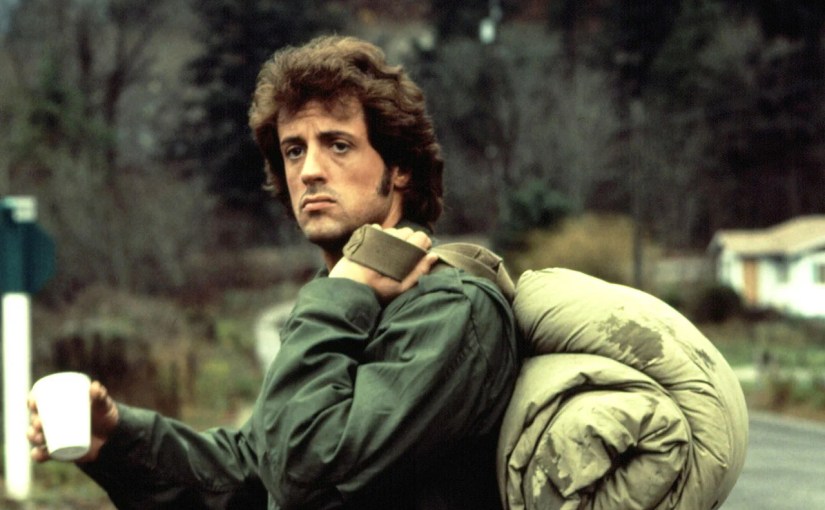
FIRST BLOOD

By Marc S. Sanders

1982 was a significant year in Sylvester Stallone’s career.  He helped popularize a rock anthem from Survivor (Eye Of The Tiger) and he ushered in the pop icon figure with the mohawk and gold chains, known as Mr. T, when the third chapter of his Philadelphia sad sack boxer, Rocky,  became a huge hit at the box office.  More importantly, however, he initiated another, bloodier, franchise character.  

Vietnam Veteran John Rambo entered a small northwestern town to catch up with an old war buddy and grab a bite to eat in First Blood, based on a bestselling novel by David Morrell.  The film, with a screenplay co-written by Stallone, contains a simple plot.  The well-liked Sheriff Teasle (Brian Dennehy) of this community takes notice of Rambo, the drifter with an American flag patched on his army coat, and immediately does not take a liking to him or his appearance.  Teasle attempts to peacefully escort the stranger beyond the city limits.  As soon as he drops Rambo off on the other side of the bridge, the former Green Beret turns around and starts to walk back into town.  A conflict is now set off that will carry the rest of the picture.

After Teasle arrests Rambo, an abusive jail search and frisk awakens the post traumatic stress that the veteran appears to be haunted by from his experiences when he was held captive by the Viet Cong.  A thrilling action sequence is welcomed by Rambo’s escape into the wintery cold mountains.  Now a personal war pitting the tormented man against Teasle’s local law enforcement has been waged.  Perhaps the only way this will end peacefully is if Rambo’s former commander, Colonel Trautman (Richard Crenna), can reign the soldier in before there’s loss of life or any further injury.

The irony of First Blood, Rambo’s first cinematic adventure, is that there is only one fatality in the whole picture.  Rambo is not necessarily a cold blooded killer.  Just don’t push him.  Otherwise, the picture hinges quite a bit on the inventive booby traps that he sets up with only what accompanies his multipurpose six-inch bayonet knife and what can be uncovered within the dense woods.  The traps are quite daring and believable, and as an action picture, it makes for good entertainment.

First Blood may attempt to demonstrate the residual effects of returning home from a tortuous war, but I do not think it sends the best message.  I could never truly understand Teasle’s  immediate abhorrence for Rambo.  This is just a guy who’s walking on by.  Where does the alarm stem from in the Sheriff’s mind?  Maybe a reader can give me some insight that I have failed to recognize after repeated viewings of the film.  

The best part of First Blood is the ending which likely offers one of the best acting scenes in Sylvester Stallone’s enormously long career.  As the adventure is wrapping up, a well written and heartbreaking monologue is delivered that unleashes the terrible trauma the Veteran carries.  Stallone gets to such a manic state of tears and anxiety that it seems so natural.  His voice gets convincingly hoarse.  His face contorts into believable anguish.  At times it is hard to comprehend what he’s describing to Colonel Trautman, but it’s easy to see the distress the character has been living with.  It’s also a perfect summation of the film.  

In this first film, before the subsequent sequels focusing on sensationalized violence, it is apparent how John Rambo contains his heartache and resorts to release what he’s coping with by fighting back against a higher power and refusing to surrender.   The closing monologue perfectly demonstrates that.  It’s as if this man has been holding his breath under water and now, once all the ammunition is expended and the town is in flames, he can finally release what’s been buried in his gut, in his subconscious, for so long.  

1982 was an appropriate time to release First Blood.  It had been ten years since the United States pulled out of a long, losing war in Vietnam.  During the Reagan years, it is fair to argue that life had become quaint and peaceful in this country.  There were remnants of a Cold War still brewing, but there was not a violently long conflict any longer to report.  Pop culture and materialism were being embraced.  Cost of living was working well for the middle class.  Sadly though, there were plenty of people who served who could not put behind the mental scars they took home with them.  Many of these men and women remain forgotten.  Some never returned and some are still unaccounted for.  David Morrell’s story attempted to bring attention to these oversights.  Though the ending to the film adaptation is far different than Morrell’s book, the message is consistent.  

I do not think First Blood is a more effective narrative than The Deer Hunter or Oliver Stone’s well received Vietnam pictures to come out later in the decade.  After all, this is by and large an action adventure.  However, due to the popularity that Stallone carried with the Rambo character, it may have garnered attention for those that never should have been neglected.  
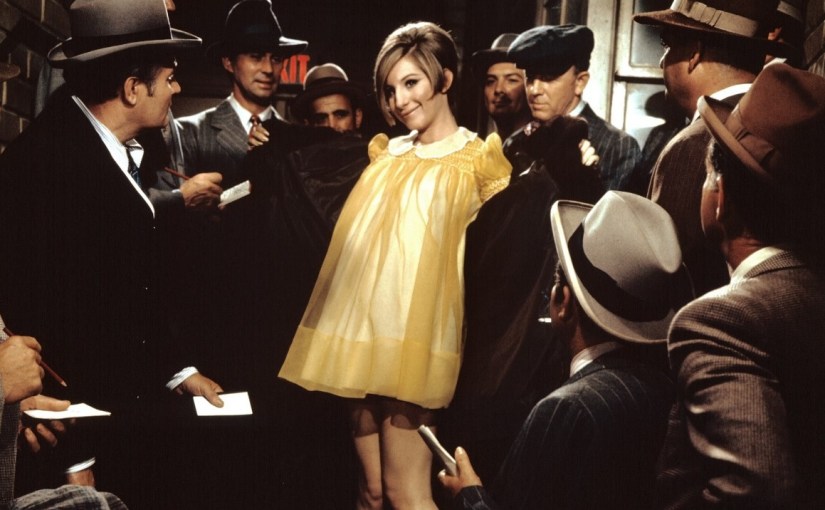
FUNNY GIRL (1968)

by Miguel E. Rodriguez

DIRECTOR: William Wyler
CAST: Barbra Streisand, Omar Sharif, Kay Medford, Walter Pidgeon
MY RATING: 7/10
ROTTEN TOMATOMETER: 94% Certified Fresh

PLOT: Barbra Streisand elevates this otherwise rote musical melodrama with her ultra-memorable star turn as real-life stage performer Fanny Brice.


There is nothing wrong with Funny Girl that couldn’t have been fixed by the film not taking itself so seriously.  With its widescreen compositions and scores of extras and lavish stage productions featuring flocks of Ziegfeld girls in the most extravagant costumes imaginable, this should have been a romp, even with the serious bits in between.  Instead, the movie sinks under the weight of its pretentiousness, short-changing the funniest bits and wallowing in pathos way more than is necessary.  Thank goodness Barbra Streisand is there, giving a debut performance for the ages that is part Groucho Marx, part Debbie Reynolds, but mostly just Barbra.  Come for the spectacle, stay for the songs.

The story begins with Fanny Brice (Streisand) walking backstage at a theater and delivering her immortal opening line to a mirror: “Hello, gorgeous.”  From there, the rest of the movie is a flashback to the rise and rise of Fanny Brice, a plain-ish vaudeville chorus girl who is discovered by a roguish playboy, Nick Arnstein, played by Omar Sharif, who looks like a man whose last name would be anything BUT Arnstein.  He cleverly gets her boss to raise her pay to $50 a week (about $800 in today’s dollars, so not bad), and in the process captures Fanny’s heart.  Shortly after that, she’s invited to join Florenz Ziegfeld’s legendary troupe of dancing girls, where she manages to tweak his authority in probably the funniest number in the movie, “His Love Makes Me Beautiful.”

It’s in this number where the first tonal tug-of-war takes place between Streisand’s playfulness and the movie’s urgency to look “important.”  There is an earlier number, “I’m the Greatest Star”, that really showcases Streisand, but the movie never gets that tone right for the rest of the movie.  In “His Love Makes Me Beautiful”, she has these wonderful glances and occasional throwaway lines, but most of them are lost in medium or long shots that emphasize the extravagant Ziegfeld costumes and the expensive-looking set dressing.  It’s like watching a play where the lights are shining everywhere except the stage.

Arnstein comes and goes, sometimes for weeks or months at a stretch, always making sure to see Fanny when he’s in town but repeatedly pointing out that he doesn’t want to be tied down by a relationship.  Their “courtship” lasts through “People”, a song most people know without knowing what it’s from, and a curious number where Arnstein invites her to dinner in a private room upholstered entirely in red velvet, and we know and Fanny knows what’s going to happen, and she has a funny argument between her lust and her manners in “You Are Woman, I Am Man.”  The song also contains a duet with Arnstein, and brother, if you haven’t seen Omar Sharif crooning, you haven’t lived.

Everything comes to a head at the finale of Act One when Fanny learns Arnstein is sailing to Europe and decides to join him instead of going to the Ziegfeld girls’ next port of call.  Here is where Streisand really pours it on, proving her virtuosity with the classic “Don’t Rain on My Parade”, belting out note after note and ending on the iconic shot of her standing on a tugboat as it passes the Statue of Liberty.  If anyone ever doubted she was the real thing before that moment and this movie, their doubts were certainly erased by intermission.

Alas, all good things come to an end, and Act Two falls into a predictable series of economic rises and falls as Arnstein’s volatile income stream finally goes south permanently, while Fanny’s career continues arcing upwards without looking back.  It’s here where the pretentious sensibilities of the filmmakers finally take over for good.  In a second number that could have been downright hilarious, “The Swan”, the movie once again keeps its distance from Streisand’s (appropriate) mugging, asides, and pratfalls…although, being a ballet, it is interesting to see her doing all the dancing herself.

I found myself committing a critical sin by comparing this movie to another widescreen, elaborate movie musical from around the same era, My Fair Lady.  Here’s a movie shot on a grand scale with huge sets, lavish costumes, and big musical numbers, but instead of feeling ponderous, there is a lightness to it.  It zings along, even during the long stretches between songs, thanks to its crackling pace, and gives us just enough pathos to appreciate why we need glee and glamour.

Everything that’s wrong with Funny Girl could have been fixed by just lightening the mood, man.  You’ve got a star-making performance by an experienced theatre actress (Streisand is actually reprising the role she played on Broadway), you’ve got one of the most legendary directors of the time at the helm, William Wyler (Ben-Hur, Roman Holiday), and you’ve got some above-average songs that people can still hum over fifty years later.  Why cloak everything in this gloomy overcoat of affectation and heavy-handed emotional beats that we can see coming a mile away?

When all is said and done, Funny Girl is by no means a bad film.  Streisand is too good at what she does to let this movie fall by the wayside without recognition.  But without her, it’s easy to imagine this movie sinking into near-obscurity, yet another maudlin melodrama that crams 100 minutes of story into a 2-hour-and-35-minute film.  So, rather than mourn what could have been, let’s instead give thanks for what we’ve got: one of the last of the old-fashioned Hollywood musicals with a 24-karat-gold star at its center and a handful of memorable songs.  I suppose it could have been worse.  [insert shrug emoji here]

THE IRON CLAW

By Marc S. Sanders

A compelling sports movie requires that uphill battle that must be overcome.  Rocky achieved that standard.  Raging Bull might not have reached a plateau for its protagonist to defy his faults, but Jake LaMotta’s demons were effectively on display. Reminiscent of that film, is The Iron Claw – the wrestling film that reenacts that supposed cursed theme linked with the famed all star Von Erich family. 

Writer/Director Sean Durkin opens his film with the patriarch of the family, Fritz Von Erich (Holt McCallany), in the ring and putting his signature move, THE IRON CLAW, on an opponent.  The title of the picture occupies the screen in big letters, and we jump to the late 1970s where the four sons of Fritz are having breakfast.  Fritz tells the youngest, Michael (Stanley Simons), that he needs to start working out, building his physique to catch up to his impressively built brothers if he wants to compete like them.  Fritz makes it clear he loves Mike the least but the rankings can change if he works at it.  Durkin’s breakfast scene sets off the pattern of the film where the four boys will have to live under the mantra of their father’s iron claw of unwavering expectations. 

The stand out role belongs to Zac Efron as Kevin Von Erich.  If he does not earn at least an Oscar nomination, then people have not been paying attention.  Kevin is establishing a name for himself in the nearby Texas wrestling federation, and Fritz sees opportunity for him to carry the torch of the family into national and worldwide championships.  What Fritz could not accomplish in his youth, he will ensure his sons complete.  If it is not Kevin, it’ll be one of the other boys.  Kevin is protective of his brothers, as best he can against their father.  The mother, Doris (Maura Tierney, another under the radar performance), makes it her mission to stay out of her husband’s controlling design of mentoring in a household where almighty God will lead the way, and handguns represent the American freedom to bear.

The other brothers consist of Kerry (Jeremy Allen White) and David (Harris Dickinson).  Kerry was on his way to Olympic gold in shot put until the United States opted to withdraw from the games.  Thereafter, Fritz directs his boy’s focus on wrestling as well. Kerry eventually finds himself in the center ring spotlight too. Durkin’s film shapes out each boy’s destiny as cause and effect based on the outcomes of the other boys.

I do not want to share much more.  While I had heard of the Von Erich family, I was not familiar with what they encountered during the boys’ young adult upbringing and within the spotlight.  Sean Durkin writes well drawn characters based on the real-life figures.  Fritz was a villain, a harsh antagonist, who was not so much a father as he was a chess player using his sons as pawns to win and win again.  If a setback occurred, then he turned to another athletic boy in his regiment to step up and fill a void.  If one of the boys were progressing, then he became the father’s primary focus, while another was pushed down a notch.  Holt McCallany is astonishing in this role. Fritz was a coach and hardly a father.  Any scene he occupies defines the obedience his character expects of his family.  Along with many others involved in the film, he is worthy of Oscar recognition as well.

Zac Efron has gone full method with a chiseled body and a mop top haircut that is a full departure from his pretty boy athletic physique.  As Kevin, what he’s done with his body should garner applause, but Efron’s character is tormented with never accomplishing enough, while accepting his father’s oversight when opportunity presents itself with one of his other brothers.  Kevin and his siblings are absolutely forbidden to cry at loss or setback.  This only allows the pain to remain unhidden on Efron’s face.  With no dialogue, the lead actor puts his insecurities and suffering on display whether he’s in the ring, working out or crouched in bed.  This is a stellar performance, in line with Robert DeNiro’s unforgettable portrayal of Jake LaMotta – a tortured, yet talented soul and athletic fighter imprisoned within inescapable circumstances.

Efron has terrific chemistry with Lily James as Pam, Kevin’s wife.  She is an impressive actress worthy of more attention to her career.  Lily James is not the headliner of this picture, but her response to scenes with Efron and a particular one with Maura Tierny make her acting partners all the more effective.

As the mother to these powerful men, Maura Tierny mostly hides in the background.  Should there be a chance she earns an Oscar nomination, the scene where she simply stares despondently at a black dress offers enough evidence.  This one standout moment deserves a lot of attention.

Sean Durkin is worthy of enormous accolades.  He has an ability to depict multiple stories occurring in one caption.  There’s a dizzying moment where Kevin, Kerry and David are working through their own respective progress.  Durkin blends the three athletes together, where you eventually see one hulking, flexing chest.  Above, are the blurred, sweaty faces of the three men meshed together and over one another, while working through their regimental exercises.  Their faces are layered upon each other.  

A later scene will show Kevin and Kerry practicing in an outdoor ring, with Kerry fighting a hard physical challenge.  In the foreground of this nighttime exercise, is a flashlight moving through the fields.  A subsequent moment will explain that significance.  Sean Durkin beautifully balances several biographies within this famed family.  You are viewing multiple stories at once, and nothing is ever distracting. This amounts to outstanding writing and directing that demands multiple layers.  

I became aware later that there is another son who remains unaccounted for in this picture.  Apparently, that story was cut for pacing issues.  I’m not sure I’d say it’s unfair to disregard that person within the confines of this picture.  Most biographical films take certain liberties to assemble an engaging structure, and frankly the destiny of that son is similar to what occurs with others in the movie.  Durkin opted to avoid appearing repetitive in his storytelling.  So, I stand by this decision.  

The Iron Claw is certainly the most surprising film of the year for me.  Based upon what happened within the Von Erich family, it seems so apparent that a movie would eventually be generated.  Yet, falling into melodramatic schmaltz with a drama like this is an easy trap.  Sean Durkin dodged that obstacle with a sensational cast.  There is not one weak performance in this picture.  You could make a separate film out of each perspective offered.  It’s fortunate that Durkin found a way to balance everything beautifully.

The Iron Claw is one of the best pictures of the year.

AVENGERS: INFINITY WAR

By Marc S. Sanders

Avengers: Infinity War is a really FAT movie. Like ORCA FAT (thank you Keyser Soze), because it is chock full of so much to see. If this equated to gorging on junk food, after two hours and forty minutes, I would have a diabetic cardiac arrest immediately following the credits. Is this a film that is worth that handicap, however? You bet it is.

There is an ensemble of top Hollywood talent portraying a huge cast of characters, once again, and thus another installment has surfaced in the franchise that allows them to have various moments to shine. Producer Kevin Feige with all of Disney’s support, has mastered the formula to ensemble casting and production, as good as when George Clooney and company performed under Steven Soderbergh’s direction in the Ocean’s 11 remake. Thousands of special effects shots do not overpower the stage presence of the actors. The Marvel movies succeed because a story is always written first. Then witty dialogue comes thereafter, and then valid, convincing shock value. The special effects are the final ingredient. This is what the Transformers franchise and (yes, I’ll even own up to it) the Star Wars prequel trilogy (about ¾ of it) failed to achieve. This successful formula gives merit to the (at the time) biggest opening weekend ever, worldwide, and Avengers: Infinity War deserves the accolades.

How good is it? Well, reflecting back to May 1980, when sitting in a crowded theatre watching the ending to The Empire Strikes Back, by comparison I think audiences have finally been served up a cliffhanger (10 years in the making) that is just as effective. How is this all going to wrap up from here? How is this all going to be resolved? Reader, I don’t know if the next chapter will be satisfying. I don’t know if we will feel cheated like Annie Wilkes from Stephen King’s Misery. Presently, however, I’m turning an ending like this over in my mind; the same way I did with my pals in 1980 debating the survival ratio of Han Solo and if Darth Vader has told the truth, and if that was Vader’s brain or head that I saw, and who is this “another” that Yoda referred to….and that, my friends, is what makes a spectacular film. I don’t care if it gets watered down in the hype and McDonald’s promotions and toys. If you can mull over a movie long after it has ended, for days, even months and years, then a film like The Empire Strikes Back and Avengers: Infinity War has more than served its purpose.

Josh Brolin provides a villain with a justification to his madness. He’s not just twirling his mustache to be mischievous and sinister. He has a destiny to fulfill, and his portrayal of the mad titan Thanos does not compromise. This is a beast of a purple villain with size 52 boots and gold-plated armor with a chin that looks like it was clawed by Wolverine. Thanos cries, actually cries, while committing his crimes. He’s not just cackling. He flat out says that he executes his actions all so that he can relax and retire. Isn’t that what we are all trying to do, anyway? Nothing wrong with that. Guy sounds like a CEO to a large corporation. Maybe Thanos is updated to resemble an Elon Musk. 

All of the other actors from main staple Robert Downey Jr to Chris Pratt to Chadwick Boseman to Zoe Saldana and Chris Hemsworth, and so on, remain consistent to what we’ve seen of various prior installments. Their gimmicks continue to avoid becoming stale. Audience applause is cued by their appearances. These are well loved characters.

As an avid comic book reader of the silver age (1980s), Avengers: Infinity War presents itself as of one those annual limited series runs that were special because they were MAIN EVENTS!!!! My favorite back then was Marvel’s Secret Wars. Typically, a comic book from the 1980s would average about 18-22 pages with advertisements sprinkled in. Nearly every scene in this film equates to one issue of a limited run of a main event. That is a why a fat movie like this succeeds. The cast of characters are separated in various story lines. The scenes are given their time to flesh out and develop to move the subplots and overall story along. Each scene is like reading a new 18 page issue comic book. If I’m watching a comic book film, by golly, I want to see how a comic book is brought to life in a cinematic medium. Marvel’s films succeed greatly over DC’s films (produced by Warner Bros) because they rely on the source material. They know they got the goods. Cast it right, adapt it properly and go with that. If it ain’t broke, don’t fix it. A wealth of material (nearly 70 years) and Marvel/Disney uses it all. (How does DC/Warner Bros miss the mark so often?)

Of all of the Avengers films, Infinity War is definitely the best one. Ironically, I wasn’t expecting it to be. I was waiting for this stuff to get old and tiring. It just hasn’t faltered yet. It hasn’t gotten lazy yet. It all seems so fresh still. It’s a fantastic cinematic accomplishment. Sure, its main story is a guy chasing down six different colorful MacGuffins. So what! It’s simple. It allows the characters to stand out from there. An organized plotline like this doesn’t take much effort or time to explain its purpose. It states its conflict early on, and then the show stopping moments present themselves. One after the other after the other until a monster of an ending that is so jaw dropping, head shaking, thrilling and gasping, satisfyingly arrives. 

More importantly, the MacGuffin search drives the motivations and fleshes out the film’s main character, Thanos. This Marvel installment belongs to Josh Brolin as Thanos. Everyone else serves as his antagonists. What matters is that the bad guy wins this time, just like demonstrating that an Empire will strike back. Ironic that Spider-Man makes a humorous correlation to that celebrated franchise from almost forty years ago.

Avengers: Infinity War ended up in my top 10 list of 2018, and still holds as the best film in the Marvel Cinematic Universe.

CLASS ACTION

By Marc S. Sanders

Two sharp San Francisco attorneys go against one another in Michael Apted’s Class Action.  The hitch is that it is father vs daughter and the two were adversarial with each other long before this trial ever began.

Gene Hackman is Jed Ward, the small-time lawyer who grandstands big theatrics in a courtroom while fighting for the little man who’s repeatedly suffered at the negligence of Goliath corporations.  His daughter is Margaret Ward played by Mary Elizabeth Mastrantonio.  She’s vying to be partner for the giant law firm that represents an automobile manufacturer getting sued for faulty explosive gas tanks on their cars.  

Jed is bullish and cocky.  Margaret is trying to prove her dominance over a father who repeatedly cheated on mom and was hardly the devoted dad as he pursued one landmark case or bed partner after another.

I saw Class Action in college while taking a law studies class.  The case at hand was inspired by a well-known trial focused on Ford Pintos.  Ford was found to deliberately ignore a faulty car part because the cost to replace the item on all of their automobiles would far outweigh the cost to settle with all of the victims of the class action lawsuit.  That’s a neat connection showing what was real being weaved into a fictitious story.  

The problem with Apted’s film is the amount of melodramatic scenes devoted to its father and daughter main characters.  It’s hammered into our consciousness over and over, and like most arguments they run in circles, getting nowhere.  We get it already.  You’ve got animosity towards each other.  Move along!

The olive branch is eventually extended as the film is approaching its standard third act, conveniently thanks to the giant law firm’s indiscretions to conceal evidence for the sake of victory.  

I’m really not spoiling much here.  This is a paint by numbers, cookie cutter outline.  You can see where everything will fall as soon as the 20th Century Fox logo appears at the beginning.

These are two good actors, but Gene Hackman is far better.  Most would agree. Mary Elizabeth Mastrantonio is not a good enough contender against him.  Hackman comes off fierce.  Mastrantonio comes off hokey like something out of a day time soap opera. She’s been much more impactful in other films like The Color Of Money and even Robin Hood: Prince Of Thieves.

I argue though that she would have been much more effective if James Horner’s instrumental music wasn’t used so much. I can feel the emotions with just the two playing out their scenes of dialogue and tempers flaring.  I shouldn’t need help to get there from a swooning saxophone that intrudes and plays over, of all people, the great Gene Hackman.  

Too much is focused on the family melodrama that also includes the mom/wife (Joanna Merlin) caught right in the middle.  I got tired of it.

I’m a sucker for courtroom drama.  I know.  In most movies, you know the beats of a cinematic trial.  You can easily predict which witness is going to be undone on the witness stand.  You likely will predict who will win the trial.  Yet, I get a thrill out of the rapid-fire pace of the questioning and the calls for objections with the barking rulings heaped on by the judge.  It’s all standard, but I gobble it up like potato chips.  The two leads are marvelous in the courtroom, despite the spoon fed ease the script allows.

When the two are screaming at each other about their past transgressions, I had no interest.  The film angles itself as a courtroom thriller with a twist on the litigators when it’s barely that way at all.  

It’s right in front of you guys!  An astounding case of deliberate negligence by one of the country’s biggest industrialists.  Why couldn’t we uncover more of the underhandedness that occurred there? Regrettably, the trial takes second banana to the trite family squabbles with a cheesy late ‘80s soundtrack. 

Hard and Fast Rule: Don’t ever play off the great Gene Hackman.

COME DRINK WITH ME (Hong Kong, 1966)

by Miguel E. Rodriguez

DIRECTOR: King Hu
CAST: Pei-Pei Cheng, Hua Yueh, Chih-Ching Yang
MY RATING: 8/10
ROTTEN TOMATOMETER: 100%

PLOT: A highly skilled martial artist (Pei-Pei Cheng) is dispatched to rescue her own brother from kidnappers.


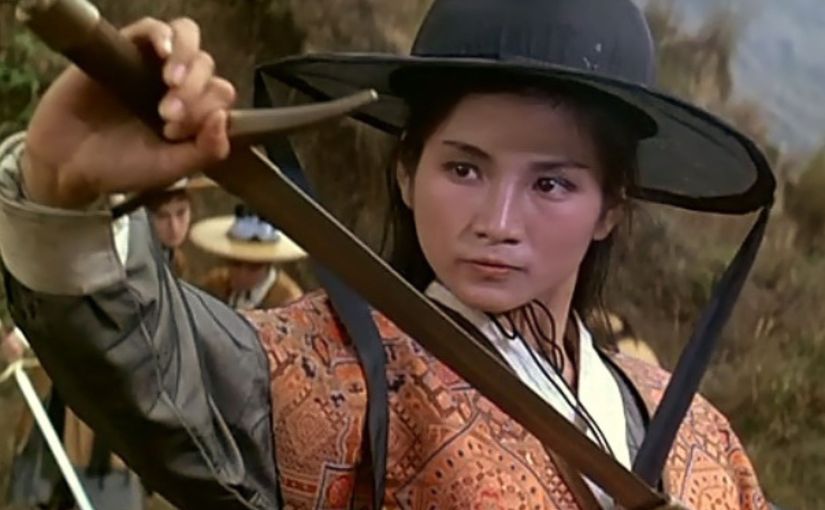
King Hu’s Come Drink with Me feels like a multiverse version of Ang Lee’s Crouching Tiger, Hidden Dragon, and no wonder: Lee, like so many of his countrymen, is a huge fan of the wuxia genre of films that have been around since the 1930s.  Come Drink with Me created the template that was faithfully followed by many other films in the succeeding years, and while I cannot claim to have seen them all, it is plainly visible that this film was their prototype, much like Halloween laid the groundwork for countless other slasher films.

Right from the opening scene, the focus is clearly on action above all else.  We watch a caravan taking prisoners to jail, in the traditionally accepted timeframe of what looks like medieval China.  The caravan is stopped by a lone figure who announces himself as the leader of the bandits known as The Five Tigers.  The gang’s name alone evokes scores of kung-fu films aired on Saturday afternoons on Channel 44. A furious battle ensues in which the prisoners are freed, and a government official is kidnapped by the bandits and ransomed in exchange for the release of another one of their comrades.  Rather than pay the ransom, the government sends a lone warrior, Golden Swallow (Pei-Pei Cheng), to rescue the captured man. (If Golden Swallow looks familiar, that’s because she played the villainous Jade Fox in Crouching Tiger, Hidden Dragon, further enhancing the idea that we’re in some kind of wuxia multiverse.)

That’s all in literally the movie’s first five-to-ten minutes.  Everything that happens afterwards is one action sequence after another, with only two breaks for a breather.  There is a bar brawl that looks curiously similar to the one featured in Crouching Tiger, Hidden Dragon, complete with some impossible acrobatics from the heroine as she leaps from a wall to the upturned legs of a table to the other side of the room.  Granted, it’s not as technically sophisticated as the newer film, but the influence is undeniable.

There is a chase across the rooftops at night, another element clearly appropriated by Crouching Tiger.  Golden Swallow fights off wave after wave of enemy thugs, most of them wielding swords, but some of them hurling wicked needles and darts, one of which finds its mark and lands Golden Swallow in the care of a man, Fan Ta-p’I, who she thought was a drunkard, but who turns out to be a skilled martial artist himself.  These two will eventually cooperate to accomplish their mission, along with a second mission that reveals itself organically.

I must say I wasn’t altogether thrilled with this secondary plot element because it takes the spotlight from Golden Swallow, who dominates three-quarters of the movie.  However, I immediately let it slide when it provided the opportunity to showcase one of Fan’s hidden skills: the ability to manipulate and focus the air so it flows from his hand and can part the cascading stream of a nearby waterfall.  That’s right out of comic books, man.  Or “Avatar: The Last Airbender.”  Take your pick.

To say Come Drink with Me is inferior because it is not as technically sophisticated as modern martial arts films is to overlook its relevance.  Yes, there are a lot of quick cuts used to hide some otherwise impossible-to-perform maneuvers.  Yes, a lot of the dialogue (what little of it there is) is either hammy or overly expository, or both.  Yes, the fight choreography, on close inspection, is not as polished as we’ve come to expect after seeing The Matrix or House of Flying Daggers.

But as an artifact of where today’s martial arts films began, Come Drink with Me is incredibly valuable and still entertaining, even in its relative crudeness.  I loved being able to draw straight lines from specific scenes in this movie to Crouching Tiger, or even all the way to the John Wick franchise.  The last John Wick film featured a scene where Wick fights off an almost literal army of henchmen on a long staircase.  I laughed at the audacity and absurdity of the situation…but I rolled with it, because that’s just what John Wick does: he fights, and he endures.  Why?  Because if he didn’t, he wouldn’t be named John Wick.  Same thing applies to Jason Bourne and James Bond.

And the same thing with Come Drink with Me.  The obviously overmatched Golden Swallow picks off the hordes of attackers one by one because they’re foolish enough to only attack her one or two at a time.  Why?  Because the story demands it.  It’s tradition, even when it looks goofy and unrealistic.  It took me some time to grasp that core concept, but when I did, my enjoyment of these older swordplay films deepened considerably.

THE PAWNBROKER (1964)

by Miguel E. Rodriguez

DIRECTOR: Sidney Lumet
CAST: Rod Steiger, Geraldine Fitzgerald, Brock Peters, Jaime Sánchez
MY RATING: 7/10
ROTTEN TOMATOMETER: 86%

PLOT: A Jewish pawnbroker, victim of Nazi persecution, loses all faith in his fellow man until he realizes too late the tragedy of his actions.


One of my favorite books about movies is Making Movies by Sidney Lumet, in which the legendary director explains in detail the moviemaking process from script selection through the preview screening and ancillary rights distribution.  He uses, of course, the movies from his own career as examples, from 12 Angry Men through Guilty as Sin (the book was first published in 1995).  One of the films he brings up many times is one I had not heard of when I picked up the book for the first time: The Pawnbroker, from 1964, starring Rod Steiger.  After reading the book many times, I found myself obsessed with finding and watching this, to me, unknown film.

For a long time, it remained a kind of missing link in Lumet’s filmography.  It wasn’t available on home video, and it wasn’t streaming anywhere.  In 2008, it was selected for preservation by the National Film Registry, and the New York Times calls it one of the 1,000 best films ever made.  Lumet is one of my favorite directors.  I was desperate to see this movie.

Some time ago, I finally found a (relatively) cheap copy on Blu Ray, and I sat down and pushed PLAY with anticipation.  I mention all of this because I believe I inadvertently made myself a victim of my expectations.  The film that unfolded was not quite as hard-hitting as I had hoped, even though the story is deep and dark.  Perhaps I am too jaded as a modern filmgoer, with so many other Holocaust-related films under my belt, to fully appreciate this intensely acted character study of a man in crisis.  I can see myself changing my opinion of this movie at some point in the future, maybe when I’m a little older.  For now, in my opinion, The Pawnbroker is a well-crafted film, thoughtfully written, but a little too heavy-handed for its own good.

Sol Nazerman (Rod Steiger) is the aging Jewish owner of a pawn shop in New York City…I’m not familiar with the specific neighborhood, but I wanna say somewhere in the Bronx, or maybe Queens.  He and his Puerto Rican employee, Jesus Ortiz (Jaime Sánchez), run the shop with maximum efficiency and minimal customer interaction.  (Hey, look at that, a guy named Jesus with a Jewish boss, I only just now got that…)  Sol is not interested in the backstories of these desperate folks who bring in radios and candlesticks and school trophies in exchange for a couple of bucks each.  “Here’s your money, get out.”  Jesus, on the other hand, is a bundle of energy who sincerely wants to learn the trade and earn some money so he can get out of the 2-room apartment he shares with his mother.  Sol tolerates Jesus the same way a parent tolerates a hyperactive child.

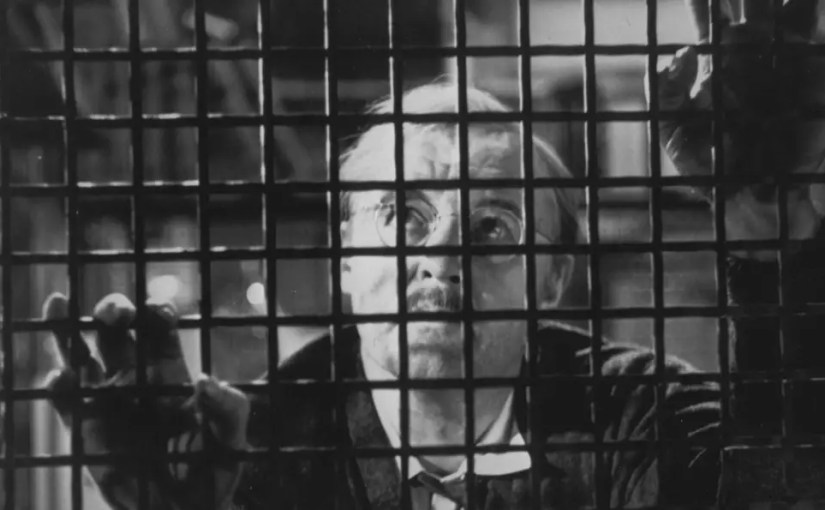
Lumet and his production designer, Richard Sylbert, are very careful to show Sol’s store as nothing but a series of cages and bars.  We learn the reason for this as we see a series of flashbacks from Sol’s past: he was a Holocaust survivor.  (There’s a brilliant scene where Jesus asks Sol what those numbers on his arm are.  “Is that a secret society or something?  What do I do to join?”  Sol’s one-line answer is one of the best things in the script, followed later in the film by a monologue about clinging to a “bearded legend” that showcases Steiger’s talent to the nth degree, but feels a tad over-dramatic.)

Sol’s tragic past is the fuel that runs the engine of the film because it’s made him the man he is today: someone who doesn’t believe in anything anymore, not God, science, art, anything at all…except for one thing: money.  “Next to the speed of light, which Einstein says is the only absolute in the universe, second only to that, I rank money!”  While this sentiment seems as if it would feed into a racist stereotype, Sol never overtly occupies that space.  He is just a man who has seen too much and wants nothing except to get by.

There are suggestions that he is experiencing survivor’s guilt.  In his shop is a tear-a-day calendar showing September 29th.  When Jesus wants to rip it for the next day, Sol stops him.  Later, someone asks him if it’s an anniversary of something.  He says it is: “The day I didn’t die.”  That was the day he was powerless to stop a tragedy, and he should have died, but didn’t.  But he doesn’t frame it as a dramatic act.  I found that a marvelously layered response.  (There is another “suggestion” of his guilt in a monologue by a much older man, but that’s another one of the movie’s heavy-handed moments, so the less said about that, the better.)

There is also a suggestion that Sol is accepting payoffs from a local slum lord to launder money through his pawn shop.  A man comes by, says he needs money to repaint the building, Sol writes the man a check for $5,000, and the man gives him $5,000 in cash.  Why does Sol willingly acquiesce to this process of aiding and abetting a criminal?  I think it’s because he has learned to survive no matter the cost.  In one of his increasingly disturbing flashbacks to his days in the Nazi concentration camp, we watch as a man frantically attempts to scale a fence.  There’s no real hope of escape, but he tries anyway.  The guards don’t shoot him, but watch almost in bemusement.  One of them finally calls for another guard with a German shepherd.  And just yards away, Sol and other prisoners watch helplessly as the man is torn apart.  (Presumably, anyway.)

I haven’t even mentioned the social worker who comes by one day to solicit donations for a youth center, the local thugs (former friends of Jesus) who reek of foreshadowing, the slum lord himself (Brock Peters, playing totally against type as an amoral crook), or Jesus’s hooker girlfriend who knows how desperate Jesus is to get some money of his own and boldly offers her body to Sol in exchange for some cash.  Her act of desperation (featuring the first waist-up female nudity in a post-Code Hollywood film) only triggers more flashbacks for poor Sol. [HA! Jesus has a girlfriend who’s a prostitute…I only just got that one, too…]

By the end of the movie, events conspire that trigger even more feelings of guilt for Sol so that the film ends with him wandering out of his store and into the inner-city jungle with his hands bloody and his head bowed.  Has he realized the error of his ways, of his tendency to reject any kind of human connection?  Certainly his last act seems to demonstrate his remorse, but…has he really changed?  It’s said that, to figure out what a movie is about, look at how the main character changes from beginning to end.  Maybe I’m naïve, maybe I’ve been lucky enough in my life not to have experienced anything remotely resembling the tragedy of Sol’s life, but I felt nothing except mild shock at the end of The Pawnbroker, not because of any realizations about Sol’s character, but because of the events of the plot.  I don’t think that means the same thing as character development.  So, ultimately, I couldn’t really say what this movie is about beyond the ability of a fine director and a courageous actor to show the details of a man wounded so grievously in his past that he can barely tolerate mankind in the present.  Yes, we see the error of his ways…but does he?  You tell me.

THE JERK

By Marc S. Sanders

As I close out this year, 2023, it’s funny that one of the last films I watched was The Jerk, directed by Carl Reiner with Steve Martin as dumb, lovable, idiotic, adorable, and moronic Navin – who was raised as “a poor black child.”  I find it funny because I have just come off the heels of directing a play I co-wrote with a best friend I just lost from ALS.  That friend was a part of my life for thirty years, and his name was Joe Pauly.  The play was a smack in the face, a head slammed against a door with an enormous amount of pratfalls to Charles Dickens’ holiday classic.  Joe and I called it A Christmas Carol Gets Decked

The play was an enormous box office hit for our theater, but the reaction to the show was mixed.  There were big laughs each night, but we also had some walkouts at intermission, and I wasn’t surprised.  Slapstick is not for everyone.  The cast was always brilliant though.

As I watched The Jerk, first I was sad that I never, ever talked about this movie with my pal Joe.  I bet he loved it.  Second, I found it fitting that my heroes Roger Ebert and Gene Siskel didn’t care for it.  Their review from 1979 can be found on YouTube.  Ebert simply said he didn’t like Steve Martin’s form of comedy.  He’s just not a fan.  Fair enough.  Siskel said the star’s brand of humor was Steve Martin doing Steve Martin, and it would have worked better as Steve Martin doing comedy as the character, Navin.  I do not think Gene Siskel is wrong.  I look at The Jerk, and I think Joe and I accomplished what Steve Martin was doing.  There is a collection of gags that I do not think are funny, but then there are at least an equal amount of jokes that are utterly hilarious and thankfully shocking.  Joe and I took a risk with comedy, just like Steve Martin; like anyone who is brave enough to enter through that dark valley alone where the act is always a test, night after night, performance after performance.

I love the plot of The Jerk, which is straight out of a Three Stooges short. Navin stands out from his family as the one with white skin and no rhythm amongst his large southern, black family.  I was so pleased to see Mabel King from What’s Happening!!! portraying Navin’s mother.  Following his birthday, Navin embarks on a journey to St. Louis to discover a life for himself.  He gets a job working for Jackie Mason at a gas station and falls into a fortune when he shares his invention for eyeglasses with a random customer (Bill Macy).  Along the way, he falls in love with Marie, a sweet Bernadette Peters, who looks like Alfalfa’s crush from The Little Rascals.  They get a mansion and live filthy rich, blah, blah, blah. SPOILER ALERT!!!!! The film’s famed director, Carl Reiner, reveals that Navin’s invention is defective and following a one, two, three class action lawsuit, Navin and Marie are flat broke.  I love the body of this plot.  Rags to riches to rags opens an invitation for one gag after another.

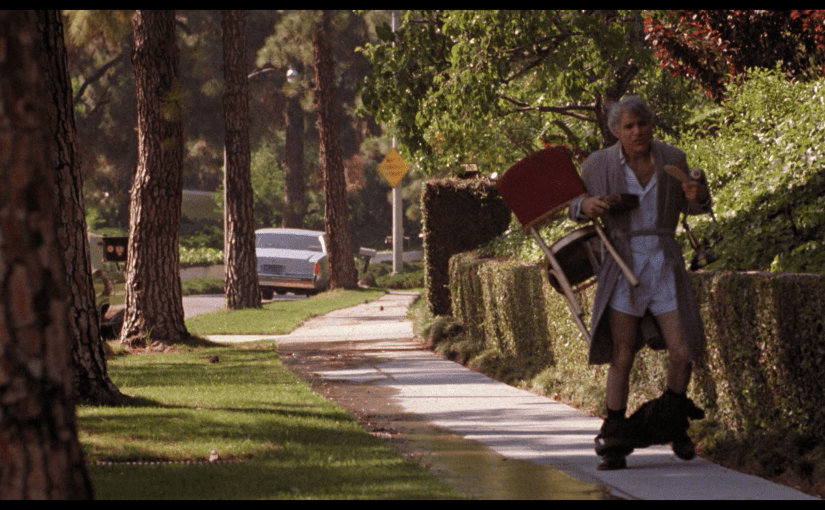
There’s his trusty dog named Shit Head.  Navin insists on no longer drinking the old wine.  Bring him the new stuff.  A crazed sniper (M Emmet Walsh) tries to kill Navin, misses and Navin reasonably concludes that it must be the oil cans that the killer has a grudge against, when the bullet holes spring leaks. Makes sense to me!  If you accidentally run outside naked to chase after the one you love, who is leaving you, then of course you will reach for the dogs nearby to cover up your bare behind and “your special purpose.”  Hilarious stuff.

There’s material that doesn’t work as well, but that’s just me.  Like the audiences that saw the play Joe and I wrote this year, what one person thinks is funny, another will not.  It’s a balancing act.  I’m not here to mandate what works and does not work for you.  I just want to celebrate Steve Martin’s inspired Three Stooges spawn that welcomed him to the big screen, long before the antics of Jim Carrey – who I rarely think is funny and simply comes off as an annoying child who won’t sit still.  That being said, I still prefer Martin’s  later work where he played the straight man victim to someone else’s annoyance such as in Planes, Trains and Automobiles (a favorite film of Joe and I, collectively) and Parenthood, not to mention the brilliant Only Murders In The Building, and his routines on Johnny Carson (a hilarious magician was my favorite) and Saturday Night Live.  The guy is an enormous talent far beyond The Jerk or The Man With Two Brains.

The Jerk had always eluded me, until now.  I think my parents wouldn’t let me watch it.  Dad thought the material was “filthy.”  He probably saw the one gag where the kid is running around with a t-shirt having the phrase “Bull Shit,” and thus opportunity passed me by.  Yet, he didn’t mind if I watched Dirty Harry or any of Bill Murray’s comedies.  Go figure.  That’s what the varying degrees of humor lend to you.  There are no straight answers in comedy.

Still, I’m glad I watched the movie.  2023 was melancholy for me.  There were some enormous ups, but losing my pal Joe, the Del Griffith to my Neal Page, was an expected but very hard moment to accept when he passed on December 4.  I’m still struggling with the loss.  In his last six months, he couldn’t speak with me on the phone, but at least I could text with him, and once the movie ended with Steve Martin happily dancing to banjo rhythms with his black family, I picked up my phone ready to write to him.  It couldn’t happen anymore.  At least not that way, from now on.  So, here I am on holiday break surfing Netflix, and there’s The Jerk with a warning that it was leaving the streaming service soon.  Joe must have been urging me to finally catch up with Navin, the poor black child.  Thanks Joe.

Chin up everyone.  We were all a name in a phone book. Happy New Year!!!!

THE HATEFUL EIGHT

By Marc S. Sanders

Quentin Tarantino’s eighth film, The Hateful Eight, has the signature director’s fingerprints all over, but it still stands apart from the rest thanks to a lurid, foreboding soundtrack from Ennio Morricone with an Agatha Christie narrative approach.

During a post-Civil War period, near the mountaintops of Wisconsin, an image of a crucifixion post is blanketed in snow as a stagecoach races past.  The cold symbol spells doom.  The coach is stopped by a curious, well-dressed man in the middle of the road.  This is Major Marquis Warren (Samuel L Jackson), a legendary black Union veteran, now bounty hunter.  With a fierce blizzard on its way, the Major convinces another bounty hunter, who has paid for the coach, to hitch a ride.  That man is John Ruth (Kurt Russell) and he’s escorting his ten-thousand-dollar bounty, a black-eyed unsavory Daisy Domergue (Jennifer Jason Leigh), to her hanging in the nearby town of Red Rock.  A would-be sheriff of that town eventually hitches a ride as well, Chris Mannix (Walton Goggins). The coach has to take shelter from an oncoming blizzard at Minnie’s Haberdashery, where four other men are already holed up.  They are Confederate General Sandy Smithers (Bruce Dern), the charming British hangman Oswaldo Mobray (Tim Roth), Cowboy Joe Gage (Michael Madsen) and the giant like Mexican Bob (Demian Bichir).  Tarantino has invented another collection of seedy two-dimensional characters whose unique appearances and vocal inflections set them apart from the rest of the gang respectively. Still, they are interesting enough.

The first celebrated performer of the piece is Morricone’s Oscar winning soundtrack which is totally eerie, sinister and immersive.  I go back to that carved out wooden image of Christ hanging from the cross and covered in snow.  Morricone’s music replays the same notes but with more intensity each time it starts up again.  It’s as if the Devil is luring us into his hellish lair.  If the famed Conductor’s chords could speak it would start with “Once upon a time, on a dark and stormy night…”

Twists of fate await all of these men and the one woman.  Like a mystery from Dame Agatha, the characters are set up for introduction to each other, with a little bit of back story.  The ones that especially stand out belong to Major Warren who possesses a personalized letter from President Abraham Lincoln himself.  The curious question of what could possibly merit a ten-thousand-dollar bounty for a small woman like Daisy is the other mystery I initially take notice of.  Once everyone is gathered at Minnie’s Haberdashery, how will these people intersect with one another?

The Hateful Eight plays like a short story you might find in a Reader’s Digest.  Taratino might correct me and insist that more specifically it would be found in a magazine of lurid subject matter – pulp fiction.  Go figure.  It is a theme he sticks to and continues to reinvent himself with each passing film.  The creativity comes in the new situations he constructs for his players.  He’s placed his figures in another kind of western by this point already.  He’s applied them to an alternate kind of Nazi occupied Europe during the second world war.  He’s updated swordplay in a zippy Dojo.  Now, he inserts his personalities into primarily a single setting, like Christie did time and again. 

Clues are uncovered as the film moves on to indicate that something may have happened here, before the stagecoach arrived.  There’s a broken door that needs to be nailed shut each time it is crashed opened.  A jellybean?  A chess board sits in front of the General and appears to be in the middle of a game.  And where is Minnie and Sweet Dave, the caretakers? The Major positions himself as the detective and within the small confines of this log cabin suspicions will reveal more about how the men and Daisy are connected and why they are here, now, while a harsh, unforgiving blizzard rages on outside.

The dialogue of The Hateful Eight is not as memorable as other Tarantino scripts.  Yet, the characters are just as colorful, and there are a couple of zips in time to keep you alert when a new development surfaces.  Tarantino is not shy about the bloodshed either.  The violence plays like most of his other films with a kind of slapstick twist.  A character gets violently ill and vomits blood all over Daisy.  That’s after a couple of wallops to the nose and jaw, plus a face full of stew that she’s had to endure as John Ruth’s handcuffed prisoner.  Later, someone’s brains splatter all over her. 

None of the guys are standard cowboys of the Old West either.  Goggins plays a good-natured dimwit.  Jackson is impervious to the racial name calling.  Russell is a cranky old grunt.  Your grandfathers did not take your fathers to Saturday matinee “ride ‘em into the sunset” westerns like these.  This is the most garish of material, and as in your face as it is, it’s also quite entertaining.

Tarantino has definitely graduated from the simplicity of his first films, Reservoir Dogs and Pulp Fiction.  The production value of The Hateful Eight is phenomenal.  Originally, I saw this movie in theaters with a couple of my Cinemaniac buddies.  Tarantino was proud to present it on 70mm Panavision film, complete with some intrusive lines and occasional burn spots.  Don’t tell me if this was not shot on location.  I don’t want to know.  I treasure the illusion. The deep snow-covered Wisconsin mountains are glorious to look at.  I feel completely absorbed in the setting with the harsh whispers of chilly winds happening outside as the dark blue of the snowstorm can be seen through the cabin windows.  This may be Quentin Tarantino’s most atmospheric film to date. 

This movie has a running time of three hours, but I strongly recommend to watch it without stopping.  The blu ray was a Hanukkah gift from my wife, and I tried watching the night before, but I kept having to pause it to struggle with a cold I’m currently fighting.  I only made it to “Chapter Four: Domergue’s Got A Secret.”  The next day, I told myself to start it from the beginning while everyone was out of the house and the experience was very fulfilling as Tarantino’s wintery day moves into night and then finally reaches its bloody conclusion. 

The Hateful Eight works like a graphic novel come to life.  It’s a great late-night rainy-day kind of picture.  If you haven’t seen it or it’s been a while since the last time, like it was for me, then I recommend checking it out during this winter season.  Trust me.  It just wouldn’t play as well on a hot summer night in July.  Quentin Tarantino and his cast work better when they are at their most cold blooded.

MAESTRO

By Marc S. Sanders

Bradley Cooper’s second directorial film suffers from the same ailments as his first film.  Like his interpretation of A Star Is Born, Maestro is not as good as the sum of its parts.

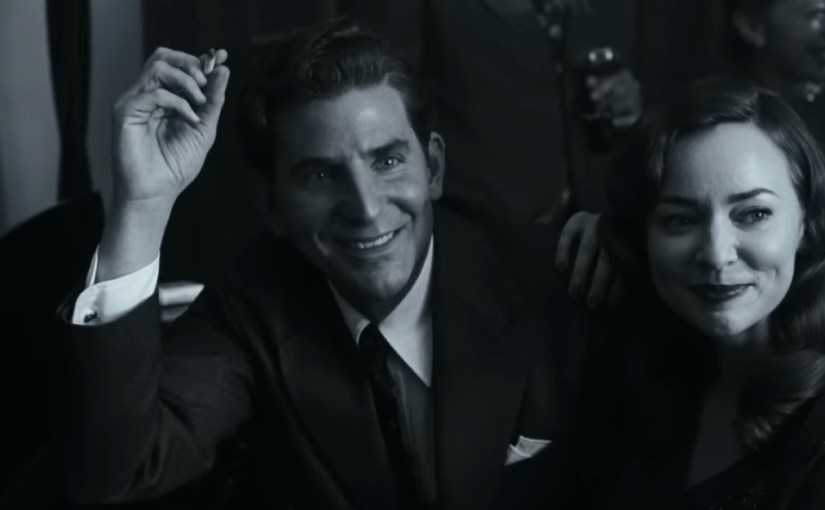
Constructively speaking Maestro is a gorgeous looking picture with a first half in a comfortable, historic black and white followed by its second half in vibrant colors.  The acting from Cooper, as Maestro Leonard Bernstein is well performed.  Carey Mulligan is sensational at no matter what age she is portraying actress Felicia Montealegre, the conductor’s wife.  Within the scenes they share together there is a beautiful rhythmic exchange of dialogue, written by Bradley Cooper and Josh Singer.  Cooper also looks powerful as he reenacts the conductor in front of his choruses and orchestras.  There are also inspiring shots that start out vague and unclear only to come into a full blossom as Cooper’s camera maintains an unbroken focus on an image. 

All that being said, none of it matters because the script from Cooper and Singer is muddied.  While Mulligan and the actor/director are in the midst of marital argument on Thanksgiving day, much is hard to understand as they naturally speak over one another, and what can be made out seems to mean nothing as they fight over people and issues that I do not believe are ever touched upon in the picture.  A scene like this looks like an actor’s dream piece, but it is hollow of substance. 

Like A Star Is Born, there are characters that enter Maestro for long winded scenes and then are never heard from again.  Either Bradley Cooper does not feel the weight of their importance, or he mistakenly presumes the audience will catch on.  An outdoor brunch with Felicia, Leonard, another couple and I believe a mentor or agent of Leonard’s seems well written, but I have no idea who those people are or what kind of influence they carry.  I was hoping to realize later, but those three amount to nothing.  Was the other couple supposed to be Leonard’s parents, and perhaps they were meeting Felicia for the first time?  I’m just not sure.

Bradley Cooper is a master with his camera.  An important moment in Bernstein’s life is when he gets the call to perform at Carnegie Hall when the other conductor calls in sick.  With its black and white imagery, a young and enthusiastic Leonard answers a phone call while a black square, with light from behind, occupies three quarters of the screen.  I was wondering if that was a stage curtain that needs to be lifted.  I was half right.  It’s a window curtain to the apartment Leonard shares with his gay lover.  The film moves into high energy as the would-be composer slaps his lover’s bottom and leaps down the stairs with a quick edit into the theater.  Mike Nichols would be proud. 

Another moment that struck me was Cooper pointing his camera up into the tall reaches of his apartment building staircase.  It’s quite dark.  You may have trouble realizing what you are looking at but then his son drops a paper airplane “good luck” note down to his father on the bottom floor.  These images blossom into something as alive as I would imagine the director/co-writer/actor regards Bernstein.

So, there is much to praise in Maestro.  Unfortunately, the assembly of these shiny, inventive, and magnificent pieces of film do not mesh very well together.  Bernstein led a homosexual lifestyle, even going so far as to welcome a lover into the home he shared with Felicia.  Carey Mulligan is excellent with expressions of resentment towards this other life that her husband follows.  However, the storyline never feels fully fleshed out.  We never get an opportunity to see the value or the menace of the other relationships that Leonard holds on to.  A so-so moment is accompanied by Bernstein’s saxophone opening to West Side Story.  The piece is used as a subtle tool of deceit and ignorant cruelty by Leonard while escorting his apprentice/lover in the home he shares with an angered Felicia in the foreground.  We presume the threat that Felicia likely feels, but it never comes to the surface. 

Bernstein’s career is glossed over as well.  Who pushed him to move on to bigger moments and acquire greater crescendos in his life?  I’d like to think it was Felicia, but I’m not certain.  Felicia has conversations with Leonard’s sister (Sarah Silverman) and other acquaintances, but what is she really alluding to or really talking about?

The most impressive moment in the film is when the Maestro conducts the London Symphony Orchestra at Ely Cathedral.  (I’ll own up and say I looked up what this scene was on IMDb.)  Bradley Cooper does a masterful reenactment of Berstein, dripping in shaggy grey hair sweat, dressed in a three-piece tuxedo with baton in hand.  This is a major multi talent working in films today.  Cooper studied film footage of the scene over a six-year period to get this six-and-a-half-minute unbroken moment caught on film.  It’s positively mesmerizing and I could watch this over and over again.  I’m waiting for the side-by-side comparison to appear on You Tube soon. It is reminiscent of what Rami Malek did as Freddy Mercury at the Live Aid concert at Wembley Stadium in the film Bohemian Rhapsody

Still, this scene much like a lot of the footage in Maestro seems to just be wedged in there.  There’s a balletic flow to some moments in Cooper’s film and then there are times that come out of nowhere and I’m left to wonder how exactly we arrived and what was truly going on in Bernstein’s life when he conducted at this historic moment time.  I’m watching a blazingly fine impersonation of Bradley Cooper doing Leonard Bernstein but I’m lacking the sub conscious dimension a biographical film should have at this point in a historical figure’s life.

Carey Mulligan is laying everything out to portray Felicia and her best moments come in the last third of the picture when the poor woman is struck with breast cancer that has spread to most of her body. We witness how she lives with the illness along with her separated husband by her side.  I’ve seen ill women before in films.  I know I sound crude by saying it’s nothing new.  I’m still allowed to be impressed though.  It’s a huge feat to bring a performance to this kind of level.

The makeup work is marvelous too.  Raw footage of the real Leonard Bernstein is shown before the end credits, and I’m impressed with how much Cooper looks in comparison.  The aging of him and Mulligan over the decades since the late 1930’s all the way through the mid 1980’s is perfectly captured.  At one moment, Carey Mulligan looks just like my mother.  I choked up a little bit when Felicia gazes upon Leonard at the Ely Cathedral.  Same hairstyle.  Same eyes.  Same expression.  Mom would have even worn a soft blue evening gown like that in the mid-1970s.

I wanted to like Maestro more than I did.  I almost feel guilty for not liking it as much.  There is magnificent camera work, sensational acting, wonderous music and perfect impressions on display, but the puzzle just did not have all of its pieces assembled together properly.  Sadly, Maestro lacks the focus it needs, either for the famed conductor’s amazing career or for his relationship with Felicia with his not so concealed homosexual lifestyle on the side.  Bradley Cooper put together a million magnificent moments, but it caused him to overlook the enduring structure of his subject.