WISH

By Marc S. Sanders

Disney’s Wish seems to stand out from many other films within the studio’s vault because the lack of filmmaking confidence appears so obvious.  What does it tell you when a newly original story is continuously guided by winks and nods from past successes?  We see this thing can’t stand on its own two feet.  So, let’s dress a character up like Peter Pan and literally name a random deer Bambi.

A sorcerer trained in the arts of magic oversees his newfound Mediterranean island kingdom known as Rosas.  He is King Magnifico (Chris Pine) and he has attracted people from all over the world to reside under his rule on the condition that he collects their wishes to be held by him in glittering, floating blue bubbles.  The people of Rosas lose all memory of their respective wishes and now live month to month with anticipation that Magnifico will award them the wishes he holds as a kind of equity or collateral.   

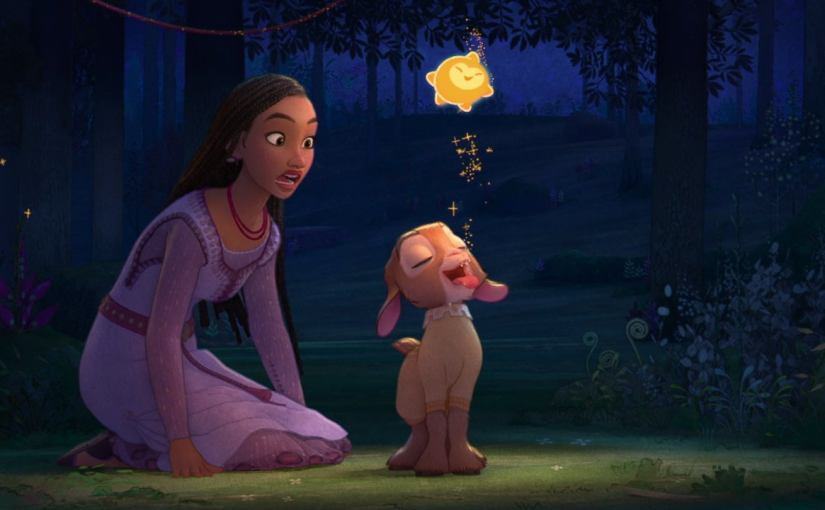
Asha (Ariana DeBose) is a seventeen-year-old who is eager to finally witness her grandfather Sabino’s (Victor Garber) wish come true as his 100th birthday finally approaches.  She also aspires to meet the great sorcerer and hopefully become his apprentice.  As soon as she meets the King though, Asha realizes Magnifico is a greedy, selfish individual who thrives off the admiration of the people of Rosas while savoring the wealth of everyone’s longings.  In other words, Magnifico is a cult leader.

Chris Pine does good voice work here.  He’s gleeful and manipulative and uncaring and evil all at the same time.  Disney’s colorful animation lends to his vocal performance of course with Maleficent inspired glows of green spells which the character conducts.  Yet, my adult mindset could not get past the fact that I’m looking at an animated inspiration of David Miscavage, long time head of the Church Of Scientology.  Magnifico’s wife Amaya (Angelique Cabral) is the quietly naïve representation of David’s wife, Shelly (who has not been accounted for in years).  The poor people of Rosas are the brainwashed disciples believing in this false prophet.  I guess it’s not a terrible concept to apply to a fantasy, but once I see the allegorical connection, Wish makes me feel uneasy.  My fault I guess for watching too many HBO documentaries and listening to former Scientologist Leah Remini too much.

Asha is the hero of this story who makes a wish upon a star.  Actually, a literal character named Star enters the picture.  Star squeaks like a precious darling, ready to be your children’s next plush toy acquisition.  He shoots sparkling trails of gold out of his pointed appendages.  With Star’s help, Asha will reach the standard showdown with the villain by the film’s end and the awakening of the people below.  It’s all trite material that’s been done before.

Wish relies on the vast history of fantastical stories, believing you can fly and be heroic or simply a sidekick tagging along with the protagonist.  Asha has seven friends.  One is referred to as grumpy.  Huh!  How do you like that? Must it be so apparent so often though?  Thanks to Star, forest animals talk and one even makes an inside gag to Zootopia.  You’re practically asked “Get it?  See what I did there?” Magnifico bears a striking resemblance to Jafar and even resides in a similar castle to the Aladdin villain with stone spiral staircases to explore.

The colors and animation are just as engaging as nearly any other Disney film.  A few songs work, but there’s nothing on the level on what was accomplished during the days of Rice and Menken, or even more updated fare like Frozen.  I can’t recall the title of a single number from Wish.  Magnifico sings.  Asha sings multiple times.  The two duet together and it’s not terrible. Ariana DeBose could sing the phone book and I’ll feel swooned.  The supporting people of Rosa sing in choral support as well.

Still, what tainted my experience was turning a very real epidemic of cultish culture into a fantasy catered for all ages to enjoy.  The wishes the people offer up are the endless “donations” that a cult mentality always requests.  While I appreciate being accepted into a fraternity of Disney loving storytelling, I did not need to be banged over the head with so much saluting either.  The end credits contain one classic Disney character after another appearing next to the ongoing scroll.  Hi Dumbo.  Hi Genie.  Hi Peter.  Hi Belle. 

Disney always reminds us to believe our wishes will come true and yet with Wish the studio chose to go with what is blatantly familiar.  It’s time for some fresh ideas again that especially do not source themselves from the reality of harmful sects spreading false doctrines. 

NOTE: I still have a fresh idea from a very popular legendary story that Disney, nor Universal or Warner Bros has yet to touch.  Maybe it’s time I get it down on paper.  Hmm.

ROCCO AND HIS BROTHERS (Italy, 1960)

by Miguel E. Rodriguez

DIRECTOR: Luchino Visconti
CAST: Alain Delon, Renato Salvatori, Annie Girardot, Claudia Cardinale
MY RATING: 8/10
ROTTEN TOMATOMETER: 90% Fresh

PLOT: An impoverished family from rural southern Italy moves north in search of a better life in Milan, a “big city” that puts their familial bonds to the test.


Movies like Visconti’s celebrated Rocco and His Brothers are much-needed reminders that films need not provide explosions or alien invasions to be interesting or exciting.  I won’t say it’s perfect (several scenes could have been trimmed and still been effective), but I was as absorbed in the story as I am when reading a particularly good novel.  (For some reason, I was reminded of my headspace while reading Donna Tartt’s The Goldfinch; the story and style grabbed hold of me and had me riveted the whole time, despite the fact my preferred tastes run to Crichton, Clancy, and King.)

Since I make no claims to be a historian, filmic or otherwise, I cannot vouch for the verisimilitude of Rocco and His Brothers in terms of Italy’s social and demographic picture in the late 1950s/early 1960s.  I seem to remember reading something somewhere about how this period reflected to some degree the Dust Bowl era in the United States when displaced midwestern families flocked to the West coast in search of better lives.  In the world of this film, we are led to understand that families like the Parondis, faced with financial hardships, were migrating north to Milan and other larger, modernized cities.  Some folks were able to adjust, others were not, and that was that.  The Parondis – Mamma Parondi and her five sons – are determined to make the move work no matter what.

The tone of constant struggle is set near the beginning when the Parondis arrive in Milan and, ominously, no one meets them at the station.  The eldest brother, Vincenzo, was supposed to be there, but he was distracted by a gathering of his girlfriend’s family.  When the Parondis arrive unannounced to the gathering, they are initially met with open arms, but innate prejudices about “country folk” get the better of everyone and they leave in a huff.  They find cheap lodging and the brothers make their first bits of money by shoveling snow.  A revealing scene shows the mother rousing her sons out of bed in the middle of the night at the first sign of snowfall so they can beat everyone else to the jobs.  Rocco and his brothers are reluctant at first, but they rally together and stay positive because, well, they must.  These strong ties will be tested as never before by the time the credits roll.

The film is broken up into sections, one for each brother.  The first section, “Vincenzo”, shows how his life seems to have changed for the better after relocating himself to Milan some months before the rest of his family, but their sudden arrival puts a crimp in his personal life when he is obliged to move in with them.  The next, very lengthy chapter focuses on Simone, a handsome, outgoing fellow who is spotted by a boxing coach and achieves local fame by winning a high-profile match soon after he begins training.

Shortly after this win, the family gets entwined with a local prostitute named Nadia who arrives unexpectedly on their doorstep in need of some clothes.  Before long, she becomes involved romantically with Simone, but tells him outright that she’s not interested in anything long-term, despite his obvious desire to be near her whenever possible.  The affair ends, and Nadia leaves town after having a crucial conversation with Rocco.

The third chapter, “Rocco”, follows Rocco after he serves a brief tour of duty in the military, after which he fatefully reconnects with Nadia after over a year.  They fall in love, and Nadia surprises herself by truly falling for Rocco despite her previous wishes not to be involved in anything permanent.  But when Simone discovers their relationship, events are set in motion that are as devastating as they are unexpected.

(The last two chapters, “Ciro” and “Luca”, focus on the fallout of the previous three sections.)

Rocco and His Brothers feels like it was adapted from an Italian opera.  It wouldn’t surprise me in the slightest if I learned that someone had turned it into an opera.  There are emotions and reversals and shocks and tragedies on display here that rival anything on American daytime television, but it rarely feels like soap opera.  Yes, there are some moments when the characters and the filmmakers take the time to deliver speeches that don’t seem to spring out of any true motivation other than to pound home the point the director is trying to make at that stage in the film.  (I’m thinking especially of Ciro’s final scene.)  But I am inclined to forgive these momentary lapses in momentum because, in retrospect, they lend emotional weight to the characters.  Novels can achieve this with a paragraph or two detailing the inner thoughts of their characters, but in film, the characters have to tell you what they’re thinking, verbally or nonverbally, or the audience gets lost.

I have hinted only vaguely about certain tragic aspects of the story.  This is because Visconti and his editor took great pains to allow them to arrive organically in a way that took me completely by surprise, so it would be wrong of me to give those surprises away.  For those of you who have seen the film, you know what I’m talking about.  It’s these moments that elevate Rocco and His Brothers into something more than a mere soap opera.  Some of the acting will strike modern audiences as exercises in histrionics, especially as exhibited by Mamma Parondi and Nadia.  To that I would say: “What do you want from opera, subtlety?”

Rocco and His Brothers is one of those elusive films that I’d heard and read about for some time now, and I’m grateful that I’ve finally seen it.  I’ll be honest, it’s not exactly a film I’ll take down and rewatch multiple times in a year, but it’s worth seeking out if you’re looking for a good old-fashioned family drama that’s not quite a tear-jerker, but it’s certainly no bed of roses, either.  Martin Scorsese once deemed it one of 39 foreign films every moviegoer should see before they die.  And if you can’t trust Marty, who can you trust?

BEVERLY HILLS COP: AXEL F

By Marc S. Sanders

It took thirty years for Eddie Murphy’s best on screen character, Detroit Detective Axel Foley, to make a return.  He should have waited another thirty years. 

Reader, I got what I expected from Beverly Hills Cop: Axel F.  Yes, it was better than the third film in the franchise, but then again so was Morgan Stewart Is Coming Home (a Jon Cryer flick, directed by Alan Smithee).  There are moments in this latest flick, offered up by Netflix, that work, but it’s not enough to save the picture.

With Murphy producing, the smartest tactic the film takes is to gather up most of the surviving members of the other films, Judge Reinhold, John Ashton, Paul Reiser and Bronson Pinchot.  The problem is they are hardly used.  Axel F opts to go in the direction of feelings for the wisecracking cop from Detroit who always wreaks havoc in 90210.  Axel has a daughter named Jane Saunders (Taylour Paige).  I certainly know her last name because in the few moments that Murphy is shooting off his mouth, he takes time to repeat her last name and actually spell it out.  S-A-U-N-D-E-R-S.  Yes.  That’s a whole scene.  This is supposed to be comedy?  Saunders is not ranked up there with Focker.  That’s for sure.

Axel’s buddy Billy (Reinhold) is a private detective now and he’s come upon some kind of conspiracy.  He recruits Jane (a Beverly Hills criminal attorney) to represent a kid who is being framed.  When Axel gets word that Jane is being threatened, out to California he goes, but then Billy turns up missing and I mean missing throughout the whole movie.  Now Axel has to uncover the bad guys while trying to reconnect with Jane.  Of course they are estranged.  Axel also partners up with Jane’s ex, a cop named Bobby, an unfunny Joseph Gordon-Levitt.  Every so often Axel also marches into Taggert’s office (John Ashton) to just remind us that Taggert is back. 

Beverly Hills Cop never functioned on complex mysteries or storylines.  The films hinged on Eddie Murphy’s schtick, which used to be very, very funny and addicting.  As well, the smart route was always taken when the comedy of the first two pictures didn’t just rely on Murphy.  There was also material for Ashton and Reinhold, and on the side was Reiser and Pinchot as well. 

The glaring error in Axel F is that Murphy hardly does anything with these guys.  Instead, there are repetitive conversations with Paige’s character and how Axel put his career ahead of being a father.  Twice within the script, they remind one another that he’s been a father as long as she’s been a daughter.  How much thought was put into this dialogue?

The Cinemaniacs gathered together to watch Axel F, and we all agreed the film would be a half hour shorter had the storyline with Jane been completely stricken from the script.  Who says Axel Foley had to have a daughter?  The guy already has enough members within his world to work with.  Ashton, Reinhold and Murphy do not share a single moment together until an epilogue scene before the closing credits.  This is as egregious as when the new Star Wars pictures opted never to have Han, Luke and Leia reunite.  You got everyone back for Axel F and you opt not to use them or use them together.  Why?  This kind of success couldn’t have been served up better and yet it’s squandered.

Part of the fun in Axel Foley is his ability to con his way into a place.  At one point he returns to the Beverly Hills hotel from the first picture.  He approaches the counter and as he’s about to start a routine, but then he says fuck it, never mind and just chooses to pay for a room.  The script and Murphy could not have made their laziness in making this movie more apparent. 

Another staple was always the outrageous chases that would happen with unconventional vehicles.  The best moment in Axel F is when Murphy and Levitt pilot a police helicopter.  Levitt gets terrified and I think a little sick.  Murphy shoots his mouth off and here is a reason to watch Axel’s return.  Other moments do not work as well including a snowplow truck careening through Detroit and a big rig crashing through the glass front doors of a mansion.  There’s also a three-wheel motor scooter that does some tricks.  I recognize the attempts at recapturing the big moments from the first two films, but the editing does not work as well with a beginner director named Mark Molloy.  Martin Brest and Tony Scott were the MVPs who cemented the success of those other pictures.

I could not help but also take issue with some minor details.  Harold Faltermeyer was the symphonic composer of the other films.  You’ll certainly recognize his tunes this time around but they are annoyingly mixed with unnecessary overlays.  At times, the needle drop of music is so distracting to what you are watching that you might think there is something wrong with your sound system. 

In addition, and I can’t believe I’m saying this about a Beverly Hills Cop film, but the costumer had to be someone who was just fired from Old Navy.  Murphy dons a Detroit Lions jacket and a pair of jeans that look two sizes too big on him.  His clothes look so baggy on his frame.  As well, for some reason, he’s given a bright orange t-shirt to wear against the black and blue Lions coat and it could not be a worse eyesore.  Any color you want and you choose orange?

Miguel’s input was that it was better than three, but what kind of endorsement is that really?  Over the last decade, the franchises that were so beloved in the 1980s are making returns with the near geriatric stars of those films.  Some work (Top Gun: Maverick, and yes Indiana Jones).  Some definitely do not (that last Die Hard movie, Rambo and Terminator).  Axel F slides into the latter category.  It has some moments to laugh at along with send ups of some of the franchises best songs.  Yet, while I’m happy to hear the picture open to Glenn Frey’s “The Heat Is On,” it’s also indicative of little thought applied to making this movie. 

Ultimately, though, why did this picture have to get so watered down with an uninteresting father/daughter soap opera while neglecting the other favorites of this franchise?  What will these filmmakers do next?  Reinvent the Three Stooges, only the trio will be split up, and you’ll only follow Larry around for two hours?

THE HUSTLER

By Marc S. Sanders

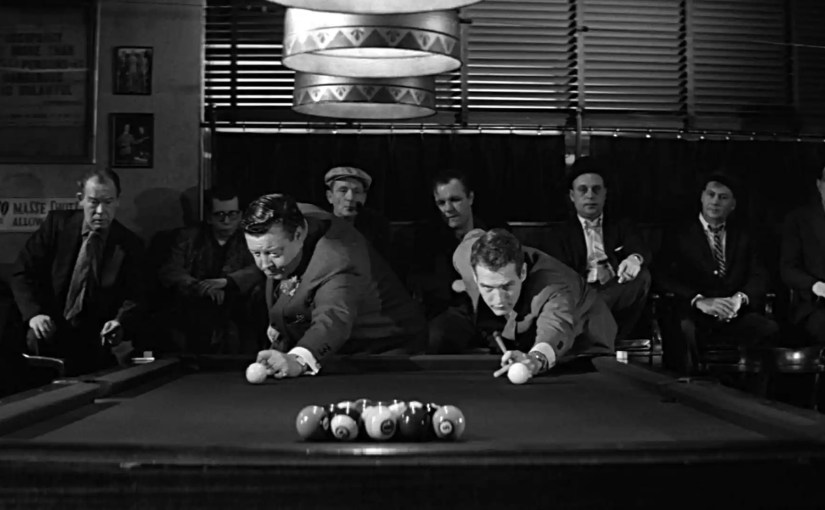
To get inside the turmoil that Fast Eddie Felson feels requires witnessing his highs and lows, all within a forty-hour time span, which equates to about thirty minutes in movie time.  Fast Eddie is The Hustler, and he was famously portrayed by Paul Newman, arguably his breakthrough role as a top billing super star.

Felson is a cocky, hard drinking pool player.  He’s got talent, but no matter how much he wins he’s always the loser because he has no discipline.  Eddie and his partner Charlie (Myron McCormick) travel from town to town, entering pool halls and setting up a bait and catch for some quick cash.  Charlie keeps his cool and treats the act like a profession.  Eddie has no subtlety.  Because he’s so how high on his expertise and what it earns him, he now only has his eye on dethroning the best in the country.  Eddie wants to take on Minnesota Fats (Jackie Gleason, in his only Oscar nominated role).

Fats sure looks intimidating.  Gleason handled his extra weight beautifully throughout his whole career, whether it be with his outrageous Ralph Kramden comedy, or when he was just being stand up Gleason for a live audience.  As well, his large frame appears kingly when he enters the pool hall.  He’s dressed to the nines with his hat, overcoat, silk tie, cuffs and studs, a cigarette in his hand, and the red carnation confidently tucked in his lapel.  The movie is in black and white, but that little flower had to be red if adorned by Minnesota Fats.  No question about it.

Newman versus Gleason in the first section of Robert Rosen’s drama is stunning to witness.  Like the actors who portray these characters, the antagonist was already a legend, while the up and comer was on the brink of higher class.  Both are the best of the best at pool, but as this scene progresses, with the regulars at Ames Pool Hall watching with their burning cigarettes and stained whiskey glasses in hand, the competition becomes a fierce and eerily quiet test of endurance.  Fast Eddie can keep on winning and winning, round after round, hour after hour, taking thousands of dollars out of Fats’ pockets, but if the fat man doesn’t surrender, has anyone really won or lost?

The Hustler isn’t so much about pool playing as it is about being a hustler or a con man who has no way to be genuine with himself or others in his life.  After the showdown between the two has finally concluded, Eddie gets acquainted with a woman who frequents the nearby bus depot.  Her name is Sarah (Piper Laurie), another hard drinker and someone who is not looking for love or companionship but will get trapped in Eddie’s charm.  What’s at play though is if their relationship, based initially on sex and booze, has anything more substantial to uphold their quick connection.  That is about to get tested by another member of this cast.

Bert Gordon (George C Scott) is the high stakes investor ready to front Eddie with a lot of money to go on the road and clean up on other wealthy players at the table.  Bert recognized a thoroughbred when Eddie went against Fats.  Now he wants to use him, but will Sarah serve a purpose or become a distraction in Bert’s plans for himself first, and Eddie second?

There’s a lot to think about when summing up The Hustler.  It’s not a typical sports film with the standard training montages.  The protagonist doesn’t necessarily get a beat down, only to triumph by the end.  Rosen’s film goes deeper than the pool playing that rests on the felt table surfaces.  Rosen co-wrote this script based on a novel by Walter Tevis, about a man overcoming the demons pecking at his attributes and skills.  When he’s not the trickster, he must ensure that he’s not getting tricked.

I was first introduced to Fast Eddie Felson with Martin Scorsese’s follow up picture called The Color Of Money, released twenty-five years after this film.  I like the coolness and rhythm of that film, but it’s mostly an exercise in Tom Cruise machismo.  It was only later that I saw The Hustler per my dad’s advice.  I didn’t care for it the first time I saw it.  Once the first act was over between Newman and Gleason, I found the picture to be slow moving and devoid of much energy.  I could not relate to the long sequence of Eddie getting involved with Sarah.  Unlike Scorsese’s film, Rosen does not rely on much music and quick edits to keep you alert.  It felt more like a movie drowning in the characters’ own drunken stupors.

Now that I have seen the film for a second time though, many years later, I can’t help but recognize the themes that carry over to The Color Of MoneyThe Hustler works better than its sequel because it functions as a character study in maturity and endurance.  The Color Of Money sets itself up that way for the Cruise character. Yet, I’m not sure it reaches a conclusion to any of the arcs or transitions for either an older Eddie Felson or for the hot shot 1980s kid, Vincent, the Tom Cruise character that Eddie mentors.

The Hustler has triumphs, but it has some shocking heartache for several characters as well.  Eddie has much to overcome internally as well as physically throughout the course of its narrative.  This fictional story had to be captured within this certain section of time (six months to a year, I think) to show how these appealing, yet cursed, individuals forever change one another.  After the film has closed, Rosen brings up the closing credits in the quiet pool hall allowing his characters to pack themselves up and walk out of frame.  There is something open ended to when the film chooses to stop. The viewer may think for a while after it’s over.  Rosen allows the viewer to take his last gulp of whiskey or bourbon and put out his cigarette and throw on his overcoat before stepping out into the cold late hours on the wet sidewalk below.

There are many impressive pool shots on display, thanks especially to the professional Willie Mosconi.  Shots are also done beautifully by Newman and Gleason.  Absolutely amazing to watch what they accomplish with a cue stick.  However, you don’t watch The Hustler for just trick billiard shots.  Rather you look at this intense drama to see a man struggling to be a winner or remain a loser.  What you realize very early on is that the outcome is never measured by how much money is wagered or what lines a man’s pockets.  Instead, The Hustler is assessed by what these people choose to do next.  Play or not play.  Bet or not bet.  Hustled or not get hustled.

KELLY’S HEROES

By Marc S. Sanders

There’s gold in them thar Nazi castle.  Hence the plot is set in motion for a World War II romp called Kelly’s Heroes.  It’s easy to get acclimated to the lightheartedness of this comedic war picture from director Brian G Hutton (Where Eagles Dare). 

The movie opens during a dark and rainy evening within a German occupied France. The on-screen credits pop up revealing an all-star cast of tough guy actors who are also quite funny.  Clint Eastwood is the title character who sits behind the wheel of a jeep. When the Nazis take notice, he hits the gas, makes a sharp left through the muddy road, and zooms away while avoiding shell fragments coming down on him. The film’s catchy theme song marches in – “Burning Bridges” performed by the Mike Curb Congregation.  The chorus of singers speak as a soldier who does not even care about authority or the rules of war.  The lyrics are rather simple to understand, and you want to just join in on the revolutionary merriment.  The song enters the film again and again over the next two and a half hours, reminding you to just enjoy the ride against this tragic capsule of time from the first half of twentieth century history.  Hawkeye Pierce couldn’t have said it better.

In his capture, Kelly has brought back a Nazi commandant and when he sees a fourteen-karat gold bar in the German’s possession, it’s easy to surmise that there must be more where this came from.  Turns out there is a stash worth roughly sixteen million dollars crated in a bank vault in the center of a stopover town, located across enemy lines in war torn France.  Kelly and his squad, led by Big Joe (Telly Savalas), are under heavy fire and forced to retreat for safety, but that isn’t going to stop him from making a snatch and grab.

Joe has been given orders to get the unit to safety and allow them a three-day reprieve of R & R.  However, he’s just as enticed as Kelly and gradually a small team of men assemble to pull off the heist.  First, they’ll need tanks to fight off the nearly indestructible Nazi Panzer machines they expect to encounter.  Fortunately, Crapgame (a scene stealing Don Rickles) and Kelly come across the hippie loving Oddball (another scene stealer – Donald Sutherland) who can supply the tanks they need and fend off what stands in the unit’s way.  What’s also important is Oddball find a bridge for the squad to cross before the allies destroy it.  That’s not so easy.  Sutherland is somewhat of a spaz; maybe an ancestor of Cosmo Kramer.

Meanwhile, a blood and guts two-star General Colt (Carroll O’Connor) is screaming for results from his subordinates.  When he intercepts the guys’ communications, he can’t help but be impressed with their progress and strategies of attack.  He’s ready to go into the field with a handful of medals for every American soldier that’s giving a damn. 

The looniness of Kelly’s Heroes is hilarious. Eastwood carries his signature quietness about him.  So, he’s the straight man leaving the loudmouth material for Savalas, Rickles, and a bevy of supporting actors.  Plus, there’s O’Connor in his own side story.  Sutherland is another kind of comedy – the free spirit who appears to have taken one too many shells to the noggin. 

It’s not a slapstick kind of movie.  It operates like the doctors from M*A*S*H.  These draftees have no loyalty to a cause.  They look out for each other.  They know how to survive the battles and they know that some will not make it.  Brian Hutton does not forget the frightening impact of war.  A memorable scene occurs when the unit realizes they are dead center in a mine field, offering up the life and death factor blended in both the comedy and drama that comes with a heroic war picture. 

There are some inconsistencies to Kelly’s Heroes.  Often, it feels like some scenes that would connect certain dots must have been edited out of the final print.  As the men come close to the to the bank where the gold is stashed, two of the soldiers are already in the overlooking bird’s nest tower giving a low down of the area to Kelly and Big Joe.  Yet, how did those guys ever get up there?  It’s not a terrible violation.  There are sequences like this that make the movie feel a little uneven. Clint Eastwood even went on record expressing his disappointment with the film as there were excised moments that drew more out of Rickles and Sutherland’s characters, and a few of the other supporting characters played by Gavin MacLeod (The Love Boat, The Mary Tyler Moore Show), Stuart Margolin (a very underrated character actor who had memorable episodes on the M*A*S*H tv series) and a young Harry Dean Stanton (here credited only as Dean Stanton). 

This film was shot in Yugoslavia simply because the country still had possession of many tanks and vehicles from the story’s time period.  The art design and battlegrounds are very impressive.  Before CGI, Brian G Hutton and his team were reenacting a lot of these loud, bombastic battle scenes complete with big fireballs of explosions along with the aftermath wreckage left behind of rubble and blasted out walls and craters.  Hutton positions his cameras either on top or right behind the cannons and guns mounted on the tanks.  So, you are actually getting a first person view of these massive war machines driving across the plains while shooting off their firepower.  The filmmakers did not hold back on making World War II look authentic in its battle wear.  I’ll be bold enough to say the settings are comparable to what Spielberg accomplished with Saving Private Ryan, and what Eastwood depicted in Letters From Iwo Jima.  The lens is just not as serious as those films.

The cast is a magnificent fraternity of brazenly funny tough guys, in the same vain as The Dirty Dozen, though much more lighthearted.  They’re a motley sort who all stand out among their similar appearances in green army fatigues and netted helmets. 

Kelly’s Heroes is a lighthearted comedic adventure where the heist is what you come to see against a historical backdrop when nothing was ever sensationalized fun.  History offers up a cruel world of pain and suffering, but who says we can’t enjoy ourselves through all the blood, guts and misery as our heroes ride off into a ravishing orange sunset?

Go for the gold and catch up with Kelly’s Heroes.

MAX DUGAN RETURNS

By Marc S. Sanders

Max Dugan Returns is one of those delightful films where the smile never leaves your face.  It’s a cozy, rainy Saturday afternoon with your favorite pillow and throw blanket.  The characters are whimsical, and they simply feel like good, good friends you would love to have in your life.

Nora McPhee (Marsha Mason) is an overworked, underpaid high school English teacher who is drowning in debt with a broken refrigerator and a car that is as ugly as it sounds on the road.  Her fifteen-year-old son Michael (Matthew Broderick, in a sensational on-screen debut performance) is a good kid, but she’s worried he’s getting too involved with the drug dealers that roam his school.

After her jalopy of a car gets stolen, the only positive that comes upon her is in the form of Donald Sutherland as a cop named Brian.  After he lends her his motorcycle to get around, there’s an immediate attraction, but it could not happen at a worse time.

Nora’s father, Max Dugan (Jason Robards), who abandoned her at age 9 arrives on her doorstep in the middle of a rainy night with a business proposition.  Now that his doctors have informed him he has six months to live, he would like to provide Nora and Michael with the six hundred thousand dollars he’s towed with him in an attaché case.  In exchange, he only wants to spend time with his grandson.  Beyond the animosity she’s held for Max, what alarms Nora is that her father stole this money from a Vegas casino.  He claims the mob stole the money from him first.  She doesn’t want the money; not with Brian the police officer in her life and she does not want to be affiliated with Max’ criminal past or associations.  Not to mention there would no way to explain this sudden windfall based on her minimal teacher’s salary.  Max won’t go away so easily, though.

Thus, the theme of Max Dugan Returns is one scene after another where a hoard of luxurious items arrive on the McPhee’s doorstep.  New appliances, new jewelry, new furnishings, fresh groceries, electronics for Michael, a Mercedes, and a thoroughbred dog named Pluto – I’m sorry.  Plato!

It’s impossible not to love this movie.  It is one of the few films that Neil Simon wrote directly for the screen.  It is so much fun though, that I think it would work marvelously as a stage play.  The story may not be grounded in reality, but Simon’s dialogue is so quick and sharp and a better cast could not be found to deliver Neil Simon’s wit.

Mason, Robards, Broderick and Sutherland have pitch perfect chemistry with one another.  These actors are so absorbed in their characters, and it makes sense.  Matthew Broderick was personally selected by Neil Simon to do his biographical play, Brighton Beach Memoirs.  Marsha Mason did five of Simon’s adapted films while she was married to him.  (They divorced shortly after the release of this picture in 1983.)  Jason Robards has an affectionate gravel to his voice – one of the best voices in film next to James Earl Jones. Robards is just so appealing as he playfully conflicts with Mason on screen while connecting with Broderick’s character under a different identity.  It’s important Max maintains a low profile.  Donald Sutherland is the straightest character in the picture.  He has a relaxed manner to him that’s found often in Neil Simon’s scripts (unless you’re a Nora McPhee or a Felix Unger).  In another actor’s hands, this would be just a walk on role, but with Sutherland on screen, you are satisfied to watch another winning performance from this actor with a relaxed stature and a genteel way about him, as his detective suits and ties hang loose on his shoulders.

Max Dugan Returns is an enchanting fantasy without the overt fantasy.  It never needed unicorns or lovable elves to deliver its magic and whimsy.  I did notice a collection of rainbows –  easter eggs hiding in plain sight, however.  Are pots of gold to be uncovered? The film asks what would happen if your long-lost father showed up on your doorstep with a suitcase full of money and a treasure trove of gifts to bestow upon you. 

Hey, it could only happen in the movies.

THE BITTER TEA OF GENERAL YEN (1932)

by Miguel E. Rodriguez

DIRECTOR: Frank Capra
CAST: Barbara Stanwyck, Nils Asther, Toshia Mori, Walter Connolly
MY RATING: 10/10
ROTTEN TOMATOMETER: 86% Certified Fresh

PLOT: During the Chinese Civil War, an American missionary is gradually seduced by a courtly Chinese warlord holding her captive in Shanghai.


When I hear people talking about the “pre-Hays-Code era” of Hollywood, I conjure up seldom-seen images of nearly-nude starlets bathing or swimming or dancing in unison, as filmmakers and studios took advantage of the proven formula: Sex Sells.  But it never really occurred to me that some filmmakers would be able to use that freedom to make films that not only showed a little bit of skin, but also took the time to tell a story that appealed to mature adults in ways that seem fresh and alive nearly a century later.

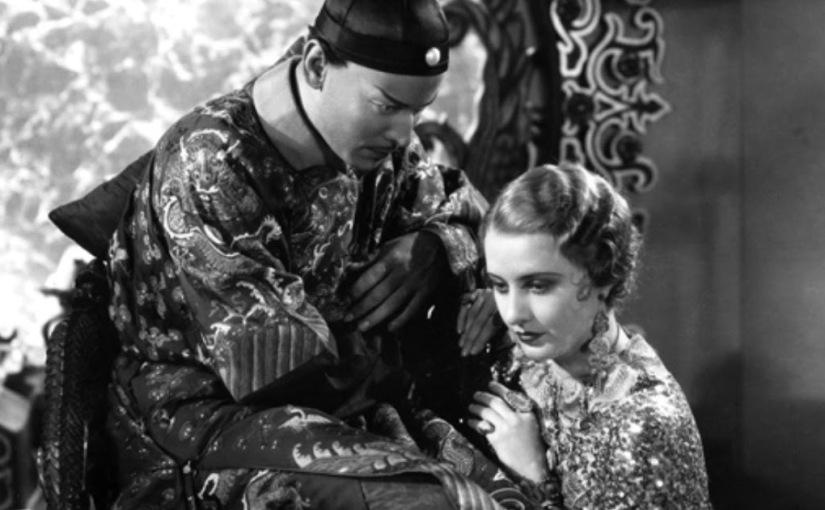
Frank Capra’s The Bitter Tea of General Yen is a contemporary “Beauty-and-the-Beast” tale of an American missionary, Megan (Barbara Stanwyck), who travels halfway around the world to Shanghai to marry her childhood sweetheart, Bob (Gavin Gordon), also a missionary.  It’s set in an unspecified year during the Chinese Civil War [1927-1949] when turmoil rocked the city and hundreds of thousands of refugees filled the streets.  A remarkable opening shot shows hundreds of extras flowing past the camera as Shanghai burns in the background, while a houseful of Americans prepares for Megan’s wedding, untouched and unbothered by the human misery thirty feet from their doorway.  (I was reminded of the idyllic family scenes in Spielberg’s Empire of the Sun where English families held birthday parties oblivious to the impending chaos in Japan leading to World War II.)

Bob insists on postponing his wedding to Megan so he can help rescue some orphans stranded in a burning section of the city.  During the rescue effort, they are separated; in a surprisingly violent scene, Megan is struck on the head by an angry civilian and is knocked unconscious.  She wakes up on a train and finds herself under the care of General Yen (Nils Asther), a famous warlord, reputed to be more bandit than soldier, but who is unfailingly courteous and polite to Megan, even as he informs her that he is unable to return her to Shanghai for security reasons, effectively making her his prisoner.

This scene on the train is a masterpiece of visual storytelling.  Yen sits in a chair and is tended to by Mah-Li (Toshia Mori) who seems to be more than just Yen’s servant.  In an unspoken passage, Mah-Li puts a pillow under Yen’s head, covers his legs with a blanket, and reclines on a chaise.  Megan, with her head bandaged, observes this ritual, then notices Yen staring intently at her.  She becomes acutely aware that she is showing a small patch of bare leg through her covers.  As slowly as possible, she gently pulls the covers up to cover her leg.  Mah-Li observes all of this, Megan watches Mah-Li, and they all go to sleep, each one of them knowing exactly what has been stated without saying a word.  Brilliant.

In a bold move, once Megan is under Yen’s care/protection/whatever, the film never cuts back to her fiancé or to any of the missionaries.  In fact, Yen refers to a Chinese newspaper article which states that Megan is missing and presumed dead.  So that takes care of that.

In another scene of startling violence for its time, Megan wakes up one morning in her private room to the sound of gunfire.  Yen’s soldiers are executing prisoners in a courtyard across the way.  Megan is horrified and complains to General Yen, who promptly orders the soldiers away: “They are taking the rest of them down the road, out of earshot.”  Megan calls him cold-blooded, but he reasonably says he has no rice to feed any prisoners: “…isn’t it better to shoot them quickly than let them starve to death slowly?”

The theme of the film establishes itself in this and other scenes.  Megan, a Christian missionary who believes that people can and must be good for the sake of their souls and their fellow man, finds herself at odds with (and strangely attracted to) a soldier who is brutal by necessity and has no illusions about any innate goodness to be found in any man during a time of war.  There is a powerful scene when she argues with Yen, and in a heated moment utters a racial slur, and as soon as she says it Yen goes silent and squints at her, and she realizes she has crossed a line.

This is not the kind of moral and ethical complexity I expected from a melodrama made only five years after the advent of sound.  I saw the name of Frank Capra and the weirdly evocative title, and I imagined a potboiler with outdated attitudes and cheesy dialogue and racial stereotypes galore.  I could not have been more wrong.  Yes, the title character is played by Nils Asther, a Swedish actor in “yellowface,” but I had to remind myself that, in the time the film was made, this was de rigueur for most films dealing with Asian characters (the highly popular Charlie Chan films starred white actors in the role for years).  I don’t endorse the practice, but it is a fact that must be acknowledged.  And, it must also be said, Nils Asther’s performance as a Chinese man is quite convincing.

The Bitter Tea of General Yen gives us espionage, intrigue, forbidden romance, high melodrama that teeters on the verge of soap opera but never gives in to that temptation (not like Gone with the Wind would do in 1939 with, let’s face it, a rather similar character arc for the two romantic leads).  It’s a film that could be remade today, almost word-for-word, and I have no doubt it would feel right at home with today’s hip audiences.  So many other films of that era feel obviously dated by their dialogue or their performances.  The Bitter Tea of General Yen suffers none of those drawbacks.  It’s a modern classic that just happens to be over 90 years old, that’s all.

[Author’s Note: there is, in fact, one sequence which I’ll call “The Dream Sequence” that feels uncomfortably over-the-top in its depiction of the vilest racial stereotypes associated with Asians.  However, given the context of the scene, who’s having the dream, why they’re having it, and the dream’s resolution, it fits perfectly with the story.  I can’t find it in myself to “cancel” this film based on this sequence.  Just in case anyone was wondering.]

THE EQUALIZER

By Marc S. Sanders

I guess Liam Neeson and Gerard Butler were unavailable when Antoine Fuqua and Denzel Washington collaborated to make the first installment of The Equalizer trilogy, based on the CBS television series that starred Edward Woodward.  This film is nothing special with a nothing special kind of script, a nothing special hero and a nothing special collection of Russian Mafia villains.  The kills are nothing special either.  The action is nothing special.  The explosions are nothing special, even when they are started by a trip wired microwave.

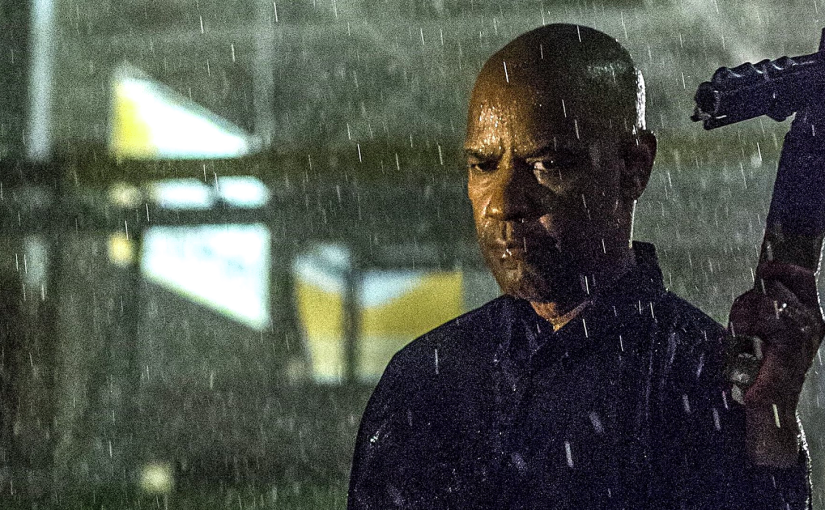
Robert McCall (Washington) lives a quiet life by himself, while working at a jumbo home improvement store (think Home Depot or Lowes – big places for lots of not so special action to take place at the conclusion of a not so special movie).  Turns out McCall, who also lives with OCD, is a retired special ops commando.  Robert uses his down time to read one of a hundred books that should be read before you die, while sitting quietly in a coffee shop each night.  He also volunteers his assistance with getting people to improve their lives.  A plump co-worker named Ralphie (the go to name for fat guys) played by Johnny Skortis is on Robert’s strict diet regimen to lose enough weight so that he can be promoted to the store’s security guard position.  Skortis occupies the best and most interesting character in The Equalizer.  During the final action sequence, it’s what Ralphie does that earned my one cheer during the course of the picture.

Robert also becomes acquainted with a young lady named Teri (Chloë Grace Moretz) who has aspirations of becoming a singer but is weighed down by her call girl commitments to members of the Russian mob.  When Robert sees that Teri has been beaten and is in serious trouble, he doesn’t wait to be asked for help.  He just does what is necessary to even the score.

That about does it for The Equalizer

No.  Seriously.  That’s all there is to it.  And so I’m very disappointed. 

First, Denzel Washington does not even look like he’s trying.  His demeanor to this character is no different than what he did in the lousy Man On Fire, directed by Tony Scott.  The script to this film is not challenging in the slightest.  Like Man On Fire, The Equalizer is simply a series of scenes where Robert torments his villains.  David Harbor is a corrupt Boston cop who gets trapped in his own car, while Robert runs a garden hose from the exhaust pipe to the inside with the engine running.  Where is the entertainment in this?  Washington sits in a chair while he mechanically opens and closes the car window and Harbor gasps for breath.  McCall is inventive with his methods but it does not lend to any story progression or character depth.  I guess Robert McCall is an artiste – one who specializes in torment, torture and death.

The climactic showdown, within the store, is a great set up for some tête-à-tête methodology to happen, but all of it is executed with little interest.  Here’s where I asked myself a question.  McCall nabs a guy in a makeshift kind of bear trap down aisle 10 (I guess).  The thug gets his neck caught in a barb wire noose and up he goes to the second level of pallet platforms for McCall to stare the guy down while the blood squirts out from his throat.  There’s four or five heavily armed other guys roaming the store, but McCall can take a break to stare this guy down for his last breaths.  If this trap works so well with this one guy, then why not set up six or seven more of these MacGyver contraptions and let each machine gun toting baddie go through the same routine?  I know.  I know.  Miguel would respond, “because then there would be no movie!”  Yet, what does that say about The Equalizer that my mind drifts to this idea?

Later in the sequence, McCall easily walks up to another thug from behind and delivers a power drill to the back of his head.  Then he puts the drill back on the shelf.  Again, if this worked so efficiently and covertly, why not just do it again? And what is so exciting about a power drill anyway if Jason Vorhees isn’t using it?

A nail gun is used a few minutes later and Fuqua opts to just have Washington shoot one nail after another into his opponent.  Bang – Nail – Cock! Bang – Nail – Cock!  There’s no pun or one liner.  There’s just a bad guy who falls to one knee, then an arm goes down.  The machine gun lets off a few rounds and drops to the floor. There goes the other knee and then he’s dead.  Washington just observes the guy die while the sprinkler system drenches him stylistically in slow motion. 

I look at The Equalizer and I think back to the ‘80s actioners from Schwarzenegger, Van Damme, Stallone (some of them), Jackie Chan and even Seagal.  The Rock had fun with a few of these action pieces too.  Go check out The Rundown.  There was a pizzaz to the hero’s methodologies back then.  It wasn’t just a brutal killing and bloodletting.  A one liner accompanied the kills.  It made you cheer and applaud.  Those pictures worked like symphonies of dialogue and ultra cool action that John Wayne never accomplished.  Robert McCall is boring.  Just boring.  An absolute bore.

The villain of this effortless piece is also boring.  Marton Csokas did not advance his career with the lack of anything beyond his Russian dialect and three-piece suits used in this picture. 

Antoine Fuqua has yet to wow me.  Though I know he’s an accomplished director, Training Day always feels like it comes up short with the three or four times I’ve watched it looking for its merits. The critically poor procedural of The Equalizer only lessens his promise for growth and potential.

Denzel Washington has resorted to uninspired characters a few times now. He still earns accolades with pictures like the recent The Tragedy Of Macbeth (a Best Actor nomination) and on stage (I was in the third-row orchestra when I saw him do a forty five minute monologue in The Iceman Cometh on Broadway.  Amazing!).  Still, he just recently completed the third installment of the Equalizer series. Ugh!  Why?  Why Denzel?  Why are you trying to be another past his prime, tired Liam Neeson in these cheapo action pictures?

What I wouldn’t give for another Crimson Tide kind of thriller.

SLAP SHOT

By Marc S. Sanders

Slap Shot is to hockey what Caddyshack is to golf.  It is rude, crude and unapologetically harsh in its language, its temperament and with the memorable fraternal trio known as the Hanson brothers unforgiving with punches, slugs, checks and body slams.  The wardrobe looks dated (some of the ugliest plaids you have ever seen) and it was produced during a time when hockey players could opt not to wear helmets but it is still outrageously funny.  Best of all, Paul Newman, the guy from more upscale, sophisticated fare like Cat On A Hot Tin Roof, The Hustler, and Hud, leads the cast.  Some of the best actors are also the best comedians.  (Look at Robert DeNiro, Donald Sutherland and Clint Eastwood as well.)

The Charlestown Chiefs are the worst hockey team in the Federal League.  When the local Pennsylvania mill has announced that it is closing, it does not look good for the team as attendance will drop lower than what it already is.  The coach and oldest teammate, Reggie Dunlop (Newman), reaches for a few last-ditch efforts to elevate a demand and an appreciation for the Chiefs. 

First, he turns to reporter pal Dickie Dunn (M Emmet Walsh) and drops a made-up rumor that a Florida retirement community is interested in buying and relocating the team down south.  Then, it dawns upon him to antagonize opposing players which will lead into a series of goon fights.  His three newest recruits, the four eyed Hanson Brothers work best at bloodshed.  The enhanced violence lead to wins and suddenly the Chiefs have a new fan base that follows them on the road and sells out their home games.  Only one player, Ned Braden (Michael Ontkean) is against this new approach.  He’s college educated with a love for the game and refuses to stoop to Reggie’s level. A side story has Ned struggling with his marriage falling apart with his alcoholic wife (Lindsay Crouse).

In the meantime, as the rumor of the buyout stays alive, Reggie does his best to find who exactly owns the team.  He wants to convince that party to keep the organization running. 

Paul Newman owns this film despite a collection of fantastic characters that embody the team.  There’s the French-Canadian goalie who is not sharp at delivering proper English.  Killer Carlson (Jerry Houser) quickly develops a knack for being more of goon than a hockey guard. The team’s manager played by Strother Martin (a regular mainstay co-star in a series of Newman films) has to get the team to catwalk model the latest in fashionwear furs, and there’s Francine (Jennifer Warren).  She’s Reggie’s ex-wife, who still shares a thing with him but will not recommit while he continues to play hockey.

George Roy Hill (The Sting, Butch Cassidy And The Sundance Kid) is the unlikeliest of directors for a foul-mouthed film like this and just knowing that seems to make Slap Shot all the more rebellious and appealing for repeat views.  It’s as if Newman and Hill decided to lift their veil of innocence and join the ranks of the worst obscene.  These guys just said “Aw fuck it.  Let’s make the movie.”  I smile each time a sharp guy like Paul Newman delivers an F bomb.  It’s shocking, but it also works so perfectly.  Hockey is anything but delicate fare.

There are dozens of fight scenes in Slap Shot and normally I might claim exhaustion with its repetitiveness.  Thanks to Hill’s direction, every check or punch or wallop is caught differently.  No one is safe; the fans, the radio announcer, the referees, the organ player, the players.  All of them are in the line of fire of a puck or a punch.  While it should, none of what you see ever looks the same.  So, every contact in this contact sport brings one more laugh after another.  Absolutely hilarious!

The Hanson trio (played by real life hockey players – Jeff and Steve Carlson, David Hanson) became a pop culture sensation in cinema with the release of this film.  The image of these three goons, who look like nerds playing with racing car toys, is as uniquely identifiable as Arnold Schwarzenegger in his Terminator get up.  You can never forget the Hanson Brothers.

Screenwriter Nancy Dowd came up with the idea for Slap Shot after listening to her brother’s experiences of being on a minor league team.  Most of the characters she developed were based on actual players that Ned Dowd played with or against. 

I always like when a movie can teach me how an industry works.  With Slap Shot, as slapstick and raggedy as the material proudly is, there’s a mentality to witness and realize.  These guys are literally this brazen, crude and unrepentant, but like Newman’s character Reggie, they’re not stupid or unlikeable either. 

The conclusion of the picture is the championship game. It works because it performs against the grain of what the characters did to get to this point in the story.  The first period break in the locker room is hilarious with Strother Martin going off the rails while Paul Newman is muttering hilariously in the background.   What eventually sends this final game into the stratosphere is unexpected and hilarious. 

Slap Shot triumphs because it was never careful in its comedy.  It’s obscene, prejudiced by today’s standards and yet I do not believe most audience demographics would be offended because there’s an understanding in what it means to be a goon on a hockey team. 

Slap Shot may be a movie of its time from nearly fifty years ago, but it still holds up with big laughs and hilarious set ups. If I need to be more formal in my praise, it’s one hysterical fucking movie with a great fucking script.

Now cue the National Anthem because I’M LISTENING TO THE FUCKING SONG!!!!!

ARTHUR THE KING

By Marc S. Sanders

I cannot stand to watch dogs in peril.  It guts me right in the feels and stays with me long after.  I only saw the movie Single White Female once, when it was in theaters, and I still remember that puppy’s horrifying demise.  Terrible. Just awful.

On the other hand, when a dog is the companion or the factor of good fortune needed for the cast of human characters, I’m going to be won over.  Arthur The King has a shaggy mutt that you absolutely fall in love with, but I don’t think its all schmaltz, because the dog who portrays the title character is not the only storyline to follow.

Mark Wahlberg is Michael, who leads a team of four endurance adventurer racers.  He has the odds stacked against him.  He’s a well-known racer within the circuit but not for the right reasons.  The teams he’s led usually place in the top ten at the finish line, but Michael has never made it to first place.  Not once.  On social media, he’s mocked as the guy who comes up short.  His father (Paul Guilfoyle) is not very encouraging either.  As well, the window of opportunity to show himself as a champion is dwindling as he’s getting up in years.  Still, Michael is confident he has one more race left in him, but he’s granted very little sponsorship money and given a lot less time to train and prepare than he and his team are accustomed to.

Joining Michael in the competition is Olivia (Nathalie Emmanuel) who is an expert climber on any terrain.  She is reluctantly joining the team at the urging of her terminally ill father.  There’s also Chik (Ali Suliman) who serves as the navigator during the race looking for alternative routes and detours off the path that will put the team ahead of others.  Lastly, there is Leo (Simu Liu).  He is the vain Instagram celebrity with thousands of followers and a huge chip on his shoulder that tests Michael’s instincts because Leo has usually been right in the past.  Michael always made the foolhardy option to ignore Leo’s concerns and thus got stuck in the mud, missing another first-place opportunity.

The homeless, neglected dog in the picture initially follows a parallel story within the streets of the Dominican Republic.  Living off scraps with damp, dirty fur, he roams from place to place, being chased and bullied by other alley dogs.

Director Simon Cellan Jones goes for a documentary approach to the endurance racing.  Bylines and GPS maps cut into the picture showing the team’s progress and where they stand in the rankings.  Sometimes there are voiceover commentaries.  It’s efficient information that allows the audience to keep up with the team’s progress as the flow of the film moves at a brisk pace.

We see the team of four run, bike, kayak, climb, stop for breaks, and debate their next options.  Challenges arrive where a large rock must be climbed.  Heavy rain weighs upon their progress.  Snakes are encountered.  Swamp conditions must be overcome.  A thrilling zip line sequence will have you sitting up in your chair.  The footage in this scene is amazing to look at from the enormous height over a bottomless jungle chasm.  It’s certainly dramatic.  Because the film does not rely on the standard suspense music you might find in other sports films, it performs like a documentary with the director’s well positioned camera work and the unexpected reactions of the cast.

At a rest stop the dog captures Michael’s attention.  Some scritches and scratches along with a few meatball treats and then the team must move on.  However, the dog seemingly turns up within the dense jungle terrain having followed their trajectory.  Michael can’t help but be fascinated by the stamina of this animal, and thus a connection is made.  Shortly thereafter, Olivia, Chik and even Leo warms up to the fifth team member.

The race goes on.  Michael’s wife and daughter follow the team’s progress from home.  Dehydration sets in.  A twisted knee interferes.  It’s all standard.  Yet, it’s hard not to get caught up in this film.

If you have never been a pet owner, it might be hard to truly relate how an animal can change a person.  It might sound cliché but there’s really no way to describe how unconditional a dog’s love can be, and Arthur The King certainly demonstrates that kind of affection. If that is still not enough for you to swallow, then consider that this film is based on a true story. 

There was a dog named Arthur The King who defied the odds to keep up with an endurance racer named Mikael Lindnord, thereby inspiring the team to push forward and strive to win.  The inspiration of the real-life Arthur established The Arthur Foundation whose ongoing mission is to raise funds to provide resources to help dogs around the world receive better care.

Arthur The King might have mapped out its story as soon as the movie began, but that does not mean it is devoid of genuine emotion.  This film possesses a yearning for adventure and a need to defy doubt and reach for victory while never losing sight of what could be more valuable than a championship.  The main character starts out as a confident endurance racer.  Yet, he’s a new kind of racer with an eye-opening perspective when he meets Arthur The King.