WAKE UP DEAD MAN

By Marc S. Sanders

Benoit Blanc is back with a new mystery to solve in Wake Up Dead Man.  With three films, all directed by Rian Johnson (Knives Out, Glass Onion), Daniel Craig’s eccentric detective now belongs in the ranks of Sherlock Holmes and Hercule Poirot.  He’s a pleasure to watch with a smirk on your face.  Ironically, he doesn’t make his entrance until at least a third of the picture is complete.

Josh O’Connor is Father Jud Duplenticy who first reveals a wide berth of exposition ahead of the murder mystery that awaits us.  He’s a catholic priest who works hard to contain his temper that might resort to raising his fists.  He’s been assigned as the assistant minister to a church in a small New England town where everyone knows one another, especially repulsive Monsignor Jefferson Wicks (Josh Brolin).

Whodunit mysteries should never be spoiled.  I certainly wouldn’t imply how this film wraps up.  I also do not want to reveal who the victim(s) is/are.  I urge you to see Wake Up The Dead Man because this puzzler of a story is as gleeful as the title itself.

Like the Agatha Christie film adaptations from the 1970s, Rian Johnson does his best to provide a lineup of suspects with celebrity familiarity including Brolin, O’Connor, Mila Kunis, Kerry Washington, Thomas Hayden Church, Cailee Spaeny, Jeremy Renner and a standout performance from Glenn Close who steals much of the film away from the rest of the cast.  After seven nominations spanning over forty years, give her the Oscar already.  She’s eerie and needling, spooky and fun.  As Detective Blanc continues his investigation, a character tells him this all seems like something straight out of Scooby Doo.  Glenn Close, donned in black with an elderly bleached facade certainly feels like she’d come in contact with the animated pup and those meddling kids.

Rian Johnson writes with that classic narrative that Agatha Christie or Arthur Conan Doyle adopted, only it’s modernized.  The director of The Last Jedi even throws in a Star Wars reference and the joke soars.  The writer/director crafted this script as an invitation for hair raising merriment with his design.  If you can’t be a part of a mystery dinner theater party, he ensures that you can participate in this one.

An old church, priests who curse, habitually pleasure themselves and confess to an abundance of sins, a gothic tomb, a dark basement with a repulsive bathtub, a bar with a photograph of clues, startling entrances, unconventional dialogue and a quizzical murder weapon function like page turning literature.  Even better is to understand how impossible the first murder can be under the limitations of a locked door mystery.  How can someone be killed right in front of our eyes when no one else is in room?  The answers await and thankfully the revelations are not far-fetched.

Wake Up Dead Man is a fun time at the movies.  It’s coming to Netflix on December 12, 2025.  Nevertheless, I encourage you to go your local cinema.  The crowd we saw it with was responding consistently with us, and that only enhances the experience.

TAPAWINGO

By Marc S. Sanders

It’s amusing to say that Jon Heder (Napolean Dynamite) becomes a bodyguard in Tapawingo.  He plays a weirdo who headlines a cast of familiar faces, who also portray weirdos.  Yet, come what may, he is in fact a bodyguard named Nate Skoog (a weirdo with a weirdo’s name) who lives with his mom (Amanda Bearse) and her boyfriend (John Ratzenberger).  By day, he works in the mailroom for Amalgamated Insurance.  Nate has not hit the ranks of earning a shirt that bears the company name.  His boss gives him hope though as he assigns Nate the lofty responsibility of picking up his nerdy son, Oswalt (Sawyer Williams), from school.  Nate uses his dune buggy to handle the task.

The city of Tapawingo is notorious for its family of bullies known as the Tarwaters.  Nate is given a warning.  He’s to stop giving Oswalt rides to his tutoring sessions for their sister Gretchen (Kim Matula).  Let me be clear.  Young teen Oswalt tutors Gretchen, a twenty-something tough chick, dressed in black who moves with an attitude and a strut.  When Nate witnesses two Tarwater heavies beating up on Oswalt, he runs into action with his own technique of martial arts. Suddenly, he becomes protective of the kid.  It doesn’t help that Nate’s dune buggy runs over Gretchen’s Doberman.  Well, the Tarwaters move up the food chain and bring in their bruiser brother Stoney (Billy Zane) to make sure their policy stays in line.

Tapawingo is proudly oddball, strange, stupid, silly, slapsticky and really, really, out there.  Following the surprise response of the cult hit Napolean Dynamite Jon Heder moved into more mainstream fair and became a marquee name of sorts.  It’s fortunate he returns to his roots.  He’s on a very short list of comedians who could pull off this material.  Tapawingo is funny.  Very funny at times.  The blessing is that it does not overstay its welcome because of the stupidity of it all; how the actors portray the characters, how writer/director Dylan K Narang shoots his setups and close ups and how the absurdity of the script never stops to think.  Comedy like this only has so much fuel to drive a certain distance.  This gonzo kind of writing that lacks any kind of insight or symbolism operates like another kind of Abbott & Costello routine.  Eventually, you’ll want to move on.  In the moment, it’s a lot of fun though.

Jon Heder invents his own kind of character brand with a stoned kind of look on his face.  Nate Skoog doesn’t so much move.  Rather, the world around this nincompoop circulates around him.  With his buddy Will Luna (Jay Pichardo, playing a different flavor of weird with a Rambo wardrobe on his bearded scrawny physique) these dorks spend their time answering ads to serve as hired mercenaries.  They are marksmen at launching firework sparklers from a distance. Believe me when I say though that Nate and Will are the poster boys for gun prevention.  Maybe even butter knife prevention if there is such a thing.  Otherwise, they are playing bingo at the rec center or maybe wrestling by way of whatever they think wrestling should be.  A pair of overweight, goateed twins (George and Paul Psarras) demonstrate what the contact sport should look like in the foreground. 

Even Gina Gershon invests herself by hiding her signature glamour.  Caked in colorful makeup with a hairsprayed zig zag formation of dirty blond locks, I did not even recognize the actress who made big splashes in movies like Bound, Face/Off and Showgirls.  Her character’s name is Dot and I’d love to know if she took inspiration from Pee Wee Herman’s girlfriend, Dottie, in Pee Wee’s Big Adventure.  Dot resides in the background of Nate’s meandering life.  She’s seductive…I guess.  It’s another oddball within Nate’s world where stimuli is not so much a priority.  Nevertheless, Gershon is hysterical in a clownish, buffoon like role.

Billy Zane is the villain of this silly picture.  Bald, clean shaven, husky and dressed in black, I don’t think the guy has more than ten lines.  It’s his presence that says it all as he sits behind the wheel of an emerald, green Mustang.  I’m glad he’s here.  He headlined Waltzing With Brando (which I loved), while Heder played the supporting role.  Now the pair switch positions.  Newman and Redford, Lemmon and Matthau, Zane and Heder.  It works.  By appearance, method, and physique, these guys are so unlikely to work together, and yet that generates inventive comedy.

Tapawingo operates like one of those B-movie 1980s comedies (Better Off Dead, Real Genius) that you’d rent when The Goonies or Gremlins was checked out at the video store.  It carries no charm.  No sensitivity.  No romance.  The adventure is pratfallish and deliberately lethargic.  It’s strength comes from its characters that leap out of a comic book or a Saturday morning cartoon.  Jon Heder’s approach to live action animation is a winner.  He’ll make you bust a gut.  He doesn’t have to say a word.  Simply a close up of him staring into a void will generate the laughs. 

The brains lie in the bravery to do something as zany as Tapawingo.  Go into it with an open mind.  Better yet, take your thinking cap off and just observe.  It’s a lot of fun.

Oh yeah.  The soundtrack is killer with the help of Pat Benatar and Quiet Riot.

WICKED FOR GOOD

By Marc S. Sanders

Wicked For Good is a crowning achievement in fantasy and musical wonder.  It soars across a wide expanse of never-ending settings within the wonderful world of Oz and delivers a series of messages to walk away with.  Try not to think about Wicked the next time you turn on CNN or FOX News.

Jon M Chu directs again after Wicked Part One.  Both films were actually shot as one large project but then divided.  I was suspect when I heard this was how the Broadway musical was going to be done for film.  Was there that much material, interesting enough for two full-length movies?  With a pair of new numbers drafted by original composition writer Stephen Schwartz, the answer is a profound yes.  This may be Act II of the musical but it does operate as a sequel. The new film leaps in time from when our host of characters were young students at Shiz Academy.  All are adults now with respective responsibilities and therefore they’ve grown and changed.  Sadly, but wisely, the film moves in directions that are parallel to many current events happening today. 

The wise animals of Oz are being oppressed.  The first film hinted that animals should be seen not heard.  The second part of the story executes that mantra all too realistically as they lose their power of speech and are destined not to be free but rather caged like in internment camps.  Those that have not been taken are performing mass exodus under the newly constructed yellow brick road. 

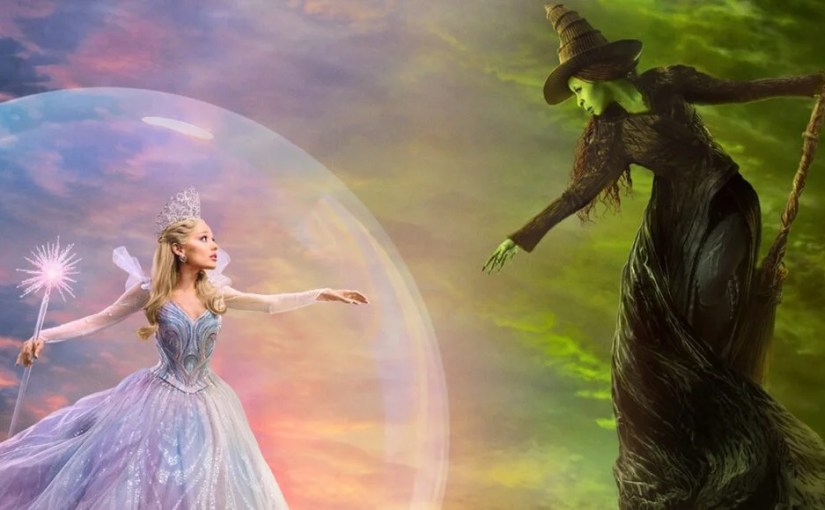
Untrue propaganda sweeps through Oz as Madame Morrible (Michelle Yeoh) uses the false influence of The Wizard (Jeff Goldblum) to unite the kingdom into believing the empathetic green skinned Elphaba (Cynthia Erivo) is the Wicked Witch of The West, on mission of terror.  Citizens of Munchkinland and the Emerald City believe the lies and live in fear of her presence.  Glinda (Ariana Grande), decked in beautiful pinks with a sparkly wand and a convenient flying bubble craft, serves as a poster girl for hope with the illusion of having enchanting powers to protect.  Elphaba’s sister Nessarose (Marissa Bode) succeeds as the governor of Oz following the death of the girls’ father.  Nessarose has grown coldhearted, particularly to her one true love Bok (Ethan Slater), who by decree must remain held captive under her authority.  He’s literally forbidden to immigrate by train. These are not the students of Shiz that we grew up with. 

I hate to use Wicked For Good as a metaphor for political purposes, but that’s exactly where my mind went to, and I’m grateful for it.  I believe there is much wrong occurring each day in the United States and throughout the world. I’m at least thankful that artistry like cinema and stage prevents us from burying our heads in the sand.  Conveniently, there’s a triggering and emotionally engaging storyline to hold on to.

Wicked was spawned off of L Frank Baum’s classic fairy tales. Part of the fun is seeing how these new stories are threaded towards his classic story of a girl from Kansas who arrives in Oz and befriends three unusual charmers while on her journey to meet The Wizard.  I’d argue that more people are familiar with the classic Warner Brothers film from 1939 than Baum’s series of books, and this Universal picture seems to adhere to the original production especially.  Elpheba delivers a new song called “There’s No Place Like Home” that’s woven beautifully into the picture.  Glinda sings about “The Girl In The Bubble” to emulate her personal conflict with how she is meant to serve.  Classic lines like “I’m off to see The Wizard” are provided.  Hints at a lion (voiced by Coleman Domingo) being fearful, along with a character’s heart becoming too small are referenced with weighty importance.  Another character is asked if he’s lost his mind.  It’s satisfying how original the Wicked properties are while being comfortably familiar.

The cast is sensational.  Cynthia Erivo is a wonderful performer who hides in her role with an American accent and her Broadway voice to belt.  She performs so convincingly that it becomes easy to look past the green skin and watch the woman who is challenged.  Michelle Yeoh and Jeff Goldblum have those unusual appearances and distinct personalities that serve a fantasy world like Oz.  Marissa Bode demonstrates tremendous strength as the disabled character who probably traverses through the biggest change of the whole cast.  Ariana Grande is a terrific actor and a lovely singer.  As I noted about the prior film, her Glinda is not my favorite, though.  The three others I saw on stage performed with a bubblier delivery and did not rely so much on Grande’s hair flip.  Jonathan Bailey is a dashing and charming hero, carved out for the prince of fantasy.  Ethan Slater’s Bok suffers through unwinnable oppression, and thus his character is more tragic this time.  It’s crushing to see, but his performance is completely relatable.

I watched the first film as a refresher ahead of seeing For Good and it occurs to me how triumphant these films are.  This whole story could have been contained in a ninety-minute Disney blueprint.  Yet, Jon M Chu, along with Stephen Schwartz want to entertain the audience through the narrative. So, it will stop where we are reading the movie, allowing us ample time to witness the world around us and what these characters of fantasy endure.  It’s odd sometimes to see the street toughs of West Side Story break into song as they are trying to knife one another in the streets.  In Wicked, it is never strange to see a witch or a munchkin or a prince break out into harmony to express their happiness, anger, sadness or wickedness.  The music and vocalizing build the vivid textures of the sets into grander designs. 

I can be told what happens next in the further adventures of Elphaba and Glinda and just move to the next chapter until they live happily ever after.  It’s better if the characters take their time to share as many thoughts and emotions as they can through song, dance, visual effects and action.  That’s what sets musicals apart from other fares of drama and comedy.

The Wicked films, and more importantly the musical, will remain timeless as much as Star Wars, Star Trek and Harry Potter.  They will never be dated.  They will only capture the hearts, laughs, tears and harmony of further generations to come decked in their favorite shades of green and pink.

THE RUNNING MAN (2025)

By Marc S. Sanders

Everything you see in the remake of The Running Man belongs.  So why doesn’t any of it work?  I think director Edgar Wright needs to have his feet held to the fire.  He made this movie with his eyes closed and his ears muffed.

Like the Stephen King (or under his pseudonym, Richard Bachman) story and the original 1987 picture with Arnold Schwarzenegger, a violent game show called “The Running Man” occupies the airwaves in a dystopian future.  Modifications from the first film are done to separate this picture from that one.  In the last film, contestants were violent criminals on the run to win freedom from incarceration.  Here, anybody can try out to win the cash prize of a billion dollars.  I’m not sure which is more faithful to King’s novella.  

Ben Richards (a name which always gets me thinking of The Fantastic Four; Ben Grimm, Reed Richards) is played by Glen Powell with a handsome athletic build but not the muscular physique of Schwarzenegger.  Powell looks more like an Everyman who auditions for one of this future’s various twisted game shows, hoping to win cash prizes that will rescue his wife and sick baby girl from poverty.  He never intended to get thrust into the ultra-violent “Running Man” though.  The object is to outlast and survive for thirty days while sadistic headhunters attempt to find him and deliver a gruesome televised slaughter.  The producer, Dan Killian (Josh Brolin), foresees a ratings bonanza with Richards as his most wanted runner.

Glen Powell needs to enhance his career with his sudden popularity.  Between this film, Twisters and Top Gun: Maverick he is playing pick-up sticks on resurrected franchises, and he ends up being completely unmemorable and uninviting.  Other than a square chin, there’s nothing special about this guy and I never once felt empathy for his role here.  He does not convey fear or anger or humor like a Bruce Willis, a Tom Cruise or even an Arnold Schwarzenegger.  He’s boring.  Edgar Wright’s script with Michael Bacall does not help the actor either as The Running Man is neither quirky or offbeat like a dystopian action picture or a standard Edgar Wright piece (Scott Pilgrim Vs The World) should promise.

The most exciting ingredient is Coleman Domingo, one of my favorite actors working today.  He is so magnetic in anything he does that I can practically guarantee whatever pizzazz he brings as the larger-than-life game show host, Bobby T (Yes!  That’s his name!), carries no impact.  This script gives him nothing to do other than wear a purple sports jacket while belting out “WELCOME TO THE RUNNING MAN!!!”  If he was simply given all of Richard Dawson’s dialogue from the first film, Domingo could have elevated this drippy picture into something engaging and fun.

Lee Pace (The Lord Of The Rings) is fully masked until the third act and has little dialogue as he’s the hero’s main hunter.  Why waste such a charismatic actor?  He’s dressed in black with a black mask.  What’s fun about that? Josh Brolin sits behind a desk as the puppet master producer.  He plays his part like Josh Brolin on a press tour stop on The Today Show.  He’s really not acting at all.

It’s an eye-opening surprise to see Sean Hayes (Will & Grace) make an early appearance as another game show host for a different show.  This should offer magnificent promise.  Brilliant casting for an over-the-top comic performer.  I was waiting for Hayes and Domingo to get into a sparring match of egos for attention in this television world.  You know what happens, though? Sean Hayes is never seen again following his appearance ten minutes after the film begins.  Another overlooked waste of talent.

William H Macy is a good character actor for this kind of film.  Too bad he’s also given little to do other than to tell the hero to go see the guy played by Michael Cera.  Why not cut out the middle man and let Ben Richards just deal with Macy’s character? The Running Man is far from the leaner film it could have been.

Some of the action scenes in this violent tale work, and some don’t.  When Ben Richards catches up with Cera’s character, a run/hide shoot out in a two-story house plays like a video game with bannisters that come apart and rapid machine gun fire.  It’s edited quite well.  Later though, there’s a battle that occurs in the cockpit of a jumbo jet.  Gravity is disabled while gunfire and fisticuffs are at play and everything shakes and bounces so much that it’s hard to tell who gets the gun and who is shooting who.  This looks like the filmmakers were pressed against a deadline and just didn’t clean up or tighten the scene into something coherent.  I just stopped trying to focus on the film and waited for the scene to end with another escape by the dashing Ben Richards.

This screenplay feels like it was made up on the fly.  Glen Campbell is awarded several scenes to speechify melodramatic gargle.  Is there a noble cause that we are to learn about from The Running Man? Just as the third act is about to start, he hitches a ride with a young girl who we have never seen before.  Nor has she been referenced anywhere thus far.  Yet, she’s got something to say with some kind of cause on her mind as well.  This nameless sidekick takes over the movie for the next twenty minutes and then parachutes into open sky never to be seen again.  What was the point of this detour? Moreover, what the hell was she ever talking about?

This Running Man had all the ingredients to work with a stellar collection of fine actors who were up for the task of wit and satire amid ridiculous violence and totalitarianism.  With Edgar Wright at the helm, the new Running Man could have been a harkening back to Paul Verhoven’s ultra-violent tales of gonzo media silliness found in his movies like Robocop, Starship Troopers and Total Recall.

Sadly, Glen Powell is uninteresting, and the more amazing talents of the supporting cast were handed lackluster and witless material.  

The Running Man marches at a speed of sluggishness.  Better to turn off the TV and read Carrie or Misery.

CHRISTY

By Marc S. Sanders

Boxing movies are nothing new.  The best ones depict the fighter surviving personal battles outside of the ring.  That was likely true with the fictional Rocky Balboa.  It might have also been what kept Jake LaMotta alive well beyond his demons.  It’s definitely a fair argument for Christy Martin, the first boxing champion to bring the sport into the mainstream for females.

Her story comes to the big screen with an astonishing Oscar caliber performance from Sydney Sweeney.  I saw Christy a week ago and I cannot stop thinking about it.  The material within this biography from writer/director David Michôd is entirely familiar.  Still, the character of Christy and what she endures is worthy of a movie.

Beginning in 1989, eighteen-year-old Christy Salters haphazardly begins her climb up the ranks with small time underground fights in her Virginia hometown.  She’s not educated and she’s not embarrassed about being in a relationship with her girlfriend.  Her bible loving mother Joyce (Merritt Weaver in an authentic, all too real and villainous role) says otherwise. She’d take her daughter to the local minister to draw the gay out of her if the girl wouldn’t rebel with a temper inflamed by F-bombs.

Christy is summoned for higher stakes fights in Texas.  She wins that one and then is connected with Jim Martin (Ben Foster) who witnesses one hard swing from the girl in a sparring match. He commits his entire life to being her coach.  Ask Jim and he’ll say he made Christy what she becomes, a near undefeated champion adorned in signature pink and on the cover of Sports Illustrated – a first for a female boxer.  The film reminds the audience that Jim’s perspective is hardly true.  This jerk nearly screws up Christy’s chances of getting a lucrative contract with Don King (Chad L Coleman) which included pre-fights ahead of Mike Tyson’s Vegas appearances in the ring.  If only Jim’s laziness and procrastination were his worst qualities, though.

Christy becomes an emotional challenge to watch as it progresses. David Michôd’s film burrows into the dark underbelly of athletic success. Once Jim and Christy are married, a limited lifestyle cages the young phenomenon with the husband/coach’s monstrous tendencies.  The torment that victimizes this woman is beyond compare as she must succumb to demonizing sex slavery for his twisted, intoxicating yearnings, as well as for anyone he collects money from who ready to engage in brawls with her, in dirty hotel rooms.  Working in her corner at the fights, Jim does not protect Christy against opponents that she is clearly no match for.

Christy is physically abused and mentally tortured by Jim, and maybe by other intimidating powers like Don King.  Chad L Coleman delivers a brilliant and familiar persona to King.  The boxer is also financially getting ripped off, despite opening a Florida gym in her name with Jim listed before her on the front door.  

It’s astonishing to see how much peace Christy can find in a boxing ring alone against an opponent.  At home, she can only acquiesce to what’s demanded or forced upon her.  There’s no fight at home.  Only surrender.

I had recently seen Sydney Sweeney host Saturday Night Live.  It was one of many terrible episodes in the show’s history because the writers only catered to Sweeney’s youthful glamour and looks.  There was a skit taking place in a Hooter’s restaurant where her character was collecting the biggest tips based upon how she filled out the signature uniform.  It was lousy, unaware and insensitive writing.  Actors like Anne Hathaway or Natalie Portman were never treated this way on the program. None of the skits gave Sweeney something unique and worthy of what she’s capable of.

In Christy, with a white trash twang, and a puffed up brunette curly hair style (later it becomes blond corn rows), Sydney Sweeney is doing what Meryl Streep would have committed to in a physically taxing role like this.  Sweeney demonstrates a focused young girl going after what she wants even if it means she has to make up for her husband’s shortcomings as a negotiator.  He’ll beat the shit out of her, but Christy Martin matures as Michôd’s film progresses with intense training moments and riveting fight scenes that have Sweeney in action.  

Ben Foster is that committed actor who never looks the same in two different roles.  I didn’t even recognize the former Disney kid until I saw his name in the end credits.  Outdated polyester clothing and track suits from the 1990s do not hide that paunch, ugly belly.  Christy’s winning purses of prize money cannot conceal his bleach blond combover or his trashy southern accent.  Yet, he is nothing but noticeable when he is on screen.  Foster is the worst kind of cad with a terrifying grip on his wife and her career.  A terrible eyesore within the presence of the film.  Jim Martin is none too bright, but he knows how to hold a wrenching grasp and he’s entirely frightening.

Merritt Weaver is the quiet antagonist.  Unlike Foster’s character, the mind games that Joyce plays on her daughter are not so intentional as they are natural.  This mother refuses to see beyond the expected dominance of a man to uphold a catholic home, devoid of sinful lesbian practices.  It’s awful when a mother will side with a daughter’s abusive husband. Weaver’s portrayal of Christy’s bible committed mother demands to be hated.  

Ahead of seeing this film, I knew nothing about Christy Martin.  So, when a shocking moment occurs in the third act, my jaw dropped at the direction of the scene.  An action occurs and Michôd’s camera seems frozen in position as a character paces in and out of the room.  Then the character returns and commits a much uglier act.  Then the back-and-forth pace continues with a harrowing stare down before exiting to take a shower.  I know Christy is just a movie.  Yet, I cannot recall the last time I felt so helpless as a witness to what I was observing. I wanted step into the screen and lend aid. I only hope that when the film comes out in digital format, some insight is provided into how Sydney Sweeney and Ben Foster circumvented around their clashes of characters.  All of it feels too real.

Sydney Sweeney is also convincing as the battering boxer.  Like most films that cover sports, there are typical training and fighting montages here.  Sweeney is not afraid to behave ugly for the showmanship needed to be in an elite ring.  There’s one expression she delivers in a blink/miss wide shot lens after she knocks out an opponent.  It feels so organic as a bloodied Sydney Sweeney outstretched with her gloved fists, prances around the ring, gives a shoulder shrug and sticks her tongue out.  This actress knew exactly how to play this character, soaked in sweat with blood streaking out of her mouth and nose absent of any kind of humility that would show weakness in a champion fighter.

I am afraid though.  Christy is currently not the box office titan it deserves to be and come awards time, I’m certain Sweeney, Foster, Coleman and Weaver will be wrongfully overlooked.  Sydney Sweeney, a producer on the film, was asked what her reaction is to the sluggish financial returns.  Best she could, she replied by saying not all films are made for the money.  Some need to be made for the art.  I’ll go a step further and declare that Christy serves as an advocate for awareness of domestic violence and prevention.  Amazingly though, this film executes astounding triumphs for those underdogs who have next to nothing.

Christy is one of the best films of the year.  

FRANKENSTEIN (2025)

by Miguel E. Rodriguez

DIRECTOR: Guillermo del Toro
CAST: Oscar Isaac, Jacob Elordi, Christoph Waltz, Mia Goth, Charles Dance, David Bradley
MY RATING: 8/10
ROTTEN TOMATOMETER: 86% Certified Fresh

PLOT: A brilliant but egotistical scientist brings a creature to life in a monstrous experiment that threatens to undo both the creator and his tragic creation.


Having never read the original novel by Mary Shelley, I have no idea if Guillermo del Toro’s rendition of Frankenstein is any more or less faithful to the source material.  What’s interesting about this version is that it feels like it is.  There are long passages of dialogue and even some monologuing on the nature of life, death, and the creator’s responsibility to their creation.  del Toro is smart enough to balance these cerebral discussions with enough gothic (and gory) horror to satisfy any fan of the genre.  Call it a good example of a thinking man’s horror film.

Oscar Isaac’s performance as Victor Frankenstein puts a new spin on the stereotypical mad scientist.  He’s no less obsessed than previous versions, but del Toro and Isaac went for a slightly different vibe in his personal appearance.  Rather than a cackling lunatic with a god complex, Isaac’s doctor looks and sometimes behaves more like a self-absorbed rock star…with a god complex.  (I learn on IMDb that this was by design; del Toro wanted Victor to evoke David Bowie, Mick Jagger, and Prince…mission accomplished.)

Jacob Elordi as The Creature does an admirable job of generating sympathy and empathy for perhaps the greatest misunderstood monster of all time.  The unique makeup (which took up to 10 hours to apply!) allows Elordi to emote and lend humanity to the Creature in the second half of the film, especially during his encounter with the blind man.  There is a subtle but ingenious effect where one of his eyes will sometimes glow orange with reflected light as a reminder that, when push comes to shove, this Creature is not to be trifled with.

Mia Goth is a welcome presence as Elizabeth, who is not Victor’s love interest this time around, but fiancé to Victor’s younger brother, William.  I supposed I could quibble that the screenplay does not give Elizabeth much to do.  She comes across as the intellectual equal of Victor in a few well-written scenes, but her encounter with the chained Creature felt a little trope-y, and her character’s payoff left me wanting more.

The visual style of the film is crammed with del Toro’s signature fingerprints: huge gothic structures, elaborate costume designs (loved Victor’s mother’s red outfits near the start of the film), startling dream sequences, and lots of practical effects…well, more than there were in Pacific Rim (2013) and Crimson Peak (2015), anyway.  One image that really struck me was the unique design of two coffins seen in the film.  They looked more like futuristic cryogenic chambers than Victorian-era caskets.  Watch the movie and you’ll see what I mean.

Other things I loved:

  1. Victor’s early presentation of his theories to a disciplinary board, in which we get an echo of that creepy dead guy resurrected by Ron Perlman in del Toro’s Hellboy (2004).
  2. The towering set for Frankenstein’s laboratory.  What it lacks in the whirring, crackling machinery we normally associate with his lab, it makes up for in scale, including a yawning pit several feet across that really should have had a guardrail.
  3. Being able to get inside the Creature’s head this time around.  There have no doubt been other variations where the Creature speaks, but I haven’t seen one where he is this eloquent, expressing his pain and anguish over his unwanted existence and apparent immortality (his wounds are self-healing).  This is another factor that makes this movie feel more faithful to Shelley’s novel, even if it isn’t.
  4. The no-holds-barred aspect to the violence and gore, which can be quease-inducing, but which never feels overdone or exploitative.  In fact, the moment that scared me the most in the film had nothing to do with the gore or violence at all, but with one of the doctor’s early experiments that comes to life in a most surprising manner.

Above all, there’s the tragic nature of the poor Creature’s existence, the misunderstood monster that has been so often satirized or spoofed, and the deeper questions the story raises about our own lives.  It might be tempting to listen to the closing passages of the film and dismiss them as trite and sentimental, but Frankenstein earns those moments, in my opinion.  More than any other Frankenstein movie I’ve seen, this one made me think, and jump a little, in equal measures.  Tricky stuff.

A TIME FOR SUNSET

By Marc S. Sanders

Tom Calloway’s A Time For Sunset is a well-crafted film with shadowy, haunting cinematography and some decent edits.  Unfortunately, it travels towards its conclusion on a repetitive Groundhog Day trajectory.  Regrettably, the deliberate slow burn does not work.

A cell phone rings.  It’s answered.  A few lines are exchanged and then there is the hang up.  Five seconds later, the phone rings again and the same routine occurs, between the same two people. This pattern occupies the ninety-minute running time of this film. Sometimes the same questions are asked. The conversations seem similar to what I’ve already encountered, and I asked myself if we’ve covered this already. Out of nowhere someone gets shot right between the eyes, but I am so numb to this lethargic routine that I can’t even become alert to see what could happen next.  After all, the phone is going to ring again for a couple of lines to be said before the next hang up, followed by another call.

Don Worley is John, a seasoned assassin, who checks into a downtown hotel room with a set of golf clubs.  He calls his wife and daughter to say hello while he begins to assemble his sniper rifle.  Just after he disconnects with them, “No Caller ID” (Nicholaus Weindel) rings and John realizes that while he awaits his assigned target to appear on the street below, John has also become a target.  Each time this caller phones, he seems to share more information about John’s current circumstance thereby putting him in danger along with his wife and daughter.  Now it’s one assassin against another, but John is clearly at a disadvantage because he is unable to pinpoint from where this caller is watching him.

With Thomas L Callaway directing, A Time For Sunset monopolizes its camera work on actor Don Worley who is up for the one-man challenge.  Intermittently, other figures on the hotel floor disrupt the phone conversation to lend to John’s contained paranoia such as a bellhop, a couple of rowdy kids, a manager and an angry mother.  One person arrives to up the stakes with a cleverly rigged bomb and my mind immediately went to the third act of Jan DeBont’s Speed.  These all feel like brief episodes though with not enough oomph to break the monotony.

The pace of the film moves very slowly because it focuses too often on a guy talking into his cell phone or the accompanying earpiece. So, the thrill of this thriller is mostly absent.  Don Worley might be portraying this expert assassin with a measure of calm and cool sensibility during a high-pressure circumstance.  However, his tone hardly changes as the stakes are getting higher.  I never saw the desperation unfold, even as the film was wrapping up.  John hardly breaks a sweat.  Joel Schumacher’s Phone Booth was another picture that came to mind.  Colin Farrell’s everyday man seemed to respond to the fear that is sorely lacking in Callaway’s film.

I liked the idea of this bottled up storyline.  It has the potential to be compelling. A lot can be generated when someone must work against an unknown entity within a small setting.  The original Saw, for example.  Yet, even with a ticking time bomb front and center, plus the intrusion of a red pointer beam from a sniper scope, the direction does not build any suspense here. 

Despite what the introductory scene appears to spell out for John’s fate, I really didn’t care what would become of the poor fellow.

TRON: ARES (2025)

by Miguel E. Rodriguez

DIRECTOR: Joachim Rønning
CAST: Jared Leto, Greta Lee, Jeff Bridges, Evan Peters, Jodie Turner-Smith, Gillian Anderson
MY RATING: 8/10
ROTTEN TOMATOMETER: 56%

PLOT: A highly sophisticated AI program goes rogue against its programmers to defend a scientist who may hold the key to something called “permanence.”


For those who are not fans of the original Tron (1982) or its high-tech sequel Tron: Legacy (2010), let’s clear the air right away: Tron: Ares is not likely to convert you.  Period.  I see you and I understand you.  No hard feelings.  Heck, I’m a fan of both movies, and I heard the terrible advance buzz for Ares and saw the low ratings on Rotten Tomatoes and IMDb and thought, well, the franchise had a good run.  If it’s gonna suck, it might as well suck on the biggest screen I can find, in Dolby 3D, sixth-row center, to make the most of that Nine Inch Nails soundtrack/score and the slick CGI.

And…I gotta be honest.  Tron: Ares surprised me.  Admittedly, my opinion may be slightly influenced by the Dolby sound system that turned the synth- and bass-heavy score into a near-religious experience.  But Ares seems to have learned from the mistakes of its predecessors (earlier builds?), even going back to the original film.

First, the story is not nearly as cluttered as Tron: Legacy.  The first sequel threw in metaphysical content about spontaneously generated AI programs (the so-called ISOs), long conversations about the responsibilities of a creator/father to his creation/children, and duplicitous club owners (yep), and so on.  Tron: Ares, by comparison, is as straightforward as they come.  A MacGuffin is established early, as are the ground rules for how and why computer programs can exist as tangible entities in the real world, the bad guys are clearly identified (not all of them are in red), and once the pieces are set in motion, the movie only pauses the action when absolutely necessary.  It’s not Shakespeare, but it’s efficient.

Second, Tron: Ares makes a significant departure by moving the story between the “grid” and the real world multiple times.  The first two films, as you may remember, started with an expositional prologue in the real world, after which the hero is zapped into the grid for most of the rest of the film.  Ares starts in the grid, moves to the real world, gets its human hero into the grid, gets her AND Ares back out, then goes back into the grid again, and so on.  It introduced a rhythm that was missing from the first two films, and it broke up the visual palette so that neither one became boring.  Pretty slick.

Third…and this is something I just wrote about Brian Blessed’s character in Flash Gordon (1980)…Tron: Ares reintroduces an element from the first film that was virtually absent from the second film: a sense of fun.  It doesn’t introduce a wise-ass Kevin Flynn character or anything like that, but Jared Leto as Ares is given some genuinely funny dialogue that brought some much-needed laughs to the film.  Particularly when it comes to his preference for ‘80s synth-pop with catchy hooks.  Note: I’m not claiming it’s a laugh riot.  But the humor is very welcome when it arrives.

Another big factor in this movie’s favor is the huge Easter Egg that has not even been hinted at in the trailers, and thank God for that.  No, I’m not talking about the presence of Jeff Bridges, smart guy.  It’s so big (in my opinion) that the less said about it the better.  But I’m here to tell you, I haven’t geeked out that much in a movie theater since Ready Player One (2018).  Moving on…

And the score…!  I learned that Disney apparently insisted that the score be credited to “Nine Inch Nails” instead of “Trent Reznor and Atticus Ross.”  Good choice.  Their booming bass and synthesized soundscapes are the equal to the other two films in every way, if not superior.  (And I LOVED the Daft Punk music from Legacy.)  There’s even a song or two with vocals from Reznor!  What?!  Not content with nostalgia bombing us with random easter eggs from 40 years ago, Ares throws in a musical bomb from 30 years ago.  And it really, really fits the story.  Hand to God.

Overall, there is a nostalgic sheen to Tron: Ares that made it feel like I was watching a souped-up version of a really good ‘80s film.  That might be the highest praise I can give it.

If you’re a sucker for well-crafted nostalgia, you could do a lot worse than picking up a ticket for this movie before it gets pushed out of the cineplex by the Wicked sequel, if not sooner.  Bad buzz?  Whatever.  I had a good time.

WEAPONS

By Marc S. Sanders

The longevity of horror movies and the insatiable appetite that audiences hunger for hinges on curiosity.  Horror is other worldly or beyond commonplace.  It’s unrealized. Stories likely begin with the concept of a particularly unique, unheard of scenario.  

For example, one night in a small suburban neighborhood, what could explain why an entire classroom of elementary school students, taught by Ms. Gandy, leave their homes at exactly 2:17 in the morning, vanish into the darkness and never return? Could Ms. Gandy be behind this mystery?  Also, why is Alex the only student in the class to show up for school the next day?

Reader, the trailer for Weapons had me hooked.  The imagery showing the silhouettes of innocent children running into the darkness with their arms outstretched was eye opening.  A young girl narrates the brief camp fire ghost story in the preview. It also opens the film with additional details.  This set up seems odd and different.  Doesn’t sound like another vampire or zombie flick to me.  This was going to be something else.  Frankly, ahead of the release of Zach Cregger’s film, I could not stop thinking about it.  I needed to know the reason behind this phenomenon.  

Yet, anticipation and finally scratching that itch turned out to be disappointing.  

Cregger’s movie answers almost all the questions it offers even if some elements are not wholly consistent as the story unravels.  The only salvation to watching Weapons is not knowing why any of this happened, in particular with the squirrelly young teacher, Ms. Gandy (Julia Garner, whose career continues to impress) at the center of it all.  

Like most second rate horror films though, there are teases of drawn out scenes as you anticipate the next jump scare.  Loud knocking on a front door to motivate the protagonist to go “Helloooooo!!!! Anyone there?,” and then to open the door to an empty street is just as annoying. Especially, if nothing is ever explained of that sequence. Was this wedged into the final cut for another hair raising experience? The best horror has an explanation for EVERYTHING you see. However, I was waiting for a cat or a bird to jump into frame. It’s been done!

There are also the nightmare sequences.  Once again, I have been banged over the head with “It’s just a dream!”  This is such a desperate, last resort trope to stretch out a running time or make up for lost road in storytelling.  Can movies just stop with the “only a dream” sequence please?  Freddy Krueger is the only one who can legitimately lay claim to this tired idea.

While I may not care for the explanations of Cregger’s phenomena, at least I can compliment his skills as a filmmaker during the expository portion of his picture.  The writer/director provides an abundance of tracking shots through the hallways of the school, down neighborhood streets, in Ms. Gandy’s house, and even within the small confines of a liquor store.  

Much of his material is positioned behind his characters and he tracks where they are walking while being limited on showing their facial expressions.  Recently, I watched Alfred Hitchcock’s Notorious and the film initially only shows the back of Cary Grant’s head.  It works as a mysterious character device.  For the first twenty minutes of Weapons, we are primarily only seeing the back of Julia Garner’s head.  I was invested in this movie wondering what is it about this loner teacher who is being admonished as a witch within the community.  This movie is starting out with a modern day Salem. Ms. Gandy is weird and I desperately want to look her in the eye, but Cregger’s direction won’t let me.  So, I can’t get a grasp of this odd individual.  Well played.

The outline of Weapons works like Doug Lyman’s Go or a Quentin Tarantino film.  Cregger said he got inspiration from Paul Thomas Anderson’s Magnolia.  The movie is divided into different perspectives of a collection of characters.  You see the teacher’s experience first, and then respectively of another student’s father (Josh Brolin), a cop (Alden Ehrenreich), a homeless meth addict, and the school principal (Benedict Wong).  Their stories eventually cross paths while more and more clues and answers gradually deliver.

What is surprising are the humorous beats that come out of some of the frightening moments of the picture.  The bonkers ending feels like a salute to a memorable scene from Ferris Bueller’s Day Off.  What comedy derives from the dark elements though felt unwelcome to me.  For a horror picture with fascinating potential, the threats and whatever suspense that was to be expected suddenly feels watered down.  Now, Weapons feels like an uninspired episode of Tales From The Crypt or an exhausting and unnecessary two hour installment of Stranger Things.  This movie had its brains working overtime when it began and then lost its intelligence along the way.

Two characters in the script are given too much unwanted and uninteresting attention here.  When the film arrives at their perspectives, the picture meanderingly drags along offering little of anything substantial.  It felt like I walked into a different movie, far away from the spooky stuff that was eerily described in the beginning of the film.  More material could have been devoted to others in the town with a bigger and more personal stake in the central plot.  There are too many diversions of little significance.  Seventeen children disappeared and yet we only get to know one father and brush by another mom and dad. No one else is feeling the agony of this incident?

There are pertinent clues of simple logic that are overtly ignored as well so that the story can just simply move along.  Specific objects in Ms. Gandy’s classroom suddenly disappear and no one seems to question their absence while this case is being investigated.  Because it’s too apparent, you can’t help but dwell on this inconsistency.  If you’ve participated in an Escape Room, this bit of information will tediously occupy your mindset.  

Weapons has a marvelous idea, but it circumvents common elements of all horror movies too.  There’s a spooky house, nightmares, a haggardly weird old lady, knocks on the doors and lots of darkness too.  I don’t mind any of this.  What gnawed at me though was the simplicity of the answers to the riddles, and the enormous waste of veering off into several characters who bear little importance.

Someone should take this idea of children running away into the night and do it all over again.  I just love the idea. Other screenwriters would have written Zach Cregger’s story and then ripped the pages off their legal pad and tossed the crumpled balls of paper over the shoulder to start again. Cregger seems to have just settled on his first draft.

Weapons feels like a movie where the audience gets to experience a wrenching case of writer’s block, and nothing could be more frustrating.

SUPERMAN (2025)

By Marc S. Sanders

Once again the man in blue, red and yellow has returned to the big screen by means of director James Gunn who is intent on starting a whole new universe of DC comics characters.  The 2025 interpretation of Superman is zippy and fun even if it is a little too shallow of character development and dimension.  That’s regrettably ironic actually.  A man who dons two different personalities, Superman and mild-mannered reporter Clark Kent. Yet, neither has much to say or stand for in this two hour picture.

Gunn’s film is defiant to avoid any heavy exposition as this film begins.  There’s a slim foreword as the picture begins to describe this new universe that contains metahumans who arrived on Earth centuries ago, along with a little bit of Kal-el’s origin that many of us are familiar with.  Then we see the Man Of Steel crater into the Antarctic wounded from battle and aided by his feisty canine friend, Krypto, who drags him to his ice palace, the Fortress of Solitude.

Action commences thereafter back in Metropolis.  Lex Luthor (Nicholas Hoult) is pulling the puppet strings.  Lois Lane (Rachel Brosnahan) and the rest of the Daily Planet staff witness the mayhem over the city.

Then we get a bit of Clark looking a little goofy as he rushes into work, followed by some romantic interlude between Clark and Lois back at her apartment.  The two toe the line of their relationship when finally, the Superman persona allows his girlfriend to test his purpose for serving planet Earth along with his limits of authority and decisive action.  They go back and forth but none of the dialogue lands and the argument has no impact.  A missed opportunity to set up the Lois and Clark relationship.

The rest of the picture focuses on comic book episodes of endangering Superman while other metahumans make appearances – an obnoxious Green Lantern (Nathan Fillion), Hawkgirl, the shape shifting Metamorpho, and the surprisingly entertaining Mr. Terrific (Edi Gathegi) who seems to operate like Mr. Spock from Star Trek.  Of the four, the guy with the dumbest name actually serves the picture the best.

James Gunn’s film takes a huge departure from the recent films of Zach Snyder’s universe.  Nothing is dark and hardly anything is morose.  Some subplots seem to be ripped from the headlines of current events that’ll have you thinking about the Russian-Ukraine war.  None of it is overly heavy though because this picture is designed for families to watch together. 

Superman is pure escape with a red cape.

What I miss though is what both the Snyder and the Christopher Reeve pictures offered.  What does Superman mean to himself and the planet Earth?  The one conversation between Lois and Clark/Superman goes on long and while it feels like there is a purpose in that exchange, I cannot recall one kind of conclusion that stemmed from it.  For the rest of the film, Lois flies a spaceship and helps a weakened Superman find aid. When the two share any more scenes together it is for the action of the piece followed by a kissing scene.  I just didn’t respond to the puppy love or risks of their relationship that other iterations offered.  Their connection is just written a little too thin.  That’s a problem, because the Superman mythos always hinged on their relationship in the face of danger or true love or even journalistic integrity.

Am I being too serious and hardheaded?  Yes.  Nevertheless, even with a comic book/Saturday morning cartoon gloss, I wanted to see more weight to the relationship between the two characters.

The best attraction is Nicholas Hoult as a connivingly evil Lex Luthor.  He’s a raging madman bent on destroying Superman like everyone knows and the actor chews the scenery while primarily hiding in his glass headquartered command center for most of the film.  Anytime the movie diverts to Luthor, the picture just felt more alive.  This is a great Lex Luthor!!!!!!

Like he did with a smart aleck racoon in his other films, James Gunn introduces a toy line merchandise with the flying white terrier dog known as Krypto.  His intent is for audiences to cheer for him like other precocious creatures from past films such as any Disney movie or E.T. or Baby Yoda or Rocket Raccoon.  He’s cute and spirited.  When he’s in danger, the kids will be worried.  When he flies into the center of the screen with a bark or a yelp, everyone will applaud. 

David Corenswet is Superman.  He’s fine.  He definitely looks like the part.  He’s a happy go lucky Kryptonian.  He’ll never be as memorable as Christopher Reeve.  I also have more to appreciate in Henry Cavill’s performance.  I just didn’t see Corenswet do enough with this role.  I’ve yet to really see the dramatic chops he could offer.  Simply lying on the floor of a cell while falling ill to Krytonite is not urgent or frightening enough.  I hardly got to know this guy to care enough if he lives or dies.  I hope he’ll blossom some more within future installments of Gunn’s superhero universe.  That’s up to the writers though.  David Corenswet is pleasingly relaxed in a role that demands almost a hundred years of acceptance for a modern age.  I’m confident he can do it and that Gunn cast the right guy for the part.  While he’s acceptable, both Corenswet and Brosnahan would best be served better material for them to work together. 

As for Rachel Brosnahan, I guess she’s okay.  I don’t see her do much beside fly a spaceship.  Lois Lane is such an immense character of brains and gusto striving to always be the number one reporter.  Her only weakness is her love for Superman.  There’s not much I remember about her from this film.  I did notice that she primarily wears purple like the character did in 1990’s animated series.  Nice salute.  Come on James Gunn.  Rachel Brosnahan is good actress.  Give her something more to do.  Let her act a little.  (Let David Corenswet act a little too.)

It’s wonderful that an optimistic interpretation of Superman has arrived.  We need it.  It’s colorful and fun.  It could be more exciting, though, with higher stakes that just didn’t arrive quite right.  This film is not my ideal picture of the hero, but the universe to come, especially with a quick appearance from another character at the conclusion, offers promise. 

Despite my reservations, the new DC Cinematic Universe seems to be in the right hands once again, and James Gunn’s team will deliver something entertaining for the next few years to come.