WALTZING WITH BRANDO

By Marc S. Sanders

You think you know someone, but then you learn a whole other side about the person.

I only know Marlon Brando from his achievements in The Godfather, Superman, A Streetcar Named Desire and On The Waterfront.  There’s also his final picture, The Score, with his Vito Corleone counterpart, Robert DeNiro.  I’ve seen him spoofed on Saturday Night Live and know that he’s even poked fun at himself in a film like The Freshman.  He was notoriously and proudly quirky.  I guess Brando was so content to appear odd to everyone else beyond the island of Tahiti, which became his escape to paradise, away from autograph hounds, environmental abuse and Hollywood barbarianism.  Brando simply endured his greatness as one of the most incredible movie actors ever to subsidize how he really wanted to live in utopian isolation.

Billy Zane seamlessly inhabits the persona and physical appearance of Marlon Brando in Waltzing With Brando.  The film presents a slice of the actor’s uncompromised efforts to build an ecological home, and maybe a hotel, on an uninhabited island next to Tahiti.  To bring this idea to fruition, Brando recruits a young, undaring Los Angeles architect named Bernie Judge (Jon Heder) to helm the project.  This will be an undertaking that Bernie could never expect and can hardly circumvent around impossible challenges in the face of proven scientific engineering, chemistry, and physics.  Brando seems to have an answer for everything though.

By breaking the fourth wall to speak to the viewer along with voiceover narration, Heder is charming about his unexpected adventures.  The white-collar shirt and necktie of city life is abandoned for shorts and conch shell necklaces.  Actually, as Brando demonstrates its better and less inhibited to just be nude like the rest of the cheerful islanders.  Despite his reservations, Bernie gets more and more accustomed to Brando’s perceptions but still he has to find ways to be practical to complete this unconscionable project.

Drinking water is needed.  Marlon’s answer is to filter it from his own urine.  Electricity needs to be installed on the island.  Though, is Marlon truly serious when he suggests that energy stem from a power source like electric eels?  Bernie soon learns that there will never be a client as unpredictable as Marlon Brando.  Money is not an obstacle he cares about.  Oscar trophies serve a menial, floor level purpose that is only a little more useful than resting on a mantle.  An upcoming gangster movie is not really his thing.  A paradise devoid of man-made contamination and pesky societal intrusions is where his focus lies.

Watching Bernie Judge struggle with being away from his wife and daughter, while working with islanders to start at the basics like building an airplane landing strip first, I was reminded of The Brutalist, the fictional period piece that centered on building a grand, outrageously expensive structure within a mountaintop.  That film watched its architect wither away into haunting madness.  The Mosquito Coast with Harrison Ford also came to mind.  Thankfully, Waltzing With Brando does not take these directions.  I know nothing about architecture or engineering or practically any kind of science.  Yet, I know that whatever Marlon Brando conjures up seems unheard of and impossible.  Brando’s friend, Bernie Judge, did not allow these considerations to stop him though.  Why shouldn’t we explore our ideal paradise no matter how exuberant it seems? (Mosquitos are also a problem to deal with and Brando frowns on using pesticides.  Hmm. What can be done?)

Still, we have to be realistic.  Richard Dreyfuss plays Brando’s money manager and represents the challenge of making resources obtainable.  Brando has to go back to work.  Judge needs more and more funds for material and labor.  He takes daring personal risks.  Even the banker does.  Utopia is expensive and never merciful. 

Director Bill Fishman wrote and adapted Bernard Judge’s biographical tales of his encounters with Marlon Brando.  His film is lighthearted, hardly stressful in any kind of dramatic weight.  Perhaps that is because Bernie Judge did not respond to Brando’s ideas with frustration like The Brutalist would have you believe.  While I was not entirely fond of the voiceover narration because I did not recognize its necessity, Jon Heder is magnetically likable.  He’s a cheerful friend telling a bedtime story that took place in a small corner of the world.  Most people never explored these crystal waters and white sands traversed only by Marlon Brando and the native islanders.  This is a civilization unaware of the burden of conflict and pressure. 

Billy Zane does not go over the top with his portrayal of Marlon Brando.  The more subtle and aloof he is in each scene, the more convinced and accustomed I became to his peculiarities.  With Fishman’s script, Zane delivers a handful of dynamics to Brando.  Early in the film, Brando tells Judge that his desire is to live in this Tahitian paradise forever.  He knows however that he must continue to make movies to eventually fund this lifestyle permanently.  Later in the film, it is easy to surmise why Brando feels that way.  While filming The Last Tango In Paradise, he is trapped in a phone booth where his fan base recognizes him.  It’s one of the few times when Billy Zane performs on Marlon Brando’s genuine discomfort, and it is terribly unsettling.  It’s awkwardly ironic that the most famous actor in the world is out of his element among a worldwide community of followers and devotees begging for pictures and autographs.

Like Marlon Brando and an eventual Bernie Judge, Waltzing With Brando wants you to leave the theater with a smirk on your face.  An attempt at achieving the impossible with absolute content does not have to be a miserable journey.  An effort to find ways to overcome challenges can deliver lifelong friendships and personal experiences that belong only to you.  Bernie Judge learned this through his friendship with Marlon Brando.

Waltzing With Brando is a thankfully rewarding experience, a brush with perfect happiness.

NOTE: Stay through the end credits because this “Marlon Brando” has a few treats in store for you.

SING SING

By Marc S. Sanders

Coleman Domingo is that under the radar actor who is on his way to becoming a marquee name.  Of late, I’m loving everything he’s participating in. Check out the Netflix series The Madness and the acclaimed film Rustin for which he received a well-deserved Oscar nomination. His second Oscar nominated role in another of 2024’s best films, Sing Sing, is directed by Greg Kwedar.  As soon as this film begins, you will fall in love with Domingo’s role as he completes a stage performance in A Midsummer Night’s Dream.  However, the theatre that is bursting with applause is located within the infamous Sing Sing Maximum Security Prison.  Coleman Domingo portrays a resident here as wrongly imprisoned John “Divine G” Whitfield.

Divine G is a founder and one of a handful of prisoners who cope with their caged lifestyle as members of the Rehabilitation Through The Arts program (RTA).  Every six months, the RTA prepare a play to perform for the prison population and other local benefactors.  Their director is Brent (Paul Raci), a much smaller guy than anyone in the troupe, white, tattooed and on the tail end of a hippie middle age.  Yet, the men trust their leader and he is nothing but encouraging with theatre exercises to uphold their spirits and get everyone energized. 

A new member of the group does not appear to have much promise.  Clarence Maclin (played by Clarence Maclin) stems from a hard living street life of gang culture.  While he champions the suggestion of a comedy for the next production, he is nevertheless resistant to engage and perform as Hamlet with the famed To Be Or Not To Be monologue.  Divine G works to penetrate Clarence’s stubbornness and get him to recognize how the program can be beneficial and enriching.  Consider Divine a combination of Red and Andy from The Shawshank Redemption – a well-respected realist but also a teacher.  Divine even takes it upon himself to prepare Clarence for his upcoming parole hearing, while he’s getting himself ready, following new evidence that may exonerate him.

Brent collects ideas from all of the men who are enthused to stage ancient Egyptians, cowboys, pirates, Hamlet, and even Freddy Krueger.  Rather than pick one, Brent takes the weekend to write a 148-page script that has all of these elements.  The spine of the plot?  Time travel!  Makes sense, and as Clarence originally suggested, it most certainly is a comedy.

I read that Sing Sing is collectively owned by the cast and crew.  Many people who worked on this production play characterizations of themselves and use their actual names and prison monikers in the dramatization of this film.  They produced and wrote the screenplay, designed the characters based on themselves and their experiences, having been members of the RTA.  The auditions for the play you see in the film are the actual auditions the cast did to be part of the film. So, be ready to be impressed because these rehabilitated prisoners, now actors, are outstanding. 

Coleman Domingo in the leading role only makes the whole cast look even better.  He is absorbed in this environment.  B28, his assigned prison cell, looks like a sanctuary for the plays that he writes with inspiring and researched articles taped to his walls and a typewriter to click away on.  With his wise looking gold rimmed eyeglasses, he looks like a guy who knows every corner of every room, every chip on every wall, every blade of grass within the courtyards and auditoriums.  Divine G may not belong here, but he’s all the more familiar and depended upon by the men he resides with.  Partnered with Clarence Maclin, the two actors have duet scenes that work effectively with one relaxed in the comfort of hope and promise while the other is ready to give up on any kind of prosperity or semblance of a future.

Sing Sing is about the incarcerated men who put on plays to nurture the days of punishment they are sentenced to serve.  Yet, the actual film could also operate like a live stage play.  It has more of that feel than anything traditionally cinematic. These men converse and discuss like a committee seated in a circle while determining the next best thing for the program.  They are led by Brent in exercises that allow them to reflect on past moments in their respective histories.  They do the silly walks to shed insecurities that come with urging the brave face needed to perform in front of people.

An extra reward arrives during the end credits when personal cell phone footage shows clips of the various plays that have been produced among the prison population.  Everything from their inventive stage sets to their costumes and lighting along with their blocking is extraordinary.  To bring men who once lived among a world of violence towards the escape of theatrics seems unheard of.  I mean, really, a gang member can now perform Shakespeare? 

Films have the ability to show what’s unheard of and what’s daring. They are not just run of the mill Mission: Impossible movies with the wildest stunts imaginable.  A courageous feat also comes from the theatre. Sing Sing reveals the most unlikely people to accomplish what no one could ever envision they would relate to. 

Sing Sing is an inspiringly beautiful piece of performance work from every member of its cast, in addition to Oscar nominee Coleman Domingo.

SEPTEMBER 5 (Germany, 2024)

by Miguel E. Rodriguez

DIRECTOR: Tim Fehlbaum
CAST: Peter Sarsgaard, John Magaro, Ben Chaplin, Leonie Benesch
MY RATING: 10/10
ROTTEN TOMATOMETER: 93% Certified Fresh

PLOT: During the 1972 Summer Olympics in Munich, Germany, the ABC Sports broadcasting team must adapt to providing live coverage of Israeli athletes being held hostage by a terrorist group.


Two of my absolute favorite true-life movies (United 93 [2006], Bloody Sunday [2002]) happen to be from the same director, Paul Greengrass.  Watching Tim Fehlbaum’s film September 5 felt at times like I was watching a Paul Greengrass film, and I can offer no higher compliment than that.  From the moment the first gunshots are heard coming from the Olympic village in Munich in the wee morning hours of September 5, 1972, this movie never lets up on the tension.  Over the next 24 hours, we will follow the ABC Sports broadcasting team as the managers and crew work through a tangle of journalistic ethics and operational logistics to report on the biggest news story of their lives while maintaining objectivity and their obligation to the truth, and ALSO keeping the safety of the victims and their families in mind.

The four major characters are legendary ABC Sports executive Roone Arledge (Peter Sarsgaard); a then-unknown control-room functionary, Geoffrey Mason (John Magaro), who was in the right place at the wrong time; ABC Sports producer Marvin Bader (Ben Chaplin); and German-to-English translator Marianne Gebhardt (Leonie Benesch), who is probably an amalgam of several different people who were most likely present during the actual events of the film.

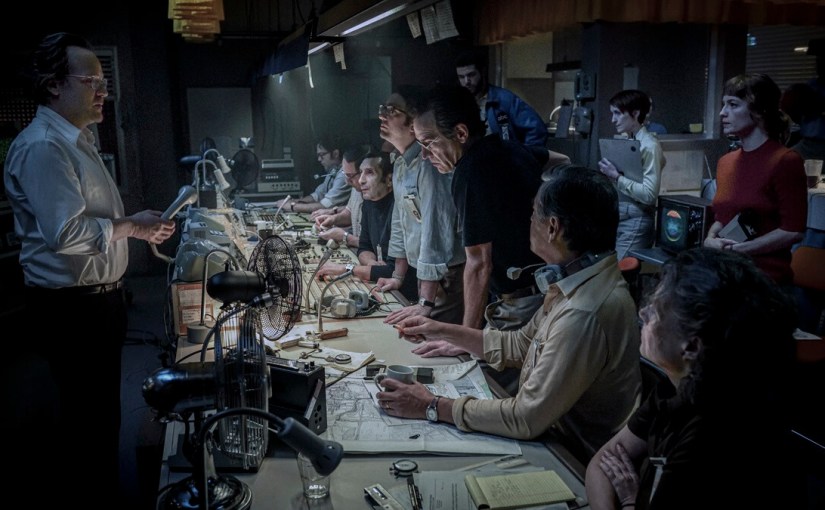
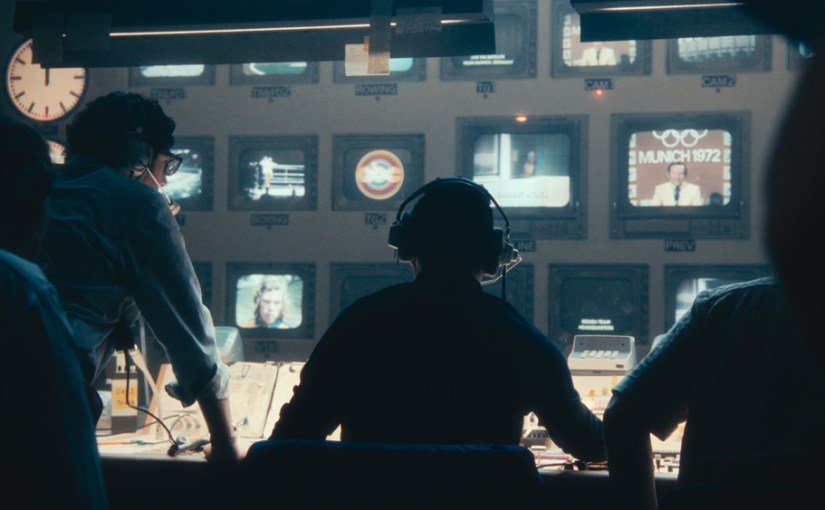
One of the masterstrokes of September 5 is how it rachets up the tension by staying inside the claustrophobic control room and connected offices for the entire film, minus the opening and closing shots showing Geoff arriving for work and leaving the next morning.  Anything showing us the outside world is only visible on the banks of television monitors in front of them, which leads to much confusion towards the end of the film as reports of the Israeli hostages being freed begin circulating, but no one can actually see what the hell is going on.  This is one of the ways the film reminded me of some of the best scenes in United 93 when the people responsible for making the most crucial decisions of their lives were limited by what they could see and hear on the news.

I have never worked in a TV studio, but this movie carries a palpable authenticity that made me believe everything I was seeing.  I never knew, for example, that chyrons (those small captions on the bottom of a TV screen during the news) were analog back in 1972.  Whenever a new development occurs, the control room has to call up a woman in a completely separate room/mini-studio so she can manually place individual letters onto a physical message board, then get behind a camera and shoot the image so it can be superimposed back in the main control room.  Exhausting!

Peter Jennings is reporting remotely across the street from the Israeli apartments, but he cannot be heard live from his radio into the audio feed for the TV signal.  So, some random dude takes a phone handset, unscrews it, solders some wires, clamps it all together in front of a microphone, and presto, now Jennings is live.  The whole operation is put together with spit and baling wire.  It feels like it’s a miracle that anything was televised at all.

The other conflicts presented to us are no less important.  Marianne, a German woman, is drafted into helping with the translation, but first she must endure some brief accusations from Marvin.  The fact these Olympics are being held in Munich less than thirty years after the end of World War II is something many people are still coming to terms with.  He asks her if her parents knew about the concentration camps.  She stares for a second and gives the best answer possible: “But I am not them.”  After that, she earns the complete trust of the entire staff.

The subtext of the German guilt over World War II is bubbling just beneath the surface for the entire film.  A German maintenance worker won’t release replacement cables to a French tech until Marianne talks him into it.  It is theorized at one point that German military forces could possibly end the hostage situation within minutes, but the German military is constitutionally forbidden to operate within the Olympic village, for obvious reasons.  Roone Arledge watches Mark Spitz win yet another gold medal, and instead of going to a closeup of Spitz, he instructs the cameraman to cut to the face of the German swimmer who lost.  Someone asks him, “Do you really want to bring politics into this?”  And he replies, “It’s not about politics, it’s about emotions.”

Which brings in the other major point of retelling this story in this way.  There is a point where ABC’s cameras have great shots of the building, the balcony, and the entire complex, and they are broadcasting live (the first time the Olympics had been broadcast live, by the way).  Someone spots German policemen – non-military – getting into position with sniper rifles.  Marianne hears chatter on the police band about an operation getting the green light.  The press is ordered out of the area, but ABC’s cameras continue to broadcast live.  Someone notices that a TV appears to be on inside the apartment where the hostages are being held.  Geoff suddenly asks a reasonable question: “Are the terrorists seeing this?”  Minutes later, German police storm the ABC control room and demand the cameras be turned off, pointing a gun at the crew at one point.  The cameras get turned off and a furious Arledge kicks the Germans out of the building, but the point is made.  Minutes later, the operation is called off. 

“They should’ve cut the electricity to the apartment, it’s not up to us to double-check on them,” says Marv.  But Geoff makes a point: “Marv, it’s not okay if we made it worse.”  The fine line between the freedom of the press and general public safety could not be more elegantly portrayed than it is here.  Earlier in the film, just as the cameras have been set up with shots of the balcony of the apartment, someone asks, “Black September [the terrorist group responsible], they know the whole world is watching, right? …if they shoot someone on live television, whose story is that?  Is it ours, or is it theirs?”

It seems like an easy question to answer: “Public safety comes first.”  But who gets to decide what’s in the public’s best interest?  Those policemen who burst into the control room and shut the cameras off at gunpoint?  Perhaps it should be left to each newsperson’s individual conscience, but can that always be trusted?  These are questions I am not qualified to answer, but I appreciate films like September 5 because they have enough faith in the viewer to pose those questions and then refrain from providing a tidy answer.  It’s one of those rare thrillers that tells a crackling good story and also asks some big, relevant questions that you may not even think about until you’re driving to work the next day.

One of the last things we hear is Marianne talking to Geoff, who had sent her to the German airport where the hostages were supposed to have been flown out of Germany.  “I was there with hundreds of people, we stared into the night.  We were waiting for something to happen because we wanted to take a picture of it.”  While that’s a rather bleak way of describing a profession that has given us some compelling images that have swayed the world’s opinion on vitally important matters, perhaps it’s also a way to caution those who would exploit situations, like the paparazzi who chased Princess Di into that tunnel.

SEPTEMBER 5

By Marc S. Sanders

September 5 is a sweeping account of how breaking news used to be assembled.  You had to be in the right place at the right time.  If you weren’t, then perhaps the sports department of your media conglomerate is, and they will get the story. 

The very first televised terrorist attack was broadcast at a sadly appropriate time.  The 1972 Olympics were being covered by the ABC television network.  For the first time, homes all across the world would be able to watch the games in color, from a satellite feed shared among the big three networks.  ABC had the broadcasting rights to the games though.  The setting is especially interesting to this story.  The Olympics are being hosted by Germany, primarily out of Munich.  This is an opportunity for the country to finally redeem itself, only twenty-seven years after World War II had come to an end and their country’s Nazi regime had been overthrown.  Germany had a lot to make up for.

The Sports Division of ABC news turn over in the wee hours of the morning of September 5.  Geoffrey Mason (John Magaro) slumps into the studio and relieves Roone Arlege (Peter Sarsgaard) following long hours of editing and covering competitions in swimming, volleyball, boxing, track and so on.  There’s minimal staff on shift as the athletes and coaches are asleep for the night, but then Geoffrey and crew believe they hear machine gun fire out of the direction of Olympic Park, and suddenly everyone is awakened and scrambling to put together the story fast. 

No other broadcasts are reporting on this alarming incident.  This is a story that comes at ABC Sports in their own time.  Had this happened today, amid an age of worldwide shrinkage with the existence of the internet, these guys would have been way behind.  In 1972 however, they can rely on Mariane Gebhardt (Leonie Benesch) a female German flunky of the sports division to translate the various radio communications between the terrorists and the German negotiators, and what plans are being put in place.  Nine Israeli athletes have been taken hostage in their hotel rooms with two believed to have already been killed.  The terrorists (believed to be a Palestinian militia group called Black September) demand that Israel release two hundred of their prisoners or they will kill a hostage every hour beginning at noon.

Forgive the cliché terminology, but September 5 is a taut, nail biting, documentary style thriller told only through the perspective of the ABC Sports division.  While the developments of the hostage situation feel urgent, for these unshaven guys in glasses and wrinkled shirts who are operating on little sleep and a lot of coffee, it is about getting the news out quickly and accurately, and just as importantly, first.  Geoffrey and Roone are constantly on the phones trying to learn whatever they can from Peter Jennings, the eventual famed ABC reporter, who is nearby the incident and at times hiding from the German police who are desperately trying to clear the area of the press.  The guys even send in a staff member with a smuggled camera and reels of film taped to his belly while he poses as an Olympic weightlifter.  The Germans forbid the press from trespassing but insist the games carry on.  So, the athletes and coaches are the only ones who can enter the area to prepare for competitions of the day.  Even Howard Cosell happens to be in a hotel staircase nearby and can provide feedback. 

In the news control room, the guys are literally putting walkie talkies next to microphones that broadcast live on air with Jim McKay who is behind the desk, talking to the world.  This is bare bones news broadcasting with unsophisticated technology to aid them in this short window of time.  The director of this film, Tim Fehlbaum, brilliantly captures the desperate inconveniences of reporting this way. 

Roone and Geoffrey also have to contend within their own ranks.  This is not a sports story.  This is a news story and so Roone must insist on keeping the story.  They are the only ones there.  How much more effective would a news division located on the other side of the world fare?  Therefore, Roone’s team are the only ones qualified to cover this developing story.  ABC News will not have access to this. 

Roone also has to improvise how the satellite feed is shared with their competitor, CBS Sports.  It’s a pain in the ass inconvenience and yet the resourcefulness and quick thinking of the control room staff find a way to uphold their claim on this story.

While watching this account, it matters little if we know the outcome of the September 5, 1972, Munich attack.  This film’s purpose is covering how the first few who knew about the situation responded. By the time the ninety-five-minute film is over a lot has been shared.  Tim Fehlbaum, with an Oscar nominated screenplay written by him along with Moritz Binder cover quite a bit.  The pace moves as fast as these people in the control had to move on that terrible day.  So, the information comes quick.  With real life archived ABC footage spliced within the film, you feel as if you are standing in the corner of this dark room with various tv screens, microphones, and telephones. 

You watch John Magaro feed information to Jim McKay, and then the picture cuts to real life footage of McKay at the desk.  It’s quite inventive how the script is accommodated to work in line with what Jennings, Cosell, McKay and others literally said as the crisis was being reported.

Having seen all ten Best Picture nominees for 2024, it is disappointing that September 5 did not make the cut.  Tim Fehlbaum’s picture certainly deserves more recognition and a slot over other contenders this year.  Still, the screenplay is a well-deserved accolade.  To interweave a fresh script that hinges on what was literally said on television screens around the world at that time is a marvelous strategy. 

September 5 is a crackling thriller of a terribly sad day.

NICKEL BOYS

By Marc S. Sanders

Colson Whitehead’s Pulitzer Prize winning novel, Nickel Boys, is now an Oscar nominated film for Best Picture and Best Screenplay. It is based on a true story that needed the exposure of a film.  However, a better adaptation than what director RaMell Moss did with it should have been completed. 

The Nickel School of Southern Georgia is the setting for a boys school where various forms of abuse took place during the civil rights era.  Apollo 8 was making new discoveries in space, but racial prejudice and crimes of adolescent abuse were not being revealed to a greater public.

Elwood (Ethan Herisse) is a bright student who has been accepted to a prestigious school for gifted learning.  Upon walking to his destination, on the outskirts of Atlanta, Elwood inadvertently gets blamed for a crime he did not commit and is sent to the Nickel Reform School.  The black students are relegated “to the other side of the nickel” in less favorable quarters than the white students. 

At the school, Elwood develops a friendship with Turner (Brandon Wilson) and together they do their best to survive the harsh challenges that go with living at Nickel.  Elwood remains positive that he will be able to leave the school one day and return to his loving grandmother Hattie (Aunjanue Ellis-Taylor).  Turner knows differently.  These boys are never leaving, and they will be compelled to obey the harsh tyranny of living at the school.

What helped me get through the near two and a half hour running time is that sadly this is an all too familiar story, especially for black youth.  The challenge though is the construction of the film.  RaMell Moss takes an unconventional approach where the viewer is the point of view of the two boys.  For about the first third of the picture, we are seeing what Elwood sees.  When he nods his head to the floor, the viewer sees the floor.  When he looks up to the sky, we look to the sky above him.  When he is listening or speaking to another person, like Turner or Hattie for example, that’s who we see.  The viewer is restricted to a forced tunnel vision of only what Elwood’s eyes focus on.  Frankly, as soon as the film began, I said to myself, “Oy.  Two and a half hours of this!”

Shortly after Elwood arrives at Nickel and sits down for breakfast, the perspective finally changes to Turner when the boys meet for the first time.  Now we get to see what Elwood looks like because we are looking through the eyes of Turner.  At this point, I told myself to either fall asleep, walk out or get accustomed to this different way of watching a movie.  I selected option number three and I’m glad I did because I started to become engrossed in the picture.  It’s compelling and absorbing. Granted I was still unsure of what this story was about as the film keeps the viewer very limited as to what is seen and told.  Arbitrary moments are shown through the eyes of the boys that do not necessarily progress the story.  These adolescent boys are not directly tormented as much as they are simply living in a captivity they do not fully understand.

A third person perspective is eventually put upon us.  We are watching the film at a different time, during an internet age, as we see a black man with dreadlock hair surfing the internet and pulling up articles about the Nickel Boys School that once existed.  I had an idea of who I was standing behind as he spoke with his girlfriend, but still I was not entirely sure, and other than an attempt at inventiveness, it puzzled me why the film veers occasionally into this direction.

Nickel Boys has an eye-opening story to tell but the experimental narrative of this picture does not entirely work.  It’s more frustrating than admirable.  RaMell Moss works with a very good cast of young actors who are focused on upholding the first-person perspective.  They are speaking the language of his camera.  Nevertheless, that doesn’t mean as a viewer that I like it.  These young actors deserve a more conventional means of telling this story.  I am confident they can handle that kind of direction just as well.

Nickel Boys ends with a mild twist.  While it might not have seemed necessary, and with Moss’ unusual approach I was not even sure what happened, it’s interesting for at least a beat.  However, to be sure I understood what occurred I turned to my resident Cinemaniac, Thomas Pahl, for assurance that I was accurate in what I think happened. 

I also took issue with RaMell Moss breaking his own rule of filmmaking.  The film limits itself to three different kinds of perspectives: a first-person view from either Elwood or Turner, and a third person sight from a character we meet in a more modern time.  Yet, for one concluding and significant moment that occurs near the end of this story, Moss changes his camera angle for a standard conventional approach.  Why do this?  Was Moss finally at the end of his rope and could not fathom how to demonstrate the story’s end unless he broke away from his own unique approach?  For me this shows the filmmaker could not stay consistent all the way through with the final cut of his picture.

Forgive the presumption, but I recall the Academy considering nominating films only if there is a minority representation contained somewhere within the finished edit.  I’m uncertain if that remains an unspoken rule or if it is set in stone.  Honestly, I think it’s simply considered with a lack of justified merit. 

I do not find Nickel Boys to be worthy of the best of 2024.  A handful of films that were not as recognized did not get the accolades this film received.  Is the picture being honored because it depicted a black experience?  I cannot help but wonder.  It is not a terrible film because there are parallel ideas happening alongside the main storyline and the cast is especially good.  Real life tragic stories are especially appealing to The Academy.  The direction of the piece takes away from much of the benefits of the film though. 

Garner up your patience with the limited view you will have watching Nickel Boys.  I also say this without sarcasm, maybe take a Dramamine.  When watching a production in a first-person narrative, often people are prone to motion sickness.  Surprisingly, it did not happen for me this time.  It should have because I cannot play updated video games that rely on this angle.  Yet, a friend had a different experience with Nickel Boys, and he said it took all his strength not to get up and exit the film.

I’M STILL HERE (BRAZIL)

By Marc S. Sanders

Biographies of terrible truths are fascinating.  Haunting, yet fascinating that circumstances ever got as far as they did when unfairness, immorality and unspeakable tragedy occurs.  Walter Salles’ Brazilian film I’m Still Here recounts the abduction of Reubens Paiva in 1970 when Rio Di Janeiro was under the control of a militaristic dictatorship.  This is a moment in world history that I am completely unfamiliar with, and so I wished that Salles’ movie provided more backstory to paint a clearer picture.

Reubens Paiva (Selton Mello) is a father of four girls and a boy.  Despite a happy marriage to Eunice (Fernanda Torres) and a comfortable life across the street from the coast, the government stronghold of the island looms with planes flying overhead and check point searches at intersections.  Other than this dark overrule, life goes on for the Paiva family as they plan to build a new home, send their eldest off to London for college, and swim daily in the ocean blue.  Ice cream outings are also a treat.

Then Reubens is requested to go with a military escort.  He gets dressed in a jacket and tie and calmly leaves the home.  Eunice is also taken and placed in a dirty cell for days while being put towards intense questioning.  Their daughter, Verona (Valentina Herszage), is stopped at a checkpoint and searched while out with friends.  No explanations come their way for these encounters.  

Following a few weeks in captivity, Eunice is released back to her home.  Reubens is nowhere to be found and assumed to still be held prisoner.  The couple were friends with people much like them who apparently spoke out against the regime.  It is likely Reubens was taken due to his writings and vocal protests as a former Congressman.  It’s also concerning that foreign diplomats are rumored to be kidnapped as well.  There’s definitely an uneasy feeling happening. Now Eunice’s dilemma is to try keeping her children calm and sheltered from news of this arbitrary situation, including her worst fears about her missing husband.  

I’m Still Here is certainly an important story that needs to be told and was more than ready for the big screen.  I’m sorry to say though that Walter Salles’ picture is terribly boring.  Once the captivity sequence is over, Salles relies often on Eunice silently wondering what has become of her spouse.  Colleagues visit with rumblings of what they have heard and in between there is a lot of gazing at photographs and newspaper articles.  It’s challenging to embrace a character looking at documents and pictures over and over with no progress being introduced to the story.

There are moments of paranoia as Eunice observes people watching her and the family from across the street.  Tragedy befalls a loving pet as well.  Yet, I never felt the tension that I’m sure resided with this woman from one day to the next.  Eventually, the film takes two different leaps in time and an older Eunice is now played by Fernanda Montenegro (Fernanda Torres’ real life mother). 

I’m Still Here is very slow moving. I couldn’t help but feel lost with most of this story and it’s not until the second and final epilogue arrives that a televised newscast offers more clarity to what likely happened.  I was glad I walked away with a better understanding, but it does not make up for how lost I was during the first two thirds of the picture.  

I still do not understand how the military coup came into power. A prologue might have helped enhance the threat the family had to face.  I was never clear on what precisely Reubens stood for against this stronghold regime.  What was his platform?  What bothered him specifically?  Anyone could tell me it should be obvious, but again I know nothing about this story that arguably is not shared in schools and is hardly a current event.  Granted, Brazilians likely have a clearer idea.

Without enough knowledge, I’m Still Here is uninteresting.   Viewing characters staring at old photos is not stimulating enough on its own and I’m sure Eunice Paiva was at least a little more aggressive than Fernanda Torres’ performance implies.  I read that Eunice never cried in front of her children and that is demonstrated in Salles’ film.  So, I have to presume this real-life woman, who eventually earned a law degree she used to fight for human rights, would have been much more aggressive than what is on display in this movie.

I can only recommend watching I’m Still Here as another example of tragic unfairness towards human rights.  

Learn about the Paiva family.  However, instead of watching this film, it might be better to rely on the book it’s based on, written by Eunice and Reubens’ son Marcos Rubens Paiva.  I’d expect it to be much more insightful.

THE APPRENTICE

By Marc S. Sanders

No.  This is not a reality show.  This film feels much more authentic than the “reality” of a reality show.

Ali Abassi is the director making broad strokes that cover the early career of one Donald J Trump (Sebastian Stan).  By the time I was finished with the picture, I gathered that Abassi was depicting how one monster created his own monster, and then that creation destroyed the original creator.  This might as well be the story of Darth Plagieus The Wise.  Watch a Star Wars movie for a change, would ya?

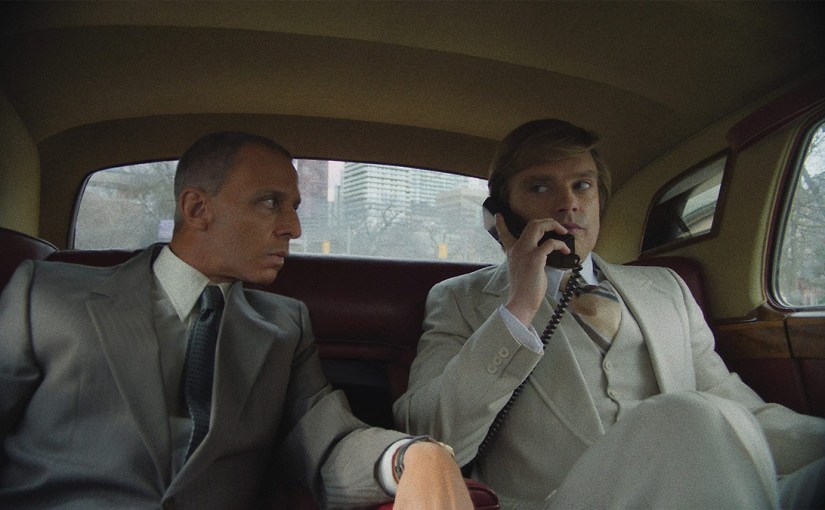
The original creator is the infamously corrupt attorney Roy Cohn (Jeremy Strong) who proudly knows how to dodge one indictment after another  while standing on the precipice of his historic conniving.  In a private New York City club one night in the early 1970s, Mr. Cohn will lock eyes with Mr. Trump across a crowded room.  Cohn will mentor this kid about the three rules of business which include denials when necessary and never admitting you’re wrong.  

Trump works for his uncompromising father Fred (Martin Donovan, bearing a striking resemblance to the real person, complete with the bushy mustache, bushy hair, and towering height).  The family is in the business of real estate while fighting accusations of forcing out lower class minorities from their run-down tenement buildings.  Donald is not even fearful of knocking door to door with late rent notices and threats of evictions.  Still, he knows they are up against a wall and if there’s anyone who can exonerate him and his father it is Roy Cohn.  Yet, Roy does not weaponize with legal research and law jargon to uphold a defense.  Instead, he digs up dirt on those figures that are in the way.  To keep skeletons from going public will mean a drop of the case. Thus, Donald has received his first lesson in cutthroat business operations.

From there, Trump gets the impression that with Roy there’s no limit on what can be achieved.  New York City is slum area, but Trump knows he can revitalize the streets with his invested infrastructures, beginning with Trump Tower on 5th Avenue.  It’s time to pressure Ed Koch for tax breaks even if there’s no justification.  If Ed doesn’t want to cooperate, it is to the press Donald J goes with how he truly feels about the Big Apple’s Mayor.

As the fast tracker gets more and more visionary, so does the recognition of a guy who…well may be crazy enough to become a game show host or even President of the United States.

Much of The Apprentice seems legitimate based on the very public image of Donald Trump.  The common gestures like the thumb and index finger held together to drive home a point or the repetitive adjectives that construct much of the man’s vernacular (“…tremendous, tremendous…”).  The junk food eating is covered.  Trump’s hyperactive ranting and slamming of those in his way work towards his drive along with his disregard for not honoring loan payments.  The growth of his empire in casinos and resorts break ground too.  None of this is slander.  The news showed how it happened.

Private moments are where skepticism could be merited.  The prenuptial agreement that Cohn drafts, and a supposed forcible rape on his first wife Ivana (Maria Baklova) by Trump are given attention.  The disdain he has for his alcoholic older brother reveal the workings of a family life never based on love, and only on platforms of business and prestige.  His sneaky approach to get his senile father to sign documents may or may not have happened.  I dunno. When his mother found out about it, she threw him out of the house. Perhaps? Doesn’t sound so farfetched.

Trump’s obsession with his appearance is also given attention.  A constant habit with fixing his hair is redundantly shown. I believe it. If he was not obsessed with his hair, he wouldn’t look like he does, and that haircut begs for some proper attention. If he’s not going to eat right and exercise, then his doctor will conduct surgery to preserve his youth, and a hair transplant will be completed to conceal a bald spot.  Apparently, Trump took diet pills as a means to offset his terrible nutrition. Doc insists they are amphetamines that his patient has to stop using, but for a guy like Donald Trump, he has to keep going and going. No time to sleep when there are worlds to conquer and beach front property to build upon. I don’t suppose any of these private activities away from the paparazzi can be validated with tangible proof beyond heresy. Nevertheless, again as the world knows Donald Trump today and for the last forty years, what is offered in Ali Abbasi’s account, with a screenplay by Gabriel Sherman, seems consistent from what the public sees regularly. Don’t get me started on the board game my dad got me for Hanukkah in the early 1990s, or the fact that Trump eats a filet mignon with ketchup.

As Trump goes up the scale, Cohn is quickly descending and the man who gave the kid access to everything is disregarded during the age of AIDS spreading in the early 1980s when Reagan seemed to inspire the use of disposable income for many middle-class yuppies.  Cohn is a victim of these prosperous, yet unexpected times. Being a closeted homosexual and contracting AIDS did not suit the cloth of this shark. Also, the mounting charges against the lawyer for his unseemly practices eventually caught up to him. Couldn’t have happened to a better guy, quite frankly.

Jeremy Strong is known for his literal method acting and he personifies Roy Cohn, the guy with chutzpah not just found in him but in everyone he associates with including criminal mob bosses.  This is a very powerful guy that no one should underestimate.  The only thing that could kill him is if Donald gets out control…along with Roy surrendering to the residual effects of a secret gay sex life in the early 80s.

This is not so much a polarizing film based on red and blue politics.  Donald Trump actually functions like the one depicted in The Apprentice.  Sebastian Stan wisely steers away from a Saturday Night Live impersonation.  You don’t hear Trump’s voice but with talented hair and makeup artists, you recognize the delivery of dialogue.  It changes from a polite young man who wants to be the emperor he sees in his father, only not as conservative and a lot more aggressive.  Later, with the help of an overly confident ego accompanied with a loud and brash mouth, do you see the person most of us are familiar with. 

The Apprentice has a documentary style narrative with Abbasi’s reliance on hand held cameras.  The grainy photography of the 1970s Nixon years enhance the crime and disruptive unsettling Northeastern America.  Donald Trump, in his beige linen suits and ties, does not fit in this environment.  There isn’t an authority to him yet. He looks too liberal actually. In the 1980s, with much accumulated for the mogul, the graininess changes to look like footage played back on a VCR.  Trump has the tuxedos and overcoats that do not hide his belly well enough.  The navy suit and red tie surface for the first time and his surroundings are often decorated in gaudy layers of gold.  The royalty he’s placed himself in is here to stay.  Roy Cohn used to go all out with his parties and sex orgy binges, but never like this.  This new Donald J Trump is so overinflated that even the great Roy Cohn is drowned out of existence.

Ali Abbasi allows some winks and nods at what we know will become of Donald Trump.  Name drops of other bigger than life businessmen enter the scenes and you nod your head when you see guys like Rupert Murdoch or Roger Stone arrive.  Trump’s brand has always been defined by the power pawns he associates with.

A side story glosses over Donald’s relationship with Ivanna.  I know why it has to be here.  It’s played well by Maria Baklova and Sebastian Stan.  Though in comparison to Donald’s relationships with his father and brother, plus Roy Cohn, the marriage storyline does not carry the same kind of weight.  Much of the material seems conjured up here and not as genuine.  Maybe that is because the general public has never seen how the husband and wife truly treated each behind closed doors.

The Apprentice declares that there are portions of the film that are fictionalized for dramatic effect.  Yet aren’t most biographies?  Sebastian Stan seems to have a lock on his portrayal.  If he judged his character at all, he lent credence to how the real man is satisfied with how he carries himself.  I don’t know how the actor sides politically or how he particularly feels about Donald Trump, but Stan grew a respect for the figure.  He doesn’t make the guy look like a buffoon.  This Trump is passionate about every new project he pursues and just as equally he’s focused on pushing obstacles and enemies out of his way. If he doesn’t push, then he steps on them. It doesn’t matter if it is his wife, his brother, his father, his mother or the one that got him everything he needed, his good friend Roy. Even a once respected mentor can become a casualty in the pursuit of greatness.

I can’t say how any one person might respond to The Apprentice.  A Trump follower, or even Donald J Trump himself, may feel very flattered by this reenactment and how the guy got to the top of his gold pyramid.  Others will be offended and exhausted over even more exposure of the largest ego the world has encountered.  Either way, I attribute my compliments for the outstanding pairing of Sebastian Stan and Jeremy Strong.  A partnership is at the center of this piece, and now we bear witness to how the connection between these two characters moved along, and then eventually very far away from each other.

ANORA

By Marc S. Sanders

Anora, or Ani as she prefers to be called, had to have been a character that writer/director Sean Baker always intended on loving.  Not in an intimate way though.  Sean Baker had to deeply care about this twenty-three-year-old girl who has no connections or family or solid friendships or kinships.  Baker wrote about Anora, wanting her to be appreciated by someone who would finally embrace her. 

Anora—sorry…Ani…has a good heart.  She may be an exotic dancer at a New York City strip club, but she is someone who has every right to be respected and valued. If you choose to watch the film you’ll know why, as a pertinent prop referenced earlier in the picture suddenly resurfaces when you least expect it.  A minute or two later the closing credits appear amid the sound of flapping windshield wipers and there is no music to cue your emotional response.  You likely will have spent the last two and a half hours laughing loudly, dropping your jaw, and gasping in shock at what unfolds for Ani. In the end though, you’ll realize that you want the best for her, like her creator did when he originally drafted this script and shot the film about Ani’s episodic escapades.

Sean Baker’s film is eye opening right from the start.  Club music blares within the HQ, the name of Ani’s strip joint where she collects an exorbitant amount of dollar bills while she strategically flirts with middle-aged men and frat boys looking for an evening of debauchery.  She has a talent for one on one charm with any customer, as she repeatedly bares her chest and reveals her thong, but she also delivers a very satisfying service.  A young man named Ivan, sometimes it’s Vanya (Mark Eydelshteyn), specifically requests a girl who speaks Russian to cater to his needs.  Ani is the only one who can comply.  Ani and Ivan get to talking, mostly in Russian but limited English too.  She gets invited to his private, deco mansion, which is really owned by his Russian aristocratic parents, and a slap happy relationship of sex and more sex, and money, and drugs and drinking and partying and New Year’s Eve partying and money, and clothes and expensive coats, and travels to Las Vegas ensue.  (Yes! I know that was a run on sentence.  My elaborate text does not even come close to what these twenty-somethings indulge in though.  It must be seen to be believed.)

Anyway, since they’re in Vegas, why not get married?  Vows are taken, the bride is kissed and Ani is emptying her locker at HQ for a promising future of being a spoiled, but loved, aristocratic wife.

In the few times that Ivan calms down, he is only engrossed in his online video games while Anora lies on his chest with an expression of wanting more than to come in second to Call Of Duty. Baker focuses on Ivan’s childish habit a few times.  So be sure to observe how Ani sadly looks upon an inattentive Ivan.

A problem occurs though that neither character could ever expect.  The tabloids have reported that Vanya, this spoiled brat son of a Russian oligarch, has up and married a prostitute. Now the family image is at risk of being shamed.  Mom and dad are on their way back to the states and have summoned Toros (Karren Karagulian), an Armenian Catholic priest and the son’s Godfather, to round up Vanya and the so-called whore to get the marriage annulled immediately.  Not divorced!  Divorce does not happen within the legacy of this family.  An annulment is what is needed. 

Toros rounds up Igor and Nick (Yura Borisov, Paul Weissman) to get over to the house right away, get the marriage license and bring the kids in for the quick annulment at the courthouse.  If only it were that simple.

Watching Anora allowed me to reminisce about other films that catered to outrageous debauchery and led to a domino effect of problems.  Doug Liman’s Go for example, or True Romance written by Quentin Tarantino, or even a super ridiculous comedy known as Very Bad Things with Christian Slater and Cameron Diaz.  The first two examples are very good films because the dialogue is sharp with eclectic casts who elevated simplistic material.  Let’s not talk about the third one, but I will say it is delicious junk food.  With Anora though, just when you think you know where this story should be going it doesn’t.  You think it will turn right, but then it makes a sharp left and Sean Baker knows he just needs to keep the fighting and the screaming and the cursing at an organic natural level.  What do you do when the wards you are put in charge of will not cooperate?  What if one of them goes missing and simply won’t answer his cell phone?

Well, on a cold winter night you may get a broken nose, car sick, and your car might get towed.   Anora is not about big stunts or gratuitous violence.  It’s not mobster movie material either.  Anora works naturally for people in desperate situations, from a handful of different perspectives.

Oh yeah.  Anora—sorry Ani, is played by Mikey Madison and she is bound for marquee attraction over the next twenty or thirty years.  This performance is so concentrated in moments of natural glee, anger, and maybe despair and sadness.  You applaud her character’s strength.  Ani talks like an updated version of Judy Holliday from Born Yesterday, but she’s no dummy and she never succumbs to intimidation.  I’ll confess it right here.  If two hulking Armenian thugs approach me, I’ll do whatever they want me to do. Ani gets all my props though.  She will never settle.  She’s a married woman and no one will deny her of her rights.

Mikey Madison has such wonderous chemistry with Sean Baker’s camera.  There must be over a hundred and fifty close-ups on this young actor and each one is unique.  I was sad for Anora when Ivan would not give her attention.  I was cheerful when the two were overindulging in carefree sex and sin city fun.  I was on Anora’s side when she was restrained. I was admirable of her giving a good fight to the giants that enter her space.  I was exhausted with her as she was forced to sit in Toros’ car while brainstorming where her husband could be.  I was supportive when she makes appeals with the family to offer a good first impression.  She hates her name, but she introduces herself as Anora to Vanya’s steely mother. Ani is willing to make all of this work. Finally, I was angry—very angry–alongside of her whenever she was unfairly treated like garbage. 

Amid all of the chaos that ensues, Sean Baker works like the eyes of the film’s audience. We keep guard over Ani’s condition and state of mind as she’s coerced into looking all over Brooklyn and Coney Island for her new husband that the Armenians need to find before the boy’s parents arrive by noon the next day. 

None of the dialogue is crafty like Quentin Tarantino’s or Neil Simon’s.  I could not quote a single line.  The yelling and conversations and overtalking and interruptions are natural and raw.  Sometimes, the exchanges feel pointless until you arrive at another scene that demonstrates with brilliant insight why certain throwaway moments are preserved in the final print of the film.  It makes complete sense that Sean Baker did not just write, produce and direct this film.  He edited it as well. 

The whole way through the picture I kept wondering how this story would end.  I spelled out variations of doom for any one of the characters.  I considered gratuitous violence or swashbuckling adventure and daring escapes.  Man o’ man, have I become cliché.  Because just as you arrive at the picture’s conclusion, a meaningful prop puts the period at the end of the story and the last audible expression before the picture goes to black comes from Anora. You now realize that this girl, who is as self-reliant as many exotic dancers must be, has feelings too.  As defiant as Anora can be, she can also get pricked and bleed and the big laughs you responded to for most of the film are distant memories. Anora can feel pain like any of us.

When I drove home, I was hurting.  I was hurting for Anora, and my one wish is that I hope Anora will be okay.

Roger Ebert once gave a seminar that lasted for eleven hours as he commented on practically every shot and piece of dialogue in Tarantino’s Pulp Fiction.  My long shot wish is that on a subsequent viewing of Anora, I can deliver a similar kind of observational lecture to others who had already seen the film too.  I believe I could reveal sincerity and perception related to every close up, every chaos-stricken scene of panic or decadence, and especially when that one prop reappears. I’d likely spend a half hour simply discussing the value that this prop carries and what it means to Sean Baker’s film, and especially to Ani.

As messy and gritty as Anora may appear, it is also one of the most adoring and perceptive films to be released in a long time. 

Anora must be in my top five favorite films of 2024.  It might just be my favorite.  There are a few other candidates, but I left feeling so satisfied with Mikey Madison’s performance and Sean Baker’s sloppy, yet astute, little film. 

This is superb filmmaking.

EMILIA PEREZ (FRANCE)

By Marc S. Sanders

I never watched a telenovela from start to finish.  At best, the only footage I’ve seen are on GIF scenes that tease at the over exasperated expressions (bulging eyes, big teeth, big hairstyles, lots of lipstick) of the actors and the characters they are portraying.  The Funny Or Die You Tube clips draw their comedy by having the straightest voiceover summarize a season of these miniseries. The stories were not meant for humor, but on the surface, I can’t help but think they are operating with a Naked Gun tongue firmly in an Airplane! cheek. 

Emilia Pérez looks like a telenovela compiled into a two-hour film, but as outrageous as the storyline and the sequence of events play out it’s anything but silly.  I held an appreciation for the circumstances that writer/director Jacques Audiard set up so that the insurmountable conflicts appeared convincing, and most especially overwhelming.  Emilia Pérez performs like an episode of Three’s Company – the one with the misunderstanding – but there are complications that border on bloody violence, life, and death.

Zoe Saldana portrays Rita, a defense attorney for Mexico’s worst criminals, and she despises the purpose she serves for the murderous scum she represents as she assists in getting one thug exonerated after another.  Early on in the picture, Saldana espouses her remorse through song and dance all within the middle of a courtroom, because as you quickly learn Audiard’s film is a movie musical. 

Shortly after the opening number Rita is summoned by Manitas, the most powerful head of the Mexican drug cartel.  He has unlimited resources and cash, and he hires Rita to do a worldwide search for the finest physicians to complete his sex change operation.  Once that is complete, the two will arrange the publicly known death of Manitas, send his wife Jessi (Selena Gomez) and their two children off to hiding in Switzerland, and the drug czar will be replaced by the woman Emilia Pérez.  Emilia and Manitas are portrayed by real life trans actress Karla Sofía Gascón.

Four years jump by, and Emilia catches up with Rita, who remains the only person to know of the ruse that took place.  Emilia wants Rita to deliver Jessi and the children back to her.  The former father will now pose as the wealthy aunt and they will live together in Mexico, going forward. 

Rita discovers a new kind of respect for Emilia as the bloody past of this individual have ceased since her sex change.  As such, Emilia recalls that her former self was responsible for countless murders and kidnappings, many of which took place under her command.  Now she seeks redemption by making herself public with a well-funded campaign that will focus on the recovery of missing people and set up proper burial arrangements so next of kin can have closure.  Emilia reveals a common burial site where hundreds of bodies were secretly laid to rest.  No one questions how she knows of this area.  Yet, she becomes a philanthropic woman who has earned the respect of millions within Mexico.  The irony is that she recruits other cartel lords to make sizable donations to this cause.  If anything, it makes them look more noble in a public eye.

Elsewhere, simplicity does not hold for her relationship with Jessi.  I won’t reveal what occurs because it lends to an ending you might expect.  All three leads embrace different perspectives of this storyline, and it only heightens the complexities of the film.

Jacques Audiard is of French descent, and after seeing the film I learned that many have taken issue with him overseeing this project.  He does not speak Spanish, has no Mexican heritage and according to many has not embraced a true account of Mexican culture or activity.  The movie was also submitted for Oscar contention as the French candidate in the Best Foreign Film category. I’m glad I did not learn of these objections until after seeing Audiard’s film, though.  It did not interfere with my take on the picture, and I believe it should not cloud your viewpoint if you intend to see it.  (It’s currently showing on Netflix.)  There were moments in the film that I predicted would occur such as where a boy on a bicycle is heading with a plastic shopping bag in tow.  By that moment, I knew what was to be revealed inside the bag. 

The film is soap opera like, especially with the musical numbers that are included.  I’d think the songs were composed by Lin Manuel Miranda if I didn’t know better because the lyrics work like dialogue much like you would see in Hamilton or In The Heights.  I was taken with the singing performances of Saldana, Gascón, and of course Gomez who works part time as a professional singer anyway.  It’s almost operatic how they and other cast members express their conflicting feelings in character.  Out of context of the film, I don’t think any of these songs work or would draw an attraction to leave the radio tuned in.  The songs are storytelling, but not memorable or catchy with chorus versus.

While I did not mind the song portions, I never missed them when scripted dialogue, primarily in Spanish with English subtitles, was being played.  I guess you could say the music makes the film different.  A different kind of telenovela, a different kind of crime drama, a different kind of soap opera, and certainly a different kind of musical.  Whether you take to the assembly of the film or not, you cannot deny that Emilia Pérez stands out within any one of these categories.

The film is up for the most Oscar nominations in the year 2024, thirteen in total.  One thing that is odd though is that Zoe Saldana is competing in the Best Supporting Actress race while Karla Sofía Gascón is up for Best Actress.  Even though Gascón plays the title character, I insist it should be the other way around. Saldana occupies most of the running time of the film and as complicated as the character Emilia Pérez is, I found Saldana to be more conflicted as Rita, the outsider looking in with all the secrets held tight in her subconscious.  The best way to share her struggles with the audience is to sing them aloud.  The long-time action movie star (Guardians Of The Galaxy, Avatar) sets the stage for the whole movie, as soon as the five hundred million studio logos get their street cred at the beginning of the film.  (I empathize with Peter Griffin on Family Guy.) Saldana is marvelous in this picture.  A stunning performance.

As Emilia Pérez, Karla Sofía Gascón pulls off an intricate stretch as she convincingly plays two very different roles.  Had the film not told me, her character could have easily been the second coming of The Crying Game. Unlike Saldana though, once Emilia is brought into the film I didn’t so much see a performance as I heard the problematic narrative that came from the script.  I don’t recall any special moments or scenes that wowed me to the point of an Oscar nomination.  It’s certainly one of the most unique roles to come along in films lately.  So I guess that’s where the justification for special recognition stems from.

Selena Gomez is a powerhouse in her role.  She was worthy of a nomination that regrettably did not come.  As I understand she cannot speak Spanish fluently and was challenged at times with the dialogue and the singing involved.  Beyond Saldana’s introductory number, Gomez has the standout song with her portion of El Trio.  Gomez has so many dimensions to this character, as the bubbly airheaded and spoiled wife of the drug czar, who then transitions to a sorrowful and cold caricature after time has passed since her husband has been killed, and later she is vengefully outraged.  This is such a standout performance from her lighter material found in Disney programming and Only Murders In The Building.  She’s quite fierce.

I liked Emilia Pérez.  Artistically speaking, I question the worthiness of some of the recognition though.  It’s up for Best Cinematography.  Often the picture is grainy, which I believe was deliberate, but intent does not imply the highest order of artistic measure.  Maybe it is earning praise due to the transitions during the musical numbers.  Nevertheless, this film does not look as sharp as Dune, Alien: Romulus or The Brutalist

As well, I did not find anything special for its nomination in Sound.  Perhaps the sound lends to the music embedded throughout the film.  I don’t know.  I can’t figure what was merited here, when there are arguably dozens of other films that likely deserved more recognition. 

The creative licenses are where the strengths lie in Emilia Pérez.  The editing and directing are good with expansive footage of Mexican locales, and transitioning film work during the song and dance portions.  It has a screenplay that grabbed me right away.  The compounded conflicts that arise feel fresh as one new development introduces itself after another. None of the material is so much for shock value like you would find in a telenovela.  The crises all seem to make sense. 

It’s not easy once a gender transition is complete, especially for a murderous drug lord.  Likewise, it’s not going to be easy for the immediate family or the one person who carries all the secrets that no one else does.  Regardless of his background, Jacques Audiard’s film lays enough groundwork and attention for each of these women’s perspectives.  He’s simply a storyteller who triumphs with impressionable tales to unfold. 

THE BRUTALIST (2024)

by Miguel E. Rodriguez

DIRECTOR: Brady Corbet
CAST: Adrien Brody, Felicity Jones, Guy Pearce, Joe Alwyn, Raffey Cassidy
MY RATING: 7/10
ROTTEN TOMATOMETER: 93% Certified Fresh

PLOT: When a visionary architect and his wife flee post-war Europe, their lives are changed forever by a wealthy client.


Maybe I’m a victim of too much hype.  Maybe that’s partly my fault, too, as I waited to see Brady Corbet’s The Brutalist until after it had been nominated for a whopping ten Oscars, including the so-called “Big Five:” Best Picture, Director, Actor, Actress, and Screenplay.  As a result, my expectations were possibly a little too high.  I admit it.  However, even if my expectations hadn’t been inflated, I don’t believe The Brutalist would have affected me any differently.  It never lost my interest during its 3.5-hour running time, but it never achieved the kind of liftoff I felt I was being prepped for.  At the end, I was left with more questions than answers, which can be acceptable for some films, but for this one, I felt like I was left out of the loop.

In 1947, László Tóth (Adrien Brody), an Austro-Hungarian Jew, successfully emigrates to America, fleeing intolerable conditions at home, but is forced to leave behind his wife, Erzsébet (Felicity Jones), and his mute niece, Zsófia (Raffey Cassidy).  He was a respected architect in his home country, but now he is part of the huddled masses, represented in a sensational shot as his ship sails past Lady Liberty, the camera tilting so she is upside-down and cattywampus in the frame.  That really got my attention, for some reason.  If you want to really drill down, it could be visual foreshadowing for how László’s American experience will not be quite as stable as he had hoped.  Or maybe director Corbet just liked how it looked.  Either way.

Although László’s overriding priority is to somehow get his wife and niece to America, he must first get a job (after first engaging in a surprisingly frank and raunchy sex scene with a prostitute).  His first safe harbor is with his Americanized cousin, Attila (Alessandro Nivola), who runs a custom furniture company with his shiksa wife, Audrey.  It’s through this job that László meets American millionaire Harrison Lee Van Buren Sr. (Guy Pearce), a man who will unwittingly shape László’s life for the next several years.  Harrison has a son, Harry (Joe Alwyn), who looks like a distant relative of the Hemsworth clan and is a condescending racist, let us not mince words, but who, in his own words, tolerates László’s presence because of his architectural skills.  (Harrison wants László to design a community center in honor of his late mother.)

This is all just in the first act of the movie, before the intermission.  The Brutalist moves with a deliberate calmness, in spite of its thriller-esque title.  I was reminded of Doctor Zhivago [1965], as it covers large swatches of László’s life with nice attention to detail, never hurrying, but never losing my interest.  The second act finally introduces Erzsébet, László’s wife, for the first time in two hours (hope that’s not too much of a spoiler).  The plot spins out for the rest of the film as a series of conflicts between László, his wife, Harrison and his son, and the crew building the community center that László has designed.  László becomes more irascible as changes are proposed and approved without his knowledge, plus he must deal with a change in his wife’s condition.  There is a detour to Italy where László and Harrison must decide on which marble to use for the center’s, er, centerpiece, and it’s here where an act is committed that, although it feels like it came out of left field, does not seem too surprising considering the behavior of the perpetrator during the first couple of hours.

As I was watching The Brutalist play out, I was repeatedly reminded of another film, featuring another madman with a single-minded focus, also played out in an earlier era of American history, though it takes place decades earlier than The Brutalist: Paul Thomas Anderson’s There Will Be Blood [2007].  Both films have the same deliberate pacing, the same focus on men of industry, their familial and professional challenges, even the same kind of jarring, atonal score playing in the background during key scenes.  But while The Brutalist is at least equally as well made as There Will Be Blood, the latter movie reached out and grabbed me by the lapels and didn’t let go until the final scene, ending with a bang and not a whimper.  I cannot say the same about The Brutalist.  I give props to the craft of the film, to the filmmakers who clearly had a lot to say and needed the time to say it.  The editors knitted everything together and gave the film a very specific voice.  But as the film’s epilogue played out, and I realized how it was about to end, I sank a little lower in my seat and thought to myself, “Well, this is mildly disappointing.”

Sidney Lumet once wrote words to the effect of, “If your movie is over two hours long, you’d better have a lot to say.”  The Brutalist does have a lot to say about the Jewish experience in post-war America, about the single mindedness of gifted artists, about the casual racism embedded in white America that persists even today.  But I couldn’t get away from the feeling that it could have said it in a movie that wasn’t long enough to require an intermission, that didn’t answer questions that were left unanswered (how and when did Zsófia suddenly start speaking?  where did Harrison go??  what exactly happened on that stream bank between Harry and Zsófia???), and that didn’t leave me feeling as if I’d watched a correspondence course video on American architecture instead of a movie.  Again, it’s well-made and occasionally beautiful to look at.  It’s not a BAD movie.  It’s just not a GREAT one.