NEXT GOAL WINS (United Kingdom, 2023)

by Miguel E. Rodriguez

DIRECTOR: Taika Waititi
CAST: Michael Fassbender, Oscar Kightley, Kaimana, David Fane
MY RATING: 9/10
ROTTEN TOMATOMETER: 41%

PLOT: In 2011, the literal world’s-worst soccer team from American Samoa gets a new coach one month before the next World Cup qualifiers.


In all the best ways imaginable, Next Goal Wins is a throwback to those countless formulaic sports movies of yore, from The Bad News Bears to Little Giants to Cool Runnings to The Mighty Ducks and beyond, right down to some of the songs used on the soundtrack. The underdog formula is nearly as old as film itself, and there have been many, many bad attempts at using it.  Where Next Goal Wins succeeds is in making the audience really care about the players and the coach before the big match.

Apparently, that’s not easy to do.  The list of films that get this basic concept wrong is long and undistinguished, from badly-thought-out sequels (Rocky V, Major League: Back to the Minors) to original concepts that crashed and burned (The Air Up There, The Babe).  In fact, there have been so many BAD sports films that I initially didn’t want to see Next Goal Wins.  But it’s from a director I admire, New Zealander Taika Waititi (Jojo Rabbit, Thor: Ragnarok), and the trailers made it look mildly interesting with its exotic setting in American Samoa.

After watching it, I am once again compelled to repeat Roger Ebert’s axiom: “It’s not what a movie is about, it’s how it is about it.”  The formula may be old, but Next Goal Wins executes it beautifully, like a textbook sliding tackle.

The story begins with a flashback to when the American Samoan national football team – that’s “soccer” to us Yanks – legendarily lost 31-0 to Australia in the first round of the 2001 World Cup qualifiers.  (The device for this flashback is a charming narration from Taika Waititi himself, playing a Samoan priest…or preacher…it’s not quite clear, but it’s pretty funny.)  Flash forward to 2011 when a down-on-his-luck soccer coach Thomas Rongen (Michael Fassbender) is given a take-it-or-leave-it offer to coach the American Samoan team…a team which, by the way, had never scored a single goal since its inception.  The existing coaching staff, along with the team’s devoted fans, are so beaten down by disappointment and defeat that they don’t even necessarily want a win.  They’ll take just a single goal in official competition.

(I should mention here that before you think this is going to be another “white savior” movie, I assure you, it’s not. In fact, one of the characters brings up that very question, and the team ultimately rises and falls based on how they incorporate their own attitudes and customs rather than in utilizing new methods from their new Caucasian coach. This is key.)

What happens next is predictable to anyone who has ever seen Major League.  We meet the team members, a squad of misfits that includes an oversized goalie, a guy who looks like a reject from the old Geico caveman commercials, and a transgender player who spends most of her time on the practice field standing alone and playing with her hair.  Tradition says that the goalie must redeem himself, the caveman guy will reveal hitherto-unknown skills, and the transgender player will rise to the occasion when it counts.

Does all of this happen?  Well, yes and no.  I don’t want to reveal too much, because a lot of the pleasure in this film is watching how it toys with cliches, turning some of them slightly sideways while fully embracing others.  …okay, I’ll reveal one example.  Remember the overweight goalie?  You’ve probably seen him in the trailer, where the coach tells him to go around instead of jumping over him during a drill.  In another, less-inspired film, he would somehow save the day during the climactic match.  Nope.  He’s replaced about halfway through the movie with the ORIGINAL goalie from ten years earlier, the one who allowed 31 goals against Australia.  (But, as another team member points out, he did make 60 saves in that same game.)  Now this guy has something to prove.

Predictably, everything leads up to the first qualifier against Tonga.  We’re never given much info about this team other than they are the opponents and are therefore two-dimensional douchebags.  They insult the Samoan team unnecessarily and taunt the transgender player at a pre-game mixer.  Formulaic, yes, but it fits neatly into the mold of this movie, and I’m willing to let it slide.  There’s even a revelatory discovery halfway through the match that blindsided me and imparted even more emotional weight to the entire movie.  Don’t let anyone spoil it for you.

After looking at the critical comments regarding Next Goal Wins, it seems like this is just going to be one of those movies that either works for you, or it doesn’t.  One critic calls it “deeply irritating” because it follows the underdog sports movie formula in lockstep.  Well, yes, but it does it so well and with enough variations on that theme that I forgive its predictability.  Another critic says the film “doesn’t seem nearly as challenging or risky as most of what Waititi has given us before.”  Well, geez, what were you expecting, Slap Shot crossed with Jojo Rabbit?  Other critics make that same complaint, that the film suffers relative to Waititi’s previous films.  Well, wouldn’t it be fairer to judge the movie itself instead of comparing it to his earlier work?  Or is that just me?

Next Goal Wins was just a great time at the movies.  It may not unlock the secrets of the universe, but I had more fun than I expected.  I can’t ask for much more than that.

(P.S. For those of you keeping score, my girlfriend cried twice.  Do with that information what you will.)

THE MARVELS

By Marc S. Sanders

If you just want to join your family to have fun at the movies then go see The Marvels

The thirty third installment in the Marvel Cinematic Universe (33???????? Wow!!!) follows a trio of women donning the superhero costumes and getting caught up in an exchange of bouncing around their respective presences with one another.  One second Ms. Marvel (Iman Vellani) is in her Jersey City home with her family and then suddenly she’s in an astronaut uniform, floating through space, previously occupied by Monica Rambeau (Teyona Parris).  Another minute, Monica is in that uniform and then suddenly she is occupying the space once held by Captain Marvel (Brie Larson).  This happens a lot within the first twenty minutes and its edited so well for laughs and hijinks as the three main characters of the film are constantly having to switch adventures on a dime.

I have not watched the Ms. Marvel Disney Plus TV series yet.  I won’t lie.  This guy who grew up on Marvel comics, cartoons, and toys is getting MCU exhausted and I just have needed a break.   I’m told there are some elements of that show that lead to some things going on in The Marvels.  Didn’t bother me though.  While I like wink and nod subtleties, it is not why I go to the movies.  I’m not watching War And Peace.  I’m watching superheroes who wear spandex and capes and fly.  I trusted myself to pick up on who was who and what was what.

The Marvels works for the most part as a stand-alone story from the rest of the MCU stuff.  Ms. Marvel, aka teenager Kamala Khan, is a diehard fan of Captain Marvel aka Carol Danvers.  Her room is adorned with her idolized hero in various poses and flights.  Kamala finally gets to meet Carol when they share an adventure together.  Her parents and brother are the strangers in a strange world who give poor Nick Fury (Samuel L Jackson, who I think holds the record for most MCU appearances) a hard time for the sake of comedy.  Monica is the niece by friendship connection to Carol Danvers.  Monica was a child the last time she saw Aunt Carol.  Since that time, her mother has passed away from cancer while she disappeared during Thanos’ blip.

A new Kree villain is mounting an offence.  Dar-Benn (Zawe Ashton) has recovered a wristlet of power (meh…it’s a MacGuffin).  Kamala has the other wristlet (meh…another MacGuffin).  Dar-Benn is going to fight the trio and then another MCU film will have been completed.

The Marvels is not a perfect movie.  At times the characters are speaking in their own science fiction scientific speak to tell me what is happening next and honestly I have no idea what in the hell they are talking about.  Meh!  I didn’t care.  Just get to where you need to go.

What serves the film is the set ups of scenes.  Kree bad guys wreck Kamala’s house while the family looks on as one dining room chair or another dish gets bashed.  Holes get smashed through the ceiling as well.  Three Stooges kind of stuff.

There’s also a planet The Marvels travel to for help where the citizens are dressed in pastel colors and ribbons and only communicate in song and harmony.  This could have been a season 3 episode of the original Star Trek series.

The most inspiring and memorable scene is especially catered for lovers of cats and Barbra Streisand.  This sequence that comes late in the film gives new meaning to the phrase “We are herding cats now.”  As silly as this moment is, it should remind you that producer Kevin Feige and his squad of MCU writers have not run out of inventive ideas yet.  This is on the level of the best Saturday Night Live skits you can find. 

Everything is still good in the MCU.  I still enjoy most of what has come down the pike.  The products are just oversaturating themselves by releasing so soon after each other. The MCU is not so enjoyable when it feels like homework to know who and what everything is and where it all left off.

With this installment, the cast is having fun.  The writers are having fun.  The visual effects are having fun.  The story and the bad guy really don’t matter.  The Marvels is simply a kaleidoscope of rainbow color sci-fi silliness and that’s enough to satisfy me.

What would have been a nice touch though is if Babs herself made a cameo appearance.  Then again, the reference joke made in the film during that cat scene left the teenage guys sitting next to me dumbfounded as to why I was laughing so hard at the inclusion of a Streisand number in the film.  Guys, have you not heard of Broadway?????????

THE HUNGER GAMES: THE BALLAD OF SONGBIRDS AND SNAKES

By Marc S. Sanders

The Hunger Games: The Ballad Of Songbirds And Snakes is a stellar prequel to Suzanne Collins’ well-known franchise approach to reality television within a barbaric dystopian setting.  Francis Lawerence returns to direct this characterization of the would-be antagonist Coriolanus Snow played by unknown Tom Blyth in a blazing performance of innocence eventually corrupted by a warped environment of law.

The story takes place just over sixty years before Collins’ first trilogy that centered on the heroine archer Katniss Everdeen.  A vicious annual tournament known as “The Hunger Games” has reached its tenth year and interest in the programming has waned.  Rebellion throughout the twelve districts of Panem is getting stronger and the idea of selecting children to compete in a battle royale to the death is frowned upon. 

The elite students, which include Coriolanus and his best friend Sejanus Plinth (Josh Andrés Rivera), have been assigned to a new development in the Games.  They are to serve as mentors to the selected contestants.  Sejanus, who is the son of one of Panem’s wealthiest entrepreneurs, protests the games altogether.  He’s outspoken and determined in his efforts to put an end to the event.  Yet, his father’s wealth always bails him out.  Coriolanus does not seem to have an opinion on the matter.  He’s more curious about the showmanship of the contestant that he’s been assigned from District 12, a wildcat by the name of Lucy Gray (Rachel Zegler, giving a magnificent presence to her role).

Lucy Gray is a free-thinking troublemaker wearing a wardrobe of colors and design.  She is a bursting talent with a guitar as well and an attitude to boot.  While the other contestants appear malnourished, poor, sad and legitimately pitiful, Lucy has a guise of confidence and independence.  She certainly stands apart from her competition when they are all locked up in a zoo cage for the public and press to look upon as hype ahead of the grand tournament.  Lucy is not a skilled fighter, but even without Coriolanus’ guidance she knows how to develop a following.

Elsewhere, there are the puppet masters.  There’s Dean Casca Highbottom (Peter Dinklage), the inventor of the games, and teacher to the mentors.  He stresses a promising future for the best mentor performance, but there is to be absolutely no cheating.  As well, Viola Davis plays a devil of a villain as a Dr. Volumnia Gaul.  Think of her as the equivalent to the Nazis’ Dr. Mengele who experiments with new inventions of hideous creatures and process.  Her towering canister of colorful snakes is chilling anytime it appears on screen.

The Ballad Of Songbirds And Snakes has a long running time for a science fiction piece catered for young adults.  However, it confirms the error that was made with Collins’ film adaptation of her third novel, Mockingjay, which was split it into two films for the sake of greedy revenue commercialization to line Lionsgate’s pockets.  Because this prequel is contained as one piece, Tom Blyth is invited to perform a thrilling character arc of a poor, but intuitive, and good-natured young man who is eventually transformed into an evil personification. 

Lawrence’s film has multiple opportunities to end and roll the credits.  However, it carries on and becomes a journey for its principal characters, Lucy Gray and Coriolanus Snow are much like in the same vein as Vito and Michael Corleone in The Godfather.  Novels often have the luxury of spanning a wide berth of time to inch their way towards a protagonist’s destiny.  Movies tend to want to hurry things along.  With Francis Lawrence’s film we are granted the time to see how Lucy Gray performs during the leadup to the games as a character of confidence that a public is willing to follow and bet on, but most importantly care about.  Accompanying her is Lucy’s mentor, Coriolanus Snow, who is curious and concerned for Lucy’s wellbeing.  While being separated from one another for large portions of time, the two characters convincingly fall in love. 

The second act of the film is the sport in an arena, far from the technologically sophisticated nature found in the other films.  In this prequel chapter, it is simply an in the round stone coliseum of wreckage following a rebellion strike with barbaric weapons left in the center to grasp for advantage. 

The third act, which in another director’s hands might have been saved for a churned-out sequel, follows the aftermath of where the characters go from here.  Coriolanus becomes an infantryman in District 12 along with Sejanus.  A whole new design is introduced late into the film, and it is as if we’ve begun a brand-new episode of a franchise series.  What keeps The Hunger Games installments feeling fresh is that we are granted both the events preceding the games as well as what’s occurring thereafter. 

The cast is outstanding.  Viola Davis and Peter Dinklage have those jaded and unusual appearances suitable for this disturbing setting.  Davis especially absorbs the scenery whenever she is on screen.  Her costume wear, hair and makeup only enhance her chilling performance.  Jason Schwartzman does a superb interpretation of Lucky Flickerman, an ancestor of Stanley Tucci’s flamboyant character from the other films, and the MC for the games.

Rachel Zegler lends her talents for song and guitar to the film, and I loved every second of it.  I know she is currently not favorable in the public eye based on comments she has made.  However, if she continues to follow a course of picking smart roles and playing them as well as she does here, and like she did in Spielberg’s West Side Story, then she is destined to becoming an elite leading actor in the likes of Julia Roberts and then later Anne Hathaway.  I loved every song she performed in the film as well.  She lends a twang to her vocals that blend beautifully with her guitar strings.

Tom Blyth is so trusting with his boyish complexion and bleach blond curly mop top.  He fits well into the destitute role of the son of a dead would have been tyrant.  His wardrobes are described as hand made at home, even with small bathroom tile pieces serving as fashionable buttons on his dress shirt.  Blyth, while humble, wears everything with confidence, remaining the exact opposite of the President Snow we knew from Donald Sutherland’s performance in earlier films.  This Coriolanus is someone I can trust.  Someone I do not question.  Yet, when the end of the film arrives, I’m left surprised by the outcome of the character even though I know what’s expected of him.  It’s a positively inventive characterization from Suzanne Collins, interpreted with a subtle balance between protagonist and antagonist from Tom Blyth.  This guy might have been a better casting choice for Anakin Skywalker in the Star Wars prequel films. 

I’m angry at myself for not having yet read The Ballad Of Songbirds And Snakes.  I imagine it’s a crackling good read.  The film concludes with doors open for questions that leave me curiously thinking, four days after having seen the picture.  I can only hope there are additional films to come that explore even more deeply into Suzanne Collins’ rich tapestry of dystopia and the complex characters that occupy it.

The Hunger Games: The Ballad Of Songbirds And Snakes is one of the best pictures of the year.

NAPOLEON

By Marc S. Sanders

I never knew much about Napoleon Bonapart.  He was short.  He’s French of course. There’s that famous painting with his right hand tucked into his tunic. Or was it his left?  The big hat. I’d heard he was kind of a brat.  Ridley Scott’s latest period piece, Napoleon, confirms most of what I recall.  The painting was nowhere in sight though.

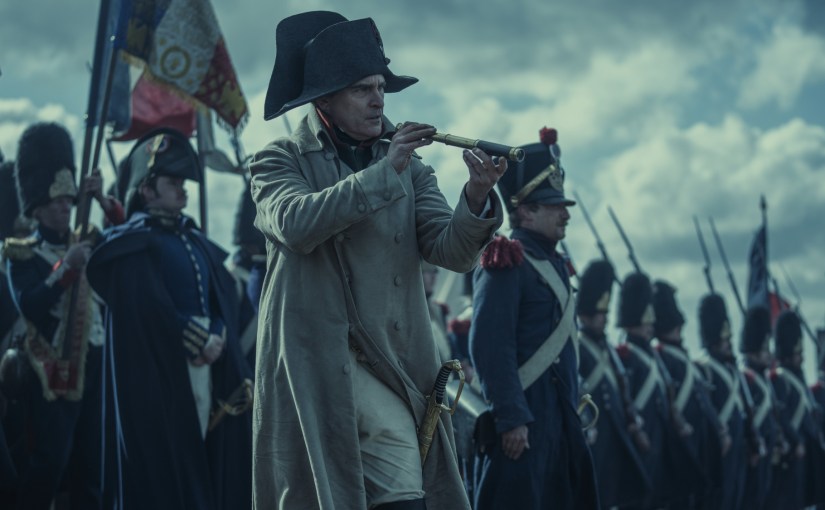
Joaquin Phoenix portrays General Bonapart, and he surely had a great challenge ahead of him. I cannot say that I was bored with any part of the film, but I did find Napoleon to be quite bland during the first act of the film.  Phoenix, doing his best with a script by David Scarpa, seems to be a stand in with nothing of much consequence to say.  It is only when the Captain all but invites a promotion upon himself to the rank of General, following the guillotine beheading of Marie Antoinette, that his arrogance begins to show.  Thereafter, he takes it upon himself to force the hands of the governing council to resign from their positions, a very entertaining sequence for sure.  Then Napoleon sees no other purpose but ongoing conquest. 

With each passing scene in Napoleon, the ego of the title character grows and grows and that is the underlying theme of Scott’s picture.  We journey to the pyramids of Egypt to witness Napoleon lead his armies towards further conquest.  Alternatively, we also trek through the raw winters of Russia and on to a blazing Moscow.  Who set the Russian city alight is a question that history may contradict of the General’s claim.

Napoleon is sure to get a slew of Oscar nominations.  However, it will likely not be in any of the major categories.  The numerous battles are outstanding in whatever setting Ridley Scott offers.  Whether it is in the desert or murky winter grounds, I could not tell if the armies were physical extras or CGI.  It all looked seamless in its construction.  David Lean would be proud.  Sound editing was also perfectly in sync.  The set designs of the many scenes throughout are exemplary from bedrooms to halls and the wallpapers, furnishings and floors and even the outdoor landscaping of the French estates.  Even Napoleon’s tent on one battlefield after another are absorbing.  The costuming always makes a statement.  Every stitch and distressed shade of blues, reds and whites tell a story.  Yes, it’s all very impressive.  However, I did not go to Napoleon to grade a college project assignment in fine arts.  Overall, it has to be the movie itself that grabs me.

Unfortunately, Ridley Scott’s film suffers from shortcomings that cannot be forgiven.  I have to lend credit to my wife who pointed out flaws that did not come to my attention until I heard her input, and thus could not deny.  There are topics brought up in the film that are either not followed through clearly or are left with questions. 

One moment in particular occurs when Napoleon opts to marry the daughter of a leader. Do not ask me to remember which leader. Characters leave the picture just as quickly as they enter.  One daughter is of proper age.  The other daughter we are told is only age fifteen and Napoleon turns down the idea of the latter, but in the scene afterwards it appears that he actually did choose to marry the fifteen-year-old.  The girl certainly looked like a teenager.  So, how did that come to be? 

A storyline I really took an interest in was Napoleon’s marriage to Josephine (Vanessa Kirby).  The widow of a dead soldier, with three children, he marries her for love.  Then he leaves to conquer some more and more around the world.  Yet, the general returns when he realizes she is happily having affairs in his absence.  The bruised egotistic response of Napoleon is very well played out. Joaquin Phoenix has his best moments in the storyline he shares with Vanessa Kirby.  However, while I thought I understood, my wife pointed out that the film does not clearly explain how the relationship continues.  There’s animosity at first but then there is a mutual love between the couple and how exactly did that flourish and change?  When was the mutual affection eventually sparked?  What works best is how the two are unable to bear a child together.  Napoleon is nothing but forceful in his moments of sex with Josephine.  He will damn well force a pregnancy even if it means he has to thrust harder and harder inside of her.  Yet, no results come of his efforts. An heir must carry on the Bonapart legacy.  Since one does not appear, it taxes heavily upon the powerful leader.

Later in the film, following the couple’s dissolution of marriage, a child is born but who exactly carried the offspring?  Details like these seem to be glossed over.

Few directors are as skillful at showing grand scenes of battlegrounds with sharp, clear edits of how the fighting progresses.  Ridley Scott demonstrates that over and over again with one scene after another.  He accomplishes fare like this so well in other films like Gladiator and his interpretation of Robin Hood.  The dark hazy cinematography works beautifully on a big screen.  However, I’m not sure if it will be as effective on a sixty-inch flat screen where there’s a risk of intrusive glares in your living room.  These magnificent scenes need to be watched on a big screen.

Unfortunately, the attention to detail is not lent to the story as effectively. Napoleon’s mark in history did not just happen in a period of a few years.  For a brief window of time, France was a superpower ahead of the likes of Egypt, Britain, Austria, Prussia and even Russia.  Two hours and forty minutes may seem like a long film and yet Napoleon likely needed at least an additional hour to serve a complete historical recount.

If you want to see Napoleon, now is your chance while it plays in theaters.  Again, I do not believe it will have the same effect at home.  Regrettably, the film does not offer enough on the plate.  No one in the cast is doing anything of Oscar caliber accomplishments.  Ridley Scott comes up short of end of the year award considerations for not inviting tighter storytelling, and that also goes for David Scarpa’s script. 

The visual marvels of this period piece are what is to behold.  Watching Napoleon, I certainly felt like I was there amid the glorious costumes, set designs and cinematic photography.  Nevertheless, while I may have been in the room, the hosts of the picture were not sharing their entire conversation with me around the dinner table.  Alas, at times, I was left to stand in the corner, feeling like an unwelcome guest.

THE MARVELS (2023)

by Miguel E. Rodriguez

[Phase Five, #3, for those keeping track]
DIRECTOR: Nia DaCosta (the first African American woman to direct an entry in the MCU, incidentally)
CAST: Brie Larson, Teyonah Parris, Iman Vellani, Samuel L. Jackson, Zawe Ashton
MY RATING: 8/10
ROTTEN TOMATOMETER: 62% Fresh

PLOT: Captain Marvel, Monica Rambeau, and the fledgling Ms. Marvel get their powers “entangled” with each other, forcing them to work together to save the universe.


I’ll get to the actual review in a minute, but first:

The MCU is now so vast – and it’s only getting vaster – that even diehard fans are starting to experience what I’ll call MFS: Marvel Fatigue Syndrome.  The newest entry, The Marvels, is the thirty-third film in a franchise that began in 2008 with Jon Favreau’s Iron Man, not to mention the nineteen streaming and broadcast TV series, starting with Agents of S.H.I.E.L.D. in 2013, with more on the way.  With those hundreds or even thousands of hours of viewing time that are required (more or less) to keep up with current events within the franchise, it’s no surprise that some members of the Marvel fandom are already blogging and writing op eds proclaiming that The Marvels may be the movie that finally sends the MCU into a death spiral, due to its relatively low box-office grosses in its opening weekend.  Enough already, they’re saying.  The people have spoken.

My opinion?  Well, if you were to ask me which two movies were the least fun of the franchise in recent years, I’d have to go with Black Panther: Wakanda Forever and Ant-Man and the Wasp: Quantumania.  That one-two punch of mediocrity would have been my choice of theoretical MCU-killers.  And yet here we are.

I say all this because I think we should all give the MCU a break.  They have no fewer than eleven films in development through 2027 and beyond.  The Marvel Cinematic Universe will be remembered as THE most profitable film franchise in the history of franchises.  They’re gonna keep cranking them out as long as we keep plunking down the money for tickets.  So, if you’re experiencing Marvel Fatigue Syndrome, allow Dr. Rodriguez to offer his expert advice: Don’t go.  Save the hate-watching for the new Aquaman movie in December.  (God knows he’ll need all the help he can get.)

Now, with that in mind:

The Marvels does indeed depend PARTLY on your knowledge of the events in the TV series WandaVision and Ms. Marvel, so if you haven’t watched either of those series, you may want to consider setting aside some binge time before heading to the movie theater.  Otherwise, yes, you may be a little lost.

Given how some of the movies in Phase Four were not exactly sensational (looking at you, Eternals and Thor: Love and Thunder), my expectations were toned down a bit.  However, speaking as someone who did his homework and watched all of the required TV, The Marvels turned out to be far more entertaining and fun than I expected.

Most of the unexpected fun comes from the “entanglement” of powers experienced by three powered individuals: Captain Marvel (Brie Larson), Monica Rambeau (Teyonah Parris), and 16-year-old Kamala Khan, aka Ms. Marvel (Iman Vellani).  For reasons that have something to do with the “cosmic bangle” worn by Ms. Marvel, they switch places whenever one of them (or only two of them?) use their powers at the same time.  I’m at a loss to explain it logically, but the movie deftly handles the transitions visually, so we’re never confused about who is where and why.

No superhero movie is complete without a villain.  In this case, it’s a Kree warrior, Dar-Benn (Zawe Ashton) who has somehow come into possession of the giant hammer first wielded by Ronan the Accuser way back in the first Guardians of the Galaxy movie.  Building on the ancient civil war between her race and the shape-shifting Skrulls, she intends to do whatever it takes to bring her desolate homeworld back to life, even if it destroys a Skrull planet/refugee camp or two in the process.  To do this, she’ll need two quantum bands.  She finds one near the beginning of the film, but where’s the other one?  Why, wrapped around Kamala Khan’s wrist, of course.

(One might wonder how Dar-Benn’s planet was desolated in the first place, and the movie does answer that question, but I’m not saying.)

There is great chemistry among the three leads, although I must confess it felt a little forced near the beginning.  However, they definitely clicked in two sequences: when they start to figure out how to work together and make their “entanglement” an asset instead of a liability, and when they visit a beautiful, almost water-covered planet to warn the population of an impending attack.

If I had my way, this world would be called “Planet Bollywood” forever and ever, amen.  The inhabitants can only communicate through song; plain old atonal speech is indecipherable to them.  Thus, when the Marvels arrive, they are greeted by an elaborate song and dance number with mundane lyrics accompanied by the most dizzying array of dance and colorful costumes outside of a Julie Taymor film.  I’ve never seen a Bollywood movie, but I have to believe this is what they’re like.

Other developments take place involving Nick Fury, Kamala’s family, a giant space station in Earth orbit, and Chewie/Goose, the Flerken cat introduced in Captain Marvel (2019).  There is a scene onboard the space station that absolutely must be seen to be believed involving Chewie, an emergency evacuation, and…Broadway.  ‘Nuff said.

I laughed a lot during The Marvels, and that’s a good thing.  With entangled powers, Bollywood, a sixteen-year-old girl with a bad case of hero worship, and an entirely unexpected “marriage of convenience” …with all that bizarre subject matter, striking a humorous tone works for the film.  Plus, it was, I must admit, refreshing that, with only one minor exception, the story didn’t include any of the three female leads dealing with a crush or a boyfriend or kids back home.  These were just three women kicking ass and taking names.  (The final battle with the villain was amazing, setting up a cliffhanger I didn’t see coming…make sure you stick around for the credit cookie!)

Am I experiencing MFS myself?  Not yet.  Sure, I groan with everyone else when a film doesn’t quite live up to expectations, going all the way back to Iron Man 2 and 3, but for every mediocre sequel, there’s a Black Panther, or an Avengers: Endgame, or…The Marvels.  Movies like this one keep me coming back to the MCU, for better or worse.  It was fun, witty, exciting, and pretty damn smart.  What more could I ask for?

KILLERS OF THE FLOWER MOON

By Marc S. Sanders

Killers Of The Flower Moon reflects on a period in Oklahoma history that I imagine has hardly been told.  In the early 1920s, the Native American residents, consisting of four tribes, came into a blessing of wealth when oil was discovered on the land they occupied in Osage County.  Almost immediately, white folk from all over the country migrated to this area and built up an infrastructure of capitalism that included private practices, pool halls, movie houses, law enforcement, pharmaceuticals, and even cab drivers.  However, they didn’t want to just stop at developing the area.  They wanted to seize it and they proceeded to do so by wiping out the Native American residents.  Family lineages were all but erased as the whites married into the race and gradually found ways to kill and bring about surprising deaths that would ultimately allow them to legally inherit what was rightfully owned by the Indian people.

Director Martin Scorsese has introduced a new kind of historical education with a film that I believe will be my favorite picture of the year.  I was mesmerized by every photographic shot, closeup, edit, and musical accompaniment contained in this movie.  Everything works so well. 

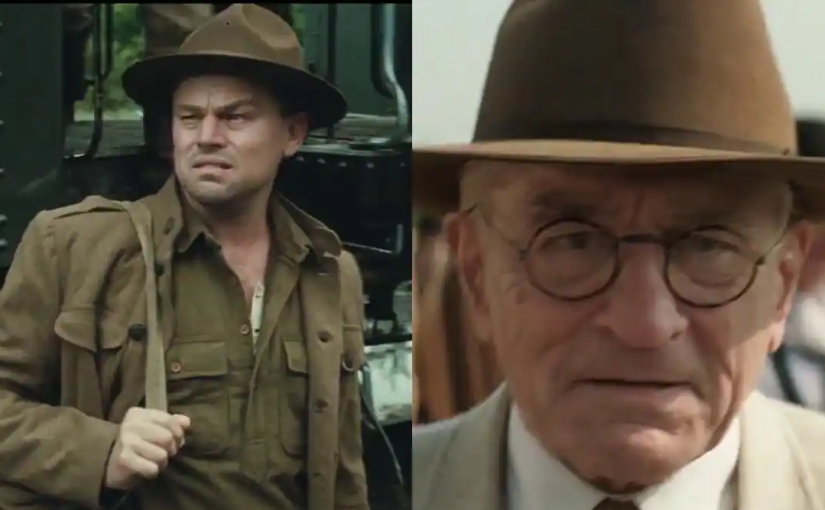
Robert De Niro reunites with the director for the tenth time; an amazing legacy of a partnership spanning fifty years.  He portrays William “King” Hale.  King is a kindly old fellow on the surface, but his intelligence shows as he strategizes how to take over more and more of this area.  He oversees a control of the white gentlemen folk, leading them into quick marriages with the young women of the tribes.  From there, they have children and over time will gradually purify the bloodline.  It’s a ruthless and scheming tactic and it successfully works thanks to how taciturn Mr. Hale is.  De Niro might win his third Oscar for this role.  This character joins that exclusive fraternity of the best villains in cinematic history, ranking up there with The Wicked Witch, Harry Lime, Norman Bates, Darth Vader, Joker, Daniel Plainview and Hannibal Lecter.

Early on in the epic film, The King’s nephew, Ernest Burkart (Leonardo DiCaprio) has returned from the war to work under his uncle.  Ernest starts as a cab driver and meets Molly (Lily Gladstone), the Native American woman he will take as a bride and establish residence together.  DiCaprio does some of his best work following a very boastful career of roles.  He’s also sure to get at least an Oscar nomination.  This is already his sixth film with Scorsese.  Ernest is not very bright, but with The King’s guidance and instruction he’ll also come to own much of this territory.

Mysterious deaths of unexpected natures occur within the tribes of Osage County, particularly in Molly’s family.  Over the course of the film, one relative after another perishes until what’s left of her bloodline is practically only herself.  The children she bears are a mix of Molly and Ernest.  Molly knows something is amiss.  She is starting not to feel well, and her suspicions speak to her.  Others in the community are also suffering peculiar deaths following doctor’s visits or evenings of drunken binging.  An investigation is warranted before it becomes too late.

Lily Gladstone will become a surprise hit at Oscar time as well.  A breakthrough role where her feared silence and bravery matches well against the deceit emanating from the King and even the poorly hidden conniving of her husband Ernest.

Scorsese builds his film with suspense and shock.  A quiet beat of instrumental music haunts certain scenes.  Who will be the next target of the King’s bidding?  The King hides behind his empathy for loss by attending funeral services and allowing the survivors to cry into his shoulder.  On another side, he instructs Ernest to carry out an assignment to some flunky to make a murder appear like a suicide.  A shot in the back of the head will not send a convincing cause and effect though, and the King and Ernest must make up for that. 

The King is everyone’s friend in Osage County, but he’s also a puppet master Grim Reaper.  With the circular rim glasses that DeNiro wears along with his peaceful beige suits, it’s a wonder that this man is an executioner using the hands of others to carry out his bidding.  He dances in the middle of town during festive gatherings.  It even amuses the Sheriff’s office when he voluntarily offers himself up following a warrant for his arrest.  At the risk of getting politically sided, DeNiro was recently interviewed during a press junket for the film.  His animosity towards President Trump is no secret.  I was in the audience at Radio City Music Hall when he led a unified roar of “Fuck Trump” during the Tony Awards.  Still, the skilled actor said he used the enmity he harbors to his advantage for this role.  In the latter half of the film, William “The King” Hale preaches in a similar approach to Trump.  There are figures in our history who just know what buttons to push and absorb massive amounts of influence while earning respect through fear. 

Killers Of The Flower Moon covers a wide berth of its period in history.  Scorsese takes an inspired approach by cutting away on occasion with black and white footage and photographs of the Native Americans coming along with their good fortune and then on to how the white “immigrants” of this area enter this land and assume a daily life within the community, whether they were welcomed or not.  All is depicted from how Osage County quickly changed following the discovery of “black gold,” to how Ernest becomes wise to the advantages of power. 

Leonardo DiCaprio has a great undertaking.  Ernest is not very bright.  He can hardly read.  He’s not subtle with his approach like his uncle.  Yet, the actor maintains an expression of no choice to abide by but what he’s been told is right.  DiCaprio does this incredible expression with long frowned lips and a fat chin that stands out from beneath his nose.  It almost seems like a barrier to finding the humanity he may have once had when he was an infantryman fighting with the allies in Europe.  It is just a haunting performance.

The third act picks up with J Edgar Hoover’s newly established Bureau of Investigation entering the story to investigate the odd happenings in Osage.  Jesse Plemons again plays that guy that you have seen somewhere before.  Often, he occupies similar kinds of roles, and still, I like what he contributes to this picture as Investigator Tom White.  Screenwriter Eric Roth lends the character simple, plainly worded questions for Plemmons to work with and it seems to come off as nothing intimidating.  Rather, the presence of Tom White on Ernest’s doorstep, with Molly mysteriously sick in the bedroom, is enough to rattle Ernest, the King, and the whole county.

It’s no secret that Killers Of The Flower Moon has a long running time at nearly three and a half hours.  However, it is necessary.  This widespread crime is not done in just minutes.  How it is gradually orchestrated needs to be seen, followed by those that uncovered how sinister it became.  Then attention needs to be given to how biased the trials of Ernest and The King had become.  Men who conspired with the King and Ernest serve on the jury.  A lot of unfair wrongs occurred during this time spanning what I believe was at least a decade and a half. 

Roth and Scorsese bring the conclusion of the film with a welcome invention.  In a time where Netflix, Dateline, 20/20 and ABC News thrive off true life crime documentaries that become so addicting, the filmmakers resort to a radio show to sum up what happened to the main players of this devastating episode in twentieth century American history with the director making a cameo to offer his final words for the main victim of the piece, Molly Burkhart.  This bookend to the film has stayed with me since I finished watching the movie, and I applaud Scorsese and Roth for their execution.  Newsmakers of today go for the most sensationalized crimes that have occurred; the ones that leave the most shock and awe and even audaciousness.  What happened in Osage County is unforgivable.  Likely a genocide of bloodlines that were unjustly ceased so that what was rightfully theirs to own could be seized.

Killers Of The Flower Moon is a drama that had to be told because the motivations that led to the series of crimes happens not only to Native Americans, but to practically any other demographic across the globe.  This is a captivating story and one of the best films Martin Scorsese has ever made.

Again, this will likely be my favorite film of the year and Oscars are deserved for DeNiro, DiCaprio, Gladstone, Roth, Scorsese and for Best Picture of the Year. 

NOTE: As I watched this movie, I could not help but think of the film August: Osage County, the motion picture adapted from Tracy Letts’ Pulitzer Prize winning play.  There is one Native American character in the film who is hired to serve the white family living on a wide expanse of land in present day 2013 (2007 for the play).  The first time I watched the movie, I could not recognize the purpose of the character.  On a second viewing, following a conversation among the dysfunctional family of characters about Native Americans, it was much clearer.  Having now watched Scorsese’s film, this picture serves as a great companion piece to watch afterwards.  I’ll be directing a stage production of this soon and much of what I learned from both films will be incorporated into my interpretation.  Even the architectural designs of the homes in both films, interior and exterior, are uniquely similar. 

Look for my review of August: Osage County (featuring Julia Roberts and Meryl Streep) on this site as well.

THE COST

By Ronnie Clements from Screen Gems – A Guest Review

Screen Gems checks out The Cost (2023) …

Introductory note …

I approach an assessment of The Cost (2023) with a significant amount of “baggage” (so to speak). Firstly, director and co-writer, Matthew Holmes and co-writer, Gregory Moss are very good FaceBook friends of mine. Secondly, I’m not overly into Australian films. My Cinema Studies concentrated on American films and most of my all time favourites are American ones. Thirdly and most significantly, as a true crime buff, I do often watch revenge thrillers and by default root for those exacting the revenge no matter what. However, I take writing reviews very seriously so I will off-load my “baggage” and appraise The Cost with a completely “cold eye”.

Review …

The revenge thriller is alive and well! We should be thankful and rejoice!

The sub-genre of the revenge thriller is an interesting one. It is very commonly tackled by American filmmakers but not so often by Australian ones. Of course the many American ones I have seen (1974’s Death Wish, 1982’s Class of 84, etc.) tend to be very “manipulative” and “framed” in such a way that we are consistently on the side of those in the business of getting even. This is where The Cost makes the sub-genre entirely its own!

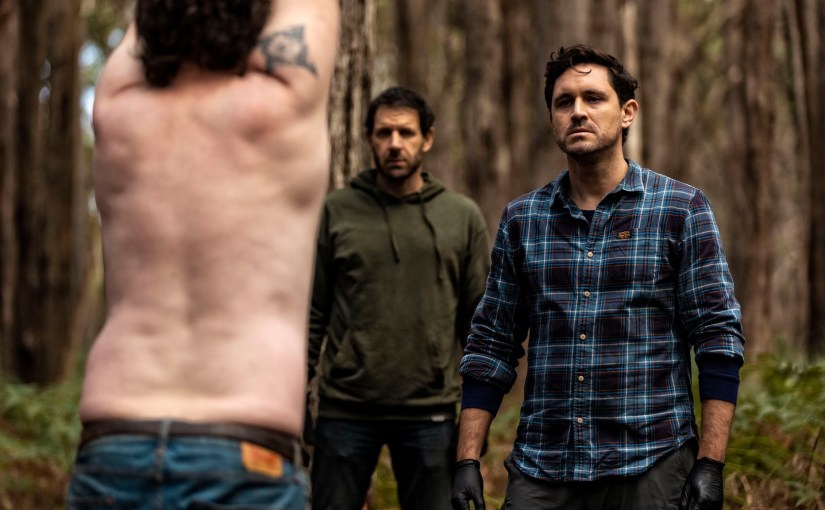
Two regular guys abduct a crim who was given early release from jail for a rape and murder many years before. The husband and brother of the victim are intent on dispensing their own brutal form of justice. However, director Matthew Holmes (by way of the script which he co-wrote with Gregory Moss) does not make it easy for us to firmly and consistently root for any one character. We are constantly shifting our allegiances between the perpetrator of the sickening crime and the revenge seekers. This not only makes The Cost different. It makes it riveting! It makes it unforgettable! It makes it superb!

The setup for the film is quickly and clearly established at the very beginning with obligatory flashbacks and slick editing. We are introduced to the three principal characters who will carry us through a very emotional journey as two of them dole out their own payback: the husband, David (Jordan Fraser-Trumble), the brother, Aaron (Damon Hunter), the perpetrator, Troy (Kevin Dee). Then there is “the intruder”, Brian (Clayton Watson) who comes into the story later and enriches the narrative as it goes in different and unexpected directions.

Of course a film with a small number of main characters lives or dies on the strength of the acting performances and in The Cost the performances are stellar. Fraser-Trumble, Hunter, Dee and Watson are equally engaging in their disparate roles and adequately capture the “development” of their characters as the tale unfolds. It needs to be mentioned that all the supporting cast are great too, not one bum performance in the piece.

Overall The Cost is a breath of fresh air in the revenge thriller sub-genre because we are often shifting our allegiances from one character to the other and sometimes even feeling for the crim. We are never being “manipulated”, we are in control. And interestingly enough, The Cost’s violence is relatively restrained too. There is not the over-the-top blood letting as there is in so many American, European and Asian revenge films. There is a particular scene where the violence could have been horrific, but the clever script does not allow that: what we don’t see happen is as effective as what we could have seen happen!

Beautifully lit and shot with a script that is crisp to the core (not one line of dialogue is wasted), The Cost is an important Australian film that is highly recommended. It will definitely have you thinking long after the credits have rolled.

On balance if I had one “issue” with the film, it would be the ending. It is perhaps not quite as “dramatic” as I would have preferred but, to be fair, it still works. We are certainly left with questions and the ending, as it is, makes way for a sequel. I’d certainly love to see that!

So … I will finish as I began: The revenge thriller is alive and well! We should be thankful and rejoice!

I am and I do!

Trailer …

May be an image of 13 people and text that says 'O DELIVER THE COST'

All reactions:

2828

ELEMENTAL

By Marc S. Sanders

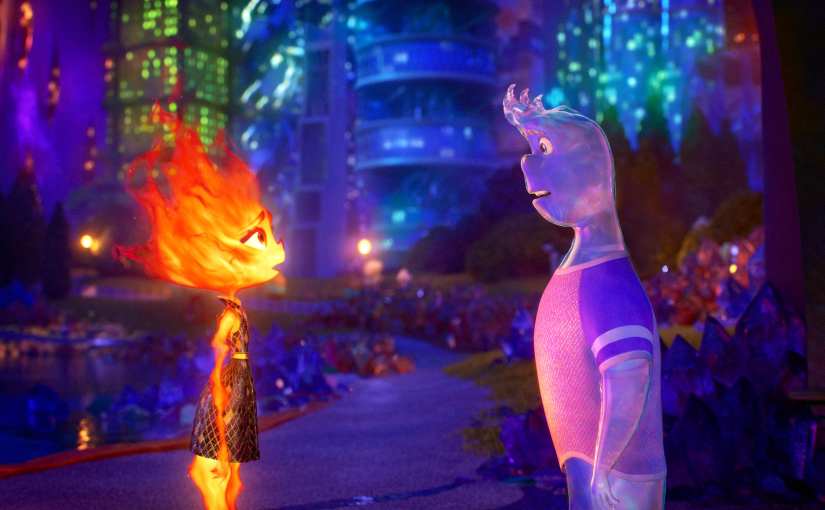
Ember and Wade are perfect for one another.  They truly belong together.  Yet, science dictates that they have zero chemistry.

Ember is a figure of fire.  Wade is a bubbling, joyful standing puddle of water.  They reside in Element City along with people of earth and air, respectively.  Pixar with Disney Studios, has transitioned from emoting human feelings in lovably figurative toys, monsters, cars and colorful emotions to the primary elements of our planet.  Hence the title Elemental.  It’s a blessing that the storylines and messages of this digitally animated feature are a winning combination.

Ember (Leah Lewis) is the daughter of her fire immigrant parents, Bernie and Cinder (Ronnie Del Carmen, Shila Omni).  She loves to work with her dad in his mercantile shop that he built from nothing, known as The Fireplace.  She’s hardworking and dedicated, but she can suffer from a short temper that turns her firebrand orange disposition into a raging purple. Suddenly, she’s charred the shop interior and maybe some of the customers.  

Wade (Mamoudo Athie) is a water made building inspector who by unexpected circumstance comes upon the aftermath of a temper tantrum from Ember.  He works as a building inspector for the city and simply by doing his job he cites enough offenses with The Fireplace that could shut down the shop for good.  Now Ember must work with Wade to avoid that from happening, including haphazard water leaks that are stemming from a mysterious source within the city.

Elemental works because while it bursts with magnificent color, it has a story to tell in a brilliantly inventive and functional environment, much like the Monster World in Monsters, Inc. Pixar does not just stop at the marvelous animation. Their products continue working even beyond their well planned stories and conflicted characters.

With this film, the immigrant crisis that is a prevalent problem in the real world is addressed, but simplified for all ages to comprehend.  Fire based citizens, inspired by Asian/Eastern cultures, are typically restricted to only fraternizing within their area of the city, among only their demographic.  They are regarded as harmful and unsafe from the other three elements.

On the other hand, people of water, air and earth live in harmony.  Director Peter Sohn, with a highly informative script from John Hoberg, Kat Likkel and Brenda Hsueh, is consistent with this reflection.  Water, air and earth make up the first three iterations of Element City.  Fire gets no recognition.  Fire was not invented by a higher power.  It had to be discovered.  Therefore, they are sadly treated as a minority.  The film doesn’t go so extreme as segregating the fire community to literal internment camps, but the feeling of isolation seems quite authentic.  

Yet, fire serves an important purpose. Bernie might envision his daughter taking over the business as he is getting older and slower.  Still, with Wade’s help Ember is realizing that she has talents that will make her happier and more fulfilled.  She’s a natural at honing glass sculptures with merits in practicality and art.

At the same time Wade and Ember are becoming friends and maybe there is something more going on in their newfound relationship.  Problem is they dare not make contact with one another.  What would actually happen if fire and water mixed?  Bernie and Cinder would never approve of this relationship either.  As well, poor Wade and Ember may be frowned upon with prejudice if seen in public together.  

My colleague Miguel reminded me that Elemental gets 98% of its science accurate.   I definitely appreciate that.  However, I’m also grateful for the remaining 2% left for my suspension of disbelief that is quelled by insightful imagination.  Ember and Wade are such wonderful characters that they deserve the happiness they long for.  As I watched, I longed for their destinies to outlast the seemingly impossible.

This is a special film from the Pixar factory.  Elemental demonstrates that nothing should limit what any us of yearn for.  No shortsighted policy of any kind should bar us from our pleasures.  There’s a way for anything to work together.  It only takes some thought.  So you know what I say as I root for Ember and Wade?  SCIENCE/SCHMIENCE!!!!

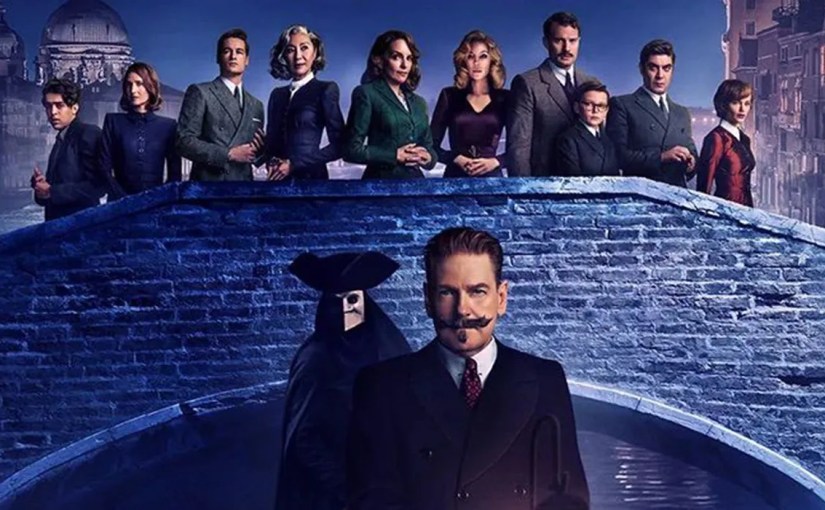
A HAUNTING IN VENICE

By Marc S. Sanders

There’s A Haunting In Venice and Hercule Poirot is on the case.  

Kenneth Branagh returns for a third time as Agatha Christie’s famed literary detective.  He also serves in the director’s chair again, and this is his best installment in the updated franchise.

The man with the exaggerated mustache is living in Venice, Italy, with the assurance of a bodyguard (Fernando Piloni) to fend off any pestering folk needing their own personal conundrums resolved.  Poirot is not interested to assist.  

On All Hallow’s Eve, he is invited to be a tag along with his American mystery novelist friend Ariadne Oliver (Tina Fey) at Rowena Drake’s home. A celebrity Medium known as Mrs. Reynolds is to appear and perform a seance. My first impression of Fey’s character is a loose interpretation of Dame Agatha come to life to partner up with Hercule.  She’s sort of a wink and nod to the author’s fan base.  What if Agatha and Hercule actually worked together?  This is as close as you’ll get.  Branagh and Fey work so well together.

Poirot reluctantly agrees to accept Ariadne’s invitation.  Upon arrival at the affair, the best feature of the film is introduced.  Rowena’s home is a foreboding dwelling alongside the Venetian River, and this Hallowe’en evening is turning into a dark and stormy night.  A children’s costume party is wrapping up complete with creepy puppetry, ghost story telling and apple bobbing.  Then it is time to welcome the arrival of a figure dressed in black wearing a pearl white Kabuki mask.  The children have left, and the eventual suspects of a murder mystery are all that remain in the house when the seance begins.  Mrs. Reynolds will use her talent to communicate with Rowena’s daughter who passed away a year earlier following a fall off the rooftop and into the murky river below.  

Poirot is the most skeptical of the guests as he staunchly believes only in logic, not the supernatural.  Ariadne insists that he will be amazed at the unexplainable talent at play. A well timed falling chandelier and a typewriter that seems to answer the Medium’s questions are not convincing enough for him.  

Eventually, a gruesome and shocking murder occurs.  Like most formula mysteries, everyone appears to have an alibi.  Yet, Poirot refuses to believe this crime took place by means of a supernatural element.  Even if there are unexplained noises within the home and the appearance of Rowena’s daughter turn up, there must be a more logical resolution.  

A Haunting In Venice works especially well thanks to the atmosphere of its setting.  The multi-floored and darkened home lend to the eeriness necessary for a spooky story focusing on death.  The faucet of a sink doesn’t work.  The innocence of apples takes on a nervous feeling.  Lanterns allow shadows to float within the darkness while the lightning flashes and the thunder pounds outside with choppy waters in the river. This haunted place where a young girl recently died is not somewhere I want to stay overnight.  

One suspect that especially stands out is Leopold (Jude Hill), a preteen boy with a fondness for the macabre works of Edgar Allen Poe.  Poirot suggests he turn towards Dickens.  Leopold seems much wiser than his years, as he tends to and speaks on behalf of his unwell father, Dr. Leslie Ferrier (Jamie Dornan).  

Michelle Yeoh turns in another memorable performance permitting the strangeness of her Medium character, Mrs. Reynolds, to elevate suspense.  Poirot can choose to be doubtful.  Nevertheless, I’m convinced Mrs. Reynolds can speak to the actual dead.  

A Haunting In Venice has murder on its mind and the sudden death of one of the characters is horrifying.  I dare not spoil how it transpires.  Thankfully, this tale returns to an approach that so many classic films adopted.  You don’t need pools of blood and guts to get the hairs on the back of your neck to stand up.  It’s clear that with the approval from Agatha Christie’s estate, Branagh is well researched in what the author wanted to accomplish.  

The screenplay from Michael Green lends wonderful color to the characters, as Poirot interviews each person.  All of the performers are engaging.  This collection of actors especially works because unlike the other two Branagh films, this installment does not rely so much on stunt casting with recognizable marquee names.  For me, the who done it resolution was more challenging to solve because the actors portraying the assortment of suspects were deliberately vague, airing a sense of distrust in any one of them.  

This is a fireplace story to curl up with under a blanket and a cup of hot cider on a brisk Autumn night. The best compliment I can give A Haunting In Venice is that it’s a never-ending page turner.

HAUNTED MANSION (2023)

by Miguel E. Rodriguez

DIRECTOR: Justin Simien
CAST: LaKeith Stanfield, Rosario Dawson, Owen Wilson, Tiffany Haddish, Danny DeVito, Jamie Lee Curtis, Jared Leto
MY RATING: 6/10
ROTTEN TOMATOMETER: 40%

PLOT: A single mom in New Orleans hires a grieving tour guide, a dubious psychic, a shady priest, and an unhinged historian to help exorcise her newly bought mansion after discovering it is inhabited by ghosts.


Writing even a mildly negative review of Disney’s Haunted Mansion feels a little like hitting “dislike” on a picture of a 3-legged puppy.  The puppy is just being a puppy.  It doesn’t know or care that it’s missing a leg.  It just is what it is.

So it goes with this new attempt at a movie based on a popular Disney ride.  It’s chock-a-block full of inside jokes and references to the ride, some in plain sight, some tucked away in the corners of the screen.  As a fan of the ride at the Magic Kingdom in Orlando (I’ve never been to the Disney parks in Anaheim), I enjoyed these little Easter eggs.  Truthfully…I enjoyed them a lot.  I especially liked the chair shaped like a Doom Buggy, and the room that stretches, and the hitchhiking ghosts, and on and on.  This movie is basically Ready Player One revolving around just one IP instead of hundreds of them.  (That’s “Intellectual Property” for all you non-nerds out there.)

But aside from all the cool references, there’s not much else to recommend, especially not for those few poor souls who are not as thoroughly familiar with the Disney ride as I and many others are.  For those people, I would imagine Haunted Mansion plays a little bit like a de-fanged version of the original Jumanji [1995] or Jon Favreau’s criminally under-appreciated Zathura [2005].  There’s a heart-tugging sub-plot about the grieving tour guide, Ben, played by LaKeith Stanfield.  (Stanfield deserves recognition for playing the absurd material absolutely straight, even pulling out the emotional stops for a touching moment as he describes his late wife, in a scene that features an absolute scene-stealing button from Danny DeVito.)  Travis, son of single mom Gabbie (Rosario Dawson), has problems with bullies at school, even when he isn’t troubled by the ghosts who have latched onto him like lice.  Then there’s the issue of who all the resident ghosts are REALLY afraid of, a big-bad known only as the hatbox ghost (Jared Leto).

(I was reminded here of Peter Jackson’s The Frighteners [1996] in which a host of ghosts were terrified of a being that can actually kill a ghost.)

The movie has all the requisite creepy hallways and creaking doors and one or two jump-scares, but everything is done so tongue-and-cheek that it’s never truly horrifying…which was, I’m sure, the aim of the filmmakers.  Certainly you don’t want to make a film, based on a theme park ride, as scary as The Exorcist.  So, to that end, the filmmakers succeeded.  The movie is harmless, even a little fun at times, Owen Wilson gets to deliver some of his trademark dry observations, and DeVito gets to play some notes that I haven’t seen him play in a very long time.  If pressed, I would be forced to conclude that, for non-fans of the ride, this movie would most likely be a bit of a slog.

…but it is cute, despite missing that one leg.