TÁR

By Marc S. Sanders

I’m not sure what to make of this.

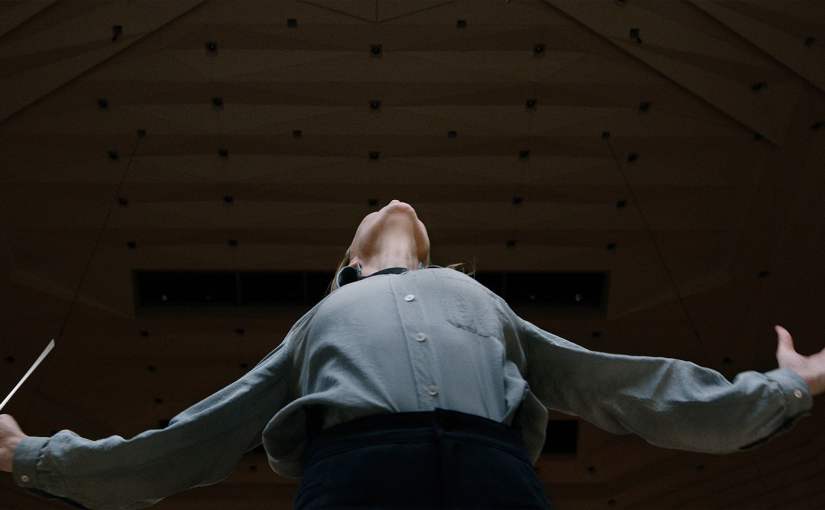
One of the very first scenes of writer/director/producer Todd Field’s Oscar nominated film Tár captures its title character Lydia Tár being interviewed for her celebrated career as one of the few widely known female conductor/composers in the world.  Cate Blanchett is Lydia, and her vocal delivery is so crisp and sharp within the wordy conversation.  I hear everything she is saying and yet I can not comprehend one thing that she is talking about.  I’m sorry.  I lack the knowledge to know the value and gifts of a skilled classical musician who expertly leads an orchestra.  However, I think I gathered the most vital element of this scene.  Lydia Tár knows she’s a celebrity as she discusses the influence she collected from Leonard Bernstein, and as she sits on this stage with this interviewer, she knows that she is one to be admired.  Lydia Tár will likely claim to be the second coming of Bernstein. She is a proud -very proud-expert at her craft.  No question about that.  Yet, in front of this classroom audience she is also wearing her best figurative mask. 

(Interestingly enough and a POSSIBLE SPOILER, the final caption of the film has the audience she performs to donning masks.)

Shortly after that interview comes another one-on-one discussion with her agent/lawyer, and a different angle to Lydia is presented at the restaurant table.  I still found it challenging to understand the breadth of the conversation.  I could uncover one thing though.  The mask has been removed.  Lydia Tár is now a proud condescending bitch. 

The most eye opening scene occurs next as Lydia attempts to shatter the confidence of a student while she teaches a class at Julliard.  Constructively speaking, this roughly ten-minute sequence is fascinating.  Todd Field captures one long take, the camera never breaks away for an edit, as the composer destroys the position of this young student’s reasoning for not being an admirer of Bach.  It consists of long, breathless monologues that travel with Cate Blanchett’s stride and Todd Field’s camera as the actress circumvents the classroom and the stage located up front. The student does not approve of Bach as a CIS, white composer whose sexual activities led to multiple children.  However, Lydia does not factor in Bach as the person he was with his ugly warts and all. Rather she only values the art he created, and therefore this student should as well.  All that is contained in the notes on the page are what Bach should be treasured for.  Lydia confidently undoes the student’s argument with logic that is hard to win against.  Todd Field will demonstrate with the rest of his film this destructive skill will also be Lydia Tár’s undoing.

It’s quite a proficiency Lydia has for tearing down the principals of anyone confronted with her.  She is also adept at ripping away the promising potential and the talented traits that others possess.  Lydia knows what she does.  She knows the hurt and pain she inflicts among the people around her.  Yet, just as she explains to the student, she should also be appreciated like Bach.  You may despise her demeanor, but Lydia Tár is an artist of varying and exceptionally high degrees, especially for a woman.  She is writing a book about herself appropriately titled Tár On Tár.  She is in the middle of writing her own symphony, and she has the esteemed honor of conducting a major German orchestra in Berlin for an anticipated live performance of Gustav Mahler’s Symphony No. 5. Therefore, who she is as a person should carry no matter.  Look only at what Lydia is capable of!!!!

Cate Blanchett is one of the few actors that can stand next to other talented peers like Meryl Streep, Jack Nicholson, Shirley MacLaine or Jimmy Stewart.  She is an uncompromising actress ready to play the unlikable characters necessary for effective storytelling.  Lydia Tár is one such sociopath.  Blanchett occupies nearly every frame of the picture, and she delivers such a frightening and obdurate drive to this person.  

It’s funny.  I often joke with a friend of mine about Faye Dunaway’s awful, over the top performance of Joan Crawford in Mommie Dearest.  It’s so ridiculously out of control and manically abusive that I don’t know where to begin with that film.  Lydia Tár has that same kind of passion, but with Cate Blanchett possessing the character, accompanied by Todd Field’s script, there are an assortment of ways this tyrant leaves her carnage strewn about when she enters and leaves a scene.  The outbursts are timed perfectly for these crescendo moments where Lydia believes she has everything under control and contained, but then a screw comes loose in her functioning that derails everything she’s built herself up to be.

However, this character lives within the modern digital age, where cell phone video footage and social media serve as a mirror and a judge and jury.  It’s not so easy to dismiss what is said about Lydia when “if it appears on the internet, then it must be true.” Underlings will surrender to Lydia’s patronizing demands.  They will cower or fidget with an involuntary bouncing knee or a clicking pen in their hand, while in her presence.  Lydia is aware of the fear she invokes because she is so good at using it for her ongoing self-empowerment.  However, she is not capable of overcoming the judgment she must endure when she becomes associated with the suicide of one of her former musicians; someone she lent the illusion of valuing only to dismiss her without so much of a care later.  She’s also unaware of how to function without the dependability of her assistant, played by Noémie Merlant, doing her mousy best under the elephant shadow cast by Blanchett’s performance.  Furthermore, the intrusion of Lydia’s self-consciousness comes into play as she gets disrupted by sounds that interrupt her sleep or silence or concentration as she kills herself trying to write her piece and live within her ego.

Tár is a film with a lot to unpack.  The other Unpaid Movie Critic, Miguel, saw it before I did and told me that.  He could not be more astute with that observation.  I read his review after watching the film and my impression is pretty consistent with what he gathered from the piece.  However, as I stared at my computer monitor wanting to write about this film, I told Miguel that I am at a loss of what to say about the picture.  It’s a long movie.  It actually feels longer.  Ironically, if I were to watch it a second time, I think it would feel like a faster pace for me.  I guess because I’d have an idea of where Todd Field was going with his film.  My problem on this first go round was that I was lost as to what was occurring, and what or who was being talked about.  Todd Field tells this story with the presumption that his audience is familiar with the art and industry of music composition.  For me, the vernacular is totally foreign.  He doesn’t offer exposition to explain the science of it all like how a crime drama will allow moments to explain police procedure for example, or a fantasy will display who/what is most valuable in its kingdom.  Don’t misconstrue what I say, please.  I’m not complaining.  Tár speaks to the musicians first. 

Only later did I accept that much of what is held within the dialogue is not a priority for me. I should be examining the act of Lydia’s cruelty, self-absorption, and the response she elicits from anyone who steps into her world.  It’s interesting that Cate Blanchett speaks fluent German (she specifically learned it, as well as orchestral conducting for this film) to her orchestra, but sometimes Todd Field opts not to provide subtitles of what she’s saying to them.  In other moments though, he will.  It doesn’t matter what she is saying.  Her body language and her – well…her OUTSTANDING – performance convey the messages.

Because my mind deviated during the film, simply because it was a challenge to understand what was going on, I kept going back and forth with the little figures on my shoulders.  I hate it.  I like it.  I hate it.  Okay, now I like it.  Reflecting back on the film, I think Tár is an enormous achievement for both Cate Blanchett and Todd Field.  This film is a very far cry from the sentimental ingredients I found in his other films (Little Children, In The Bedroom). 

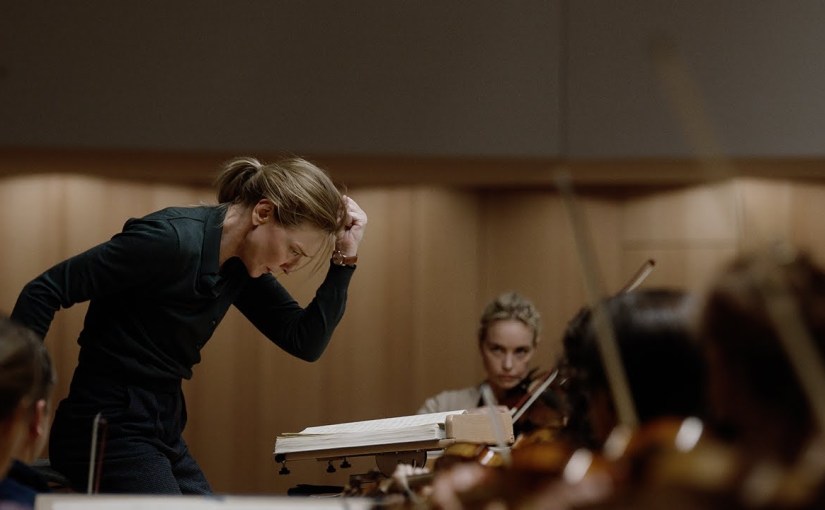
For Blanchett, this role is a massive test of endurance with endless amounts of dialogue to cover in long takes, along with speaking French, German and especially the dialect of classical music while she stands at the podium with the baton held in her hand.  She uses that baton like a weapon at times, a ruler with a broad sword or an extension of her arm.  There was one moment where she holds the instrument with both hands and swings it violently like a golf club or a baseball bat.  I’ve never seen that before.  It’s shocking how she handles herself.  I noted how Margot Robbie must have exhausted herself into oblivion while performing her drug fueled rages in Babylon.  I said she must have curled up in a corner after some takes just to calm herself down.  I would not be surprised if Cate Blanchett sought some therapeutical treatment following shooting some of these scenes.  A role like Lydia Tár is so tyrannical, so cruel, so paranoid and so indulgent that it exhausts you mentally to watch her function.  For Blanchett, her strive for perfection must have taken a toll on her mentally as well as physically. Her performance is comparable to the crazed obsession found in Daniel Day-Lewis’ portrayal of the greedy oilman Daniel Plainview in There Will Be Blood or what he achieved as Abraham Lincoln.

Come later this year, Cate Blanchett will be the one taking home the trophy for Best Actress at the Oscars. It’ll be so well deserved.

I recommend you see Tár, and I urge you to stay with it.  It’ll test you.  It’ll try you. Stay with it, though, because when it is over you won’t stop thinking about it.   

NOPE (2022)

by Miguel E. Rodriguez

DIRECTOR: Jordan Peele
CAST: Daniel Kaluuya, Keke Palmer, Brandon Perea, Michael Wincott, Steven Yeun, Keith David
MY RATING: 7/10
ROTTEN TOMATOMETER: 83% Certified Fresh

PLOT: Residents of a lonely gulch in inland California bear witness to an uncanny and chilling discovery.


After watching Nope, the third feature from Jordan Peele (Get Out, Us), I found myself curiously unable, or unwilling, to sit down and write a review for it.  What more can I add, I thought, to the volumes that have already been written about it?  What insights can I share that aren’t revealed in the making-of documentary on the Blu-ray?  How can I analyze a movie that can literally be boiled down to, “What if Close Encounters turned into Jaws?”  What good would it do to figuratively take this movie apart and critique its individual components?  It’s a roller-coaster, pure and simple, much like Jurassic Park III [2001].  How do you review a roller-coaster ride and try to compare it to other roller-coaster rides in terms of a review?

“I found the first hill of Rip-Ride Rocket much more intense than the slingshot approach of Hulk or Rock-N-Rollercoaster, but each has something to offer in terms of inversions, smoothness, and on and on and on…”

It just feels pointless, for reasons that are proving themselves difficult to pin down.  So, instead of a “normal” review, here are random thoughts, in no particular order:

  • The “true” nature of the UFO – oops, sorry, UAP, I had to look that up – stretched my disbelief suspension to the limit, but I will admit, it’s certainly original.  I can’t think offhand of any other movie or book I’ve watched or read that even considered that explanation for all those unexplained sightings in the books.  Once that was established, every successive appearance of the “spacecraft” became even more ominous and/or menacing.
  • I loved how the movie is littered with clues or easter eggs that either give a hint to the film or sort of comment on what we’ve seen before.  There is an early scene when OJ (Kaluuya) and Em (Palmer) are walking outside with a magnificent setting sun behind them behind the clouds, and hand to God, I remember noticing one particular cloud that looked…off.  Also, there’s another scene when a horse runs off and OJ watches it through the gaps of a wooden shed, and the visual impression is that of a zoetrope, the machine that made the opening images of the running horse possible.  Or even look at the screenshot at the top of this article…quick! What does that lampshade look like to you?
  • There was something about the design of the UAP that bugged me throughout the movie, not necessarily in a bad way, but it just seemed weird.  Why would something that is [SPOILER REDACTED] need what looks like fabric when seen up close?  Is it a sail?  That seems most likely.  In the latter stages of the movie, the “anomaly” doesn’t seem quite as mobile or speedy as it did when its “sail” was intact.  It’s an interesting design concept.
  • One of the scariest moments for me had nothing to do with the UAP itself.  It’s the scene in the exhibition area where the lights seem to be turning on by themselves.  The payoff for the scene seems predictable in hindsight, but as the scene progressed, I was BESIDE myself.  You can ask my best friend, Marc, who watched it with me.  When that shapeless mass by the light switch suddenly started to “unfold”, I echoed OJ: “Nope!  Gotta go, goodbye!”  It is a brilliantly executed scene.
  • I’ll need to watch the movie again to fully understand how that little parachute managed to scare off the UAP.  I assume it has to do with actual horse training, and with some research I could find the answer myself, but the movie does very little to explain it to the viewer.  Or maybe it does.  Like I said, I need to watch it again.
  • I loved how the flashback with the chimpanzee seems utterly incongruous at first.  And I loved how creepy and horrifying it is.  It’s a brilliant framing device (if I’m using that term right) that kept me guessing as to its real purpose right up to the end, or CLOSE to the end.  And did I mention how horrifying it is?  That moment when it’s resting…and then looks RIGHT AT THE CAMERA…chilling.
  • Someone somewhere had said that Keke Palmer was robbed of an Oscar nomination.  With all due respect to Ms. Palmer…she did an admirable job, but I didn’t see anything in the film that would have had me reaching for my Oscar ballot.  But I will give her props for her opening speech to that film crew.  The special features on the Blu-ray reveal that she delivered MANY different variations (fourteen, according to IMDb), much like you see so many other actors do in broad comedies, just to find the exact right version or take.
  • Much like Us, Nope feels like it bit off a little more than it could chew when it comes to the resolution of the film.  Everything leading up to the last 10 minutes or so is gangbusters, honestly, even the silver-helmet guy.  But as everything started to wrap up, I began to feel as if I’d seen all this before, just in different ways, in many different films.  Perhaps I’m being unfair.  Perhaps I’m criticizing the movie for what it isn’t instead of reviewing what it is.  I don’t know.  As it is, also like Us, Nope is one helluva roller-coaster ride that ends, not with a bang, but with a “pop.”
  • Allow me to shamelessly quote Roger Ebert, again: “If you have to ask what something symbolizes, it doesn’t.”

TÁR (2022)

by Miguel E. Rodriguez

DIRECTOR: Todd Field
CAST: Cate Blanchett, Noémie Merlant, Mark Strong, Allan Corduner
MY RATING: 10/10
ROTTEN TOMATOMETER: 91% Certified Fresh

PLOT: A renowned composer/conductor’s career and personal life take an unexpected turn after she embarks on a project to make a live recording of a prestigious, difficult symphony by Mahler.

[SPOILERS FOLLOW…BE WARNED]


In his invaluable book Making Movies, Sidney Lumet wrote: “Movies are very powerful.  You’d better have a lot to say if you want to run over two hours.”

I found myself remembering that quote as Tár began with three long scenes spanning 35 minutes of running time, in a film that runs 2 hours and 38 minutes.  In the first scene, a man interviews Lydia Tár (Cate Blanchett), a prestigious and fiercely intelligent composer/conductor in a field traditionally dominated by men.  That scene runs at least ten minutes and is full of esoterica about composers, conducting, music theory, etcetera.  It’s wonderfully shot and acted…but despite my fanboy-level of admiration for Cate the Great, I started to wonder, “What have I gotten myself into?”

There is the briefest of breaks.  The second long scene takes place in a restaurant as Tár lunches with a colleague who seems interested in conducting as well, but who is not quite at Tár’s level…and she knows it, AND she never quite lets him forget it.  This scene is also filled with jargon and musical references that I didn’t quite get, but I found it interesting because here, Tár is no longer “performing” for the interviewer.  She’s more herself.  And she reveals herself to be, not only a tad self-involved, but also coldly calculating and decisive in her words and actions.

And then…the third scene.  Tár is teaching a class in music conducting at Juilliard.  In an astonishing unbroken take that lasts at least ten minutes, if not more, she demonstrates a mastery of the subject matter, but again reveals herself to be more overbearing and arrogant than we saw her at the top of the film.  One of her male students reveals he doesn’t care for Bach because he was a cis white male whose sexual proclivities resulted in 20-some-odd children.  In a wonderfully roundabout way, she asks him what Bach’s personal life has to do with chords and key changes.  It’s a brilliant dismantling of so-called “cancel culture,” though I’m not sure how much water her argument holds when it comes to, say, politicians or musicians espousing Nazism.  But it’s food for thought.

It’s that third scene that finally hooked me, and I was with Tár the whole rest of the way.  It was almost like an overture in three separate movements.  Given the subject matter, that can hardly be a coincidence.

I was not a literature major, but to a relative layman like me, Tár resembles nothing less than a Shakespearean tragedy.  It’s an intimate story told on a grand stage.  A towering figure, powerful, intelligent, passionate, makes questionable decisions based on her ego, her hubris, and her inability, or unwillingness, to allow humility into her life. Writer/producer/director Todd Field (making his first feature film since 2006) shoots his film in what appears to be mostly natural light, lending a Kubrickian feel to virtually every shot.  This enhances the film in a way that I can’t describe accurately…you’ll have to watch the movie to see what I mean.  The result is a movie that, yes, is “Oscar-bait”, but it’s too easy to dismiss it that way.  Tár stayed with me mentally the way only one other movie in the last few years has done: Hereditary.  The two could not be more different story-wise, but they both have a marvelous visual quality that, when combined with the dialogue and superlative acting, gives the impression of something pulsing beneath the surface.  This is top-notch filmmaking.

Throughout the movie, there are hints that, in spite of (or BECAUSE of) her meteoric rise to the lofty heights of her profession, there were casualties along the way.  These casualties seem to be haunting Tár in subtle ways.  Early in the film, we get glimpses of a woman with red hair.  Who is she?  We’re not told; she eventually disappears.  Tár receives an anonymous gift that, upon opening, she immediately throws into the trash.  What was the inscription?  On her morning jog through a tree-filled park, she hears blood-curdling screams, but she is unable to find the source.  (Easter egg alert: the screams were actually taken from the soundtrack of The Blair Witch Project…kinda cool.)

As Tár went on, I was continually fascinated, but I found myself coming back to that Lumet quote and asking: What is this movie saying?  What is Todd Field getting at?  That people in power should be more careful of how they treat others, especially friends and lovers?  Not exactly breaking news.  But as with so many other movies, it’s not WHAT the movie is saying, but HOW it’s saying it.  The movie’s length allows us to sort of settle into the routine of Tár’s life with her partner, her loyal assistant, her adopted child, her piano, her rehearsals, her infatuation with the new cellist, etcetera, so that when something out of the ordinary happens, you sit up and take notice.

As fate would have it, I recently sat down to watch another movie with a similar strategy: Jeanne Dielman, 23, quai du Commerce, 1080 Bruxelles, a 1975 Belgian film that just recently won the top spot in Sight and Sound’s decennial critics’ poll.  For three hours, we observe a single mother going through the motions of “everyday” life – cooking, cleaning the house, feeding her teenage son, and daily assignations with men who pay her for sex.  The strategy of the movie is to establish the heroine’s routine drudgery so that when the smallest element is out of place, it takes on extraordinary meaning.

In my humble opinion, I believe Tár takes that strategy, refines it, and presents it for a more contemporary audience, take it or leave it.  For me, it worked.  The more I think about it, the more impressed I get.  I have a general rule about disliking movies with unlikable characters in the lead, but there are so many exceptions nowadays I’m thinking of demoting it to a guideline instead of a rule.  Cate Blanchett’s Tár is in every single scene of the film, and she has the trappings of being a fascinating dinner guest, but she is not someone I would want to be friends with.

Take her relationship with her assistant, played by Noémie Merlant (whom you may remember as the lead in Portrait of a Lady on Fire).  One day the assistant finds herself in line for a promotion.  Tár gives the promotion to someone else for her own petty reasons, and when the assistant resigns, Tár immediately resorts to anger and fury.  She has a revealing line where she says something to the effect of, “She KNOWS how much I depend on her!  She did this on purpose!”  Tár is so clueless about how terribly she treats people around her, she doesn’t even realize it when she accidentally admits how much she needs her assistant.  This is not a nice person.

This makes her tragic story arc fairly satisfying.  She begins to imagine phantom noises in her apartment at night.  Some are explained away; others aren’t.  An off-camera suicide occurs, and she is summoned to a deposition.  The press gets hold of the story, and suddenly she finds herself in the process of becoming cancelled, which makes her opening teaching session that much more ironic.

I’m rambling at this point.  I’m trying desperately to get my feelings of the movie across without giving too much of the plot away.  This was a thoroughly enjoyable character study, shot and written and performed in a way that made every moment impactful and mesmerizing.  As a fan of classical music, I LOVED the scenes where she conducts a German orchestra.  She has a speech about how a conductor must literally obliterate herself in the service of the music, and I found that equally applicable to stagecraft.  There is so much to like in this movie it’s difficult to know where to start or how to finish.

What is Tár telling us that is so important that it takes 2-and-half hours to tell?  Maybe it’s something different for everyone.  Maybe the better question is: What does it tell you?

TRIANGLE OF SADNESS

By Marc S. Sanders

I’ve noted before that the value of satire lives off how divisive it is within audiences.  Satire will drive home a perspective by going to the extreme to maintain order or deliver a sense of logic that needs to be prompted. Ruben Östlund’s Oscar nominated film Triangle Of Sadness explores how a rank in social class values itself and what’s beneath them in different scenarios.  I do not think there is room to argue with the message delivered in the film.  However, for all the reasons I liked the film, in turn my wife hated the picture.  Yet, I can’t blame her.  The message is just.  The message is sound.  The envelope it was delivered in is quite grotesque, though.  I guess that is how satire should be served.

When your dependence on others becomes so reserved to only what your stature and money pays for, then what will you do when that assured reliance is absent from what you live for?  Ruben Östlund will have you believe you could end up getting violently sick, drowning in your own feces, and propagandized with debates about the needs for communism vs capitalism.  Then again, you could just be pirated by scavengers and shipwrecked on an uncharted island.

Östlund begins his picture with cattle of chiseled male models auditioning for a catwalk stroll.  Carl (Harris Dickinson) is asked to adjust his “triangle of sadness” – the area identified between someone’s eyebrows and above their nose.  Carl acquiesces, but I never saw the difference.  The casting agents apparently did, and it is implied that Carl is past his prime.  In the next scene, he’s in the front row of an audience ready to watch a fashion show, and he’s asked to move down the row of chairs until there are no seats left.  He’s left to take a seat in the back.  He no longer carries any value in the world of modeling.  More importantly, because he has only been a male model with good looks, he is no longer a value in any world, anywhere. 

Following this pretext, we are introduced to Part I (“Carl & Yaya”) of a trilogy of chapters involving Carl and his model/social media influencer Yaya (Charlbi Dean).  Östlund stages a scene duet with his characters at a restaurant table debating about who is going to pay the bill.  Yaya makes more money, but Carl is the man.  What is appropriate here?  What is the societal norm? The conversation turns into a tense exchange between boyfriend and girlfriend, that carries over to an elevator ride and I don’t recall any kind of resolution coming from any of it.

The centerpiece of the film is Part II (“The Yacht”) where Yaya has been complimentary invited to sail on a small, luxury yacht with other passengers, all stemming from the most elite and wealthy social class.  Yaya’s influence will lend testimony to the vacation voyage.  Carl is her plus one.  The other passengers include a husband who made his fortune “selling shit,” or more appropriately, fertilizer.  Another couple are thriving off their success selling hand grenades worldwide.  The staff of the yacht have a rah-rah session led by their cruise director, Paula (Vicki Berlin), who stresses that whatever the passengers say or need is right and should be completely satisfied.  What will that lead to?  Better tips!!!!!! WOO HOO!!!!!  She gets the primarily white and attractive looking staff in a clapping and stomping frenzy of enthusiasm for the voyage while the maintenance crew of darker skinned minorities are on the deck below waiting to clean or do housekeeping with no sense of gratitude for their service.  What’s in it for these people on the bottom deck?

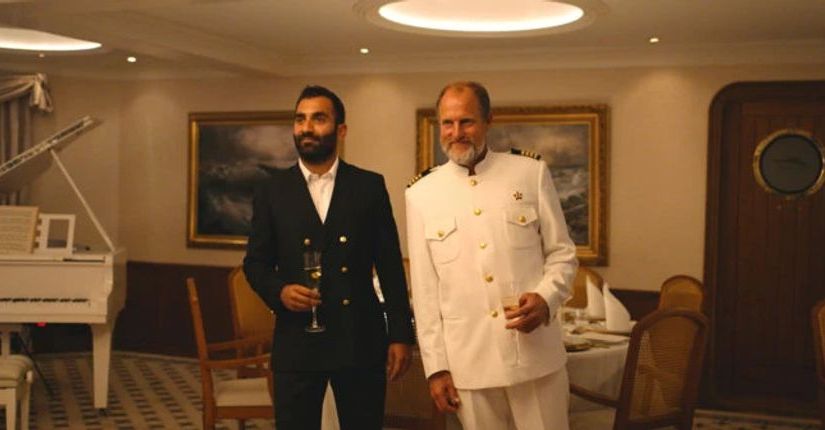
Part II of Triangle Of Sadness really drives home the point of the picture.  These wealthy folks rely on their satisfaction based upon how they are catered.  Carl thinks he is so elite that he inadvertently gets a maintenance man fired for cleaning the boat while shirtless.  A woman insists the sails are unclean compared to the pictures in the brochure.  Paula will ensure it is addressed.  Another woman insists that all the staff do a swim with her.  The cooking staff has to prepare for the Captain’s dinner.  If they swim, the food risks getting spoiled.  Doesn’t matter though.  This passenger has asked for a staff swim and Paula will make certain the upper class are accustomed.  It doesn’t help either that the Captain (Woody Harrelson) – the man in charge – refuses to leave his cabin and thus no one with authority is steering the ship away from choppy waters and a violent storm.  As such, the Captain’s dinner is going to be unforgettable for sure.

Part III is known as the “The Island” which depicts a turn of events when seven surviving people are marooned on a desert island following the graphic complications of that doomed dinner at sea.  Dynamics in social class take a drastic turn here.  The rich and privileged don’t know how to fish or build a fire.  So, what happens when a maintenance worker does?

The message of Ruben Östlund’s film is not surprising to me.  Yet, how many of us forget that we all biologically evolve the exact same way.  We come from the womb with the same appendages and capabilities to eat, breathe, learn, and digest.  Eventually we all face the same demise.  What I appreciate about the movie though is how many people of a wealthy social class are incapable of fending for themselves, even in the most desperate of situations.  What can a social media influencer do for her fellow man or woman beyond taking endless selfies of herself?  How can a man who profits off of selling fertilizer or hand grenades survive with just the raw materials of the earth?  How can a woman suffering from the aftereffects of a stroke with limited communication make due for herself? 

Östlund’s script examines the dependability of one for the other, and how it is taken for granted.  The dependability is not from equal peers though.  Östlund goes a step further when the one positioned lowest on the pole turns herself into the highest rank when any kind governing mandate is dismissed.  In any community, opportunity will allow someone to always usurp the higher cabal and assume his/her own dominance. 

There are many ways to deliver the message of what is unfair or what is right in a social class system.  I don’t think I risk much by declaring that anyone who watches Triangle Of Sadness should have a presumption of extending value and appreciation to his/her fellow neighbors, even if we don’t always live by that mantra.  What will divide audiences of this satire though is in the route that Ruben Östlund adopts to make his point.  In The Three Stooges, the wealthy would lose their dignity and authority when they got struck with a pie to the face, humiliated by the well-known vagabonds.  Here, the wealthy gradually toss their cookies as the boat continues to toss and turn with no Captain at the wheel, while they all continually try to consume the fancy prepared entrees that are not agreeing with them.  I could tolerate and laugh at that ugliness that surfaces during Part II of Östlund’s film.  My wife could not.  I can appreciate a good pie splattered in someone’s deserving kisser as well.  My wife doesn’t like The Three Stooges.  However, the point is what we agree upon.  The approach is where we differ.  My wife could have done without watching endless streams of vomit spew across the dining room or toilets bubbling over with brown sewage.  I can’t fault her for that, though.  It is disgusting.  It’s supposed to be.  I wouldn’t want to watch my wife or child get violently ill.  For that matter, I wouldn’t want to watch anyone in real life succumb to that state of helplessness.  Fictionalized mediums allow that opportunity though. 

An interesting angle that Ruben Östlund takes is as the ship is spiraling out of control, the Captain engages in a drunken debate with the wealthy fertilizer seller on the positives of communism vs capitalism.  Both men use the loudspeaker to preach the gospel of celebrated leaders like John F Kennedy and Karl Marx.  Our leaders are arguing.  The constituents of this doomed boat have no choice but to listen, all the while they are drowning in their own vomit and shit.  These are just words that our leaders are drunkenly shouting.  Heck, these guys didn’t even write these policies.  They stole them from pioneers before them.  Where’s the execution leading to a salvation for their community, though?

As I continue to write this column, it occurs to me how much I listen to the guidance of others.  A doctor tells me what pills to take.  An article will explain what foods are bad for me.  A politician will tell me his or her platform is the best course.  I write critiques of movies encouraging readers like you to watch or avoid. These are all sources of authority that we are exposed to everyday.  Triangle Of Sadness explores what occurs when those sources are taken away and we are each individually left to our own devices. Maybe Ruben Östlund’s testament is that only the meek shall inherit the earth.

I can not promise that you’ll like Triangle Of Sadness.  You will appreciate the message though, and whether you care to or not, you will think about it for a while after it is over.  Hence, another satire has done its job.

WOMEN TALKING

By Marc S. Sanders

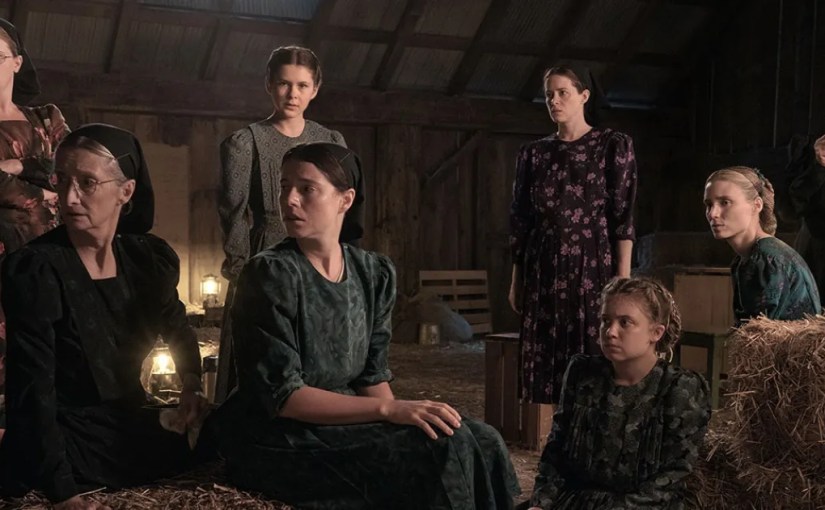
In the year 2010, a sect of women must hold congress in the upper level of a barn to debate whether to leave their colony or stand and fight against the oppressive men who rape, beat, and brainwash them into believing they will be denied entry into the kingdom of heaven should they never offer forgiveness and tolerance for the abuse they suffer.  That is the story of Women Talking, written and directed by Sarah Polley, from the novel by Miriam Towes.

From IMDB, Towes based her novel on a true story of vicious serial rapes in an insular, ultraconservative Mennonite community in Bolivia. From 2005 to 2009, nine men in the Manitoba Colony, using livestock tranquilizers, drugged female victims ranging in age from three to sixty and violently raped them at night. When the girls and women awoke bruised and covered in blood, the men of the colony dismissed their reports as “wild female imagination”–even when they became pregnant from the assaults–or punishments from God or by demons for their supposed sins.

Sarah Polley’s film works like a stage play.  She shoots with deliberately dim cinematography as if to have you feel the cold, helpless isolation the women of this fictional community endure.  These women are smart but uneducated in reading or writing.  When they vote for what do, pictures are drawn to display their options.  Two figures with dueling swords are drawn for stay and fight.  A horse is sketched for the choice to leave.  The women cast their ballots by drawing an X under the picture they opt to follow. 

To know that this piece of fiction is inspired by true events is very chilling, and when the film finishes there’s much to ponder and talk about.  It stays with you.  A young educated man named August (Ben Whishaw, in a beautifully reserved performance) from a university is recruited to keep the minutes of the meetings.  Topics of debate include if they should leave with a mass exodus of all the women, do they also take the young boys; most of them products of the numerous rapes they suffered through.  At what age are these boys incapable of trusting they will not be as monstrous as their bastard and abusive fathers?  What about August?  He is harmless and sympathetic to the ladies’ victimizations.  Shouldn’t he be allowed to go too, or because he is a man, is he excluded?  Frances McDormand’s character, whose appearance lives up to the name Scarface Janz, insists upon doing nothing.  She’s convinced they will be denied entrance into heaven by their almighty God.  To not forgive their attackers is a sin.  Is doing nothing an option?    If they stay and fight, how exactly will that be done?  Violence is an unforgivable sin, as described in doctrine.  How else do you fight against the constant attacks of violence, though?

Women Talking deserves an audience.  It’s a very good film because it draws attention to a modern day hardship.  When there are communities like this in the world that most of us are unaware of, how are the members accounted for?  Are they being nourished and educated and living comfortably?  Is everyone safe and protected?  If they are not, then how are they getting the justice they are entitled to, and do they have a chance of survival?  I appreciate when movies can open my eyes to a reality for which I have yet to carry any regard or awareness.  I feel taught having watched a movie like Women Talking

When the movie began, before knowing anything of what the story was about, my first presumption was that maybe this is an Amish or Quaker community based on the farm country setting and the simple wardrobes of the characters.  The time frame was uncertain to me as well.  Horse and buggies are shown, but no automobiles.  So, is this the early twentieth century, perhaps?  Only after the first ten minutes of exposition, did I realize this was something else taking place within a more recent time period.  It is astounding how far we’ve come globally with the rights of women, minorities and the overall oppressed.  Yet, there are those who regrettably remain overlooked.

Polley’s script is rhythmic with strong dialogue, and the cast of actresses (Rooney Mara, Claire Foy, Judith Ivey, Frances McDormand, Jessie Buckley) are quick with their retorts when one makes one statement after the other.  There are lots of fascinating arguments at play here, reminiscent of Sidney Lumet’s 12 Angry Men.  Again, this is gripping material ready for live stage work. 

I did have a problem with the picture, however. The trajectory of the film works on its dialogue of debates.  The actors deliver lines from Polley’s script perfectly.  This is a smart collection of actors.  Still, it is challenging to keep track of what platform each woman stands upon.  When one gets swayed from one argument over to other side, it is also a little tricky to realize when that has occurred.  Who is staunch in their beliefs is also difficult to keep track of.  The dark photography that Polley layers the film with is meant to be morose.  It works.  It places you in the helpless mood of these afflicted women.  When you consider the practicality of the piece though, it makes it hard to identify who is who and what perspective they have.  Often, the characters don’t stand apart from one another.  It might sound trivial.  I may risk putting a stain on the filmmaker’s art.  Nonetheless, but it got in the way of the movie I was watching.

It is a blessing that Women Talking has received Oscar nominations for Best Picture and for Sarah Polley’s screenplay.  Had it not, the film would likely go unnoticed, and it cannot afford to be.  Sarah Polley’s film deserves attention.  Any one of us may never come upon these very private, hidden, and isolated communities that function under an unfair governance.  However, the film demonstrates the vicious dominance that one sex can have over another which still remains all to common.  No matter how much wiser we have become as a people, there are some who still have never gotten the message.

THE MENU

By Marc S. Sanders

Whether you’re the storyteller or the viewer/reader, you take a chance with satire.  The darker the satire is, the even greater the risk you take. A film like The Menu, from director Mark Mylod, is one such example. You’ll hate it…like my wife did, despite the lively conversation we had afterwards.  On the other hand, you might love its invention to strike back at an upper class that lacks any clue or respect for the talents of others. Then again, you just might only like it.  Well…at least I liked it.

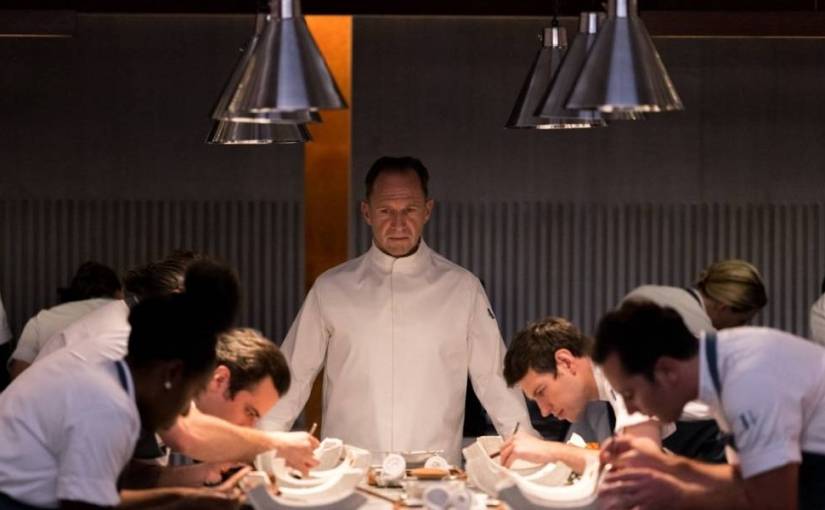
Ralph Fiennes’ résumé has earned a reputation to intimidate an audience. He is a superb actor who can be absolutely frightening as a Nazi in Schindler’s List, or heartbreaking as a torn affiliate of a deceitful plot like in Quiz Show. He can also go toe to toe as a Greek god against Liam Neeson, or he can demand that James Bond “Stand down!” and strike with snake like glee at Harry Potter. He can also teeter along the antics of the devil himself as he portrays the world’s most esteemed chef in The Menu.

A collection of guests is escorted by boat to a remote island where the finest restaurant is located and run by Chef Slowik (Fiennes), with assistance from Elsa (Hong Chau).  There’s Tyler (Nicholas Hoult), a die-hard fan of the chef’s craft with his date Margot (Anya Taylor-Joy), who is nowhere near as impressed.  Tyler has to remind Margot not to smoke, otherwise it’ll destroy her palette for taste.  There’s an older couple who has frequented the Chef’s dining establishments before and are back for another visit.  There are a pair of restaurant critics. There’s a movie star (John Leguizamo) with his young assistant.  Finally, there is a trio of sophomoric, yuppie businessmen who are here because their last monthly commission likely afforded this exclusive opportunity, and their favorite hockey team was out of town.

When the guests arrive on the island, Elsa gives them a tour ahead of the restaurant where they will eventually dine.  A cabin is displayed to show how the meats are aged over a period of 152 days. Quite specific! One of the yuppies has the audacity to ask what happens if you age it to day 153. I don’t recall Elsa’s response.  I do remember her disdain for the question though. They walk through the lodge where Elsa explains that the entire staff reside and sleep in the one room together. One cot for each person. Odd, but okay. Moving on is a quick pass by the cottage where the Chef resides, and no one is permitted to enter. Oooo!!!! I know one thing I expect to happen.

It is important to note that I opted not to read up on anything The Menu was about.  I didn’t know if I was to see a comedy, drama or horror film.  As this tour continued though, I had eerie recollections of the film Midsommar, directed by Ari Aster. That movie still gives me the bejeebees.  So much so that I could not bring myself to write an article about it.  Like that film, our cast has become isolated in a desolate locale, and the guide could not be more unsettling.  When they arrive at the restaurant, a large horizontal door is thunderously closed behind them. Margot gives a quick look back over her shoulder. This cannot be good.

Lending to the structure of the film, courses are presented with a startling clap of the hands from Chef Slowik. Mark Mylod executes a nice pattern of gracefully displaying text across the screen describing what the next featured course is, along with its fine ingredients.  It is elegant but also only partially revealing of some of the guests. Tyler isn’t the kind of fan that Chef would welcome.  After a request has been made not to take pictures of the dishes, he does so anyway.  He is uncouth with his commentary and clumsy as well.  Additionally, bewildering for Chef Slowik is the presence of Margot. He was not expecting her to attend. Yet, here she is and he cannot understand why.

The Menu does not deviate from its intent to be strange. A bread dish is presented without any bread! Only the dips. Tyler is absolutely impressed. Margot thinks it is ridiculous. By the time, the fourth course has arrived, a shocking presentation is exhibited to the guests and that is where the film takes a graphic turn.

It’s best not to reveal much about the movie.  Its features work if you share the perspective of the guests, particularly Margot. What you are left to decide though is if you accept that dark satirical nature of the piece.  You will or you won’t.

I did not find The Menu to be very symbolic, allegorical, or even a reflection of the natures of social classes who partake in exclusive high-end cuisine.  Chef Slowik has prepared a specific plan for this assortment of guests. The execution and outcome cater to his personal satisfaction and no one else’s.  I guess that’s why I only liked the wit behind the message of the film.  I just could not fully embrace its invention.

My experience with satire typically allows me to think about how people behave and what they can learn from outrageous proposals or extreme actions. Network explores how the world responds to what is proposed for satisfying television audiences while generating business profits.  A film like The Menu delves into grandiose, unheard of actions that will satisfy the one puppet master behind everything you are seeing.  Maybe I was looking for the message the Chef delivers to include my own misgivings and sins and temptations in his overall delivery.  Instead, his machinations rely on these specific guests on this particular night, and so I kind of felt left out of the circle. As the guests are specifically affected by the developments of the evening, I can’t say I had any care or sense of suspense for them.  Nor did I care for Chef’s own satisfaction as the evening carries on.

The cast is a terrific eclectic assortment. Anya Taylor-Joy is a smart and forthright hero against Ralph Fiennes’ antagonist. A well written conclusion that made me applaud is included by her character’s deductive reasoning. The other players though are not given much fat to chew on in terms of dialogue or scenes.  Their purpose is specifically explained, and then they are left to watch and wait for the climax of the film. I like the veil that is lifted from Margot’s character.  I would have welcomed a little more subtext on the other characters, however. Again, their purpose is laid out, but I think the film, which clocks in at around an hour and forty-five minutes, could have dug a little deeper into the guests sitting at the other tables. Not to mention those few who also serve on the Chef’s cooking staff.

The Menu is an unusual film, like an episode of Tales From The Darkside or The Twilight Zone.  It is limited like a TV episode. I just think it needed two or three more courses to savor just a little more meat on the bone.

THE BANSHEES OF INISHERIN

By Marc S. Sanders

You ever hear of the modern term “ghosting?”  Normally, it applies to social media, like with Facebook, Instagram and every other brain cell sucker app we occupy ourselves with on our electronic devices.  It’s where suddenly, for no reason at all, a friend or acquaintance will stop speaking to you.  They will ignore your attempts to talk.  If they do talk to you, they simply will say stop talking to me and do not call me again. They will never share a reason for this new perspective they have for you.  They just want to continue with their lives without you being a part of it.  I have been ghosted on two separate occasions.  It hurts.  It really hurts, and I constantly must remind myself not to dwell on these people.  They don’t care.  They lack any further regard.  It’s just unbelievably puzzling when it happens.

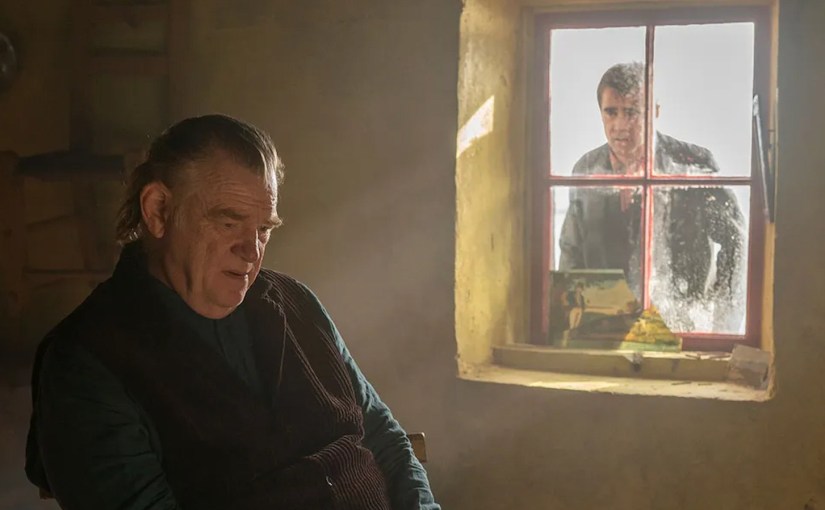
With The Banshees Of Inisherin, director Martin McDonagh reunites Colin Farrell and Brendan Gleeson, who shared the screen together in the well received In Bruges, to portray these two former friends.  Farrell plays Padraic.  Gleeson is Colm.  The film takes place in 1923 on the fictional Irish coastal island of Inisherin.  Padraic strolls over to Colm’s house to walk with him to the pub for their daily 2pm pint together while they chat.  Upon arrival, Colm is seen sitting in his home, ignoring Padraic’s knocks on the door and window.  It’s odd and unexpected. 

When Padraic shows up at the pub alone and later Colm arrives, the other regulars ask Padraic if the two lifelong friends are “rowing.”  Not to Padraic’s knowledge.  Maybe this is an April’s Fools joke?!?!

Colm holds true to his new position.  He explains to Padraic, with no uncertain terms, that he no longer wants to speak with him.  Padraic makes attempts to open up to Colm hoping they can hash this out, but there is nothing penetrating Colm’s stance.

What lends to the sustenance of the near two-hour film is the setting that Padraic resides within.  An island in the middle of nowhere where he has no interests or hobbies or specialties for anything.  He really has only happily lived with his friendship with Colm, which is now suddenly yanked away from him.  He lives well with his sister, Siobhan (Kerry Condon), and his adoring miniature donkey, Jenny.  Siobhan truly loves her brother, but not Jenny or the other animals who reside on their property.  As the Irish Civil War is coming to a close, an educated Siobhan is ready to move on from the nothingness of Inisherin.  Padraic is not.  He’s lived so comfortably on the Irish coastal island his whole life.

Colin Farrell is an actor you want to embrace in this film.  As I’ve experienced something similar to what Padraic endures, I can relate to what stuns him at his sudden loss of friendship.  Padraic is a good man.  Colm knows this which is seemingly why extremes needs to be undertaken to stress exactly how Colm feels about Padraic going forward.  Colm cannot simply plead for Padraic to move on.  He first makes the request.  Later, he has to do something else to deliver his point.  When I say extremes are taken, you can not even imagine what occurs.  It’s shocking, but believable. 

Brendan Gleeson normally offers an intimidating presence on screen.  He falls into roles of men you’d likely only cautiously approach.  The same goes for his character of Colm here.  McDonagh wrote the character with no compromise. Only when a significant turn occurs, does Colm violate his feelings with how he regards his former friend.

Kerry Condon should get an Oscar nomination along with Gleeson and Farrell. Siobhan is both a loving sister but while she’s the younger sibling, she is also the more sensible.  As Siobhan, Condon’s timing for losing patience in the part is well paced.  Condon is awarded with some of the best dialogue in the script.  McDonagh could have written this film from the perspective of her role, rather than Padraic’s, and I bet it would still work thanks to what she lends to the piece.

Barry Keoghan plays a young regular around Inisherin named Dominic.  Kind of like a local idiot who is undeservedly abused by his policeman father.  Keoghan’s role is a side story, but he plays it so well.  Despite Siobhan’s protests, Padraic takes Dominic in.  He’s not meant to replace the void that Colm left in Padraic’s life but it further reminds you of the kindness of Farrell’s character.  It begs the question why someone would ultimately stop speaking with a good person like Padraic, at a given instant.

My wife was not interested in watching this film and asked me to give her a rundown of what happens from beginning to end.  When you describe The Banshees Of Inisherin out loud, you sound ridiculous even though you’ve appreciated some of the surprising moments you just watched.  I told my wife; you have to see it to understand.  I understand Padraic’s yearning for the friendship he once had.  I understand the measures he takes in response to the one thing he valued beyond his sister and his pet donkey.  When you live in a low populated island town with little stimulation beyond the people who have been a part of your entire life, to suddenly lose that is devastating.

Martin McDonagh has crafted an unusual script.  Often, break ups in films go the traditional route of the loving relationship going through a split.  If it’s a friendship, I’d argue I’ve seen it occur more often between two women.  McDonagh’s film acknowledges the impasse among two grown men.  His script could have been occupied only with dialogue constructed of standard duet scenes between two very strong actors.  Fortunately, he doesn’t just rely on that.  McDonagh stretches his imagination further to drive home the point of how these two men respond to this unfortunate outcome.  The actions they take are startling, but as I reflect on the script for the film, I cannot deny how alert McDonagh is with crafting the motives of his characters. At the very least, I’m empathetic for poor Padraic who struggles with the loss of a friend. 

To lose a friend is to lose a part of your soul. What can I say? I’m an overly sensitive guy.  It’s always been my Achille’s heel.  How do I survive, though? I think back to what my father once told me.  He said “Marc, if you have one friend in life, then you’re the luckiest guy in the world.”  Thankfully, I’m rich in many friendships.

Forgive my digression though.  It’s important to know The Banshees Of Inisherin is a very good and a very sound film.

BABYLON

By Marc S. Sanders

Director Damien Chazelle has come a long way since his first major motion picture, Whiplash, a small film about a young, tortured drummer.  Since that accomplishment, he seems to get more and more elaborate with each project.  Babylon certainly exceeds ambition in any select 3–5-minute scene it offers within its grand opus.  The main title card doesn’t appear on screen until after the first thirty minutes and by then you are exhausted, yet completely awakened.

Babylon begins in the mid-1920s, during the pioneering times of Hollywood filmmaking where silent films were fresh and were regarded outlets for escapism and entertainment.  Big studios like MGM were not quite on the scene just yet and movie makers experimented with their films having no regard for rule and caution while constructing them.  On a busy day of shooting at around 3:15pm, an open field sword and sandal battle might turn up an extra in an accidental death with an impaled spear.  No matter.  Must keep shooting before daylight is lost and everything runs off schedule. 

It was at this time that a star like Jack Conrad (Brad Pitt), rugged with a square jaw and dashing with a pencil thin mustache, offered greatness in movie houses that showed silent pictures.  A new discovery like Nellie LaRoy (Margot Robbie) who seemingly came in off the street captured producers and patrons alike with her wide-eyed expressions and lanky, yet appealing posture.  These were the first celebrities of the advancing twentieth century.  They were starlets that brought people back and back again to the cinemas to witness battles of roman conquest or dancing on top of a bar while batting their long eyelashes for a mug at the camera.  The filmmakers loved to work with them. 

These performers ruled Hollywood until the Talkies appeared on the scene.  Movies with sound revolutionized the industry, but these famed individuals couldn’t keep up with the evolution.  Audiences and filmmakers couldn’t accept a compatibility.  Try to imagine a Jack Conrad listen to a packed movie house chuckle at one of his romantic speaking scenes.  It’s heartbreaking to watch.  He was admired, but now he’s a joke.

When the sun would set, the parties soaked–make that drenched–in orgy and debauchery would begin and nothing was off limits.  Naked women would happily get high and drunk and tossed over a large crowd.  Prop penises would be inserted into one partygoer and then another and then another.  Fat ugly men would happily accept getting urinated on.  Endless amounts of liquor and especially cocaine would be gulped and snorted and the greatest dares imaginable would always try to top themselves.  Have you ever heard of a party getting so out of control that someone would go so far as to wrestle a rattlesnake in the middle of the desert?  Jack happily watched all this decadence go down.  Nellie joyfully became the outrageously intoxicated and fearless ringleader. 

I have offered only a sliver of description for Chazelle’s over three-hour film.  To sum up, Babylon offers a hard-edged response to the family friendly interpretation found in Singin’ In The Rain.  Both films delve heavily into the transition of silent filmmaking to talking pictures and those who were left behind.  Gene Kelly and Stanley Donen’s G rated picture will have you giggle at their Lina Lamont with the squeaky voice and pratfalls who’s all wrong for the next phase.  The heavy R rated dramatic interpretation is offered in Chazelle’s script with Margot Robbie’s Nellie LaRoy and her Jersey accent, accompanied by unrefined posture and behavior.  Her drug binges are no help either.  Margot Robbie is fearless in her performance.  She is messy, sloppy, harsh and frenzied with her character.  One thing that came to mind as she is snorting line after line of coke is that at that time, there was no such thing as a means for rehabilitation like today.  No one was even looking out for the harm that drugs and alcoholic binging could have on people.  People were left to their vices to just drown in their poison of choice.  For silent pictures, you could plaster them in makeup and costume and let them mug and bat their eyes for the camera.  It didn’t matter if their speech was slurred.  Talkies required much more concentration of their performers.

The main player of the film is newcomer, Diego Calva, as Manny Torres.  A Mexican who inadvertently finds himself in the Hollywood nightlife while pushing an elephant up a steep hill only to get shit on.  (The elephant serves no purpose except to make an appearance at one of these crazy parties.)  Manny has an instinct for what’s to come in the movies and builds himself up into a studio executive.  While he’s dangerously falling in love with Nellie, he’s also discovering next big things like a Negro entertainer who’s magnificent with a trumpet, Sidney Palmer (Jovan Adepo).  Manny is a good man who swims above the dangerous life of Hollywood partying and decadence.  He’s an innovator that’ll never receive credit for what he uncovers.  That’s for the white executives to profit from.

A minor but welcoming story is Sidney’s.  He’s soon hung on posters outside movie houses, and performing with big bands.  Hollywood awards him with riches he could never imagine and never asked for.  However, ironically, his complexion comes off too white against some of his other band players and the idea of caking himself in charcoal makeup is insisted.  How will Sidney respond to this humiliating request? The wealthy also have a particular regard for him.  His status as an entertainer.  Do they see him as a showboat clown or the artist he values himself to be?  How does Sidney want to be considered?

With all of the parties and drinking and drug use to go around, Babylon goes off in a hundred different directions before it finds an even keel outline that switches storylines from Jack to Nellie to Manny and Sidney.  Chazelle strives to one up what other filmmakers before have attempted.  I could not help but think about Paul Thomas Anderson’s Boogie Nights which follows the porn industry in the late 70s and early 80s.  Happiness abounds until time and technology and constant self-abuse cause everything to unravel.  Babylon follows a very similar trajectory.

A friend of mine found Babylon too be overly gratuitous.  She’s not wrong, but while she took it as a complaint with the film.  I take how superfluous the movie is as a major compliment.  There are long scenes where Chazelle will not surrender for the audience.  He shows how drug raged Nellie is when no one will fight that rattlesnake by having her violently pick it up, swing it around and thus it will eventually latch on to her neck while she’s running around amid a gang of naked partygoers.  Then we get to see another starlet cut the snake off below it’s head, rip its fangs out of Nelly’s skin and proceed to suck the venom out.  Oh, you’ll squint and squirm through the whole scene.  What do we learn from this?  Drugs are bad.  Really bad, and they will delude you into acting with no vices or boundaries.  So, let’s be completely honest about it.

When Nellie is recruited for a talking film, we see take after take after take of her trying to make her mark while it is shouted over and over again to the crew to shut the fuck up.  There can be absolutely no noise from anywhere that the mikes can pick up and it doesn’t matter if a crewman is getting dangerously overheated in a soundbox.  (No air conditioning could be allowed because the hum would be picked up by the microphones.)  It’s a brilliantly, well edited, long and tortuous scene of flaring tempers, sweat, heavy light and stress.

I remember reading an interview with Henry Hill, the mobster who was the focus of Martin Scorsese’s Goodfellas.  Hill said with no uncertainty that the characters portrayed by Joe Pesci and Robert DeNiro were not even close to how frightening and violent their real-life counterparts were.  So maybe even Scorsese glossed over how harsh that world ever was.  Damien Chazelle is a relentless filmmaker with Babylon.  Nothing is whitewashed.  Most of what you see is shock value, but that’s the message he’s conveying and per his research he must be convinced the life of this era was actually this outrageous and way over the top. He’s certainly not forgiving with how manic these people lived, particularly with Margot Robbie’s character.

At the same time, he calms the film down to offer a harsh truth to a quickly becoming has been like Jack Conrad, Brad Pitt’s character, no longer in his prime.  Jean Smart portrays a gossip columnist reminding Jack that the height of his career is long gone, but fifty years from now, new generations will be rediscovering his achievements.  He will be a legend for all eternity.  Chazelle is speaking to us, those that appreciate what Turner Classic Films and other formats like videotape and DVD offer to see the first of these kinds of pictures where it all began with legends like Jack and maybe Nellie and especially Chaplin. Chazelle was an important student of this later generation.  This is the best scene of the picture with a magnificently written monologue, and I won’t be surprised if Jean Smart gets an Oscar nomination that no one ever saw coming.  I’m inclined to declare she should just get the award.  It’s such a telling moment for all kinds of movies.

Chazelle loves to make films.  The epilogue to Babylon demonstrates his affection as his story jumps to twenty years later, and an older Manny watches Singin’ In The Rain in a theatre. From what he inadvertently brought to the fold all those years ago, movies have evolved and continue to develop into bigger scales of what we could never have thought possible.  Chazzelle edits in a sequence where it started with silent films like A Trip To The Moon and Keystone Kops over to grand musical ensembles and adventures like Ben-Hur and then on to special effects with quick cuts of Raiders Of The Lost Ark, Terminator 2, and Avatar.  Flashes of color appear on the screen and then quickly cut back to these captions in celebrated films and film stock.  I don’t believe any of this spoils anything of the film, but I like to recognize how Chazzelle takes inspiration from Stanley Kubrick’s bewildering conclusion to 2001: A Space Odyssey.  Movies are going on and on and on.  Whoever is hot now and presently significant will have to adjust to an ever-changing industry.  Once celebrated puppeteers working for guys like George Lucas have no value in an age of computer graphic engineering.  Big box office stars might not be able to uphold their careers during a time of streaming films that come to us by means of our flat screen TVs we can affordably buy at Walmart.  Kardashian girls are more widely recognized than maybe a Jack Nicholson or a Meryl Streep.  (Someone I know had no idea who Carol Burnette is.)

It’s hard to sum up everything captured in a film this big and ambitious and yes, gratuitous.  Perhaps, the best I can tell you is simply that a hard truth to accept is that casualties come from discovery in a film like Babylon

THE WHALE

By Marc S. Sanders

I still have a lot of catching up to do, but arguably the best performance by any actor in 2022 comes from Brendan Fraser in Darren Aronofsky’s The Whale, an adaptation of the stage play written by Samuel D. Hunter.

Fraser plays Charlie, an intelligent online writing professor.  His course is done online as he has become an enormously overweight recluse, following the loss of his boyfriend, circumstances to be revealed over the course of the film.  Charlie is so obese that he can barely walk, and he confines himself to the left side of his sofa with the television in front of him and his laptop nearby to conduct his courses or to pleasure himself with gay pornography.  He has a walker to get himself on to his feet and carry his bulk, but showering is not easy.  Even picking a key up off the floor is an impossibility.

He receives visits from his only friend, a nurse named Liz (Hong Chau).  When she arrives on Monday, she discovers that his blood pressure is indicative of congestive heart failure and urges him to go to the hospital.  He insists he can not afford the bills and has no insurance.  He also receives unwelcome visits from a young man named Thomas (Ty Simpkins) spreading the word of God with brochures from the local church.  Lastly, the visits Charlie treasures the most are from his cruel and mean-spirited daughter Ellie (Sadie Sink) who takes no reservations with berating Charlie as a deadbeat dad and only comes to him because she practically demands he write her essays to avoid dropping out of school.  She also rudely takes pictures of Charlie at any given moment.  Each time she raises her cell phone for a click, it feels like she is giving her father the harshest middle finger imaginable.

Much like an earlier film, known as The Wrestler, Darren Aronofsky explores what comes after the main character has tormented himself into a destiny difficult to escape or be rescued from.  Aronofsky is frank about offering up helpless souls only now living with everyday ongoing pain both physically and, as we discover, more importantly, mentally.  Highlights of Charlie’s day are when the pizza is delivered and he shouts through the door that the money is in mailbox.  The delivery guy knows the routine all too well by now and the best he can offer is to ask if Charlie is okay while never seeing his grotesque appearance.

Aronofsky doesn’t offer much variety on the surface.  The film takes place entirely in Charlie’s apartment.  Sometimes we go down the hallway and see another room or we get a conversation between Liz and Thomas on the front porch.  The cast only boasts seven actors.  Yet, Hunter’s screenplay is not limited to what Charlie is having to endure.  There is also an unexpected backstory to Thomas and there’s more to uncover with Liz and Ellie. The pizza delivery guy, who we never see, even discovers something.  One particular essay about Moby Dick that Charlie desperately urges Thomas to read out loud early on has a surprising significance that I didn’t see coming. 

Still, the film belongs almost entirely to Brendan Fraser and how he enhances the performances of his cast mates, particularly Sadie Sink.  Their scenes are so well performed.  She is an outstanding young actor working on a manic level.  I imagine Sadie Sink had to come down from the hyper activeness of her scenes.  She is uncompromisingly mean. When the director yells, there is no way she could just turn that characterization off.  I bet she walked away from the set to catch her breath.  Opposite her, Fraser’s character has no choice but to be more restrained.  Physically, it is hard for him to breathe and therefore speak at times at a high octave.  He cannot stand up very well and rush to embrace his daughter even if he wanted to try.  She is mean enough to challenge him though.  The outcome of that moment will have you hate her character for sure.  Yet, you don’t forget she’s a kid and her current state is a product of something else, perhaps from Charlie’s past misgivings.

Timewise, they are also on uneven playing fields.  Hunter’s script counts down the days as the top of some scenes depict it as Monday and then Tuesday and so on.  Charlie is running out of time and has a lot of hanging threads to tie off.  Ellie has an entire life ahead of her to name call and scream at him and hurt him, but Charlie cannot afford to upset someone and work on apologies later.  The best he can take advantage of right now is to appeal for all the wrongs he’s committed or been accused of.  Most importantly, can he fix his relationship with his daughter?

Liz is a health care professional by trade and knows what is best for Charlie, but likely also knows it’s too late and rather hopeless, considering his current condition.  So, it only makes sense to surrender to his needs by bringing him meatball subs and barbecue ribs.  What she is determined to do is to keep his daughter and ex-wife away from him.  It’s a conflict that Charlie has no choice but to allow.

Thomas is that last new person to ever enter Charlie’s life.  Yet, what is his gospel of God and salvation going to do for Charlie now?  Charlie can’t keep this kid from coming over, but is he really going to listen and take any of it seriously? 

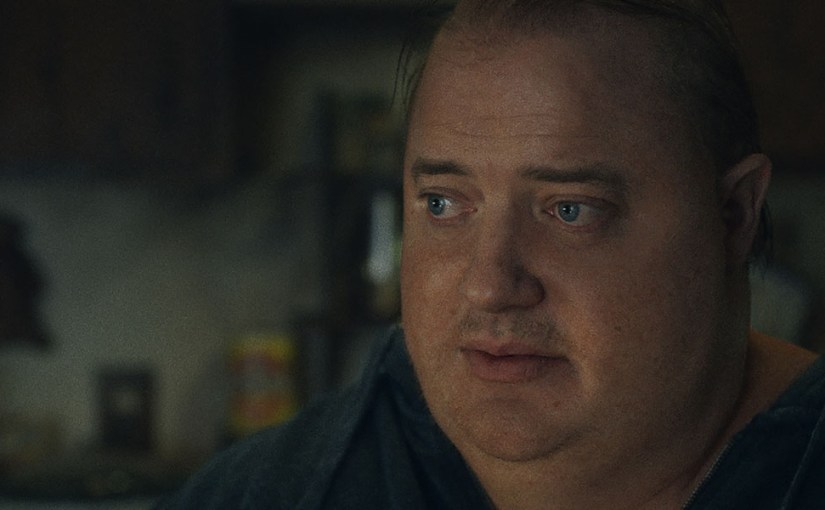
Brendan Fraser’s performance is so limited to the setting of the film and the physical restraint of being a large man with no flexibility.  However, he provides so much in the pain his character has suffered long before the current week captured on screen.  It’s an astonishing achievement in acting.  Within the bulbous head depicted in so many closeups are tired eyes that have gone through so much like toiling with leaving a marriage in exchange for a homosexual relationship, and weakening a connection with his child.

Beyond the enormous weight he lives with, Charlie also lives with an unhealthy food addiction.  Just ahead of the last act of the film, Aronofsky is relentless in showing how Charlie responds to personal suffering, not physical, by drowning himself in enormous amounts of sloppy and messy food as Fraser guzzles everything into his mouth.  Charlie suffers from so much more than just being morbidly obese.  He could live with that.  It’s other moments and people and losses in his life that are hard to continue to live with.  The difficulty of those things is cursed upon by Charlie with uncontrollable amounts of food.  Some people who suffer with difficult matters might hide in bed all day or binge watch television for an entire week.  Some turn to drugs and alcohol.  Charlie binges on food.  He doesn’t love his food.  He only uses it to drown out his pains.

I imagine it’s hard to learn about people like Charlie who are held down by the challenge of extreme obesity.  They have become so physically large that they literally can not get up from their sofa without help and therefore never leave their homes.  Because they never go outside, we are unaware of people like this.  I once had a neighbor that I never, ever saw.  I could hear their TV in the apartment next door but I never saw them.  How is that possible?  Why is it that they never revealed themselves?  There’s a story there.  Maybe a terrible or uncontrollable dilemma.  Darren Aronofsky, Samuel D. Hunter and Brendan Fraser offer a glimpse into what goes on behind this closed door.  It’s heartbreaking. 

Maybe it is so tragic because of why Charlie is shown within his confines by Aronofsky, written within the circumstances that Hunter offers and most importantly demonstrated by Fraser as a man ready for his life to end.  If only he can resolve a final digression with his teenage daughter suffering from a pain of anger likely instigated by him. 

Again, Brendan Fraser’s performance is the best one I have seen this year, and with no doubt in my mind, he should absolutely win the Oscar.  This could go down as the best accomplishment is his colorful career. 

THE FABELMANS

By Marc S. Sanders

Often, coming-of-age stories are narrated through the eyes of the child on the cusp of becoming a teenager or a grown up.  It’s important you realize that I say through the eyes, however.  It’s what the protagonist observes that allows him or her to appreciate, and comprehend.  Steven Spielberg will tell you he came of age by learning how to make movies.  It stands to reason however, that he did not come of age by looking with just his eyes, but rather with his 8mm and 16mm cameras.  The Fabelmans is a fictionalized, loose interpretation of how the celebrated filmmaker transitioned from adolescence into young adulthood with dreams of telling stories with movie making inventiveness.

Sammy Fabelman (Gabriel LaBelle, the older version; Mateo Zoryan, the younger version – both performances are magnificent) is escorted for the first time to the movies by his parents Mitzi and Burt (Michelle Williams and Paul Dano) on a wintery New Jersey night in 1952, where he sees The Greatest Show On Earth.  For eight year old Sammy, what starts out as nervous fear of what to expect in a dark theater with a giant screen turns into exhilaration as a car does a head on collision with a locomotive.  Shortly thereafter, a series of eight Channukah gifts assemble a Lionel train set for Sammy.  It’s exciting to see it go around on an oval track.  It’s more electrifying to preserve it on film with a toy car driven by a Mordecai figurine crash right into the steam engine and the boxcars hitched to it.  That was Mitzi’s idea to capture it on film.  That way Sammy can get a thrill out of watching the accident over and over again without causing any further damage.

Sammy only progresses from there.  When Burt gets a job promotion, the family moves to Arizona.  The desert allows a teenage Sammy to continue with his love of filmmaking by shooting his family during the cross country trek and then making westerns and war films with his Scout Troop pals as the actors.  He sets up tracking shots by propping his camera on a baby carriage rolling along cardboard laid out on the ground.  Ketchup becomes blood.  Sammy is even inventive enough to poke holes in the actual film strip at precise moments when his sheriff and outlaws fire their six shooters.  Now it really looks like the cowboys are shooting real rounds of gunfire.  Mom and dad, his sisters, his teachers, and friends are all impressed. 

His Uncle Bennie (Seth Rogen) is also dazzled by Sammy’s natural talent.  Bennie is Burt’s best friend and co-worker, and per Mitzi’s insistence he moves to Arizona with the family.  By use of his camera and editing machine, Sammy will soon learn that Bennie actually means more to Mitzi than he does to Burt. 

With a script that Spielberg constructed with Tony Kushner, the director/writer depicts a kid, much like he was, who expressed his honesty and learned the truth about the people around him when his projector was on.  The camera doesn’t lie, ever.  A motion picture camera will even hold on to the final beats of a person’s pulse before they finally expire.  That one moment in time where there’s life and then suddenly there’s death can be eternalized on film, forever.  It’s through this storytelling device that allows The Fabelmans to stand apart from other coming-of-age films like Rebel Without A Cause or Splendor In The Grass or any of the John Hughes brat pack films.  The childlike quality yearning for adventure and fantasy shines through with Sammy’s westerns or John Wayne inspired war pictures.  Sammy also realizes though that he can pick up on real life and emotion with his 8mm, like on a family camping trip.

Michelle Williams gives an outstanding, sometimes ethereal performance.  It’s real.  She’s not doing fantasy.  Yet, she lives for the fantasy and adventure.  I recall a well known anecdote of Spielberg where he described in his youth, his father woke up the family in the middle of the night to watch the skies for a meteor shower.  (Watch The Skies was the original title for his film Close Encounters Of The Third Kind.)  In The Fabelmans, Mitzi enthusiastically takes her children in the car to pursue a tornado.  Later moments will have her dancing freely in her nighty in front of the car headlights while the family is camping; uncaring over the fact that her dress is see through.  Sammy will notice how awkward his father Burt feels, while at the same time seeing how enamored Bennie is at the sight.  Williams has a beautiful balance though of a woman trying her best to appear happy and collected for the sake of her children and husband, but not living the story she wants.  This will influence Sammy as he maps out his own future.  He’ll live the life he wants.  Learning the merits of algebra will never hinder his destiny to make movies.

Later occurrences will show evidence as to how well Sammy can capture reality with his camera.  Following a series of bullying and antisemitic teasing after the family transitions to northern California, Sammy is welcomed to shoot the senior ditch day at the beach.  A telling moment occurs when the film is shown at the prom.  The taller bully is overwhelmed by how championed he’s depicted in the film.  He’s bordering on furious with Sammy, though.  The mean kid knows he’s cruel to the scrawnier, Jewish Sammy, and it immediately eats away at him with guilt over his past treatment.  Sammy’s film has changed and disrupted this kid.  Another kid bully is shown to look like the jerk he is and nothing else.  He walks alone on the beach.  He’s not an athlete.  He’s nothing but a no talent, unlikable antisemitic jerk.  This kid is also changed because now he can see what he truly is as the viewer looking at his own cruel behavior shown on film for the whole world to see.  Movies will bring out what we harbor deep down, inside. 

Ironically, Sammy is so well versed with camera work and follow up editing that he is practically unaware of how durable his theme of honesty through the lens truly is.  What Sammy captures comes without even trying and it sends a raw emotion to the viewer, whether it’s a mean-spirited bully or even his own mother watching.

Steven Spielberg could never be anything else except a movie maker.  Yet, after over five decades he’s still introducing audiences to new kinds of accomplishments.  He started as a director with adventure and fantasy on his mind with the likes of monster trucks, killer sharks as well as swashbuckling treasure seeking and visitors from outer space.  Later, he had to reinvent his craft and think outside his fanciful dreams to show brutality and hope through horrifying moments in history like the abuses endured by black southern plantation dwellers, slavery, the Holocaust and the unglamorized harshness of war, political unrest, and terrorism.  Further on, he carried out the romance of stage musical performance and even learned to poke fun at his own past accomplishments.

In the short period of time that we get to know Sammy Fabelman, we see transfers of perspective in this young boy’s outlook through a camera.  Sammy goes from making silly mummy monsters of his sisters to intimate hand holding shared by his unhappy mother and the man she truly loves, a man who is not his father. 

Whether he is watching his own films, or it is his friends, or his mother, his father or even his tormentors at school, Sammy realizes that a film will always do one thing and never falter away from that one thing.  His camera will always, always, always tell the truth. 

Thankfully, a truly inspired epilogue moment, which left me with a big, enthusiastic grin, has Sammy still learning that as frank as his filmmaking may be, it’s important that it is also never boring.  I don’t think I have ever been bored with a movie made by Steven Spielberg.