FALL

By Marc S. Sanders

Sometimes a movie will simply cover a circumstance.  The crew of Apollo 13 end up lost in space.  James Franco gets trapped behind a rock for 127 Hours.  Chrissy Watkins and Alex Kintner wind up abandoned in shark infested Open Water.  I recall Ryan Reynolds being buried alive in a coffin for ninety minutes.  Haven’t seen that one yet.  Not interested, honestly.  

Any of you curious to see what happens when two expert rock climbers neither of whom wear safety gloves, while one wears Converse All Star high tops, (Pass the grain of salt, please!) opt to climb a rusty 2,049-foot-high television antenna and get stuck at the top?  That’s about all there is to Fall, directed by Scott Mann.  

Granted, there is a thin slice of characterization layered on the crust.  Becky (Grace Caroline Currey) is severely depressed and maybe suicidal following a rock-climbing accident that took her beloved husband Dan (Mason Gooding) away from her.  Fifty-one weeks later, she still defies her father’s (Jeffrey Dean Morgan) pleas to help her.  Yet, her best friend Hunter (Virginia Gardner) urges Becky to accompany her while she records their climb up the infamous B-67 TV Tower, located in the Mojave Desert.  Hunter’s thousands of online followers will be in awe!

Subtle beats of conversation show that Hunter may be hiding a secret from Becky.  Frankly, if you’ve at least read a Dr. Seuss book, you’ll be much more intuitive than Becky, and know what the secret is.  So why should I waste the keystrokes spelling it out for you?

The climb up is pretty unchallenging as the young ladies are tethered together by about fifty feet of climbing rope.  The photography will dazzle you though. They’ve got their cell phones and a drone for some masterful sights of the wide expanse of desert and unlimited blue sky.  One water bottle between the two should be enough. The vultures are nothing to worry about as they are feasting on a near dead coyote down below.  Only thing is that we know something the girls don’t.  As the ascent gets higher into the upwards void, the frailer the rusted ladder becomes, and the more bolts and beams pop off.  You can guess what happens next and follow the film all the way down to its end.

What saves Fall from being a waste of time is Scott Mann’s use of his camera.  IMDb states that he insisted on not doing green screen work.  If he was going to be this daring, the climb up and the need for the ladies to hold out on a grilled, narrow platform high above had to be as authentically real as possible.  Mann’s team built a duplicate antenna on the top of a high mountain location, that reached as close to the structure’s actual height as possible.  So, the height matches that of the real structure.  The recreated antenna was apparently shorter though.  Hey, I was convinced of everything I was looking at from a scorching sun to heavy breezes to sunburns and running mascara and the eventual exhaustion, fear and despair the girls had to endure while trying to survive close falls and drops.  

The edits will make shout and gasp as one of the girls slips or barely holds on to a bar or rope or hand that could give way.  It’s not as impressive as some of the material in Cliffhanger.  Remember that opening?  The enormity of the elevation also does not compare to what Robert Zemeckis did across the open chasm between the World Trade Center Towers either (The Walk).  However, there’s much to look at and take in with a strong sense of vertigo and shortness of breath.

Becky and Hunter’s dilemma left me with trying to figure how they’ll get out this scenario.  You account for what they climbed up with and what might be at the top of the pole for them to use.  You also consider the injuries they suffer when they attempt a risk at gaining an advantage.  Most of what is tried seems apparent.  Though I question their short cut knowledge for charging a cell phone or drone battery.  

I was skeptical of their plight as well.  Expert climbers would wear gloves while climbing a rock or an old rusty two thousand foot high ladder.  Converse sneakers with no tread on the soles? C’mon!  As well, this giant, narrow thing is erect in the middle of the scorching, desert sun.  These girls ever experience going down an aluminum playground slide?  My hands were burning just looking at every rickety piece of this thing.  How did Becky and Hunter avoid painful skin tears and callouses? How did they not have any sort of involuntary reflex against touching what should be burning hot, rusted metal?

Despite the unnecessary, or maybe neglected liberties, the film takes, Fall is watchable. Just take your bathroom breaks during the two “it’s only a nightmare” scenes that look lifted straight out of Jaws: The Revenge. When will filmmakers realize how stupid and unnecessary an “it’s only a nightmare” scene is? The only time it worked was in Aliens. Beyond that, this stale uncreative kind of filler is there simply to muster a jump scare that does not advance a character or teeter a plot. Just stop with the nonsense.

Fall offers a situation I never want to end up in.  I’ve actually developed a fear of heights as I’ve gotten older.  Yet, I’d love to observe from the safety of my home theater how others like Becky and Hunter respond.  The ending is acceptable with a mild twist.  I think I would have embraced this fictional circumstance much more had the story been more frank with itself and the characters who were selected to play this foolhardy game.

One thing I’ve learned though. Nursery rhymes will not help you get your mind off the heights. Thing about what happened to Humpty Dumpty, or if we all play Ring Around The Rosie. Yikes!!!!!!!


PEARL (2022)

by Miguel E. Rodriguez

DIRECTOR: Ti West
CAST: Mia Goth, David Corenswet, Tandi Wright, Emma Jenkins-Purro
MY RATING: 10/10
ROTTEN TOMATOMETER: 93% Certified Fresh

PLOT: In 1918, a young Texas woman on the brink of madness pursues stardom in a desperate attempt to escape the drudgery, isolation, and lovelessness of life on her parents’ farm.


I originally gave Pearl a rating of 9 out of 10 because it was not quite as terrifying as its predecessor, X [2022], but I have decided to amend that to a 10 out of 10 based solely on the performance by Mia Goth in the title role.  If her performance had appeared in anything other than an indie horror film, I firmly believe she would have been nominated for an Oscar, or at least a Golden Globe.  But I’ll get to that in a second.

Pearl is a prequel to the acclaimed horror flick X, in which most of a porno film crew is stalked and murdered by an insane old woman, Pearl, and her equally insane old husband, Howard, in Texas in 1979.  It starred Mia Goth as Maxine, a stripper who was convinced she was meant for bigger and better things.  This time, in the prequel, Goth plays Pearl as a young woman growing up in Texas, but this time it’s 1918.  World War I is on the verge of ending, but the Spanish Flu pandemic is in full swing; folks in town don’t go anywhere or do anything in town without wearing a cloth mask over their nose and mouth.  (Sound familiar?)

Pearl’s home life is not quite functional.  In her first scene, over a lush score that sounds as if it were imported from the 1940s, Pearl dances in the barn and talks to a cow and a goat and a horse, like Snow White, about how she’s going to become famous and leave town, and everyone will know her name.  Then a goose waddles in from outside and interrupts her conversation; Pearl gets an odd look in her eye, grabs a pitchfork, sidles up to the goose, aaaand you can probably guess the rest.  (The gator from X makes a nice cameo shortly thereafter.)  Meanwhile, that ‘40s musical score punctuates the action like a Disney movie.  The effect is profoundly odd, but compelling.

We learn more about Pearl’s home life with her invalid father and domineering mother, Ruth (Tandi Wright).  She married young, but her husband, Howard, was called off to war in Europe, leaving her alone with her less-than-ideal parents.  She dreams of fame, but Ruth, with her strong German accent, sternly reminds Pearl of her responsibilities to her father and the farm.  One day, Pearl rides her bicycle to town to buy medicine for her father (sounds like the beginning of a fairy tale) and decides to go to the movies, which were very different in 1918.  She meets the strikingly handsome projectionist (David Corenswet, aka the new Superman) who encourages her to take the time to live her own life before it’s too late.  On her way home, Pearl stops in a cornfield, finds a scarecrow, and engages in a charming little song and dance with him…until her mind plays tricks on her and the encounter turns into something altogether different.

The whole movie is like that.  Shot in vivid colors and featuring an evocative soundtrack, it alternates between The Wizard of Oz and Joker.  (In fact, IMDb trivia notes that female fans of this movie call it “the female Joker.”)  It keeps you off balance in all the best ways, threatening to fly apart, but Ti West’s direction and Mia Goth’s performance manage to hold everything together in a satisfying, but disturbing, whole.  As with X, I can acknowledge the achievement, but I’m damned if I can explain how it was done.

There are many highlights in Pearl: her audition for a traveling dance show.  Pearl wheeling her father to the edge of the lakeside dock.  The scarecrow.  The tipping point between Pearl and her mother.  The pig on the porch.  (Gross.)  The look on her father’s face when Pearl dresses him up for a gentleman caller.  But the pièce de résistance of the entire film is, without question, Pearl’s monologue.

In a movie in which Mia Goth teeters on overkill in several scenes, the screenplay (co-written by Goth and Ti West) provides Pearl with a heart-rending soliloquy that should be more famous than it is.  Pearl’s sister-in-law, Mitsi (Emma Jenkins-Purro), sensing that Pearl is troubled, encourages her to indulge in a little play-acting: “Pretend I’m Howard.  What do you want to say to me?”  What follows is a 7-minute speech, most of it captured in an unbroken 5-minute take that must be seen to be believed.  In it, Goth expresses virtually every emotion imaginable as she unburdens herself, purges herself of all her repressed rage at her husband for leaving her alone, at her mother for holding her back from her dreams, at her father for having the temerity to fall ill and causing her to remain home for his sake.

Does this speech excuse her violent behavior?  Not at all.  But it explains it as well as any other serial killer movie I’ve ever seen.  I was reminded a little bit of Charlize Theron in Monster [2003], who also played a woman who committed terrible crimes, yes, but who was pushed into making those choices by her family and a society who little noticed or cared about her situation.  That’s how stirring Goth’s performance is, that I would compare it to one of the greatest performances ever captured on film.  In a movie that flirts with parody a couple of times, this last speech grounds it and the main character firmly in the real world.  It’s truly astonishing.

I’m almost sorry I saw Pearl AFTER watching X.  Almost.  It kind of makes me want to go back and watch X again, armed with all this new information on Pearl’s backstory.  It also solidifies the psychic connection between Pearl and Maxine, which was touched on several times in X, and which I imagine will be revisited in some way in Maxxxine [2024]…but I’m just speculating.  Pearl is good enough to stand with any of the best serial-killer-origin stories ever made.

(P.S.  As with X, you’ll want to make sure you watch the credits, except this time you want to stay with it until the last image fades to black…you’ll know what I mean.  IMDb informs me this crazy, creepy moment happened because after the last line, director Ti West refused to yell “Cut” and just let the camera run, and the actor in question, being a professional, simply stayed in character.  It’s remarkably unsettling.)

X (2022)

by Miguel E. Rodriguez

DIRECTOR: Ti West
CAST: Mia Goth, Jenna Ortega, Brittany Snow, Kid Cudi
MY RATING: 10/10
ROTTEN TOMATOMETER: 94% Certified Fresh

PLOT: In 1979, a group of young filmmakers set out to make an adult film on a rural Texas farm, but when their elderly hosts catch them in the act, the crew find themselves fighting for their lives.


I like great horror, but I have never enjoyed slasher films, with the clear exceptions of Halloween [1978] and Psycho [1960].  They tend to fall too easily into the formulas lampooned in Scream [1996] and The Cabin in the Woods [2011] and lose all suspense when the stories cave in to ancient tropes and traditions.  You’ve seen one bloodthirsty masked strangler/slasher/axe-murderer jump from behind a tree at night, you’ve seen them all.

So, how do I explain my delight and gushing praise for X, the indie horror phenomenon that turned Mia Goth and director Ti West into industry darlings?  I can only report that, despite following timeworn traditions of the genre, this film somehow found a way to ratchet up the tension to almost unbearable levels.  I’m not exaggerating.  The night I finished watching it, I found it impossible to fall asleep right away.  My mind was racing and rehashing what I had just seen.  It is the creepiest, scariest horror film I’ve seen since Hereditary [2018], and I freaking LOVE Hereditary.

The plot is right out of Slasher Films 101.  The year is 1979.  An aspiring group of wannabe porn stars pile into a van and head to a rural Texas farm where the crusty owner has agreed to rent out his barn and guesthouse, ignorant of this motley crew’s true motives.  The composition of the group reads like the beginning of a dirty joke: a cowboy, a film school graduate, his mousy girlfriend, two strippers, and a black guy (Kid Cudi…yes, that Kid Cudi).

Upon their arrival on the farm, ominous music and occasional breathy noises on the soundtrack tip us off that something just ain’t right…not to mention the blood-soaked prologue.  The elderly farmer, Howard, has an elderly wife, Pearl, but we don’t see much of her at first.  There’s a magnificently tense scene when one of the strippers, Maxine (Mia Goth), skinny dips in the lake behind the farm, unaware of the gator eyeing her from the opposite bank.  It slithers into the lake just as Maxine starts to swim back to the dock.  An overhead shot shows Maxine swimming leisurely, and the gator getting closer and closer, and…I mean, I’ve seen scores, if not hundreds of movies with similar scenes, and very few of them evoked the kind of terror I felt as that gator closed in on Maxine.

Why?  This isn’t even a monster movie about a killer gator, it’s a – let’s be honest – formulaic movie with creepy old people and a slew of young people just waiting to be dispatched in hopefully creative ways.  But something about how Ti West directed this film got right under my skin, in a good way.  Even in the gloriously retro scenes when the ersatz film crew is shooting a sex scene, there is still an undercurrent of unease over the whole enterprise.  (And by the way, if I were to make a list of things I didn’t think I’d ever see in a movie, a topless Brittany Snow in a brief-but-raunchy sex scene would be really close to the top.)

It’s hard for me to describe the intensely creepy atmosphere in writing, especially because I want to preserve the film’s surprises for anyone who hasn’t seen it yet…and boy, I wish I could be there to watch it with you.  There’s the scene in the farmhouse between Maxine and the farmer’s elderly wife, Pearl, where you have absolutely every reason to believe it’s about to turn all Texas-Chainsaw, and then the scene abruptly pivots.  Pearl looks like your stereotypical crazy old lady; that’s the best way I can put it.  I seem to remember a few characters who looked like her in the background of Shutter Island [2010].  We learn a little bit about Pearl’s past, and we can see that she’s sharper than she looks…or maybe she’s just crazy.  I’m not sayin’.

When things heat up around the halfway mark, the tension factor skyrockets.  I learned a phrase a while ago that captures it perfectly: the film becomes a stress sandwich.  Situations arise that we’ve all seen before, but in this movie I was on the edge of my seat waiting to see what would happen next.  When Jackson (Cudi) searches the lake at night and makes a creepy discovery right out of Hitchcock.  When “Don’t Fear the Reaper” plays at a critical moment.  When Lorraine (Jenna Ortega…yes, that Jenna Ortega) goes to the cellar looking for a flashlight.  When a soundly sleeping Maxine gets some unwanted physical contact from a nocturnal visitor.  (That sound you just heard is me shuddering.)

I could write more about the plot, but I would give something away, I’m sure.  To call the film’s finale satisfying is a vast understatement, right down to the very last line that, in my book, is as perfect as “Nobody’s perfect!” or “Tomorrow is another day!”  Ti West has created a slasher movie for people who hate slasher movies, and it’s one of the best modern examples of the genre that has ever been made.

(P.S.  Don’t spoil this for yourself by Googling it or anything if you don’t already know, but make sure you watch the closing credits.  When I saw the name of the performer who plays “Pearl”, my jaw dropped.)

SHE SAID

By Marc S. Sanders

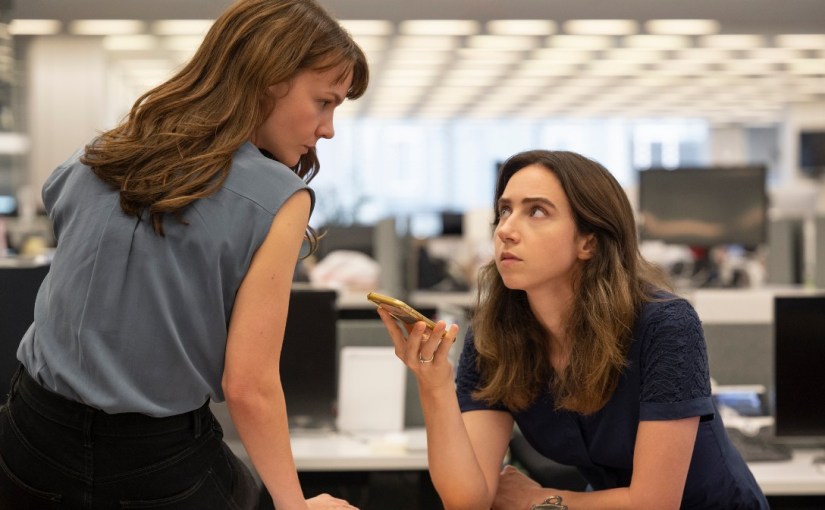
I get high off movies about journalism.  All The President’s Men and Spotlight are at the top of this pillar.  The main characters seem to be moving a hundred miles per hour even if they are reserved to their cluttered desks and phones, or if they are talking delicately, and slowly, with empathy as they carefully approach a potential, yet frightened source.  She Said is a 2022 film about how the New York Times reporters, Megan Twohey and Jodi Kantor (Carey Mulligan, Zoe Kazan), exposed the systemic process of sexual harassment and rape that was running rampant through Miramax Films.  The accused was always its CEO, Harvey Weinstein.

It’s extraordinary that this film got produced so soon after the MeToo movement and Weinstein’s downfall occurred.  All of it seems like it just happened yesterday.  In fact, Harvey Weinstein is still going through court procedure and trials for sexual crimes he’s accused of that occurred in London, New York and Los Angeles.  There might even be more locations.  New developments hit the internet all the time.  This guy just never stopped.  So, there’s much for the courts to process and try.  This was a terrible black eye, not only for Miramax’s reputation (at the time owned by Disney), but on the entire film industry in Hollywood.

She Said explores not only Twohey and Kantor’s relentless pursuit of the truth and various descriptions of Weinstein’s method with young women, but also how corrupt non-disclosure agreements (NDAs) were used.  The NDAs contained unreasonable demands for hush money provided.  Mandates such as speaking with a therapist or other professionals and close-knit relatives were never allowed lest they suffer consequences.  The victims would get paid, but would also be denied of a copy of the contract, and thus Weinstein found a way to allow his constant grooming and sick pleasures of perversion to carry on. 

The reporters concluded that these victims had no money or resources to stand up to the kind of bullying and harassing that Weinstein’s power exerted.  Quitting or getting fired for fighting for their rights or just refusing his advances left these women out of an industry in which they were trying to elevate their careers.  They lacked proof of the occurrences.  They had to fight a he said/she said scenario.  They were victimized by a man who associated with some of the most powerful people in the world.  It happened to known actresses like Rose McGowan and Ashley Judd (who plays herself in the picture).  It nearly happened to Gwyneth Paltrow (providing her own voice on the phone) as well.  Even worse, it happened to women who didn’t even have the luster of celebrity brand name recognition to help them in their cause.    Nevertheless, it practically destroyed McGowan’s reputation in Hollywood altogether as she was labeled a crazed pariah for declaring her truth.  The tolerance and strategic payoffs were perhaps just as overwhelming as the attacks by Harvey Weinstein.  (Forgive me, I say perhaps because there is no way I am qualified to empathize, measure, or relate to what these victims endured or continue to survive through.)

Maria Schrader’s film does a good job at explaining the risks these reporters take.  A brief prologue shows Megan Twohey getting death threat calls for her write up of Donald Trump’s accusations of sex crimes.  A very convincing Trump vocal impersonator even calls her to tell her she’s a disgusting human being and how he must be innocent simply because he does not know any of these women.  Reader, it bears repeating that many rapists and harassers never know their victims.  When Twohey teams up with Kantor, the intimidations don’t stop and their supervisors and editors in chief (Patricia Clarkson, Andre Braugher) lend support.

Paltrow’s ex-boyfriend, Brad Pitt, was a producer on this film and it’s gratifying to see him lend the support.  I recall reading how he confronted Weinstein following attempts of harassment upon Paltrow shortly after they began dating and making the film Seven together.  Looking back to those years of the mid-1990s, I’d argue that Pitt and Paltrow were taking enormous risks with their careers.  They were just becoming marquee names. Yet, they could have still been ruined within the industry.  This is an environment synonymous with putting blinders on to systemic offenses that occur while lending praise to those that’ll eventually grant them potential Oscar winning roles or twenty-million-dollar paychecks.  

When Matt Damon, Ben Affleck, George Clooney, and Quentin Tarantino say in interviews that I’ve seen that they had no idea what was occurring with Harvey behind closed doors, my reaction has always been skeptical to these claims.  At one point in this film, Twohey and Kantor refer to Harvey’s antics as the worst kept secret in Hollywood. It is sad to say that these marquee names will always owe their careers and success to Harvey Weinstein, criminal rapist or not.

I do have some reservations with She Said, though.  Often the reporters are typing and quick close ups or glances at their monitors are edited into the film, but I can’t read what they are documenting, and I believe the film was assuming I could.  At one point, Braugher’s character announces that Weinstein spoke to Variety magazine and another competitor to share his side of the story and declares “This is bad.”  Yet, we never find out what Weinstein said, and we just get the “Oh shit!” expression from Twohey and Kantor.  Why leave us in the dark on subjects like this?  Why is this so bad? 

The film is fast paced, but many of the scenes are identical to prior ones.  As the reporters speak with victims, they break down their own story.  I believe Weinstein practiced a similar method each time, but the dialogue in these accounts seems redundant.  I get that we are to understand how excessive his predatory actions were, but I was hoping for fresh angles to their ongoing investigation.

The cast is spectacular, particularly Mulligan and Kazan who make a great pair. I really like the dialogue written and delivered by Andre Braugher.  I always thought I don’t see that actor enough in films.  He’s sensational in everything he does, and he carries a real strength to his authority in the New York Times offices.  A championing moment occurs when he cuts in on Harvey’s call with the reporters to give an ultimatum and hangs up.  He just told Harvey, “ENOUGH ALREADY!”

She Said relies on prior knowledge that you must have before watching the film.  You must know who Harvey Weinstein was and the large space he occupied within Hollywood and the film industry.  You need to know who these actresses were, and you have to be familiar with the overwhelming female response to Donald Trump’s agendas which set up the picture.  Unless you’ve been hiding under a rock, it’s hard not to be aware of what’s occurred in the last 5-6 years. 

However, as this film is discovered by future generations, long after Weinstein and Trump, and these victims are passed on, future generations like our children’s children may not fully understand the terrible conspiracies that transpired. 

She Said is a good movie and it holds significant importance.  However, I imagine the book written by Twohey and Kantor provides more details and exposition that I wish the film adaptation offered.  The pace and performance of the picture work very well.  I’m just afraid the script relies a little too much on assuming we know the whole backstory as the film carries on to its triumphant ending.

Watch it anyway, though.  It’s a bravely daring film to say the least.

A MAN CALLED OTTO

By Marc S. Sanders

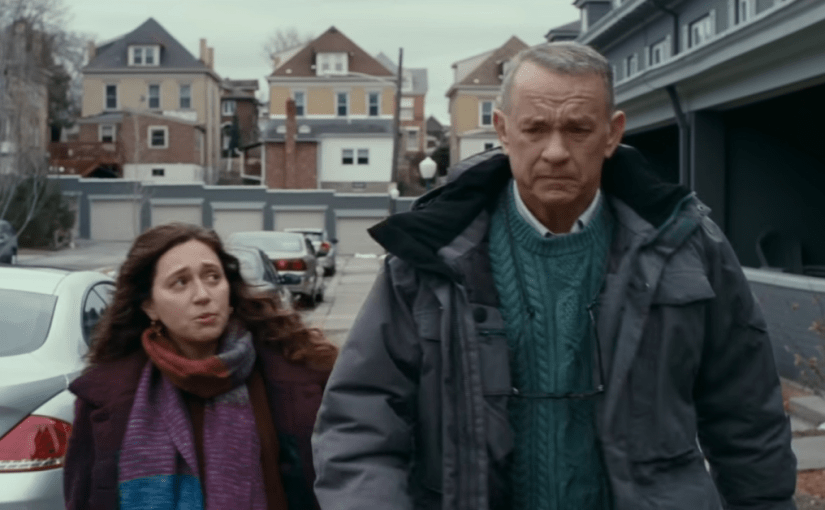
There’s A Man Called Otto who seems to be liked by everyone except himself. People in his neighborhood happily say hello to him every morning as he shovels the snow off his walkway.  They will try to chat with him on their morning jog.  He won’t even allow his work, where he was forced to retire, to send him on his way with a celebratory going away party. 

On the other hand, Otto prefers to occupy himself with insisting that the UPS truck driver not drive down their block, sniffing out whose dog left behind a present on his yard and scaring off the real estate agent in the fancy BMW who attempts to convince elderly residents to sell their townhomes and move into assisted living.  A new family moves in across the street and they appreciate Otto’s grumpy insistence of properly parking their car with a U-Haul trailer attached.  What Otto doesn’t appreciate is how one more attempt at a planned-out suicide is foiled by their disruption.

I’m told this late 2022 release is an adaptation of book called A Man Called Ove, which was also turned into a European film that is supposedly better than this picture.  I can’t offer an opinionated comparison as I have neither seen that other film nor read the book.

Tom Hanks is the title character in this film from Marc Forster.  He’s very good and right for the role.  I’m one of the few who find Hanks to be miscast on occasion.  Not here though.  His performance had me thinking back on a more subdued Jack Nicholson in About Schmidt.  Hanks has transitioned finally to the older generation of characters that are not as wide eyed with discovery, innocence and gusto that were depicted in films like Philadelphia, Big or Forrest Gump.

Marc Forster is striving to tug at the heartstrings.  Flashbacks of Otto when he meets his eventual wife, Sonya (Rachel Keller) hint at what led to his current state of nonstop crankiness.  Otto’s a widower but why is he so bitter with himself or any kind person who comes his way?  The younger Otto is portrayed by Truman Hanks, one of Tom’s sons in real life.  It’s inspired casting, because there is a consistency towards the mannerisms and personality within the two separate performances.  Truman Hanks and Rachel Keller pair up nicely as young adults from different backgrounds who convincingly fall in love.

The standout though is the pregnant wife/mother of the new family who’s moved in. Mariana Treviño is Marisol, and she is superb in her comedy as the Hispanic neighbor who is always getting in Otto’s way with prepared home made food to bring over while she relies on the grouch to babysit her children or give her a ride because she doesn’t have a license.  Eventually, a terrific scene arrives where Otto is teaching her to drive, and the two characters open up to one another despite their different backgrounds.  Treviño carries so much range with her part.  She’s ditzy but intelligent, sensitive, and very warm, lovable, and funny.  Every time she appears on Otto’s doorstep, Marisol is a new surprise.  You might think at first that she’s scatterbrained.  When you see her next, she’s intuitive.  Otto may think she knows this person from just one or two encounters, but Mariana Treviño’s performance is so well done and beautifully written that even the viewer really doesn’t know her until the climax of the film.  If A Man Called Otto had gotten a little more publicity traction upon its release, she could have been an Oscar nominated contender.  I think she was definitely worthy of more praise than I could uncover.

The script sets up a lot of questions that carry the film and keep it interesting.  Otto’s internal crisis is one thing, but there’s also a neighbor’s mute husband who apparently shares history with the title character.  There is also a scheme being plotted out behind this pesky real estate agent who blasts his hip hop music from his luxury car. (TRIVIA: Another son of Tom Hanks, Chet, is the rapper heard on the radio.)

I was never really convinced that A Man Called Otto could be a real-life story, however.  Call me a cynic, but the number of sweet natured people all living in one small space seems far-fetched.  These happy go lucky folks, including a transgender teen (Mack Bayda, wonderfully likable in his first film role) who was kicked out of his father’s house, find so much positivity out of life.  I’m not sure real life lays it on this thick!  Sometimes, the side characters appear like walking Hallmark cards.

I also felt uneasy about the suicide theme that is most prevalent throughout the picture.  I think I counted four different ways that Otto attempts to end his life (hanging, shotgun to the mouth, jumping in front of a train, carbon monoxide poisoning).  Each attempt is interrupted somehow and how it’s done is nothing so inappropriate or spoofed, but it is done with an intent of irony and humor. It started to feel comparable to another foiled attempt by the Coyote trying to capture the Road Runner.  Looney Tunes serve a purpose escapist slapstick.  Suicide, even when cheerfully disrupted, often doesn’t put a smile on my face. 

Otto does go through a character arc that I appreciate though where demonstrations of heroism and soul saving are captured.  The ending, while sad, is also quite rewarding.  With Marc Forster’s film, I’ve gotten to know a beautiful collection of well-intentioned and thoughtful people who do not give up on trying to rescue one of their own from a life currently mired in misery. 

A Man Called Otto is a good film worth watching.  The cast is absolutely wonderful and through the performances, everyone seems positively proud of what they accomplished with the final product.  I’d be up for seeing this exact same cast perform this script live on stage.  Still, I offer a warning of caution.  While it is trying to deliver sugary optimism at every turn, it is also coming off a little bit like artificial sweetener. 

ELVIS (2022)

By Marc S. Sanders

Baz Luhrmann’s take on the legacy of Elvis Presley will certainly grab your attention, even if the director refuses to carry an attention span of his own lasting longer seven seconds.  Having watched the celebrated film from 2022 for a second time, eight months after my first viewing, I see more faults with the picture than achievements.  Elvis is strongest when the carnival ride stops moving, allowing its cast of colorful characters to have conversations with one another. 

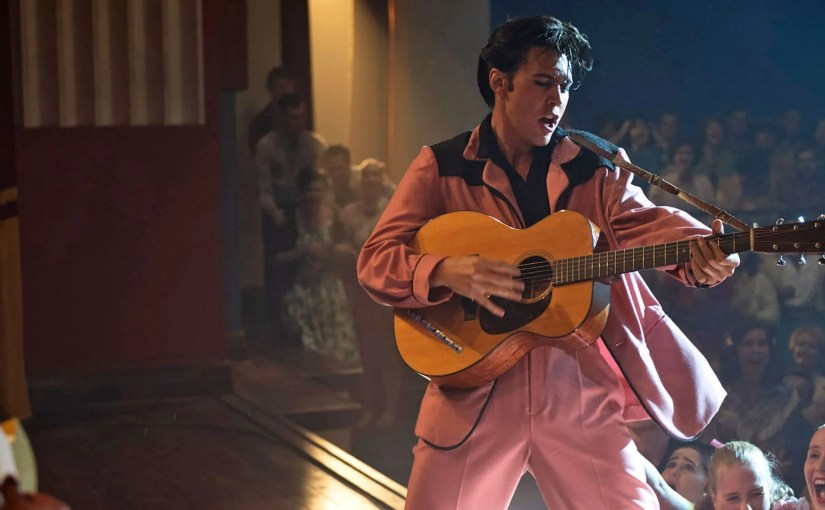
Austin Butler is now a known name for his portrayal of the King Of Rock N Roll, whose career was squandered by a slimy business manager known as Colonel Tom Parker (Tom Hanks).  Butler personifies what pop culture has recognized first and foremost about Elvis Presley, everything from the wild stage presence of dancing to the deep rockabilly singing or speaking (you decide) vocals.  He really bears an uncanny resemblance to The King as well.  Butler could have been better though had he been graced with a more economical and thoughtful script.  I don’t think Austin Butler was given enough to do.

The Elvis character hardly shares any conversations with any of the supporting characters.  That’s the film’s major shortcoming.  There are a scant few scenes of dialogue exchanged between Elvis and his mother and father, between Elvis and the Colonel, and between Elvis and his wife Priscilla Presley.  Baz Lurhmann wrote the script with Sam Bromell and Craig Pearce, and I guess it incorporates some major moments within the singer’s illustrious career but nothing seems to hold much weight.  Elvis gets threatened with being arrested for his pelvis swiveling gyrations while he performs.  We get a close up of the state Governor who leads this censoring campaign, but we don’t get an idea of his warped logic.  Elvis gets drafted into the army and the Colonel thinks to sell it as a comeback when his tour of duty will finish in two years.  Two years go by in a matter of sixty seconds however and the King is back to touring and donning the outrageous costumes, but we don’t see the marketing machinations led by the Colonel.  Where’s the deviousness and conniving?  Where’s the brainwashing of the public and our hero?  Elvis is also bedhopping from one woman to another and popping pills, but these incidents which arguably led to his life being cut short are glossed over with a sway of Luhrmann’s camera work.  When the third act of the film arrived, I didn’t even know Elvis was sleeping around until Priscilla (Olivia DeJonge) announces she is leaving him.  On her way out the door, the two characters share about five or six lines of dialogue before the film races to another transition or scenario.  In this film, the love of Elvis’ life, Priscilla, holds about as much presence as an extra in the film.  Their relationship isn’t explored like Johnny and June Carter Cash in Walk The Line, for example.

Lurhmann edits his scenes with title cards of what year it is or what place it is as Elvis tours the country.  Yet, I never got the feeling that I was inside these time periods.  A minute to a minute and a half go by and suddenly it is “One Year Later.”  What difference does that make?  Where’s the transition in Elvis’ character?  When exactly did he become a sensation?  Suddenly I see that Elvis is moving into a mansion (I think is what will eventually be Graceland) with his parents and I presume he’s…well…he’s a success?!?!?!

An opportunity presents itself for Elvis to have a mentor into the world of celebrity stardom by means of B.B. King (Kelvin Harrison Jr.), but as soon as he introduces himself, the man disappears and is not heard from again.  Elvis only offers a piece of dialogue later suggesting that “B.B. King once said…”  There’s no significance to the influences or naysayers who enter Elvis’ life.  The same goes for Elvis’ mother, Gladys (Helen Thomson).  The Colonel will assure Elvis’ parents that he has their son’s best interests in mind as he blossoms his career, but we don’t get enough of a solid foundation for his mother’s apprehension or her religious doctrine or the alcohol addiction that kills her.  

I know, reader.  You can argue that I’m offering descriptive text for these people.  However, the text that I give in this column is all that you see.  Baz Lurhmann is a flashy director.  I don’t doubt his skill for color with sparkles and glamour. No subject is glitzier than Elvis Presley.  Yet, if a biography is going to be recounted on film, it needs to be more than just a near three-hour music video.  Luhrmann seems prouder of the letter fonts and graphics that introduce another year like 1956 or another state like Tennessee as it zooms towards you from the depths of the screen.  The gloss of the photography in the movie is overly animated, lacking feeling or character arcs.

The script for Elvis seems to also adopt the approach that Milos Forman’s Amadeus took, where the puppet master/antagonist recalls the celebrity’s story.  Colonel Parker provides voiceover with a thick, German/Austrian (maybe ???), dialect for Tom Hanks to deliver.  Unlike popular opinion, I was surprisingly taken with Hanks’ portrayal.  He’s quite the villain in a disproportioned fat suit and bulbous sweat-soaked head.  The relationship between Elvis and the Colonel is nothing surprising.  We’ve seen plenty of bios where the manager swindles the fortunes of the outstanding talent.  Considering that is how it happened, I don’t mind seeing it again in Elvis.  However, much like everything else in the film, it is glossed over.  Only very late in the film do we learn that Colonel Parker is deeply indebted to the Las Vegas casinos, and he signs away a long-term Elvis obligation in lieu of repayment.  Before all of that comes into play however, while we know we can’t trust the Colonel, we also don’t know what his endgame is.  Only near the end, Luhrmann and his script writers throw in a last-minute Hail Mary to shock the viewers and uncover how the Colonel destroyed Elvis’ financial assets and betrayed his trust.  Unfortunately, we haven’t seen much of a relationship between the two rivals after over two hours of film.  A build up is missing.  The best way for a villain to attack a hero is to whet his appetite with trust and then use that reliability as a control device.  The script for Elvis never sets up those early moments of exposition that get the viewer, and more importantly Elvis, to trust the Colonel. 

Michelle Williams once played Marilyn Monroe in a film called My Week With Marilyn.  It’s an astonishing performance in a very shallow film.  In my review of that picture, I wrote that I wish I could see Williams play the role again in a story more worthy of what she puts on screen.  She was above that movie.  I feel the same way for Austin Butler and Tom Hanks here.  These are great actors who were not given adequate material to shine.  If only another Elvis picture could be made with them in the principal roles.

What I find ironic about Elvis is that when I first saw the film upon initial release in theatres, I felt thoroughly impressed.  While I am always more cold than hot on Baz Luhrmann’s movies, I thought maybe this was the exception.  Watching it a second time however, eight months later, I realize that much of the film I could not remember and that is because that movie doesn’t invest in memorable scenes.  It focuses much too much on flashy edit, cut aways.  What I lost from that narrative is an intimate connection to Elvis or any of the other characters. 

Even the music is not as electrifying as it is known for.  There is not enough time devoted to individual set pieces of Elvis performing numbers like Heartbreak Hotel or Jailhouse Rock, and because of the quick cuts, I’m not convinced that Austin Butler is truly crooning away in an Elvis impersonation like Jamie Foxx as Ray Charles or Joaquin Phoenix as Johnny Cash or Val Kilmer as Jim Morrison.  Austin Butler is just not offered ample opportunity to do his best Elvis performing.

As colorful as Elvis’ life was and his legacy continues to be, Baz Lurhmann is certainly a viable candidate to direct this biography.  The problem is maybe that Lurhmann needed an editor and producer who would put their foot down and tell him to try again.  Lurhmann was more concerned with showing his own kind of magic in filmmaking and reserving the story and plot devices for the closing act.  Exposition within the last thirty minutes of a movie usually never works.

EMILY THE CRIMINAL

By Marc S. Sanders

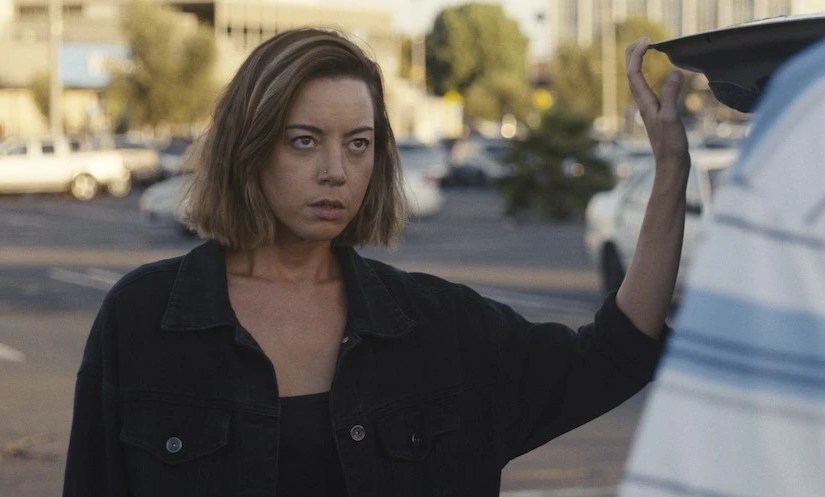
Aubrey Plaza becomes Emily The Criminal, a woman down on her luck with mounting debts, who resorts to credit card fraud with some low level hoods in the Los Angeles underground in order to make ends meet. 

This movie popped out at me while searching through Netflix.  It’s a little over a brisk ninety minutes, made on a shoestring budget, but it has twice the intelligence of whatever crumb of a story Avatar: The Way Of Water has with the two billion dollars spent to make big screen exhausting blue junk.  Goes back to what I always say. If you have an intelligent script, the movie will more than likely be worth watching.  Emily The Criminal is worth watching.

Normally, I don’t look at the running time of a movie before seeing it.  However, this happened to catch my eye in the screen summary just as I was about to hit play.  It’s an hour and 37 minutes.  Once the movie starts, there is a lot piled on to Emily.  First her excessive bills are established. She also has a proclivity for flying off the handle when she’s questioned about her prior arrests for assault and DUI.  Then, she is recruited with a group of others to take a fake credit card and driver’s license into a store and buy a flat screen TV.  A fast two hundred dollars is made.  The ringleader behind this scam is a guy named Youcef (Theo Rossi) who entices Emily with a more complex transaction the next day that’ll earn her two grand.  That works out, but frightening complications intersect.  Still, the cash was better, quicker, and easier to come by than her day job delivering UBER meals.  Eventually, Youcef and Emily connect with one another and she’s learning the tricks to manufacturing the cards and pulling off her own scams.  She’s good at it but not perfect, and when she trips up, a rift in trust between Youcef and his partner comes into play.  Emily is compelled to protect Youcef.

On the side, Emily also reunites with a high school friend (Megalyn Echikunwoke) who offers a line on a professional day job that could use her talents for graphic art.  Emily’s personality might not be suitable for that environment though, and the criminal underworld seems more attractive, despite the danger and risks involved.

I was never looking at my watch but as the movie progressed, I knew I had covered a lot of mileage and there still seemed to be a lot of road left to travel.  My expectations were that some questions will be left unanswered as the ending is approaching.  The cops have yet to make an appearance.  Will Emily be able to go legitimate, or does she even want to?  Most importantly, will her new friend Youcef survive his strained relationship with his business partner?  Thankfully, everything does conclude satisfyingly, and the ending ties together believably, even if there are a few conveniences that enter the frame.

I’m not familiar with Aubrey Plaza’s work prior to this film.  (I’m one of the few who didn’t get into her TV show Parks & Recreation.  My colleague Miguel refuses to let me live that down.)  However, she’s a good actor with lots of range, going from quick bursts of anger to showing mental toughness on screen against some scary people she encounters.  When she meets with a criminal in an empty parking lot who is twice her size and says a flat screen is $600, but the thug insists he’s taking it for $300, I was wondering how she’s going to get out of this one.  Plaza shows her character’s inexperience with such entanglements, but what opportunity will rescue her?  An even scarier episode happens later when Emily is getting robbed.  Plaza is sensational in both scenes.  First time writer/director John Patton Ford sets up these acts, but Aubrey Plaza always delivers it believably.  She’s brash, tough, and smart.

Ford’s film and script work because it doesn’t get too grand with itself.  The criminal world does not open itself up to the highest and wealthiest on the food chain.  Ford was smart to keep the complications of his story within this low-level demographic of delinquent offenders.  Other films would have taken the new student who quickly capitalizes over to the highest mansion on the highest mountain to where the kingpin of everything sits in his hot tub throne on the thirtieth floor overlooking a city.  Ford’s script is wise not to go beyond its reach and mire itself in flashy bloodbath violence.  Also, the window of time from when Emily first dabbles in this shady activity toward the film’s conclusion and epilogue is succinct, not spanning years or decades.  The contained routes that Ford takes with his debut film allow the misdeeds and outcomes to be convincing.

I especially took great pleasure with how the ending of Emily The Criminal circles back on itself to the beginning.  That tells me that John Patton Ford thought this storyline and his protagonist all the way through with good insight. 

Emily The Criminal is an under the radar film to look out for.

CRIMES OF THE FUTURE (Canada, 2022)

by Miguel E. Rodriguez

DIRECTOR: David Cronenberg
CAST: Viggo Mortensen, Léa Seydoux, Scott Speedman, Kristen Stewart
MY RATING: 5/10
ROTTEN TOMATOMETER: 80% Certified Fresh

PLOT: In a dystopian near-future, the human pain threshold has suddenly disappeared, giving rise to bizarre performance artists who publicly showcase bodily mutations and self-mutilations.


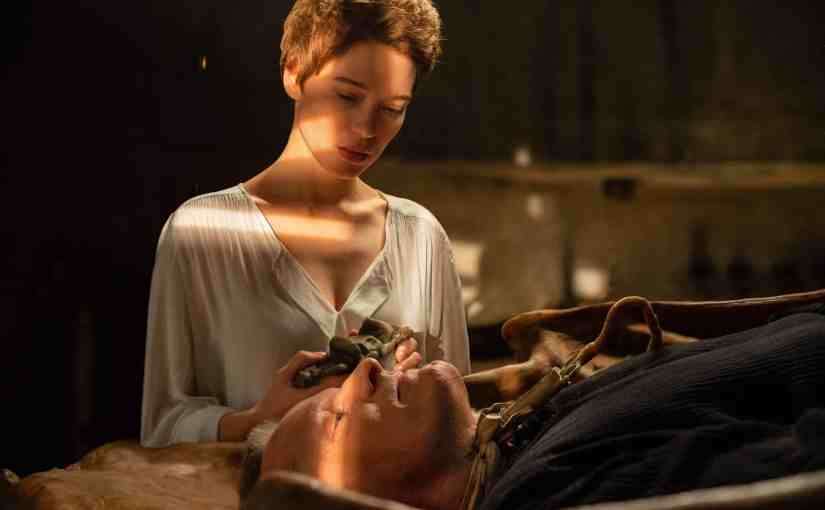
Somewhere at the core of David Cronenberg’s Crimes of the Future is a crackling good thriller waiting to happen.  I was still waiting for it when the end credits rolled.  I couldn’t predict what was going to happen next, which is normally a big plus for me, but the problem was, I didn’t care what was going to happen next.  Just when the movie seemed about to kick into a new gear story-wise, boom, credits.  Shame.

In the near future, human bodies worldwide have started undergoing bizarre mutations involving the development of new internal organs and the disappearance of a pain threshold.  This leads to the proliferation of underground performance artists who are either publicly mutilated or mutilated themselves.  Why?  Because Cronenberg.  We get close ups of the lead character, Saul Tenser (Mortensen), lying in a special chamber while knife-wielding robotic arms controlled by his partner, Caprice (Seydoux), slice, probe, and excavate his thorax in search of unwanted new organs.  Another performer lies in a chair while a surgeon literally cuts grooves into her face.  Yet another performer has grown dozens of additional ears all over his body, and has his eyes and ears sewn shut while he dances to modern music as a voice intones, “NOW is the TIME to LISTEN.”


This is all typical stuff from Cronenberg, who was and is a virtuoso of so-called “body horror,” going all the way back to Scanners, Videodrome, and the remake of The Fly.  It’s so typical, in fact, that the sight of various bodily injuries and mutilations didn’t really faze me as much as I thought it would.  Or should.  Maybe this says more about me than about Cronenberg, but the most off-putting sight was that one dancer with the extra ears.  Everything else, while graphic, didn’t feel “real.”  It all felt like effects.  Instead of recoiling, I found myself thinking, “Wow, how’d they do that?”  (By contrast, the dancer with the ears may yet give me nightmares.)

The storyline of the movie remains maddeningly vague for the first half.  In a weird prologue, we watch as a mother performs an unthinkable act after seeing her son eat a plastic trash can as if it were made of gingerbread.  Saul Tenser seems to encourage the growth of these new organs in his own body, even though they could become harmful over time.  His assistant, Caprice, gets turned on by seeing him getting carved up in his chamber; he seems to enjoy it as well.  They call it “the new sex.”  There is a subplot about a new police division, New Vice (not terribly original), trying to crack down on people who perform these public acts of mutilation.  We watch as an unknown gentleman stalks Saul and Caprice while he eats what looks like a purple chocolate bar.  At a bar, another stranger inexplicably grabs the purple bar and takes a bite out of it himself, and immediately experiences something that makes him wish he hadn’t.

This is all interesting, cerebral stuff, I must admit.  The makings of a dystopian thriller a la Blade Runner or Gattaca (with more blood) are all there.  But the mood and lethargic pacing of the movie literally put me to sleep.  I had to rewind it several times during the first half to catch what I missed.

But then the second half kicks in.  Saul is contacted and asked to perform a public autopsy on a child who may have inherited a surgical self-mutilation from his father, a medical first which might be the signal of a true next step in human evolution, but one which was engineered by man and not by nature.  New Vice reaches out to a deep-cover agent (whose identity I wouldn’t dream of revealing) who is assisting the search for cells of bio-terrorists who are trying to alter the course of human evolution.  Meanwhile, Saul, who has been battling some kind of respiratory affliction for the entire film, is tempted with one of those purple bars.  Caprice undergoes a self-transformation of her own…

And then, when a crucial discovery is made that might change the course of the entire movie…it’s over.

How to describe my disappointment?  I was a huge fan of Cronenberg’s two entries in the genuine, “traditional” crime thriller genre, A History of Violence and Eastern Promises, both starring Mortensen.  Both films are much more conventional than Crimes of the Future, but both are light years ahead in terms of holding my attention.  I naively thought this film (with the word “crimes” right in the title!) would be along the same lines.  Am I critiquing the film I wanted it to be instead of critiquing the film it is?  Maybe I am, because the first half of the movie was so bland and stultifying that I can’t think of anything else to say about it except to compare it to something that I wish it had been.

Crimes of the Future, Cronenberg’s first feature film after an 8-year hiatus, sees him returning to a horror sub-genre that he virtually created, or at least perfected, nearly 40 years ago, and he does have something meaningful to say about what mankind is doing to itself and the planet without regard to future generations.  I just wish he had found a way to say it without boring me for the first fifty-four minutes, then leaving me hanging at the end.

ALL QUIET ON THE WESTERN FRONT (GERMANY, 2022)

By Marc S. Sanders

Edward Berger’s Oscar nominated interpretation of All Quiet On The Western Front is a massive success in filmmaking, storytelling, character and construction.  This 2022 adaptation of the well-known novel by Erich Maria Remarque does not only depict the ugly horrors of a mud soaked, gory and bloody conflict within deep dug out trenches, and on endless plains of wasteland battlegrounds.  It also provides perspective for the difficult peace talks occurring near the tail end of the third year (1917) of the First World War.  Another aspect covers the celebrated commander who leads a charge from the comfort of a German high castle while feasting on grand meals, far away from the front, steadfast to never surrender, and emerge victorious no matter the cost.

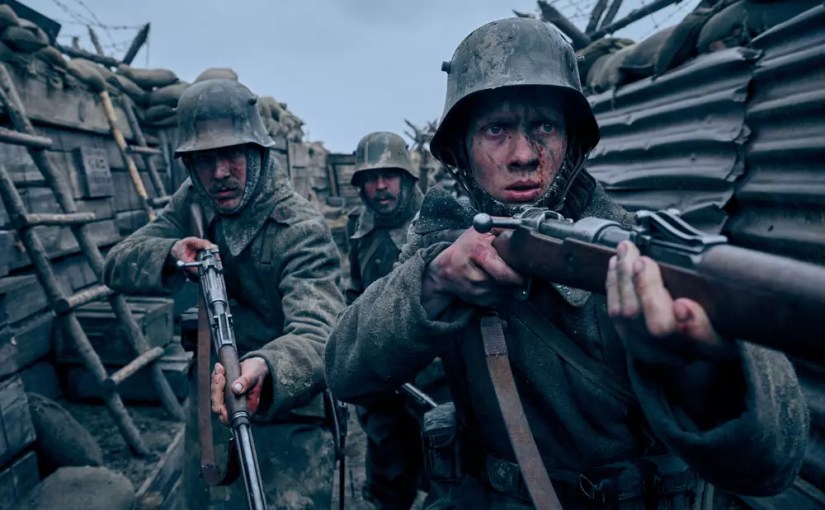
The main character is a youth named Paul (Felix Kammerer) who is eager to join the German brigade against the French armies.  He happily takes up with school chums to forge their parents’ signatures and enlist amid the reverie that greets them with cheer from his school superiors raging with heroic propaganda.  Shortly after, he is gifted an honorary soldier’s uniform, pressed, and laundered, that once belonged to another soldier who violently perished in battle.  Paul and his friends are rushed to front line of the fighting, into a muddy German trench and pushed on to slaughter in the name of his country. It does not take long for Paul to realize any derring-do he envisioned is nonexistent as men die by gunfire, grenades, flame thrower attacks and tank armaments.  If the men around him aren’t dead, they are at least dismembered with shredded, bloody stumps in place of limbs.

Elsewhere, the German diplomats travel in class aboard a luxury passenger train to meet up with French leaders in an effort to come to a cease fire.  Germany is greatly failing this conflict with loss of life, territory, supplies and money.  It’s a reluctant meeting to partake as the French are uncompromising with their terms.  Either Germany agrees to the demands of the French, or the war continues.  The Germans only has 72 hours to concur.  Coinciding with all of this is General Friedrichs of Germany (Devid Striesow) who lays out commands while dining and taking his butler service for granted.  He also sheds no tears for the soldiers beneath him as they are giving up their lives to fight a war that can’t be won.  Assuming a complete understanding of what constitutes a soldier based upon the generations who fought before him, he asks “What is a soldier without war?”; a dangerous philosophy for all others but him.

Of the modern war pictures to arrive in the late twentieth century and on (The Thin Red Line, Born On The Fourth Of July, Letters From Iwo Jima, 1917), the battle footage consistently offered a convincing and horrifying reality of the bloodshed that occurred during these historical conflicts.  These are not the John Wayne pictures of yesteryear.  Watching Berger’s film, which he co-wrote, I didn’t necessarily see anything that I hadn’t seen before, like sudden gun shots to the head, rapid gunfire, caked on mud, faces being blown off, or bodies being blasted to bits. Tanks are destroyed with grenades tossed into the cockpits and within their tracks. At times Paul even loses his sensory hearing amid the deafening battles, just as Tom Hanks’ character did in Saving Private Ryan.  Much of the material is identical to these other esteemed films.  What grabbed me though was how three storylines in this new film compound on each other.

Peace talks arrive. However, any kind of reconciliation will not begin until the eleventh hour of the eleventh day of the eleventh month.  That’s quite convenient for country leaders to agree on while sitting around a dining table within a luxury train compartment, but the bloodshed continues until that scheduled moment arrives.  Talk of peace also does not force battalion leaders to stand down.  If Germany is to lose the conflict to France, they will go down with one final victorious conquest in battle.  War does not play like a sporting contest where the officials ensure that everyone stops what they are doing as a clock runs out.  War unleashes a rampage in the pawns used to obtain territory and conquest. The fighting gets personal.  One on one fights resort to drowning your enemy in a brutal mud puddle or clubbing an attacker with a rock to the head.  A very personal scene occurs when Paul resorts to stabbing a French soldier multiple times in the heart.  The poor man is giving his last breaths and Paul needs to shut him up to avoid drawing any attention to their location, so he starts to shove mounds of dirt in the man’s mouth.  Soon after, Paul is apologizing to this man and begging his victim to hold on for dear life.  It’s a powerful scene never intended to make any sense, because ultimately in the field of battle, nothing makes sense.  Only frenetic chaos exists.

I have every appreciation for men and women who serve their country with the courageous will to protect against enemy threats and uphold domestic freedom and democracy.  Yet, endless war for achievement of gain does not necessarily translate to protection or honor like General Friedrichs preaches to his battalions from his balcony.  It’s easy for him to heed this policy, dressed in an unstained, decorated uniform with the pride of his fighting generations before him who were all hailed as heroes.  For an insignificant solider like Paul, though, when does he earn the recognition he has sacrificed?  When will his dead comrades gain any appreciation?  Paul’s greatest accomplishment is that he does not get shot and blown away as he runs head on towards a more powerful enemy.  Is that a celebration of the Germany he thought he stood for, though?  Paul encounters an awakening he never expected while fighting at the front line. 

Edward Berger controls a very detailed and forceful piece.  Every ditch or shredded body of a solider tells the real story of this bloody war that cost nearly 17 million lives.  The art direction of the trenches for both the German side and the French, located at the front lines, are endless mazes dug deeper than the heights of the even the tallest soldiers.  Vokel Bertelmann provides the blaring, monstrously echoing soundtrack to the film and uses his horn like chords as an omnipotence to this hellish environment.  His orchestra is so pertinent to the setting of the film.  The craft of makeup and costumes for all the extras and main players in the battle scenes is grotesque with extra thick caked on mud and different shades of blood reds, browns, and blacks.  The sounds of the tanks and the rattling explosions will make you wince with fear and shock for these boys running to their ill-fated doom with just a thin rifle to fight with. 

All Quiet On The Western Front has all of the common tropes of other more modern war pictures.  It works on its own though because the battle scenes are spliced in with the puppet masters, comfortably located elsewhere, who can control the outcomes of these bloody conflicts.  The delay of peace and agreement prolongs the horrifying carnage.  The fate of Paul, his friends, and all the other soldiers rests on what does or does not come to settlement from the people whose commands they serve.

This is a fantastic movie.  One of the best films of 2022.

THE BANSHEES OF INISHERIN (Great Britain, 2022)

by Miguel E. Rodriguez

DIRECTOR: Martin McDonagh
CAST: Colin Farrell, Brendan Gleeson, Kerry Condon, Barry Keoghan
MY RATING: 9/10
ROTTEN TOMATOMETER: 96% Certified Fresh

PLOT: Two lifelong friends find themselves at an impasse when one abruptly ends their relationship, bringing unexpected consequences for them both.


Is The Banshees of Inisherin slow?  Yes.

Is The Banshees of Inisherin sad?  Yes.

Does the movie have a sad ending or a happy one?  Yes.

These are not normally the trademarks of a movie I rush out to see.  In fact, I didn’t see The Banshees of Inisherin at a movie theater for those very reasons.  I had heard that, yes, it is well-written and extraordinarily well-acted, but that it was a bit of a slog.  I had hoped Banshees would be another film like In Bruges, one of the finest dark comedies ever made, but that did not seem to be the case.  So, I stayed away.

Well, I have just finished watching it at home, and I can confirm the film’s slowness and unavoidable moments of sadness, but they are contrasted with unexpected comic beats.  (I was going to say “unintended,” but they were surely intentional, further confirming the ingenuity of the screenplay by director Martin McDonagh.)  I can also confirm that this is one of the most unpredictable stories I’ve ever seen, and I mean literally, like ever.  At first, I was comparing it to Melville’s short story “Bartleby, the Scrivener”, but that turned out to be woefully inadequate.  The Banshees of Inisherin does have the structure of a fine short story, but there its similarities to Melville ends.  I’m not sure if Banshees has a chance of winning the Oscar for Best Picture, but it’s certainly one of the strongest contenders for Best Original Screenplay.

Pádraic (Farrell) lives on the fictional island of Inisherin, off the Irish coast, in the early spring of 1923.  He is stunned one day to learn that his best friend, Colm (Gleeson), has abruptly decided to end their lifelong friendship, cold turkey.  Colm doesn’t want to talk to Pádraic for any reason whatsoever, nor does he give a reason, at least not initially.  When Pádraic persists in speaking to Colm, Colm gives him a warning: Every time he talks to or bothers Colm in any way from here on, Colm will cut off one of his own fingers and give it to Pádraic, until he stops or until Colm has no fingers left.

It was at this point that I sat up and started really paying attention.  I’ve lived long enough to know the specific kind of grief and consternation that occurs when a long-term friend abruptly cuts off all contact for reasons that are not at all clear.  So I felt Pádraic’s pain, I saw it in his face, when he realized how serious Colm was with his threat.  At that moment, I drew mental lines: Pádraic was the protagonist, and Colm was the antagonist.

Of course, Pádraic is the good guy.  He’s nice!  His adult sister, Siobhan (Kerry Condon), confirms it!  I mean, sure, he’s a little dull, and maybe not all that smart, and maybe he has a pet miniature donkey that he lets in the house when his sister isn’t looking, and he’s never heard of Mozart, but is that a crime?  Is that reason enough to end a friendship?  Pádraic doesn’t think so.  I didn’t think so!  Pádraic is so full of righteous anger that he confronts Colm.  Colm is dumbstruck.  Their conversation ends in a bit of an impasse.  And then, the next morning, as Siobhan prepares breakfast, they hear a thunk on the front door…aaand you’ll have to watch the movie for further plot developments.

(While I watched The Banshees of Inisherin, my girlfriend wondered if I was watching some kind of slapstick comedy with the volume of laughter coming from our movie room.  My explanation of why I was laughing, and what I was laughing at, didn’t quite translate.)

What is Banshees trying to say?  In my opinion, perhaps it’s this: you can’t go through life worrying about what other people think of you.  When Colm lays down the law, Pádraic should have just sucked it up and moved on with his life, right?  I was originally comparing their situation to something that might happen on social media, when someone expresses a very negative view of your post or opinion or whatever.  What do you do?  Latch onto it and let it gnaw away at you?  Post rebuttal after rebuttal until you change their mind?  (Spoiler alert: you won’t.)

As I said, that kind of thinking made Pádraic the good guy and Colm the bad guy.  But then Pádraic starts making some very bad, very DUMB decisions.  He starts listening to the advice of the closest thing they have to a village idiot, Dominic (Barry Keoghan), who suggests that Pádraic just needs a new approach: tough love.  At that point, if he’s dumb enough to take advice from a moron, whatever happens next is on him, right?  So now the balance changes.  Now Pádraic is the bad guy/dumbass and Colm is the good guy.  Just leave him alone, dude.

(For the record, Colm does explain his decision, which may shed some light on his own state of mind.  Depression?  Despair?  The screenplay offers clues, but nothing truly definitive.)

All through the film is Pádraic’s sister, Siobhan, who functions as the audience surrogate.  “You’re all f*****g boring!  With your piddling grievances over nothin’!”  She is as dumbfounded as we are at Colm’s stubbornness.  Not to mention at her brother’s foolish attempts to reconnect with someone who clearly doesn’t want to be bothered.  There are a couple of moments when it seems as if all is forgiven, but alas, it is not to be.  Siobhan’s solution to rid herself of their bickering is as simple as it is final.

When the credits rolled, I found myself wondering what kind of review this was going to be.  I liked the movie.  But it is slow and sad.  But its massive unpredictability sucked me in as inevitably as if I were watching Kill Bill or Interstellar.  That’s the key factor to The Banshees of Inisherin.  You may think you know what’s about to happen, but just try to guess exactly how the movie ends, and see how wrong you are.