QUICK TAKE: Mary Queen of Scots (2018)

By Miguel E. Rodriguez

Director: Josie Rourke
Cast: Saoirse Ronan, Margot Robbie, Guy Pearce
My Rating: 6/10
Rotten Tomatometer: 60%

PLOT: Mary Stuart attempts to unite England and Scotland, but her cousin, Elizabeth I, refuses to acknowledge her sovereignty, resulting in years of treachery and political maneuvering.


I came into Mary Queen of Scots with only movie knowledge to guide me, mostly from Elizabeth, the 1998 film starring Cate Blanchett.  After watching this movie, I can honestly say that, in terms of knowledge, not much has changed.  All I learned was that Mary Stuart would stop at nothing to keep the throne, which she believed was her birthright, and her cousin, Elizabeth I, refused to acknowledge that birthright because of her religion.  I think.  And much heartbreak and backstabbing ensued, resulting in Mary Stuart’s beheading.  (That’s not a spoiler, we see it happening at the very beginning.)

This isn’t so much a BAD movie, as it is a DENSE movie.  It assumes the audience knows much more about Elizabethan intrigues than I obviously do.  It becomes clearer as the movie progresses, but for the first 20 or 30 minutes, I was a little lost.  There is some excitement during a military attack, not to mention the unexpected exhibition of cunning linguistics, but for the most part the movie is content to sit back and simply regard the drama without getting invested in the story.  It was rather bland.  Not boring, just lacking in flavor.

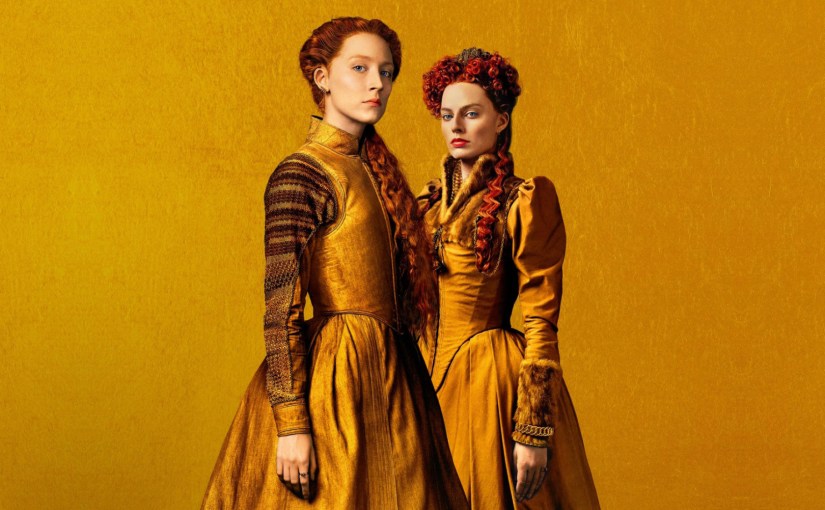
The biggest draws here are the performances from the two female leads.  Saoirse Ronan and Margot Robbie are riveting, Robbie in particular as Elizabeth I.  She disappears into the role, without any trace of her previous screen personas.  Ronan’s Scottish brogue is on point, and she brings Mary Stuart to fiery, red-headed life.  But the surrounding story density never seems to let the actors swing for the fences.  It was a muted experience.

Fans of this historical period will likely enjoy Mary Queen of Scots more than I, much as Queen fans adored Bohemian Rhapsody more than non-fans.  I wouldn’t necessarily run to theaters, though.  Maybe wait for cable or Netflix.  Yeah.

FANTASTIC BEASTS: THE CRIMES OF GRINDELWALD (2018)

By Miguel E. Rodriguez

Director: David Yates
Cast: Eddie Redmayne, Katherine Waterston, Jude Law, Johnny Depp
My Rating: 7/10
Rotten Tomatometer: 40%

PLOT: Magizoologist Newt Scamander (Redmayne) searches Europe for a young man harboring a powerful talent, but must contend with dark forces led by the notorious dark wizard, Gellert Grindelwald (Depp).


[SPOILER ALERTS!!!]

In a nutshell, Fantastic Beasts: The Crimes of Grindelwald is more exposition than spectacle, delivering chunk after chunk of background information on new and existing characters, culminating in a filial revelation that, frankly, I found more than a bit unbelievable.  (But then, I originally thought Vader was lying to Luke Skywalker, so there you go.)  The movie also has a weird habit of introducing characters and then forgetting about them, either altogether or for long stretches of time.  (Wasn’t Bunty interesting?  Two scenes, then nothing.)

But, I have to say, I loved the creatures again, just as I did in the first installment.  The obscurial, for example, is a deceptively hard creature to bring to life, and it’s just as imposing and fearsome this time around.  I loved seeing the niffler again, and who wouldn’t?  The Chinese dragon creature, the Zouwu, was the highlight of all the creatures for me, if for no other reason than the charming method used to calm it down.

I did have a problem following the action during the film’s opening sequence, Grindelwald’s escape.  In all the worst ways, it resembled one of the main fight scenes from Ang Lee’s “Hulk.”  It takes place at night, in driving rain, and a lot of the action happens too fast for the eye to follow.  I might as well have been watching an abstract screen saver.

Being a middle chapter, there were also a lot of threads left hanging, no doubt to whet our appetites for the third chapter, but frustrating nevertheless.  I felt some key information was left out in Yusuf Kama’s story.  The French witch in charge of the archives in the French Ministry of Magic seemed to know more than she was letting on…did she know immediately that she was being hoodwinked?  It was nice to see Nicolas Flamel…but who was he talking to in that big book of his?  A prophecy is mentioned repeatedly…but no one is ever able to finish it without being interrupted.  The woman who fatally pulls a wand on an auror at the big gathering in the finale was glimpsed earlier in the film.  Why?  Was she meant to be important?

I haven’t read the negative reviews of the film, but I would imagine these questions and the density of the screenplay are key points in their arguments.  I have no counterargument.  The screenplay is indeed very dense.  But the visuals are a treat, however rare they were.  It was extremely cool, on a Potterhead level, to see Hogwarts again.  (An audience member applauded when it appeared on screen.)  The creatures are, naturally, fantastic.

I can only hope that these great gobs of backstory pay off in future installments of the franchise.

ON THE BASIS OF SEX

By Marc S. Sanders

Director Mimi Leder provides a biopic on Supreme Court Justice Ruth Bader Ginsburg in On The Basis Of Sex. The movie is worth a view even if it is nothing very special.

Felicity Jones plays Ginsburg capably, even if her British accent keeps intruding into her performance. If Jones raises her voice in a debate with her daughter, all I’m hearing is Jyn Erso from Star Wars.

Leder’s film opens in 1956 as Ginsburg is depicted dressed in blue as a lone woman walking the campus of Harvard among a sea of male law students dressed in black. I’ve seen symbolism like that before. Nothing inventive here. From there, we learn she is entering the school as of one of nine women in the student body.

Ginsburg is married to fellow law student sophomore, Martin Ginsburg, played by Armie Hammer. I’m convinced if a film takes place at Harvard, Armie Hammer is going to be cast. He’s become a poster boy for the institution. When Martin is diagnosed with testicular cancer, Ruth accepts the challenge of not only attending her classes but Martin’s as well so he does not fall behind. Ruth then requests to finish her law degree at Columbia University to be with her husband. This is her first challenge as she is denied the request and its apparent because she is simply a woman. She perseveres and goes anyway. From there, Leder depicts a setting where even if you are at the top of your class at both Harvard and Columbia, if you are a woman, a mother and Jewish, then there is no job available to you as an attorney. Therefore, Ruth must settle for being a law professor.

The film jumps to 1970. Ruth’s daughter, Jane played by Cailee Spainee is a preteen ably ready to debate with her mother about the merits of Atticus Finch while Ruth continues to fall second to the male population mostly reliant on laws seem directed in preference to men over women. Don’t be too hard on our forefathers. Times have changed! Eventually, Martin introduces a case that would be perfect for Ruth to champion. An unwed man is denied a tax deduction for nursing expenses for his elderly mother. Had he been married or divorced or widowed or even if he’d been a woman, then the deduction would qualify. After all, single adult men should be out hobnobbing and earning a wage, or fighting in a war. So, if we can’t convince our lawmakers that a woman deserves the same equal rights as man, how would it appear if men were not entitled to certain rights equally? The case makes its way to the Supreme Court as Martin and Ruth team up for the cause.

All of this very inspiring and really should be seen by young students to open their minds to what they as people and American citizens are entitled to. However, I worry that if I were to show this film to my daughter, for example, she’d just get bored. Yes. You have to stick to the facts of the story and how it all played but the case that Ruth represents is kind of stale I’m afraid. If I, as a banker by day, find this case uninteresting, what should I expect of other adults and young viewers alike.

As well, Leder and screenwriter, Daniel Stiepleman (Ruth’s real life nephew), portray the opposition as tough minded, stubborn and bullish. Stiepleman might have been pushing this portrayal a little too far though. Were these great minds of debate and justice really this foolhardy and mean, or is this all for cinematic effect?

Ruth Bader Ginsburg is a hero because she’s an agent of change. Many of our current laws and those that continue to be updated must be credited to her efforts. The film primarily focuses on this one case which blazed the trail for her legacy to come. I would have rather have seen the legacy though. I bet that is much more exciting than listening to an exchange of tax law between Martin and Ruth. It just doesn’t make for good movie material and admittedly I got lost in some of the legal jargon speak. What happened exactly?!?! What now!?!?!

Jane and Ruth’s relationship kind of plays like an afterschool special. Jane did follow in her mother’s footsteps but it came off kind of hokey to me how Jane eventually participates in Ruth and Martin’s legal team. Still, this is a device that can attract young students to the material. I just think it’s kind of cheesy. There was better adult/kid chemistry and writing in Iron Man 3, for example.

Kathy Bates and Justin Theroux were kind of distracting to me as individuals who allied with Ruth. They are larger than life in this film and really they shouldn’t be. This film is about Ruth Bader Ginsburg, no one else.

On The Basis Of Sex won’t put you to sleep. I learned about Ginsburg’s beginnings a little bit. So I’m grateful for that, but as far as entertainment and insight, I’d turn to another source. Perhaps, I will seek out the 2018 Oscar nominated documentary RBG that is gaining massive positive response. I expect I’ll take away more from that film than just a dried up tax case that’s detailed over two hours.

ROMA

By Marc S. Sanders

Alfonso Cuaron’s new film, Roma, is a masterpiece in cinematography, sound, and empathetic storytelling. Shot in beautiful, multi-dimensional black & white, it tells the story of a house servant named Cleo who tends to a family living in the city section known as Roma during the year 1970 in Mexico.

Cleo is portrayed beautifully with quiet reservation by Yalitza Aparicio. I imagine this actress is not well known to mainstream audiences. Perhaps she is not well known to Mexican or Hispanic audiences as well. However, it would be so refreshing if the positive response of this film opens up opportunities for her within more widely known fare, much like Precious did for Gabourey Sidibe.

Cleo seems content to cater to the family that contains four young children and their mother. The father appears stern in his mannerisms until one day he leaves for a conference taking place in Quebec. However, allusions to this conference indicate a different story when his absence lingers on longer than expected. During this year, Cleo gets pregnant by Fermin, the cousin of a friend. Fermin leaves Cleo to deal with the pregnancy on her own, and in the moments when he returns to the story, it is not promising that he will commit to fatherhood.

Cuaron writes and directs a relatively simple story amid turmoil in a very confused country that centers on riots among the young citizens and men who are not noble enough to dedicate themselves to the women that cross their lives. Family is not convenient either. When a conclusion dawns upon Cleo near the end of the film, you can’t help but understand her position. What she has seen is gut wrenching.

To further compliment this work is to appreciate the visual sense and sound of the film. This is not a sci fi special effects extravaganza like Cuaron has accomplished with his Oscar winning Gravity, or the dystopian action depicted in his under appreciated Children Of Men (masterful steady cam work in that film, especially). Cuaron takes advantage of a crowded bustling lower middle class city with an overpopulation of dogs, planes flying overhead, music, and crowded streets of different happenings. I watched this film with my new 7 point sound system and this film is perfect proof that I made a smart purchase. Cuaron hooks your senses to engage you in his setting. Therefore, the setting justifiably serves the title of the film.

The photography is sensational as well. Cuaron hardly does a close up on any of the characters. Rather, he opts to go deeper to show there’s more going on in any one given moment than just what is in front of you. The first example of this is during the opening credits that are displayed over the course of several minutes on a tile paved driveway. First you are just looking at tiles. Then you are looking at Cleo’s soapy mop water splash across the tiles. Now you have a reflection of the sky above and you get a sense of how high the sky goes as a passenger jet plane casually flies overhead. Dimension is gradually introduced and the theme of Cuaron’s filmmaking continues on during the course of the picture.

Later, at a pivotal point in the film, when Cleo delivers her child (I don’t think that’s a spoiler), Cuaron puts the silhouetted profile of Cleo close to his lens and then to the right deeper into the room you watch as the hospital staff tend to the newborn; seeing the baby, seeing the towels held by the staff, watching the staff tend to the baby. Cleo is separated from the activity but she remains in the room, exhausted and discombobulated from what she has just experienced. A moment like this, I would imagine, would be good material for film students to examine. Cuaron proves that what you show in a moment can be limitless in the scope of a lens. Nothing is impossible.

Because the film is in black & white, the activity of the hospital staff never appears to upstage or overshadow the experience that Cleo is enduring. Had this been in color, a viewer could have been distracted by the blood and the sweat and lighting in the hospital room. It’s all there. It’s just not as distracting as a colorized moment might have suggested. Cuaron’s choice of black and white permits you to focus on everything. So, a scene like this is so wisely conceived.

Roma will likely be selected as a nominee for Best Picture and Director. It deserves it, much more so than many other films I saw in what I consider 2018 to be a weak year for inventive filmmaking. I highly recommend this film. If you don’t have a good sound system or a high definition TV to watch it currently on Netflix, then find it at a local cinema. To immerse yourself in this film, requires the best in sound and visual quality.

I will admit that it takes some getting used to reading the subtitles translating both Spanish and Mexican, and Cuaron takes his time setting up his story. You have to be patient with the film. However, I watched the film on Saturday, December 28, 2018 and I still can’t stop thinking about it.

Please check out Alfonso Cuaron’s beautiful film, Roma. I think you’ll be glad you did.

VICE

By Marc S. Sanders

Christian Bale is one of the greatest method actors working today. He’ll put on muscle mass for Batman. He’ll shrink himself down to a skeletal 100 pounds for roles in The Mechanic and his Oscar winning turn in The Fighter. In Adam McKay’s new film, Vice, Bale puts the weight to present an uncanny resemblance to former Vice President Dick Cheney. Without Bale and co-star Amy Adams as wife Lynne Cheney, Vice would not succeed. Both will be nominated for Oscars this year. McKay can expect nominations for himself and Best Picture.

McKay approaches Vice similarly to his winning film The Big Short, where a historical debacle of great proportions is told from a comedic approach. However, the gags of Vice don’t necessarily measure up to the absurdity of the real estate investment collapse of The Big Short. Cheney’s accomplishments were just too sad, too tragic, too shocking to laugh at entirely.

Dick Cheney was a drunk who suffered multiple heart attacks. He got kicked out of Yale University. His daughter, Mary, is gay. His other daughter, Liz, went into politics herself and dismissed her sister’s sexual orientation. Dick has remained married to his very wise and very aggressive wife Lynne who more or less rescued him from a wasted life. Dick Cheney shot his close friend accidentally while hunting, and never apologized for it. He was fortunate to receive a heart transplant that continues to prolong his life, and Dick Cheney became Vice President of the United States for two terms. You don’t have to like the guy but you have to admit he’s got a colorful past.

It’s all in the movie. Immediately, McKay puts in a few words of a byline that this film is based on fact to best of their knowledge but they more or less tried their fucking best.

My impression of what could be considered a very divisive film was actually not divisive to me at all actually. Bale along with McKay’s screenplay show a Dick Cheney who truly sees no other way to carry on a political career than with a silent yet ruthless touch. Later, it required more aggressive tactics not labeled as torture and not appearing beyond his authority even if he is only the Vice President. Bale has the voice down, the walk and as noted before the appearance. This film will likely win Best Makeup.

Having recently seen three potential nominees for Best Actress in The Favorite, I have to say Amy Adams as Lynne Cheney beats them all. This is not an Amy Adams we’ve seen before. Lynne is depicted as smart, aware in a mindset of no nonsense bullshit. She gets the job done, and if she had her way she’d take the job herself but she’s aware of her limits as a woman. Adams easily shows her Lady Macbeth in a scene where daughter Mary reveals herself as gay. Dick promises to love Mary no matter what. Adams as Lynne does not. Adams offers an expression that kills. Right there in this scene is her Oscar moment. This is one of the best performances I’ve seen all year.

Back to Macbeth for a moment, McKay has a great imagination for gags including elevating the fantasy of Dick and Lynne reciting MacBeth to each other in bed while mulling the possibility of becoming George W Bush’s running mate. It’s more than that for Dick. Both know this is absolute power…finally. I’d accept if their decision to run came down to something like this. It takes an ego trip to obtain power after all. If you’ve already been denied power before, the power trip only becomes more powerful on another occasion.

The Shakespeare gag works. Some others fall a little flat. Some really win. Out of the blue, prior to running on Bush’s ticket, McKay wraps up the first portion of Cheney’s life and literally rolls end credits. Then a phone rings and Cheney’s biggest story begins. The end credits moment is a great psyche out.

Vice is not a perfect movie. A huge misfire occurs midway through the end credits that derails McKay’s best effort at a neutral point of view for the Republican. It’s a moment that screams of present day chaos of opinion. McKay said screw it and folded his hand to take advantage of showing how he really feels. Before this scene, McKay and his cast embraced the Cheneys despite their hard to swallow viewpoints and actions. If you are going to make a movie about Dick Cheney or Barack Obama or Mickey Mouse you, as the storyteller, have to develop an appreciation for the centerpiece. If all you are going to do is bash and mudsling, then perhaps you are not qualified to tell the tale. McKay failed at the finish line.

Still, the journey is always interesting. There are things to learn here, things to recollect and things to question how it all came to be a reality.

A good cast is offered including a surprising appearance by Tyler Perry as Colin Powell; make a movie about this guy and get Perry back. Steve Carrell plays a buffoonish Don Rumsfeld. Was Rumsfeld this stupid and this haphazard? I don’t know. McKay uses him to play the fool and the jester. I doubt Rumsfeld has a loyal fan base ready to wave pitch forks. So who cares, really? It’s in the past.

A casting misfire is Sam Rockwell. Moviegoers are too familiar with the real George W. Bush especially in 2018 following the loss of his parents and his deeply appreciated eulogies. Rockwell teeters on 12:45 am Saturday Night Live material, as he chomps down on chicken wings, with a good ol’ boy Texas dialect. I know people want to believe Bush 43 was this stupid. I’m just not ready to accept that. Ironically, a producer on this project is Will Farrell, widely known for his George W Bush on SNL. Farrell would have been a better George here.

Compliments also go to Jesse Plemons as a narrator with an unknown connection to Cheney. Plemons’ delivery plays well on an even keel.

Vice is a complicated film about a hard man to like with little to know redeeming qualities. Adam McKay is cornering the market on films about American absurdities of the past. He’s good at this kind of filmmaking. This isn’t his best film but it still works. Just get ready to leave the theatre as the real end credits roll. Again, it’s a moment that serves the film’s worst flaw as McKay leaves his imagination at the door. Everything before that was right on track. Adam McKay…next time, don’t think too hard.

SPIDER-MAN: INTO THE SPIDER VERSE

By Marc S. Sanders

Spider-Man: Into The Spider Verse is a spectacular new take on a beloved American tradition.

You know you are in for something good when Peter Parker’s Spider-Man introduces himself by reminding the audience how we know his story and the impact his alter ego has had including a cheesy street dance (Spider-Man 3) and an awful looking popsicle stick from the neighborhood ice cream truck. Then it swiftly jumps to a Brooklyn kid named Miles Morales, a good student who loves art and loves his mom and dad as well, even if he gets embarrassed to be seen stepping out of his dad’s patrol car.

Miles resides in one universe that we soon learn is separate from other universes that each have a spider version of their own. Look out though, because the universes are about to collide thanks to the dastardly Kingpin.

I’ll save the rest of the storyline for you to check out. There are some terrific surprises embedded in Miles’ journey to becoming a Spider-Man mixed with tragedy and surprising humor.

The animation took me a little to get used to but it was not a challenge. It’s a slick rainbow of different splashes of color. The action moves fast and I even got chills when a variation of Peter Parker encourages Miles to take a leap of faith, a moment that is inspiring for any young kid no matter if they are a boy, girl, White, Black, Hispanic or whatever.

Spider-Man: Into The Spider Verse reminds you that you can be whatever you want to be. Nothing and no one can stop you. Sure, its lesson sounds trite and done before but this film allows you to soar through inspiration. It’s difficult to describe the exhilaration, really. You have to see it for yourself to understand. Some might not accept this interpretation of the wall crawler. Some will embrace it. I never expected to love this film as much as I did. I was reluctant to see it and only opted to do so, once the incredibly positive reviews came out. This film is worthy of its praise.

Spider-Man: Into The Spider Verse might just be the best animated film of 2018.

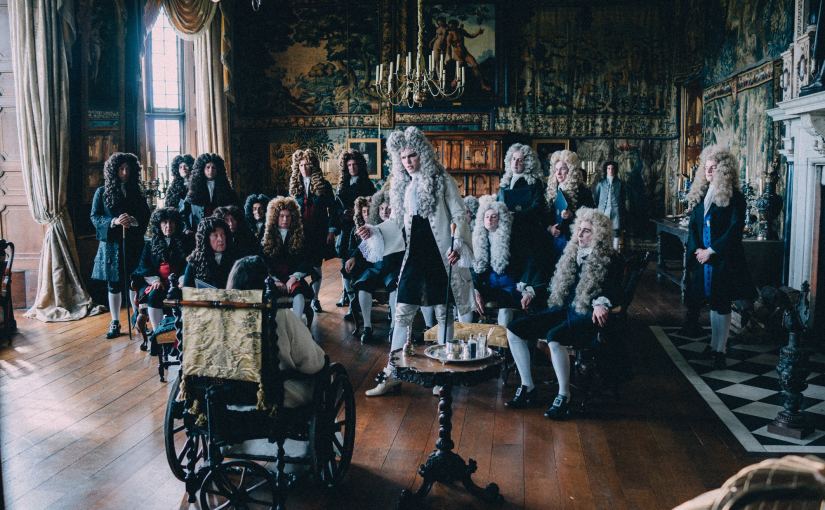
THE FAVORITE

By Marc S. Sanders

Director Yorgos Lanthimos’ The Favorite. Wow! This is a weird one.

This film focuses on a competition of one-upmanship between two ladies, one a servant named Abigail (Emma Stone); the other a close friend, Lady Sarah (Rachel Weisz) of Queen Anne during 18th Century England. As Queen Anne is frail physically, and often mentally (she insists on keeping 30 rabbits running loose in her bed chamber), Abigail capitalizes on opportunity to win the admiration of the Queen over Lady Sarah, a cruel woman in her own right. The humor is more shocking than overt or witty.

It becomes laughable to witness the shenanigans of the highest of aristocrats from mud baths to duck shooting to naked fruit tossing at one another. Sometimes, you ask why? Then again, it is probably because a lower class, say the majority of the free world, would like to stick it to the upper class and show them as the fools that they are or that we wish them to be. A royal vase is always nearby if a lady feels the need to vomit; not a bucket, a vase.

Olivia Colman is very good as the Queen, seemingly incapable of making decisions and being subtly overruled by the influence that her friend Lady Sarah carries. If the Queen really wants to reduce the taxes imposed to prolong a war with France, Lady Sarah will make certain that just the opposite is done. The Queen will unsurely oblige and back up the message that Sarah makes to the Cabinet. Sarah has no reluctance in abusing and humiliating the servants, the men in the Cabinet or anyone else, including the Queen. She will happily admonish the Queen by criticizing her makeup just as she is to meet with a Russian diplomat, thereby allowing herself to run the meeting while the Queen retreats to her chambers.

Abigail has come from wealth but due to hard times, has become recruited to be a servant destined to take care of menial tasks or be humiliated by being forced to watch an English officer pleasure himself, falling into “mud that stinks,” or taking cruel showers with a rough sponge. An opportunity arises however, when she discovers a natural way to bring relief to the Queen’s frail legs. Soon, Abigail is becoming intimate with the Queen much to the dismay of Sarah and now the cruel games of back and forth begin.

No one is really likable here. It’s a competition in royal politics, and politicians of any nature in any setting are never entirely liked. To hold stature, requires ego. Ego, however, is not a strong enough word for how these three ladies treat each other. The frail Queen is just as guilty. If she feels slighted, she will disregard those that have won her over in prior moments, particularly to her first friend Sarah and later to Abigail. When Sarah goes missing, the Queen declares she better be dead when she eventually begins to worry. If she’s not dead, the Queen will surely slit her throat. Abigail wins the Queen’s affections but will ultimately be used cruelly as well.

Eventually, all of this back and forth has to end of course, and Lanthimos along with screenwriters Deborah Davis and Tony McNamara bring in a sneaky last “stick it to ya” moment.

I’d never seen a film by Yorgos Lanthimos before. I’d heard good things about his other film The Lobster, though. Here, he’s got a camera angle I rarely see in films. There are times when a wide shot of a room, like the Queen’s chambers or outskirts of the palace are shot through the bottom of a glass, where the edges of the caption are curved outward, almost like looking at the film through a view finder or a telescope. Not sure why he opted for this technique. Perhaps it was to up the ante on the strange environment of it all; to offer a discomforting feeling towards watching this community of Establishment behave behind closed doors.

Rachel Weisz and Emma Stone are also very good. A film like this could have played like a bad day time soap opera cat fight. Yet, when you have Academy Award winning actresses like Weisz (The Constant Gardner) and Stone (La La Land), you are watching a period piece that will stand out albeit very strangely.

Yes. Once again, The Favorite is a very strange film. A good film and a weird film that takes some patience and getting used to. Four people walked out of the theatre I was in, but there was still plenty of laughter from the crowd. The best of the year, like most critics claim? Maybe not. Then again, most of the critics’ common choices for best of the year is indicative that 2018 really was not a great year as a whole for movies. I’d argue prior years have offered a better collection of films to treasure, admire, award and salute. In another year, The Favorite would be trumped by many other candidates.

AQUAMAN

By Marc S. Sanders

The next installment in the DC Cinematic Universe takes place in the ocean. Too bad the ocean is just too murky. James Wan’s Aquaman is muddied in long, boring, unsurrendering exposition and CGI. It is a film based on the most famous of all the undersea super heroes who is destined to be King of Atlantis. HE’S HALF MAN! HE’S HALF FISH! HE’S AQUAMAN, AND HE MUST BE KING!!!! That’s about all we should have to know to appreciate the storytelling of this film. However, Wan left me guessing just what the hell everyone was talking about for most of the film. King Orm (boring Patrick Wilson) declares takeover of this kingdom and take over of that kingdom and I’m like what, who, how, why???? Who the hell is he talking about? Why is this a threat? What will this mean for everyone? Shut up! Stop talking! Show me something! In the immortal words of Syndrome (from a better super hero film), “Stop Monolouging!!!!”

The first problem is when we are brought from one ocean floor to another and another and another and they all have location names like Kingdom of the Starfish Curtain or Dwelling of the Stingray Horse or some such thing. So what? These locales are literally shown for no more seven seconds before it moves to another location. This isn’t Krypton or the Batcave. We get to go to “Somewhere In The Atlantic Ocean” or “Somewhere In The Indian Ocean,” but so???? And????? Wan seems too proud to uncover these geographical areas that hold no measure.

Then there is the cast of characters. We got Dolph Lungren with a red beard, Willem Dafoe with a slicked back ponytail, Amber Heard beautiful as the love interest Mera, Nicole Kidman with her alabaster skin looking angelic as a queen and mother to Arthur Curry (the Aquaman title character) and Patrick Wilson, blond, white and curiously looking like the Hanna Barbera Aquaman during the days of Super Friends. Wilson is the big bad here and he’s kind of boring, kind of not intimidating, kind of the guy who looks too innocent to ever be cast as a villain in any film.

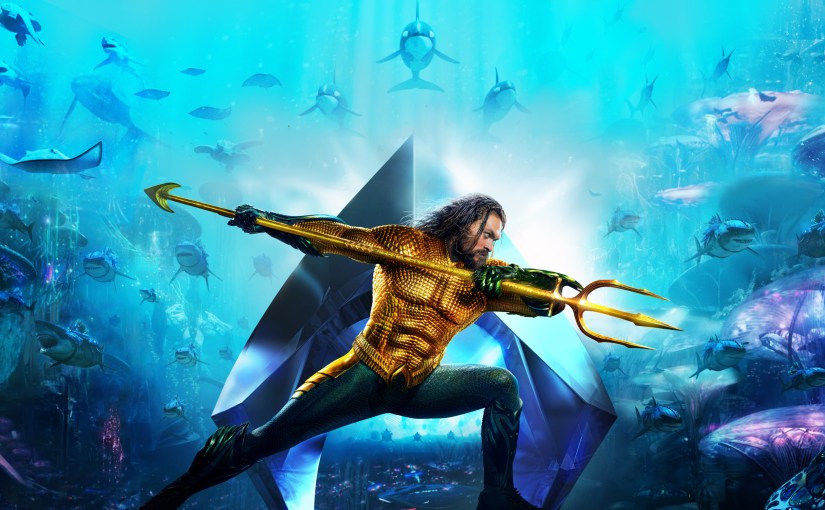
Let’s go off subject for a moment, shall we? Jason Momoa is the best thing about Aquaman and he makes a great Aquaman. I knew that when I saw him in the role in last year’s Justice League (a much better film; yes the Joss Whedon cut). Momoa is ripped, muscled and tattooed perfectly with long flowing charcoal hair, a perfect beard and sparkling blue eyes. This guy looks great on land while downing full pints of beer with his dad, or under CGI water. As I became less and less interested as the movie went on, I found it curious that the image of Momoa’s Aquaman is destined to defeat the image of Patrick Wilson’s (supposedly) ruthless King Orm, also known as Ocean Master. It’s as if the gorgeous motorcycle dude is meant to erase the much maligned (see countless GIFs and a couple of Big Bang Theory episodes) Hanna Barbera blond boy image.

The CGI does its best. After all, how else do you film a movie that primarily takes place under the ocean? It’s colorful. The effort is there. What I took issue with was the great battles between all these kingdoms. I couldn’t tell who was fighting who, who was with who, and who lived and who died, not to mention how they fight. Was it with spears? Laser guns? Swords? Hammers? Pies? What?????? I know these are underwater battles, but why can’t any of these great kingdom of kingdoms movies learn from the best like Peter Jackson’s Tolkien films or Ridley Scott’s Gladiator? There is something more literal in those grand battles. You could always recognize who was charging at whom. In Aquaman, it’s mass hysteria, riots in the ocean streets.

The villain Black Manta is next best thing after Momoa. Played by Yahya Abdul-Mateen II. Unfortunately, he’s not given much to do. He’s out for revenge against Aquaman. That’s been done before. What saves the character is the costume and helmet. Now this is a villain!!!!! He looks badass with red sonic blasts shooting out of his eyes and he’s agile; the filmmakers at least got the image and movements of this guy right. The best scene of the film takes place on land in what looks to be the Greek Isles. Lots of rooftop jumping, statue shattering, and wall breaking with good fisticuffs are in play here between Momoa and Abdul-Mateen. It’s a good long scene. Then, oh yeah, we gotta go back to Wilson and Dafoe talking about something somewhere that’s labeled with some “legendary” location amid some coral.

James Wan and the writers of Aquaman try too hard. There’s too much going on here that doesn’t belong. I don’t know how a pre teen kid nor an adult could sit through these boring conversations of fiction that is unfamiliar to many. Again, none of this is the stuff of legend like Lord Of The Rings, or Krypton, or Gotham City, or even Star Wars or Star Trek. If only Wan and crew didn’t elevate the importance of things that even they show are just not that important. Stick with the simplicity guys. At least, you got the Atlanteans riding Sea Horses. Nice touch, there!

MARY POPPINS RETURNS

By Marc S. Sanders

PL Travers’ character Mary Poppins is synonymous with the flavor of Disney. You may visit a Disney Theme Park or Cruise Ship or watch a classic film, and you might think to yourself this sidewalk, this room, this cast member’s uniform appears like something out of Mary Poppins. Walt Disney Studios and all its products would be something entirely different without the exactness of the most popular nanny in film. Ironically, until now, since 1964, has there been only one Mary Poppins film…and, well one PL Travers biography.

Director Rob Marshall (Oscar winning director of Chicago) has been recruited to bring the magical character back complete with her bottomless bag and her umbrella in Mary Poppins Returns. Perfectly cast is Emily Blunt in the role. Because this new installment that jumps to the next generation of Banks children is not a franchise reinvention, Blunt beautifully carries on the rigid mannerisms and casual magic that Julie Andrews effortlessly brought to the part. Blunt is not mimicking Andrews however. I think she takes the purpose of Mary more seriously actually. Andrews would smile at the fantasy. Blunt responds as if animated dog carriage drivers are seemingly normal. I also detected another dimension of maybe sadness or melancholy from Blunt as she observes the anguish of the children’s father Michael (Ben Whishaw, a great performer) now all grown up and reluctant to accept fantasy as a means to save the Banks’ home from foreclosure. When this Mary Poppins has to depart this family at the end, for a moment, I felt like she didn’t want to, like she needed this family as much as they needed her; not something I got from the first installment. Alas, this is 2018 and people are more attuned to the harshness of the world. Maybe Mary Poppins is as well.

Lin-Manuel Miranda adopts a cockney accent and fills the role of Jack, a street lamp vendor, all too familiar with Mary. What Dick Van Dyke brought to the original, as Bert, the chimney sweep, Jack offers to this film. Miranda is great. The best musical performer of the last five years (Hamilton, In The Heights). He opens the film with the whimsical new song “Under The Lovely London Sky” and Marshall and company make sure the audience catches on quick. It’s not “Chim Chim Cheree” but it’s a fun tune that provides a little mystery to the legendary nanny and the goings on at Cherry Tree Lane. Miranda is the only one I can think of to play this role today. Ten or fifteen years ago, it might have been a younger Hugh Jackman.

Cameo appearances abound from Meryl Streep showing another side of her not seen before as a gypsy like cousin of Mary’s, Angela Lansbury, so fortunate she is still performing, and best of all Dick Van Dyke who can still provide a little tap and two step in his spring.

Amidst an entirely new and well versed soundtrack that feels comfortably familiar, the film includes imaginative scenes like diving into an ocean through the bathtub, spinning into the animated (CLASSIC ANIMATION) world of a priceless porcelain bowl and soaring into the sky with a balloon that is just right for you. These are great scenes because they are so silly but Emily Blunt as Mary encourages you to take all this fantasy seriously. “Everything is possible,” she says. “Even the impossible.”

Walt Disney felt that way too. So without Mickey Mouse or Mary Poppins, there really is no institution called Disney. With these brands however, they are all practically perfect in every way.

RALPH BREAKS THE INTERNET

By Marc S. Sanders

You and your family are likely to be entertained with Disney’s Ralph Breaks The Internet featuring John C Reilly voicing the title character and reunited with Sarah Silverman as his trusty, spunky video game racer companion Vanellope.

Reilly and Silverman have perfect timing. Their voice work plays so well, it wouldn’t be too outrageous to see them do a live action comedy together one day.

Disney has made another winning animated film but this Ralph plays superbly as a comedy. As the title suggests, Ralph and Vanellope end up in the world wide internet and beginning with an out of control bid on an item in eBay, they cause a mess of trouble for themselves. Along the way their friendship is tested as they realize things never can stay the same forever. Honestly, Disney’s films have offered up more fleshed out life lessons in other films. Never mind though. It doesn’t weigh down the film in kitschiness.

There’s much to offer in high speed car chases with Gal Gadot as a stunning tough, leather clad roadster in a game called Slaughter Race; a far cry from the innocence of Sugar Rush but still a reminder of the violent fare offered up today. No worries, parents, it’s all shown in a G rated fashion nonetheless. As well, Ralph comes face to face with user commentary that isn’t always the most flattering and the trends of You Tube videos.

Everything is familiar to a 2018 viewer and we are seeing new things as we actually get an imagination as to how the internal workings of the internet engage with one another. It’s an invented engineering of science as we see how viruses might interact and an “Ask Jeeves” encyclopedic character voiced by Alan Tudyk rapidly presumes your question as you offer up a word at a time.

The all time highlights of the film come from the Disney Princesses and how they socialize outside of their films. It’s so hysterical. Maybe the funniest moments on screen of the entire year. Even more impressive is that the original voice actors were recruited to reprise their respective parts like Jodi Benson as Ariel, Ming Na Wen as Mulan and Idina Menzel as Elsa. You read it here first. Disney will be offering a comedy featuring all of their princesses in one film. I’m telling you. It’s coming. I know it.

Ralph Breaks The Internet is an hysterically inventive comedy. It only falters slightly in its overly long final act featuring a gigantic Ralph made up of millions of little Ralphs (just see the movie to understand what I mean), and the lessons are kinda throwaway, but the gags are fast. The animation is sharp and colorful and the voice cast is second to none.

This is a film that’s worth multiple viewings. You’ll have great fun each time you watch it.

NOTE: Stay to the end for an exceptional end credits scene. I mean its truly exceptional. TRUST ME!!