DAWSON CITY: FROZEN TIME (2016)

by Miguel E. Rodriguez

Director: Bill Morrison
My Rating: 9/10
Rotten Tomatometer: 100% Certified Fresh

PLOT: In 1978, a treasure trove of lost silent films and newsreels is discovered buried under permafrost in the Yukon.


Time travel is real.  To the past, at least.  The future’s another story.  But you experience time travel every time you watch an old movie or look through photo albums.  Light waves from years, decades, or perhaps just minutes ago are captured and stored on paper or your phone (or the “cloud”) so you or someone in the future can look at it and see what you looked like in your high school yearbook, or an old newspaper clipping, or that one candid shot from your cousin’s wedding.

You ever find an old dusty photo album in someone’s attic or a thrift store?  You open it up, and there are people’s faces, and whether you know them or not, there they are.  They may be long dead, but you are a time traveler, looking through a window into the past.

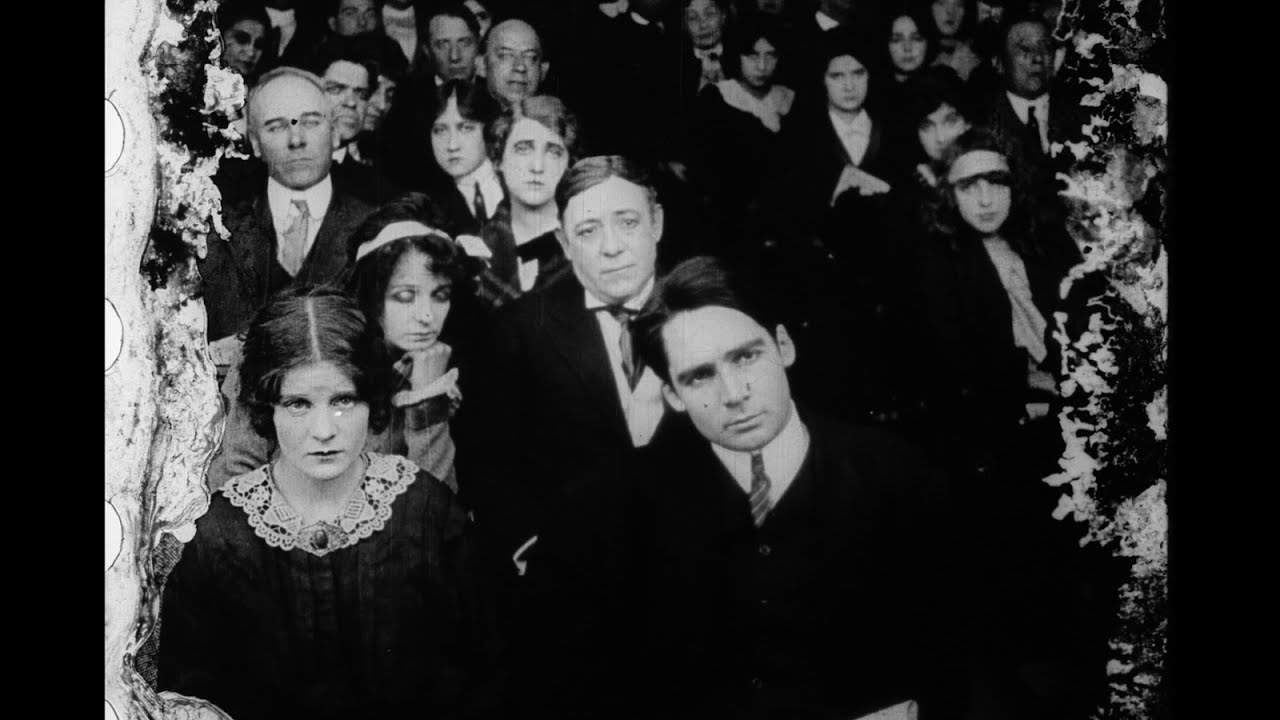
That’s what happened in 1978.  In a small town in the Canadian Yukon called Dawson City, construction workers uncovered an old swimming pool dating back to the 1910s and ‘20s.  Inside it, protected by the harsh permafrost, were hundreds of reels of old cellulose nitrate film.  These reels included old silent films long thought lost, travelogues, and old newsreels, back when the concept of the newsreel was first invented.  Back when cinema was a brand-new art form.

The story of how those films came to be buried for over sixty years is told in Brian Morrison’s documentary.  Dawson City sprouted almost overnight back in 1896 in the wake of the Klondike Gold Rush that brought thousands of prospectors to the area.  When they weren’t prospecting in the hills, all those people needed something to do.  Casinos, restaurants, and dance halls fit the bill, but at some point, someone hit on the idea of building a theater to take advantage of the new art form sweeping the nation: silent films.  Movie distributors down the coast in California included Dawson City on their list of customers, but because Dawson City was so remote, it was decided that it was too expensive to pay to have them shipped back to California.  So they asked the Dawson City officials to just store them away – safely, as cellulose nitrate film was extremely flammable.


At some point, when the storage facility got too full, those old silent films were either chucked into the nearest river or used as landfill for an old swimming pool that was converted into a hockey rink.  And there they stayed until 1978.  When they were uncovered, they were carefully packed away and shipped to facilities in Canada and the U.S. where technicians painstakingly restored the films as best as they could.

What makes Dawson City: Frozen Time so unique and compelling is the fact that this entire history is told with virtually no narration, using only titles and footage from the restored silent films themselves.  (Old photographs are also used, but these are no less haunting than the film clips themselves.)  There is a romance to seeing these relatively ancient images brought to life once more, especially the documentary scenes showing daily life in a rough boomtown.  We see old clips of men trudging up snowbound mountain passes for their shot at striking it rich.  People walking the streets looking curiously at the camera…what is that thing, they’re probably thinking.


We see newsreels featuring the likes of “Shoeless” Joe Jackson before he and seven other players tarnished themselves with the White Sox scandal.  We see a clip of spectators watching a baseball game from hundreds of miles away with the help of a telegraph and a big play-by-play scoreboard that featured little magnetic markers showing the progress of base runners in real time.  (Ever watch a fantasy football play-by-play on your computer or phone?  Same thing.)  I never even knew anything like that existed.

The silent films themselves, like all the other reels, have varying degrees of damage, especially water damage.  To try to watch one of them as an actual cinematic experience would be extremely distracting.  But as a previously closed window into the past, they are fascinating.  In my mind, it was like someone had opened a portal or a wormhole where we can see the past without interacting with it.  The warps and spots and tears only make the experience even more exotic.  It’s as if the fabric of the space-time continuum was being torn for our benefit, but it can only show us so much.

Maybe my imagination ran away with me.  Who knows?  I think this is the kind of documentary you’ll either love or hate.  All I can say is that, for two hours, Dawson City: Frozen Time made me feel as transported as only film can do.  The idea of knowing that these images were just waiting in a landfill to be discovered, and that here I am watching them now, sort of closing the circuit between past and present…it felt profound.  I don’t know if this is streaming anywhere, but if you’re any kind of film fanatic, you owe it to yourself to check this out.
FANTASTIC BEASTS AND WHERE TO FIND THEM

By Marc. S. Sanders

I really do like the Wizarding World of J.K. Rowling.   The attention to detail is marvelous.  The landscapes she has painted over eight best-selling books that follow the adventures of a boy wizard, are limitless.  A new kind of fun vocabulary was invented thanks to her colorful imagination.  Still, she needs an editor!  Even if it is not a novel, her recent screenplays that follow the escapades of another magical protagonist, Newt Scamander, and his small, distressed suitcase drift off into so many side stories, it is difficult to focus on a central plot at play.  While some might appreciate the assortment of distractions, for me it grows a little frustrating.

Fantastic Beasts And Where To Find Them (great title) is the first of what will become five new films that focus on an earlier time before the famous boy who lived was ever born.  Rowling takes the magic to New York City for the odd, but adorably likable Newt (Eddie Redmayne) to accompany his suitcase that carries the most unusual creatures that any other fantasy has likely ever introduced.  There’s a platypus duck thing that has a penchant for stealing jewelry and coin; perfect for stuffed animal merchandising at Universal Studios.  There’s a purplish-blue mosquito that twittles around.  There’s a dragon and an elephant/rhino combo thing.  There are bright green grasshoppers that hide in Newt’s jacket pocket.  It’s an encyclopedia of Rowling wildlife.

Newt arrives in Depression era New York and some of the creatures flip the buckles on the suitcase open, and before you know it, he’s chasing them through the streets.  Soon after, he gets his bag mixed up with another one belonging to a lovable baker “No Maj” (American term for “Muggle” or non-magic person) named Stanley Kowalski (Dan Fogler).  From there, a partnership is forged, and the men are pursuing the missing animals through the city bank, the zoo, tenement buildings and jewelry shops.  Romantic angles serve the men by way of magical sisters, Tina and Queenie (Katherine Waterston and Alison Sudol).

Parallel to all of this are concerns of a magic criminal known as Grindlewald who is making headlines for his various worldwide offenses.  The North American magic congress is disturbed by these events and rely on a man named Graves (Colin Farrell) to investigate.  As well, there is a No Maj woman (Samantha Morton) leading a chorus of city folk and politicians (including Jon Voight) in the hunt for what are believed to be witches and those that are committing crimes of witchcraft.  This woman serves also as a foster mother to numerous children, two of which are known as Credence and Modesty (Ezra Miller and Faith Wood-Blagrove).  These two in particular are curiously quiet with a dark way about them. 

So, yeah!  There’s a lot going on here.  There are a lot of stories to explore and a lot of characters to meet. As well, there are a lot of animals to learn about.

David Yates has become the go to director for the Harry Potter franchise and he takes up the mantle here as well.  This first film in the new series is gorgeous to look at with its period piece art design and the CGI special effects blend nicely with the human actors. 

However, the film loses itself over and over again with the different avenues it takes.  One moment we are supposed to feel the tension of Grindlewald on the loose. Then we are getting into madcap mischief with two other characters chasing down silly creatures seemingly inspired by a Jumanji theme.  We are also treated to an opportunity to literally step down into the suitcase for a whole other world of different settings where these animals are meant to be housed.  It’s wonderous for sure and Yates simply allows time for observation and nothing else.  Intermittently within the film, we also end up following these two dark children who are altogether disturbing, and we wonder why.  How and when do they come into play?  Rowling’s script is more concerned with painting broad strokes of new environments, rather than staying focused on one trajectory.  At times, I’m asking myself, where did we leave off with this storyline or that storyline.

Eddie Redmayne is adorably quirky, but maybe a little too much.  He has the “Willy Wonka” palette to his wrangler occupation. Though, his dialogue gets swallowed in his modified English accent and it is difficult to comprehend what he is saying.  He’s deliberately mumbling his words to build upon the oddities that come with Rowling’s character.  Newt has a name for each creature in the film, but there’s no way I could understand what he calls them.  I don’t even think his acting partner, Dan Fogler, understands everything being said to him.  On this latest viewing with my wife, we opted to turn the subtitles on our 4K player.

The characters are suitably atmospheric for the dark and unusual that stems from Rowling’s imagination.  Colin Farrell always plays well as the handsome, yet brooding man of mystery.  Ezra Miller seems to come from the cloth of a Tim Burton iteration.  Fogler’s character is the best though.  His expressions of stare at the amazements he’s witnessing for the first time represent the audience.  He’s not the bumbling fool that other storytellers might depict him to be.  He truly can’t believe his eyes at first, but eventually builds an affinity for the fantasy in front of him.

The ending somehow brings all of these characters together. It is engaging for sure with an action-packed encounter with a black cloud blob within the underground subway tracks. Then it is concluded with a celebrity cameo that teases of what’s to come. 

Fantastic Beasts And Where To Find Them is not unwatchable, but it requires extra attention so that you can recall where one story leaves off and then later resumes itself.  Often, I found myself asking how did I get here, and then my mind would wander and I’d get distracted from the continuing narrative. 

There’s no doubt of the kind of power and influence J.K. Rowling has.  If only someone would be brave enough to offer her a little constructive criticism, though.  The Fantastic Beasts series was originally meant to be a trilogy of films.  Then her contract with Warner Bros expanded to five films.  You know what?  With all that Rowling has to share with us, I think she might need ten or twelve films.

ARRIVAL (2016)

by Miguel E. Rodriguez

Director: Denis Villeneuve
Cast: Amy Adams, Jeremy Renner, Forest Whitaker, Michael Stuhlbarg
My Rating: 9/10
Rotten Tomatometer: 94% Certified Fresh

PLOT: When 12 alien spacecraft descend to Earth at seemingly random points around the globe, a linguistics expert (Adams) is recruited to interpret the aliens’ speech in order to find out why they are here, among other things.


“If you could see your whole life from start to finish, would you change things?” – Louise Banks (Amy Adams), Arrival

That seemingly simple question lies at the heart of Denis Villeneuve’s sci-fi brainteaser, Arrival.  Surrounding it is a film of uncommon grace, beauty, and intellectual stimulation that deserves comparison to Kubrick’s 2001 or Tarkovsky’s Solaris.  When I first saw it in 2016, I’ll admit to some slight confusion at the end, but after many repeat viewings, I believe I understand it fully enough to call it a masterpiece.

After a prologue where we witness a montage of her losing a daughter to an unnamed but ravaging disease, we see Dr. Louise Banks (Amy Adams) teaching linguistics at a university.  Classes are interrupted when news breaks of not one, but TWELVE alien spacecraft suddenly appearing at random points around the globe.  Eventually, the military contacts her and reveals that contact has been made between us and the aliens, but to say we can’t comprehend their language is an understatement.  She and a top-notch mathematician, Ian Donnelly (Jeremy Renner) are flown to the US sites in Montana and are given an impossible task: decipher the alien language and ask them why they’re here.

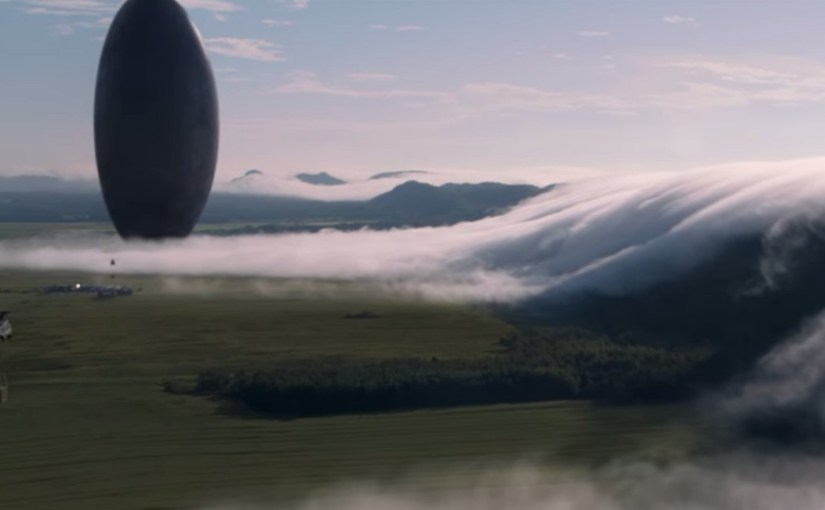
The design of the aliens and their ship are visual masterstrokes.  The ship, in fact, bears a striking resemblance to the famous Cloud Gate sculpture, aka “The Bean”, in downtown Chicago.  (Google it if you’re unfamiliar with it.)  But imagine it standing vertical on end, matte gray-black instead of chrome, and hundreds of feet tall.  Ominous and delicate at the same time.  The aliens themselves…well, I won’t spoil it for anyone who hasn’t seen it, but I will say they are called “heptapods” by the scientists.  Seven legs.  Cool.

The US researchers and military are connected via satellite to every other landing site around the globe, each attempting to make a communications breakthrough, but it’s Dr. Banks who realizes the aliens may have a form of written communication.  Using a whiteboard and simple words at first, she can have very limited conversations with the heptapods.  But when Banks is finally able to ask the all-important question, “Why are you here”, the answer she gets throws the military and government representatives into a tizzy and they cut off all communications to the other landing sites.

Meanwhile, Dr. Banks has periodically been having extremely vivid visions or memories of her daughter at random moments.  At one point, she is struggling to remember the scientific term for a “win-win” situation, and the memory comes back to her in a flash from a previous conversation with her daughter.  Although it is odd that we hear the term first in the present, and then she remembers it in the past…but enough about that.

Arrival may strike some as slow and plodding.  I suppose they’re right, in a sense.  It lacks any of the deliberately manipulative editing of, say, a Spielberg or a Scorsese film, where the cuts are specifically designed to grab the audience member by the collar and propel them to the film’s high and low points.  By contrast, Arrival takes its time.  It stands back and presents us with all the information we need to really, actively watch the film and work those brain cells.

[The score of Arrival deserves special mention.  In a film whose story arc involves linguistics and translations, it’s appropriate that, at key moments, the score includes multiple human voices harmonizing in ethereal chords or pulsing in a rhythm that sounds utterly alien, not just foreign.  A brilliant touch.]

What gives Arrival that extra push is that question Dr. Banks asks at one point in the film.  “If you could see your whole life from start to finish, would you change things?”  This question, when it comes, has poignant undertones that were not even hinted at in previous scenes.  And I find it to be incredibly moving, every time.  In fact, I wonder if I’m not really the prime target audience for this movie.  I wonder if it’s most effective for people who have lost loved ones to disease or accidents – untimely, unbearable deaths.  For those people, I cannot even begin to imagine how they would answer, or if they agree with Dr. Banks’s answer to her own question.

For myself, I have been blessed in this life, knock wood.  I have lost family members, but mostly to old age, although two uncles were taken by cancer in their fifties and sixties.  But I found myself thinking about this question today more than any other time, for some reason.  If I could magically go back in time, while retaining all my current knowledge, would I change things?

It’s deceptively easy to say “yes”, especially when it concerns the big things.  Sure, I would probably not stay as silent as I did when I learned a dear friend was being molested in high school and college.  No, I would probably not have gotten romantically involved that one time with the absolute wrong person.  No, I would most certainly not have skipped work that one day to see Spider-Man 3.  I would have remembered my driver’s license that one time I was pulled over.  I would have rearranged my schedule to go with my father and sister to Spain that one time.  And on and on.

But…if I hadn’t done some of those things…I may not be where I am now.  In a wonderful relationship with my best friend.  Working at a job that has its challenges but is rewarding and accommodating enough for me to do theater.  Surrounded by a support structure of friends that is second to none.  Able to leap tall buildings in a single bound.  Just kidding.

Your answer may differ from mine, or from Dr. Banks’s answer in the film.  That’s fine.  We all have our own reasons for our own answers to that question.  What’s wonderful about Arrival is its ability to couch that existential question in a top-notch sci-fi drama that, in its own unflashy way, is every bit as exciting and though-provoking as ten Independence Days.  It looks great, sounds great, acted great…what more could I ask for?

GOLD

By Marc S. Sanders

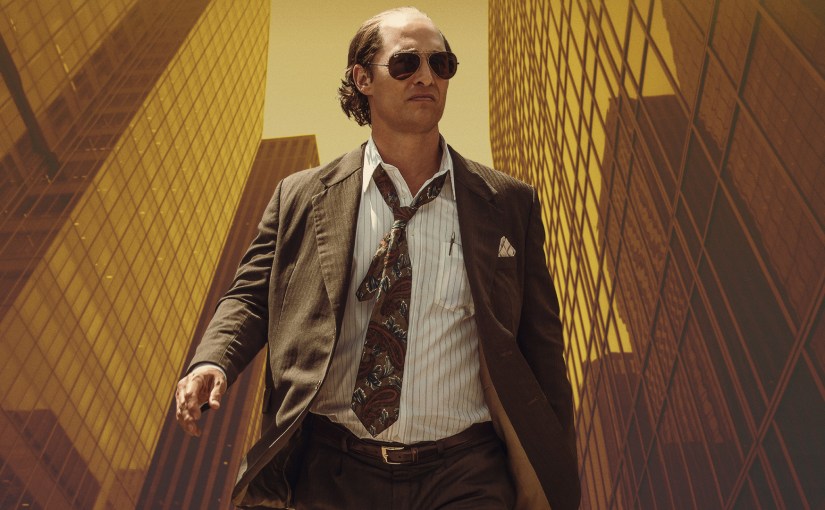
Fantastic find on Netflix with Matthew McConaughey doing his best chain smoking, hard drinking, pot bellied method acting.

Stephan Gaghan directs a patchwork film that zig zags from the sleazy get rich quick offices of Reno, NV, to the wet, mud strewn Indonesian jungles,and on to the steely ice nature of white collar New York City.

What is depicted is the hunt for the most precious metal, and when it is found how best to capitalize on it while maintaining your name and growing your fortunes. Yet any sudden development could crash it all in what seem like seconds.

I had no idea what to expect from this movie. Early on for about 15 minutes, it seemed to be moving too slow but then it picks up because the true life story is mired in twists I never saw coming. Great acting. Great script. Great direction.

Fantastic movie. McConaughey doesn’t get enough credit for his fantastic career of performances. He’s just a top notch actor in so many ways.

This is so worth checking out.

LA LA LAND (2016)

by Miguel E. Rodriguez

Director: Damien Chazelle
Cast: Ryan Gosling, Emma Stone, John Legend
My Rating: 9/10
Rotten Tomatometer: 91% Certified Fresh

PLOT: While navigating their careers in Los Angeles, a jazz pianist (Gosling) and an actress (Stone) fall in love while attempting to reconcile their aspirations for the future.


SPOILER ALERTS! MULTIPLE SPOILER ALERTS!


La La Land was greeted by the American public in one of two ways.  There was no middle of the road.  You either loved it or hated it.

Critics loved it.  It broke records at the Golden Globes that year and was the odds-on favorite to win Best Picture at the Oscars (Moonlight took the prize instead, and deservedly so).

When it came to the viewing public, people were immediately divided into opposing camps, with each trying to convince the other they were wrong.  “It’s homage!” cried one camp.  “It’s derivative and sad!” cried the other.

Me?  I’m part of the “loved-it” camp.  And after re-watching it tonight, for the first time since seeing it in theatres, I have no plans to change my mind.

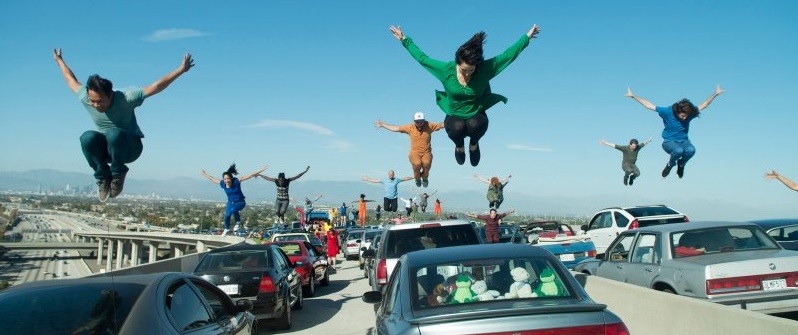
I once wrote that there is no movie more in love with “old Hollywood” than The Artist.  Well, La La Land is more in love with classic movie musicals, specifically, than any other modern movie in recent memory.  It opens with an astonishing musical number, “Another Day of Sun”, set on a Los Angeles overpass.  In a breathtaking feat of choreography and cinematography, scores of dancers perform nifty moves in and around a traffic jam, incorporating a live band inside what looks like a UPS truck, in one single take…or at least what LOOKS like one single take.  Could be some CG in there.  Who cares?  It’s awesome, and it sets the tone right away: this will be like one of those old musicals where people break into song and dance without warning.  You can stay where you are or you can leave now, but this is what’s happening.

After that, we settle in to a tried and true story of boy (Sebastian [Ryan Gosling], a jazz pianist who wants to start his own jazz club) meets girl (Mia [Emma Stone], an aspiring actress looking for a break).  This part of the story was old when Mickey Rooney and Judy Garland did it in countless other films, so yeah, I get it.  I can see why some folks called it derivative.

But that criticism neatly dismisses the underlying subplot about the Old vs. the New.  Sebastian desperately wants to start a jazz club that plays the greats – Monk, Coltrane, Davis – because, as he says in a passionate speech to Mia, jazz is dying.  Nobody wants to hear it anymore.  It’s old.  (He decries a nearby club that combines jazz, samba, and tapas, or some such nonsense.)  “They worship everything and value nothing,” he laments.

But Keith, a fellow musician (played by John Legend) tries to get him to see sense.  (“How are you gonna be a revolutionary if you’re such a traditionalist?”)  History is written by the people who strike out in a new direction.  Sebastian himself uses this philosophy with Mia, who has gotten tired of auditioning for the same teachers and doctors and coroners over and over again.  He tells her to do something different if you’re tired of the same old/same old.  She takes his advice and starts writing a one-woman play about her life.

And here’s where it gets cool.  While the characters in the movie are urging each other to embrace new concepts, La La Land still has one foot firmly in the past, i.e., the grand musical traditions of Gene Kelly and Fred Astaire and Cyd Charisse, etcetera.  Two later numbers stick out in my mind.  One is a twilight duet between Sebastian and Mia, shot on location in the Hollywood Hills when the sky is that perfect shade of somewhere-between-pink-and-purple.  They sing a little and then they do a beautiful dance together, but they’ve just met, so they’re careful to dance ALONE together…watch it and you’ll see what I mean.  Right out of Vincente Minnelli.  (Let’s be clear…Gosling and Stone are not exactly Fred and Ginger, but they do a damn sight better than I could do myself, so I give them props.)

Another number with classic-musical overtones is set during the first giddy months of their relationship.  With little or no singing (can’t remember which), we follow Sebastian and Mia as they tick off Los Angeles landmarks, finishing at the famous Griffith Observatory.  They enter the planetarium, and in a gloriously giddy moment of cinematic fantasy, they rise into the air and dance among the stars and galaxies before falling perfectly into their seats and sharing a kiss.  I no longer remember what I did the first time watching this movie, but this time around, I watched that whole sequence with a goofy grin on my face.  If you can’t enjoy watching people dancing in the stars, well…

At one point, Sebastian tells someone, “You say ‘romantic’ like it’s a dirty word.”  I like that.  This movie is, above all, romantic, in spite of how it ends.  It’s romantic in the sense that it revels in the unreasonable, illogical hope that everything will work out okay in the end.  Sometimes it does, sometimes it doesn’t, but that doesn’t mean you can’t still dream.  (There’s even a song about this exact thing, sung by Emma Stone in a sequence near the end that oozes romance and heartbreak.)

But all of this is nothing…nothing…compared to the emotional roller-coaster of the last thirty minutes of the movie.  It’s here that La La Land gets all serious in the middle of the fluff, because it explores the nature of success and what is necessary to achieve it.  Sebastian is touring with a band that pays well…but it’s not exactly a jazz ensemble.  Mia is just about ready to give up acting…until a casting agent gives her an opportunity to star in a movie shooting in Paris for four months.  These two characters, for whom the audience has been rooting for the previous 90 minutes, are on a downward spiral, and the only way to save their relationship would be for one or the other to completely give up on their dreams.  But neither of them would ask that of the other.  So they go their separate ways.

WHAT?  After all this they don’t wind up together?  Well…what would you have preferred?  An ending that awkwardly keeps them together, with him, say, playing jazz in a French club while she shoots a movie in Paris during the day?  Enjoying success together?  Having kids?  Sure, that kind of ending is POSSIBLE.  (In fact, in one of the many highlights of the movie, you even get a tease of what that might have been like.)  But, hey.  Isn’t that just the traditionalist way of looking at things?  Why not strike out in a different direction?  Do something no one’s doing.  End your movie where each character gets what they’ve always wanted their entire lives…even if that means they don’t get each other.

Boy, that last sentence sounds harsh.  But that’s what this movie’s about, and I think the film’s detractors simply couldn’t get past the grand tradition that demands the two leads wind up together.  They wanted Singin’ in the Rain, and instead they got the musical equivalent of The Remains of the Day.  (Maybe not quite that extreme, but I trust the point is made.)

ANYWAY.  Like I said, I just finished watching this a couple of hours ago, and I am no less convinced of its greatness.  Even though it’s a wrench watching their relationship head towards the rocks, the movie makes up for it at the end with half an hour of glorious, emotional catharsis that left me feeling wrung out, but in a good way.  It’s not quite a tragedy, but not quite a comedy.  Like life itself, it falls somewhere in between.

MIDNIGHT SPECIAL (2016)

by Miguel E. Rodriguez

Director: Jeff Nichols
Cast: Michael Shannon, Joel Edgerton, Kirsten Dunst, Adam Driver, Sam Shepard
My Rating: 10/10
Rotten Tomatometer: 83% Certified Fresh

PLOT: Two men go on the run with a child in tow, pursued by federal agents and by members of a cult who believe the child has special powers.


The general concept of “mystery” in a film is a subtle art.  Not enough mystery, and people will say they’ve seen it all before.  Too much mystery, and people will wonder why they’ve spent good money to be confused for two hours.

Every now and then, though, a movie comes along that shows everyone else how it’s done.  It manages to plunge the viewer headlong into the story with little to no exposition, provides just enough clues to keep things intriguing without giving the game away, and supplies a climax that is not just satisfying, but revelatory.  Prometheus is one of those movies.  So is Freaks (2018).

And so is Midnight Special, from director and screenwriter Jeff Nichols (Take Shelter, Mud).

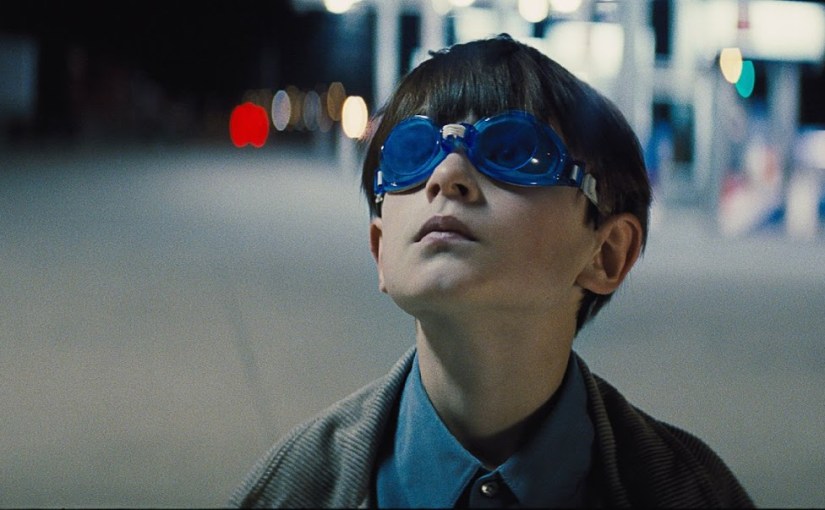
This movie grabs you right from the opening minutes.  Two men appear to be holed up in a hotel room with a young boy wearing blue swim goggles.  Cardboard and duct tape cover the windows.  A news broadcast on the TV reports on the young boy’s kidnapping.  However, he does not appear to be distressed in any way.  One of the men may or may not be his father.  He goes willingly when they vacate the room and hit the road.

In another part of the country, a pastor watches the same newscast with concern.  He later leads a church service, but the scripture reading consists of non-sequiturs and random numbers.  The FBI interrupts the service and hauls each and every church member in for questioning about the missing boy.

What the deuce is going on here?  How is this church connected to the boy?  Where are the two men taking the boy?  What’s with the blue goggles?  What is so important about this boy that the two men with him would be willing to kill for him?

These are all very good questions.  Whenever the movie takes the time to answer one of the questions, two more spring up in its place.  And I may as well tell you now: not every question will get an answer.  But instead of feeling frustrated, I just got more and more involved in the film.  I felt like I was an active participant in figuring out the story, along with the characters.  There’s nothing quite like feeling involved in a movie, rather than simply watching a movie.

When the revelations arrive about where the men are headed with the boy, why they’re headed there, and why the FBI is interested, I’m not gonna lie, I was gobsmacked.  In retrospect, I suppose I should have seen some of the plot points coming a mile away.  But that’s the beauty of the screenplay and the direction.  I wasn’t interested in trying to second guess what surprises were in store.  As a result, when the surprises arrived, I was constantly in a state of jaw-dropping amazement.

I would also like to point out the great restraint used by the filmmakers when it came to the few scenes that required CGI enhancement.  There are a hundred ways these scenes could have gone wrong, resulting in a shot that completely takes you out of the movie.  They avoided all those pitfalls and instead created scenes of startling beauty, even when things seem to be going wrong…or when they at last go right.

This is a movie that deserves to be seen with as clean a slate as possible.  It didn’t exactly make a dent in the pop-culture zeitgeist, so it’s not likely you’ll see any spoilers on the internet without Googling the movie, but why would you want to do that?  Keep an open mind, don’t ask how it ends, and find a way to see this movie.  You won’t be disappointed.

DEADPOOL

By Marc S. Sanders

Okay….so here’s where I risk getting the “What!?!? You’ve got to be kidding me!!!!” response from fellow nerds.

Sorry, but I don’t get the hype or the reason why this stupid character called Deadpool continues to have legs in mainstream comics or, now, movies.

I was hoping to see something more fun than just one wisecrack after another.

Granted, the movie consistently breaks convention of everyday blockbuster movies beginning as early as the opening credits, but it also mires in absence of story…..I mean ZERO story. NONE!!!! NADA!!!! ZILCH!!!!

I like spoofs like Airplane! especially. Now I see that I like spoofs as long as there is some narrative. I guess I want the movie to hold my hand a little as it takes me on the journey. Sue me….okay?!?!?!?

This movie has no direction, and jumps in flashbacks and forwards countless times. I can not remember a movie before this one that had, I think 4 beginnings, sorry, maybe 5 beginnings. LET’S GO ALREADY!!!!

Yes, there are some good gags that I smirked at or goodness me, even laughed at but those moments ended quickly. Ryan Reynolds is trying waaaaaaayyy too hard to channel the smart alec ways of Robert Downey Jr and he’s boring trying to do it. He makes the character and the movie Deadpool look like a stand up comedian who wore out his welcome. I was waiting for the cane to yank him off screen. (In a movie like this, that could’ve happened.)

Here’s what I recommend, buy a ticket to The Big Short (a real movie; a genuinely funny movie that demonstrates how to break the 4th wall effectively), only before it starts, sneak into the end of Deadpool to watch the secret scene at the end of the credits. For fans of John Hughes 80s movies, that’s the best part.

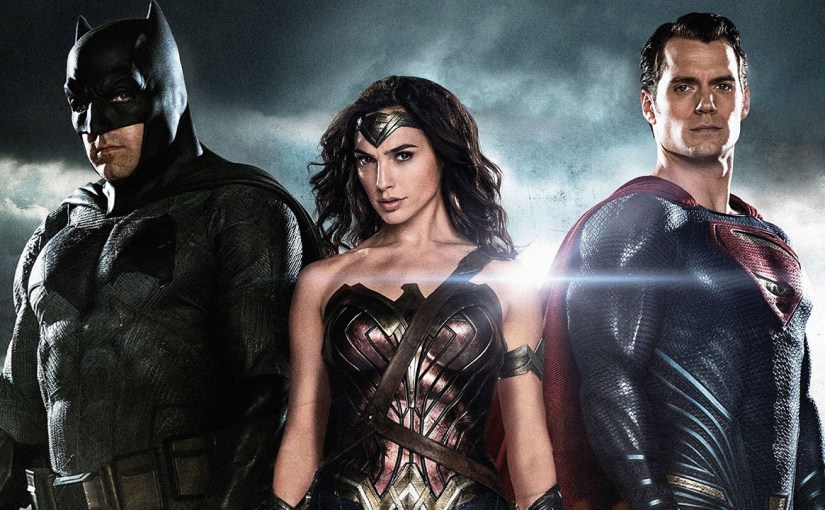
BATMAN V. SUPERMAN: DAWN OF JUSTICE

By Marc S. Sanders

Zack Snyder may have been indulging in too many cookies from the jar when he made Batman v Superman: Dawn Of Justice.  I can not deny how ambitious this film is, but did it ever need to be this ambitious?  There are too many storylines, too many characters, and not enough thought provoking dialogue to really make any sense of the gobblety gook that’s splattered all over the screen.

Reader, my favorite super hero of all time is Batman.  Nearly any variation of Batman (including moments from the dreadful Joel Schumacher films) contains an element that I just love about the character.  Ben Affleck is cast as The Dark Knight here.  He’s fine in the role.  I knew since he had done Daredevil, that he could pull off this part.  He might be too long in the tooth, and too busy an actor/director, for a new series of super hero films, but I digress.  That being said, the movies have gone into overkill on the Batman character.  It’s time the Gotham crusader hide in his cave for a little while and let some of the other super heroes out to play.  Snyder’s film proves my theory.  After all, the true highlight is neither title character in this movie.  

Actually Wonder Woman (Gal Godot) making her big screen debut is the draw above anything else here.  Even that is problematic, though.  I’ve seen this film twice now.  Can anyone tell me why Wonder Woman aka Diana Prince even makes an appearance in this film?  From a story perspective, what justifies Diana creeping into this film, other than to plaster her picture on DVD covers and merchandise a new action figure?

Events begin right after Snyder’s stellar Superman film, Man Of Steel.  An older and experienced Bruce Wayne is dubious of the benefits that Superman (Henry Cavill) can serve on Earth.  After all, his bout with the Krypton villain, General Zod, practically leveled Metropolis.  Heaven forbid if one day this powerful alien with the red cape goes out of control.  Bruce, as well as politicians led by Holly Hunter, ask a wise question.  Who on earth could ever stop him?  So Bruce, with assistance from Alfred (Jeremy Irons playing the well known sidekick more as a strategist, than a polite butler) begin preparing for a seemingly inevitable battle to eliminate the Kryptonian. 

Meanwhile, a young, brainy Lex Luthor (Jesse Eisenberg) is planning for his own undoing of both of these super heroes by living up to the film’s title; pitting the Bat of Gotham against the God of Metropolis; mano y mano.  Like most iterations, Luthor plays with defying the odds of nature.  In this case, he is experimenting with a green element sourced from Krypton which we all know is Kryptonite, as well as extracting blood from the corpse of Zod to create his own monster movie.  That last part feels like a side gig for the supposedly genius villain.

In addition, a mysteriously exotic and beautiful woman is turning up on various occasions.  Somehow, only Bruce seems to take notice of her.  Why?  I don’t know.  There’s really no purpose for him to scope out this person amid a sea of other extras attending a Luthor gala. 

There’s also Lois Lane (Amy Adams) and Martha Kent (Diane Lane).  There’s a retread of Bruce Wayne’s origin story that we’ve seen countless times before.  There’s a bitter and disabled former employee of Wayne Enterprises.  There’s a dream sequence showing vague plague like foreshadowing to come.  There’s an arms dealer/terrorist sequence in the desert for Lois to investigate, and another figure for Bruce to track.  There’s the eventual gladiator battle between the two heroes, and then there’s another battle thereafter for the two guys to team up with the the woman who carries a magic lasso to defeat a Doomsday monster; likely rejected sketches from the Harry Potter and Star Wars franchises.  Oh yeah.  There’s also some teaser material for what’s yet to come in the DC cinematic universe.

Do you see where I am going with all of this?  There’s just too much stuff here.  Eventually it all gets tedious.  A laundry list of storylines with little to no connection with one another feels burdensome.  I wish the screenwriters, Chris Terrio and David S Goyer, finished writing a script before starting another script.  As lengthy as all of these stories feel, they also seem unfinished, and, I can’t understand why.  

Forgive me.  It’s easy to compare the DC Comics film adaptations to the Marvel Comics films that Disney now owns.  The latter franchise seems well structured and outlined.  The former franchise helmed by Snyder seems rushed to catch up to everything that Marvel has already accomplished.  If the intent was to have a huge franchise of films, then why smash all of your material together in one sitting?

That gets back to my viewpoint on Batman.  Why Batman, all over again?  Snyder and the producers really aced it with the casting of Gal Godot.  She is Wonder Woman.  Snyder also struck gold on Man Of Steel with Cavill as Superman.  I wanted more exploration of that guy.  So why make this a Superman and Batman film?  We’ve seen enough Batman through the last thirty years.  Let’s give someone else a chance.  Much could have been accomplished had this installment been a Superman and Wonder Woman team up with maybe a teaser ending of a new Batman yet to come.  This Batman shows me nothing I hadn’t already seen.  There’s a new car and gadgets and cables to swing from.  It’s all been done before.  Lemme see some of what this Wonder Woman can do.  As well, if Wonder Woman is here, then tell me why she is here.  Again, she just comes out of nowhere and never explains why she’s there.  My wife and daughter tried to explain it to me.  Apparently, she wants to acquire a photograph of her with her war comrades from the first World War, and Lex Luthor is in possession of it.  Really?  That’s it?  She just needs to get a sentimental photograph back?  By the way, why does Lex have this photo, and how did she know he has it anyway?

Good stories always answer questions with more questions until it’s eventually tied off at the end.  Moments in Batman v Superman: Dawn Of Justice seem to begin in the middle of their stories with questions that did not answer questions that likely came before, and by the end of the picture, there’s no ending or answers in sight.

I had already reviewed Wonder Woman, and in that column I specifically noted that DC films with Warner Bros always seems to come close, but never gets it completely right.  This film boasts an impressive cast, and all are good in their respective roles.  My approach to this Lex Luthor from Eisenberg might have been different if I were in charge; make him more like a Steve Jobs kinda guy rather than a slight variation of the actor’s other famous role as Mark Zuckerberg.  Still, it’s not good enough and it’s hardly forgivable for what the filmmakers churned out with this picture.  The writers have an infinite wealth of source material to select from.  Pick up a comic book, guys!!!!  They have the funds and opportunity to divide up the best moments of these outstanding characters for the next ten years of film installments.  Nevertheless, they don’t take the time to think strategically, and flesh out the environments and the characters that inhabit these settings.  

Batman v Superman: Dawn Of Justice is just a sloppy mountain of peas, carrots, corn and green beans, with lumpy mashed potatoes and covered in lots of over seasoned gravy.