THE BIG SHORT

By Marc S. Sanders

Ever since Adam McKay’s The Big Short was released in 2015, it has remained a favorite film of mine. I watch it at least once every year. McKay’s script with Charles Randolph, adapted from the book by Michael Lewis, is enormously funny but also realistically frightening.

The film shows how America’s housing market crashed in the first decade of the 21st Century. Mortgage backed securities never failed in history until now, and no one anywhere, especially the banks, ever believed a crash would occur, but it did. Only a select few people like Dr. Michael Burry (Christian Bale) and Jared Vennet (Ryan Gosling) foresaw what no one else could imagine, and thus they took advantage of it by making enormous betting transactions against the housing market. To say you need a strong stomach for this kind of investment is a serious understatement.

Burry is the first one to realize that the country as a whole will default on their mortgages once their interest rates go up in 2007. He represents Scion Capital and invests billions of dollars against the mortgage backed investments. Now he watches for the next two years while the capital at Scion declines into negative digits and drowns out the frustration with death metal music. Bale is fascinating as Burry who has a brilliant mind, but he lacks social skills.

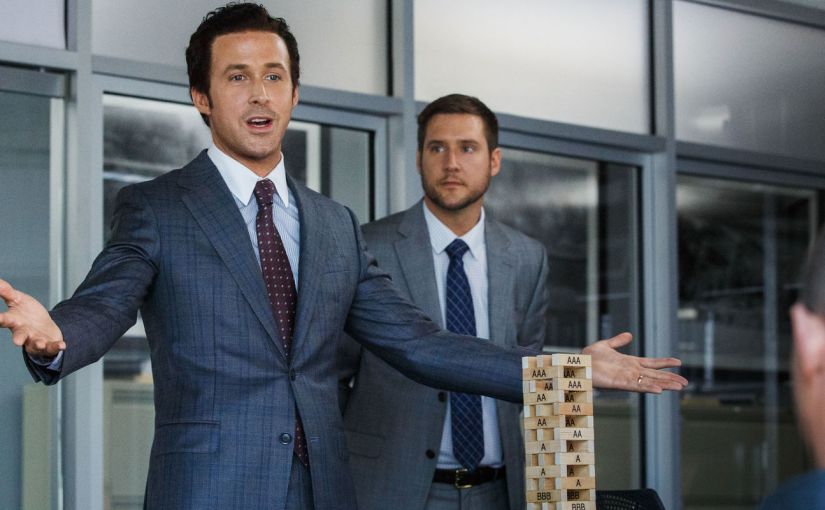
Vennet gets wind of Burry’s discovery and sells the idea to Mark Baum (Steve Carell) and his team of representatives. Vennett narrates how it all played out in the market; how ratings agencies gave triple A rankings to bonds made up of worthless backed securities. McKay wisely has Vennett introduce celebrities like Margot Robbie, Anthony Bourdain and Selena Gomez to break down the vast complexities of everything. Robbie in a bathtub. Gomez playing black jack. It’s hilarious and relatable. Gosling is great. A great scene is his selling presentation which includes a metaphoric prop of a Jenga tower. Vennet has no qualms about collecting premiums as the rest of the country is going down. He’s profiting, and why not? Big banks have been doing it for years.

Carell is spectacular as well as Mark Baum. He has a heart, but he’s an angry individual. It sickens him to make money off this short buy, but it’s the responsible action to take for the benefit of his own clients. Mark also suffers from his brother’s suicide. McKay allows just enough time for this to draw out the misery of this character. Carell should have gotten an Oscar nomination at least. Baum is a guy with no filter as he confronts authoritarian parties throughout the film. He’s a hero really, but he’s not a guy I’d ever want to be left in a room with either.

An additional story arc comes from two young guys (Finn Wittrock & John Magaro) who also uncover this opportunity. They enlist Brad Pitt as a recluse who get them into the arena of big traders. These kids who started their investment company in a garage are great as well. Another party who came out of nowhere to uncover what no one else saw.

McKay assembled a magnificent blend of actors for these unusual characters who always hid behind their computer monitors. He directs with a lighthearted approach having his characters breaking the 4th wall at times to explain what all of this means in the simplest terms.

As simple as McKay makes it with his humor, this was a terrible, terrible tragedy putting millions of people out of work and owners losing their homes. Even renters lost their homes. Pay your rent but it means nothing if your landlord isn’t paying his mortgage. McKay tragically shows this outcome.

It’s terrible to imagine, but it’s a major downfall of the American economy. When the country, is doing well, while paying short term low interest rates, no one concerns themselves with what could all go away in an instant. It’s a vicious cycle, and the only funny thing about it all is that the supposedly most brilliant investors will naively allow this to happen over and over again.

The Big Short is one of the best films made in the last 20 years.

LOOK WHO’S BACK (2015, Germany)

by Miguel E. Rodriguez

Director: David Wnendt
Cast: Oliver Masucci, Fabian Busch, Christoph Maria Herbst
My Rating: 10/10
Rotten Tomatometer: No score [never released in the U.S.]

PLOT: Without a single word of explanation, Adolf Hitler materializes in modern-day Berlin and, thanks to an unscrupulous TV station, begins to once again take the world by storm.


In the comedy documentary The Aristocrats, scores of comedians tell different versions of the same hilariously dirty joke.  In one scene, the staff of the parody website The Onion gets together in a room and tries to construct the perfect Aristocrats joke by combining every known shocking and taboo subject into their version.  Nothing is off the table: religion, politics, graphic sexual acts, nothing.  We never hear their version of the joke, but their discussion is hilarious by itself.  Look Who’s Talking, a shocking comedy from Germany, feels like someone took all the notes from that meeting, pulled out all the Hitler material, and put it all in this one movie.

…this has happened to me before.  I started a review of this movie earlier this week and abandoned it after I realized I had written over 1,500 words of mostly summaries of the action and plot.

I think the reason is because the plot and the comedy in Look Who’s Back are so outrageous and shocking that I felt I HAD to give context to my reactions.  And the only way to do that was to summarize this scene and that scene and the next.

I simply am unable to put my feelings about this movie into words, at least none that would do justice to this stunning, effective, supremely disturbing satire.

The story: For reasons that are never explained, Adolf Hitler materializes in modern-day Berlin…well, Berlin in October, 2014.  After some initial confusion, he marches to the Brandenburg Gate and tries to get some answers from the crowds of people regarding his situation.  No one will answer his questions…but a bunch of people take a second for a quick selfie with this crackpot in a Hitler costume.

At first, Hitler concerns himself with short-term goals.  After befriending a newsstand vendor, he is informed that he smells.  He needs to get his uniform laundered.  And if you don’t think the sight of Adolf Hitler trying to communicate with a laundromat clerk, who doesn’t speak German very well, about when he can pick up his dry cleaning is hysterical, this movie may not be for you.

The story expands.  A TV producer on the skids at work discovers Hitler at the newsstand and convinces his bosses to allow him to take Hitler on a road trip across Germany.  (They’re convinced because a short video of him railing against German politics has gotten a TON of views on social media.)  Then he lands a spot on a live TV show, and things REALLY start to snowball.  He writes a book.  The book is optioned for a movie.  And so on.

I assure you, this is just the bare bones of the story.  I haven’t even gotten into the innumerable scenes that made me laugh like a hyena on acid.  But I can’t describe those scenes in detail, because I don’t want to get banned from the internet.

Here is a list of the scenes that struck me as the funniest or the most disturbing.  Usually both at the same time.

  • The dog.
  • The discussion about rap music.
  • The “hand puppet.”
  • Hitler drawing sketches (badly) in a public square to earn some money.
  • The TV host in blackface.
  • The scene at the soccer stadium.
  • When Hitler visits a pro-Nazi demonstration.
  • When Hitler compares the TV network manager to Leni Reifenstahl

…and on and on and on.

The true horror/comedy of the movie comes when you realize that, for the VAST majority of scenes where Hitler interacts with people on the street, those are real people having real reactions, not actors. The things that come out of the mouths of some of these people is beyond belief. One guy tells Hitler point blank that he had the right idea about concentration camps. A shop vendor says he had the right ideas about how to run the country economically, and she’d support him if he ran for office. All on camera.

There are other genuine laughs, to be sure. The sequence where Hitler discovers the internet for the first time is worth the rental/streaming fee. But by the time the movie is over, I was left with a distinct feeling of unease. The movie depicted the sinister way in which someone with extreme views can manipulate popular opinion and catapult themselves into a position of power. And it’s not so hard to imagine what it must have been like in the 1930s when Hitler did it all the first time.

The film closes with Hitler being driven down a public street in a convertible, saluting random people as they go by. Most people are shocked. A lot of them flip Hitler the bird. But there are some who give the Nazi salute as he drives by. Are they joking?

This is one of the most effective, provocative satires ever made, and it was never released in the U.S. due to the controversial nature of some of its funniest scenes. If you can stream this somewhere, you won’t regret it. Then ask yourself: could it happen this easily today? This movie provides its own answer. Compare and discuss.

THE LOBSTER (2015)

by Miguel E. Rodriguez

Director: Yorgos Lanthimos
Cast: Colin Farrell, Rachel Weisz, John C. Reilly, Olivia Colman
My Rating: 4/10
Rotten Tomatometer: 87% Certified Fresh

PLOT: In a dystopian near-future, single people, according to the laws of The City, are taken to The Hotel, where they are obliged to find a romantic partner in forty-five days or be transformed into an animal.

[So, yeah, this is about 1,800 words of how much I disliked the majority of this movie, so this review is FULL OF SPOILERS, because it pissed me off so much…if you have ANY interest in seeing this movie, I’d seriously advise against reading this review.  I’d advise you MORE against SEEING the movie, but whatever, dealer’s choice.]


“The course of your relationship will be monitored closely by our staff and by me personally. If you encounter any problems, any tensions, any arguing, that you cannot resolve yourselves, you will be assigned children. That usually helps, a lot.” – Hotel Manager (Olivia Colman)

(That’s the best line in the movie, just thought you should get the highlight now.)

——————


I first became interested in The Lobster after discovering The Favourite, one of the very best films of 2018.  I thought director Yorgos Lanthimos’s vision and directorial style were stunningly original, and the story was exquisitely well-acted by all three of the female leads.  So, by extension, I figured The Lobster would be more of the same.  It came highly recommended by other friends, and I remember seeing it in stores with that now-familiar “Certified Fresh on Rotten Tomatoes” sticker.

Well, I just finished watching The Lobster on Netflix.  It was, putting it mildly, a major letdown.

It had a promising start.  The opening scene features a woman driving wordlessly through some countryside.  She stops on the side of the road, and as she exits the car, you can see she’s carrying a revolver.  She calmly walks into a field and approaches a nearby donkey and…well, let me just say that my attention was immediately grabbed.

Eventually, the audience is fed enough information to deduce that, for reasons left unexplained, single people from The City (it’s never referred to by its proper name) are being trucked to a resort hotel in the country.  Their personal possessions are confiscated, and they are assigned small rooms with single beds.  They are calmly informed that, if they manage to pair up with another hotel guest, they will both be relocated to a room with a queen bed, and from there to a yacht.  (They are mum about what’s supposed to happen after that.)

If, however, you are unable to pair up with someone after 45 days, you will be literally transformed into an animal.  You are permitted to decide which animal.  Well, naturally. (David, our “hero” (Colin Farrell), wants to be a lobster if his time comes, although not for any reasons that Phoebe Bouffay might celebrate…)

So…yeah.  You’ve basically got Logan’s Run meets Black Mirror.

—————–

For the first section of the film, taking place mostly in and around the resort, I was mesmerized.  It felt like the best films of Spike Jonze, or even Monty Python.  For example, The Hotel strictly prohibits masturbation.  When John C. Reilly’s character breaks this rule, his punishment is bizarre but, I would imagine, 100% effective.  (And let me just say, it’s probably not what you’re thinking.)

Another bizarre moment: sexual intercourse with any other guest while still single is also strictly prohibited, but as part of the “treatment” for a single person, once a day, a maid comes to your room to replace any tranquilizer darts you may have used the previous night (long story) and then performs, for lack of a better word, a lap dance.  This dance, while technically “erotic”, is drained of any sexual chemistry.  It defies description.  It is one of the most bizarre things I’ve seen on film in recent years.

Now, I LIKE bizarre.  This whole opening third of the film is right up my alley.  I had literally NO idea where any of this was headed, and that thrills me. But then…disaster strikes, at least from my point of view.

David, Colin Farrell’s character, can take it no longer and engineers an escape from the Hotel.  In the surrounding forests, he discovers a band of Loners, single people who survive off the land, as they are unwelcome in The City.  They pride themselves on being able to do what they want where they want (as long as it’s not in The City), but they ALSO have strict rules about not pairing up.  Masturbation: A-OK.  Hooking up: VERBOTEN.

From an allegorical point of view, I believe The Hotel represents the cult of Couplehood, or Marriage, if you like, that tends to assault single folks, in one way or another, their entire single life.  (Argue with me all you want, but if you want concrete examples, look no further than television commercials, game, set, match.)  On the other end of the spectrum, you’ve got the cult of Singularity [my own name, not from the film], the folks who love being single so much that, when their friends couple up, the single friend backs off from invitations and begs off of parties and fades away, because who needs that pressure, am I right?

So the rules of the Loners make sense from that perspective.  But…from a STORY perspective, the movie comes to a stop once David finds himself in that forest.  He meets a beautiful woman (Rachel Weisz, credited only as “Short Sighted Woman”), they flirt surreptitiously, they develop a forbidden relationship, they go undercover into the city with another faux couple (just to prove they can, I guess), and then they are discovered by the leader of the Loners.  The Loner leader tricks Short Sighted Woman into seeing an eye doctor on the pretense of getting her vision corrected, but instead, the doctor [SPOILER ALERT] blinds her as punishment for her transgression.

BLINDS her.  Don’t you think a severe tongue-lashing and two nights without food or water would have sufficed here?  I mean, what the actual f***?

At this point, I was getting tired of this story.  I felt bogged down by melodrama after a seriously promising start.  (For example, the way in which the forbidden relationship between David and Short Sighted Woman was discovered was absurdly preventable; it felt like something that happened only because the screenplay required it, not because it was something the characters would actually do.)

——————————

So, now we’re at the REAL reason I disliked this movie so much.  If you’ve stuck with me this long, we’re at the home stretch.  MAJOR spoiler follows, so last chance to bail.

David and the newly-blinded S.S.W. engineer a second escape and wind up on foot on a country road, presumably heading into The City.  At this point, I made a startling realization.  From an allegorical point of view, David and S.S.W., at least to a small degree, represented my relationship with my own girlfriend.  They were in a relationship, but not an officially “sanctioned” one (Marriage), so they don’t belong in The City.  And they’re a couple, but not truly “single”, so they don’t belong at The Hotel.  They’re in relationship limbo, at least as far as cultural designations go.

I was like, “Hey!  Finally, a movie that acknowledges a relationship like mine!  …although I certainly don’t feel like I’m navigating a no-man’s land, but at least we’re being represented in some small way.”

So.  They wind up at a diner, where David makes a decision: he will blind himself with a steak knife.

What.  The f**k.  What is this plot point supposed to represent in this allegory?  The need (requirement?) for one partner in a relationship to make drastic changes to themselves, physically or otherwise, in order to belong with the other person?  I understand the need for change and compromise in ANY relationship, but here’s my two cents: if you decide your relationship depends on you BLINDING YOURSELF for your partner, you need to check yourself before you wreck yourself.

So, picture the scene: David leaves blind S.S.W. at the table and heads to the bathroom.  We see him preparing to do the deed.  The knife is in his hand.  He stuffs paper towels in his mouth to stifle the screams that are sure to come.  He holds the steak knife with the point JUST about to penetrate the eyeball.  Suddenly, CUT back to S.S.W. at the table.  Waiting.  And waiting.  And waiting some more.  A waiter refreshes her water glass.  She continues waiting.  Through the diner window, construction is in progress across the street.  She waits.  And waits.  And waits.

Suddenly…CUT TO BLACK…ROLL CREDITS.

Reader, I am being 100% truthful when I say, at that point, I literally flipped the double-bird at my TV screen and yelled out, “WHAT THE F**K!!!”

I mean, seriously…what is the POINT of that dangling participle of an ending?  There are only three possible outcomes: he blinds himself and returns to S.S.W., OR he chickens out and returns to S.S.W., OR he chickens out and bails on S.S.W.  Since we get the Schrodinger’s Cat ending, it is simultaneously ALL of those endings and NONE of those endings, which is extraordinarily FRUSTRATING BEYOND BELIEF.  I got NO resolution to the story OR the characters.  Do they try to find safe harbor in The City, perhaps on forged documents?  Do they travel the country, taking only the back roads and taking shelter in backyard sheds or hastily dug shelters?  ARE THEY BOTH BLIND during all this?

Don’t tell me, “Well, it’s up to you what happens.  What do YOU think he does?”  I don’t know, I DIDN’T WRITE THE SCREENPLAY.  Farrell plays the character with an almost childlike simplicity, so it’s impossible to predict what he’ll do.  This serves the story extremely well in the first part of the movie, but it does the viewing audience no favors when it comes to this absurd anti-climax.

I felt short-changed and cheated at the end of this movie.  And I really liked the characters, and I liked the first third of the story, and I stuck with it hoping it would arrive at a grand conclusion, some epic, symbolic imagery that would bring things full circle or SOMETHING.  And I got bupkis.  That’s not how you treat a viewer, folks.  I felt insulted.

So.  Despite my hatred for the ending, I still give it a 4 (rounding up 1/3 of 10) because of how original and oddball the first third of the film was, and how much promise it displayed.  If they had stuck with that tone all the way through, I could see this REALLY being a gem.  As it is, I would like to quote Admiral Ackbar:

“IT’S A TRAP!”

SPOTLIGHT

By Marc S. Sanders

It’s tough to be a fair journalist when a higher power carries great influence over the what and how of honest reporting. In Tom McCarthy’s Best Picture Oscar winner, Spotlight, it’s not so much the crimes of child molestation by the hands of priests from the Boston Archdiocese that are so important. Rather, it is how the facts are suppressed and the pressure to contain the truth are so apparent. Maybe it finally took the will of a new editor, a Jewish editor from New York, named Marty Baron (Liev Schrieber), at the esteemed Boston Globe newspaper to get the special section crew known as Spotlight to work on how case after case of reported child molestation incidents were allowed to occur for decades under the eye of the highest powers in the church.

First, it’s important to note how easy it is for a priest to seduce a young boy. He welcomes the boy for special duties within the church. Then the priest and child may share a dirty joke together. Just their little secret. After that, touching occurs which leads to unimaginable and irreversible damage. Yet, the grown man once considered that special attention he received as a direct link to God himself. McCarthy deliberately repeats that viewpoint from more than one victim in the film; it was as if God had selected them for special attention and God was especially speaking to them. None of this could be more patterned.

Marty Baron counts on his team to not only collect the mounting number of cases. He tells them to uncover an even worse truth and that is the systemic response the church upheld where when a new case comes to light, a deal is worked with a pawn for an attorney to give settlement hush money while the priest in question will take sick leave or simply be reassigned to another church location free to do God’s will while also committing his own willing nature.

The Spotlight team consists of Mark Ruffalo and Rachel McAdams as well as Michael Keaton. All of their true to life characters were born and raised in Boston. Some under Catholic influence. So the conflict for them to do their jobs ethically and morally is challenging when faced with literally going up against the one institution that seems to own the city of Boston without it showing on paper necessarily. It also means coming to disheartening terms with their own upbringing.

To convincingly depict the grasp the church has on the politicians and newspapers in the area, McCarthy shoots a lot of his talking scenes outdoors on public benches and sidewalks. Therefore, you get an almost claustrophobic shadow of how close the Catholic Church is to the city’s residents. If a scene is at a dinner party or cocktail hour, a man of the cloth is nearby. A sidewalk stroll between a victim and a reporter seems to tread carefully. You never know if that cathedral on the corner is listening. Spotlight is primarily a journalism film of the highest standard. The pursuit for the truth is ripe with the obstacles of slamming doors when trying to get a statement or dealing with the unfair reveal of no records that legally are meant to be public. There’s a race to get the whole truth before a competing media outlet grabs it and misconstrues it. As well, what happens when a bigger story suddenly takes precedence and this story must be put on hold. I mean how do you not drop everything to report on 9/11?

Spotlight is another important film as it does not compromise in its true to life storytelling. It’s unfathomable to believe that men of God could use their positions to take advantage of the innocence of children and then refuse to accept responsibility for it. Even worse is the egregious actions taken to modify the authority of local law enforcement and judicial objectivity that should be there to protect the rights of these victims.

Tom McCarthy’s piece is excellent with a cast in top form. It would have to be as the screenplay is peppered with conversation after conversation. This is a newspaper film. So therefore it’s a talky piece. You get passionate monologues from Ruffalo who does not hold back his anger and disgust at what he uncovers with an acerbic but crusading attorney played beautifully by Stanley Tucci. This attorney has lost every battle he’s had with the church but he does not give up on his client victims either. He’s their only protector in an arena of powerful criminals who hide behind scripture.

You also have a real go-getter reporter in Rachel McAdams. McCarthy repeatedly shoots her from behind walking the streets of Boston with a pad and pen as she meets a victim or simply knocks on neighboring doors for some facts. Her challenge is seeking the truth while her grandmother holds an undying faith in religion of Catholicism by visiting the church at least three times a week. A crushing, albeit brief, scene occurs near the end of the film when the reporter’s grandmother reads her final story in the Spotlight section.

Michael Keaton is the Irish Bostonian rooted in tradition. He knows all the important people in the city. He knows Cardinal Law who runs the church and he holds on to his journalistic code of fact collecting for as long as he can muster.

The truth and web of lies and deceit could never really shock me in Spotlight. I’ve heard it all before. Instead, it’s the knowing acts of concealing horrifying sin. Ironically, those actions are committed by those that listen to the confessions of its sinful disciples. As I’m of an age where I question the validity and need for religion in our upbringing, I can’t help but wonder how these victims would have turned out had religion never became a factor in their lives. These children, now men, went on to commit suicide, become chemical dependent, and occasionally became child molesters themselves. It’s easy to argue that these conditions were never part of their chemical make up. It’s also easy to argue that the Catholic Church carelessly determined the destinies of these men without any regard for being accountable of the damaging results. Spotlight confidentially reaffirms both of these arguments.