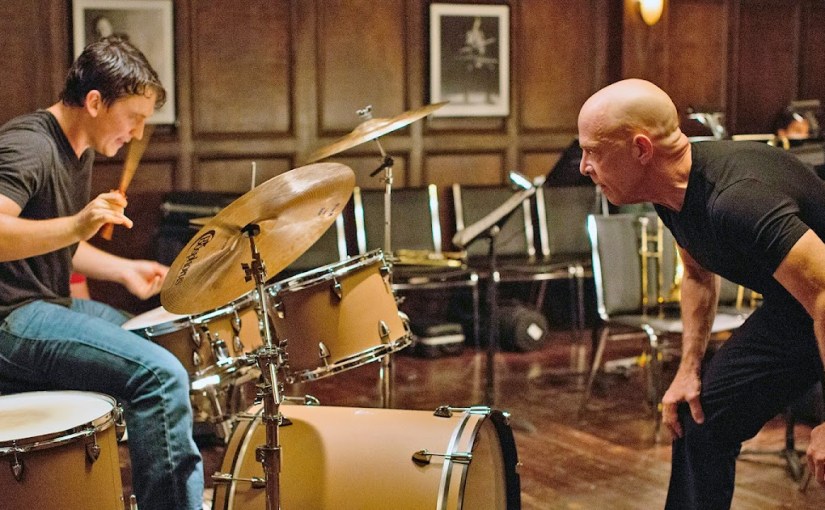
WHIPLASH

By Marc S. Sanders

It’s impossible to find absolute perfection.  I don’t care if it’s in the field of medicine, law, mathematics, art or even music.  No one is THE ONE.  Yet, if you are determined to partake in that hunt, it’s likely you’ll scream with frustration.  You might think you’re on to something but still it’s not quite the one.  Maybe, however, you will force your search for the one if you throw a chair at your gifted student, scream some of the ugliest obscenities, impose threats, slap him, allow the tears to run, force a literal blood draw, or sweat them into numbing exhaustion.

Whiplash is the name of a piece of jazz music originally composed by Hank Levy.  It is also the title of Damien Chazelle’s brilliant first film, and the best to come out of 2014. Allegorically speaking, the term takes on a harsher connotation.   The word whiplash gives me an image of torn skin and hot, dripping blood.

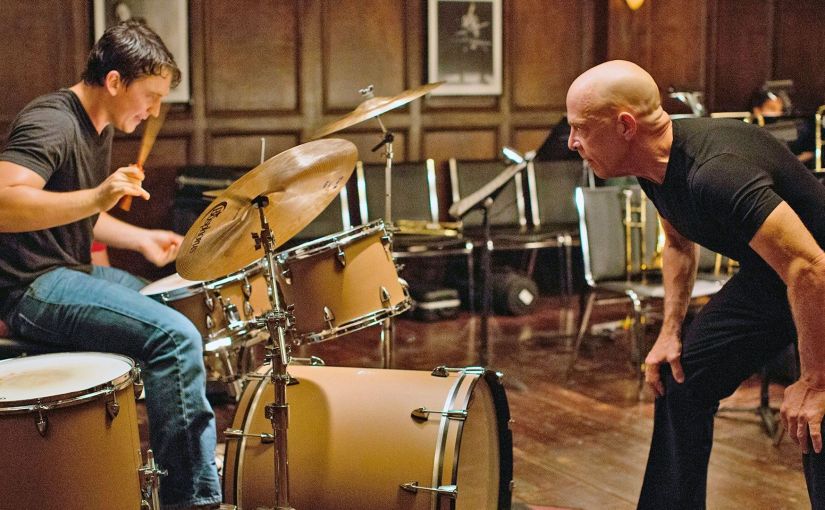
Andrew (Miles Teller) attends the Shafer Conservatory in New York.  He’s a jazz drummer who gets hand picked by the esteemed conductor Terence Fletcher (J.K. Simmons, in a well deserved Oscar winning role) to join his elite class.  Mr. Fletcher is cordial at first and a little instinctive as he’ll stop his musicians short of getting past one note before asking them to start again.  A hand gesture with a headshake and a wince.  Now go again.  Another gesture.  Go again.  One more gesture.  Again. Now an outburst of violent rage.

Individually, Andrew and Terence are determined with unhealthy mindsets to obtain levels of achievement that appear impossible to grasp.  The boy wants to get to where his drummer idol Buddy Rich plateaued.  The teacher wants to find the next Charlie “Bird” Parker.  These men of different generations are terribly talented.  Terribly I say because their passion for music is their self-imposed and cruel undoing.

Chazelle has much respect for the field of contemporary jazz.  I like jazz but I know nothing about how a piece is assembled so rhythmically among an assortment of instruments from the drums to the harp to the cello to the 88 keys and the various horns.  Put them all together, and there’s an atmospheric magic to what’s churned out.  It’s beautiful and bewildering.  Complicated, yet mesmerizing.  In Whiplash though, the music may be the worst antagonist because the frustrations that arrive with trying to become a master are unforgiving.

A late scene in the film shows Terence Fletcher, an altogether tyrant of a teacher, playing melodic nightclub piano in a bar.  He’s applauded and appreciatied as he presses down on the final key.  He thanks his audience with a nod.  Nevertheless, J.K. Simmons shows a different level of frustration.  Up to this point, the actor’s character has been a series of screaming eruptions.  In this moment, the man looks like he wants to cry.  No matter what he plays or how well loved he is, Terence Fletcher knows it could have been better.  So, if he lives with his suffering, then he will teach his best students to suffer through music as well.

Andrew is on the cusp of living his own life.  With a mother no longer in the picture, he still shares movie times with his father (Paul Reiser) perhaps so his father can still be a father, or maybe it is to remain a child to someone.  He’s starting a what could be a promising relationship with a girl named Nicole (Melissa Benoist), but his need to be a better drummer interfere and the only way he’ll know he’s at least as good as Buddy Rich is if he satisfies his teacher.  That’s the only sure sign.  

Does Terence turn Andrew into a monster, or is it the music?

This will always be one of Miles Teller’s best roles.  He’s got that innocent, quiet way about him, but as he gets “mentored” by this new composer, he changes.  He becomes devoid of care for Nicole and rebellious towards the lack of respect he receives from family and fellow students.  Like a chess champion, the art of drumming turns the drummer into an unloving creature soaked in blood and sweat.  This ongoing trajectory might make him a better musician but it will also bring him to an end result that matches his teacher.  

Beyond the energy of the music, Damien Chazelle steers a thrilling duo.  Simmons is an outstanding villain as a guy you can only hate until you see the motivations he’s only trapped himself into.  Only then you might just sympathize. Teller is circling the waters of a dangerous relationship with music.  Chazelle allows his picture to swim towards defiance with bloody and painful persistence. The epilogue of the film demonstrates precisely what these two men are searching for.  It’s only when you arrive at the end of Whiplash do you realize and empathize with the internal and physical pains these people choose to weigh on themselves.

To my ears, music is a beautiful, universal language.  

For the scribes, it’s an agony they choose to bear.

STILL ALICE

By Marc S. Sanders

Still Alice is the observation of a woman whose mind gradually deteriorates from the symptoms of early onset Alzheimer’s disease.  Julianne Moore won an overdue slew of awards, particularly the Oscar, for the portrayal of the title character.  It’s a magnificently sensitive performance that will have you in tears following the first twenty minutes of the film.

Alice Howland is a revered Columbia professor of linguistics.  She has three grown children (Kristen Stewart, Kate Bosworth, Hunter Parrish) and John, her loving husband (Alec Baldwin).  The sad irony of Still Alice, adapted from Lisa Genova’s novel, is the fact that Alice specializes in teaching word origins and their formations, but she is stricken by the disease that will wipe her memory of the simplest vocabulary.  A highlighter becomes a “yellow thing.” 

The beginning of the film shows Alice functioning at her highest capacity following her fiftieth birthday.  She teaches her classes, does her daily jogs across campus, plays word games on her phone, travels across country delivering seminars and also tries to convince her youngest daughter, Lydia (Stewart) to abandon her dreams of becoming an actor and acquire a college degree.  Mixed in, however, are losses of train of thought, forgetting recipes, misplacing basic objects, forgetting appointments and getting lost during her jogs.  A quick glance over some visits with a neurologist (Stephen Kunken) set the wheels in motion of what we will witness Alice struggle with over the course of the film.  These doctor visits also teach the audience how one is examined for symptoms with simple memory tests and spelling questions. 

The film was directed by Richard Glatzer and Wash Westmoreland.  After I watched the movie, I learned that Glatzer could not speak while he was directing.  Due to his gradual deterioration from ALS, he had to resort to a computer monitor that would express his instructions to the cast and crew.  So now I’m that much more impressed.  To home in on the sensitivity of Still Alice, it only seems fitting that someone with Glatzer’s condition could co-direct this story. 

This is not a glamourous film.  Sometimes we may laugh at ourselves because we cannot think of a word or we forget a year or a name or we put our car keys in the refrigerator as soon as we come home and reach for a cold beverage.  However, when we see Alice discover that she puts a bottle of liquid soap in the fridge it says so much more.  Illnesses like Alzheimer’s and ALS strip people of the basics in living.  Having recently witnessed a friend slowly suffer and perish from ALS, I know that one disease brings you to this point with complete mental capacity while the other seems to tease you with how your mind gradually deteriorates.  Yet, like Richard Glatzer, my friend Joe did not stop functioning and co-wrote a play with me in his final year of life.  He couldn’t speak.  He couldn’t walk, but the man could write.

I have to credit the supporting cast behind Moore’s performance.  The film begins with the ease of conversations between the family members.  Before you know it, the exchange of dialogue shifts and becomes more one sided.  Julianne Moore most often shares scenes with Alec Baldwin and Kristen Stewart respectively.  She hides so well in her character’s mental incapacity that eventually, it looks like Alice Howland is not even applying the intelligence she’s collected and earned over her lifetime.  A scene in a yogurt shop towards the end of the film seems like Baldwin is the only one working.  He’s consuming his yogurt and reminding his wife of where she used to work while she sits beside him in an absolute haze of emptiness.  He simply says she is the smartest woman he’s ever known and by this point, I know exactly what he is talking about.  Moore is so heartbreaking in moments like this that I have to give credit to Alec Baldwin for maintaining his own performance against a scene partner who cannot offer much in return.

Alzheimer’s first affects the victim but also the family.  Still Alice allows time to explore the inconvenience of the illness.  There is the expected residual squabbling among the siblings.  Alice needs to be overlooked more and more as she gets sicker.  Who can be with her?  John still has to earn a living and has an opportunity for career advancement that he cannot afford to pass up.  A relocation is questioned because will it be okay for his wife.  Lydia is on the other side of the country trying to build her acting career.  Anna (Bosworth) is a pregnant, busy attorney, while Tom (Parrish) is in medical school. 

It’s also much more serious when the family learns that the gene Alice possesses has a one hundred percent chance of being passed down to the children.  This angle is touched upon for a brief moment, but then is hardly reflected as the film moves along.

Still Alice is a difficult film to stay with because it feels genuine in its account of living with Alzheimer’s.  Simple mistakes are just as heartbreaking as the big developments.  Leaving a potato in a purse is as hard to watch as seeing a mother speak to her daughter backstage, following a live acting performance. The daughter is now a stranger to the mother. 

Yes.  At times, the film feels like schmaltz you may find on the Lifetime channel, but then again you are seeing authentic, relatable performances from a cast who make up this family, especially the Oscar winner, Julianne Moore.  Alzheimer’s is an unfair and cruel disease that strips away everything a person builds for themselves in a lifetime.  Pardon the pun, but Still Alice makes sure you never forget that.

THE EQUALIZER

By Marc S. Sanders

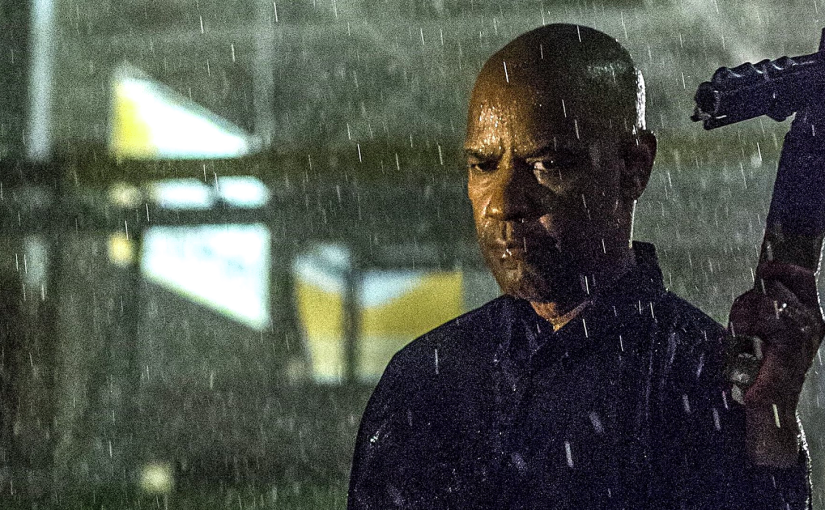
I guess Liam Neeson and Gerard Butler were unavailable when Antoine Fuqua and Denzel Washington collaborated to make the first installment of The Equalizer trilogy, based on the CBS television series that starred Edward Woodward.  This film is nothing special with a nothing special kind of script, a nothing special hero and a nothing special collection of Russian Mafia villains.  The kills are nothing special either.  The action is nothing special.  The explosions are nothing special, even when they are started by a trip wired microwave.

Robert McCall (Washington) lives a quiet life by himself, while working at a jumbo home improvement store (think Home Depot or Lowes – big places for lots of not so special action to take place at the conclusion of a not so special movie).  Turns out McCall, who also lives with OCD, is a retired special ops commando.  Robert uses his down time to read one of a hundred books that should be read before you die, while sitting quietly in a coffee shop each night.  He also volunteers his assistance with getting people to improve their lives.  A plump co-worker named Ralphie (the go to name for fat guys) played by Johnny Skortis is on Robert’s strict diet regimen to lose enough weight so that he can be promoted to the store’s security guard position.  Skortis occupies the best and most interesting character in The Equalizer.  During the final action sequence, it’s what Ralphie does that earned my one cheer during the course of the picture.

Robert also becomes acquainted with a young lady named Teri (Chloë Grace Moretz) who has aspirations of becoming a singer but is weighed down by her call girl commitments to members of the Russian mob.  When Robert sees that Teri has been beaten and is in serious trouble, he doesn’t wait to be asked for help.  He just does what is necessary to even the score.

That about does it for The Equalizer

No.  Seriously.  That’s all there is to it.  And so I’m very disappointed. 

First, Denzel Washington does not even look like he’s trying.  His demeanor to this character is no different than what he did in the lousy Man On Fire, directed by Tony Scott.  The script to this film is not challenging in the slightest.  Like Man On Fire, The Equalizer is simply a series of scenes where Robert torments his villains.  David Harbor is a corrupt Boston cop who gets trapped in his own car, while Robert runs a garden hose from the exhaust pipe to the inside with the engine running.  Where is the entertainment in this?  Washington sits in a chair while he mechanically opens and closes the car window and Harbor gasps for breath.  McCall is inventive with his methods but it does not lend to any story progression or character depth.  I guess Robert McCall is an artiste – one who specializes in torment, torture and death.

The climactic showdown, within the store, is a great set up for some tête-à-tête methodology to happen, but all of it is executed with little interest.  Here’s where I asked myself a question.  McCall nabs a guy in a makeshift kind of bear trap down aisle 10 (I guess).  The thug gets his neck caught in a barb wire noose and up he goes to the second level of pallet platforms for McCall to stare the guy down while the blood squirts out from his throat.  There’s four or five heavily armed other guys roaming the store, but McCall can take a break to stare this guy down for his last breaths.  If this trap works so well with this one guy, then why not set up six or seven more of these MacGyver contraptions and let each machine gun toting baddie go through the same routine?  I know.  I know.  Miguel would respond, “because then there would be no movie!”  Yet, what does that say about The Equalizer that my mind drifts to this idea?

Later in the sequence, McCall easily walks up to another thug from behind and delivers a power drill to the back of his head.  Then he puts the drill back on the shelf.  Again, if this worked so efficiently and covertly, why not just do it again? And what is so exciting about a power drill anyway if Jason Vorhees isn’t using it?

A nail gun is used a few minutes later and Fuqua opts to just have Washington shoot one nail after another into his opponent.  Bang – Nail – Cock! Bang – Nail – Cock!  There’s no pun or one liner.  There’s just a bad guy who falls to one knee, then an arm goes down.  The machine gun lets off a few rounds and drops to the floor. There goes the other knee and then he’s dead.  Washington just observes the guy die while the sprinkler system drenches him stylistically in slow motion. 

I look at The Equalizer and I think back to the ‘80s actioners from Schwarzenegger, Van Damme, Stallone (some of them), Jackie Chan and even Seagal.  The Rock had fun with a few of these action pieces too.  Go check out The Rundown.  There was a pizzaz to the hero’s methodologies back then.  It wasn’t just a brutal killing and bloodletting.  A one liner accompanied the kills.  It made you cheer and applaud.  Those pictures worked like symphonies of dialogue and ultra cool action that John Wayne never accomplished.  Robert McCall is boring.  Just boring.  An absolute bore.

The villain of this effortless piece is also boring.  Marton Csokas did not advance his career with the lack of anything beyond his Russian dialect and three-piece suits used in this picture. 

Antoine Fuqua has yet to wow me.  Though I know he’s an accomplished director, Training Day always feels like it comes up short with the three or four times I’ve watched it looking for its merits. The critically poor procedural of The Equalizer only lessens his promise for growth and potential.

Denzel Washington has resorted to uninspired characters a few times now. He still earns accolades with pictures like the recent The Tragedy Of Macbeth (a Best Actor nomination) and on stage (I was in the third-row orchestra when I saw him do a forty five minute monologue in The Iceman Cometh on Broadway.  Amazing!).  Still, he just recently completed the third installment of the Equalizer series. Ugh!  Why?  Why Denzel?  Why are you trying to be another past his prime, tired Liam Neeson in these cheapo action pictures?

What I wouldn’t give for another Crimson Tide kind of thriller.

AMERICAN SNIPER (2014)

by Miguel E. Rodriguez

DIRECTOR: Clint Eastwood
CAST: Bradley Cooper, Sienna Miller, Luke Grimes, Jake McDorman
MY RATING: 9/10
ROTTEN TOMATOMETER: 72% Certified Fresh

PLOT: Real-life Navy S.E.A.L. sniper Chris Kyle becomes the most lethal sniper in American history during four tours of duty in Iraq, but he finds it difficult to leave the war behind when he finally returns home.


I once called Katherine Bigelow’s award-winning The Hurt Locker the Deer Hunter for the Iraq War generation.  Having just seen Clint Eastwood’s masterful American Sniper for the first time, I must now amend my statement.  American Sniper presents its story concisely, almost tersely, states the facts of the matter, and leaves the audience to draw its own conclusions when the credits roll.  For myself, I was once again struck by the sacrifices of those men and women who have ever made, and will ever make, the choice to serve their country, for whatever reasons.

Chris Kyle’s reasons are made clear at the outset.  30-year-old Kyle (Bradley Cooper) is a skilled cowboy and rodeo rider when he decides to enlist in the military after seeing footage of the embassy bombings in 1998.  In a marvelously edited prologue (resembling a Scorsese film), we see Kyle’s father impress upon a school-age Kyle how people are either sheep, wolves, or sheepdogs.  Wolves attack the sheep, and the sheepdogs protect the sheep.  Kyle has lived his entire life with a sheepdog mentality and badly wants to do his part to protect his country against what he feels are the forces of evil.

Kyle enlists in the Navy S.E.A.L.s and, after a brutal training process, becomes a skilled sniper.  Shortly after graduation, he meets and falls in love with Taya (Sienna Miller).  The abbreviated exposition of their courtship and marriage contains little details that give a ring of authenticity that even The Deer Hunter lacks at times.  (After their first meeting in a bar, for example, Taya has to run outside and throw up after doing one too many shots.  Kyle follows and discreetly holds her hair back, as every gentleman should.  It’s the kind of scene you would normally see in a mid-level rom-com, but it feels as real as an autobiography.)

Kyle’s and Taya’s relationship at home is an important factor in the film, but the bulk of the story shows us Kyle putting his unique skills to use in Iraq, where he is sent shortly after the 9/11 attacks.  These scenes belong in some kind of war movie Hall of Fame.  Kyle’s first kills occur when he has to make a command decision whether or not to shoot a young Iraqi boy holding a grenade and running towards a US convoy.  The scene takes on an even more horrific dimension when the mother tries to pick up where her young son failed.  This horror is echoed in triplicate in a later scene when an even younger boy approaches an abandoned rocket launcher and appears ready to fire it at American troops.

Kyle goes on to much more “conventional” warfare later on (including a virtual duel between himself and another similarly skilled enemy sniper), but it’s scenes like the ones I mention above that elevate American Sniper into a masterpiece.  Watching them, I could not help but remember that this movie is based on a real person who went to real war zones during his lifetime.  I have no idea whether Kyle really did make those choices in real life, but the idea remains: whether Kyle did or not, it’s a foregone conclusion that someone had to make similar decisions at one time or another, not just in the Iraq War, but in other wars, many wars, ALL wars.  (I was perversely reminded of another superior war film, also based on fact, Jarhead, where the main character is also a sniper, except he never gets to fire his weapon in combat.  My respect for that character is no less profound.)

Speaking for myself, I don’t know if I have it in me to make that kind of call.  I have nothing but admiration and respect for those people who are making those calls every day in wartime, who are asked to put their lives and mental health on the line and do their duty no matter what.

Kyle’s compulsion to be a protector leads to his decision to become part of the teams “clearing” houses on the ground, as opposed to being the “overwatch” who protects them from the rooftops.  He sees too many squads being cut down by enemy soldiers inside the houses where he can’t see them from above.  “If I can’t see them, I can’t shoot them.”  One of his comrades disagrees with this decision.

“All these guys?  They know your name, and they feel invincible with you up there.”
“They’re not.”
“They are if they think they are.”

His decision puts him in even greater danger than before, but he can’t help himself.  Every death that he feels he could have prevented haunts him.  In another echo of another shattering war film, I was reminded of Oskar Schindler’s last scene in Schindler’s List when he breaks down thinking of how many more Jews he could have saved, instead of focusing on the ones he did save.  It’s impossible to say exactly how many lives Chris Kyle may have saved with his actions in Iraq, but in his mind, he was just doing the right thing, not the heroic thing, so he never felt comfortable accepting the title bestowed upon him by his grateful comrades: “The Legend.”

American Sniper is also very careful to depict the cost Kyle faced as the result of his job.  For one, the Iraqi insurgents put a $180,000 bounty on his head, making his job even more dangerous than it already was.  For another, he witnesses some things firsthand that would give Quentin Tarantino nightmares.  At one point, he tracks down an Iraqi enforcer nicknamed “The Butcher” who uses a drill to punish anyone who collaborates with American soldiers.  When Kyle raids his compound, he finds a freezer full of the Butcher’s “souvenirs.”  This is all on top of the various times he sees his teammates cut down by enemy fire, sometimes right in front of him.

The other cost comes during the brief periods at home between tours.  He loves his wife and children, but he finds it impossible to share the details of what happened to him in Iraq.  This reticence threatens his marriage to the point where Taya tells him flat out: “If you leave again [for another tour of duty], I don’t think we’ll be here when you get back.”  This kind of plot point is hardly new, but again, there is a ring of truth to it in this movie that makes it much more poignant than it normally is.  Kyle’s internal code can’t allow him to let someone else go to a war zone and do a job that he is eminently more qualified than anyone else to do.  “I have to serve my country.”  And that’s that.

(The film does have one drawback that compels me to score it as a “9” instead of a “10.”  There are scenes later in the film depicting more of Kyle’s troubles at home and as he speaks to a psychiatrist who recommends he go down to the VA and meet with disabled veterans as a way of “saving” soldiers without being in combat.  While these scenes are invaluable in terms of shedding even more light on Kyle’s character, even this late in the film, I did feel like there could have been a little more time spent with Kyle and those veterans so we could flesh that issue out just a little more.  There’s much more to it than could possibly be explored in just the last fifteen minutes of a movie.  I’m not saying it should have become Coming Home, but…that’s my opinion.)

In the event you don’t know Chris Kyle’s ultimate fate, I won’t spoil it here.  I had forgotten about it, and when the movie sprung it on me, it was as surprising as any other plot twist I can think of.  American Sniper proved to me, as if it needed proving again, that the people in our armed forces, especially those in combat zones, face unthinkable decisions, sometimes on a daily basis.  The morality of those decisions can, and will, be debated from now until such time (God willing) that armed forces are no longer necessary in this world.  This movie doesn’t pass that kind of judgement.  It merely says, “Here is what happened.  What do you think about it?”  How you answer that question is what the movie was really about.

A MOST VIOLENT YEAR

By Marc S. Sanders

If Michael Corleone had kept his promise to Kay to go strictly legitimate, he’d probably have become Abel Morales, the protagonist of A Most Violent Year, played exceedingly well by underrated Oscar Isaac.

Writer/Director J.C. Chandor sets his story in winter 1981, on record statistically recognized as what the film’s title literary suggests.  Therefore, it is a challenge for Morales to successfully bring his heating oil enterprise to a capital success when his competitors don’t play by the rules and hijack his product while threatening his able staff of truckers and salespeople. Then there is the stigma Morales must endure by being married to a reputed mob boss’ daughter, searingly played by Jessica Chastain, ready at a moment’s notice to call on her own family for help or to just pull a trigger herself.  Morales tried his hardest to keep her in check.  Furthermore, the industry he’s chosen is riddled with suspicion of fraud, embezzlement, racketeering, and underhanded tricks. All this warrants the DA to bring an endless array of indictments against Morales and his business, despite all the cooperation and legal activities that have been accomplished so far.

So why go through with this at all?  A lifetime has been invested.  Time of money and work to fight for an opportunity.  Abel knows this more than anything, and he will not surrender to deals from the DA or the mob.  He will not compromise despite the challenges.

Chandor’s film is well done.  It had been on my radar to watch since its release and yet it was not what I expected.  I was waiting for Abel’s widely seen beautiful camel overcoat to end up soaked in blood.  It never came to be.  That observation only suggests that A Most Violent Year does not promise on its descriptiveness.  On the contrary, it offers the setting so that we understand Abel’s conflict.  

A good story piles on one problem after another to keep a viewer compelled. Maybe one primary problem is wrapped up a little too neatly here, but no matter.  I also would have preferred better camera positioning from Chandor on occasion. Some characters who are being introduced for the first time are heard speaking off camera only to then be shown a close up of them with no more to say.  Happened more than twice and I can’t understand why.  I’m sure Chandor artistically intended it to be that way.  Yet, I didn’t like it.

Oscar Isaac and Jessica Chastain are great.  These are two actors rarely seen in the gossip rags.  So, they are more well known for selecting smart roles and stretching their flexibility for the parts they agree to take.  It’s refreshing. It’s why A Most Violent Year can be capably made with a great script (better than the film) amid all of the tentpole blockbuster sequels.  

It’s worth it to check out.

GONE GIRL

By Marc S. Sanders

David Fincher is best when he builds tension in dark cinematography. It’s eerie and moody, but it all seems to make appropriate sense.

A skilled director like him proves that even with Lifetime television soap opera material, if delivered with care for detail and with genuine acting he can hold on to the attention of a scrupulous movie going audience. Haunting filmmaking, like Fincher is known for with movies like Seven or Panic Room, can also work in sensational material that at first might draw the attention of lonely housewives pigging out on Rocky Road ice cream while watching hours upon hours of scorned victim gossip material on the WE Channel. Gone Girl adapted from the best-selling novel by Gillian Flynn, who also wrote the screenplay, is a thrilling cinematic piece even if the story’s ending is a little disappointing.

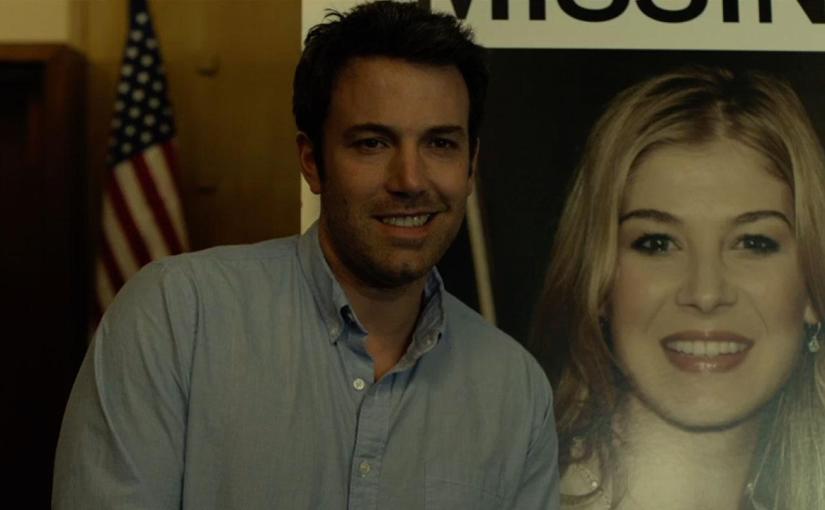
Ben Affleck plays Nick Lowe who discovers a broken glass coffee table in his home and realizes his wife of 5 years is missing. Rosumund Pike is Amy, who seemingly vanished without a trace.

Fincher closely shoots Flynn’s story with developments you might expect or have experienced with various news stories and documented investigations by sensational legal journalists like Nancy Grace. Nick, with Amy’s parents (Lisa Banes, David Clennon), initially form a united front for the press but that falls apart when it’s uncovered that Nick has had an affair. Amy had a close neighbor who expresses tearful concern that cameras latch on to for ratings. The cops (Kim Dickens, Patrick Fugit) grow more and more suspicious of Nick. Nick eventually hires a high-priced lawyer (Tyler Perry). Nick is eventually considered to be an abusive husband as well. It all adds up.

These are the steps you’d expect from a missing persons case. You might also suspect murder, but no one can claim that out loud if there’s no body to be found. So, toe the line carefully detectives, journalists, & gossip mongers!

What is not expected in Gone Girl are the surprises that open up midway through the picture, and the book. Flynn is a really inventive storyteller, and Fincher as director gives ample opportunity to answer for every surprise up the writer’s sleeve. Gone Girl plays with a lot of internal character thought to process its details.

I had read the novel long before the movie was even cast, and I couldn’t put it down. That being said, I was frustrated when the conclusion arrived. I can say the same for the faithful film adaptation. It’s an ending that could happen but, wow, is it a long shot.

Rosamund Pike was Oscar nominated as Amy, the complicated wife in this marriage. She’s good at occupying the complexity of her past shown in flashback. She’s likable in many moments, but then Amy is also a character that we are reluctant to trust based on her relationship to Nick, as well as her own parents.

Affleck remains a good actor with this picture. I think it takes an honest actor, writer and director to accurately show a man who might not be responding to this crisis like a general public expects. I think much of Affleck’s personal issues of infidelity and alcoholism in the public eye lend credence to how genuine he makes Nick out to be. Could this guy be handsome enough to think he could harm or actually murder a woman as beautiful as Amy; the “Amazing Amy” as she’s widely known in her mother’s series of best-selling children’s books? Is Nick that good at hiding his evil side? On the other hand, is Nick simply innocent, despite all the skeletons that are gradually uncovered? That’s a fair question as well.

Again, Gone Girl is superb in its delivery. It’s ending, though, is the setback. At least I felt that way. For every reader, like me who considers it dubious, I’m sure there are readers who applaud the inventiveness of Gillian Flynn’s gripping and modern mystery.

I guess if a good story prompts a group discussion on a Saturday night, then a really good novel or a great movie has achieved its purpose. At the very least, I consider that a great compliment for an outstanding cast, director and writer.

MALIFICENT

By Marc S. Sanders

The wagon train of live action adaptations of Disney animated classics reached its pinnacle with 2014’s Maleficent. Much credit going towards Angelina Jolie’s portrayal of the title character. However, the visuals cannot be dismissed either. It’s a gorgeous film directed by Robert Stromberg.

Stromberg brings his wealth of experience in visual effects (Avatar and Master And Commander: The Far Side Of The World) to his directorial debut. The fantasy world of Maleficent’s forest, as well as the looming castle on its outskirts are dressed in gorgeous colors and vast dimension of pathways and caverns. The magical spells wafting in greens, golds, blues and reds, wielded by the characters, including the three protective fairies (led by a strong Imelda Staunton) is hypnotic and blends beautifully with the live actors’ performances. It’s as bold in the visual department as anything cropped up by Peter Jackson or James Cameron.

What makes this brisk 90 minute film special is a different point of view from the classic film Sleeping Beauty. Is there justification to a villain’s actions? Stromberg and Jolie certainly make a case for it. It’s a reminder that there are two sides to every story. Anyone ever consider that maybe Maleficent might have been betrayed at one point? I’ll be damned. At least that’s what I thought, after watching this film.

No one in life is born evil. I like to think people are made evil or perceived as evil. This film is a great example of that, much like the musical Wicked or the recent hit film Joker.

Jolie offers up the frightening aspects of the fairy dressed in black that we’ve been familiar with all these years. However, she’s fortunate that the capable script from Linda Woolverton offers up opportune moments to consider her soft, sensitive side. There are moments of no dialogue as Maleficent observes Princess Aurora (Sleeping Beauty) grow, and she develops a reluctant (it’s hard to resist calling her “Beasty”) affection for the child. Maleficent will even participate in a playful mud fight. There are more than just evil machinations going on here.

Unlike the other Disney live action iterations, Maleficent shows something new and unexpected. It harbors my appreciation for the film whereas Beauty And The Beast or Aladdin did not because they just churned out the same old thing.

If Stromberg’s film suffers from one weakness I’d say it could have used a stronger performance from Sharlto Copley (The A Team film adaptation) as the antagonist, Aurora’s father and Maleficent’s first love; the eventual king. There was not much threat from this guy. He was no match in character much less performance against Jolie.

Still, Maleficent is a great character film with lots of fun, whimsical visuals to explore.

WILD TALES

By Marc S. Sanders

Humans were meant to be distressed.  It just goes with the territory.  It’s in our nature to distress one another and respond with another layer of distress.  It’s also a cosmic element of practically any environment we find ourselves in.  Within our journeys of life, when we are striving to be better as a spouse, a parent or worker, it takes an acceptance of stress to get to where we want to be.  It’s only when we die that we can truly rest in peace.  Wedding planning or road rage or airline travel can be overly taxing. Your car could get towed, a person from your past could turn up or you can even become unreasonably extorted when faced with extenuating circumstances.  It all seems so unfair or inconvenient or intrusive.  So, I find it interesting that director Damián Szifron would provide the credits of the cast and crew for his film Wild Tales against a backdrop of wildlife animals.  Humans may be the dominant species, but even they have animal instincts that can spiral wildly out of control.

With writer, Germán Servidio, Szifron offers up six different short stories in this Argentinian film that was nominated for Best Foreign Language Film at the 2014 Oscars.  Each story focuses on an opportunity for revenge or an experience of high stress where people come in contact with other people.  Granted, some of the stories are so outrageous in circumstance, response and outcome that I’d find them hard to believe they truly happened if someone vouched for it.  For example, you likely never saw a wedding reception like the one staged in this film.  I don’t care who you are.  YOU NEVER SAW A WEDDING LIKE THIS!!!!  Still, this is a very entertaining film that left me curious with how each story was going to play out.

A truly engaging airline experience prologues the credits when a beautiful model strikes up a conversation with the elderly gentlemen across the aisle.  When a woman in the next row can’t help but eavesdrop on their exchange, a most unexpected event occurs.  Doom awaits!!!  More importantly, though, why does it await?  It’s a brilliant opening, likely never to occur in real life, but altogether unexpected and humorously shocking.

Following the credits, a question of morality and revenge plays out in an after-hours diner when someone from a waitress’ past enters for a late night meal.  This is the most incomplete vignette of the bunch, but the narrative remains interesting. 

Listed below the airline tale, my next favorite tale involves a road rage incident between the driver of a beautiful black Audi and someone who drives an old jalopy of a car.  Likely, it is the most relatable of all the stories.  We’ve all either experienced some form of road rage, or read about it, or have committed or been tempted to engage.  There’s a strong lesson to be learned from this story and it is rather incredible how this encounter between two descends into madness.

Stories of extortion and unfair city policies fill out the other slots, before finally closing on a wedding from hell.

What’s interesting is that while the stories may rely somewhat on their dialogue, I believe I could watch Wild Tales without knowing much of what is being said.  The cast is phenomenal in expression and response.  Szifron quickly sets up the scene and then has his various token characters react to what faces them.  We see the extremes a bride goes to when an unexpected guest appears at her reception.  We are the lone witness to how a driver will seize an opportunity when another driver is stranded on a lonesome highway with a flat tire.  We can understand the persistence a man will uphold in order to prove he did not commit a parking violation.  Wild Tales does not depend on crackling dialogue.  Instead, the visuals and the performances do a lot of the work.

Too often, I hear that people will not watch films with subtitles.  They cannot stand to “read” a film.  Come on!!!!  You have to allow yourself the opportunity to uncover amazing documents of cinematic escapism beyond the American fare.  No film hinges on the subtitles that flash across the bottom of the screen.  Like any movie, the primary element is the photography of the piece.  Since I am not much of a traveler, domestic or international, it is so refreshing when I’m reminded that cultures, behaviors and customs outside my comfort zone of the United States, are not any different from me or the people I surround myself with.  We are all capable of love, drama, humor, sacrifice, crime and an innate possibility of flying off the handle in very, very extreme ways, whether we are justified or not. 

I am not familiar with many foreign pictures.  Honestly, I don’t get motivated enough to seek them out.  I need to lighten my reluctance.  It is fortunate that my colleague, Miguel E Rodriguez, provided this entertaining, mischievously fun collection of devilish short thrillers to our Cinephile movie group for a Sunday viewing.  Damián Szifron has crafted a film that you can’t take your eyes off.  The photography is striking with amazing camera angles such as a point of view from inside an airplane luggage compartment or from the sidewalk ground level where an automobile owner discovers that his car has been wrongfully possessed.  Miguel says moments like these are Tarantino inspired.  Maybe.  I like to think I’m watching a film by Damián Szifron, an insightful and skilled director at the top of his game.

SELMA (2014)

by Miguel E. Rodriguez

Director: Ava DuVernay
Cast: David Oyelowo, Carmen Ejogo, Tom Wilkinson, Common, Tim Roth
My Rating: 8/10
Rotten Tomatometer: 99% Certified Fresh

PLOT: A chronicle of Dr. Martin Luther King, Jr.’s campaign to secure equal voting rights via an epic protest march from Selma to Montgomery, Alabama, in 1965.


In one of the special features on the Selma Blu-ray, Oprah Winfrey, one of the film’s producers and co-stars, says that Selma is the first feature film with Dr. Martin Luther King Jr. as the central figure.  (She is presumably not counting TV movies or miniseries.)  There have been one or two other films where King appears as a “side” character, but never as the star of the film.

I’m not exactly sure what that means, but I found that tidbit of information fascinating, especially after watching Selma, which carries all the cinematic heft of any Oliver Stone biopic.  For example, I never knew there were two previous attempts to make the iconic march from Selma to Birmingham, some fifty miles away.  The first attempt, at which King wasn’t present, was violently turned away by local police with batons, tear gas, and honest-to-God bullwhips.  The second attempt, this time with many white participants, mostly clergy, was aborted by King himself after he had second thoughts about asking people to potentially lay down their lives for the cause.

That right there is indicative of far more conflict than I ever thought existed in the mind of Dr. King, played with poise and pent-up energy by David Oyelowo.  In my mind’s eye, King never wavered.  He was always 100% sure of his actions because his cause was just.  But, surprise, he was also a human being who was clearly affected by the injuries – and fatalities – sustained by the folks who were marching for that cause.  Selma brought that dimension home to me in a potent, well-made film.

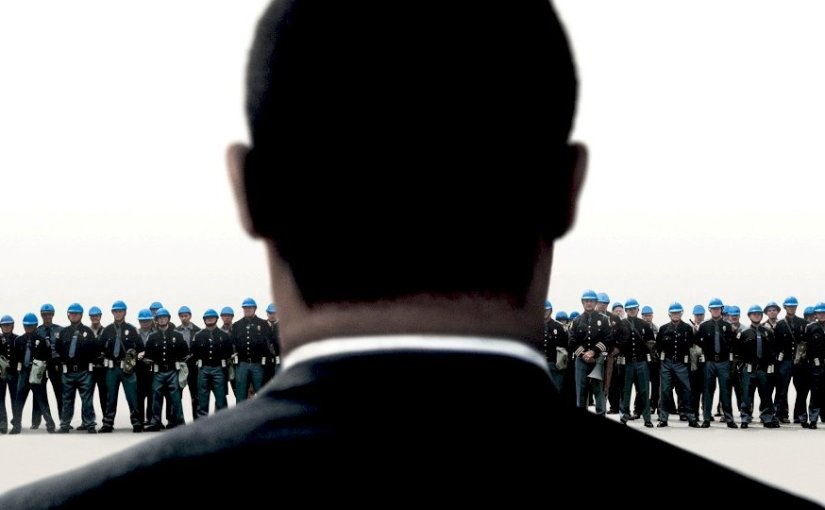
The beginning of the movie sets the tone poetically and tragically.  After a scene with Dr. King receiving the Nobel Peace Prize for his civil rights activism, we are shown the truth of the situation in the American South in the mid-60s.  A black woman tries to register to vote in Selma and is turned away by a racist registrar.  In Birmingham, a bomb goes off at the 16th Street Baptist Church, killing four young girls.  When King arrives in Selma to organize a protest, he is greeted in a hotel lobby by a friendly-sounding white man who proceeds to punch him in the face.  King even meets opposition from a separate civil-rights group in Selma who are uncomfortable with how most out-of-state protesters march for King, not necessarily for the issues.

Nor is King portrayed as the perfect husband to his wife, Coretta Scott King (Carmen Ejogo, who incidentally also played Coretta Scott King in a 2001 HBO movie, Boycott).  Their home life is troubled right from the get-go.  That’s a factor that I learned about years and years ago, but it’s still something that takes a little getting used to.

No one likes to hear that great men were human, too.  We want our heroes, whomever they might be, to be spotless.  Selma doesn’t shy away from the less flattering, more human side of Dr. King.  After the FBI taps his phones, they send an audio recording to Coretta with the sounds of two people having sex.  Martin listens in dismay but insists to Coretta that’s not him on the tape.  She agrees with him (“I know what you sound like, Martin.”), but you get the idea that she’s still upset that this kind of thing would be an issue.

I loved the scenes where King is invited to the Oval Office to speak directly to then-president Lyndon B. Johnson, who desperately tries to get King to back off Selma.  Johnson wants what every President in history has always wanted: a second term.  King reminds him that, if he would simply pass a law removing any and all voting restrictions, he would win a second term in a landslide…thanks to the black vote.  Johnson urges King to wait, King urges Johnson to act, and they make little progress for most of the film.


I am no historian, but I have no doubt that Selma is at least as accurate as Nixon or JFK or any other big-budget historical film.  That is, mostly true.  When it comes to film, I’m a big believer in the credo: “Don’t let facts get in the way of the truth.”  If Selma were to show each and every incident that led to that march, I’d still be watching the movie because it would be 10 hours long.  I feel that the movie captures exactly what needed to be captured and did it in such a way that not only was I entertained, but I also learned some things I didn’t know.  (I never knew about the death of a white protester, for example.  Or about the “night march” that occurred somewhere between the first two attempts, and which also resulted in someone’s death.)

After having just watched movies like Whiplash or The Prince of Egypt that got me genuinely emotionally invested, so that their finales had me floating a few inches above my sofa, I must be honest and say that the finale of Selma did not quite inspire that same reaction in me.  It was compelling to see the march finally taking place, especially when intercut with shots of the actual marchers making their way to Birmingham.  I enjoyed King’s speech on the steps of the capital building (although I learn from IMDb trivia that director DuVernay allegedly reworked some of the speeches to make them more cinematic).  I thought it worked well as a climax to the film.  But honestly, I wanted to see a little more of the march itself.

I suppose it could be argued that the march was not quite the point of the film.  Selma highlights the struggle more than the victory.  It demonstrates the terrible hurdles and living conditions faced by black Americans during those dark days.  Have things improved since then?  Well, I’d say things have evolved into something different.  Some things change more easily than others.

The struggle continues.

WHIPLASH (2014)

by Miguel E. Rodriguez

Director: Damien Chazelle
Cast: Miles Teller, J.K. Simmons, Paul Reiser, Melissa Benoist
My Rating: 10/10
Rotten Tomatometer: 94% Certified Fresh

PLOT: A promising young drummer at a prestigious music conservatory is mentored by an instructor who will stop at nothing to realize a student’s potential.


That’s right, I finally jumped on the bandwagon and watched Whiplash after no fewer than eight years of prodding by my fellow cinephiles.  Not only can they finally get off my back about it, but they all now owe me one.  Hope you all enjoy Wild Tales when next we meet.

I was hesitant to watch Whiplash because it was released and gained notoriety at a time in my life when I was yearning for some positivity after getting psychically beaten down by some really depressing foreign films.  Why, I asked myself, would I want to subject myself to ninety minutes of watching J.K. Simmons verbally abuse some poor kid just so he could play the drums a little better?  I’ve seen this movie before.  The abusive mentor sees the light, the victimized student either turns his back or excels like never before, etcetera, etcetera, blah blah blah.  I had the whole plot written out in my head from start to finish.  (I used to do that a lot, I’m realizing…kinda stupid, in most cases.)

Having just finished watching it, I can say, without reservation, that Whiplash belongs on the short list of the best films ever made about the drive for artistic perfection along with The Red Shoes, Black Swan, and Amadeus.  And it manages to have its cake and eat it, too, when it comes to the ending.  Tragedy and triumph walk hand in hand, though not necessarily in the way I would have ever imagined it.

Andrew (Miles Teller) is a talented young jazz drummer who has just started his first year at the fictional Shaffer Conservatory of Music.  He is anxious to gain the attention of Terence Fletcher (J.K. Simmons), the leader of the school’s prestigious jazz ensemble, The Studio Band.  Fletcher is a piece of work.  To say he engages in mind games is like saying Bill Gates dabbles in computers.  He recruits Andrew for his own band in the middle of someone else’s music class.  On his first day with the Studio Band, Fletcher berates another musician for playing off key.

Did I say “berates?”  Fletcher belittles, humiliates, and degrades the poor guy with a stream of profanity that would have made the drill sergeant in Full Metal Jacket envious.  He fires the guy on the spot.  When the guy leaves, Fletcher looks around and confesses that he wasn’t really out of tune, but he didn’t know he wasn’t, which is just as bad.  Accurate?  Technically yes.  Does that kind of teaching method belong anywhere outside of a military unit?  I’m going with “no.”

Andrew is willing to go along with this because he doesn’t just want to be good, he wants to be GREAT.  He wants to be remembered in the same breath with Charlie Parker and Buddy Rich, and he believes, like Fletcher, that greatness is not achieved without struggle and sacrifice.  Again, technically true.  Would Rembrandt have painted half as well with both ears?  Would Beethoven’s Ninth be remembered today if Beethoven hadn’t been totally deaf by the time it was finished?  The rolls of the Screen Actors Guild are littered with actors from broken or abusive homes.

There’s a revealing scene when Andrew eats a meal at home with his father and uncle and his two cousins.  The table conversation rings with praise for the two cousins who play football at their school and scored a long touchdown, etcetera.  When Andrew talks about being a “core” member of the best conservatory jazz ensemble in the country, he’s met with polite congratulations and that’s about it.  No one seems to think he’s going to make it as a musician, not even his own father.  “I’d rather die drunk, broke at 34 and have people at a dinner table talk about me than live to be rich and sober at 90 and nobody remembered who I was.”  Like Charlie Parker.  Like Amadeus.  Andrew’s only goal is to be great.  If he has to give up friends, romance, even family to achieve it, so be it.

But at what cost?  Fletcher pushes Andrew so hard that his hands bleed during rehearsals.  He demotes Andrew, then puts him back in the core, demotes him again, then basically makes him re-audition for the core spot against two other alternates until 2 am.  In one excruciating scene, Andrew actually tries to play in a competition after being in a freaking car accident.  It’s a truly desperate act from someone who is so afraid of being anonymous that only a body cast will stop him from taking his shot.

Make no mistake, the rehearsal scenes and the verbal and mental abuse from Fletcher are not pleasant.  They’re emotionally engaging, but they were also off-putting.  In a strange way, I was reminded of Requiem for a Dream and its disturbing subject matter that was nevertheless compelling to watch.  When we get to what happens to Andrew after the car accident, I was getting thoroughly depressed, despite the powerful emotional beats of what came before.

But then the movie enters its final act, and that’s where Whiplash finds another gear story-wise.  Andrew and Fletcher meet in an out-of-school setting, and Fletcher has an interesting speech where he says, among other things, “There are no two words in the English language more harmful than ‘good job.’”  He admits his tactics were brutal, but he devoutly believes in the necessity of pushing people beyond what is expected of them.  “Otherwise, we’re depriving the world of the next Louis Armstrong.”

Fletcher convinces Andrew to play for a new jazz ensemble one last time.  What happens at that concert is so horrifying that I watched most of it through my fingers.  I kid you not.  But then the screenplay transforms that situation into something magical, almost religious.  You get the sense that all of the horrible and despicable things Fletcher did and said during the whole film, all misery we had to endure with Andrew, during which time I wondered, “Why am I watching this??” – all of that unpleasantness was just the setup for the finale.  And that finale only means something because of everything that came before it.

In other words, just like Andrew, I was only able to experience that tremendous cathartic moment at the end because of the suffering I had experienced in the movie’s first 90 minutes.

…which leaves me feeling torn because that’s exactly the kind of thing that Fletcher believes in, but which I feel is unnecessary outside of a boot camp.  Ideally, yeah, I think that you catch more flies with honey than with vinegar.  I’ve directed my fair share of community theatre productions, and I’ve never had to resort to yelling or humiliation as a method to get what I’m looking for.  But then, I’m directing community theatre, not a multi-million-dollar film that may live or die on the performances I’m getting or not getting from my star.  Nor am I a drill sergeant training men to become soldiers.  It seems there is a line, but apparently to get certain kinds of results, it must be crossed.

It’s this dichotomy that will likely keep me awake the next couple of notes.  That and the senses-shattering finale.  I mean…I did not see that coming.  (And man, I am a jazz fan, so to me it was like eating a perfectly-cooked steak.)  It was not a pleasant road to get there, but it had to be unpleasant.  Otherwise, it wouldn’t have been great.