AMOUR (2012, Austria)

by Miguel E. Rodriguez

Director: Michael Haneke
Cast: Jean-Louis Trintignant, Emmanuelle Riva, Isabelle Huppert
My Rating: 9/10
Rotten Tomatometer: 93% Certified Fresh

PLOT: Georges and Anne have known a lifetime of love within their intimate marriage. Though their bond has survived the test of time, it’s about to meet its greatest challenge.


I’ve only seen three films by famed German director Michael Haneke.  The first was Caché (2005), which some may consider maddening, but which I think is a masterpiece of open-ended storytelling designed specifically to provoke arguments at the nearest Starbucks after the movie is over.  The second was The White Ribbon (2009), a pre-World War I fable about what happens when children give in to their tribal appetites.  I thought it was well made but a little too sedate, but it also won an unheard-of FOUR awards at Cannes that year, so what do I know.  (One day I’ll watch Funny Games [1997], but today is not that day.  Tomorrow is not looking good, either.)

Last night, I finished watching Amour, Haneke’s 2012 film that won Best Foreign Film at the Oscars that year, and the Golden Palm at Cannes.  After seeing three of his films, the one thing I can say about Haneke as a director is that he is apparently a perfectionist, who edits and composes shots as well as Kubrick, and that his subject matter is all over the place…also like Kubrick.  He also does not shy away from shocking the audience by lulling them into a kind of complacency before presenting them with a moment of violence or revelation.  Like Hitchcock, he plays the audience like a grand piano.

Amour tells the story of an octogenarian couple, Georges and Anne, still very much in love with each other.  They are retired music teachers living a quiet life of piano concerts, meals at the kitchen table, and reading the newspaper.  Georges might be a little more straightforward or curt than Anne, but they clearly know each other’s rhythms.  The style of the film clearly indicates their routines with a brilliant economy of editing and camerawork, not to mention the subtle performances from the two main actors.

One day, something happens at the breakfast table.  Anne and Georges are having a conversation over a boiled egg when Anne simply stops and stares into space.  Unable to get a response, even after dabbing a wet towel on her face, Georges prepares to fetch the doctor.  Suddenly Anne snaps out of her trance and wonders where Georges is going.  When he tries to explain what’s happened, she gets confused and angry with him for torturing her.  But when she tries to pour herself a cup of coffee, the coffee goes everywhere except in the cup, and suddenly her right hand seems to be trembling…

At this point, in years past, I would have probably turned this movie off, or returned it to Blockbuster without finishing it.  I can hear my inner monologue now: “Why do I need to watch an ultra-depressing movie about someone who’s dying?  I mean, I can hope that it has a life-affirming message at the end like Philadelphia or Angels in America, but this is a foreign film that won awards at the Oscars AND at Cannes, so chances are it’s going to end on a down note.  Who needs it, am I right?”

Well, Amour may not have the kind of crowd-pleasing finale one might hope for, but it is nevertheless engrossing, quietly devastating, and even a little terrifying.

…you can’t see it, but I’m very frustrated right now.  I’m trying to figure out how to write the rest of this column and it’s eluding me.

With a movie like this, an analysis of its technical prowess seems irrelevant.  I learn from the extras on the Blu ray that the couple’s apartment was constructed entirely on a set with a big green-screen backdrop.  Haneke wrote the script with his parents’ apartment in mind, so it seemed appropriate to just recreate it on a soundstage.  How does this contribute to the story?  I honestly don’t know.  I would imagine it enabled the filmmakers to control every aspect of lighting so that anything involving scenery through the windows felt as if it was real.  So I guess there’s that.

My problem is that this movie is intended very specifically to make you empathize with the characters.  It does this job very well.  It was a pleasure to watch a great film with great characters in the hands of a great director.  But if I’m going to talk about how the movie made me feel…I guess I must be honest and say it didn’t exactly make me feel good.  It didn’t make me feel bad, exactly, just really, really sad.

There is a kind of sadness I can feel at certain kinds of films (The Remains of the Day and Requiem for a Dream come to mind) where the endings are so mind-blowingly sad, and so unexpected, there is a kind of emotional exhilaration that accompanies the sadness.  I am so wrapped up in the story I have left real life behind, but after the movie is over, I am back in the real world, and I am stoked to tell someone about how great the movie is, despite its dark material.

With Amour, though, when the end of the film arrives, and I’m back in the real world…I still felt like I was in the movie.  Because, in a way, the movie is about me.  About all of us.  One day, I will (finally) grow old and eventually die.  Watching the scenes where Georges stares into Anne’s eyes as her body functions waste away and he reluctantly hires a nurse who is stronger than he is because Anne has lost the use of her right side and must be carried out of the wheelchair to be bathed?  Listening to the conversation when Anne says point blank that she sees no point in going on living if she’s going to be such a burden?  Watching Anne’s face when the nurse turns her in her bed to demonstrate to Georges how to put on her diaper?

Watching these scenes, I wondered how I would feel myself if I were to succumb to something similar.  I tell myself I would want to live.  There’s a line in Full Metal Jacket: “The dead know only one thing.  It is better to be alive.”  But what if I got as sick as Anne does?  What if I lost the power of speech?  What if I lost the ability to type with both hands, as I’m doing right now?

I’m not even sure that is the point of the movie, to make me reflect on my own mortality.  It’s said that Haneke made this movie to honor his aunt who suffered a degenerative disease as Anne does.  The title of the movie is Amour, so maybe I should be writing about the great love between Georges and Anne.  But whenever I think about that aspect of the film, I fall back into thinking about myself again.  It’s a vicious cycle, and I’m not sure how to break it.

I’m making this movie sound depressing to the nth degree.  I suppose it is, by default, but it is still definitely worth your while to watch.  It is so well made and so thought-provoking.  It deserves to be seen and discussed, ideally with someone you love.  I don’t agree with every decision made by the characters in this film.  But I understand why they were made, so I do not judge them.  One day, I will get old, and I will think back to this movie and say to myself, “Now I really know how they feel.”


P.S.  The only reason I don’t rate this movie 10/10 is because there’s a brief prologue involving an empty apartment and a bedroom with a single occupant that, to me, telegraphed a key moment that I saw coming a mile away as the scene unfolded.  But that’s just me.
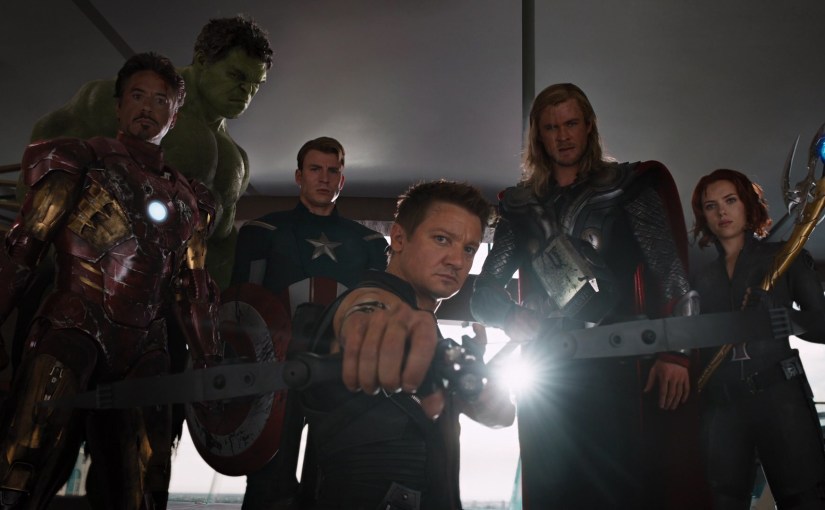
MARVEL’S THE AVENGERS

By Marc S. Sanders

Phase One of the Marvel Cinematic Universe concludes with Marvel’s The Avengers. This is a real treat and a feast for the eyes. It’s not my favorite of all the Marvel films because it gets a little too Saturday morning cartoon like at times, but it’s enjoyable to watch for good escapist popcorn fun.

Movie goers were salivating for the year 2012 to arrive which would finally assemble Thor, Iron Man, Captain America and the Hulk on screen. Thanks to writer/director Joss Whedon that wish had finally come true and Whedon does not try to reinvent the wheel. When you assemble a team of heroes, you pit them against a large army and watch every variation imaginable of how the Hulk can smash, or what Iron Man’s armored suit can launch.

By now, you all know how I feel about the actors portraying their respective roles. Best to just say the chemistry works among them. They find reasons to squabble and Whedon provides moments for them to use their given talents against one another. So you get to see what happens when Thor smashes his hammer against Cap’s shield.

The actor who finally gets his moment in the sun is Samuel L. Jackson as Nick Fury, the orchestrator behind this team up. Jackson is more subdued than his other well known characters from the Tarentino films or Snakes On A (Mother effing) Plane. He does get to say “stupid ass idea” at one point and there’s the Samuel L. Jackson we all know and love! In comics, the Nick Fury character was reinvented before any of the films to harbor the appearance of Jackson. This film proves why the writers went that route. He’s great. He’s fun to watch. He makes for a great leader of the secret agency SHIELD. In tow with him is Clark Gregg as Agent Phil Coulson, a welcome cameo guy before this film, Gregg gets in a few scenes that show his endearment, and offer some dramatic weight as well. The guy could be waiting on hold while Black Widow takes out a couple of thugs, and you are cracking up at Gregg as Coulson, not necessarily Black Widow. He’s so likable that well…heck…he should get his own Marvel TV show….wait….nevermind….I digress.

Again, however, the women of the MCU are not drawn well for the screen. Scarlett Johansson makes her second appearance as Black Widow. She’s got a great, funny early fight scene while tied to a chair in a sleek black dress, but that’s all for show. She hints at a checkered past but this film does not offer much to expound on that. I understand. There’s a lot going on here. So there’s not much here for her to do. It’s time she got a film of her own, however. I’ll sign the petition. Wait! Nevermind! Colbie Smolders is a waste as Agent Maria Hill. She is nowhere convincing as a bad ass agent. Her line delivery seems forced. Her role seems unnecessary. Her scenes should have been on the deleted floor. It would have allowed more time for Johannson to play up her character. How is Maria Hill different from Black Widow in this film, anyway? She’s not. Therefore, cut out Maria Hill.

Jeremy Renner is given nothing to do but shoot arrows as Hawkeye, and work against the Avengers while under a spell from Loki.

Speaking of Loki, the great Tom Hiddleston is back. Hiddleston just elevates the Marvel films to more than just a comic book movie. His glee as the God of Mischief is different than say any version of the Joker’s. Pay attention Syndrome (from The Incredibles)!!! When Hiddleston monologues, you want to listen, unless you are the Hulk.

Whedon does an awesome job with the action scenes as he gradually destroys an aircraft carrier when chaos takes hold among the various heroes, and then later he destroys New York City in a fun amusement park like battle through the streets, subways and skyscrapers. It’s a little reminiscent of Richard Donner’s (or Richard Lester’s) Superman II, and Ivan Reitman’s Ghostbusters. It’s fun to watch the Hulk run through a building only to come out the other side and leap upon the head of a gigantic, flying centipede to bring it down on to the top of a building. Who cares how this all gets cleaned up? The greatest city in the world always figures out a way.

Whedon sealed the pop culture significance of superheroes in the early 21st Century. He’s done what guys like Michael Bay beg to do with other toy/comic book franchises. Marvel’s The Avengers stands out as an important impact in cinematic filmmaking. It’s not best picture worthy, but it is nonetheless important to how blockbuster films are conceived and created. Sadly, some people still don’t get it right, all these years later.

SKYFALL

By Marc S. Sanders

Skyfall is a great James Bond film. One of the best. However, …it has one major shortcoming that always gnaws at me. Regrettably, it has a contrived middle section that steals some of the magic away from the film. Yes, for a moment, my suspension of disbelief is robbed from me.

Daniel Craig’s third outing as 007 has become a favorite among fans and movie goers. Craig is magnificent in a primarily dramatic turn in the part. Following a fantastic action packed opening where Bond pursues an assassin through the streets of Istanbul, Turkey (widely known as a favorite locale of Ian Fleming), the chase involves cars, motorcycles, rooftops, fruit stands and trains for well edited shootouts and fist fights. Alas, the assassin gets away and Bond is left for dead.

Following an attempt on the life of M (Judi Dench in her absolute best portrayal in the role), Bond returns for active duty. However, he’s not what he used to be. His aim is off and his body is worn. The question remains if Bond is ready to be back in the field.

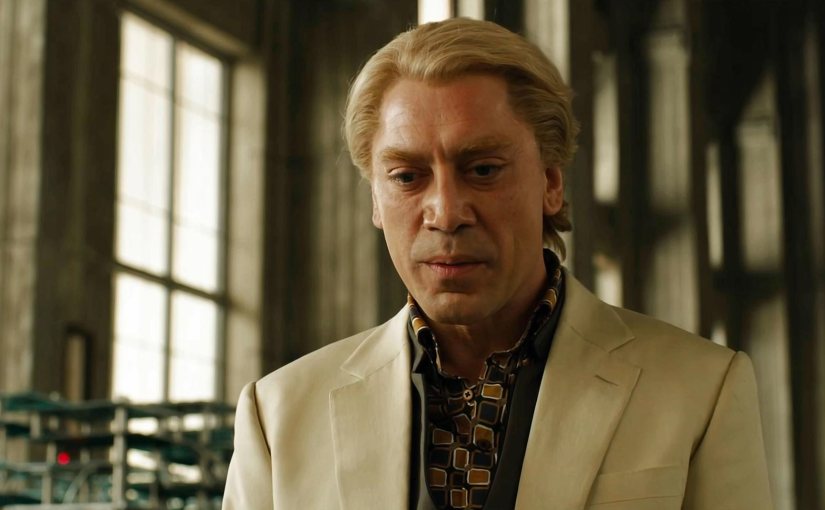
The plot centers on a bitter former MI6 agent named Silva (Javier Bardem in a potentially Oscar worthy performance) out to seek revenge on M for the sins he believes she’s committed.

It’s funny. The Austin Powers films, and even film critic Roger Ebert, would always draw attention to the fact the villain would just longingly speechify when they have all the time in the world to just shoot Bond dead and move on with their devious plot. Silva is a response to that issue. He has a mutual respect for Bond, and you can see he’d rather keep him alive for the time being to allow the game to keep running. It’s not said outright, mind you. Yet that’s what I took away from the character. A superbly written monologue to introduce Silva at the midway point of the film compares him and Bond to the last of two rats surviving a trap. Which rat will win out?

It’s also quite special that Bardem shapes his villainous role with a homosexual tendency. Silva is fashionable and proudly dons a bleach blonde hairstyle. He gleefully rubs Bond’s legs and opens his shirt to examine his scarred chest, pronouncing that Bond must ponder his “training” at the moment. Silva is beyond the typical femme fatale. It’s different and it’s time the Bond franchise acknowledges the differences in people. A welcome trait for a major character.

The plot set up of Skyfall‘s devices are ingenious in simplicity with a basic revenge tale but also with broadening the legacy and responsibilities of the M character. What Casino Royale did for a story arc for James Bond, Skyfall does for M, and with Dench in the role it works beautifully. She must answer to superiors, like a very welcome Ralph Fiennes, for the death of several agents and a bombing of MI6 headquarters. She must resist the pressure of early retirement. This is the most that M has ever had to contend with personally, and it’s here at last.

My one reservation with the film occurs just after the midway point. Silva somehow arranged to get apprehended and then managed to escape, don a police uniform, travel through London’s tube, and time an explosion on a runaway train ready to crash into James Bond who is on his trail. Thereafter, he’s able to locate the interrogation session where M is making a public statement in her defense and try to kill her. There are way too many factors at play that work too conveniently to Silva’s advantage. It’s a tension filled sequence. It looks great. It has great action and effects, but it’s overly contrived. I wish the script from Neal Purvis, Robert Wade and John Logan made this middle section a little more believable.

Sam Mendes (American Beauty) directs a terrific, action-packed film filled with more drama and minimal tongue in cheek that the series is primarily known for. I was grateful for the more serious Bond. Like the other Craig installments as well as the Dalton films, Skyfall offers a different and fresher approach.

Granted the ending plays more like an Arnold Schwarzenegger action piece from the 1980/90s, but it’s highly entertaining, well edited and well shot, nonetheless.

I highly recommend Skyfall for its outstanding cast that also includes Ben Whishaw as a nerdy variation of Q, the gadget man, and Naomie Harris in a secret role that has a satisfying payoff. As well, the standard revenge story works quite well here when you have Bardem, Fiennes, Craig and most especially Dench doing some really top notch acting with terrific dialogue. Mendes is a stage director first, and it shows quite admirably here.

Again, Skyfall is not the best Bond film but it’s at least one of the best.

SILVER LININGS PLAYBOOK

By Marc S. Sanders

Bipolar disorder can be a crippling ailment, not only to the person, but to his/her family as well. That, I imagine are the limits of my knowledge on the subject. David O. Russell’s Silver Linings Playbook will have you believe a way to embrace the disorder is to be involved with people who accept it and love you regardless.

Bradley Cooper is magnificent as Patrick; a hyperactive man suffering from his own demons. He is short tempered, confrontational, and prone to exhausting and uncontrollable outbursts. Because of that, he has lost his wife, his job, his friends and when the film begins, he is being picked up by his mother from an eight month court ordered stay in a mental institution on his way to live with his parents, Dolores and Patrick Sr., played brilliantly by Jacki Weaver and Robert DeNiro. Patrick is determined to rebuild his life. He feels confident that he is now on a positive track of exercise and healthy eating, and he wants to win back his wife. It is not so easy however, when Pat refuses to take his prescribed medication and his own father probably suffers from a similar disorder and he has to share a house with him. This means dealing with Pat Sr’s obsessive compulsiveness over his beloved Philadelphia Eagles, as well as his own short temper and his insistence on using family time with Pat Jr as a means to break the “jeu, jeu” that has cursed the team. Pat Jr. wants to move on with his life and find meaning and peace. His own obsessions with winning back his wife and overcoming witnessing the affair she was having behind his back do not help.

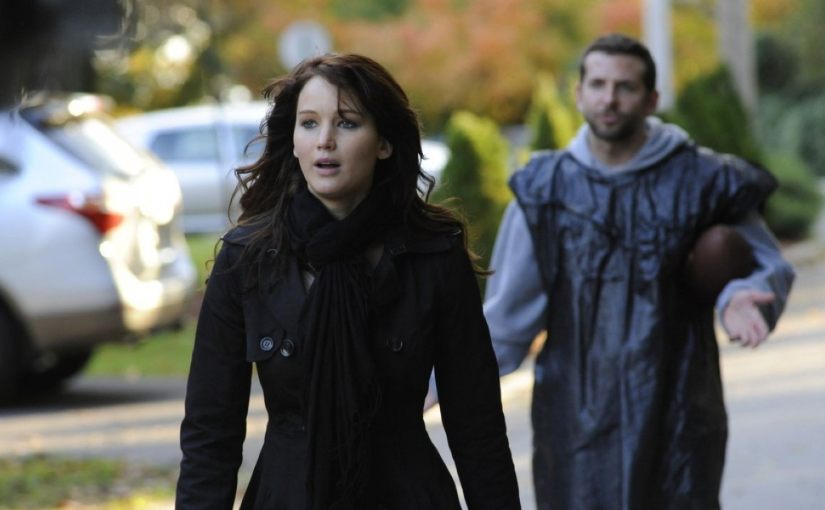
However, then Pat Jr meets Tiffany (Jennifer Lawrence in her Oscar winning role) and her own past is tormenting her, following losing her policeman husband in the line of duty. It’s clear she has not overcome this experience and she has taken up dance, which she is teaching herself in a refurbished garage. Tiffany is not quick to accept Pat Jr, but eventually the moments necessary for any film about relationships line up despite some screaming and shoving.

It sure sounds like I’m describing a heavy, miserable drama, here. Reader, I’m not. David O. Russell offers up moments of comedy without any of his characters really trying. No one is outright normal in this film. They are all burdened with their own idiosyncrasies and diagnoses, even Pat Jr.’s therapist, who we learn is an obsessed, face painted Eagles fan himself. Russell repeatedly uses a steady cam (I believe) to rush right up into the face of his characters, individually, when a moment is overtaking him or her. It’s a way of showing that no one else in the room can see what the sufferer is seeing. Everyone else is bound by their own disorder. Russell uses this device to isolate the character that owns the scene whether it is Delores, who endures the aggravation of her husband and son, Tiffany who can not get over the loss of her husband at a young age, Pat Sr. who must live with his Eagles losing another game, or Pat Jr. who is only trying to adapt to a new way.

There is no calmness in the domesticity of Pat Jr’s life and it only feeds the fire of his bipolar disorder. What he needs is someone who will not shun or ignore the disorder but embrace it and Tiffany is that person. Tiffany is also the person who will beat up on Pat Jr in one scene to bring his self-involved neglect to light. A helpful gesture for Pat Jr, but not a fulfilling action for Tiffany. Then in another scene she will solely come to his defense. The best moment in the film belongs to Jennifer Lawrence as she storms through the door and quickly confronts DeNiro on his own shortcomings, basically disarming him with sports statistics of every Philadelphia team, only to prove that Pat Jr had nothing to do with the outcomes of these games. Lawrence is harboring a machine gun of dialogue and she does not let up. DeNiro, I’m sure, loves to balance scenes like this with talent of this caliber. (I’d imagine he was missing great acting moments like this when he was shooting his Focker movies.) Russell wisely captures most of this scene in one shot. He is well aware of his leading actress’ strengths.

The ending is as quirky and inspired as Little Miss Sunshine, where Pat Jr and Tiffany participate in a dance competition that has everything is on the line, not just for their own sanity, but also for that of Pat Sr and the rest of the family. At the risk of spoiling a piece of the story, I have to recognize the dance sequence in this climax. Russell and his choreographer wisely mix it up with contemporary music that quickly switches over to head banging heavy metal and back to contemporary again. I caught it as an allegory of the mood swings these characters, especially Tiffany and Pat Jr, go through. The dance is messy, unsophisticated, aggressive and most of all it is adorable and lovable all at the same time. Psychologically, there must be something eating at Pat Sr and Pat Jr, and Tiffany and the rest of the cast, but that is, in no way, a reason not to love them.

ARGO

By Marc S. Sanders

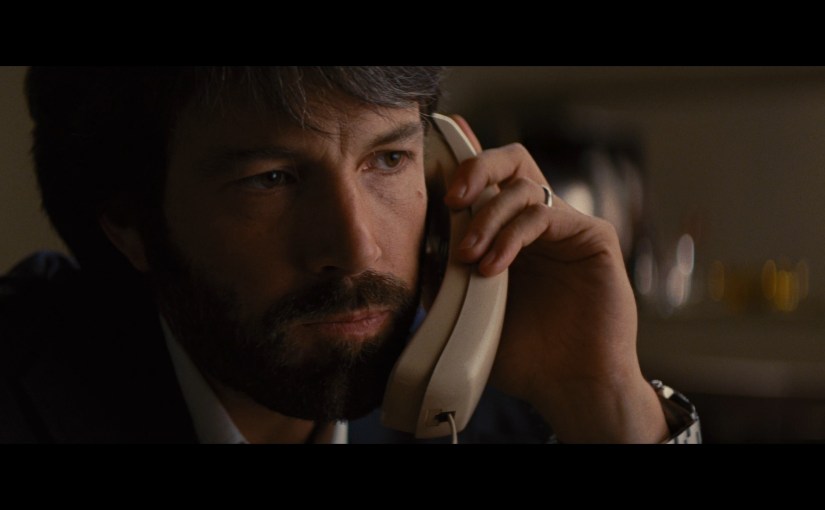
Ben Affleck’s third directorial effort Argo is his best. It makes me wonder why he followed this with playing Batman, a done to death cinematic character.

Argo showed promise of another great actor/director in the same vein as Orson Wells, Woody Allen, Robert Redford and Clint Eastwood. I’m sure Affleck will direct again but a Batman commitment certainly sidelines you. I hope he’ll direct again. I’m a big fan of his previous films, The Town and Gone Baby Gone.

The story tells of one aspect of the Iranian hostage crisis that spanned the end of 1979 through 1980. Six employees of the riot stormed American embassy in Iran manage to escape and hide in the Canadian ambassador’s home. Slowly but surely their hideaway will be revealed and they will inevitably be taken prisoner. Affleck plays CIA operative Tony Mendez who is tasked with getting them out. His plan, with assistance from John Goodman as legendary Hollywood makeup artist, John Chambers, and Alan Arkin as producer Lester Siegel, will make up a cockamamie story about producing a fake science fiction Star Wars rip off film called, you guessed it, Argo. They will do marketing write ups, poster advertising, and even a costumed table read at the Beverly Hills Hotel, all with the intent to just appear authentic as a film studio seeking out production locales in exotic Iran. The six hostages naturally are the film’s crew.

Affleck directs two acts here with two different narratives using both masks of theatre. Namely comedy and tragedy. The pleasure comes in watching Arkin and Goodman pair up to bring the Hollywood flavor that’s necessary. It’s great fun, especially when watching Arkin (in an Oscar nominated role) shyster his way with character actor Richard Kind to buy the Hollywood script-these two guys are like Oscar and Felix. Goodman is great as the been there done that Hollywood insider. He says “You can teach a Rhesus monkey to be a director.”

The drama comes with Affleck’s talent for delivering taut tension from his directing especially but also from his own performance as well as his cast of six hostages consisting of Tate Donovan, Scoot McNairy and Kerry Bishe. Bryan Cranston is also good as Mendez’ comunica from home. Cranston is just good in anything.

The tension builds with intimidating locals screaming of their loyalty to the Ayatollah as well as the eventual airport security. It’s all very nerve racking.

The critique for the the film lies in its own admission of historical inaccuracies. The escape was not as tense as the film suggests. More importantly, the caper was really primarily pulled off by the Canadian Ambassador, Ken Taylor (great actor Victor Garber). No. Canada is not given enough credit in the film. Still, here is a rare exception where I don’t mind. I guess because the suspense Affleck offers up is at its peak. You really shake your head at it all.

Forgive the cliche but Argo is a nail biting, edge of your seat thriller. At best, I can be grateful for learning about the true story following seeing the film. It’s a story that was kept hidden for 17 years. In these times of hardship and turmoil in America, it’s fortunate that a success can finally be celebrated.

Argo was undoubtedly worthy of its Best Picture Oscar win, and Ben Affleck should have at least been nominated for Best Director.

Fun Fact: Argo is produced by two former Batmans: George Clooney and Ben Affleck.

CLOUD ATLAS (2012)

by Miguel E. Rodriguez

Directors: Lana Wachowski, Lilly Wachowski, Tom Tykwer
Cast: Tom Hanks, Halle Berry, Jim Broadbent, Hugo Weaving, Jim Sturgess, Doona Bae, Ben Whishaw, Keith David, Susan Sarandon, Hugh Grant
My Rating: 10/10
Rotten Tomatometer: 66%

PLOT: An exploration of how individual lives impact one another in the past, present, and future, as one soul is shaped from a killer into a hero, and an act of kindness ripples across centuries to inspire a revolution.


Okay, faithful readers, I hope you’re comfortable.

Cloud Atlas is one of those movies like Baraka that leaves me with the urgent need to tell people how amazing it is.  It’s visually spectacular, thought-provoking, and hopelessly optimistic about love and the good side of human nature, even in the face of the worst humanity has to offer.

Based on a critically acclaimed novel by David Mitchell, the movie tells six separate stories, linked by the fact that a core group of actors plays all the principal roles in each story, and by the fact that at least one actor in each story carries a curious birthmark shaped a bit like a comet or a shooting star.  Each story is separated from the others by decades or centuries, taking place in the years 1849, 1936, 1973, 2012, 2144, and an apparently post-apocalyptic 2321.

I cannot imagine the lengths to which the filmmakers, and the film editor in particular, went to make this movie work.  The film jumps freely from one story to another, forward, back, forward, and back again, somehow maintaining a clean flow and keeping each storyline absolutely clear.  Although the stories are unique, the editing keeps the idea of connection alive for nearly three hours.  Just based on the editing alone, that makes Cloud Atlas kind of exhilarating to watch, especially when things heat up in the 2144 segment.

Let me see if I can quickly summarize each story, without giving too much away:

  • 1849 – An American lawyer visits property holdings overseas and witnesses the brutal whipping of a slave, who stows away on the lawyer’s ship returning to San Francisco; meanwhile, an unscrupulous doctor has plans to steal the lawyer’s gold en route.
  • 1936 – A struggling composer, Robert Frobisher, is hired as an amanuensis (a fancy word for a music stenographer) to another aging composer, which allows Frobisher to compose his own masterpiece, The Cloud Atlas Sextet. The aging composer demands credit for the piece and threatens to expose Frobisher’s bisexuality, including his deep, unconditional love for a gentleman named Rufus Sixsmith.
  • 1973 – An investigative reporter stumbles onto a conspiracy at a nuclear power plant, thanks to a whistle-blowing report written by none other than Rufus Sixsmith, now in his sixties.
  • 2012 – An author on the run from hooligan creditors takes refuge in what he thinks is a hotel, but is in fact a nursing home, to which he has inadvertently committed himself.  He and three other residents plan a daring jailbreak.
  • 2144 – Set in a vastly futuristic New Seoul, a renegade “fabricant” is brought in for questioning by the ruling government known as Unanimity.  The fabricant, known only as Sonmi-451, spins a tale of oppression, liberation, and horrific realization as she becomes the voice of a revolution that will ripple across centuries.
  • 2321 – In a post-apocalyptic Hawaii, peaceful Valleysmen live in constant fear of attacks from vicious cannibals, the Kona tribe.  They also receive periodic visits from Prescients, a highly advanced society that apparently lives offshore.  One day, a Prescient, Meronym, asks a Valleysmen leader to guide her to a remote mountain peak where she hopes to send an SOS signal to off-world colonies.

Confused yet?  Don’t be.  The editing keeps everything crystal clear.

But that’s just the clinical description of the movie.  What catapults Cloud Atlas into the stratosphere is how the fancy editing and visual effects occasionally take a back seat to a really deep philosophical question that leaves me with a sense of awe.  It’s really a what-if question, one of the greatest what-if questions of human existence.

What if…death isn’t the end?

I know that countless other movies have asked this question. We all have our own answers and beliefs.  I am not suggesting that Cloud Atlas has somehow figured out THE answer to this question, or that the answer it provides somehow trumps your own beliefs. But of all the movies I’ve seen on this topic, Cloud Atlas is the only one that really, genuinely, truly left me in awe of the possibilities it proposes.

I mentioned earlier that key roles are played by the same actors over and over again in each of the stories.  While that was initially distracting, I realized that the filmmakers were actually making a genius move.  It was nothing more than a simple way of illustrating the concept that a life in one era is echoed in another, decades or centuries later.  Heavy makeup is used to indicate how one person’s life as an Asian woman could, in theory, be echoed in the life of a Mexican woman in another era.  Or perhaps the life of a British man might be echoed later as a British woman.

And then there’s the question of that recurring birthmark.  One key character from each storyline bears a birthmark that resembles a shooting star.  So many people (including me the first time around) wanted to attach some kind of conventional story-based meaning to that birthmark.  Did it mean these characters were all somehow blood-related?  Was it a prophecy of some kind?  Something mentioned in the book, perhaps, that had to be left out of the film for pacing reasons, or some such thing?  No.  It’s just another visual reinforcement of the idea of recurrence, or reincarnation.

And that’s where I get awestruck by the movie.  Reincarnation is not a new concept in films, but Cloud Atlas really got under my skin.  Imagine.  What if…the person you love, your soulmate, the one you’ll love until the day of your death…what if, centuries hence, you’ll meet each other again?  Maybe you’ve walked down the street, or been eating in a restaurant, and for a fleeting second you lock eyes with a total stranger across the room, and you think, “I KNOW that person,” but the moment passes and life goes on.  What if that happened because you have met in some past life?

Or maybe you go on a date, and it goes phenomenally well, as if you’ve known each other for ages?  Well…maybe you have.  It’s your destiny to meet and love this person because you’ve already done it before.

I know I’m getting a little woo-woo/touchy-feely here.  It’s not a new idea.  It’s just that Cloud Atlas presents the idea so well that my breath gets taken away when I think about its implications.

I just have to bring up the stunning visuals again.  There’s a scene where the composer, Frobisher, is writing to his lover, Rufus Sixsmith, and there’s a passage where, in his mind, he meets Sixsmith in a china shop.  In a wonderfully poetic moment, they start smashing the china in slow motion as Frobisher’s composition plays in the background.  Then, just as the music reaches a crescendo, the two of them stop in place, and hundreds of china vases and plates rain down from the ceiling in slow motion, hanging in space, descending slowly to the ground like gigantic snowflakes.

I’m at a loss.  I’ve come to the end of whatever I can discuss about this movie without repeating myself endlessly.  I want to reiterate that I don’t believe this movie has THE answer to what lies beyond death.  But it has a truly lovely hypothesis, one that leaves me awestruck with its implications.

So let me just end with a line from the movie that makes my heart swell every time I hear it.

“I believe there is another world waiting for us, Sixsmith. A better world…and I’ll be waiting for you there. I believe we do not stay dead long. Find me beneath the Corsican stars, where we first kissed.”

PROMETHEUS (2012)

by Miguel E. Rodriguez

Director: Ridley Scott
Cast: Noomi Rapace, Michael Fassbender, Charlize Theron, Idris Elba, Guy Pearce, Logan Marshall-Green
My Rating: 10/10
Rotten Tomatometer: 73%

PLOT: A deep-space research vessel arrives at a distant moon, searching for clues to the origins of mankind.  What they find instead threatens their lives and the lives of everyone back on Earth.


I am at a loss to explain the mediocre Tomatometer score for Prometheus, Ridley Scott’s long-awaited return to the universe he created in Alien [1979].  Intellectually, I can hear the arguments:

  • “Where’s the Xenomorph?”
  • “So did the ‘Engineers’ create humans or what?”
  • “Is that planet at the beginning supposed to be Earth?”
  • “Where’s the Xenomorph?”
  • “Why did that idiot scientist approach the snake-looking creature?”
  • “How is the android able to break almost all of Asimov’s Laws of Robotics?”
  • “What’s with the open-ended ending that provides no resolution?”
  • “WHERE’S THE XENOMORPH???”

I get it.  You hear Ridley Scott is making a prequel to Alien and you build up a lot of expectations, especially after watching some of the sorrier sequels that piled up after Aliens [1986].  When you go into a movie expecting one thing and get another, people get hacked off.  I feel you, bro.

But to those people who dismissed Prometheus because it didn’t deliver what they expected to get, all I can say is: your loss.  Because Prometheus is one of the greatest sci-fi movies of all time, in my humble opinion, and it’s mostly for the very same reasons that people disliked it in the first place.

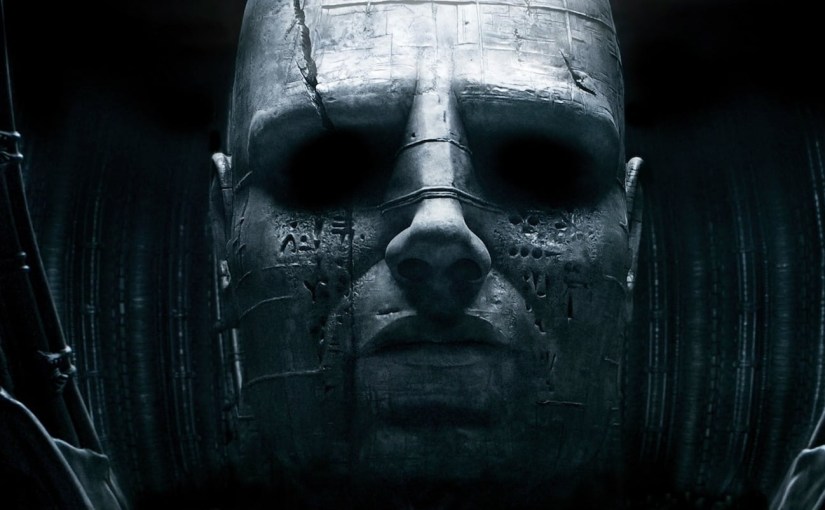
After a brief prologue set in an unknown time in an unknown place, we jump to the year 2093, when a deep-space research vessel arrives at a far distant moon, searching for clues to the origin of mankind.  Dr. Elizabeth Shaw (Noomi Rapace) says they were led to this specific moon by “Engineers”, humanoid beings who are visible in ancient cave drawings from across the globe.  She believes the Engineers can provide an answer, THE Answer, to Life, the Universe and Everything. (Apologies to Douglas Adams.)

Instead of Engineers, Dr. Shaw and her expedition discover miles of underground caverns and a room full of canisters that turn out to contain a horrifying contagion that attack the body at a cellular and/or genetic level, creating painful mutations that, if they don’t kill the host outright, turns them incredibly violent.  We also get a glimpse of the famous “space jockey”, the fossilized alien creature seated in some kind of contraption inside the spaceship in Alien.  So at LAST we’re in familiar territory.

But still no Xenomorph.

The story progresses, the shipboard android turns out to be less than trustworthy, people die in creative and horrifying ways, an Engineer actually turns up, we get a couple more visually spectacular tie-ins to the first Alien…but by the time we get to the end, what gives?  The movie’s obviously over, but we haven’t gotten any answers to the burning questions: Who are the Engineers?  If that was an Engineer in the prologue, was that supposed to be Earth?  If it WASN’T Earth, why even HAVE that prologue?  And don’t try to tell me that was a Xenomorph at the end…

Well, here’s my two cents.

First, of all, expectations are tricky.  They can color and compromise your entire movie-watching experience.  When I went to see Prometheus, I did have my own set of expectations, but as the movie settled in and it became clear that the movie had other designs, I had to consciously shake myself loose of my expectations and embrace what was being presented to me.

Second of all, the visuals are stunning.  I happened to see this in 3-D, and it’s one of a handful of movies where the technology was used PERFECTLY.  No gimmicky shots of spears or harpoons or whatever being pointed out of the screen.  It was used as it should always be used: as a tool to further immerse you into the world of the film without overloading you or being ridiculously obvious.  The gorgeous landscapes during the prologue and during our heroes’ descent to the surface are awe-inspiring.

And then, the story.  I was completely okay with the open-ended nature of the story, and I’ll tell you why.

There are some films out there that play Prometheus’s game of asking questions and not answering them.  One of the most famous examples is Stanley Kubrick’s adaptation of 2001: A Space Odyssey [1968].  If you’ve never read the book, I defy you to provide a concise explanation of the last thirty minutes of that movie.  But that didn’t bother people, because the goal was to get the viewer to ask questions, to provoke discussions about the movie that would eventually get around to some of the same questions asked in Prometheus: Why are we here?  What is our purpose?

And then there are other films that play that open-ended game and fail.  The one that comes immediately to mind is Darren Aronofsky’s The Fountain [2006].  By the end of that movie, my head was locked in a tilted position like a cocker spaniel hearing a strange noise.  If I had been a cartoon character, the word balloon over my head would have been all question marks.  I once read a full description of what was really going on in that film, but to the degree that I understood it, I simply didn’t care.  If I have to go that much work to “get” a movie, the movie didn’t do its job.

There are those who say that’s what Prometheus did, throwing us in the deep end and making us do some mental heavy lifting with no payoff.  But I disagree.

I think, for me, it has to do with the very nature of the questions Prometheus is asking.  “If we could discover the answers to the riddles of our existence, to what lengths would we go, or should we go, to get those answers?  And do we even want to know the answers?  Are we better off NOT knowing?”  These are questions that, almost by definition, can’t be answered in any satisfying way.  So Prometheus presents a possible answer, but then teases it away so there is still some mystery in the story.  If the characters in Prometheus had discovered some kind of document that laid out the Engineers’ plans in detail, I would have felt cheated.  It would have been woefully anticlimactic.  I liked it better that the biggest questions went unanswered, so I could formulate my OWN theories about the Engineers, their plans, their methods, their history, their future, etcetera.  It’s much more stimulating to let my imagination run riot.

(Granted, some of those questions are answered in Alien: Covenant [2017], but that movie still had the guts to leave some things to the imagination by the end.)

Prometheus couches deep philosophical riddles about our very existence within a crackling good thriller with spectacular visuals from beginning to end.  It stands tall as one of the best prequels ever made…Xenomorph or no Xenomorph.