
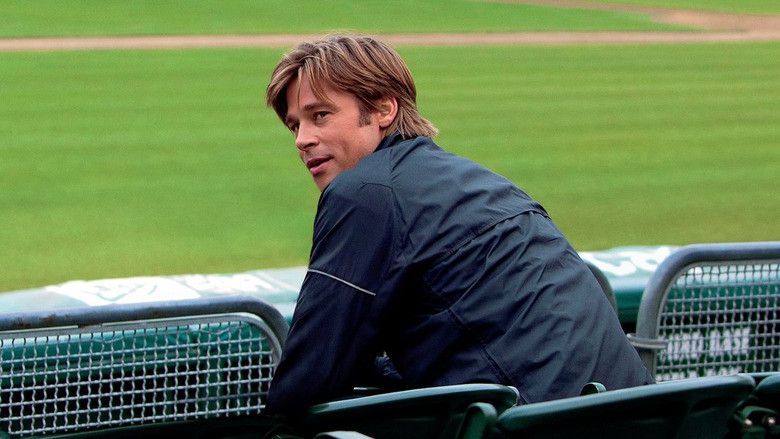
MONEYBALL (2011)

by Miguel E. Rodriguez

Director: Bennett Miller
Cast: Brad Pitt, Jonah Hill, Philip Seymour Hoffman, Robin Wright, Chris Pratt
My Rating: 9/10
Rotten Tomatometer: 94% Certified Fresh

PLOT: The general manager of the Oakland A’s attempts to assemble a winning team on a lean budget by employing computer-generated analysis to acquire new players.


On paper, Moneyball should not work as a movie. What have you got?  A feel-good sports story about the 2002 Oakland A’s utilizing the science of statistics to assemble the right combination of players to get them into the playoffs.

I mean, really?  Specifics aside, a Cinderella story about an underdog sports team trying to make it to the big game is one of the oldest, most predictable tropes in film.  Shall I count them off? Major League, The Bad News Bears, Bull Durham, The Mighty Ducks, Little Giants, Cool Runnings, Hoosiers…need I go on?

And in Moneyball, we barely even get to see any baseball action itself.  The movie is more concerned with the behind-the-scenes action, beating the trade deadline, shaking up the scouting crew, trying to get the manager to believe in the new system.  We don’t really see any major baseball action until we get close to the finale.

[SPOILER ALERT…unless you’re a HUGE baseball fan, in which case you were already aware of this.]

And let’s talk about that finale, while we’re at it.  The A’s make it to the 2002 ALDS elimination game, and what happens?  They LOSE.  Say what???

So why, oh why, does Moneyball work the way it does?

…no, really, I’m asking.  Because I’m not 100% sure myself.  Let me just tick off my thoughts as they occur to me here.

  1. There’s the screenplay.  Here’s some good advice: when you want to make a movie about a potentially dry subject, get both Steven Zaillian AND Aaron Sorkin to write your script.  The pace of the movie is stately, even sedate, but the dialogue is crisp, clean, and precise, getting to the point as efficiently as possible without being flashy.  In one memorable scene, someone walks up to the General Manager’s office and says just one word: “Peña,” and then walks away.  The GM takes it in, says, “Okay”, and calmly stands and flips his desk over.  The whole thing is over in 15 seconds.  I can imagine another movie wasting a lot of time with extra words or edits, but not “Moneyball.”  (SPARTAN.  That’s the word I’m thinking of.  The dialogue is spartan.)
  2. There’s the editing.  The dialogue is sleek and uncluttered, but there is a lot of information that has to be conveyed to those audience members who may not know what a box score is, or what a DH is, or why Billy Beane (the GM, played by Brad Pitt) doesn’t CARE whether his new first baseman can even field the ball properly, as long as he gets ON BASE when he’s batting.  Rather than use flashy editing to generate false suspense or excitement, the Oscar-nominated editors use more of that spartan vibe, with occasional jumps to real-world film clips of the actual team or individual players.  This is especially helpful when the film’s middle section details the woeful first half of the season under the new statistics-based system.  Again, not flashy, but effective.  Very hard to pull off, and deservedly recognized.
  3. There’s the structure…which I guess points back to both the screenplay and editing, but I’m just saying.  As I said, it’s a classic, well-worn trope.  Good guys get knocked down for the count – the A’s flat-out suck for the first half of the season – but then they suddenly start winning games and crawling back into contention.  As many of these films that I’ve seen, I still found myself unwittingly getting caught up in the spirit of the comeback.  In actual fact, the 2002 season is the one where the real Oakland A’s threatened to break the American League record for longest winning streak.  And it all comes down to one at-bat in the bottom of the ninth.  Because of COURSE it does.
  4. …and that sort of brings up another point.  Is there another sport that has as much innate mythology as baseball?  Sure, football has its share of comeback stories, and so does hockey and everything else.  But with baseball…lemme tell you.  A few years ago when the Chicago Cubs were on the verge of winning their first World Series in a hundred-and-eight years, I watched Game 7, rooting for the Cubs.  For those Cubs fans who watched as well, you’ll recall: that game was unmerciful.  The Cubs blew a three-run lead, they ended nine innings in a 6-6 tie, and then there was a RAIN DELAY before the 10th inning started.  But I will never forget that moment when the Cubs made the final out, and they wound up winning 8-7.  It was glorious.  …well, watching Moneyball, watching that section when the A’s are creeping up to winning twenty games in a row, I found myself grinning and laughing spontaneously, without even realizing I was doing it, and I remembered what it was like to watch the Cubs win.  And a big part of it has to do with that unexplainable psychic connection we have to the game itself, that sense of the romantic when someone clobbers a game-winning homer, or makes a dramatic catch to save a no-hitter, or when a relief pitcher retires the side with bases loaded.  I’m not a true baseball fan, I’ll admit…but I know good drama when it happens.  Moneyball gets that aspect of the game just right.

(I haven’t even mentioned the sterling performances from the principal actors, particularly Jonah Hill, who nabbed an acting nomination for one of the most underplayed characters in history.)

In the end, Moneyball is exactly like the Oakland A’s in the film.  It’s an unlikely combination of talent that generated surprising results and was critically acclaimed, gathering six Oscar nods.  It failed to win a single Oscar…much like the A’s were eventually eliminated from the playoffs in 2002.

But in the end, it’s not the shutout at the Oscars that I remember.  It’s the fact that this is still one of the best sports movies I’ve ever seen, and definitely one of the top 2 or 3 baseball films I’ve ever seen.

MIDNIGHT IN PARIS (2011)

by Miguel E. Rodriguez

Director: Woody Allen
Cast: Owen Wilson, Rachel McAdams, Marion Cotillard, Kathy Bates, Adrien Brody, Tom Hiddleston, Alison Pill, Léa Seydoux, Michael Sheen
My Rating: 10/10
Rotten Tomatometer: 93% Certified Fresh

PLOT: A nostalgic screenwriter travels with his fiancée’s family to Paris where, every night at midnight, he inexplicably finds himself going back in time to the 1920s.


The best of times is now / As for tomorrow, well, who knows?
La Cage Aux Folles

It’s currently 11:05 at night on a Sunday evening.  I’m getting older, so if I’m smart, I should get off to bed, owing to the fact I have to get up early tomorrow to get ready for work.

But I can’t.  I have just re-watched Woody Allen’s Midnight in Paris for only the second time in my life, and I have revised my original rating of 9 up to a 10.  And I am just bursting to write about how wonderful this movie is.  I’m hoping that I can reach someone who has not seen it before, so I can convince them that, even if they’ve never seen a Woody Allen movie before, this is the one they should start with.  Yes, even over Annie Hall or Manhattan or even Match Point.  In my mind, Midnight in Paris captures the voice of the artist as he is reaching a certain age and has something important to say about nostalgia, and how sometimes it’s not always what it’s cracked up to be.

Gil Pender (Owen Wilson) is a Hollywood screenwriter trying to complete his first novel.  He and his fiancée, Inez (Rachel McAdams), travel to Paris with her family so he can perhaps get inspired by one of the all-time great cities of the world.  He is immediately smitten with the atmosphere of the place; the movie opens with a wordless montage of static shots of Parisian cafés, streets, museums, statues, apartment buildings, and, of course, the Eiffel Tower.  The sequence sounds simple on paper, but the effect is – I don’t know how to describe it.  It captures the ineffable romance of the place.  More so than any other movie set in Paris, Midnight in Paris really, REALLY makes me want to go there.

Gil and Inez seem happy enough, but he is a little more antisocial than she is.  He is star-struck by Paris, but Inez is not incredibly fond of it.  They bump into an old friend of Inez’s, a pleasant enough man who turns out to be a bit pedantic; during a museum tour, he presumptuously corrects the tour guide on details of the life of Auguste Rodin.  This is not the kind of guy I would want to be stuck with on an elevator.

One night, Gil goes walking by himself on the Paris streets and gets a little lost.  Long story short, he inexplicably finds himself transported back to Paris of the 1920s, when the cafés were full of American expats and frequent visitors like Ernest Hemingway, F. Scott and Zelda Fitzgerald, Cole Porter, Gertrude Stein, T.S. Eliot, Pablo Picasso, Salvador Dalí, etcetera.  As a writer, Gil is over the moon; it just so happens his unfinished novel is about a man who runs a “nostalgia shop”, so this pleasant turn of events is a welcome tonic to his vaguely unhappy days back in the present.

Watching the scenes of Gil rapturously conversing with Hemingway, or goggling at Cole Porter playing the piano, I was swept away by the audaciousness of this movie.  It’s illogical and steeped in fantasy and seems to be begging not to be taken too seriously.  But it is a pure joy to watch.  I immediately identified with Gil.  I found myself imagining how I would respond if I were somehow transported back to a time and place when some of my own idols walked the Earth: Hollywood, the 1940s, walking around and conversing with Orson Welles, Alfred Hitchcock, Jimmy Stewart, Katharine Hepburn.  Or even not so far back: the 1970s, having lunch with young Spielberg and Coppola and Lucas, and Pacino and Streep and DeNiro, discussing film and life and getting insight into their inner workings.

From our perch in the present, it’s easy for us to look back at the past and say, well, those were the days.  Just earlier today, I was having an online discussion about the difference between CGI and practical effects in movies like Star Wars or The Lord of the Rings and even Honey, I Shrunk the Kids.  We tell each other that older movies felt more real because the effects were made with real props occupying real space, whether they were miniatures or matte paintings or what have you.  And we say, “Man, they just don’t make them like that anymore.  They knew what they were doing back then.”

That’s Gil.  He looks around at the shimmering jewel of Paris in the 1920s and he’s convinced that this is “where it’s at.”  What can today’s world offer in comparison to sitting in a café and discussing art with Salvador Dalí and Luis Buñuel?  Or the pleasure at hearing Ernest Hemingway tell you he’ll hate your book, even if it’s good, because that would make you a better author than him?  Or getting constructive notes on your novel from Gertrude Stein?

The story progresses.  Gil becomes infatuated with a beautiful woman from the past, Adriana (a luminous Marion Cotillard), and it becomes harder and harder for him to go back to his own present each night.  Inez’s father gets suspicious and hires a private detective to follow Gil during his midnight strolls.  You may ask how a private detective can follow someone who is traveling back in time.  Well, my friend, that is an EXCELLENT question, one which the movie answers in satisfying and gut-busting fashion in the final reel.

But the heart of the movie lies in the touching, revealing segment when Gil and Adriana go even further back in time, this time in a horse-and-carriage, back to the Belle Époque, the “Beautiful Age” of Paris, which lasted from about the 1870s to the 1910s.  Adriana, who lives — lived — in the ‘20s, is entranced with this even more bygone era.  She feels about the Belle Époque the way Gil feels about the ‘20s.  To her, the ‘20s are slow-paced, a drudge.  But, oh, to be back in the 1890s!  Dinner at Maxim’s, the Moulin Rouge, meeting Toulouse-Latrec and Gauguin and Degas!  How wonderful those days must have been compared to the Boring Twenties!

And there’s the message of the movie.  We can grouse and grumble about the modern world all we want.  The movies are dime-a-dozen.  The books even more so.  The music is crap.  Cell phones have turned us into tiny-screen junkies.  But, oh, to be back in the good old days of the 1980s, when the music was gnarly, and the movies were iconic, and the books were amazing, and everything was just better.

But we forget that, in the ‘80s, people were grousing and grumbling about THAT era, and they longed for the more sedate and rosy era of the 1950’s.  And in the ‘50s, people said the ‘30s were the BEST.  DECADE.  EVER.  And so on and so on.

It’s human nature for us not to realize what we’ve got going for us until it’s gone.  We are living in glorious times.  (Coronavirus and politics notwithstanding…gimme a break, I’m trying to make a point here.)  Look around.  Really SEE it.  Embrace it.  We don’t need a time machine to go back to our glory days.  We’re IN our glory days.  Just wait.  In 20 years, you’ll look back on the 2010s and say, “Man, wasn’t that a time?”

If you take nothing else away from the above review, remember this: Midnight in Paris is pure charm, is laugh-out-loud funny, and is the best Woody Allen film since Match Point.  So if you haven’t seen it, you really, really, REALLY need to make a point to do so.

THE LINCOLN LAWYER

By Marc S. Sanders

Michael Connolly authored a series of best seller legal thrillers featuring his famed character Mickey Haller. His most favored book of that series was adapted into a 2011 film called The Lincoln Lawyer with Matthew McConaughey in the role and directed by Brad Furman. I only wish more of Connolly’s books were adapted thereafter, because this movie is at least as good as the novel.

McConaughey is well cast as Haller, a defense attorney who operates out of his Lincoln Town Car working to get low level criminals off on technicalities or by easy settlements with the prosecution. His clients range from prostitutes accused of possession to notorious motorcycle gang members. When these clients can’t pay, Mickey wisely becomes resourceful with favors they can provide later on. One of his former clients drives the car while Mickey works in the back seat making calls out of his mobile office.

Louis Roulet (Ryan Phillippe) has just been arrested for beating up a prostitute at knifepoint. Roulet is a spoiled, preppy thirty something who is protected by the vast wealth of his mother (Frances Fisher) and their successful real estate enterprise. So it’s surprising that Roulet turns to street lawyer Mickey to be his legal counsel. At the same time though, this is a big score in legal fees. So Mickey is enthusiastic to accept the case, and go to trial. Louis doesn’t want it any other way to prove and insist upon his innocence.

It wouldn’t be fair to reveal much more about The Lincoln Lawyer because it’s got a lot of welcome surprises and twists along the way. What I can reiterate is how good an actor Matthew McConaughey is as I’ve written before. He just performs with a relaxed and confident swagger about himself. Mickey Haller is written as a smart and very strategic attorney. He knows the ins and outs of the courtrooms. He not only uses his clients for additional help, but he also sidles up to the bailiffs so he gets his clients cut ahead of the line to quickly face a judge. McConaughey is really good at not glamorizing the intelligence of Mickey Haller, but rather the charming personality of the guy. The character doesn’t come off as having all the answers at his fingertips, even though he likely does. It makes the film that much more dynamic to see McConaughey’s personality ahead of a Sherlock Holmes or Perry Mason kind of lawyer who might telescope everything five steps ahead of what’s eventually going to happen.

The supporting cast of The Lincoln Lawyer is also magnificent with Marisa Tomei, Bryan Cranston, John Leguizamo, Bob Gunton, Michael Pena, Trace Adkins, Josh Lucas and William H Macy. These are just great character actors. Everyone serves a purpose, even if it is just for a few moments.

Again, Mickey Haller is a great, modern day crusader. Like other literary characters such as Alex Cross and Jack Ryan, based on this film, I always hoped McConaughey followed up with at least one or two more additional films. I’d sure as hell be there to watch. Heck, the eventual Oscar winner went on to be a spokesman for Lincoln automobiles. So why couldn’t he have continued to carry the torch on the big screen?