WALL·E

By Marc S. Sanders

There are some movies that seem to accurately predict what we can expect of our planet’s future.  Paddy Chayefsky was one such prophet with his script for Network and the rampant consumption of television influence and addiction.  Author Phillip K Dick might have also been a Nostrodomus of sorts when his writings were adapted into such films as Total Recall, Minority Report and Blade Runner which offered convincing convenience to lifestyles and evolved productivity.  Perhaps the imagineers behind PIXAR are also on to something because their adorable, futuristic WALL·E does not seem so farfetched.  

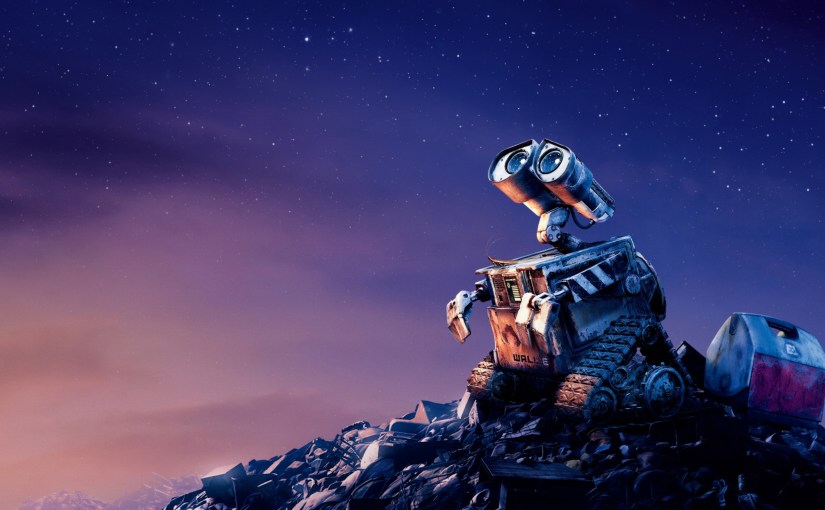
The robot title character is a trash collector on an abandoned planet Earth seven hundred years into the future.  A Wal-Mart/Sam’s Club amalgamation known as the fictional Buy N Large appeared to have become the main resource for any immediate need of the human population that once existed; what the coming of Amazon is turning into. This monopolized interpretation of absolute capitalism was run by a CEO and maybe Commander In Chief of the free world, played by Fred Willard, the one major flesh and blood actor to appear in this picture. 

WALL·E, along with a faithful cockroach, roams the wastelands.  The puppy dog, bug eyed robot wheels around on his tractor legs collecting the endless amounts of leftover trash and compacting it into neat, stackable boxes.  Piled on top of each other, these boxes get as high as skyscrapers.  These are the remnants from what Buy N Large left for the planet.

One day a rocket ship arrives and drops off a highly sophisticated and glossy white droid that we come to know as EVE.  For WALL·E, it’s almost love at first sight even though EVE has a treacherous laser cannon for an arm and intimidating blue cyborg eyes.

Eventually, the two bots hitch a ride into space when the rocket returns to pick up EVE.  They arrive on a galaxy cruise liner that’s floating through the solar system.  While the two get into a bunch of Looney Tunes shenanigans running through the corridors and piping of the ship, the audience bears witness to what exactly happened to planet Earth, and who has survived to carry on.  At this point a prophecy seems to be declared by writers Andrew Stanton, Pete Docter and Jim Reardon (all PIXAR regulars at the time).

Humans aboard this liner have become oversized, lazy blobs with no neck, fat arms, fingers and legs, and reclined to permanent seats while robotics cater to their hungers and comforts.  These people are cheerful but happily lazy and unproductive.  Remember when your mother would tell you to clean your room?  Well, the wasteland universe of WALL·E bears justification for mom’s aggravation and constant pestering.

The computerized animation of this PIXAR romantic adventure is dazzling in details and character expression.  There’s an unattractive sand like and earth tone mood to anyplace we explore on Earth.  Yet, the industrial sheen of the cruise liner appears to have all the comforts imaginable.  You can practically taste the colors and feel the balmy air conditioning within this ginormous vehicular city in space. Yet, the telling story of WALL·E has no problem convincing me that this is not right.  This is not a future I’d want to be a part of.

Disney and PIXAR follow that mentality of ensuring a soul of emotion drives their characters of fantasy and it’s easy to fall in love with the clunky lead robot.  You want WALL·E to be safe from sandstorms, while also keeping his only friend, the cockroach, by his side for companionship in an entirely lonely world.  His only other source of cheerfulness comes from watching the musical Hello, Dolly! on an old TV. Even playing ATARI’s Pong is not stimulating enough for this little guy.

Sound Effects Wizard Ben Burtt, who pioneered staple sci fi elements with the Star Wars films, performs the vocal expressions of chirps and beeps for WALL·E’s innocence.  There’s a language to the little fella and it’ll leave a lump in your throat when he calls for EVE.  Elissa Knight brings a more experienced, technologically up to date personality to EVE.  We worry when an organized entity like EVE robotically screams for WALL·E when she thinks he’s in danger.  She’s only supposed to follow a program, but the manufactured mind lends to a side effect of genuine emotion.  As the two get acquainted with each other, there’s a touching chemistry to them both.  A floating dance through space is as much silly as it is adorably romantic.  You cannot help but smile because by this point you are invested in this relationship as much you’d buy Rick and Ilsa’s affections towards one another, or Harry and Sally’s.

I really embrace the childlike love story connecting these two non-living beings.  Set against what appears like an apocalyptic wasteland, there are layered dynamics to this animated film, one of PIXAR’s best.  

I have to also salute the film’s nods to classic science fiction that also offer not so unrealistic possibilities.  An antagonist comes in the form of a robot similar in appearance to HAL-9000 from Kubrick’s 2001: A Space Odyssey.  He’s a nasty bugger with an all too familiar blood-red eye. It’s also a delight to recognize Sigourney Weaver’s voice as the cruise liner’s computer, a sort of slap in the face to monochromatic computers that would countdown a certain doom for the actress’s most famous role of Ellen Ripley in the Alien films.  PIXAR has always been brilliant with their wink and nod delights.

The film was released in 2008, a near generation ago maybe, when iPhones and Androids were not even as entirely sophisticated as today.  Yet PIXAR could telegraph what was to come.  The environments on Earth and on the cruiser tell us just how overly reliable we’ve become on technological conveniences for socializing or even one stop shopping.  

We are getting to a point where we might not even procreate with one another.  It’s a sad irony that it will take two self-thinking, yet designed for programing, robotic appliances to remind us how valuable the human touch is and what a purpose to life really serves ourselves and those we have to interactively live with.  

You might be embracing that cell phone tight in the palm of your hand, but will that device ever hold your hand in return?

FOUR CHRISTMASES

By Marc S. Sanders

I love Christmas cookies.  Those Santa, snowman and tree shaped sugar cookies with the frosting and sprinkles.  They are my weakness come every December.  Cookie cutter, however, is not necessarily a compliment when talking about a movie.  Four Christmases is as cookie cutter as they come.

Reese Witherspoon and Vince Vaughn are Kate and Brad, an unmarried couple happily going on three years and ready to celebrate the holidays alone in Fiji while lying to their divorced parents, on both sides, about doing charitable service within poorly developed countries.  However, when they arrive at the airport and learn that their flight is cancelled, wouldn’t you know it?!?!  A news reporter is there to capture them on live television revealing their ruse.  Now Brad and Kate have no choice but to visit each parent’s home on Christmas.  With less than an hour and a half running time, let’s chop this up evenly, shall we?  Figure there will be about 15-20 minutes devoted to each parent.  Hence the title… (say it with me now) …Four Christmases.

Let’s go see Brad’s dad first, Robert Duvall, who lives with Brad’s aspiring MMA fighting brothers played by Jon Favreau and Tim McGraw.  They live a simple life with a Zenith television set and Christmas presents that are purchased with a ten dollar or less limit. A gift of a satellite dish is not gonna go over well, and will likely mean a fall off the roof.  Side note: doesn’t falling off a roof seem to happen a lot in Christmas movies?  Also, if the bros are into MMA fighting, well you know that Brad is going to have to endure body slams galore while Kate simply gasps in shock at her boyfriend’s demise.

Transition time in this film happens in the car while going to the next Christmas celebration.  Brad and Kate take these opportunities to question the purpose of their relationship.  They think they have relationship troubles licked by NOT getting married and not devoting themselves to time with family, but are they kidding themselves? 

Next stop is at Mary Steenburgen’s house, Kate’s mom.  Kate’s older sister played by Kristin Chenoweth is here too.  Kate’s agonizing childhood is brought up for laughs like attending a fat camp and reminiscing about her being the one with the cooties and fearful of bounce houses.  Oh, look what’s in the backyard!  A bounce house!  How ironic!  Know where this is going?  A visit to the church of an overzealous evangelist (Dwight Yoakum), where Kate and Brad are quickly recruited to participate in the Nativity play, happens. 

This is about midway through the film and I gotta say I can’t blame Brad and Kate for always lying about going somewhere else for the holidays.  Who wants to live with this kind of torment?  There’s some truth to the adage “You can pick your friends but you can’t pick your family.”  The movie wants me to recognize the oversight of Brad and Kate and their disregard for family time, but I don’t see it.  These are cruel people that they are confronted with.

Next up, let’s go see Sissy Spacek, Brad’s mom, who is sharing coitus with Brad’s high school best friend.  Enough said there. 

There’s more transitional driving to happen where the question of if Brad wants to get more serious about their relationship is discussed following Kate’s reveal that she took a pregnancy test.  Often in films, it’s the baby factor that tests the relationships.  I wish Hollywood would think outside that box a little.  Having children is not the end all be all, all the time, in building a loving relationship.  Components involving work, religion, and money also come into play.  Mustn’t forget about love too.  Just once, I’d like to see something else.  So many couples live happily without children.  We are even reminded how it’s rude and intrusive to ask “when are you going to have a baby?”  In fact, it is rude to ask that question because it’s too standard and presumptuous.  Hollywood should account for that.  I digress though.

The fourth and final Christmas visit occurs at Jon Voight’s house, Kate’s dad.  Not much wrong here, as we are in the final act of the movie where it’s more about a will they or won’t they conundrum for Brad and Kate.  So, cue the insightful commentary from Voight dressed in a comfy blue sweater.

Look, I can’t deny it.  I laughed at several moments in Four Christmases.  Favreau is hilarious in his tattooed, buzz cut, intimidating presence.  The Nativity play with Brad dressed as Joseph and getting caught up in the hallelujah enthusiasm is funny too.  Duvall is doing his old man redneck routine like he does in Days Of Thunder, and well…c’mon it’s ROBERT DUVALL!!!!

I just wish I didn’t know what was coming from one scene to the next.  In a film this structured, you don’t even have to try to predict what will happen.  You have an involuntary instinct to just know. 

As well, I don’t get a kick out of seeing how uncomfortable characters are made out to be when they are doing nothing but paying a visit.  Poor Brad gets outnumbered by his fighting brothers and suffers the Home Alone slapstick body blows.  Later, a baby spits up all over Kate’s dress, and Brad starts to dry heave at the sight of the mess. That’s not funny.  That’s a shame.  In life that happens.  Babies spit up, but we should feel awful for the victim.  How uncomfortable that must be.  Kate is not Joe Pesci trying to rob a house and getting a deserving paint can to the face.  Kate isn’t laughing at her misfortune.  She’s in shock.  Steenburgen and Chenoworth cackle hysterically, though.  I can’t bring myself to do that.    I feel bad for these two, and all I’m thinking is that it really sucks that they couldn’t make it to Fiji.  I wish they made it to Fiji.  What a shame they never got to Fiji.

Like Home Alone or Planes, Trains and Automobiles, Four Christmases wants to deliver the message that there is nothing better than to spend the holidays with the family, or get married and start a family of your own.  Yet the campaign seems to defeat itself in its demonstration.  I love my family and I love being married, but if I saw this film ahead of what I have now in life, twenty years going strong, I might have thought otherwise. 

Quick reminder: THEIR FAMILIES ARE FRACTURED IN DIVORCE ALREADY!!!!  So, all that Four Christmases tells me is TO HELL WITH FAMILY.  I JUST WANNA GO TO FIJI!!!!!

INDIANA JONES AND THE KINGDOM OF THE CRYSTAL SKULL

By Marc S. Sanders

Indiana Jones And The Kingdom Of The Crystal Skull succeeds on so many levels of storytelling and construction. It stays true to form of its title character protagonist. Indy is not only a hero. He’s also a traveler of history. The film takes place in the year 1957, and director Steven Spielberg delivers visuals that reiterate the time, when the Cold War was on the horizon, and Nazi Germany was behind us. It’s time for the Russians to step up as the big bad.

David Koepp’s script really is quite brilliant as it never loses sight of the times with references to McCarthyism, communist red scare, and flying saucers and aliens directly inspired by the B movie serials of the decade. Even Shia LeBeouf portraying a sidekick to Indy is a model of Marlon Brando from The Wild One.

I’ve mentioned before how simply the silhouette of the famed archeologist with his fedora hat and bullwhip is as recognizable as Batman or Darth Vader or James Bond. Here, Spielberg uses the visual motif against a mushroom cloud of a nuclear bomb test site, and later against a flying saucer. As noted earlier, Dr. Jones moves with time; truly living up to his famous phrase, “It’s not the years honey. It’s the mileage.”

Harrison Ford maintains the character quite well, still skeptical of what is not literal. He’s not prepared to believe in higher powers until he sees it for himself. Ford conveys Koepp’s interpretation very well.

It’s refreshing that he is paired up again with Karen Allen as Marion Ravenwood (from Raiders), the best of Indy’s female companions. Their sparring remains natural. Allen folds back into her role quite comfortably.

Stalin’s top underling is dispatched with recovering a legendary Crystal Skull and revealing it’s true power. Master character actor Cate Blanchett makes for a great Russian bob haircut villain, with uniform physique. She’s smart but she’s got every fighting skill known to pose great threat.

An infamous scene involves Indy sheltering himself in a refrigerator to survive a nuclear blast. Majority despise this scene. The phrase “Nuke The Fridge” became almost as iconic as “Jump The Shark,” simply for the audacity of its imagination. After having witnessed the near-death escapes of his past adventures (parachuting from a plane in an inflatable raft, sliding under a speeding truck, becoming “a penitent man” to cross a cavern), what is so wrong with this moment? Heck, Spielberg knows it’s crazy which is why he offers a close up indicating the fridge is “lead lined.” The scene works because it holds true to Indiana Jones’ series of absurd survival.

Besides all of the periodic references, the set design of Kingdom… is spectacular. Looking at the final act of the film, we are treated to a column that opens itself up with ingenuity as sand must pour out of the column in order for the structure to open with a receding downward staircase. Then, there’s a beautiful open sesame moment before entering a circular throne room.

Another earlier moment stages a hidden chamber that is revealed on a large, stone, tilted disc. All of this collectively speaking is truly one of the best set pieces in all four of the Indy films.

A delightfully fun car/motorcycle chase on Indy’s college campus is great as well as there is jumping from bike to car and back to on to the bike before swerving into the library. The scenic background design has to be admired for showing protest signs to Communism on campus. The film never loses sight of where its story is set. Detractors of this film fail to recognize any of this.

Fans also took issue with LeBeouf. Not me. He’s got an adventurous fun side to him. The smart aleck way of Ford’s younger years, but not the same character background. He has fun with swinging from vines and sword fights, in the same vein of a mine car chase from a prior installment.

The story is moved by clues and maps and deciphering a welcome John Hurt who speaks in a gibberish of riddles that stem from a brainwash his character experiences. This is all good for a great pursuit. Nothing is easily revealed. Mayan writing needs to be interpreted; maps need to be read. Stories of legend need to be told. Indy needs to apply his professional knowledge to move forward through the Amazon to his final destination.

I’d argue that Indiana Jones And The Kingdom Of The Crystal Skull is one of the most misunderstood and divisive films of all time. People gave up on it too easily, I think. They reserved their approval because of either a ridiculous title (a great B movie title), or LeBeouf’s casting, or Ford’s age, or vine swinging and big ass red ants (a great monster horror scene by the way). I say those folks just didn’t get it and failed to recognize where all of this stemmed from. David Koepp, George Lucas and Steven Spielberg were very aware of what to present. If I were them, I wouldn’t have changed a thing.

Again, it’s not the years. It’s the mileage.

GRAN TORINO

By Marc S. Sanders

I had a few reasons to watch this movie. One, a good friend, Greg Spiegel, had given this film his full endorsement on a number of occasions. Two, as some of you know, I’ve been a huge admirer of Clint Eastwood for as long as I can remember, since age 8 or 9 I imagine, when I saw his Dirty Harry films and even Fido Beddow in Every Which Way But Loose (and its sequel; those films are much better than maybe they are given credit for actually).

Eastwood matured as a filmmaker during the mid 80s and on into the present. He transitioned into films that delivered messages that sometimes even contradicted his past films as the gunslinger who never asks questions and always knew where to shoot. Films like Unforgiven and A Perfect World really showcase the tragedies of violence perfectly, and I think Gran Torino is worthy of being added to that list.

Eastwood plays Walt Kowalski, a racist Korean War veteran, who never left the war he used to fight in. The war comes home with him 50 years later to his Michigan neighborhood where he seems to be the only Caucasian American to live among a melting pot of other races; highlighted especially here are his Hmong neighbors who look past Walt’s prejudices to befriend him following his unintended gesture of protection from an intrusive gang. From there, Walt makes a bond with young Tao, a boy with no male influence in his life, and Tao’s sister.

Eastwood is probably the best director to direct himself. He knows how to position his camera and lighting, or lack thereof, to carve out the lines on his face and hide himself in haunting shadows to show a riddled history to Walt. He also adheres to similar themes that worked well in other films. A defiance to religion represented by a young minister looking to help Walt is reminiscent to the sarcastic approach Eastwood’s character used in Million Dollar Baby. The neglect of a protagonist’s family, and most especially, the connection of the pessimistic old man with the young child, barely adult, as well echos the Clint Eastwood/Hilary Swank pairing in that film. I don’t mind if it’s a repeat actually. Relationships like these are hardly shown in films these days, and I think they are important. Films like Harold & Maude and The Karate Kid show that gaps in generations are not an excuse to separate ourselves. (Heck, I even attempted it when I wrote my play, Arnie & The Itch.)

Eastwood has great, uncompromising racial affection (yes, those two words work nicely here) with his two Asian co-stars Bee Vang and Ahney Her, who are well cast in their own right.

Name calling is a method of maintaining a relationship in a film like this. The PC bandwagon is tossed out so the actors, especially the minority Asians, find something more wholesome to a prejudiced old coot.

The language is strong in Gran Torino, but I say it’s an important film to show to many kids to learn of a neighbor’s tolerance; of what goes on behind a closed door or even if that neighbor sits quietly on his porch with a dog by his side and a beer in his hand. We learn of the roads they have crossed, the battles they have fought, and the accomplishments they’ve made. Learn from these people. Learn from the humanity they carry; the honest humanity that may look offensive on the outside yet is present due to a tormented history inside.

I could say “these whipper snappers with their phones” but it’s honest frustration. It’s hard to learn what a person really is by means of a handheld device. To learn about a person, you have to eat with them, work with them, speak to them and even appreciate their 1972 restored Ford Gran Torino, automobile.

This was a great effort in performance and production from Clint Eastwood. I’m glad I watched it finally.

QUANTUM OF SOLACE

By Marc S. Sanders

A writer’s strike never bodes well for a film. So the 22nd installment in the James Bond franchise, Quantum Of Solace, suffered because of it. Daniel Craig returns in his second film as Bond which begins as a direct sequel to my favorite film in the series, Casino Royale. Marc Forster (Finding Neverland) directs, but not very well.

Much of the action scenes are very shaky and choppy. Forster seems to have adopted Paul Greengrass’ technique that works so effectively in the Jason Bourne films and United 93. However, Forster does not make clear what is occurring. You can’t recreate Picasso with crayons.

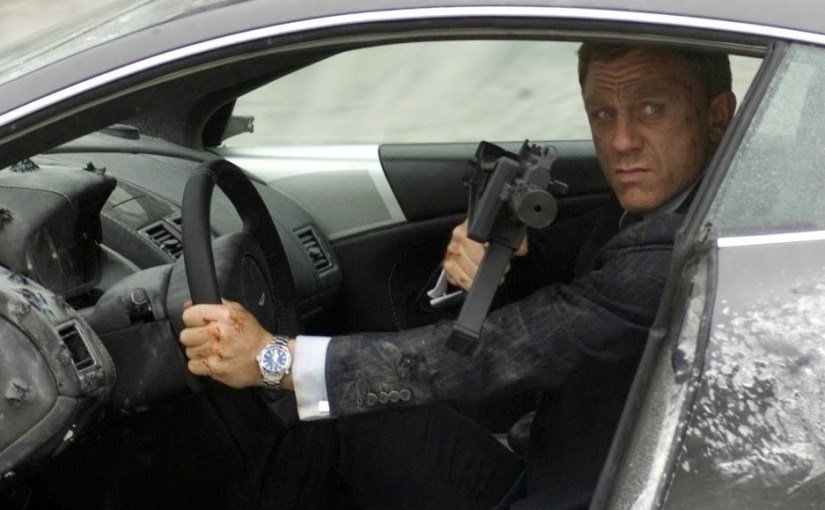
The opening is a rush job of a car chase as Bond races away from enemies in his Aston Martin. Machine guns and heavy traffic and construction sites make way for his car to gradually fall apart but it’s hard to really see how the car becomes damaged in the first place. Just when exactly did the driver’s side door come off? There’s lots of spinning out of control and dirt flying with bombastic gun fire and engine revving. It’s all sensory overload to hide the preciseness in the high speed chase.

Later, Bond is attempting to rescue the girl Camille (boring name, boring girl) played by Olga Kurylenko when she’s held captive on a boat. He jumps into a motor boat and the chase is on. Bond fends off the bad guy by tossing a rope with a hook on it. Just tossing it up. Suddenly the bad guy’s boat flips over. What exactly happened here? How did the rope take out that boat? I didn’t see the connection. Film is visual. So show me the fundamentals from A to Z, please.

The story involves Dominic Greene (Mathieu Almaric) who appears to be an environmentalist with interest in a pipeline in Bolivia. (Bolivia????) At first Bond is under the impression this pipeline must be for oil. Later, it’s realized that Greene intends to charge the country enormous prices as he takes over the water supply. (Roman Polanski’s Chinatown did this all much, much better.). In exchange, Greene will assist a tyrannical Bolivian General in becoming President. This General raped and murdered Camille’s family. Naturally, she wants revenge. As Bond pursues Greene, he comes to learn that Greene is a member of a secret organization called Quantum. Hence the strange title.

Bond follows through with this assignment while trying to determine why his past love (Vesper Lynd from Casino Royale) was murdered, and after MI6 is infiltrated.

The story is kind of all over the place. It has a lot of interesting threads like Bond’s need for revenge, Camille’s need for revenge and a secret organization that MI6, nor the CIA, were ever aware of. Threads remain hanging as threads though if a writer’s strike interferes.

The story for Quantum Of Solace hardly gets fleshed out. We learn nothing of the organization, Quantum. When Bond finishes his mission with Camille, she just gets out of the car and walks away into the middle of nowhere. Where is she going exactly? The climactic battle takes place in a luxury hotel located in the middle of the desert. Unless this is Las Vegas, who goes to a hotel in the middle of the desert? I mean like ever?????

The film is a tremendous disappointment after the creatively artistic success of Casino Royale. Often sequels do not live up to their predecessors, but Quantum really goes off the rails. This film was a make-up as you go.

Craig is fine in the role of Bond; consistent with his first film. Almaric is okay as the villain, but never given much to do. A second woman comes into play, named Fields played by Gemma Arterton, assigned by M to bring Bond out of service. She seems to have a personality that the Camille character lacks, but she’s hardly given much screen time, save for a nightcap with Bond and later an image that harkens back to Goldfinger.

Jeffrey Wright (a great Felix Leighter, that I have not talked about yet) is belabored to share scenes with an obnoxious CIA partner played David Harbour. These two guys seem to be acting in a different movie.

Marc Forster was given a toolbox but didn’t know which end of the hammer to hold with Quantum Of Solace. There are too many things wrong with this film to justify any merits it may have.

Maybe the most interesting moment happens in the epilogue scene as we learn more about Vesper’s past. The scene has next to no relevance with much of the main story beforehand. Still, why couldn’t this film simply stay on this trajectory from the beginning? This is a thread worth pulling on and then tying off.

In other words, Vesper Lynd is far more interesting than the water supply in…ahem…Bolivia. 

THE INCREDIBLE HULK

By Marc S. Sanders

The Marvel Marathon continued with the most underappreciated installment in the Marvel Cinematic Universe (MCU), The Incredible Hulk.

Edward Norton is the best of the cinematic Bruce Banners. He plays the role smart and desperate, and that’s the purpose of Dr. Banner once he is left to be on the run following his unfortunate encounter with gamma radiation. Norton enhances a script credited to Zak Penn. As such, we are treated to the efforts of Banner to rid himself of the raging green monster within. He communicates with a mysterious “Mr. Blue” by means of encrypted email as he hides out in the stacked, labyrinth tenements of Brazil. This setting presents an early high octave foot chase over rooftops and through narrow alleyways as Banner is pursued by General Thadeus “Thunderbolt” Ross, bent on using the hulk effects as a means to develop an army of super soldiers. Banner knows nothing good can come of this and therefore has to run until he finds a cure. To make things more complicated, Banner must keep his true love, Betty (Liv Tyler), out of harm’s way. Betty is the General’s daughter.

Louis Leterrier directs under a lot of demanding expectations following the unforeseen success of Iron Man, and before that, the disappointing bore delivered by Ang Lee with Hulk. For the most part Leterrier gets it right. Three high stakes action scenes featuring both Norton as Banner and later as a very gritty, very angry and very strongly aggressive nine-foot green monster are well choreographed blends of CGI and principle photography. A well-cast adversary in the form of Tim Roth is great as he willingly gets experimented on to match the power of the Hulk. Roth plays Emil Blonsky as an eager soldier bent on getting superior to the might of the Hulk. Leterrier shoots Roth gradually changing physically, but more importantly in performance. The center of the film shows Roth sprinting across a college campus to confront the Hulk head on. He then demonstrates astounding agility with leaps over the Hulk’s head. It’s a great match up.

William Hurt plays General Ross. I’d never consider him for this part based on Hurt’s previous resume. Yet, if you put him in a camouflage uniform, slap a thick, silver mustache on him, and grizzle his voice, he works well in the part.

Like Jeff Bridges in Iron Man, the villains offered up by Tim Roth and William Hurt are another two of my favorites in the MCU. Again, they are not after world domination. One is motivated by the discovery of advanced power. The other is moved by misguided opportunity.

Not much can be said about Liv Tyler. She screams. She cries. She yells at a New York City cabbie and she gets to kiss Edward Norton.

What I like about this film is the approach from the beginning. The opening credits offer all you need to know, so that it can quickly jump into the action and the pursuit. Penn, Norton and Leterrier dodge the go to origin story to tell us instead where Bruce Banner and the rest have left off. It’s efficient storytelling.

Leterrier also cuts his action and attention to the Hulk quite well. Sure, we all want to see the Hulk but let’s see his ultimate power first. Leterrier recognizes this is part monster movie. So, when an early set piece takes place in a dark soda factory, we are quickly familiarized with the architecture, and we believe the monster to be hidden under cat walks and in dark corners ready to swipe away a thug leaving only a sneaker behind. Eventually you see his silhouette, followed by his eyes accompanied by a Lou Ferrigno growl, and now you are sitting up at full attention. Later, Leterrier sticks to a similar routine by showing an enlarged hand bursting from a gas cloud.

This iteration of the Hulk is the best. He’s dirty and built like a linebacker with shaggy green hair. His expression is one of “STOP BOTHERING ME AND LEAVE ME ALONE.” Compared to the later installments, this version is better. He’s not as clean, not as disciplined, and thus we are more nervous around this Hulk than other Hulks we see in later films.

It’s still disappointing that Norton did not continue on with the role. I believe his “lonely man” interpretation, inspired by the late Bill Bixby’s TV version. A sad man in an unfortunate circumstance. Comparing his portrayal to Mark Ruffalo, the latter seems trapped in unconvincing dramatics. The internal conflict never seems that challenging to Ruffalo like it does to Edward Norton.

Though my only wish was that some unraveled threads (The Leader, The Abomination. Right, Marvel fans?) were not left unresolved in later MCU films. As an actor with several dual personality roles on his docket (Primal Fear, Fight Club, The Score), Norton is the better Banner, and it’s because of him along with Tim Roth and William Hurt that The Incredible Hulk is really one of the better Marvel pictures.

A Favorite Stan Lee Cameo: What happened after he drank that soda????

IRON MAN

By Marc S. Sanders

It’s fair to say in 2008, a new pop culture phenomenon occurred and that was the Marvel Cinematic Universe (MCU). The first of a collection of highly successful crossover films was Iron Man featuring a Robert Downey Jr that was offering little promise in box office and commitment following stints in prison for his personal drug addictions. Director Jon Favreau felt that Downey was right for the title role, also known as brilliant, genius, wealthy playboy Tony Stark. Favreau’s confidence, as it turned out, was right all along.

Iron Man is an origin film. Tony Stark is a man with everything, but because of a lack of surviving family following the deaths of his parents, really, he sadly has nothing.

After being captured by Afghan terrorists, Stark, the world famous weapons manufacturer, has an epiphany and opts to take his billion dollar company in a new direction by halting production on all weaponry. Stark’s partner, Obadiah Stane played by Jeff Bridges, tries to contain Stark’s new campaign, and in turn becomes an adversary to contend with.

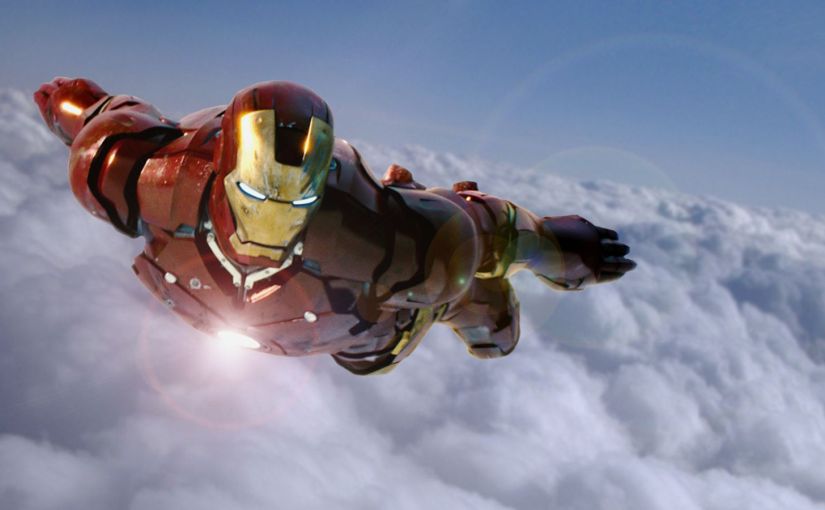
This is a summary of a great story, and even better, I have yet to discuss the main attractions of the film, the Iron Man suits. Sci fi and adventure movies work best when the highlighted visuals are not the story, but rather what accompanies the narrative. Iron Man is not so much about the suit. Moreover, it’s about the guy who built and wears the suit.

Downey is perfect in the role. Sure, his sarcasm and impulse to perform off script can get a little tiresome, but Downey also stops to give Tony Stark some heart as he bashfully pines for Pepper Potts played by Gwyneth Paltrow as his adorable sidekick in business. Also, his maturity comes into focus following his will to undo what he’s wrought prior to his captivity. It’s a great character arc of dimension and change.

Jeff Bridges plays one of my favorite MCU villains. At least I think so, because I understand where Stane is coming from. He’s gotta answer to his stockholders. Stark and Stane are in the money business regardless of the products they market and manufacture. He’s not all about global domination. He’s a man of responsibility. Bridges went with the comic book iteration of Stane from the late ‘80s publications by going bald with a devilish goatee. His height and broad shoulders plus his age match well against Downey. Bridges’ stature is intimidating opposite Downey’s reckless lack of care and immaturity through the first half of the film. Stane puts an arm around your shoulder, and you know you’re in trouble. So, it works really well here. Jeff Bridges really ranks as one of MCU’s most overlooked gems, now over 10 years and over 20 films in.

Favreau depicts some all too real and scary moments of terrorism and violence. This is all a step above the fantasy actions later to be seen from the likes of other Marvel villains like Loki, Ultron or Thanos.

It’s sadly ironic. One terrorist kicking a local in the head is harder for me to watch than a godlike giant who eliminates half the world’s population. Still, Favreau takes advantage of Downey’s comic timing and playful chemistry with Paltrow as well. Plus, there’s Terrence Howard as the no nonsense army colonel and friend “Rhodey” Rhodes (played in later films by Don Cheadle). Had Favreau not found that balance of heavy and light, we might not have seen the longevity of this continuing franchise.

The action scenes work well too. The Iron Man and Iron Monger (Stane’s costume) engage in a well edited and choreographed fight scene in the streets and evening skies of Malibu. Stark is plagued with weaknesses to add some “yikes” moments as he faces off against the hulk size Monger with Stane in control. These scenes are not blurry. It’s really what the action scenes of the Transformers films needed.

“Iron Man” foreshadowed a lot of fun material we were meant to see in later films. Blink and you’ll miss a certain patriot’s shield and stay for the first of many legendary end credits scenes that introduces an important character, leading to an eventual hit television series as well as becomes instrumental for all of these fun crossover moments.

Iron Man is an important film in cinematic history. It blazed a trail in big box office that’s given audiences lots of escape. The success of this franchise has attempted to be matched, but no other franchise has yet to come close. Sorry Star Wars and DC Comic films.

For now, the Marvel Cinematic Universe is as bulletproof as the Iron Man.

NOTE: Stan Lee cameo salute….Was that the real Hugh Hefner?!?!?!?

LET THE RIGHT ONE IN (2008, Sweden)

by Miguel E. Rodriguez

Director: Tomas Alfredson
Cast: Kåre Hedebrant, Lena Leandersson
My Rating: 9/10
Rotten Tomatometer: 98% Certified Fresh

PLOT: A bullied schoolboy makes friends with the new neighbor, a girl about his age who doesn’t leave her apartment during the day and has some alarming eating habits…


A little while ago, I reviewed a movie called Klaus, a film that took an age-old pop culture trope (the origins of Santa Claus) and turned it on its ear.  I wasn’t sure when I would find another movie that would be able to do that so effectively.

Well…here it is.  Let the Right One In, a Swedish film from 2008, made huge waves at the time of its release.  Critics called it a film with “magnificent emotional resonance.”  “One of the great horror films of recent years.”  “One of the real finds of 2008.”  “A spectacularly moving and elegant movie…a remarkable film.”

Too good to be true, right?  Well, I’ve just finished watching it earlier tonight, and I can tell you, the hype is real.  While the very ending brought up more questions than it answers (where is the train going?  where are the parents?), the ride getting there was phenomenally good.  Calling it simply a “vampire movie” is almost insultingly reductive.  It poses questions about vampire lore that I had never really thought about, and it provides immensely satisfying answers.

For example, one of the most well-known rules about vampires is they cannot enter your home unless you invite them inside.  At one point in the film, a vampire hesitates at a doorway because she hasn’t been invited, and the boy asks her, “Well, what happens if you come in anyway?  Is there something in the air?”  So, she goes inside without being invited.  What happened next was totally unexpected, and it made perfect sense.  I remember thinking, “So THAT’S what they’re afraid of…”

But I’m jumping ahead.  Let the Right One In tells the story of a bullied pre-teen schoolboy, Oskar, who fantasizes about knifing his tormentors.  One day, new neighbors move into the apartment next door, an older gentleman and a preteen girl.  He meets the girl one evening out on the snowy playground in front of their apartment building.  (Her first appearance is one of the great entrances in cinema.)  She tells him her name is Eli (pronounced “Elly” in Sweden).  He says she smells funny.  She tells him they cannot be friends, even though she seems eager to make friends with Oskar.  Her eyes seem to be abnormally large, almost like a character in a Miyazaki anime.

We’ve already seen the older gentleman who moves in with her botch a food-gathering run, so it’s obvious from the get-go what exactly Eli is, and what she needs to survive.  This is all done within the film’s first fifteen minutes or so, so I promise I’m not giving anything away.

What happens after those establishing moments, I’ll leave for you to discover.  You may already be remembering countless other vampire films like Fright Night or Interview with the Vampire and thinking, “I’ve seen all this before.”  But I can assure you, you haven’t.  Not like this.

The relationship between Oskar and Eli never gets sexual (they’re both too young for that…well, Oskar is), and is handled with remarkable sensitivity and keen observation.  At one point, he buys her a snack from a vendor.  She refuses it.  He feels hurt.  So she takes one anyway and eats it.  Seconds later, she’s sick to her stomach.  What does Oskar think about this?  He’s surprised, but he takes it in stride and apologizes.  There’s something so clever about this approach, about making it between an old soul and a child, that feels fresh and new to me.  Oskar knows the term “vampire,” but clearly hasn’t seen enough movies to recognize the signs of one standing right in front of him.

Eli is forced to make a kill periodically to survive.  These attacks are done with a minimum of gore but are incredibly effective and horrifying.  There’s something instinctively creepy about seeing a little girl jump – or drop – from the shadows, clamber onto the back of her victims, and latch onto their necks with an animalistic growl.  The fact these attacks are stitched together with quiet moments, like Oskar teaching Eli morse code, creates a unique atmosphere that is impossible for me to describe satisfactorily.

(Another detail: when Eli is hungry, it’s not depicted as it is in other vampire movies, where the overpowering urge to feed makes her go mad and wide-eyed.  Her stomach rumbles.  True, it’s a little louder than when it happens to a normal person, but it feels…right.  Of course her stomach rumbles…she’s hungry.)

There is more to the story, of course, about Oskar’s bullies and Eli’s incompetent roommate and the suspicious bar regular whose friend was killed, and so on.  Better to leave the rest as a surprise.  And there are LOTS of cool surprises here.  This feels like the kind of movie Guillermo del Toro might have made if he had gotten there first.  (Oh, wait, he did make Cronos…I stand corrected.)

QUANTUM OF SOLACE (2008)

by Miguel E. Rodriguez

Director: Marc Forster
Cast: Daniel Craig, Olga Kurylenko, Mathieu Amalric, Judy Dench, Gemma Arterton, Jeffrey Wright, David Harbour
My Rating: 5/10
Rotten Tomatometer: 65%

PLOT: Super-spy James Bond investigates a mysterious organization that seems intent on cornering Bolivia’s water supply.  Yes, you read that right.


The trivia on IMDb for Quantum of Solace (Bond #22, for those keeping track) contains this revealing nugget:  “Editing this movie was so stressful that co-editor Richard Pearson was brought in to assist Matt Chesse, to speed up editing. Director Marc Forster only had five weeks to edit the entire movie. In his previous movies, Forster would take an average of fourteen weeks to edit.”

Right there.  That’s the biggest problem with Quantum of Solace, the reason it’s ranked among my least favorite Bond films.  The stunts are there, the wordplay is there, the Bond girls are there…I was going to add “good villain” to the list, but more on him later.

Anyway, most of the important elements are there, but the movie never really makes us CARE about what’s going on.  We do get the barest bones of a connection to Casino Royale from two years earlier, but that’s still not enough to bring this up to the level I’ve grown accustomed to with Bond films.  This film feels more like one of Vin Diesel’s old XxX movies.

One of the biggest problems is the aforementioned editing issue.  In Casino Royale, the fight scenes were clearly defined and visually exciting.  (Remember that fight in the stairwell?  BRILLIANT.)  In Quantum of Solace, the fight scenes are cut so rapidly I’d swear they were from a Michael Bay movie.  Rather than make the scenes more exciting, this had the effect of making the scenes feel like the trailer for the movie, rather than the movie itself.  It was distracting, and lessened the tension for me.

Another problem that kept me from caring what happened is the plot.  Dominic Greene (Mathieu Amalric) is the villain this time around, and I’m sorry, but he does not exactly come across as a dangerous fellow.  He’s a little on the shorter side, he doesn’t dress impeccably (except when attending the opera), and his hair looks…greasy.  This is not a villain; this is a sidekick looking for a villain.

And his evil plot?  Using an environmental advocate organization as a front to…corner the Bolivian water supply.

The water.  In Bolivia.  After decades of James Bond stopping villains who wanted to do everything from steal nuclear submarines to kill literally every human on Earth, it seems to me this particular mission could have been left to the varsity squad.

There are other elements that were distracting.  David Harbour makes an appearance as a CIA agent whose character serves no real purpose other than to be the stereotypically obnoxious American.  One scene takes place during a beautifully staged outdoor production of Tosca that looked so amazing, I almost wished I could have left the movie just to finish watching the opera.  Gemma Arterton plays Agent Fields (first name Strawberry…get it?), another in a very long line of female characters in Bond films whose sole purpose is to sleep with Bond and/or get killed…or both.  Usually both.  (In an interesting first for the franchise, Bond actually does NOT sleep with the main Bond girl…go figure.)

The movie’s showdown takes place in a location that looked very real, but was ALSO distracting.  What is a four-star hotel doing in the very middle of the Bolivian desert?  We get a clumsy exposition line about the hotel running on “fuel cells” that are apparently poorly protected indeed, given the building’s incendiary tendencies during the climax.

I’m making the movie sound like a BAD movie.  It’s not truly BAD, but it just feels so slipshod in comparison to its predecessor, Casino Royale.

So what happened here?  Well, another tidbit on IMDb quotes Daniel Craig as saying this is the last time he’d work on a Bond movie without a finished script.  I guess THAT’S what happened here.  Shooting a movie without a finished script can sometimes end well, but not usually.  It’s like building a 30-story skyscraper using plans that only go up to the 15th floor, with couriers bringing new blueprints for the floors already under construction as well as the unbuilt floors.

But…BUT.  There is one overwhelmingly bright spot in the film: the THEME SONG.  Performed by Jack White and Alicia Keys, it marked the first (and, so far, only) Bond song to be performed by a duet.  It’s called “Another Way to Die”, and it is a SCORCHER.  Words fail me.  It’s down, dirty, mean, and growling, complete with the occasional staccato brass flourishes so evocative of John Barry’s score from earlier Bond films.

Too bad the rest of the movie is unable to live up to the promise of its title song.  Alas.

TRANSSIBERIAN (2008)

by Miguel E. Rodriguez

Director: Brad Anderson
Cast: Woody Harrelson, Emily Mortimer, Ben Kingsley, Eduardo Noriega, Kate Mara
My Rating: 9/10
Rotten Tomatometer: 93% Certified Fresh

PLOT: An American couple takes a trans-Siberian train ride across Russia, but things take an odd turn when they meet another mysterious young couple.


One of the reasons I like writing about movies is that it gives me the opportunity to talk up great movies that I’ve discovered off the beaten track.  Movies like the stunning stop-motion film Mary and Max (2009), or Sunrise (1927), hands-down the greatest silent film I’m ever likely to see, or Wild Tales (2014), an Argentinian anthology film that plays like The Twilight Zone crossed with Quentin Tarantino.

Or Transsiberian, a virtually unknown film from 2008 that is one of the finest examples of Hitchcockian suspense in the modern era.  It was an international co-production of – get this – Germany, the UK, Spain, and Lithuania.  It was co-written and directed by Brad Anderson, a man who’s directed a LOT of episodes of various television shows, and so has a good sense of efficiency and economy in his style and pacing.  It has yet another stunning Ben Kingsley performance as a Russian narcotics detective.  And it turns the screws on the heroine of the story in such a way that you can tell exactly why she’s doing what she’s doing, when every good instinct says she should be doing the exact opposite.

After a brief prologue involving a police investigation in Vladivostok, we meet Roy and Jessie (Woody Harrelson and Emily Mortimer), a married couple traveling home from China after a faith-based missions trip.  They decide to take a 6-day train trip across the Russian continent because Roy feels it would be nice to take an adventure…plus, he LOVES trains.  He’s one of those enthusiasts who don’t realize when they’re boring you with talk of gauges and coal-burners and cow-catchers. (Sheldon Cooper would have loved this guy.)  Jessie seems like a nice woman, but she seems to be keeping this adventure at arm’s length; you can tell she’d rather be flying coach than spending six days in a double-berth cabin.  I empathized with her right away.  They make a good couple, even though he wants kids and she doesn’t, she smokes and he’d like her to quit, he drinks and she doesn’t, et cetera.  Pretty normal.

A little while into their trip, Roy and Jessie meet the couple they’re sharing a cabin with, Abby and Carlos (Kate Mara and Eduardo Noriega).  Abby seems much younger than Carlos, but Jessie lets that slide, especially because Carlos seems to take an immediate interest in Jessie, and he doesn’t seem too concerned about hiding it.  Abby seems annoyed, but says nothing.  Roy is too jazzed about being on trains and interacting with the locals to really notice.  Carlos also seems to be pretty cagey about the souvenirs he’s carrying around in his suitcase.

At one of their scheduled stops, both couples leave the train to stretch their legs.  When the train leaves for the next leg, Jessie suddenly realizes something: Roy’s not on the train.  She didn’t see him get back on.  In fact, no one can recall seeing Roy re-board the train.  The movie plays a little by making us think one thing has happened, when it may or may not have…we can’t be sure.

And then, in true Hitchcock fashion, things start to spiral into one unexpected development after another, until the movie becomes about something entirely different than what you thought it was going to be.  Without getting into too many other details, Jessie finds herself trapped in a lie that she absolutely cannot back out of, no matter how much she wants to, because doing so would cause more harm than good.  Even when she’s presented with a life or death situation, she still can’t go back on it, and the story is constructed so tightly that it’s never for a moment unclear on her motivations.  You always see the “why” to her actions.

This other level to the movie is what separates it from the pack and places it in a higher weight class.  The screenplay is a masterpiece of suspense.  There’s a scene involving her camera that had me yelling, “Oh, NO!” at the screen…and I’ve SEEN the movie before.  You won’t believe the amount of suspense that will be generated with a slightly-open camera bag, or the fact that there’s never a garbage can around when you need one, or just the absence of a train stewardess.

This movie stands apart in its genre because the characters behave EXACTLY as they should, with perfect logic, and it never feels forced.  The bad guys are never too stupid, and the good guys are never too smart.  (They get pretty lucky a couple of times, but what are you gonna do?)  I don’t think I’m giving anything away by saying that, by the end, some characters are happy and others are not quite so much, but I don’t think you’ll be able to guess who will last that long.

This is a treasure of a film to be sought out and…uh, treasured.