LETTERS FROM IWO JIMA

By Marc S. Sanders

The companion piece to Clint Eastwood’s World War II film, Flags Of Our Fathers, and shot back-to-back, is Letters From Iwo Jima.  It’s not so much a war film as it’s a perspective of a losing battle during the height of the war, shown through the eyes of Japanese soldiers bearing little ammunition, food, and supplies while being plagued with dysentery and starvation. 

Right from the start, what I found interesting is how similar the Japanese mentality is to that of American soldier characters I’m all too familiar within other cinematic retellings. Paul Haggis recruited Iris Yamashita to write the screenplay, entirely in English, and then translated into Japanese.  The subtitles seem to read with a familiar English vernacular that my limited knowledge of Japanese culture would never expect.  I also find it interesting that rankings are the same from General to Lieutenant for example, and the salute to officers is precisely identical.  All of these similarities, and still the world powers find reason to fight one another.

The running theme of the picture reminded me of the television show M*A*S*H.  An assortment of characters take the time to write home about their experiences and fears along with the hardships they are enduring with unpure water, sweltering heat, infectious bugs and exhaustion.  One soldier’s letters are told will get censored if they ever reach the mother land.  These men are bakers and scholars, forced to serve a power that controls them.  They are not spies or regular army men.  They had no choice but to be here digging and preparing to kill.

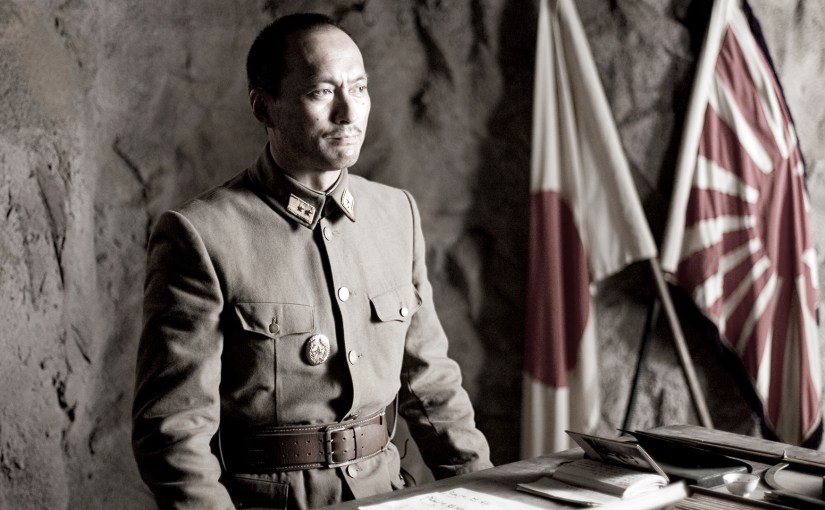
Ken Watanabe portrays General Kuribayashi.  In the beginning of the film, he is writing a letter to his wife as he is landing on the island days ahead of the battle to come.  One of his biggest concerns is that he did not finish installing the kitchen floor in his home before leaving. Kuribayashi is a celebrated strategist and hero, who actually studied and worked abroad in the United States.  He even broke bread with famed American military leaders and carries a valuable gift from them in his holster.  Yet, he is committed to his country’s Imperial Army and he knows he will not return home from this island.  He also knows that he will have to kill the very same men that he shared a meal with just a few years earlier. That kitchen floor is what is on his mind. 

A young infantryman named Saigô (Kazunari Ninomiya) was forced to enlist while his loving wife is carrying their child.  I’ve seen character situations like these before.  It’s much more revealing to see what cinematic history has described as the enemy to my John Wayne and Clint Eastwood heroes, though.  Recently, I listened to The Cine-Philes podcast recap of the film Crimson Tide, and they focus heavily on the midway dinner scene among the officers.  Denzel Washington’s character concludes that “…the true enemy of war is…war itself.”  Letters From Iwo Jima delivers on that argument.

Ahead of the well-known battle, there’s a quiet tranquility among the Japanese troops.  They debate about digging trenches and even fighting on the island which is devoid of any stronghold or power.  It’s also an unwinnable battle as the Japanese have realized that they are getting no air or naval support because much of their military cavalries have already been decimated.  The ultimate purpose for these men is to hold off the Americans, who are ten times more powerful, for as long as possible.  No man serving the Imperials is to surrender.  They will fight until they are as good as dead.  General Kuribayashi’s best idea to hold out is to dig caves within the mountainsides, thus making it challenging for the American soldiers to locate Japanese within the darkness of the caverns.  It worked longer than it should have as the engagement that was expected to only last five days went as long as thirty-six days instead.

Disturbing moments within the film do not compromise.  A small unit’s unified shout of “BANZAI!” will live with you forever when you see what they jointly commit within the cave they occupy.  Eastwood convincingly shows you the carnage.  Another character recollects how he was enlisted for five days in the military before he was forced to serve at this miserable place for disobeying a direct order. His humanity undid him.  Letters From Iwo Jima tells the stories before the occurrences that left gravesites (estimated to be ten thousand Japanese men lost) on its black sand beaches.

In a way it makes me proud that Clint Eastwood chose to direct Letters From Iwo Jima.  While his war pictures (Where Eagles Dare, Kelly’s Heroes), and even his Dirty Harry films which lean on prejudice for the truth found in humor, are endlessly memorable, he opts to take a sensitive position to the other side of the coin.  Eastwood does not lose sight of the fact that his heroes celebrated during the first half of his career were heroically killing and taking out fellow humans.  Letters From Iwo Jima recognizes the loss of humanity amidst the rocket fires and artillery of violence.  Six Japanese men will take to killing a captured American by beating and stabbing him into lifelessness.  Later, faceless Americans concealed by the director’s familiar shadows of photography will point blank kill a pair of unarmed Japanese men. 

Flags Of Our Fathers points a critical eye at the celebrations of victory.  Letters From Iwo Jima acknowledges victory is beyond reach but the enemy of all of us, war, is never done with any of us.

BOBBY (2006)

By Marc S. Sanders

There’s the distinguished doorman who is retired now but returns each day to play chess with a colleague in the hotel lobby.  There’s the open-minded girl who is inspired to prevent a young man from getting drafted into the Vietnam War by marrying him.  Her hairdresser is married to the hotel manager, who happens to be having an affair with the beautiful switchboard operator.  As well, the dining manager is a bigot who will deny his Mexican employees enough time to leave work and exercise their right to vote.  A busboy will have no choice but to miss what will likely be Don Drysdale record breaking sixth shut out game in a row.  A drunken night club performer can hardly stand up straight while she is completely dismissive of her caring husband.  A wealthy man is ready to introduce his trophy wife to an eventful evening in modern politics.  Two young campaign workers sneak away to drop acid for the first time.  A black man is at a loss following the recent assassination of Dr. King. Though he has hope that at least Bobby Kennedy will uphold his faith for a promising future in America for African Americans to carry equal rights. 

So, what does any of this have to do with Robert F Kennedy?  Not much I’m afraid.  Writer/Director and star Emilio Estevez tells us that all of these stories occur in the Ambassador Hotel on the fateful night when the Senator was assassinated in the hotel kitchen by Sirhan Sirhan.  In Bobby, the only character that is not a character is Bobby Kennedy and that is unfortunate.  More to the point, all of these short stories and other characters are precisely boring.

Estevez committed himself to grinding out stories that occur in the Ambassador that would lead up to Kennedy’s tragic death.  He’s admitted that they are all fictional. Based on his research and photographs, these characters are very loosely inspired by those that were there that night.  Before gathering in the ballroom to hear Kennedy’s victory speech after winning the California primary, these people were going through own personal ordeals.  If Emilio Estevez was not so personally inspired and researched in Robert Kennedy’s purpose to American history and politics, then perhaps Arthur Hailey (Hotel, Airport) would have pieced together this script of anecdotes and vignettes.

I commend Estevez’ efforts here.  The film looks great and even though the Ambassador was being demolished at literally the same time as this film was being shot, the scenic designs are very authentic.  The cast is even more impressive as the director reunites with many co-stars that he’s worked with before including Demi Moore, Anthony Hopkins, Christian Slater and his real-life father Martin Sheen, a lifelong loyalist to the Kennedy family.  The “importance” of this movie seems to sell itself.  Yet, everything is incredibly mundane and of little interest.  When your cast and your characters are just items on a grocery list to check off, there’s not much that’s interesting beyond the coupons.

The juicy gossip that surrounds the real-life actors is more captivating. Estevez cast Ashton Kutcher (Demi Moore’s real-life husband at the time) to play the drug dealer who provides acid to the campaign workers (Shia LeBeouf, Brian Geraghty).  Moore is also Estevez’ ex-girlfriend.  Yet, to watch Kutcher, LeBeouf and Geraghty experience an acid trip with weird visions they see when they open a bedroom closet is unfunny and not captivating.  Emilio Estevez is not living up to the Coen Brothers (The Big Lebowski).

A tryst with the boss (William H Macy) and his young, attractive and naïve switchboard operator (Heather Graham) is nauseatingly hokey.  The aged wife who works in the hotel salon (Sharon Stone) turns it all into squeamish soap opera tripe.

Bobby has an alarming opening.  A false alarm fire call is wrapping up at the Ambassador Hotel and you may feel like you are entering the middle of a panic storm, but things quickly calm down and the film resorts to cookie cutter editing to introduce its all-star cast.  None of what they say matters.  This is a game of who you can recognize.  Joshua Jackson, Nick Cannon, Harry Belafonte, and eventually the guy with the most significant role, Laurence Fishburne, is given his moment, the best scene of the whole film.  Fishburne is the kitchen chef who allegorically uses his creations in cuisine to compare the black man’s experience to the brown man’s, or Mexican. 

Having finished a trip to Martha’s Vineyard, I wanted to show my wife the under-the-radar and captivating film, Chappaquiddick, which covers Ted Kennedy’s personal story of controversy.  (My review of that film is on this site.) To continue on the Kennedy parade, we were motivated to follow up with Bobby.  Yet, this picture offers very little to the significance of Senator Robert F Kennedy.  There are samples of news reports complete with Cronkite.  Plus, the Senator’s own words ring through the epilogue of the picture.  Yet, I felt cheated of learning nothing new about the historical figure. 

Reader, you may tell me to kick dirt and go find another movie or read a book.  Fair!  However, this is film is called Bobby, and if I’m not going to learn about Bobby Kennedy from the man himself, then allow me to get to know the man through the eyes of these individuals.  Who hates him?  Who loves him? Who has a crush on him?  Who is inspired by him?  Who wants him dead and why? 

Estevez’ script does not allow enough material to describe what Kennedy meant to these campaign workers or hotel workers or guests.  They are primarily self-absorbed in their own personal battles to think enough about the fact that Bobby Kennedy is expected to make an appearance later this evening.  Again, their personal concerns for each other is very dull.  I don’t want to be around a drunk and obnoxious Demi Moore.  I don’t want to drop acid with some guys who hide behind a façade for caring about the candidate they are supposed to be serving.  I feel sorry for the busboy who will miss that big game, but that’s not enough to get me engaged in the entirety of the picture.

Bobby lends very little to the confusing times of the late sixties when an unwinnable war was persisting and championed leaders were being killed for others’ agendas.  Any of these stories could have been yanked from this script and slotted into a disaster flick like The Poseidon Adventure or The Towering Inferno

Bobby only picks up momentum when it arrives at its end that many of us learned about in school or witnessed firsthand in documentaries or directly from that very sad and unfortunate evening, June 4, 1968.  This day in history is so much more important than a Helen Hunt character trying to convince her Martin Sheen husband to let her buy a new pair of black shoes.  Bobby Kennedy deserves more recognition than what Emilio Estevez offered.

FLAGS OF OUR FATHERS

By Marc S. Sanders

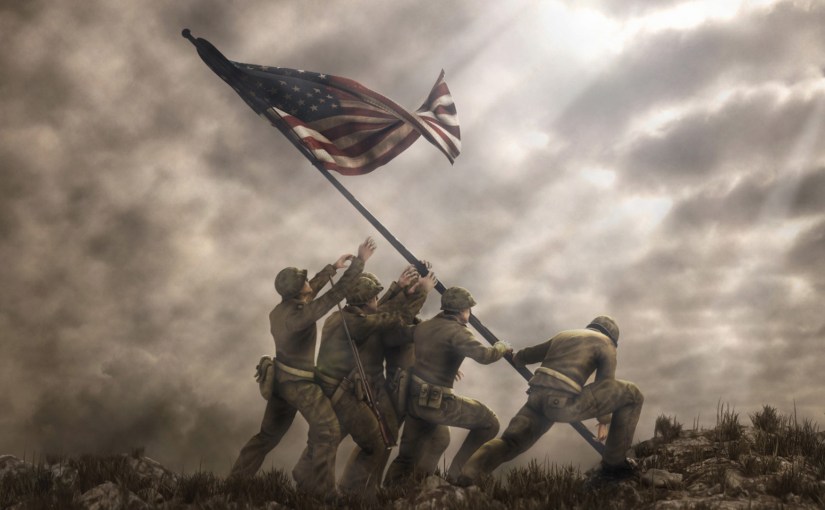
Arguably the most famous photograph in American history is that of the six soldiers raising the flag on the island of Iwo Jima while battling Japanese forces during World War II.  I remain fascinated by the image.  

I recall visiting the landmark statue in Washington DC when I was traveling by myself.  I took countless pictures of the piece.  I got close ups, wide lens shots, pictures of the flag and pictures of each sculpted soldier.  It’s heroic in any aspect.  It looks like something out of a Superman comic book.  As it turns out, the famed image was just a happy accident during a violently terrible time in twentieth century history.  Photographer Joe Rosenthal didn’t even realize what his camera captured until his film was later developed.  Turned out this was the second attempt at raising the flag.  Furthermore, this occurred on the fifth day of the conflict – with thirty-five days still to go before the Americans could claim victory over the bloody crisis.

So, while Rosenthal’s image seems to declare American patriotism at its finest, the real story is not as romantic.  In fact, one of the narrators of Clint Eastwood’s film, Flags Of Our Fathers, suggests that there are no heroes to celebrate.  Whoever the men in that picture were, they were not so much fighting for their country as they were trying to stay alive and look after the comrades ahead and behind them.

Flags Of Our Fathers has a very reminiscent feel to producer Steven Spielberg’s Saving Private Ryan with unforgiving battle scenes of blood, death, bombings and young soldiers storming a beach while screaming for their buddies.  Spielberg might have impressed me first, but Clint Eastwood masterfully shoots wide landscapes and up-close turmoil with his reliable strategies of shooting in shadows and silohouettes.  Eastwood’s film, scripted by Paul Haggis and William Broyles Jr veers into a unique direction though as Rosenthal’s picture takes on a life of its own back in the states.  It makes the front page of every paper.  Harry Truman stands proud of it along with all the decorated military leaders.

Now that America has entered the war, it is appropriate to ignite a propaganda campaign.  This picture of the Stars and Stripes getting elevated into the sobering, smoky war-torn skies will motivate citizens to buy war bonds to further fund the war effort.  The spokesmen will be the ones believed to be the remaining surviving three of the six in that image.  Ryan Phillipe is Navy enlisted John “Doc” Bradley.  Jesse Bradford is Rene Gagon, and Adam Beach plays Native American Ira Hayes, both of the Marine Corps.

I believe Flags Of Our Fathers embraces what every enlisted person did to serve the efforts of America during the war, and the picture mourns the countless sacrifices and losses that occurred.  However, it frowns upon the domestic response to what really went on overseas.  Those that returned carried terrible and unforgettable trauma based on their experiences.  Yet, the three thought to be part of the flag raising were pushed to celebrate their achievements summed up in a split-second image.  Bradley, Gagon and Hayes were skeptical if they were the ones in that picture.  Government Bureaucrats could care less.   There were others on that hill who cannot speak for themselves, but officials in suits and ties will insist otherwise to uphold a countrywide tour complete with recreations of the hill they ran up on that fateful day.  Even desserts are crafted like the famed image.

Ira Hayes is the one who is especially conflicted with his new responsibilities to the governing body that historically acquired his ancestors’ territory.  Adam Beach portrays a torn individual who is limited in celebration by the United States and certainly patronized.  Who he stems from does not matter.  He represents a false interpretation of the English acceptance of his Native heritage.  His obligation to this machine of propaganda only doubles the exaggeration that his other two peers are coerced to parade with marching bands and fireworks.  All that the ongoing extravagance does is keep him absorbed in the Japanese lives he brutally slaughtered and the bloodshed that surrounded him.  It’s a heartbreaking performance told with an absence of true appreciation for what Hayes gave up on that battlefield.

I learned much from Flags Of Our Fathers, but I had issues with comprehending everything.  While the immense war footage is chaotic with sharp editing and camerawork, it’s challenging to match names with faces in the picture.  There are two elderly men who are recounting what occurred and what happened to these men and their families long after the incident was over.  It was hard for me to line up which older man was who, on top of who they are talking about at times.  Paul Walker is one famous face in the crowd.  So is Barry Pepper but I could not identify the names of their characters until the film was arriving at its conclusion.  It was not until the epilogue of the movie arrives that it became a little clearer.  I also had to later reference what is listed on IMDB.  

The entire design of Eastwood’s movie is authentic from the battles staged for the Iwo Jima conflict to what mid-1940s domestic life looked like back home.  Truly absorbing while both storylines seem so different.  Clint Eastwood also wrote the soundtrack composition, and it is truly sobering.  His son Kyle performs with the orchestra.  

Flags Of Our Fathers partnered with Clint Eastwood’s follow up later in the year, Letters From Iwo Jima, which offered the Japanese perspective of the incident.  Bridge the films together and you get an incredible cinematic experience.  So many war pictures are one sided.  In all fairness, most movies do not have the time, luxury or finances to expand their palettes from one side to the other.  Because these two films are companion pieces, the viewer gets a fair account of how this battle, located on a tiny island, treated the men on the ground while their governing bodies celebrated their stands for patriotism, victory and monetary funding.

Eastwood demonstrates that the war destroyed practically everyone who was engaged in it regardless of the countries these soldiers served.  Many were slaughtered, but the innocence of those that physically survived died with everyone else during this period of time.  Clint Eastwood directed two films that explain this never-ending atrocity.  These men eventually laid down their weapons, but they never left the war.

INSIDE MAN

By Marc S. Sanders

The abundance of Spike Lee’s films offer a message as quickly as the film begins.  Then they set out to demonstrate what Lee is talking about in the scripts he writes and/or directs and what is presented on screen for the next two or three hours.  BlacKKKlansman (a favorite of mine) and especially Do The Right Thing are perfect examples.  Lee is direct and hardly ever ambiguous.  Inside Man is an exception.  

This Spike Lee Joint is having a bit of fun with the director’s own take on the staple bank robbery found in so many films.  By the time the film is over, and all the cards are on the table, you realize the audacity of this caper is as unique as Sidney Lumet’s Dog Day Afternoon or Michael Mann’s Heat.  With a screenplay by Russel Gerwitz, Spike Lee is proudly vague until he finally reaches his conclusions during the third act of the piece.  It’s unusual.  It’s out there and it’s a stretch, but the math of the heist seems to add up.  Still, knowing what I know now, I do wish there was a little more focus on some characters that lend to the film’s twist. Then again, maybe that would have implied too much.

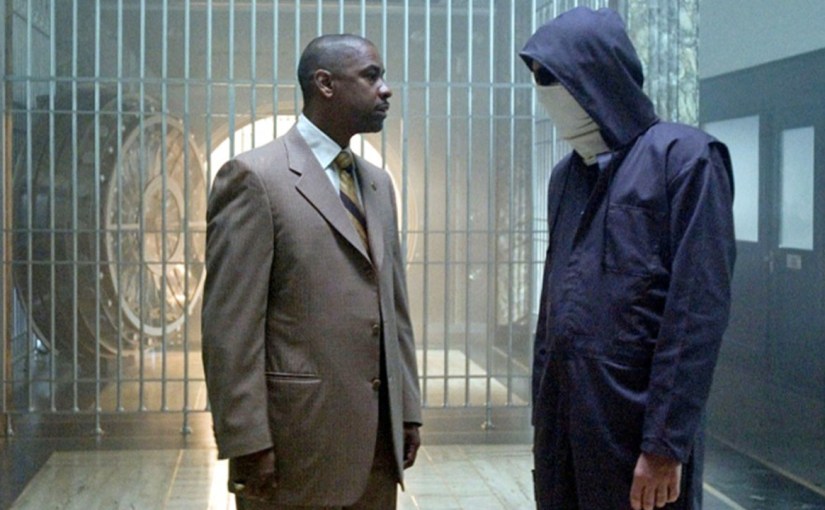
Four people wearing sunglasses, caps and painters’ uniforms take a well trafficked New York City bank branch hostage, complete with the entire staff and around thirty customers who are in the lobby.  The ringleader is played by a mostly concealed Clive Owen.  You might not see his face too often in the film, but you’ll be grateful he’s the bad guy in charge.

Denzel Washington is Detective Keith Frazier, and with his partner Bill Mitchell (Chewetel Ejiofor), they are on the scene attempting to diffuse the situation. The police captain right next to them is John Darius (Willem Dafoe).  Ejiofor and Dafoe are good as expected, though their roles are routine elements for these kinds of movies.  Washington has the kinetic pace that audiences are familiar with as he tries to outthink the bank robbers.  His character is labeled with a checkered reputation as he’s suspected of stealing drug money.  That element really goes nowhere.

Another party comes into the fold with Jodie Foster as a well-tailored and confident “fixer” hired by the bank’s president (Christopher Plummer).  To get these two actors together in a film along with Washington?  Well, that begs for repeat viewing.  Unfortunately, I didn’t see much point to the Foster character.  Upon hearing the news of the robbery, Plummer’s character clandestinely employs Foster to contain the situation so that a particular item in a safe deposit box remain untouched.  She arrives on the scene, exchanges dialogue with Washington that does not add up to much.  She surveys the hostages being held and then exits the story, until the epilogue.  As welcome as it is to see Jodie Foster, I can’t imagine what was gained from the context of her role, which does nothing to advance the story.

Inside Man always kept me interested and guessing.  The structure of Gerwitz’ script jumps ahead at times to show the detectives interrogating each hostage with suspicion after the incident is over.  So, I always wanted to know how it ever came to that shift in direction.  Plus, what happened to the bank robbers, and what precisely had Christopher Plummer so concerned about one particular branch robbery that he had to reach out for special services from Jodie Foster’s character? 

The answers arrive, and I can swallow the explanations.  Yet, the wrap up actually involves additional characters who hardly say a word or appear on screen earlier in the film.  Because they are briskly glossed over, it did not give me complete satisfaction.  I like the twist a lot.  It just needed a more solid foundation.

Inside Man is of those rare films that Spike Lee is invested simply for the fun.  The quick cuts and bustling New York atmosphere work well.  I love the opening credits to the movie; kind of his own spin on what Lumet did with Dog Day…  Lee has a good villain and appealing heroes. Other than few shortcomings, this is a solid crime drama.  

Often, Spike Lee positions himself on a platform that endorses a cause for the African American populace, or he brings attention to social wrongs in world history.  He is one of the best at what he does with his filmmaking approach.  Ironically, a message and a comeuppance arrive with Inside Man, but for a different demographic.  It might not be as hard hitting or thought provoking as other Spike Lee Joints, but it is appreciated.  

THE SENTINEL

By Marc S. Sanders

You know those movies where in the first twenty minutes you learn that there is a mole in the department?  The department could be the police or the FBI or the Starship Enterprise.  In the Presidential assassination thriller, The Sentinel, the mole is someone within the Secret Service.  Having read several John Grisham and Brad Meltzer novels in my day, I have a weakness for assassination plotlines within the hallowed halls of the White House or on-board Air Force One.  However, if the object is to uncover who is framing the hero, in this case that’s Michael Douglas, and more importantly to reveal the mole, then at least give me more than one possibility. 

Director Clark Johnson works adequately with the sunglasses, dark suits and ties adorned by Douglas and his antagonist former colleague and friend played by Kiefer Sutherland.  Douglas portrays Pete Garrison, an elder agent who has commendations for heading off the Reagan assassination.  Amazing that President Reagen was even shot because on top of Michael Douglas, I believe Clint Eastwood and Kevin Costner were also there on that fateful day.  Sutherland is Dave Breckinridge. He wasn’t there because he was just a teenager in 1981.

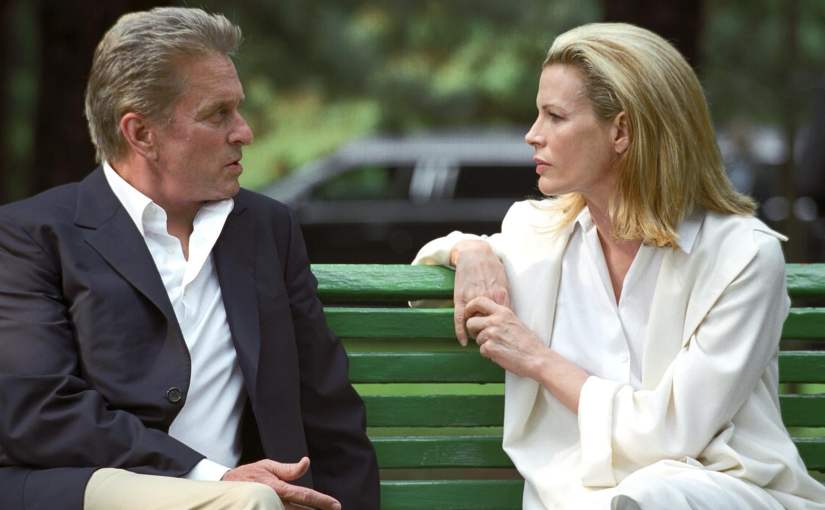
There’s troubling bubbling up in this Presidential cabinet, particularly because black and white photographs have mysteriously landed on Garrison’s desk depicting his clandestine tryst with the First Lady, played by Kim Basinger.  An agent partner of Garrison’s is shot dead on his front porch.  Then Marine One is taken out by a missile.  Obviously, someone has the President (David Rasche) in their sights.  Therefore, it must be a mole.  Who’s the likely traitor?  Pete Garrison is suspect numero uno, and so Michael Douglas is in the spotlight doing a subpar Jason Bourne treatment of resourcefulness to prove his innocence and uncover who framed him.

The Sentinel is not a terrible movie by any means.  It’s just this flavor of film has been done countless times before it came out in 2006, and thereafter.  Eva Longoria plays a former student of Garrison and now partner to Breckinridge and together with Sutherland they do the staple run with guns drawn down the streets of D.C. and the black sedan daytime drives while trying to stay hot on Garrison’s trail.  For some extra spice, Pete and Dave had a falling out some time ago and when we discover what that’s about it’s not very savory.

What keeps Johnson’s film from entering the lexicon of other grade A thrillers is that the true bad guy is completely apparent long before the plot unravels itself.  You know who’s spiking the voodoo doll within the first five minutes of the picture.  Why did Clark Johnson have to give this character the most oblivious close up?  That’s a failure on the director’s part, I’m afraid.  The Sentinel is short of plausible red herrings.  Someone told me recently that the best part of a magic trick is when you forget you are watching a magic trick.  Well in this movie, you know how the rabbit pops out of the hat.

There are obligatory shootouts. There’s also the big speech the President gives at the end when the bad guy is about to make a deadly move at the podium. As well, naturally there’s another typical Michael Douglas affair in a long line of on-screen Michael Douglas affairs.  Kim Basinger, I’d like to introduce you to Sharon Stone, Demi Moore, and Glenn Close.

Michael Douglas and Kiefer Sutherland (more or less doing his Jack Bauer schtick) have a magnetism on screen that’s upheld their long careers.  However, The Sentinel is not evidence of their worthiness.  Watch this film after you’ve exhausted all the other movies belonging in this category, and you just need to see who Michael Douglas is sleeping with this time, while the President gets saved one more time.   

MISSION: IMPOSSIBLE III

By Marc S. Sanders

Remember that CW TV show called Felicity?  I’ve never seen an episode, but I remember the advertisements.  Beautiful, former child actor, Keri Russell with the golden, curly locks of love, was on her way to college.  Every commercial had that crisp, home like comfort feel voiceover.  It left me with an impression that this was a corny, yet sweeping exploration of coming of age while at college, and gaining independence.  The show came from JJ Abrams.  Abrams is a good director and writer.  He’s now one of the biggest producers in Hollywood.  Back in the early 2000s however, he wanted to nurture his characters.  Protect them.  Make them feel warm and content.  After Felicity, he went on to develop a spy thriller series called Alias with Jennifer Garner.  She was a college student with a lovable roommate by day and was super spy by night, or whenever the moment called for it.  Abrams went on to blending his coziness with that of stunts and explosions that modernized a series like, say…Mission: Impossible.  Naturally, when Tom Cruise recruited him for the third film of the high-octane franchise, we got the “Felicity Finish” applied.  Ethan Hunt is sweet and kind, and he’s ready for married life.  How precious!

Don’t get me wrong.  Mission: Impossible III is likely what kept the still running blockbuster movie series going.  Following a style over substance lackluster entry before, from action director John Woo, this third entry went in a completely different direction.  Ethan Hunt hugs a soon to be sister-in-law. Ethan Hunt cries.  Ethan Hunt has feelings.  Ethan Hunt has to rescue who he regards as his “kid sister,” Felicity…I mean adorable Keri Russell from being held hostage.  Ethan Hunt belongs on the cover of a Hallmark card with actress Michelle Monaghan.

I imagine JJ Abrams is not fond of the early James Bond movies.  I’d make a case that he watches them and wishes that someone, anyone would just give 007 a warm and sincere hug after he saves the world, and hold him close.  Superspies have emotions too, ya know?

The story of this third M:I chapter focuses on the pursuit of a MacGuffin known as the rabbit’s foot.  A powerful weapons dealer named Owen Davian (a brutally frightening Phillip Seymour Hoffman) is working to get a hold of it.  Following a first act rescue mission that Ethan and his IMF team (Ving Rhames, Maggie Q, Jonathan Rhys Meyers) engage in, the main hero finds reason to capture Davian and intercept the mysterious rabbit’s foot.  Complications get in the way because Ethan has fallen in love with an adorably beautiful doctor named Julia (Monaghan), who is unaware of her fiancé’s exploits.   

The action is superb in Abrams cinematic directorial debut.  Once it gets started after a sweet engagement party scene, it does not let up.  Everything is well edited and choreographed. An essential part of a Mission: Impossible movie.  An unexpected attack on a bridge crossing is spectacular.  The covert tactics are fun to watch as well.  When Ethan and team secretly invade The Vatican, the step-by-step maneuvers are carried out with gleeful ease.

There are twists and double crosses at play as well that you are not even thinking about looking for.  Frankly, they work more effectively here than they did in the original M:I film directed by Brian DePalma.  When the traitor is revealed to deliver a line like “It’s complicated,” it is not unreasonable to gasp.

Hoffman still remains the best of the villains in Cruise’s action franchise.  Maybe that’s by Abrams’ design because this is probably the most personal of all the films to date.  Phillip Seymour Hoffman is the guy who will be apprehended and braced to a railing on an airplane by the IMF team, and yet will still hold the upper hand.  A question like “Do you have a wife or a girlfriend?” has a much more sinister context when uttered by Phillip Seymour Hoffman.

I do recall when I first saw the film that the ending is not original.  It’s an opportunity for Tom Cruise to do another running scene, but it was first used in an episode of Alias where an operative is remotely giving directions to the hero while talking on a cell phone.  Clever the first time.  The second time seeing it, I was just calling it out.  So, Abrams needs to stretch his imagination a little.  No matter.  The pulse of the adventure races at high speed.

Mission: Impossible III might be unabashedly hokey and corny.  Everyone looks like they belong in a JC Penney commercial at Christmas time, or on a CW TV show like Felicity. However, it won’t deny you of what you are looking for which are big stunts in the sky and on the ground, along with the cool gadgets and those signature pull away masks that made the original series so memorable. 

I still realize that by the time film series reached this chapter, the franchise still belonged exclusively to Tom Cruise occupying every frame.  Once again, his team of IMF agents really don’t matter or carry any substance except to wear clothes.  At least this time, Tom Cruise cries over someone else.  So, he’s not as self-involved as the last couple of times, or even the last couple of dozen movies.  That’s a nice change of pace. 

THE DA VINCI CODE

By Marc S. Sanders

Akiva Goldsman’s screenplay adaptation of the bestselling novel The Da Vinci Code by Dan Brown suffers from an overabundance of information; like A LOT of information, a TON OF INFORMATION actually. The book is an incredibly fast read with brief chapters and plenty of diagrams and images to study. It surprises me, though, how in depth director Ron Howard’s approach is with the film. Howard must have literally shot every page Brown documented including his edits. Amazingly there is a Blu Ray EXTENDED CUT. It seems Goldsman and Howard at one point couldn’t help themselves. Restraint had to step in for the controversial story’s cinematic debut.

Tom Hanks plays the great modern literary character, Robert Langdon. He is very good in the role of a research expert on historical symbols and cryptology. Hanks even masters Langdon’s self-debilitating weakness of claustrophobia very well, which proves to be a hinderance. It’s maybe an under celebrated part in Hanks’ career because the film is so heavy. Little is talked about this film any longer. (The second sequel, Inferno, flopped at the box office. I’ve yet to see that one.)

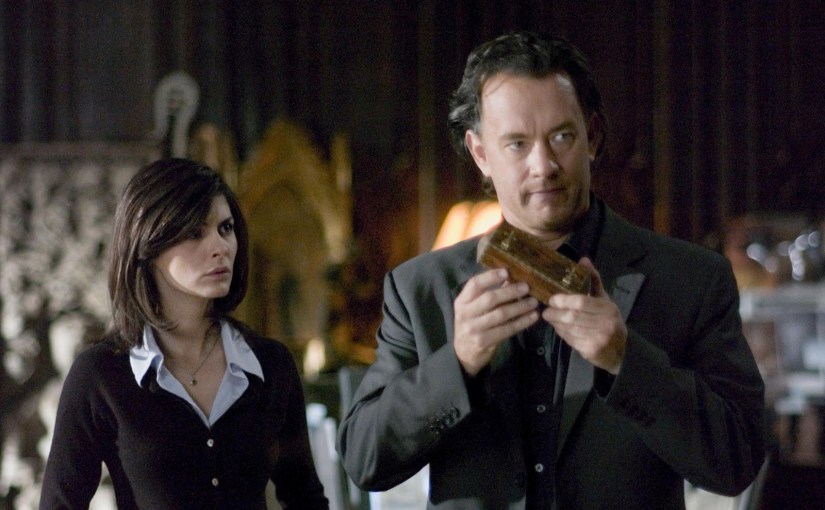
Langdon is recruited to go the Louvre in Paris one evening to look over a recently murdered victim left with a pentagram carved in his chest and a gunshot wound in his belly. The victim’s name is Sauniere (Jean-Pierre Marielle). Soon Langdon is teaming up with Sophie (Audrey Tatou), Sauniere’s granddaughter, to uncover one puzzle or clue after another left behind most prominently within the artwork of Leonardo DaVinci, including the “Mona Lisa.” Gradually, a conspiracy is uncovered revealing a strong possibility of how Mary Magdalene and Jesus Christ are actually connected. Amidst all of this, Langdon and Sophie become fugitives under the suspicion of murder. Now the cops (headed by Jean Reno) as well as a secret society within the Catholic Church are hot on their trail to stop them from revealing the truth. A dangerous, self torturing Albino monk (Paul Bettany) also comes into play.

That’s a long ass paragraph I just wrote and it hardly scratches the surface of how in depth The DaVinci Code really is. Because it is so nuanced, I had some major problems with the film. For one thing the cinematography from Salvatore Totino is very dark. I know. Most of the film takes place in the middle of the night within the hallowed halls of the Louvre and the streets of Paris. However, I think certain liberties should have been taken here. The details thrown at the audience never stop. Long summaries of dialogue come into play and at times Totino and Howard will highlight a code or a portion of a piece of art or a passage in a book. Because the story is so deliberately murky, I wish at times what I was looking at could have been presented all the more clearer.

Another issue is with Audrey Tatou who is of French descent and whose character is that way too. Her French accent is too thick to clearly understand every word she is saying. A lot of details become lost because her dialect swallows her words. Natural dialects can be a slippery slope in film. You want the characters to be as genuine as possible but none of that means much if you can’t follow along.

The best surprise of the film reveals itself when Ian McKellen appears, portraying Sir Leigh Teabing, a mentor and friend to Langdon. Yes. He offers up a ton of information too. Too much for any one film really. However, McKellan is so giddy in the role. Leigh relishes the fact that Langdon and Sophie appear at his home. He’s elderly and crippled and excited with glee to come across them so he can share his own theory of Mary, Jesus and what is possibly the real interpretation of the Holy Grail. At ninety minutes into the film, McKellan’s introduction is quite a welcome, relief from the heaviness of everything before.

The DaVinci Code clocks in at over two and a half hours. It feels longer actually. There are multiple endings as surprise traitors need to be revealed, more history and theories need to be uncovered and more European locales need to be visited complete with secret passages and hidden staircases. It took a lot of mental effort to remain patient with the film, and I had already read the book!!!

Ron Howard’s film merits the discussion of whether Brown’s bestseller should have ever been filmed. As good as Hanks and McKellan are, I say no. This is not Indiana Jones with bullwhips and truck chases. This is a treasure hunt that sticks to what is on a page and within an exhibit. To mask what is discovered by dictating endless dialogue from the cast becomes incredibly tedious.

Dan Brown’s story is wildly out there in theory and supposition. It’s what makes it fun, really. So, do I recommend The DaVinci Code? You bet I do. I definitely recommend you read the book.

CASINO ROYALE

By Marc S. Sanders

Casino Royale from 2006 is the one film in the entire James Bond series that gives the MI6 agent a complete character arc, and for that reason alone, it is also the best film to date in the franchise, and another of my most favorite movies.

Bond becomes a different person, and a different agent by the end of this film. It’s a pleasing and unexpected surprise.

Following the misfire of Pierce Brosnan’s Die Another Day, the franchise was wisely reinvented, going back to the origins of 007 and how he earned his well-known license to kill. Fans immediately protested the casting of a blonde-haired Bond with relatively unknown Daniel Craig. Yet, as soon as the film was released, tensions were overall subdued.

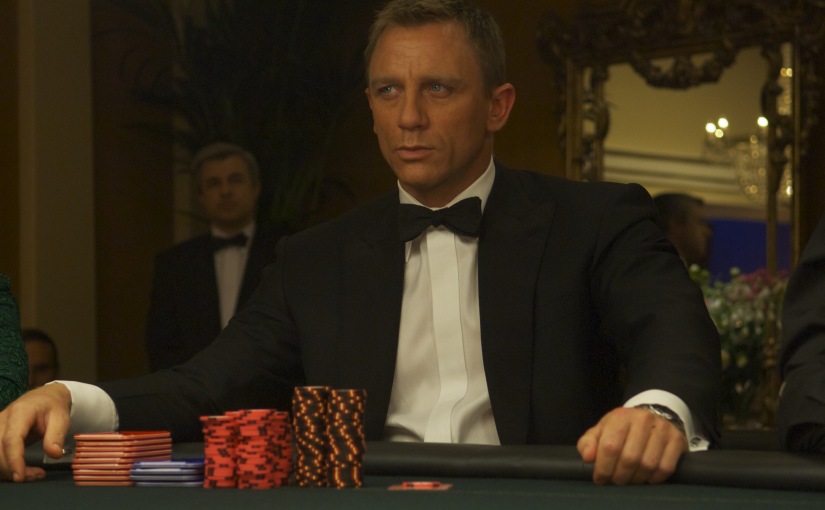
Martin Campbell (Goldeneye) returns to direct the EON Production’s adaptation of Ian Fleming’s very first Bond novel. The super spy quickly completes the necessary requirement of two kills to earn his 007 status and is assigned by M (Judi Dench, still so good in her role) to pursue LeChiffre (Mads Mikkelsen), a mathematic genius and money launderer for high priced terrorists. Bond engages in a high stakes’ poker game at the renowned Casino Royale where he must beat LeChiffre’s bluff or monies from his Majesty’s government will have directly funded terrorism. Along the way, Bond falls in love with the treasury agent, Vesper Lynd (Eva Green), who is assigned to fund his poker buy in.

This film offers a James Bond with faults and mistakes to learn from. He’s never completely perfect and he is subject to losing a bluff in more ways than one, albeit at the poker table or in the face of love. As well, Bond doesn’t necessarily think far enough ahead, as his kill ratio continues to rack up. To M’s displeasure, she wishes he’d have some reservations so that they can question who he comes in contact with. Bond doesn’t seem to consider that.

Daniel Craig gives a brilliant performance of a man who believes he is even wiser than the reputation moviegoers have been accustomed to for over 40 years prior. By the time the film reaches its climax in an action paced shootout within a floating building along an Italian strait, Bond’s steely armor is donned against affection or distraction. James Bond becomes humbled by personal betrayal. I never would have imagined. Death will never affect him again. Love won’t either. This James Bond makes mistakes, but never will he make the same mistake twice.

Mikkelsen is a great villain as the bad guy who gets in over his head. He is not trying to dominate the world. He’s only interested in a profitable return from his dealings with terrorists. James Bond can’t interfere. LeChiffre is a new brand of villain, but still written with a trademark deformity of weeping blood uncontrollably, plus a case of asthma. A far cry from metal teeth and hooks for hands. Mikkelsen plays LeChiffre as cold and terrifying, almost like a vampire with a winning hand.

Eva Green is the best Bond girl of the series. There’s a mystery and a dimension to her performance. Something is driving her and it may play against Bond ever succeeding. Green portrays Vesper as lovely, graceful and suave like her partner, but she is incredibly smart too. She is evenly matched with Craig’s Bond. A great moment occurs when James & Vesper first meet for dinner on a train and size each other up. Eva Green is precise in monologue delivery. She is assured and confident. This woman is able to read Bond before Bond is given the opportunity to seduce her.

Campbell puts together real looking and tangible action sequences where 007 pursues a bomber specializing in parkour, a sport of climbing and leaping on and off of objects within a construction area. There’s also a well choreographed fight scene in a hotel staircase.

The best moments are reserved for the poker match however. Campbell amps up the tension with these ridiculous hands the players have in a fierce match of Texas hold ‘em. Bond gets sidetracked with sword wielding killers and poisonous drinks, but still manages to return to the table time and again with his tuxedo neatly pressed. The interplay at the table with or without dialogue is mesmerizing.

Daniel Craig went entirely different with his James Bond. The wit is there, but the tongue in cheek is not missed. This James Bond doesn’t give a damn if his vodka martini is shaken or stirred. Most of the prior Bond films had the super-agent without any scruples or demons in his closet. World domination, death and casual sex were just all in a day’s work. This 007, however, comes with a heavy background. Craig is great with his silent, seemingly guilty regard for killing someone whether it be by drowning a thug in a flooded bathroom sink or stabbing another one to death amid a museum crowd.

Screenwriters Paul Haggis with Neal Purvis and Robert Wade write a dramatically induced James Bond story. A tale not easily forgotten. It was time to reinvigorate the franchise that was going off into the absurdity of invisible cars and over the top gadgets. The puns are still here, but they serve more as a cover of a necessary internal pain for Bond, rather than disregard for his actions.

Casino Royale is one of the best films ever made. No qualms about me saying that. It’s hard to find great relationships among characters with huge risks at play, and magnificent chemistry for one another, as well as the story that serves them.

Casino Royale is an absolute winning hand at any table.

THE DEPARTED

By Marc S. Sanders

Martin Scorsese finally won his Best Director Oscar with the 2006 Best Picture The Departed, from a script written by William Monahan. The film is a remake of a Hong Kong crime drama called Infernal Affairs.

Also known as the one film in Scorsese’s library with a linear plot, The Departed depicts the stories of two guys who grew up in the south end of Boston and joined the police academy to serve. Only difference is one is recruited to go undercover within the Irish mob, while the other is recruited by the same mob to become a highly respected police officer and supply an unlimited wealth of information to his criminal boss.

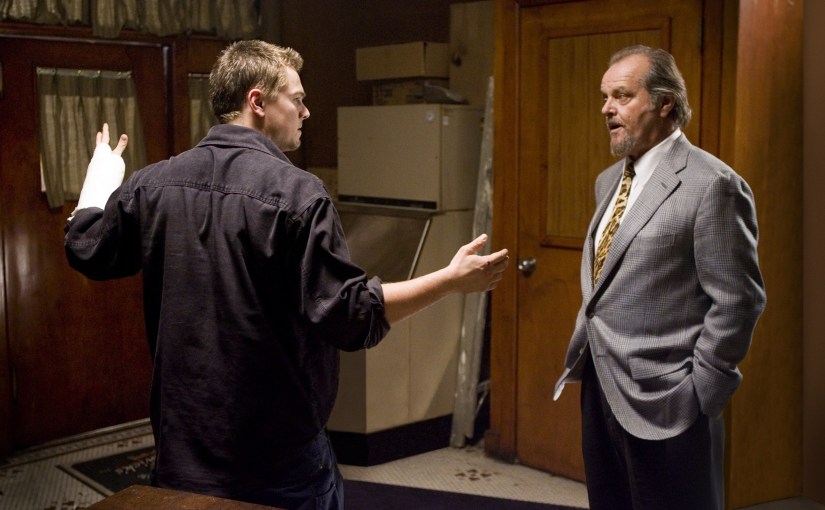
Leonardo DiCaprio is the undercover cop Billy Costigan. Matt Damon is the criminal cop Colin Sullivan. Jack Nicholson is the Irish mob boss in the middle, Frank Costello.

The Departed works because Scorsese and Monahan allow the audience in on every deceit playing against the characters. Pleasantly surprising is that there are even twists to this layered story, and cellular flip phones assist all the players with trying to remain in hiding or hoping to one up and trap the other. However, because everyone is getting tipped from their own respective sources, people are either not ending up dead, or arrested or caught red handed. As Costigan builds his case against Costello, Sullivan is worming his way to protecting his cover in the police force while also tipping off his true boss.

Performances from DiCaprio, Damon and Nicholson are what you’d expect. Nicholson is chewing the scenery again appearing like the devil incarnate while hamming up the facial expressions. Damon is great at playing it like the Boy Scout cop in well-tailored suits, clean shaven and flirtatious within his department and earning respect among his peers, that is until it all seems to unravel. DiCaprio is wired as the cop who needs to show he’s a dangerous hood to be trusted among the mob cohorts. However, he’s getting more paranoid and unwound at the risk of being made.

Thelma Schoonmaker (one of my favorites) does a balanced approach edit to showing a parallel among the cops. She will insert a happening of Costigan for a snippet and then segue to Sullivan appearing to do honest police work, or reaching out to Costello with a warning of what’s coming for him.

Great support also comes from Ray Winstone as Costello’s right hand man, and Alec Baldwin, Anthony Anderson and Martin Sheen, all within the police department.

Ironically, the one Oscar nominated performance was bestowed upon Mark Wahlberg and I grew tired of his presence quickly as the cop who berates Costigan endlessly with yelling and fast one liners that involve someone’s mother. Could we just move on from this please?

I also found Vera Farmiga as a police psychologist to be mostly unnecessary until a contrived ending point needed to arrive. Her character naturally has affairs with both Damon and DiCaprio, who also attend her office for sessions. Of course they do! Whenever the film sidetracks to one of them with Farmiga, The Departed stalls for a moment. Her character carries no stake in the plot line and offers no further dimension to DiCaprio and Damon’s characters.

The film works best as the complications compound on each other. A great moment occurs between the cops when one of them picks up a bloody cell phone to dial back the most recent call. Silence on both ends of the line, and the moment just plays out until someone speaks or hangs up.

Moments like that is suspense similar to when a man is intruding in a dark house. However, this is suspense delivered by Martin Scorsese, and Martin Scorsese will film suspense that is anything but typical. Martin Scorsese’s suspense leaves you breathless.

UNITED 93 (2006)

by Miguel E. Rodriguez

Director: Paul Greengrass
Cast: Ben Sliney, Khalid Abdalla, Corey Johnson
My Rating: 10/10
Rotten Tomatometer: 90% Certified Fresh

PLOT: A real-time account of the events on United Flight 93, one of the planes hijacked on September 11th, 2001, and of the chaos on the ground as the FAA and the military grasped what was happening.


There are a handful of movies that can still make me cry when watching them, even on repeat viewings, and even then it doesn’t always happen.  Fearless, directed by Peter Weir, is one of them.  The finale of Edward Scissorhands still has the power to choke me up.  The transition from black-and-white to color at the end of Schindler’s List can still bring a lump to my throat given the right circumstances.

But only one movie has made me shed real tears every single time I watch it, and I’ve seen it now at least four times.  I used to watch it every time September 11th came around, as a sort of (morbid?) remembrance of that terrible day.  I haven’t done so the last couple of years simply because the emotional reaction I have to the movie and the events it depicts is just too much to deal with.

Paul Greengrass’ United 93 is unlike any other film about 9/11 that I’ve ever seen.  Many people praised Oliver Stone’s World Trade Center when it came out, but I found that movie too pumped up with melodrama and forced situations.  United 93, on the other hand, takes a documentary approach and simply follows the passengers and crew boarding their flight, like any other, on their way to a date with destiny that nobody saw coming.

Intercut with the flight itself are scenes on the ground, in various air traffic control centers, and the FAA itself.  One of the masterstrokes of the film was to cast Ben Sliney as himself.  Ben Sliney, for those who don’t remember, was the FAA Operations Manager on 9/11.  In fact, it was his first day on the job in that new position that very morning.  It was his decision, after seeing the carnage in NYC and the Pentagon, to take the unprecedented step of grounding ALL air traffic over the United States.

The movie’s effectiveness comes partly from the re-enactments of the ground controllers, trying to make sense of garbled messages coming from first one, then two, then three flights, something about people taking control – and then seeing those flights disappear from radar coverage.  And then someone in the tower sees smoke coming from downtown New York…  Those scenes, more than any documentary I’ve seen, really bring back the memories of that morning for me, the disbelief and utter shock of seeing that building burning and smoking.  And then the second plane hits…

But the movie’s real power is with the flight that ultimately didn’t hit a significant target, crashing instead in a field in Pennsylvania.  (There has been some speculation about its intended target, but the truth is we’ll never know.)  The scenes aboard United 93 have been pieced together using recorded phone conversations from passengers, flight deck recordings, and data on the plane’s flight path.  There’s no way to know how accurate some of these events are, but the point of the movie is that it feels 100% real.  The fear on the face of the hijackers, the fear of the passengers, the slow realization that this flight is headed to another target, and their gradual determination to do something about it.

Watching those scenes, with the knowledge that this flight will eventually crash with total loss of life, is an unbearably sad experience.  The final few minutes of the film, as the passengers rush their attackers and frantically try to break down the cockpit door, fills me with dread.  I find myself thinking, unreasonably, “Maybe this time they’ll get to the cockpit in time…maybe THIS time they’ll get the one pilot among the passengers behind the wheel this time…”  But no.

So WHY, oh, WHY do I give this movie a “10” when it’s such an immensely tragic experience?

Because this movie does not feel like a cheap attempt to cash in on a national tragedy.  Instead, it feels more like a memorial to those brave souls who did everything they could to keep themselves alive, to keep their attackers from fulfilling their evil deeds.  As much as any soldiers who gave their lives attacking a beach head, these everyday civilians deserve our gratitude, and they should be acknowledged as genuine heroes.  I believe United 93 treats them as such.