MYSTIC RIVER

By Marc S. Sanders

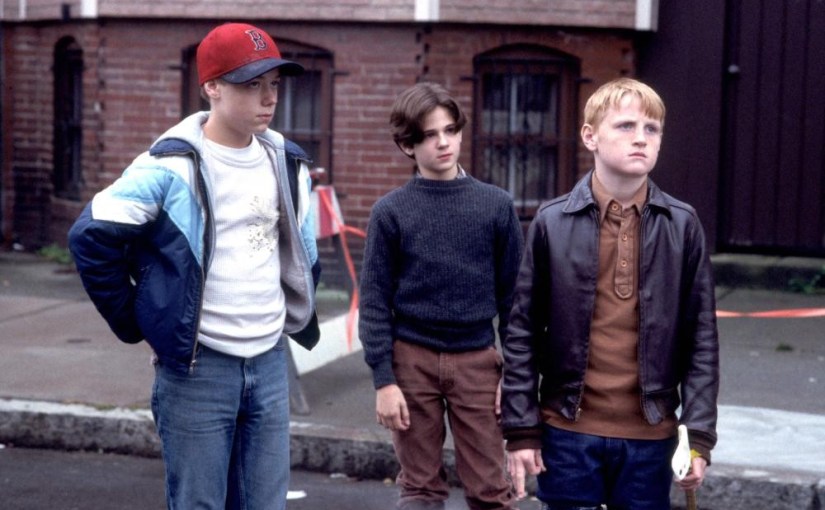
Two crimes, thirty years apart, pave the destiny for three childhood friends during their adulthood, while residing in the same Irish neighborhood of Boston.  Sean Penn is Jimmy, a former criminal.  Kevin Bacon is Sean, a police detective.  Tim Robbins is Davey, who was held captive and molested for four days following an afternoon when the guys were playing street hockey together.  Naturally, Davey was never the same but over the course of events in Clint Eastwood’s psychological crime drama, Mystic River, we learn that Jimmy and Sean likely changed too.

Jimmy’s daughter, Katie (Emmy Rossum), is found brutally murdered following an evening of bar hopping with girlfriends.  Sean and his partner Whitey (Laurence Fishburne) head up the investigation.  While the magnetic screenplay written by Brian Helgeland, based upon the novel by Dennis Lehane, relies on a who done it track, that seems to be less a priority as details unfold for the trio of men.  Jimmy and Davey’s wives (Laura Linney, Marcia Gay Harden) may be hiding some information.  A possible murder weapon invites some curious questions. There’s reason to question Katie’s boyfriend, and Davey’s odd behavior combined with his childhood trauma raises eyebrows as he was one of the last men to see Katie alive.

The less you know about Mystic River the better, but this engrossing cast which earned Oscars for Penn and Robbins, plus a nomination for Harden, is not the only stand out feature.  This film is one of Clint Eastwood’s best directing efforts; definitely one of my favorites.  

First, Eastwood hides many of his characters in dark shadows so the viewer never forgets that all these people have pasts they regret or would rather not resurface.  Sometimes, you hauntingly recognize the silhouettes of Sean Penn and Tim Robbins, each for different and unnerving reasons. Eastwood notably shoots himself this way often when he’s in front of his camera (Unforgiven, Sudden Impact, Million Dollar Baby).  It’s a brilliant photographic strategy that will make you fear or empathize with his flawed protagonists.

Second, Clint Eastwood shoots much of the Boston neighborhood with wide overhead shots in the daytime.  Interiors offer little light no matter the time of day.  Exteriors present the multi floor homes which are easy to see and showcase a labyrinth of crevices, yards and blocks where activity occurs.  

While the title of Lehane’s mystery is hardly spoken until a series of shocking revelations occur at the end, Eastwood ensures the setting of this Boston Irish populace is given much attention.  The more closely located these homes are up against one another, the less apt that any of the residents can truly see what’s going on under their nose.  These people live on top of each other with no room to spread out.  Their nearsightedness is practically blinding.

Furthermore, Eastwood composed the morose soundtrack for this piece. The director seems to speak to the audience because nothing good will likely arrive for any of these folks who grew up together like the generations before them.  Even a colorful Red Sox cap worn by Davey does not offer much cheer or Boston pride.  Eastwood’s musical compositions paint a modern-day setting encased in unimaginable heartache.  

Mystic River is not an easy film to watch.  Yet it’s not gory.  It’s not scary.  It’s the internal struggles of these characters that’s hard to imagine or observe. On the surface Lehane’s story seems reminiscent of most any other crime drama or Law & Order episode of the week.  The challenge is to watch these masterful performances, especially from Sean Penn, Tim Robbins and Marcia Gay Harden.  

We’ve seen moments where the father comes upon the crime scene of a murdered child.  However, Sean Penn delivers this staple with raw, unbearable heartache.  This actor invests his soul into the moment and reminds any one of us, whether we are a parent or child, of how wrenching it is to even imagine losing a loved one to senseless violence.  If I had to ever experience an episode like this, it might just take the entire police force to hold me down too.

Robbins and Harden are husband and wife, who get in over their heads when incidents of surprise occur.  Harden is especially ripped apart with what she knows and what she suspects.  Robbins embraces an inner child who has never outgrown a trauma that stubbornly stays attached to him, even if he’s a loving father.

As difficult as Mystic River is to watch, I’ll return to it on repeat because this cast and crew are at the top of their game.  Dennis Lehane has written other Boston crime stories (Gone Baby Gone with the film adaptation directed by Ben Affleck), particularly involving children, and he recycles his characters for future tales.  To my knowledge, I do not believe he’s ever written a sequel to Mystic River, but I’d love to see what happens to these people after the events of this film unfolded.  

Everything is revealed in Mystic River, except what happens next and I’m dying to know.  

BAD SANTA: Director’s Cut (2003)

by Miguel E. Rodriguez

DIRECTOR: Terry Zwigoff
CAST: Billy Bob Thornton, Tony Cox, Brett Kelly, Lauren Graham, Bernie Mac, John Ritter
MY RATING: 9/10
ROTTEN TOMATOMETER: 78% Certified Fresh

PLOT: The world’s worst department-store Santa experiences an existential crisis in between drunken benders and burgling department stores.

[Author’s note: This review is of the Terry Zwigoff-approved Director’s Cut, NOT the studio-released Unrated “Badder Santa” version created without Zwigoff’s input. The Director’s Cut improves on the original theatrical release, in my opinion, by removing a lot of extraneous scenes (the Advent Calendar shots, Willie teaching the Kid how to fight, etc.) while keeping some bits from the Unrated version, resulting in a leaner, darker, yet even funnier movie.]


I recently re-watched this movie with my girlfriend, first time for her, first time in a long time for me.  I had forgotten how relentlessly funny it is, specifically because of how vulgar, offensive, and, let us not mince words, dirty it gets.  I don’t know if it’s because this was the Director’s Cut as opposed to the original version, but I was also reminded of the earlier films of Kevin Smith.  It has all the coarseness and low-budget production values of Mallrats, but with a better story and a funnier script (all due respect to Mr. Smith).

The film opens with our “hero”, Willie T. Soke (Billy Bob Thornton) getting drunk and puking in an alley while dressed as Santa Claus.  This is the high point of the movie in terms of his character.  It’s all downhill from here.  Almost.  Sort of.  Anyway, we learn that he is involved in a somewhat-feasible scam with Marcus, a felonious dwarf (Tony Cox), and his rather materialistic wife, Lois (Lauren Tom, aka “Julie” from Friends…I was today years old when I learned that, thanks to Penni).  After Soke does the Santa thing, muttering profanities under his breath the whole time, Marcus stays behind after hours, deactivates the store’s security system, and lets Soke in the back so he can crack the store’s safe.  Meanwhile, Marcus steals whatever is on the list his wife gives him.  (I liked that little touch; he’s not a random thief, he’s a very SPECIFIC thief.)

One day, a literally snot-nosed kid (Brett Kelly) perches on Santa/Soke’s knee and solemnly tells him, “You’re not Santa”…then peppers him with questions about the reindeer, Mrs. Santa, the elves, ad infinitum, while Willie does his best to keep up through his alcoholic haze.  To say this is the start of a beautiful relationship is straining the definition of “beautiful” and “relationship”, but there is a point to all of it.  Trust me.

There’s more, much more, that’s been crammed into this barely ninety-minute-long movie.  The bartender (Lauren Graham) whose non-traditional sexual kink makes Willie implausibly irresistible.  The department store detective (Bernie Mac) who senses Willie and Marcus are trouble but has plans of his own.  The store manager (John Ritter) who claims he’s no prude but who can barely pronounce the words he heard coming from the dressing-room stall in the plus-size section where Willie was…well, modesty forbids.  Not to mention the Kid’s grandmother with the apparent obsession with making sandwiches.  And the profanity.  The virtually non-stop stream of profanity pouring from Willie’s mouth.  In a comic strip, his dialogue would be almost entirely composed of symbols and punctuation marks.

The executives at the now-defunct Dimension Films must have had cojones of solid rock to give this movie the green light.  Who is this movie for?  I’ve seen so-called “polarizing” movies before, but this achieves some kind of high bar.  Some of the lines must be heard to be believed.  Bernie Mac and Tony Cox have an exchange late in the film that belongs in some kind of cuss-word Hall of Fame.  I can imagine Kevin Smith watching that scene and nodding his head in a kind of salute.

As I’ve said many times before, I have always had a hard time watching movies or TV shows with loathsome characters as the leads, no matter how funny they are.  I have never been able to stomach Seinfeld for this reason, but I do acknowledge the ingenuity of the show’s writing and the comic skills of the actors.  I just find it a shame it’s all been attached to characters whom I would cross the street to avoid.  But here is Bad Santa, with a lead character who is not only alcoholic, but who is also suicidal, who haunts mall arcades to hit on teenage girls (“She said she was eighteen”, he says at one point), has no compunction about swearing around children, and beats the crap out of some local bullies who are picking on his new friend…then has the chutzpah to look at the beating as a turning point in his life.  “You need many, many, many f***in’ years of therapy”, Marcus tells him.

And yet I don’t just like this movie, I LOVE this movie, because it makes me laugh.  I’ve been sitting here trying to self-analyze my affection (if that’s the right word) for this film, but I am failing.  I can only report that it has some of the raunchiest dialogue I’ve ever heard, that it is definitely NOT appropriate for kids, that it is certainly NOT one of Penni’s favorite movies (kudos to her for making it all the way through), and that hand-carved wooden pickles stained with blood are not the best Christmas presents ever.

And I laugh like a loon whenever I watch it.  Sue me.

CAMP (2003)

by Miguel E. Rodriguez

Director: Todd Graff
Cast: Daniel Letterle, Joanna Chilcoat, Robin De Jesus, and introducing Anna Kendrick
My Rating: 8/10
Rotten Tomatometer: 64% Fresh
Everyone’s a Critic Category: “Watch an Early Film of a Famous Actor or Actress”

PLOT: Teen drama enthusiasts attend a summer drama camp and perform in several productions while dealing with an alcoholic musical director and their own messy lives.


Todd Graff’s film Camp plays like Meatballs [1979] crossed with Waiting for Guffman [1996].

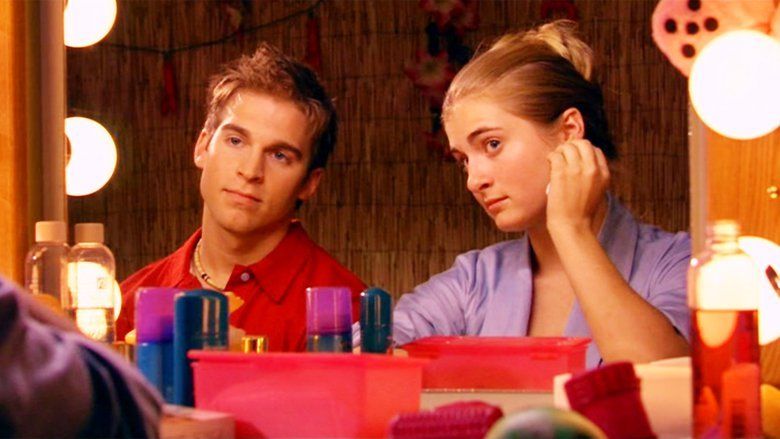
A bunch of theatre-geek teens attend Camp Ovation, a summer drama camp where the campers rehearse and perform a different show every two weeks.  And I’m not talking Aladdin Jr. or Annie.  Among this camp’s productions are Follies, Promises Promises, and a color-blind presentation of Dreamgirls.  (It’s exactly as weird as it sounds.)

A brief prologue introduces the main characters, including Michael (Robin de Jesus), a gay boy who gets beaten up by classmates when he attends his junior prom in full drag.  Ellen (Joanna Chilcoat) is a plain-but-pretty girl with a self-image problem exacerbated by the fact she has to beg her brother to be her date to her own prom.  The appropriately-named Vlad (Daniel Letterle) is a handsome young man who doesn’t seem to have any overt personal problems.  At his camp audition, when he accompanies himself on guitar while crooning “Wild Horses”, one of the camp counselors is beside herself: “An honest-to-God STRAIGHT boy!”

There’s also the introduction of a mousy young lady named Fritzi, played by a 16-year-old Anna Kendrick in her film debut.  We all know how attractive she is in real life, but when we first meet her, she is in complete “Princess Diaries” mode: long straggly hair, flannel skirt, and acting as personal flunky for Jill, the blond camp floozy who doesn’t let anyone forget how pretty and talented she is.

Vlad is the eye of the storm at Camp Ovation.  Ellen is attracted to him, Jill wants to make out with him, Michael is burning to know if he’s gay or straight, and he’s not afraid to speak his mind.  He’s also an emotional demon-child, an incurable flirt in both directions, so everyone is off-center around him.  That’s the “A” story.

One of the flaws of Camp is that there are one too many “B” stories.  Maybe two too many.  There’s Bert Hanley, who composed a musical decades ago that is still performed today, but who has not written anything since.  He’s coming in to assist with the camp’s productions, but things look grim when he shows up two days late, drunk, and with a suitcase full of booze bottles.

There’s Michael’s ongoing issues with getting his unsupportive parents to attend one of the camp’s performances.  One of the movie’s high points occurs when Michael is performing in Romeo and Juliet, sees the empty chairs in the audience where his parents are supposed to be, and launches into his own interpretation of Shakespeare’s tale.  Bernstein and Sondheim would have approved.

There’s a hilarious subplot that is never fully explored where the camp introduces a sports counselor.  At a drama camp.  This bit is granted two brief scenes, then never heard from again.  Alas.

There’s Jenna, a young girl whose parents wanted her to attend “fat camp” instead of drama camp, so they compromised: Jenna will attend Camp Ovation with her jaws wired shut.  I will leave it up to you to discover how she performs onstage through clenched teeth.  (This subplot does get a very satisfying resolution by movie’s end, it must be said.)

Most of these subplots are good enough to support an entire movie by themselves.  In Camp, however, you get a little whiplash going from comedy to drama to teen angst to revenge back to comedy to performance and so on and so on.  While watching it again, I noticed more than ever how many times the editing seemed to be working around chunks of dialogue that probably had to be cut for time.  Somewhere out there is Todd Graff’s 3-hour director’s cut of this movie, in which every story is given enough time to breathe, expand, and evolve.

So…why do I give this movie an 8/10 rating with so much not going for it?  Purely personal reasons.

Camp is a movie about theatre geeks, made by theatre geeks, for theatre geeks.  The film’s director, Todd Graff – who coincidentally played “Hippy” in The Abyss [1989] – was a drama camp counselor himself, and the film is loosely based on his experiences.  There is virtually zero crossover appeal for this film.  Near the beginning of the film, Fritzi is trying to jog Jill’s memory where they’ve met before: “We were in Night Mother last summer, remember?”  That joke only lands if you know how many people are in the cast of Night Mother, and what the plot is, and how ludicrous it is to imagine that show being performed at a summer camp.

For all his shortcomings, Vlad has a scene that speaks directly to me.  He confesses to Michael that he has OCD.  Without medication, he counts the letters in the words in people’s sentences.  (I count syllables.)  He talks about how his affliction is “always there.”  But when he’s performing onstage…it’s not.  Not only does that speak to me directly regarding OCD, it’s also a metaphor for anyone who has felt like an outsider for some reason or another.  Offstage, you might have self-image problems or obsessive behavior or shyness.  Onstage, those things magically fall away.  I don’t use that term lightly: “magically.”  I don’t know how else to describe what happens in that boundary between offstage and onstage.  Anyway, that’s cool to me, personally.

The movie has a suitable climax, but for me, the real centerpiece of the movie comes when a group of the kids and some of the adult band members meet in secret to rehearse and perform a song that Bert Hanley (remember him from earlier?) wrote but never published.  As they perform, the cynical Hanley overhears it and struggles with himself whether to let them play or to walk in and stop the performance.  It’s a cliched moment, to be sure, but the song itself is rousing and borderline inspirational, and when the scene’s payoff occurs, it’s almost cheer-worthy.

And let’s not forget what happens between Fritzi and Jill.  After some harsh words are said, Fritzi exacts her revenge and performs a show-stopping number from a Sondheim musical.  It’s here where Anna Kendrick’s screen and stage presence are both on full display.  For years afterward, Penni and I would see her in other movies and recognize her based solely on her performance in this movie, and particularly this scene.  (Of course, we couldn’t remember her name for a while…she was always “that girl from Camp.”  It wasn’t until after she appeared in Scott Pilgrim vs. the World [2010] that her name finally stuck.)

And, of course, there’s that cameo from a surprise audience member at the camp’s final production.  (Hint: their car’s license plate reads 4UM.)

Camp may not have the name-recognition of so many other teen comedies, but this one speaks to me directly.  I’m not any one of those kids at this camp, but there’s a part of me in all of them.  I loved the musical numbers.  I enjoyed the theatrical in-jokes.  (“There’s this new thing called ‘drums,’ you’ll love it.”)  And maybe there’s also a part of me that wishes I had attended one of these camps in the summer instead of Bible camp two years in a row.  Just sayin’.

DAREDEVIL

By Marc S. Sanders

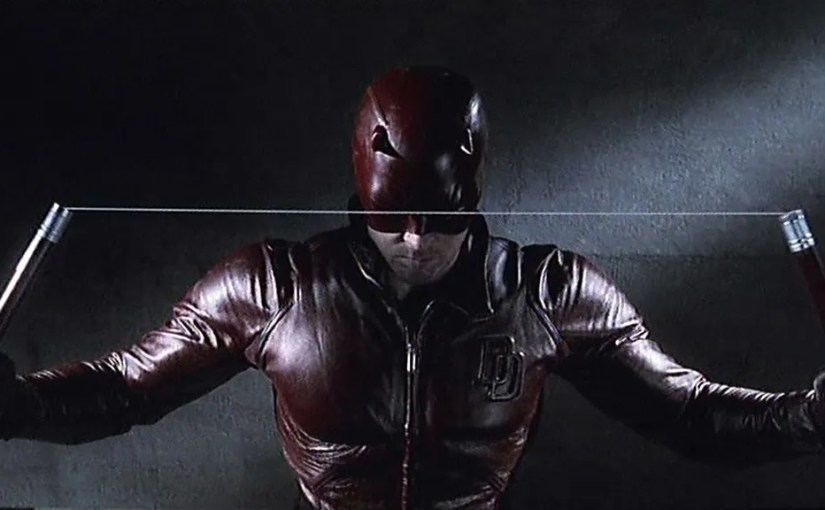
Mark Steven Johnson is probably a director you never heard of. He made two very bad movies based on Marvel’s character Ghost Rider featuring Nicholas Cage. Still Johnson has one redeeming quality and that is the very underappreciated Daredevil featuring Ben Affleck in the title role.

It’s not so much that Affleck is good in the role as blind lawyer/vigilante Matt Murdock aka the title character. More so, is that Johnson writes and directs a solid film very faithful to the source material. So, reader, what if you tell me you never read the comic books? My reply, so what! There’s still a lot of fun and colorful characters to get caught up in and you should have no trouble getting the hang of it.

Michael Clarke Duncan’s hulking physique was always his best attribute and serves him well as the crime warlord Kingpin aka Wilson Fisk, the puppet master of Hell’s Kitchen and the man responsible for the death of Murdock’s washed up boxer father. Colin Farrell chews the scenery (maybe little too much on my repeat viewing many years later) as Bullseye, a mercenary villain who can use any object as a precise throwing weapon, whether it be a card, a pencil, or shards of glass. It’s a ridiculous and unlikely talent but Farrell makes the most of it and the character serves as a perfect foil to the blind vigilante hero who uses his remaining four senses to skillfully fight and dodge and acrobat his way through rooftops over the city at night.

Jon Faverau (before directing Iron Man) is welcome relief as Murdock’s legal partner with some good humor material. Jennifer Garner is filler in the role of Elektra, a skilled fighter with trident weapons in each hand and the film’s standard love interest looking for revenge. Garner is nothing special. I’ll say it. She’s here based on her looks and her body and at the time she was the action go to gal (thanks to her TV show Alias) when Angelina Jolie was not available.

Affleck is fine in the part. He’s got the looks and physique. You can easily believe he’s a lawyer. If anything, I could have done without his voiceover narration. I think the film narrates itself fine without additional instructions. I’d argue that Affleck and Johnson could have taken this franchise further. At the time, it actually got good reviews. What did not help were the published exploitations of Affleck with his girlfriend at the time (now new bride), Jennifer Lopez (and later Garner), as well as his other poor choices of roles like Gigli and the insultingly embarrassing Pearl Harbor. (Main character Raif McCauley I have not yet forgotten!!!!)

Years later, some of the fight scenes look clunky. Some of the mid 2000’s alt rock is a little much (but Evanescence is always welcome, especially during a nicely dramatic rainy funeral scene). However, Johnson still has some tricks up his sleeve that work really well. He uses a great filming technique where Daredevil can see by means of sonic waves of sound thus making him more attuned to the trajectory of a bullet or where to find his adversaries. So, to pit a blind guy against the greatest marksman…yeah that’s a dual worth seeing. This gimmick was invented in the comics by Stan Lee and John Romita, yet very well captured in the medium of film. Another great bit is to translate how Daredevil can tell if a person is lying, a great skill for any lawyer to have. He can hear their heartbeat. Duh! Especially well done is how Murdock can see the facial features of Elekra during a brief escapade in the rain. Johnson CGIs it in midnight blue to leave an impression. Yes, Garner’s best moment comes when she’s animated in CGI blue.

The film offers a great theme of superimposing the devil image of the vigilante against the backdrop of the catholic church and other opportunities for a cross to intrude a scene. It hints that Matt Murdock is a religious catholic, but not enough. It seemingly questions the actions of its hero. Affleck even asks himself at one point “Am I the bad guy?” It’s a good additional dimension to the character; one I wish Johnson capitalized on a little more. When is a vigilante truly crossing over into the realm of sin?

Daredevil is worth watching and not worth comparing to the Netflix series. The product is served in two different mediums, one of which has the luxury of telling its story over a span of 10 hours each year. The original film, though, is condensed quite well in origin and character. Live with that and feel forsaken.

THE LORD OF THE RINGS: THE RETURN OF THE KING

By Marc S. Sanders

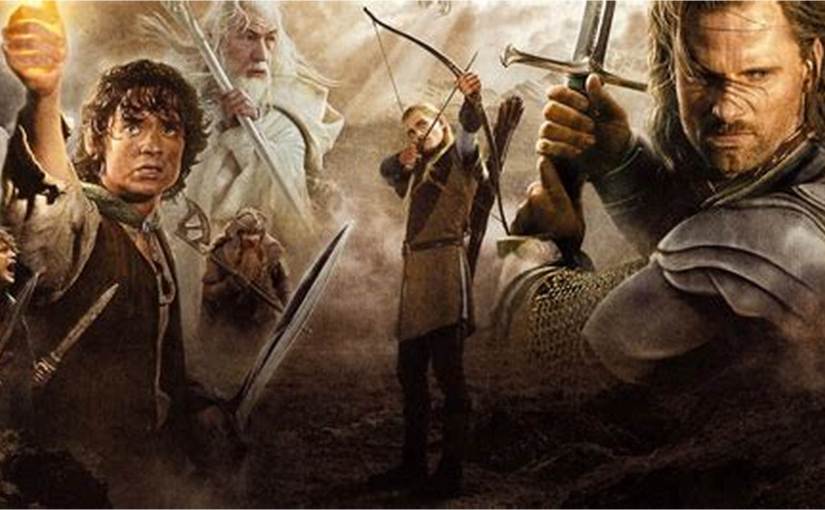
I remember film critic Gene Siskel once said that to take issue with the length of a film is not entirely fair. After all, you are getting more movie for your buck. Would Siskel have felt that way about The Lord Of The Rings: The Return Of The King? Peter Jackson closes out the film adaptation of JRR Tolkien’s sweeping fantasy with an epic that allows you to marvel at everything you see, but does that mean we want to feel as overly exhausted as its main protagonist, Frodo Baggins, feels? Trust me. Poor Frodo looks wiped.

More battles are enacted in the third film. Jackson just changes the dynamics up a little bit. Now armies don elephants with a number of enormous, curved tusks. Another army has a different looking giant troll. Haven’t seen elephants before. Haven’t seen that kind of troll yet either. As well, there is another King who is apprehensive to cooperate in the fight against Sauran and his Orc minions. There’s also a green glowing ghost army. Meanwhile, Frodo and Sam (Elijah Wood and Sean Astin) continue their journey to Mount Doom where the almighty Ring must be destroyed. Gollum (Andy Serkis) remains as their untrustworthy guide.

Jackson seemingly covers every page written by Tolkien. I’m talking about depicting every dream each character has or line they utter or slow motion expression they offer, or walk that they take. Peter Jackson is a completist.

The Return Of The King won Best Picture along with a bevy of other Oscars. Seemingly it should have won anyway. The first two films were recognized with Best Picture nominations as well. For the third film to win was to honor the entire trilogy and its achievements in filmmaking. The Lord Of The Rings trilogy reinvented movie making as a whole. The bar was set so much higher following its release and huge reception of these films.

That being said, it takes endurance to stay with the picture. Most especially with The Return Of The King as the film has multiple endings. Just when you think it’s over, it’s not, and it’s tedious and a little frustrating. Jackson seemed to have too hard a time saying farewell to his digital Middle Earth with its endearing characters.

The length is a problem I have with the film, but none of it seems wasteful either. Every caption and scene carry an importance to it. At least that’s how Jackson wants you to feel. The question is, if a number of momentary scenes had not been woven into the final edit, would I miss it, and my answer would be likely not.

THE ITALIAN JOB (2003)

By Marc S. Sanders

F Gary Gray’s 2003 remake of The Italian Job is crackling with cool and sleek film coverage. It is a blend of wit and fast paced action delivering a solid heist thriller. The cast is terrific as well.

Donald Sutherland plays John Bridger, a near retired master thief and safe cracker. He is ready for one last job with his protégé, Charlie, played by Mark Wahlberg. They assemble a team specializing in different skills like Left Ear, played by Mos Def, who overlooks explosives, Lyle or “Napster”, Seth Green, as a computer hacker, and “Handsome Rob,” Jason Statham, the getaway driver. With another member named Steve (yeah, he’s just called…ahem…Steve) played by Edward Norton, they successfully rip off a safe containing $35 million in gold bars from a home located off the straits of Venice, Italy. However, Steve betrays the team leaving them for dead.

Jump to a year later and the team ventures out to Los Angeles with Stella (Charlize Theron), another safe cracker and daughter to John. They have an opportunity to even the score with Steve while also collecting what’s left of the gold bars. Early on, an idea is conceived to use light weight, speedy MINI Coopers to get in and haul away the booty. However, soon they learn that it’s not so easy to just take it from Steve’s house. They will have to apprehend the gold while in transit.

There’s nothing overly special about The Italian Job. I don’t think Gray was looking to achieve an iconic classic. He just made a solid caper flick that’s pure fun. Sure, the thieves would likely get busted. No, the timing of everything from sabotaging the downtown traffic lights and exploding a precise hole in the street for an armored car to fall through would never occur so perfectly. Who cares? This film is a pitch perfect dance in car chase choreography where we get a kick out of watching sporty little red, white and blue MINIs careen through a subway system, down public staircases and through cylindrical tunnels. It’s all done to get your heart racing.

The players are fun but they aren’t putting in much dimension. I doubt they did much research on the specialized skills their respective characters possess. Maybe Theron researched how to crack a safe. She amps up some nail biting in those sequences as Gray edits between high speed motorcycles approaching while she’s quietly trying to concentrate on the lock’s combination.

There are some cute inside jokes. The best being that Lyle insists he is the inventor of Napster (a little dated by now), and the idea was stolen from him by Sean Parker. The real Sean Parker makes a quick cameo as that scene is told in flashback. Seth Green is quite funny in a nerdy kind of way.

I like the cast. Norton plays a good jerk for villain; a real “Frank Burns.” I appreciate the story behind his character. Early on before he betrays the team, each member shares what they are going to spend their money on. Later, it’s revealed that Steve just used what he ripped off to buy everything the other guys had in mind. He’s a killer and he’s a jerk, but he’s also a guy with no imagination or creativity. I like that angle for a bad guy. He’s only just so much of a genius.

The Italian Job is a fun film that is never too intense, and offers great surprises in the step-by-step process of how to pull off a cinematic heist. If anything, it’ll make you wanna buy a MINI Cooper. I came…THIS CLOSE one time!

THE MATRIX FRANCHISE

By Marc S. Sanders

Miguel and I went to see the The Matrix Resurrections last night and honestly, when I woke up this morning, I had forgotten I’d even seen it.  That’s because, other than the original Matrix film, the subsequent chapters are about as special as cheap food court Chinese food.  When you get home from the mall, you recall what you may have window shopped, but you never reflect on what you had for lunch; well maybe your gut does later on, and that’s certainly not doing you any favors. 

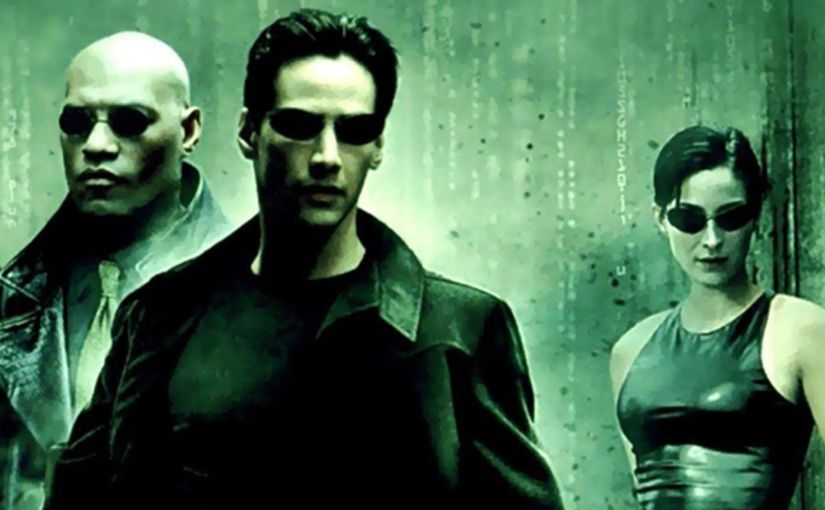
When The Wachowskis introduced the world to The Matrix way back in 1999, it was one of the biggest surprises in films.  No one saw its uniqueness coming.  Everyone was focused on the over hyped resurgence of Star Wars, or a kid who desecrated a pie, or a hand held video film that was seemingly terrorizing audiences.  Yet The Matrix arguably may have had the best longevity that year.  It seemed like a combo sci fi/super hero picture with the players looking ultra-cool in designer sunglasses and leather night club outfits.  Guns and jiu jitsu flew off the screen, but it was done in a new visual kind of way.  Bruce Lee would have likely been a part of this picture had he been alive.  When someone took a kick to the face, it was edited super cool looking sloooooowwww motion.  Bullet time became a thing with projectiles warping through the space between characters and these players, especially Keanu Reeves as the messianic Neo and Carrie Anne Moss as Trinity, would bend and twist and twirl acrobatically (again in slow motion style) to dodge machine gun fire and endless shrapnel.  The look of the film remains absolutely superb.  Nothing (other than maybe the film’s sequels) has duplicated what was accomplished here. 

As well, the original Matrix stands apart from the other three because it actually told a story and developed its protagonist and his mentor (Laurence Fishburne as Morpheus) into fleshed out characters.  It also went so far as to describe what the Matrix is, and what the world outside of that realm represents.  Like all humans, Neo, also known as Thomas Anderson, was actually under the control of a machine-like community designed to sustain a world known as the Matrix, and…well…that’s just bad!  There was solid storytelling here with setting and character development that was later accompanied by well-choregraphed action and pulse pounding club music.  When the film ended, audiences couldn’t wait for more and Warner Bros happily greenlit two more films that were shot back-to-back.  Only the train derailed from there.

Gearing up for the 2021 installment, directed by Lana Wachowski, I watched the first three films again.  Other than the first film, I had forgotten much of what occurred in the 2nd (The Matrix Reloaded) and 3rd (The Matrix Revolutions) pictures.  I realize now that I only forgot what really wasn’t there.  Substance!  Of the two films, Reloaded is likely better, thanks especially to an outstanding highway car chase involving sci fi effects of the characters bouncing off of big rig trucks, motorcycles and car roofs.  A pair of characters dressed in evil white leather with dreadlocks morph in and out of the vehicles and concrete streets as well.  The scene comes late in the film and only wakes you up from the meandering ahead of it.  Truly, it’s hard to comprehend what the hell is being explained in this second film.  The Wachowskis almost would prefer you be impressed with the monosyllabic vocabulary that’s exchanged with each character.  Dialogue doesn’t advance the story any further from where the first film left off.  All that I gathered was our band of rebels who successfully broke free from the slave-controlled Matrix are regrouping at the promised land of Zion, and the machines (squid like metal robots with countless red light bulbs) are advancing for an attack.  Morpheus, Trinity and Neo take it upon themselves to reenter the Matrix (because they look so much cooler there) and do who knows what.  Near the end of the film, Neo walks down a long hallway, opens a number of doorways and encounters the one supposedly responsible for the Matrix, an older gentleman known as The Architect.  This moment was intended to be a highlight of the film and yet it was anything but.  This architect spews out word diarrhea at an alarming rate that only clouds your mind further and further.  The guy has a great radio voice and has an antithetic appearance against the heroic looking Neo, but what in the hell are we supposed to do with any of this?  What’s the point?

On to Revolutions which begins exactly where Reloaded left off.  This is a picture that could have had a running time of thirty minutes at best.  The robots are finally attacking Zion.  One character who seems like he should be important or necessary to the Matrix storyline saddles up in a robot suit equipped with massive machine guns and The Wachowskis make the poor choice of feeding their audience a good seven or eight minutes of this guy spraying endless amounts of bullets in an upwards direction towards the infinite swarm of octopi robotic armies.  His guns never run out of ammo.  He just bellows as he continues to fire.  Where’s the story here?  Where’s the innovation that the first film offered?  Also, what goes up, must come down.  Shouldn’t some of that ammunition have dropped down in a hail storm eventually?  Reader, if I have to ask that last question then you know there’s not much to pay attention to in this film.

The wisest character of the Matrix films, Morpheus, is given very little to say or do in either film.  Fishburne stands in the background and let’s everything happen around him.  He’s not utilized to explain anything like he was in the first picture.  His skill for teaching the audience has been completely diminished.  Whatever he had to offer was exhausted following the first picture.  With Revolutions, especially, the filmmakers rely on B characters that we’ve never really gotten a chance to know or remember or adore like Yoda or Jabba or even Boba Fett in the films that followed the original Star Wars. In fact, Revolutions seems more concerned with its extras than any other film I can recall.  So much so that when a major character from the first film has a death scene, you hardly care for the loss.  There wasn’t much to expound on the character after the original film.  Revolutions only relies on the war nature of the human armies against the monochrome metallic squid race.  Beyond shooting at one another, where’s the conflict?  Ms. Pac Man and Frogger have more depth than any of this.

That’s the problem with these films.  A discovery was made with the 1999 installment and the filmmakers opted to capitalize on the effects and not the challenge of story. 

Furthermore, and this goes back to the original film when I first saw it in theatres, I was always of the mindset that I’d rather live in the Matrix.  After all that Morpheus has revealed to me, the Matrix still seems like the better place to reside.  The real world consists of living on a dirty, dreary ship and eating slop for food while wearing torn sweaters and having electrical plug orifices running down my spine.  Who wants that?  A Judas character from the first film turns on his crew by telling the evil Agent Smith that he will bring them Neo as long as in return he doesn’t know that he’s under the control of the Matrix and he can savor the taste of a juicy steak again.  Now I’m with this guy.  Aren’t The Wachowskis as well, though?  More footage and highlights take place in the computer mainframe of the Matrix than outside of it.  Thereby, more cool looking action sequences can happen and the cast appears more glamourized.  The films want us to fear the horrors of the Matrix on the humans by showing them plugged into wires while drowning in a pod like puddle of KY jelly embryonic ectoplasm.  You know what?  What I don’t know won’t kill me.  So, leave me be.  Perhaps the argument would have been more convincing had the environments been reversed.  Put the rebels as slave dilemma in the real-world areas and the utopian setting within the Matrix.  Then I might buy the problem here.

The newest film, Resurrections, is nothing special and nothing new.  It’s rather boring actually.  Revolutions was boring too.  It only kept me awake because it was two hours of headache inducing noise.  With the new 2021 film, apparently a new Matrix has been developed and thus a new Neo and Trinity have been conceived.  The antagonist is represented by Neil Patrick Harris and that’s about it.  Miguel pondered much, following the picture as to what was going on.  That’s not a good sign for a popcorn action flick, and it’s consistent with what was done with the 2nd and 3rd films.  What the hell is anyone talking about. Once again, dialogue moves to a beat of answering questions with questions. Even the allies speak to one another that way, and if it is not a question, then it is a cliché of some sort.  Don’t these people want to help one another?  If so, then speak to each other like your four years old and get to the point.  The action scenes drone on and on.  A goal of the picture is to keep Neo from finding Trinity because if they do, then the Matrix crashes.  Okay.  That’s simple enough.  Yet (spoiler alert), when they do find each other, somehow this new Matrix continues on.  Huh??????  The movie just betrayed me, and I don’t like that. 

Miguel attempted to conjure up the idea that Lana Wachowski was trying to demonstrate her transition from a man to a woman and this new picture was a representation of that.  Could that be true?  Maybe, but it never occurs to me while I’m watching the picture.  Am I watching The Matrix Resurrections because it’s the newest Wachowski film?  No.  This isn’t a Quentin Tarantino or Christopher Nolan piece.  This is leather and gunfire and sunglasses and noise, all depicted in a green DOS computer hue lens.

The Matrix was always worthy of a sequel; a subsequent follow up that explored imagination and perhaps more background.  What has Neo not yet uncovered.  Yet, the series as a whole continues to deny those opportunities and simply settles for cool looking visuals that get overly exhausted and tired.  No new skills are featured with each passing film.  Over the course of the series, the big bang, so to speak, of the first Matrix never reveals itself.  Instead, we are mind controlled viewers relegated to depend on overlong dialogue with no point and no where left to explore.  We are simply gifted with Neo punching Agent Smith and/or infinite duplicates of Agent Smith with no one getting weakened or wounded or defeated.  Look no further than an early fight scene in Reloaded.  The scene goes on forever.  The editing is amazing.  So is the choreography but after four minutes of this, it’s time to show some progress.  The Wachowskis limit their imagination to just having Neo fly away.  Scenes like this only allow me ample time to exit the theatre for a bathroom break and return having not lost out on any storytelling.  My friends, you can find plenty of bathroom breaks in this series of films.

The Matrix Reloaded, The Matrix Revolutions, and The Matrix Resurrections should never have been made.  Producer Joel Silver and Warner Bros would argue otherwise though.  Their wallets continue to get fatter, but at the cost of controlling moviegoers’ appetite for something more when all they really got was dry rice and overcooked orange chicken from the food court.

LOVE, ACTUALLY

By Marc S. Sanders

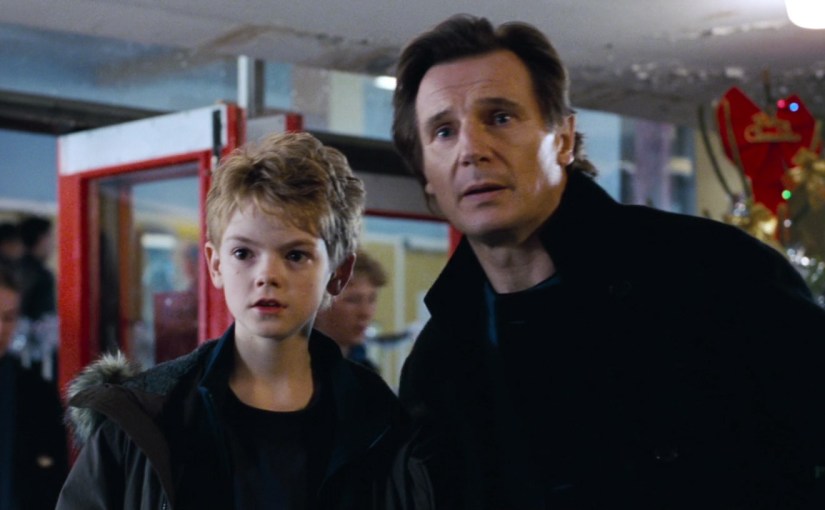
Love, Actually is like a warm favorite blanket to snuggle up in. Richard Curtis writes and directs a collection of the greatest British actors (along with American Laura Linney) in a kaleidoscope of love and relationships against the backdrop of beautiful London, England during the five weeks leading up to Christmas.

I won’t list my favorite characters or actors. In a film this treasured, this loved and this appreciated, that would be like picking your favorite child. It’s impossible when every single storyline is perfectly executed with thought and tenderness.

The stories of love uncovered, love that’s lost, love based in friendship, and love drowning in heartache beautifully jump from one to the next and then back again. Curtis is wise to not show all of the facets of each story early on. Some stories reveal more about themselves later that’ll leave you hurting for those that are not so merry and those that offer plenty of cheer.

I’m especially happy that Curtis did not compromise in the language or subject matter of his tales. Strong language at times makes for some memorable dialogue and nudity presents a normality to how we really are with those we have affections for.

It’s fair to say everyone in life experiences some variation of love. Yes! I mean everyone. Richard Curtis reminds you that love is a natural instinct, and so we can not focus on the easily recognized gloom of our world. To have these stories captured around Christmas time only enhances what we treasure, or what we wish we didn’t have to endure at times. Curtis’ blazing soundtrack helps along the way.

Love is hard. Love is challenging. Love will sweep you off your feet and love will destroy everything you thought you had. However, love will never leave you with complete regret. It’s never the love we have for someone that we regret. It’s only a wish to have it wholesome, healthy, happy and pure.

Love, Actually is all around.

KILL BILL VOL. 1

By Marc S. Sanders

Kill Bill Vol. 1 is Quentin Tarantino’s love letter to the best in Kung Fu films. A cinematic celebration for the eyes amid swords, blood and feminine gusto.

I consider Tarantino a writer of two dimensional characters; people with roll off the tongue names like Elle Driver and the only depth he awards them is to provide a code name like a breed of a deadly snake (Black Mamba, Cottonmouth). Multi dimensional characters are an absolute must for me most of the time. The only time I forgive its absence is when I watch Han Solo, Indiana Jones (circa the original Raiders…) and anything introduced by way of QT. Why? Because with these examples it is the situation and depiction of action that offers more than what you see. A ball and chain with a saw blade is wielded by Gogo, the catholic school girl assassin, and we don’t care so much if it hits its target. Rather we care about its traveling trajectory. The ball will zing through the air, sever a wooden table into splinters and zing back to hit its target in the back of the head. QT can thank his loyal editor, the dearly departed Sally Menke for achievements like this.

None of this is serious. It’s a step-by-step storyline of vengeance by Uma Thurman as The Bride, who is vows payback on Bill and his underlings for having the nerve to crash her wedding, leaving her for dead.

Getting from place to place is the glorious fun of the picture, thanks to a rocking soundtrack and actors (Thurman, a stellar Lucy Liu and a brash Vivica A Fox) ready to recite heightened, forthright dialogue that a 10 year old might give to his favorite action figures. “The baseball diamond where I coach little league and we have ourselves a knife fight.” Only assassins from Quentin Tarantino’s glossary talk like this.

Action scenes are not only gorgeously crafted with knife choreography and plenty of martial arts, but there’s almost a slapstick element to it all, along with a comic book feel. Tarantino is a well-known Three Stooges fan and beyond being an admirer of cinematic heroes. The Bride doesn’t just spill the blood of her opponents (The Crazy 88), she severs limbs and heads, so arteries spray never-ending geysers of blood. By the time the showdown of 1 vs 88 is over, the blood is in such excess, it appears as if the most extreme of pie fights has occurred among the mess. If Wile E Coyote took it up a few notches against the Road Runner, it might border what’s presented in this film. This is Quentin Tarantino with free reign and an unlimited budget providing what Kung Fu cinema fondly remembered from the offerings of legends like Sonny Chiba (who appears as a sword maker here) and Bruce Lee.

Kill Bill Vol. 1 is a glory to behold. It’s a variety of clear cinematography through different lenses Black & white, red with siren sounds, quiet dual set ups in glowing blue, and the purity of Lucy Liu’s code in a snowy white setting. Following a prenote of “Our Feature Presentation” the picture is bright in color and crisp in sound. Cereal is spilled all over a kitchen floor following a knife fight, and you just adore the crunch beneath The Bride’s feet as she walks out.

Overhead crane shots give an outline of a locale’s interior. Scorsese did this for terrifying effect at the end of Taxi Driver. Tarantino uses it as a means for the viewer to be let in on everything The Bride considers or looks for. The 4th film from Quentin Tarantino is so well constructed and so well-orchestrated. You see something new with each repeat viewing.