MEMENTO

By Marc S. Sanders

Christopher Nolan’s Memento was Oscar nominated for his screenplay, adapted from a short story by his brother Jonathan, as well as for editing.  You’d be hard pressed to find a better example that lives up to the merits of these categories because without the inventive storytelling and how it’s cut together, Memento would not be so memorable.  

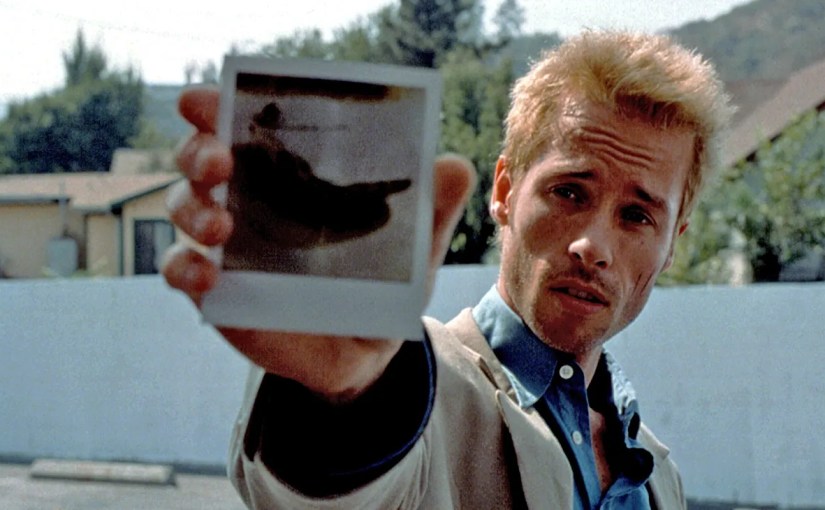
Guy Pearce plays Leonard, but he distinctly remembers that only his wife called him Lenny.  We observe him in two different narratives.  A black and white collection of scenes has him in a hotel room chatting on the phone with an unknown caller.  In modern color, Leonard is wearing a tan suit and driving a dusty Jaguar while traipsing from one place to another.  He’s trying to make progress with uncovering who murdered his wife.  The scenes in color though must be shown in reverse.  In other words, a scene is shown, then it will cut to Leonard back on the phone, and then another scene is revealed showing what occurred literally just prior to the last color scene we saw.

It must be done this way so we can be just as discombobulated as Leonard.  He suffers from a condition where he has no short term memory.  Therefore, if Leonard learns something or meets someone or arrives at a location, he’ll soon forget anything he just encountered minutes ago.  

While he pursues the mystery of his wife’s killer, Leonard tattoos his flesh with notes to help guide him when his short attention span can’t. He also takes instant Polaroids of people he meets and the places he goes.  As quick as he can, he’ll jot a note on the photos to aid him as he carries on.

Memento starts at the end of the story and when the film concludes, the viewer arrives at the beginning.  Perhaps the beginning will explain the end that was shown almost two hours before.

Christopher Nolan had a small budget to work with and the California city locales are nothing dazzling.  There’s little to offer with special effects as well.  So, it is impressive that he uses Jonathan’s idea to create a mystery we want to see resolved where the information we get seems to erase itself as quickly as it is told.

Leonard can’t remember anyone he’s recently met, but oddball cases like Teddy (Joe Pantoliano) and Natalie (Carrie-Anne Moss) certainly remember him.  Are these folks working with Leonard or against him?  Even with seeing the ending first, I could never spoil anything, and you’ll find it hard to decipher what these are these characters’ best interests.  

Nolan exercises some neat visuals to keep you on track.  We see a broken car window before we see how it got shattered.  Leonard can’t recall how that happened.  Leonard is also unable to remember why a bar patron is chuckling at him.  Christopher Nolan maintains well placed book marks to aid the viewer in this story that makes an effort at throwing off its protagonist as well as the audience.

What also helps is that when all the secrets are revealed, at least to the viewer, it’s a pretty solid crime set up that does not come off like a stale Murder, She Wrote episode.  It’s clever, tricky and unexpected.

Guy Pearce is really good in his role that eventually reveals some duality, but that’s where I’ll stop.  Carrie-Anne Moss always seems questionable, but what’s her agenda?  Joe Pantoliano is the sleazy guy with the mustache.  So why is he always turning up in Leonard’s way?

Like his future efforts to come, Christopher Nolan layers his films in great depths of dimension.  It never stops thinking. Often, he answers a riddle with one or two or three more conundrums.  What’s especially appreciative is that he eventually reaches a final answer to all of his questions.  Still, that doesn’t mean he ever would want you to stop thinking about what you ascertained from Memento.
MEET THE PARENTS

By Marc S. Sanders

Am I the only one who used to get tired of feeling sorry for Ben Stiller?  The go to formulas of his earlier comedies made him the unfortunate stooge.  The best of that batch was The Farrelly Brothers’ hilarious There’s Something About Mary.  Every gag, every cast member, every storyline was straight up side splitting.  Late last year, during the hurricane chaos in Florida I got around to watching Along Came Polly.  Poor Ben had to play basketball defense against a bare chested wookie hairball of a guy and his close up of misfortune carried the advertising campaign for that movie. 

Back in the year 2000, Stiller suffered through a terrible weekend with an intimidating Robert DeNiro frowning on his every move in Meet The Parents, also known as the first of a “Fockers Trilogy.”  Yeah, Meet The Parents is funny.  You shake your head at the absurd comedy that befalls Stiller’s character, Greg Focker. Though that isn’t even his real name at birthright.  Still, I can’t recall feeling so guilty for one guy’s misfortune that he can hardly ever help to avoid.  This guy is destined to never win, to never overcome, to never live without self-consciousness.

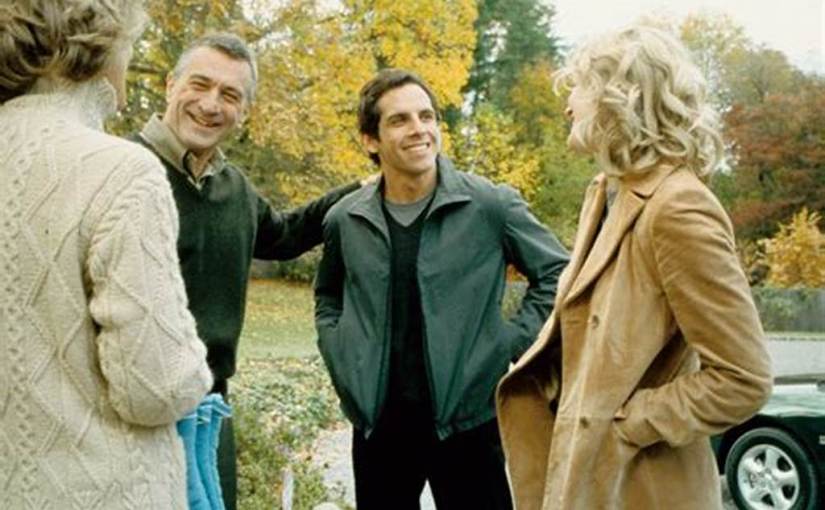
Greg Focker is ready to propose to his loving girlfriend Pam Burns (Teri Polo). First, he has to survive a weekend at her parents’ house where the other daughter is getting married.  Not so easy because first the airline loses his luggage and poor Greg has no clothes to wear, other than what Pam’s pot head brother can provide. Baggy jeans and baggy sweatshirt on a short and svelte Ben Stiller is one sight gag of many.  The guy also has to nonchalantly dismiss his uninviting surname and the fact that Pam’s father Jack (DeNiro) is unimpressed with his occupation.  Greg is not a nurse.  Greg is “a male nurse,” who opted not to go all the way for the MD, even after taking the exams. 

Jack and his wife Dina (Blythe Danner) are less than impressed with Greg’s housewarming gift.  Jack’s precious cat Mr. Jinx is a bit of a problem because Pam can’t keep her mouth shut that Greg is not fond of cats.  Doesn’t make him a bad guy, but does her cat loving father need to know this interesting tid bit, right away?  Pam’s ex-boyfriend Kevin (a hilarious Owen Wilson against Stiller’s pitiful expressions) can do absolutely no wrong – like nothing at all.  The biggest challenge for Greg though is Jack.  Whether it’s Taxi Driver or Meet The Parents or Rocky & Bullwinkle, Robert DeNiro is the embodiment of intimidation. 

Meet The Parents is funny, and it serves no purpose to surrender the many sight gags or one liners that are offered in the film.  I laugh.  I laugh hard when I watch this movie, but I hardly ever feel good about myself.  Poor Greg never catches a break.  He’s in a no-win situation and I’m just uneasy about the whole thing.  The guy chooses not to go swimming because he has no swimsuit. Then Kevin offers one and well…yeah…I’m on Greg’s side and it’s not funny for Greg.  If I was a guest in someone’s home only to wake up late when the whole family is dressed and finishing breakfast, and I’m wearing my girlfriend’s dad’s PJs, of course I’m going to feel insecure.  For the sake of the comedy in Meet The Parents, the set ups are simply awkward situations to laugh at that one guy in the room.  Poor Greg.  Poor, poor Greg. 

In fact, the real villain of Meet The Parents is not even DeNiro’s Jack Burns who has some secrets to hide.  Actually, the unsympathizing bad guy is Teri Polo’s character.  Pam never makes it easy for her boyfriend.  Greg rightfully asks why didn’t she wake him up or why didn’t she tell him her dad is not a florist, or why this and why that, and Pam is naïve to Greg’s justified concern, never empathizing with his position.  In fact, when he tries to explain his feelings, she’s nothing but insensitively dismissive. 

Yes.  It’s a comedy, but I was begging and begging and BEGGING Greg to just leave.  Leave this place.  LEAVE PAM FOR GOOD AND GET OUT OF THIS HOUSE.  You know, like we would tell the counselors in a Friday The 13th flick?  It’s not so much the father as it is his girlfriend who quickly nosedives Greg’s comfort into an inescapable hell.  You know how people love to say Jenny is the villain of Forrest Gump?  Well, I got one better.  Pam Burns is an unthoughtful, uncaring, spoiled brat of a daddy’s girl with nary a shred of consideration for others. 

I despise you Pam Burns – daughter of Jack and Dina Burns, rotten and heartless girlfriend to Greg Focker!!!!! 

GLADIATOR

By Marc S. Sanders

Ridley Scott’s Gladiator is a terrifically sweeping sword and sandal epic adventure.  It contains well drawn characterizations of its heroes and its one tyrannical villain, along with superbly bloody hack n chop violence and action that live up to its title. 

Rome has finally finished its campaign of conquer throughout at least one quarter of the world.  General Maximus (Russell Crowe) is ready to return to his wife and son to live out the rest of his days as a farmer and family man.  However, the dying Emperor Marcus Aurelius (Richard Harris) begs him to take over his position so the Roman Empire may carry forth with prosperity.  If Maximus does not take over, the empire is at risk of being inherited by Marcus’ spoiled son Commodus (Joaquin Phoenix).  While Maximus ponders the request, Marcus dies and Commodus quickly takes over, and orders the immediate deaths of the celebrated General and his family.  Maximus and Commodus will eventually circle back with one another, however.

Gladiator feels like an epic film in the vein of a David Lean picture that would require time and work to follow through its various developments.  Maximus certainly goes through a widespread arc.  One of the advertising bylines described it as the man who was General, who became a slave, who became a gladiator. Russell Crowe is right for this role.  Not only is he lean and built for the part, but he brings a empathetic approach to the character.  Maximus is loyal to his country, but he also carries pain and longing for his family and when he is wronged, Crowe does very well at displaying his character’s plot of  vengeance against Commodus with strategy and skill.

Joaquin Phoenix rightly earned his first Oscar nomination as a wonderful villain.  The screenplay from David Franzoni, John Logan and William Nicholson offer memorable pieces of dialogue for the bratty son.  “I feel vexed. I am very vexed.”  – a line that sounds so minimal and yet when Phoenix delivers it, it’s only more terrifying.  This little monster captured in an adult body can respond to anything that slightly irks him.

The battle between Commodus and Maximus is hardly physical.  Maximus realizes through his companions that a better and wiser form of revenge is to win Rome’s admiration away from its ruler.  Commodus lives off his ego.  So, when Maximus is encouraged by his slave owner to “win the crowd” amid the games performed in the famed coliseum, it not only lends to the gladiator’s ongoing survival, but it tears away at Commodus’ rule.  A great subplot is included focusing on the ruler’s nephew, Lucius (Spencer Treat Clark).  The expression on Joaquin Phoenix’ face when young Lucius role plays as the great Maximus works like a frozen moment in time.  Imagine a famed quarterback’s child cheering for the defensemen who performs an unforgivable sack during the final ten seconds of a game.  It’s terribly bruising.

When Gladiator was first released in theaters, I found the CGI to lack texture and it appeared very dark like a bad 3D film.  It looked too animated.  This most recent viewing was on a restored 4K transfer and the picture quality is astounding.  Every element of the broad landscapes within the battlefields and especially in the gold sheen photography of the coliseum battles blend perfectly.  If you still don’t understand the importance of 4K, turn to this film to uphold the argument. 

Ridley Scott does not waste a shot in this picture.  Reactionary sequences are just as effective as the cuts to the action.  Blades and barbaric weapons shed gorgeous splashes of blood. Every thrust and parry are easy to see. I’ve never forgotten when a chariot rider is cut in half at the torso from an oncoming blade attached to rolling wheel.  The choreography and editing of the battles are thrilling with sound editing that compliments the moments. 

Beyond Russell Crowe and Joaquin Phoenix, the cast is wonderful.  I’ve always admired Richard Harris’ quiet approach in the twilight years of his career.  He never had to do much to offer a presence.  Connie Nielsen portrays Lucilla, Commodus’ sister who he has affections for.  Her subtle resistance allows Joaquin Phoenix more opportunities to feel “vexed.”  Oliver Reed passed away during the making of this film. Fortunately, Ridley Scott and company did not opt to cut out his role as the gladiator/slave trader, Proximo.  He works well as a kind of mentor to Maximus and the band of other warriors, coaching them on how to stay alive and rise above Commodus’ monarchy.  “Win the crowd and you win your freedom.”  Djimon Hounsou is a loyal sidekick to Crowe’s character. Derek Jacobi is once again that guy you have seen before allowing his expert craft in Shakespearean performance to flesh out the political angle of the story among the Senators.  Every actor serves a valuable purpose in the film.  None of these performances feel like walk on roles.  So, the overall casting of the picture must be commended.

Gladiator is a crowd-pleasing film. Though it is based in ancient history, there remains a fantasy element to the movie when you look at grand designs of the settings, costumes, and dialogue.  Storylines of politics and tyranny hold relatable to modern current events.  What can occur when one man takes over everything for his selfish purposes?  Pointless displays of theatrics can occur at the behest of others who were once heroes, instrumental in placing a despot atop a throne.  I presume Ridley Scott’s film is just one more example of the inherent nature found in humans.  Some of us are destined to rule and control.  That alone is cruel and selfish.  It is even worse when this totalitarian mindset is unleased upon those that put these rulers in their place.  History and especially modern times demonstrate that loyalty is only fleeting.  The ability to possess totalitarian control, however, is hopefully even more short-lived.

MISSION: IMPOSSIBLE II

By Marc S. Sanders

Mission: Impossible II is undoubtedly the weakest installment of Tom Cruise’s series, adapted from the classic tv show. Action Director John Woo is normally regarded as “ACTION DIRECTOR JOHN WOO” because he can only direct action. He hardly ever directs story. There’s no dimension to his characters and nothing intriguing. It’s all just glitz and neon colors in his cinematography. No weight at stake in Action Director John Woo’s action.

A third act fist fight between Cruise’s Ethan Hunt and a very, very uninteresting villain played by Dougray Scott gets very tiresome, very, very quickly. Punch, kick, tackle, twirl, take off your jacket, get up in very slowwwwww motion, throw off your sunglasses, and do it again and again and one more time.

The MacGuffin of the picture is a virus and the anti-virus. Hunt recruits a sexy thief played by Thandie Newton to infiltrate Dougray Scott, her ex-boyfriend seeking to cash in on the prize at hand. Somewhere, lost in Robert Towne’s script, Scott’s character gets wise to the fact that of all the “M:I” agents out there, Ethan Hunt is the one onto him even though they never come in contact with one another until the middle section of the film is complete. So, the bad guy, at times, disguises himself as Hunt. Screenwriter Robert Towne thought he’d get one over on the audience with the disguise twists that the M:I franchise is known for. Sadly, it’s not subtle enough in this picture. All twists can be foreshadowed as early as the opening credits actually.

Action Director John Woo really fails with this effort. He makes a terrible habit of amping up the gloss of his film with an abundance of slowwwwww motion actions and reactions to accompany a mostly mandolin soundtrack from Hans Zimmer. Beautiful set pieces of music. Though none of it belongs in this film. Zimmer’s work here is better suited for something more genuinely romantic and exotic, without the revving motorcycle rides and bare-knuckle brawls in the final act of the film.

In addition, Action Director John Woo is not given much action to “action direct.” There’s a lot of bland talking in Towne’s script. So much so that we finally arrive at what the film promises, only it’s very late in Act 2, and then drags on very slowwwwwwwly in Act 3.

For a brief stint early on, you get the impression that Cruise is adopting a flirtatious James Bond approach with Newton’s character. They hide away cuddled in an empty bathtub and quickly bed one another, but Towne writes no sexual innuendo to go with Cruise & Newton’s grins, or their shiny, moisturized complexions.

There’s no humor either. There’s really no reason to like Ethan Hunt here. He has nothing to say. All he does is walk in slowwwww motion in response to Action Director John Woo.

Cruise, again as producer, makes the mistake of only allowing his hand in the cookie jar. No one gets to do anything of great importance except him. A team is assembled to just watch Tom Cruise play and walk slowwwwwly. Cruise hired his own fan club for this film, including Anthony Hopkins. Now here’s a charming chap playing Hunt’s supervisor. You see him appear for the first time early on. He returns in the epilogue, and when the film has concluded you realize that Oscar winner Anthony Hopkins next to nothing to do, really. He doesn’t debate or joke with Cruise. He, like most of the cast of the first two M:I films, just tells Hunt who to meet next. What potential for a great character played by a marvelous character actor and it’s regrettably squandered away.

Fortunately, the approach of the subsequent M:I films went in different direction following Action Director John Woo’s contribution. All elements of this short-changed story were abandoned for better material from better directors to later come.

UNDER SUSPICION

By Marc S. Sanders

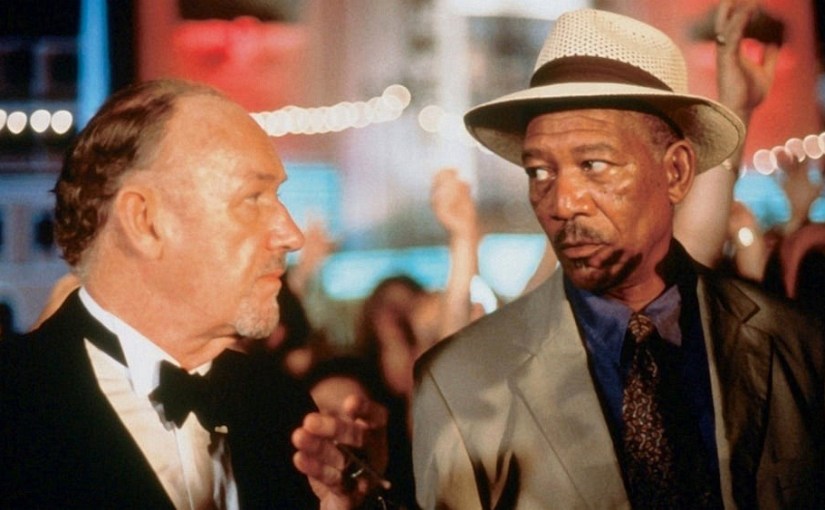
I’ve noted before how sometimes you can’t decide if you like a movie until it reaches the final, climatic five minutes that remains.  That’s the experience I had with a below the radar picture called Under Suspicion, which features two of the best headlining actors ever – Morgan Freeman and Gene Hackman.  Well, I didn’t care for the last five minutes of the film.  So, I didn’t care for Under Suspicion.

Gene Hackman plays Henry Hearst, a wealthy, hot shot tax attorney who resides and practices on the island of Puerto Rico.  When the film opens, he’s already dressed in his tuxedo and his gorgeous, much younger wife, Chantal, played by Monica Bellucci, is zipping up her black evening gown.  They are on their way to a benefit dinner to honor him for his charitable fundraising for underprivileged children.  Henry has to take a quick detour to the police station however to answer a few questions that Captain Victor Benezet (Freeman) has regarding the recent strangulations of two young girls. Victor plays good cop, while his underling, Felix Owens (Thomas Jane), does the bad cop routine on Henry. 

Since this is Gene Hackman playing a likely suspect, it’s no surprise that he’s cool as can be with Victor’s inquiries into some inconsistencies that have been uncovered.  Flashbacks to recent moments of where Henry has been jogging or visiting his sister-in-law cut in, and director Stephen Hopkins puts a present-day Victor within the scene of Henry’s recollections.

The theme of Under Suspicion is all about the gradual breakdown of a powerful guy.  Victor and Felix chip away at Henry’s alibis.  While Henry starts out virtually bulletproof to the cops’ questions, soon he’s reduced to being stuck without explanations, and even physically humiliated.  Let’s just say that more than just his tuxedo gets torn.  Eventually, the officers bring Chantal into the fold and the story diverts into a checkered relationship that Henry has with Chantal’s sister and her family, but what does that really have to do with the murders of two girls?  I hoped I’d see some relevance by the time the conclusion arrived.  I didn’t, and that’s the problem with this picture. 

What did I gain from the prior two hours that I was watching?  The main question at hand is did Henry murder these two girls?  Only if he did commit the acts is what the picture will have you believe is pertinent.  The script from John Wainwright (based on his book Brainwash), and Claude Miller & Jean Herman (based on their 1981 screenplay Garde à vue) never really scratches the surface for a motive.  Implications that Henry could be a child sex pervert come up, but I didn’t think it was explored deep enough to then bridge it to murder.  All that Victor and Felix seem concerned with is whether Henry killed the girls.  That’s too simple.  The movie isn’t thinking hard enough for us.  What makes this self-assured guy, with the familiar cockiness of Gene Hackman’s many other film personas, tick?

When the veil is finally lifted on who committed the murders, I felt emptyhanded like I’d been dealt a bait and switch.  The reveal comes out of nowhere and then the credits roll.  Under Suspicion practically promises a plot twist that never materializes.  A shame really, because there are winning moments between these two acting giants on screen.  Not an ounce of dialogue is memorable, however.  Yet, to see the pair together longer than the screen time they shared in Clint Eastwood’s award-winning film Unforgiven, bears my attention and curiosity.  Ultimately, Hopkins’ film is further proof that a script must come first before the talent is recruited.  It doesn’t matter if you have contracted the likes of Hackman and Freeman for your film.  If you don’t give them anything interesting to say, then there’s nothing interesting to see them do.