BATMAN FOREVER

By Marc S. Sanders

Last month, upon hearing the news of Val Kilmer’s unfortunate passing, Joel Schumacher’s Batman Forever actively swept the social media rounds.  Fans of Kilmer praised his one and done occupation with the costumed role.  Some declared the film their favorite of all the superhero’s cinematic adventures and expressed their immense appreciation of the Juilliard graduate as Bruce Wayne and his vigilante persona.  He’s good.  Yeah.  I’m not going to say he’s great though because the film doesn’t offer much meat for Kilmer to chew off the bone.  As for the film, well, it’s a Joel Schumacher movie.  Should it be good?

The director took over the reigns from Tim Burton.  Michael Keaton opted not to return following two films and thus Kilmer was contracted.  The villains of the week are a very miscast Tommy Lee Jones as Two Face and Jim Carry doing a misbehaved class clown interpretation of The Riddler.  Unlike Burton’s noir approach, Batman Forever is gleefully campy and colorful with overly apparent winks and nods to Batman’s butt, codpiece and notorious chest nipples.  None of it necessary because it’s all wrapped in vinyl and plastic.  Buy the action figures if you want to cop a feel.

Akiva Goldsman was the head screenwriter.  His script carries no reluctance in delivering cliche dialogue.  “It’s the car right? Chicks dig the car!”  or “I’ll get drive thru.” (McDonalds was a proud sponsor.) Worse though are the two halves of the picture.  Kilmer’s Batman endures his ongoing traumatic psychosis of losing his parents, while Jones and Carrey go for a reiteration of the beloved Adam West slapstick TV series.  These two languages never speak to one another.  The hero and the villains hardly confront or challenge each other and never hold a substantial conversation during the course of the film.

Jim Carrey and Tommy Lee Jones try way too hard to duplicate what Jack Nicholson’s Joker portrayal memorably did the first time.  There is no backstory to Jones’ character except a brief news clip.  Otherwise, the middle-aged actor looks like he’s exhausting himself out of breath while trying to match Nicholson and Carrey.  As a Batman fan, he’s entirely wrong for this role.  The Two Face alter ego is the handsomely vain district attorney Harvey Dent.  According to comics lore, when Dent gets half his face grotesquely disfigured, he develops a deep-seeded anger to losing his looks and it leads to his ongoing villainy.  Tommy Lee Jones is a fantastic actor, but he is not the Adonis that Billy Dee Williams (Burton’s Harvey Dent) carried his charming career on.  The makeup job with Estee Lauder pink and purple is awful craftsmanship.

Jim Carrey is doing his usual schtick that skyrocketed his career with Ace Ventura and Dumb & Dumber, but it’s overly abundant here.  Goldsman, Schumacher and Carrey take equal blame.  This Riddler only offers three or four puzzles.  Otherwise, we get Carrey doing the Nicholson gags that should never have made the final print; a baseball pitcher tossing a curveball bomb in the Batcave and a mad scientist routine that drives the bad guy’s stupid plot line of using television waves to absorb the collective intelligence of the people of Gotham City.  The more this side story carries on the more mind numbingly stupid it becomes.  The Riddler’s device is nothing more than a kitchen blender that glows neon green while it hardly maintains balance on anyone’s head.  Junky production value.

Nicole Kidman is radiant as the next romantic Bat gal in line.  She’s so much better than this insubstantial material, though. She consists of zero significance.  Nothing else I can say.

Chris O’Donnell makes his first of two appearances as Dick Grayson, Batman’s sidekick known as Robin.  O’Donell actually has the most interesting storyline as a daredevil kid who tragically loses his family but can’t sit still when adventure awaits.  He gets into all kinds of mischief on his motorcycle and within the confines of Wayne Manor before he finally dons the famous costume. Yet, even when he’s standing in the same frame as Kilmer, both actors look like they are performing in different films.  One guy is hyperactive.  The other is morose and neither seems to be reading from the same script. Their chemistry is begging. Did these guys ever stop and develop an appreciation for one another?

Joel Schumacher applies a candy-colored polish to his Gotham City with black light graffiti, bright lights and more glow, glow, glow!!! Even the street gangs use neon glowing fighting sticks and Two Face’s henchmen work with neon red machine guns.  Oy!!! Enough.  Willy Wonka’s factory was not this sugary sweet.  Batman Forever is one film that can give you diabetes just by looking at it.

Other than an impressive opening scene with a helicopter and a cylindrical bank vault, none of the action sequences are worthy of postponing your bathroom break.  Batman’s fighting prowess and his ugly car and jet look like they are being run by an eight-year-old with his action figures.

So, as I noted before, I took another look at Batman Forever to explore what Val Kilmer did with the role.  He would have been a good Batman if he was given some things to do.  Ultimately, his dashing good looks complement Bruce Wayne’s suits and ties quite well and his square jaw fits perfectly in the mask.

What else can I say except I can’t imagine any chicks loving the car because this Batmobile has a pointless fin sticking out of the chassis and the wheels glow white, plus there’s an odd rib cage of lights on the sides of the vehicle.  Oh, and it drives up the wall of a building.  Is this where people are supposed to be impressed with Val Kilmer?

CRIMSON TIDE

By Marc S. Sanders

A little over a year ago, having just seen Christopher Nolan’s Oppenheimer, I shared with friends how it is sadly surprising that a nuclear weapon has not been launched by a super power country since the bombs were dropped on Hiroshima and Nagasaki.  Those two bombs certainly served their purpose in response to the Pearl Harbor attack of 1941.  I deem it sad that any of us consider this a possibility that can easily be repeated. With all of the threats that continue worldwide with weapons testing, technological advancements and arms trading, it’s frightening to wonder what can ever be expected. Is it easier to execute a command like that again, now that it has been done?  It’s got to be a little surprising that the United States did not respond that way following the 9/11 attacks.  Tony Scott’s Crimson Tide comes close to providing an answer by weighing sound vs unsound reasoning. 

This is not only my favorite of Tony Scott’s films, but the movie also offers maybe my favorite performances from Denzel Washington and Gene Hackman.  The two actors of different generations are equal in measure as they debate what should be done, along with how the submarine they command, the U.S.S Alabama, should respond while in the midst of a revolutionary conflict stemming out of Russia.  

Washington is Commander Hunter, recruited at the last minute to serve as the Executive Officer aboard the Alabama.  Hackman is Captain Ramsey who proudly leads the charge of the sub with an intimidating welcome to Hunter.  Before any kind of real conflict comes their way, Ramsey puts Hunter to the test.  An uncomfortable dinner conversation, wisely written by Robert Towne (Chinatown), has the Captain question Hunter’s stance on using nuclear force to deliver a harsh defeat to the enemy.  Hunter’s position though is the real enemy is war itself.  Ramsey and his commanding staff have no reply to the new member’s observation.

Another moment occurs when Ramsey orders a missile launch drill while Hunter is assisting with containing an on-board fire in the galley.  The Captain has his reasons that Hunter cannot truly debate. Besides, Ramsey precisely tells his XO to “bite (his) fucking tongue,” even if he doesn’t agree with him.

The centerpiece of the officers’ conflict arrives when they receive a fractured message from command.  Ramsey’s instinct is to launch missiles at Russia based on the presumption that the Soviet rebels have overtaken the country’s arms.  Though Hunter cannot deny the concern, he will not agree to a missile launch until they receive the entirety of the broken order.  This occupies the second half of the film, and it becomes a back-and-forth mutiny of power.  The Captain is relieved of command but then retains control and the crew is divided between the leaderships of these two characters.

Having recently seen and reviewed the submarine classic Das Boot, it’s fair to say that film feels much more authentic and maybe it should be much more tense than any other movie of its kind.  Crimson Tide is glossier with outstanding interior cinematography on a studio constructed set designed to tilt like a maritime vessel should.  The dashboards and colored lighting are fancier.  The cast is good looking as Tony Scott obtains close up shots of them beaded in glistening perspiration with no facial hair.  Crimson Tide is definitely a Hollywood picture.  However, the screenplay from Michael Schiffer is razor sharp with not one wasted piece of dialogue.  In addition to Robert Towne’s contribution, Quentin Tarantino also script doctored a portion of the piece as well which includes a well-placed Star Trek allegory. 

There’s a jolt of energy to Crimson Tide that Das Boot has at times, but because of the latter’s three hour plus running time it also slumbers like life should while living on a submarine.  It is the theatrics of Crimson Tide that hold my attention on many repeat viewings.  I’d never want to question a guy like Captain Ramsey, but I’d be grateful that someone like Commander Hunter is around to stand in protest.  

I wish Gene Hackman and Denzel Washington had done another film together.  Their conflicted chemistry is second to none.  You like them both equally in the scenes they share together, or individually.  The timing of their tempos is perfect.  They find just the right moments to be alarming in a quiet way and save other opportunities for shocking outbursts.  The best actors practice their scripts this way and avoid any traps of overdramatizing.

Tony Scott made this film before his penchant for chaotic angles and grainy captions took over much of his other films to come hereafter.  Crimson Tide is cut perfectly from one scene to another with outstanding colors of blue, red and green lights that illuminate the cast while they stand at their posts.  Washington, Hackman as well as a sensational supporting cast (Viggo Mortensen, James Gandolfini, George Dzundza, Steve Zahn, Matt Craven, Lillo Brancato) do fine work and respond beautifully to the director’s camera positions. 

It’s impossible not to feel the tension accompanied with the progression of this film.  It serves as a motivation to wonder if we act on what we know or don’t act on what we don’t know.  As taut and dramatic as Crimson Tide is, you find yourself considering if those with access to the real-life red button consider all that could come of their decisions.  

Crimson Tide may tidy itself up after two hours, but the movie still makes me ponder if this planet’s military forces are thinking each and every day about if we are preventing nuclear war or if we are on the cusp of waging a nuclear holocaust.

This is one of my most favorite films. 

THE QUICK AND THE DEAD

By Marc S. Sanders

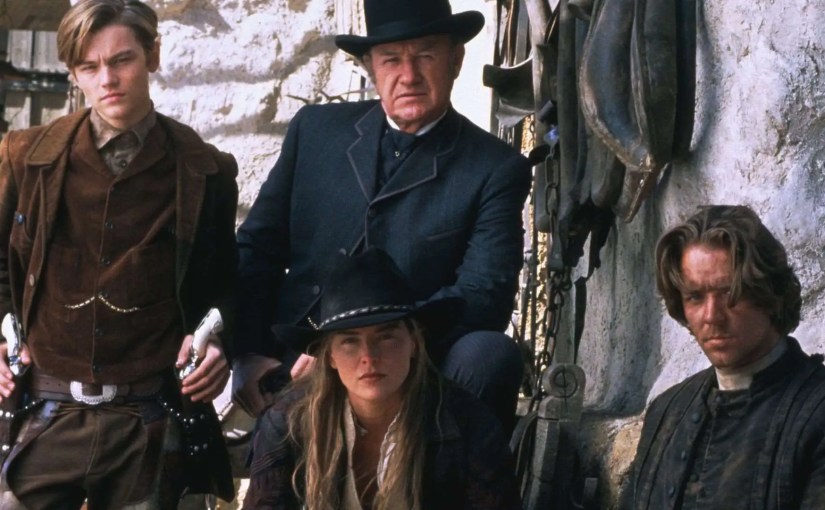
The Quick And The Dead is a gritty, stylish western that boasts a who’s who of great actors.  Some of which went on to magnificent careers.  I wish the story was a strong as the cast list though.  It’s watchable.  It’s intriguing. It’s also too repetitious.

Sharon Stone is Elle.  Otherwise known in these parts as The Lady.  Two minutes into the picture and my suspension of disbelief is withering away.  Not because this gunslinger cowboy is a cowgirl, but because Stone does not look like she fits in the Old West.  Her blond locks are shampooed and conditioned.  Her complexion perfectly made up without a hint of grime or dirt or sunburn.  Stone looks like she took one step off the Oscars red carpet and onto this set. Her costume with a scarf, leather pants, black rimmed hat, and spurred boots looks like its attempting its own kind of Clint Eastwood stranger.  Frankly, it appears to have leaped off the pages of an Old Navy catalogue.

Below Stone on the credit lineup is a much more redeemable list of characters.  Gene Hackman is Mayor Herod who has amped up his level of sinister from his Oscar winning performance in Unforgiven.  There’s also Ace Hanlon played by Lance Henrickson with a rare on-screen giddy grin, whose personal deck of cards consists of aces of spades for every man he’s killed. Sgt Cantrell is the flamboyant personality with the handlebar mustache, deep voice and toothy grin that actor Keith David proudly bears.  A kid named Leonardo DiCaprio plays up the youthful cockiness of an outlaw named The Kid.  All these folks are gunslingers participating in the sport of gunslinging.  Last one left standing is the winner.  Midway through though, Herod will up the ante and deem that the last one left alive is the winner.  Each one challenges another until a final winner is recognized.  One reluctant participant is played by a very youthful looking Russell Crowe.  Cort is a former fast draw, who is now a remorseful preacher for all of the killings he’s committed.  Herod is not entirely convinced and will antagonize Cort to throw his hand in the game.

Sam Raimi directs and Sharon Stone produces this slick small town modern day High Noon.  The problem though is that Raimi and screenwriter Simon Moore choose to only send up the climax of that classic Gary Cooper western over and over.  Time and again, two opponents line up at opposite ends of the street.  The townsfolk observe with close up tension shots.  The hands twitch their fingers next to the holsters and when the clock strikes twelve, the guns go off.  Raimi often gives you the impression that the one expected to live is the one who is going to topple over dead and then an edit shows the match went exactly like you thought it would. 

This whole supporting cast has enough presence and charisma to keep my attention, but the set ups are the same over the course of the film.  Cut in between are discussions within the saloon or the hotel rooms where Herod or the Lady rest.  Cort remains chained in the town square.  When the movie breaks away it goes to flashbacks of Stone’s character as a child when she once crossed paths with the devilish Herod. 

I like the polish that Sam Raimi brought to The Quick And The Dead.  Before Quentin Tarantino was glamourizing his pulp fiction to his own two dimensional westerns and war movies, Raimi was daring enough to let us look through literal bullet holes from the front to the back of his victims.  Holes through the hand, the chest and the head.  It’s fun.  There are also countless closeups of haunting music from Alan Silvestri as a new stranger enters a saloon to click his spurs on the wooden floor.  Quick draw action is how these pistols perform too.  Hangings are a part of any day as well.  All of this is familiar and standard to the B movies brought to us by Sergio Leone’s spaghetti westerns during the mid twentieth century, but now we have a modern day cast and some glossy cinematography.

I was ready for a worthy salute.  It just comes up short due to a lack of any depth in story.  Gunslinging quick draws are not as dynamic as a gunfight at the OK corral.  How much different is one dual draw going to be from the last one we watched five minutes ago?  Raimi’s camera points from behind each challenger.  The music builds louder and louder.  Zoom in shots of townsfolk cut in.  The minute hand on the clock tower moves closer and closer to the roman numeral twelve, and then…BANG BANG!!! (I’ve said this before, haven’t I?  Well, so does the movie.)

The Quick And The Dead is worth seeing especially for another scenery chewing villain from the great Gene Hackman.  I’ll never tire of watching him.  To see the beginnings of Russell Crowe and Leonardo DiCaprio’s potential is a real treat as well.  They all certainly have some acting moments that I loved digging up from this time capsule.  Character actors Keith David and Lance Henrickson break from the standard personas you’ll find on the rest of their resumes.  I just needed more of a variety to this town setting they got play in.  The déjà vu is too overdone.

Sharon Stone usually looks like she’s giving a so so community theatre audition.  It’s hard to take her seriously, the same way I would had Uma Thurman, Susan Sarandon or Geena Davis been cast as The Lady.  Those actresses work for their appearance to be appropriate for the setting of their films.  Look at Sharon Stone here in the dusty Old West.  Then look back to what Sarandon and Davis did in Thelma & Louise.  You’ll see right away, practically anyone else would have been more suitable for the lead of The Quick And The Dead.

12 MONKEYS

By Marc S. Sanders

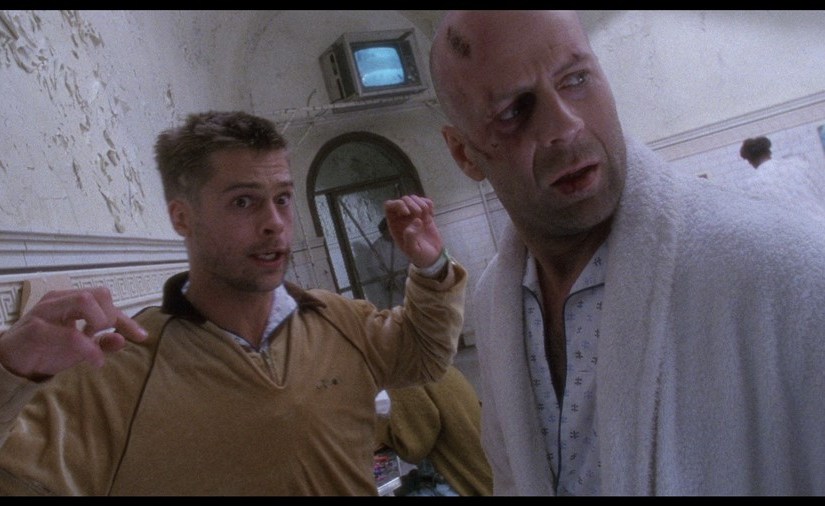
Bruce Willis is a time traveler from an ugly dystopian future in 12 Monkeys.  His name is James Cole and his mission is to uncover why all but one percent of the world’s human population perished from a mysterious virus in the year 1996. 

Director Terry Gilliam specializes in disorienting his films.  No shot or closeup is well defined.  He’ll position his camera on a slant or he’ll turn it on an uneven axis so that nothing appears completely clear.  In 12 Monkeys, the viewer is as confused as the protagonist, James Cole, along with a psychiatrist he periodically encounters named Kathryn Railly (Madeleine Stowe).  Beyond the camera trickery, the script of the film offers up oddball characters in both Cole’s present time period (the “future”) and in his past.  Jeffrey Goines (Brad Pitt, in his first Oscar nominated role) is one particular weirdo, residing in a mental institution that Cole is entered into when he time traveled back to Baltimore, Maryland in the year 1990.  During his stay in the loony bin, Cole is talking gibberish to Dr. Railly and her team.  Jeffrey has his own language of nonsense.

Cole’s dreams of himself as a child are intermittently weaved into the final edit of the film.  There’s a woman running after a man, a rapid beep, beep, beep and a gunshot.  Later returns to this dream will provide more clues fleshing out its significance.

It would be easy to have a five-minute conversation and spell out what occurs in 12 Monkeys, but that would be defeating the cleverness of the film.  The achievement of its story relies on the sum of its parts.  Terry Gilliam strategically lays out breadcrumbs with fractional pieces of dialogue, words and pictures that quickly flash in front of you.  It may even hinge on a news story or memorable pieces of music playing on a radio. Still, he also unnerves the characters and the viewer with uncomfortable and sometimes grotesque imagery. 

The first time you watch the film your attention may turn to the long stream of bloody drool hanging from Bruce Willis’ mouth when he shares his first scene with Madeleine Stowe.  Repeat viewings, which I believe only enhance the picture, will have you focus on the nonsensical dialogue that James Cole is continuously uttering.  Other characters are seemingly disruptive to your concentration, particularly the herky jerky behavior of Brad Pitt’s character, but their purpose is essential to a mystery that has left the world of the future in a tailspin where the last of the human race lives underground while animal wildlife roam the cities above.  Furthermore, who or what can explain the enigma behind a team of people perhaps known as The Army Of The 12 Monkeys?

12 Monkeys is a very weird and very unusual kind of science fiction film and that is its crowning achievement.  I have spoken before of how sometimes a movie can not be determined as a success until it reaches its climax, say the last five minutes of its running time.  Terry Gilliam’s picture is one such example.  Gilliam has a keen sense of foreshadowing with tactical layering of complexity.  He is wise with how everything neatly unravels at just the right moment. The answers to the mysteries that James Cole pursues eventually rise to the surface, reminding us that everything was right under our nose the whole time. 

I recall the elation I had the first time I saw the film in theaters.  On repeat viewings, I grin at how the movie is assembled.  Quick references that seem like blink and you miss it moments add up to a satisfying conclusion in Terry Gilliam’s film.  My colleague, Miguel, and I both agree on the time travel motif in 12 Monkeys.  It is one of those rare occasions where the science built within the story’s fiction seems to make sense.  Too often time travel movies paint themselves into a corner and can’t escape the gaping plot holes they leave behind.  Yet the different time settings of 12 Monkeys cooperate with themselves.  Because the film doesn’t color outside of its lines, its worth applauding how ingenious the picture truly is from beginning to end.

12 Monkeys may require your patience the first time you watch it.  It’s not a comfortable journey.  However, you’ll be glad you stayed with it as the story answers its own questions.

SAFE (1995)

by Miguel E. Rodriguez

DIRECTOR: Todd Haynes
CAST: Julianne Moore, Xander Berkeley, Peter Friedman
MY RATING: 4/10
ROTTEN TOMATOMETER: 87% Certified Fresh

PLOT: An affluent but unexceptional homemaker in the suburbs develops multiple chemical sensitivity.


From Wikipedia:  “Multiple chemical sensitivity (MCS)…is an unrecognized and controversial diagnosis characterized by chronic symptoms attributed to exposure to low levels of commonly used chemicals…Blinded clinical trials show that people with MCS react as often and as strongly to placebos as they do to chemical stimuli; the existence and severity of symptoms is seemingly related to perception that a chemical stimulus is present.”

I lead off with that because the disease showcased in Safe is utterly unknown to me.  To me, it sounds like a fancy term for bad allergic reactions, but I’m not a pharmacologist, so there you go.  I don’t mean to suggest it isn’t real, despite the blinded trials.  For the people afflicted by it, their symptoms are real enough for them, so it’s good enough for me.

And yet, despite the fact that Carol (Julianne Moore), the protagonist of Safe, is clearly suffering from something – clinically, mentally, or otherwise – affecting her health in unusual ways…I simply didn’t care.  Safe is one of those movies probably best discussed with a group so I can get opposing viewpoints, because mine is fairly negative.  Apart from Julianne Moore’s effective performance, the movie is a well-photographed but ultimately confusing slog.

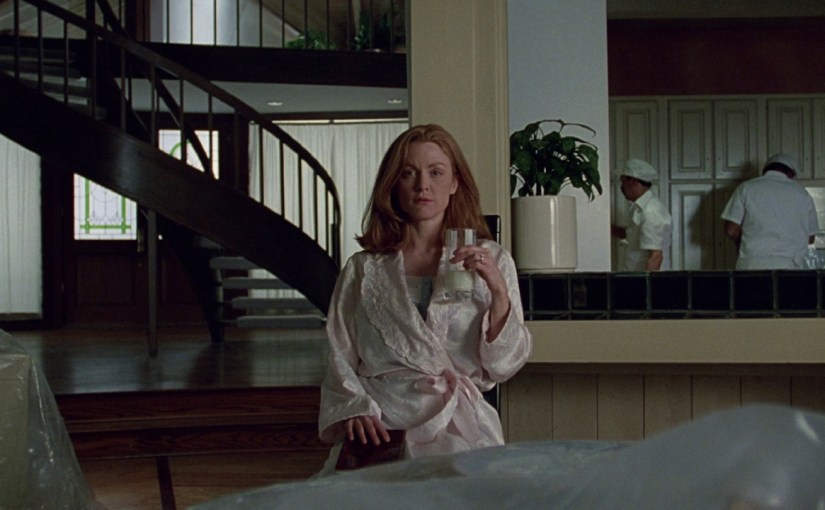
Carol is an affluent housewife – sorry, homemaker, she makes that correction herself in the film – whose days are filled with making sure the 2-piece sofa she and her husband ordered is the right color, tending to her rose garden, lunching with friends, baby showers, and Jazzercise (the film takes place in 1987).  Her speaking voice sounds as if she’s internally apologizing for filling the gaps in conversations.  Her relationship with her stepson isn’t the greatest, and the role of her husband (Xander Berkeley) seems to be little more than that of a breadwinner and baby-maker.  Moore is a great actress, and in Safe she succeeds in making Carol a void, which is not an easy task.  (I was sometimes reminded of Anthony Hopkins in The Remains of the Day where his one goal as a butler was to make sure everyone forgot he was there.)

One day, Carol suffers a coughing fit after driving behind a dump truck that spews vast amounts of smoke.  Later, she zones out at a dinner engagement with her husband’s clients.  She has trouble breathing after drinking a glass of milk.  She gets a spontaneous nosebleed after getting a salon perm.  The way the movie and Carol’s character are constructed, I got the idea that her illness was directly related to her nearly crippling ennui.  Actually, Carol reminded me of the main character in Jeanne Dielman 23, Quai du Commerce 1080 Bruxelles, that semi-obscure Belgian film that was recently named the best film of all time by Sight & Sound magazine.  In both cases, a woman goes through the routine of everyday life while something percolates beneath the surface.  Safe attacks the story directly while Jeanne Dielman takes the long, long, LONG way around the barn, but the principle is the same.

Carol sees her family doctor who pronounces her perfectly healthy, aside from her apparent reactions to chemicals.  She starts wearing a mask when going outdoors.  One day, she walks into her local dry cleaner’s wearing her mask before realizing the place is being fumigated for pests.  She immediately falls to the floor with convulsions; blood suddenly appears in her mask.

So far, it’s looking like a “Disease-of-the-Week” Lifetime movie.  Ah, but here’s where it gets sort of interesting.  In a nearly throwaway line, it is revealed that the blood in Carol’s mask didn’t come from her lungs or her nose.  Apparently, she bit her lip.  No one can fathom why she bit her lip, least of all Carol herself.  So, I’m thinking, “Okay, she’s really suffering, but it’s not from anything real.  She bit her lip because she saw the exterminators and their masks and their sprayers and she needed to be sick.”

Mind you, despite the sensational nature of that plot description, the movie up to this point is slow as molasses.  It seems to want to create a sense of creepiness or dread, but because I was pretty sure she wasn’t truly sick, based on the information provided in the story, it didn’t really grab me.

Eventually, Carol winds up at Wrenwood, a kind of “rehabilitation clinic” she saw in a commercial on TV.  If the movie was weird and confusing before, it gets more so from here on out.  Wrenwood is not so much a clinic as a metaphysical/holistic retreat.  Its leader, Peter Dunning (Peter Friedman), speaks to his patients/slash congregation with a curious message that can be distilled down to this: if you’re sick, it’s because your negative emotions – anger, fear, envy, etc. – have gotten the best of you and are affecting your immune system.  In other words, it’s your fault.  And to get better, you just have to be more positive.

This philosophy is insidious to the extreme.  I have a friend right now who was just recently diagnosed with ALS, a disease for which there is no known cure, and which is invariably fatal.  I wonder how he would respond if someone told him that, not only is this disease his fault, but he would get better if he would only be more positive.  Pardon my French, but that’s a load of horseshit.  ALS and cancer kill many thousands of people a day, no matter how positive their attitudes are.  Are you telling me they died because they didn’t smile enough?  Give me a break.

So, here Carol is, with this guy, and she listens to his orientation speech (which is followed by a musical duet right out of a stereotypical hippy commune from the late ‘60s), and she goes back to her cabin and cries her heart out.  And I’m thinking, “Finally, she’s come to her senses.  She realizes, like we the audience do, that this guy isn’t going to help her illness, imagined or not, because he’s a charlatan.”

But no!  She buys into it.  The movie keeps throwing these plot-related curveballs that made it difficult for me to understand what the filmmakers are getting at.  I’ve read that Carol’s illness is a metaphor for AIDS.  Okay, if that’s the case, what is Safe trying to say?  That there’s no cure?  What else is new?  This movie was made in 1995, long after AIDS first invaded the cultural zeitgeist, and two years after the movie Philadelphia brought it into the cinematic mainstream.

But let’s say that is the message.  Okay, let’s talk about how Safe delivers the message.  Short answer: it doesn’t.  At first, the movie would have you believe Carol’s illness is motivated by hysteria and not pharmacological.  Then it isn’t.  Then it is again.  Then she finds a haven that might provide a cure.  Then the haven turns out to be a fraud.  But she goes along with it anyway.  But then her condition seems to get even worse…

Safe wants to have it both ways.  Maybe it’s a Rorschach test.  Or maybe it’s more accurate to call it Schrodinger’s movie, where both solutions are equally possible, depending on who’s watching.  Are there movies that can pull this off?  Maybe you can list other examples besides 2001: A Space Odyssey, because I can’t.  By the time the cryptic ending rolled around, my chains had been yanked so many times that I just didn’t care anymore.  Carol is suffering from her illness, imagined or not, so it’s real to her.  But if the movie isn’t going to come down either way, what is it actually saying?  Having no perspective is worse than having one I disagree with.

Like I said, I need to watch this movie with other people, and we need to discuss it afterwards.  Maybe other viewpoints will broaden my mind a little bit to grasp Safe’s message, whatever the heck it is.  Viewed by itself in a vacuum, much like Carol herself, I was bored sick.

[P.S. The trailer for Safe is one of the most misleading trailers in film history, yet another in a long line of scenarios where a studio cuts the trailer for the movie they thought they’d get as opposed to the one they have. Watching it, you’d think you were in for another Outbreak. But, alas, no.]

APOLLO 13

By Marc S. Sanders

What’s fascinating about Ron Howard’s film Apollo 13 is that I can hardly understand what anyone is talking about.  I don’t know how they identify the problems of the doomed spacecraft.  I don’t know how any of the folks at NASA resolved the issue to get the three astronauts, Jim Lovell, Fred Haise or Jack Swigert (Tom Hanks, Bill Paxton, and Kevin Bacon), back to Earth.  What I do know is that William Broyles’ script, based upon the novel from Lovell with Jeffrey Kluger, allows for an ease of comprehension to know where one thing has started, where it leaves off and where it needs to go with each passing scene.

Forgive me, but when I watch NASA documentaries, I honestly get bored.  It’s amazing what has been accomplished during the history of our space program.  So much has been discovered but it’s only a fraction of what’s still left to be uncovered beyond our planet.  The films and literature that account for the engineering of space craft and what is required to travel in space lose me though.  Ron Howard puts everything in place with Apollo 13, however.  It’s the emotions that stem from the actors.  All I need to understand are the efforts each character serves to the ending that we all know.  It’s not about telling us what these guys are educated with or what science mandates.  Rather, it is about how these people respond to an unexpected and unfamiliar crisis.

On the ground in Houston, Texas Ed Harris portrays Gene Krantz.  He’s a pretty quiet kind of character, but upon his entry into the film, just ahead of the anticipated launch of Apollo 13, he is gifted a pure white vest.  Krantz wears this as his armor, prepared to take on any challenge including navigating a crew of three astronauts towards the moon.  He is surrounded by a school of nerdy looking engineers and scientists, in their short sleeve shirts, skinny ties and black rimmed eyeglasses.  They are all disbursed among an assortment of different departments.  I think one specified simply in human waste disposal aboard the ship.  Yeah, there’s a guy there making sure the urine is dispensed properly.  Again, I couldn’t tell what specialty each man is designed for, but they’re the experts.  Harris simply tells his men what needs to be done by drawing two circles on a chalkboard; one is the moon, the other is Earth.  When a frightening malfunction occurs aboard the rocket, Harris explains that his men now need to get the ship back to Earth by drawing a line between the solar locales.  He doesn’t know how it can be done, but like a football coach he demands his team find a way.

On board Apollo 13, the three astronauts are crammed in what is left of their ship, marooned to float through space. The interior gets extremely cold, exhaustion gradually overtakes them, and they are left with no choice but to power down whatever sources they have left as a means of preservation. 

A third angle comes from the wives and families of the three men.  More precisely, focus is drawn towards Marilyn Lovell (Kathleen Quinlan) with her family, including the children and Jim’s elderly mother watching the television with anticipation for ongoing developments while the media waits outside their doorstep.  The first act of the picture offers the anxiety that Jim’s wife has with this upcoming mission.  There is the standard nightmare scene.  Acknowledgement of the unlucky number thirteen.  Marilyn loses her wedding ring down the shower drain (something that actually happened). Ironically, the Lovells’ eldest daughter seems to carry the same kind of apathy for her dad’s upcoming trip like the rest of the country.  Jim may finally be having his dreams come true, to walk on the moon.  However, the rest of the world is more concerned with the possibility of the Beatles breaking up or what else is on TV.

A side story is delivered by Ken Mattingly (Gary Sinise).  The poor guy was originally a part of Lovell’s three man crew, only to be sidelined at the last minute because of a suspected case of measles.  When things go wrong for Apollo 13, he enters the flight simulator to diagnose the issue and find a resolution.  He’s offered a flashlight but rejects it because the guys in space don’t have that tool.  He specifically tells his men not to give him anything that they don’t have up there, and he refuses to take a break either.  If they don’t get a chance to rest, then neither does he.  This mantra carries over to the other guys working diligently to keep the astronauts alive and get them home. 

Apollo 13 is not a how to picture.  Rather, it is a film that focuses on response. 

Ron Howard offers amazing shots of the rocket and footage in space.  The launch is extremely exciting as shrapnel sheds off the craft during its fiery liftoff. Then other parts disengage after it leaves the Earth’s atmosphere.  The interior looks extremely claustrophobic, but the actors look comfortable within the floating zero gravity confines. Hanks, Paxton and Bacon have great chemistry together whether they are kidding one another about vomiting in space or bickering with each other while caught up in the problem at hand. 

The base of NASA is alive with hustle and bustle.  Not one extra looks like they are sitting around.  They all know what monitor to look at or which teammate to lean over as they desperately discuss what needs to be accounted for.  There’s a great moment that is explained to the audience as if they are a four year old.  A man in charge throws a pile of junk onto a boardroom table and says they need to build something with nothing but what’s on this table to absolve the problem the astronauts are having with carbon dioxide poisoning.  A few scenes later, we see the junky device that’s been rudimentarily assembled.  Who knows what it does?  All I need to know is that it works. 

I did take one issue with Apollo 13.  To heighten the dramatics, sound is provided as the ship comes apart. Even I know that sound does not travel through space.  I forgive it when I’m watching fantasies like Star Wars or Superman.  However, this film recaps a real-life event and during those moments, as startling as they may be, I could not help but think about the dramatic clanging and crashing penetrating my sound system.  Apollo 13 draws from a well-known case, but it still resorts to cinematic tropes to hold my attention.  I wonder if the picture would have worked had it remained faithful to basic scientific fact through and through.  It’s not a terrible offense.  It’s forgivable.  Though it got me thinking. Heck, it obviously never bothered the masses because the film was awarded the Oscar for Best Sound Design.

Ron Howard’s film is a magnificent experience, full of outstanding footage.  It relies on actors who depend on the emotions of the scenario to narrate the story.  Recently, I watched the film Tár with Cate Blanchett.  In that film, the mechanics of orchestral music and conducting are endlessly discussed.  It’s like listening to a foreign language at times while trying to keep up.  Howard’s film could have taken that approach and bored me to tears with a lot of technical jargon from engineers and scientists.  Instead, Apollo 13 succeeds by only presenting the basics of the issues at hand.  I couldn’t name one specific part on the engine of my car, but I know it powers the vehicle, allowing it to go from point A to point B.  The army of NASA folks declare this thing has never done that before or it must be crazy to consider because that has never been attempted.  I can count on the players of Apollo 13 to know what they’re doing.  They are aware of the risks that need to be taken and know what’s at stake.  I don’t need to see their diplomas to trust their concern or computations.

Like other films where known historical events are depicted, Apollo 13 maintains its suspense even if you already know the ending.  The aborted mission to the moon became known as “The Successful Failure.”  It’s refreshing to see how this proud moment all played out. For fleeting window in time America, actually most of the world, seemed to hold a unified care for three men trying to outlast a doomed, desperate and impossible situation. 

Apollo 13 is a triumph.

THE USUAL SUSPECTS

By Marc S. Sanders

There’s something inviting – or maybe intriguing – about seeing a person in a hat with a dark trench coat on.  Just the person’s silhouette will leave you asking for more.  What is it to this guy?  Steven Spielberg does that in the first few minutes with Indiana Jones in Raiders Of The Lost Ark.  Before Indy, there was Orson Welles as Harry Lyme in The Third Man.  Guys like these have a danger to them, and we can’t look away.  In The Usual Suspects, one of many variations of a legend called Keyser Soze has a dangerous reputation that carries him, and we want to know more about the figure in the hat and coat.  In the first few minutes of the film, we see this mysterioso extinguish a kerosene flame by urinating on it.  Who is this guy?  Maybe we, as the viewers, are Icabod Crane looking at an updated inspired spawn of The Headless Horseman.  Perhaps, we are actually catching a glimpse of that boogeyman who hid in our closets or under the beds.

Bryan Singer’s modern day film noir, masterfully written with inventive riddles by Christopher McQuarrie, works towards its ending as soon as the opening credits wrap up.  Each scene hops from a different setting or time period and as a viewer you feel like you are sitting at a kitchen table turning puzzle pieces around trying to snap them together.  Not all of it makes sense by the time the picture has wrapped up.  That’s okay though, because one of the players in the story perhaps played a sleight of hand and we can do nothing but applaud when we realize we’ve been had.  Magic is fun when you never quite realize where or when the deceit began.

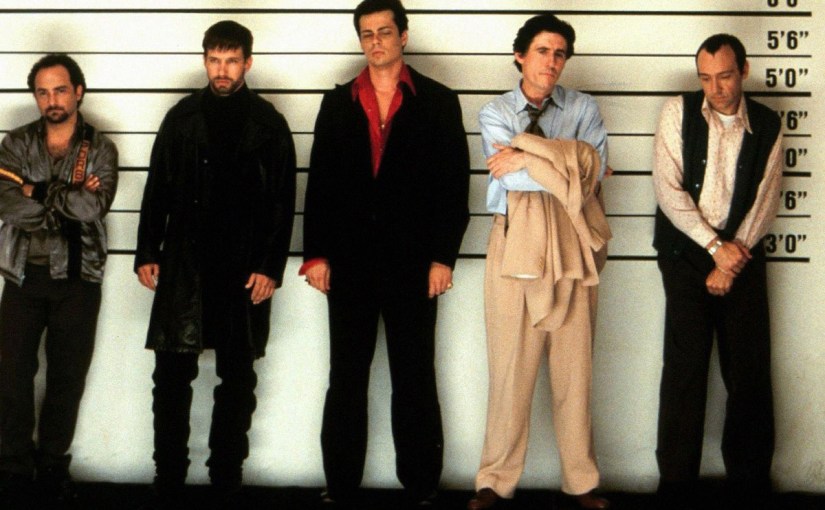
A scenario is set up early on that assembles five different kinds of criminals in a police lineup.  It works as a device to team these guys together to pull off additional heists.  A prologue to the film depicts the aftermath of their last job together.  One holdover, a hobbled cripple named Verbal Kint (Kevin Spacey) is brought into a police precinct to be interviewed by a determined detective named Kujan (Chazz Palminteri).  Verbal might ramble on endlessly in circles about nothing, but Agent Kujan is going to get to the bottom of what happened the night prior on a shipping dock that turned up several corpses.  How did it all go down, and where is the money and cocaine that was expected to be there?

Verbal was one of the five in that lineup, along with McManus (Stephen Baldwin), Hockney (Kevin Pollack), Fenster (Benicio Del Toro) and Keaton (Gabriel Byrne).  Each carries a different specialty or personality, but Keaton is the guy that Kujan is really after.  He’s a master criminal who’s been known to fake his own death, supposedly turn legitimate while dating a high-priced lawyer, and now may be the lead suspect in an armored truck heist.  On the other hand, maybe it was one of these other four guys. 

Amid all of this back and forth and side stepping stories, there is mention of a name – Keyser Soze.  Whenever he comes up in the vernacular of the script, the mood seems to change.  These criminals, usually comfortable in their own cloth of transgressions, get noticeably frightened and concerned if there is even a remote possibility that this Soze character is the engineer behind what follows them. 

It’s fun!  The Usual Suspects is fun.

McQuarrie’s script will toss out names of people we never meet.  It will quickly imply an anecdote from another time.  It’ll share a bunch of short stories with how these five guys work together, like upending a secret criminal sect of the New York City police force while robbing them of their fortunes. Yet, a tall tale of lore will intrude on their typical heists to derail what we may normally be familiar with in other crime dramas or noir films.   

Spacey is the real star of The Usual Suspects.  He earned the Academy Award for Supporting Actor because Verbal Kint is so well drawn out as a weak, unhelpful, and frustrating man.  Often, you ask yourself what the heck is this geeky looking crippled guy even talking about. 

On other occasions, I’ve noted that sometimes with movies I can not determine if I just watched a superior film or dreadful nonsense until I’ve reached the final five minutes.  The final five minutes of a movie can be the verdict.  Sometimes you’ll claim the journey getting there was great, but the conclusion was a big letdown.  If you have never seen The Usual Suspects, then you likely won’t know if the path towards its end is good until you’ve reached the culmination. 

Roger Ebert couldn’t stand this picture, and I’m not going to say he didn’t know what he was talking about or that he was wrong.  Bryan Singer and Christopher McQuarrie’s assembly of scenes don’t make for a well-defined picture, even after the movie is over.  Ebert was less than fond of that technique.  I think that was their intent, though.  Everything you have seen doesn’t have a suitable answer.  Certain parts don’t link well with others.  However, the director and screenwriter were always working towards an ending while piloting the film in swerves and unexpected knee jerk turns.

Unlike Ebert, however, I’m wholly satisfied with the film.  In fact, the first time I saw the movie, I cheered for the conclusion that got more than just one over on me.  On repeat viewings, knowing how the picture wraps up, I treasure the path towards its finale. 

If you study Verbal Kint, you’ll realize that he doesn’t offer easy answers and explanations for what’s occurred, thereby lending to the frustration of Agent Kujan who only demands cookie cutter, fall-into-place arrangements. What can I say Roger Ebert?  How else should I lay it out for you Agent Kujan? Life is messy with no easy answers sometimes.  Especially, in film noir.  

Ironically, one of Ebert’s favorite cinematic characters is Harry Lyme.  So, I guess Keyer Soze couldn’t live up to that threshold or repute.  If that’s the case, then I forgive you Roger.

SEVEN

By Marc S. Sanders

There’s an interesting dynamic to David Fincher’s Seven that is not touched upon often enough.  Beyond the clever and grisly murders set to a theme of the Seven Deadly Sins, the two police detective protagonists are carved from completely different molds.  The spine of Fincher’s film, written by Andrew Kevin Walker, focuses on how these men approach the craft of the killer’s accomplishments.  One man wants to cut to the chase, find the criminal and cuff him.  The other wants to study the nature of this mystery man, and only then will it lead to the suspect’s true identity.

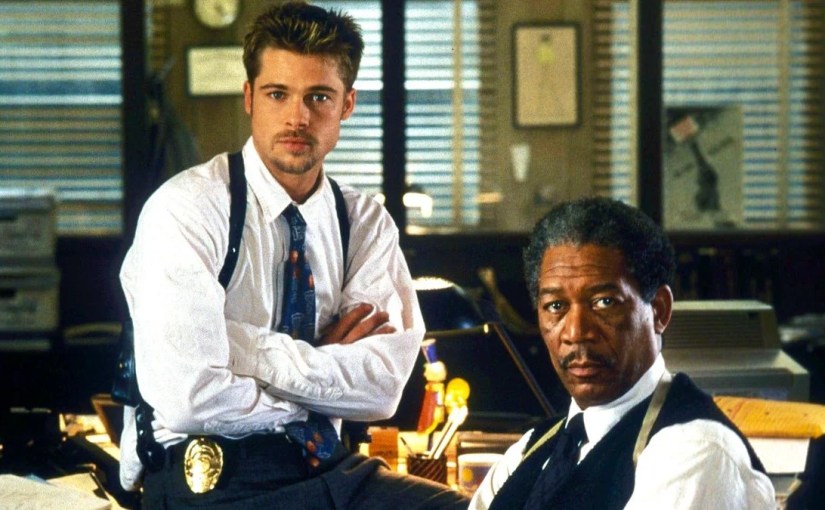
Detective William Somerset (Morgan Freeman) stems from a time gone by for the cinematic detective.  He’s the trench coat wearing investigator who examines and connects dots, never resorting to fists or police intimidation with a gun.  Newly assigned Detective David Mills (Brad Pitt) dons the leather jacket with the cute goatee and boy blond haircut.  He’s more apt to making fun of the sick weirdo they are chasing, hardly lending any valuable insight or observations.  Somerset will approach with respect for the killer and his work.  Mills, with nowhere near the experience of his new partner, will disguise his loss of where to begin with this case by resorting to cheap shots at the killer’s expense, calling him Yoda and surmising this guy must be pleasuring himself in peanut butter, perhaps.

Fincher is widely recognized for the dark photography of his films, like the cherry wood hallways of Harvard in The Social Network or the lurid neighborhoods in movies like Zodiac and Gone Girl.  In Seven, the setting is very much a character in and of itself, but other than the fact that it is a California (thanks to a throw away piece of dialogue) metropolitan area, we never know the name of this city.  It is a dreary, ongoing rain-soaked environment that hinders the police officers and keeps everyone contained in the film, especially David’s wife Tracy (Gwyneth Paltrow), unsettled.  The city has no name or identity.  Therefore, the police officers who occupy it are not the stereotypical cops designed for this place.  One works as a tired, wise and experienced Colombo figure, minus the sarcasm.  The other is an aggressive hot shot who is over trying to prove himself to peers and superiors.  Now he wants to be in charge.  They both follow the footsteps of the mystery together.  Yet, they are reading different roadmaps.

With seven days left before retirement, Somerset meets newly arrived Mills.  They are quickly dispatched to a filthy apartment for an ugly murder scene of an odd nature.  It is a scene labeled as Gluttony by the killer.  Greed follows shortly thereafter, and Somerset knows none of this random.  Whoever has orchestrated these two executions is methodical and resourceful, with a point to prove.  The artistic measure and inspiration are too creative, far from the sloppiness of a standard stabbing or gunshot to the head.  Somerset already knows five more murders will likely turn up and doesn’t want to get involved.  He’s seen enough.  Mills has the cavalier attitude.  Find the freak, and maybe take him out in a blazing shootout.  It’s reckless. 

Could Seven be an answer to how cop movies performed at one time and how they act now?  Seven may be the closest outline of pairing Humphrey Bogart’s Sam Spade with Mel Gibson’s Martin Riggs.  Sure, the murder scenes are hard to look away from, as deliberately repulsive as they are.  Even after multiple views of the film, I still get curious with how the killer planned all of this out to the absolute most minute detail.  However, ninety percent of the dialogue is exchanged only between Freeman and Pitt. Paltrow has a couple of scenes that help paint the sad picture of life in this city, but ultimately the film belongs exclusively to the two cop characters.  Seven has one action scene, but it primarily covers how the two men respond to the nature of what they come upon.  Mills will crack jokes that maybe his college pals would snicker at.  Somerset asks the young man to just be quiet while he explores the scene.  Mills gets grossed out by a bucket of vomit.  Procedurally, Somerset will ask Mills if there was any blood in it.  Mills will resort to Cliff’s Notes on the Seven Deadly Sins.  Somerset will spend his evening in the library, digging through the original source.  Mills will kick down a door without authority.  Somerset will protest against that action without following the standards of procedure.  It’s a dichotomy of impatience versus patience.

The two men actually don’t come to a common platform until the third act of the picture, when the rain has subsided, the sun comes out, and the killer opts to surrender himself.  Still, the mystery of his purpose remains and there’s an unknown element of what to expect next.  So, while the partners may agree that there’s more to come, they still respond to the killer, in person, differently.  Mills can only yell at the deranged suspect and call him names.  Somerset interviews the gruesome and imaginative architect with questions. 

Seven is a sensational crime drama.  It’s eerie, creepy and appreciatively sickening in its crimes.    The outline of some of the killer’s actions might seem conveniently questionable or far-fetched.  Some of the crime scenes were planned over a year’s time. Others were not meant to be revealed until a certain point within these particular seven days.  So, the writing might be a little too overly precise.  However, that should not be dwelled upon.  Rather, one kind of cinematic cop is not the standard in Hollywood films anymore.  Another kind of cop has filled that void in its stead. 

Andrew Kevin Walker’s script follows a very structured outline.  It’s not until the story’s infamous end does the film divert itself, as it is almost unfathomable that it could have actually happened. 

It is fortunate that David Fincher was allowed vast liberties with the production of only his second film, following the abysmal Alien 3 which famously took away any of the personal oversight he depended on as a rookie filmmaker.  With Seven, Walker and Fincher draw out four characters quite well – Somerset, Mills, the city with Tracy as its spokesperson, and the killer’s actions.  Blend these elements together and see if they make for a good product.  Fact is they couldn’t be any more disagreeable, but the chemistry works perfectly. 

Seven is a sensational movie and will likely always remain as one of David Fincher’s best films.

CASINO

By Marc S. Sanders

When a movie is set in Las Vegas, doesn’t it feel like it should be overly exaggerated, maybe a little loud, and quite bombastic?  That’s how I feel about Martin Scorsese’s three-hour opus, Casino.  The film opens with a car bomb exploding our primary narrator, Sam “Ace” Rothstein into the skies where he then makes his descent into the expansive signs that light up sin city in the desert.

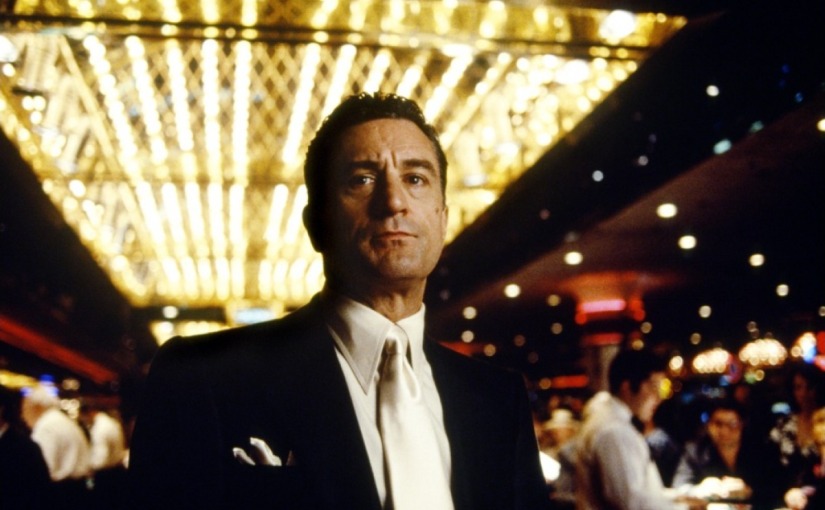
Ace (Robert DeNiro) runs The Tangiers Casino.  He was especially picked by the mid-west Mafia back home (St. Louis, Mo.) to oversee everything that happens at the casino.  He’s looking for cheaters.  He’s making sure blueberry muffins live up to their name.  He’s dodging the FBI and their hidden bugs.  Most importantly, he’s making sure hefty suitcases are walked out of the casino and delivered on a monthly basis to the wise guys he has to answer to, and those deliveries better not come up light.  These guys treasure Ace because he never loses a bet.  Not one.  He can predict the outcome of any sports contest.  He can beat the odds on any table.  Ace is the best at his job because he also works eighteen hours out of every day, and he makes a lot of money for his superiors.

Everything should go smoothly.  However, the mob has also allowed Ace’s childhood friend, Nicky Santoro (Joe Pesci) to move out to Vegas.  Nicky is a heavy.  It’s not wise to upset or anger Nicky, because it’ll likely be the last time you ever do.  He’ll kick you when you’re down on the ground, but he’ll also stab you with a pen an endless number of times.  Don’t get your head caught in a vice when you are around Nicky.  This bull might have been sent out as a toughie to protect Ace and his work, but he’s not subtle about his methods.  When law enforcement gets involved, it only causes interference for Nicky and his crew to get back in the casinos or even in to Vegas.  Because Nicky won’t settle for that, it’s only going to make things harder, and especially challenging for Ace.

Ace’s other problem focuses on the one bet he did lose in life, and that was marrying Ginger (Sharon Stone in an Oscar nominated performance).  She’s a high-class hooker that Ace quickly becomes infatuated with, and the worst mistake he could have ever made was that he trusted her.  He trusted Ginger way too much.  Ginger may have quickly had a child and married Ace, but she never gave up on her loyalty to her scuzzy pimp, Lester (James Woods), and just wait until she starts carelessly confiding in Nicky.  Early on, everyone in the room, like even those in the comfort of their own homes, scream out loud why Ace would entrust a safe deposit box containing millions in cash with only Ginger’s name.  Ace can’t even get into the box if he wanted to.  He arranged it so that only Ginger could have access.  Keep the cash out of his name and the Feds can’t make a case.  As well, is Ace hiding his own interests from his own people?  Yet, that’s what he did.  He trusted his hooker wife way too much, way too often.

I’ve seen Casino a few times and I always leave it with the exact same problem.  I don’t think the film lives up to its title enough.  The first half of the film, while a similar blueprint to Goodfellas and later The Wolf Of Wall Street, is incredibly sweeping with Scorsese’s signature steady cams and voiceover work from DeNiro and Pesci.  You can travel from one end of the gambling hall, and then through clandestine back rooms and into secure areas all within sixty seconds.  Scorsese with a script from Nicholas Pileggi gives you a very fast education on how Ace operates a tight ship and keeps his mob superiors invested. 

Later, however, the film loses its way with an abundance of material on the Ginger character and how she is undoing Ace.  Stone gives an incredible performance as a constant drug and alcohol fueled spoiled brat of a trophy wife/former hooker.  She has wild outbursts that continuously threaten Ace and who he works for and with.  Minutes later, the film cuts to where the drugs have worn off and she comes back to her husband with her chinchilla coat draped over her shoulders.  The energy that Stone puts into this role must have exhausted her.  As a viewer, I get wiped out just watching her.  Yet, as engrossed the actress is in the part, what does it really have to do with life in a mob run casino? 

It’s not crazy to say that Las Vegas is city of at least 8 million stories.  It’s not called sin city for nothing.  In three hours’ time, much attention is given to how Ace’s casino funnels out monies to the mob.  Focus is also given to how they deceive the gaming commission and how Ace dodges the need to have a gaming license if he is to work at the casino.  There’s a great scene where he demonstrates what happens to cheaters who rip off the joint.  He also has to contend with the governing good ol’ boys who staked their claim in Nevada long before it became the gaming capital of the world.  If a dumb nephew is fired for not properly handling the slot machines, Ace is going to have to answer to someone with a big shot title.  Pileggi’s script is best in scenarios like this.  So, I can’t understand why he diverts his story into a domestic squabble of screaming and shoving between a husband and wife. 

The Ace/Ginger storyline populates over one third of the movie and then not much is talked about with the casino.  There are broken glasses and screaming and crying and drug fueled rages and opportunities to beat up Lester and now the film has become a personal picture, rather than Las Vegas mob cycle we were invited to observe.

Ironically, what I always hoped to gain from Casino is only a tease at the end, when Ace narrates how Las Vegas segued from mob rule and sold out to corporate America, even comparing it to Disney Land.  A wise shot is provided showing the senior citizens entering the doors of the casinos en masse, dressed in their sweat pants and polyester outfits ready to take a chance on the slots, not the more sophisticated gaming tables where the fat cats would lay down ten grand a hand.  Why couldn’t Nicholas Pileggi and Martin Scorsese devote time to this transition?  This seems like the bigger bet that Ace wouldn’t win out on.  Tons of married couples lose out and get married for the wrong reasons.  We’ve seen that kind of material before.  The real undoing of Ace Rothstein was likely the blue-chip organizations who pounced on what the mafia pioneered.  Hardly any of that is shown, only left to be implied.  I’m sorry, but Casino concludes on a missed opportunity.

ROB ROY

By Marc S. Sanders

In Scotland, in the year 1713, Robert Roy MacGregor, the chief of the Clan MacGregor, protects his people from cattle thieves while trying to endure against starvation and minimal resources. Rob Roy was a leader but never looking to herald a cause. He just wanted to live day by day with his clan, along with his wife Mary and their two children.

Michael Caton-Jones directs Rob Roy with Liam Neeson as the title character and Jessica Lange in a strong performance as Mary. The film doesn’t move with the sense of sweeping adventure that I was expecting. However, that’s the point. Caton-Jones shoots Alan Sharp’s screenplay as a Rob Roy reluctant to rebel or wage war against a selfish monarchy that rules Scotland.

James Graham, Marquess of Montrose (the always effective John Hurt) agrees to lend Robert 1000 pounds to be paid back with interest. Rob is most grateful for the assistance that can help his clan. However, when Rob’s trusted friend Alan (Eric Stoltz) picks up the money, he is brutally murdered on his way back by Archibald Cunningham (Tim Roth, in maybe his best role ever).

Montrose, unaware of what has truly occurred, carries no sympathy for Rob’s predicament and obligates him to the original contract. Eventually, it becomes ugly as Montrose permits Archibald to carry out violent intimidation including slaughtering the clan’s cattle and burning down Rob’s home as well as raping Mary.

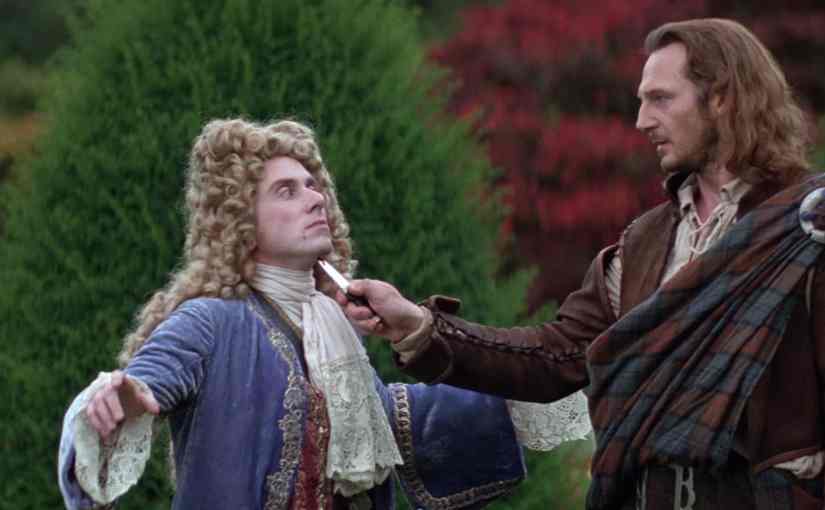
Rob Roy moves at a slow pace at times, but that doesn’t take away from brilliant characterizations. Roth as Archibald is a blazing villain. He’s introduced as a snobbish brat dressed to the nines though living off the prosperity of the mother who sent him to Montrose for a better royal upbringing. He carries an effeminate way about him in his long, curled, flowing wigs and garish pink and blue aristocratic wardrobes. He is a bastard though, yet a master swordsman. Like many great scene stealing performances before, Tim Roth has just the right timed expressions for the camera. Caton-Jones captures every best shot of Roth’s presence. Tim Roth, at the very least, deserved his Oscar nomination. I couldn’t get enough of him.

Jessica Lange gives another reason why she is such a celebrated actor for women. She picks smart roles over and over again. I was going into the film thinking she would be playing the dutiful wife and mere damsel. However, as Mary MacGregor she’s incredibly strong before and after she is victimized. She is torn with conflict to share the whole truth with Rob as to what has occurred to her. How will Rob respond? Will it make it worse for him with the monarchy? Will he feel ashamed of Mary? A fascinating character piece.

Brian Cox appears as Killearn, Montrose’s aid and factor. Yet, he is also secretly serving to Archibald’s underhandedness. He’s quite good in his role too.

Liam Neeson is fine as Robert Roy MacGregor; tall, built and athletic. He looks like a real hero. However, I’m not sure if I got a dense enough character from Alan Sharp’s script. Much of the film only comes alive when the other performers are on stage, like Hurt, Cox and especially Lange and Roth.

I was always aware of the famous sword fight in the film and it is quite spectacular. However, maybe hearing the hype over all these years watered down my expectations. The choreography is spectacular and often it really is Neeson and Roth in the moment; not stunt doubles. Yet, I remain more impressed with the work of Errol Flynn and scenes from The Princess Bride and The Empire Strikes Back.

Rob Roy takes some patience to watch. A very good film but not necessarily wall to wall action to consider it a popcorn flick. Watch the film for the performances and take in the gorgeous countryside footage.

I recommend it.