INTERVIEW WITH THE VAMPIRE: THE VAMPIRE CHRONICLES

By Marc S. Sanders

Fantasy of the supernatural or science fiction work best when the writer can teach the reader or the viewer how its foreign worlds work and how the characters who occupy the environments function and live.  Anne Rice had her own interpretation about how creatures of the afterlife live by night.  Her vampires possessed theatricalities.  Some were charming and sophisticated, and relished how they lived immortally while satisfying a hunger for the blood of living humans.  Some struggled with the discomfort that comes from being a remorseful bloodsucker.  The first of Anne Rice’s series of vampire novels, Interview With The Vampire, runs a very wide gamut of perceptions.  By the end of the film adaptation, directed by Neil Jordan, I’ve earned quite an education.  (Frankly, Rice’s novel was tediously slow moving and bored me to tears.)

In present day San Francisco, a young man (Christian Slater) sets up his tape deck to record a conversation with a soft spoken pale faced man in a dark suit with a neat ponytail in place.  This mysterious person is Louis, played by Brad Pitt.  His story begins two hundred years earlier, in New Orleans, back to the day when he was incepted into an immortal life as a vampire. His agent of delivery is the devil-may- care and mischievous Lestat, one of Tom Cruise’s most surprising and unusual portrayals.  He gives a brilliant performance that’s as far a cry from his lawyer roles or his Maverick and Ethan Hunt heroes as possible.  

Lestat is eager to guide Louis into the benefits of vampire life.  Louis, having already been depressed following the loss of his wife and daughter during childbirth, cannot grow comfortable with Lestat’s insatiable appetite to feast on aristocratic figures or plantation slave servants.  This is not a match made in heaven and their chemistry as a couple is tested. Louis would rather miserably feast on chickens and rats, while Lestat grows frustrated by unsuccessfully swaying his partner to taste the sweet nectar of blood dripping from the wrist of a lovely young lass.  Lestat turns towards a grander extreme to maintain his embrace of the morose Louis.

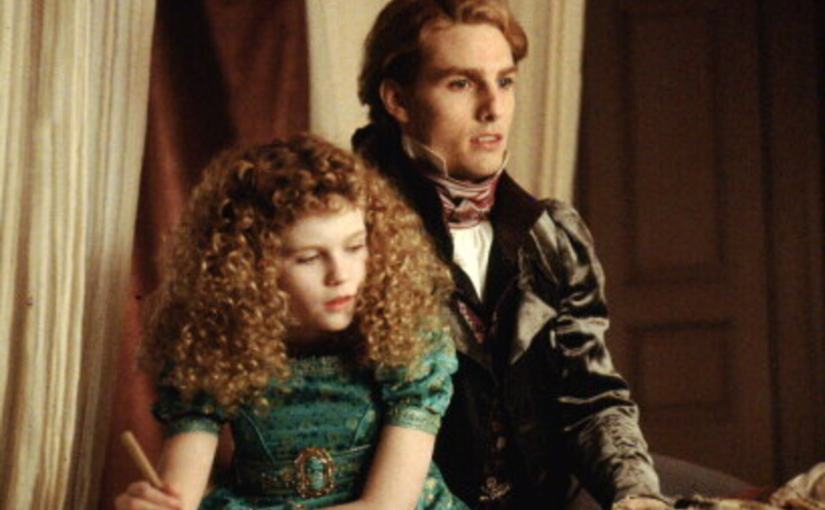
Through deception, the men welcome an eleven-year-old “daughter” into their underworld.  Her name is Claudia, played Kirsten Dunst in her introductory role.  I still believe this is her best performance, worthy of an Oscar.  The life of a vampire is delightful to the child, the same as Lestat perceives it.  However, as the decades move on, with changes in fashions and industry quickly developing, so does Claudia’s understanding.  Her body never matures, destined to always remain within the shell of a preteen child, and thus she commiserates with Louis.

It appears like I’ve summarized Anne Rice’s entire story, but I have not even come close.  Interview With The Vampire is to gothic horror the same way The Godfather is to mafia gangster life.  Both communities victimize people of an innocent world, but their members are expected to follow codes of decorum and respect.  The conflict lies in living as a bloodsucking vampire or a criminal gangster.  When a peer interferes or does not cooperate, then the individuals of these respected worlds become violent unto each other.    The viewer/reader observe how their patterns of behavior all play out and how one action or policy generates one response after another.  These films are high ranked authorities on their subject matters.

Louis explains to his interviewer how Bram Stoker’s celebration of vampires is dreamed up escapist fiction, though coffins and the avoidance of sunlight are absolute necessities to carry on.  Just like any person, vampires want to live happily, but life gets in the way and that can be frustrating on any number of different levels.  

Neil Jordan’s film is a marvelous exploration into the mindset of being a vampire.  Tom Cruise perfectly exudes Lestat as a vampire ready to joyously live with sin while he savors and lives a life of eroticism and material wealth.  A child like Claudia sees the attraction of being spoiled and spoiling herself, and she cannot get enough consumption of blood. Eventually though, her mentality outgrows what becomes redundantly mundane.  Louis is relatable like many people.  He is unhappy living the life he was born into.  Lestat grows aggravated with his family’s resistance to partake of what he relishes.  There is an extensive range of emotions on display with Interview With A Vampire. To be a vampire can be a privilege or a curse. It all depends on who you interview.

The look of this film is astonishing.  I know it was shot within New Orleans, Paris and San Francisco locations.  However, I can easily recognize some sound stage locales, and I have no complaints.  The art designs from Dante Ferretti are thoughtfully crafted with lantern lit, rain-soaked cobblestone streets of the seventeenth century to mucky, moonlit swamps.  Horse drawn carriages transporting abundances of coffins serve a purpose of humor and narrative as character misdeeds are routinely committed by Louis, Claudia and especially the trickster Lestat.  The furnishings of the aristocracy are embracing too.  It’s a remarkably convincing step back in time.  

The periodic costume wear by Sandy Powell completes the settings with colorful, silk garments, white ruffled shirt sleeves and buckled shoes for both the men and women as well as for Kirsten Dunst and some cherub cheeked children who come into play.  Everything looks so rich. The whole picture feels like stepping into one of those late-night ghost walking tours I’ve taken in small southern towns like Savannah and St Augustine.  Every scene, even when the film jumps to late twentieth century, is immersive.  

Anne Rice’s screenplay adaptation tells so much within two hours.  She allows time for the characters to sail to Europe seeking out others like them.  The second half of the film teaches us more about what it means to uphold oneself as a vampire.  

Neil Jordan sometimes delivers his film like a how-to documentary because you are consistently learning new details, not so much about plot but about a people you are not as familiar with. Often, the film segues into theatrical play as you might expect from Phantom Of The Opera.  It’s no wonder since eventually Anne Rice puts us in touch with the cabal known as Theatres des Vampires. Stephen Rea and Antonio Banderas get to take center stage within a literal theater where the facade of behaving like a vampire can be executed beyond the suspicions of a – ahem- live audience.  

Rice and Jordan get playful while also performing with horrific familiarity.  The bites on the neck are known to many of us for drinking blood.  Did you also realize that a vampire can drink from a crystal wine glass? There’s an elegance to how the actors’ characters consume the blood of humans.  Cruise and Pitt begin by going in for a passionate kiss, either on the neck or the weightless wrist of a victim.  Lestat is more aggressive. Louis caresses his meals on the rare occasion he dines. Claudia gives a puppy love bite. Cruise especially finds new and titillating ways to dine with each new feast.  Both actors are deliciously homoerotic, but on different parental planes with their child. Their love/hate relationship operates like Shakespearean stage work. That’s why I really take to Neil Jordan and Dante Ferretti’s choice of soundstages.  

I’ve become so bored with zombies and vampires.  How many iterations must be churned out of the same kind of monster.  This year’s horror hit, Sinners, was superb until it stopped being eye opening with surprise.  It eventually became the same old thing and offered nothing new to show me in its final blood-shedding act.  

Interview With The Vampire is one of the best vampire films though.  The film never ceases to speak directly to its audience.  The settings describe how life is lived.  The characters grapple with both internal and external struggles.  

It’s one shortcoming is that Anne Rice, Neil Jordan and cast/crew did not follow up with the author’s subsequent tales.  The subtitle, The Vampire Chronicles, seemed to promise an extension of this universe. I know of other Anne Rice film adaptations that chose not to continue on from what was done here, and the execution was terribly poor and disappointing.  There’s a biographical intelligence to Neil Jordan’s film that many films of all genres lack.

Anne Rice’s first film adaptation set the standard on vampire culture, and I have trouble thinking of anything since its release that closely matches it.  

Interview With The Vampire is the only one with a blood curdling bite.

TRUE LIES

By Marc S. Sanders

James Cameron’s True Lies never had to be believable.  It only had to be fun, and it is fun for the first act and most of the third act.  Too bad the sitcom like, chauvinistic second act pretty much overthrows the whole picture.

When you watch an Arnold Schwarzenegger pic, you have to take it with a boulder of salt.  Throughout his career, he’s been pregnant (never saw Junior), he’s begged God to give him the strength to fight Satan (I’m being honest here. It happened in End Of Days), he’s been tossed out of a plane at thirty thousand feet with no parachute and lands safely in a dumpster (Eraser) and his twin brother has been Danny DeVito.  (Do I really need to share the title of that movie?) In True Lies, I have to accept the fact that the muscular body builder with an Austrian accent, and pretty good line delivery, convinces his wife and daughter, played by Jamie Lee Curtis and Eliza Dushku, that he’s simply a boring computer salesman.  It’s shocking, utterly shocking, to realize that he is actually a clandestine spy, and his family is completely unaware.  See if Bruce Willis or Harrison Ford or Mel Gibson were in this role, then I’d buy it.  Tom Arnold might have been a good pick, but James Cameron settled to make Roseanne’s ex-husband Schwarzenegger’s secondary partner with some comedy bits. He might be the best part of the movie.

A brilliant 007 inspired opening gets this adventure started off with a literal bang at a black-tie affair at a wintery German mansion. Harry Tasker (Schwarzenegger) infiltrates the party along with support from his partner Albert (Tom Arnold) who hides in a tech equipped van that’s close by.  Harry does the tango with Tia Carrere, which is charming and something new for the Terminator.  The outcome of this shoot ’em up episode puts these super spies on the trail of an Arab terrorist who has the capability of unleashing a nuclear arsenal on the United States.  When Harry is not chasing this guy on horseback and up high-rise elevators, with the equine in tow, he and Albert report to an eye patch played by Charlton Heston.  

Somehow, I sleepwalked into another movie, though.  Harry has not been the model family man and when he tries to make amends, he inadvertently hears his wife Helen (Jamie Lee Curtis) chatting with a sleezy car salesman (Bill Paxton).  Now all of the spy department’s resources change course to surveille Helen and this moron she’s been talking to because this is the episode with the misunderstanding.  James Cameron’s script makes very poor efforts to achieve sitcom level comedy.  A laugh track couldn’t even save this tripe.

Bill Paxton is a great actor, but he accepted a terrible, unfunny role as he ironically pretends to impress Helen by actual being a spy.  Ha!!!! Go figure!!!!

Jamie Lee Curtis is a great actor too, but she agreed to play one of the dumbest women to ever grace a screen.  She believes this moron’s lies as easily as she believes the one and only Arnold Schwarzenegger is just a computer nerd.

One of the most intolerable scenes I can ever think of occurs after Harry learns what is really going on. He gladly continues to play one over on his neglected and unhappy wife by believing he’ll give her a fun adventure he thinks she deserves.  Helen is convinced that she must abide by the wishes of a clandestine government group who apprehends her.  She arrives at a dark hotel room with Harry sitting in the shadows, mere feet away, and convinces his wife to do a striptease dance in front of a stranger.  This routine goes on for the longest five minutes.  It’s not funny.  It’s not sexy.  It’s eerie and perverted with sick narrow mindedness. 

At the risk of getting political and prudish, Jamie Lee Curtis has always been one of the most outspoken celebrities for equal treatment between men and women and has ostracized those in positions of power who work towards their own self advantage.  Yet here she allows herself to be objectified by James Cameron and Arnold Schwarzenegger to be a punchline for male chauvinistic pranks.  If this scene ended with Curtis breaking Schwarzenegger’s nose with a karate chop while holding him at gunpoint, then this becomes something else.  That’s a no, however.  Instead, she is a scantily clad victim of sexual deviants, and she never stands up for herself, or exudes any kind of pride.  I recall in 1994 not liking this sequence.  Over thirty years later, well after the tides of the Me-Too movement have passed, I still hate this material.  With all of the high-flying stunts and action thrown in to other parts of the movie, it is this scene that stays with me.

Once this stupid story detour is over with a cast of actors enhancing its inanity, do I sleepwalk my way back into the movie I was watching before.  Whattya know?  The Arab terrorist who has not been discussed for the last forty-five minutes, still exists. So, while being held captive, this becomes an opportune time for the unhappy couple to sort through their baggage.

True Lies starts out so fun and when the action is turned on, James Cameron and his team are offering some solid footage.  Helicopters, limos, and missiles fly over a bridge running from the Florida Keys.  Then it is ridiculous silliness with a fighter jet piloted by Schwarzenegger who uses the entire cache of weapons to wipe out the one bad guy while trying to rescue his daughter who his hanging from a crane high in the skies over Miami.  Some say the slapstick of The Three Stooges is a demonstration in violence.  I ask if those critics have seen True Lies because the mayhem is absolutely bonkers. 

I can’t endorse this movie because I think it is one of Arnold Schwarzenegger’s worst films.  It’s also one of James Cameron’s most awful efforts.  The action is marvelously over the top, but the characters are reprehensibly idiotic and the film gets hijacked by a whole other storyline that is neither funny nor worth caring about.  There are so many better options to select from this writer/director, and this entire cast. 

With an absence of untruth, I am being forthright by declaring that True Lies belongs back within the scummy cauldron from it was stirred up from.

THE PROFESSIONAL (Léon)

By Marc S. Sanders

The cult following that has come with Luc Besson’s first American made film seems unwarranted to me.  It’s currently listed as number 40 on IMDB’s top 250. I have no idea why. I recognize the artistic style of the picture, but what is here to relish beyond an enlightening introductory performance from would be Oscar winner Natalie Portman?

To watch Besson’s use of the camera makes me feel like a viewer from the director’s native France.  The setting is Little Italy, New York and it has a feel to it like Besson just stepped off the plane and decided to hone his lens on a condensed city section, but lacking an education of its culture or history.  The Professional certainly doesn’t look or feel like Dog Day Afternoon, When Harry Met Sally…, or Die Hard With A Vengeance.  (Perhaps the music from Éric Serra altered my mood.)  I never took issue with this aspect of the movie. It is unfortunate however that Besson’s film comes off too perverse in its storytelling, especially with its character blend.

Portman is Mathilda, a spunky kid who survives the murder of her family when a corrupt, drug dealing DEA agent named Stansfield (a way over the top Gary Oldman) carries out the slaughter after her father fails to pay a debt.  Fortunately, as Mathilda is returning home and coming upon the bloody aftermath, Stansfield and his crony of killers opt not to take her out too as they believe she belongs with the occupant of her neighboring apartment.  Léon lives there and happens to be a skillful hitman and weapons expert who pulls Mathilda inside to safety.  He’s played by Jean Reno.  These killers who massacre by day have no care to eliminate the other tenants living on the same floor, including a little old lady.  Why?  I don’t know.  Maybe they called in sick on the day assassination school covered “Chapter 6: Leave No Witnesses.”

Besson does not apply much brainpower to the script he wrote and directed.  Oldman’s characterization could not be more obvious with how unhinged he behaves.  His department colleagues who take less than a minute and a half to question him don’t even raise an eyebrow.  While the storyline can be dismissed as a pulpy kind of graphic novel come to life, isn’t it lucky that if your family is going to get shot up, you have a professional hitman living right next door? I mean c’mon.  This is only the set-up of the picture, within the first ten minutes, and my suspension of disbelief never arrived.  

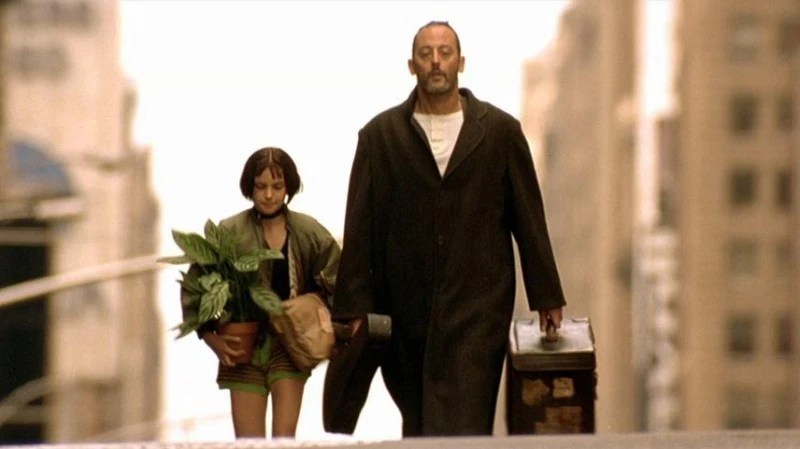
The most egregious lack of consideration falls within the relationship between Reno and Portman’s characters though.  She’s twelve.  He’s in his late thirties or early forties, but his silence implies it is time for assisted living.  When they are not relocating from apartment to apartment, trying to stay out of sight of Oldman’s gang, they are valuing the life of Léon’s beloved plant, drinking milk and demonstrating the fine art of sniper operations.  That’s fine – it’s the stuff of Tarantino fare.  

However, when the pair decide to entertain each other with Portman doing routines of Madonna and Chaplin for play fun, there’s a cringey temperature to the picture.  Besson was seeking out a relationship between a random man and child without any element of sexual proclivities involved and yet, it’s there.  In another writer/director’s hands, there would have been a stronger attempt to develop a paternal relationship between the two characters.  Yet, Natalie Portman doing a childlike song and dance performance of “Like A Virgin,” with Jean Reno’s Léon acting unaware seems artificial and perversely moving in the wrong direction.  When danger crosses their path later and they both say “I love you” to one another, I can’t help but question how this bond might have turned out if they were never forced to separate and save themselves from the bad guys while continuing to live a quiet life with a house plant and gallons of milk.

The final third of The Professional has the inevitable shootout and explosions.  Out of context, it looks good but again this is New York.  So, when Stansfield brings in the firepower of the entire city police to force Léon and Mathilda out of the tenement building, shouldn’t someone be questioning someone?  Anyone? It’s ridiculous.  None of the neighbors run for cover or are given warnings to divert away as a small rocket launcher is propped up for blasting the front door open, along with anyone inside.  

The Professional contains a boring, inappropriate middle section accompanied with a ridiculous opening and ending.  Therefore, I have trouble locating the merits for this piece.  I can recognize the potential of Natalie Portman in her performance.  Yet, if this were the first film I ever saw Gary Oldman in, I might not be so prone to watching anything by this best of the best character actors.  “EVERYONE!!!!” he screams, shouts, screeches, and bellows all at the same time.  Whether you’ve seen the film or not, most cinephiles relish in that sound byte from him on social media. I’d argue it’s in no way a salute to the actor.  Frankly, it’s indicative of the material when a guy as accomplished as Gary Oldman cannot uncover enough of a quirk in a bad guy from a very unimaginative script.  It’s not your fault Gary, so much as it is Mr. Besson’s.

Jean Reno has a cool looking, silent poise to Léon, the professional hitman, but there’s nothing lent to him to work with except a pair of opaque, circular sunglasses, milk, a plant and at least as many guns and ammo as found in The Matrix.  Reno functions on little dialogue and no background save for a few scenes he shares with Danny Aiello as the mob boss who frequently hires him for jobs.  Reno’s scenes with Natalie Portman only demonstrate how inappropriate their connection as actors in a scene are, as well as how their characters are supposed to serve each other. 

The faults of The Professional ultimately lie with its puppet master, Luc Besson.

QUIZ SHOW (1994)

by Miguel E. Rodriguez

DIRECTOR: Robert Redford
CAST: John Turturro, Rob Morrow, Ralph Fiennes, Paul Scofield, David Paymer, Hank Azaria, Christopher McDonald, Mira Sorvino
MY RATING: 7/10
ROTTEN TOMATOMETER: 97% Certified Fresh

PLOT: In the late 1950s, a popular TV quiz show, along with its current champion, falls under federal investigation following allegations of rigging.


I imagine there will be no shortage of people more than willing to tell me how wrong I am, but while Robert Redford’s Quiz Show was well-directed, well-written, and well-acted, I never fell completely under its spell.  For that matter, it never felt like it had the director’s stamp on the material; a lot of it felt like a Ron Howard film.  No doubt the story captured a lot of attention when it happened in the late ‘50s, but it failed to grab mine, at least to that same degree.  It’s too well-made for me to skewer it mercilessly, but neither do I consider it a masterpiece.  It’s…okay.

It’s 1957, and Sputnik captures the world’s attention at (or at least near) the height of the Cold War.  To distract themselves from Sputnik’s implications, Americans tune their TV sets to the most popular game show on the air: Twenty-One, in which competing contestants are asked random trivia questions while isolated from each other.  These questions are something else.  One multi-part question includes: “Who rode with Paul Revere?  Who lent him his horse?  Was it a mare or a stallion?  And what was the horse’s name?”  I mean, really?  The current champion, Herbie Stempel (John Turturro), knows these answers and many others and has become something of a local hero, but he’s not terribly photogenic, with his oversized shoulders, those nerd goggles, and that one rotten bicuspid that you can’t take your eyes off.

Twenty-One’s showrunners decide Stempel’s run has come to an end and hatch a plan to throw the next episode to handsome young Charles van Doren (Ralph Fiennes), a Harvard professor who in real life did not look quite as handsome as Ralph Fiennes, but whatever, this isn’t a documentary.  Both Van Doren and Stempel comply with this plan, but the scenes in which they make their decisions felt contrived, or false, or something.  I was never convinced of their motivations.  Stempel needed the money but was supposedly swayed by the possibility of being awarded his own “panel show.”  Van Doren clearly didn’t need the money and even turns the offer down at first, but then he changes his mind because…I guess he needed a way to live up to his Pulitzer-Prize-winning father?  All the pieces are there, but it’s never fully explained until his final speech in front of a Congressional committee.

The story engine involves a young DC lawyer named Dick Goodwin (Rob Morrow) who gets a whiff of potential scandal and, eager to make a name for himself – as a possible parallel to Van Doren himself – does some independent investigating.  His digging leads inevitably to Stempel, who is more than happy to name names, but whose irascible personality makes him a less than ideal witness.  Things get interesting when he interviews Van Doren.  He is clearly suspicious, but no hard evidence appears…until he watches an old clip of a previous Twenty-One contestant who appears to give an answer the host was not expecting…

I don’t know how relevant this is, but I feel compelled to observe that director Redford seems to have phoned in a lot of favors when it came to casting Quiz Show.  In addition to the fine performances from the leads (Rob Morrow is outgunned by Turturro and Fiennes, but he holds his own), the supporting cast reads like a Woody Allen picture: David Paymer, Hank Azaria, Christopher McDonald (perfectly cast as the smarmy, superficial host of Twenty-One), Mira Sorvino, Martin freaking Scorsese, and walk-ons by Timothy Busfield, Ernie Sabella, Barry Levinson, Mario Cantone, Illeana Douglas, Calista Flockhart, and a blink-and-you’ll-miss-him Ethan Hawke.  Redford clearly wanted to make sure his canvas was deep and well-drawn, and not just with the impeccable period production design.

But to what end?  I went into Quiz Show thinking it would involve a much deeper conspiracy than just two showrunners who, following orders from corporate, simply bribed several contestants to follow a scripted playbook.  About halfway through the movie, I realized there was not going to be much more to that part of the story, and we were going to follow the lawyer on his quest to uncover the truth, and I was like, “…that’s it?”  Does that make me guilty of criticizing the movie that I wanted it to be, instead of criticizing the movie itself?  I’m not sure.  Rightly or wrongly, I felt the movie wanted me to empathize or sympathize, or one of the -izes, with Van Doren.  But I was not moved to goosebumps by Van Doren’s final speech at the end of the film.  I found myself siding more with the committee member who says, “I don’t think an adult of your intelligence ought to be commended for simply, at long last, telling the truth.”

(I suppose a case could be made that the whole film is a parable for Watergate, still several years in the future; Nixon is name-dropped a few times.  The end credits inform us that NBC and Twenty-One’s sponsor, Geritol, were never indicted because their underlings claimed full responsibility for their actions, much like Haldeman, Ehrlichman, and the rest.  Does the buried subtext of America’s lost innocence make Quiz Show a better film?  Maybe a little, but only when you stand back from it, not while you’re watching it.)

CLEAR AND PRESENT DANGER

By Marc S. Sanders

Tom Clancy’s Jack Ryan finds himself in an inadvertent private war between the United States and Colombian drug kingpins in Clear And Present Danger.  Harrison Ford returns as the heroic government operative. I like this film for much of the same reasons I liked the prior Jack Ryan pictures.  These movies give an inside view of internal politics within Congress, the CIA and inside the hallowed halls and Oval Office of The White House.  The Clancy adaptations are not just about action set ups and shootouts.  Though we are treated to plenty of that material as well.

The film opens with a luxury yacht being raided by the Coast Guard. They uncover Colombian killers that have murdered a wealthy American and his family for reasons of a failing partnership with drug dealers.  The incident can be bridged to the President played by Donald Moffat, a terrific character actor who also shared the screen with Ford in Mike Nichols’ Regarding Henry. He secretly initiates a retaliation for what has occurred while also insisting on collecting over six hundred and fifty million dollars he feels the US is entitled to, following his friend’s murder.  Henry Czerny, playing a carbon copy of his role in Mission: Impossible, headlines the covert plot and recruits a mercenary named John Clark (Willem Dafoe) to place a clandestine militant team into the South American jungles to take out the drug runners one by one.

The suit and tie formal dynamics fall on Jack Ryan when he swears testimony on the legitimacy of the country’s response.  However, the President’s armament exercises are unbeknownst to Jack.  When it finally dawns on him what has been occurring, into the field Jack Ryan goes to clean up the mess.

A lot of spinning plates structure the storytelling of Clear And Present Danger which is on par with Clancy’s thousand-page novels.  There’s an abundance of characters to address, betrayals to happen and even the mechanics of various weaponry and policy decisions that need exploring, despite the innate complexities of it all.  It can feel overwhelming.  However, with this film, as well as with The Hunt For Red October and Patriot Games, I feel included.  If you’re patient through the exposition and set ups, then these fictional controversies become very absorbing, and you feel like you’re there.  

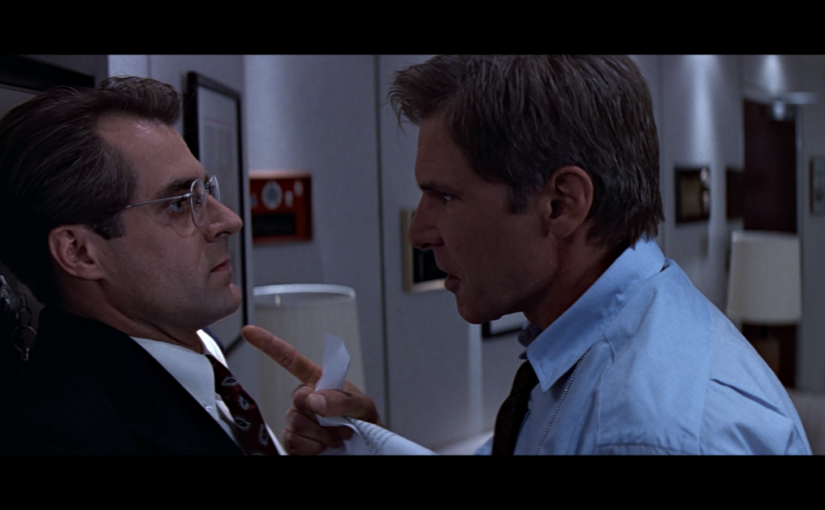
There’s a great scene between Ford and Czerny racing to download vs delete some suspicious files on a computer.  These guys are in their boring offices, dressed in their boring suits and they’re clicking on the mouse pad and typing away on the keyboard.  Director Phillip Noyce gets nail biting back and forth closeups on each guy as they are off to the races trying to get ahead of each other.  Then it becomes a yelling match in the hallway with threats of prosecution between both men, and I feel I’m in on the whole thing.

There is also a good amount of internal conversations between the main drug czar (Miguel Sandoval) and his top henchman (Joaquim de Almeida).  Almeida’s role is written very well as we witness how smart and resourceful he is while protecting the best interests of his employer.

For the most part, the action is nothing special.  However, the highlight of the whole film involves an SUV convoy getting ambushed by Colombian terrorists mounted on rooftops firing missiles at the government vehicles below.  Harrison Ford prefers to do as much stunt work as possible and it definitely helps the ten-minute sequence.  This is an outstanding part of the picture with perfect editing of sound and photography. Later on, we see Ford leap on to the landing gear of an ascending helicopter. Very impressive. Harrison Ford always does his best to invest himself in his movies.

I also admire many of the explosions that went into the Special Forces’ continuing storyline of sabotaging the drug lords’ laboratories and various locales. Nothing is miniaturized here, and the resulting blasts are really big and eye opening. This movie did not shortchange on anything it was attempting to accomplish.

The film adaptation of Clancy’s fourth book takes some major liberties.  In the novel, the story is primarily focused on John Clark and his mission, with Jack Ryan not appearing until after the midway point.  However, at this stage of Harrison Ford’s career there was no way he’d accept just a supporting role.  The notable changes hold well within the screenplay though, and a showdown between Jack Ryan and the President is one for the ages.

Overall, Clear And Present Danger was a successful picture at the box office. Critics and Clancy fans alike had favorable responses to the picture.  So, it’s disappointing that producers decided to try numerous reinventions of the Jack Ryan franchise subsequentially.  Those other movies, along with a TV show, would prove well.  Yet, it is regrettable that Harrison Ford, or at least this interpretation of the hero, did not move on through Tom Clancy’s ongoing stories transcending within other areas of government and espionage.  If you have read the books, then maybe you recall the unbelievable ending to Without Remorse.  Boy, would I have loved to see what Harrison Ford did with the cliffhanger that closed out that book. Care to know? Then this Unpaid Movie Critic suggests you pick up a book.

NOTE OF TRIVIA: James Horner conducts the music for this film and he includes samples that were used in the beginning of Aliens. Interesting to catch this as the music works for both a science fiction piece, as well as for a political thriller.

CLERKS

By Marc S. Sanders

Did Kevin Smith know he’d create a lasting cultural phenomenon when he recruited his neighborhood friends to depict the mundane life of a convenience store clerk (Dante) and video store clerk (Randall)? How could he? He made this very shoestring budgeted movie by maxing out his credit cards. He’s on a short list of entrepreneurs who went all in. Bravo!

Clerks is a film that doesn’t seem to say much, but actually says a lot by the time it’s finished. Smith wrote a script where Dante mulls over how hard it is to move on, to change and accept the fact that even his ex-girlfriend moved on to get married, while he’s nothing but number 37 on his current girlfriend’s oral conquests. It’s a challenge as he and Randall debate over the accomplishments of Star Wars films. Then there are the eccentric customers like Smith’s friend Walt Flanigan (of Comic Book Men) as a guy looking for the perfect dozen eggs, or another one offended by the harsh language of a couple of bored clerks.

On paper, this all looks ordinary and boring. Yet, that’s the point. It’s fair to say we have all experienced the boredom of work with no definitive vision of a future. So, we complain about how we are not supposed to be there on our day off, or that the most important, immediate need is participating in a Saturday afternoon hockey game. Since we gotta work, we’ll compromise. If we can’t leave work, we will move the game to the roof of the store.

Two legendary cinematic characters also debuted, Jay & Silent Bob (Jason Mewes & Smith). They just lean against a wall, smoke and do not much else. Still, they offer atmosphere. There’s always loiterers mulling around a 7-11 or Circle K. They have stories as well, but we will likely never know. They just cross our paths as we pick up a soda. Smith wrote these guys as anybody we’d recognize and who we’re familiar with.

Kudos to Kevin Smith for following through with Clerks. This doesn’t look like much of anything, but it’s everything.

THE RIVER WILD

By Marc S. Sanders

Meryl Streep can do anything. Comedy, drama, accents, age defiance, make unbearable choices, even play opposite Roseanne; anything! She can even go white water rafting. She’s a real life James Bond.

In The River Wild, Streep takes a while to outsmart bad guys Kevin Bacon and John C Reilly, but she always maintains the raft through dangerous rapids while protecting her husband and son (David Strathairn and Joseph Mazzello).

See, according to Curtis Hanson’s adventure film, the best way to outrun the law following committing a robbery is to go white water rafting, even if you have no experience with the sport. That becomes a downer for Meryl Streep’s family getaway where tensions are high in her marriage to her workaholic husband. Fortunately, this setback might get them on the right track and Strathairn will find an appreciation for the dog that has come along. Reader, I won’t give it away but like I said, Meryl Streep can do anything. So, the odds on the family pet making it out of this alive are pretty favorable. Too bad Mazzello and the dog won’t listen to dad when it’s necessary.

The plot of The River Wild is very simplistic. Hanson quickly gets to the river following some exposition of familial discourse at home. However, just because he gets to the river so soon, doesn’t mean that the thrills begin right away. There’s a lot of beautiful nature footage here and everyone is happily getting along. Bacon connects with Mazzello much to Strathairn’s chagrin, and he flirts charmingly with Streep. Then lo and behold, oh my stars, Kevin Bacon is a bad guy??? What? The Footloose guy?????? Why he’s six degrees of any one of us!!!!!

Hanson gets some good action moments on the rapids. There close up shots against the rocks, and right into the water and down the impossible falls. The suspense is lacking though. Strathairn makes an escape in the woods. He’s got a good head start, and the best option he can come up is to climb a steep rock wall in plain sight with no coverage whatsoever. Kevin Bacon, what are you doing? Shoot the guy!!!! Mr. Hanson, you just brought your stride to a screeching halt.

That’s the problem with The River Wild. There’s a lack of thrill to it all. This is not a film brave enough to really endanger the dog, nor the kid, nor Streep. The worst that’s really done is a couple of punches to Strathairn and a cut above his eye.

Mazzello made it as the screamer kid star in his adolescent years in film (see Jurassic Park). Bacon seems like he wanted to get a little crazier in the villain role, but he held back. I wanted him to cross the line a little more, a lot more actually. He wasn’t dangerous enough for me. Reilly was just a bumbling, worried accomplice in tow.

Hanson has done way better than this with his supreme effort like L.A. Confidential and even Eminem’s 8 Mile. Thank goodness I can still respect the man’s career beyond this doused misfire.

SPEED

By Marc S. Sanders

Jan de Bont’s Speed is one of the best action thrillers ever made. It moves at a breakneck pace with huge suspense, big laughs and never-ending excitement. It’s also really smart with its crazy storyline.

A mad bomber (Dennis Hopper) manages to terrorize the city of Los Angeles by rigging a high-rise elevator with a bomb. Thirteen hostages need to be rescued and for an opening scene of a movie it does not get better than this. The heights and cramped space of the elevator and shaft are tightly claustrophobic, leaving you biting your nails. Small explosions come unexpectedly. This is what Hitchcock is always talking about. Putting a bomb under a table is suspense. The moment you detonate the bomb, the fear is over. De Bont blows up some bombs, but he leaves you hanging for when he’s going to set off the biggest bomb of all – the one that’ll put a hole in the world.

Later, the bomber does the same to a city wide transit bus traveling the freeway routes of rush hour traffic in the city. If the bus’ speed drops below 50 MPH, it’ll explode. Imagine pulling two tricks of Hitchcock all in one film. Imagine trying to never slow down a bus. This bad guy is destroying the city without even setting the big bomb off yet. This is great writing from Graham Yost. The whole scenario is tension at a maximum level.

The cop trying to stop the bomber is Jack Traven (at the time of release, an unlikely Keanu Reeves). Reeves is a perfect hero in this film. He allows the film to stand apart from being just another Die Hard rip-off by avoiding the Bruce Willis smart aleck stance. He’s a smart guy who keeps focus on just the situation at hand. He’ll get the bad guy later.

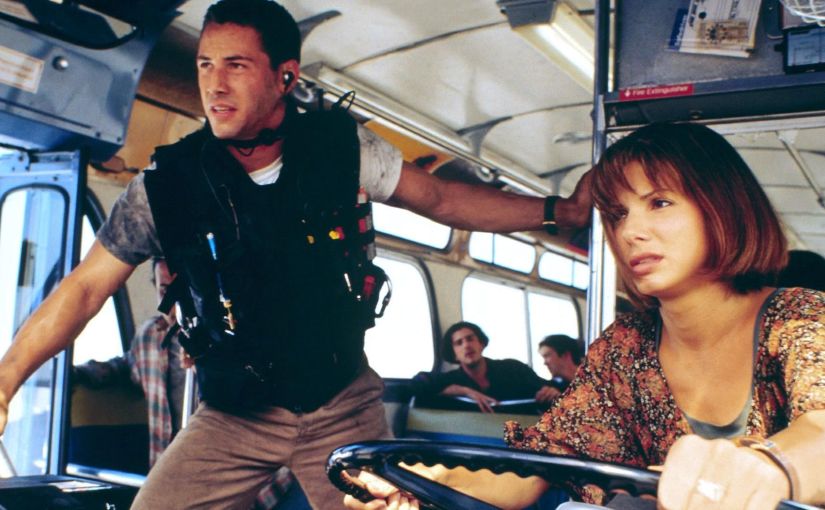
Sandra Bullock plays an adorable character named Annie who consequently has to drive the bus. This was Bullock’s breakthrough performance and I truly think it still holds as one her best. She’s funny, but she has some good dramatic moments as the tensions build up where Hopper’s crazed bomber makes things more difficult for Jack and the passengers. Bullock is good at crying on film, but she also knows how to deliver a line too.

De Bont does a great job at poking fun at the mundane trappings of traffic and intercity daily activity. As the bus careens through the city, pedestrian crossings are at risk, tow truck cars are problematic, cop cars are bashed up, and Annie is mindful enough to turn her blinker on as she careens around the corners. That last gag kills me every time. De Bont does what I always insist works in most films. He makes the setting of his film the character as well. This bomb rigged bus is stressing out the city of Los Angeles, for sure.

Seeing Speed holds a special memory for me. I saw it on its opening Friday night with some college buddies. Two days later, I insisted on taking dad to see it. Dad could not stop laughing through the absurdity of it all as street signs crash down, cars get totaled, and the fast editing blended with Annie’s laughable panic. Most especially, he loved a hapless driver (a scene stealing cameo from Glenn Plummer) in his gorgeous Jaguar convertible known as “Tuneman” by his license plate. Jack desperately hijacks his car as a means to catch up to the bus. As Tuneman’s car gets more and more wrecked, Dad could not get over it. He was in stitches. This is why movies can be so vital in our lives. I’ll never forget Dad’s nonstop laughing. I carry it with me forever, and I heard it again last night as I caught up with Speed. He’s gone now, but these are the moments I miss most about Dad.

A third act of the film is just as thrilling. Let’s see. We’ve done an elevator and a bus. How about a subway train? It’s a briefer sequence for the climax of the film, but it keeps the thrills ongoing.

Speed works on so many levels with a brilliant cast of B actors (at the time of 1994) that also include Joe Morton, Alan Ruck and a great Jeff Daniels as Jack’s partner with bomb experience. The action sequences cannot be complimented enough, and the Oscar nominated editing from John Wright with De Bont’s direction pair perfectly in timing.

Speed is an absolute thrill ride and a rocking great time at the movies.

MURIEL’S WEDDING (1994, Australia)

by Miguel E. Rodriguez

Director: P.J. Hogan
Cast: Toni Collette, Bill Hunter, Rachel Griffiths
My Rating: 9/10
Rotten Tomatometer: 79% Certified Fresh

PLOT: A young social outcast in Australia steals money from her parents to finance a vacation where she hopes to find happiness, and perhaps love.


For years and years, I had always assumed Muriel’s Wedding was your stereotypical romantic comedy.  I mean, come on, it’s got Wedding right there in the title.  The story involves a quirky young woman, obsessed with weddings, who runs away from home to find a new life for herself.  Who knows…maybe she’ll get married herself?

But what am I saying, of COURSE she gets married…once again, it’s in the title.  So, based on that bit of logic, I never made any serious effort to watch this movie.  The rom-com has never been my absolute favorite genre.  For me to enjoy one, it has to really stand out in some way.  Either it must be REALLY different (Stranger Than Fiction), or it must be a shining example of the genre (The Philadelphia Story), or it must be so well written that it sneaks past my defenses (Jersey Girl – I know, I don’t get it either, I just responded to it, leave me alone).  I never imagined Muriel’s Wedding would meet any of those criteria.  On the surface, it didn’t look like much.

Welp…I was wrong.  Be warned because some story spoilers may follow, though I will do my best to be obtuse where necessary.

The plot: Muriel (Toni Collette, in the role that put her on the map) is a painfully awkward, overweight young woman who lives for weddings.  At the opening of the film, she is one of many women fighting for the tossed bouquet at a friend’s wedding, and the look on her face is of pure religious ecstasy.  She wears a hideous leopard print outfit completely out of place with…well, everyone.

Her home life is one of middle-class desperation.  She and her family live in a hopelessly hopeful seaside town called Porpoise Spit.  Her parents are in a loveless marriage, she and her oldest brother are on the dole (that’s “welfare” to us Yanks), and one of her sisters seems capable of greeting her only with the same phrase over and over again: “You’re terrible, Muriel.”  She has “friends”, but when they’re on their way to celebrate their newlywed friend’s discovery that her new husband is already cheating on her (long story), they tell Muriel point blank they don’t want her around anymore because she’s a drag on their image.  Muriel’s reaction to this news is as pitiful and heartbreaking as anything I’ve ever seen on film.

It was around this time that I started to wonder if the word Wedding in the film’s title was some kind of perverse code word for “suicide.”  What’s going on here?  There’s comedy here, but it’s comedy of awkwardness, the kind of comedy that can be painful to watch.

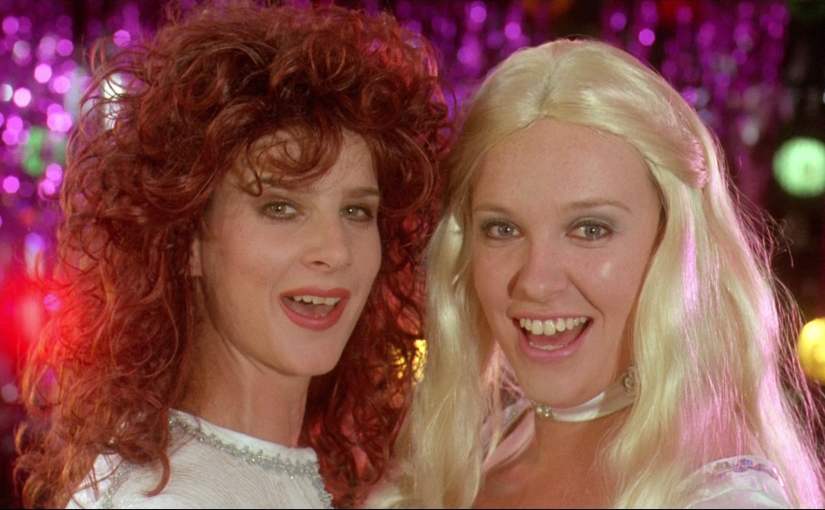
Through an improbable, but satisfying, chain of events, Muriel steals quite a bit of her father’s money, goes on an impromptu vacation, and meets an old schoolmate, Rhonda (Rachel Griffiths, in her film debut), who gets Muriel to open up a little.  For the vacation resort’s talent show, they lip-synch and dance to “Dancing Queen” by Abba in white stretch pants, a scene that must have at least partially inspired the makers of Mamma Mia!  Instead of returning home after her vacation, Muriel moves to Sydney and tries to reinvent herself.  At her low points during this time, she finds herself irresistibly drawn to the wedding gowns on display at the local bridal shops…

The rest I leave for you to discover.  One of the joys of this movie is how one thing leads to another in completely unexpected ways.  This was, without a doubt, one of the most unpredictable films of any kind that I have ever seen.  I can’t tell you how delightful it is whenever I find a movie that avoids cliches and narrative pitfalls and continually surprises me.

For example, there’s a scene involving – how can I say this without giving too much away – two people clumsily making out, a broken window, two naked men, and a malfunctioning beanbag cushion that had me laughing uproariously.  And then, just when I thought the scene was over, a curveball gets thrown that made me gasp audibly, as if I were watching footage of a dog getting run over.

The whole movie is like that.  For an hour and forty minutes, I was completely and utterly in the dark about what might be coming next.  The screenplay is bloody ingenious.  It starts with what looks like a generic rom-com premise, leads you down the garden path, then removes the path, and then removes the garden.  There are genuinely tender moments, and moments of delight (Muriel’s reactions during her first date are sheer perfection), and one or two shocking moments, and, and, and…  You get the idea.

Muriel’s Wedding gets high marks for its honest performances and its unfailing unpredictability.  The posters and especially the trailers paint the film as an “uproariously funny” comedy, and it is…at the funny parts.  There are also loads of dramatic surprises, and tender moments, and utterly unexpected plot twists.  It’s one of the most original movies I’ve ever seen.

HOOP DREAMS

By Marc S. Sanders

Hoop Dreams is not a simple documentary. It spans five years beginning in the late 80s through the early 90s capturing the lives of two young promising basketball prospects looking for a shot at the NBA, a million to one shot.

Arthur Agee and William Gates are two black youths from the ghetto areas of Chicago who are given an opportunity to attend St. Joseph’s High School and to participate on their prestigious basketball squad, the same team where Isaiah Thomas began his trek to the pros. The film, directed by Steve James, continuously shows how far reaching the accomplishments of Thomas really are with moments frequently focusing on the school’s hallway cabinet display dedicated to the legendary former student. Arthur and William are magnificently talented as top coaches and recruiters will attest, but are they that good? Do they have Thomas’ drive and ferociousness on the court. As well, are they capable to maintain their required minimum grades and ACT test scores for college scholarships? Can the boys overcome injury or tuition demands to stay at St Joseph’s?

Hoop Dreams explores these questions in its three-hour running time. Though it’s a documentary, the drama is undeniably intense.

For Arthur, his talents on the court can only go so far. A family life that has highs and lows make it challenging for him during his high school years. His father, Bo, has been in and out of prison and he’s a drug addict. Director Steve James is so attentive and unforgiving with using his camera that he shows fourteen-year-old Arthur playing on the neighborhood court with Bo, who eventually drifts off into the background where we actually see Bo purchasing drugs from a dealer, right in front of his son and right in front of the camera.

Arthur’s NBA dreams also become more fleeting in his sophomore year when his family can not come up with the necessary portion of his tuition to remain at St. Joseph’s. From there, I desperately wondered if he’d ever return to the school.

William’s story begins with much more promise. He’s a magnificent player and comes off very responsible beginning in his freshman year at age 14 while keeping a job, and a respectful and positive attitude with his teachers and peers. His scholarship to remain at St Joseph’s is backed by a top executive for Encyclopedia Britannica. He’s a dynamo on the court and he’s got tremendous support from legendary St Joseph’s Coach Eugene “Ping” Pingatore who started Isaiah Thomas on his road to success. However, a knee injury comes into play. William is given the best treatments available including numerous surgeries to remove cartilage and maintain repairs. The knee never seems to go back to what it once was for William but even worse, according to Ping, the injury is messing with William’s confidence on the court.

This is not only disappointing for William with various setbacks that keep him off the court, but also for his older brother, Curtis, who lost out on his own basketball dreams. Curtis lives through the potential success of William.

The Agee and Gates families have next to no money living in the projects of Chicago. They endure job layoffs, welfare and at times no means to put food on the table or cover the cost of electricity. The need to support families of multiple children while they make every effort to survive the streets laden with drugs and crime beyond these troubles. What they live for is the will of Arthur and William’s potential for athletic greatness. The families are these boys’ greatest cheerleaders.

James’ film puts the golden ticket for these young men front and center at the beginning of the film when Isaiah Thomas speaks at a session for many prospective talents with a shot to attend St. Joseph’s High School. There’s uplifting footage of young Arthur playing with Thomas, and you feel the drive to now follow the boy’s journey to maybe see the professional ball player again but maybe in an arena where Arthur is now wearing a Detroit Pistons uniform as an actual teammate. As a viewer I was truly believing this could work out and by the time I get to the end I’ll finally see that moment captured in real life footage.

Nevertheless, Hoop Dreams shows that exceptional talent is never a promise for a shot in the NBA. Surviving day to day with no money and even a challenge to maintain academics, stay healthy, and avoid drugs and crime are at least just as important factors along that path.

Hoop Dreams is a long film. It needs to be to truly depict the essence of what happens to William and Arthur from year to year in high school. It’s absolutely riveting and emotionally suspenseful. Amazingly enough is that Steve James could never know what would come of Arthur and William when he began covering their stories in freshman year. Unlike other celebrated documentaries, Hoop Dreams is not a recap of a historical moment in time with stock footage that’s been recovered for narrative use. Hoop Dreams is in the moment. It’s a continuous exploration of what direction life will spell out for these boys and their families once high school comes to an end. Steve James was intuitive in following the respective trajectories without really ever being fully aware of the conclusions for these two stories.

Siskel & Ebert declared this film the best picture of 1994, topping films like Pulp Fiction, Forrest Gump, and The Shawshank Redemption. I can’t decide yet if I agree with that ranking, but I will never deny that the film belongs in that company of greatness for sure.

Hoop Dreams is absolutely magnificent, and likely one of the best documentary films I’ll ever see.