TRUE ROMANCE

By Marc S. Sanders

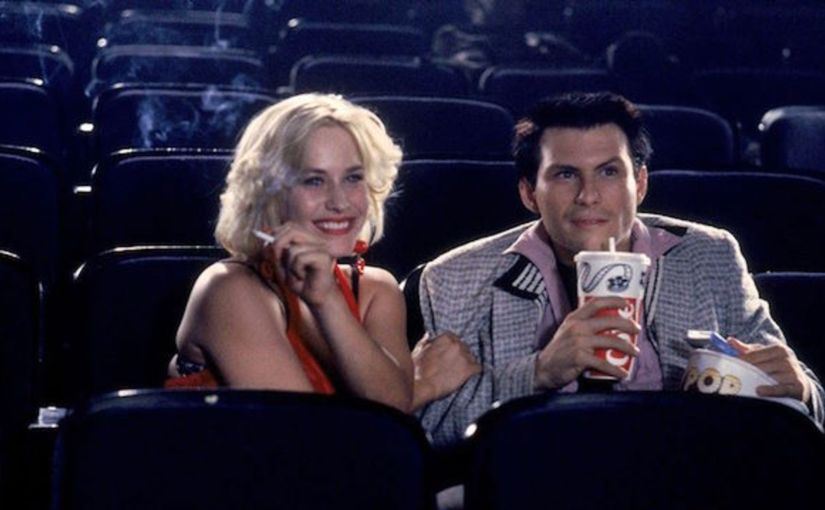
The structure built into the script for True Romance by Quentin Tarantino, directed by Tony Scott, is like the trunk of a solid oak tree with strong, sturdy branches representing its collection of seedy characters in off color scenes. Tarantino sets it up – an Elvis infatuated boy meets a rookie call girl (Christian Slater, Patricia Arquette). Boy marries girl, and then boy & girl find a suitcase filled with a fortune in uncut cocaine. A simple storyline that now allows a bunch of fun, short vignettes to be played out, all leading to one moment after the other within this universe of outlandish, lurid debauchery.

What works so well in True Romance is that literally from beginning to end, you are always meeting a new and incredibly interesting character. Each scene welcomes someone else into the fold. For that, you need an all-star cast. Gary Oldman, Samuel L. Jackson, Christopher Walken, Val Kilmer, Conchata Farrell, Dennis Hopper, James Gandolfini, Brad Pitt, Bronson Pinchot, Saul Rubinek, Michael Rapaport, Tom Sizemore, Chris Penn, Ed Lauter, Elvis & martial arts master Sonny Chiba. The list goes on and on. It should be noted that some of this cast were hardly bankable stars before this film, which flopped at the box office in 1993. Before the movie became a cult B movie obsession on home video and cable, it was blazing the trail of well-established careers for much of its talent.

Nearly every character can have a story of their own written about them. Take Gary Oldman in one of his best roles as the vicious looking pimp named Drexel, a white guy adopting a Jamaican gangsta accent with dreadlocks, gold caps on his teeth, a blind eye and wickedly curved scar down the side of his face. His appearance alone makes me beg to know this guy’s background in a whole other movie. Drexel’s introduction comes early when he pumps a shotgun into two hoods. Shortly thereafter he’s conversing with Clarence Worley (Slater), and we know who’s in charge of this scene. Oldman is only given about 10 minutes of screen time, but it’s hardly forgettable.

The same goes for Walken, as a well-dressed mafia don interrogating Clarence’s father (Hopper). This scene has become legendary for film lovers, and it carries into a stratosphere of intelligence and timing in performance duality. It remains one of the best scenes Tarantino ever wrote as we learn a probable origin of Sicilians from a doomed Dennis Hopper. This is an acting class at its finest.

Jeffrey L Kimball filmed the piece showing contrasts of a wintery cold and dirty Detroit versus a sun-soaked Los Angeles. It’s sharp photography of gorgeous colors schemes.

Hans Zimmer scored the soundtrack, deliberately saluting Terrance Malick’s Badlands where we followed a similarly young criminal couple played by Martin Sheen and Sissy Spacek. Zimmer’s fun, melodic tones to celebrate Arquette and Slater’s adventures is perfectly in tune with the two-dimensional charm of their new and happy relationship. Most of Tarantino’s script is not taken seriously. Zimmer was the right device for that.

A few spare moments are played with dread, though. Slater and Arquette are truly in love. So, Tarantino & Scott threaten what the film treasures. Arquette as a call girl named Alabama Worley is incredible throughout the film. She’s a silly, adorably cute Southern belle dressed in secondhand store accessories, such as a cow spotted patterned skirt with neon blue sunglasses, and red cowgirl boots. This is not someone you’d hire to manage your accounting firm or run a library. However, Arquette’s emotional range really comes through during a brutal beating scene with Gandolfini. It pains a viewer to watch the moment, but it comes long after we’ve grown to love her.

Later, towards the end, our favorite couple is again endangered during a three way Mexican standoff. It’s hilarious, and way off kilter, but then it also gets downright scary.

That’s the beauty of True Romance. It’s a well-organized mess of emotions from comedy to drama to violence and silliness. Tarantino has great set pieces put together in a connect the dots rhythm.

It’s an endlessly quotable film. It’s a visual film. It’s a literal roller coaster of dangerously amusing storytelling told with affection and gratuity. It’s also quite sweet.

True Romance remains one of my favorite films of all time.
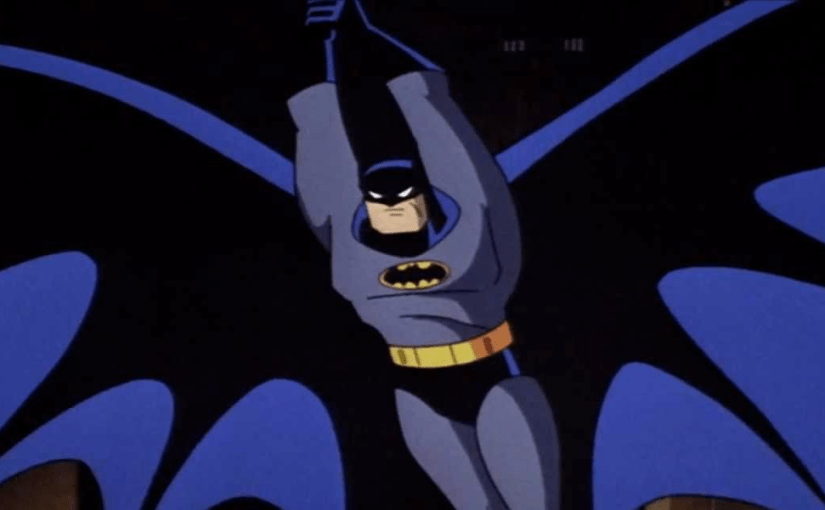
BATMAN: MASK OF THE PHANTASM

By Marc S. Sanders

Batman: The Animated Series from Warner Bros was a hallmark in telling more mature stories that could still appeal to kids, but adults as well for the superhero genre. Due to the show’s success, following the release of Tim Burton’s successful live action films, the animated series spun off a film of its own for the theatrical medium, and it works.

Subtitled Mask Of The Phantasm, Batman finds himself to be the blame for some vigilante murders of high-ranking mobsters in Gotham City. Turns out there’s another shadowy caped figure causing the mayhem.

At the same time, Bruce Wayne (Kevin Conroy) is reunited with an old flame (Dana Delany) who has returned. Their history is told in flashbacks, and it could pertain to the appearance of this Phantasm. The Joker (Mark Hamill) is causing interference as well.

The animators and writers for Batman: Mask Of The Phantasm take their film completely seriously. From a story perspective, there are plot developments at stake along with the colorful cast of characters. Batman especially looks great as does his cave, Batmobile, Bat Cycle and Bat Plane. The Art Deco settings of Gotham City’s skyscrapers, and broad angles that enhance the vastness of the city are completely immersive. The voices work too.

The movie certainly ranks better than the Joel Schumacher Batman films, and at least just as good as Tim Burton’s second effort with the Caped Crusader, Batman Returns.

Batman: Mask Of The Phantasm is a great adventure steeped in mystery and big surprises. I really liked it.

MENACE II SOCIETY

By Marc S. Sanders

Sometimes I’ll come across a movie that I will not like until the very, very end; until literally the last 60 or 90 seconds. The Hughes Brothers’ film Menace II Society is one such movie.

There’s great skill at work here. I saw that from the film’s explosive beginning and then all the way through. This is a story centered in the California ghetto known as Watts, following the 1965 riots through the drug trafficking 70s and then quickly transitioning into present day 1993 when the film was originally made. Rodney King was fresh in the country’s psychosis.

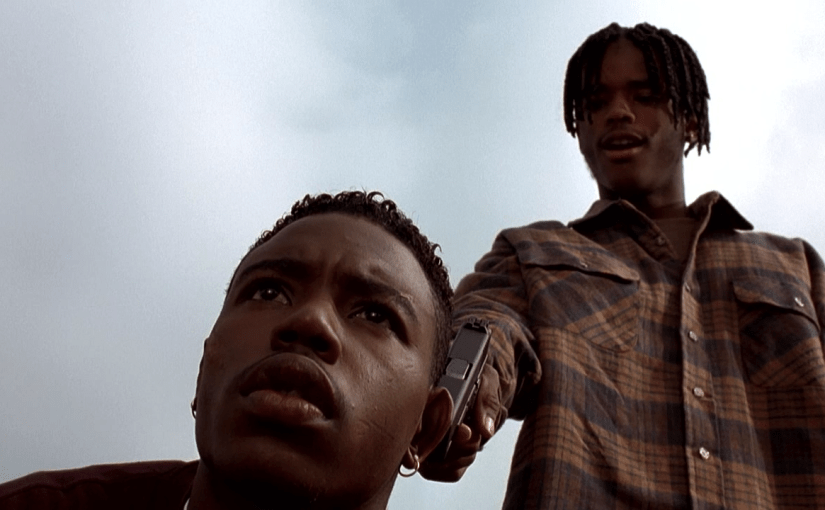
A kid named Caine (Tyrin Turner at the adult stage) is the central character. We see him at age 10 witness his father murdering a friend by shooting him across the kitchen table. (If you’re keeping score, that’s another Samuel L Jackson cameo.) Caine’s mother eventually dies from an overdose; his father we are told dies in a deal gone wrong. Caine is blessed to move in with his grandparents. He befriends a young woman with a 5-year-old, along with another friend who tries to influence the teachings of Islam, as well as a kid with a football scholarship. Then there are those who see no other way to live except to always be strapped and ready for a drive by or to rip off a car. Caine’s closest friend, O-Dog (Larenz Tate) will be more than happy and carefree to fire his pistol at anyone who says something disagreeable.

So what didn’t I like? Well, maybe it’s me, but I normally look for a transition in a main character. That special moment where a kid’s life will change; where it will occur to him to make a change. That doesn’t happen for Caine, and it frustrated me. He is impulsive to beat up someone, steal a car, get a girl pregnant, continue to deal and continue to disregard those that try to rescue him from the threat of living in the hood. Opportunities are offered and yet Caine never considers them as better alternatives.

Maybe that’s how it is in the hood. I will not even presume to understand. My upbringing was more advantageous to me and I’m not an authority on the despair and violence that exists in that world. Sad that it still must persistently exist at all.

So the film is quickly approaching its end, and STILL I’m asking what is the point if Caine is the same here as he was in the beginning. He’s no better. He’s no worse. He’s just the same with no change.

But, then…THEN…Caine’s last voiceover kicks in with some telling words accompanied by The Hughes Brothers’ wise choice to accompany it with some quick flashbacks, and now I fully understand and realize that what I watched was an insightful piece of shoestring budget filmmaking that left me thinking.

Second chances are fleeting. Life can easily be taken for granted with no reason to hold any value for it. There will be casualties and collateral damage because of your recklessness. Yeah, it’s all a recognizable “After School Special” but it still holds power here.

Forget it!!!!! Don’t even ask me to spoil what that epilogue literally recited or its relevance. Come back to me after you’ve watched Menace II Society. Then we’ll talk.

THE FUGITIVE

By Marc S. Sanders

In 1993, Andrew Davis directed the best Alfred Hitchcock film that was not directed by Alfred Hitchcock. The Fugitive with Harrison Ford being pursued by Tommy Lee Jones was a runaway smash. As we now live in an age of cell phones and the World Wide Web, you’d think this film might be somewhat dated but it is the last thing on your mind while watching. This is a tense, taut thriller that never, ever lets up. Another favorite picture of mine.

The opening credits serve as a prologue, showing Dr. Richard Kimble struggle with a one armed man in his home after his wife (Sela Ward) has been assaulted and killed. Kimble becomes the accused and eventual guilty party who is sentenced to death.

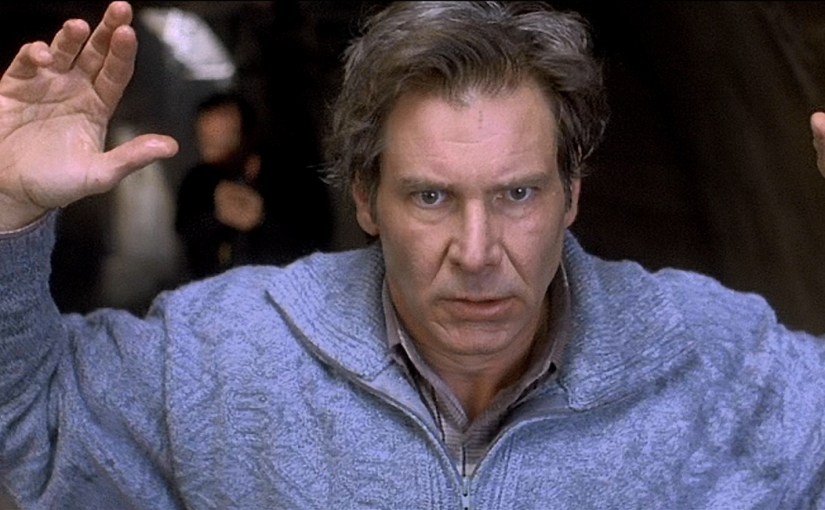
Davis is now ready to show his first of many wonderful set pieces. As Kimble’s prison bus careens off the road landing on railroad tracks, an oncoming train collides with the bus. Kimble and another prison inmate now have the opportunity to escape and go on the run. Enter Tommy Lee Jones as Deputy Sam Gerard and his team of smart, intuitive misfits to catch up to Kimble who has made a mad dash into the dense Illinois woods. Because Kimble and Gerard are depicted to be incredibly smart, Kimble only remains a few steps ahead throughout the picture. Later in the film, Kimble makes his way back to Chicago to search for the one armed man and uncover exactly why his wife was murdered.

Location shots are masterfully done in The Fugitive. From the woods to a sewer system (a manufactured set I believe), to the streets of Chicago and Cook County Hospital.

The train crash is one of the all time best moments in film. No miniatures. No CGI. This is a fully loaded train crashing into a bus, and this is where you can not deny the craftsmanship of great filmmaking. Cameras were positioned at multiple angles to capture the mayhem in one take.

The other great set piece occurs during the actual St Patrick’s Day parade in Chicago. Gerard once again gets Kimble in his sights and Kimble manages to blend in with the parade marchers. The quick editing of improvisational camera work is spectacular here. Kimble and Gerard are literally in the same frame and yet Gerard can’t see what’s under his nose. Moments like these can’t be storyboarded. Andrew Davis’ production could not stop the actual parade for another take. It all had to be done on a now or never basis.

I watch The Fugitive and I always think back to Alfred Hitchcock’s best work like The Man Who Knew Too Much and North By Northwest. An innocent man is unexpectedly swept up in a conspiracy where he becomes the target and his adrenaline and instincts must kick in to save himself. The only thing he’s armed with is his mind. There’s also an unusually creepy antagonist, The One-Armed Man. This makes the film incredibly foreboding. I know the film stems from the legendary television series, but Davis treats this villain as if he’s among the ranks of Hitchcock’s use of Martin Landau or James Mason.

Harrison Ford is great at never glamorizing his role. He doesn’t suddenly become Rambo. He becomes a man of convincing desperation. Ford shines in roles like these such as his other films like Witness, Air Force One, and Frantic.

Tommy Lee Jones gives one of my most favorite performances on film. He plays Gerard with non stop adrenaline. He has exquisite chemistry with his team, including Joe Pantoliano. As well, Gerard is only interested in fetching what has escaped. He has no interest in guilt or innocence, until he realizes that Kimble has no interest in the consequences of escape. Kimble is interested in his innocence. Even Gerard becomes attuned to Kimble’s drive. Here is where the script is wise. There is no dialogue to imply what Gerard is thinking. Tommy Lee Jones has a way of giving a great close up to show what he’s thinking. He trusts the audience will presume what’s driving his intuition.

Davis pulls out all the stops with this film. There’s magnificent action shots of Gerard’s helicopter quickly flying over the ambulance that Kimble is racing away in. A great cat and mouse maze sequence happens within a sewer system. Lighting is perfect, there. Nothing is overly dark. There’s also incredible overhead shots of the dam and ravine that Kimble makes for a getaway with an absolutely surprising dive from an enormous height.

The Fugitive is smart and action packed to the teeth. You are in full focus while watching the ongoing pursuit. This film was nominated for Best Picture. Rare for an action film, but also a testament to its greatness. Tommy Lee Jones deservedly won the Oscar for Supporting Actor.

No doubt for me that The Fugitive is a must-see film for any kind of moviegoer. There are moments to feel scared, to laugh, and to cheer. When it is finally over and the story arrives at its satisfying conclusion, you cannot help but let out a deep breath. You feel like you’ve run a hundred miles, or at least as long as Richard Kimble ran towards his innocence. Your time will be well spent investing in the The Fugitive. An absolutely fascinating picture of great, mounting suspense.

PHILADELPHIA

By Marc S. Sanders

Tom Hanks most certainly deserved the first of his two Oscars for his portrayal of Andrew Beckett, one of the first protagonists to be an AIDS victim on screen in Jonathan Demme’s 1993 film, Philadelphia. Its a good film but not a great film.

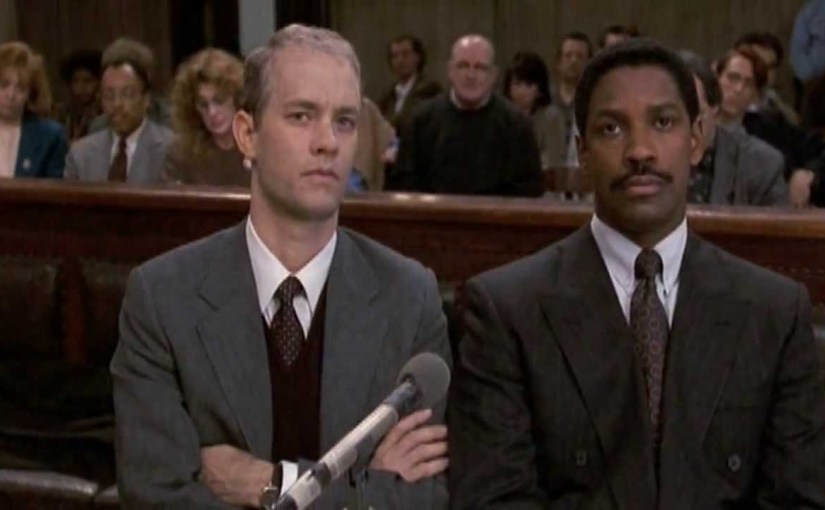
I recall seeing Philadelphia when it was originally released. Seeing it today, my opinion hasn’t changed. I don’t believe the film takes enough risks and the script from Ron Nyswaner is too cookie cutter and simple. Beckett hires Joe Miller (Denzel Washington) to represent him when he proceeds to sue the law firm who wrongfully fired him for having AIDS, and most likely being gay as well. The argument hinges on proving that having AIDS is a handicap that never interfered with Andrew’s work performance. Andrew is clearly made out to be the firm’s best of the young attorneys when he’s assigned their biggest client. Nine days later he’s sabotaged, and soon after he’s fired for an attitude problem and carelessness. Eventually, Andrew and Joe assemble, despite Joe’s prejudices against homosexuals.

The trial, Andrew’s struggle of living with AIDS, and Joe’s own inner debate with associating and defending a homosexual, AIDS victim are the three main storylines.

The first storyline is the best. Demme does a masterful job of showing the evolution of the disease. Andrew could be looking at papers on a desk and when he turns his head, a lesion appears on his neck. Makeup artists Carl Fullerton and Alan D’Angerio deservedly were Oscar nominated as Hanks’ appearance seems to change from one scene to another and another. He’s thinner in one moment with very fine ash gray hair. In another scene, he’s got a full head of hair with an energetic way about him. I cried for Andrew’s deterioration. Hanks and Demme carry that aspect very, very well. The actor does great work of changing his voice when he’s fighting a cold with a terrible cough or evoking massive weakness. As the film progresses and Andrew gets sicker, he’s incredibly pale with a droopy eye. The makeup artists tell the story with Hanks’ performance and Demme’s direction.

The 2nd and 3rd storylines don’t offer much of a challenge. The law firm primarily represented by head partner Jason Robards is too easily “evil.” There’s no subtlety here. Robards gets right in the face of the film – “Andrew brought AIDS into our office.” A better script would wait for the bad guys’ momentous third act Freudian Slip. This case was unchallenging really. It was too easy to win. Especially true considering this great and powerful law firm hires Mary Steenburgen as defense counsel. Steenburgen plays her part very mousy and unaggressive though. This case is too lopsided and uneven and I just couldn’t get past that.

Joe’s own reservations are too apparent as well. He’s meant to represent those that simply never understood the mentality of gay love, nor the scientific evidence of the AIDS virus. He rushes to his doctor following an initial meeting with Andrew. Demme does an extreme close up of this doctor to teach the audience the basics of AIDS. This guy is right in your face with his dialogue. I didn’t care for moments like this. Too patronizing.

A side story attempts to show the intimate relationship of Andrew with his boyfriend Miguel (Antonio Banderas). I still feel the same about this part. The script holds back. Hanks and Banderas give each other “bro hugs” and kisses are done on the bottom cheek. Back in’93, filmmakers were not prepared to go all the way with depicting the true nature of homosexuality. I found it insulting. You finally want to make a film that shows AIDS and homosexuals at the forefront but you stop short at the finish line.

Ironically, Joe has a repetitive line “Explain this to me like I’m a 4 year old…” Demme adopts that method throughout the film with major “in your face” close ups to glaringly make the beliefs of what any character values or has to say as obvious as possible. I felt as an audience member that Demme didn’t have to take it this far. I get it. You don’t have to be THAT FORTHRIGHT.

Washington is a great actor as always. He’s likable even if he’s tripped by the fault of misunderstanding. His “TV GUY” ambulance chasing lawyer is comic relief at times within a film of very heavy subject matter.

Demme’s filmmaking does make some wise choices despite some of my issues. The opening credits offers a lot of footage of the city with people carrying on their daily lives while waving to the camera, selling fish at the market, street dancing, etc, all accompanied by Bruce Springsteen’s sweet, yet haunting theme “Streets Of Philadelphia.” I like this opening as it shows what we see on the surface of the people we live with does not necessarily reveal the struggle any one of us might be enduring. This is a moment where the script is not so easy to grasp. There’s a challenge to accepting Demme’s footage blended with Springsteen’s overture.

Jonathan Demme is a good director, who is sadly no longer with us. I appreciate Philadelphia for showing the illness but not much else. It’s a film that should be seen. I’d argue most would embrace more of the movie than I did. I just felt the envelope could have been, actually should’ve been, pushed further. It was too careful with its subject matter.

A great observation though was recognizing the many faces that appear in the film from Demme’s other film, The Silence Of The Lambs. As well as naming Joe’s baby daughter “Clarice.” I also recognized an identical tracking shot that Demme offers. When Joe goes to visit Andrew in the hospital, it is a shot for shot remake of the tracking movement when Clarice goes to visit Jack Crawford in his office, at the beginning of Lambs. This might not be original, but I had fun recognizing it, nonetheless.