WALL STREET

By Marc S. Sanders

Oliver Stone is a very good director at providing the evidence of cynicism within the worlds he films.  JFK covered a clandestine, conspiring environment oozing out of the columns of government.  Platoon not only depicted the horrors of war, but also the cancer that poisons the mentality of soldiers expected to protect one another.  Wall Street explores the temptations to cheat the stock market for grand prizes in wealth.  Gordon Gekko is the 1980s tycoon who never knows the meaning of enough.

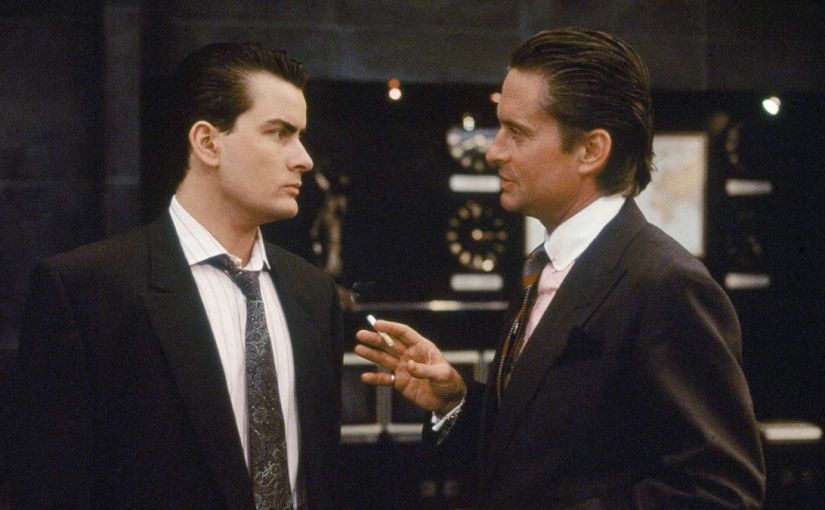
The well-dressed yuppie lizard, Gordon Gekko, is memorably played by Michael Douglas in his only Oscar winning role; regarded as one of the most villainous characters of the last fifty years.  It’s not a modest part, and Douglas’ performance is therefore electrifying.  With slicked back hair, the signature crackle of a voice inherited by his father Kirk, and the newest 80s innovation, a brick size cellular phone, the power to earn money and crush corporate enemies is done with ease.  Gekko relies on obtaining inside information (a federal crime) to find the next chest of treasures.  It might be an illegal practice but the best of the best at making mountains of money do it, and if you keep your process on the down low, nobody will catch wind of what you’re up to.  Gordon Gekko is an absolute genius, and he’s awarded a script of fast talking, slick monologues that justify his sins.

Bud Fox (Charlie Sheen) is the kid on the ground, way below Gordon’s high-rise office, desperately trying to get five minutes with the guy.  A whole day’s wait in the lobby and a birthday gift of Cuban cigars does the trick.  Now the lizard has the fox ensnared in his money-making schemes of deception and pursuits for unlimited greed.

Oliver Stone writes Sheen’s character as virginal when it comes to stock trading.  The kid is dying to get laid with the big boys while getting away from the cold calling hang ups of promising uncertain futures in stocks and bonds.  A subtle and effective angle is to give Bud a mentor.  Hal Holbrook enters the screen from left or right on many occasions to put his hand on Bud’s shoulder and give him his own twist of Confucius philosophy.  Then he exits out of frame towards the opposite direction he enters, leaving Bud to follow the questionable paths that Gordon paves.  Holbrook’s contribution to Wall Street has never been celebrated enough over the years.

Michael Douglas and Charlie Sheen are an outstanding pair of devilish mentorship against innocence lost.  Gekko preaches his passion for wealth on top of more wealth and why nothing should stand in his way, especially the law or the cost of others’ livelihoods.  Bud Fox emulates him as a master of the universe.  Charlie Sheen is great at being the biggest fan in Michael Douglas’ concerts of monologues. Watch how Sheen listens when Douglas has the floor. 

Martin Sheen extends his paternal role to Charlie within Stone’s film.  As Gordon sets designs on taking stock ownership of the small airline company that the father works for, the father/son relationship is tested, and Bud becomes blurred between what is right and wrong.  The Sheens have good debates and heightened dramatic moments.  I wish they were given more to do together though.  Perhaps even showing the wedge of the mother role within this family.

Additionally, Oliver Stone writes dynamics for Bud in a worker relationship with a fellow trader colleague (John C McGinley). There’s a former college pal/now lawyer (James Spader) that Bud tries to squeeze at the behest of Gordon’s demands.  Bud is also covered doing his own tricks of the trade such as dressing as a janitor to dig for what’s forbidden.

Why bring up all of these storylines?  Well, there’s a wealth of great material in Wall Street that’s relevant to the practice of insider trading and corporate overhaul.  Somehow though, Oliver Stone is responsible for writing one of the most unnecessary characters in film history.

Daryl Hannah just had to be cast as the buxom blond love interest for Bud Fox.  She’s never believable as a New York City interior designer and the chemistry between Hannah and Sheen is as thin as water.  Her name is Darien (a 1980s name) and one scene between Michael Douglas and her bustling the streets of Manhattan goes nowhere.  Wall Street is simply not the superb film it could have been because of the amount of time devoted to Daryl Hannah’s character.  Every moment she occupies is cutting room floor material.  When Darien exits the picture she’s never mentioned again.  The history she has with Gordon is never revealed to Bud.  Regrettably, it’s all meaningless.

What’s frustrating with Wall Street is its promise is never fully committed.  The roles awarded to Spader, McGinley, Holbrook and even Saul Rubinek in an early role as Gordon’s nerdy lawyer could have been even more fleshed out in lieu of what is covered with Daryl Hannah’s part.  More moments with Martin and Charlie Sheen would have better served the film.  A competitor tycoon played by Terence Stamp is very interesting and worthy of a larger presence.  Sadly, I imagine a studio producer or even Stone insisted on having a love interest that serves no purpose here except to put a glamorous actress above the title in the credits.  

Nonetheless, Oliver Stone built an authenticity to the hysteria of stock trading and corporate underhandedness.  When he shoots the scenes occupied by Bud and Gordon, he does handheld shaky camera work to emulate that nothing feels sturdy and balanced.  In moments that Bud’s father is at the center, the director shoots with a locked in position, bearing the character’s assured apprehension to trust his son or this prophet of greed.

I especially like the scene where Michael Douglas delivers his famous “Greed…is good!” speech at a shareholders’ annual meeting.  Stone glosses over all the company vice presidents and officers as well as the fat cat suits who carry stakes in the company.  Yet, the filmmaker also takes the time to show that little old lady with the pocketbook who finds her entitled seat to see how the value of her small ownership share is being treated.  Remember, if you own stock like Disney or IBM, you get that invitation in the mail to attend these meetings, and you have just as much a right to attend as all the Gordon Gekkos of the world.

Wall Street serves an important reflection of 1980s capitalism, while taking place in 1985, two years ahead of the infamous market crash of 1987 (the year the film was released).  Guys like Bud Fox had the Charlie Sheen image. Boyish men who got rich quick with little imagination to create and build.  They stood next to tall wealth and learned, but they never gained the knowledge to prepare for quick falls and disheartening sacrifice.  Most importantly, they took their own sense of morale for granted.  These are the best parts of Wall Street.

THE SECRET OF MY SUCCESS

By Marc S. Sanders

Reader, it has been a hard week.  Hard because my flat screen has been on the fritz.  Finally, today at last, the Best Buy Geek Squad will be paying me a visit and working on a repair. In the meantime, I have had to relegate myself to one of the smaller flat screens within the household.  I feel dirty.  Cheap.  I can’t even look at myself.  Just look away!!!!  Considering the dire circumstances, I could never look at my next big film to review during the absence of my 9.0 sound system and 65 inches of viewing pleasure.  It would be a sin to watch a Christopher Nolan or Steven Spielberg piece anywhere else (unless it’s in the cinema).  Therefore, I settled, and I hit rock bottom.  I opted to for Netflix meh! 

All I have, all I can give you, all I can offer, all I can claim for you during this dark, sad time is Herbert Ross’ attempt at shaping a Michael J Fox thirty second MTV style 1980’s music video into a film.  The “film” is The Secret Of My Success

I recall seeing this movie at age 14 during a field trip to Washington DC with my eighth grade Yeshiva class.  Every time the dimply cute yuppie Canadian sensation from Family Ties and Back To The Future graced the screen, the girls in my class screamed with puppy love glee.  I liked Fox at that time.  I still do.  He was a bright guy and while not an actor like Brando or Olivier, he had a unique charm that defined the clean cut 1980s with knit ties and Benneton sweaters.  His unforgettable Alex P Keaton was the fictional cheerleader for the era of Ronald Reagan, and no one protested.

I recall the promise of The Secret Of My Success as being the vehicle that would elevate his tv persona to the big screen since he already had luck with Marty McFly and a healthy B-movie following with HBO airings of Teen Wolf (a much better movie than it ever deserves to be). Regrettably, this film never landed.  It’s most glaring failure is that it never even lives up to its title.

The assembly of Herbert Ross’ romantic, New York, yuppie comedy occupies itself so much with music montages.  It’s as guilty of its own indulgence as Rocky IV.  How many times must we see a grinning Michael J Fox hustle through the concrete jungle of the city and then through skyscraper cubicle hallways within a white collared business world?  Night Ranger is the ‘80s hair band who provides most of the movie soundtrack and they owe much to Michael J Fox as the face that accompanies their work with trinkling keyboards and electric guitars with the raspy roar of their lead singer.  If Michael J Fox is not walking down streets where apparently supermodels live to turn their heads (I saw you Cindy Crawford), he’s got a pen wedged between his teeth and he’s pulling huge three ring binders off of shelves while doing an all nighter.  This is oh so boring.  In 1987 however, it is all a couple of Teen Beat readers needed in their lives.  I can watch Meryl Streep or Gary Oldman read a three-ring binder.  Michael J Fox just doesn’t have a knack for this skill.

Fox plays Kansas farm boy Brantley Foster.  Now that he has earned a business degree, he has enormous aspirations to climb the top of the New York corporate ladder and make a success of himself with a “beautiful secretary.”  Because, you know, you can’t make it without a secretary, much less a beautiful secretary. 

Upon relocating into a roach infested apartment, Brantley’s plans fall through, and he has to beg his super rich Uncle Howard (Richard Jordan) into giving him a job in the mail room of his building.  Brantley encounters a beautiful blond executive named Christy (Helen Slater) amid a sea of uptight middle-aged men.  The depth of this attraction only goes so far as fantasizing about her walking towards him in a cheesy, glittery pink evening gown with a keyboard and saxophone chiming in.  On the side is Howard’s bored trophy wife Vera (Margaret Whitton) crowding young Brantley in an illicit Mrs. Robinson kind of affair.  Let me clarify.  Vera is married to Brantley’s Uncle Howard.  So, Brantley is being terrorized by Aunt Vera.

For the purposes of ridiculous farce, that might be funny for a moment.  However, The Secret Of My Success takes forever to arrive at the farce it could have hinged on.  Instead, Brantley has to discover a way into the white-collar world when he comes upon an empty office and bears the fictional name of Carlton Whitfield to justify his suits and his motivation to work in the heart of the corporate world.

I noted that the film does not live up to the title.  When Brantley is working the persona of Whitfield, we never get an idea of his brilliant ideas for business success and operations.  We never learn what turned Uncle Howard’s high-rise building into the towering reputation it apparently stands upon.  We never understand the threat of a shareholder’s takeover that Howard and his team fear is imminent.  Where’s the value in anything that Brantley is doing to be that corporate hero and what is he trying to improve or salvage?

Instead, we are left with a very poor chemistry pairing between Helen Slater and Michael J Fox.  Slater is flat out boring with no dynamic to her.  If you want to see how to deliver any variation of a line in a flat, monotone way, then observe what she has to offer.  Fox is on another level of energy that Slater cannot match and Herbert Ross and the script from Jim Cash and Jack Epps Jr (Top Gun, Legal Eagles) chooses to occupy itself more with this romance than the corporate world at play.

The following two years after this film’s release would do better for this hustle and bustle setting with Oliver Stone’s cynical Wall Street and Mike Nichols romantic comedy Working Girl.  The latter film follows a near exact blueprint of The Secret Of My Success.  Yet, it wins because we actually see the main character, portrayed by Melanie Griffith, actually demonstrate her prowess for the cutthroat world of business power and politics.  By comparison, Michael J Fox just wants to play hooky and make out in the back of a limousine.

A last-ditch effort is made though when the big wigs assemble for a weekend getaway. What seems like an attempt at bedroom farce barely gets started with the players climbing staircases and tip toing behind doors and hopping into bed together and blah blah blah.  It doesn’t serve, however, because the idiot plot intrudes where everyone has to act as if they have no idea of who is sleeping with who and who is Brantley and who is Whitfield amid the fast-talking dialogue edited within.  You want to scream at the screen and tell everyone to shut up because this can all be explained in sixty seconds.

Again, as Mike Nichols’ Oscar nominated film eventually proved, there was a better film to be made here for Michael J Fox.  It could have included all of the cynical realities that go with the natures of a corporate American beast.  Instead, The Secret Of My Success relies on music video montages with the teardrop keyboards and the yearning saxophone that seemed like a requisite for the adoring Michael J Fox of the 1980s. 

Enough already!!!!  I need to cleanse my palette.  GEEK SQUAD, WHERE ARE YOU????? 

SOME KIND OF WONDERFUL

By Marc S. Sanders

I don’t get it. Why title a movie with the name of a popular song only to make the movie title seem arbitrary? Some Kind Of Wonderful is a rockin’ great song by Grand Funk Railroad that you turn the volume up on your car radio as you leave work on Friday afternoon. Maybe you get the bar patrons riled up on karaoke night. Some Kind Of Wonderful is also the name of a movie written by John Hughes that has no meaning or relevance to the song it’s named after. It’s as lacking in imagination as the film itself.

Why do you suppose John Hughes didn’t direct this film and left it for Howard Deutch to take over? Could it be that Hughes realized this script was nowhere near as insightful as The Breakfast Club or even Ferris Bueller’s Day Off?

The characters are positively boring in Some Kind Of Wonderful. In fact, they are so boring that they look bored with each other. They look half-awake when they are talking to one another. Unless, that’s how you look cool in the rebellious 1980s. I dunno. To me they all looked flat.

Eric Stoltz plays Keith. He’s a kid who avoids college discussions with his father (John Ashton) while pining over Amanda Jones (Lea Thompson), the popular girl who’s dating the popular jerk with the Corvette. We get to hear a song called Amanda Jones not once but THREE TIMES. Where’s the song Some Kind Of Wonderful, though? Why not just call the film Amanda Jones?

Unbeknownst to Keith, his tomboy best friend Watts (Mary Stuart Masterson) plays it cool, while carrying around her cool looking drumsticks, like she doesn’t love him when it couldn’t be more apparent. Keith is so unbelievably stupid that he can’t even detect the slightest crush that Watts has on him when she practices kissing him so he’ll be prepared for an upcoming date he has with Amanda. Now I’d buy this routine if Keith were at least playing dumb to Watts’ advances. However, Keith is not playing dumb. Keith is just dumb.

As a community theatre actor and playwright at times, even I follow at least a slight discipline of exploring character backgrounds. Watts and Keith are best pals yet I don’t recall one tender moment or discussion that even slightly recollects their history or friendship. Pretty In Pink offered plenty of moments that shaped the Molly Ringwald and Jon Cryer relationship. Not in Some Kind Of Wonderful, however. Every time Stoltz and Masterson meet up for a scene together it feels as if they never met each other before. They never look like they are familiar with one another and really know what makes the other tick. Are they acting with their stand in doubles?

I also was not so convinced of Keith’s attraction to Amanda. There’s nothing to this girl beyond Lea Thompson’s sultry looks. Granted, I recall having a day or even a month-long crush on a number of girls in high school simply based on appearance alone; girls who never gave me the time of day. Raging hormones naturally will do that to teenage boys but remember this is a movie. In a movie, I need to be shown why there is a crush. Not just told in a statement of dialogue.

Recently, I reviewed Can’t Buy Me Love. I didn’t like that film either. However, the popular girl in that film at least revealed a knack for poetry and a sudden interest in astronomy and an old airplane graveyard. The popular girl here only opts to go out with Keith to anger her jerk of a boyfriend. I don’t know anything about Amanda from beginning to end.

Keith only paints and draws images of Amanda. A talent for art is a springboard for sweet and sincere in a John Hughes movie, but it’s all Keith ever learns about Amanda. So it’s all we ever learn about Amanda. Great! You sketched a third picture of Lea Thompson. Sorry, but I already know what Lea Thompson looks like.

The date between Keith and Amanda tries to aim for cuteness and maybe some comedy. I say maybe because I’m not sure if the cast with Hughes and Deutch are looking for laughs. But see Masterson volunteers to be the limo driver complete with the hat and uniform, and drive the lovebirds around town. A limo uniform on a character can be funny like if Kramer in Seinfeld did it, or if it was one of the Three Stooges. Problem here is no one in this movie sees how funny it could be. So, it’s not funny. See how that works?

No one was at the wheel of this D grade fare teenage 80s flick. Beyond all that’s wrong with the story and characters and performances, ultimately again I ask, where is the song Some Kind Of Wonderful in the movie Some Kind Of Wonderful? If that doesn’t even occur to you, then I can’t have much faith the film will have any provocation of thought either…and it doesn’t!!!!!

SUSPECT

By Marc S. Sanders

Okay. Fair Warning. I am going to spoil this movie with my review. Why? Well, if you haven’t seen Suspect, directed by Peter Yates, then I’m telling you that you absolutely do not ever need to see Suspect directed by Peter Yates.

What is Suspect worthy of 33 years later? Nothing beyond my personal allowance to spoil the film for you. I know! It goes against my principals as a film critic, but I choose, for YOU, MY READERS, to fall on my sword.

Scripts of any variation whether they be stage plays, television episodes or feature films should always show the unusual. If it’s mundane, it should never be made. You don’t want to watch two hours of someone brushing their teeth. You want to watch epic films like Malcolm X or witness a man that flies in Superman: The Movie or the murderous ways a person will devote his affection for his mother in Psycho. Unusual and special stories make the best stories. Unusual! Not utterly preposterous!

Now, I’m sure in the annals of trial law there had to have been a handful of cases where a defense attorney got involved socially and/or romantically with a member of the jury. Otherwise, we’d never hear of the term “jury tampering.” So, there’s something unusual to sink our teeth into. Preposterous though (AND I WARNED YOU) is that within this very same trial, you know the one where the defense attorney and jury member are getting some from each other on the side, that one, the presiding judge turns out to be the killer. Okay. Now Mr. and Mr. Filmmaker, you’re no longer using your imagination. You’re just throwing spaghetti at the wall, hoping it’ll all stick.

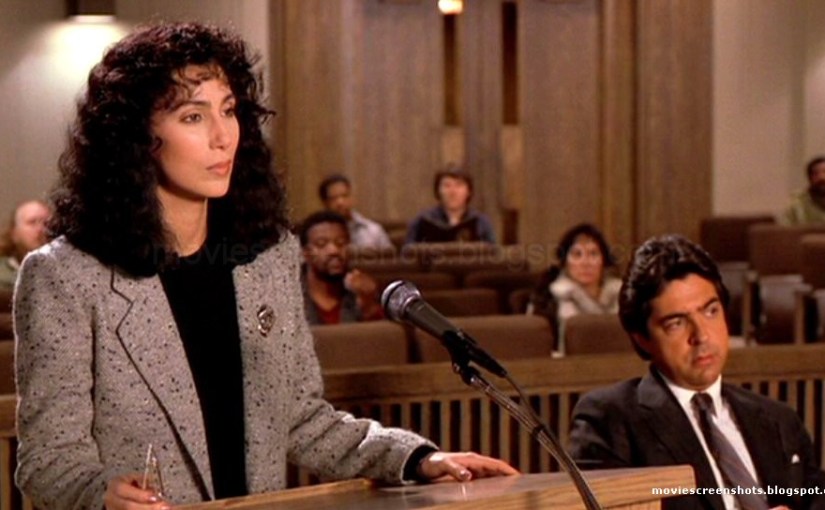
Cher plays a public defense attorney named Kathleen Riley. Dennis Quaid is a handsome DC lobbyist named Eddie Sanger serving on the jury. Liam Neeson is the deaf mute title character who is a vagrant homeless person, and John Mahoney is the presiding judge aka the actual killer revealed at the end. Lawyer and juror meet up outside of court to find clues and eventually make out. The judge is the killer. People please!!!! Washington DC is not this effed up, is it? (Maybe don’t answer that.)

Frankly, Kathleen is not a very good attorney. She’s not aggressive enough with her objections and I don’t think she applies herself well enough to win her case. In fact, without Eddie’s self motivation to dig into the case himself and help her out, then this suspect (Neeson) doesn’t have a chance in hell of being exonerated. The victim, a political staff member, had her throat slashed. Kathleen doesn’t even consider if the killer is right or left handed? Really? Eddie did at least. Still, I’m okay with watching an inept lawyer in a movie. Too often, movies show us lawyers that are too brilliant and quick on their toes. They’re almost too brainy. So, okay yeah, I’ll accept a lawyer whose not the sharpest crayon in the box for a change of pace.

On the other hand, Mahoney, the actual killer, is easy to predict when he voluntarily takes this case and then rules against literally every objection that Kathleen brings up. Every single one! Plus it stands to follow Roger Ebert’s economy of characters. There’s only so many characters in your multiple choice of cast members to consider as the killer. I can’t fathom Quaid, the juror, as the killer, nor Cher the defense attorney. So either Neeson, the suspect on trial, is the killer (not likely because then why have a movie) or it’s the judge. Nah! It couldn’t be the judge. Could it? Hmmmm.

Washington DC makes for a great setting for legal thrillers or courtroom dramas. It’s full of secrets and government and dealings and politics. A million and a half motivations and any one of its residents could find a reason to kill. The script for Suspect, written by Eric Roth, never cares to try that hard though. We are treated to a wasteful side story of Eddie doing some lobbying for milk (I’m sorry. MILK? LIKE DAIRY MILK????) when he’s not in court. He sleeps with a congresswoman to get her vote…and why am I seeing any of this?

There’s no build up in the murder trial either. The few expert witnesses called to the stand are forgettable. Nor do they foreshadow anything. Cher’s character doesn’t seem to work hard enough in questioning a witness. Instead, this dumb lawyer relies on a juror she shouldn’t ever be talking to.

Once again, normally, it’s against my policy to spoil a film. After 40 years, I won’t even spoil The Empire Strikes Back, cuz someone out there still hasn’t seen it. However, this film is ridiculous. This would even be too ridiculous for a Maury Povich episode or a Lifetime TV movie. How absurd must one murder trial be?

Think about it. All in one movie. One murder trial. One case. The defense attorney is involved with a juror AND the judge is the killer????? There are odds….and then there are gazillion to one shots.

CAN’T BUY ME LOVE

By Marc S. Sanders

I’m ashamed of myself. All the hours I wasted in my adolescence watching the 1980s teen flick, Can’t Buy Me Love. Now, having watched it again with my 12-year-old daughter, what was I thinking?

The overall problem with Can’t Buy Me Love is that literally every single character is drowning in depths of despicable shallowness. There’s not one redeeming character. Truly. I couldn’t stand to watch most of the film. Over and over again I asked myself what could I have been thinking? These are not likable people. Did I just repeatedly return to the film during Friday nights on HBO because I couldn’t take my eyes off actress Amanda Peterson?

Lawn mower nerd Ronald Miller (Patrick Dempsey) pays $1,000 to popular high school cheerleader, Cindi Mancini (Peterson) to be his girlfriend at the start of their senior year. The plan will be once Ronald’s reputation is established among the jocks and preppy valley girl cheerleaders, that Cindi and Ronald will break up. In other words, boost Ronald’s image so that he can live by that image. (I can’t believe I just clarified this movie with a sentence beginning with “In other words,…” A movie this stupid should not need additional clarification by means or words or even crayon sketches.)

It’s obvious what’s going to happen. Beware the idiot plot!!!! They fall in love, but both are too stupid to realize that they have fallen for one another. So, they are just cruel instead. Their friends are cruel too in their own superficialities.

I don’t find much to be proud of anymore with Can’t Buy Me Love. Maybe it reminds me too much of high school, which by and large I don’t look back on very fondly. High school in a film like this is all about impressing the greater mass with the car you drive, how much mousse you drown your hair in, or the sunglasses you wear.

John Hughes’ teen films looked at material with more substance like status quo and social class with a picture like Pretty In Pink or The Breakfast Club. No one was trying to impress anyone with the latest trendy look. The characters stayed secure in their appearance and yet found a personality to be attracted to, not an outfit. The challenge was in keeping to yourself while stepping into territory where you didn’t feel welcome.

Can’t Buy Me Love adheres to the observation that “he went from totally geek to totally chic.” Thanks for the limerick. I appreciated Pretty In Pink for a sobbing scene where the main character is embarrassed to show where she lives to the rich guy whose genuinely interested in her. There’s a consciousness to Pretty In Pink that Can’t Buy Me Love lacks.

If anything, Can’t Buy Me Love introduces us to The African Ant Eater Dance. So, as a plus, at least it’s got culture and diversity going for it.

EMPIRE OF THE SUN

By Marc S. Sanders

Empire Of The Sun is a marvelous film.  Finally, I got to see it, and now I consider it to be Steven Spielberg’s transition film within his storied career. It’s also one of his best cinematic achievements.

Other than The Color Purple, the majority of his directorial work up to this point in 1987, consisted of adventure and escapism found in cliffhangers and children with the innocent curiosities to uncover what is underneath.  Empire Of The Sun contains all of these elements, but as the film progresses, it matures and grows up right before your eyes. 

Christian Bale makes his introductory role a performance to remember as young Jamey Graham.  He is a British child of unlimited privilege living in Shanghai with his parents, naïve and sheltered from the gradual Japanese occupation taking place in 1941 when China and Japan were in conflict with each other.  Jamey happily plays and gets into adventures with his model airplanes and his imagination of heroics.  One day, while at a costume party, he discovers a crashed war plane and then envisions his fantastical heroism.  Shortly thereafter, the fantasy becomes real when he comes upon a Japanese battalion, just yards away.  With his parents, they make a desperate escape from the city they and their ancestors have called home.  However, Jamey becomes separated from them amid the chaos within the surmounting crowds.  Now, this young child with no sense of self reliance has no choice but to become resourceful if he is to survive and reunite with his mom and dad.

Eventually, Jamey meets up with two Americans named Basie (an outstanding John Malkovich) and his sidekick Frank (Joe Pantoliano).  The three are sent to a Japanese Internment Camp forced to live and survive on bare necessities as the second World War rages on with the Americans joining the fight.

Spielberg treats his protagonist the same as he did with the Elliot character in E.T. The Extra-Terrestrial.  Jamey happily lives in his own imagination until it is disrupted by an intrusion.  For films like Close Encounters Of The Third Kind and E.T., an alien of fantasy interrupts the protagonist’s lifestyle.  For Jamey, however, the reality of war harshly takes over.  It fascinated me how Empire Of The Sun, with a screenplay adaptation by Tom Stoppard of J.G. Ballard’s biographical account, seems to follow a familiar formula to Spielberg’s other pictures, and yet it reinvents itself with reality as opposed to fantasy.

Furthermore, Steven Spielberg does not abandon one of my favorite tropes of his as he makes the unseen the antagonist of the film.  When the veil is lifted, you can’t help but gasp.  Everyone knows he followed this approach in Jaws.  I also like to think he did this effectively with the German tank in Saving Private Ryan.  Here, he caught me completely off guard.  Young Jamey is dressed like Sinbad for Christmas jubilation at a costume party.  He’s happily tossing around one of his model planes and then when it flies out of sight over a grassy ridge, he runs over to the edge and finds something shocking beyond his treasured toy.  It’s a moment that happens early in the film and immediately tells me that this story will be bigger and more frighteningly real than meeting a cute, strange friend from another planet willing to eat my Halloween candy.

Spielberg’s production value is eye opening with thousands of extras within the scenes of mass exodus from Shanghai or within the internment camp.  Especially impressive is how he directs his extras to seem so overwhelming against young Christian Bale.  The child actor really followed direction, but more importantly it’s easy to see how method Bale might have been even at this young age.  He gets pushed and pulled and tugged on like I can only imagine an unforgiving circumstance of war would present itself.  Cinematics often praise Whoopi Goldberg’s debut in The Color Purple as one of the greatest introductions ever.  I have to put Bale’s performance up there as well.  The character arc that young Jamey experiences is well drawn out within Stoppard’s script, but Bale really performs the gradual change of a spoiled brat forced to become resourceful for not only himself but his comrades within the camp.  A director can tell a child actor where to walk or to sit or to stand.  A director can discuss the motivations of a particular scene.  With Christian Bale though, his performance throughout the film seems to remember where his character left off earlier in the story, where it has currently arrived and where it hopes to end up.  This young actor is so in tune with his character’s story. 

You may say John Malkovich serves as the staple mentor that every child protagonist has in so many other stories.  Basie is not that simple though.  A child will be quick to trust anyone he comes in contact with.  Spielberg and Stoppard know it’s not that easy though.  Malkovich is that dynamic actor who never seems forthright with his portrayals.  There’s something he always seems to hide from the audience.  Is he a snake ready to strike?  Is he a gentle pup ready for an embrace?  I never trusted how Basie would end up with Jamey by the film’s conclusion.  Malkovich delivers unpredictability so well.

Miranda Richardson is credited as a once wealthy friend to Jamey’s parents.  She’s not given much dialogue or scene work, but with the times she appears on screen Spielberg gradually breaks her down.  At first, she is well dressed in her finest linens insisting that her husband explain who they are to the Japanese forces.  Later and later in the film, the strength of her proud stature slowly crumbles.  It’s nice work and it’s crushing to watch.

Notable “tough guy” Joe Pantoliano goes through a similar transition.  A capture of him with Spielberg’s camera eventually focuses on a weeping and weak man.  Like much of the film, it is so unexpected.

There are epic overhead shots of panic and riots within the streets of Shanghai.  There are amazing moments where aerial attacks coming from nowhere with Jamey depicted running in a parallel line along the trajectory of a bi-plane.  It’s such a sweeping, personal story but the visual effects and camera work are so impressive as well.  The photography is striking in bright sunlight amid fireball missile strikes.  It is dazzling to watch.

As I noted earlier, Empire Of The Sun is Steven Spielberg’s transitional film.  Once again, he focuses on the innocent, young and unaware hero who is forced to become wise and most especially sensitive to a change in setting and circumstance.  With Empire Of The Sun, Steven Spielberg demonstrated that he could mature himself away from fantasy and embrace reality. 

I think Empire Of The Sun is an absolute masterpiece.

DIRTY DANCING

By Marc S. Sanders

Dirty Dancing was a major surprise at the box office. For me, it is such an eye opener because of how good it actually is, and how well it still holds up. It’s energetic and fun and a different kind of escape from the endless supply of action films and gross out comedies.

Here’s a film with a no name director, Emile Ardolino (I’m sorry, who????) and produced by…excuse me…Vestron Video???? It did not carry a cast with box office clout either, the tallest guy from The Outsiders and the older, bratty sister from Ferris Bueller’s Day Off. Yet, the film wins out in the end.

“Baby” Houseman (Jennifer Grey) arrives with her family to a Catskills like vacation resort during the summer of 1963. Usually costumed in whites, Baby is as virginal as her moniker suggests. Eventually, she gets taken with the entertainment staff who spend their off hours dancing in, shall we say, a non-conservative manner. Particularly, she falls for the gorgeous head dance instructor, Johnny Castle (macho name, dressed in macho cool blacks with macho cool shades) played by Patrick Swayze.

Every development of their relationship is telescopic. Yes! We know they’re gonna fall in love despite coming from two different worlds. They’re gonna sleep with each other. Then they’re gonna argue. Then they’re gonna make up and then they’re gonna have the big dance to close out the film with one huge extravaganza. However, it’s the material within that grabs me, and much of that is thanks to the chemistry of Swayze and Grey.

The leads dance beautifully together, and when a music montage comes up, it is adoring to see the frustration of the dance instructor with his giggling student. It’s also charming to see them work it out as well. Reader, I’ve seen this stereotypical “chick flick” many times and I still get caught up in it. The movie comes alive in their puppy love with music and dance. Hey, I got a sensitive side to me. What can I say?

The subplots of the film are lacking though. An abortion storyline really is not necessary to assemble all these characters together. Jewish high income guests meet rebellious, but mostly kind hearted, staff members. There are a couple of distracting jerks too. Something more substantial could have been here. Perhaps, a more meaningful acknowledgment where the two parties favor or do not favor each other, and why. Abortion is a heavy subject matter that does not blend well with the rest of this film, though. The fact that the script never even utters the word “abortion” tells me that the film isn’t even sure of itself with this side story.

As well, when one dancer friend (Cynthia Rhodes) needs emergency medical help, couldn’t Baby’s doctor father (Jerry Orbach) just stop to listen for the explanation? Guess not. He just chooses to stop speaking to his daughter. Thus, making it hard for Baby to hang with Johnny. This could all be resolved with a quick sentence of dialogue. As my colleague Miguel suggests however, then there’d be no movie!!! It’s called the idiot plot, I guess.

A third sub plot involves a pick pocket thief and the reveal comes ridiculously out of nowhere. It’s here to give reason for Johnny’s reputation to be threatened one more time, while Baby defends him. Now this storyline has next to no purpose of existing. Johnny’s reputation in the boss’ eyes was tarnished enough already. This is cutting room floor material.

Dirty Dancing is a film that is merited in its special talents, but not necessarily its whole story. The consistently good soundtrack of oldies mixed with some anachronistic 80s tunes work so well. The setting is completely absorbing with its mountainous camp getaway cabins and intermittent calls for entertainment activities like with its social director (played deliberately corny by comedian Wayne Knight). It feels authentic and escapist. Therefore, I look past those silly plot developments that scotch tape one enthralling moment of dance, sex appeal and music for another.

This most recent time of watching the film was especially fun as I got to witness my twelve-year-old daughter seeing it for the first time. Nothing shows how special a movie, any movie, can be than to see your daughter slap her face when Baby chickens out from doing “the lift” with Johnny during a dance performance. Later, when she finally accomplishes that feat, my daughter sat up with a huge smile on her face. If you ever ask me why movies are so special, I might just have to reiterate this experience when I watched Dirty Dancing with my Julia.

PREDATOR

By Marc S. Sanders

Predator is not only my favorite Arnold Schwarzenegger film, but it also remains as one of the best action films of all time.

The main reason for my praise stems from its cast consisting of the Austrian headliner followed by Carl Weathers, Jesse Ventura, Bill Duke and Sonny Landham. The cast is sensational because they take the science fiction material seriously by evoking their machismo gradually evolving into fear. Director John McTiernan displays all of this very well through quiet and covert close ups as each character sums up the possibility that they are being hunted for sport by an entity they are not familiar with.

McTiernan makes use of his setting to the point that the real-life dense jungle of trees amid thick humidity, within South America, is its own character. I don’t know how he did it but, in this film, McTiernan and his cinematographer capture flawless tracking shots of running over uneven grounds and roots, leaves and low hanging foliage. It’s really spectacular how it all moves fast without any chopped up quick cuts like a Michael Bay movie for example. In this movie, the chases are actual chases.

An outrageous Oscar crime is that this film lost its Visual Effects prize to Innerspace. That gnaws at me when you consider the vagueness of the Predator’s chameleon like invisibility shape. It leaves the viewer intentionally as confused as these expert Gung Ho military men are. They can’t quite make out what this thing is because McTiernan wisely follows Spielberg’s Jaws technique by not showing you the creature until all the cards are dealt. The viewer is left curious and aware but still in suspense. There’s a kaleidoscope of transparency in the figure that scopes these men but what is it, really? The best horror films present the horror by literally not showing you the horror.

I like how this rescue team is continuously displayed with their talents for covert sabotage, hand signals, caution and focus. The actors are actually setting up the booby traps and climbing and ground crawling.

It’s honestly a very well-acted piece most especially from, yes Schwarzenegger, as well as Bill Duke and his psychological trauma during the 2nd half of the film, and Sonny Landham as the Tracker Billy who can relay what transpired with a keen Native American sense of environment. It’s a great collection of characters all together.

Sadly, the majority of the follow up films in the franchise do not live up to what originated here. In the first installment, the story is condensed in an efficient 90 minutes that leaves enough time for one story of adventure and rescue before it gets to all its sci fi suspenseful showpieces. The follow up films never took advantage of the strengths used here from over 30 years ago.

Predator is a brilliantly edited, well shot, taut and a gripping yarn of imagination and fear.

From 1987, it hasn’t aged a bit.

HOUSE OF GAMES

By Marc S. Sanders

David Mamet is one of the most renowned writers of the last fifty years.  The first film he directed was for his script, House Of Games, with his wife at the time, Lindsay Crouse, and Joe Mantegna.  It’s also important to point out that he recruited well known con artist and card trick player Ricky Jay to consult on the film and join the cast.  When you are constructing a film about the confidence game, a guy like Ricky Jay, who is widely known for his slight of hand and scam artistry, is important to ensure your story remains solid and airtight. (Note: seek out videos of Ricky performing eye popping card tricks and magic on You Tube.  He’ll make you believe that you’ve never seen a card trick before because not many come close to his mastery with a deck in hand.)

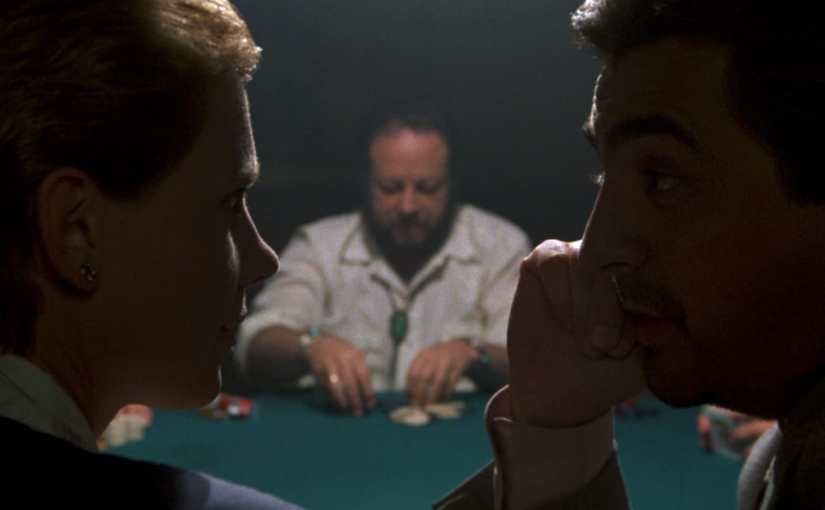
House Of Games plays like an instructional or “how to” video demonstrating how to be a successful con artist.  Crouse portrays a psychiatrist with a best-selling book titled “Driven” that focuses on obsessive behaviors.  One of her clients reveals that his compulsive gambling habits have put him $25,000 in debt with a card shark.  Crouse takes it upon herself to confront the card shark (Mantegna) on behalf of her frightened client.  Shortly thereafter, he’s got her acting as his wife to determine if the guy at the other end of a poker table is bluffing.  Then he’s introducing her to his con artist buddies, and she is becoming enamored, not only with him, but with the art of the con and the steal.  Her mundane life gives her the urge to see more.

The other Unpaid Critic, Miguel, recently reviewed this picture.  At the time of this writing, I have not read his review, but he forewarned me that the performances are stripped down to nothing.  Mantegna and Crouse are left bare to just delivering Mamet’s dialogue.  Miguel hadn’t liked this film the first time he saw it many years ago.  On my first viewing, this past week, I was engrossed.  However, I could foresee the ending as quickly as the film began.  I dunno.  Maybe it’s because I’ve seen several con artist films before like The Grifters and the granddaddy of them all, The Sting.  Films that focus on the best liars seem to always move towards a twist where even the viewer is scammed.  It’s fun to participate in the activity.

With House Of Games, the sequence of events move step by step.  Following the two characters’ introductions to each other, Mantegna is caught in the middle of doing another con but now he’s reluctantly forced to include Crouse in on the game.  This time it is seemingly much more complex and grander than the first time they worked together at the poker table.  It also gets all the more confusing when an unexpected murder is involved.  This con spells out a long night for the couple who are also falling for one another. 

Miguel is right.  The performances are most definitely stripped down and often the dialogue is wooden.  Crouse and Mantegna are deliberately flat.  I don’t even think they laugh or smile if I remember correctly.  It is likely because Mamet wants the viewers to follow along and pick up on how a successful con job is meticulous in its methods.  A con artist is not going to make waves with loud, angry monologues or passionate seductions and outrageous silliness.  What’s important is that everything that plays out seems convincing with no distractions that lead to doubt.  So, when the only African American in the cast (extras included) leaves a key on a hotel counter, you notice it.  It happened for a reason.  Later, when the characters come upon a BRIGHT RED Cadillac convertible, you are going to remember it.  A Swiss army knife with tropical artwork on the handle.  A gun metal briefcase with a large amount of cash.  A gun.  A murder.  Props and scenarios guide Mamet’s picture. Not the characters. 

Fortunately, the film remains very engaging.  As well, while I could figure out what was being played here during the entire course of the picture, as a viewer I had no choice but to feel proud of myself for uncovering the puzzles and riddles at play.  For me, watching House Of Games was like answering “Final Jeopardy” correctly when none of the contestants on screen had a clue. At least I was smiling by the end.

HOUSE OF GAMES (1987)

by Miguel E. Rodriguez

Director: David Mamet
Cast: Lindsay Crouse, Joe Mantegna, J.T. Walsh, Ricky Jay
My Rating: 8/10
Rotten Tomatometer: 96%

PLOT: A psychiatrist is led by a smooth-talking grifter into the shadowy but compelling world of stings, scams, and con men.


I’m sitting here trying to figure out how to summarize the story of David Mamet’s House of Games without giving away plot points, and it’s virtually impossible.  Mamet’s screenplay is composed almost entirely of double-crosses, triple-crosses, short cons, long cons, and the kinds of surprises that are greatly diminished in their description.  Remove one surprise, and the whole thing collapses like a house of cards.

A distinguished psychiatrist, Margaret Ford (Lindsay Crouse) pays a visit to a handsome con artist, Mike (Joe Mantegna), on behalf of one of her clients, who is distraught because of how much money he owes to Mike.  Dr. Ford is unexpectedly intrigued by Mike’s business methods, Mike senses this, and takes her to a back room where he and some other gentlemen are playing poker.

(These men don’t talk much, but when they do, it’s almost exclusively in poker patter.  “A man with style is a man who can smile.”  “Damn cards are as cold as ice.”  “The man says you gotta give action to get action.”  “Everybody stays, everybody pays.”  It’s like they learned how to talk from watching endless episodes of the World Series of Poker on ESPN2.)

Mike makes a deal with Margaret: if she helps him beat the hot player (Ricky Jay) at the table, he’ll tear up her patient’s marker.  The hot player has a tell when he’s bluffing.  Mike will go to the restroom.  If the hot player shows the tell, Margaret will tell Mike, and Mike will beat him because he’ll know he’s bluffing.  Mike goes to the bathroom, the hot player reveals his tell, and Margaret tells Mike when he comes back.  The hot player raises the pot, but Mike can’t cover it.  Margaret comes to the rescue: she’ll stake Mike with her own money.  But, uh oh, turns out the hot player wasn’t bluffing…and now Margaret owes $6,000 to a total stranger.

And that’s where I have to stop. If you think I’ve given too much away, you’ve got to trust me – I haven’t.  That’s barely the preface.  What follows is a character study of a woman who suddenly realizes that, after a lifetime of helping patients, she needs some kind of release, a change in routine.  Mike can provide this much-needed change.  The fact that it involves conning innocent people out of their hard-earned money is incidental.

Her fascination lies in Mike’s method.  For a great con to work, you can’t take someone’s money.  They have to give it to you.  They have to trust you to do the right thing.  The trick is working out how to gain the other person’s confidence without them realizing what’s happening.  We are shown two or three examples, and they’re all brilliantly sneaky.  At one point, Mike tells Margaret the cardinal rule of the con: “Don’t trust nobody.”  After watching this movie, I can’t say I agree 100% with this credo, but a healthy dose of skepticism never hurt anybody.

So how does Margaret square that credo, or anything about Mike’s lifestyle, with her profession?  She helps people for a living.  Her livelihood depends on getting strangers to trust her, but not to take their money…although let’s not forget she is well paid for her services.  Is her fascination with Mike an acknowledgement of the similarities between the two of them?

The screenplay doesn’t provide easy answers.  When we get to the final shot of the film, we can clearly see the choices Margaret has made, but it’s still unclear as to why she made them.  This is one of those movies where the complexities only really come alive during lively discussions afterwards.

Before watching it for this review, the last time I had seen House of Games was over thirty years ago.  At the time, I was unimpressed.  I originally gave it a 2 out of 10 on the IMDb website.  It was slow, the actors looked like they were giving bad performances, and nobody talked like real people talked.

Since then, I’ve had the opportunity to see not one, but three films by a French director named Robert Bresson.  (Bear with me here, I do have a point.)  Bresson, who was active mainly in the ‘50s and ‘60s, was famous for his method of shooting scenes over and over again, take after take, until all emotions had been drained from the actor.  His philosophy, in a nutshell, was that, in a film, the story isn’t everything, it’s the only thing.  If a screenplay couldn’t carry an emotional impact just by virtue of the story alone, if he had to rely on someone’s specific performance to make the movie work, he wasn’t interested.  The results are films that are curiously compelling, despite their utter lack of anything modern audiences might recognize as a typical acting performance.  His films are routinely included on the most prestigious lists of greatest films ever made; seven of them made it onto the 2012 critics’ poll by Sight & Sound magazine, a feat unequaled by any other director.

Sitting down to watch House of Games for the first time in three decades, after having seen Bresson’s films for the first time, I think I see what David Mamet was going for, in this, his directorial debut.  The actors aren’t quite dead-panning the entire time, but their performances (with one or two necessary exceptions) are pared down to the bare minimum of emotion.  Vocally, they’re angry, curious, flirtatious, what have you.  Facially, they’re ciphers.  Which, if you’re a good con man, that’s exactly what you want to be: a blank slate for the unlucky mark to interact with, then forget immediately.

I think back to those poker players and their mournful aphorisms, always said in nearly monotone.  And then I think to the film’s finale when Margaret believes she might be able to turn the tables on Mike (long story), and as the frantic words come out of her mouth, there’s not a smidgen of emotion on her face.  Like…a poker player.  Neat.