RAMBO: FIRST BLOOD PART II

By Marc S. Sanders

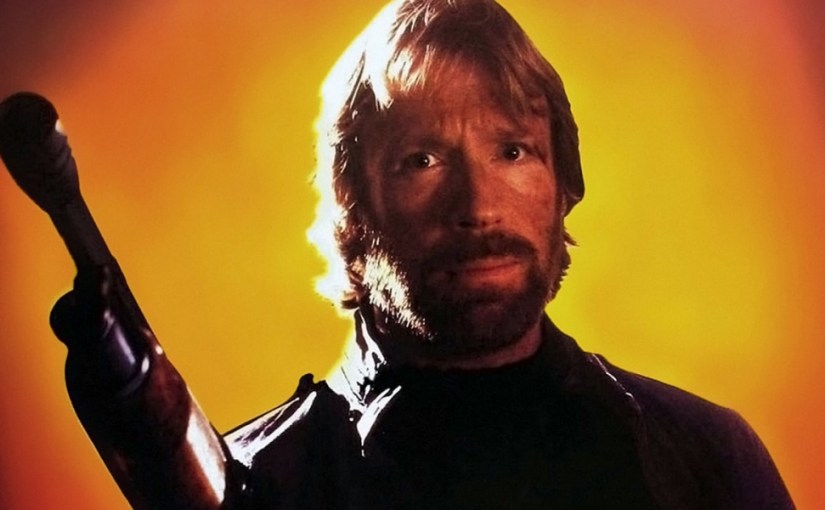
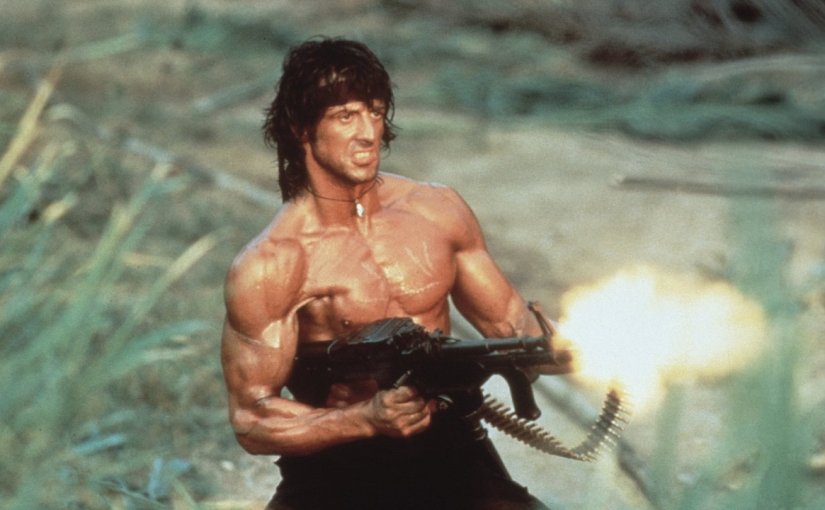
David Morrell’s literary character Rambo (no first name in the book, First Blood) cinematically survived his first post Vietnam adventure to spill buckets of bloodshed for many more follow ups.  Sylvester Stallone hit box office gold when he signed up for Rambo: First Blood Part II.  The Vietnam War was long over leaving an endless supply of storyline threads for Hollywood.  Who better to go back there with a ripped upper torso, a bow and arrow, a bayonet knife that won’t carve your steak but will hack up the cow, and a lot of firepower?

Green Beret John Rambo is specially recruited by his former C.O., Colonel Trautman (Richard Crenna) for a solo mission into a Viet Cong camp where American POWs might be held captive.  He’s got thirty-six hours to get in and out.  There’s a catch though.  A mercenary led operative named Murdock (Charles Napier), who hides behind a desk, a white collar and necktie specifically instructs Rambo to only survey the area and take photographs.  Under no circumstances is he to engage the enemy or escort any prisoners back to his rendezvous point.  Thing is that Rambo is not much of a photographer.  

James Cameron is credited as one of the screenwriters and apparently Stallone modified the script from there.  This bloody sequel is entertaining but I always found it a little mundane despite all the action.  

Just as the movie is about to grow a brain and intelligently debate with itself about how so many American soldiers were disregarded following the war, it stops talking and only resorts to one action set up after another.  Crenna and Napier potentially engage in a worthy debate focusing on government mistrust and moral servitude before the moment is cut short.  Trautman is the easily assumed ally of Rambo.  Murdock is the antagonist, but truly I have to ask why.  What is the motivation not to side with Rambo’s efforts to literally rescue half a dozen abandoned soldiers?  First Blood Part II cuts the argument short and never returns to settle the discord. 

There is perhaps only 5 or 6 lines in the last forty-five minutes of the picture.  There’s a melodramatic closing monologue from Stallone’s morose character.  Otherwise, this movie would prefer not to think.  Sadly, there is a lot to consider here, but the explosives and machine-gunning filibuster, insisting on holding the floor.

The action is categorized in a series of episodes.  A five minute section offers a variety of ways Rambo covertly takes out Russian military soldiers who are maintaining a stronghold with the Viet Cong.  It’s clever how one guy is taken by surprise when a mud caked Rambo guts him with his knife.  For another stooge, he’s literally sucked away into the mouth of a cavern.  You don’t even see Rambo.  How does the hero get around with enough time to set up these sophisticated traps?  This is all cool to look at but I would have liked to have learned more about how the Russian General (Steven Berkoff) formed an alliance with the Vietnamese.

Later, Rambo uses his endless supply of arrows to blow away acres and acres of marsh and tall grass.  I buy one man army tropes in movies.  Yet, I still question how a guy on two feet can set ablaze the equivalent of five football fields worth of territory.  How does he always manage to get in range? 

A war copter hovers over a river.  The henchman riddles the surface with bullets, and Rambo LEAPS from the depths INTO the chopper.  I mean he flies up like Superman.  Another moment has him submerged and then he pops out of the water with perfect aim to mow down a mob of men.  How did he know where to shoot?

I guess all of this is entertaining.  I just don’t relish it like I’m expected to because I’m asking too many “how does he…” questions.  My suspension of disbelief doesn’t have a high level of tolerance for what Rambo is apparently capable of.  David Morrell’s character was somehow blessed with superpowers, practically!  

With Rambo serving our country, how in the hell did we ever lose the Vietnam War? Seems damn near impossible.

First Blood embraced a common problem with veterans who were disregarded by the institutions they swore to defend and serve.  It’s a terrible blemish on our country’s patriotism.  An awareness was offered in that film amid all of the believably capable action scenes.  Part II clearly shows a lack of concern.  POWs get rescued but they are not even given an opportunity to reflect and speak.  Their bearded and malnourished figures speak for them in close ups.  I didn’t think enough was delivered for any semblance of a message that was asking to be heard.  Instead, we get a Stallone showing off a bronze, ripped chest, red bandana and a slew sophisticated weaponry. Rambo looks sexy here, and that does not sit right with me.

I can rewatch Rambo: First Blood Part II.  I just can’t feel for any of it.  I think I was entitled though.  Moreover, those that served in this awful conflict are deserving of a product that would better honor their sacrifices.

THE PURPLE ROSE OF CAIRO (1985)

by Miguel E. Rodriguez

DIRECTOR: Woody Allen
CAST: Mia Farrow, Jeff Daniels, Danny Aiello, Dianne Wiest, and…Jeff Daniels
MY RATING: 10/10
ROTTEN TOMATOMETER: 93% Fresh

PLOT: In 1935 New Jersey, a movie character walks off the screen and into the real-world life of a lonely, unhappily married woman.


I can imagine that it would be absurdly easy to poke holes in The Purple Rose of Cairo.  The premise is outlandish, taking place in the real world but firmly in the realm of fantasy.  It stretches the suspension of disbelief to the breaking point, then goes a little further.  It asks the audience member to forget cynicism and snark for eighty-two minutes and give in to the kind of hopeless romanticism that exists only on the movie screen.  And then, amid all that glorious make-believe, it abruptly confronts you with the knowledge that, yes, this kind of thing really does only happen in the movies, and the real world can be messy and unforgiving and sad.  Yes…but at our lowest points, we can always turn to Fred and Ginger, and Bogey and Bacall, and Luke and Leia, and Gene Kelly, and Hogwarts and the Emerald City.  The Purple Rose of Cairo reminds us that the movies allow us to escape reality for an hour or three.  Sign me up.

This movie’s plot is the embodiment of the “high-concept pitch.”  What if a movie character walked off the movie screen and tried to live in the real world?  I don’t have any statistics to support this, but I’m pretty sure there are at least 18,337 other films with variations of this fish-out-of-water scenario, most memorably Splash, Last Action Hero, and Who Framed Roger Rabbit.

In this version, Mia Farrow plays Cecilia, a semi-depressed housewife in 1935 New Jersey, living in a small town still in the grips of the Great Depression.  Her husband, Monk (Danny Aiello), claims he’s looking for work, but we only ever see him pitching pennies with his buddies or making life miserable for Cecilia at home.  Her wages from her waitressing job go directly to rent and groceries, and anything left over goes to Monk.  Amid this bleakness, Cecilia goes to see the new film opening at the local theater, The Purple Rose of Cairo, starring a dashingly handsome actor named Gil Shepherd in the supporting role of archaeologist Tom Baxter (both roles played by a young Jeff Daniels).  She is swept away by the glitter, glamour, and romance of the film.

Imagine her surprise when, during one of the many screenings she attends, Tom Baxter abruptly stops mid-sentence, breaks the fourth wall, and speaks directly to Cecilia from up on the screen.  “My God, you must really love this picture…I gotta speak to you.”  And he simply walks off the screen, much to the consternation of the movie audience, and walks out of the theater, arm in arm with Cecilia.  The wit with which Woody Allen handles the reactions of the audience AND the movie characters Tom leaves behind is priceless.  The characters and the real people react with perfect logic, so the effect is not one of slapstick (I can see an Adam Sandler version of this movie beating the joke to death), but one of a strange mixture of high and low comedy.  To relate the scenes here word for word would ruin the magic.  (An African-American maid steals every scene she’s in.)  Tom and Cecilia go off together, and the rest of the film is, from a plot perspective, fairly predictable.

What makes this movie unique is how it tells the story.  Tom knows what an amusement park is, but he has no clue what popcorn tastes like.  (“Been watching people eat it for all those performances.  When they rattle those bags, though, that’s annoying.”)  He has fallen instantly in love with Cecilia…love at first sight.  Tom hides in the city, and Cecilia lies to Monk to go back and see Tom the next night.  A nice touch comes when calls start coming in to RKO that the Tom Baxter character in prints being shown in other cities is also trying to escape his gilded silver-screen cage.  (“He almost made it in Detroit.”)  There’s the inevitable showdown between Tom and Monk.  Tom only knows the moves he uses on film, but Monk fights dirty.  However, the fight still doesn’t end quite as I expected…another nice touch.

The real crisis occurs when the studio calls in Gil Shepherd, the actor who PLAYS Tom Baxter, to New Jersey so he can try to wrangle his creation back into the movie where he belongs.  There is the expected confusion when Cecilia bumps into Gil, mistaking him for Tom.  The plot thickens even more when Gil starts falling in love with Cecilia herself, and she finds herself in a pickle.  She tells Gil, “I just met a wonderful new man.  He’s fictional, but you can’t have everything.”

The commentary being made here regarding our fascination with movie characters (and the movies themselves) as opposed to the actors who play them seems simple, but in trying to analyze it like a “real” critic, I feel helpless in the face of the ingenuity of the situation.  My words aren’t doing justice to the almost poetic elegance on display.  The more you love movies, the more you’ll appreciate what I’m desperately trying to convey.

There are two moments/sequences that elevate The Purple Rose of Cairo from a dramatic exercise into the realm of genuine movie magic.  One is when Tom wants to show Cecilia a night on the town, but they have no money (Cecilia is broke, and all of Tom’s movie money is fake).  But he remembers that, in the “fake” Purple Rose movie, the scene coming up after the one he abandoned takes all the characters to the Copacabana.  It’s here that the viewer simply must suspend what little disbelief remains and give in to the simple but grand gesture of watching Cecilia herself appear on the black-and-white screen with all of the people she’s been watching night after night.  They go to the Copa, and after watching the singer who’s supposed to be Tom Baxter’s love interest, Tom and Cecilia head out for a night on the town, as only 1930’s movies could provide.  (The maĂ®tre d’ provides one of the movies biggest laughs when he suddenly realizes he can do whatever he wants…and does.)

But the greatest moment is the very ending, which I will try desperately not to spoil here.  It’s here where we get to the heart of what Woody Allen is really trying to say: The movies are here and real life is there, and never the twain shall meet.  Is this a depressing point of view?  Well, I mean…yeah, a little.  But it’s also indisputably true.  If we walked around like we were actually in a movie, we’d never lock our doors behind us when we walked into our apartment.  Everyone’s phone numbers would begin with “555”.  We’d turn on the light when answering the phone at night (who does that, really?).  But in the real world, none of that is true.  In the real world, hearts get broken, sometimes for good.  We get fired.  People die.  WE die.  Love the movies, Allen is saying, but never forget that you’re flesh and bone, and that actions have consequences.  I’m reminded of a good line from Ready Player One: “As terrifying and painful as reality can be, it’s also the only place that you can get a decent meal.”

The final shot of the movie, of Cecilia smiling through her tears, moved me like I’ve rarely been moved before.  It reminded me, perversely, of some of the worst times in my life because it was at those dark times that the movies came to my aid.  I went through a fair episode of depression in my twenties; a friend showed me Harold and Maude, and it literally changed my life.  During the Covid lockdown, I was furloughed, and the maddening Florida unemployment website sapped my will to live, figuratively speaking; my best friend, out of the blue, bought me a copy of Star Wars: The Rise of Skywalker just to cheer me up…and it did.  During that same period, several different films were in constant rotation in my movie room, all of which provided spectacular ways of escaping real life: Blade Runner 2049, Prometheus, The Martian, Interstellar, Gravity, and Sunshine [2007].  Not all laugh riots, to be sure, but they were excellent tonics against the constant worry of unemployment and disease.

And in 2017, Hurricane Irma threatened Florida.  For the first time, I was genuinely frightened that we would finally see real danger from a hurricane.  Miraculously, a local multiplex chose to stay open until almost the eleventh hour, and to get our minds off the approaching storm, I took my girlfriend to see the new remake of Stephen King’s It.  For two hours, we got scared out of our wits in the best way possible.  We escaped reality, and collectively we had our real-world fears literally exorcised.  I cannot tell you how grateful we were to have that brief respite from our troubles.

Those are the memories that came back to me in the final sequence of The Purple Rose of Cairo.  Yes, the real world is still the only place to get a decent meal, and it remains imperfect and sometimes painful.  But the movies are as close as a button click or a car ride.  They’re implausible and sometimes unrealistic and not always perfectly written.  But The Purple Rose of Cairo just wants to remind us of their power to cheer us up and transport us.

THE MEAN SEASON

By Marc S. Sanders

I get caught up in movies focused on serial killers.  As an actor, I imagine it must be fun to portray a deranged psychopath like Norman Bates or Hannibal Lector, or maybe even John Doe from Seven.  On the other hand, maybe not because an effective screenplay needs to be nearby.

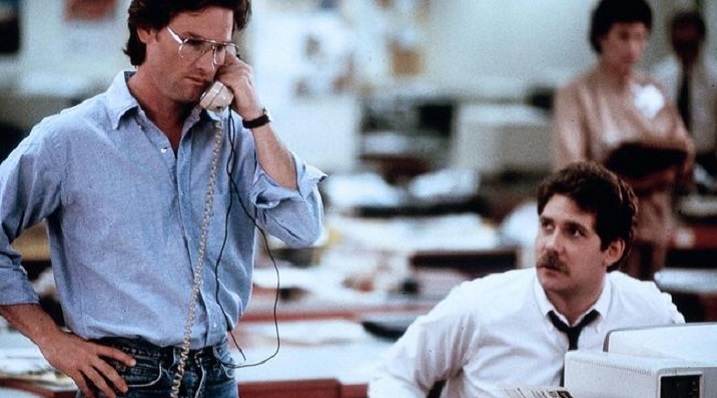
The Mean Season from 1985 has an effective premise but that’s where the positives of the picture stop.  Kurt Russell portrays Malcolm Anderson, a burnt-out reporter for the The Miami Journal.  He is the paper’s most reputable writer but just as he is ready to resign and move to Colorado with his loving girlfriend, Christine (Mariel Hemingway), he’s tasked with writing an article about the murder of a teenage girl on the beach.  Soon after, he’s getting phone calls from the killer himself, played by Richard Jordan whose face is concealed through most of the film by his hand holding a telephone.  The killer insists on only maintaining communication with Malcolm and no one else, especially not the cops.  He relays that the city of Miami can expect four more murders.

The title of the film stems from south Florida’s well known weather variations that occur at the start of hurricane season, primarily in July.  That does nothing for me, but the title alone sounds marketable enough for a thriller.  Almost sounds like a Stephen King novel.  The Mean Season!!!!!  Unfortunately, that’s all that this movie has to rely on, even if Kurt Russell is doing his best like he always does in better suspense movies like Unlawful Entry and Breakdown.

The fault with The Mean Season resides with the director’s amateurish approaches.  Fifteen minutes into the film, with the story hardly in motion, a nude Christine is taking a shower.  The haunting music begins and suddenly the shower curtain is pulled for Malcolm to deliberately startle his girlfriend.  So, we have the Psycho salute.  Check!  Later, following an argument between the two lovers, Malcolm gets in his car and is startled by Christine coming up from behind in the backseat. Ha!!!! Okay and there’s the Halloween nod.  Another check!  I bet these cheap tactics were not even written in the script.  Director Phillip Borsos (never heard of this guy before; doesn’t surprise me) must be so insecure in his skills behind a camera that he just goes for duplicative tripe.

Threats to the couple elevate as the film moves on and when Malcolm gets wind of Christine being in danger, he’s in his Mustang racing to her.  The cops (Andy Garcia, Richard Bradford) are right behind him, and no one thinks of summoning a squad car to where Christine is expected to be?  Of course not.  If they did, then we wouldn’t be treated to a clumsy sequence where an elevated bridge gets in Kurt Russell’s way forcing him to make a leap across the gap and come down on the steep other side and continue his foot race.  Kurt Russell really looks stupid in this moment, and I’m sure he was thinking I can not believe I agreed to this.

As with any of these movies, there is a just when you think the bad guy is dead, there he is again.  No wonder we didn’t get a long enough closeup on the corpse found in the dense Everglades.  However, we get treated to seeing a long, meaningless sequence of Kurt Russell being a passenger on a swamp buggy.  Big deal.  Does this enhance any kind of suspense?  Does it move the story along?  The director got access to a couple of swamp buggies and a day of shooting in the Everglades and said we gotta get this in here.

The final fight is as moronic as the rest of the picture.  Richard Jordan and Kurt Russell are going at it in the living room while a hurricane rages outside.  Mariel Hemingway just sits on the sofa and watches.  She just watches.  She doesn’t reach for a kitchen knife or a vase to smash on the bad guy’s head and help her poor boyfriend.  We just get a sad excuse of a damsel who is not in distress. 

Thankfully, Kurt Russell’s career survived this junk of standard jump scares and shortness on intellect. 

As I’ve said before in other columns, there was a better movie here.  There could have been a movie that explored the endless hours that an investigative reporter must endure.  His editor and photographer (Richard Masur, Joe Pantoliano) could have shared the heightened fear and suspense.  The cops on the case could have applied more pressure and/or assistance to the reporter.  They don’t even tap his phone to trace where the calls are coming from.  In 1985, I think they already had the technology to do that.  A tape recorder was used though, and the audience not only gets to listen to the conversations once as they are happening but then again as the characters listen to the tape.  Why?  Is there something I missed the first time I heard Kurt Russell say hello?  This is filler crap. 

A better movie would have pursued what motivates this killer we hardly get to know.  We should have learned more about this guy because he’s the one making the phone calls.  So, it is obvious he wants to be heard.  However, the guy has nothing to say of any significance.  Even a psychologist who’s recruited for one scene doesn’t make any observation that gives me, or the characters in the film, pause. 

The Mean Season is an “I got it!” film.  It’s where the director gets his big break and declares “I’ve got it!!!!  We’ll do Psycho and then we’ll do Halloween.  Gotta make sure we see Marial Hemingway topless.  That’s definitely at the top of the list. Oh yeah, and then we’ll get swamp buggies and can we get some wind and rain machines for a really, really, really mean—I mean very mean—season!”

THE LEGEND OF BILLIE JEAN

By Marc S. Sanders

Growing up as a teenager, in the dog days of summer, and living in a new town with few friends at the time allowed a lot of binge watching of movies on Showtime.  Top Gun must have been shown twelve times a day.  So was Back To School.  The other movie on constant repeat was The Legend Of Billie Jean – a movie of few merits and yet the heroic sweep of the fugitive rebel on the run with her trailer park gal pals and her little brother was addicting.  It’s a brisk ninety-minute film, but each time I’d watch the movie it felt like the title character raised even more awareness and support for her cause than the last time I watched, which was likely four hours earlier in the day, during breakfast.

Helen Slater is Billie Jean.  Her younger brother is Binx played by Christian Slater, in his first film.  NO RELATION!!!! 

Under a hot sun-drenched setting in Corpus Christie, Texas, the siblings are bullied by Hubie (Barry Tubb).  Binx gets beat up.  Even worse, his shiny maroon motor scooter is stolen and trashed.  When Billie Jean approaches the bully’s father, Mr. Pyatt (Richard Bradford), to collect the six hundred dollars for the cost of the bike, she narrowly escapes a rape after Binx shoots the scumbag in the shoulder.  Now the kids are on the run with Ophelia and Putter (Martha Gehman and Yeardley Smith – eventual voice of Lisa Simpson).

A firestorm starts to spread with a loyal underground following for Billie Jean and her band, and they receive assistance from the District Attorney’s (Dean Stockwell) son Lloyd, played by Keith Gordon.  The cop on their trail is played by Peter Coyote.  Wait!  I’m not being fair.  This cop is never on their trail.  Somehow every kid in the state of Texas can find and help Billie Jean, except the cops.  Even with the DA’s son in tow, these fugitives cannot be located by one single, solitary police cruiser.  Yet, the kids on the playgrounds make no effort to find Billie Jean, Binx and the others.  Yes.  You shake your head at the whole thing.  When you are age fourteen though, you get caught up with Helen Slater, one of your first celebrity crushes, and the accompanying soundtrack of Pat Benatar’s rebellious anthem “Invincible.”

The Legend Of Billie Jean is a stupid movie.  I don’t think anyone can argue with me.  I mean think about this for a second.  Peter Coyote’s cop finds their getaway car with Putter and Ophelia.  Still, he doesn’t choose to search the vehicle for a significant clue to the hero’s whereabouts until the next day.  Isn’t this sloppy investigative fieldwork?  As well, during the climax a brushfire is started by Billie Jean and no one runs or calls for a firetruck.  The DA, the cops, the kids – they all just stand there watching in deep thought like they were directed.  I can only imagine the director with his megaphone yelling out the command to stare straight ahead at the growing flames.  Mind you, this isn’t a control burn firepit.  This is a BRUSH FIRE with hay and wood and clothes as accelerants.

Nevertheless, the movie is an only slightly embarrassing guilty pleasure.  It’s not as hokey as it looks on the surface.  The acting isn’t terrible because the young cast is embracing the absurdity of the whole situation.  It stands, albeit wobbly, on the same plotline of an eventual and exceedingly better film called Thelma & Louise.  More importantly, Helen Slater makes for a good lead role and heroine.  When she tells Mr. Pyatt “No,” and cries her anthem of “Fair is fair” you root for her.  Slater’s performance is far grander than the script she is working with. 

The Legend Of Billie Jean performs like an afterschool special without dubbing out the cursing. The cause of these kids’ plight enhances as the film progresses.  What starts out as a simple bullying story and a demand for monetary damages of only six hundred dollars turns into a fight for respect and honor from the adult males within a small, southern local community.  However, there is little to feel inspired by, and I’m afraid Billie Jean’s supposed legend unfolds into only a slightly miniscule smidgen of Legendary

MISHIMA: A LIFE IN FOUR CHAPTERS (1985)

by Miguel E. Rodriguez

DIRECTOR: Paul Schrader
CAST: Ken Ogata, and a host of Japanese actors unknown to me
MY RATING: 8/10
ROTTEN TOMATOMETER: 79% Fresh

PLOT: Director Paul Schrader and executive producers George Lucas and Francis Ford Coppola present a fictionalized account of the life and shocking death of celebrated Japanese writer Yukio Mishima.


It’s hard for me to know where to start with this review.  I had heard of Mishima: A Life in Four Chapters by reputation for years, mostly because of Roger Ebert’s rave review and also the film’s inclusion in the Criterion Collection AND in the invaluable compendium 1,001 Movies You Must See Before You Die (ed. Steven Jay Schneider).  I finally got a chance to watch Mishima recently, and in my opinion, if it does not quite succeed as Entertainment, I believe it is worthy of consideration as a genuinely artistic achievement.  Mishima is an elegant rebuttal to anyone who doesn’t believe cinema can be Art.

The lives of artists are notoriously difficult to translate to film, especially when it comes to the life of a writer.  Who wants to watch two hours of an author typing, in a fit of inspiration?  Paul Schrader came up with a rather brilliant method of getting over that hurdle by breaking up Mishima’s life story into four distinct acts, with each act featuring three separate storylines that coil around each other: the last day of Mishima’s life, flashbacks to Mishima’s earlier years, and scenes from his semi-autobiographical books that parallel events from those flashbacks.

If that sounds confusing, it’s not.  Each story thread has its own easily distinguishable color scheme.  If it’s black-and-white, it’s a flashback to Mishima’s real life.  If there is muted color and a mostly hand-held camera, we’re watching the events of his last day on earth.  If the colors are brilliant and saturated, we’re watching a scene from one his books.

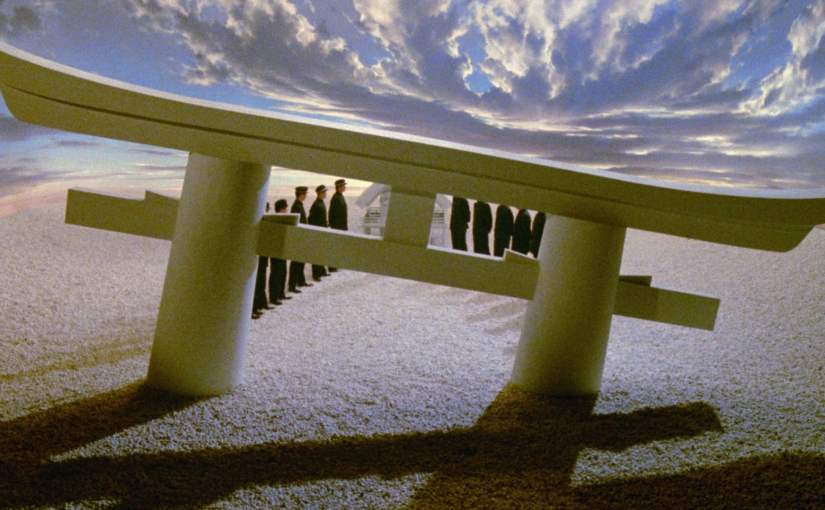
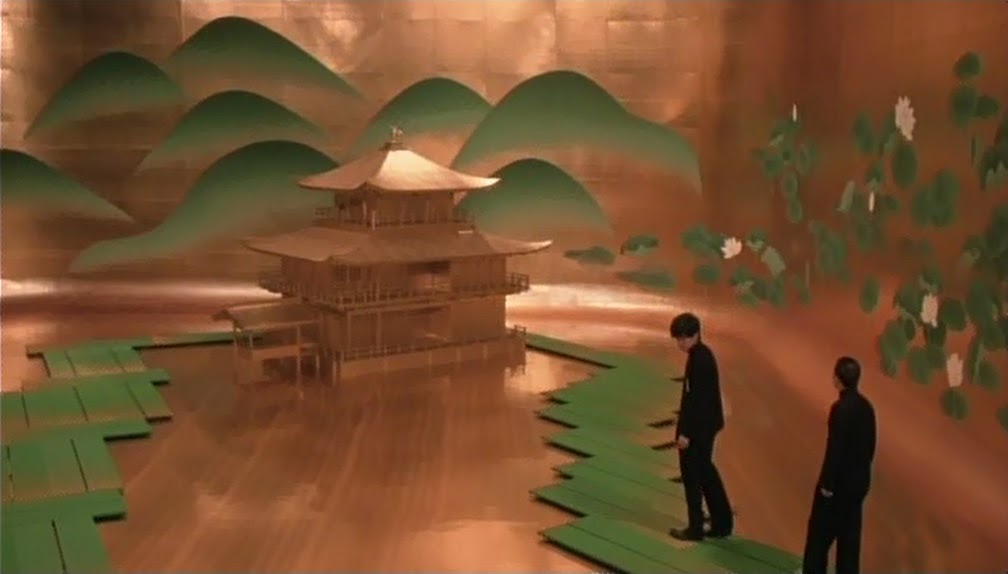
What sets Mishima apart are those sequences featuring scenes from his books…and right about here is where my powers of description may fail me, but I’ll try anyway.)  It would be easy to just call them dreamlike, but that’s both true and reductive.  To me, they look like a cross-between highly stylized opera and a David Lynch film.  In the first segment, based on Mishima’s Temple of the Golden Pavilion, the set was built with lavish golden walls and accented with green lily pads, while the temple itself is a detailed miniature that at one point splits down the middle.  The second segment, based on Kyoko’s House, is awash in garish pink lights and walls (production designer and Oscar winner Eiko Ishioka describes the scene as being highly informed by American “bad taste”…trust me, she means it in a good way).  The third segment is only slightly more realistic than the first two, with breakaway walls, representational jail cells, and a ritual act that is echoed in Mishima’s real life.

Each segment is not just visually cool to look at; they are also extremely theatrical.  In one scene, we watch a wall get pulled away from a character lying on the ground, and we can clearly see the tracks on which the wall is rolling.  In another scene, a conversation at a roadside noodle stand is staged – literally on a stage – with the restaurant on a turntable turning clockwise, while groups of actors walk in a circle around the restaurant counter-clockwise.  The effect is both simple and convincing, despite its obvious theatricality. (In fact, the visual aspects of the film are solely responsible for taking this movie up from a “7” to an “8.”)

Those scenes by themselves are reason enough for me to recommend the film to viewers.  I am an unabashed fan of superhero films (the GOOD ones), but it seems as if we’re living in an age where, instead of finding different ways to tell the same story (which is bad enough), filmmakers are telling different stories, but doing it all the same way.  For example, I know, intellectually, that Black Widow and Shang-Chi were made by different directors, but is there anything in either movie that bears the imprint of their respective directors?  Nothing springs immediately to mind.  However, here is Mishima, a film that is nearly 40 years old, which may not feature countless CGI battles, but which gave me more visual surprises than any two Iron Man movies combined.  I don’t mean to pick on the MCU (which I do love, full disclosure), but you see what I’m saying.  It’s refreshing to come across a truly original work of art.

The film also asks some serious philosophical questions.  Throughout his life, Mishima believed in and advocated the bushido, which literally translates as “the way of the warrior.”  He was unashamedly right-wing, advocating the restoration of the Japanese Emperor to power, as opposed to Japan’s governmental policies of democracy and globalism.  In the film, he several times mentions “Harmony of Pen and Sword,” a philosophy in which one’s writings are nothing unless they are backed up by action.  Mishima espouses this belief so fiercely that he ruthlessly follows it to its logical conclusion in the closing passages of the film.

What is director Paul Schrader trying to tell us here?  Should we consider Mishima as a hero?  He is certainly one of Japan’s most famous and celebrated writers, but he remains controversial for his right-wing views.  (If you’re wondering how right-wing he was, in 1968 he wrote a play called “My Friend Hitler,” an event omitted from the film.)  Does Schrader consider him heroic for following through on his beliefs, even when it became, shall we say, EXTREMELY inconvenient for him to do so?

That could be one interpretation, but I don’t see it that way.  I came away from Mishima with the knowledge that, once, there lived a man who lived and died by a code.  I did not agree with his beliefs, but they were defiantly his, and no one could take that away from him.  I was reminded of one of my favorite lines from A Man for All Seasons: “But what matters to me is not whether it’s true or not, but that I believe it to be true, or rather not that I believe it, but that I believe it.”

At the end of the day, while I think Mishima’s moral stance was questionable, and while Mishima itself is less entertainment and more museum piece, the experience of watching Mishima was nevertheless time well spent, especially when considering the astonishing visuals.

(Oh, crap, I’ve gotten to the end of the review and just realized I never mentioned the phenomenal score by Philip Glass, parts of which are quoted at the finale of The Truman Show…if you’re a fan of the movie, you’ll know which parts I’m talking about.)

THE BREAKFAST CLUB

By Marc S. Sanders

The outcry of teen angst in the 1980s comes through predominantly in the dramatic talking piece called The Breakfast Club.  I look at the film as a mature interpretation of Charles Schultz’ Peanuts Gang actually, and maybe an extension of some of the themes found in Steven Spielberg’s E.T. The Extra-Terrestrial.  The children are heard.  The adults are present but are mostly muffled and out of consideration.  Writer/Director John Hughes wanted the five teenagers destined to occupy a Saturday in the school library for detention to completely undo their armor.  With adults in the way, kids can never truly be themselves.  Lies, exaggerations and attempts at acceptable image come first but as his script progresses, the teens are reduced to expressing how they value themselves and each other. 

Having grown up watching The Breakfast Club by myself on many Friday nights after some challenging weeks of school, I was always looking to sit on the floor with this pack and share my own demons and fears.  Sometimes it worked.  Sometimes I felt as if the brain (Anthony Michael Hall, as Brian), the athlete (Emilio Estevez as Andrew), the basket case (Ally Sheedy as Allison), the princess (Molly Ringwald as Claire) and the criminal (Judd Nelson as John) spoke back to me and told me when I was wrong or when I was justified for having felt like I did. 

Nearly forty years later, some of the thought processes the five endure of themselves seems outdated and inappropriate, however.  For example, in Hughes’ film the female characters are sexually harassed, harshly criticized and/or they succumb to stepping outside their comfort zone and changing their appearance to please a male character.  Had this film been released in a post Me Too era, I think both sides of the political aisle would protest its content.  The Breakfast Club is certainly a movie of its day where it’s treated as comedic escapism to have Nelson’s character commit a fellatio act upon Ringwald’s panty covered crotch.  Do not mistake me.  I am not crying foul and demanding censorship or calling for torches and pitchforks.  The contents of The Breakfast Club should certainly remain preserved and viewed upon as what was a mindset of films in the 1980s, and perhaps how the opposite sexes treated one another then.  Sadly, it is still happening all too often.

The success of the film relies upon the differences in the characters.  None of them have the same interests.  Yet, if you allow them to live among themselves without any outside influences, they will open up to one another.  Hughes’ film begins where the characters hardly speak.  John gets the ball rolling as the troublemaker looking for shock value as he attempts to urinate on the floor in front of the others and then succeeds in unifying the students when he causes the library door to remain shut keeping Mr. Vernon (Paul Gleason), the teacher/antagonist, out of reach of them.  Why should the five work together against Mr. Vernon?  They don’t know or have respect for each other.  Why?  Because one generation will stand arm and arm against another generation, specifically a domineering entity. 

Now that they are isolated, Hughes writes in set ups allowing the five to shed their skin.  In one scene, the ladies empty the contents of their purses while the men’s wallets are exposed.  John sleeps around.  Allison may be mentally ill.  Claire lives off the vanity that comes with makeup and perfumes.  Brian’s middle name is revealed.  (“Ralph, as in puke.”)  The kids lie about their sexual conquests only to be cornered into telling how little experience some of them actually have.  Maybe the most common plane they share are their home lives.  Each uncovers how they relate to their parents and none of them have an ideal upbringing.  Rather, they are disregarded or abused or forced into an appearance they really are not passionate about.  Before the film ends, the five will have their battle cry of dancing individually first, and then lined up together, unified, to a song titled, We Are Not Alone. 

Hughes even allows enough time and subtlety to demonstrate how Mr. Vernon seems to suffer.  There’s a quick moment, where Vernon commits John to two months of detention.  As Vernon storms out of the room, John screams out “Fuck You!” and Hughes keeps a closeup on Vernon letting out a weary sigh.  His exhaustion of being the authoritative adult is wearing on him.  Yet, after twenty-two years of teaching it is also the only pedestal he has left to stand on; to rule over five misfits on a boring isolated Saturday.  Later, he’ll only feel his most powerful when he has John imprisoned away from the others and he can antagonize and threaten him with the intent of elevating his stature over a punk kid.  (Ironically, this moment also reveals how weak John is and not the intimidating bully he holds himself to be in front of the others.)  Later, Vernon tells the janitor how he’ll have to worry about these kids growing up to look after him when he is elderly.  He’s been so occupied with being sadistically cruel, he has not allowed time to carve out a balanced future.

The Breakfast Club is an important piece to watch for uncovering teenage mentality and the subconsciousness.  How do teenagers function by themselves, with outsiders, with their peers, and with their parents?  What’s best celebrated in many of John Hughes’ films are when he allows his characters not to hinder how they truly regard one another.  While I won’t spoil how these five consider each other by the end of this particular Saturday, as an adult and one who analyzes story more carefully than I did at age fourteen, I am disappointed with how Hughes concludes his film.  At least for four of the characters, it doesn’t seem right.  While I’m let down though, that doesn’t mean the movie is wrong. 

Teenagers will not always act upon what is right or more precisely what they know to be right or just.  Our teenage years are an opportunity to commit and then learn from our mistakes.  In our adolescent years, we explore what is forbidden with misbehavior and risk whether it be rebelling against authority, daring to drink and do drugs, acting upon sexual impulse or exacting bullying and peer pressure.  Even sneaking through the hallways around school is a game of cat and mouse where the goal is not to get caught by the teacher.

I’m inclined to recommend that parents watch The Breakfast Club with their kids when they are mature enough for the material.  Yet, I really don’t want to.  The whole point of the film is to cut off these kids from the outside world of parents and teachers and peers who expect something different of them than how they truly see themselves.  If my daughter were to watch this movie with mom and dad sitting right next to her, then she might not unequivocally respond to what Andrew, Claire, Allison, Brian and John really have to say.  To get in their minds, my daughter would have to watch without any outside influence where the conversation she has with the film is private between The Breakfast Club and her.  Perhaps, then she’ll see another teenager’s honest point of view.

EXPLORERS (1985)

by Miguel E. Rodriguez

DIRECTOR: Joe Dante
CAST: Ethan Hawke, River Phoenix, Jason Presson, Robert Picardo, Dick Miller
MY RATING: 7/10
ROTTEN TOMATOMETER: 72% Fresh
Everyone’s a Critic Category: “Watch a Family-Friendly Film”

PLOT: Three friends try to unravel the mystery of these strange dreams they’ve all been having, at the same time.


I’m probably biased, but one of the best times to be a teenaged movie fan had to be the 1980s.  In the wake of his stupendous earlier successes, Steven Spielberg began to produce movies, letting other directors do the heavy lifting while he contributed behind the scenes.  This led to Gremlins, The Goonies, Young Sherlock Holmes, and of course, Back to the Future.  All in a two-year period.  Awesome.

In an attempt to replicate the success of these box-office favorites, director Joe Dante (The Howling, Gremlins) presented a film unabashedly aimed at its target audience, starring a cast of unknown, but immensely likable, teenagers, including two young men making their Hollywood debut: Ethan Hawke and a nerded-up River Phoenix.  While Explorers lacks the polish and sophistication of its predecessors, it is undeniably charming and, for a while at least, even a little spooky, even if the ending flies spectacularly off the rails.

Ben Crandall (Hawke) is a teenage kid obsessed with 1950s sci-fi movies.  He’s been having these strange dreams filled with what look like electrical schematics.  He draws these pictures as best he can and shows them to his best friend, Wolfgang (Phoenix), a science prodigy.  Ben also makes friends with Darren (Jason Presson), the stereotypical kid-from-the-wrong-side-of-the-tracks, and brings him along when Wolfgang decides to turn on the machine he built using Ben’s drawings.

What this machine eventually enables them to do is fly around inside a converted Tilt-a-Whirl car using an Apple II computer to steer.  (Did I mention this was made in 1985?)  One night, though, a phantom signal takes control of their little craft and starts sending it up, up, up…into space?  I wouldn’t dream of saying.

As a fourteen-year-old kid watching this movie, I strongly identified with the idea of receiving a message from space, not to mention being able to fly in a makeshift spaceship.  To say I envied those kids on screen is a monumental understatement.  Their dialogue may not have been as refined as it could have been, and the sub-plot about Ben’s crush on the “gorgeous blonde” in his class is a little ham-handed (not to mention that plot point never really goes anywhere), but I didn’t care.  SPACE, man!  Just imagine being able to go to SPACE!  What a bunch of lucky kids!

Well, naturally, after a couple of false starts, the three of them actually make it to space, where they have a close encounter of the…goofy kind.  If you’ve seen the movie, you know what I’m talking about.  You see, the aliens who were sending these schematics have been listening to and watching decades worth of TV signals.  So that’s how they communicate with our heroes.  Close Encounters it ain’t.  And the way these aliens look…any sense of wonder at being in space and communicating with an alien species gets torpedoed by the fact these guys look like a kid’s version of an alien.  Even Ben realizes something’s amiss when he says, “They don’t make any sense.”

So, yeah, Explorers is no Contact.  But let’s be fair, it was never meant to be.  Sure, it does kind of lead you down that garden path, but the final reels leave you in no doubt that this is sci-fi comedy, not drama.  It has not aged as well as its Spielberg-produced contemporaries.  But I watch it today, and I still get that little thrill of discovery when they turn that machine on for the first time.  And flying around in a spaceship that you built?  Who wouldn’t find that idea exciting?  Am I right?


QUESTIONS FROM EVERYONE’S A CRITIC

Which character were you most able to identify with or connect with?  In what way?
Shoot, are you kidding?  Ben, played by Ethan Hawke.  He was my age at the time.  Loved movies.  Loved sci-fi.  Wanted to be an astronaut.  Had a crush.  (Christine Day.  Went to my church.  Red hair.)  And also thought those aliens at the end made no sense.  Man, that was ME.

What elements do you feel are necessary to create an entertaining family-oriented film?  Do you feel this movie had those things?
Explorers has everything necessary to create an entertaining family-oriented film…in the first half.  The second half goes for easy laughs and cheapens what could have been something wondrous.  Alas.

THE GOONIES

By Marc S. Sanders

You know how there are some movies designed for that unexpected thunderous rainy, Saturday afternoon?  Maybe a Star Wars flick or an Indiana Jones.  James Bond or Marvel?  For me the best candidate is probably The Goonies, where the rascally kid in all of us comes alive, yearning for adventure like riding our bikes through the paths of the sleepy town we live in over to a hiding spot on the other side of the woods where a once long lost treasure map begins an unknown journey.  Quick on our tales though are the bad guys with the humped back, crooked nose and clicking revolver.

Richard Donner did more for The Goonies than I think a lot of people realize.  It’s no wonder to me that the film is officially inducted into the National Film Preservation Archives since 2017, the same year that pictures like Guess Who’s Coming To Dinner, Ace In The Hole and Titanic also received their recognition.  Maybe Donner had help from producer Steven Spielberg and screenwriter Chris Columbus.  Granted, ahead of the age of cell phone addiction, these guys knew how twelve and thirteen year old kids ticked.  The Goonies bond over insulting each other, shoving one another, telling each other to shut up and freely dropping the s-word.  It’s a rite of passage.  It’s how I bonded with my buddies at that age.  Heck, I still maintain contact with my best friend at the time, Scott, and we still trade barbs like that even if we live over a dozen states away from each other.

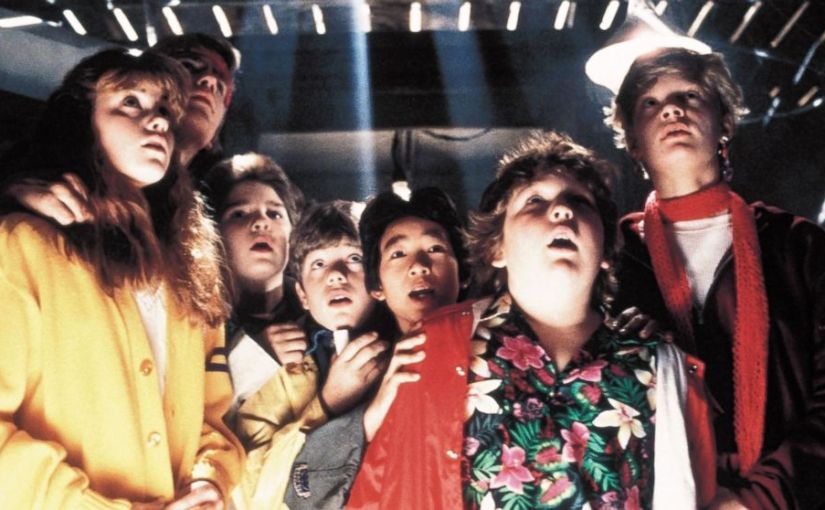
Sean Astin plays the asthmatic leader of the gang, named Mikey.  A son of actors Patty Duke and John Astin, he made his film debut with The Goonies, and I think it holds as one of the best child performances to grace a screen.  He’s such a genuine little guy, who is passionate about making any last ditch effort to save his house and home town from being bulldozed by greedy golf course developers.  On a rainy Saturday afternoon, Mikey’s buddies ritually come over to the house and with his older brother Brand (Josh Brolin, another celebrity son making his film debut) make their way into the attic and uncover a treasure map written by the infamous pirate from the 16th century, One Eyed Willie.  Soon after, Mikey along with Mouth, Data and Chunk (Corey Feldman, Ke Huy Quan and Jeff Cohen) embark on adventure that leads them to the underground caverns of an old restaurant off the Pacific coast.  Two high school girls, Andy and Stef (Kerri Green, Martha Plimpton) join the gang.  Andy and Brand have adorable puppy love crushes on each other. 

One Eyed Willie’s map supposedly leads to a treasure of enormous wealth that Mikey and the gang believe can save their small town of Astoria from being razed.  However, there are inventive booby traps along the way, and the nasty Fratelli brothers with their cranky old mother (Robert Davi, Joe Pantoliano and Anne Ramsey) are hot on their trail.  The Fratellis are straight out of those old Hardy Boys and Nancy Drew mysteries.  They are hilarious with their bickering, and scary at the same time. Anne Ramsey was a special kind of character actor with her ugly appearance and craggily voice. It eventually even got her an Oscar nomination (Throw Momma From The Train).  

We may know how the story will end up, but Donner, Spielberg and Columbus advance with one unpredictable scene after another.  Reader, when I feel the height of suspense in a film, I actually tear up and I get a very nervous laugh.  The shootout scenes in Heat (1995) and Lethal Weapon will do that to me every time.  The lightsaber dual in The Empire Strikes Back and the snake pit scene in Raiders Of The Lost Ark!!!!  I’ve been watching The Goonies since I was the age of most of these characters.  I still get this natural reaction when Andy has to play the correct notes on a skeletal piano to open a passageway.  Each time she plays the wrong note though, a tease of impending doom appears.  It works so well in the ensemble performance of the cast bellowing “Oh no!” and “Oh shit!” and “My God!” and “Hurry up!”  Edited with the quickly advancing villains getting closer, and the pulse beat music accompanied by composer Dave Grusin, and you are so caught up in their escapades now, that it feels like you are there.

All these kids become your best friend quickly.  Data is the inventor with the tripped out gadgets, inspired by James Bond, ready to set his own booby traps.  Mouth is the Spanish interpreter who gleefully causes trouble and mischief, but Feldman the actor is allowed some tender moments as well.  Jeff Cohen is like the Curly of The Three Stooges who gets sidetracked on his own adventure with a monstrous but loving, and sadly rejected son of the Fratellis.  A chained-up ghoul named Sloth (John Matuszak).  Cohen might have the best comedic moments in the film.  When I moonlight in Community Theater, I still must remind myself that just once I’d like to audition with his hysterical crying monologue where he confesses to stealing his uncle’s toupee to use as a beard to dress up as Abraham Lincoln, while another time he used fake vomit to sicken an entire movie house.  Hilarious stuff! 

There are dropping boulders, rattling pipes, a waterfall wishing well, scary skeletons, that creepy piano, and fun water slides to circumvent around One Eyed Willie’s maze onward to his legendary treasure aboard the most spectacular pirate ship ever seen.  Rarely are kid’s adventures constructed like this anymore.  I dunno.  Maybe it’s the script.  More likely, maybe it is the cast of kid actors doing one of the best ensemble performances together on screen.  Their timing could not be more perfect among the seven Goonies. 

The Goonies is a much more honest and transparent look at how kids behave with one another than you might find in a bleached-out Disney flick.  These kids get dirty and unsophisticated, yet thoughtful.  They are not age 21 playing age 14.  They don’t have fashionable haircuts and designer clothing. They are not pop singers trying to be actors.  Most importantly, the conversations among the gang are more natural in pal around rudeness.  You’re not really a friend unless you are telling the kid next to you to shut up and exclaiming “Oh shit!” when another encounter with danger lurks ahead. 

The Goonies is just a fun ride to watch over and over again. It succeeds with its own interpretation of The Little Rascals, and it’ll give you all the feels as you watch Mikey plead with One Eyed Willie for the next clue, or when he stops to remind his Goonies that there’s more at stake than just a play date on a Saturday afternoon. 

My advice is to keep the rose colored glasses off your children’s eyes.  Let them know it’s okay to get in trouble and make mischief.  Make sure your kids know they should be the best Goonies they can be.

CODE OF SILENCE

By Marc S. Sanders

I must admit I have not watched many Chuck Norris movies. Just a handful here or there like The Delta Force, but on my radar to catch was always the cop thriller from 1985, Code Of Silence. I always intended to watch it someday as the film is highly endorsed by Siskel & Ebert. As well, it’s directed by Andrew Davis, the skilled filmmaker who would go on to direct The Fugitive and Under Siege.

Code Of Silence works in two ways; two stories that live up to the title. Norris is a Chicago cop named Eddie Cusack who heads a squad of under covers within the city. The film opens with what is supposed to be a well-planned drug bust that goes wrong when the one mob faction is overrun by another mob. Cusack’s informant as well as others turn up dead just before his band were to move in with arrests. Nearby, two of Cusack’s men come upon a young, unarmed man. The rookie officer witnesses the elder officer accidentally shoot the kid, and afterwards he plants a pistol in his hand to make it look like self-defense.

Now Cusack has to contend with a mob war in the streets where a boss’ daughter (Molly Kagan) is the only survivor of an attack and he must protect her. While at the same time he has to deal with his squad turning on him because he knows what the elder cop really did. The code of silence motif is expected to be honored in both camps. Personal vendettas and violations of police policy need to remain quieted.

The film belongs to Norris exclusively. Andrew Davis allows some of the action star’s kickboxing skills to work their way into the movie, and it all becomes a sidestep dance routine really. It always amuses me in these action pictures where the star will take on twenty guys at once yet he fights one or only two of them at a time. The other eighteen or nineteen thugs wait their turn. Why not just have all of them tackle Norris all together? No. Then we wouldn’t get his outstretched 360-degree roundhouse kicks in the air.

There’s also an unnecessary cop robot contraption that Norris pilots for the climactic action packed ending. This thing looks a rejected auditioner for the role of Johnny 5 in Short Circuit. The robot must have been too tall for the part and rather clunky. It has no relevance to either storyline and was obviously inserted for fun, campy violence of fireballs and explosions in the necessary old, abandoned warehouse where all of these actioners have to take place.

Fortunately, Code Of Silence has good story material to work with, and some thrilling stunt work including Chuck Norris pursuing a bad guy on top of a moving elevated train that makes its way with an eventual leap into the river. From what I could tell, that was really Mr. Norris himself in that whole scene. Good footage here.

Andrew Davis relies on what would become regular side characters that appear in many of his other films including Ron Dean and Joseph Kosala. They always make for good cop antagonists within the Chicago settings of his films. Norris is also good in a quiet Clint Eastwood kind of manner as he holds his own beliefs against the rest of his department who support the elder cop.

I like the conflicts that happen on both sides of the law in Code Of Silence. Sure, it’s got some silliness to it with the kickboxing and the gigantic, cop robot that shamelessly waddles along, but the two stories hold up by keeping me engaged of their outcomes.

Code Of Silence is a pretty effective thriller.

COMMANDO

By Marc S. Sanders

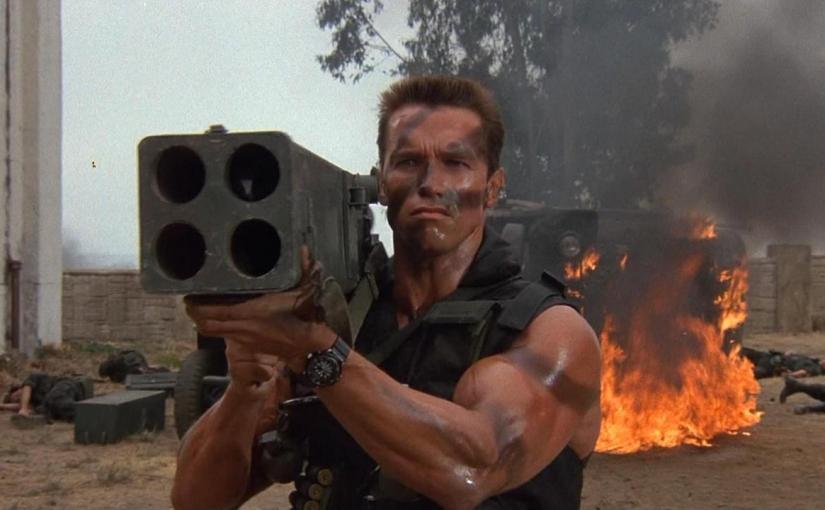
Colonel John Matrix (HUGE ACTION STAR NAME WITH MUSCLE AND BULK AND SWEAT AND…AND…MUSCLE, because this is Arnold Schwarzenegger) lives a quiet life in the beautiful nature the mountains have to offer him, along with his 11-year-old daughter Jenny Matrix (Alyssa Milano). SIDE BAR: Imagine roll call at elementary school and that name comes up, Matrix, Jennifer Matrix. OKAY! BACK ON POINT: Father and daughter tickle one another, mash ice cream in each other’s faces and feed gentle deer from the palm of their hands. By and large, Commando is a beautiful after school special.

However, this is also a cheerfully bloody and fiery explosive R rated after school special adventure. Jenny is kidnapped and used as ransom to coax John, better known as Matrix, (cuz it’s cooler that way), into assassinating a foreign political leader. Though that’s not how this film is gonna go.

Matrix makes an escape from his watchful guard who ends up “dead tired,” by jumping out of a commercial airliner. He determines that he has eleven hours to find Jenny and blow everyone up real good. He gets help from an airline stewardess, a hilarious Rae Dawn Chong that pioneered what Sandra Bullock memorably did later in Speed. She conveniently has been taking flying lessons that will get Matrix to the private island where Jenny is being held. Thank goodness for that, or Jenny might never see daddy again. Everything happens for a reason.

Look, the chances this film would ever be Oscar nominated against the 1985 Best Picture winner, Out Of Africa, were slim for sure. However, all these years later and I’m still not exhausted of repeatedly watching Commando. It’s a comfortable crowd pleaser. The film is action packed to the teeth with bad guys getting impaled, razor saw disks being used as frisbees to take off a scalp or two, arms getting chopped off and big bunker houses being blown up into huge balls of fire. Thankfully, lots of blood gets to splurt all over the place.

This is an action film for the eyes and ears. For me, it’s better than any of the unfunny Rambo films with their minimal dialogue. In Commando, you get some fun at a shopping mall with elevators rolling across the floors and swings from balloon streamers. Matrix even pushes 10 security guards off him all at once. There are car chases. In a neighboring hotel room, he takes on another muscle head while a naked couple is going at it in the room next door. Commando is just too damn funny, for sure.

Schwarzenegger is a master of the one liner. He drops a bad guy off a cliff and tells his new stewardess friend “I let him go.” Well, he ain’t lying. Rae Dawn Chong is equally funny in her own way. I’d argue the script called for a nothing woman role and she brought something special to the picture. Her incessant complaints and screams at this ridiculous circumstance she gets caught up in are laugh out loud hilarious. Commando is not just action alone. The characters respond to the hyped-up scenarios.

No, the villains are nothing special. A potbellied cheesy porno lookalike Australian, named Bennett (Vernon Wells), with a chain mail tank top and tight leather pants is a former squad member of Matrix’ team from when they were military mercenaries. Bennett is no James Bond villain by any measure, but he’s pleasurably laughable, even if it is all unintentional.

This is a guy’s movie for the most part. It’s brawny and muscled out. It’s got machine guns, shotguns, handguns, and even more guns along with some grenades, detonators, knives and a rocket launcher that seems to become a character all its own. However, I think there’s an opportunity for chick flick adoring women to have a good time with Commando too, when I once again hearken back to Rae Dawn Chong. She is probably Schwarzenegger’s best female counterpart in any of his films. Yes! Above Linda Hamilton and Jamie Lee Curtis. The chemistry just works so well here.

There’s so much to like about Commando and I believe it remains as one of Arnold Schwarzenegger’s satisfyingly best films to date.