TIGHTROPE

By Marc S. Sanders

The most recognizable cop Clint Eastwood portrayed is of course Dirty Harry Callahan, San Francisco’s finest.  Tightrope introduces a different kind of policeman though.  Wes Block covers New Orleans, and he balances the seedy underworld of crime in and around the French Quarter while being a single dad to two preteen daughters (the elder one played by Eastwood’s real life child Alison Eastwood).

There’s a serial killer on the loose whose victims of choice are ladies who work in the sex industry.  A skeleton in Wes’ closet is his penchant for getting involved in the world of kinky sex for satisfaction.  This killer seems to follow closely behind Wes’ investigation and his personal trysts.  Best he knows about this creep is he wears tennis shoes and he’s likely a Caucasian.  If Wes didn’t know any better, he could be as likely a suspect as the mayor.

Tightrope is a surprising film considering Eastwood’s resume in the nineteen seventies through eighties.  Usually, his tough, quiet persona never emulated weakness or questionable morals pertaining to rough sexual treatment of women.  Tightrope is not an action picture, but it implies ugly portraits of victimization for women.  It does not hold back on the nudity or the peril that the killer’s victims find themselves in.  It’s an uneasy crime thriller that does not compromise.  

On the flip side of Wes Block’s kinky obsessions is a genuine relationship he begins with a woman named Beryl (Geneviève Bujold). She specializes in helping women protect themselves from rape attacks as well as recovery.  The two have a good chemistry that begins with different interests with sex crimes. Later, they find a mutual appreciation for one another.  Wes might carry shame and fault, but considering Beryl’s background she might be the only grown woman who understands his personal demons.

What I like about this section of the story is that Wes and Beryl’s relationship does not rush itself.  He has an armor that covers his weakness.  She has a bold strength and will not be intimidated.  In order for them to connect, they’ll need to alter their nature when it comes to affection and respect.

There’s also a good dynamic with the two daughters.  To watch Clint Eastwood try to maintain composure while explaining a hard on to his youngest daughter is both hilarious but also stands for another conflict for this protagonist with a checkered background.  This is a different kind comedy routine than his prior connections with an orangutan or a bulldog named Meat Head.

I like that his older daughter played by Alison Eastwood offers empathy with little dialogue.  A great moment has her lie down on her father’s back while he’s in an anguished, drunken stupor. A young girl lending comfort to her pained father.

Eastwood lends a convincing portrayal of guy dealing with personal torment as both a parent and a cop.  The more he digs into what makes this psycho tick the more he seems to endanger what could be another victim for prey and even his own children, plus Beryl.

Writer/director Richard Tuggle captures great location shots of New Orleans along Bourbon Street and within the French Quarter, sometimes celebratory and frequently frighteningly lurid.  Jazz trumpets deliver an atmospheric soundtrack.  A lot of cuts, edits and photographic shots seem reminiscent of Eastwood’s techniques. It would not be surprising, especially since he’s a producer, if he sat in the chair behind the camera to bring the film to completion.

Tightrope is a slow burn potboiler with convincingly ugly material.  It’s disturbing but wholly engaging with different reasons for a familiar Clint Eastwood to quietly brood.  The suspense and frustration build as the danger heightens.  This is the kind of movie you watch after midnight when the rest of the household has gone to bed.

TEACHERS

By Marc S. Sanders

I grew up watching the television show M*A*S*H with my mother and brother.  Don’t hate me but I have yet to see the Robert Altman film.  Perhaps that is because I was afraid of major disappointment.  The formula for many of the episodes and seasons of the TV show work so well at blending tidbits of comedy within a setting that is nothing else but bloody turmoil.   For those characters to survive required all of them to laugh and lampoon into the face of an uncontrollable situation where their lives could end at any time while they live in misery.

These thoughts came back to me as I watched an unsung and forgotten film from 1984, Teachers directed by Arthur Hiller.  John F Kennedy High School is only going in one direction which is very far south beyond the gates of hell.  A gym teacher is getting students pregnant, a kid shows up at the principal’s office with a stab wound in the arm, and the school psychologist has just lost her marbles because the old fart tenured teacher hogs the ditto copy machine (Remember those?  You could get high off the ink on the paper.).  A mental patient has managed to worm his way into a comfortably welcome substitute teacher position.  The driver’s ed car has been stolen and one student terrorizes another teacher in an assortment of ways beginning with biting and then moving on to theft.

Alex Jurel (Nick Nolte) is the admired social studies teacher who has lost his passion for the profession.  It’s not so much that the student body or the teaching staff is out of control.  The whole administration has taken to a new mentality of profit over proficiency.  The merits that come with an education are all but dismissed.  The assistant principal (Judd Hirsch) used to care as well.  Now, his job is to maintain a façade for the school and churn out one student body after another year after year.  The principal only knows to answer any questions with a genuine “I don’t know.” reply.  Bottom line is no student should ever be flunked from John F Kennedy High School.  If they can read enough, then it’s enough to get the diploma.

A former student of the school is Lisa Hammond (JoBeth Williams), now an attorney and representing a graduated student who is suing the school claiming he is an illiterate who cannot find a job or begin a future due to the negligence of the school. Lisa is a crusader.  She’s not here for the money to be earned from the case.  She’s here to make a change and her lynchpin deposition will come from Alex who will testify about the truth that’s occurring. Hopefully, he will also recruit other teachers in tow to back up the claim.  Naturally, as his former student with the nice ass, Lisa becomes involved with Alex on the side.  Like most movies, this one also does not question the conflict-of-interest circumstance.  We just have to roll with it.

I really take to the dilemma of the school and I understand both sides of the argument.  Now, more than ever, over forty years after the release of this film, I think our educational system is in dire straights with minimal funding, lack of support and respect for a teaching staff, parents who exonerate themselves of being responsible for their children’s lack of progress and behavior, and then of course there is the very real epidemic of school shootings and on campus violence. 

However, school is a necessary element to our society and its where all of us begin.  To uphold a reputation will involve both losses and wins.  Not every student will make it.  Not every student will miss out either.  As Judd Hirsch’s character insists, half of these students will not graduate with a proper education but half of them will.

Okay.  Enough arguing!  How about Arthur Hiller’s movie? Teachers has much to stand on and I wish it had garnered more attention.  It’s undoubtedly worthy of it. 

Like M*A*S*H, there’s organic comedy that comes from the film and a variety of teachers and students appear like they have been cut from familiar cloths.  Most of the comedy works especially well.  I love the ongoing joke of the one teacher who sits at the back reading his paper and dozing off, with the students facing away from him while they complete an assignment during the period.  The punchline to this joke may be predictable, but I’m still allowed to laugh as I watch it play out.  It’s funny. 

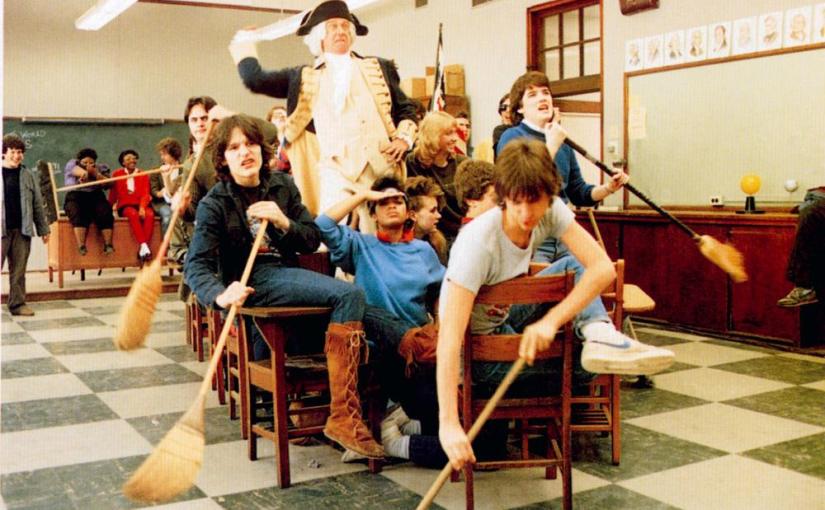
Richard Mulligan (Empty Nest) plays a mental patient that ironically engages his students when he conducts his classes dressed as famous historical figures like Lincoln and Custer.  Watch him reenact George Washington’s crossing of the Delaware with his students “rowing” the boat.  It’s an image I will not forget.  Nor will I forget his final scene in the picture as he encounters Nolte’s character in the hallway.

Where the film falls short is in the one student that is primarily focused on, played by Ralph Macchio, shortly after coming off his first Karate Kid movie.  Just like in The Outsiders, which I recently wrote about, Macchio relies on his dark complexion, stylish black hair, blue jeans and that popped up jacket collar again.  There’s also that strut he always has.  Forgive me for beating up on the kid, but too often I see Macchio donning the same image – that cool kid pose needed for the cover of Teen Beat Magazine.  Nick Nolte shares a lot of scenes with the actor playing the troubled kid with a sixth grade reading level.  However, Nolte is the only one working most of the time.  Another actor in this role would have served better.  It’s a necessary role as it attempts to awaken Nolte’s teacher character to try saving another kid before he gets lost.  Back then, maybe Emilio Estevez or Lou Diamond Phillips would have been more suitable.  Instead, we get Ralph Macchio being Ralph Macchio all over again.

Teachers is a comedy drama that mostly works.  It’s easy to get caught up in the comedy and, sadly, the absurd truth of what goes on in a metropolitan public school system back in the 1980s.  There’s also very dramatic and heavy elements to the film that stay with you.  Before school shootings no longer became shocking (a sad and current truth), Teachers explored the trauma of school bullying and the response the comes with that issue.

Arthur Hiller’s film did not invent the wheel on troubled times within school.  Heck, even The Sweat Hogs from Welcome Back, Kotter were troublemakers too.  Not to mention there are other school dramas to come before, like Blackboard Jungle.  However, Teachers is an very engaging film. I was completely absorbed as soon as the movie began, first in its comedy, and then later in its drama.  A near final scene of the film is eye opening and much like Steel Magnolias will leave you laughing and crying all at the same time.  That happens because you quickly begin to care for most of these characters and the turbulent times they live through as a teacher making next to no money while working under unfair and unreasonable scrutiny.

I think Nick Nolte is delivering one of the best performances of his career.  He has great chemistry with JoBeth Williams, who is good in her role.  The romantic storyline does not go overboard.  It does not get schmaltzy.  It is just enough, and it’s wise to include dialogue where they debate one another from two different sides of a coin.

Teachers also works as a great look back piece.  A lot of well-known, eventual recognizable actors round out this cast including Morgan Freeman, Crispin Glover, Laura Dern, Allen Garfield, and Lee Grant. Anytime Nolte is on screen, he only enhances the scenes he shares one on one respectively with most of these actors.  The moments between him and Macchio only work because of Nick Nolte.  Call Nolte the Alan Alda/Hawkeye Pierce of this picture. 

Teachers might look tame by the turmoil we see today in schools across the country but none of what is seen is untrue or exaggerated either.  Well, maybe except for the mental patient who arguably turns out to be the most engaging and influential instructor of them all.  That’s funny stuff, but you gotta be a little bit crazy to become a teacher nowadays.

THE RIVER

By Marc S. Sanders

A film like Mark Rydell’s The River only thrives on witnessing the misery of people living with the misery of others.  That’s not to say this is not how ordinary people are often forced to live.  There’s too much suffering in the world.  I can never deny that.  A homeless shelter or a prison are settings of great misfortune, hardship and sadness.  Yet for a movie, sometimes you must ask what the point is, especially when it is apparent that the heroes are destined to lose against the forces of nature while the villain is entirely correct in his own cause.  Sometimes in a no-win situation it is honorable to just give up.  I wish Tom Garvey, the corn farmer, would have just quit being a farmer and sought a better life for his wife Mae and their two young children.

Tom and Mae are played by Mel Gibson and Sissy Spacek.  He is the current generation who owns the Tennessee corn crop farm that his family lineage has passed down.  The first twenty minutes of The River depict the harshness of terrible rainstorms that flood the nearby river and wash away the family’s prized crops and land.  Tom, Mae and the children do everything in their power to recede the water as the rain continues to come down in buckets.  Mae fills up sacks of mud and water with their daughter Beth.  Their son Lewis works with Tom on the beat-up tractor against a never-ending battle of plowing the flood waters away from the land.  There’s no way to overcome this terrible plague of weather that comes at least twice every year.  As I watch the sopping wet struggle that opens the picture in the middle of a stormy night, shot very well by Rydell and his crew, I already ask myself what’s the point?  Get out of this situation Tom!!!!! Take up babysitting, tutor, become a fireman, go back to school.  Relocate for heaven’s sakes!!!!

What recuses the Garvey family and the farm, one more time, is when the rain finally stops.

Scott Glenn is Joe Wade.  He is a wealthy industrialist, who also grew up in these parts under a family legacy.  Joe is on the good side of the state politicians and is aggressive in buying out the farmers’ land so that he can flood the valley, build a dam and use the overabundance of water to power the utilities of the area in a more efficient and much less costly way for everyone.  And he’s the villain of the story????????

Joe makes sense.  Tom’s passion for holding on to what his family has owned does not.  I get the idea of grasping on to family heirlooms like my grandfather’s watch that he maybe kept hidden in an uncomfortable orifice while being held captive by the Nazis, or the prized jewel that survived a shipwreck generations ago.  I also understand the desire to carry the torch of the harsh labor a father and a father before endured and died for while allowing a farm to thrive.  Yet, there are children to feed and debts to pay. The ruin that comes from the acts of God do not empathize.  Therefore, I say again, sometimes the bravest and most sensible thing a person can do is actually quit.

Tom, along with most of the neighboring farmers, are adamant about not selling their land to Joe.  When auctions occur to sell off the equipment and leftover supplies of the few that do surrender, it is practically considered a gross violation of a sacred code in these parts.  I look at the stubborn folks who frown upon their peers as terribly disrespectful.  The script is expecting me to empathize with Tom and those who stand with him though. 

Midway through, The River takes a detour as Tom leaves to do hard labor elsewhere to earn much needed cash.  This is where misery does not love company.   He is one of many men selected to do factory work as an inexpensive replacement for the union workers on strike.  Tom, along with the other recruits, are threatened, called scabs, and in a glaring scene spit directly in the face.  A fellow worker is beat up in the middle of the night.  All of this is powerful footage and yet who am I supposed to empathize with?  These workers on strike are demanding better benefits and rights.  A guy like Tom, who values the survival of the Garvey farm, interferes in someone else’s just cause for his own welfare. 

I think about films like Schindler’s List and even The Lord Of The Rings fantasies and I witness the hardships and suffering of a collective people.  Those stories never expect me to value the misery of a select few over others.  I take stock in a whole populace.  In Mark Rydell’s film, however, I feel like I’m only asked to cry for Tom Garvey’s relief, the stubborn father who is defiant for an unlikely future of promise for the area he occupies while also ignoring the welfare of his family against the forces of nature.  Joe is offering Tom and Mae hundreds of thousands of dollars for their land so that he can enhance the state.  Joe’s bounty will rescue the family from insurmountable debt and the unforgiving floods that repeatedly destroy their crops.  Still, I’m supposed to believe that Joe is the asshole.

Sissy Spacek was nominated for Best Actress for her performance.  She competed against Sally Field (who won) and Jessica Lange.  Both were ironically featured in their own “farm life films” in 1984.  Spacek remains one of Hollywood’s finest actors.  However, I did not think there was much for her to do here.  A drawn-out sequence has Mae caught under a tractor with a nasty wound while the blistering heat bears down with no one around to help.  It has its moment of suspense because this film could go in many different directions of tragedy, but a development like this is more circumstantial than performance based.  If Katherine Hepburn or Laurence Olivier were under that tractor, the scene would not play out much differently.  It’s just a standard farmer accident destined to be included in a standard farmer picture.

The possibility of a love triangle is also implied during the film.  As soon as I saw the opening credits (Sissy Spacek, Mel Gibson, Scott Glenn), I hoped against all hope that the story would not go there, and yet…

Having hardly even used a rake or a shovel, I know that farming is a grueling life and still so necessary for our world consumption to survive.  The River attempts to demonstrate this message. I empathize with people like Tom.  I really do.  However, I empathize with the sacrifice they may need to take, not with their with their foolhardy stubbornness or their intrusion upon others’ challenges for gain.  If a doctor told me that no matter what efforts he performs he will not be able to save my arm or my leg, I’m going to have to believe him and accept that the limb must be amputated.  If an overflowing river and an unbearably long rainstorm affects my home, my farm, my family and my livelihood at least twice a year, eventually I’m going to come to my senses and tell myself that the bad guy is probably right. 

Contrary to the well-known slogan, sometimes money is everything.

BLOOD SIMPLE.

By Marc S. Sanders

 “blood simple” is a term coined to describe the addled, fearful mindset people are in after a prolonged immersion in violent situations.

         IMDb – originally located in the book Red Harvest by Dashiell Hammett

The Coen Brothers’ first of several legendary and unique films is a seedy noir thriller called Blood Simple.  Joel Coen is the director.  Ethan Coen is the producer.  They wrote the script together and collected whatever pennies they could find door to door from anyone willing to invest in the picture.  You see how shoestring the budget was for this small film, but that’s exactly why it works so effectively.  The lowlifes of their script are not the sophisticated type like Hannibal Lecter or Harry Lyme.

This is a condensed piece, just over ninety minutes, with four principal players who inadvertently cause themselves to get tangled in a bloody web of gory crime.  The fun part is that none of the four know the whole picture of what’s occurring, or how, or why.  I’m satisfied the audience is in on the whole thing, though.

Without giving too much away, Dan Hedaya is Marty, the owner of a sleazy Texas saloon.  A private investigator provides evidence of Marty’s wife, Abby (Frances McDormand, in her debut performance), having an affair with one of his bartenders, Ray (John Getz).  Marty hires the P.I. to murder the two lovers.

Simple enough, right?  Wrong, because the Coen Brothers wisely have their players color outside the lines and soon there’s blood all over the floor, as well as in the back seat, and maybe something important was mistakenly left at a crime scene.  Perhaps someone who was thought to be dead is not, and maybe what you thought occurred is something else entirely.

Blood Simple. works because it operates beyond convention.  The characters are so unaware of what to do next or what precisely has happened that it introduces one layer of confusion and misunderstanding after another.  This is nowhere near a common episode of Three’s Company.  What’s even more appreciative is that once the end credits roll, those that survive this lurid tale will still never have a complete grasp of what’s happened or when or where the convolutedness began.  It’s satisfying that all of the answers are at my disposal. It gives me a sense of omnipotence.

M Emmet Walsh is the scuzzy private investigator.  You’ve seen this celebrated character actor countless times before.  It is this performance that might be the one where you would no longer recognize him as “What’s that guy from?” because now you’ll never forget his name. He’s a villain who pounces on a genius opportunity, covering all bases, until there’s one minor oversight.  The Coen Brothers inventively have this guy circling the waters of the whole film, and yet only one other character is aware of his existence.  Still, this guy is vital to the assorted conflicts uncovered in this sort of graphic novel pulp fiction.

Blood Simple. sets up scenes  that can be bridged together by what if scenarios. How can two windows mere inches away from each other lend to a painfully agonizing, thrillingly welcome moment of terror and suspense? When this scene arrives, does it make sense for how the characters play it out?  You bet it does.  

The film is strong due to its lack of dialogue too.  We watch what these characters do much more than we listen to anything they have to say.  Important props and locations seem to tell us more than any of the actors, and that’ll allow you to think like the character.  You read their minds rather than feeling a need to have everything explained to you.

Blood Simple. is an inspired nod to some of Hitchcock’s bewildering best like Dial M For Murder and Strangers On A Train.  It succeeds because of the twists it offers as nothing ever goes according to plan.  You’ll watch it once and then you’ll want to see it again to follow the breadcrumbs that trail off the path.

SIXTEEN CANDLES

By Marc S. Sanders

John Hughes became a pop culture pioneer of the 1980s when he directed his first film, Sixteen Candles. The movie adopted a slapstick approach to teen anxiety related to love, cliques and high school popularity. Had Hughes waited much longer, it’s fair to say the picture may not have ever gotten produced. In a current age of political correctness and “Me Too” movements, Sixteen Candles is more shocking than originally intended.

There is no way this film would be made with a character like Long Duk Dung as a run-on gag Chinese foreign exchange student with a stereotypical Asian accent of mispronunciations, presumptions of mental retardation, and an accompanying “GONG” each time the film circles back to him. It is fair to say this is equivalent to when Buckwheat would wipe the sweat off his brow against a nearby wall and it would appear as ink stains in a random Our Gang/Little Rascals film. Actor Gedde Wantanabe who plays Dong has gone on record saying he was vilified for the role since the release of the film. Likely he was also quite embarrassed. I wouldn’t blame him.

Date rape is also a common element of the film. Dong is implied to be a victim by a butch high school girl. In another storyline the hot guy Jake Ryan (Michael Schoeffling), who drives a cherry red Porche, implies to the geek, Farmer Ted (Anthony Michael Hall), an offer to have his way with Jake’s intoxicated girlfriend. Freshman nerd Ted takes as much advantage of the opportunity as he can by taking photographs with the girl and then even forgetting what exactly occurred the next morning but making hopeful assumptions nevertheless, simply to bolster his reputation.

I don’t draw attention to these tropes to celebrate and guffaw though. The film continues to have a staying power with Hughes’ name labeled on the picture as well its recognition for making Molly Ringwald an ongoing cover photo for Teen Beat and Rolling Stone magazines during the MTV Generation.

Perhaps John Hughes had no idea at the time that his material would carry a shock element beyond plain silliness. I’m almost convinced of that. It’s fair to say Sixteen Candles is a byproduct of the raunchiness delivered by Animal House. I’m content with that because it is very, very funny in spite of the offending and inappropriate material.

Molly Ringwald is Samantha who is beside herself when everyone has forgotten her sixteenth birthday while gorgeous Jake seemingly doesn’t even know she exists. The family’s focus is drawn to her older sister’s upcoming nuptials the next day. It’s a lot to deal with for a high school sophomore. Ringwald embraces the frustration nicely as she doesn’t try for the comedy but often becomes the embarrassing victim of Hughes’ set ups: invasively touchy grandparents, Long Duk Dong, Farmer Ted’s obsession with her, and even giving up her underpants as a special favor. Samantha is the straight character among all the clowns in the cast, including her jerky younger brother played by Oscar nominee Justin Henry (Kramer vs Kramer). Paul Dooley, known for a career as a notable schlub, offers a nice scene or two with Ringwald as her father. John Hughes allowed himself to demonstrate how much he respects the characters he’s invented even if he spent the first two thirds of the picture humiliating them.

The transitional arc of the script almost parallels Hughes’ method of writing in his career. The comedy is sketched primarily in broad strokes. I said earlier it is rife with prejudiced humor, raunch and slapstick. That is until the end arrives with a mature, candle lit first kiss over a birthday cake accompanied by the sweet, soft melodies of the Thompson Twins. It’s adoring, sensitive, and Hughes closes the book on Sixteen Candles with the love and care he awarded most of his characters during his filmography. In one film, John Hughes approaches a level of maturity by the time the story’s end arrives.

The tenderness Hughes shows in the concluding scene of Sixteen Candles would become more evidently special in his later films like Ferris Bueller’s Day Off, Pretty In Pink, (not directed, only written by him), The Breakfast Club, and Planes, Trains & Automobiles.

John Hughes’ legacy is unmatched. Sixteen Candles is proof of that, and though some today would be dismissive of its ingredients, it remains a defining film of what the 1980s provided, culturally. If you grew up during the decade of excess or likely the grunge of the ‘90s, chances are you attended a sleepover with friends watching Molly Ringwald as the lovestruck, but crushed Samantha. She had to survive the most awful night of high school, coincidentally occurring on the day of her sweet sixteen, while making wonderful memories of laughter, tears, love and bonding.

NOTE: I waited to post this review for over two years until the eve of my daughter Julia’s 16th birthday. Happy Birthday Jules. I didn’t fucking forget your birthday!

ROMANCING THE STONE

By Marc S. Sanders

Robert Zemekis’ Romancing The Stone is one of those perfect Saturday afternoon rainy day movies. Since it focuses on best-selling author Joan Wilder (Kathleen Turner), it seems apropos that the movie feels like curling up with a good book.

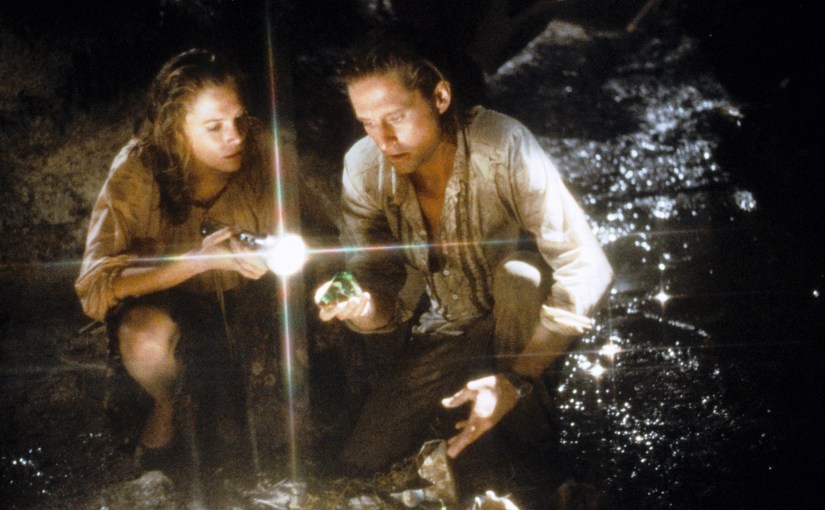
Upon discovering that her New York apartment has been ransacked, Joan gets a call from her terrified sister who has been kidnapped in Columbia. Joan is instructed to deliver a treasure map in exchange for her sister’s safe return. However, Joan is not as romanticized or adventurous as the characters in her novels. So, her three-piece suit and heels won’t serve well in the wet jungles in which she ends up completely lost. Fortunately, she meets a heroic, handsome guy in the form of Jack T. Colton (Michael Douglas). Together, they flee from the parties interested in the map, while trying to find the titled priceless gem.

Zemekis might have been taking an Indiana Jones route with this picture, but it finds its own identity, nonetheless. The fun comes with how Joan adapts to the outdoor elements and escapes the safe and lonely concrete jungles of city life. Turner is great as the one with no clue for travel or the instinct to stay out of a bad situation. It’s amusing to see her encounter and respond to one approaching cliffhanger after another.

There are great scenes here with mud slides, vine swinging, shoot outs and car chases. The best adventures never rely on CGI. A favorite sequence involves a meet up with a Columbian drug runner who helps the pair evade the bad guys in his 4 x 4 truck. That’s one of the many unexpected and wild moments offered here.

A third star is Danny DeVito fast on the trail of Joan and Jack. He’s here as the stooge more or less but he’s added comedy.

The one sad thing about Romancing The Stone is that it’s screenwriter Diane Thomas passed away shortly after her script was sold. Imagine what she could have done based on the promise of this film. This script has focus, fun and outstanding action sequences.

Romancing The Stone is just great escapism.

STAR TREK III: THE SEARCH FOR SPOCK

By Marc S. Sanders

Leonard Nimoy accepted the director’s chair for Star Trek III: The Search For Spock.  Though background stories dictate that he was done with the famous character especially following the end of the previous film in the franchise, one hanging thread was left untouched to permit another chapter.  It’s fortunate that Nimoy worked with so much good, solid and well written material for him to oversee on this follow up picture.

The Enterprise is returning to Earth following its entanglements with Khan.  Admiral James T. Kirk (William Shatner) is morose following the loss of a close colleague. In addition, Dr. McCoy (DeForest Kelley) is mysteriously unwell.  Meanwhile, the newest invention, Project Genesis, is being thoroughly studied by Kirk’s son David and Lt. Saavik, now that it has formed a planet of its own.  Genesis has become a clandestine and highly politicized issue among the Federation Of Planets and it is not to be discussed in public arenas. 

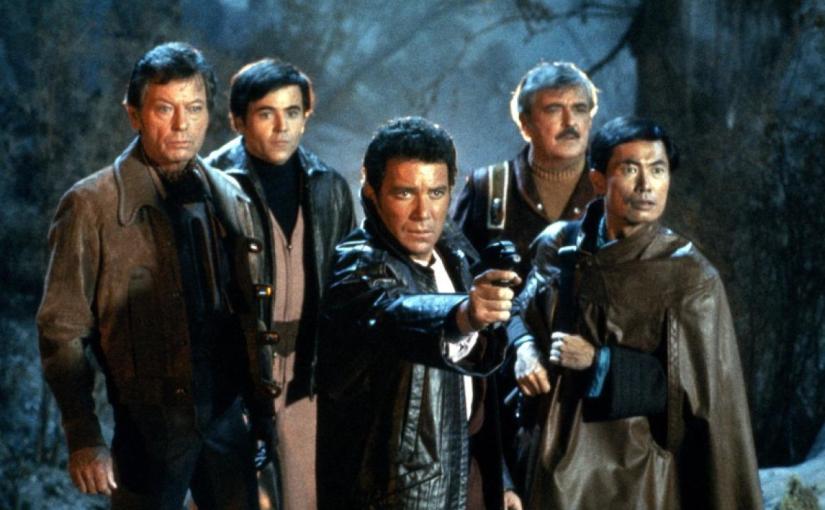
Shortly after Kirk arrives home, he is approached by Spock’s father, Sarek (Mark Lenard).  They both realize that before Spock’s unexpected self-sacrifice, he left his “spirit” within the mind of McCoy.  Now McCoy is unstable in the current life and Spock’s afterlife is not settled as well.  Kirk and crew must find a way to escort McCoy to the planet Vulcan, along with Spock’s corpse that is resting on the Genesis planet.  So, without authorization, they hijack the Enterprise and off they go into the far reaches of space all over again.  It won’t be easy as Christopher Lloyd has been cast as a vicious Klingon who commands a Bird Of Prey ship that can cloak itself just before an attack. 

Due to the enormous popularity of The Wrath Of Khan and The Voyage Home (even numbered installments in the movie series), The Search For Spock doesn’t get the recognition it truly deserves.  People love to point out how the odd numbered installments are the weaker films.  Star Trek III negates that observation for me, though.  Maybe whatever dismissal it carries is also in part because it’s a short film and doesn’t feature the main attraction for many Trek fans, Spock.  Yet, Nimoy with a script written by producer Harve Bennett tackles some shocking developments in the continuing adventures of Kirk, Bones, Scotty, Sulu, Uhura and Chekov.  All these years later and two eye opening moments occur in the film’s third act where I tell myself, “Wow, I can’t believe they actually went there.”

The film has a very gratifying ending.  Yet, it ends with a couple of big cliffhangers.  Look, when Darth Vader revealed his big secret, moviegoers had to wait three long years to find out the backstory and what was really the truth.  With this third Star Trek film, there’s much to account for as to what will become of our first favorite science fiction crew.  Leonard Nimoy hit all the right notes leaving audiences wanting more.

Nimoy has directed a well-versed picture.  The film doesn’t just belong to Shatner this time. Though he’s just as marvelous as the last film.  He just has such a likable charm to him, and his dramatic moments can be heart wrenching.  DeForest Kelley is given good material here.  At times, his mental dilemma is a struggle for the character.  In other areas, his curmudgeonhood comes out for humor as he curses Spock for what he’s left him with.  It’s a humorous kind of sci fi prejudice (sort of like Archie Bunker) that made Spock and McCoy a good pair to traditionally watch spar with each other.  George Takei, Walter Koenig, Nichelle Nichols and James Doohan are blessed with moments as well that feature some funny one liners (“Up yer shaft!” and “Don’t call me Tiny!”).

It’s easy to regard the third film of a “geek culture” as just another film.  However, in its brisk ninety-minute running time, The Search For Spock explores facets of religion, albeit fictional, and debates with science and discovery.  If that’s not good enough for you, at least it’s also a helluva great adventure.

INDIANA JONES AND THE TEMPLE OF DOOM

By Marc S. Sanders

Steven Spielberg’s second installment in the Indiana Jones series of films deserves more credit than it has received, nearly forty years later. Spielberg isn’t even fond of his film, and I think he needs to reexamine his own self-criticisms.

By the time he’d make this prequel, he was already a master filmmaker (followed by Close Encounters…, Raiders Of The Lost Ark, and E.T. The Extra-Terrestrial). Temple of Doom almost seemed easy for Spielberg to construct. He just filled in the holes from one scene to the next and he’s so natural in his instincts that the thrill of adventure never wavers, and it always feels new and fresh.

Think about it!!! He accompanies a John Williams led rendition of a Busby Berkeley number while Indy tries to escape from machine gun toting baddies in a Shanghai nightclub (called “Club Obi Wan”; nice wink and nod there).

That’s followed by an unlikely jump out of an airplane with only an inflatable water raft to glide through the heights of the sky. Reader, I bought it, and only because Spielberg shot it. He just knows what looks good on film.

The main crux of the film focuses on rescuing the enslaved captured children of an Indian village from a bloodthirsty cult while also retrieving sacred stones. Over the years as we’ve approached an age of a PC climate, many take issue with racial prejudice overtones. Do Indians eat monkey brains for dessert, and rip beating hearts out of the chests of men? I don’t care, and I don’t associate these horror/comedy moments with people of a certain race. I’m not foolhardy enough to do that.

However, I do correlate this material with what inspired the Indiana Jones character in the first place, and that is the serial cliffhangers of a forgotten age. Ridiculous stunts and outrageous visuals kept the attention of the viewer and that is what Spielberg, along with creative partner George Lucas, accomplishes here.

So you are treated to thousands of icky, crawly bugs, a screeching, off the rails mine car pursuit and a “snake surprise” as a main course dinner entree.

It’s all in good fun and it’s all shown in the campy adventure thematics that Indiana Jones was always recognized for.

Just go get your jolts every time he cracks the whip. That’s all Indiana Jones And The Temple Of Doom was ever meant to be.

THE KARATE KID (1984)

By Marc S. Sanders

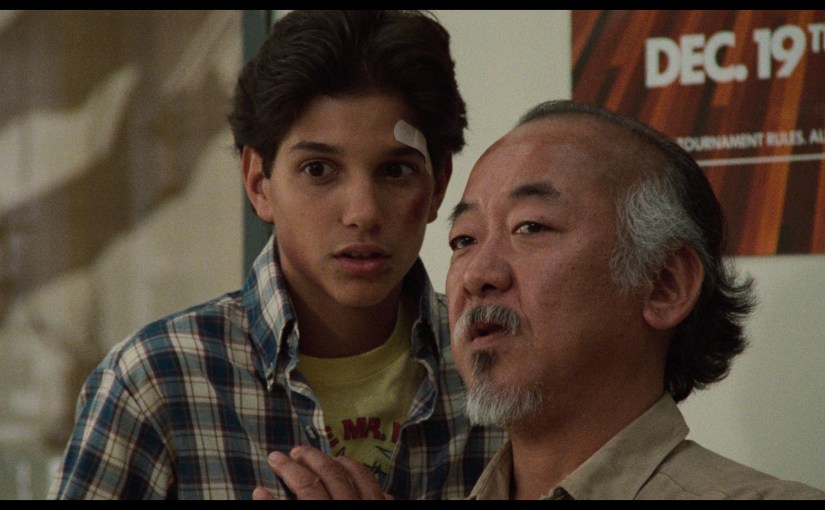
Though it may feel like an After School Special at times, there’s always been a charming quality about The Karate Kid, and that stems from the relationship between Daniel LaRouso (Ralph Macchio) and his elderly Asian mentor from Okinawa, Mr. Miyagi (Oscar nominee Pat Morita).

John G. Avildsen, director of Rocky, is harsh in the expository bullying that Daniel endures when he moves from Newark, NJ to California. The Kobra Kai kids led by William Zabka (your go to bully for 1980s films) are brutal in their fighting skills as they use Daniel as a means to exercise their Sensei’s philosophy of “No Mercy!” The Sensei is played very frighteningly by Martin Kove.

What’s hard for me to digest with The Karate Kid is that Macchio is not very good in the role. He kind of comes off as a kid I’d never want to hang out with. He tries too hard to be cool, but he doesn’t look cool. His sense of humor is really never funny. It’s too hokey really when he puts the charms on his crush Alli (Elisabeth Shue). While Shue is fine her in her sweetness, Macchio is really why I never found any chemistry between the two actors. He comes off like Shue’s little brother more than a high school crush. He’s a twerp. What saves me from giving up on Daniel, or Macchio in the role, is the maintenance man who steps in to rescue Daniel from another beating.

Pat Morita is excellent as Mr. Miyagi and has truly created one of the most pop culturally significant characters in film from the last forty years. There’s an authenticity to his role. Most importantly, he’s a veteran of World War II who suffered loss. A great scene occurs mid way through the film where Daniel finds a drunken Miyagi commemorating the death of his wife and newborn both lost due to complications in childbirth while he was away in service. Screenwriter Robert Mark Kamen brought a depth to the Miyagi role. Along with Morita’s performance, he allowed a likability in Daniel that eventually catches my interest. Daniel eventually appreciates the elderly man beyond his devotion of karate. When Macchio is responding to Morita, I like him. When he’s responding to any other character in the film, I don’t like him.

The centerpiece of the film is the mundane training that Daniel endures. “Wax on. Wax off,” and so on. It’s hardly forgettable but it’s also a little slow moving. Still, I like the lesson. Miyagi demonstrates that the best way to learn karate is ironically when you have no inkling that you’re learning karate. Use the fundamentals of any skill and apply it to the art of karate. Karate doesn’t stem from an urge of violence. It comes from something more intrinsic. Karen’s script with Avildsen’s direction never forgets that.

The payoff moment is when it dawns upon the very naive Daniel of what Miyagi was teaching him all along. Daniel might be painting the house and sanding the floor and waxing the cars on Miyagi’s property, but is that all he’s doing? Soon we discover the significance of this drawn out sequence. Morita opens your eyes when he throws punches and kicks at a frustrated Daniel, and it dawns on the kid that he suddenly knows how to defend himself. Avlidsen films a hair raising scene at this moment. Its like when the frail Yoda uses the Force to lift Luke’s X-Wing fighter out of the swamp. It’s another layer revealed in the Miyagi character.

So, without Mr. Miyagi The Karate Kid plays like a cheesy home room, early 80s lesson film. When a scene includes Morita, the wow factor is front and center. Often I talk about the best characters are the multi dimensional ones. Mr. Miyagi is the perfect example. We see him as the quiet maintenance man, then he’s the master fighter, then he’s the guy with a healing skill, then he’s the guy who’s got the secret crane technique for delivering a kick, and then he’s the guy with a sorrowful past and finally he’s the mentor and most importantly, he’s the friend. All of this crammed into one little old man from Okinawa. Pat Morita is the reason to watch The Karate Kid.

A CHRISTMAS CAROL (1984)

by Miguel E. Rodriguez

A CHRISTMAS CAROL (12/17/1984)
Director: Clive Donner
Cast: George C. Scott, David Warner, Joanne Whalley, Edward Woodward, Susannah York
My Rating: 10/10

PLOT: In 19th-century London, a bitter old miser who rationalizes his uncaring nature learns real compassion when three spirits visit him on Christmas Eve.

——————————

[SPOILER ALERTS! (For anyone whose souls are so dead they have never seen or read A Christmas Carol before…)]

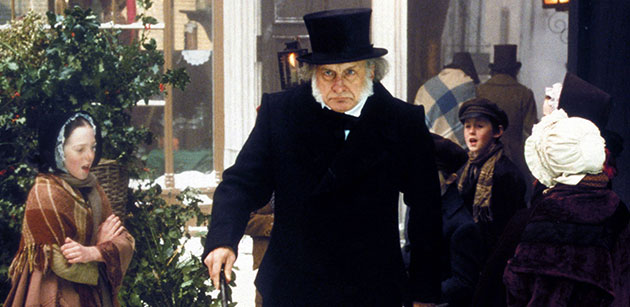
The TV version of A Christmas Carol that first aired on CBS in 1984, starring the legendary George C. Scott as Ebenezer Scrooge, is the best version of Charles Dickens’ story that I’ve ever seen.

Oh, but let me tell you why.

Without exception, every other version I’ve ever seen, including live theatre versions, have made humor and lightness their prevailing mood. The musical Scrooge (1970) does have its share of dark moments towards the end, but the darkness is derailed by an unnecessary detour into cartoonish humor (while in the depths of Hell, no less). I’m not saying that making the story fun is wrong, necessarily. After all, it’s a Christmas story, with a strong message of redemption, so why shouldn’t it be a joyous experience? Right?

Ah…but this 1984 version takes a novel approach. It realizes what I’ve always known all along: that this is, above all, a ghost story with a Christmas message. And not all ghost stories are merry and bright.

Take the Ghost of Christmas Present, for example. In this version, he’s played by Edward Woodward, with a deep booming voice, an absurdly hairy chest, and hidden stilts making him upwards of 7 feet tall. His eyes twinkle, but something about his grin and hearty laughter gives you the sense of a cat toying with a mouse. There are moments when he berates poor Scrooge for his vices, and his voice becomes intense, and the smile vanishes from your face, and he tells Scrooge that his life may be worth less than MILLIONS of other souls like Tiny Tim, and…it’s quite a moment. It reminds you that this is a morality tale.

Another example, of course, would be the ever-popular Ghost of Christmas Yet to Come. In every other version I’ve seen, this specter doesn’t speak, just points, usually with some kind of musical flourish. This version is no different, except the filmmakers ingeniously use an intensely creepy sound effect whenever this Ghost points or nods. It’s like someone pulling a violin bow across a huge piece of sheet metal. The effect is not comic or melodramatic. It’s deeply unsettling.

Of course, yet another reason to love this version is the towering performance from George C. Scott as the proto-Grinch, a man for whom Christmas is just an “excuse for picking a man’s pocket every twenty-fifth of December.” He injects moments of sly humor if you watch carefully (to the mute Ghost of Christmas Yet to Come, he mutters, “You’re devilishly hard to have a conversation with”), but for the most part he plays the character completely straight with nary a grin to be seen except on the rarest occasions. This is an aspect missing from every other version. The prevailing wisdom seems to be to amplify and overdo the character of Scrooge, so he’s not as unlikable, I guess. Not this time. Scott creates a mean, heartless, ruthless businessman who would as soon bankrupt you as say two words to you. Even Albert Finney’s interpretation in Scrooge, as completely as he disappears into the role, is not as dark and merciless as George C. Scott’s version.

It’s that darkness that appeals to me here. Yes, yes, the ultimate scenes of happiness and redemption are all there – the boy on the street, Scrooge skipping around his room, “giddy as a drunken man”, the massive turkey – but I love this version because it remembers its roots. This is a gothic ghost story, and as far as I’m concerned, any version of A Christmas Carol would do well to remember that.