SOMETHING WICKED THIS WAY COMES (1983)

by Miguel E. Rodriguez

DIRECTOR: Jack Clayton
CAST: Jason Robards, Jonathan Pryce, Vidal Peterson, Shawn Carson, Royal Dano, Diane Ladd, Pam Grier(!)
MY RATING: 5/10
ROTTEN TOMATOMETER: 62%

PLOT: In a small American town, a diabolical circus and its demonic proprietor grant wishes to the townsfolk…for a price.


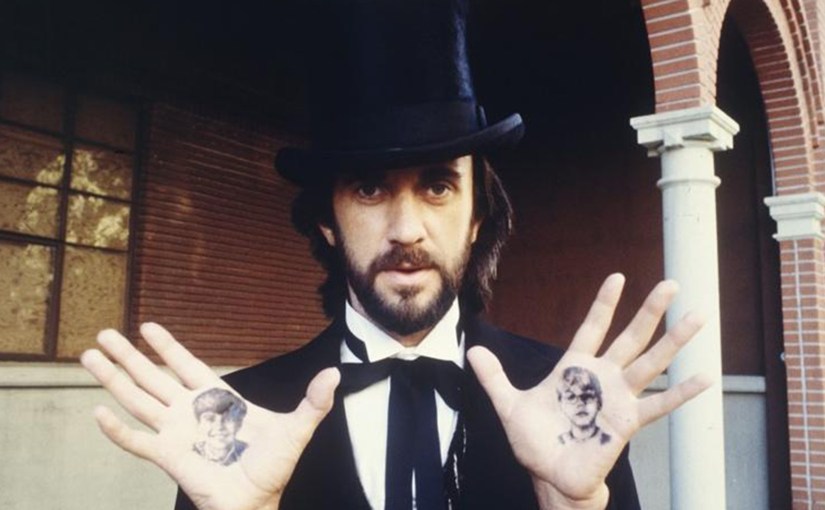
Something Wicked This Way Comes answers the question: What would the Disney version of Needful Things (1993) look like?  Instead of the Devil opening a curio shop in the middle of town, we get a malevolent carnival impresario, Mr. Dark, and his devilish carnival that promises delights beyond your wildest dreams.  But beware, for the price of having your wish granted comes straight out of The Twilight Zone.

And no wonder, the screenplay was written by Ray Bradbury, based on his novel.  Too bad the movie fell victim to studio interference, resulting in jarring tonal shifts, some awkward edits, and two re-shot scenes where the two child stars are clearly a year older and a year taller than they appear elsewhere in the film.

The movie starts out as feel-good Americana, right out of Normal Rockwell: a small midwestern town in what looks like the late 19-teens or early ‘20s, complete with a town square, a general store with the obligatory cigar-store Indian out front, and a friendly bartender with one arm and one leg.  We are introduced to Will and Jim, our two child protagonists, and Will’s father, Charles (Jason Robards), who looked to old to have an 11-year-old son in 1968, let alone 1983, but whatever.

So, there’s that part of the movie, where it looks like it’s going to be a gentle fantasy like Field of Dreams (1989) or something, with the background score to match…but then really weird things start happening.  A local eccentric vanishes after seeing a ghostly woman inside a funeral parlor.  Mister Dark’s Pandemonium Carnival opens just outside of town.  We watch as the local miser takes a ride on the Ferris Wheel with a beautiful woman…but she’s the only one who gets off the ride at the end.  The disabled bartender sees a marvelous reflection in the House of Mirrors and walks in…but never comes out.  Our two heroes, Will and Jim, witness something incredible when they peek under the big top at a broken-down carousel that only runs in reverse…

And so on.  I’ve seen umpteen versions of this story, and so have you.  It can be done well, but it takes a singular vision.  Watching this movie felt like someone spliced two films together and hoped no one would notice.  First of all, who in their right minds casts Pam Grier as a non-speaking character called The Dust Witch?  Granted, she’s a looker, but you don’t cast Pam Grier in a movie just because she’s beautiful.  You gotta give her something to do besides seduce men and stare menacingly, which, granted, she does better than most, but what a waste!  I wanted to hear her vow to bring the powers of darkness down upon your village in a fiery rage, or something, I dunno, anything.

But that’s a side point compared to the horrors awaiting our heroes.  In a scene right out of your nightmares, our two heroes are faced with an army of tarantulas in their bedrooms in the middle of the night.  So many tarantulas, in fact, that in one horrifying moment, you can see the bedsheets moving from the sheer numbers of arachnids under the covers.  (This was one of those re-shot scenes where the kids are a year older.)  Much later in the film, Mr. Dark grips someone’s hand so hard that we see the victim’s hand literally splitting open – in a VERY brief shot, mind you, but there is no question of what has happened, as the victim wears a bandage on that hand for the rest of the movie.

What is this horrific material doing in a Disney movie, for crying out loud?  Something Wicked This Way Comes arrived during a transitional period for Disney, when they were testing the waters with more adult-themed fare – The Watcher in the Woods had been released a few years earlier, and Touchstone Pictures was on the brink of breaking out with Splash (1984).  But when it came to this weird hybrid family/horror movie, they got a little gun shy.

According to the invaluable IMDb, after a poorly-received test screening, Disney execs delayed the film’s release for a year so the film could be re-edited, an opening narration could be added, additional scenes could be shot and old ones replaced, and an entirely new score could be composed by maestro James Horner.  In their attempts to make the movie more family-friendly, they were the embodiment of the axiom “too many cooks in the kitchen.”  On an early laserdisc commentary, Ray Bradbury stated that much of his original intention for the film was destroyed as a result of these after-market edits.

There is a really, REALLY good movie trapped inside the existing version of Something Wicked This Way Comes.  Watch the movie, and you can see that really good version peeking through here and there (it feels like there was a LOT more that could’ve been done with Jonathan Pryce’s rendition of Mr. Dark).  As it is now, the movie is little more than an object lesson on why so many directors dream of getting “final cut” in their contract…so something like THIS doesn’t happen.
UNCOMMON VALOR

By Marc S. Sanders

In the decade following the Vietnam War a common denial (or ignorance, maybe) went towards American soldiers who were missing in action.  Many men were theorized to be prisoners of war long after the armed forces left the country, ending a losing battle with record numbers of casualties.  A handful of films of the 1980s brought focus to this topic, as a means for adventurous entertainment.  Chuck Norris had a series of Missing In Action films.  Even light action fare TV shows like The A-Team and Magnum PI brought attention to this issue.  Most predominantly, the possibilities of POWs were ingrained within Sylvester Stallone’s box office bonanza of Rambo pictures.  In 1982, Ted Kotcheff directed the initial entry of that series, First Blood, and he zeroed in much more precisely the following year, with Uncommon Valor.  

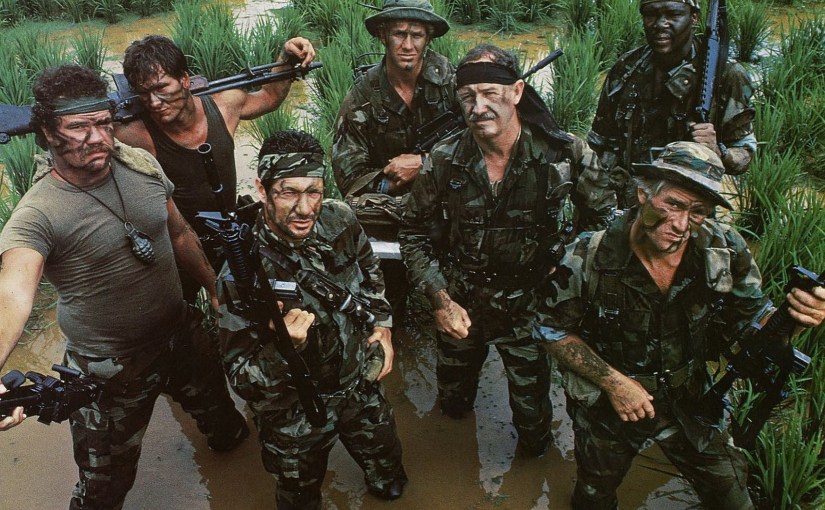
Gene Hackman is retired Marine Colonel Jason Rhodes who begins a decade long campaign convincing the U.S. government to seek out those who were left behind and are likely being held as prisoners of war.  His motivation stems from his belief that his son Frank is likely being held captive in a camp located in northern Laos.  

By the time 1983 arrives no action of recovery or rescue is taken.  The Colonel is committed to bearing the responsibility.  He appreciatively accepts financing of his own mission from an oil tycoon (Robert Stack) whose son might be with Frank.  The Colonel also recruits members of Frank’s unit who made it home (Fred Ward, Reb Brown, Randall “Tex” Cobb, Harold Sylvester, and Tim Thomerson). Patrick Swayze is a young guy named Scott who never served in the conflict but is an expert combat and weapons specialist who will get these men retrained for the upcoming rescue.  He also has his own reasons for partaking of this mission. 

Uncommon Valor is sporadic on humor and focused on the adventure and resourcefulness.  The first half provides footage of how the squad gets reacquainted with each other and the jungle elements they left behind in Vietnam.  They practice routines outlined by the Colonel with ground patrols, detonators, hand to hand combat, artillery, sabotage, and chopper rescue.  The second half follows them back into the Asian country where they have to obtain weapons and supplies, while making connections with locals who will escort them through the dense jungle area towards the camp.  

This is a rare occasion where Gene Hackman is not applying much of his acting craft. He is primarily going through motions of Kotcheff’s film direction with a script rumored to be co-written by Wings Hauser (also a producer on the film).  The trauma of the war is primarily carried by Fred Ward who struggles with PTSD long before it became so widely attributed to service men and women after returning from combat.  In First Blood, Stallone offered a much more substantial and convincing demonstration.  Yet, Ward does a serviceable job with a script that never goes terribly deep.

Uncommon Valor is better described as a present-day adventure picture.  It’s never boring.  There are fireball explosions and machine gun shootouts. The action set pieces still hold up with good art designs staged off the Hawaiian Islands in place of a sweltering Vietnam.  The prisoners who are recovered, supposedly held for over a decade, are chilling to look at with obvious malnourishment and dead-blank expressions.

Randall “Tex” Cobb and Reb Brown (the TV movie Captain America) are mostly doing wacky A-Team material here.  Gene Hackman, Fred Ward and Harold Sylvester are the straight characters.  

It’s not as grand as a Rambo film, but Uncommon Valor never lampoons or minimizes what was a horrifying experience for those enlisted soldiers who never came home, while their next of kin never obtained closure.  

For the 1980s, which feels like it had just passed yesterday, it’s fair to say that all those missing in action during that terrible and bloody war are no longer alive over fifty years later.  The opportunity to search and negotiate for their freedom has long expired by now.  While movies like Missing In Action, Rambo and Uncommon Valor focused on fictional triumphs that were never factually replicated, at least these films can serve as reminders for the sacrifices these people served at the behest of their country.  I’m not writing to ease lifelong pains.  All I can do is recognize, remind and be forever grateful.  These movies still serve a purpose beyond the pulpy Saturday afternoon adventures. 

SILKWOOD

By Marc S. Sanders

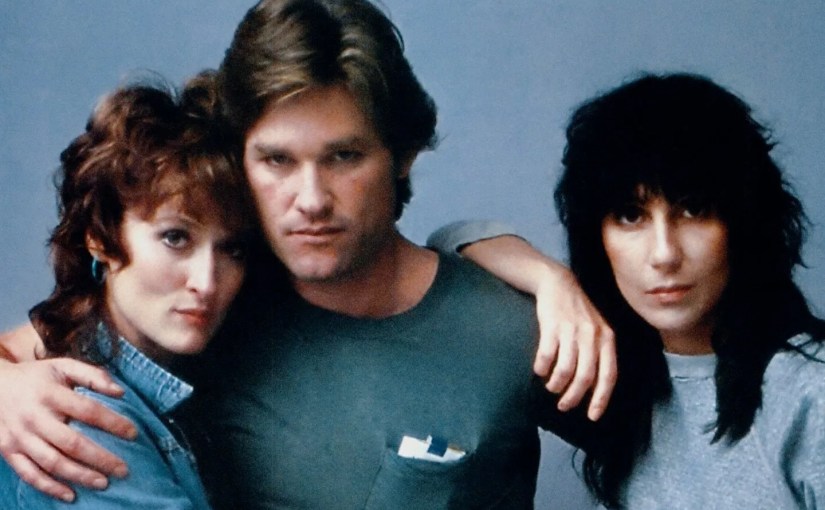
As the 1980s were setting its stride, Silkwood might have been one of the earliest in a line of films to focus on the union worker who fights back at the billion-dollar corporation.  Some might unfairly regard the movie as The China Syndrome, Part II. Other well-known pictures of this mold are even more familiar to me like Michael Mann’s The Insider.  However, director Mike Nichols, working with a first screenwriting effort from Nora Ephron who partnered with Alice Arlen, showcases the aggravation on not just Karen Silkwood, the real life potential whistleblower, but also her friends and co-workers in a one factory town just outside of Oklahoma City.

Karen (Meryl Streep) lives with her boyfriend Drew (Kurt Russell) and her best friend Dolly (Cher) in a run-down house in the middle of nowhere.  They ride to work together at the local plutonium manufacturing plant where they dress in scrubs and gloves. Punch in, punch out kind of days, and often they are expected to work double shifts and weekends.  Karen works an assembly line where she places her hands in rubber gloves and assembles dangerous combinations of chemicals in an enclosed box.  It’s also routine that before you leave your station you wave your hands over a sensor to ensure you have not been exposed to radiation.  There’s even sensors you walk through as you enter and leave the plant.  When those sensors go off, a calm kind of film seemingly turns into a horror movie.  The last thing anyone could ever want is to get “cooked.”

Karen does not live a perfect life.  Her three kids reside with their uncompromising father in Texas.  Money is not ideal.  Dolly is a slob and has also invited her girlfriend to live with them.  Karen can manage with all of this, but when she observes some unconventional activities around the factory she gets up the nerve to head the union for better protection and working conditions.  However, the further she goes looking at files and photos, jotting down notes of what people say and do, plus taking trips to Washington DC, and getting phone calls from attorneys at night, she becomes more and more isolated from Dolly and Drew, along with the rest of her close-knit workers.  Karen is not just risking her job, but everyone else’s jobs and worse her own life.

The attorneys lay it out to the townsfolk and the union of the horrifying statistics that go along with radiation exposure.  The tiniest fraction of a miniscule of exposure to the smallest crumb of chemicals could increase a human’s bearable limit towards radiation and cancer.  The sad irony is that the more that is learned, the more the people of this area smoke and smoke some more.  Granted, this story takes place in the early 1970s, though.    

The company is primarily represented by an intimidating Bruce McGill.  He’s great in everything he does and is worthy of an Oscar nomination somewhere.  M Emmet Walsh has no lines but his presence is enough to shake you; the slimy guy you easily recognize from every other movie you have seen.  While the company’s overbearing intrusion is shown plenty, the script for Silkwood focuses more on how these working people get by.  They are treated unfairly and in dangerous working conditions, but they also know this is the only place that offers steady income in the area.  Without this factory, the whole town would be left in dire straits.  Karen is repeatedly told or implied to leave well enough alone.

Meryl Streep notches another harrowing performance on her resume and bears such a departure from more sophisticated characters found in Sophie’s Choice and Kramer Vs Kramer.  Karen Silkwood is not educated and she bears an unmistakable white trash dialect but she’s also not stupid and the more progress she makes at exposing the plant’s shortcomings the more unfairly she is treated with department transfers and workplace shake ups that she is indirectly blamed for.  Potential threats on her life begin to build, but she only upholds a bravery.  You really observe the strength of Meryl Streep.  She’s at the top of an elite class of actresses at this time that also included Sally Field, Jessica Lange and Glenn Close.

Cher plays Dolly in her first on screen role.  The variety act performer probably subjected herself to a bigger departure than Streep.  She was not a professionally trained actress at the time.  Mike Nichols insisted on no makeup along with her hair unkept and flat, while dressed in green chino pants and baggy sweatshirts.  The new actress carries herself so well without the usual glitz that accompanies her.  Her scenes with Streep are workshops in acting technique. 

Kurt Russell delivers another understated performance.  One of the best actors out there who has never been enough of a critical darling.  Drew is likable and Kurt Russell plays him as a settled in match for Streep’s portrayal of Karen.  Watch how they tangle up in each other’s arms in bed or when he snaps at her as she carries on her crusade while he’d rather things be left alone.  His timing is perfect for the script.

Mike Nichols keeps his film calm, except when the go by the numbers narrative must be disturbed.  A radiation cleanse with high pressure hoses will make you wince.  The factory alarms will terrify you.  Meryl Streep accepts the physical taxations necessary for this setting.  Nichols gets in close with his camera to show how cleansers dressed in scrubs and masks rub Streep down until her skin is a burning red.  I distinctly remember how her right ear appears in this scene, getting flushed by something just short of a fire hose, and the aftermath of her sitting in a chair is so discomforting while a company doctor assures her that there’s not much to worry about as long she brings in her urine samples daily.  In fact, soon all of the employees are tasked with delivering their urine samples.  What kind of place is this?

While Silkwood is based on a true story with a burning question left behind, I do not want to reveal too much.  Many have seen Silkwood since it was released over forty years ago, but as the third act begins, the fallout only becomes more disturbing and Mike Nichols directs a horrifying sequence built primarily on the pealing of old wallpaper.  That’s all I want to suggest. 

Karen Silkwood was a very unlikely crusader.  She probably never envisioned what she would become and what she would fight for.  Yet, she uncovered horrible truths that should not have been occurring under the eye of billion-dollar corporate America.  After watching Silkwood, I can only imagine what else was there to turn over.

NOTE: Another good reason to watch Silkwood is to discover early performances from some amazing character actors who were either just starting their careers or continuing to hide in the crowd. 

Scavenger hunt for Anthony Heald, James Rebhorn, David Strathairn, Ron Silver, Fred Ward, Diana Scarwid, Bill Cobbs, M Emmet Walsh, Craig T Nelson, Tess Harper, Will Patton, Richard Hamilton and Josef Sommer.

NEVER SAY NEVER AGAIN

By Marc S. Sanders

If it walks like James Bond, if it talks like James Bond, it is…STOP RIGHT THERE! 

Sean Connery in Never Say Never Again is not James Bond…at least not the James Bond that I know.

Why was this movie even made?

I know.  You don’t have to tell me. 

For the most part it was a legal blessing for a gentleman named Kevin McClory, a contributing writer to the film Thunderball.  McClory sued the Ian Fleming estate for the rights to such named properties as the villainous “Ernst Stavro Blofeld” and the organization he heralds known as “SPECTRE.”  Eventually, it came to be that none of the films could use these copyrighted terms going forward.  (Hence, why Roger Moore never uttered these names in any of his films.  He just dropped a wheelchair bound bald man down a smokestack.)  Anyway, the courts allowed McClory a second chance at his Thunderball creation by granting him the blessing to remake the film with certain moments and developments that upheld the structure of the story.  So, in 1983 a competing studio to United Artists called Warner Brothers greenlit the release of this new film and banked on Sean Connery’s return to the famed secret agent.

Frankly, the backstory is a much more tantalizing adventure than this misfire.

Never Say Never Again always eluded me.  I never had a desire to see it.  I regarded it like a generic brand.  I turn to the EON productions for my James Bond fix the same way I turn to Heinz ketchup, never, ever Hunts.  What I’d heard of this film and the scant moments I saw of Connery in the picture over the years made me question how necessary this movie ever was.  It’s like that Gus Van Sant shot for shot remake of Psycho.  Why do it?  Because you can?  Is that all you need?

So, Connery opted to return for a large salary and for the only time in history two James Bond films were released in the same year, 1983, when Moore’s Octopussy also made it to the big screen.  Connery’s picture is a direct remake of Thunderball. One of SPECTRE’s top agents Maximillian Largo (Klaus Maria Brandauer) catches possession of two United States nuclear missiles and hides them in the Bahamas.   Bond is older now, reflective of Connery’s age at the time, and practically retired as he loses a bit of his step in a training simulation.  Soon, however, he is on the case and contends with a female henchman by the name of Fatima Blush (Barbara Carrera) while also womanizing Largo’s main squeeze Domino (Kim Basinger, in a very early role).  His primary gadget is an exploding fountain pen.

Other than Carera who was Golden Globe nominated for her role, I can’t say anyone is doing anything terribly wrong here.  It is simply that this reiteration seems altogether flat.  This film is certainly missing the exhilarating pace of director Irvin Kershner’s The Empire Strikes Back.  Here, James Bond the hero just seems to walk and sit and stand in and out of frame.  A lifeless tango occurs midway between Connery and Basinger as an opportunity to share some confidential information.  I don’t care if 007 is adorned in his tuxedo next to a 1980s hair sprayed Kim Basinger, the tango is boring to watch.  It is a dance that goes nowhere or builds to anything. 

Games are updated as well.  We are not in the casino watching baccarat or poker anymore.  James Bond plays video games against Largo and the only threat is a shock on the joystick when a parlay is struck.  I can’t feel the zap that is supposed to happen, and Sean Connery is hardly displaying any anguish as Klaus Maria Brandauer smirks in triumph.  So, where’s the suspense here?  Sound effects from an Atari 2600 while the hero and villain sit at a table with joysticks doesn’t send this scene into astonishment. In 1983, in the movie theatre next door, Roger Moore is undoing a cheating Louis Jordan in backgammon while the muscle headed henchman crushes the dice into dust.  That’s much more frightening. 

A midway motorcycle moment with smoke and missile gadget tricks is fun but still not as escapist as most other Bond pursuits. Maybe it’s because 007 wears a dark helmet and thus hiding his charm.  It’s a lot more fun to see Connery or Moore give a wink and nod as the chase continues.  Here there is no reaction and no response to the environment of the Bahamas.  Couldn’t a banana tree topple over or something?  Maybe some coconuts?  Could a yacht or boat capsize?

I always remember the infamous shark scene in Thunderball as Bond gets trapped in a swimming pool with a couple of great whites.  That scene is now changed to an ocean floor shipwreck setting.  For the most part this works as Bond circumvents through the wreckage trapping one shark after another.  This is one of the film’s few improvements.

The big regret is that Klaus Maria Brandauer as the main villain Largo was not served a better product. He is gleefully good.  He’s at least trying as hard as he can. He has the evil grin and short fused temper, but he’s also sophisticated among his wealth. 

He’s certainly working much harder than Sean Connery who seems to just be going through the motions and hardly exerting himself.  The actor is much too relaxed in his role here.  It looks like he memorizes his few lines minutes before the camera starts shooting.  Then he says what needs to be said.  You can subconsciously visualize Connery walking back to his trailer take after take.  There are some decent one liners, but none of his delivery soars anymore.  I think Connery was out of the role far too long since his last turn in 1971 and he just didn’t pick up where he left off.  He’s never applying himself.  His wardrobe, from the tux to a camouflage uniform, or even his swimsuits do not seem to rest well on him.  The tailoring looks off.  He’s not wearing anything as well as he used to.  Not even his hair piece, which is far too thin and uncooperatively resting on his scalp, sits well.

Kim Basinger is the blond.  Nothing more needs to be said.  Rowan Atkinson debuted on the screen with some silly escapist humor but either he’s not on long enough or he’s there too much.  The part should have just been cut altogether.

You don’t forget Barbara Carrera but that’s not necessarily a compliment.  She’s working like a dastardly cartoon from the Adam West Batman TV show and Connery is hardly responding to her screaming or antics.  Funnily enough, the screenwriter is Lorenzo Semple Jr, writer of the Batman show and Flash Gordon, from 1980.  So, while the tongue is trying to touch the cheek it’s only reaching the roof of the mouth this time.  Carrera is a headache. She acts like a misbehaved child.  Somebody loved her though for that Golden Globe nomination.  How? Why?

Another bit of buyer’s remorse is the casting of Max Von Sydow as Blofeld.  Inspired casting.  Yet, why is he given nothing to do?  This is Max Von Sydow!!!!!  He’s been hired to watch a Sony monitor with his white cat tucked into his lap, but that’s it.  Between Brandauer and Sydow, these are some heavy hitters.  Plus, Connery, and a built-in storyline.  It should have all worked but it doesn’t.

The theme song is a painful earworm.  It is performed by Lani Hall, doing a Holiday Inn barfly lounge act that will never leave your consciousness.  You can practically see that wet, shiny lipstick slobber all over the microphone while she’s wearing a blingy sparkle dress and a red, leafy boa around her neck.

Never Say Never Again is a lifeless, uninteresting, tedious and sleep-inducing picture that no one but a Mr. Kevin McClory wanted. 

Like Jeff Goldblum would say ten years later, just because you could doesn’t mean you should.

SILKWOOD (1983)

by Miguel E. Rodriguez

DIRECTOR: Mike Nichols
CAST: Meryl Streep, Kurt Russell, Cher, Craig T. Nelson, Fred Ward, Ron Silver, Bruce McGill, David Strathairn, M. Emmet Walsh, James Rebhorn
MY RATING: 8/10
ROTTEN TOMATOMETER: 77% Fresh

PLOT: On November 13, 1974, Karen Silkwood, an employee of a nuclear facility, left to meet with a reporter from the New York Times. She never got there.


The tagline for Silkwood (quoted above) almost feels like it gives the game away, but it doesn’t really.  Even if Karen Silkwood’s name isn’t exactly part of the cultural zeitgeist anymore, I am willing to bet that a lot of people know what her name signifies in one way or another.  So, it’s not like the movie’s poster or trailers are spoiling what happens at the end of the film because most of us know.

In any event, Mike Nichols’ film isn’t a nuclear-based thriller, like The Day After (1983) or WarGames (1984), that depends on an unexpected resolution.  Silkwood isn’t about theatrical heroics or bombastic personalities.  It’s a quietly intense character study of an everywoman with an untidy personal life who experiences a seismic shift in her perception and decides she simply can’t stand by and do nothing.  This isn’t a crowd-pleaser like Erin Brockovich (2000), but this film’s story and central character are no less important.

The film goes to great pains to show us how ordinary and messy Karen Silkwood is.  The incidents at the Oklahoma nuclear facility where she works (along with her live-in boyfriend, Drew, and her roommate, Dolly) are almost secondary to the plot, at least for the first half of the film.  Karen has kids that live with her ex-husband and his girlfriend in Texas.  Her relationship with Drew isn’t stormy, but it’s not perfect.  Dolly seems tolerable as a roommate, but is not shy about speaking her mind.  Dolly brings a girlfriend home one night, and there is a slyly amusing conversation between Karen and Drew about Dolly’s sexual preferences.  (“I can handle it.”  “Me, too.”  “…so why are we talking about it?”)

I don’t want to go into too many details about the true-life incidents that occurred at the facility where Karen worked because, if you’re not intimately familiar with the facts of the story, they should be as surprising to you as they were to me.  Plutonium is involved, but probably not in the way you’re thinking.  Karen learns enough to know she should be more involved in the factory’s union…a LOT more.  One plot thread almost feels like it’s ripped off from The China Syndrome (1979), until you realize Syndrome was released four years after the events of Silkwood, so if anything, Syndrome was probably inspired by Karen’s discoveries.

I also have to mention Cher as the roommate, Dolly.  Of course, Meryl Streep is amazing and convincing as an everyday, average divorced mom, but Cher more than holds her own in every scene.  There is absolutely no hint of the pop music megastar of the ‘70s in this film.  Director Mike Nichols insisted she wear little or no makeup in her scenes, which went against every fiber of her instinct as a performer.  She understood the assignment: she never upstages anyone.  This is not a grandstanding kind of supporting role, like Tommy Lee Jones in The Fugitive (1993) or Cate Blanchett in The Aviator (2004).  It required subtlety and understatement, and Cher delivered.  I tried to spot her “acting,” and I never could.  She was unbelievably natural and, at times, heartbreaking.  The movie is almost worth searching out just to see her performance.  It’s a clinic in how to own a small role and make it stand out by doing less than you might expect.

Silkwood may not feel as thrilling as some of the other thrillers I’ve already mentioned, but it is just as compelling, specifically because we’re watching an ordinary person under extraordinary circumstances.  We’re not watching a hero triumphantly rise to the occasion.  We’re watching a struggling divorcee who’s trying to do the right thing after years of inaction, even if it means losing the trust of her co-workers or sacrificing her other personal relationships.  I identified more with Karen Silkwood and her situation than I did with Jane Fonda in The China Syndrome or Julia Roberts in Erin Brockovich

The ambiguous nature of the film’s ending mirrors what happened in real life, and when the credits rolled, I felt a surge of empathy for the people left behind and the unanswered questions they live with to this day.  That doesn’t happen to me very often.

SCARFACE (1983)

By Marc S. Sanders

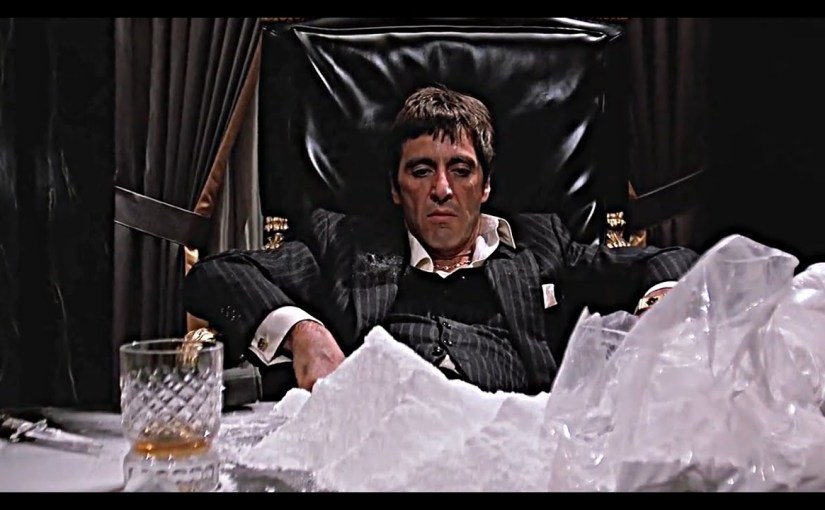
On Thanksgiving Day when we glutton ourselves with an abundance of food, it seemed highly appropriate to watch one of the most self-indulgent pieces ever put on film.  Brian DePalma’s Scarface with a script written by Oliver Stone and featuring Al Pacino.  This is a movie that brags about its boastfulness.  I mean look at everything that is mashed into this thing.  Blood, bullets, lots of cocaine and too much Al Pacino.

Pacino is Cuban refugee Tony Montana.  He is one of a handful of small time criminals who is shipped over to the United States when Castro wanted less people to oversee.  Refugee camps are fenced up under the highways of Southern Florida where no law is enforced among the tented populations.

Soon after Tony arrives he’s hot on the scene of pushing the newest underground product through Miami – cocaine.  With his buddy Manny (Steven Bauer) the two men get in good graces with a well dressed sleaze named Omar (F Murray Abraham), who is second in command to an established drug kingpin named Frank (Robert Loggia).  For Tony and Manny it’ll only be a matter of time before they take over as the numbers one and two bad guys.  That’ll include Tony marrying Frank’s blond trophy girlfriend Elvira (Michelle Pfeiffer in her breakout role) and winning a trusting partnership with a South American drug czar named Alejandro (Paul Shenar).  If you ever expect to get killed, you don’t want to be by the orders of Alejandro.  A helicopter serves much more of a purpose once it takes flight.

Scarface is a step-by-step movie or a climb up a three-hour ladder and then a gradual drop down off a balcony into a bloody fountain below.  There’s no depth and it works like a shopping list that you check off as it moves along. Props and houses and suits and jewelry and cars and cocaine and cash have more significance than what anyone has to say. Other than Tony, none of the people in this film matter. What Tony acquires and what he says about himself is all that is important.

This is a big ass movie with bloody graphics and killings, mountains of drugs and money, a lot of fucks, a gaudy estate home, a way over the top Al Pacino and lots and lots and lots of bullets and guns to go with them.  The film only settles for one chainsaw killing, though.  At the time, I recall that scene was up for big debate on the film’s MPAA rating.  Brian DePalma wanted to up the ante on brutality to grab moviegoers’ attention.  The scene remains quite stomach churning.

DePalma’s best work is at the beginning of the Scarface.  Following the establishing real life footage of the Cuban refugees arriving by boats in search of an American dream, Tony is taken into custody and questioned by a batch of immigration agents.  DePalma only keeps one steady camera focused on a very tan Pacino with a faint signature scar on his left cheek, sitting in the middle of the room and putting on a Cuban accent that only he could uniquely own.  Pacino’s concentration in this moment is admirable as he responds to questions from all different directions.  It’s all done in one take with the director’s camera circling around Pacino.  After this introduction is over, the tone of the movie changes for the next two hours and ten minutes into a gritty interpretation of Lifestyles Of The Rich And Famous.

Oliver Stone’s dialogue with Brian DePalma’s set ups don’t require much of the other actors.  It’s like everything caters to an always inebriated, hyperactive Al Pacino doing his Tony Montana with the gold chains and wide collared shirts over the linen suits.  He’s a motor mouth of endless f-bombs, with a slinky Michelle Pfeiffer in a blond bob-cut, dressed glittery evening gowns, at his side.  She has nothing of significance to say.  This is all you learn about Elvira; what you see of her materialism and all the coke she snorts.  She never smiles or exudes any connection to the Pacino character.  It’s all eye candy.  In fact, there’s never a clear answer of what becomes of this character.  That’s a problem because the movie is so much about Tony Montana, nothing else matters.

Other characters not given enough attention are Tony’s sister Gina (Mary Elizabeth Mastrantonio) and their mother (Miriam Colon).  Momma despises Tony for the criminal thug he is while Gina becomes enamored with the wealth and drug night life.  Unfortunately, Momma only has one meaty scene and Gina’s purpose to the script is to lend reason for another character’s eventual demise.  Both of these actresses are very good with what little they have.  Yet so much is devoted to Tony’s indulgence and the mania that Pacino brings that they are sidelined as well.

Brian DePalma seems to be more proud with how excessive he can make this guy than actually turning him into a guy.  Wait until you see the mansion that Tony gets. His office alone is of black, gaudy exuberance. His master bedroom contains a small swimming pool size tub right in the middle of the carpeted floor.  That setting occupies a fifteen-minute-long scene of Tony in a bubble bath, watching his five TV screens while not talking about anything meaningful except himself as he chastises Manny.  Elvira is only there to uphold her dread for her husband as she snorts coke off of her vanity.  When they both leave, an Oliver Stone monologue ends with a now recognizable sound byte of “Well say ‘allo to da bad guy!” Ah! Big deal! Tony never seemed so bad ass as he does feel obnoxious.

Again, Scarface is about not much else except the conceit of sleazy criminal.

When someone has to die it becomes a long drawn-out process as Tony, aka Pacino, puts on a performance or delivers a sermon.  Tony will meet with kingpins from Columbia along with other South Americans and dirty government officials.  There will be 5-7 guys in the room but for the most part it is only Tony talking.

“Say ‘allo to my little fren!” is one of the most memorable lines to come out of the 1980s decade of excess and it arrives during the ongoing and endless bloody shootout that closes the film.  There’s buckets of blood and truckloads of ammunition fired off.  These machine guns seem designed to kill things twice the size of elephants.  Little Al Pacino, with a ginormous cannon gripped in one hand, gets hit in all places and extremities except the head so that he can keep ranting – I mean this guy never shuts up – and going as he fends off the armies of goons coming at him from all directions.  Truly, it’s laughable and nowhere is it ever absorbing.  It’s like I’m watching someone else play a first-person shooter video game during a sleepover.  My friend is entertained while I’m just watching him be entertained.

Scarface comes to an abrupt halt when the final shootout stops.  There’s no footnote to ponder or real news story to follow up on.  The credits roll and the orchestral strings of the soundtrack cut in. You get the idea that DePalma, Stone, and Pacino became exhausted over this monster of a movie and simply declared “Okay! That’s enough!”

Considering the later insightful pieces that Oliver Stone delivered like Platoon and JFK, I wish he explored more of the politics and Cuban dealings affecting the United States.  As this film arrived in 1983, soon after there would be more of an intellectual standpoint to make us aware of a very real drug epidemic in this country.  It may appear to be sending some kind of message, but Scarface doesn’t challenge the brains that flourished this contraband industry.  Forty five minute episodes of Miami Vice tell more than this three-hour opus.

Plenty of gangster films like Chinatown, The Godfather, and Goodfellas offer up the greed and ego of the criminal mind, but the men of those pictures are never as self-indulgent or off putting as Tony Montana.

Besides, what does it say about a movie called Scarface when no one calls the main guy Scarface, and you hardly ever see the scar graced across his profile?  The real Scarface, Al Capone, would be very disappointed in Al Pacino.

THE OUTSIDERS

By Marc S. Sanders

As we are about to embark on a trip to New York City to celebrate my wife’s half century milestone (wish her a Happy Birthday, please), we decided to watch the film adaptation of S.E. Hinton’s celebrated novel The Outsiders, read by many high school juniors and seniors, and now a beloved Broadway musical.  The play has to be better than the movie.  It truly would not take much.

Francis Ford Coppola is the director of this very amateur piece that is best known for introducing a who’s who of the brightest actors that would go on to occupy some of the biggest films of the 1980s and 90s.  One of these guys, someone named Tom Cruise, is still a money maker elite. Ironically, he’s got one of the smallest roles in this film.

I can see the potential talent of C Thomas Howell, Ralph Macchio, Patrick Swayze (age 29 here), Emilio Estevez, Rob Lowe and Matt Dillon.  Diane Lane is likely giving the best performance in a next to nothing role as a could’ve been puppy love interest.  However, I said potential.  Had they been directed with just a little bit of passion, it’d be nothing but apparent. Coppola didn’t put enough work into getting this cast into shape.

Hinton’s story focuses on two factions of kids from small town Oklahoma, the greasers dressed in jeans with slicked back hair and tough guy attitudes all portrayed by the gang listed above and the Socs (pronounced Sosh), who are the spoiled rich kids dressed in school letterman jackets and khakis.  Their leader is Leif Garrett, the only known celebrity name at the time of this film’s release.  The antagonism between the groups is as evident as the Jets and Sharks.  The greasers flash their switchblades, curse and strut, particularly Matt Dillon as the fearless tough guy leader Dallas. Yet, within this screenplay, and among the performances by the whole cast, Coppola often relies on hokey, cornball drama that is on par with an after school special.  This is a lousy, rejected Hallmark card come to life. I’ve cried more at “Deep Thoughts With Jack Handy.”

The edits of the picture hide much of the bloodshed until a climactic rumble in the pouring rain presents itself with many endless, overdramatized punches and kicks that clearly don’t make contact.  Yes.  I heard Tom Cruise broke his teeth from a slug to his jaw. Otherwise, the ballet boxing of West Side Story has much more threatening smacks and cracks. 

C Thomas Howell is Pony Boy and Ralph Macchio is Johnny – the sixteen-year-olds who are overtaken by the Socs in the middle of the night. One of the prep kids turns up dead as the two young greasers defend themselves.  They hop a freight train and hide out of town, only to be brought into the spotlight when they rescue a group of little kids from a burning church. Pictures are smack dab on the front page.

The Outsiders is a very brief ninety-minute film that does not do enough to establish relationships among these kids.  Howell has the most fleshed out role.  With his two older brothers (Swayze and Lowe), Pony Boy dresses the part but his appreciation for literature and poetry by Margaret Mitchell and Robert Frost says that his life as a greaser is not for him.  His current situation does not allow for any other opportunities, though. Howell is just mediocre in his performance.  I cannot say I related to his supposed anguish and conflict.  He’s a body saying the lines and standing on his mark for the camera.

Just as in The Karate Kid, Ralph Macchio is an annoying over actor.  His character has an abusive relationship with his parents. However, we never see the parents. Frustratingly speaking, I’d question if this kid Johnny is simply a storyteller looking for attention. Why would Coppola leave out this dimension of one the main character’s home life that is frequently mentioned? Macchio looks more concerned with making sure the collar on his jean jacket is popped up with his bangs hanging down just right for a cover photo on Seventeen Magazine.  The profile that has the cute scar imbedded in his tan complexion is front and center. He always looks like he’s posing for a still shot in front of Coppola’s movie camera.  Macchio delivers the final monologue of the piece, and it’s near impossible to believe the actor truly embraced any of the dialogue of the script.  His performance appears mechanically memorized. 

Matt Dillon looks like he was genuinely trying to turn in a tough guy performance, but his moments on film, especially his final scene, look terribly edited and off kilter.  The cutaways that Coppola uses are awful, like a TV movie that is interrupted by commercials.  Only someone axed the ads from the final print and did not tape the film reel properly together.  

The Outsiders is a coming-of-age story hinged on tragedy and the yearning for a better life, particularly for Pony Boy.  Hinton’s book remains essential reading for young adults needing to relate to characters their own age.  It also serves as an effective homework assignment.  Francis Ford Coppola’s film though offers little focus on what makes any character tick or why there’s a conflict between the rival groups.  Where’s the history and backstory?  Most of the actors, especially Estevez and Cruise, come off as if they are high on sugar with incomplete sentences for lines. What are you guys doing here if not to look anything but hyperactive?

West Side Story and Stand By Me quickly found their footing for adolescent boys with insecurities and uncertain futures.   The respective settings of those films knew these misfit kids, and they in turn interacted within the environments. Coppola went the wrong route because there is hardly any bond between the kids and the other folks who reside in this picture.

From a technical standpoint, The Outsiders is a muddled mess of poorly timed original scores, from Carmine Coppola, wedged into scenes that do not call for anything to enhance the emotional heft.  The director often puts one actor’s close up at a zoom in, while a buddy will be in the foreground. This technique looks like an Olan Mills family photograph you get in the mall.  It’s cringey.  It’s hard to take seriously as well.  

The Outsiders simply does not work to acquire an emotional punch of despair and loss.  These pretty boy tough guys have no effective humor even with Tom Cruise behaving like an ugly, incomprehensible wild man and Emilio Estevez donning a Mickey Mouse t-shirt with his signature cackle.  There’s just too little to relate to anything in this picture that S. E. Hinton magnetically achieved within her pages.  Her book was published when she was age seventeen by the way. What an amazing accomplishment!

Regrettably, the filmmaker who upped the scales of the war picture (Apocalypse Now) with terror and disillusionment, and successfully delivered two of the greatest, most operatic films of all time (The Godfather movies), not to mention his smaller but shocking films like The Conversation offered little attention to what S.E. Hinton captured and impressed upon young readers.  If anything, Coppola was more concerned with shooting picturesque, midwestern sunset landscapes that honestly have an artificial texture to the eye.  Nothing from the music to the photography to the editing to the overt contrivances or the acting seems natural here.

The Outsiders is equally regarded as assembling one of the most impressive groupings of eventual male box office stars, as it is for Francis Ford Coppola’s lazy and uninspired film work.

MAX DUGAN RETURNS

By Marc S. Sanders

Max Dugan Returns is one of those delightful films where the smile never leaves your face.  It’s a cozy, rainy Saturday afternoon with your favorite pillow and throw blanket.  The characters are whimsical, and they simply feel like good, good friends you would love to have in your life.

Nora McPhee (Marsha Mason) is an overworked, underpaid high school English teacher who is drowning in debt with a broken refrigerator and a car that is as ugly as it sounds on the road.  Her fifteen-year-old son Michael (Matthew Broderick, in a sensational on-screen debut performance) is a good kid, but she’s worried he’s getting too involved with the drug dealers that roam his school.

After her jalopy of a car gets stolen, the only positive that comes upon her is in the form of Donald Sutherland as a cop named Brian.  After he lends her his motorcycle to get around, there’s an immediate attraction, but it could not happen at a worse time.

Nora’s father, Max Dugan (Jason Robards), who abandoned her at age 9 arrives on her doorstep in the middle of a rainy night with a business proposition.  Now that his doctors have informed him he has six months to live, he would like to provide Nora and Michael with the six hundred thousand dollars he’s towed with him in an attaché case.  In exchange, he only wants to spend time with his grandson.  Beyond the animosity she’s held for Max, what alarms Nora is that her father stole this money from a Vegas casino.  He claims the mob stole the money from him first.  She doesn’t want the money; not with Brian the police officer in her life and she does not want to be affiliated with Max’ criminal past or associations.  Not to mention there would no way to explain this sudden windfall based on her minimal teacher’s salary.  Max won’t go away so easily, though.

Thus, the theme of Max Dugan Returns is one scene after another where a hoard of luxurious items arrive on the McPhee’s doorstep.  New appliances, new jewelry, new furnishings, fresh groceries, electronics for Michael, a Mercedes, and a thoroughbred dog named Pluto – I’m sorry.  Plato!

It’s impossible not to love this movie.  It is one of the few films that Neil Simon wrote directly for the screen.  It is so much fun though, that I think it would work marvelously as a stage play.  The story may not be grounded in reality, but Simon’s dialogue is so quick and sharp and a better cast could not be found to deliver Neil Simon’s wit.

Mason, Robards, Broderick and Sutherland have pitch perfect chemistry with one another.  These actors are so absorbed in their characters, and it makes sense.  Matthew Broderick was personally selected by Neil Simon to do his biographical play, Brighton Beach Memoirs.  Marsha Mason did five of Simon’s adapted films while she was married to him.  (They divorced shortly after the release of this picture in 1983.)  Jason Robards has an affectionate gravel to his voice – one of the best voices in film next to James Earl Jones. Robards is just so appealing as he playfully conflicts with Mason on screen while connecting with Broderick’s character under a different identity.  It’s important Max maintains a low profile.  Donald Sutherland is the straightest character in the picture.  He has a relaxed manner to him that’s found often in Neil Simon’s scripts (unless you’re a Nora McPhee or a Felix Unger).  In another actor’s hands, this would be just a walk on role, but with Sutherland on screen, you are satisfied to watch another winning performance from this actor with a relaxed stature and a genteel way about him, as his detective suits and ties hang loose on his shoulders.

Max Dugan Returns is an enchanting fantasy without the overt fantasy.  It never needed unicorns or lovable elves to deliver its magic and whimsy.  I did notice a collection of rainbows –  easter eggs hiding in plain sight, however.  Are pots of gold to be uncovered? The film asks what would happen if your long-lost father showed up on your doorstep with a suitcase full of money and a treasure trove of gifts to bestow upon you. 

Hey, it could only happen in the movies.

LOCAL HERO (United Kingdom, 1983)

by Miguel E. Rodriguez

DIRECTOR: Bill Forsyth
CAST: Burt Lancaster, Peter Riegert, Fulton Mackay, Denis Lawson, Peter Capaldi
MY RATING: 8/10
ROTTEN TOMATOMETER: 100% Certified Fresh

PLOT: An American oil company has plans for a new refinery and sends someone to Scotland to buy up an entire village, but things don’t go as expected.


Local Hero is not normally the kind of movie I gravitate to.  It’s not slow, but it’s deliberate.  It’s not hilarious, but it’s funny.  It’s not plotless, but it meanders and skips around.  It’s not flashy, it’s not glossy, and it’s not kinetic.  I can easily remember a version of myself that might have turned this movie off after the first thirty minutes.

But today, at this time in my life, for whatever reason, something made me look at this movie in a different way than I might have once upon a time.  The movie started to resemble a memory.  Not one of my memories, but like someone else’s memory, like I was listening to someone tell a story about this one time when he went to Scotland and something happened that didn’t exactly change his life, but it made him look at the world differently.  Fiction or not, Local Hero plays not as a movie, but as a recollection.  Its charm carried me through the entire film.

And I’m not talking about the kind of charm you might see in any 2 or 3 movies set in Scotland or Ireland.  Normally, in films set in and around the British Isles, the villages one might find there are laid back, yes, but filled with eccentric characters who know each other’s business, are friendly but cautious around outsiders, and who are loud and boisterous at the local pub.  In Local Hero, the most eccentric characters are the Americans, and the village pub might fill up, but you’ll never have to raise your voice to be heard.  It’s an interesting switch.

The story: A Texas oil company wants to buy the entire village of Ferness in Scotland so it can turn the surrounding area into a giant oil refinery.  The company’s CEO, Felix Happer (Burt Lancaster), sends a junior executive, Mac (Peter Riegert), to Scotland to facilitate the deal.  When Mac arrives, he gets his first taste of culture shock, not due to all the eccentricities he finds, but due to how quiet this town is.  He is checked into the local hotel by Gordon Urquhart (Denis Lawson, aka “Wedge Antilles” in the Star Wars films), who also turns out to be the town’s bartender, the town treasurer, and the head chef in the hotel’s kitchen.  Mac is accompanied by an eager Scottish assistant, Oldsen (an impossibly young Peter Capaldi), who develops a crush on a local scientist and runs from one assignment to another as if his arms were on fire.

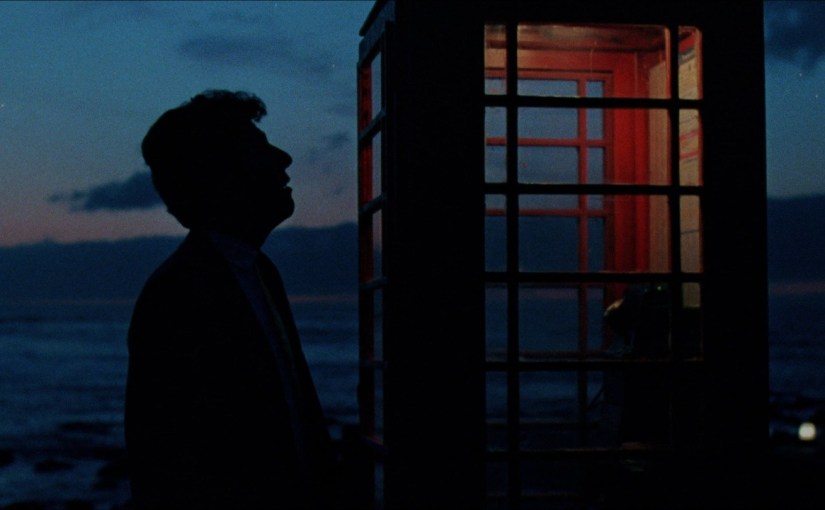
Local Hero throws curveballs every chance it gets.  You’d expect the citizenry to get indignant at the idea of an American mega-corporation wanting to buy their town.  But when the locals get an idea of how much each person would get, they become instant supporters.  When they all convene at the local church, the Reverend is not an inexperienced youth or a crusty old soul, but an African gentleman who, according to the story he tells Mac, came to Scotland to learn the ministry and just…never left.  Happer, the CEO, insists on periodic updates from Mac, and since this is 1983, Mac has to call Texas from a red phone booth just outside the hotel.  But Happer seems less interested in the deal than in the potential discovery of a comet, somewhere in the constellation Virgo.

All of this is told in the laid-back manner of someone telling a story around a campfire.  There are little jumps forward that omit what might seem to be key information, but we pick up on it right away.  Little details emerge, like the motorcyclist who always seems to be roaring down the town boulevard just in time to nearly run Mac over.  There’s a moment when Mac encounters a group of men near the beach, has a pleasant conversation, then notices a baby in a stroller.  “Whose baby?”  His question is met with an uncomfortable silence as the men slowly look at each other, and Mac wonders what just happened.  And the beautiful thing is, that’s it.  That’s the end of the scene.  No one ever answers the question, and we never find out why not.

That kind of thing would normally infuriate me, but in this movie, it reinforced the idea of a fond memory.  I can easily imagine someone telling the story and saying, “And that was it!  No one ever said whose baby it was!  I still don’t know whose baby it was!”  It has the ring of real life, it’s not played up for laughs, and there’s no punchline at the end.  The punchline is that there IS no punchline.

There is a nice moment when Mac has had one or two whiskeys too many one night, and he gets on the phone with Happer in that red phone booth.  Suddenly, the sky starts to glow and glisten – the aurora borealis.  Mac gets excited and tries to explain to Happer what’s going on, but he lacks the vocabulary.  “I wish I could describe it to you like I’m seeing it!”  I know how he feels.  It’s how I felt when I went to Alaska for the first time in decades and traveled on a cruise ship through a narrow fjord and saw towering cliffs covered in trees and intermittent waterfalls cascading over rocks so everything looked primeval, like something out of The Lord of the Rings.  Just describing it doesn’t convey how it felt.  It’s a short moment in the movie, but I felt the reality of it in my bones.

In an interview on the Criterion Blu-ray, the film’s producer, David Puttnam, talks about how, when this movie was made, the general public’s idea of comedy was Airplane! and Blazing Saddles.  If it wasn’t zany, it wasn’t considered a comedy.  He wanted to help make a film that tried to remind audiences that comedy doesn’t automatically mean pratfalls and fart jokes.  Comedy can be gentle.  Local Hero is as gentle as they come.  It’s marvelous closing shot speaks volumes, and it wouldn’t have had the same impact if the story had been told any other way.

TRADING PLACES

By Marc S. Sanders

Dan Aykroyd and Eddie Murphy are the unaware invitees of a Prince And The Pauper R-rated, yet whimsical, scenario in John Landis’ Trading Places.  They are one of the best on screen pairings in film, and this is one of the best comedies to come out of the 1980s.

Randolph and Mortimer Duke (Ralph Bellamy, Don Ameche – another brilliant on-screen duo) are the filthy rich misers who live to make more and more money and use their wealth to cheat and make even more monies or to perhaps use those that are at their behest to test certain social experiments.  Namely, Randoph believes that regardless of a man’s environmental upbringing, anyone can become a success based on their merits.  Mortimer believes otherwise.  It’s in the blood, he claims.  Who you spawn from is how you are destined to become.  To settle this debate, they make a modest bet of switching out their protégé investment representative, Louis Winthorpe (Aykroyd), with homeless bum/con artist Billy Ray Valentine (Murphy).  Deplete Louis of all his possessions and wealth along with his sparkling reputation, his lovely fiancée, his friends and even his faithful butler, Coleman (Denholm Elliot).  At the same time, establish Billy Ray as an up and comer in the WASP Hoi Polloi and award him all of Louis’ assets, along with assistance from Coleman.  Then they will see what shakes out and who wins the bet.  A plot like this was staged in a few Three Stooges shorts during a post Great Depression phase.

The premise for Trading Places allows for a lot of gags that consistently serve the story set mostly in Philadelphia around Christmas and New Year’s.  The holidays lend an atmosphere to the picture.  The brutal cold seems to only make it downright worse for poor Louis, the suddenly accused drug dealer and petty thief.  It only looks worse for him when he’s dressed in a dirty Santa Claus suit and getting peed on by a dog just before the cold rain arrives.  For Billy Ray, the warm comforts of Louis’ home seem like a welcome respite from the chilly, damp streets he likely has slept upon night after night.  If not on the street, then in a jail cell. 

The characterizations are perfect.  I get a kick of Dan Aykroyd’s performance of Louis, the contemptible snob with not one hair out of place and the arrogant tone of his line delivery.  Eddie Murphy is basically doing his routine from all of his early work like Saturday Night Live and 48 Hrs or Beverly Hills Cop.  Yet, I have no complaints.  He’s just funny as hell and the dialogue lends to his basic schtick.  This is the Eddie Murphy I miss from most of his modern film releases.  Denholm Elliott is great at often breaking his regal character to refer to someone as a scumbag.  Bellamy and Ameche are equivalent to wicked stepsisters from a fantasy story.  They are scheming and dreadful with glee.  Paul Gleeson is that “seen that guy somewhere before” henchman working in line with the Dukes.  He’s a great jerk who gets Louis and Billy Ray into their unexpected predicament.  Jamie Lee Curtis is unforgettable as a hooker with a heart of gold, convinced to help out a poor down on his luck Louis when there’s nothing else available to his assist.  She portrays Ophelia whose got the street smarts and sometimes the Judy Holliday squeak in her voice to lend to the spoof comedy this film relies upon.  It’s hard to believe this is the same actor who was a scream queen in a couple of slasher flicks a few years before this film’s release. Never a glamourous actor, but Jamie Lee Curtis has such an amazing range that still surprises in newer films of today (see her Oscar winning performance in Everything, Everywhere, All At Once).

The imagination into this film’s story has to be admired.  When Louis and Billy Ray become aware of the ruse pulled against them, it’s suggested not to kill the villains in cold blood. Rather do unto them what they already committed. Thus, a wonderfully energetic third act is welcomed on the floor of the New York Commodities Exchange that hinges on insider trading and realistic mass hysteria for a silly, yet highly valuable commodity such as Frozen Concentrated Orange Juice.

John Landis incorporates so many side gags into Trading Places.  Imagine Billy Ray intruding upon the wealthy’s exclusive club of snobs and you get a memorable caption of ten police officers pointing their guns in his face.  Poor Louis being subjected to a strip search conducted by nerdy Frank Oz.  Randoph and Mortimer explaining how commodities trading functions to Billy Ray thereby inviting Eddie Murphy to break the fourth wall for a moment.  Even one of my favorite actors of today, Giancarlo Esposito, makes a blink and miss it appearance as Billy Ray tells a tall tale of how he got arrested after using the “Quart of Blood Technique” on ten cops at one time while two hilarious jail cell thugs listen in to his BS.  A train ride to set the victims’ plot of revenge in motion is great involving silly disguises, a New Year’s Eve costume party attended by James Belushi, and a live gorilla.  Even Bo Diddley gets a scene with Louis trying to sell his expensive wristwatch while wearing the ugliest sports jacket and tie combination.

I yearn for another comedy that reunites Aykroyd and Murphy.  We were treated to a little sampling of Bellamy and Ameche in Murphy’s later film, Coming To America.  Oh, how I wish those guys could have capitalized on that small scene.  They pair just as well as Jack Lemmon and Walter Matthau did. 

Trading Places is always a perfect holiday movie to watch in December.  It’s funny, charming, and very smart.  It remains one of the best comedies ever offered by any of the cast members listed in this film.

Looking good Billy Ray!

Feeling good Louis!