ROCKY III

By Marc S. Sanders

By the time a series of franchise films reaches its third installment there better be something interesting for the characters to encounter.  Otherwise, it is the same old show.  Not many talk about it, but Rocky III actually does have something new to offer even if the story still feels like the same kind of tread.  What’s new?  Mr. T!

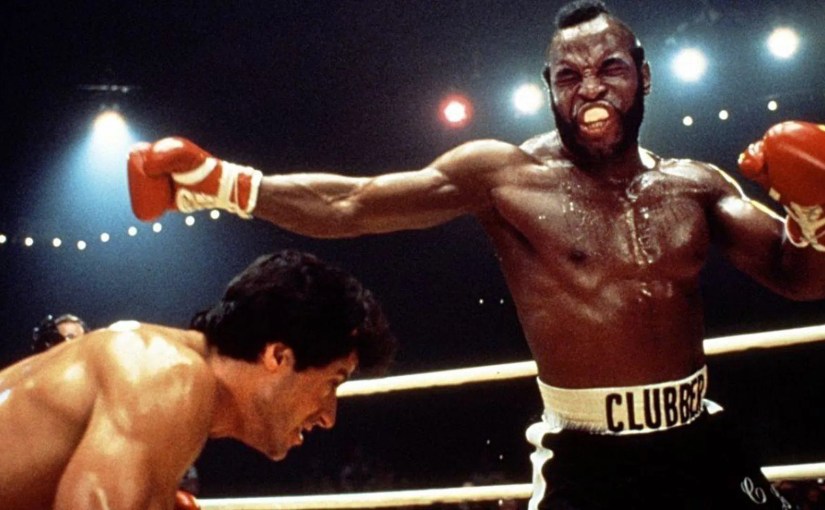
In the lexicon of greatest villains of all time Mr. T’s introductory role of Clubber Lang, the fierce boxer who lacks pity for a fool, should be included within these tabulations.  Reader, I challenge you to find him listed anywhere.  I don’t think you’ll be successful.  Not even as a runner up. That is a terrible oversight.

As Rocky III opens with a quick flashback of Rocky Balboa (Sylvester Stallone who also writes and directs) winning the championship away from Apollo Creed (Carl Weathers), quick cuts of the hero show him knocking out one fighter after another with debonair ease.  When he’s not boxing, he’s posing for commercials and magazine covers, or he’s riding his custom-designed Italian Stallion Harley with his wife, a glamorous Adrian (Talia Shire) on the back.  Juxtaposed within this montage, played against one of the greatest songs in film history (Eye Of The Tiger by Survivor), is Clubber Lang executing bloodletting beatings on his own opponents.  He’s angry and he threatens to kill Balboa in the ring. Rocky’s mainstay coach Mickey (Burgess Meredith) attends these fights and grows fearful of this new menace.  Clubber will not give up on this campaign until he has his shot in the ring with Rocky.

Rocky III has a glossy finish the first two installments deliberately withheld.  The photography is sharper. Stallone is quite handsome, rich and fit.  Adrian has abandoned the meek bashfulness and nerdy, wing shaped eyeglasses.  Their furnished house sits on a gorgeous estate complete with servants, a golf cart, and a little boy all their own.  The filth-ridden areas of Philly are behind these protagonists.  Welcome to the materialistic and decadent 1980s.  Frankly, I like how nice and put together everything feels in Rocky III.  It truly is a window into what much of the 1980s looked like.  Stallone and Shire’s characters have evolved amidst their wealth, and I continue to like them. 

The one ingredient that carries over is the alcoholic slob, Paulie (Burt Young), whose grumpiness hasn’t changed.  He is a given a substory in the first ten minutes of the film where he shows his resentment for Rock.  Then, the slugger bails him out of the drunk tank, gives him a job, and he only remains through the film for a few laugh bits.

(SPOILER ALERT) Following accepting the challenge to fight Clubber Lang, Rocky loses in terrible defeat just as Mickey suffers what will be a fatal heart attack.  Not only does he lose, but he cannot overcome his sorrow, and fear has intruded upon his psyche.  Apollo volunteers to train Rocky and encourages him to do one last fight against this new opponent, now champion.  Only now, Rocky has to get that “eye of the tiger” back and he needs to move light on his feet like Apollo originally learned.

Everyone in Rocky III has an energy about them.  These actors are used to one another even if Stallone and Weathers were on opposite sides for the last two films.  Stallone’s script experiments with testing his boxing character to lose what he earned organically in his earlier films.  He also sketches the guy with conceited fault ahead of the film’s first fight when he showboats his training and does not take this new fighter seriously enough.  This is good material for a third follow up piece.  It’s certainly more exciting than what Rocky II offered.

However, the film belongs to Mr. T who became a pop culture icon of the 1980s with gold jewelry, the mohawk, a TV action series, cartoons, toys and guest appearances on telethons, Johnny Carson, Diff’rent Strokes and Silver Spoons.  Forty years later, he deserves some recognition for the impact he had on the American psyche.  This guy was a big influencer.  No one has ever replicated what Mr. T delivered.  If you watch Rocky III again, you can’t help but get caught up in how hostile his Clubber Lang is.  I doubt this guy was written this broad or aggressive in Stallone’s script pages.  Clubber Lang is a villain that owns this picture anytime he appears on screen.  Mr. T is not a diverse actor by any stretch but the personality that was introduced here is unforgettable.  During both training and boxing montages, his muscular physicality is an astonishment, and he’s a terrifying new kind of monster with every threat he screams at this cast of likable heroes.  This guy would burn the whole happy village down if given the chance.

I’m also impressed with Talia Shire.  She’s not given much to do here.  For the most part she is sitting in the audience, cheering on Rocky, or watching from the sidelines while he trains.  However, there is one special scene that Stallone wrote for them that turns the tide of this ninety-minute film ahead of the inevitable, pulse racing training montage.  Her scene of truth-hurting candor with Stallone’s character on California shoreline where all of the pain and anguish surfaces is carried by her against Sylvester Stallone, the superstar.  It’s a reminder why the Rocky films were never anything without Adrian.  The love of Rocky’s life has to always be there to rescue the lug from his despair and lack of confidence.  I love this scene.

I would never argue with anyone who said this franchise became a sad joke upon itself by the time Rocky III rolled around.  The formula is very recognizable.  It’s not a tremendous sequel like The Empire Strikes Back, The Godfather Part II, or even Superman II demonstrated ahead of its release.  Yet, there is a vigor to Rocky III, and the highs and lows are told efficiently at a very comfortable pace. 

I saw Rocky III before I saw the prior two films and at age ten, this had my attention from beginning to end. It’s likely when I left the theatre, I wanted to be a boxer and pound someone’s flesh into a bloody pulp amid a cheering crowd.  I recall the whole audience in the theater applauding as soon as Rocky triumphed again.  I also recall the tears and sniffles I heard at the midway point when poor Mickey’s life suddenly ends.  These are beloved characters that we only want to remain happy and healthy.

Rocky III is not accurate to how it really is for professional boxers.  I do not think the well edited cuts of the fights are genuine either.  A lot of the footage looks like an action movie more than a sports picture.  When Clubber Lang swings with a jab, there’s a whooshing sound.  However, Stallone as a writer/director knew how to touch on the melodrama effectively with laughs, sadness, fears and cheers. 

With that amazing Bill Conti soundtrack, Survivor’s rattlesnake opening chords of their Oscar nominated song, Mr. T and, oh yeah, a giant named Hulk Hogan as a beast of a wrestler named Thunderlips, Rocky III is outstanding, pure escapist entertainment.
TOOTSIE

By Marc S. Sanders

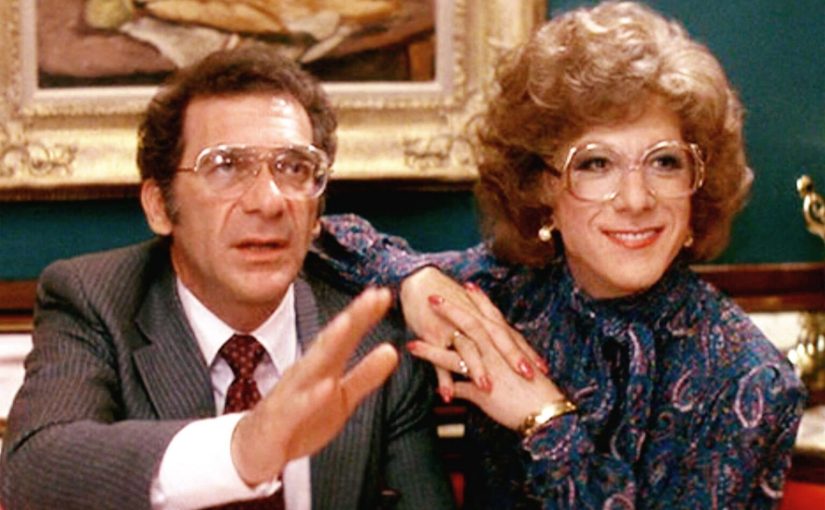
Tootsie is my favorite comedy of all time.  At age ten I saw it on Christmas Eve with my family and beyond the Star Wars and Rocky films, I had yet to see an audience respond, or more specifically laugh, so uncontrollably for two hours straight.  I might not have recognized all of the innuendo and I was not yet alert to the idea of women feeling belittled while knowing they should be entitled to equal respect, but the performances, especially from Dustin Hoffman were entirely genuine.  Tootsie still remains the only film where I can forget that a man, a not so attractive or sexy man, is convincingly disguising himself as a woman who possesses internal strength and gusto.

Whether directing or acting on screen, Sydney Pollack was not someone well known for overseeing comedy at the time.  Yet, that’s an attribute to the end product of this celebrated movie.  Other than a typical Bill Murray routine in an uncredited role, no one in this picture is waving their hands in the air to insist they’re funny.  The humor of Tootsie bears from true, raw emotion, fear and desperation.  No one is doing Saturday Night Live sketches and building up to the next punchline.  Despite the cross dressing, Tootsie is not even a farce.  A guy gets a job wearing the necessary garb and modifying his verbiage, but only to earn enough money to survive.  However, it also doesn’t help that he’s falling for his co-worker.  

Dustin Hoffman is an actor living in New York City named Michael Dorsey.  He’s a great, learned performer, especially on the stage, who lives with his playwright buddy Jeff (Murray) in a crummy apartment in the meat packing district.  They need to raise enough money to put on Jeff’s play in Syracuse.  

The problem is that Michael can no longer get cast in anything.  Not on stage or even in a commercial.  His agent (Pollack) says it point blank that nobody will hire him.  He’s just too difficult with short bursts of temper and no tolerance for others who work in the field.  

So, Michael surrenders to desperation and puts on the guise of a character actress named Dorothy Michaels.  As quick as she stands up for femininity against a chauvinistic TV director (Dabney Coleman) she is cast on the most watched daytime soap opera.  As long as Michael can perform off and on camera as Dorothy he should be able to earn more than enough money for Jeff’s play.

Complications arise though when he becomes protective of his co-star, Julie (Jessica Lange, in her Oscar winning role), against her unfaithful boyfriend, the TV director.  Julie’s widowed father, Les, is falling for Dorothy though, and then there is Michael’s friend Sandy (Teri Garr) who lost out on the part that he earned, and to keep things maintained has been seduced by Michael into a romantic relationship beyond just their friendship.

With me so far?  I hope so because there’s even more obstacles to overcome.  Tootsie is very economical in its story development, but it’s also a very crowded film.

Don McGuire and Larry Gelbart (TV’s M*A*S*H) wrote this Oscar nominated script with a brilliant collection of characters.  The blessing is while it sounds like farce, Tootsie is never delivered with a slapstick tongue.  In order for the film to work, Dustin Hoffman especially had to portray Michael Dorsey as a guy with natural ticks, motivations and fears.  He accomplishes that because Michael always ensures that Dorothy is as real as she can ever be.  When Dorothy hails a cab or shops for clothes the southern accent must hold while perusing through the city streets in heels.  Michael gets frustrated over what to wear for a dinner visit at Julie’s apartment.  Especially when Julie opens up her heart, Hoffman is precise to make sure Dorothy approaches with a low whispered approach to simply be a consoling girlfriend.  

The comedy arrives when Michael has no other choice but to break this strong powered female persona.  Dorothy will call for a cab but if it just won’t stop, then a deep voiced, bellowing New Yorker will come out of this woman’s mouth with an angry “TAXI!!!”  I like to believe that Sydney Pollack deliberately arranged for Dorothy to yank a Woody Allen lookalike out of a cab that was about to be taken from Dorothy too.  Dustin Hoffman knows Michael Dorsey is such a committed method actor that he has to convince all eight million people in New York he is strong willed Dorothy Michaels – a character actress capable of playing the new Hospital Administrator on Southwest General

There are so many fleshed out pairs of relationships in Tootsie – all going beyond the cross dressing of the film’s main character.  All of these people could get along forever if only for the fact that some characters have befriended a man while others truly believe they have made a connection with a woman.  How long can we have it both ways?  The facade has to undo itself, right?  True.  Thankfully it occurs at the end when every single character can have it explained to them all at once.  I’ve never forgotten the roars of laughter from my mom, dad and grandmother as the end of Tootsie arrived.  Well-placed close-up shots of every actor who had a speaking role in this movie is covered (well except for Sydney Pollack as Michael’s agent). On Christmas Eve in 1982, the packed movie house at the Forum Theater on Route 4 in Paramus NJ only amplified the shocking reactions.  Tootsie is a reason why you sit among a crowd at a movie theater.  

This is Dustin Hoffman’s all-time best performance.  He was nominated against fierce competition from Paul Newman in The Verdict, Jack Lemmon in Missing, and Ben Kingsley in Ghandi (who took home the trophy). Michael Dorsey/Dorothy Michaels is a much more challenging role than what Hoffman superbly accomplished in his two Oscar winning roles (Kramer Vs Kramer, Rain Man).  Robin Williams or Tom Hanks could have played Michael Dorsey who invents Dorothy Michaels.  Yet, what Hoffman emotes are the natural tics of a guy who is constantly broke while he charms an array of women at his birthday party, only with the intention of bedding them and hardly ever listening to what these ladies have to say.  When Hoffman puts Michael literally in a pair of woman’s shoes though, he begins to identify the lack of respect that women endure on a daily basis.  

Watch Dustin Hoffman’s body language.  He becomes angered with his agent upon learning that he lost out on a role which somehow leads to a debate about whether a tomato should walk or talk or sit or stand.  That back and forth is outrageously hilarious.  Having seen Tootsie hundreds of times though, I now appreciate how a schleppy looking Michael hustles across the streets of New York, avoiding traffic and then marches down the hallway to his agent’s office.  Hoffman twitches his head and shrugs his shoulders as if he’s prepping to give the agent a piece of his mind.  Hoffman is so absorbed in this guy he’s playing.  I am not recognizing any other kind of Dustin Hoffman that I’ve seen anywhere else.

Sydney Pollack is also attuned to the cutthroat atmosphere of desperate theater folk trying to survive in this concrete jungle.  Tootsie opens with a montage of quick episodes for Michael.  He is leading a workshop while being candidly ugly with his fellow thespian students about how challenging it is to get work.  In between, are auditions that he goes on where there is one reason after another why he can’t land a role.  Michael Dorsey is an incredibly skillful actor, but that means nothing for this role or that role.

On this most recent viewing I caught on to a detail that never occurred to me.  Bill Murray as Jeff, the broke playwright, is snacking on lemons and wincing while he talks to Michael.  Now I don’t know if this is in the script or if this was Pollack or Murray’s idea.  Nevertheless, it’s a brilliant detail.  These guys are so broke that they have resorted to smuggling lemon slices out of the restaurant they work at to live off of.  Another actor or filmmaker would have used an orange or cookies.  Who snacks on lemons?  Only those with nothing else to rely on.  

Makeup bottles with spirit gum, cannisters of fake blood, prosthetic teeth, props and sloppily hung costume wear are all given focus beyond the broad comedic storylines.  Sydney Pollack pans his camera over all of these items with no actors in frame because he wanted to ensure that being an actor or a playwright in New York is nothing glamorous.  It’s a world of unending torment. All of these nuances and details justify the extremes that Michael has to go through to achieve his goal.  

Jessica Lange never plays her role for laughs.  Her portrayal of Julie, the beautiful, blond celebrity of daytime television, is authentic and she inherits a new girlfriend to confide in. Finally, Julie can share what she values and holds dear.  You can’t not fall in love with someone who only treasures the best parts of her young life and yet only seeks a companion to chat with.  A humble celebrity is hard to find and that is one reason Michael falls hard for her.  Lange is outstanding while being so heartfelt.

Teri Garr’s comedy stems from the insecurities of actors.  Sandy is described as someone who wants to commit suicide at a birthday party.  Doing community theater for over thirty years I know precisely who this person is.  I’ve been this person, and I’ve encountered hundreds of these people.  It’s hard to be a big fish in the small pond of community theater.  Imagine trying to hold on to your sanity when you have to compete with all of New York.  Teri Garr was rightly Oscar nominated for what could have been a throwaway part. Like Hoffman she also has these little gestures that suggest her lack of confidence. After she sleeps with Michael and he’s getting ready to leave, Garr peaks at her naked chest hidden underneath the sheets.  It’s as if she’s wondering was I not attractive enough.  She’s hurting. No matter if she just had sex with one of her favorite people, she is still suffering.

Charles Durning is familiar for having the tough guy, intimidating persona because he’s usually so much larger than life.  However, he offers a sweetness to this guy who’s ready for companionship.  You don’t want Michael or Dorothy to let him down.  Les doesn’t deserve to get hurt.

Again, as I described any of these characterizations, none of it is funny.  They are wrapped in sensitivity. There’s a lonely sadness to people like Michael, Jeff, Julie, Sandy and Les.  Yet, when this variety of sorrow and anguish collide, while poor Michael is only trying to make some money, does it all combust in hilariously, unwinnable scenarios of tremendous proportions.

Tootsie is an amazing film.  It is one of the smartest, most insightful scripts ever written and it is blessed with a cast and director who mastered how to live in an unforgiving and unsympathetic industry.  This picture offers lessons in the human spirit while demonstrating the lengths and boundaries that must be broken in order to survive.  By practically not performing as a comedy, it only becomes that much more funnier and wiser.  

Tootsie is a perfect film!

AN OFFICER AND A GENTLEMAN

By Marc S. Sanders

You ever feel proud of a character in a movie?  Like you walk out, and you say to yourself, “Well done, Rocky!  You did it!!!”  That’s how I feel about Zack Mayo, the Navy enlisted candidate who has to survive his first 13 weeks of basic training on his way to eventually obtaining his dream of flying jets.  Just as important though, Zack has to mature as a responsible young man with a commitment to caring at least as much for others as they already care for him.  Richard Gere plays the guy who must become both An Officer And A Gentleman.

Director Taylor Hackford goes deep into the bottom of the well to show what makes Zack such a loner.  His Navy enlisted father (Robert Loggia) abandoned him and his mother, and only reenters Zack’s boyhood life once his mother commits suicide. Zack spends time growing up on the Philippine Islands Naval base where he gets bullied while remaining unloved.

Years later, after college graduation, not knowing of any other direction to take with his adult life, he opts to go down the same path of his bum of a father and join the Navy where he’ll perform basic training when he arrives at a coastal Seattle base. The enlisted men do not have a good historical reputation in this area.  Many are known for bed hopping with the local factory girls, and then they relocate to where they are going towards next in their servitude, leaving the girlfriends behind and forgotten.  Zack’s father was one of these guys. The ladies in the area also have a stained legacy.  Many of them will deliberately get pregnant or even lie about missing their period to keep these enlisted men from leaving them.

Sergeant Foley (Louis Gossett Jr, in his unforgettable Oscar winning role) oversees Mayo and his class, specifically warning all of them that these trends occur over and over again.  When he’s not cautioning them, Foley attacks the character traits that weigh Mayo and the others down.  If they had a rough childhood or checkered background, Foley will not hold back.  He has to prepare these men and women for a possible war or a position of captivity behind enemy lines.  If these young folks can endure Sgt Foley’s cruel mind games and unforgiving, hard-hearted nature, then they are more prepared for any worst-case scenario that can come while performing military service.  

Mayo is a leading candidate in his class.  He has the potential to break the record on the brutal obstacle course, and he’s secretly resourceful with selling polished boots and belt buckles to his classmates ahead of bunk inspection.  Not bad.  However, he’s not mature and he doesn’t even realize it.  The first time he completes the obstacle course he sits over on the side, proud of himself, rather than joining his teammates in cheering each other on to finish the job.

Love is also not something Mayo is experienced with. He meets Paula (Debra Winger in a superb Oscar nominated performance) who is ready to love Zack but he’s not ready to open up to her.  Perhaps he never wants to love or commit to anyone to save himself from loss or further abandonment because it’s all he’s ever known.  An Officer And A Gentleman is very good at subtly covering what makes a loner a loner.  

Contrary to Zack’s background is the best friend he makes, Sid Worley, a fellow classmate (David Keith).  Sid is a happy go lucky fellow, but eventually the film shares what motivated him to enlist and how his relationship with a local girl pans out. Perhaps there’s some sense to what Foley has been warning these people about.  

An Officer And A Gentleman is sad at some points and very uplifting as well.  Sometimes it’s hard to watch the encounters that Zack and company must endure during these first thirteen weeks of a committed six-year servitude to the Navy.  The glamour of flying jets can only arrive once you shed away the person you once were by developing maturity, respect, resilience and honor.  

I love the way Taylor Hackford’s film tests Zack.  He’s tested by Paula, by Sergeant Foley and even by his own father.  Can he let go of the drunken whore parties arranged by his dad? Raised by a guy who might have worn the officer rankings and uniform, but now beds the women he picks up in bars only to finish it off with a drunken vomit session in the morning.  

Foley puts Zach to his mental and physical limits after he catches him in violation.  The sergeant then insists on the kid’s DOR (“drop on request”).  It’s up to Zack if he wants to take this seriously or simply quit and remain a loser like his father.

Then there is Zack’s commitment to Paula.  Can he trust Paula will not trick him or let him down, again like his father, then his mother, and followed by his father all over again?  

Richard Gere is sensational at balancing two stories at once.  This remains the best role of his career.  It’s a dynamic, multi layered performance.  First, the physicality he devoted to the role is impressive.  That is Gere doing the obstacle course and cockpit test crash dives in the swimming pool.  Gere is the one doing endless pushups in the mud and running in place with a rifle above his head while Gossett’s character torments him with his abusive yelling and a dribbling water hose.  Gere is also the one riding Mayo’s motorcycle.  The actor is completely absorbed in this divided character.  Arguably, he should have been considered for an Oscar nomination.  

Zack Mayo is not always likable.  The purpose of the film is to discover what is to admire about the conflicted loner who never had anyone to care for him or anyone for him to lend sincerity towards.  If joining the Navy can pull this guy towards a meaningful life that can be purely earned and not cheated or circumvented, then it’s possible to feel proud of what this man becomes.  

An Officer And A Gentleman is now over forty years old. So, it might feel dated. Yet, the traits that make a man and a woman good, honorable, and loving people has never lost their immense value.  If you have never seen this movie, it’s time you did, and if you have seen it, it is due for a rewatch.  

The last line of the picture, depicted in one of the greatest endings ever to close out a film, is “Way to go Paula!”  Allow me to also say “Way to go Zack!”

THE DRAUGHTSMAN’S CONTRACT (United Kingdom, 1982)

by Miguel E. Rodriguez

DIRECTOR: Peter Greenaway
CAST: Anthony Higgins, Janet Suzman, Ann-Louise Lambert, Hugh Fraser
MY RATING: 8/10
ROTTEN TOMATOMETER: 97% Fresh

PLOT: An insouciant young artist is commissioned by the wife of a wealthy landowner to make a series of drawings of the estate while her husband is away.


The directorial debut film of Peter Greenaway at first feels like a mashup of earlier British period films, most notably Kubrick’s Barry Lyndon and Tony Richardson’s Tom Jones.  It contains much of the painterly beauty and some – not a lot – of the stateliness of Kubrick’s film, combined with the irreverence of Tom Jones, especially concerning sexual matters.  However, The Draughtsman’s Contract makes its own mark, particularly in the closing sequences when revelations occur throwing everything that has come before into a different light.  In behind-the-scenes interviews on the Blu-ray, multiple people say multiple times that the clues to the mystery that pops up unexpectedly are hidden in plain sight.  Well, kudos to the filmmakers, because I was fooled.

The story takes place in 1694 in one of the more beautiful portions of the English countryside.  A dimly-lit prologue establishes the particulars: Mr. Neville (Anthony Higgins, whom you may recognize as Sherlock Holmes’s mentor in Young Sherlock Holmes [1985]) is a talented but arrogant draughtsman (pronounced “draftsman”), much in demand for the quality of his pencil drawings.  After much prodding from Mrs. Herbert (Janet Suzman) and her married daughter, Mrs. Talmann (Anne-Louise Lambert), he is persuaded to enter into a contract to produce twelve drawings of Mrs. Herbert’s country estate while Mr. Herbert is away on business.  But because Mr. Neville is abandoning a previous commitment, he insists that his payment be his regular fee, full room and board on the estate…and one private visit each day to Mrs. Herbert so that she may “comply with his requests concerning his pleasure.”  I would say that this may have influenced Jane Campion’s masterpiece The Piano, except the favors in The Piano evolve into something deeper, while the favors in Contract have no deeper level than satisfying Mr. Neville’s appetites.

Given the reputed over-the-top nature of Greenaway’s The Cook, the Thief, His Wife & Her Lover (unseen by me so far), I expected the scenes depicting Mrs. Herbert’s contractual obligations to be far more explicit than what is shown.  This is not a criticism.  I think, for this film, that kind of attention-getting device would detract from the narrative momentum Greenaway achieves.  Since the movie is extremely dialogue-heavy, we are better served by short scenes leaving no question as to the liberties taken by Mr. Neville, so we may return expeditiously to the plot.

(I stand corrected: there is one brief but potentially stomach-churning shot of Mrs. Herbert dealing with the effects of eating something that perhaps did not entirely agree with her…eeyuck.)

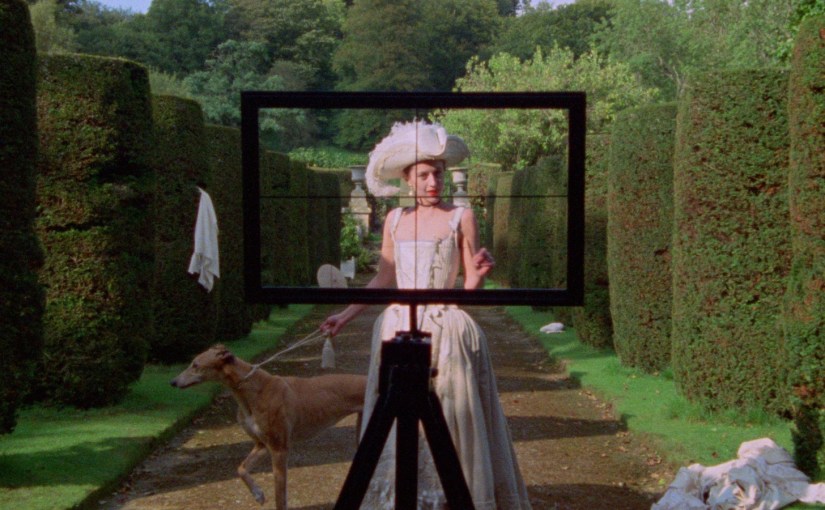
Leaving those interludes aside, the film is essentially a series of deliberately wordy conversations among Mr. Neville, his servant, Mrs. Talmann, Mrs. Herbert, etcetera, while we also watch Mr. Neville practicing his craft.  Using an ingenious device I’ve never seen before, he sets up a framed grid of wires on a tripod so that the object he’s drawing is divided into multiple squares.  Then he simply draws an expanded version of the framed object onto his sketchpad, grid by grid.  (My girlfriend and I used a variation of this same process to draw Timon from The Lion King at Animal Kingdom.)

His one guiding rule is: “Draw what you see, not what you know.”  As such, if the view has changed in any way when he returns to each site, he immediately incorporates those changes into his drawing, whether the changes be as simple as the addition of a ladder on the side of a building or more complex, like adding a dog standing outside a greenhouse.  This credo will come back to haunt Mr. Neville in ways he cannot anticipate.

A mystery arises.  Mr. Herbert never returns from his business trip.  His horse is found wandering the estate.  No one can confirm his arrival at his destination.  Articles of Mr. Herbert’s clothing suddenly appear here and there around the estate…and as such, immediately become part of Neville’s drawings.

And what’s the story with the occasional appearance of a naked man whom we, the audience, can see, but which the movie characters cannot?  True, he’s not quite in anyone’s field of vision, except twice, when a child can clearly see him, but his guardian cannot, and when a steward shoos him away off a bridge.  I have gone over his scenes in my head multiple times, and I still cannot grasp the significance of this anomaly.  Director Greenaway was a painter before he became a filmmaker (indeed, it is his hands we see making Neville’s sketches), so presumably there’s a reason behind it.  Is this man a Fellini-esque or Lynchian sideshow, intended to raise questions without answering them?  Or is this man a visual representation of the “paint what you see, not what you know” philosophy?  If we extend that rule to our lives, are we being encouraged not to ignore the fanciful, the odd, the unusual, simply because they may not fit in the limited framework of our beliefs and/or prejudices?  Perhaps the child could see this man because he did not yet have any prejudices that would exclude him from his awareness, whereas his guardian simply sees a wall, or a statue, because that’s easier to deal with.  Discuss.

Whatever this naked man represents is secondary, at least during the film, to what happens among Mr. Neville, Mrs. Herbert, and her daughter Mrs. Tallman.  I especially enjoyed just listening to them talk.  In its own way, The Draughtsman’s Contract reminded me of the films of Tarantino, where outrageous incidents or conduct are always framed by characters who talk and talk.  What a treat it is sometimes to just listen to dialogue that doesn’t feel like it was generated at the cliché factory.  Some examples:

  • “Why is that Dutchman waving his arms about?  Is he homesick for windmills?”
  • “When your speech is as coarse as your face, Louis, then you sound as impotent by day as you perform by night.”
  • “He doesn’t like to see the fish.  Carp live too long…they remind him of Catholics.”
  • “Your inventory, Louis, is unlimited, like your long, clean, white breeches.  There is nothing of substance in either of them.”

And so on.  Full disclosure: before the eventual resolution of Mr. Herbert’s disappearance and the subtle change in relationship between Mr. Neville and Mrs. Herbert, I was resigned to the idea that the movie had nothing else to offer, plot-wise, and I was mentally giving the film a more mediocre score.  But good things come to those who wait.  Give The Draughtsman’s Contract a chance, and you will find, as I did, that Greenaway has a few surprises in store for anyone who thinks they know how this story will end.

FIRST BLOOD

By Marc S. Sanders

1982 was a significant year in Sylvester Stallone’s career.  He helped popularize a rock anthem from Survivor (Eye Of The Tiger) and he ushered in the pop icon figure with the mohawk and gold chains, known as Mr. T, when the third chapter of his Philadelphia sad sack boxer, Rocky,  became a huge hit at the box office.  More importantly, however, he initiated another, bloodier, franchise character.  

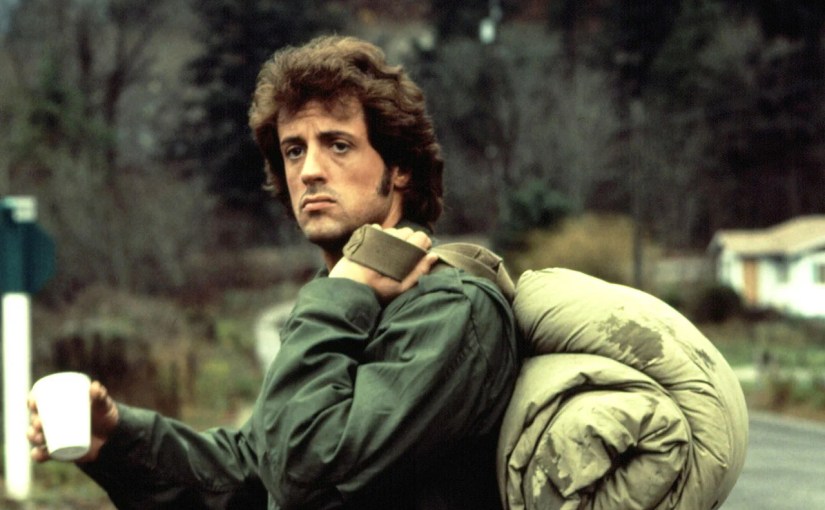
Vietnam Veteran John Rambo entered a small northwestern town to catch up with an old war buddy and grab a bite to eat in First Blood, based on a bestselling novel by David Morrell.  The film, with a screenplay co-written by Stallone, contains a simple plot.  The well-liked Sheriff Teasle (Brian Dennehy) of this community takes notice of Rambo, the drifter with an American flag patched on his army coat, and immediately does not take a liking to him or his appearance.  Teasle attempts to peacefully escort the stranger beyond the city limits.  As soon as he drops Rambo off on the other side of the bridge, the former Green Beret turns around and starts to walk back into town.  A conflict is now set off that will carry the rest of the picture.

After Teasle arrests Rambo, an abusive jail search and frisk awakens the post traumatic stress that the veteran appears to be haunted by from his experiences when he was held captive by the Viet Cong.  A thrilling action sequence is welcomed by Rambo’s escape into the wintery cold mountains.  Now a personal war pitting the tormented man against Teasle’s local law enforcement has been waged.  Perhaps the only way this will end peacefully is if Rambo’s former commander, Colonel Trautman (Richard Crenna), can reign the soldier in before there’s loss of life or any further injury.

The irony of First Blood, Rambo’s first cinematic adventure, is that there is only one fatality in the whole picture.  Rambo is not necessarily a cold blooded killer.  Just don’t push him.  Otherwise, the picture hinges quite a bit on the inventive booby traps that he sets up with only what accompanies his multipurpose six-inch bayonet knife and what can be uncovered within the dense woods.  The traps are quite daring and believable, and as an action picture, it makes for good entertainment.

First Blood may attempt to demonstrate the residual effects of returning home from a tortuous war, but I do not think it sends the best message.  I could never truly understand Teasle’s  immediate abhorrence for Rambo.  This is just a guy who’s walking on by.  Where does the alarm stem from in the Sheriff’s mind?  Maybe a reader can give me some insight that I have failed to recognize after repeated viewings of the film.  

The best part of First Blood is the ending which likely offers one of the best acting scenes in Sylvester Stallone’s enormously long career.  As the adventure is wrapping up, a well written and heartbreaking monologue is delivered that unleashes the terrible trauma the Veteran carries.  Stallone gets to such a manic state of tears and anxiety that it seems so natural.  His voice gets convincingly hoarse.  His face contorts into believable anguish.  At times it is hard to comprehend what he’s describing to Colonel Trautman, but it’s easy to see the distress the character has been living with.  It’s also a perfect summation of the film.  

In this first film, before the subsequent sequels focusing on sensationalized violence, it is apparent how John Rambo contains his heartache and resorts to release what he’s coping with by fighting back against a higher power and refusing to surrender.   The closing monologue perfectly demonstrates that.  It’s as if this man has been holding his breath under water and now, once all the ammunition is expended and the town is in flames, he can finally release what’s been buried in his gut, in his subconscious, for so long.  

1982 was an appropriate time to release First Blood.  It had been ten years since the United States pulled out of a long, losing war in Vietnam.  During the Reagan years, it is fair to argue that life had become quaint and peaceful in this country.  There were remnants of a Cold War still brewing, but there was not a violently long conflict any longer to report.  Pop culture and materialism were being embraced.  Cost of living was working well for the middle class.  Sadly though, there were plenty of people who served who could not put behind the mental scars they took home with them.  Many of these men and women remain forgotten.  Some never returned and some are still unaccounted for.  David Morrell’s story attempted to bring attention to these oversights.  Though the ending to the film adaptation is far different than Morrell’s book, the message is consistent.  

I do not think First Blood is a more effective narrative than The Deer Hunter or Oliver Stone’s well received Vietnam pictures to come out later in the decade.  After all, this is by and large an action adventure.  However, due to the popularity that Stallone carried with the Rambo character, it may have garnered attention for those that never should have been neglected.  

SOPHIE’S CHOICE (1982)

by Miguel E. Rodriguez

DIRECTOR: Alan J. Pakula
CAST: Meryl Streep, Kevin Kline, Peter MacNicol
MY RATING: 10/10
ROTTEN TOMATOMETER: 78% Certified Fresh

PLOT: Sophie, a survivor of Nazi concentration camps, has found a reason to live with Nathan, a sparkling if unsteady American Jew obsessed with the Holocaust.


I have not seen a movie as stirring, as affecting, or as emotionally shattering as Sophie’s Choice in a very long time.  For years, I was aware of the film’s cachet and of Meryl Streep’s Oscar-winning performance, but the opportunity to watch the movie never presented itself until very recently.  I was intellectually aware of the slang usage of having to make a “Sophie’s choice”, meaning that one had to choose between two equally undesirable options.  I knew it had to do with the movie of the same name, but I had no other context.  And for decades, the real context of Sophie’s choice had remained unknown to me until now.

That fact is one of the reasons Sophie’s Choice had such a devastating impact on me.  The screenplay is another, and naturally, there’s Streep’s landmark performance.

The story opens with an older man’s narration while we watch his younger self onscreen.  This is Stingo, played as a young man by Peter MacNicol.  He’s an aspiring author, and he’s just moved into a large pink boarding house in a Brooklyn suburb shortly after the end of World War II.  On his first day there, he encounters the two people who will irrevocably change his life, Sophie (Streep) and Nathan (Kevin Kline in his film debut).  They appear to be a couple, but they are in the middle of a brutal verbal argument on the stairs, with Nathan yelling awful things to Sophie, calling her a Polack, saying how much he doesn’t need her.  He leaves in a huff, Sophie is in tears, Stingo instinctively goes to comfort her, they get to talking, and the next morning Nathan returns, utterly contrite, at first suspicious of Stingo, but when Sophie assures him Stingo is just a friend, Nathan is all charm and goodwill and has nothing but good things to say about Sophie.

At this point, in my head, I had the movie all planned out.  Okay, so we’ve got a love triangle with a writer/narrator coming between an unattainable beauty and the capricious brute who loves her.  And this, I imagined, is what Sophie’s choice would eventually come down to: the penniless aspiring writer who is “safe” or the roguish charmer with the turn-on-a-dime temper.  Ho hum, been there, done that, I thought, but wow, is Meryl Streep’s Polish accent spot-on or WHAT?  Guess I’ll keep watching just so I can say I watched it.

That’s the ingenuity of the screenplay I mentioned earlier.  It strings you along for close to an hour, making you believe it’s about the romantic relationship among the three leads.  And then the movie springs one of the greatest head-fakes in film history.  What started as a soapy melodrama becomes a character study of the limits of human endurance, with scenes as fraught with tension as anything written by Hitchcock or Tarantino.

(I am going to have to write very carefully from here on out because I want to convey how effective the movie is while preserving its revelations.  It worked so well for me precisely because I knew very little about the plot, and I want to make sure you have the same experience, dear reader.)

Any appreciation of Sophie’s Choice must include a discussion of Meryl Streep’s performance as the title character.  She reportedly begged director Alan J. Pakula for this role, even after he had lined up a Polish actress for the part.  We can all thank the cinema gods Pakula went with Streep instead.  This is, without a doubt, one of the top three or four performances I’ve ever seen by any actor, living or dead.  Even leaving aside her mastery of the Polish accent…well, actually, let’s talk about that for a second.  She learned to speak with a flawless Polish accent.  Then there are scenes where she had to speak fluent Polish, so she learned Polish.  Then there are scenes where Sophie also speaks German, so she learned how to speak fluent German with a Polish accent.  I mean…it took me two weeks to learn two sentences in French and say them fluently.  If there were a fan-fiction theory that Streep is really a magical drama teacher at Hogwarts, I’d believe it.

At times during Sophie’s Choice, Pakula’s camera simply stops and stares at Streep while she delivers a monologue about her days before the war, or about how she survived as a personal secretary to the chief commandant of Auschwitz.  Her delivery during these scenes feels about as naturalistic as you can get.  You don’t feel like you’re watching an actress give a performance anymore.  It’s more like you’re watching a documentary about a Holocaust survivor.  It’s a performance that simply must be seen to be believed.

Next to Streep, Kevin Kline as her beau, Nathan, is almost overdone, stagey, far too full of ebullience and rage and earnestness.  Nathan is Jewish, and he is obsessed with the idea of tracking down the Nazis who escaped justice after the war.  However, his antics are balanced by Sophie’s serenity and unconditional forgiveness.  I look at it as a yin/yang kind of thing.  It works.

There are questions, though, about their relationship, especially as the movie wraps up.  Why does Sophie put up with this lout who whispers sweet nothings to her and impulsively proposes marriage in one moment, and in another moment is given to vicious accusations of infidelity and collaboration with the Nazis, then swings back again in a fit of contrition?  Perhaps she was wracked with survivor’s guilt.  Her parents, husband, and children never emerged from the concentration camps.  Perhaps she felt it was her duty somehow to prop someone up and latch on to a soul like Nathan, someone whose outward cheerfulness masked internal demons.  Perhaps being a helpmate for such a person keeps her own demons at bay.  Just a thought.

When I’m watching a movie on my own, I can measure how effective it is by how many times I talk to myself or yell at the screen while it’s playing.  With Sophie’s Choice, I didn’t do a lot of yelling until it performed its head-fake and veered into territories not even hinted at previously.  After that, there was a lot of my Gods and holy craps and oh Jesus-es.  The end of the movie is a roller-coaster that may not end in the happiest place ever, but it’s the kind of earned emotional catharsis that doesn’t happen very often at the movies.  A movie like this is a treasure.  I hope, if you’ve never seen it, you’ll make it a point to hunt down a copy and see for yourself what all the fuss is about.

And don’t let anyone spoil it for you.

POLTERGEIST (1982)

By Marc S. Sanders

The original Poltergeist holds together based only upon its visual imagination.  The characters?  Well, they’re pretty thin to me. 

The Freeling family are JoBeth Williams and Craig T Nelson as mom and dad, with a teen daughter (Dominique Dunne), a preteen son (Oliver Robins) and an angelic five-year-old girl named Carol Anne (Heather O’Rourke) who speaks to the “tv people” through the white noise channel in the middle of the night.  Following odd occurrences that include unexplainable trickery from the kitchen chairs, a monstrous oak tree comes alive during a violent thunderstorm ready to consume the boy, while little Carol Anne is abducted by her closet into another realm that “exists” somewhere within the suburban house.

Mom and dad recruit help from ghost whisperers to uncover the mysteries that reside in the home and hope to rescue Carol Anne.  Beatrice Straight is the leading scientist of this team.  She introduces dialogue that says their home might be not be so much haunted as it is consumed by a “poltergeist.”  That little nugget to ponder stops there though, and is never explored further.   Who cares, actually?  Poltergeist!  Haunting!  Tomato! TomAto!  The piano is still moving by itself, and the toys are still floating around the children’s room.  Since the unexplainable can never be explained, a psychic is brought in, perfectly played by Zelda Rubinstein as a withered old lady with a kinship for the supernatural.  She knows how mom and dad should direct Carol Anne back to their dimension, and has a pretty good idea how they need to enter the other realm and physically rescue her.

Watching Tobe Hooper’s classic haunted house film from 1982 (rumored to primarily be directed by producer/writer Steven Spielberg), almost feels like I’m touring a warehouse of monster creations at a movie studio with all the lights turned on.  Most of the inventions offer little depth or curiosity.  I could care less about any of the characters like the parents and three kids that make up the Freeling family, or the squat psychic who enters the second half of the picture.  Beatrice Straight is an interesting actress with a humorous shiver and terrified whisper.  She leads two ghost hunter assistants who lack the speak to talk with researched authority.  I run down this list though, and all I get from the movie is an arts and crafts display of the dazzling and grotesque creations spawned from the imaginations of Industrial Light and Magic.  The artistry is to be admired.  Yet, I question if anything I saw ever served a story. 

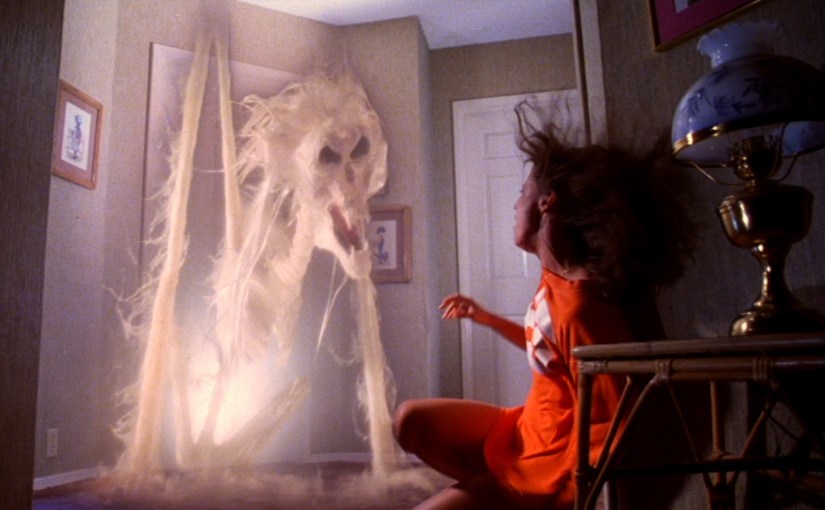
I don’t watch Poltergeist as often as others I know, simply to avoid experiencing the terrorizing clown puppet that dons a wicked tooth like expression and strangles the young boy.  Still very effective.  Coffins burst from the muddy swimming pool to pour out skeletons upon a screaming JoBeth Williams.  A ghostly white phantom guards the door to the children’s room and the closet entrance becomes a gaping, hellish monster mouth ready to swallow what it inhales.  Raw meat crawls across the kitchen counter.  A chicken leg turns into maggots and let’s not forget about the guy who hallucinates in front of mirror while pealing the skin off his face.  These are just lists!  Lists of scary things to do.   

Poltergeist is a simplistic fun house of haunts.  Nothing further.  I appreciate that only to a degree, however.  I wanted more.  An explanation is given for these occurrences in a tiny exchange of dialogue during the terrifying climax.  Beyond that, there is nothing I can say about these characters or what they stand for.  The kids toss cereal at each other at the breakfast table, and the parents smoke pot in bed, but there’s really no affection, or conversely, animosity shared among the family members.

If I were to compare Poltergeist to other fright fests like Hitchcock’s The Birds or even the original Predator or Alien, I would undoubtedly say those are superior films because beyond the monsters that terrorize the characters there’s also room for mistrust and paranoia among the players.  There’s time to devote towards care that those characters may have for one another.  A suburban mom is seemingly expected to want to be reunited with her little girl.  That’s a give in.  It’s standard.  Completely apparent in every way.  Couldn’t some competition from mom and dad come into play though?  Some blame pointing tossed about for example?

I guess I get a little bored with Poltergeist because it doesn’t stop to acknowledge the value of its cast of characters.  There are only a few moments of suspense that come upon me like when I’m trying to figure out where the scary clown puppet went off to.  Another terrifying moment is watching JoBeth Williams hustle as fast as she can to her children’s room while the hallway seems to stretch the bedroom door further and further away from her.  These are all things to look at though.  These are not moments that I connect with emotionally.

Some close friends of mine absolutely love this movie.  They can’t get enough of it.  They recite the lines.  They get caught up in the supposed “Poltergeist Curse.”  They watch all of the making of documentaries and return to the film for the nostalgia.  For me though, I never felt an intimacy with the mystery, or the family being victimized.  On that level, it’s almost on the same plane as a disposable Jason or Freddy movie.  I’d like to shed at least one tear before that teen gets their head chopped off, or the screaming kid gets eaten by the tree trunk.

TRON

By Marc S. Sanders

I was not raised on video games.  My father refused to allow us to have them in the house. While I was envious of every kid that owned an Atari 2600, dad didn’t want us to get addicted to them.  I wouldn’t know until later on how thankful I was for that rule he stood by.  I like arcade games for a once and a while escape, but once I reach the banana board (which isn’t often) on Ms. Pac Man, I’ve had my fill.

I recall seeing at least a few scenes of Walt Disney Studios’ Tron back when it was released on VHS.  Way back then, just like now, I just was never so impressed by it.  I can forgive the thin characterizations of really the only 5-7 actors with speaking roles.  Yet, the visuals and sound really do nothing for me.  What am I looking at?  Grids!  Just grids or endless squares.  A blank chess board looks more exciting to me.  The players in the film are dressed in what are presumed to be digitized armor that have carved out glowing blue and red lights.  Their human faces are grainy grays.  It all seems so flat to me, like that awful Pac Man adaptation Atari developed for their game consoles. 

Jeff Bridges plays Flynn, a game software developer done dirty by a corporate conglomerate led by a man named Dillinger (David Warner, the bad guy with the British accent).  Dillinger, along with a super computer intelligence known as the Master Control Program, have stolen Flynn’s intellectual property for dynamic new video games.  Since that time, Flynn has been making efforts to hack into the computer system and steal back what was originally his to begin with.  Master Control Program always fends him off, though.

A side story involves Bruce Boxleitner as Flynn’s colleague, Alan, working for the corporation. Alan has just developed a new security system known as TRON.  Dillinger puts a stop on the TRON program however.  Flynn, Alan and a third colleague named Lora (Cindy Morgan) break into the corporate computer lab one night, and before you know it, while attempting to hack in, Flynn is zapped right into the computer system, where he finds himself ensconced in a series of gladiator like games that were part of his original program write ups.

Master Control Program has the capability to erase Flynn from existence but insists on having him compete in the games that involve frisbees that deflect lasers and drive colorful racing cycles.  All of these games occur on this boring grid.

The actors mentioned above are utilized in the film much like The Wizard Of Oz.  They are introduced in the real world for the brief exposition portion of the film, and then later used to represent the TRON program (Boxleitner), as well as other elements that serve or perform under the eye of Master Control Program in the digital computer world.  The only real entity is known as a “user,” and that is Flynn.

I got sleepy watching Tron.  I think it is because like many video games it does not challenge me to figure things out or solve the dilemma. How can I envision Flynn escaping this world before he’s zapped out of existence?  I have no idea, because I’ve not been shown anything that demonstrates how this computer world functions.  Basic video games, at least from the early 1980s, were primarily about timing your button pushes and jerking the joystick accurately and timely.  Like the film Tron, they were never about application of the mind. 

No.  Movies are not meant for me to solve their riddles all the time.  Often, if I’m not trying to figure out how to resolve a story’s conflict, then I’m at least absorbed in the writing and performances of the cast.  The music might heighten the adventure or suspense.  The set designs will dazzle me.  Don’t get me wrong.  This Star Wars fanatic loves visual effects, but without any kind of story or suspense for the players and their outcome, what’s left to watch?  Tron is as dimensional as a blank index card for me. All these grids and lines are no more exciting than office stationery.

Tron from 1982 may seem very outdated, forty years later, but as a ten-year-old, I recall not being impressed either.  The sound design is annoying as when the digital players walk with clunk, clunk footsteps.  The objects on film are just sketched out, geometric glowing, colored lines on a black background. There is no depth, at all, to Flynn, Lora, Alan, Dillinger, or their computer counterparts.  In 1982, this might have been groundbreaking. For the Atari lovers this may have been the answer to many of their prayers.  I dunno.  Maybe I couldn’t relate or understand back then because my tyrant for a father denied me of an Atari game console.  I certainly don’t understand the fascination now. 

I have a 100-sheet pad of graph paper, here in my desk.  I’ll stand my Darth Vader action figure on a page and just stare at it for five minutes.  There!  Now, I can say I’ve watched Tron for a third time.

THE THING (1982)

By Marc S. Sanders

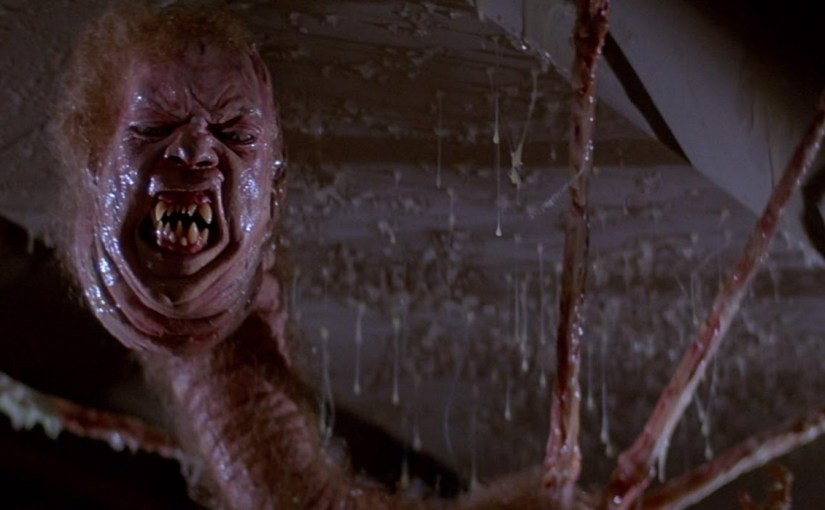
Often, a great beginning to a film offers an intriguing question. So as I finally watched John Carpenter’s 1982 interpretation of The Thing, I was especially curious as to why a sniper aboard a fast moving helicopter was targeting a dog running across the open plains of Antarctica with a pulse pounding beat from legendary film composer Ennio Morricone. The film has me hooked and none of the gory horror to come, compliments of creature effects wizard Rob Bottin, has even presented itself yet.

Gore never did anything for me in horror, and horror has never been my most favorite genre of film. Rather, suspense always held my attention and kept me thinking long after the movie was over. Carpenter’s film is full of Bottin’s imaginative gore but the paranoia and mistrust among a crew of science operatives is the real centerpiece here. Whether it’s the innocence of a dog or the star power of Kurt Russell, I never trusted the narrative of The Thing and that’s the point.

An exceptional scene on the same level as the dinner scene in Ridley Scott’s Alien occurs following a crew man suffering a heart attack. The defibrillator is brought out, “CLEAR” is shouted and the man is zapped. Then something else happens. I won’t spoil the moment. Yet, this is where imagination was put to work; where effects and storytelling work cohesively. Thankfully, moments like these become a running theme throughout The Thing. You never know what to expect from an unmeasurable and incomprehensible enemy. The fact that resources are scarce and escape is impossible traps our characters and the viewer as well.

Convenient, fast learning knowledge only tells you that this entity can duplicate anything it comes in contact with. So, you might just be sidling up to the thing itself and you won’t even know it until it’s too late.

Isolation, lack of trust, fear, paranoia – all of these elements work towards the advantage of superb imagination and storytelling in Carpenter’s piece.

The Thing was always a movie that eluded me. I’m now so grateful to have witnessed it. It makes me yearn for better storytelling in today’s films beyond remakes and superhero exhaustion.

John Carpenter’s The Thing is an absolute must see motion picture. Watch it with friends and watch it with the lights turned off.

THE VERDICT

By Marc S. Sanders

Sidney Lumet is a master filmmaker at shooting predominantly talkie films. In The Verdict by David Mamet, his best special effect is, at least, the just as legendary Paul Newman as washed-up alcoholic attorney Frank Galvin. Lumet opts to shoot Newman for the screen talent he is. Occasionally, his camera points up at Newman, who looks as if he will fall over. Lumet also makes Newman look great as he runs down a hallway, or with a stare of his familiar blue eyes. The chemistry of camera and performance are blended rhythmically.

Alcoholism has been depicted countless times, but Newman’s interpretation ranks at the top of the list. He can’t function without his drink whether it’s gaining a high score on pinball, flirting, reading a brief or even getting a fast protein fix by dropping an egg yolk in a beer. Paul Newman makes you wonder if Frank Galvin is going to pass out or fall asleep even while he’s barely practicing legal brilliance. He toes the line beautifully between coming undone and barely squeaking by. This is one of his best roles ever.

Frank is given a chance to salvage himself as goes up against the Boston Archdiocese and the hospital it owns in a case of medical negligence, who are represented by a conniving antagonist in the form of James Mason with his limitless resources, power, strategies and army of lawyers. If this were a silent film, I’d buy it with Mason twisting a handlebar mustache. He’s absolutely a man you love to hate.

The dialogue crackles against simply the inflection of vocals from Newman, Mason, an unexpected Charlotte Rampling as Galvin’s sudden love interest, a difficult judge played by Milo O’Shea, and Frank’s assistant played Jack Warden. The delivery of lines, the twisty double crosses, and conflicts play to the precision of great Shakespeare. So much so that when on the rare occasion these characters curse or the ominous cue of music steps in, it’s all shocking and applauded.

The settings are great for atmosphere too. Worn in leather chairs, polished cherrywood tables and courtrooms with their squeaky floors. This is a well-worn Massachusetts backdrop of legal reputation and intimidation.

Every member of the filmmaking team from Lumet to the cast, to the composer,Johnny Mandel, and David Mamet’s fantastic script have been thought out and measured to completion.

Some will say this film is dated (rotary phones, ladies’ hairstyles, wardrobe; year of release was 1982). I say its themes are still significant. Power is something that must always be overcome by a weak, flawed protagonist. Whether or not Frank Galvin can do it, matters not. It’s the struggle that’s important to follow in a film like The Verdict.