THE CHINA SYNDROME

By Marc S. Sanders

The China Syndrome explores the inherent risk that comes with a reliance on nuclear energy.  It also touches upon the moral choices within the field of journalism.  Most importantly though, it’s a hell of a thriller.

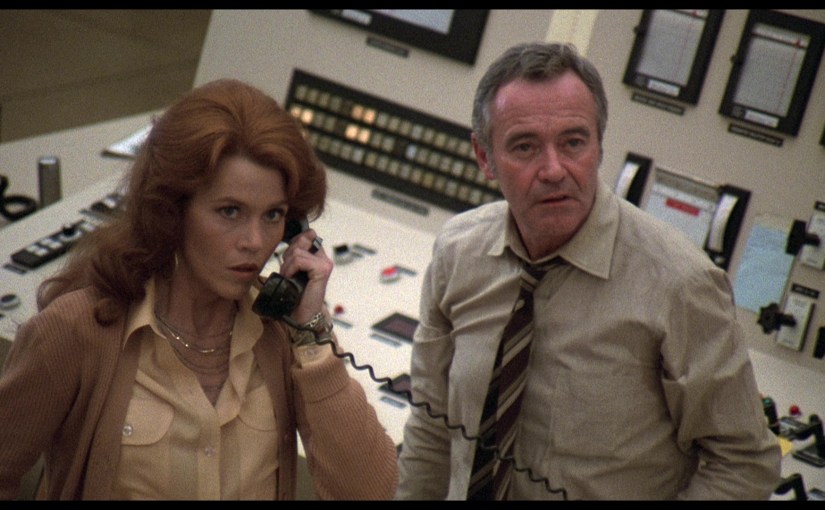
Kimberly Wells (Jane Fonda) is an on the scene reporter doing light fare topics for the evening news, like the novelty of singing telegrams for example.  With her subcontractor cameraman, Richard Adams (Michael Douglas, also one of the film’s producers), they cover a story on how a nuclear power plant operates.  During their tour, a very frightening accident stops short at only being a threat.  While the top brass at the company downplays the incident, Richard manages to record the panic-stricken activity happening among the operators in their soundproof control room.  As Kimberly and Richard gather information about what really happened, they are told they only were so close to what can be described as a China Syndrome – the underground nuclear rods could have overheated, imploded and the blast would have ruptured through the core of the earth where even China could feel it on the other side of the world.  

The corporate elites (led by Richard Herd) are the villains of this picture.  The could be hero is Jack Godell (Jack Lemmon), a could be whistleblower.  Jack oversees the whole operation and following that frightening scene begins to do his own kind of investigation.  What happened only makes sense because due diligence was not upheld, and inconsistencies are being neglected. Problems are only expected to get worse because they are not contained. There would be an enormous monetary expense that will put the company at a loss.  Initially, Jack wants to remain quiet, but the idea of what he’s certain will eventually happen is conflicting him.  As well, Kimberly and Richard’s pursuit of what truths he holds is gnawing at him.  

Jack Lemmon is a frazzled, yet sensible, marvel in this film.  I love the unspoken subtleties of this guy.  Best I could see is that Jack Godell is unmarried and has no children, nor friends beyond the faint connections he shares with his work colleagues, particularly one played by Wilford Brimley.  This only enhances Godell’s isolation in a them-against-him matchup.  Lemmon is great at emoting a sorrow and regret to his character.  He tells the journalists that he loves that plant.  It’s all he has in life and now it spells a certain, eventful doom if the faults in operation are not exposed.  Like Michael Mann’s The Insider, which was released over two decades later, the unlimited resources of this company will do everything in their power to silence this liable peon who works for them.  

The other side of The China Syndrome focuses on Fonda’s character.  When this film was released in 1979, it was the norm to not take a woman reporter seriously.  They were best used as attractive figureheads with beautiful hairstyles and well applied makeup to shift the seriousness of the news over to stories about dogs who can do tricks or hot air balloon happenings.  This film could have made more of a campaign to embrace the female journalists with heavier topics.  Instead, Jane Fonda’s character is not a fighter so much for deserved recognition in a male dominated world.  She’s actually just trying to circumvent around the unspoken chauvinism of her industry and get to the heart of this story that she witnesses firsthand.  The news station would rather her efforts be focused elsewhere.

Richard, the cameraman, is not embraced by Kimberly’s news station and therein lies the debate of airing what appears to be a story of urgency for the benefit of the public.  Yet, the station does not want to face a lawsuit.  What do the principles of journalism mandate even when there’s a monetary and reputational risk to their institution?  

Plenty of films with these kinds of dilemmas have come out following The China Syndrome.  What’s remarkable is the authentic feel of this fictionalized account.  Ahead of the release, the real-life companies that were developing a need for nuclear power were lambasting this film, insisting there was no validity to this story.  They were adamant that the production and maintenance of nuclear power was completely safe and well monitored. Twelve days after this film hit theaters in March 1979, the Three Mile Island accident occurred in Harrisburg, Pennsylvania when a partial nuclear meltdown of a reactor occurred. Traces of harmful gases and iodine were released into the atmosphere, and the incident was rated a Level 5, an “Accident with Wider Consequences.”  I do not believe Michael Douglas and his co-producers/filmmakers necessarily set out to make a statement. Though there are protesting movements peppered throughout the film. It’s a frightening irony, however, when life imitated fiction. 

 Jane Fonda and Jack Lemmon put the suspense of The China Syndrome into play. There’s an awareness to what could happen with technological advances in nuclear energy especially if they are not carefully observed and addressed.  

Over forty years later, do we really know what’s going on and even if we did, what could any of us do about it?
THE JERK

By Marc S. Sanders

As I close out this year, 2023, it’s funny that one of the last films I watched was The Jerk, directed by Carl Reiner with Steve Martin as dumb, lovable, idiotic, adorable, and moronic Navin – who was raised as “a poor black child.”  I find it funny because I have just come off the heels of directing a play I co-wrote with a best friend I just lost from ALS.  That friend was a part of my life for thirty years, and his name was Joe Pauly.  The play was a smack in the face, a head slammed against a door with an enormous amount of pratfalls to Charles Dickens’ holiday classic.  Joe and I called it A Christmas Carol Gets Decked

The play was an enormous box office hit for our theater, but the reaction to the show was mixed.  There were big laughs each night, but we also had some walkouts at intermission, and I wasn’t surprised.  Slapstick is not for everyone.  The cast was always brilliant though.

As I watched The Jerk, first I was sad that I never, ever talked about this movie with my pal Joe.  I bet he loved it.  Second, I found it fitting that my heroes Roger Ebert and Gene Siskel didn’t care for it.  Their review from 1979 can be found on YouTube.  Ebert simply said he didn’t like Steve Martin’s form of comedy.  He’s just not a fan.  Fair enough.  Siskel said the star’s brand of humor was Steve Martin doing Steve Martin, and it would have worked better as Steve Martin doing comedy as the character, Navin.  I do not think Gene Siskel is wrong.  I look at The Jerk, and I think Joe and I accomplished what Steve Martin was doing.  There is a collection of gags that I do not think are funny, but then there are at least an equal amount of jokes that are utterly hilarious and thankfully shocking.  Joe and I took a risk with comedy, just like Steve Martin; like anyone who is brave enough to enter through that dark valley alone where the act is always a test, night after night, performance after performance.

I love the plot of The Jerk, which is straight out of a Three Stooges short. Navin stands out from his family as the one with white skin and no rhythm amongst his large southern, black family.  I was so pleased to see Mabel King from What’s Happening!!! portraying Navin’s mother.  Following his birthday, Navin embarks on a journey to St. Louis to discover a life for himself.  He gets a job working for Jackie Mason at a gas station and falls into a fortune when he shares his invention for eyeglasses with a random customer (Bill Macy).  Along the way, he falls in love with Marie, a sweet Bernadette Peters, who looks like Alfalfa’s crush from The Little Rascals.  They get a mansion and live filthy rich, blah, blah, blah. SPOILER ALERT!!!!! The film’s famed director, Carl Reiner, reveals that Navin’s invention is defective and following a one, two, three class action lawsuit, Navin and Marie are flat broke.  I love the body of this plot.  Rags to riches to rags opens an invitation for one gag after another.

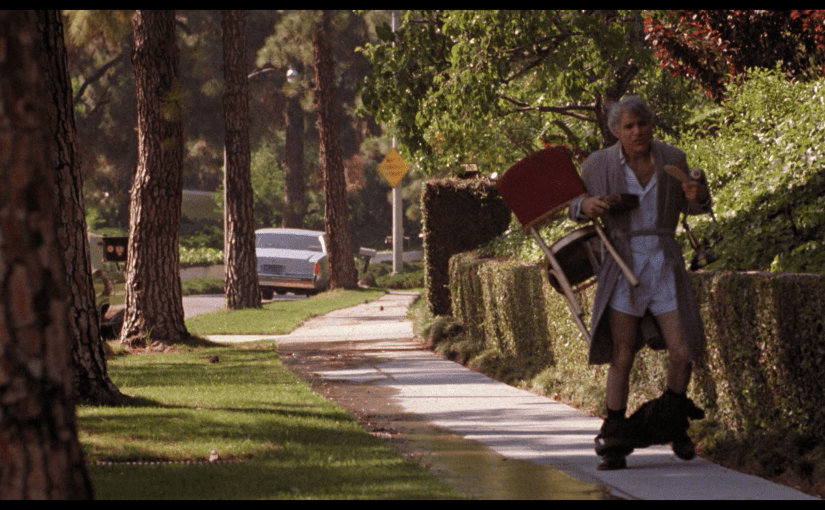
There’s his trusty dog named Shit Head.  Navin insists on no longer drinking the old wine.  Bring him the new stuff.  A crazed sniper (M Emmet Walsh) tries to kill Navin, misses and Navin reasonably concludes that it must be the oil cans that the killer has a grudge against, when the bullet holes spring leaks. Makes sense to me!  If you accidentally run outside naked to chase after the one you love, who is leaving you, then of course you will reach for the dogs nearby to cover up your bare behind and “your special purpose.”  Hilarious stuff.

There’s material that doesn’t work as well, but that’s just me.  Like the audiences that saw the play Joe and I wrote this year, what one person thinks is funny, another will not.  It’s a balancing act.  I’m not here to mandate what works and does not work for you.  I just want to celebrate Steve Martin’s inspired Three Stooges spawn that welcomed him to the big screen, long before the antics of Jim Carrey – who I rarely think is funny and simply comes off as an annoying child who won’t sit still.  That being said, I still prefer Martin’s  later work where he played the straight man victim to someone else’s annoyance such as in Planes, Trains and Automobiles (a favorite film of Joe and I, collectively) and Parenthood, not to mention the brilliant Only Murders In The Building, and his routines on Johnny Carson (a hilarious magician was my favorite) and Saturday Night Live.  The guy is an enormous talent far beyond The Jerk or The Man With Two Brains.

The Jerk had always eluded me, until now.  I think my parents wouldn’t let me watch it.  Dad thought the material was “filthy.”  He probably saw the one gag where the kid is running around with a t-shirt having the phrase “Bull Shit,” and thus opportunity passed me by.  Yet, he didn’t mind if I watched Dirty Harry or any of Bill Murray’s comedies.  Go figure.  That’s what the varying degrees of humor lend to you.  There are no straight answers in comedy.

Still, I’m glad I watched the movie.  2023 was melancholy for me.  There were some enormous ups, but losing my pal Joe, the Del Griffith to my Neal Page, was an expected but very hard moment to accept when he passed on December 4.  I’m still struggling with the loss.  In his last six months, he couldn’t speak with me on the phone, but at least I could text with him, and once the movie ended with Steve Martin happily dancing to banjo rhythms with his black family, I picked up my phone ready to write to him.  It couldn’t happen anymore.  At least not that way, from now on.  So, here I am on holiday break surfing Netflix, and there’s The Jerk with a warning that it was leaving the streaming service soon.  Joe must have been urging me to finally catch up with Navin, the poor black child.  Thanks Joe.

Chin up everyone.  We were all a name in a phone book. Happy New Year!!!!

TIME AFTER TIME (1979)

by Miguel E. Rodriguez

DIRECTOR: Nicholas Meyer
CAST: Malcolm McDowell, David Warner, Mary Steenburgen
MY RATING: 6/10
ROTTEN TOMATOMETER: 87%

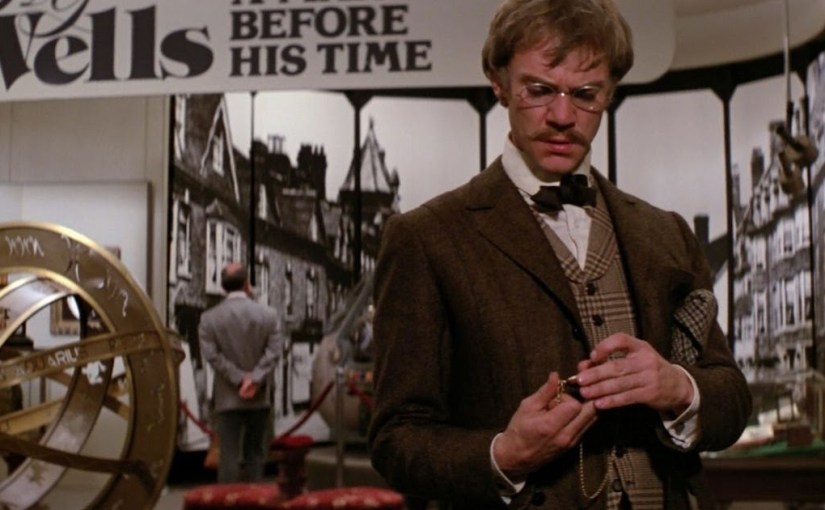
PLOT: Before he wrote any of his famous novels, H.G. Wells pursues Jack the Ripper to the 20th Century when the serial murderer uses the future writer’s time machine to escape his time period.


There are two scenes in Time After Time that are genuinely shocking from a story perspective.  One involves a newspaper headline.  The other involves a bloody crime scene.  The first I should have seen coming, but the second I never would have guessed in a million years, and I literally yelled at the TV when it happened.  That’s good plotting.

Those two scenes are the only things that prevent me from giving Time After Time a lower score.  That, and the fantastical, thought-provoking nature of the story itself.  Too bad both those scenes and the plot are buried under layers and layers of hackneyed dialogue and the kind of forced situational comedy that would be more at home in Three’s Company than in a sci-fi adventure.

First, the good stuff.  After a credits sequence that looks inspired by countless grade-Z movies before it, the story starts back in London, 1893, two years before H.G. Wells would write his first novel, The Time Machine.  A prostitute is murdered in a dark alley, victim of the infamous Jack the Ripper.  Later that night, Wells hosts a dinner party at his house for some friends and shows them something he’s been building in his basement: a fully functional time machine.  It doesn’t quite resemble the famous machine from the 1960 classic The Time Machine – it looks more like a ride vehicle from an amusement park than a chair with attachments – but the Victorian details are all there.  There’s some talk about a vital key needed to return to their present and a VERY important device that is discussed without being precisely explained, at least not to my satisfaction.  When it makes a reappearance late in the film, I was still mystified as to its actual purpose other than a convenient deus ex machina.

Suddenly, Scotland Yard appears.  Turns out they tracked Jack the Ripper to Wells’ doorstep.  Tricky Jack awaits his chance and uses the time machine to escape…though, without that handy key mentioned earlier, the machine returns to its point of origin on its own, leaving Jack stranded in a world 86 years in the future.  Wells feels duty-bound to bring Jack to justice, so he follows Jack, setting up the meat of the next few reels: a man from 1893 London struggling to adjust to daily life in 1979 San Francisco.

(It must be noted that the bulk of this film’s budget was clearly NOT devoted to the visual effects department.  The effects on display as Wells travels through time are cheesy at best.  I’d try to describe them here, but my words cannot possibly do them justice.  I couldn’t even find a decent still shot to embed here that would accurately convey just how low-rent they are.  I recently watched 1974’s execrable Zardoz, and I’m here to tell you, from a VFX perspective, Time After Time makes Zardoz look like Interstellar.)

H.G. Wells chasing Jack the Ripper through time?  This is a great plot from a sci-fi perspective, a thrilling “what-if” tale.  I had heard about this film for years but was never able to find a copy until recently.  The scores on IMDb and Rotten Tomatoes are decent.  Not stellar, but decent enough that I was pretty sure I would enjoy it.  The movie was directed and co-written by Nicholas Meyer, the mind behind The Day After, Star Trek II: The Wrath of Khan, and Star Trek VI: The Undiscovered Country.  That’s not a bad track record.

But, man oh man…for most of the film’s middle section after Wells arrives in 1979, the movie’s brain goes on sabbatical.  Example: he walks into a McDonald’s, takes careful note of how the customer in front of him orders a meal, then does his best to literally impersonate the customer.  He doesn’t just order what he orders…he gives an impersonation of the customer’s voice and accent.  Why?  He doesn’t do that at a pawn shop or a bank.  No, it’s just there because someone thought it would be a laugh to see Malcolm McDowell do a broad American accent.

I can’t deny that the potential is there for real humor.  I couldn’t find it.  I thought these scenes were completely at odds with the tone of the first third of the film.  Wells meets a bank teller, Amy, (a very young Mary Steenburgen) who inexplicably falls in love with him at first sight.  She’s so taken with him she impulsively asks him to lunch, an act that, in 1979, was directly at odds with 99.99% of all other screen romances, so kudos to that, I guess.  But why?  I’m not saying Malcolm McDowell is an affront to the concept of human beauty, but…really?  As Wells, he’s the 19th-century version of a science nerd.  Amy is not a character so much as a cardboard placeholder to be moved and manipulated according to the whims of the plot.

The dialogue is clunky, to say the least.  There is a foot-chase between Wells and Jack that is devoid of suspense.  The score by Hollywood legend Miklós Rózsa feels utterly out of place, as if someone simply lifted Rózsa’s score from some other film and plugged it in where necessary.  There is simply no romantic chemistry between McDowell and Steenburgen, as evidenced in a painfully unfunny scene when they sit on a couch and she declares: “Herbert, if you don’t take me into your arms, I’m going to scream.”

Another actual line of dialogue: “My mother was rather an atrocious woman in her own way, but her many failings did not include raising mentally deficient sons.”  That’s not a real person talking, that’s a writer trying to imitate George Bernard Shaw.

No doubt someone out there will tell me I missed the boat with this movie somehow.  Perhaps Rózsa’s score is intentionally “retro” to make the whole movie feel as temporally displaced as its characters.  Perhaps the intention was the same with the hopelessly amateurish visual effects.  Who knows.  It’s possible.  Maybe there’s a better movie here somewhere and I’m not equipped to find it.  I doubt it, but it’s a possibility.  In the meantime, I’m going to keep this movie in my collection as an example of how a great story can be derailed by poor execution.

And maybe I’ll bring it out if my fellow Cinemaniacs are in the mood for a “So-Bad-It’s-Good” movie day.

[P.S. Keep your eyes open for the screen debut of an 8-year-old Corey Feldman.]

MONTY PYTHON’S LIFE OF BRIAN (1979)

by Miguel E. Rodriguez

DIRECTOR: Terry Jones
CAST: Graham Chapman, John Cleese, Terry Gilliam, Eric Idle, Terry Jones, Michael Palin, Carol Cleveland
MY RATING: 9/10
ROTTEN TOMATOMETER: 96% Certified Fresh
Everyone’s a Critic Category: “Watch a Controversial Film”

PLOT: Born on the very first Christmas in the stable next door to Jesus Christ, Brian of Nazareth spends his life being mistaken for a messiah.

[EDITOR’S NOTE: Let the record show this was originally going to be a review of Mel Gibson’s The Passion of the Christ, but the author had just seen 2 or 3 dramatic films in a row and apparently decided it was time to switch gears a bit.  Complaints about this adjustment may be directed to the author’s colleague, Marc Sanders, who promises to reply to each and every complaint at about the same time hell freezes over. ]


Life of Brian is widely considered Monty Python’s tightest, most well-written film, even if it’s not quite as hysterically funny as Monty Python and the Holy Grail.  I agree.  I can speculate that this is due to the subject matter, and so great care needed to be taken to ensure that viewers would not mistakenly think the film was poking fun at the Jesus Christ Himself.  On the contrary, right from the very opening, it’s quite clear this movie is not about Jesus, but about the poor sod who was born in the stable next door and the deluded individuals who continually mistake HIM for a messiah as a grown man.  (“…how shall we f*** off, oh lord?”)

But that didn’t stop the mighty train of offensensitivity from rolling right along.  To wit:

  • Norway banned the film for a year.
  • Ireland banned it until 1987.
  • A town in Wales banned it until 2009, after a cast member was elected Mayor.
  • A town in Britain banned it until 2015.

However, no amount of bans and protests could prevent Life of Brian from becoming an integral part of the cinematic comedy landscape.  At the annual Venice Film Festival, the Premio Brian (Brian Award) is awarded to the most rationalist/atheist movie presented at the festival.  It was named the funniest comedy of all time by the BBC’s Channel Four, beating out Groundhog Day and The Full Monty.  In 1982, during the Falklands War, sailors aboard a severely damaged British vessel started singing “Always Look on the Bright Side of Life” while awaiting rescue.  You can’t BUY that kind of publicity.

After a brief prologue in which the Three Wise Men visit the wrong manger by mistake (“We were led by a star!”  BRIAN’S MOTHER: “Led by a bottle, more like!”), we jump ahead to when Brian is just about Graham Chapman’s age, struggling to hear the Sermon on the Mount from a distance (“Blessed are the cheesemakers?!”).  Much like Holy Grail, the film is punctuated by sketches, some of which are pauses in the action, but most of which still manage to carry the story forward.  That’s quite a feat when you consider their subsequent film, The Meaning of Life, was composed entirely of self-contained sketches, albeit with a common theme.  The fact that the Pythons were able to rein themselves in and keep things relatively lean is rather admirable.

If I kept relating plot developments and summaries of sketches and funny quotes, I would be here all day:

  • The “Biggus Dickus” scene.
  • The stoning.
  • The unexpected Latin lesson.
  • “What have the Romans ever given us?”
  • Graham Chapman’s willy.  (Hey, it’s a memorable scene, shut up.)

If I must be honest, though, I was never, and still am not, a fan of the film’s ending.  Yes, I get the supreme, absurd irony of the situation juxtaposed with that cheerful song, but…to be honest, it’s always felt like the Pythons said, “Okay, so we’re here, aaaaand…now what?  Any ideas?  No?  Okay, let’s end the movie.”  Perhaps they always meant to end it that way.  So be it.  But I’m selfish.  I wanted just a little more.  …although, now that I think about it, I’m not sure what kind of mileage you could get out of a bunch of people at a tomb waiting for someone to emerge, but never does.  There’s a joke there, somewhere, but I’m not the one to tell it.

There is one scene that I found VERY interesting.  It never stood out before, but it does now.  People are fond of saying, “Well, you could never make Blazing Saddles today.”  Perhaps, but I bet the chances are even slimmer of someone trying to make Life of Brian today, and even if someone did, the scene in question would probably not make it to the final cut.

Picture this: Four members of the People’s Front of Judea (NOT to be mistaken for the Judean People’s Front…those splitters) are trying to decide something when one of the male members, Stan, reveals he wants to be a woman and asks everyone to start calling him “Loretta.”  The others ask him why, and he says, “I want to have babies…It’s every man’s right to have babies if he wants them!”  “But you can’t HAVE babies!” retorts Reg, “you haven’t got a WOMB!  Where’s the fetus gonna gestate, you gonna keep it in a box?!”  They eventually agree that Stan/Loretta can’t actually HAVE babies, but they will fight for his RIGHT to have babies.  “It is symbolic of our struggle against oppression!”  (“…symbolic of his struggle against reality…” grumbles Reg.) [Ed. note: view the full scene here: https://www.youtube.com/watch?v=jlo7YZW8vPA ]

If you ask me, in today’s society, if that scene were to appear in a contemporary film, even in an obviously comic context like this one, it would become an even bigger controversy than “Nipplegate.”  Forget about all the religious overtones and perceived (but non-existent!) blasphemy.  All it would take is for one person to call that scene out, and Monty Python would be on the road to social cancellation faster than you can say, “Carla’s your uncle.”

ANYWAY.  As a lifelong fan of the Pythons, I consider Life of Brian their high-water mark in terms of storytelling and contextual comedy.  If it’s not quite as funny as Holy Grail, well, I ask you, what is?  Any arguments about the movie being blasphemous are easily deflated by pointing out it’s not about Jesus.  It’s about this other idiot and the group-thinking idiots who follow him.  Case closed.


QUESTION FROM EVERYONE’S A CRITIC

Best line or memorable quote:
(Talk about being spoiled for choice…it’s a little out of context, but if you know, you know:)
“He has a wife, you know.  Do you know what she’s called?  Incontinentia.  …Incontinentia Buttocks.”

After watching the film, can you see both sides of the controversy surrounding it?
I can acknowledge that two sides exist (or existed), but the anti-Brian argument is pointless because, once again for the cheap seats, the movie is not about Jesus.  It can’t be blasphemous if it barely even mentions His name.  My two cents.

APOCALYPSE NOW

By Marc S. Sanders

Francis Ford Coppola’s Vietnam War masterpiece, Apocalypse Now from 1979, focuses on a madman assigned to find another madman and assassinate him.  I look at the film as a spiral into a dark, demented psychosis.  Each section of Coppola’s film appears like some variation of insanity within an environment and period of time where there was no end in sight for a war that was going out of control.

Captain Benjamin Willard (Martin Sheen) is first shown in a hotel room that he has ransacked during a drunken rage, going so far as to smash his fist into a mirror.  His voiceover explains the horrifying experiences he has already endured.  Now he is at a point where killing is all he is capable of performing. He is summoned to a General’s lunch where he is assigned to seek out a highly decorated Special Forces soldier named Colonel Walter Kurtz (Marlon Brando).  Kurtz has taken his squad over to Cambodia without authorization.  It is believed that he has gone insane with his will to harbor people over there into a cult that he controls while engaging in his own actions against the Vietcong.  The army needs this problem contained and Willard has been selected to terminate Kurtz.

Apocalypse Now is primarily about the journey, rather than its destination.  Willard is to be escorted by patrol boat up the Nang River to find Kurtz and complete his mission.  Along the way he will encounter a variety of scenarios and characters. 

The standout character is Lt Colonel Kilgore (Robert Duvall) the commander of a helicopter calvary battalion.  Willard meets up with Kilgore early on as he will provide an opening on the river for the long journey to begin.  This is the most memorable section of Coppola’s film.  Robert Duvall is truly maddening as he relishes in the destruction he commands.  Kilgore is amused to blare Wagner’s The Ride Of The Valkyries as his choppers blast the shore line where Vietnamese villagers and farmers reside.  Duvall almost seems god like during this sequence because he does not even flinch as explosions and armory are set off mere inches away from him.  He’s crazed enough to even send his troops out into the ocean to surf while the mayhem is still occurring.  When he takes off his shirt while proudly wearing his calvary hat, sunglasses and yellow scarf around his neck, he utters the famous line “I love the smell of Napalm in the morning.”  There is no hint of sarcasm in that line.  Kilgore truly means it.  The commands of war are his absolute pleasure.  The only human feeling that Kilgore shows is when his personalized surfboard turns up missing.  Otherwise, the carnage he leaves behind is a job well done.

Why do I focus on this sequence so much?  First, it is a perfect construction of filmmaking and acting combined.  Coppola’s clear daylight shots of the choppers advancing on the surf are an amazing sight to behold.  To have that much control of so many vehicles in the air so that a select number of cameras can take in the sequence amazes me.  It is feats like these that show why I love movies so much.  The moment is more enhanced with Wagner’s piece accompanying it.  This could all be appreciated as simple documentary style filmmaking.  However, when you combine the mayhem Coppola stages with the proud march of The Ride Of The Valkyries, and Duvall’s crazed glee of commanding this episode of mass destruction, you start to see a pretense.  The hypocrisy of all the elements contained in this sequence tells the story. This country and its people are being obliterated by a crazed individual arriving from the heavens above.  As the scene progresses, my mind returned to the overall plot of the film; the mission of the protagonist which is to kill a lunatic.  At this point in the picture, I have yet to meet Colonel Kurtz.  So, how much of a madman must Kurtz be when compared to a maniac like Kilgore?

Later sequences carry on the insanity theme.  A trio of Playboy playmates are brought in to entertain the troops during one of Willard’s stop overs.  Yet, the crowd of soldiers gets out of control and the entertainers are forced to flee by helicopter with some of the men grasping on to the chopper as it takes flight.  My thoughts were you must be insane to continue hanging on while it gets higher into the air.  Let go for heaven’s sake before you plummet to your death.  Nevertheless, these half naked women are the purest, most angelic thing that these boys have ever seen since being recruited into this hellish nightmare. 

Willard’s crewmen on the patrol boat seem too green with the impacts of war.  They are not as battle weary as Willard.  There’s a guy named Lance (Sam Bottoms) who seems happy go lucky to play the Rolling Stones.  There’s a chef by trade (Frederic Forrest) and a young kid who goes by the name of “Clean” (Laurence Fishburne).  Chief Phillips (Albert Hall) drives the boat.  Willard must keep his mission classified.  These men are only supposed to get him to his destination no matter how far up the river it takes them.  These soldiers are riding into the unknown, escorting a crazed fellow who knows that a positive outcome is not likely.  Coppola provides moments where the men lose control of their senses.  These boys don’t come as informed about what is right and wrong within the parameters of war.  Innocent lives are taken as the patrol boat continues its horrifying tour.  Their lives might be taken as well.  The question is what is the worse cost?  Death, or the horrors they encounter, act upon, and live with thereafter?

It’s notable to watch Frederic Forrest’s performance as he transitions into a mindset with no other option but to slaughter as he dons camouflage makeup later in the film.  Albert Hall’s performance lends some sensibility to the picture.  However, how does Chief Phillips’ receptivity measure up to the crazed obsession that Willard has for completing his assignment?  It’s all quite tragic as the film moves from one moment to the next.

As expected, the third act of the film focuses on Willard’s encounter with Kurtz.  Before all of this, we follow along as Willard reads through the extensive files of Kurtz’ history and career.  This man seems like a giant among giants and in 1979 it seems only befitting that a giant of an actor portrays the mysterious Colonel.  So, that actor had to be none other than Marlon Brando.  Oddly enough, this portion of the film is where the film starts to wear out for me.  Kurtz is insane in a quiet and dark way.  Coppola shoots much of Brando’s performance in darkness.  I’m aware of the purpose with that kind of filmmaking, but it is a long section of film to watch an actor move in and out of the light.  Brando comes off mysterious with lines of dialogue that make little sense at times.  Some allegories work as he describes Willard’s purpose as that of a clerk delivering groceries.  Yet, Kurtz seems the least crazed of all the crazies provided within Coppola’s film. 

A babbling, hippie photographic journalist (Dennis Hopper) greets Willard upon his arrival.  He’s talking in circles with envy for Kurtz, his leader, who resides within the tomb like structure along the banks of the river.  The natives also seem to heed towards Kurtz’ influence.  Willard is taken captive and tormented.  Still, when Kurtz speaks he doesn’t come off so kamikaze like the others we’ve seen before.  I can only presume there are levels to insanity.  Madness is not a well-defined ailment.  I find it ironic that Kurtz, the great soldier and decorated war hero, is deemed the greatest threat to the armed forces’ image within this conflict.  Kilgore, on the other hand, has free reign to slaughter helpless women, children, and farming communities all in the name of victory while commanding his underlings to surf along the coastline. 

What is so mystifying about Apocalypse Now is how thematic the movie seems to be.  It follows this common pattern demonstrating how crazed the effects of war can have on people.  The killing and bloodshed are the most apparent of course.  However, the military declares early on that there is a loose cannon within their ranks that must be contained.  The only option is to kill this man, who has done his bidding for the progress of its army for so long.  This man, Colonel Kurtz, has sacrificed promotions in ranking and a return to a quiet life with his wife and children, so that he can continue with carrying out the agendas administered by his government.  Yet somehow, he crosses a border, and he no longer kills the way his superiors want him to, and now he must be terminated.  The hypocrisy is to send a madman to do a madman’s bidding, as if that will preserve some sort of sanity within this out-of-control conflict.

I could not get away from that impression during the whole three-hour running time of the film.  Practically every caption, scene, expression, or scenario is rooted in madness.  Francis Ford Coppola wrote the script with John Milius and it’s been said that much of the filmmaking was done on the fly.  Still, with Coppola’s direction along with a strong cast, particularly from the quietly, reserved Martin Sheen, the message comes through clearly.  War begins with a difference in politics and a need for further control.  Pawns are the collateral damage used at will to settle the argument.  Rules of engagement may appear formally on paper.  However, is anyone with a gun in his hand or facing the end of a loaded barrel going to pause and consider what’s just and appropriate before taking action? 

Apocalypse Now speaks to an end of days where the soldiers sent to do the bidding of others respond by doing what they ask of themselves.  Therefore, I’ll end this piece on a vague note. 

There is no organized effort when it comes to war.

NOTE: This article is based on my viewing of Coppola’s third iteration of his film, entitled Apocalypse Now: The Final Cut.

THE BLACK STALLION (1979)

by Miguel E. Rodriguez

Director: Carroll Ballard
Cast: Kelly Reno, Mickey Rooney, Teri Garr, Clarence Muse, Hoyt Axton
My Rating: 8/10
Rotten Tomatometer: 90% Fresh
Everybody’s a Critic Category: “Watch a Film Starring Animals”

PLOT: After being shipwrecked off the coast of Africa in the 1940s, a boy bonds with a magnificent Arabian stallion and trains him to race after their rescue.


Horses are great, but they are not my favorite animals.  That honor goes to the great white shark.  (They fear nothing; the only things they are even cautious around are larger great whites…but I digress.)  I always hear and read about how magnificent and majestic and spiritual horses are.  I have never denied their intelligence, but I never jumped on the bandwagon with folks who believe they are angels on four legs.  And I’ve never really gotten into horse racing, at least not on an ongoing basis.

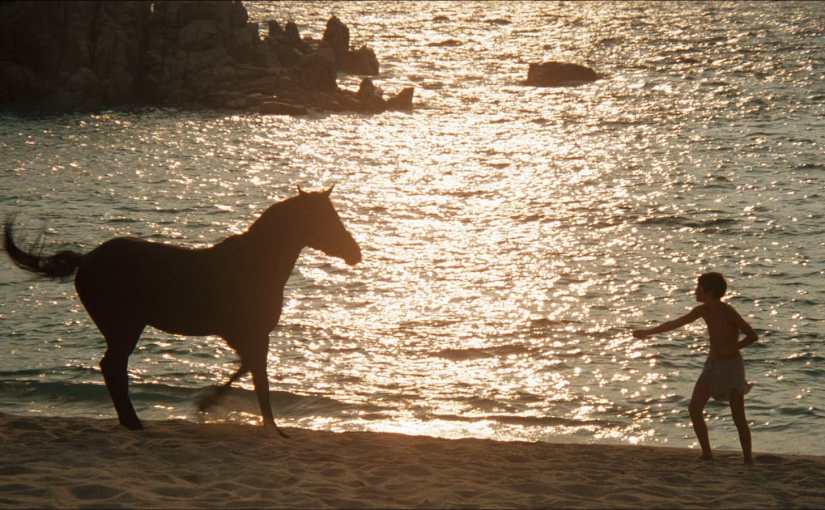
But there is one movie that combines the mystique of horses and horse racing with poetry, grace, and true art.  Carroll Ballard’s The Black Stallion is one of the most beautiful films ever made.  The visuals are so good and well-edited that fully 28 minutes of the movie are presented with zero lines of dialogue spoken.  After a fearsome shipwreck, Alec Ramsay (Kelly Reno) finds himself stranded on a desert island along with a magnificent unnamed black stallion whom he later simply calls the Black.  During this shipwrecked portion of the movie, all dialogue is dropped, and we simply watch as Alec and the Black overcome their initial fear of each other and bond.

It is in these scenes that The Black Stallion truly shines.  There is one particular sequence that will stick in my memory forever.  After some days and weeks alone, Alec tries to get the Black to eat food directly out of his hand.  In a nearly unbroken take, we watch as the Black warily approaches Alec, then turns away, snorting and stomping, then turns back, taking one cautious step after another, getting closer and closer…and it all looks completely organic.  It’s one of the greatest acting performances by any animal in any film I’ve ever seen.  In that scene, the Black exhibits more proficiency at acting on camera than I’ve seen in a few human actors I could name.

When I first saw this movie at 8 years old, I couldn’t fully appreciate the ingenuity of this portion of the film.  All I cared about was how invested I was in seeing Alec bond with the Black.  I didn’t care about cinematic theory and editorial processes and visionary cinematography.  But it’s all there in full view, presenting a visual story clearly and cleanly.  Buster Keaton would have loved this movie, I think.  (At least, the silent portions, I would imagine.)

The Black Stallion piles on one visually exhilarating scene after another involving Alec gradually gaining enough trust from the stallion to the point the Black allows Alec to ride him.  And then they are both rescued and returned home to America, and it’s here the movie seems to stumble just a bit.  After the grand vistas of their desert refuge, the white picket fences and tree-lined avenues of 1940s suburbia is a tad underwhelming.  When the Black gets spooked by garbagemen and runs off, we do get a nice contrast of seeing this semi-mythical creature of a bygone age galloping past storefronts and hurdling fruit crates.

Alec chases the Black and eventually finds him in a seemingly deserted barn owned by one Henry Dailey, an ex-jockey played to utter perfection by Mickey Rooney.  To say Rooney’s performance in The Black Stallion is “natural” is an understatement.  And to older audience members familiar with Rooney’s performance as a jockey in the 1944 film National Velvet, this must have been like seeing the remaining members of the Ghostbusters reunite in Ghostbusters: Afterlife (2021).  When he trains Alec how to ride the Black, you get this incredible sense of a man tapping a massive reservoir of knowledge for the benefit of the next generation.  I don’t know if I’m accurately describing this facet of Rooney’s performance, but if you watch the movie, you’ll see what I mean.

As do so many other movies featuring horses (not all, but many), The Black Stallion culminates with a horse race, this one pitting the Black against the two fastest horses in the country.  As we are fed information about how and why this race comes about, I particularly noticed how one phrase was repeated at least twice: “They’ll never let him run…he doesn’t have any papers.”  No doubt there are horse enthusiasts who know what that means.  I haven’t the foggiest clue what they’re talking about, but the cool thing is…it doesn’t matter.  It doesn’t matter now, and it certainly didn’t matter when I saw it as a kid.  It’s enough to know that “papers” are something other horses have, but the Black doesn’t, and that seems pretty important to some people, no matter how fast he runs.  It’s just another way The Black Stallion is constructed to appeal to audiences of all stripes, be they equestrian aficionados or rank amateurs.  There are not a lot of films that can do that, and I don’t know if The Black Stallion gets recognized enough for that accomplishment.

The climactic horse race ends exactly how you would expect it to end.  Formulaic?  Of course.  But what a race!  The cinematography, editing, Oscar-winning sound design, and carefully restrained use of the musical score all combine to create a moment every bit as thrilling as any NASCAR race.  Even now, watching the movie for this review, I fell into the moment all over again, smiling with delight as Alec and the Black pound their way around the track, hooves thundering on the dirt, pumping my fists when Alec discards that pesky helmet and goggles, and those other horses ahead of them get closer and closer…

Any lover of horses owes it to themselves to find and watch The Black Stallion.  Kids will get a kick out of it, but adults will, too, perhaps on another, more nostalgic level.  (That could just be me projecting based on my own childhood memories, but I stand by it.)


QUESTIONS FROM EVERYONE’S A CRITIC

  1. Which character were you most able to identify with?  In what way?
    Well, for me, there’s no question I identify with Alec.  I still remember how I felt watching this movie for the first time.  I mean, I didn’t necessarily want to BE Alec, but he was my entry into the world of the movie.  I knew how he felt when he was trying to convince his mother to let him ride in a race.  I knew what he must have felt at the very beginning of the movie when his curiosity about the Black overcame his very real fear of such a powerful animal.  And I thrilled when he raised his hands in triumph during the horse race.  (Kind of an easy answer, to be honest, but…there you go.
  2. If you were to make a movie starring animals, what animals would you choose, and why?
    …well, as I mentioned before, great white sharks are my favorite animals, but they are notoriously difficulty to film, as shark cinematographer “Three-Fingers” Joe will tell you.  I’d have to go with dogs.  Much easier to train, plus every day they see you arrive on set, they’ll treat you like they thought you’d be gone forever.  My film would be a comedy/sci-fi story involving a cat’s brain being transplanted into a dog’s body.  Maybe get Paul Rudd to do the voice of the dog.  …it’s a work in progress.

ALIEN

By Marc S. Sanders

To be lost and alone is my absolute greatest fear.  I don’t know what to do when I find myself in situations like that.  I feel palpitations and terrible anxiety.  The only argument my wife and I had on our honeymoon was when we got lost in the Louvre in Paris.  She was relaxed.  I definitely was not.  I didn’t know in which direction to walk through the massive museum, located in a country that I’m not at all familiar with, inhabited by a majority of people who speak a language that I’m terribly limited at using for conversation.

When a person is completely, physically isolated, the only thing to depend on is his/her own wits and sensibilities.  That’s step one in constructing a scene of terror.  Step two is to lock that person away with an entity that is unpredictable, unrecognizable, smart and grotesquely frightening.  In a film, each time that entity comes into the play, the scene should not look like the last time the protagonist or the audience encountered this creature.  Whatever I learned a few minutes ago is not going to offer much help the next time around. 

I’ve just described the spine of the story that makes a horror film like Ridley Scott’s Alien so successful.

Science Fiction always works best when it can be convincing enough to lend authenticity to the fiction of its, well, science.  With Alien, a variation of biology and evolution lends to the terror of the picture and you don’t even realize it until the movie is half over. The title character is introduced in different characterizations with every scene it is called for.  First, it’s an egg, then a tentacled creature wrapped around the face of an unfortunate victim.  Later, at dinner time, it reveals itself in an unforgiving and memorable scene as a phallic shaped organism with a snake like tail and steel teeth.  Lastly, you just can’t even describe what it is except to say it is huge and its even worse than the monsters you imagined as a kid hiding in your closet or under your bed.  Credit has to go to the creature designs from H.R. Giger.  Every limb or shape of the monster seems to serve a purpose.  If that’s not enough, the animal bleeds acid that’ll burn through the hull of an enormous spaceship.  The alien in this 1979 film, later deemed a “xenomorph,” is one of the scariest and most unforgettable monsters in movie history.

A crew of seven are piloting a large ship back to the planet Earth.  Their cargo is carrying mineral ore (whatever that is).  This crew is not military of any kind.  There’s a science officer, but by and large, I’d characterize these people as truckers in outer space working on behalf of a company, by hauling a load across the galaxy.  During the long journey, they rest in a cryo-like sleep.  As the film opens, they are awakened by their transmission computer, known as “Mother,” to respond to a distress call.  Their ship has been diverted from Earth to investigate an unexplored planet.  As the piece continues, the crew brings back a plus one. They have no idea what to expect or how to handle its presence, and then they are hunted across the maze of the large ship, dispatched one by one.

The byline for Alien is marketing brilliance.  In Space, No One Can Hear You Scream.  It only scratches the surface of the terror you encounter when watching this terrifying film.  Ridley Scott uses art direction set up with long, dark hallways and warehouse size rooms that make the cast appear infantile.  His labyrinth of a spaceship offers up practically any place for a killer creature to hide and strike at an opportune time. 

It’s important to point out that Alien lends to the argument for the value of 4K resolution.  This latest print to honor the film’s 40th anniversary offers much clarity within the dark settings of the picture.  Having seen Alien countless times, I still examine each frame carefully because Giger’s designs allow the monster to blend in properly with engineering architecture of long and large pipes and cables, and immense darkness.  Chains hang from the ceilings and water drips down for no reason to be explained.  It’s just how the spaceship lives, apparently.  The atmosphere rattles you, however, when you realize there’s a dangerous bug crawling around somewhere.  Did I just catch a glimpse of the alien’s head there????  Was that his tail????  Is that a limb, like an arm or a hand????  I know all of the highlights of the picture by now, but to this day I still look for when and where the silent terror is looming, thinking I missed it from the last time I watched.  Would you believe on this last viewing, I found a caption of the alien I don’t recall ever seeing before?

Once the monster is established and we see our heroes within inescapable danger, then paranoia and mistrust can lend to their erratic nature.  The screenplay from Alien co-creator Dan O’Bannon establishes how the “grunts” of the seven (Yaphet Kotto, Harry Dean Stanton) debate what is and isn’t their responsibility and what monies they truly are entitled to on this mission.  Early on, before the threat is even considered, a divide exists within the band.  They are not always going to get along.  Later, the debate on whether to quarantine the crew members who investigated the distress signal on the strange, unknown planet comes into play.  It would be easy to simply make Alien all about blood, guts and sci fi laser pistols in a post Star Wars/Star Trek era, but it is even more effective to create disagreements and seeds of unreliability among the group.  One or two of them could end up operating in a different and unexpected direction that won’t help their cause.  Maybe it’s not just the alien we should be afraid of.

The seven members (5 men, 2 women) all have different personalities.  They like one another well enough, but they all have uncommon values and motives.  Sigourney Weaver portrays Ripley, the third in command, behind two men.  However, in outer space, does it really matter where she falls in the line?  The science officer, Ash (Ian Holm), seems to drift into his own way of thinking, separate from the rest.  Captain Dallas (Tom Skerritt) moves along the straight and narrow, only doing what’s assigned simply to move on and get things over with.  The other woman Lambert (Veronica Cartwright) does not have much dialogue to work with, but her expressions seem to be questioning why she even took this job.  Was this woman desperate for work and this is the best she could find?  She’s definitely the most unrelaxed and fearful of the crew.

Like Steven Spielberg’s Jaws, Alien does not operate on the movie monster alone.  There are other factors at play.  A popular Hollywood story is that Spielberg didn’t show the shark for a long period of time simply because the thing would not work, mechanically speaking.  Ridley Scott, however, demonstrates that he can present the animal one way and then show it in a completely different form later.  When it has reached what we can only believe is full evolution, we still don’t get a clear physical picture of the creature’s design from head to toe.  Scott will show us teeth, or maybe a shoulder blade or a tail that whips or moves at a slow and cautious pace.  The alien functions with a combination of real-life predators’ behaviors.  It hatches.  It sheds its skin.  It bites.  It runs.  It hunts a prey.  It grows and evolves…and seemingly very quickly.

Alien has been duplicated many times following its release, including a few shameless sequels.  Mind you, some of the franchise follow ups remain exceptional in their own right.  What misgivings Ridley Scott’s movie have later inspired cannot be helped.  Mr. Scott should consider it an honor, at best, that various craftspeople have attempted to top what he accomplished, I guess.  Those copycats don’t follow the recipe of Alien though.  There’s either too much of an ingredient included like blood and guts or there’s a lacking in its script, such as the eerie haunts of a dangerous setting or the overeager intelligence of its characters.  Whatever the case may be, the achievements in horror work so well in Alien, because it moves with dread, uncertainty, helplessness, a lack of knowledge, and then with only a few touches of gore and violence that are mostly left to our worst imaginations. 

Alien is not only one of the best science fiction films ever made.  It is also one of the best horror films ever made.

MEATBALLS

By Marc S. Sanders

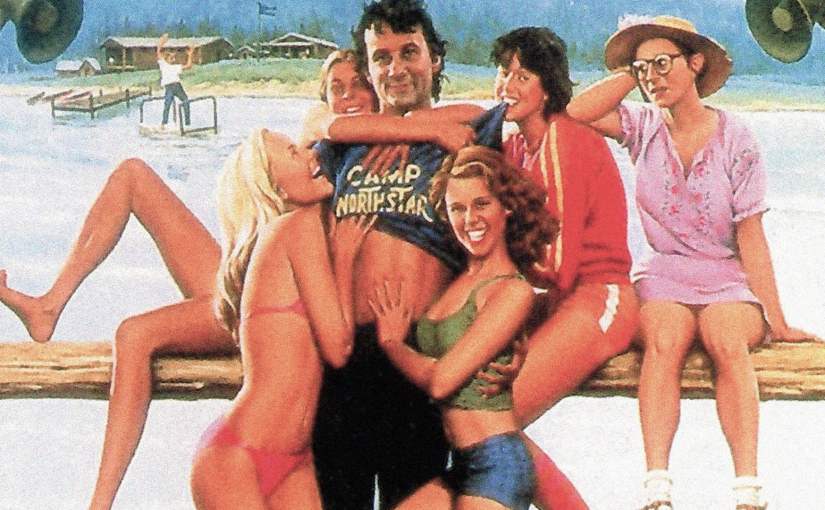
Director Ivan Reitman with Bill Murray and writer Harold Ramis made a fantastic team. Their summer camp comedy, Meatballs, from 1979 is not one of the all-time greats but it’s still a fun romp through the life of young campers peddled off under the supervision of teen counselors for eight weeks.

Meatballs works as an excuse to allow Bill Murray to break free from his SNL restraints and allow his off the cuff humor to improv its way through. As the head counselor named Tripper, Murray gives hilarious loudspeaker announcements about the cafeteria lunch or daily activities. He also uses his CITs, with names like Spaz, Crockett and Fink to carry Morty (“Hi Mickey!”) the camp manager who’s sleeping in his bunk out into the woods, or the lake or high up in a tree for his morning wake up surprise. This is all Animal House lite.

A touching secondary story involves a lonely teen camper named Rudy (Chris Makepeace) to bond with Tripper. Though I enjoyed my summer camp days, I was much like Rudy, not an athlete. I was a fast runner though, and Tripper with the Bill Murray personality builds Rudy’s confidence during the film leading up to the climactic inter camp big race. It’s not necessarily a well-rounded storyline. It tidies itself up pretty neatly by the end, but it’s a break from the material shenanigans, in between. Look, even a film like Meatballs needs some semblance of story somewhere.

The fun comes in brief skits with Meatballs. There’s sing along songs like “Are You Ready For The Summer?” and the campfire favorite “We’re The North Star CITs!” There’s the hot dog eating contest, Spaz’ spoon water relay and the basketball game against the wealthy, neighboring camp who can’t keep their shorts up.

Meatballs is a movie that would be shot with better quality on an iPhone today, but the dated camp days of the late ‘70s remain cherished here, before we became reliant upon technology. It’s a time where we depended on the outdoors, without mom and dad, and getting into harmless trouble while making new friends and discovering our freedom and ourselves.

The original Meatballs still has some material that’s worth a watch, and it still makes me yearn for my cabin bunk days. It’s nice to reminisce and it’s all just fun.

THE BLACK HOLE

By Marc S. Sanders

In 1979, Walt Disney Studios must have felt compelled to respond to the resurgence of science fiction, following 2001: A Space Odyssey, Star Wars, Close Encounters…, and even Moonraker, with The Black Hole. Their contribution to the genre falls flat however with shiny looking, helmeted, stiff robots that hardly use their joints and even more stiff performances from the human cast. If these actors didn’t have dialogue to speak, I would have thought they were dead.

Maximillian Schell is the deranged James Bond villain reject Dr. Reinhart, resigned to helm the mad plot of this film. His long-lost space craft is found at the border of the mysterious black hole. His intent, now that he has converted his entire human crew into mind-controlled humanoids, is to enter the unknown void that’s ahead and discover its secrets.

The small crew of another ship that discovers him consists of Robert Forster, Anthony Perkins, Joseph Bottoms and a poor imitation friendly robot named V.I.NC.E.N.T. who resembles R2D2 in shape and talks in cliche with C3PO’s voice. Their lack of personalities boards the ship simply to listen to Dr. Reinhart’s insane plan to fly into the black hole. Then in the final 30 minutes, the band of heroes run away across the pointlessly long platforms of the lost vessel as it crumbles apart during its slow-very slow-descent into the hole.

This is a film that lives up to its title. There’s no one to really rescue here. No romance or swashbuckling. No one for the villain to threaten. No reason to stop this nut job from committing his own mad suicide; Reinhart could care less if this band is with him or not. Even John Barry’s (“James Bond”) music lacks harmony, as the film contains at most two of his compositions to play over and over again.

When none of the mainstay ingredients for adventure carry any weight, then what’s the point really?

The Black Hole was Disney’s way of pushing action figures with the menacing razor blade bearing red robot Maximillan and the hardly lovable V.I.N.C.E.N.T. I recall when I was a kid the merchandising hardly made a dent in pushing the agenda for this film. A film catered towards kids, but barely entertaining for kids. There’s a lot, a whole lot, of speechifying going on here, mom and dad. What kid would be interested in listening to old farts like Ernest Borgnine or Maximillan Schell just yak away?

The Black Hole is as nothing as its title suggests. A void of a film. A franchise or cultural impact never came to be from this movie, and rightly so.

Though I do recall my mom buying me the pop-up book adaptation of the film. I wonder if that’s a valuable collector’s item these days.

1941

By Marc S. Sanders

Steven Spielberg’s first critical and box office flop, 1941, is a splattered mess of slapstick hysteria set a week after the Japanese attack on Pearl Harbor.  Residents of the California coast line prepare to be the next target.  Ahem!!!!!  Well, that’s it for the story…Goodnight.  Tip your waiters.

Just a year ahead of the Zucker brothers with Abrams comedy team that’ll deliver Airplane!, Spielberg opted to direct a spoof script penned by Robert Zemeckis and Bob Gale (Back To The Future).  1941 is full of gags galore beginning with a reference to the director’s most successful film to date, Jaws.  For me, seeing actress Susan Backline on screen again for another ocean skinny dip only to be intruded upon by a rising Japanese submarine was the second best joke of the film.  Once that was over, I had two hours left to go.  A long two hours. 

I’ve noted before that satire or spoofs are the riskiest genres to produce.  They can succeed with a picture like Dr. Strangelove…, or Network or Airplane!  Satire can be divisive too though, and thus only one half of your audience will appreciate the poke and prod.  Even worse, satire can just be unfunny across the board no matter which side of the aisle you lean on.  That’s 1941.  It plays too much like a Three Stooges series of slapstick violence.  Reader, even Steven Spielberg cannot capture the magic of the Three Stooges.

Zemeckis and Gale opt to poke a little fun at the Puerto Rican zoot suit riots vs the Enlisted men ahead of America’s entry into World War II.  So, when army soldier Treat Williams gets jealous of one handsome zoot suit dancer flirting with his girl, a fight breaks out which eventually populates two thirds of the film as it escalates all the way over to Hollywood Boulevard. Now thousands of stooge wannabe extras are walloping each other from one side of the street to the next. 

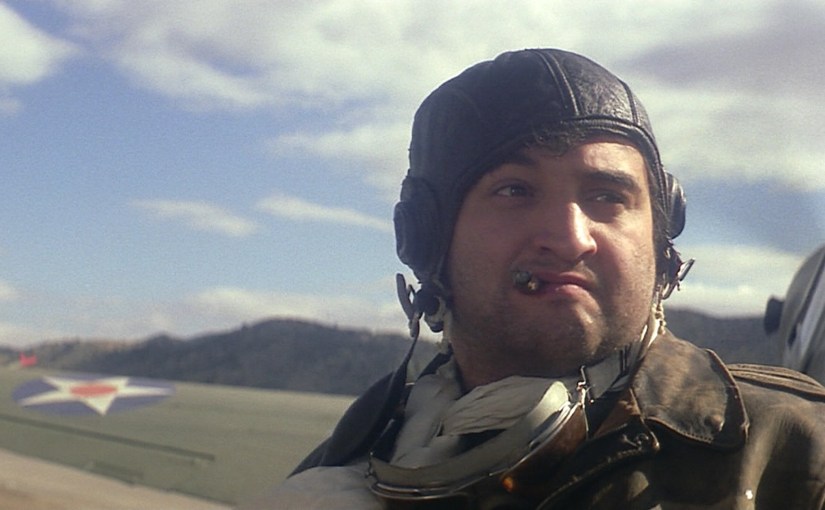
To allow a breather from this, the writers sidetrack over to Tim Matheson and Nancy Allen getting frisky in an out of control bi-plane while being mistaken for the enemy by John Belushi doing a very poor resurrection of his Bluto character from Animal House.  As Captain Wild Bill Kelso, Belushi’s pursuit fires upon everything else in sight, especially Hollywood Boulevard, but misses the plane occupied by Matheson and Allen.

The third point of this rectangle concerns Dan Aykroyd with John Candy and a whole platoon opting to set up a military cannon along the ocean view property belonging to Ned Beatty and Lorraine Gary in anticipation of the Japanese invasion.  Ned Beatty is the best stooge of the entire cast as the nerdy resident determined to protect his home while exercising his patriotic duty.  Gary’s response to Beatty’s ineptitude cracked me up as well.  The house wreckage of The Money Pit has nothing on what occurs in 1941.

The fourth storyline focuses on the enemy with a German speaking Nazi portrayed by Christopher Lee debating with the captain of a Japanese submarine (Toshiro Mifune) plotting to bomb Hollywood.  Somehow, each foil understands the other’s language.  These guys are just here to scream at one another.  There’s nothing funny about them.

Oh yeah.  Robert Stack is the Army General who watches Dumbo in the movie theatre while Hollywood Boulevard gets demolished outside.  Ho! Ho!

Often, I compliment Spielberg for his reliance on the sets he provides.  Everything you see on the screen serves a purpose to his films.  It happened as recently as with his remake of West Side Story in 2021, and it’s effectively used in Close Encounters…  He uses the same approach with 1941.  In this film though, there’s no pulse or significance to the props and pieces that are used.  The house is demolished.  So is the storage shed.  So is the movie theatre.  So is the Ferris wheel.  Yes.  What you’ve already seen in endless Looney Toons cartoons occurs here with a miniature model.  The Ferris wheel comes off its hinge and rolls across the beach side dock into the water along with Murray Hamilton and Eddie Deezen in tow.  When it happens, you’ll tell yourself I was waiting for that to happen.  What you expect to happen, happens, but you’re not laughing at it.

None of what you see in 1941 are terrible gags.  If you watch one scene out of context on a four minute You Tube channel, you may chuckle.  The problem is that every scene is treated like throwing spaghetti at a wall and seeing what will stick.  Mashing all of this together is not appetizing.  I like ice cream and I like steak.  I don’t like my ice cream on my steak.  Any idea of development is completely ignored.  The film can’t even work like a collection of skits.  Even Airplane! had a romantic storyline trajectory to perform with.  Here, two jealous guys have a fist fight and it more or less stretches that fight for an entire two hours.  The Three Stooges knew when to eventually quit.  Spielberg, Zemeckis and Gale didn’t. 

As soon as I saw Belushi on screen, I laughed.  It’s Bluto again.  Yet, the appearance wears off very quickly.  He has little dialogue and is limited to chomping on a cigar while grunting and groaning as the fighter plane he occupies wobbles around shooting at everything in sight.  When he eventually crash lands, Belushi continues to chomp on the cigar and grunt and groan.  Only now, he pratfalls as well…badly.

Ned Beatty is the real star here.  The ultimate nerd is also limited in dialogue. Still, to watch his body language with his glasses and bow tie and pear-shaped physique, accompanied with Lorraine Gary’s helpless gasping wife responding to the damage he commits with the cannon is hilarious.  Absolutely hilarious.  Tape all of their scenes together and make it a short to present ahead of the main attraction in a movie house. The audience will have a great time.

Otherwise, the only other fun I got out of 1941 was spotting the stars that were relevant at the time of its release.  Candy, Aykroyd, Frank McRae, Slim Pickens, Christopher Lee, Robert Stack, the cute blonde daughter from Eight Is Enough.  Even Penny Marshall has a quick blink and you miss it moment.  Oh, and look, there’s Lenny and Squiggy!

I think Zemeckis and Gale were on to a real smart idea here.  They maybe should have consulted with Harold Ramis and his National Lampoon’s crew however, because that’s the direction Spielberg’s film was aiming for.  What sets a film like Animal House apart from a 1941 though is in the set up.  Dialogue also helps.  1941 lacks set up.  1941 lacks dialogue.  It’s all visual and noise and more noise and more noise. 

1941 begins at letter A, and stops at letter A, never making it to B, and definitely never reaching Z.  An idea with potential was put down on paper.  The problem is these guys stopped writing after the first sentence.