IPHIGENIA (Greece, 1977)

by Miguel E. Rodriguez

DIRECTOR: Michael Cacoyannis
CAST: Irene Papas, Kostas Kozakos, Tatiana Papamoschou
MY RATING: 9/10
ROTTEN TOMATOMETER: [Not scored]

PLOT: In ancient Greece, King Agamemnon, in order to appease the gods, is told he must sacrifice his favorite daughter, Iphigenia, before his troops can march to war.


To my mental library of favorite closing shots in cinema, I must now add the final image of the engrossing Greek film Iphigenia.  I won’t spoil it, but the hatred in the eyes, the set expression of the face, spell out exactly what will follow in the years to come without saying a word.  It’s cinematic, yes, but it’s also theatrical, expressing oceans of passion (good or bad) with a stare instead of a monologue.

Director Michael Cacoyannis’ filmed adaptation of an ancient Greek tragedy by Euripides (Iphigenia in Aulis) does not immediately seem like the kind of film I would cotton to.  I’ve never read any of the ancient Greek plays, nor have I ever read the Iliad or the Odyssey, though I am familiar with their plots…barely.  This is not the kind of literature I have traditionally sought out, and I am content in my decisions.  But a weird thing happened while watching Iphigenia.  After a somewhat rocky start, I became enthralled with the language these characters were using.  I don’t mean the Greek language itself, but the subtitles used in the English translation.  I cannot say with any certainty how closely the subtitles mirror what is actually being said, but if they’re even just fairly accurate, then I now understand, at least to a small degree, why these plays have endured for millennia.

The story itself is one that has undergone countless interpretations and revisions over the course of history.  King Agamemnon (Kostas Kozakos) and his vast army are ready to set sail for war against the kingdom of Troy, but their ships are stranded by a lack of wind.  The seer Calchas informs Agamemnon that the winds will not blow until he sacrifices his eldest and favorite daughter, Iphigenia, to the goddess Artemis, who is withholding the winds because his men have offended her by killing a sacred deer.  (And now I know where the title of The Killing of a Sacred Deer [2017] comes from…knowledge really IS power!)

Agamemnon agonizes over this decision, but his hand is forced by the eagerness of his troops to sack Troy; he’s afraid they’ll mutiny if he doesn’t go through with the sacrifice.  He invents a pending marriage of Iphigenia to the great warrior Achilles to get Iphigenia to the encampment, but Clytemnestra (Irene Papas), her mother and Agamemnon’s queen, tags along unexpectedly.  The rest of the movie churns with gloriously over-the-top melodrama, as Clytemnestra rages at Agamemnon, Iphigenia pleads for her life, and Achilles swears to defend Iphigenia at all costs.  Agamemnon also argues with his brother, Menelaus, in a terrific scene during which they both change each other’s minds just a little too late.  In the meantime, the winds never blow, the Greek troops grow restless, and the seer waits a little too eagerly for the chance to carry out the impending sacrifice.

It was during Agamemnon’s argument with Menelaus that I really started to perk up.  This is not an easy scene to write or act out.  Even with English subtitles, the sentence construction and syntax were occasionally overworked.  I remember thinking at one point, “Huh…this is almost Shakespearean.”  Except these scenes were written roughly two thousand years before Shakespeare was born.  When that concept smacked me in the face, I started paying attention a little more to the style and the passion of the words.  And I can’t explain it, but everything acquired a new dimension.  It started to feel more like a play than a film.  It became – at the risk of sounding a tad abstract – poetic.

That feeling permeated everything after that scene.  Throwaway scenes felt more immediate, and really important scenes felt monumental.  Sure, there is some overacting, particularly from the actor playing Achilles, but really, it’s called for in this scenario.  When Clytemnestra promises her husband that, if he goes through with the sacrifice, she will accept his will but hate him for the rest of her life…I really felt it.  And it’s not just the language, but the zealotry of the acting on display, especially from Irene Papas, who must have salivated at the chance to play this fiery woman, a proto-feminist who accepts her duty as a queen but never lets the king forget who truly rules the roost.

And then there’s Iphigenia herself, played by a waifish, almost elvish actress I’d never heard of before seeing this movie, Tatiana Papamoschou.  In her first scenes, she’s almost too innocent to be taken seriously.  It’s only when Iphigenia learns of her father’s plans to murder her for the sake of war that Papamoschou’s acting style allows her to really embody the character, and she delivers a speech late in the film that is, for lack of a better word, biblical.  She accepts her fate and shames the men around her with the same surgical precision that can be found in the Gospels when Jesus accepts His own fate while dismantling the Pharisees with His words.  There are monumental themes at play behind the scenes, and “normal” dialogue just would not feel adequate.

And then there’s that final shot.  I did a tiny bit of research on the original play, and when you learn what historically happened to the main characters after the play’s events, that last look carries even more weight, foretelling decades of death and tragedy without saying a word.  That a foreign film of a 2,200-year-old play was able to affect me this greatly was very pleasantly surprising to me.  I doubt any newer version with today’s technology or modernized dialogue would affect me the same way.  Iphigenia was a very pleasant, surprisingly effective discovery.

3 WOMEN (1977)

by Miguel E. Rodriguez

DIRECTOR: Robert Altman
CAST: Shelley Duvall, Sissy Spacek, Janice Rule
MY RATING: 6/10
ROTTEN TOMATOMETER: 83% Certified Fresh

PLOT: Two roommates/physical therapists, one a vain woman and the other an awkward teenager, share an increasingly bizarre relationship.


Ever see the movie Big?  Tom Hanks, Elizabeth Perkins, Robert Loggia, directed by Penny Marshall?  YOU know.  Well, there’s a scene in Big, AFTER the hero boy has magically changed into Tom Hanks, and he’s now working as a toy-tester at a big toy company.  He’s invited to a focus group to give his feedback on a new toy that transforms from a robot into the Empire State Building.  The other suits are enthusiastic, but Hanks (because he’s a little boy at heart) is confused by it.  He raises his hand and tells the designers: “I don’t get it.”  They try to explain the demographics and the survey results, etc.  He nods, takes it in, and says, “I still don’t get it.”

That was me after watching 3 Women and reading about it a little.  I didn’t get it while I was watching it, and I still don’t get it after I learned more about it.

Robert Altman’s 3 Women is a dreamlike psychodrama that explores concepts of identity, self-discovery, and, I guess, femininity that reminded me, oddly enough, of the Burt Lancaster film The Swimmer (1968), mostly because a lot of it centers around water, but also because of the similar atmosphere created by both films: creepy and reluctant to give up its secrets.  There are numerous shots that are filtered through one of those store-bought wave machines that were so prevalent in the ‘70s and ‘80s, so the shot achieves a surreal effect that’s hard to describe.  It feels like foreshadowing, and in one respect it is, but for the most part it’s just there to either illustrate someone’s mental state or…I’m not sure what else.  I’ve had a day to think about this, and I’m no closer to interpreting exactly what those shots are supposed to mean.

Anyway.  We meet two women, Millie Lammoreaux (an impossibly young Shelley Duvall) and Pinky Rose (an even younger-looking Sissy Spacek).  We’ll get to the third woman later.  They both work at a physical therapy center, assisting elderly patients as they walk through a pool or sit in a hot tub – more water.  Millie is a wannabe sophisticate who is very friendly on the outside, but she doesn’t seem to have any actual friends.  Her co-workers and her neighbors at her hotel do their best to ignore her and her endless patter about articles in McCall’s and what she’s cooking for dinner tonight.  Pinky, whose real name is Mildred, is a young woman whose emotional maturity seems to have peaked around the age of fifteen.  She is immediately awestruck by Millie and contrives to be as close to her as possible at all times.  It’s essentially hero worship, though Millie hasn’t given her anything to really worship aside from being…herself.  They will eventually become roommates.

Millie is fond of yellow; Pinky dresses in, you guessed it, pink.  Millie will talk to just about anyone; Pinky is shy and introverted.  Millie has a large closet full of clothes; Pinky seems to own only one outfit, including underpants.  They are as opposite as it’s possible to be.  These points are drummed home in scene after scene.  The two women frequent a themed saloon called Dodge City, where we will eventually meet the third woman, Willie Hart (Janice Rule).  Willie, who is pregnant, communicates with glares.  She also paints these amazing, disturbing murals featuring what appear to be harpies or something like the mythological Furies.

I could go on with the story, but why bother?  This is not a movie about a story.  This is a movie about conveying a mood.  Altman literally conceived of this movie in a dream, pitched it to 20th Century Fox almost on a whim, and insisted on shooting without a finished script.  The pervasive mood of the film is one of suspense and foreboding.  There are a pair of twins who lurk in the background of scenes of Millie and Pinky at work.  Foreboding.  The musical score is atonal and creepy.  Foreboding.  Pinky starts to read Millie’s diary.  Foreboding.  You may have noticed that the last part Millie’s last name, Lammoreaux, is phonetically similar to Pinky’s last name, Rose.  Foreboding.

So, okay, Altman’s movie is about creating a mood.  To that degree, he succeeded.  It’s nothing if not creepy.  Events occur that were surprising.  Mystery abounds.  But…there came a point about halfway where it all became repetitive to me.  How many scenes of Millie being snubbed socially do we need to get the idea that Millie is not popular?  How many times do we need those shots that are filtered through the wave machine?  How many lingering panning shots do we need of those murals?  I’m just saying.  I got the point after five each.  Call me crazy.

And when we get to the final sequence…man, if I wasn’t confused before, I was completely at sea when the credits rolled.  I’ve seen some open-ended movies before, some I loved (Mulholland Drive, 2001), some not so much (The Lobster, 2015).  When it’s done right, I find it exhilarating to see a film that trusts a viewer’s intelligence so much that it doesn’t spoon-feed you.  But 3 Women gave me an ending that is so open to interpretation that it backfired.  Because it could mean so many different things, it ultimately meant nothing and left me feeling a little cheated.

I get it.  This is not that kind of movie, by Altman’s own admission.  Fair enough.  I give it 6 out of 10 based purely on the craftsmanship and sheer chutzpah of the film, and because the performances by Duvall and Spacek are worth the price of admission.  (And I just wanna say, Duvall may have won Best Actress at Cannes, but my vote would have gone to Spacek, who is utterly convincing as a woman-child in a state of arrested development.)

But I cannot really call this movie “entertaining.”  I don’t mean in the sense that I didn’t laugh or cry or whatever.  I just mean that watching it felt like a homework assignment, not an escape.  I never connected to it emotionally, so I ultimately didn’t care what was happening, or why.  I have enjoyed so many of Altman’s other films, but this one might have just become my least favorite Altman film that I’ve seen, finally replacing [name redacted so I don’t get doxxed].

TWILIGHT’S LAST GLEAMING (1977)

by Miguel E. Rodriguez

DIRECTOR: Robert Aldrich
CAST: Burt Lancaster, Charles Durning, Richard Widmark, Paul Winfield, Burt Young, Melvyn Douglas, Joseph Cotten, Richard Jaeckel, John Ratzenberger
MY RATING: 7/10
ROTTEN TOMATOMETER: 80% Fresh

PLOT: A renegade USAF general takes over an ICBM silo and threatens to provoke World War III unless the President reveals details of a secret meeting held just after the start of the Vietnam War.


Twilight’s Last Gleaming, one of Robert Aldrich’s last films, is a cleverly constructed Cold War thriller whose pointed message about the Vietnam War nearly torpedoes the suspense.  The political message is hammered home in a scene that goes on for a bit too long with people speaking dialogue that feels hammy and trite.  But the movie surrounding this one scene is good enough that I would still recommend it to anyone in the market for something off the beaten track.

The movie is set in 1981, four years after it was released, so no one could draw any real-life parallels between the characters and people in real life.  In an opening sequence that feels reminiscent of Die Hard (1988), General Lawrence Dell (Burt Lancaster) and his team of military ex-cons manage to infiltrate and take command of a US ICBM missile silo in Montana.  While I highly doubt it would be as easy as portrayed in the film, Aldrich films the sequence so that I got caught up in the suspense of the narrative instead of worrying about pesky details.  (If there’s a drawback to these and other sequences featuring military hardware and installations, it’s the overall low-budget feel to the sets and props; everything looks like it was shot on a TV soundstage instead of a big-budget film set.)

Once inside, Dell makes his demands: $20 million for each of his remaining team (Burt Young and Paul Winfield), the President must read the transcript of a secret meeting held just after the Vietnam war started, and the President must hand himself over as a hostage to secure their escape.  Otherwise, he’ll launch nine Titan ICBMs at their targets.

This creates a little tension among the would-be terrorists.  Winfield and Young couldn’t care less about the secret meeting, but Dell is adamant.  Meanwhile, General MacKenzie (Richard Widmark) formulates a plan to eliminate Dell and his crew using a “tiny” nuclear device, the President (Charles Durning) agonizes over the secret transcript, and his best friend and aide uses some “tough love” to get him to make a decision.

Despite the fakeness of the surroundings, I was absorbed by the thriller elements in Twilight’s Last Gleaming.  I would compare them to the best parts of WarGames (1983) and The China Syndrome (1979).  There is some impressively impenetrable technobabble about booby traps and inhibitor cables and fail-safe systems that I just rolled with.  The plan involving that “tiny” nuclear device leads up to a sequence that I would compare favorably with any contemporary thriller you can name.

One of the ways Aldrich achieves this effect is through the use of split-screens…LOTS of split-screens.  It starts at the beginning of the film with two screens.  Then there are moments with three split screens, two on top and one in the bottom section.  Then, during the most intense sequence of the film, we get four splits in each corner of the screen.  At first, I found it disorienting, but it absolutely works when it most needs to.  (I’m trying not to give away too many plot details, so excuse the vagueness.)  I don’t know that I would want to watch an entire movie like this (Timecode, 2000), but in small doses, it’s very effective.

Where the movie bogs down is the middle section of the film when the President expresses his disapproval of the contents of the secret transcript Dell wants publicized.  It’s a bit theatrical to believe a sitting American President would be this vocal about his feelings in the middle of a dire crisis.  I think the scene would have played just as well if we had gotten a general idea of the transcript, or even if the contents had NEVER been revealed to the audience.  It would have been a perfect Macguffin, leaving viewers free to imagine anything they want.  The truth about Kennedy’s assassination?  Area 51?  Pearl Harbor was an inside job?  The Super Bowl really IS fixed?  Who knows?

Instead, the President insists on reading a portion of it out loud to his Cabinet members, enlisting them to read certain lines.  While I admire Aldrich’s intent (to send a cinematic protest to the architects of the Vietnam war), the scene nearly brought the movie to a stop, which is deadly when dealing with a suspense thriller.

But, like I said, the rest of the movie is so good, I am compelled to let it slide.  Later, we get surprise attacks, snipers, helicopters, a crafty fake-out involving torture, and an ending that is as cynical as they come, but which felt like the best way out of the situation for everyone involved…except for the American people, but that’s another story.  Twilight’s Last Gleaming feels virtually forgotten, and that’s a shame.  Aldrich directs this movie with a lot of passion for the material and milks every ounce of suspense he can with the tools at hand.  If you’re prepared to overlook that middle section, you’ll get a kick out of this movie.

P.S. Look fast for an unexpected appearance by William Hootkins, aka “Porkins” from Star Wars (1977).

SATURDAY NIGHT FEVER

By Marc S. Sanders

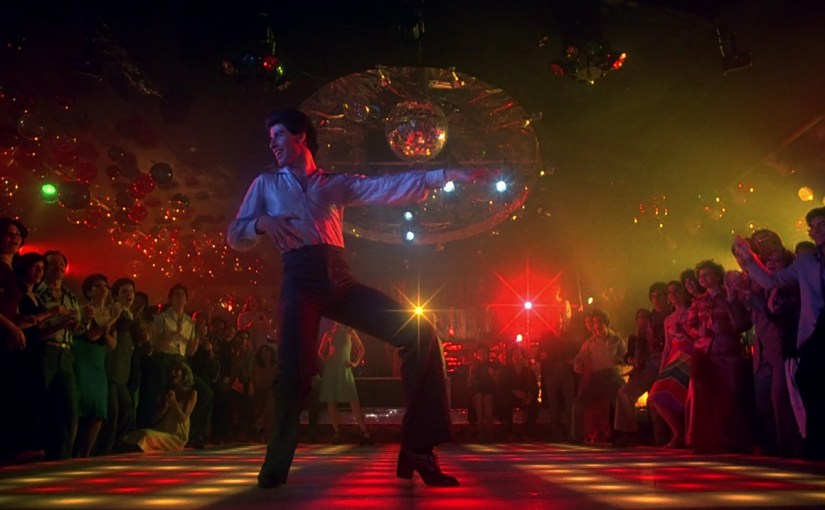
One of the biggest cinematic cultural touchstones announced itself just as the fad was withering away.  John Travolta blew up movie screens in 1977 when he strutted down the streets of Brooklyn with a paint can in one hand while wearing his wide collared red shirt under his black leather jacket.  The song that that got audiences grooving in their seats with the immediate superstar? Staying Alive by The Bee Gees.  The movie?  Saturday Night Fever which offered one of the most memorable character introductions in film history.

Disco might be dead and only designed for themed costume parties nowadays, but Saturday Night Fever remains very much alive.  No one forgets the moves Travolta did on the dance floor in his polyester shirts and suits.  John Badham’s film continues to be saluted with spoofs ranging from Airplane! to Saturday Night Live to Family Guy and one commercial after another.  The soundtrack is an unforgettable mix played for every generation that comes along at weddings, proms and bar mitzvahs.  The film was also adapted into a successful Broadway and touring musical.  I loved the live stage performance by the way.

Still, there’s a sensational dramatic story to Saturday Night Fever and Tony Monero, the nineteen-year-old kid who is only a Brooklyn celebrity on the streets and especially at the local dance club 2001: Oddyssey (the extra d is included).  Tony has unwanted ladies dying to sidle up to him, especially his contest dance partner Annette (Donna Pescow) who will eagerly surrender her virginity to Tony without protection.  His buddies idolize him as well, as they cruise the streets at night drinking in their beat-up Ford sedan on the way to and from the club, before finishing off the evening with some risky tomfoolery on the edge of the Verrazano bridge.  His boss at the paint shop even loves the kid.  Tony doesn’t ask for it, but he gets a raise and by the end of the conversation, the boss has nearly doubled his first offer. 

None of this is enough for Tony though. He doesn’t want to be tied down to working at the paint store for the rest his life.  He’s afraid he’s losing his beautifully well coifed hair and maybe his dancing skills will not survive as the years pass him by.  He also gets no love from his father.  Every dinner erupts into a family argument.  His mother has preferred adorations for Father Frank, Tony’s older brother who entered the priesthood.  Ma calls her son Father Frank, because, after all, he’s a Father of the Catholic Church.  Tony is also envious of Frank, first for their parents’ adoration.  Later, it is because Frank decides to leave the seminary to be free of the parents’ expectations.  

Tony also sees the talents and beauty of a dancer named Stephanie (Karen Lynn Gorney) who has no interest in his immaturity but is willing to be his partner for 2001’s upcoming dance contest.  Try as he might, Tony cannot keep up with Stephanie beyond the dance floor.  He’s not educated or cultured like her, and she is relocating across the bridge to Staten Island for a better life.  On the other hand, Tony remains stationary and therefore he is a frustrated man about to put his teenage years behind him with no aspirations and the weight of those who he spends time with holding him down.

I’d argue many are familiar with the colorful dance sequences accompanied by The Bee Gees’ memorable numbers (How Deep Is Your Love, Night Fever, More Than A Woman) as well as KC and the Sunshine Band (Get Down Tonight) and The Tramps (Disco Inferno).  Yet, Saturday Night Fever demonstrates a tough coming of age struggle for its protagonist.  John Travolta is at least just as memorable as James Dean was in Rebel Without A Cause.  Life goes on, but how can it when all you have to show for yourself is being the best at disco dancing?  There’s a whole other world beyond Brooklyn.

Sex is even frustrating for Tony.  He gives in to Annette’s desires to make love to him in the back seat, but then tosses her aside when she does not bring a condom.  All of this is too easy for Tony; so easy that it’s not even pleasurable and thus he’s continuously cruel and dismissive of her.  When Annette gives in to group sex with the guys, one after the other, Tony can do nothing but chastise her for allowing herself to be subjected that way.

Bobby C (Barry Miller) is the fearful, untalented, uncool and insecure buddy who is lost with what to do when he thinks he might have gotten a girl pregnant.  Tony is the greatest guy he knows, but he has no interest in helping.  Bobby even tries the next best thing by approaching Frank…formerly Father Frank.  Everyone wants to be with Tony and stay in his social circle, yet Tony is the one who wants out.

Norman Wexler’s screenplay is tremendously insightful but never so apparent.  As loud as the clothes, the disco music and the dance is, this is a script of subtly in Travolta’s performance.  It’s likely why he got the film’s sole Oscar nomination for Best Actor.  Despite Tony’s continued outbursts, there’s nothing so blatant in Saturday Night Fever like you would find in other coming of age films like James Dean’s, for example, or any of John Hughes’ films.  Director John Badham accustoms you to Tony Manero’s anxiety. 

It’s ironic, normally a protagonist will grow into self-assurance.  In this film, Badham wisely shows the confident swagger of Tony Manero in the film’s unforgettable opening only to see him diminish as the character arc proceeds over the film’s next two hours.  Badham includes small hints in this opening.  Tony might walk with a strut, but the first attractive woman he passes on the street does not give him the gumption to approach her, and the second woman tries avoiding him being in her way.  Later, Tony is outright rejected by Stephanie for anything beyond friendship and dance practice.  Tony wears the local celebrity façade, but in reality he is just a nobody.

John Travolta is so effective at showing on screen how Tony internally speaks to himself as he vocalizes his frustrations at those around him.  Whatever is angering Tony only looks like it’s Annette’s fault, or Stephanie’s or the guys, or Mom and Pop.  There must be something better for him than just being a small time, well dressed disco dancer, and a valued worker in a paint store.  He’s also outgrowing the street brawling with his buddies.  All he knows is he had better find a way out of this life with no promise of a future. Otherwise, he’s destined for a destructive ending.

Saturday Night Fever has a staying power.  Years after anyone has seen this film, all that might be remembered is John Travolta in the white suit on the lighted disco floor while Staying Alive is blaring through the speakers.  However, it’s a deeper film than just glitzy aesthetics that arrive with the final cut.  This is a coming-of-age story that does not hide the struggles nor romanticizes a path towards a better person or future. 

The film’s ending is even deliberately ambiguous. It’s more realistic than you might realize because the future remains uncertain for all of us, especially when we believe we don’t have much beyond what we are envied for to send us forward.  I know of the film Staying Alive directed by Sylvester Stallone which brought Travolta back into the legendary role.  It is the follow up film to Saturday Night Fever; notoriously considered one of the worst sequels ever made as it attempts to bring Tony Manero into the early 1980s cheesy zeitgeist world of Cats on Broadway or a poor impersonation of Prince pop music.  Norman Wexler demanded his story credit be stricken from that film. 

Choosing to ignore what came with that awful sequel, Wexler’s script for Saturday Night Fever wisely offers no promises for its protagonist, because unlike what we often see in the movies, life never guarantees a new day, and that’s what truly scares Tony Manero more than anything else.  It’s fair to say an uncertain future terrifies all of us.  That is why Saturday Night Fever remains completely genuine.  We are never meant to see what comes of Tony Manero because Tony Manero struggles with the unknown of what’s to come.  Some endings are meant to have those hanging threads from a time gone by.

CLOSE ENCOUNTERS OF THE THIRD KIND

By Marc S. Sanders

Close Encounter of the First Kind – Sighting of a UFO.

Close Encounter of the Second Kind – Physical Evidence.

Close Encounter of the Third Kind – Contact.

Music is the most universal of all languages.  Steven Spielberg’s Close Encounters Of The Third Kind demonstrates that claim. 

I appreciate how Spielberg’s script, along with his direction, opens the film.  It takes place during a sun swept sandstorm in New Mexico.  At first, hardly anything but sand blowing can be seen, along with the high volume of wind breezing about inconveniently.  You are not even sure what you are looking at.  Then, headlights from a vehicle appear and a group of men assemble.  We come to find the main character of this scene is a French scientist named Lacombe (Francois Truffaut).  He only speaks French and hardly understands any English.  He is in need of an interpreter (Bob Balaban) to translate to American men who are accompanying them.  After we’ve established French and English are in the fold, we then realize that Spanish must enter the conversation amidst the overwhelming winds from the blinding storm.  An occurrence must have happened here recently, because Lacombe and crew interview some of the locals who are trying their best to define what took place the night before.  An elderly man is mysteriously sunburned on only one side of his face.  Thereafter, a grouping of bi-planes last seen flying over the Bermuda Triangle nearly forty years earlier come into focus.  No matter how you learn, communicate or understand, the confusion depicted is a perfect match for each of the men occupying this space.

A parallel story begins after this opening in the state of Indiana.  Sightings by airline pilots, as well as residents, are discovered in the skies above.  Blackouts occur everywhere.  The experiences of two residents, a young boy named Barry, and a utility worker named Roy Neary (Richard Dreyfuss), are who Spielberg uses to guide us through these strange episodes of phenomena.  They are being drawn towards a calling or an image and they become entirely focused upon what has happened to them.  Barry’s mother, Jillian (Melinda Dillon), while trying to reign her son back home has also been delivered a message from unusual spectacles in the skies. 

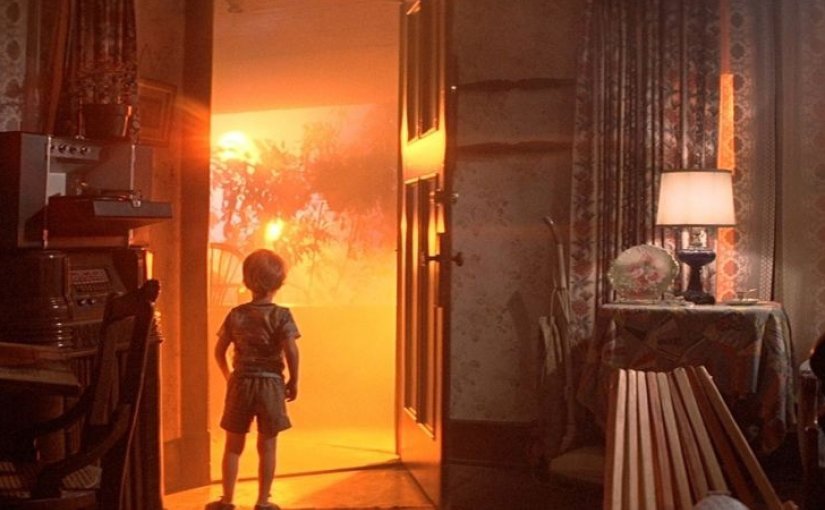
Soon after, these people cannot help but focus on a shape that they know they’ve seen before but can not place it.  Roy sculpts the shape in his shaving cream and his mashed potatoes.  He becomes neglectful of his work, his three children and his wife, Ronnie (Teri Garr), who refuses to take him seriously.  Barry’s young age allows him to avoid understanding the meaning of any this.  So, when the blinding “lights,” of whatever these entities could be, come towards his home in the middle of the night, he happily welcomes them, and willingly accompanies them back to wherever they came from.

I know this science fiction film is a highly regarded classic.  It’s earned the right to be considered as such, and so many have seen it.  Yet, I also know that I appear vague in my description of the film here.  I choose not to expound on everything going on in Close Encounters…  Steven Spielberg would want it that way, and I hate spoiling any movie.  A movie not seen is new to any of us. 

The residents of Indiana insist to higher governmental and military authorities that they have witnessed unidentified flying objects.  What those UFOs are, or where they came from, or why they visited their home state is unexplainable.  Spielberg intentionally avoids definitively explaining what’s occurred.  After all, if aliens are visiting our planet Earth, then who’s really to say we understand what they want or why they’ve come here?  Like the rest of the countries of the world, it’s fair to say that inhabitants of another planet in our galaxy would likely have their own way of communicating or speaking that’s entirely different from English, or French, or Spanish.

Spielberg goes even further to distance any understanding among ourselves or with these new entities that we are encountering.  A cargo sea vessel appears out of nowhere in the most unlikely place, the Gobi Desert of Mongolia.  Why?  How?  The people of a village within the continent of India are harmonizing a tune over and over again, in unison.  Lacombe along with his interpreter, and their American crew, attempt to decipher why these episodes have occurred as well.  The harmony must mean something.  What’s the message?  The world must learn to communicate with one another if they are to understand why these strange happenings continue.

Once Spielberg introduces the Indian village’s response to their experience, oddly enough Barry becomes obsessed with the tune as well.  Lacombe believes he’s recognized the tune as a means to speak with the visiting entities.  Again though, what is the message within the song?  In addition, Roy and Jillian are beginning to understand their obsession of the shape.  “This means something.  This is important.”  The script for Close Encounters… does not take for granted the repetitive significance of this line.  It is uttered a few times at different moments, by both Roy and Lacombe.

Close Encounters Of The Third Kind functions as a riddle, and yet it all makes sense in a breathtaking ending that occupies the last 30-40 minutes of the picture.   I hope there will be readers of this column who have yet to see this film.  It is better to go into it by knowing as little as possible.  Only then can you truly experience the maternal frustration that Jillian has for her young son’s insistence on going towards the lights, or Roy’s obsession with what dwells in his mind following his encounter.  With knowing as little as possible, can you become all the more curious at Lacombe’s pursuit.  When Spielberg gradually pulls the curtain away, it is such a satisfying relief and a feeling of fulfillment to have taken the journey with these characters. 

The construction of Spielberg’s first of many sci-fi films is magnificent.  It performs as if it is operating with real world science and language.  Yet, I have to draw attention to a scene that arrives in the middle of the picture.  Barry’s innocent, but youthful obsession, is tested within the home, beside Jillian’s fear.  Spielberg uses every prop and device available within the set of this scene.  Battery operated toys come alive.  The record player goes off.  The stove turns on. The dishwasher opens and closes. Blinding lights bleed through the curtains, chimney and keyholes.  The echoing sounds become overpowering.  What’s come to the house can’t be explained.  However, one person is thrilled by it while another is terrified.  It is such a well edited scene of terror at the unknown, that for me still remains as one of the most suspenseful moments in film history.  Steven Spielberg is bringing life to a “boogie man.”  When I showed my daughter this picture during a re-release in a Dolby movie theatre, I held her 11-year-old self in my lap concerned she’d become frightened of the scene.  It’s as thrilling as going on an unpredictable roller coaster for the first time.  The scene occurs out of nowhere, with no convenience of foreshadowing.  Once again, as he did with Jaws and somewhat implied with Duel, Steven Spielberg does not show you the terror or the invasive entity.  He allows the viewer’s subconscious to draw its own conclusion.  This is master craftsmanship.

Close Encounters Of The Third Kind remains as one of the best science fiction films of all time.  Nearly forty years later, despite its fiction, it still feels like it’s real.  It all feels like it means something.  It still feels like its important. 

STAR WARS

By Marc S. Sanders

Of all the infinite times I have watched Star Wars (now also known as Episode IV: A New Hope), what remains appealing to me is the depth of its outer space setting. It would have to, right? Otherwise, what was the point of making action figures beyond the main characters, Darth Vader & Luke Skywalker? It’s a film where it’s just as important to get to know the extras seen in the film like a “Walrus Man” or a “Hammerhead,” or green skinned “Greedo.” Unquestionably, Star Wars is a film with a very, very rich and very deep setting.

What kept moviegoers coming back to the film time and again in the late ‘70s through the ‘80s and on into the next century, is that there is just so much to get accustomed to. One moment, you are adjusting to a summary scroll that opens the film with John Williams triumphant music, and then you are trying to familiarize yourself with an unusual ship that is being pursued by a much grander one within the depths of space while circumventing an orange planet. Laser shootouts occur with robots caught up in some kind peril, and then we meet a towering figure in black with an asthmatic, incessant breathing mask.

Later, we have to get used to small scavengers, and then scarier scavengers tormenting a boy on the cusp of adulthood who only dreams of adventure. The boy meets a mentor and then we are in a saloon with the oddest collection of patrons we could ever encounter. The film carries forward to daring rescues and escapes and a sword fight that may lack sophisticated choreography, but makes up for it with lightsabers and a surprising death that leaves an air of mystery. Before that’s all over, we still have to become enamored with the daring dog fights within space among battalions of one man piloted space ships.

That’s what has always kept Star Wars alive with much to celebrate. There is always something new and different just minutes away from the current scene you are engaged in. No two characters or bands of people look the same. No two settings look the same either.

Lucas always sought out to build a “used universe.” The ships and settings beyond the villains’ (known as the Empire) powerful Death Star space station were beat up and bruised and rusted and dented. This galaxy is lived in, and mired in a history.

Considering the film released in 1977 is somewhat telling of that decade. Films like The French Connection and Dirty Harry showed the ugliness of their respective cities and citizens with broken down cars and trash in the streets, and hoods with unkempt beards and worn-out clothing. Lucas must have carried these visions over to his PG universe to give viewers the idea that a guy like Greedo is a dangerous bounty hunter unconcerned with drawing his pistol in public, and a gangster like Jabba The Hutt rules a territory with a threatening criminal fist. (Incidentally, I strongly oppose Jabba’s appearance in the reissue of the film; better to imagine how vile this guy is in my own mind when watching the picture for the first time).

Lucas also famously takes inspiration from Akira Kurosawa’s Japanese films (especially The Hidden Fortress) of samurai culture, and blends it perfectly with a sci fi interpretation of the Old West gunslinger as seen in Sergio Leone’s spaghetti westerns.

Star Wars pleases so many different demographics of audiences because it jump starts its multiple stories and settings with what made going to the movies so appealing to begin with. Present within the film are humor, childlike appeal, fantasy, western motifs, suspense and romance.

It’s a visual classic that remains unmatched. At least with the original trilogy, Lucas never allowed any two settings to look alike. With this film in particular, we are treated to the contrast of a desolate desert planet vs the cold industrial operations of a ruling regime proud to carry out their actions with menace and terror. (More pleasing contrasts occur in the next two films.)

Star Wars is well known for the simplicity of its story. It’s main hero, Luke (Mark Hamill), is recognized for his basic innocence simply with his white tunic and mop top head of hair. Same can be said for the damsel in distress, Princess Leia (Carrie Fisher) and the fearful but sweet droids she sets out to embark on a mission. She evokes a royal and dedicated government in her white robe with elegant hairstyle; the droids have an expression of worry for the tall one, and spunky nerve for the shorter fat one, like a Laurel & Hardy pair. Villainy is epitomized with Darth Vader (voiced with commanding authority from James Earl Jones), who dons all black with a terrifying mask/helmet. You don’t know what Darth Vader really is beneath that dark costume. It’s not important for the exposition of this film. All that matters is that Lucas shows you who is good and who is bad. The visual references are enough for the explanations. What we need to know about these characters are summed up with the wise but elderly prophet in quick summation by Ben Kenobi (Alec Guinness, in an Oscar nominated role). Kenobi serves as the historian of this universe.

Over time, even almost immediately upon its release, the commercialization of Star Wars hogged the spotlight of the original product. It’s reflected today based on a measure of expectations both financially and within the fraternity of diehard fandom. Ironically, in 1977 everyone was satisfied with the surprise that George Lucas shared on the big screen. There were no objections to be found. Today, though, it’s become an act of trying to satisfy the masses by what they believe the next developments should be. I’m guilty. I admit to sometimes being an accomplice to that notion. It’s impossible to please everyone. So new film products in the Star Wars franchise will never succeed as well as the original film managed to do.

I don’t let any of that bother me. I remain pleased that I can still feel the sensation of pumping my fist in the air when Luke & Leia swing across the chasm thereby evading Stormtroopers, or getting a thrill when their pirate escort, Han Solo (Harrison Ford), finally lets loose of his quiet, cool demeanor to run down a hallway while trying to take out an army of baddies. I get a lump in my throat when Kenobi gives a slight grin before surrendering to Vader in front of Luke’s eyes.

So much is to be seen in Star Wars, but not all of it is explained. George Lucas completed his film with routes left to wonder and think about; he gave an opportunity to continue our imagination long after we finished watching the film for the first time. On the multiple occasions we watched thereafter, we pondered where we could get a table in the Cantina/saloon, or just how many droids the Jawa scavengers kept in their sand crawler.

As well, what did the blue milky substance taste like. More importantly why exactly did Luke’s uncle give a concerned glance across the dinner table to his aunt during a slight mention of his father?

That’s the magic of Star Wars. Like the land of Oz or Willy Wonka’s chocolate factory, there’s just so much to explore and think about and imagine beyond its surface. Long after we are all gone and our grandchildren’s children are beginning to stimulate their imaginations, they may well turn to the cartoons and other films and toys in the vast galaxy from long ago and far, far away. One thing is certain, though. They should ALWAYS begin with the original Star Wars.

SMOKEY & THE BANDIT

By Marc S. Sanders

Does a comedy get much better than Smokey & The Bandit?

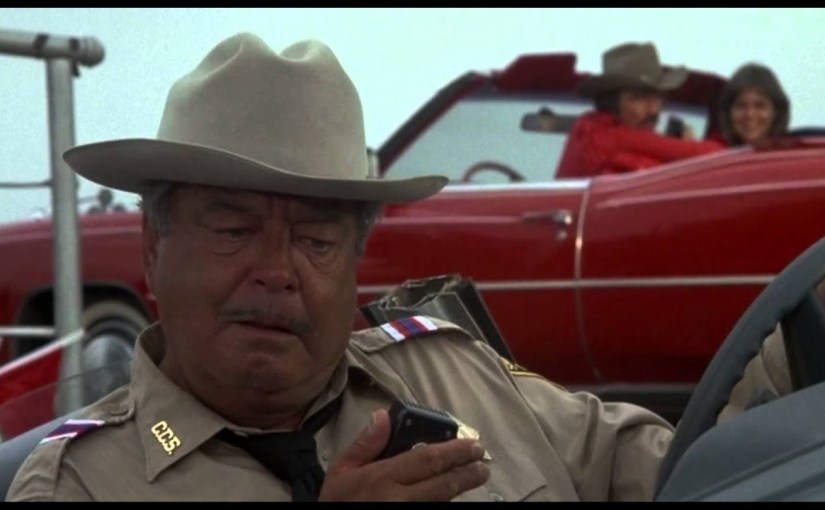
Stuntman Hal Needham re-energized the car chase comedy with this classic from 1977 featuring foul mouthed Jackie Gleason as Sheriff Buford T Justice of Portague County, Texas pursuing the charismatic, cocky and lovable Bandit played brilliantly by Burt Reynolds. It still holds up as a hilarious film.

Big Enos and Little Enos Burdette (Pat McCormick, Paul Williams), in matching cowboy hats and suits, challenge The Bandit to bootleg 400 cases of Coors beer from Texas back to Georgia in 28 hours; that’s 1800 miles total. They’ll pay him $80,000 to do it. Bandit recruits his best pal, The Snowman (the terrific Jerry Reed who also sings memorably on the soundtrack), to drive the truck hauling the manifests while he pilots the black Trans Am at 110 mph, distracting law enforcement away from the truck. On the way back from Texas, Bandit picks up a hitchhiking bride (an adorable Sally Field as Carrie soon to have the handle of “Frog”), who has fled from her wedding to Sheriff Justice’s son, Junior (a great dim-witted Mike Henry).

That’s all there is to it!

From there, it’s just one pursuit after another with the Trans Am doing ungodly stunts like jumping bridges and dodging roadblocks from state to state, while keeping Smokey Bear Sheriff Justice off his tail. A great on-going slapstick gag is seeing the excessive damage piled on to the Sheriff’s squad car. He loses the roof, the driver’s side door, the muffler and so on. The car keeps up with The Bandit, though, and Sheriff Justice never loses his hat.

This film doesn’t belong to any one member of the cast. Collectively it belongs to all of them. Every character is memorably quoted and given great comedic moments to laugh at over and over again. Even The Snowman’s basset hound, Fred has his share of laughs.

It’s impressive to think how influential this film actually became. The black Trans Am with the gold eagle spread across the hood, became a classic car much like any James Bond vehicle. The hit series The Dukes Of Hazzard made its debut shortly thereafter, and stole much of this film’s themes and gags. Tons of crash ‘em up stunt filled chase comedies attempted to duplicate the success of this film in the late ‘70s and early ‘80s, including further team ups of Needham, Reynolds, Reed and Field (Hooper, The Cannonball Run).

Hal Needham, with his cast and crew, really touched on something special with Smokey & The Bandit. As one of the first films I ever saw in theatres, it’ll always remain as a favorite movie going experience that I shared with my brother and babysitter, Mrs. Garcia. Along with late night viewings of the classic 39 episodes of The Honeymooners, Jackie Gleason will always stay on top as one of my favorite funny men. I’ll still watch and happily quote this picture endlessly for years to come.

“Now lemme have a diablo sandwich and a Dr. Pepper and make it fast. I’m in a g-ddam hurry!”

THE SPY WHO LOVED ME

By Marc S. Sanders

The Spy Who Loved Me remains as my most favorite movie going experience ever. It was the first Bond film I saw in a movie theatre. I was 5, accompanying mom and dad to a dinner party. Upon leaving the party close to midnight, dad says to mom “Linda, let’s go see James Bond.” Mom’s reply was “Walter, it’s midnight and we have Marc with us.” Dad won the argument by simply saying “C’mon Linda!” So he pulled into The Forum movie theatre located off Route 4 in Paramus, NJ.

At the time, my youth didn’t allow me to comprehend really what was going on, but I clearly remember being thrilled during the pre title sequence as Bond (Roger Moore) dons his yellow snow suit to evade KGB agents trying to kill him off while skiing in Austria. I’ll never forget the ski jump/parachute ski dive off the mountain to close out the scene. Still one of the greatest stunts ever performed in a Bond film.

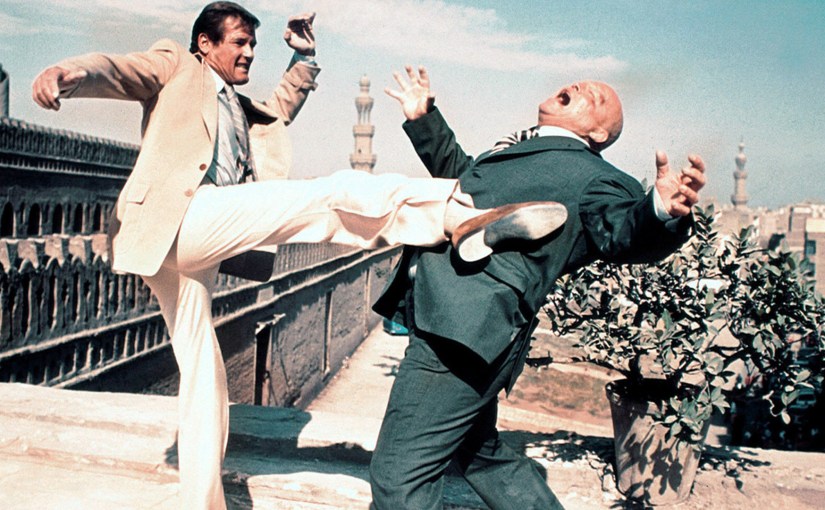
Beyond that, I cherish the memory of mom covering my eyes each time the vicious henchman Jaws bared his metal teeth and the maze running through the Egyptian construction site. 007 in his tuxedo with Russian Agent Triple X (Barbara Bach, one the best Bond girls) in her navy evening gown. Bach was gorgeous, intelligent and perfect in the role.

The Spy Who Loved Me is superb in so many ways. It returns to the Cold War threats that a megalomaniac takes pleasure in. This time it’s Stromberg (Curt Jurgens) who manages to apprehend nuclear armed submarines from Russia, Great Britain and eventually the United States. His plan is to destroy the world and start a new civilization beneath the sea. Honestly, I think that might take a little more effort than the capabilities of three submarines.

Triple X must now form an alliance with 007, only she has vengeance on her mind following the loss of her lover during the earlier ski pursuit. Bond must survive Stromberg and Jaws, as well as his Russian partner.

There’s so much that Director Lewis Gilbert, with Producer Albert Broccoli (first time working without Harry Saltzman) offers here. Bond drives a Lotus Esprit turned submarine, while also outrunning helicopters, motorcycles and Jaws who seems invincible. He also gets a cool new gadget vehicle to play with-a put it together yourself Jet Ski. Who woulda thunk it?

Jaws (Richard Kiel) is menacing but he’s also a great running gag, almost like the Wile E. Coyote from Looney Tunes. Throw him off a train, drop a building on him or fly his car off a mountain and he’ll come out of it with just a dust off of his shoulders.

Gilbert gets great scenic footage of Cairo, Egypt, Sardinia, and the snowy mountains of Austria. Stromberg’s ocean base is really cool to see too. Just avoid the elevators if you can.

Again, The Spy Who Loved Me has some of the best of everything-Bond Girl, a terrific soundtrack from Marvin Hamlisch as well as his musical accompaniment on the film’s Oscar nominated song from Carly Simon (“Nobody Does It Better”), Jaws, and it’s arguably Roger Moore’s best work in the role.

I could watch The Spy Who Loved Me a hundred times and never get tired of it.

Nobody Does It Better.

ANNIE HALL

By Marc S. Sanders

Some of the best comedy comes from watching the suffering of others. One of the best examples of this is Woody Allen’s Best Picture winner Annie Hall. Allen directs and stars in the film, and the suffering his character Alvy Singer endures is by his own mindset. Alvy could never be happy unless he is finding another opportunity to be unhappy. At one point he marries a terrific girl played by Carol Kane. Yet that doesn’t work out. As a child, he finds an allegorical reason to live his life as he does by riding the bumper cars where his father works on Coney Island. Alvy just sees life as one crash after another.

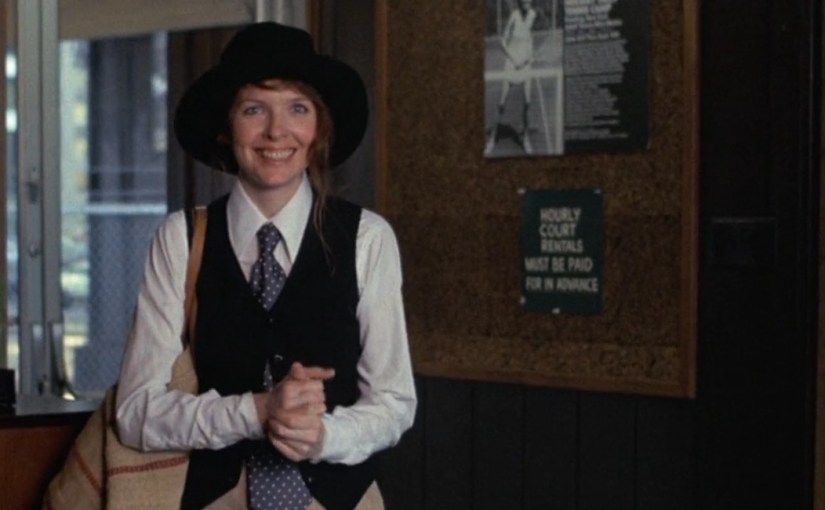
Neurotic doesn’t even begin to describe what Alvy puts himself through. Most especially he becomes insecure with himself as he dates Annie Hall (Diane Keaton, who won her Best Actress Oscar for arguably her best career role). Annie is fun loving and a little flighty. Still, there’s nothing not to love about Annie. She wants to be a singer and Alvy showers her performance with compliments despite a very rough bar crowd. However, when Annie gets reassurance of her talent from others, Alvy is not so encouraging to advance a promising future for Annie.

We see a handful of women that Alvy dates, but most of the ninety minute film focuses on Alvy’s relationship with Annie. Woody Allen penned the script with Marshall Brickman as a loose interpretation of the real life relationship he had with Diane Keaton.

Alvy is a mess. As a child he frustrated his mother with the idea of world ending events yet to come, and thus not much reason to apply himself for a fulfilling life. As an adult, he can’t even wait patiently in a line for a movie because the gentleman standing behind him is aggravatingly wrong on his viewpoint of the films of Marshall McLuhan. The best response to a hilarious scene like this is realized by actually welcoming the real life McLuhan into the frame of the picture to tell off the snobbish jerk standing behind Alvy. I must admit I never heard of Marshall McLuhan myself. Still it’s the idea of running through with a depicted scene like this that’s so dang hilarious. Wouldn’t it be so satisfying to any of us to just have our heroes interrupt a conversation to shamelessly put down our enemies?

That’s what makes Annie Hall a much more special romantic comedy than anything before or thereafter really. Woody Allen breaks the fourth wall at times. He welcomes his adult self into his childhood classroom to debate with his elementary school teachers. Later, he tries to provide a source to his neuroses by bringing both Annie and his best friend Rob (Tony Roberts) into his home to see the relatives Alvy grew up with. These intrusions into scenes of Alvy’s childhood are daringly funny and like nothing I’ve ever seen.

Alvy’s neuroses are so intense that he’ll randomly stop people in the middle of New York to inquire about their sexual experiences. He even unloads his endless dialogue of some of the greatest wit on a horse being ridden by a police officer.

Keaton is perfect for Allen to play against. There’s the hilarious moment of the two of them trying to boil live lobsters. Just between the two of them they are going to be cooking SIX LOBSTERS. Why six? Who cares? The point is to demonstrate a hilariously loving memory at being surrounded by creatures they are both terrified to handle. One lobster even crawls behind the refrigerator and that’s an amusing problem. Annie takes advantage of getting action photos of Alvy with the lobsters. Later in the film, we see that Annie has displayed a collage of this moment on her wall.

Alvy and Annie know they don’t belong together. Yet, it’s hard for them to live without one another too. Annie feels no choice but to call Alvy over at three in the morning to get rid of a spider in her apartment. Alvy obliges without hesitation to leave the bed he’s sharing with his current girlfriend to rush right over to Annie’s aid.

The trying misery they have within themselves is what keeps Annie Hall alive. Interestingly enough is that Allen and Brickman write in a conclusion for the relationship between Alvy and Annie, and show their respective aftermaths. Alvy is a professional stand up comic. Annie dreams of being a singer. What comes of their destinies is refreshing.

I don’t think I could be a close friend to Alvy or Annie. I’d get tired of their ongoing kvetching. That certainly doesn’t mean I don’t like them. I love them actually, and I want them to be happy. Maybe Annie ends up being happy following the events of Annie Hall. For Alvy, I know for sure he’ll be happy so long as he continues to be miserable, and that’s completely fine with me, and I’m certain that’s completely fine with Alvy too.