HIGH PLAINS DRIFTER

By Marc S. Sanders

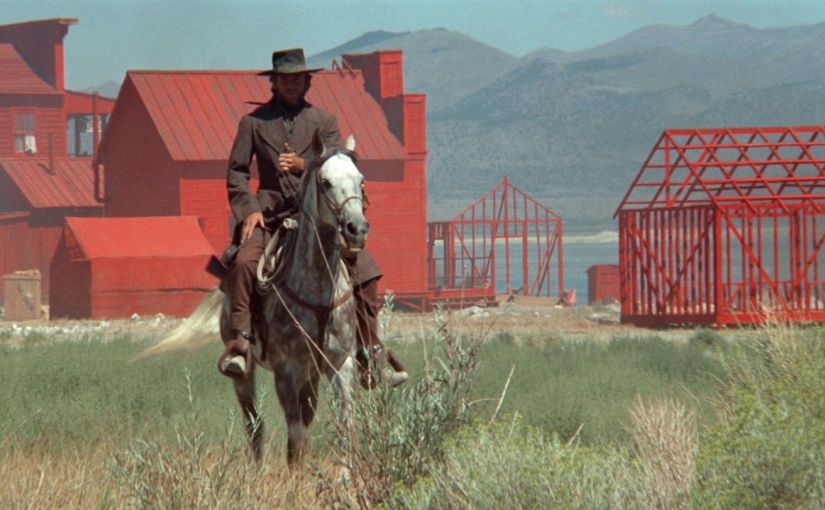
Because Clint Eastwood’s career of acting roles is thematically the strong, silent type, it’s easy to appreciate that in one film he may be The Man With No Name, while in another picture he’s simply The Stranger.  In the second film he directed, High Plains Drifter, he’s an intimidating force riding on horseback into the lakeside town of Lago.  

He may enter the saloon for a beer and a bottle and then cross the street to the barber for a shave and a bath, but you likely do not want to ever involve yourself with him.  He is also horrifically unkind to one of the few women in these parts.  Let’s just say it ain’t no roll in the hay.  This Stranger is a scary dude in a black hat.

The townsmen recognize a convenience in this man’s arrival though.  He’s demonstrated what he is capable of and therefore he appears to be the one qualified to kill three outlaws who were just released from prison with vengeance on their minds as they make a return to Lago.

There’s a hint of supernatural play in High Plains Drifter.  The Stranger recalls a harsh night when the local Marshall had been whipped to death by the townsfolk.  Could the Marshall be the Stranger?  Perhaps.  The victimized Marshall is portrayed by Eastwood’s long time stunt double and occasional director Buddy Van Horn (Pink Cadillac, The Dead Pool).  While that bloody slaughter occurred, the townsfolk simply watched with no offer to help.  For a while, High Plains Drifter was rumored to have been inspired by a real-life rape from the mid-1960s which ultimately led to the need for calling 911 in the event of an emergency.  Art imitates life even in the Old West.

The Stranger agrees to help the town prepare for the outlaws’ violent return, but like a fantasy character he makes special requests of his own including reassigning the sheriff’s badge to the town dwarf, plus taking whatever merchandise he wants from the mercantile and occupying the two best rooms in the hotel.  Also, he gives instructions to load up on a large supply of red paint.  Is the town of Lago getting what they bargained for or are they dwindling into a worse fate? Could be a deal with the devil or as Jewish mysticism might imply, the town of Lago might be inheriting a gollum.

Clint Eastwood salutes his prior directors that prepped him to become an esteemed filmmaker.  Don Siegel’s (Dirty Harry) and Sergio Leone’s (The Dollars spaghetti westerns) names are engraved on tombstones within the nearby cemetery built for the set.  Eastwood adopts some of their famed techniques while not setting himself apart from what those influencers accomplished.  He was still finding his footing behind the camera. High Plains Drifter is just a tale of revenge with recognizable set ups found within typical Hollywood westerns.  

Visually, the film starts out mysteriously with The Stranger’s arrival out of a sun soaked desert boil.  The photography looks deliberately grainy before the modern twenty-first century film restoration appears. Not a word of dialogue is uttered until after the picture has run for over seven minutes.  

Lago becomes a town with a new kind of identity later in the film as mandated by the script.  This is where Eastwood finds opportunity to do things with his western that his earlier pictures had not offered yet.  A bloody, hellish war is expected.

High Plains Drifter traverses in different directions while primarily staying in this one small town and you may wonder what this storyline has to do with that storyline.  Well, the commonality of its various parts is The Stranger’s arrival.  

You’ll may question who this unnamed man truly was by the time film ends.  Maybe it was not a man at all.  There are moments included by Eastwood’s direction to question what precisely occurred.  

Is High Plains Drifter a western or is it a ghost story? Like me, perhaps you’ll uncover moments that support either argument.

THE EXORCIST (1973)

By Marc S. Sanders

Perhaps it is my Jewish upbringing or the fact that I’m not a spiritual person anymore, but what many consider to be the scariest movie of all time really does not alarm me that much.  William Friedkin’s The Exorcist is a superb demonstration in horror though.  Disturbing? Yes.  Unsettling? That’s an understatement.  Scary? A little bit. 

It’s not so much the threat of a random demon or the possibility of Satan on earth that chills me.  It’s this poor, sweet girl who has been unfairly taken advantage of that makes me shudder. 

William Peter Blatty adapted his best-selling novel into his Oscar winning screenplay and it succeeds so well because amidst all of the terror, there’s an education to be had.  Do any of us truly know or have witnessed someone who has been demonically possessed by an entity of pure evil?  I’ll be the first to come clean and say no.  Therefore, I’m intrigued as Friedkin’s film proceeds to observe how the decision to exorcise a demon from the shell of a pre-teen girl arrives.  Nevertheless, to me it is all fantasy.  I might just hold more faith in the Jedi practice of the Force than I do in the ideas of holy water, devilish idols or even what can befall you by flippantly using the name of Christ in vain.

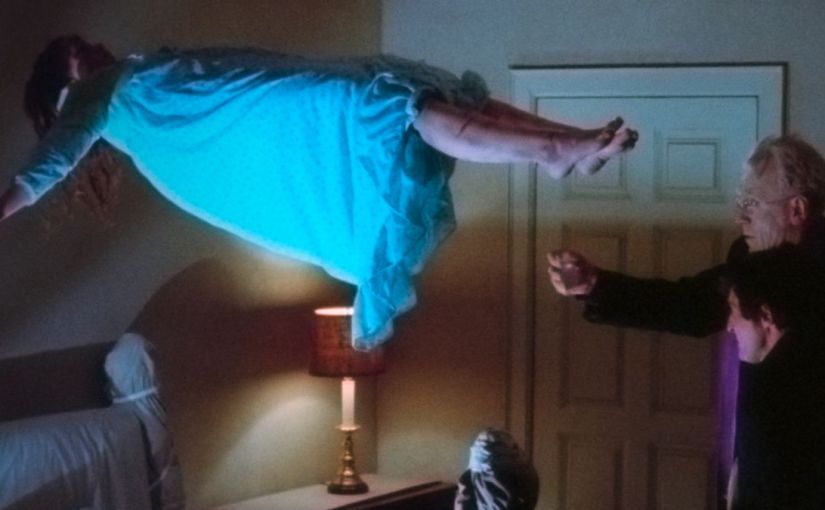
Famous film star Chris MacNeil (Ellen Burstyn) is on location in Georgetown shooting her latest picture.  She resides in a furnished home with her twelve-year-old daughter Regan (Linda Blair), along with an assistant and a butler servant.  Regan is a fun-loving kid and adored by her mom.  Strange behaviors begin happening and all too quickly, the daughter is beyond control with patterns of activity that are anything but recognizable.  I can’t even describe most of the imagery.  I could never do it justice.

Doctors are quick to attribute Regan’s afflictions to a lesion resting on the cerebellum of her brain.  Yet, extreme procedures and x-rays show no medical disruption or disturbances.  I recall Friedkin’s director cut from 2000 inserted the questionable practice of dosing the girl with Prozac.  Before the supernatural is ever considered, the merits of science and medicine must be explored.  

Nevertheless, it is unbelievably bold how this personification puppeteers young Regan with vile actions of vomiting, uttering the ugliest vocabulary and committing terrible bodily harm and atrocities with a crucifix.  Blatty could have drawn the line with the slaps and punches Regan delivers to the doctors and her own mother.  The point would have been clear.  Yet only something that has to be tangibly real with no question of a joke or side humor, has to go this far.  It’s often sickening and demoralizing to the worst degree, but reality never compromises.  The drivers of this fiction wish to move this as far away from what’s not valid. It’s evident how convincing all the footage is within the film.

Following the mysterious death of Chris’ film director, along with an unheard-of recommendation from a physician, the idea of committing an exorcism to release whatever’s possessing the girl is suggested.  The problem is there is no expert on the subject of exorcism.  It seems absurd, and the Catholic Church is never quick to endorse the procession.  

During the first hour of the picture, a second story covers the personal conflict of Father Karras (Jason Miller).  One of his first scenes shows him arriving home to his ailing mother and removing his collar.  It’s a visual sign that the minister is questioning his own faith as he undoes his garb.  Karras may be a priest, but he also specializes in the study of psychology for his parishioners.  As he encounters Regan in her bedroom, he’s gradually assured that he is speaking with the demon who knows too much about himself.

A third story, which actually opens Friedkin’s film, occurs in Iraq where Father Merrin (Max von Sydow) is excavating through an archeological dig.  He doesn’t have much to say but his stoic expression tells us that his discovery of a medallion buried in the rubble, along with particular statue, spell dread.  It’s no accident that Friedkin places this scene often against the backdrop of a sun sparked, blood red sky.  

Eventually, all three stories intersect within the coven of Regan’s upstairs bedroom, where this demon taunts, cackles, teases and defies the power of the Bible and the Catholic faith.  This third act is impossible to take your eyes off.  Every second of imagery builds upon the power of the supernatural from moving furniture that charges forward like monsters on the attack, to ceilings and doors that split open.  The bed rumbles.  Demonic imagery appears out of the cold darkness.  It’s such a well-crafted sequence of events that is completely atmospheric.  

On what I believe is only my second viewing of the film, there are few things I noticed.  Chris is not a religious character.  So, when she evokes frustration, first at her ex-husband over the phone, and then at doctors and priests who lack explanations, she’s apt to shout “For Christ’s sake,” or “Jesus Christ.”  Variations of the word fuck is also adjacent to this dialogue.  Chris’ language could be a close second to the abhorrent verbiage coming from her monstrous daughter.  Blatty and Friedkin seem to imply how the son of God and the potential of Satan are so easily taken for granted.  Chris may be corrupted, but it is the innocent, young Regan who is trifled with.  There is nary a thing more disturbing in film than watching a child in peril.

Friedkin’s direction with Father Karras is consistently interesting as well.  Often, he positions his camera on a ground floor or at least pointed up to a level above to witness Karras’ ascents.  His faith is clearly shaken.  So, all he can do is rise and rise again, closer to a heaven that may still be welcoming.  Karras climbs flights of stairs or walks up sidewalk hills, to approach a vile intruder seeking to disrupt the purity of angelic youth.  

Only after I watched the film did I read that Linda Blair’s unforgettable performance was not the only contributing factor to Regan’s demonic possession.  Oscar winner Mercedes McCambridge who originally was not credited, supplied the scratchy, tormented and taunting voice of the demon.  It’s an unbelievable embodiment of a powerful villain.  Linda Blair was Oscar nominated for this role, but because she did not entirely own the performance, she likely lost to another child actor, Tatum O’Neil (Paper Moon).  The craft of Blair’s makeup all the way to her changes in eyes is a gut punch to the psyche.  Regardless, this is one of the most uncompromising and effective child performances I’ve ever seen in a film.

Max von Sydow donned aging makeup on his youthful forty-four-year-old complexion, and he looks straight out of another famous role from later in his career (Minority Report).  Richard Pryor and Saturday Night Live did a hilarious spoof on The Exorcist and for this nonbeliever I related to Pryor’s antics.  Yet, Max von Sydow takes what could have looked like utter silliness and convinces me that the ritual of exorcism is incredibly trying and exhaustively repetitive accompanied with the robes he dons to the holy scripture he reads from.  Merrin specifically instructs Karras not to directly respond to the demon.  Don’t even talk to it.  Merrin sticks to that practice.  Karras, the younger and less experienced sidekick, is drawn into the monster’s personal jibes.

Despite my position on religion and faith, I do not frown on what others value.  People find solace in their perceptions of God, the biblical stories, and the figures who teach. Religion often bestows a fulfilling life cycle.  Religion offers comforts through pain, loss, love and hope.  That’s okay. Everyone must follow their own path towards salvation. I tend to turn towards my personal psyche which I speak to daily.  

I watched The Exorcist off of a 4K streaming print found on HBO MAX, and the picture is positively striking.  Aside from dated fashions and cars of the early 1970s, the picture looks incredibly modern.  The themes of the film remain strong.  Hardly anything has ever matched the horror of The Exorcist.

I value everything in The Exorcist that Father Karras and Father Merrin heed to.  I believe in this story wholeheartedly.  Friedkin and Blatty, plus the cast enhance the authentication of demonic possession and how it operates.  This work of fiction, which Blatty claims to have been inspired by from an account of possession of a young boy during the 1940s, is a thousand percent genuine.  Within the moment and inside the confines of this picture this demon lives by overtaking young Regan.

How much did I believe it? Before bed last night, I made sure my little night light was on and I never walked into a dark room.   Every single light in the whole house was practically turned on.  

It’s not about the fear of God or the Devil.  It’s the fear I had for young Regan.

A WOMAN UNDER THE INFLUENCE (1973)

by Miguel E. Rodriguez

DIRECTOR: John Cassavetes
CAST: Peter Falk, Gena Rowlands, Fred Draper, Matthew Laborteaux (for all you Little House fans out there)
MY RATING: 9/10
ROTTEN TOMATOMETER: 89% Fresh

PLOT: Domestic turmoil gets a whole new definition in director John Cassavetes’ landmark portrait of a family in psychological free-fall.


I am a newcomer to the films of John Cassavetes.  The only one of his films I’d seen prior to A Woman Under the Influence is Love Streams (1984), a character study of a woman, played by Gena Rowlands, whose determination to only be herself puts her in conflict with the people and expectations around her.  As a director, Cassavetes seemed only to be interested in putting real people on the screen.  I don’t mean that other great films don’t do that kind of thing, but few directors have made films with scenes so genuine that I had to fight the urge to cough and look away because I felt like I was intruding on a private conversation.

A Woman Under the Influence is about a woman, Mabel Longhetti, a mother of three, who is similar to the woman in Love Streams in that she is constantly waging a battle between how she wants to behave and what is expected of her.  The difference this time is that Mabel is clearly suffering from…well, I’m not going to embarrass myself by putting a name to it because I’m not a psychiatrist.  She seems to be overly anxious all the time.  ALL.  THE.  TIME.  Her husband, Nick (Peter Falk), appears to be sympathetic with her anxiety, almost to a fault sometimes, but he tends to explode at her when she tries to be the life of the party.

How has this relationship lasted through three children?  Nick promises Mabel a romantic night at home, but is unexpectedly called away when a city water line bursts.  (He works in construction.)  She assures him everything’s fine on the phone…and promptly walks out of the house, goes to the nearest bar, and picks up a random dude and brings him home to spend the night.  But hey, Nick’s no angel, either.  After a long shift at work, he impulsively invites his entire crew of roughneck buddies to his modest home for a spaghetti dinner…cooked by Mabel, of course.  Mabel anxiously tries to “act normal” by being friendly and chummy with Nick’s co-workers, but she overdoes it, and Nick blows up at her.

Later, there is a remarkable scene where Nick brings a doctor to the house to see if he can talk Mabel down from one of her episodes.  Gena Rowlands adds these brilliant physical tics and peculiarities to Mabel that, in someone else’s hands, would be showboating, but with Rowlands, they come off as so real that it felt like I was watching a documentary.  I read on IMDb that Cassavetes did very little rehearsing, if any at all, so a lot of what we see in this scene and elsewhere was improvised on the spot.  It’s one of the best performances I’ve ever seen.  Had it not been for One Flew Over the Cuckoo’s Nest (1975), Rowlands would have walked away with the Oscar.

A Woman Under the Influence was one of the first movies to really make waves as a truly independent production, predating the modern indie movement by some fifteen years or so.  Is it a movie I enjoyed watching?  Yes, but not in the same way that I enjoy watching The Goonies or Avatar.  This was like watching There Will Be Blood or Sophie’s Choice.  It’s an amazing example of acting as a craft, as an art form.  Not a single scene felt scripted or contrived.  I never knew Peter Falk had this kind of range as an actor.  I’d heard that Gena Rowland’s performance was the stuff of legend, and now I understand the hype.  If I have to be honest, I didn’t care for the very end of the film, a scene that seems to indicate that nothing will keep Mabel and Nick apart, even though they are not good for each other, in my opinion, especially considering what happens in the scene immediately preceding it.

This is a shorter review than I might normally write, but words are failing me with this one.  I’ll start describing one scene, then another, then another, and soon I’ve just recapped the entire film, which I don’t want to do.  This movie is searing, uncompromising, authentic.  To do it justice, I’d have to go away for a month or two and write an old-fashioned research paper (remember those?) complete with outlines, bullet points, and a bibliography.  Whatever you may have heard about Gena Rowland’s performance is 100% true, and then some.  In an earlier review of Peter Hall’s The Homecoming (also 1973), I mentioned that I did not have a lot of space in my head for blistering dramas about dysfunctional families, but I’m glad I made room for A Woman Under the Influence.  It’s a master-class of direction and performance.

THE HOMECOMING (Great Britain, 1973)

by Miguel E. Rodriguez

DIRECTOR: Peter Hall
CAST: Paul Rogers, Ian Holm, Cyril Cusack, Viven Merchant
MY RATING: 7/10
ROTTEN TOMATOMETER: 86% Fresh

PLOT: After a nine-year absence, a philosophy professor visits his psychologically dysfunctional family in London to introduce them to his wife.  Let the mind games begin.

[WARNING: This review contains mild spoilers. …not that a ton of people will run out to find this movie right away, but still…just in case…mild spoilers.]


There have been countless movies about dysfunctional families through the ages, so many that I won’t bother listing any.  I haven’t watched them all because there is only so much psychic room in my mind for movies about mean people being mean to each other for the sake of being mean.  There are exceptions to the rule, as always, but that is my general feeling on the matter.  Peter Hall’s The Homecoming, based on a blistering play by Harold Pinter, has an ending that I’m still trying to sort out, and which I felt left me hanging, but I think I may see what Pinter was reaching for, and in order to suss all that out, it will be necessary for me to discuss specifics of that ending.  So, be warned.

In the tradition of Arthur Miller, Edward Albee, and Tennessee Willaims, Pinter’s The Homecoming is a portrait of several unlikable people who are thrown together due to an accident of birth.  Based on the movie, it is unlikely any of them would cross the street to piss on any of the others if they were on fire.  Max (Paul Rogers) is the patriarch, a mean, abusive little man who spews never-ending insults at whomever is in range.  He is a widower with three sons: Lenny (Ian Holm), Joey, and Teddy.  Lenny and Joey are grown but still live at home.  Joey is an aspiring boxer, and Lenny…well, we never quite get to know what Lenny does for money, although it is hinted towards the end that he is involved in some less-than-savory enterprises.  Teddy, miraculously, has made good as a professor of philosophy in the United States, but he hasn’t been home in nine years.

There is also Max’s brother, Sam (Cyril Cusack), a tall, effete man with a high, reedy voice that would probably be comic in different circumstances.  Sam absorbs Max’s tirades with the kind of unruffled calm that only comes after years of experience.  Together, they form one of the most unpleasant family units since Jaime and Cersei in Game of Thrones.  Here’s one of Max’s more pleasant descriptions of his sons: “Look what I’m lumbered with.  One cast-iron bunch of crap after another.  One flow of stinking pus after another.”  How is this guy still single.

One night, they’re surprised by the return of Teddy, the philosophy professor, with his wife, Ruth (Vivien Merchant) in tow.  It’s indicative of Teddy’s relationship with his family that none of them knew he had been married for nine years…with three sons of his own.  After some quote-unquote pleasantries, everyone goes to bed except Ruth and Lenny.  Lenny has the balls to slyly put some moves on her in a weird-ass game of cat and mouse, as if he’s probing her for weaknesses, looking for the best place to stick the knife in.  Ruth is passive at first, but shows a spark of strength before everyone calls it a night.  But the next day…that’s when the feces really hits the fan.

The Homecoming is a great example of a “slow burn” film, the kind of movie that takes its sweet time getting around to its prime directive because it only makes sense because of everything that came before, like Atonement [2007] or Incendies [2010].  We are shown so much of Max’s vitriolic harangues because we have to see how momentous it is when his brother or Ruth finally respond in a meaningful way.  We are shown so little of what Ruth is capable of at the beginning because it is that much more shocking when she proves herself even more adept at psychological warfare than anyone else in the house, including her husband.

But what is the point of all this?  In a movie like In the Company of Men [1997], for example, we spend so much time in the presence of sociopathic monsters so that, at the end, one of them can be shown the error of his ways in an immensely satisfying conclusion.  But, in The Homecoming, we don’t really get that kind of wallop in the face at the end.  Granted, Ruth displays her tenacity in a satisfying manner, putting each and every man in the house in their place in one way or another (some ways more surprising than others), but when that final shot faded to black, I was like, “That’s IT?”

What is Pinter getting at?  Is he demonstrating that, no matter how bad you may think your family is, it could always be worse?  Did he perhaps exorcise some demons in his own past by committing these flawed individuals to paper?  The film is based on a play, but the acting style throughout is very stilted, for lack of a better word.  The only character who displays something vibrant on the screen is Max, but his vibrancy is only defined by his cruelty.  Everyone else (with the possible exception of Ian Holm as Lenny) sounds almost as if they’re reciting their lines at the first read-through of the rehearsal period.  Cyril Cusack gets some jabs in as Sam, but they’re very few and far between.  Why does the meanest character have the strongest voice, at least until the final sequence?

It might be easy to explain it as a Whiplash [2014] thing, where great things can only be accomplished after even greater trials and tribulations.  You can’t appreciate the light unless you’ve spent some time in the dark, et cetera.  As a movie-watching experience, I must honestly report that my patience was starting to wear thin until we finally got to the second act of the film.  I would have enjoyed more color and flair from the other actors.  However, that might have ruined the effect the filmmakers were going for, so I’m of two minds.  It explains my only slightly-above-average rating.  If the entire movie moved and sparkled like its second half, I may have gone a little higher.

It’s also worth mentioning that this film only exists because of a filmmaking project spearheaded by producer Ely Landau whereby fans of stage drama would purchase a subscription to a “season” of films that would be shown simultaneously at 500 movie theaters across America, sort of like what Fathom Events does today.  These were filmed adaptations of stage plays, not a record of a staged production, and 100% faithful to the original scripts.  Notable films in this experiment included The Homecoming, Eugene O’Neill’s The Iceman Cometh [1973, dir. John Frankenheimer], Ionesco’s Rhinoceros [1973, dir. Tom O’Horgan], and Albee’s A Delicate Balance [1973, dir. Tony Richardson and starring Katharine Hepburn and Paul Scofield <!!!>].  American Film Theatre only lasted two seasons, but if you’re a fan of faithful cinematic adaptations of stage plays, these are going to be worth the search on streaming or home video.

The Homecoming is ultimately a rewarding watch, for the performances from Paul Rogers and Ian Holm, if for nothing else.  (Vivien Merchant is appropriately cool, but again, you have to wait for near the end of the film to see her really shine.)  It’s an interesting record of a moment in film history when a group of people had a radical idea and the money to fund it.  And, it must be said, it’s an excellent way to remind yourself that, however bad your family is, it can always be worse.  MUCH worse.

THE LONG GOODBYE (1973)

by Miguel E. Rodriguez

DIRECTOR: Robert Altman
CAST: Elliott Gould, Nina van Pallandt, Sterling Hayden, Henry Gibson
MY RATING: 9/10
ROTTEN TOMATOMETER: 95% Certified Fresh

PLOT: Private eye Philip Marlowe does a favor for a good friend, and as a result he loses his cat, spends three days in jail, and incurs the wrath of a mobster looking for his missing $355,000.


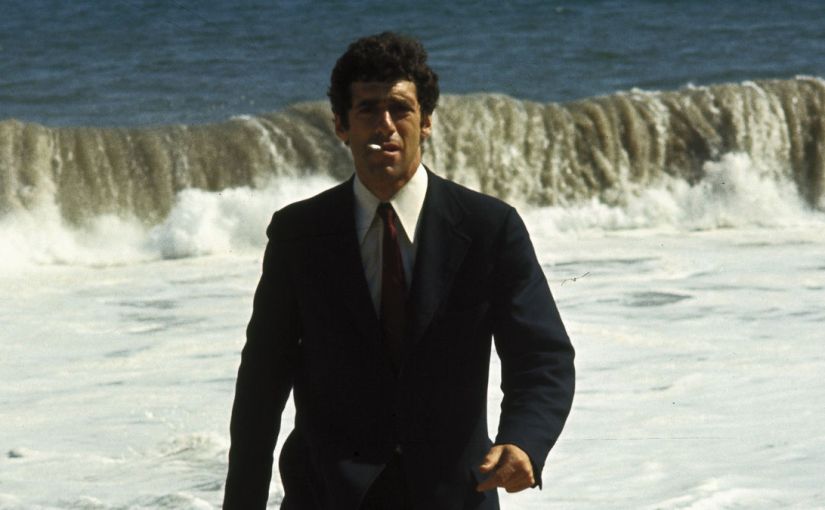
Elliot Gould’s version of Philip Marlowe is a far cry from Humphrey Bogart’s classic interpretation in The Big Sleep [1946], and I’m okay with that.  Who wants to see any actor, no matter how talented, try to follow in Bogey’s footsteps?  Gould resembles no one so much as Walter Matthau as he shambles from one fine mess to another, cracking wise to cops and hoodlums alike, smoking cigarettes like there was no tomorrow, and bemoaning the loss of his cat (played by the original Morris the Cat…no, seriously).

I mention all that because, apparently, there were (and maybe still are) Raymond Chandler fans who were none too pleased with Robert Altman’s film The Long Goodbye when it was released, as Gould did not fit the image they had in their mind of one of fiction’s greatest hard-boiled detectives.  In my opinion, it just doesn’t matter.  Bogey is Bogey and Gould is Gould and, as Marlowe himself repeats throughout the movie, “It’s okay with me.”  Just had to get that out of the way.

The Long Goodbye is one of the finest private eye flicks I’ve ever seen.  With Robert Altman’s trademark style and wit, we first encounter Philip Marlowe as he wakes up in the dead of night to feed his cat.  Much has been made of this opening scene, as the filmmakers apparently intended it to be a metaphor for the Marlowe character being transposed from the ‘50s to the early ‘70s, like a “Rip van Marlowe” suddenly having to deal with a new world after being asleep for 20 years.  I get it, but the movie plays just as well without that kind of metaphysical layering.

Next thing you know, Marlowe’s best bud, Terry Lennox, shows up at his door with bruised knuckles, scratches on his face, and a sudden desire to visit Tijuana, Mexico…indefinitely.  Marlowe does what any friend would do: drives his buddy to Mexico and drops him off at the border.  But when he gets back to his apartment, the cops are already there, interrogate him, and bust him on a phony charge until he tells them where Lennox is.  Three days later, Marlowe is released because Lennox has turned up dead, with a suicide note and a confession to murdering his wife at his bedside.

That’s just the setup.  Next thing you know, he’s hired by a ritzy dame, Eileen Wade (Nina van Pallandt), to find her drunkard husband, famous author Roger Wade (the always dependable Sterling Hayden), who apparently has a nasty habit of taking his drunken frustrations out on Eileen’s face.  That leads to an encounter with a mean little mobster named Marty Augustine (director Mark Rydell) who makes Roger Wade look like Tiny Tim.  HE wants to know where his $355,000 is, that TERRY was supposed to deliver to him in Mexico.  Are these three plot threads connected?  Is the sky blue?

Even if the mystery plot of The Long Goodbye weren’t meticulously plotted and virtually airtight, the movie would still be a pleasure to watch and listen to because, hey, it’s a Robert Altman movie.  I’ve only seen one movie of his that I HAVEN’T liked so far, but I’m reluctant to say what it is for fear I’ll get a deluge of comments about how wrong I am.  Anyway, Altman’s style is in full force in this movie: overlapping dialogue, the occasional cameo (David Carradine as a cellmate, and a certain Austrian bodybuilder as one of the mobster’s muscle men), and characters who never, ever look like they’re acting.

Altman frames his actors and directs them almost as if he’s shooting a documentary, although there are very few (if any?) hand-held shots, so you can tell that there was a method to the…well, not madness, but spontaneity.  Watching them deliver their lines is like watching the scene play out through a keyhole, or like we’re watching them on a hidden camera.  There’s a voyeuristic feel to the whole movie that, while it lacks a certain polish, is nevertheless compelling and absorbing.  I wanted to know what happened next, not because the mystery still hadn’t been solved, but because I simply wanted to see what these characters were going to do or say.  This is a vibe that I don’t even REALLY get, at least not to this degree, in some of Altman’s later films, like The Player [1992] or Short Cuts [1993].  There is something about the synergy between Gould, Altman, and the Marlowe character that struck a chord in me, and I was just happy to be along for the ride.

Naturally, I wouldn’t dream of revealing any of the secrets to the mystery of Terry Lennox and the mobster and the author’s wife.  But I do want to mention one specific scene, between Marty Augustine and his beautiful mistress.  To say that the payoff of this scene was a jolting is a vast understatement.  I can’t even say what other films it reminded me of, but it’s safe to say that it took me completely by surprise.  You’ll know what I mean when you see it.  (And how about that ending!?  Altman had a clause written into his contract specifically stating the ending of the film could NOT be changed by studio interference or whatever…and thank God he did.)

Based on the movie posters for The Long Goodbye, I had always assumed this was Altman’s stab at madcap, screwball comedy.  I could not have been further from the truth.  This is a great film noir, or I guess neo-noir, that does its best (and mostly succeeds) to capture on screen the grittiness and fatalism of only the best dime store detective novels, as well as some of the more highbrow entries in the genre.  Only Altman could have made a movie specifically like this, in this way, and only Gould could have captured that precise mix of “here we go again” and “I’m smarter than you and we both know it”.  I wouldn’t call it a forgotten film, but it’s worth digging up if you’ve never seen it.

THE FRIENDS OF EDDIE COYLE (1973)

by Miguel E. Rodriguez

DIRECTOR: Peter Yates
CAST: Robert Mitchum, Peter Boyle, Richard Jordan, Steven Keats, Alex Rocco
MY RATING: 9/10
ROTTEN TOMATOMETER: 98% Certified Fresh

PLOT: After his most recent arrest has him looking at a long prison sentence for repeat offenses, an aging Boston gangster must decide whether or not to snitch on his friends to avoid jail time.


When scrolling through movie titles online or on your favorite streaming service, you might be forgiven for thinking that a 1973 movie with a title like The Friends of Eddie Coyle is a dialogue-driven character study by John Sayles or John Schlesinger, about a group of friends gathered at a hunting cottage or a class reunion or something.  Imagine my surprise when I watched it, and it turned out to be a nearly-forgotten gem of early ‘70s crime films.  (I’d call it a neo-noir, but it was released over fifty years ago now, so I’m not sure the term “neo” applies anymore.)  Featuring spare, economical storytelling reminiscent of other crime classics like Rififi [1955] or The Killing [1956], The Friends of Eddie Coyle is indeed a character study, but one that manages to downplay even Robert Mitchum’s heroic persona.

Eddie Coyle is getting old, and he knows it.  He’s currently facing up to 5 years in jail when he goes in front of a judge in a few days, but his old associates still rely on him to obtain “clean” firearms to use in pulling bank robberies.  The first time we see him doing this thankless job, he tells his cocky young supplier a story about why he has extra knuckles on his left hand, a speech that might have been written by a multiverse version of Quentin Tarantino.  (In fact, the bank robberies are accomplished when Eddie’s friends hold the bank manager’s family members hostage, so he’ll open the vault without question, a method paraphrased by “Pumpkin” in the opening scene of Pulp Fiction.)  Mitchum delivers this mini-logue with his trademark brand of world-weariness and menace, leading us to believe at the outset that he’s a man not to be trifled with, when in fact he’s little more than a glorified gofer for his bosses.

The film oozes a 1970’s atmosphere in every frame, but somehow it doesn’t feel all that dated.  There are no long zooms or extended chase sequences.  The most suspenseful scenes are the two bank robberies and one aborted car chase that is over as soon as it starts.  (I actually thought that was pretty clever, subverting our expectations by ending the chase after about fifteen seconds; this method was also put to good use in 2003’s not-as-bad-as-you-think S.W.A.T.)  The dialogue feels more modern, laced with f-words and racial epithets that, again, feel more at home in a Q.T. film than in a Robert Mitchum movie.  For my money, there may be a few movie-watching experiences that can top hearing Robert Mitchum telling someone to go f— himself, but I can’t think of what they are right now.

Director Peter Yates (Bullitt, Breaking Away) never once strains for effect, never showboats.  Like John Huston’s The Asphalt Jungle, it is content to merely set the stage and observe what happens, letting the events and the characters drive the plot instead of contrived action scenes or fancy camera movements.  Instead of becoming bored, I was drawn into Eddie’s dilemma, his conflict between loyalty to his so-called friends and his desire to stay out of prison.  Complicating matters is the fact he has a wife and three school-age kids; they all live in a tiny townhouse where you can touch both walls of the kitchen with your arms outstretched.  This is a wrinkle uncommon in most gangster films, where the heavies lead unattached lives.

When Eddie approaches a federal agent (Richard Jordan) and asks if the New Hampshire judge will look favorably on Eddie’s sentencing if he agrees to squeal on his gunrunner friend, I felt a little sorry for him, and that’s a neat trick.  Because of Mitchum’s presence, you almost automatically want to root for him to do the right thing, but because of the character he’s playing so well, I just got the feeling that things were not going to end well for him, and I was right.  After getting a taste of what Eddie has to offer in terms of high-profile arrests, the federal agent leaves him dangling, telling him the judge will keep him out of jail if he keeps ratting on his buddies.  Poor Eddie is in an impossible situation, and the irony is, when he finally makes his decision, it’s already too late…but I don’t want to spoil anything.  It’s a brilliant catch-22 that left me feeling even sorrier for Eddie than I did before.

The whole movie is like that.  We’re shown right up front that Eddie is a criminal.  But the hands-off filmmaking approach allows the viewer to make up his own mind.  You could, I suppose, watch this movie in one of two mindsets: either you empathize right away with Eddie and his predicament, or you can take him at face value and watch the movie waiting to see if he gets what’s coming to him, both for being a crook AND for squealing on his friends.  Either way, I think the movie’s resolution satisfies both interpretations, which is not an easy task.

If you sit down to watch The Friends of Eddie Coyle, just remember that it’s not The French Connection or Heat or anything splashy or flashy.  It’s a grim, gritty crime drama with a bona fide legend playing a petty thug instead of a crime lord.  Mitchum fits the bill, and the movie fits Mitchum.  The Boston environments – all shot 100% on location – mirror the way Eddie walks and talks: gray, blank, tired.  Beneath that grimy coating, though, is a rather brilliant character study of a man whose life has brought him to a crossroads where he must decide what’s more important to him, his friends or his life.  (His decision kinda surprised me, I’ll be honest.)

MAGNUM FORCE

By Marc S. Sanders

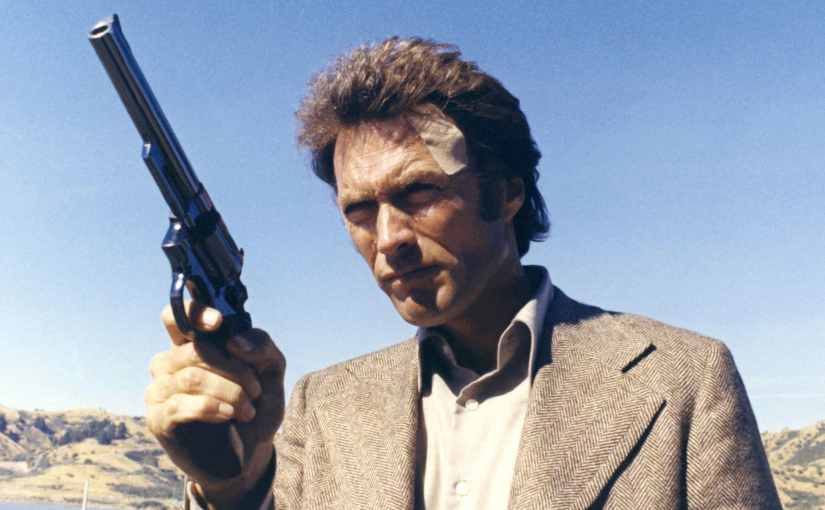
If you don’t know by now, I’m a huge admirer of Clint Eastwood’s work. His talents broach so many facets.  He acts.  He produces. He’s likely even better when he’s in the director’s chair.  He actually sings and he has even orchestrated his own music for some of his films.  Ever since I was first introduced to him at a young age when he played Dirty Harry Callahan and Fido Beddo, partnered with Clyde the orangutan, I was fascinated by his coolness and confidence in his stature on screen.  Whether he’s raising a fist, donning a scowl, giving a smirk or a squint of his narrow eyes or using his most famous prop, a .44 Magnum handgun, as an extension of his right arm, I’ve always been magnetically drawn to what he does on screen.

Online, a common question is asked: What is your favorite Clint Eastwood movie?  If I have to choose one, I guess it would have to be Magnum Force, the follow up to Dirty Harry.  Yet, I always believed Magnum Force could not operate without hitching on to the impact and message from Dirty Harry.  I can’t just like The Godfather Part II without liking the first film.  I can’t just love The Empire Strikes Back without liking its box office predecessor.  Same goes for The Lord Of The Rings pictures.

Magnum Force works so well because it questions what celebrated the Harry Callahan character that Eastwood portrayed two years prior.  This is a San Fransisco cop who defies authority when he knows that a danger must be suppressed without the inconvenience of bureaucratic red tape and police procedurals that ultimately will work in the criminals’ favor if not taken care of immediately.  As the first film demonstrated, it is easy for us to side with Harry’s desperation because we know the crazed killer is on the loose and he is only going to kill again and again while never surrendering or negotiating.  This second follow up film (in a series of five) tests the ideology of Eastwood’s character. 

A series of grisly murders are occurring within the city and it appears that a traffic cop is committing the acts.  The victims are the worst mobsters and pimps within San Fransisco who time and again have been overlooked for their crimes and/or have been released from trial or prisons based on technicalities.  A handful of characters within Magnum Force remind us that someone is saving the taxpayers a lot of money each time the body count increases. 

There’s a slight mystery to this film.  Harry encounters four rookie cops (David Soul, Robert Urich, Kip Niven and Tim Matheson) who seem very likable.  They are admirable of Harry’s reputation.  Harry is impressed by their shooting skills in particular.  Another traffic cop is an old friend of Harry’s, a guy named Charlie McCoy (Mitchell Ryan) who is on the edge and might pose a threat if he continues working the streets.  Any of these men could be suspects to these vigilante murders as it is soon realized that the scene of some of these crimes are similar. Often, cars are pulled over for traffic violations.  As well, ballistics indicate that the weapons of choice are normally a .357 Magnum, the standard issued firearm for a police officer.

The debate with Harry’s philosophy, firmly established in the prior film, is staged against that of his superior, Lt. Briggs.  He’s played by Hal Holbrook who is one of the best antagonists in all of Eastwood’s films.  They play so well against one another.  Early on, Briggs declares he’s never once had to pull his gun out of his holster.  Callahan sarcastically salutes the lieutenant by reminding him that men have got to know their limitations and that’s where the measure of asking what is ultimately necessary in fighting crime.  Where does it begin and when does it end?

Harry Callahan is that unusual cop who is frowned upon for the actions he takes in his own hands.  Other cops in movies played by Stallone or Gibson go to extreme measures simply for the cinematic action of it all.  Callahan is never thanked or given any serious commendations for what he executes with his .44 Magnum, a weapon that is as outside the lines as Harry himself. 

The difference between Harry and whoever this vigilante is must be deciphered and much of Magnum Force’s grey area is all that is seen.  Eventually, the black vs white clarity reveals itself and a telling lesson presents itself between what Harry Callahan stands for and what guise a vigilante operates under.  At the risk of revealing too much, the best scene of the picture occurs between Holbrook and Eastwood’s characters as they sum up the entirety of the film before the climax.  This film is over fifty years old and still the assortment of mindsets found within Magnum Force are worth pondering. Callahan is put to the test one time before in a haunting parking garage.

Beyond what’s worth considering among these many dangerous philosophies, this is a solid action picture with thrilling and well edited shoot outs among the cops and robbers.  A hilarious plane hijacking is derailed by Harry when he poses as a pilot.  Later there’s a store robbery that is undone and then there is a warehouse port exchange of gunfire that puts Harry and his partner in unexpected danger. 

There is an interesting target competition between the cops that implies what Harry suspects.  I like this scene in particular because it gives an inside look into how police officers interact and admire one another when not on the streets.  Yet, when one particular cop cannot get a thought out of his mind, it carries over into the action of the moment.  At the combat range, Harry fires his gun at one particular target that may cause you to sit up in your chair a little.  Often, Eastwood performs with little to no dialogue in his films and this is one very informative moment.

As much as I’m a big fan of Magnum Force, the penultimate scene always sticks in my craw a little.  Callahan is pursued on foot within the bulk of a freighter.  There is very little light provided in this sequence as Harry moves down one corridor or around a corner elsewhere.  It’s hard to see what is happening and who is where or who I am looking at.  For such a thrilling movie, this is a bit of a letdown as overall much of the action of this movie is driven by the plot.  Nothing feels random in Magnum Force.  Everything moves towards more story development or realizations.  Yet, I have to be somewhat forgiving only because this darkened scene occurs after all of the cards are put on the table and all the hero has to do is survive.

Just before the foot chase, there is a thrilling car chase with Eastwood actually doing the driving that takes us through the well-known twists of Lombard Street.  Director Ted Post wisely covers this from an overhead shot.   The car careens up and down the steep slopes of San Fransisco’s avenues and there are plenty of intense close ups of Eastwood behind the wheel accompanied by the screeching tires, bullets bouncing off the windshield and motors humming.  I have declared it before, the best place to have a car chase is in San Fransisco.  Surprisingly, this pursuit hardly ever gets categorized with the great ones like Bullitt, The French Connection, Ronin or The Seven Ups.

If you have never seen Magnum Force, check it out.  It is off color at times, but the exploits of Harry Callahan and the scum he’s forced to associate with were never about political correctness.  Still, there is much to debate, argue, and lend some serious thought to, especially in a newly unsteady climate of police acceptance and procedure.  My one recommendation though is to watch it as a double feature with the original Dirty Harry to truly see the two sides of Harry Callahan’s coin. 

NOTE: An interesting fact I just realized at the end of Dirty Harry, the cop shoots the bad guy with his right hand.  Later, he tosses his badge, but with his left hand.  Especially with Magnum Force as a follow up film, I see the internal struggle of Harry Callahan pitting his gun up against the mindsets that come with his badge.

DON’T LOOK NOW (United Kingdom, 1973)

by Miguel E. Rodriguez

DIRECTOR: Nicolas Roeg
CAST: Julie Christie, Donald Sutherland, Hilary Mason, Clelia Matania
MY RATING: 8/10
ROTTEN TOMATOMETER: 94% Certified Fresh

PLOT: In Venice, a married couple grieving the recent death of their young daughter encounter two elderly sisters, one of whom is psychic and brings a warning from beyond.


I’ve only seen two films from director Nicolas Roeg.  The first was Walkabout, which I’ve now seen three times in an effort to “get” it.  While I admire Walkabout’s visual strategy, that film has always left me cold and frustrated, and I do not imagine that will ever change.

However, Don’t Look Now, Roeg’s adaptation of a Daphne Du Maurier short story, is about as expertly made as any supernatural thriller could be.  While the story may feel a little thin when all is said and done, this is yet another case of a movie not being what it’s about, but how it’s about it.  The entire film utilizes an editing and cinematographic strategy to convey an aura of dreamy dread and paranoia.  Of course, the performances from the two leads, Julie Christie and Donald Sutherland, are exceptional, but the direction, editing, and cinematography are really what make Don’t Look Now so disturbing and compelling.

Christie and Sutherland play married couple Laura and John Baxter who are grieving the death of their daughter, Christine, who drowned in the pond behind their cottage.  The scene of her death which opens the film showcases the visual and editing strategy that will come into play so heavily later in the film.

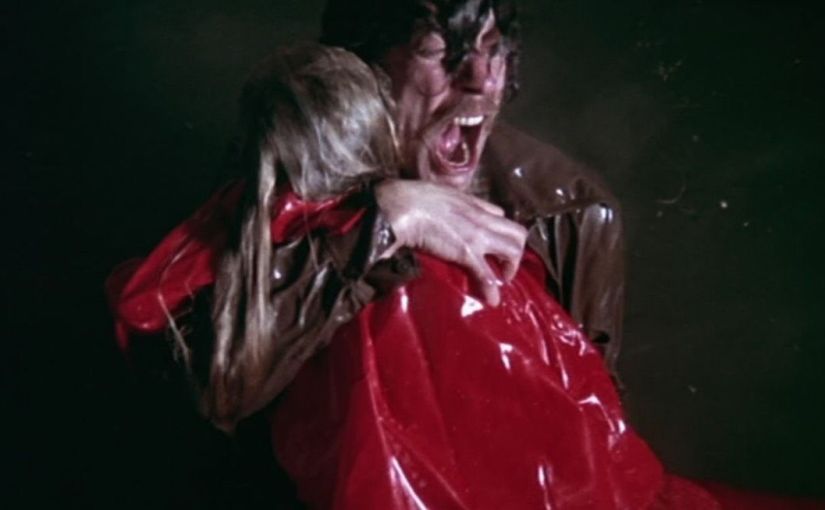
They relocate to Venice, leaving their other child, a son, behind in England in a boarding school.  In Venice, John works on restoring an old church while Laura…well, it’s not clear what Laura does to pass the time in Venice.  One day she bumps into two old women in a café restroom, one of whom is a blind psychic.  The psychic abruptly tells Laura that she’s seen Christine, happy and laughing, and wearing the red raincoat in which she drowned, information the psychic could not possibly have known beforehand.

Later, as John wanders the Venetian streets at night, he gets a brief glimpse of a small figure darting among the buildings ahead…wearing a red raincoat.  When Laura visits the psychic again, the psychic warns Laura that she and her husband are in danger and must leave Venice as soon as possible.  Meanwhile, a body is discovered in the canal near their hotel…

Because the film’s effectiveness relies so heavily on its visual style and editing, I’m finding it difficult how to convey how strongly I recommend searching this movie out, while simultaneously acknowledging the story itself is not as “meaty” as, say, a thriller from David Fincher or Alfred Hitchcock.  I was actually reminded more of the films of Brian De Palma and David Lynch, two directors whose visual and storytelling styles were clearly influenced in one way or another by Don’t Look Now, which was itself clearly influenced by the early films of Dario Argento (The Bird with the Crystal Plumage, Suspiria), though without quite so much bloodshed.

Making a movie like this is tricky.  Use too much cross-cutting and non-sequitur edits, and you risk simply confusing the audience.  One plot point involves John putting Laura on a plane back to England, but hours later he clearly sees her on a funereal gondola in Venice.  Convinced the two elderly women are somehow behind it, he tracks down their apartment, only to find it abandoned.  Quick cut to the sisters in another hotel somewhere…laughing.  Are they involved in some kind of sinister plot?  Or is he having a breakdown?  Is this the director just yanking the audience’s chain simply because he can?  One could make the argument, but the process and style of the storytelling kept me intrigued rather than confused.

All sorts of small details become ominous.  A single glove abandoned on a windowsill.  A child’s plastic baby doll left on the steps leading down to a canal.  Old family portraits on a table.  The lingering glance of a stranger in a police station or a café.  In one scene, John visits the police, convinced the two sisters have kidnapped his wife.  IMDb trivia reveals that the Italian actor playing the captain had no knowledge whatsoever of the English language, so he simply read the lines phonetically without understanding what any of it meant.  As a result, his dialogue with John sounds oddly stilted and detached, almost menacing.  Is he part of some kind of conspiracy?  During their conversation, he actually sees the two sisters walking outside his window but fails to mention this fact to John.  Is he in on the conspiracy?  Or does he simply not recognize the two women?

After a few more plot developments and a couple more sightings of the small figure in the red raincoat in the distance and the discovery of yet another murder victim, everything finally gets wrapped up in a way that I found satisfying even though it didn’t exactly bring the kind of closure I was hoping for.  However, it does bring all the story threads together, including the possibility that John himself might be psychic without realizing it.  Don’t Look Now doesn’t pack quite the punch of Psycho or Mulholland Drive, but it is exquisitely well-made, well-acted, and well-directed.  Watch closely, and you can see how many other filmmakers have been influenced by this movie decades later.

ENTER THE DRAGON (Hong Kong, 1973)

by Miguel E. Rodriguez

DIRECTOR: Robert Clouse
CAST: Bruce Lee, John Saxon, Jim Kelly
MY RATING: 8/10
ROTTEN TOMATOMETER: 95% Certified Fresh
Everyone’s a Critic Category: “Watch a ‘B’ Movie”

PLOT: A Shaolin martial artist travels to an island fortress to spy on an opium lord under the guise of attending a fighting tournament.


I have just finished watching the quintessential ‘70s chop-socky kung fu flick, Enter the Dragon, Bruce Lee’s fitting, if all-too-early, swan song.  I now sit in front of my computer terminal and try to figure out how to review this movie that screams low-budget, from its liberal use of zoom shots and slow-motion, to the gloriously cheesy score from Lalo Schifrin, interspersed with kung fu yells during the opening credits, to the cookie-cutter nature of the bare-bones screenplay.

I sit.  I ponder.  By any “serious” metric of film criticism, this is not a “good” film.  Sure, it was probably groundbreaking for its time, but in the years since its release, other movies have trumped it on many levels.  I’ve seen movies with WAY more kung fu action (Drunken Master II, Kung Fu Hustle), movies with way higher production values (Crouching Tiger, Hidden Dragon, Big Trouble in Little China), and movies with way better screenplays (Everything Everywhere All at Once, Kill Bill).

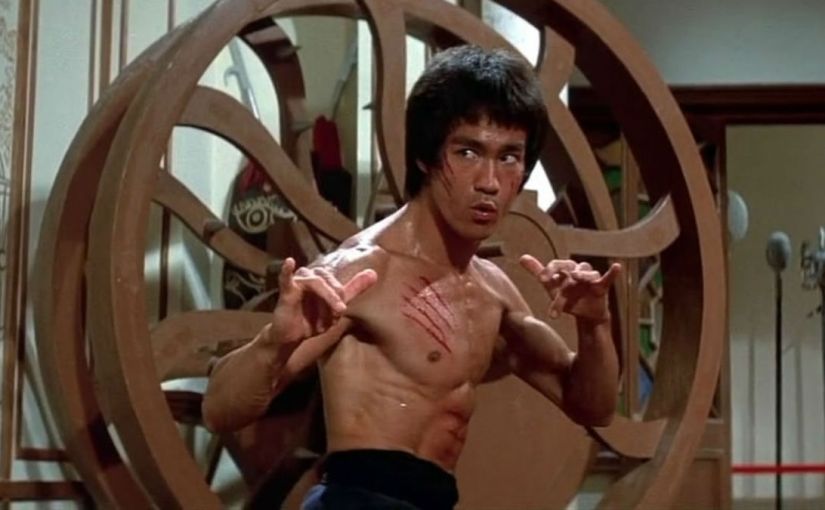
But Enter the Dragon has one thing those other movies don’t: the sheer charisma and magnetism of the master, Bruce Lee.  In every scene he’s in, Lee’s eyes always seem to be working, working, working, whether he’s having a conversation with a British official or defeating an opponent twice his size in a kung fu tournament.  His intensity radiates off the screen.  In one scene, he instructs a young pupil in short, clipped tones, exhibiting nothing but concentration and admonition.  Then later he wins a bet on an unusual animal fight – praying mantises – and check out his cocky smirk as he reaches out for his winnings.  He may not be subtle, but who cares.  He’s Bruce freaking Lee.

He is the single “x-factor” that elevates Enter the Dragon into the pantheon of hallowed action films.  If it had been made with another actor in the lead, it would have been forgotten a long time ago, the second half of a double bill for all eternity.  The story is decent enough, although it feels cribbed from more than one Bond movie, or maybe all of them at once.  The screenplay is…well, let’s say it doesn’t give its characters very good things to say.  One of my favorites is when Williams (Jim Kelly) looks at the vast squalor of the “boat cities” in Hong Kong Bay.  He shakes his head ruefully and says, “Ghettoes are the same all over the world.  They stink.”  It’s not exactly Tennessee Williams.

Then again, that may be one of the factors that works in the film’s favor.  We must come back once again to Bruce Lee.  With his imposing presence throughout the film, that fierce stare, that iconic yell, that chiseled physique, perhaps more realistic or polished dialogue wouldn’t quite fit.  If you’ve got an actor swinging for the fences, don’t try to hinder him, or anyone else in the film, with exquisitely crafted lines.  Accept the fact that all the characters, not just Lee’s, are intended, nay, EXPECTED to behave in very specific ways, and just switch your brain to “low-power mode.”  That’s where Enter the Dragon lives.

By the way, I’m a big Jackie Chan fan (he has a VERY brief appearance in Enter the Dragon as “Thug in Prison”).  I love the intricately choreographed, unbelievably long action sequences in his films.  Enter the Dragon has multiple fight scenes, but none of them are very long when compared to Chan’s movies.  Truth be told, some of the fights in Dragon feel a little…stagey.  But that staginess is balanced by, once again, Bruce Lee’s intimidating aura that brings believability to every scene because, by god, HE certainly believes it.

Is Enter the Dragon the end-all/beat-all of kung fu movies?  In my opinion, no.  That title goes to Jackie Chan’s Drunken Master II with its mind-boggling battles that go on forever.  However, Enter the Dragon is an excellent example of how any movie, however badly written or shot, can be improved with the right actor in the starring role.


QUESTIONS FROM EVERYONE’S A CRITIC

Best line or memorable quote?
[after watching an opponent trying to intimidate him by smashing a board in mid-air:]
“Boards don’t hit back.”

Why did you choose this particular film?
First, I had to Google search “notable B movies” to see what would fit the bill.  I’ve seen Birdemic, Troll 2, and the execrable The Room, but I don’t own any of them.  I saw a lot of 50’s monster movies on the lists I found, but I don’t own any of them, either.  Suddenly, pay dirt.  Turns out Psycho qualifies as a B movie…who knew?  But that movie is too darn good to be lumped with movies like The Blob and The Tingler.  I needed a movie that exhibited its low-budget restrictions on its sleeve and still managed to be unironically entertaining.  Voila: Enter the Dragon.

SERPICO

By Marc S. Sanders

In the 1970’s Al Pacino had a slew of Oscar nominated roles.  One of those revered performances was as Frank Serpico, the righteous cop working with a corrupt New York City police department, in Sidney Lumet’s gritty Serpico.  The wardrobes and appearances of New York and its five boroughs seem unfamiliar nearly 50 years later, but the film can still maintain interest for a viewer because it’s astonishing how valid and true all the facts remain.  Cops were happily taking handouts, while the politicians and commissioners took no issue with looking the other way.  Whether it was disregarding a deli owner’s double-parking offenses for a free sandwich, or skimming some payouts from drug and prostitution rings, Serpico’s morals were always facing an insurmountable conflict.

Lumet’s film starts off with an interesting observation.  Word gets out that Frank has been shot and is being rushed in an ambulance, and one police officer asks the other, if a cop did it (not who did it).  If you never knew anything about this guy’s life or what he experienced, you know in just a small economy of words that Frank Serpico has become everyone’s enemy; not just to the hoods, pimps and drug pushers, but to those who are supposed to be his allies and support.

Long before Al Pacino inherited his gruff smoker’s voice that bellows like an angry lion with too much phlegm, he had the ear piercing outbursts with the same intensity to frighten his co-stars.  His character is seemingly the one true blue cop in the entire squad who doesn’t befriend the local hoods.  Serpico never accepts a bribe or hides a report.  It’s a frustrating ordeal and Pacino goes to the limits with big outbursts while pacing back and forth and showing terrible fear and panic in his eyes.  Lumet’s camera is quick enough to capture every tick that Pacino exudes.  It’s not Al Pacino performing within the frame of the camera.  It’s actually Sidney Lumet’s lens adjusting to how wild Pacino goes physically with his volume and body language.  

Frank Serpico was a lone wolf.  As the story progresses, the other cops find it hard to believe that he will not accept being part of the gang that is on the take. They grow concerned.  Can they trust Frank to keep his mouth shut and let things be?  No, they can’t count on Frank to toss a blind eye.  He is persistent on getting this story out to the proper authorities.  Naturally, it’s hard for these corrupt individuals to share a locker room or ride in the same car with him as a passenger.  Frank’s limit though is that he is reluctant to testify.  Get the investigation going and have the authorities uncover it for themselves, and then do something about it.  That’s all.  If he testifies, then his life is truly in danger as this all becomes official in a court of law.

Serpico is a good film because of Pacino and because of the concept of the story.  It’s more compelling because arguably in the United States’ most well-known city, corruption actually abounds.  Dirty cops in New York City?  Why, that’s unheard of! It was sadly all true and justice was not being executed fairly.  

However, Serpico is not Lumet’s best film, nor Pacino’s.  Often it meanders.  There’s not a lot of action.  There’s quite a number of scenes where Pacino’s screaming paranoia takes over.  It grows tired, honestly.  Moreover, it gets repetitive.  Many of Pacino’s outbursts feel like I just saw a scene like that, five minutes earlier.  

What keeps me going through the film is the fact that one authority after another refuses to take this problem head on.  The captains, the commissioner, the prosecutors and even the mayor of New York City never allow any chance of pursuing the wrongdoing that’s occurring.  After all, if you prosecute everyone involved, who is going to be left and how would that make an elected official look in the eyes of his constituents?

There are subplots focusing on the relationship between Frank and a couple of his girlfriends played by Barbara Eda-Young and Cornelia Sharpe.  I found these connections to exist as additional outlets for Pacino’s outbursts.  I didn’t terribly mind this material.  The acting is fine, but what did I gain from moments?  I read that the actual Frank Serpico had four relationships during his time as a New York City cop.  From a story perspective however, condensed into a film, I didn’t gain any new insight.

Serpico is worth watching.  I just wouldn’t put this on the top of my Lumet or Pacino priorities for must see viewing.  Still, it’s a true story that I’m satisfied was told.  In 1974, Hollywood was taking risks to show the ugly side behind a uniform or face of nobility.  This is where I consider film medium to be a necessary conduit of information and awareness for us.  On that level, Serpico serves as an important treatment.