THE HOT ROCK

By Marc S. Sanders

I’m a sucker for a good caper.  Capers play like strategy games.  An object (Hitchcock called them MacGuffins) needs to be acquired.  It doesn’t matter so much what the object is.  The importance falls within the pursuit. 

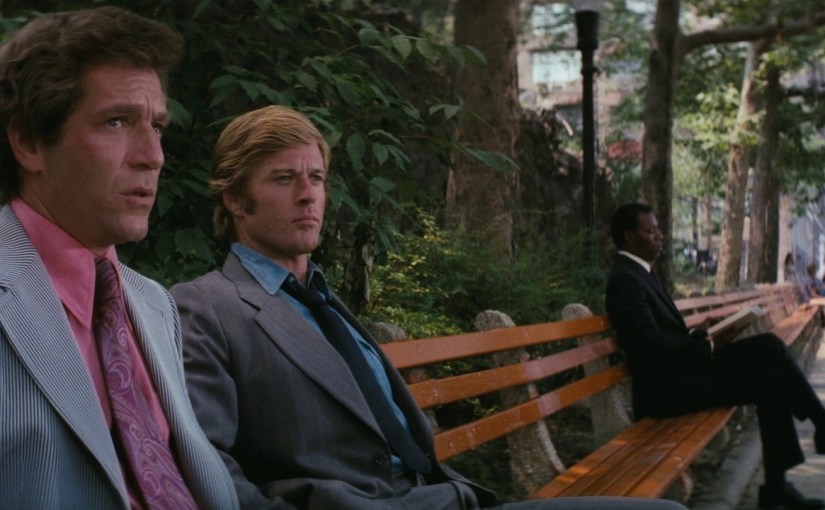
William Goldman wrote The Hot Rock, adapted from a novel by Donald E Westlake who penned a series of books focusing on the ex-convict John Dortmunder and his further adventures.  In the film, he’s played by Robert Redford. 

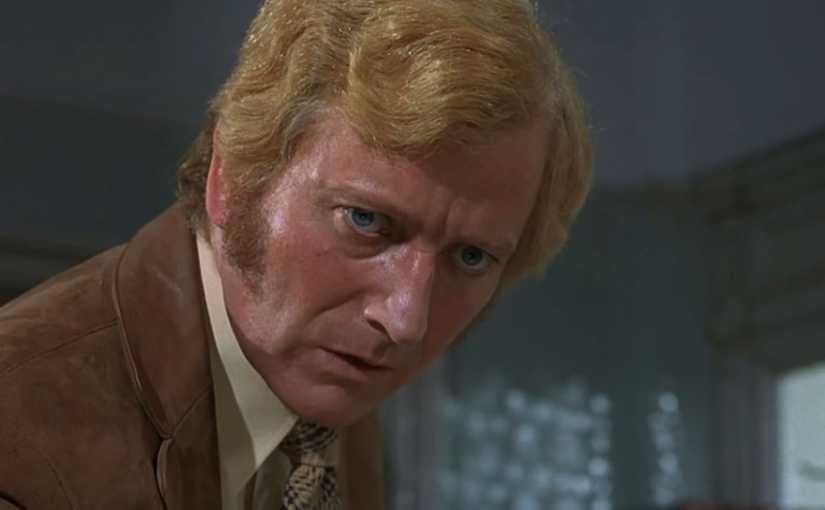
On the day that John is released from a New York state prison he’s picked up by his inept brother-in-law Kelp (George Seagel) who escorts him to Central Park.  Kelp wants John to be the fourth member of a team and steal a priceless diamond.  A man by the name of Dr. Amusa (Moses Gunn) sits about five feet away from them on a park bench.  Amusa breaks it down for the men, but they get interrupted by an elderly woman who sits between them to feed the pigeons.  This is what you can expect from The Hot Rock, a film structured under one pesky inconvenience after another.

This rock is currently on display at the Brooklyn Museum, on loan by an African country who has no business having possession of the valuable.  The stone belongs with Amusa’s country and he’s ready to pay Kelp and his crew $25,000 each to pull of the heist.  He’ll also, reluctantly, front some funding monies ahead of the theft for preparations. 

Like in all of these kinds of movies, John is ready to do one last job.  Then he’s out for good.  However, one last job turns into four last jobs.  Without spoiling too much, the rock gets relocated from one place to another.  So, a late-night heist at the museum turns into a break in a prison, and then it’s somewhere else and somewhere else after that.

As Hitchcock describes, you never care about the MacGuffin.  For movie purposes, you see it on display in its majestic glory, encased in a glass box right in the center of the museum, but so what.  The question is to uncover how the guys are going to get it out of there.  The Hot Rock doesn’t work nice and neatly like Ocean’s 11 or The Score.  In those movies, there are things that don’t go according to plan.  In The Hot Rock, nothing goes the way it should. Honestly though, it should be funnier than it really is. 

I recall there was a movie called Quick Change with Bill Murray doing his best to get out of New York City following a bank robbery.  It was comedic all the way through and maybe that’s because it was Bill Murray of Caddyshack and Ghostbusters fame, not to mention Saturday Night Live.  Robert Redford is the rugged actor of the time in 1972, though.  Not a comic and he plays Dortmunder like a serious kind of thief, even with his famous blond locks and toothy grin.  George Segal along with Ron Leibman and Paul Sand are bumbling chatter mouths, but are they funny?  Segal’s character steals a car to pick up John and we see him trying to figure out how to drive the dang thing, nearly running over Redford.  I never believed he did not know how to not drive the car. 

BY THE WAY: Ever notice in movies that they’ll show someone does not know how to drive a car by having them accidentally turn on the windshield wipers?  That’s all that is done.  That and having the car drive in S shape patterns as if the steering wheel suddenly took on a life of its own.  Then the scene comes to a halt with a startling slam on the brakes.  Never fails.  This happens over and over again in the movies.

Zero Mostel appears as the father/attorney for Paul Sand’s character.  It’s Zero Mostel, but Goldman’s script doesn’t give him much material to play with.  It’s not a silly caper flick because suddenly Zero Mostel of The Producers makes an appearance.  Look at Ocean’s 11, and see what Carl Reiner is doing.  There’s an organic affection for Reiner’s character that Mostel never achieves here. 

Peter Yates directed The Hot Rock a couple of years after the car chase thriller, Bullitt with Steve McQueen.  He impressed audiences with what two cars pursuing one another across the hilly streets of San Francisco could accomplish.  In this film from the early 1970s, Yates attempts to dazzle the audience with a few more speeding car stunts but they just don’t cut the corners.  Everything on screen looks like Yates and his crew are trying too hard.  There’s a helicopter sequence and much time is devoted to seeing how the chopper flies low over the Hudson River and then soars above the Twin Towers, still under construction at the time.  Look everyone!  Ron Leibman is flying a helicopter and Robert Redford and the rest look woozy about it all.  Thing is that James Bond movies were already doing this kind of schtick (with special effects) year after year by this time.  Peter Yates just doesn’t offer up anything that looks like a new sensation.

I’m actually surprised The Hot Rock has not been remade like Ocean’s 11 or The Italian Job.  In this film, the tools and skills are left to the guys and their cons. There’s no computer overrides or laser sensors to assist them.  Today, all of the techno stuff would be there with lots of closeups of fingers tapping away on a keyboard and then data entries appearing on a monitor.  In between, would be the comedy and would you believe of all people, I thought Will Farrell would be the guy to play the straight man and lead the charge.  The comedy of the situations would remain, but the thieves would be nerdy geniuses, each having their unique abilities and quirks. 

The set up is there for a remake.  Who you cast and what is done with it is up to the filmmakers. 

SILENT RUNNING (1972)

by Miguel E. Rodriguez

DIRECTOR: Douglas Trumbull
CAST: Bruce Dern, Cliff Potts, Ron Rifkin, Jesse Vint
MY RATING: 5/10
ROTTEN TOMATOMETER: 71% Fresh

PLOT: In a future where all plant life on Earth is extinct, an astronaut works to preserve the last of Earth’s flora, kept in domed greenhouses aboard a spacecraft.


Silent Running was directed by Douglas Trumbull, a visual effects specialist whose VFX credits include Close Encounters of the Third Kind, Star Trek: The Motion Picture, and Blade Runner.  In 1968, he worked with Stanley Kubrick as the Special Photographic Effects Supervisor on 2001: A Space Odyssey.  Shortly thereafter, he was given the opportunity to direct his own film.  With a script by Michael Cimino and Deric Washburn (who would both later go on to fame with The Deer Hunter), Universal Studios offered him a limited budget and final cut (!) as part of a project to encourage independent filmmakers in the wake of the success of Easy Rider in 1969.

With a crew of mostly college students as modelmakers, and with no directing experience whatsoever, Trumbull created a sci-fi parable that has some grand ideas, but it never quite achieves liftoff.  I don’t know how Silent Running reads at the screenplay level, but on its feet and on the screen, it slogs.

In an unspecified future, Bruce Dern plays Freeman Lowell, one of four astronauts living semi-permanently on a massive, mobile space station, the Valley Forge.  It’s part of a small fleet of similar spacecraft, each bearing several greenhouse domes housing the last remnants of Earth’s botanical ecosystem, including plants, trees, and small forest animals like squirrels, rabbits, frogs, etc.  The astronauts are tasked with protecting these greenhouses until the eventual call back to Earth (they’re currently in the vicinity of Saturn).

[Note: there is more than a passing resemblance between this plotline and that of Pixar’s Wall*E, but I’m sure that’s homage, not plagiarism.]

When the call comes, however, it’s not what they expect.  They’re ordered to detach the greenhouse domes from their ship, detonate them, and return home immediately.  No explanation is given.  These orders do not sit well with Lowell, and before long he’s alone on the Valley Forge with one dome left and only the ship’s waddling repair drones for company as he heads for the dark side of Saturn.

That’s about it for story.  Once he’s alone, there’s not much left for Bruce Dern to say or do except have one-sided conversations with the repair drones while he tries to teach them to play poker.  It’s clear that Trumbull’s focus was on putting his visual effect concepts on the screen in a way that would evoke 2001, but he did not appear to lose much sleep over pacing or plotting.  For a movie that clocks in under 90 minutes, there are endless shots of Lowell tending to plant and animal life, programming and reprogramming the drones, staring at the stars while confronting his guilt over his actions.  It’s almost a relief when he is forced to administer mechanical first aid to a drone that gets accidentally run over by an offroad go-cart.  (You read that right.)

There are too many other movies out there about castaways and solo adventures that were way more successful for me to give Silent Running a pass just because of its cult status.  There was never one exterior shot of the spacecraft that did not look like a model.  Explosions in space consist of a bright flare of light that dissipates quickly.  Bruce Dern’s acting is nothing to sneeze at, but it’s put to no good use.  It’s clear that Trumbull was counting on the effects to do a lot of the heavy lifting from a story-telling perspective, but they looked so fake that I was taken out of the story whenever they took front and center…which is a lot.

As a bookmark in VFX history between 2001 and the game-changing Star Wars, I suppose Silent Running does have some historical significance.  It’s clear the movie was made with tender loving care.  But from a cinematic perspective, it’s dull, dull, dull.

[Second Note: the film’s score was composed by Peter Schickele, a rather brilliant musician/comedian who is better known as P.D.Q. Bach.  The score is nothing memorable, but it includes two original songs sung by Joan Baez.  Yes, Joan Baez.  It’s a VFX-heavy sci-fi parable with two musical montages.  It takes all kinds…]

THE RULING CLASS (United Kingdom, 1972)

by Miguel E. Rodriguez

DIRECTOR: Peter Medak
CAST: Peter O’Toole, Alastair Sim, William Mervyn, Carolyn Seymour, Arthur Lowe
MY RATING: 8/10
ROTTEN TOMATOMETER: 77% Fresh

PLOT: A member of the British House of Lords dies, leaving his estate to his son. Unfortunately, his son thinks he is the one true God made flesh.  Murder and mayhem ensue.


Re-watching The Ruling Class for the first time in some fifteen years, I came up with a great but still imperfect way to describe it: Being There directed by Terry Jones and written by Terry Gilliam.  It has more religious blasphemy than Life of Brian – not a great example because Life of Brian is not technically blasphemous, but whatever – and more exuberant overacting than any two Nicolas Cage movies put together.  There’s nudity (but no sex), a little cross-dressing, murder, auto-erotic asphyxiation, impromptu musical numbers, and more jabs at organized religion and class structure than you can poke a burning cross at.  It feels a little too chaotic for its own good at times, but I am willing to forgive those transgressions because I am so grateful for its periodic flights of fancy and for the deliciously hammy performance from Peter O’Toole.  Is it a masterpiece?  Not quite.  But you just can’t turn away from it.

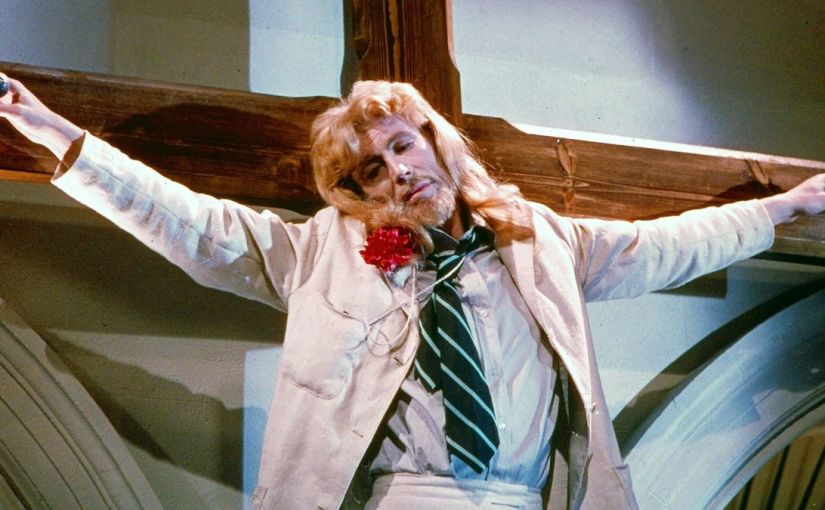
One day, the veddy-veddy proper 13th Earl of Gurney dies after a mishap involving a silken noose, a tutu, and a dislodged stepladder.  His brother, Sir Charles Gurney, is dismayed to learn that the heir to the Gurney fortune and name is none other than Jack (Peter O’Toole), the 14th Earl of Gurney.  We see the reason for Charles’s dismay when we see Jack for the first time…dressed as Jesus Christ, in a brown robe and white rope belt and long golden locks down to his shoulders.  He tells everyone he is God.  Someone asks him, “How do you know you’re God?”  He answers with unassailable logic: “Simple.  When I pray to Him, I find I am talking to myself.”  He also says things like, “For what I am about to receive, may I make myself truly thankful.”

Charles realizes he must have Jack committed to wrest away control of the family fortune, but he cannot do so until Jack has an heir.  But Jack (who insists on being referred to as “J.C.”) refuses to marry because he says he’s already married to the Lady of the Camellias, which everyone knows is the name of a less-famous novel by Alexandre Dumas fils.  To get around this inconvenience, Charles arranges for his own mistress to impersonate the Lady.  Meanwhile, Charles’s wife, Lady Claire, puts the moves on Jack’s psychiatric doctor to distract him because he opposes the marriage, citing Jack’s condition.  And always in the background is Tuck, the family butler, who received 30,000 pounds from the 13th Earl’s will, but stays in service apparently just to blow raspberries and say exactly what’s been on his mind for the last several years.  I would say he’s the comic relief, but he’s more like a demented court jester.

Peter O’Toole’s performance as Jack must be seen to be believed.  Imagine, say, Daniel Day Lewis or a young Robert De Niro, dressing up as Jesus Christ, talking animatedly to flowers, and taking a nap while standing on a life-size crucifix, arms outstretched.  At one point, Jack woos the faux Camille by impersonating a bird, and she follows suit.  You haven’t lived until you’ve seen Peter O’Toole dressed in an impeccable white ensemble, strutting across the lawn, head bobbing like an oversize pigeon, and literally cooing.

The Ruling Class is clearly a jab at its namesake, the upper-class nobs and snobs of England who firmly believe they rule their country simply because they are more suited to it than anyone else.  They never suffer from the same human foibles as the lower classes do, and if they do, it’s never acknowledged, or acknowledged and hushed up, or blamed on someone or something else.  The film is based on a stage play, which explains the occasional fourth-wall breaks and the frequent interruptions for short musical numbers, which further enhances the Python-esque feel of the movie.  I would imagine it was much more notorious upon its release than it might be today, but the message itself hasn’t dated.

That message is especially brought home when Jack is ostensibly cured, after a fantastic sequence involving a second psychotic patient, a lightning storm, and a vision of a gorilla wearing a top-hat and a tux.  However, his “cure” has an unintended side effect.  To everyone else, it looks like he’s back to being himself: Jack, the 14th Earl of Gurney.  But a creepy monologue in the attic reveals his secret.  He no longer believes he’s God, nor does he believe he’s Jack, the 14th Earl.  He believes he’s another historical “Jack,” the one who stalked prostitutes in 19th-century London.  He has visions of old London streets.  In one masterful scene, he is in the sitting room of his country house, and as he crosses the floor, the house magically transforms into an old London cobblestone street at night, in an uncut take with no visual effects.  I can imagine Terry Gilliam nodding approvingly at that absurdist touch.

What will become of the “new” Jack?  Will he remain a member of the ruling class to which he was born, whether he deserves it or not?  Will his former doctor, or his wife, ever learn of Jack’s new persona?  With his newfound purpose, he delivers a speech to the house of lords in favor of capital punishment, quoting no fewer than three verses from the Old Testament.  Their response to his words serves as the macabre capper to the film.

JOE KIDD

By Marc S. Sanders

Joe Kidd is not one of Clint Eastwood’s best westerns.  In fact, it might be his weakest of the sort.  The film arrived at the tail end of director John Sturges’ (Bad Day At Black Rock, The Magnificent Seven) career and through my research it seems that Eastwood did not get along with him.  Sturges was rumored to be an alcoholic providing limited focus on the film in question.  I’m apt to believe that theory.  Joe Kidd, which was scripted by Elmore Leonard who would go on to write Get Shorty, is full of enormous plot holes. 

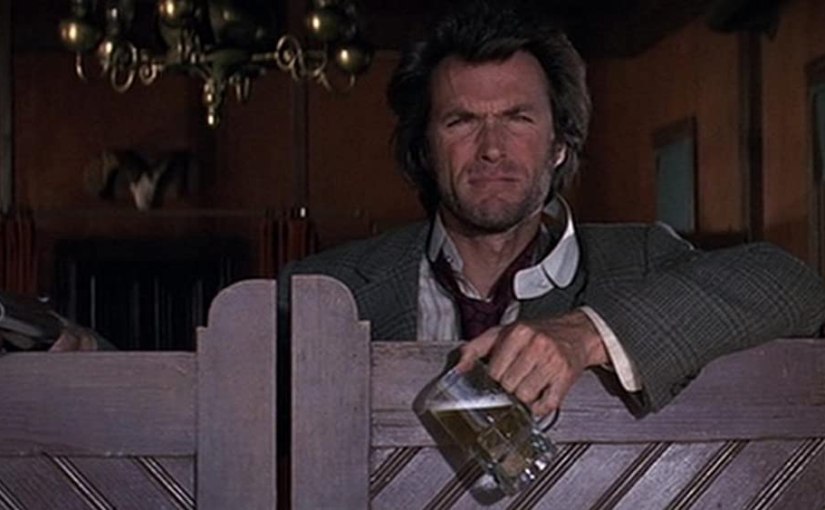
Eastwood is a welcome sight at first, handcuffed in the Sherrif’s jail until he’s unlocked to attend his court hearing.  Before leaving, in typical quiet, tough guy style, he demonstrates to an annoying cellmate that he won’t be intimidated by splashing the guy’s stew in his face and then denting the pot over his forehead.  It’s a great introduction for a title character.  I laughed.  I clapped.  After that, however, the movie fell apart.

The structure of Joe Kidd seems to start in the middle of a story that opted not to go back to the beginning.  A Mexican rebel leader named Luis Chama (John Saxon) causes some ruckus in the courtroom and around town, and then he flees into the nearby mountains.  Joe manages to shoot one gang member who enters the saloon.  Thereafter, a wealthy landsman named Frank Harlan (Robert Duvall) arrives and after paying for Kidd’s bail, he hires the ex-bounty hunter to accompany his posse and bring back Chama and his squad.  According to Harlan, Chama is occupying a large chunk of valuable land and therefore has to be taken out of the equation.  Okay.  Simple enough.

However, the narrative zig zags from that point.  First, Joe declines the offer from Harlan.  Then he discovers that Chama has tied up one of his ranch hands in barbed wire.  So, he dons his perfect tough guy cowboy duds (his hat looks great on his head) and off he goes with Harlan.  Midway on their journey through the mountains, they set up camp at a Mexican church.  Harlan announces into the wide expanse, for Chama to hear, that he will kill five people in the church if he does not surrender himself.  After a period of time, he’ll kill five more until the Rebel gives himself in and so on and so on.  Joe Kidd does not agree with this arrangement, gets fired by Harlan and eventually sidles up with Chama.  What’s going on here?  Didn’t Joe want to even a score with Chama after what he did to his ranch hand?  In a short ninety-minute running time, set ups occur only to be undone minutes later, and I’m starting to question my ability for basic comprehension. 

To date, of all I’ve seen in Robert Duvall’s illustrious career, this is hands down the weakest character he’s portrayed.  He’s not a terrible actor here.  He just has nothing to do except look like a greedy landowner with a mustache and a six shooter on his hip.  He’s not given any dimension of material to play with, and thus comes off like a bad guy of the week on an episode of The A-Team.  John Saxon actually guest starred a few times on that show as a variety of different bad guys.  The only new thing I see from him in this picture is his unconvincing Mexican accent. 

Clint Eastwood is playing his typical westerner.  He looks great with the hat and stature and the gun in his hand.  Yet, the novelty looks tired here.  As if we’ve already seen him in other classics like the Dollars trilogy, and High Plains Drifter.  There was nothing new to offer with Joe Kidd.  A diversion occurs early on where Kidd is about to take advantage of Harlan’s girl.  That goes nowhere and serves no purpose.

I imagine there was a better and more fleshed out script here that never materialized.  A friend of mine recently asked me if it would make sense to remake films with potentially good ideas that were poorly executed.  Seems logical to me, and then he asked me to name some examples.  On the spot, I could not come up with one.  Howard The Duck? Never!  Green Lantern?  Yeah, that’ll likely be done eventually anyway.  However, I think I have come across a good one to consider.  How about remaking Joe Kidd

You know what?  Wouldn’t work.  There’s a tone to the piece that seems a little prejudiced and not appropriate for present day. More importantly, on another try, it wouldn’t have the main attraction. 

Has anyone remade a Clint Eastwood picture? 

My point exactly!

THE LAST HOUSE ON THE LEFT (1972)

by Miguel E. Rodriguez

DIRECTOR: Wes Craven
CAST: Sandra Peabody, Lucy Grantham, David Hess, Fred J. Lincoln, Jeramie Rain, Marc Sheffler, Richard Towers, Martin Kove
MY RATING: 4/10
ROTTEN TOMATOMETER: 65%

PLOT: Two teenage girls heading to a rock concert for try to score marijuana in the city, where they are kidnapped and brutalized by a gang of psychopathic convicts.

*Note: This review contains spoilers.


I am not quite sure where to start with this review.  On the one hand, The Last House on the Left resembles the lowest kind of shock-ploitation movie…and if that’s not a word, it should be.  Rock-bottom production values, bad edits, hammy acting, gratuitous nudity, incongruous music on the soundtrack, and some of the most repulsive violent acts I’ve ever had the displeasure of watching on a movie screen. (Or TV screen, whatever.)

On the other hand, the sickest scenes are followed by an extremely gratifying second act where the chief perpetrators in the first act get what’s coming to them in an orgy of carnage that makes Halloween look like The Little Princess.  So, we’ve got a situation where the traumatic scenes at the beginning are necessary if the over-the-top revenge killings at the end achieve the necessary catharsis.  The question becomes: are you, the viewer, willing to sit through the filmic equivalent of eating a bowl of spider eggs in order to get to the chocolate cheesecake for dessert?

The story is as bare bones as it gets, except for the twist ending (and if you’ve ever seen Bergman’s The Virgin Spring, none of this would have come as a surprise anyway).  Two teenage girls, Mari and Phyllis, head to the city for a rock concert where a band called “Bloodlust” will be performing.  Subtle.  They try to score some weed from a skeevy character in a doorway, and before you can say “cautionary tale”, they’re in the clutches of four psychopaths who proceed to kidnap them, take them to the woods outside of the city, and force the girls to…but I find myself reluctant to even type out what happens to the girls.  Maybe I should leave that stuff out, if for no other reason than to preserve the surprises for any reader who still feels adventurous enough to watch this movie cold, as I did.  Suffice it to say the violent acts that follow are as distasteful as they can get.  If you know anyone who gets turned on or excited by these scenes, delete them from your contacts.

What makes these scenes even more outrageous is the background score used for some of the scenes.  In one shot, the bound and gagged victims are being slowly carried out the window of the apartment where the psychos were being holed up.  The apartment is 2 stories up, so they have to be carried down the fire escape, a delicate process.  And in the background, the score provides us with music that, instead of making the scene harrowing, makes it sound instead like a comedy beat from a cheesy TV comedy.  This jarring musical device is used again when the villains are driving the car out to the woods, with the girls tied up in the trunk, and again during a rape scene, although the music is far less giddy than before…more like a blues tune.

I’m shaking my head even now, thinking about it.  What was Craven thinking?  In interviews on the Blu Ray, Craven talks about how he had been disillusioned by how Westerns and war movies had glamorized violence to the point that it looked “cool” when good guys killed bad guys.  So, he set out to make a movie that showed violence, real and true, and showed the real effects of that kind of violence, without cutting away, without fancy camera tricks, and without anyone feeling good about it afterward.  He wanted to show violence as an ugly act.

Well, he succeeded.  The violence in The Last House on the Left is ugly, depressing, and deplorable.  It’s been said that it’s impossible to make a truly anti-war film because war, by its nature, is exciting.  Well, this may be the first truly anti-violence film, despite the amount of gut-churning violence it contains.  There is nothing exciting about any of it, not even at the end (which I’m getting to, I promise).

But I have to ask myself: while the goal is worthy, was this really the way to go about it?  At one point, the psychos’ leader, Krug, tells one of the girls, Phyllis, to pee her pants, or he’ll cut her friend, Mari.  Phyllis complies, in one of the most downright miserable scenes I’ve ever seen.  They’re forced to disrobe and make out with each other.  In another scene, one of the girls is stabbed so many times she’s disemboweled.

In another one of those Blu Ray interviews, David Hess, the actor who played Krug, nonchalantly mentions how, during a scene where he rapes Mari, the actress (Sandra Peabody) suddenly got this look in her eyes, like she had really gone somewhere else mentally, and he says, “At that point, I knew that if I’d really wanted to, I could have f****d her, and she wouldn’t have done anything.”  What???  So, yeah, the movie up to this point is ugly, unpleasant, repulsive, pick an adjective.  I found myself wondering how Craven found a career after this movie.

But then, a saving grace, plot-wise.  The killers’ car is dead, so they seek help/refuge from the people who live in a nearby house…and wouldn’t you know it, this is where Mari lived with her parents.  After some uneasy conversation, the parents offer them room and board for the night.  At some point, the mother discovers a clue that leads to the inescapable conclusion that these people have murdered her daughter.  She informs her husband, and in the dark of night, he carefully locks all the doors, removes the window handles, and lays out some rudimentary traps that look like nothing so much as the prototypes for Home Alone: whipped cream on the floor, hard-to-see wires in doorways to trip you up, even an ingenious way to electrocute someone that, if it doesn’t actually work in real life, it really should.

The bloodbath that follows is chaotic and messy, much like it might be in real life if an unassuming doctor tried to kill three people.  (Don’t worry, I didn’t lose count…the fourth psychopath has been seduced by Mari’s mother and led out to the neighboring woods where she gets her own revenge, Lorena Bobbitt style.)  To Craven’s credit, his credo for this film remains intact: while the violent acts inflicted on the bad guys do provide a catharsis, they are hardly glamorous or exciting.

(I haven’t even mentioned the two bumbling cops who provide an insanely inadequate level of comic relief…and of them is Martin Kove, who would later achieve fame as the sensei of Cobra Kai in The Karate Kid.)

So, the question remains: are you willing to sit through this series of depraved acts of (pretend) violence that have been designed to remind you that real violence is not cool?  See, I already knew that.  But then, I’m in my fifties.  The Last House on the Left seems geared towards younger mindsets than mine who, at the time (1972), had not yet seen The Silence of the Lambs or The Girl with the Dragon Tattoo, or Henry: Portrait of a Serial Killer, a movie that covers this same ground with equal or even greater impact, but without spending quite so much time depicting the violence it’s eschewing.  Craven’s philosophy and motives are sound.  I am just not a fan of this movie’s method.

P.S.  The story of this film’s surprise success is no doubt well-known, as is the fact this was a fledgling director’s first film.  I assure you, I’m well aware of the backstory, but to delve into that particular rabbit hole would result in a 3,000-word essay, which I have neither the time nor the inclination to write.  I’ve decided to focus on the immediate effect this movie had on me personally.

THE GODFATHER

By Marc S. Sanders

Probably the greatest character story arc in all of film is of Al Pacino’s portrayal of Michael Corleone in Francis Ford Coppola’s The Godfather based upon Mario Puzo’s best-selling novel. (The film is a thousand times better than the book.)

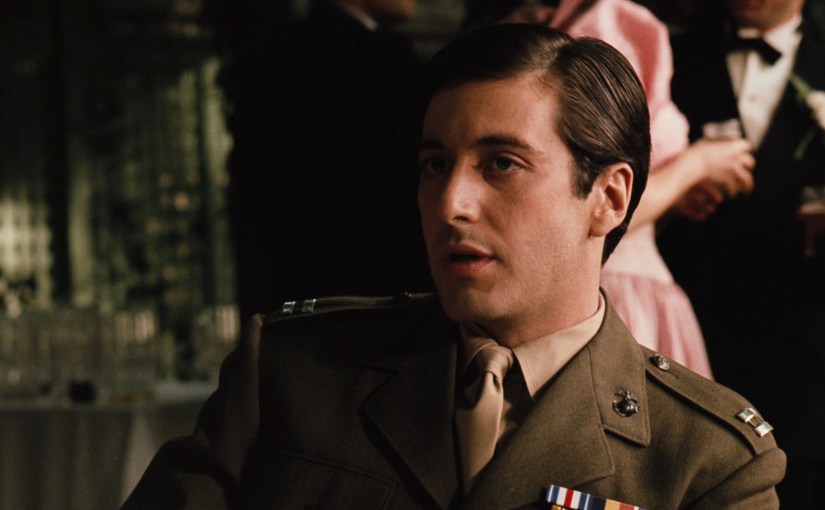
Michael is the youngest of three sons intended for a legitimate life separate from his Mafia family. The masterful opening sequence of his sister’s lavish wedding show him courting his eventual wife, Kay (Diane Keaton), and never feeling proud of the actions of his notorious father, Vito (Marlon Brando), nor his brother Sonny (James Caan) or their consigliere, Tom (Robert Duvall). He’s an innocent war hero in uniform with an open mind of an untarnished future. It is only when bad blood circumstances are tested that he feels forced to strike with the same intent that the Corleone family is infamous for.

Coppola presents quiet, subtle moments of expression in Pacino on camera. You see the change in Michael sneak up on you and you see a character develop into something else entirely. What starts as a false impression to appear as if he’s carrying a gun in his pocket, soon after leads to murder, by means of nothing personal but “strictly business.” From there, he retreats and hides until he is blessed with carrying on an evil legacy.

Yes, the first chapter in the operatic trilogy of crime, is mostly known for a grandstanding performance by Marlon Brando but the story relies on Pacino as Michael. Michael Corleone at least must be one of Al Pacino’s greatest roles. He arguably has one of the most impressive resumes in all of film. Here is where it jump started.

The direction by Coppola is a film student’s required studying. With Puzo’s script, the best idea was to open the film with a wedding. As the film offers so many characters and much back story among all of the guests, the interaction and workings of the family are efficiently condensed into this 25 minute opening sequence. Don Vito meets with people needing favors while outside the home, the crew is dancing, doing their jobs and minding who is watching. By the end of this opening you have a full grasp of the family tree and who works for who and what their characters are like. Sonny is the hot head. Michael is the innocent. Fredo (the middle son played by John Cazale) is not doing much but being a cut up, Momma Corleone is the valued matriarch and Tom is the well managed advisor. You even get a glimpse of some “very scary guys,” some competing hoods, who’s cheating on who, and some people who need help with citizenship and film casting.

Art direction from Alex & Dean Tavoularis is magnificent, depicting a post WWII New York, and a historical Sicily stagnant in open plains, romance and murderous pasts.

The cinematography is better today than it was originally. Gordon Willis returned decades later to (for lack of better word) lighten up the picture. The interiors remain dark in secret and comfort, but the characters are more illuminated. The Blu Ray restoration is a fantastic return to the classic film and its two sequels.

The Godfather is endlessly quotable and never dull no matter how many times you watch it. Puzo’s screenplay plays like the biography of a real person and family, much like his adaptation for the screen of 1978’s Superman: The Movie. It is an American classic rich in a history we believe has been told and carrying on the tradition over the course of a 10-12 year period.

I return to praise Pacino to remind you how his appearance even changes as he gradually builds his strength and accepts his title of Don. I feel like I’m looking at two physically different people from the beginning in his Marine uniform with boyish looks, to his independent walkabout way during his Sicily retreat, to a more broad shouldered, slicked back hair, dark suit tailored appearance during the film’s third act. It’s an uncanny transformation that is built on performance and expert direction and writing from Coppola and Puzo. I still get chills as Michael in his college boy sports jacket volunteers himself to satisfy a family vengeance. Coppola zooms in on him slowly as he sits in a leather arm chair, arms at his side, legs folded. We are seeing a new man in charge for the first time. It’s chilling.

The Godfather is one of the greatest pictures that will ever be made. It’s a perfect chemistry of technical achievement, attentive storytelling and sensitive, yet powerful performances from probably the best cast ever assembled.

I’m amazed that I know of some friends who still have yet to see it.

The Godfather is the film that everyone should see before they die.

FRENZY

By Marc S. Sanders

London is being terrorized by the necktie strangler.

In 1972’s Frenzy, Alfred Hitchcock hearkened back to his killer classic themes remembered from Psycho. Only this time he is much more macabre with his material. Frenzy is Hitchcock’s only R rated film and his first movie to show outright nudity. Naturally, it’s all pretty eye opening, and considering that the film’s killer is regarded as a “sex maniac,” necessary as well.

Richard Blaney (John Finch) is not doing so well. He’s broke and he’s just lost his barkeep job. Subsequent from that he turns to his ex wife Brenda (Barbara Leigh-Hunt), a successful marriage and friendship counselor for comfort. It does not help that Brenda’s secretary overhears Richard violently losing his temper. Nor does it do any good when he has an outburst while dining with Brenda in a crowded restaurant. Why, this could only make him look suspicious of a crime, and the infamous, serial necktie strangler has yet to be caught.

When Brenda turns up dead by means of a necktie around her throat, all accounts point to Richard. Once again, Hitchcock’s protagonist is the Everyman caught up in an unwelcome conspiracy.

Frenzy is thankfully like many of Hitchcock’s best films. It gets straight to the point. Just as the film begins, the naked body of a dead girl floats up from The River Thames. Then it follows through with Richard and introduces likely suspects and or villains including Richard’s friend Robert Rusk (Barry Foster) and his bar waitress co-worker Baba Milligan (Anna Massey)

Hitch goes more horrifying than he might have had the liberty to do so a decade prior to this release. The necktie strangler’s rape and murder of the first victim is quite graphic and disturbing. This is a deranged individual and his victim is rendered helpless.

What keeps viewers interested in a good Hitchcock yarn is the suspense he manufactures for the one who is blamed, as well as for the killer. Hitchcock doesn’t dwell on mystery. Rather, he focuses on what his principal characters are going to do next, now that they are swept up in intrigue. The strangler continues his killing spree but overlooks one thing that could implicate him. The man who is blamed seems to get little help from anyone. Richard is in quite a pickle after all. As well, how will these two people encounter one another to wrap up the storyline?

Humor also comes through quite nicely with Chief Inspector Timothy Oxford (Alec McCowen) who is blessed with a loving wife who relishes analyzing the gruesome details of his investigation while preparing dinner time meals that look awfully worse than the corpses the Inspector encounters; quail with raisins for example. To look at her concoctions will certainly make you wince. It’s great side humor for the suspense at play.

A film like Frenzy hardly explores dimension in its characters. Many of Hitchcock’s films never get weighed down with too much material. The stories he directs are lean, only focusing on the central plot at play. The fun is in the disturbing angles he uses like a woman’s outstretched hand or frozen expression after succumbing to strangulation. Overhead shots of a man imprisoned in a small room can also be jarring. He keeps you engaged as tightly as the fingers of a dead body gripping a significant piece of evidence.

Films like Frenzy or Psycho cannot be made today. There are too many advances in technology and science to undo the developments of simple, yet grossly disturbing stories like this. DNA evidence and cell phones would wrap up any of these plot lines in five minutes. It’s fortunate that we can still transport ourselves to the period when these tales of suspense were originally developed. It doesn’t make it easy for the innocent man, the victims or the killer. I wonder how Hitch would approach today’s conveniences of modern science. If anything, he’d likely make his signature cameo on the wallpaper of someone’s iPhone. Nevertheless, I’m sure he’d find a way to continue to build his suspense. He had such an eye for his camera, his captions and his edits.

Frenzy is a demonstration of classic Hitchcockian thrills.

THE CANDIDATE

By Marc S. Sanders

A politician’s career isn’t being elected. A politician’s career is getting elected. Once it is all over, what does the politician do now?

I’m not sure I understand why Jeremy Larner’s script won the Oscar in 1972; only because I didn’t gather much from this Robert Redford star vehicle. What exactly was the point of what I was watching? Redford plays Bill McKay, an idealistic lawyer recruited to run for the California senate on a Democratic ticket.

He’s sure to lose and I guess he’s okay with that because it’s acknowledged that way early on, and yet he just follows through with the campaign. He’s a kid compared to his seasoned Republican incumbent opponent. So he’s got that to deal with, and he’s remorsefully living in the unwanted shadow of his father, a former good ol’ boy governor. He also occasionally brushes past a girl that follows his campaign. Bill is happily married. Sounds like a good set up, right? Maybe it is. Yet I’m not sure any of this is the set up of the film. There is rarely any conversations in The Candidate. Hardly any dramatic pauses occur either. Nary a scene with his wife. The televised debate midway through is generic cliche really. One good moment occurs when the Republican candidate steps on Bill’s toes during a threatening brush fire. Now here’s some conflict. Now we’re cooking. Except…we’re not. The film returns to its established theme from earlier. For some reason in the last half of the film, it throws two or three punchlines at you, and…well, I guess it’s a comedy now.

The Candidate fills a majority of its two hours with McKay doing a lot of handshaking, baby holding, celebrity meets (Hi Natalie Wood!) and autograph signing. When that’s not happening, we are treated to repetitive close ups of members of his campaign and voters. I felt like I should have known these people. Did I fall asleep during their big introduction in the film, or were those scenes deleted from the finished product? Bill doesn’t say much except to make generic statements that no voter would ever disagree with. That’s okay, I guess, yet really it’s just boring. None of this packs any punch.

Larner was a speechwriter for Eugene McCarthy in 1968, and Redford recruited him to write and tailor this script for him to produce and star, in response to his own dismay with the political climate at the time. Maybe The Candidate is supposed to be narrated in a documentarian sense but even if that’s the case, it fell short for me. Scenes here seem about as interesting as someone who unwraps a stick of gum and chews it.

Perhaps the Oscar was merited due to the political climate at the time. Redford’s character told audiences what they wanted to hear and magically Larner’s screenplay is now brilliant. If that’s the case, then I guess The Candidate is now dated. There’s no way this film outshines other political films like Wag The Dog, Primary Colors, Mr. Smith Goes To Washington, or from what I hear Bulworth (never saw it).

The Candidate carries no drama, no comedy, no shock value. I’d say no message either, but the unexpected ending (unexpected only because I didn’t know the end scene was actually the end scene) finally told me something that I laboriously waited a long two hours for. The wait wasn’t worth it.

CABARET

By Marc S. Sanders

Is it possible for a musical to be disturbing? Maybe Bob Fosse’s Cabaret favors that argument.

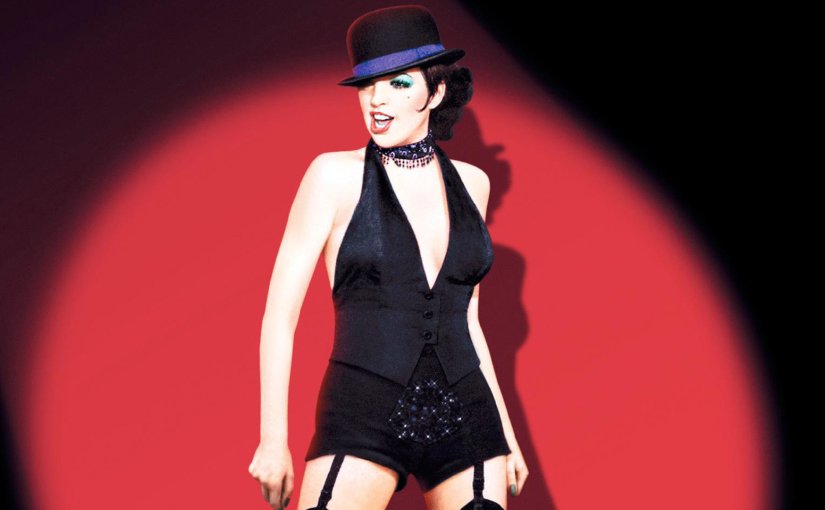
Liza Minnelli won the Academy Award for Best Actress in 1972 for her portrayal of Sally Bowles, a carefree, happy go lucky performer at the underground Kit Kat Club located in Berlin, 1931. She is the lead attraction among a company of dancers doing a different kind of stage vaudeville with its colorful emcee played amazingly by Joel Grey, also an Oscar winner.

The musical numbers are outlandish with caked on makeup and outfits that could make Victoria’s Secret seem like a children’s shop. I gathered from the film that Fosse, who choreographed the numbers as well, offered up the escape of life first, before showing the harsh reality of Berlin in its historical context.

Sally and the Emcee’s performances are first on hand, depicted as silly and showstopping. Thereafter, Sally encounters an English gentleman named Brian Roberts (Michael York) who is a professor of English study attempting to complete his doctorate. As Sally and Brian become closer as friends first, he must reluctantly admit to Sally that he’s a better bed companion with a man than with a woman. Sally doesn’t understand why he didn’t say that in the first place as she attempts to come on to him.

Herein lies the dilemma many faced as the Nazi party was gaining traction in Germany. How necessary is it to hide your true natures to preserve your life? Sally’s underground lifestyle at the club clouds her vision of what’s gradually happening in the world. Nevertheless, they eventually develop a relationship as Brian appears to be bisexual, more specifically.

A side story concerns Brian & Sally’s relationship with a baron named Maximillan (Helmut Griem), who will wine and dine them at his estate only to later abandon the respective relationships he sets up with them to more or less make them feel as cheap as prostitutes. I wasn’t sure what to gather from this extension, however. The irony is that unbeknownst to Sally and Brian they have both been sleeping with Max. Eventually, Sally reveals she’s pregnant but does not know who the father may be, Brian or Max, and an abortion is considered.

An additional side story concerns a wealthy Jewish German heiress named Natalia who falls in love with a German Jew named Fritz living under the guise of a Protestant.

Cabaret is a loose adaptation of The Berlin Stories by Christopher Isherwood (the Brian character) and his experience with stage performer Jean Ross (the Sally character). Isherwood’s stories gradually formed into different iterations of stage plays and short stories before making it to Broadway and Fosse’s celebrated film.

Though Fosse apparently took some questionable liberties and departures from Isherwood’s writings, I think it depicts the personal struggles of love and self identity while the world around them is quickly changing into a scary reality where your own self identity could get you killed.

Fosse gives terrifying glimpses of how the Nazi party seeps it’s way into a decadent Berlin of underground showmanship. Though apparently Berlin really wasn’t so decadent as the film has you believe. Ross and Isherwood have gone on record describing Berlin was a more destitute and poor environment, actually.

In Fosse’s film, a Nazi youth is seen early on being kicked out of the Kit Kat Club. A few minutes later, the night club manager is being beaten in an alley. Fosse juxtaposes scary moments like this against the silly debauchery depicted on stage. It’s as if the Gypsies, homosexuals and Jews in the area are unaware of the evil practice that is gradually taking over outside.

Soon, Fosse makes the swastika more apparent in the streets with propaganda handouts. Most telling is when a young boy is seen at an outdoor beer garden gathering singing a number selfishly entitled “Tomorrow Belongs to Me.” Fosse is frighteningly effective at showing this boy from the neck up. Eventually, he moves the camera down to reveal the boy’s swastika wrapped around his sleeve. The song which seemed to champion beauty and nature now evolves into a march of grandstanding fascism. It completely shocked me. Just as people like Brian and Fritz are reluctant to reveal their backgrounds, both sexually and religiously, the Nazi party is proud to announce their mindset in a converse manner. By the end of the film, the audience at the Kit Kat Club more predominantly shows Nazis in the audience as opposed to just the one shown in the beginning of the film. Hatred has spread its disease.

While Minnelli shines in her role, her showstopping moment really comes at the end when she dangles her carefree attitude while belting out the title song with “Life Is A Cabaret.” Along with Joel Grey’s Emcee closing out the film with the “Finale,” this musical goes against the grain of most musicals’ cheerful close outs or romantic theatrics. Fosse’s mirror image of the Nazi party taking in Sally and Emcee’s performances are chilling. We sense the characters’ time is at an end and wisely the film runs its closing credits among frightening silence with the cold, blurred images of Nazi soldiers staring right at us.

I had never seen the film of Cabaret until now, but I had attended two different stage productions; neither of which I liked. Bob Fosse’s film seems more clear with its content than I ever got from a stage performance. Perhaps it is because the Oscar winning art direction is more apparent than a stage set. We can see the bustling of Berlin change amid a political climate that at first is not taken so seriously. As hurtful and harrowing the relationships of love between Brian with Sally and then with Max, as well as Fritz and Natasha are, none of this will eventually compare to the upcoming demise for Berlin.

As Miguel noted in our recent podcast that focused on musicals, Cabaret won the most Oscars without winning Best Picture (losing to The Godfather). It’s clear how deserving it was of its accolades. The musical numbers are very engaging but the fear of fascism is well developed too. So there is a roller coaster of emotions to absorb from Fosse’s film. I believe in that podcast I noted that Francis Ford Coppola won Best Director. I now realize I was wrong. It was in fact Bob Fosse who took home that prize, and it’s truly evident how deserving that honor was for him.

Again, while I’ve yet to find a stage production I’ve liked, I was terribly moved by the film. Cabaret, the film from 1972, is a sensational and frightening production.