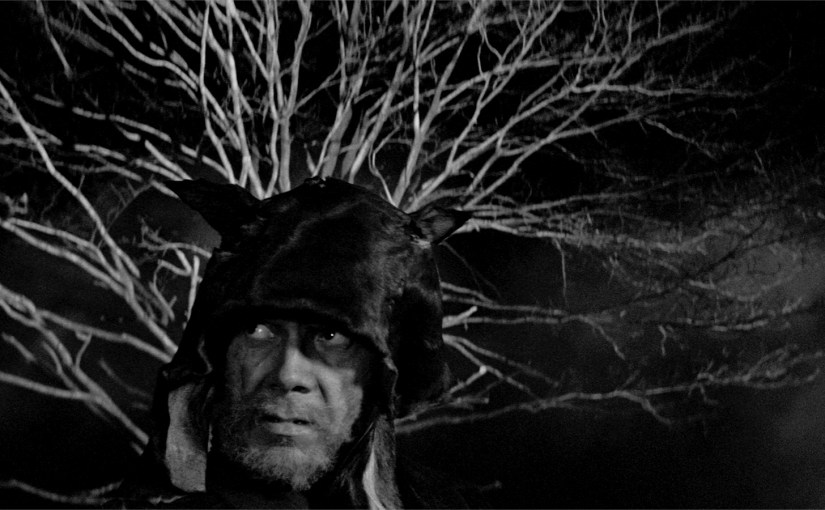
WEEKEND (France, 1967)

by Miguel E. Rodriguez

DIRECTOR: Jean Luc Godard
CAST: Mireille Darc, Jean Yanne
MY RATING: 8/10
ROTTEN TOMATOMETER: 93% Fresh

PLOT: A married couple go on the road trip from hell to visit the wife’s parents, intending to kill them for her inheritance.


You don’t risk the time it takes to do this…unless the act itself has meaning. – Detective Somerset, Se7en (1995)

In my personal opinion, there are few things more dangerous than a skilled director who genuinely has something to say.  Oliver Stone.  Stanley Kubrick.  Martin Scorsese.  Spike Lee.  Even Kevin Smith (Dogma, 1999), among many others you or I could name.  Give these guys a finished script and a camera and watch the fireworks from a safe distance.

In 1967, iconoclastic filmmaker Jean Luc Godard became disgusted or disillusioned or just plain pissed off about the class division in France and around the world, especially with how the middle class/bourgeoisie had forsaken human connection for the accumulation of material wealth.  So, he dashed off a screenplay, gathered up a crew and some actors (including a lead actress that he specifically did not like, because he needed her to play a CHARACTER he did not like), and made a film that defies classification or genre.  Is it a comedy?  A drama?  Satire?  I’m still not sure.  All of the above?  None of the above?  Weekend stands stubbornly apart from anything I’ve ever seen, thumbing its nose at the world with one hand while flipping the bird with the other.  It is many things, but timid it is not.

The movie begins with a simple enough scene, interrupted by title cards that say things like, “A FILM FOUND IN A DUMP”.  A husband and wife calmly discuss their plans to murder her parents so she can get her inheritance.  They might as well be talking about what movie to see tonight.  When the husband leaves the room, the wife takes a call from her lover.  In the driveway of their house, a fight breaks out among three people about…what?  Doesn’t matter, they’re never seen again, and the husband and wife observe the fight without commenting on it or making any attempt to stop it.

This is followed by an extraordinary scene, in a film full of extraordinary scenes, in which the wife, apparently speaking to her analyst, describes, in graphic detail, a sexual encounter she had with a strange man and his other mistress.  Meanwhile, Godard’s camera does a slooow zoom in to the woman’s face, then a slooow zoom out to reveal she’s in her bra and panties, then another slooow zoom in, and out, and in, and out, and you get the idea, right, wink, wink, nudge, nudge?

Is Godard being too obvious in this scene?  Clearly.  So, what is he trying to say here?  By being so blatantly obvious, is he parodying earlier French New Wave and Italian neo-realist films, some of which invested a lot of screen time in long conversations about nothing?  Sure, let’s go with that.  What’s with that in-and-out camera move that I read someone describe as “masturbatory” that occurs during the explicit discussion?  Is he also poking fun at other filmmakers who lack subtlety?  Yep, that works, too.  In a weird way, I was reminded of Tarantino’s Kill Bill cycle, movies that took every kung fu trope imaginable, turned the volume up to eleven, and then turned it up some more.  That’s what Godard is doing here.  Why?  As Robin Williams once said, “Because we’re French.”

That’s just the first two scenes.  Later, there is a justly famous tracking shot (really two or three that are spliced together) that lasts for nine minutes and covers 300 meters of ground.  It tracks past an endless traffic jam as our “heroes” try to get around them on their way to kill her parents.  The camera passes cars, convertibles, trailer trucks, a flatbed with two caged lions and a monkey on a leash, horns honking, people yelling at each other.  THIS part reminded me of some of the best “Family Guy” gags where something is spun out for a ridiculously long time, where the duration of the event becomes the gag, instead of the gag itself.  In the film, it actually did become kind of funny…until finally, nine minutes later, we see the cause of the traffic jam, and my jaw dropped.

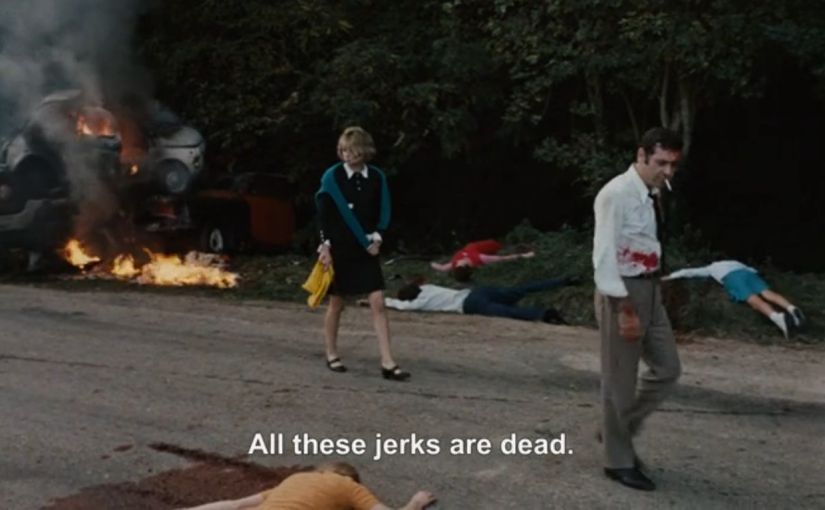
Car accidents are a recurring motif throughout the film.  Perhaps they represent Godard’s assertion that his country was, at the time, more or less a trainwreck.  With other filmmakers, showing just one or two car wrecks would get the point across.  Not Godard.  They’re everywhere.  And you don’t get just twisted and burning metal; there’s also broken and bloody bodies adorning the wrecks and the roadside.  And through all of this (and more), our main characters walk or drive, apathetic to the chaos, asking everyone – even the dead bodies – how to get back to the main road, blind to the madness around them.

Godard adds intertitles at random intervals, some of which are laden with French cultural references that escaped me.  Some of them didn’t even get translations on my Blu Ray.  One of them says “THE EXTERMINATING ANGEL”, which is the title of a famous film by Luis Buñuel…sly wink to the cinemaniacs in the audience.  Go Godard, celebrating geek culture before it was cool.  Some of them are repeated while the film backtracks as if the projectionist is having a spasm.  At one point, the film jumps and skips forward as if there was a bad splice in the reel. At another, a scene occurs in a field full of abandoned cars. Then, JUMP CUT, and the cars are now a flock of sheep. Take THAT, audience expectations!

At every stage, Godard is constantly reminding the viewer that they’re watching a movie.  One of the characters even says, “What a rotten film, all we meet are crazy people.”  Later there are scenes that approximate some kind of revolution.  Battles are fought.  The gunplay looks curiously amateurish.  There’s a scene with a pig.  I don’t want to give too much away, but let’s just say that it was definitely harmed in the making of this movie.  Same with the chicken.

The chaotic nature of the movie was mesmerizing, like…a car accident that you can’t turn away from.  To fully analyze every historical, literary, and cinematic reference would be like trying to catalog every single pop culture reference in Ready Player One [2018], and that’s something for which I have neither the time, the inclination, the education, nor the space to do.  Weekend is not for everyone, he said, blatantly stating the obvious.  But I ultimately enjoyed it because it’s not that often I get to listen to the voice of a really angry filmmaker.  I may only understand the basics of what Godard is angry about, but that doesn’t diminish the power of his statement.

THE TWO OF US (France, 1967)

by Miguel E. Rodriguez

DIRECTOR: Claude Berri
CAST: Michel Simon, Roger Carel, Paul Préboist, Alain Cohen
MY RATING: 10/10
ROTTEN TOMATOMETER: 94% Fresh

PLOT: In German-occupied France during World War II, a Jewish child is sent away from his family and conceals his religious affiliation from the anti-Semitic elderly man that takes care of him.


What are we to make of Pépé Dupont, the grandfatherly old man at the center of Claude Berri’s film The Two of Us?  Here is the kind of craggy, crotchety, yet endearing old man we’d like to turn into when we get to be his age.  He loves his 15-year-old dog almost as much as he loves his wife, if not more.  He’s a vegetarian who doesn’t like it when his wife cooks rabbit for dinner.  “Cannibal!” he exclaims.  He makes friends easily with Claude, the little 9-year-old boy who comes to live with him and his wife in the French countryside in late 1943, sent away by his Jewish parents who feared for his safety during the German occupation of Paris.

But Dupont makes some comments at the dinner table about Jews that makes it very clear: he is anti-Semitic.  He quotes statistics about how the percentage of Jews in political office is vastly higher than the percentage of Jews in France.  The little boy, Claude, is instantly cautious and tentatively asks Dupont, how can you tell if someone is a Jew?  “Why, by their smell, and their large noses, and their flat feet that keeps them out of the army, but look how fast they run to make money!”

These scenes and others like them are intentionally jarring because they emerge from a man who is utterly unaware he’s talking to a Jewish child.  Dupont’s deep-seated bigotry is as much a part of him as his beloved dog, Kinou, but it is so blindingly wrongheaded that he completely overlooks the fact that Claude is Jewish himself.  It’s a situation that is both funny and heartbreaking at the same time: funny because we laugh at the ignorance of someone blinkered by his prejudices, and heartbreaking that such attitudes are harbored by a man who would otherwise be the perfect picture of a loving grandfather.  (Or surrogate grandfather in this case, but you get the idea.)

The Two of Us is based on the actual experiences of director Claude Berri, which makes the film even more poignant.  Over the course of the film, little Claude will cautiously befriend Dupont, but he is careful to never let Dupont’s wife wash him (it wouldn’t do for her to see he has been circumcised).  He memorizes the Lord’s prayer.  He assumes a new last name – Longuet instead of the more Jewish “Langmann.”  Over time, he even becomes bold enough to tweak Dupont’s ignorance.  When Dupont says all Jews have large noses and curly hair, Claude gleefully points out Dupont’s own bulbous nose and frazzled hair and runs away in mock terror: “You’re a Jew!”

Perhaps I’m making this film sound like a dreary exercise in pointing out the obvious – anti-Semitism is wrong, DUH – but it’s far more than that.  Berri’s film is very careful to never, ever include a scene in which Dupont is shown the error of his ways.  The closest we get is when Dupont’s son refuses to enter his house because Dupont supports the Vichy (pro-German) Prime Minister Pétain as opposed to Charles de Gaulle.  Aside from that, we are simply allowed to observe Dupont’s behavior and Claude’s reactions.  Berri is smart enough to realize that people (generally) know right from wrong on an instinctive level and do not need to be preached at.  So few films dare to assume their audiences have a brain that it’s a relief when one is discovered, waiting in some long-forgotten corner of cinema history.

The dichotomy between Dupont’s beliefs and his obvious affection for Claude define the word “provocative.”  It forces us to realize that not all bigots are loud-mouthed blowhards.  They can be just as charming and effusive and loving as your best friend’s favorite uncle or aunt.  Is Dupont evil in The Two of Us?  Some of his core beliefs are rotten, for sure, but I started to take pity on him a little bit.  Like so many other racists, his attitudes were probably taught to him by his own parents, and he simply accepts them as reality without realizing how deeply wrong he is.  The phrase “the banality of evil” has perhaps been overused of late (especially in the wake of Jonathan Glazer’s brilliant film The Zone of Interest), but it occurred to me time and again during scenes showing Dupont playing with Claude, doing chores with Claude, helping Claude with his first crush, and so on.  We get lulled into the idea of a wonderfully jolly fellow…and then he says something anti-Semitic, and it all comes crashing down again.

Not only that, but we get hints and omens of what is occurring on the wider world stage during the war.  At Claude’s new school, children’s heads are checked for lice.  When they are discovered on another boy’s head, the teacher immediately sits him down and shaves his head, right then and there, using a pair of uncomfortable-looking clippers, to the amusement of the other schoolchildren.  As the boy’s hair falls to his feet in clumps, and the other kids are laughing, Berri cuts to Claude, who observes the process without a trace of emotion.  What is he thinking?  Is he aware of the concentration camps?  Or were they still just rumors to everyone else in France in 1943?

The Two of Us feels like a Fellini film (poignant reminiscences of childhood) cross-bred with a Stanley Kramer message picture, minus the sermonizing.  It shifts between delight and solemnity with no warning, making each shift stand out that much more, and enhancing the storytelling by making us passive observers, letting us make our own judgements without guidance from an overanxious screenplay.  This movie was made to be discussed around the water cooler, or on a podcast, or in a movie chat room, just so we can try to wrap our heads around exactly what this film is trying to say by making the kindly old man at the center of the film the source of all of its moral and ethical conflict.

GUESS WHO’S COMING TO DINNER

By Marc S. Sanders

Watching Stanley Kramer’s Guess Who’s Coming To Dinner had me reflect on a brief encounter I had many years ago.  I was a head teller in a bank and approached the drive thru window to collect a customer’s transaction.  The junior teller who was part of my team got there before me and as she reached for the checks and deposit slip she commented “That’s disgusting!”  I was so engrossed in a busy day that it didn’t register until later what she was referring to.  In fact, I’m proud it did not register.  The customers in the car were a mixed couple with two children in the back.  I guess I’m happy to be naturally color blind.  Sadly some others still live with such an ailment.  We’ve come a long way, but I think we have a lot further to go.

Guess Who’s Coming To Dinner is a classic American film that should be watched by anyone with a pulse.  If not for anything else, then to realize that somehow our human nature is held back by prejudices that we can not keep from considering.  So, let’s learn to overcome whatever foolhardy thinking stands in the way of happiness for ourselves and our loved ones.

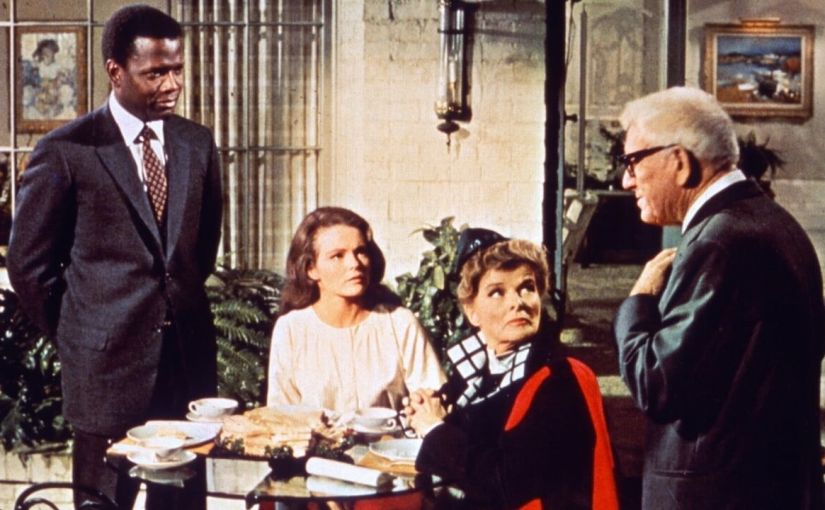
Sidney Poitier portrays Dr. John Prentice, a gentlemanly successful, polite, and brilliant physician with an educational background from Johns Hopkins, a professorship at Yale and internships with the World Health Organization in Africa and Asia.  He has just flown into San Francisco from a Hawaiian vacation with the young girl he has fallen madly in love with, Joanna Drayton (Katharine Houghton).  Joanna is the daughter of Matt and Christina Drayton (Spencer Tracy, Katharine Hepburn).  She is a highly energetic twentysomething with an optimistic view on life.  Everyone else has to take a second look at the fact that Joanna is paired up with a Negro or a colored man (as the movie indicates).  Even their cab driver has to offer an odd glance while the happy couple kiss in the back seat.  John is even aware that it can be a little startling at first.  Joanna doesn’t give it a second thought as she was raised by liberal parents who taught her that no race or creed is better than any other.  Everyone is equal.

The test for Matt and Christina however is whether a black man can be a husband to their white daughter?  It’s much different when you are on the outside looking in.  How do you respond when such a scenario occurs within your own household.  Even the black loyal housekeeper to the Draytons, Tillie (Isabel Sanford), takes a serious contempt towards the situation, more vocally than Joanna’s parents.  For Tillie, this is a hairbrained stunt by a wild-eyed young girl.  John’s parents fly up to meet Joanna and they have reservations as well.  It does not help that John doesn’t share with his mom and dad that Joanna is white ahead of meeting her in person.  Joanna also did not offer the same courtesy to Matt and Christina about John.  Curiously, for Joanna it should not even make a difference.  For John, he’s hesitant because he knows this will not play out well, initially. John is okay with his new, loving relationship.  He’s wise enough to know that his parents, particularly his father, will not be, however.

What caught my attention more than anything was the difference in age between John and Joanna.  He’s 37.  She’s 23. 

In Stanley Kramer’s film, there isn’t so much a prejudice towards whites or blacks.  It’s more so that there is a reservation toward a mixed race couple.  Should blacks only belong with blacks, and whites only belong with whites?  Of course not.  However, biting sarcasm is tossed into the script suggesting that what Joanna and John are doing would be considered illegal in 14 states.  It wasn’t at the time of the release of this film in 1967, but this was just ahead of when Dr. Martin Luther King Jr was assassinated amidst the civil rights movement spreading throughout the country.  Joanna even makes reference to the fact that she would not let go of John even if her mother was Governor of Alabama, who at the time was Governor Lurleen Burns Wallace, wife of notorious segregationist and former Governor George Wallace.  As well, let’s face it.  While it might be legal on the books, many in the United States were still intolerable of a living situation like this. Legally, a mixed marriage can happen.  Yet not everyone settles for just accepting what is law. 

Spencer Tracy as Joanna’s father Matt is the one who most prominently struggles with this situation.  He’s insisted upon to offer his blessing on John and Joanna’s upcoming nuptials.  However, he’s on a deadline to approve as they are flying out of town later that night and will get married in ten days while John is working in Geneva.  This is all contrived to contain the story within one day where a beginning is offered that must arrive at an end that provides closure.  It’s kind of sitcomy.  Christina warms up to the idea.  She likes John very much.  It’s Matt who has the problem.  It’s also John’s father (Roy Glenn) who takes issue as well.  His mother (Beah Richards) approves if the children are happy simply because she loves her son.

Spencer Tracy closes the film with his reasoning on the subject.  Arguably it is one of the most well thought out soliloquies in film history.  What I took away from it the most is that he stressed his concern for how hundreds of people across this country will look upon John and Joanna with unjustified derision.  Yet, the young couple will have to plow on and survive through those challenges. 

As a film, I could not help but account for a common theme in the picture which did not have so much to do with race as it did with a change in generations.  First, Kramer offers a quick escapist scene where a white delivery truck driver is bopping along to the latest rock music.  Tillie’s daughter joins in and hops in the truck for a ride with the fella.

Matt drives to a diner with Christina and orders an ice cream float.  Upon leaving, he accidentally backs his car into a young black man’s hot rod.  The older white man has to negotiate and accept fault with the younger, frustrated black man.  Once it is settled, Matt vents to his wife that he runs into one of them everywhere he looks.  Times have changed.  Matt has taught his daughter that no race is better than any other.  Does he realize that as well, though? 

Later in the film, Sidney Poitier as John has a stern conversation with his father.  John says in no uncertain terms that he owes nothing to his father.  He does not owe it to his father to not fall in love with a white woman.  His father owes everything to him for having him as a son, and he will commit that same mindset to his own children, if he should ever have any, regardless of the changes that come of that future generation.

There’s a reason Sidney Poitier is noted as a pioneer for black actors in cinema.  He was the first African American man to win an Academy Award for Lillies In The Field.  He also performed in Guess Who’s Coming To Dinner in the same year he made In The Heat Of The Night, which focused on a black Philadelphia cop headlining a murder investigation in the racist state of Mississippi at the time.  Both films were nominated for Best Picture. Heat won.  Poitier was well aware of the racist strife permeating throughout the country.  Per his insistence for his own safety, In The Heat Of The Night had to be shot primarily in the state of Illinois, away from the southern states that were not ready to accept a black man in an authoritative role.  I recall reading that Poitier refused to be cast in roles as the clown where the black man was treated as the punchline for white people’s entertainment.  He kept to a policy of adhering to roles demonstrating the intelligence of black men the same as other colleagues in his profession who were of the Caucasian race.  What an influence he was because of his doctrine.

Guess Who’s Coming To Dinner does not take daring risks with its story.  Every single character is likable, other than the racist colleague memorably dismissed early in the picture by Hepburn.  At times, the story does play like a sitcom ready to welcome a laugh track.  Nevertheless, it is an important film to see nearly sixty years later when racism and prejudice remain uninvitingly prominent.  The script, written by William Rose, is so sensible.  What is so wrong with a man, any man, in love with a woman, any woman?  Yes.  It feels unconventional when your household has consisted of one race for so many years or decades.  However, despite the difference in the pigments of two people’s skin, happiness is what is most important.  Matt testifies towards his unconditional love for Christina in his closing remarks and determines that is the one true factor in a relationship that must always be questioned whether it is the start of something new or something that has reached its twilight years.

As I come to my conclusion, again I reflect to that incident I had working in the bank with that teller.  What exactly was so “disgusting?”

NOTE: On this second viewing of the film, I specifically paid attention to Spencer Tracy’s closing monologue.  George Clooney recalled on Inside The Actor’s Studio with James Lipton, a story he heard.  Tracy was very ill during the making of this picture.  So ill, that Katharine Hepburn contributed financing to making this film to appease the insurance company that was concerned about the actor being unable to finish the project.  She drove him to and from the studio and often left early with him when she could see he could not go on much longer in the shooting days. During Spencer Tracy’s monologue, you can see him looking down frequently as he delivered his dialogue.  He was reading lines and blocking cues on the floor.  Clooney was just so impressed.  Typically, an actor would be directed to avoid looking down so much and focus on the camera in front of him or the other performers in the scene.  Spencer Tracy was just so impressive with his timing in this moment.  His glances down at the floor were embedded into the behavior of the character.  Sadly, Spencer Tracy passed away 17 days after filming was completed on Guess Who’s Coming To Dinner.  He received a posthumous Oscar nomination for Best Actor.  I like to think the challenge he endured lent itself to an adoring, beautiful and unforgettable performance. 

IN THE HEAT OF THE NIGHT

By Marc S. Sanders

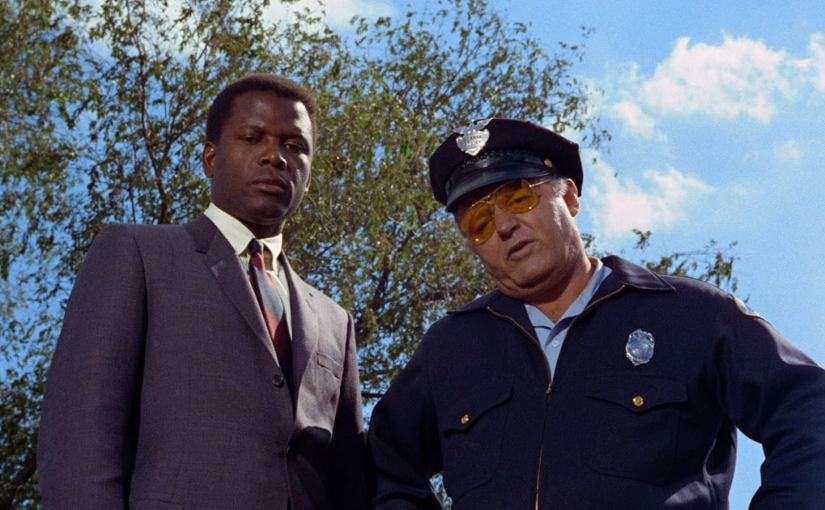
In 1967, just before the assassination of Dr. Martin Luther King Jr, Norman Jewison’s film In The Heat Of The Night won five Academy Awards including Best Picture, Best Actor for Rod Steiger and Best Adapted Screenplay by Sterling Silliphant.  While it is easy to classify the movie as a crime drama/murder mystery/detective story, the setting and themes of racial prejudice overshadow who the killer is or the motive.  As the film progressed, I grew less curious of who bludgeoned white businessman Philip Colbert to death and why.  It was much more important to understand exactly why Steiger’s Mississippi Police Chief Gillespie is so quick to believe that a well dressed and cooperative black man who was simply apprehended for waiting at a train station would be the culprit.  The black man is Virgil Tibbs (Sidney Poitier), a Philadelphia police detective.

After Tibbs has an opportunity to identify himself, Gillespie shamelessly requests his services in solving the crime.  Murder doesn’t happen often in Sparta, Mississippi.  Tibbs’ supervisor speaks highly of his officer’s capabilities.  Tibbs knows how to look for signs of rigor mortis on the deceased.  He knows how to identify that the killer was right-handed and he knows that when another suspect is quickly brought in, that he can’t be the killer either.  Still, many of the heated conversations between Gillespie and Tibbs are the same.  Their back and forths even become redundant at times.  Gillespie, nor the deputies and other residents of Sparta, are apt to listen to a “colored” person.  At one point, Tibbs is put in a cell for not agreeing with Gillespie’s conclusions.  He’s also ordered on two or three occasions to get out of town.  Tibbs is not so willing to surrender though, even if he’s regarded with racial disdain.  The impression is that this murder will not be so challenging for Tibbs to solve, if only he had a little more time and cooperation.  So, the riddle of the crime is not the overall conflict of In The Heat Of The Night.  More so, it is the racial hatred that a deep south Mississippi town has for an educated and skillful black man from up north.  

I read that the film was shot primarily in Sparta, Illinois.  Poitier made that request for his own safety while a tense period within America was occurring against the backdrop of the civil rights movement.  Jewison’s film is quite brave.  In the face of racial divide within the United States, this film still got made.  Yet, it had to be produced with an abundance of caution. 

A telling scene happens in the middle of the picture.  Tibbs requests Gillespie escort him to a wealthy cotton plantation owner’s home.  As they drive up to the home, they pass by the black cotton pickers collecting the crops under the hot sun.  They meet in the estate green house with a Mr. Endicott, who comes off very cordial to Tibbs at first.  However, when a slight accusatory question comes from Tibbs, Endicott slaps him across the face.  Tibbs responds with a slap right back at him.  In Mississippi, a black man better know his place, even if the prime suspect of a murder is a wealthy white man, or more simply just white.  It’s a classic moment in film history.  However, it remains an important scene and maybe its significance should be all the more heightened in modern day 2022 with the Black Lives Matter mentality at the forefront; where police/African American race relations are being tested. 

Three white men were recently sentenced to life in prison without parole for the hate crime killing of a black jogger named Ahmaud Marquez Arbery in the state of Georgia.  All that Mr. Arbery was doing was jogging through a neighborhood.  He didn’t have a weapon.  He hadn’t come in contact with anyone to even slightly suspect a threat.  He was noticed by these three criminals, and because he didn’t belong in that area, he was brutally murdered for the color of his skin.  Evidence would reveal where these men stood with regards to black people as a history of various texts that were clearly racial in nature were later uncovered.  If it wasn’t going to be Mr. Arbery who was murdered, it was eventually going to be another black person who would fall victim to these men. 

Though Dr. King was murdered shortly after the release of In The Heat Of The Night, I’m cautiously optimistic that racial hatred has lessened and the generations that followed learned from the misgivings of their ancestors.  Still, the term “hate crime” is often used in news reports today.  The debate of the Confederate flag and its argument for keeping it flying still has to be pondered.  Fifty years later, I cannot understand why, though. 

I will never forget a vacation I took with my family to Stone Mountain in Georgia back in 2005.  It was fourth of July and we were picnicking on the lawn next to a couple of teenagers while waiting for the fireworks.  I struck up a conversation with a local teenage girl and the flag and the confederacy along with the carving of Confederate leaders (Stonewall Jackson, Robert E. Lee and Jefferson Davis) on the rock sight were brought up.  Her defense of these topics was “It’s history.  Not hate.”  I became much wiser in that moment.  I was just a naïve Jewish guy who was raised in New Jersey.  I was not aware enough.  Much still hadn’t been learned and a whole lot needed to be unlearned.  History is not a reason to celebrate.  History is not meant to honored.  History is meant to be remembered for our rights, and especially our wrongs.  Much of history should not be repeated, and yet that’s what happens all too often.

In The Heat Of The Night is another example of the power of films.  So much is debated about what is taught in our schools.  A proposal of law for “Don’t Say Gay” is likely to be passed in Florida where it’s deemed impermissible to discuss homosexuality in elementary schools.  Books are continuing to be restricted from availability in libraries.  So, if our institutions of learning are being censored, then we have to rely on other mediums.  Movies like Schindler’s List or In The Heat Of The Night or Do The Right Thing offer those opportunities.  Films open a window to view love and hate as well as tolerance and prejudice.  We can never afford to look at our world with rose colored glasses.

YOU ONLY LIVE TWICE

By Marc S. Sanders

James Bond is murdered in a murphy bed!!!!

Thereafter, he ventures off to Japan to uncover who is capturing American & Russian spacecraft in an effort to pit the two countries in a global war. 007 already has his suspicions. Could it be SPECTRE?

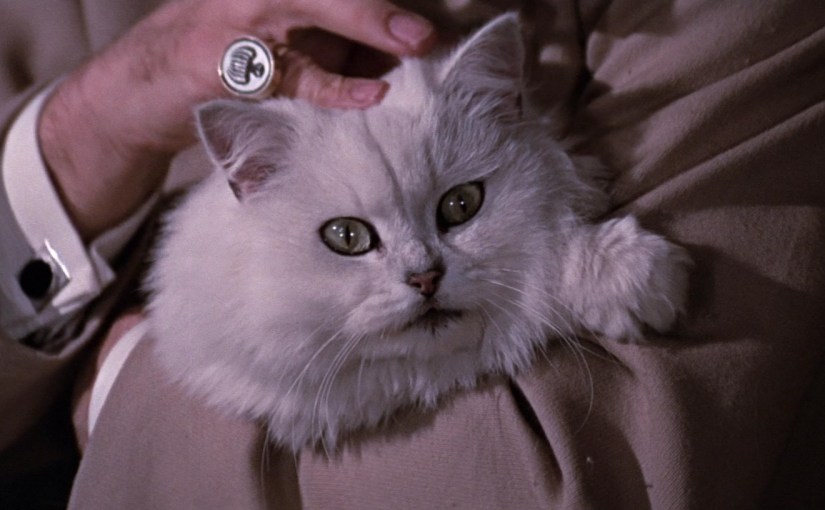
In Sean Connery’s 5th outing as the super spy, Roald Dahl (yes, the same guy who wrote James & The Giant Peach and Charlie & The Chocolate Factory) pens the script for You Only Live Twice, a story that finally reveals the architect in charge of the terrorist organization. His name is Ernst Stavro Blofeld. Donald Pleasence appears as the man with the white cat, long before he chased after slasher Michael Myers every October 31st. “Austin Powers” films have taken all of the shock & awe away from this Blofeld. You can’t help but see Dr. Evil when Pleasence appears.

Still, there is so much to be impressed with. Producers Harry Salzman & Albert Brocolli throw all the money into this film with a hidden fortress beneath a giant volcano, plus gorgeous footage of the Orient, as well as in simulated outer space and underwater, for the secret agent’s funeral.

The first two thirds are fast paced storytelling as Bond encounters one informant or enemy after another. He even gets into a great brawl with the grandfather of Dwayne “The Rock” Johnson. A large sofa makes a great battering weapon.

Regrettably, the movie languishes very unnecessarily into a silly subplot where Bond has to disguise himself as a Japanese man (Mickey Rooney may have looked better in Breakfast At Tiffany’s), learn how to be a ninja in four days (ummmmm…why????), and get married to a Japanese woman (again…..why?????). This apparently is all necessary to raid the hidden volcano fortress. Yeah. It’s ridiculous and you can almost see how ridiculous Connery thinks this is. One of Dahl’s everlasting gobstoppers might have been more useful.

Fortunately, the film redeems itself very well in its ending with an explosive battle between ninjas and henchmen. Bond serves the biggest henchman to some quick eating piranhas. That’s pretty fun.

You Only Live Twice is a gigantic production of grand indulgence largely thanks to the success of 007’s four prior large screen adventures. It’s got big moments, cool gadgets like “Little Nellie” and some unexpected surprises too.

It’s good entertainment.