A HARD DAY’S NIGHT

By Marc S. Sanders

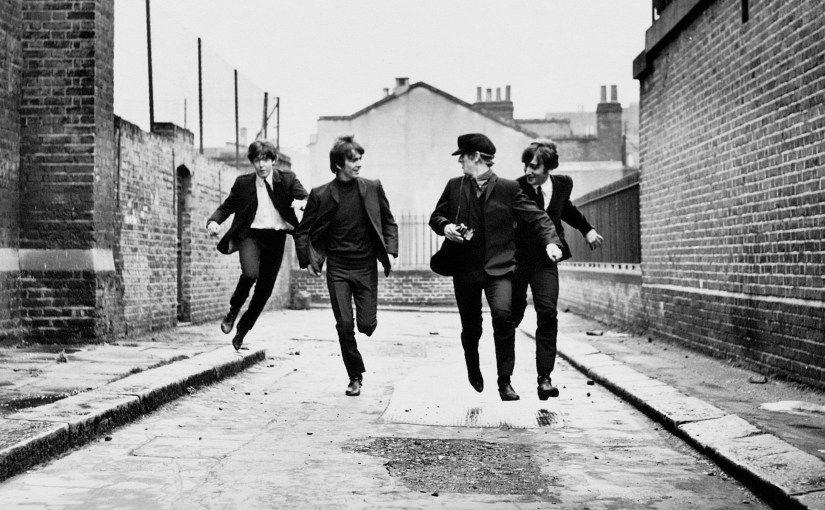
Before there were Swifties or Dead Heads or Parrotheads or Beliebers or Fanilows, there were Beatlemaniacs.  Everyone was screaming for and chasing after The Beatles – John Lennon, Paul McCartney, George Harrison and Ringo Starr.

The musical mockumentary, A Hard Day’s Night, captures the famous foursome from Liverpool over a two-day period, during their time of matching suits and mop top haircuts when they were taking the world by storm with their harmonizing vocals of innocent love and fancy-free celebration.  Richard Lester (eventual fill in director of Superman II) directed with a loose documentary like camera while the young men carried themselves in lighthearted and silly situations that served as a visual vehicle for their hit songs like Can’t Buy Me Love, All My Loving, and I Love Her.  The title song was featured too of course.  Along with Billy Joel and Barry Manilow, I grew up on this music and it helped me appreciate the loose construction of Lester’s film. 

Silly scenarios are set up with McCartney’s supposed “grandfather” (Wilfred Brambel) getting into all kinds of mischief while the guys circumvent through media conferences with improvised dialogue like:

REPORTER: Are you a mod or a rocker?

RINGO: I’m a mocker.

I’m not sure I understand the humor or the existentialism of this exchange, but it had fans, including famed critic Roger Ebert, going ga ga over it.  It even made it on to Premier Magazine’s Top 100 movie quotes of all time.  Then again so did “Plastics!” from The Graduate.  These are the vernaculars of the time.  It’s gotta have something to do with devoted fandom.  Right?

I recall seeing the music documentary U2: Rattle And Hum in the theaters upon release, and there was a moment where The Edge was sitting quietly next to Bono in an interview and snapping his palm on his knee, and the die-hard fan I saw it with could not stop laughing with appreciative glee.  I’m just as guilty.  If someone says in simple conversation “I have a bad feeling about this,” my Star Wars man child wakes up like a dog seeing a squirrel.  It can be politicians, rock stars, movie stars, preachers, athletes or even our parents that center us on an obsession that we respond to.  There’s no denying the Beatles had this kind of magnetism.  With half the band gone, the appeal still upholds much like it does for Elvis Presley and Michael Jackson.

A Hard Day’s Night serves a visual extension of the band beyond just what we would receive audibly over the airwaves and on vinyl.  They had recently finished performing on The Ed Sullivan Show, during their first arrival in America. Their charm, good looks, witty intelligence and even their quiet sensitivity enhanced the worldwide significance of the band.

Richard Lester finds opportunities to show the Beatles being performers of themselves behind the scenes, though most of what is shown in A Hard Day’s Night seems staged.  After all, we famously get to see John acting silly in a bubble bath and when his frustrated manager drains the tub and the suds dissipate, John is nowhere to be found.  A cute gag, much like we would find in music videos on MTV, twenty years after this film’s release.

There is a blend of overhead and wide ground level shots of the four prancing and dancing in an open field while Can’t Buy Me Love echoes through a scene.  It’s silly.  It means nothing.  It’s simply sophomoric fun begging us to appreciate their harmless, mad cap shenanigans.

Each bandmate is given room to shine, but Ringo surprisingly stood out to me the most.  He seemed like the little brother to the other three who was never taken seriously.  Paul’s grandfather even tells Ringo to give up music. He should be “parading.” Suddenly, just before a practice warm up for a television program, Ringo is missing.  The fourth Beatle has seemingly run away.  If I could find character dimension anywhere in this Oscar nominated script by Alun Owen, it surprises me that it came from Ringo; the one who was occasionally considered the least celebrated of the Beatle craze.  At the time, he wasn’t a songwriter.  He sat in the back with his drums.

A Hard Day’s Night is enjoyable simply for the innocence shown of the four guys from Liverpool.  They’re happy with themselves and to be with each other.  It’s very natural and yet it’s a little sad too.  This film predates what was never expected to come of them over the next decade and a half with break ups, marriages, controversies, new career trajectories, and even a sudden death of one of their own, occurring on December 8, 1980.

I can only imagine that in the moment of Beatlemania, A Hard Day’s Night was a celebration of happiness and cheerfulness.  They had a rebelliousness to them, yes.  However, there was never anything like them.  Today, the film serves as a reflection of my earliest appreciations for infectious song lyrics and music.  As a middle-aged man, with two members of the band gone, the picture works like a home movie for me.  It’s like watching archived footage of family members who have long passed away.

When you watch A Hard Day’s Night and sing along to the songs as they enter the picture, the words and the melodies return. You’ll likely find yourself thinking back as if to ask yourself “Remember When…?”

THE PAWNBROKER (1964)

by Miguel E. Rodriguez

DIRECTOR: Sidney Lumet
CAST: Rod Steiger, Geraldine Fitzgerald, Brock Peters, Jaime Sánchez
MY RATING: 7/10
ROTTEN TOMATOMETER: 86%

PLOT: A Jewish pawnbroker, victim of Nazi persecution, loses all faith in his fellow man until he realizes too late the tragedy of his actions.


One of my favorite books about movies is Making Movies by Sidney Lumet, in which the legendary director explains in detail the moviemaking process from script selection through the preview screening and ancillary rights distribution.  He uses, of course, the movies from his own career as examples, from 12 Angry Men through Guilty as Sin (the book was first published in 1995).  One of the films he brings up many times is one I had not heard of when I picked up the book for the first time: The Pawnbroker, from 1964, starring Rod Steiger.  After reading the book many times, I found myself obsessed with finding and watching this, to me, unknown film.

For a long time, it remained a kind of missing link in Lumet’s filmography.  It wasn’t available on home video, and it wasn’t streaming anywhere.  In 2008, it was selected for preservation by the National Film Registry, and the New York Times calls it one of the 1,000 best films ever made.  Lumet is one of my favorite directors.  I was desperate to see this movie.

Some time ago, I finally found a (relatively) cheap copy on Blu Ray, and I sat down and pushed PLAY with anticipation.  I mention all of this because I believe I inadvertently made myself a victim of my expectations.  The film that unfolded was not quite as hard-hitting as I had hoped, even though the story is deep and dark.  Perhaps I am too jaded as a modern filmgoer, with so many other Holocaust-related films under my belt, to fully appreciate this intensely acted character study of a man in crisis.  I can see myself changing my opinion of this movie at some point in the future, maybe when I’m a little older.  For now, in my opinion, The Pawnbroker is a well-crafted film, thoughtfully written, but a little too heavy-handed for its own good.

Sol Nazerman (Rod Steiger) is the aging Jewish owner of a pawn shop in New York City…I’m not familiar with the specific neighborhood, but I wanna say somewhere in the Bronx, or maybe Queens.  He and his Puerto Rican employee, Jesus Ortiz (Jaime Sánchez), run the shop with maximum efficiency and minimal customer interaction.  (Hey, look at that, a guy named Jesus with a Jewish boss, I only just now got that…)  Sol is not interested in the backstories of these desperate folks who bring in radios and candlesticks and school trophies in exchange for a couple of bucks each.  “Here’s your money, get out.”  Jesus, on the other hand, is a bundle of energy who sincerely wants to learn the trade and earn some money so he can get out of the 2-room apartment he shares with his mother.  Sol tolerates Jesus the same way a parent tolerates a hyperactive child.

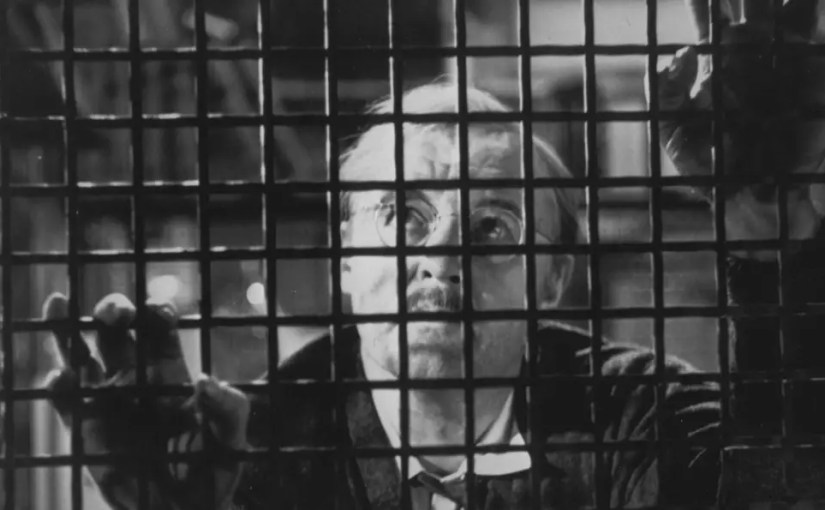
Lumet and his production designer, Richard Sylbert, are very careful to show Sol’s store as nothing but a series of cages and bars.  We learn the reason for this as we see a series of flashbacks from Sol’s past: he was a Holocaust survivor.  (There’s a brilliant scene where Jesus asks Sol what those numbers on his arm are.  “Is that a secret society or something?  What do I do to join?”  Sol’s one-line answer is one of the best things in the script, followed later in the film by a monologue about clinging to a “bearded legend” that showcases Steiger’s talent to the nth degree, but feels a tad over-dramatic.)

Sol’s tragic past is the fuel that runs the engine of the film because it’s made him the man he is today: someone who doesn’t believe in anything anymore, not God, science, art, anything at all…except for one thing: money.  “Next to the speed of light, which Einstein says is the only absolute in the universe, second only to that, I rank money!”  While this sentiment seems as if it would feed into a racist stereotype, Sol never overtly occupies that space.  He is just a man who has seen too much and wants nothing except to get by.

There are suggestions that he is experiencing survivor’s guilt.  In his shop is a tear-a-day calendar showing September 29th.  When Jesus wants to rip it for the next day, Sol stops him.  Later, someone asks him if it’s an anniversary of something.  He says it is: “The day I didn’t die.”  That was the day he was powerless to stop a tragedy, and he should have died, but didn’t.  But he doesn’t frame it as a dramatic act.  I found that a marvelously layered response.  (There is another “suggestion” of his guilt in a monologue by a much older man, but that’s another one of the movie’s heavy-handed moments, so the less said about that, the better.)

There is also a suggestion that Sol is accepting payoffs from a local slum lord to launder money through his pawn shop.  A man comes by, says he needs money to repaint the building, Sol writes the man a check for $5,000, and the man gives him $5,000 in cash.  Why does Sol willingly acquiesce to this process of aiding and abetting a criminal?  I think it’s because he has learned to survive no matter the cost.  In one of his increasingly disturbing flashbacks to his days in the Nazi concentration camp, we watch as a man frantically attempts to scale a fence.  There’s no real hope of escape, but he tries anyway.  The guards don’t shoot him, but watch almost in bemusement.  One of them finally calls for another guard with a German shepherd.  And just yards away, Sol and other prisoners watch helplessly as the man is torn apart.  (Presumably, anyway.)

I haven’t even mentioned the social worker who comes by one day to solicit donations for a youth center, the local thugs (former friends of Jesus) who reek of foreshadowing, the slum lord himself (Brock Peters, playing totally against type as an amoral crook), or Jesus’s hooker girlfriend who knows how desperate Jesus is to get some money of his own and boldly offers her body to Sol in exchange for some cash.  Her act of desperation (featuring the first waist-up female nudity in a post-Code Hollywood film) only triggers more flashbacks for poor Sol. [HA! Jesus has a girlfriend who’s a prostitute…I only just got that one, too…]

By the end of the movie, events conspire that trigger even more feelings of guilt for Sol so that the film ends with him wandering out of his store and into the inner-city jungle with his hands bloody and his head bowed.  Has he realized the error of his ways, of his tendency to reject any kind of human connection?  Certainly his last act seems to demonstrate his remorse, but…has he really changed?  It’s said that, to figure out what a movie is about, look at how the main character changes from beginning to end.  Maybe I’m naïve, maybe I’ve been lucky enough in my life not to have experienced anything remotely resembling the tragedy of Sol’s life, but I felt nothing except mild shock at the end of The Pawnbroker, not because of any realizations about Sol’s character, but because of the events of the plot.  I don’t think that means the same thing as character development.  So, ultimately, I couldn’t really say what this movie is about beyond the ability of a fine director and a courageous actor to show the details of a man wounded so grievously in his past that he can barely tolerate mankind in the present.  Yes, we see the error of his ways…but does he?  You tell me.

ONIBABA (Japan, 1964)

by Miguel E. Rodriguez

DIRECTOR: Kaneto Shindô
CAST: Nobuko Otowa, Jitsuko Yoshimura, Kei Satô
MY RATING: 7/10
ROTTEN TOMATOMETER: 90%

PLOT: In feudal Japan, two women kill samurai and sell their belongings for a living. While one of them is having an affair with their neighbor, the other woman meets a mysterious samurai wearing a bizarre mask.


Squint your eyes, and long stretches of Onibaba look as if they were adapted from comic books.  I’m not talking about the eye-popping colors of Kirby, though.  More like the moody noir of Miller or McFarlane…especially Miller.  Extreme closeups, off-centered faces (to make room for word balloons, of course), sneering lips and bared teeth, gratuitous female nudity, shocking violence, the possibility of supernatural elements getting involved in the story – we’ve got all the makings of a new chapter for the Sin City saga.

But Onibaba misses its chance for true greatness by the disappointing nature of its ending, which I cannot, in good faith, describe in detail here.  The last time I felt this cheated by the ending of a film was when I watched the original Night of Living Dead for the first time.  When the credits for that movie rolled, I wanted to throw popcorn at the TV.  Since I didn’t have popcorn, I cursed out my friends instead.  C’est la vie.

The story of Onibaba begins as we see two women – one older, one younger – living in poverty in medieval Japan.  Some later exposition informs us of an ongoing war far away between two warlords.  Weary soldiers from both sides wander into the tall grassy fields where the women live, and the women promptly kill them, take their clothes and belongings, and sell them to local merchant for bags of millet.  (We never learn the women’s names, by the way.  They are identified only by how they relate to Kichi, a man we never see: one is Kichi’s mother, the other is Kichi’s wife.)  The bodies of the men they kill are disposed of in a large, ominous pit hidden by the tall grass.

I should mention yet another stylistic and visual flourish.  The two women live in a grass hut constructed in a vast field of tall grass at least six, possibly seven feet tall.  There is poetry in many shots when the wind rises and pushes the grass.  In one neat overhead shot, the only way we can see a man pushing his way through the grass is by tracking the hole he makes as he walks.  It’s an indescribably lyrical moment in an otherwise mundane scene.

ANYWAY.  A neighbor arrives, Hachi, with sad news for the two women: Kichi has been killed.  When he asks how the women got by during his absence, they are cagey.  It’s here where we get the first of many masterful sequences where faces and eyes are used to convey emotion more vividly than any prose could.  When Hachi propositions the young woman, now a freshly-minted widow, she sneers.  But as days go by, Hachi wears her down, and they begin an affair, much to the mother-in-law’s disapproval.

Night after night, the young widow wanders off to Hachi’s shack, while the mother-in-law sneaks off and follows her, disapproving but never interrupting their liaisons.  All she offers as a rebuke are stern words and resentful glares.  This cycle repeats itself several times, and despite the visually unique methods of showing us these middle passages, I found myself wondering where this was going.  No doubt people more knowledgeable than I can make conjectures about how this might be a representation of Japanese culture at the time: the old severely disapproving of the young, but powerless to stop the march of progress.  It’s not a far-fetched theory, but if so, it’s an obvious one.  So, what’s the point?

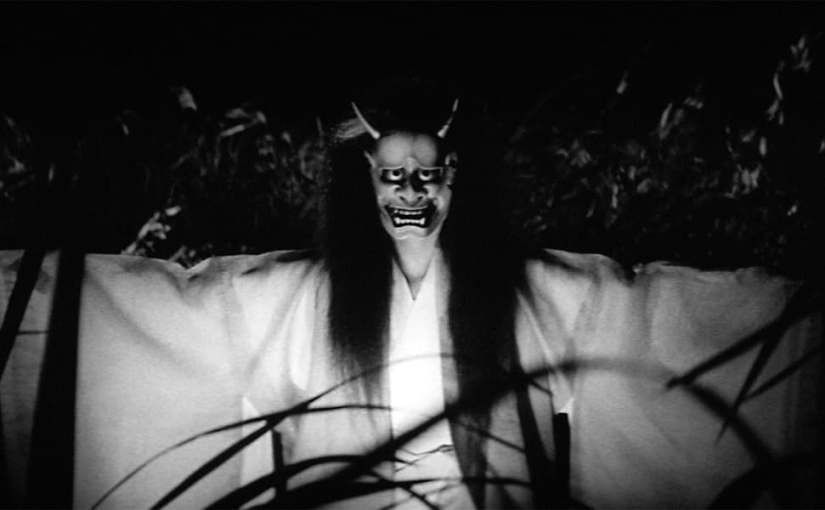
Hope arrives (story-wise) in the form of a tall samurai warrior the mother-in-law encounters in the tall grass one night.  He wears a fearsome demon mask and demands the old woman show him the way to the nearest town.  She asks him to remove the mask.  He refuses, but he assures her that he is very handsome underneath.  Right.

At this point, I was on the edge of my seat.  At last, here we go, some real horror-story stuff.  The mask looks awesomely horrifying, not like the kind of demons we tend to think of, but a weird, bug-eyed, fanged face that still looks vaguely human, which only makes it that much creepier.  When the old woman finally gets her hands on the mask (I won’t say how), she formulates a plan.  The next night, when the younger woman sneaks off to another rendezvous with Hachi, she is confronted by a tall figure with long black hair with the face of a demon…gliding through the grass is if it were floating over the ground.  Floating?  People can’t float.  …what exactly is going on here?

At this point, I was primed for a Twilight Zone kind of twist, revealing the true nature of the samurai warrior, the mask, and the old woman.  (Onibaba translates to “demon woman”, according to the main titles of the movie.)  But what?  I was pleasantly surprised by my eagerness to see what would happen next, even if it were mildly predictable.  The movie had shown great visual flair, so even if the ending was a cliché story-wise, it would look really cool.

But…alas.  The film’s ending teases us with several minutes of truly disturbing stuff psychologically, and then throws it away in a moment of ambiguity, the kind of open-endedness that may inspire discussions on the movie blogs, but which is terribly unsatisfying when it doesn’t work.  And here, unfortunately, it doesn’t work.  It leaves us with more questions than answers, and when “The End” appears, it almost feels like the director and/or screenwriter said, “That’s it, I’m out of story.”

The liner notes of the Criterion Blu Ray for Onibaba inform me that it’s based on an ancient samurai legend, so I guess I can’t totally blame the director/screenwriters.  But I just wish there had been something meatier waiting at the end of what had been a visual treat.  If it had provided a nudge into something deeper or more visceral, I’d have been ready to put Onibaba near the top of my favorite Japanese films.  Visually, it’s stunning with a surprisingly modern feel.  But, oy, that ending.

SEVEN DAYS IN MAY (1964)

by Miguel E. Rodrigugez

DIRECTOR: John Frankenheimer
CAST: Burt Lancaster, Kirk Douglas, Fredric March, Ava Gardner, Edmond O’Brien, Martin Balsam
MY RATING: 9/10
ROTTEN TOMATOMETER: 91%

PLOT: United States military leaders plot to overthrow the President because he supports a nuclear disarmament treaty, and they fear a Soviet sneak attack.


Barely two years after The Manchurian Candidate shocked audiences, director John Frankenheimer delivered the goods again with a political conspiracy thriller that is the equal of Candidate in almost every way.  Were it not for some overcooked sermonizing during a transitional scene, I would almost call Seven Days in May a perfect example of the genre.  I’m frankly a little surprised it’s not mentioned more often in the same breath with other similar thrillers like Fail Safe, The Parallax View, and Three Days of the Condor.

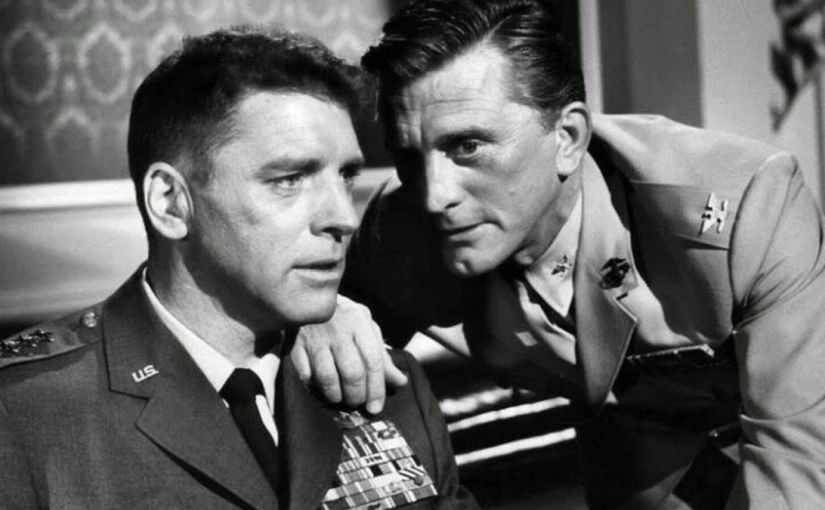
The action starts on a Monday and, predictably, spools out over the next seven days.  We learn that the current American President, Jordan Lyman (Fredric March) has just signed a nuclear disarmament treaty with the Soviets, this being the height of the Cold War in the early 1960s.  His actions have brought his approval ratings to a record-setting low, and demonstrators outside the White House express their desire to see someone else in the Oval Office: General James Scott (Burt Lancaster), a hawkish individual who sees no evidence the Russians will ever honor such a treaty.  General Scott’s aide is Colonel “Jiggs” Casey (Kirk Douglas), a soldier who disagrees with Scott’s views privately, but who knows his duties and performs them admirably.

Over the next couple of days, Casey picks up scraps of conversations from senators and other generals critical of the President.  There is talk of the President attending an “alert”, or an exercise in which armed forces are scrambled in a drill; uncharacteristically, he’s attending alone – no press.  A friend of Casey’s mentions something called “ECOMCON”, a secret Army base in El Paso, and a mysterious “Site Y.”  A Pentagon messenger relays a teletype message from General Scott to other members of the Joint Chiefs about who’s placing bets in the Preakness pool…then gets transferred to Pearl Harbor.  Casey wonders why questions about a horse race would be broadcast over Top Secret channels…

Watching Casey piece the clues together is one of the pleasures of this movie.  It never talks down to the audience, depending on them to follow Casey’s line of reasoning while he draws his own conclusions.  Once he brings his suspicions to the President, and the President elects not to attend the alert, things start happening very fast.  It’s here where the height of suspense occurs, as three men are sent in different directions to accomplish three separate fact-finding missions.  As each man got closer to achieving their goal, there was a feeling in the air, a vibe, a tone that felt like disaster was just around the corner, knocking on the next-door window.  A man drives his car into the desert in search of the secret base in El Paso, and I half-expected the sands to just open up and swallow him whole.

Frankenheimer always was an expert at that kind of suspense generation.  Second only to Hitchcock among his contemporaries, he was a genius at creating tense situations with a minimum of flash, depending on strength of story and screenplay, and his actors, to generate a nervous tension in his viewers.  Those powers are on full display here.

It’s odd…Seven Days in May is a political thriller that doesn’t have any real action scenes or sequences.  A plane crash is referenced but never seen, as opposed to today’s films that would make room in the special FX budget to show audiences the crash.  At least in this film, it’s far more effective when it’s revealed but never seen.  That’s pretty gutsy.  There are no pumped-up chase scenes between a guy with crucial evidence and the shadow forces trying to keep it a secret.  It’s all handled very simply, which makes everything more plausible…and, as a further result, much more suspenseful.

I haven’t mentioned Ava Gardner’s character yet, Eleanor Holbrook, a former lover of General Scott’s.  How she figures in Casey’s plans to uncover evidence of Scott’s treason leads to a devastating scene involving old love letters and mistaken assumptions.  It’s some brilliantly incisive writing, and another example of how the movie achieves plausibility through simplicity.

Any further discussion would necessarily involve spoilers, so I’ll stop here.  Seven Days in May is a prime example of a good story told well, with hardly any bells or whistles.  It reminded me, for some reason, of some of those classic ‘80s thrillers where their only reason for existence was to turn up the tension without getting bogged down in subtext (Body Heat, No Way Out, Blow Out).  There is that one sermonizing speech, as I mentioned before, and I cringed a little when it happened, but it’s a minor quibble.  This is a superior thriller that deserves to be seen.

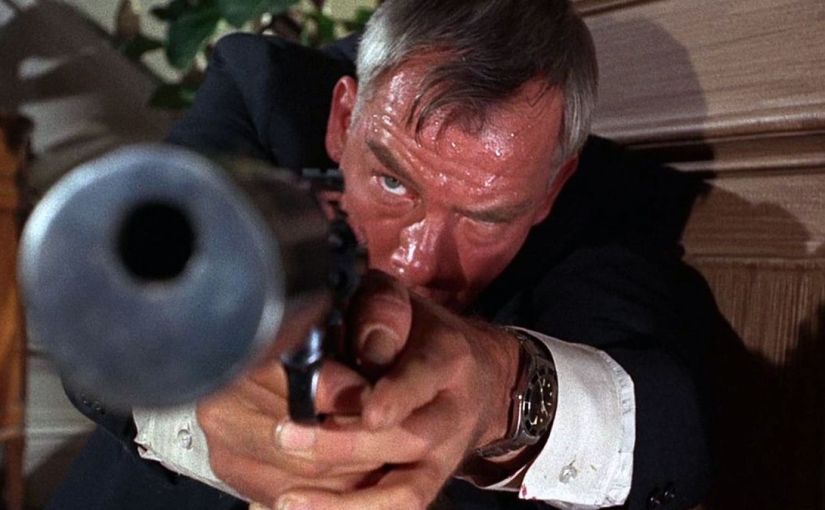
THE KILLERS (1964)

by Miguel E. Rodriguez

Director: Don Siegel
Cast: Lee Marvin, Angie Dickinson, John Cassavetes, Clu Gulager, and in his final acting role, Ronald Reagan
My Rating: 5/10
Rotten Tomatometer: 80%

PLOT: A hit man and his sadistic partner try to find out why their latest victim, a former race-car driver, did not try to escape.


…well, THAT was disappointing.

Fresh off watching the original The Killers from 1946, I dove into the 1964 remake.  Originally intended for television – indeed, this was supposed to have been the very first made-for-TV movie – it contained so much casual violence and sexual content that no network would touch it, not even the network that commissioned it, NBC.  It was imported to movie screens, pillarbox framing and all, where it cemented Lee Marvin’s status as one of the all-time great Hollywood tough guys.  (How tough?  He reportedly shot a scene while he was literally falling-down drunk.  That’s the take that’s in the film; you’ll know which scene it is when you see it.)

But while Lee Marvin is indeed tough, and even though his partner (Clu Gulager) plays a sociopathic killer who brings tension to every scene he’s in, I couldn’t get as worked up over this remake as I did over the original version.  Those two performances aside, this movie felt cliched and a little boring to me.

The story is the same as the original, with a couple of minor changes.  Two hitmen stroll into a school for the blind (!) and gun down Johnny North (John Cassavetes) in broad daylight.  Afterwards, Charlie, the veteran hitman (Lee Marvin) latches on to something he can’t figure out: why didn’t the target try to escape?  He does his own digging which leads him to a motley assortment of thugs and one duplicitous dame, Sheila (Angie Dickinson), who isn’t just a gold-digger, she’s a gold-strip-miner.  Turns out North was part of a million-dollar heist along with Sheila and some other thugs, including Jack Browning (Ronald Reagan).  The heist was successful, but after a series of double-crosses, no one seems to know where the money is.  With his seriously psycho partner, Lee (Gulager), Charlie tracks down the witnesses, and we get the same flashback structure as the original.  And the more he digs, the less he likes what he finds…

One major factor that didn’t score many points with me was the production’s obvious roots in television.  As you can well imagine, lighting on a movie set is very different from lighting for television.  And this movie looks like a TV movie through and through.  At the time, because of the relatively smaller screens of most televisions, it was believed that a movie shot FOR television needed bright lights and especially colors, so the pictures would be clearly visible on the tiny screens.  Well, in this remake, everything is so brightly lit and colorful it looks an episode of Star Trek or any other TV series of that era.  The very brightness of the surroundings drains a lot of the tension out of scenes that are meant to be disturbing or violent.  Blood doesn’t look like blood; it looks like Sherwin Williams.  I’m aware of the technical limitations of the time, but the shortcomings are just so obvious that it left me cold.

(By comparison, the original 1946 version is steeped in darkness and shadows and pools of light; it’s not only more beautiful, but it also just works better for the story.)

I also had problems with the casting of some of the big character roles, but my momma always said, if you can’t say nothin’ nice, don’t say nothin’ at all.  So that’s all I’ll say about that.

The editing was also a little distracting.  Again, this might be a factor of the period when it was made, as well as the fact that it was intended for TV, not the movies.  But one scene annoyed the heck out of me.  I don’t normally nit-pick bad editing, but here goes.

There’s a scene where someone has to drive a car down the length of a winding dirt road within two minutes, if not faster.  Zoom, off he goes.  And as we cut back and forth to various shots showing the car’s progress, instead of cutting directly to a different vantage point or camera angle, it’s cut with fades, which are normally used to indicate a passage of time.  But when the fades are used in what is basically a race against time, it has the effect of making the scene feel longer than two minutes, even though only 30-40 seconds of real time have elapsed.  It made the whole scene feel “off”, even amateurish.  Director Siegel had already directed 15 or 16 films by this time.  I think he should have known better.  Or his editor should have.

By the time we get to the end of the film, we’ve seen someone get dangled out of a hotel window from seven stories up, six or seven people get shot dead (one by a sniper rifle), more double-crosses than a Luftwaffe squadron, and a future hardline conservative President of the United States play…a villain.  But it all felt like an exercise in futility.  Sure, you get Lee Marvin playing a tough guy, but in three short years he’d get to play a really tough guy in Point Blank.  THAT’S the movie you wanna see. Or go find Dirty Harry, or even Escape from Alcatraz, both directed by Don Siegel, both superior films.

This one?  This one I only got because it came packaged with the 1946 version on the Criterion Blu-ray.  Do with that information what you will.

A FISTFUL OF DOLLARS

By Marc S. Sanders

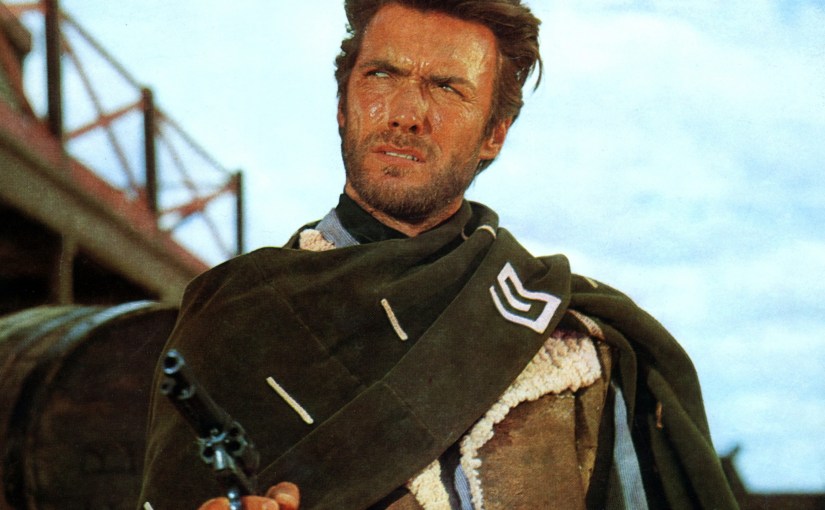
Sergio Leone’s A Fistful Of Dollars is a pioneering classic. It set the standard for the spaghetti western. It made Clint Eastwood a household name and it set a trend for tension filled violence in cinema often imitated by directors like Robert Rodriguez (Desperado) and Quentin Tarantino (Kill Bill, Django Unchained), as well as even Clint Eastwood (Dirty Harry, High Plains Drifter, Unforgiven, Magnum Force) who regarded Leone as well as director Don Siegel as his inspirations and teachers in filmmaking.

The set up is simple. A desolate town plagued by two warring factions is met by the antihero, only known as The Man With No Name (Eastwood). The Man plays the best interests of the Mexican Rojas family against the Baxter family. In the midst of it all, he continues to collect bounties from both sides.

Leone seems to have invented trademark shots that have become routine staples in films like the protagonist appearing from behind a cloud of smoke, the zoom in camera during a quick draw duel, the surprise survival against the odds, and even the memorable one liner (“Get three coffins ready”…”My mistake. Four.”).

It’s exciting entertainment and it paved the way for a different kind of western. The good guy no longer rides a horse named Trigger while dressed in white. Here he welcomes the violence because he knows he’s the only who can eliminate the threat of bloodshed.

Eastwood’s character is a man of few words to keep the viewer curious. Where does he come from? Who is he? How long has he been traveling? It’s one of the all time great movie characters that leads threads hanging and inspired future favorites like Dirty Harry, Rambo, Wolverine, Neil McCauley (Michael Mann’s Heat played by Robert DeNiro), Batman and even Boba Fett, as well as some early Han Solo.

The first of the trailblazing Dollars trilogy still holds up despite the dubbed in English of most of the players. They might be hard to understand at times. Yet the craftsmanship of Sergio Leone makes sure all the elements are easy to follow with seamless control of the camera.

A great Western.

THUNDERBALL

By Marc S. Sanders

Director Terence Young returns to direct the most auspicious James Bond adventure yet, Thunderball from 1965.

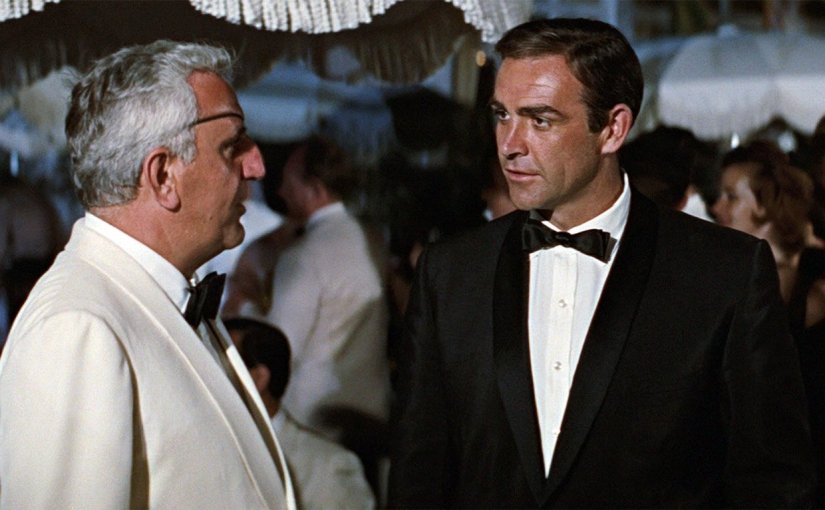
SPECTRE’s Number 2 officer, Largo (Adolfo Celi) captures a British jet carrying two nuclear bombs, and demands England pay 100 million pounds or he will destroy a location in Europe and the United States. Bond is on the mission heading to Nassau, Bahamas to stop Largo (complete with evil voiceover and eyepatch), and recover the plane with the bombs.

The crystal blue sea of the islands allow for a huge undertaking of underwater footage complete with sharks and fight scenes with fists, knives and spear guns. It remains dazzling how well the footage is. Bond (Sean Connery, actually underwater) is there, easily disarming countless SPECTRE agents.

A great centerpiece scene occurs when Bond gets trapped in Largo’s swimming pool with a thug and three sharks to contend with. All this while Largo covers the surface of the pool with a steel sheet. The moment seems inescapable, and Young shoots a memorably suspenseful action piece.

Connery maintains that smooth, suave composure that audiences became accustomed to in his three prior outings, even if his hairpiece is noticeable and his girth is a little wider. On the beach, Bond takes out a bad guy with a spear to the chest and utters the line “I think he got the point.” It’s perfect delivery for 007.

The girl this time around is Domino (Claudine Auger). She is not the most memorable. A beautiful redhead who is not given much to do, even with Bond.

While the underwater camera work is marvelous, Thunderball is not ranked near the best in the series. It feels a little long even when the action scenes are occurring.

Still, Bond continues to hold up as does the curiosity of SPECTRE. Just who is the man with the white cat? We’ll just have to wait and see I guess.

GOLDFINGER

By Marc S. Sanders

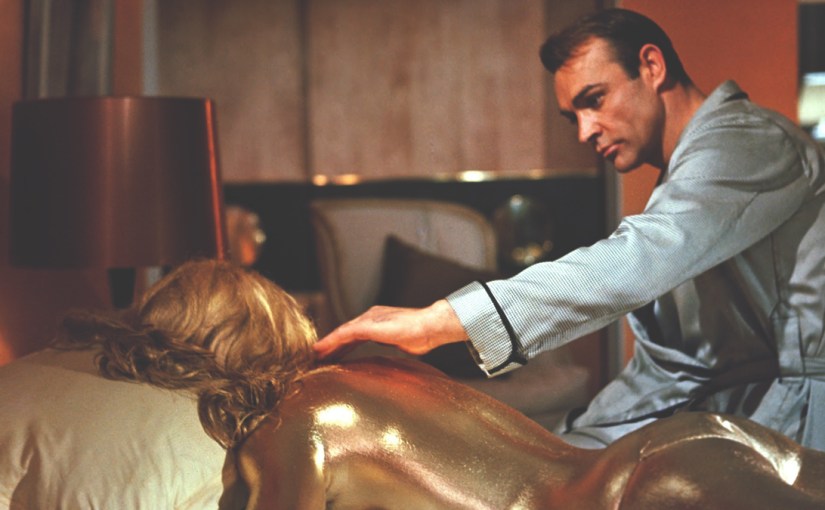
If From Russia With Love offered a promising future for James Bond, Guy Hamilton’s direction of Goldfinger solidified it. This is Sean Connery’s best representation of 007, and yet the only triumphant thing the character does is win a golf match against the title character, Goldfinger, played by Gert Frobe.

As good as the film is, ironically Bond does not succeed in any effort to thwart the diabolical plans of Auric Goldfinger, who intends to invade the gold depository located at Fort Knox. Bond doesn’t deactivate the bomb. He doesn’t successfully get his CIA allies on the right track. He doesn’t even do away with Mr. Goldfinger. Everything happens to occur circumstantially. James Bond just got lucky this time.

So then why is the third entry considered by many to be the best in the series?

Well, the movie is immense in its charm, and it pioneers the flavor of nearly ever Bond film released from here on out, at least until the coming of the blunt, brooding instrument of Daniel Craig.

The vile henchman, Oddjob, with his razor bowler hat introduced a staple needed for a winning film. Every bad guy had to have an unusual trait. Pussy Galore (Honor Blackman) set a more defined precedent for the Bond Girl. Even Shirley Bassey’s dangerously pounding title song carried a threat of the most sadistic villains to come.

Plus the gadgets are exceedingly fun. How do I know? Because time and again Bond returns toward using his classic Astin Martin DB5 with tricked out machine guns, oil slick and (I wouldn’t joke about this) ejector seat. 007’s moment with Q became a necessary ingredient in every Bond film following “Goldfinger.” Actually, I think Q is only missing from 2 or 3 films following this entry.

The tongue in cheek theme couldn’t be more apparent in this film thanks to Sean Connery. “Manners Oddjob. I thought you always took your hat off to a lady.” 007’s casual response to any threat, or what follows after subduing a bad guy, is such fun. What else would you say after you’ve electrocuted a guy in a bathtub?

“Shocking. Positively shocking.”