THE EXTERMINATING ANGEL (Mexico, 1962)

by Miguel E. Rodriguez

DIRECTOR: Luis Buñuel
CAST: Silvia Pinal, Jacqueline Andere, José Baviera
MY RATING: 9/10
ROTTEN TOMATOMETER: 94% Fresh

PLOT: The guests at an upper-class dinner party find themselves unable to leave the drawing room in Buñuel’s famous, none-too-subtle satire.


Buñuel’s The Exterminating Angel has many moods.  On the one hand, it’s a dark comedy of manners railing against the entitlements of the upper classes, much like the more recent Triangle of Sadness (2022), which owes much to this film.  On the other, it’s a Serling-esque horror story mining a common occasion for unexpected suspense, like The Ruins (2008) or Open Water (2003).  On a deeper level, perhaps it’s a Lynchian exploration of the human psyche, regardless of class, like Mulholland Drive (2001) or…well, with Lynch, you can probably just take your pick.

I experienced all of those moods while watching The Exterminating Angel.  I haven’t seen such an effective juxtaposition of tone since Everything Everywhere All at Once (2022).

The weirdness starts right away, in scenes that seem to be setting the stage for a Marx Brothers comedy.  Edmundo Nobile (“Nobile”, “noble”, get it, wink, wink?) has invited a large number of his posh friends to his mansion for dinner following an opera.  The moment they arrive, Nobile notes that his servants are not stationed at the door to take the visitors’ coats.  This is because most of the servants felt the sudden need to take the night off and left, being careful to avoid their employer.  He makes a statement about his servants, then everyone troops up the grand staircase to the dining room.

Moments later, this scene literally repeats itself, not by re-using the same footage, but in a separate take.  This kind of repetition occurs multiple times during the actual dinner scene, as well.  If there’s a deeper meaning to this device, I’ll have to leave it to film scholars to analyze.  For myself, it simply added a layer of oddness to the proceedings, but not in a bad way.

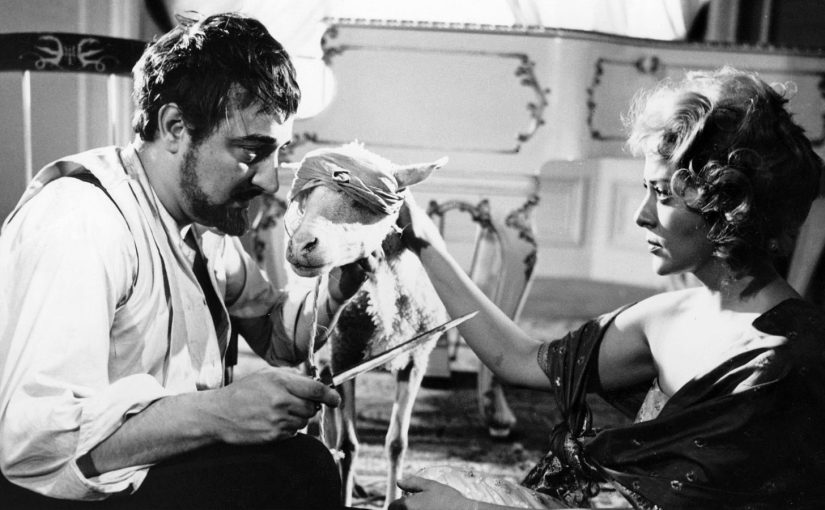
The dinner scene contains pratfalls, repeated conversations, and a visit to a side room containing three or four lambs and a bear on a leash.  What the WHAT…?  I remember thinking, okay, so this is going to a broad comedy turning upper-class manners into slapstick.  Seen it before, so I hope this movie executes it well.

The weirdness escalates when everyone retreats to a drawing room just off the dining room, where one of Nobile’s guests entertains everyone with a piano solo.  But when one of them tries to leave, he finds he can’t.  Not physically, like there’s suddenly an invisible wall, but one by one the guests discover they’re simply unable to leave the room.

They slowly realize the logistics of this bizarre situation.  The drawing room has no food.  Water runs low.  The one servant who remained outside manages to bring in a tray of water and coffee, but when he tries to leave to bring food…he can’t.  There’s no phone for them to call anyone about their predicament.

Outside the house, people find themselves unable to enter the grounds, so no one can tell what has happened to the people inside.  Curious crowds gather.  Inside, social structure starts to degenerate.  There are no restrooms, but one quick shot reveals a closet full of nothing but vases, and we see people entering and exiting these rooms repeatedly.  Ick.  Arguments are started with the drop of a hat.  One couple finds a unique, but undesirable, method of escaping their prison.

I responded to this material very unexpectedly, due mostly to its unpredictability.  I wasn’t cheering at the sight of upper-class twits being brought low when faced with bizarre circumstances, but I was more in tune with the horrific aspects of this story.  Buñuel has stated in interviews that he regretted not being able to take the story even further by including cannibalism, which is honestly where I thought things were headed.  It would have made a marvelous satirical statement, hearkening all the way back to Jonathan Swift.

(So, what DO they eat, you may be asking yourself?  Wouldn’t EWE like to know?)

I realize this review of the film hasn’t been much more than just a summary of its events, minus the surprising, “circular” ending.  A more detailed analysis might require listening to the commentary or reading Roger Ebert’s review or something.  But I hope I’ve conveyed how much I enjoyed The Exterminating Angel.  It was weird and surreal and absurd, and comic and horrific, and slapstick and satiric, and totally unpredictable all the way to the final frame.

P.S.  Now that I’ve seen this movie, the Woody Allen film Midnight in Paris (2011) has even deeper resonance when Gil meets Buñuel at a party and gives him the idea for The Exterminating Angel, and even Buñuel can’t understand it: “But I don’t get it. Why don’t they just walk out of the room?”  Funny stuff.

WHAT EVER HAPPENED TO BABY JANE? (1962)

by Miguel E. Rodriguez

DIRECTOR: Robert Aldrich
CAST: Bette Davis, Joan Crawford, Victor Buono, Maidie Norman
MY RATING: 9/10
ROTTEN TOMATOMETER: 92% Certified Fresh

PLOT: A delusional former child star torments her paraplegic sister in their decaying Hollywood mansion.


I have heard of this movie by reputation almost my entire life, and only now, near the end of my 52nd year on Earth, have I finally sat down to watch What Ever Happened to Baby Jane?, a movie that has been called a camp classic, a horror film in the guignol tradition, and a showcase for two of the greatest bitches in the history of cinema.  And let me tell you, it was worth the wait.  Bette Davis’s performance as Baby Jane Hudson is the stuff of legend: evil, despicable, vile, and impossible to look away from.  She doesn’t just chew the scenery, she purees it.

And yes, before faithful readers get up in my grill, this is one of the slowly growing list of films where the main character is an absolute douchebag, and I not only tolerate it, I celebrate it.  It’s impossible not to.  Like Christian Bale or Jack Torrance, Davis hypnotizes viewers by so perfectly embodying the character that it becomes impossible to imagine anyone else playing it.  It’s been said that at one point, Joan Crawford was going to play Baby Jane, but as talented as Ms. Crawford was, I can’t imagine her improving on Davis’s fearless performance.  This is the very definition of “commit to the bit.”

If you’re like me before I watched the movie, you know the bare bones of the story.  Back in the heyday of vaudeville, Baby Jane Hudson with her golden curls was the darling of the stage, entrancing audiences with her heartbreaking rendition “I’ve Written a Letter to Daddy.”  Her slightly older sister, Blanche, was ignored by her talented sister and, tragically, her father.  But karma is a bitch, and in the early-to-mid-1930s, Blanche becomes a Hollywood superstar, while Baby Jane toils in obscurity, clearly an inferior talent to her celebrated older sister.

One night, there is a terrible “accident” in front of their house (an old Hollywood mansion that once belonged to Valentino), and Blanche is paralyzed from the waist down.  For the next thirty years, Blanche is confined to a wheelchair on the second floor of their mansion, while the delusional Jane, who in her late sixties still wears her Baby Jane makeup and curls, dutifully brings up Blanche’s meals and verbally abuses her.  Their part-time maid, Elvira (Maidie Norman, unknown to me, but quite good in a pivotal role), discovers a trove of Blanche’s fan mail…opened and discarded by Jane.

How to describe these scenes of emotional and verbal abuse?  The words that come out of Jane’s mouth are as harsh as you can get in a movie from 1962.  (In one scene, watch her mouth carefully, and you can see her call Blanche a “bitch” just as a buzzer drowns out her voice.)  But because Blanche, with the patience of a saint, puts up with it, we the audience are forced to accept it.  I mean, I wanted to punch Jane in the face about 30 minutes into this two-plus-hour movie, but I had to tough it out because Blanche is toughing it out.  At that point, I just wanted to see what kind of karmic fate awaited this intolerable harridan.  I wanted her to get trampled by horses while being drawn and quartered by four tractors.

But this is just summary.  I’m not doing the movie justice.  For a 61-year-old movie, it felt just as tense and thrilling as anything I’ve seen in theaters this or any year.  The term “camp” I absolutely disagree with when applied to this movie.  Camp occurs when someone genuinely believes they’re making a great film, and the result is so laughably bad it’s good.  Ed Wood is camp.  Reefer Madness is camp.  Troll 2 is camp.  But NOT What Ever Happened…  Director Robert Aldrich knew what a casting coup he got with Davis and Crawford in the leads, two actresses whose well-known feuds were constantly reported.  All he had to do was turn them loose on the script and keep the cameras rolling.  Rather than getting a movie that got overcooked by hammy histrionics, Aldrich got a top-notch thriller that keeps audiences off-kilter right up to the last five minutes.  That’s not an exaggeration.  As such, this cannot qualify as “camp” because the result was not a bad movie, but a brilliant one.

The different ways in which the screws get turned in such a claustrophobic thriller are ingenious.  Blanche has a pet parakeet that flies away while Jane is cleaning the cage…so she says.  Jane serves dinner to Blanche one day, always with a covered dish, and just as she walks out, she casually mentions there are rats in the basement.  Blanche and we look with horror at the covered dish waiting on her table.  Blanche tries to send a distress signal to their next-door neighbor; the way THAT scene plays out would have warmed the cockles of Hitchcock’s heart.  Blanche discovers that Jane has been practicing forging Blanche’s signature…UH oh.  One day the maid, Elvira, sees too much, and I found myself yelling at the screen when it becomes apparent her life is in danger.

The whole movie works on you like that.  I did a lot of yelling at the screen, just like your stereotypical rude audience member.  At one point, Jane has lied and lied and dug a hole so deep she can’t find a way out, and she pleads to Blanche, “Help me, Blanche, I don’t know what to do!”  The things I yelled at the screen at that point, I will not repeat here, but they involved words that rhymed with “witch”, “ducking”, and “blunt.”  That’s how well the movie got under my skin, in a good way, I should hasten to add.

What Ever Happened to Baby Jane? is one of the finest thrillers I’ve ever seen.  I hesitate to call it a horror film because, in a way, I guess it transcends the horror genre.  It includes some occasional horrific imagery, but the movie is too complex, too rooted in real-world physics and situations for me to see it as a horror film.  It’s a domestic thriller that flirts with self-indulgence, but the performances are so good, we forgive it when, for example, Jane performs her old Baby Jane number, her voice croaking on the high notes like a frog on helium.  In any other movie, I can imagine people would shake their heads and mutter, “Oh, brother…”  In this movie, we still shake our heads, but in awe of an utterly unafraid actor.

As for why I give it a “9” instead of a “10”…ask me after watching it yourself and I’ll tell you.

LAWRENCE OF ARABIA

By Marc S. Sanders

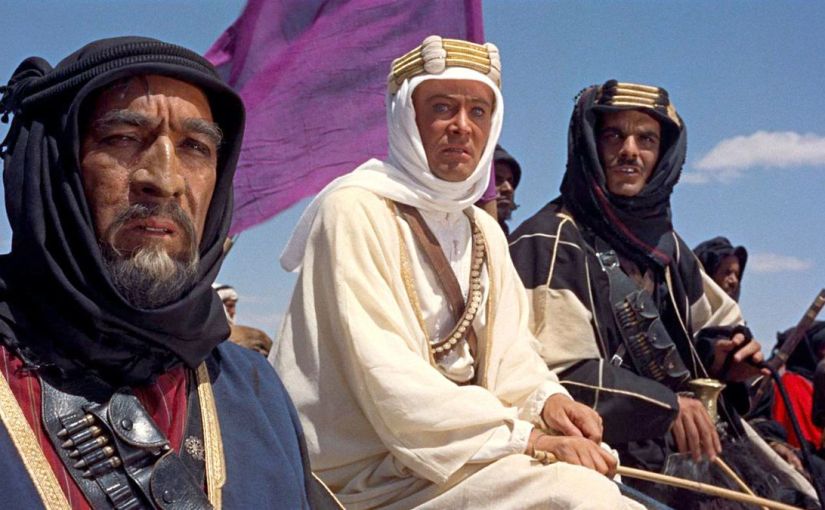
The moment finally arrived where I was able to see David Lean’s epic, also regarded as my colleague Miguel’s favorite film, Lawrence Of Arabia.  It truly is an eye-opening spectacle, and one of the most beautiful pictures I have ever seen, especially enhanced by an up-to-date Blu Ray restoration.  With a near four hour running time there is hardly an element or sliver of film that does not appear out of place.  Far ahead of the conveniences of dazzling special effects and CGI to arrive later in the twentieth century and beyond, Lawrence Of Arabia must be one of the greatest cinematic achievements ever created. 

When you factor in what David Lean made with an earlier picture, The Bridge On The River Kwai, it is fair to say that he was the James Cameron of his time – a bold, daring film director who did not surrender until every shred of a masterpiece was included in a final cut.  What puts a man like Lean ahead of Cameron perhaps, is that he depended on the resources of thousands of human extras and animals, broad desert landscape locations, painstaking architecture to set designs and buildings, along with authentic explosions and battlegrounds while delivering the story of British Lieutenant T.E. Lawrence and his efforts to aid an Arab nation into battle against the Turks during World War I. David Lean was persistent in bringing as much natural quality to his finished product as possible.  In fact, Miguel informed me that Lean was seeking out any possible way to point his cameras at the desert sun to heighten the feeling of the sweltering, unimaginable heat endured by his cast of characters.  It likely pained Mr. Lean that he had to settle for an optical illusion.  Nevertheless, when I was watching the movie, it did not occur to me once.  I was still appreciating his strive for absolute authenticity.

Peter O’Toole is the title character in his unforgettable film debut.  A daring, handsome, charming blond leading actor poised for adventure.  Lawrence is assigned to ally with the Arabs during the war to hold on to the necessary access of the Suez Canal which is a through way for oil, supplies and territory.  His determination for crossing wide, endless desert plains under a sun drenched open blue sky turn him into a leader, and a hero to the Arab soldiers, particularly represented by Sherif Ali (Omar Sharif).  They are a small band of fifty men, but Lawrence proceeds with the intent of gaining fifty more as he begins a long trek from one side of the desert to the other with persistent walking or by riding camel.  Lawrence won’t even leave a single man behind.  His resolve is courageous but could be costly later.

The technical construction of Lawrence of Arabia is likely what many notice and remember first, but the film comes with a well-set character arc for its protagonist.  Peter O’Toole was a perfect casting selection for this role.  Lawrence changes over the course of the film and it’s not a celebratory transformation.  Oft times, it seemed ironic to consider him the villain; perhaps a hero who falls from grace.  His derring-do is impressive, but likely also his undoing.  Lawrence allows strength and confidence to awaken a weak Arab nation who only survived for themselves with what little they held onto before their encounter with him.  Yet, the monster Lawrence creates within his own psyche may have also spawned a challenging threat from the Arabians for many years to come, long after this war is over and further generations come into play.  Bless a people with power but be aware of how that gift is used thereafter.

Lawrence accomplishes what has been regarded as seemingly impossible and now the Arabs adorn him in heroic white cloths (which must be one of the memorable costumes in film history).  He is who they look up to as the giver of their strength and confidence.  However, like most heroes that we find in the best of stories, T.E. Lawrence is weighed by fault, particularly his own hubris.  After his conceit gets him captured and tortured, it is not so easy to return to his home country who insist he continue to carry out his leadership.  Madness is invading his mindset and the hero we have borne witness to for well over two hours of film is now significantly diminished.  Parallel to that is the overconfidence and newfound freedom a political leader like Prince Faisal (Alec Guinness) absorbs for his Arabian people.  The end of David Lean’s film seems to imply what came of T.E. Lawrence’s contributions to the Arabs.  Was the world better or worse for what he achieved with his pioneering, yet dedicated military efforts?  What about Lawrence?  How did he fare, personally?

Forgive my incessant urge to compare David Lean to James Cameron.  I look at a film like Avatar and I see the monies and efforts invested to make that piece.  Yet, I feel like I walk away with little substance.  The films of Cameron not only fall short of story, but often lack texture as well.  I could never reach out and shake the hand of a “Pandoran.”  When I see Lawrence Of Arabia, though, I can feel the sweat and heat that O’Toole and Sharif experience.  Both are big films, not made on the fly. Rather, time and stress and a means to improve and show what’s never been seen or done before are offered.  David Lean might have been given all the monies in the world or the keys to kingdom to make his masterpiece.  However, it’s how he used these resources to painstaking perfection that lend to longevity in reputation for his career and Lawrence Of Arabia.

A train explosion near the start of third act is very impressive.  Lawrence and his men detonate a planted bomb on the tracks, and we see the locomotive derail onto its side, plowing into the hot desert sand.  We feel the immense weight of that steam engine.  We can detect the sand cloud that forms from the crash.  The collision of the cars being ripped apart and burned black thus create a new setting as Lawrence’s Arab followers rush to loot the train.

Grand battle scenes on horse and camel backs are meant to be seen at least ten times over in order to capture every piece of activity from the numerous extras and animals occupying a thousand different corners of the screen.  The bigger the screen, the better enhanced is the viewing experience. 

Long walks and camel rides in the desert may seem tedious for some, but not for me.  I was accompanying T.E. Lawrence and Sherif Ali on this journey.  This is another film where its running time affects what Lean set out to accomplish.  A trek through the desert is impossible to rush and this film is a testament to that notion.  I can’t say I’ve hiked through a desert plain that bears no end in near sight, but now I can lay claim that I’ve watched Lawrence Of Arabia.

Having only seen David Lean’s picture once thus far, I know that on repeat viewings I’d likely see something new each time hereafter.  This film is so alive of its period setting and backdrop and the unforgettable original score from Maurice Jarre give definition to the sweeping adventure that awaits with T.E. Lawrence’s travels.  The cast is marvelous as well.  Peter O’Toole is positively engaging.  Omar Sharif and Anthony Quinn are scene stealing character actors, much like Robert Shaw would become known for a decade later with Jaws.  Alec Guinness may be doing a brown face appearance as an Arab leader, but I’ll just salute the performance.  A charming actor of grand, yet subtle, skill.  I’m glad I’ve discovered him all over again from beyond …River Kwai and Star Wars.

Movies like Lawrence Of Arabia must remain at the top of the broad lexicon of films to watch.  It’s length and scope may be challenging, but its edits, its score, its immense visuals, and the performances therein, are unmatched by most anything else available to watch. 

DR. NO

By Marc S. Sanders

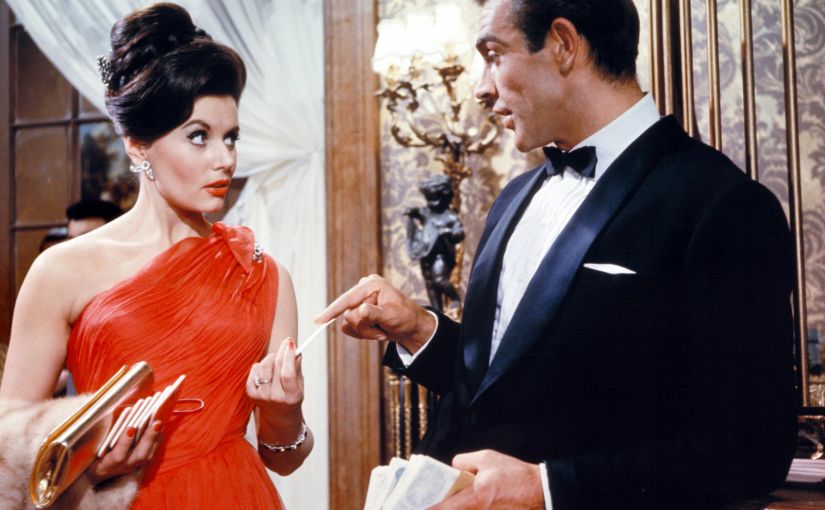
Sean Connery introduced the iconic James Bond, Agent 007, with a license to kill the way he should be (sorry Woody Allen); handsome, highly intelligent and perceptive, quick with fighting techniques and even faster with a beautiful woman.

However, one hero who gets overlooked is director Terence Young who must receive credit for changing the movie landscape. In 1962, sets like Dr. No’s Crab Key fortress were not often conceived in movies. Dr. No is a mysterious villain with limitless resources who serves a Dom Perignon ‘55 while revealing his sinister intent to Mr. Bond. To make him even more unnerving he is bestowed with a handicap of black steel hands to intimidate the hero. This is a scary villain.

Terence Young deserves much credit for a lot of this imagery. It would change how we see action/ adventure films for the latter half of the 20th century and thereafter. Bond’s first cinematic mission set a standard in adventure formula. Set up the threat or mystery, assign the hero to the job, cross him with an ally or two, give him a damsel in distress, interfere him with one bad guy after another. Indiana Jones, Luke Skywalker, Riggs & Murtaugh, Batman and even The Goonies follow this path time and again.

Dr. No doesn’t look so sophisticated a film these days in its cinematography and effects (a car chase consists of going around the same curve 3 times), but it’s storytelling still holds up and even managed to get my 10 year old daughter interested. That’s proof of its staying power.