SHANE (1953)

by Miguel E. Rodriguez

DIRECTOR: George Stevens
CAST: Alan Ladd, Jean Arthur, Van Heflin, Brandon De Wilde, Jack Palance
MY RATING: 8/10
ROTTEN TOMATOMETER: 97% Fresh

PLOT: A drifter (who may or may not be a retired gunfighter) comes to the assistance of a homestead family terrorized by a wealthy cattleman and his hired gun.


Shane affords me the opportunity to use a word I never get to use in daily conversation: archetypal.  John Ford’s Stagecoach [1939] may be the granddaddy of the modern Western, but Shane taps into something even more primal.

Alan Ladd as Shane is the archetype of the mysterious stranger riding out of the mountains, either coming to the aid of a community who has lost hope (Pale Rider, 1985) or wreaking havoc as an avenging angel (High Plains Drifter, 1973), and then disappearing into the sunset or riding back into the distant mountains.  This formula was probably already old when Shane was made, and the film does little to dress it up or add any kind of pretentious spin to the story.  But by sticking to the formula and really nailing it home, director George Stevens achieved a weird kind of clarity that elevates Shane into a mythical realm.  If it’s not terribly realistic, well…who wants realism mixed in with their magic?  Not me.

Shane is set in the high plains of Wyoming in 1889.  (I don’t remember the exact year being mentioned in the film – I pulled it off IMDb – but we can tell it’s after the war because a running gag involves a harmonica player who always starts playing a Union song whenever a homesteader called Stonewall, who fought for the South, walks into a meeting.  It’s a mark of faith in the intelligence of the average viewer that the screenplay never comes out and explains that’s what’s happening; we just see it and have to put two and two together.  Nice.)

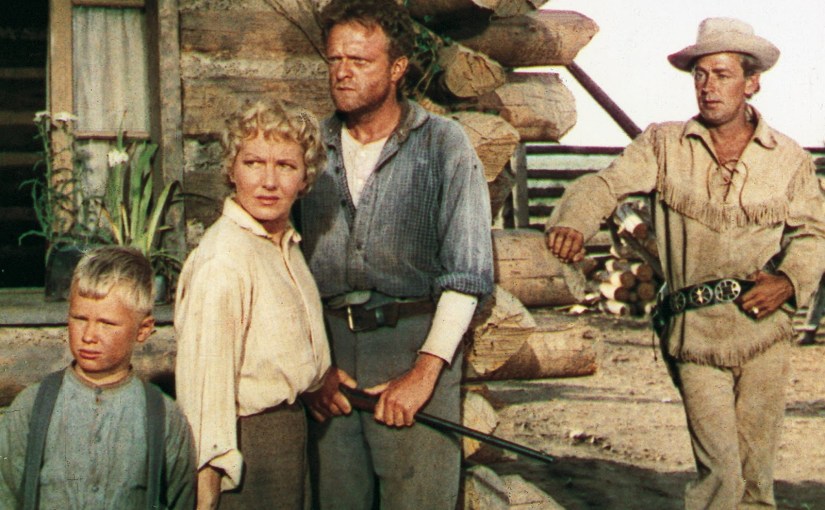
ANYWAY…it’s 1889, and a land baron named Rufus Ryker is trying to run homesteaders off some land that they rightfully own, but which is preventing Ryker from expanding his cattle ranch.  Among these homesteaders is Joe Starrett (Van Heflin); his wife, Marian (Jean Arthur); and his little boy, Joey (Brandon De Wilde, who earned an Oscar nomination for Best Supporting Actor, but don’t ask my opinion of his performance…just don’t).

One day, true to mythical form, a lone figure rides out of the mountains and up to Starrett’s patch of land.  He is improbably good looking, wears a fringed buckskin jacket, two ivory-handled revolvers, and identifies himself only as Shane.  After earning Starrett’s trust, he agrees to stay on as a hired hand and possibly help with the struggle against Ryker…

…and if you’ve been watching movies as long as I have, you could practically write your own screenplay for the rest of the film, because you’ve seen it before, many times.  The stranger proves his worth, defends his new friends, makes friends with the wife (but not TOO friendly), gets hero-worshipped by the little boy, and eventually runs them cattle barons plumb out of business.  But I’ve never seen it done quite like Shane.

For example, there’s a bar fight that ought to be in the Bar Fight Hall of Fame.  Shane, in what HAS to be a deliberate move to goad the bad guys into action, walks into a saloon filled with Ryker’s men to return a soda-pop bottle for the deposit.  A fight predictably breaks out, first one-on-one, then 1-on-2, then 3, then 4.  (Who does this guy think he is?  John Wick?)  The fight gets to a point when it’s winding down…then it picks right up again.  Then they get Shane on the ropes and start waling on him…until Starrett sees what’s happening, grabs an axe handle, and cracks it over someone’s head.  That may not sound like much in writing, but it’s pretty impressive visually, especially from a 1953 Western that feels at times like a Disney product.

(It almost feels like what Tarantino did with the fight between the Bride and the Crazy 88 in Kill Bill, Vol. 1 (2003).  George Stevens said, “Okay, these people want a bar fight?  I’ll give you a damn bar fight.”)

But while I was watching it, I started to analyze it a little bit.  Bar fights…seen one, seen a thousand.  But Shane felt to me like it was embracing the cliché, making friends with a trope, and in so doing the fight became a myth of a bar fight, a fever dream of itself.  It’s not just a bar fight.  It’s THE bar fight.

A lot of Shane works that way.  Shane isn’t just a mysterious stranger, he’s THE mysterious stranger.  An argument could be made for Eastwood’s “Man with No Name” as the archetype of this character, at least in the Western genre, but it’s clear that Eastwood took a lot of cues from Shane when writing and directing his own films.  I’m not suggesting that Eastwood plagiarized Shane.  I’m suggesting that Eastwood’s creations are infused with Shane’s DNA in all the best ways.  (I wouldn’t presume to speculate how much of Shane is in Sergio Leone’s spaghetti westerns starring Eastwood, though I would say those have more of Kurosawa in them than George Stevens.)

There are just two items that bugged me while watching Shane.  One, the editing was occasionally erratic, using a lot of fades or cuts to virtually empty frames in the middle of the action.  I don’t normally pick that kind of thing apart in a review, but it was glaringly apparent in a lot of places.

Two…the tragic waste of talent by casting Jean Arthur as Mrs. Starrett.  Jean Arthur is the fast-talking, quick-thinking actress who appeared in such classics as Mr. Deeds Goes to Town [1936], Mr. Smith Goes to Washington, and Only Angels Have Wings [both 1939].  She goes (or OUGHT to go) on the list of intelligent female actors like Katharine Hepburn and Rosalind Russell.  By 1953, she was semi-retired and only appeared in Shane as a favor to her friend, director George Stevens.  When I saw her name in the credits, I had visions of her delivering fiery speeches, shaming and out-thinking the menfolk, declaring her admiration for Shane without exactly laying out her TRUE feelings for him, and so on.  Instead, she is reduced to spending the majority of her screen time fretting over her husband’s safety, casting loaded glances at Shane while her husband isn’t around, baking pies, and reading bedtime stories to Joey.  I know I just got done writing about how the movie embraces clichés and becomes mythological, and there’s nothing more clichéd than the “little woman” supporting her husband, etc., but something about her role just rubbed me the wrong way.  After this film, Arthur retired from film completely, and although Shane was a massive popular and critical hit, I can’t help but wish she had been given more to do in her last film.

By the time Shane reaches its famous finale (“Shaaane!  Come baaack!”), justice has been meted out and the little guys have won…all is right with the world.  Echoes of Shane still linger today, because who doesn’t like a good old-fashioned bad-guy beatdown, administered by the archetypal mysterious stranger?  This may not be my favorite Western of all time, but from now on, whenever I do watch my favorite Westerns, I’ll keep an eye out for Shane’s shadow, looming large over all who came after it.
GENTLEMEN PREFER BLONDES (1953)

by Miguel E. Rodriguez

DIRECTOR: Howard Hawks
CAST: Jane Russell, Marilyn Monroe, Charles Coburn
MY RATING: 7/10
ROTTEN TOMATOMETER: 88% Certified Fresh

PLOT: A couple of showgirls on a cruise to France get themselves involved in a plot involving a private detective, a diamond tiara, and the occasional musical number.


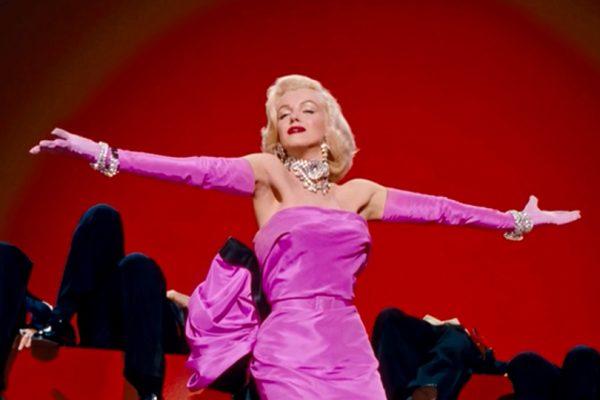
Why did I watch Gentlemen Prefer Blondes, a musical from 1953 featuring Jane Russell and Marilyn Monroe?  Well, it happens to be listed in the movie compendium 1,001 Movies You Must See Before You Die, for one thing.  And there’s the uber-famous production number “Diamonds Are a Girl’s Best Friend” performed by Marilyn Monroe in that iconic pink dress that showcased her shimmy like nothing else I can think of.  And it’s directed by Howard Hawks, one of my favorite directors from Hollywood’s golden years (His Girl Friday, The Big Sleep, Bringing Up Baby, many others).

While the song and the actors and the direction are competent, I didn’t quite get involved in the story as much as I hoped I would.  There’s no denying the wattage generated by Monroe whenever she’s on screen, and the screenplay by Charles Lederer provides some amazing little zingers, some of which I’m shocked got past the 1953 censors.  (When a man is asked which girl he would save from drowning first, Russell or Monroe, the man replies in admiration, “Those girls couldn’t drown.”)  But the plot, which I won’t even bother describing here, is merely a nail on which to hang those visuals of Jane and Marilyn strutting their stuff in exuberant Technicolor dresses and the occasional song or three.  Make no mistake, from a narrative standpoint, Gentlemen Prefer Blondes is pure farce, top to bottom.  (And no wonder, it’s based on a stage musical.)  You either give in to the formula or you don’t.  And I’ll admit, there were times when I didn’t.  There’s a song and dance number at a Parisian café which I thought was unnecessary, and the tortuous route traveled by the tiara, especially its final hiding place, stretched the logical part of my brain to the limit.

But, on the other hand…yeah, it was fun.  Set logic aside and surrender to the sights and sounds, and Gentlemen provides substantial eye and ear candy.  And there are some genuine laughs.  Like the subplot about Monroe looking through the passenger manifest looking for gentlemen traveling “with valets”, who must therefore be rich.  She finds one, Henry Spofford III, and arranges for him to be seated at her dinner table.  The revelation of Mr. Spofford’s true nature is one of the comic high points.

Or the bit towards the end where Jane Russell gets to have her cake and eat it, too.  Thanks to the machinations of the plot, Russell not only gets top billing for the movie, but she also gets to lampoon her sexy costar by impersonating Marilyn Monroe.  (In fact, if I didn’t know any better, I’d say that her appearance in a courtroom wearing a fur coat that conceals all until she crosses her fishnet-clad legs may have provided at least SOME inspiration to that one scene in Basic Instinct.  YOU know which scene I’m talking about, perv.)

But when it comes down to it, if for nothing else, you’ve got to watch Gentlemen Prefer Blondes just to see Marilyn Monroe singing “Diamonds Are a Girl’s Best Friend.”  She may play ditzy and dumb for the whole rest of the movie, but in this number, Monroe is totally and fully in command of her body, the camera, and the audience in that strapless pink dress which looks like it’s held up by sheer willpower.  For several minutes, she coos, struts, bumps, shimmies and shakes, and there’s nothing you can do but just watch in awe.  Almost as much as she did in Some Like It Hot, she simply embodies sexual…sexual…you know what, she just embodies sex.  I suppose there’s a more literary way to describe it, but I’m too tired to think of it.

Gentlemen Prefer Blondes may not feature the dancing feet of Gwen Verdon or Gene Kelly, or the vocal stylings of Debbie Reynolds or, well, Gene Kelly, or the literary complexity of West Side Story or A Star Is Born.  But when you have a song and dance number that is literally inimitable (sorry, Madonna, nice try), who cares?  I can think of plenty of worse ways to spend an evening than watching Jane Russell and Marilyn Monroe for 90 minutes.

[Side note: Penni was NOT a fan of how Monroe’s character constantly called her fiancé “daddy.”  Not sure why I’m mentioning that, but it just made it funnier to me every time Monroe said it.]

THE WAR OF THE WORLDS (1953)

by Miguel E. Rodriguez

Director: Byron Haskin
Cast: Gene Barry, Ann Robinson, Les Tremayne
My Rating: 7/10
Rotten Tomatometer: 89%
Everybody’s a Critic Assignment: Watch a Movie “Classic”

PLOT: A small town in California is attacked by Martians, touching off a worldwide invasion.


I admire the 1953 version of The War of the Worlds most when I try to imagine myself back in that era as someone seeing it for the very first time.  For me, 69 years is still an almost unimaginable gulf of time.  In 1953, TVs were not quite a luxury item anymore, but a color TV definitely was.  Little kids still wore coonskin caps and watched The Howdy Doody Show for fun.  The very concept of UFOs was only six years old.  And the Cold War was a direct threat to our national security and our general peace of mind.

Into this culture came a film that, while thoroughly cheesy by today’s standards, nevertheless captured the paranoia of a nation.  Unstoppable creatures from another planet!  Wreaking havoc wherever they go!  Not even the mighty A-bomb can defeat them!  And who could resist those terrifying movie posters?  “A mighty panorama of earth-shaking fury!”  I would have been BEGGING my parents to give me ticket money.

Is a plot summary even necessary for this classic story?  A fiery meteor plunges to Earth near a small California town, but instead of making a crater, it carves a gully as it slides to a stop.  A scientist hypothesizes it might be hollow inside.  Presently, an alien spacecraft emerges from the meteor, bearing a fearsome weapon that looks like a cobra’s head and rains destruction and death on anything in range.  Forsaking Wells’ original vision of Martian tripods, this version presents sleek, manta-ray-shaped spacecraft supported by nearly-invisible electromagnetic currents.  Or something like that. Reports start coming from around the globe of other meteors and other spacecraft, and it quickly becomes apparent they’re not interested in friendly negotiations.  To paraphrase the stentorian commentary that bridges some scenes, this is the beginning of the end of civilization as we know it.

The heroes of this film are Dr. Clayton Forrester (Gene Barry) and Sylvia van Buren (Ann Robinson).  To put it kindly, their acting skills are…adequate.  To be fair, they weren’t working with a stellar screenplay, but the filmmakers wisely decided the real star of the movie should be the Martians and the Oscar-winning special effects.  As a result, Clayton is reduced to either giving scientific explanations of the Martians, while Sylvia’s main purpose is to look scared, scream loudly, and fry some eggs for Clayton in the middle of a war zone.  (I’m not making that last part up.  It’s not exactly Aliens.)

Regarding those special effects, sure they’re dated, but consider that, at the time, Hollywood studios regarded effects-heavy films as financial losers.  At least, that’s what they thought before The War of the Worlds.  It did so well that one of the head honchos at Paramount – one Cecil B. DeMille – presented the extraordinarily effects-heavy The Ten Commandments (1956) just three years later…and it broke box-office records.  The current trend is to blame Jaws (1975) and Star Wars (1977) for singlehandedly creating our insatiable appetite for special-effects extravaganzas, but look back far enough and there’s plenty of blame to go around, in my opinion.

Full disclosure: I still prefer Spielberg’s whiz-bang 2005 remake of War of the Worlds with its actual tripods and its CGI explosions and its callbacks to the 1953 original, including a cameo by Barry and Robinson, to satisfy cinephiles.  But this version, while dated, still has enough charm to remain effective.  Mostly.  (My favorite part is when the “hatch” on the meteor starts unscrewing; right about then is when I would’ve bought a ticket to Australia.)


QUESTIONS FROM EVERYONE’S A CRITIC

  1. Best line or memorable quote?
    When Dr. Forrester speculates how the Martians’ death ray works: “It neutralizes meson somehow. They’re the atomic glue holding matter together. Cut across their lines of magnetic force and any object will simply cease to exist! Take my word for it, General, this type of defense is useless against that kind of power! You’d better let Washington know, fast!”  It’s formulaic nonsense that’s only once or twice removed from calling an alien mineral “unobtainium”, but it’s delivered with the kind of conviction that only exists in the movies.
  2. What elements of this film do you feel have helped it become a movie classic?
    On a surface level, I’d say the quaintness of its visual effects.  Comparing them to the films of today is like comparing a paper airplane to the space shuttle.  But its also how the film captures the pop culture of the day.  The War of the Worlds fed on the fears and paranoia of a nation and stuck in the minds of millions of moviegoers and continues to do so today.  The 1953 film was influenced by the Cold War.  Spielberg’s remake was at least partially fueled by a nation’s fear of global terrorism.  Perhaps in another 20 or 30 years, some other enterprising filmmaker will once again send Martians to Earth to lay waste to its cities as a commentary on some future phobia or event.  …perhaps a global pandemic…?  Nah, too on the nose…

I CONFESS

By Marc S. Sanders

Alfred Hitchcock’s 1953 film noir I Confess is an absolute must see. An underrated film that held my attention all the way to the end. Perhaps because of its subject matter and setting within the Catholic Church it didn’t hold the reputation of Hitch’s other more well known classics like Psycho, The Birds and North By Northwest. Those films played with their suspense. They had fun with humor and special effects to carry their adventures and horror. I Confess has a little more serious weight to its story, as it examines the scruples of its characters within a murder yarn.

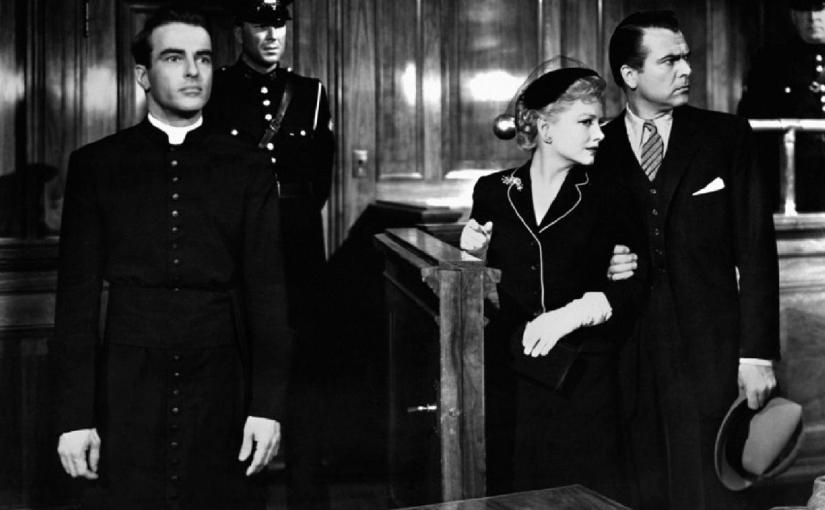
Montgomery Clift portrays Michael Logan, a Catholic Priest, who hears the confession of a murder from the church’s maintenance man (O.E. Hasse), late one night. Only now, sworn to his oath of confidence, he must keep it undisclosed. That might be a little challenging when it is gradually revealed that Fr. Logan might have a connection to the victim, a well known attorney.

Anne Baxter plays Ruth Grandefort, the wife of a politician, caught speaking with Logan just outside of the scene of the crime the next morning. Inspector LaRue (Karl Malden) has reason to follow up on these people. Immediately, your mind will likely go somewhere. When a man and a woman are caught whispering to one another in any murder mystery, well, what are you gonna think? Still, could it be something else entirely? Alibis are not quite solid and unlikely suspects are caught together. Why? What do they know? What’s the connection?

Hitchcock shoots a mystery turned inside out. You know who the killer is in the first five minutes. From there he pursues the red herring until it’s conclusion. The mystery isn’t really the issue here. The question is whether Logan and Grandefort will avoid a frame up. Can Fr. Logan maintain his oath while maintaining his innocence? Det. LaRue has every reason to believe he’s got his culprit, and yet he doesn’t.

Film noir set in Quebec sidles up to questions of morality beautifully here. I was truly wondering whether Logan was going to get exonerated. Hitchcock applies the suspense in that perspective. It’s a great twist on the traditional Agatha Christie motif. He’s got a great tracking shot (actually he was probably carrying the camera and walking on his own two feet) of the maintenance man walking at a fast pace alongside Logan down a hallway, reminding him of his commitment of confidentiality. “As long as you’re a priest…”. Hitch got my pulse racing at this moment.

The three principal players (Clift, Baxter and Malden) are very good here. None of the performances feel dated. As well, Hasse as the murderous German caretaker makes for a good, creepy foil, always looking in from the outside to make certain the investigation never sways away from Logan.

The set up is really well executed from Hitchcock using a script by George Tabori & William Archibald, adapted from an early 20th century play by Paul Anthelme. It’s a little surprising to see a priest caught up in a murder and perhaps some other sinful acts in a film from 1953. There were actually aspects of the original script that Warner Brothers insisted be excised.

However, had this film been made today, there’d likely be an uproar over a Catholic Priest being considered for murder or even participating in a possible affair.

The shock of it all still works in I Confess. A priest is a prime murder suspect? Never! How could it be? Yet, that’s what engaged me. We all are capable of carrying out the worst acts imaginable. The same could be said that we are all capable of holding true to our moral character. Our capabilities are embedded in our human mindset. The question is what is everyone willing to believe.