WINCHESTER ‘73 (1950)

by Miguel E. Rodriguez

DIRECTOR: Anthony Mann
CAST: James Stewart, Shelley Winters, Dan Duryea, Stephen McNally, Millard Mitchell, Rock Hudson, Tony Curtis
MY RATING: 9/10
ROTTEN TOMATOMETER: 100% Fresh

PLOT: A cowboy’s obsession with retrieving his stolen rifle leads to a violent odyssey through the American West.


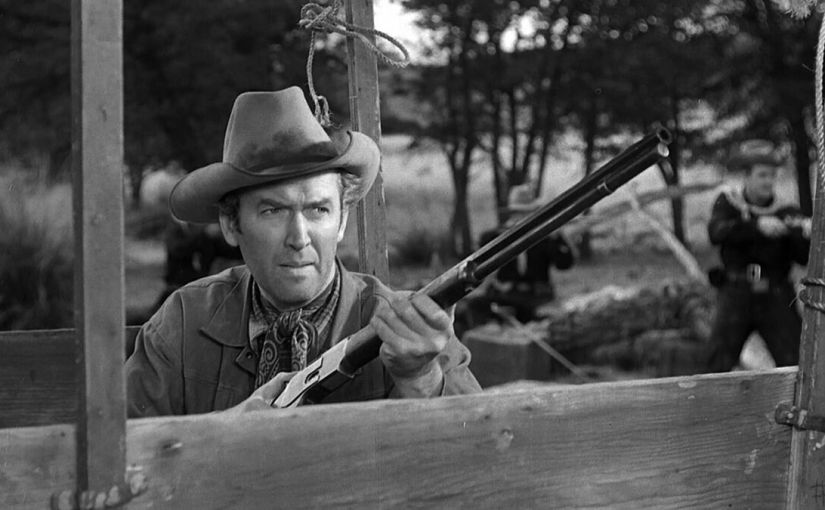
Even without knowing the full history of how the film impacted contemporary audiences, Anthony Mann’s Winchester ’73 still packs a punch.  Using an ingenious story structure, courtesy of a very Western MacGuffin, the film follows the path of a rare, expensive Winchester rifle from hand to hand for ninety taut minutes.  James Stewart is top billed, but he is on screen for less time than you’d think.  That’s actually a good thing in this case, as Mann’s focus is not on star power, but on metaphor and mythology.  (Although Stewart’s star power certainly doesn’t hurt, as he demonstrates in several key moments.)

The movie plops us right into the action with nary a flashback nor an expositional monologue in sight.  The legendary town of Dodge City is holding a shooting contest to celebrate Independence Day, 1876.  Sheriff Wyatt Earp (!) is officiating, and the prize will be a rare model of the Winchester ’73 repeating rifle.  Arriving in town that day is Lin McAdam (Stewart) with his partner, High-Spade Frankie Wilson (Millard Mitchell).

(Around this part of his career, Stewart’s trajectory was on the decline, as he was getting too old to play the aw-shucks-y kind of roles that were his bread and butter in the ‘30s and ‘40s.  Winchester ’73 was an opportunity to showcase his range, and he delivered.  Lin McAdam is not the villain, but neither is he the kind of character Stewart had ever played before.  It’s been written that, when audiences of the day saw Stewart get violent and pin a man to a saloon bar, there were gasps.)

Lin is none too friendly towards another man in town, Dutch Henry Brown (Stephen McNally), who reciprocates in spades.  There is clearly some kind of history, but what that history entails would take too long to explain, so the movie wisely doesn’t try.  They’re enemies, and that’s enough.  Somewhat predictably, they both enter the contest for the prize Winchester, but in the first of many twists, the contest doesn’t play out exactly as you would expect.  Then the rifle is stolen, Dutch and his pals skip town, and Lin and his partner give chase.

From there, the movie gets episodic.  There’s the Indian trader, the Indian himself, Young Bull (Rock Hudson in a fake nose and braids!!!), the obligatory feisty lady, Lola (a luminous young Shelley Winters) and her beau who behaves in a most unmanly manner, a run-in with some cavalrymen (featuring an unknown young actor billed as “Anthony Curtis”), and winding up with a real sleazeball, Waco Johnny Dean (Dan Duryea).  How the rifle makes its way from place to place I will not reveal, but it’s all perfectly feasible.

(I will leave it to wiser minds than I to discuss the racist portrayal of Indigenous Americans, including using Rock Hudson in “red-face” to play a tribal chief.  Yes, it’s shameful and unfortunate, but it happened, and I use the term “Indian” earlier because that’s how they’re referred to in the film, for better or worse.)

If I had to explain what this movie is actually about, beyond its brilliant plotting, I’m not sure I could do it.  I can report that it was engaging and crisp and surprising and almost demands a rewatch after the end credits, but aside from just being a darn good entry in the Western genre, it’s hard for me to pin down its message.  Is it a screed against the violence in the real West?  How some men searched for violence because it was in their nature, or because they felt it was their duty?  I mean…yeah, I guess, but that feels like just scratching the surface.  What were Mann and Stewart trying to say?

Maybe it’s one of those movies where the message depends on the viewer.  If you look at it as an anti-violence film with a bittersweet ending filled with moral ambiguity, it’s there.  If you look at it as just a travelogue or tapestry of the old West, made by a director who loves the genre and an actor sinking his teeth into a great role, that’s there, too.  (Mann and Stewart would go on to make seven more films together, five of them Westerns.)  There’s even melodrama and a hint of romance along the way, but never too much to drown everything else out.  For me, Winchester ‘73 is much harder to unpack than Unforgiven (1992), whose message is crystal clear from beginning to end.  Both movies are equally entertaining, though, don’t misunderstand me.

If any active readers have made it this far, feel free to let me know what the “true meaning” of Winchester ’73 is.  Whether I find out or not will truly not matter, because the movie is still hugely entertaining with or without an explanation.  I might have a tiny bone to pick with the final battle, with its foregone conclusion, but it comes with the territory, so I have to forgive it.  This is a great entry in the genre, featuring a star pushing his boundaries and a director who knew how to harness that energy.

THE ASPHALT JUNGLE (1950)

by Miguel E. Rodriguez

DIRECTOR: John Huston
CAST: Sterling Hayden, Louis Calhern, Jean Hagen, James Whitmore, Sam Jaffe, Marilyn Monroe
MY RATING: 8/10
ROTTEN TOMATOMETER: 97% Fresh

PLOT: A major heist goes off as planned (almost), but then double crosses, bad luck, and solid police work cause everything to unravel.


On the Criterion Blu Ray of John Huston’s The Asphalt Jungle, noir historian Eddie Muller says you can draw a straight line from Jungle to the French heist film Rififi on through to the Tom Cruise Mission: Impossible franchise and Three Kings.  To that list I would add the crime films of David Mamet.  At the moment, I can’t think of another movie in Asphalt Jungle’s era in which the dialogue is so flat, menacing, and uncluttered.  The story is exciting without being flashy, the characters are sharply drawn, and the cinematography creates the underbelly of a city almost Blade Runner­-ish in its gloom.  Even the planned jewelry heist, while detailed, is almost like a Hitchcock MacGuffin: the heist itself hardly matters, only the results…like Reservoir Dogs.  Another descendant.

Doc Erwin Riedenschneider (Sam Jaffe) has just gotten out of prison.  After evading a police tail, he visits a local clip joint looking for help in putting together a heist he had worked on before he was imprisoned.  (I like how Doc and his colleagues rarely refer to “jail” or “prison”; it’s always “behind the walls.”)  He eventually enlists Gus, the wheel man (James Whitmore); Louis, the safecracker (Anthony Caruso); and Dix Handley, the muscle (Sterling Hayden, as shambling as ever, even in 1950).  Doc dismisses Handley as a hooligan.  “Violence is all they know, but they are, unfortunately, necessary.”  Throughout the film, Handley will do nothing to prove them wrong.

They need a bankroll for the heist, so the team goes to a crooked lawyer, Alonzo Emmerich (Louis Calhern), who agrees to their terms, but eventually reveals himself to be even more crooked than they are.  (Emmerich has a mistress, Angela, played by a young, gorgeous Marilyn Monroe in the role that made her a star.  She calls Alonzo “Uncle Lon” and steals every scene she’s in.  John Huston reportedly said Monroe was “one of the few actresses who could make an entrance by leaving the room.”)

The Asphalt Jungle is not so much about the heist as it is about the characters and their behaviors.  We watch how Dix Handley treats the one woman in his life, the appropriately named Doll (Jean Hagen).  She shows up on his doorstep the day after he’s released from a police lineup.  He grudgingly acknowledges her existence and allows her to crash at his place for a couple of nights, “but don’t you go getting any ideas, Doll.”  We see the money man, Emmerich, as he sweats about his planned double-cross, but still has to find the time to placate his bedridden wife.  There’s a great scene with Gus, the wheel man, who also owns a greasy spoon.  A rude cabbie takes cruel jabs at Gus’s hunched back, crippled gait, and scrawny pet cat; Gus reveals his true colors when he handily throws the cabby out of his restaurant while Dix looks on, amused.

Everyone gets their character-driven spotlight, even a crooked cop, Lt. Ditrich, who is assigned the task of finding Doc Riedenschneider, but when he does see him inside a clip joint, he simply turns around and walks away.  Later, Ditrich has a brutal scene with the weak-willed owner of the clip joint where he slaps him around several times to get him to spill his guts.  Watch the scene carefully, and it certainly looks as if Ditrich is really slapping this guy around.

Behavior is everything in this movie, not necessarily the plot.  Without giving too much away, behavior is what gets two characters killed, gets one arrested, drives another to suicide, and leads one to meet his fate in a horse pasture.  Nothing feels artificial or melodramatic.  There is an inevitability to what happens, a tragic undercurrent, that causes us to empathize with these hardened criminals.  These are not nice people.  But when one character unwisely stays seated in a diner when he really should have left, we are disappointed.  When one character’s lies to the police come back to haunt him, we shake our heads in resignation.  Their nature got the best of them.

Sterling Hayden is the headliner of The Asphalt Jungle, and he does get one or two scenes that are “juicier” than the rest, but this is a true ensemble piece.  It takes its time to make us familiar with each key player, with who they are, so we will understand why they do what they do at every turn.  That may seem like Storytelling 101, but you’d be surprised how many movies get that wrong.  Here’s one that gets it right in spades.

SUNSET BLVD

By Marc S. Sanders

One of Billy Wilder’s most famous films is Sunset Blvd. A film that’s always escaped me despite seeing two productions of the stage musical, most recently on Broadway with Glenn Close as Norma Desmond. No matter how it is interpreted, it is a haunting story narrated from the grave of young screenwriter, Joe Gillis. In the 1950 film, Joe is played by William Holden. Norma is played by Gloria Swanson, with Erich von Stroheim as her butler Max.

Joe is a down on his luck screenwriter trying to avoid his car being repossessed. Events lead him toward hiding the car in the garage of a mysterious mansion belonging to one time silent film star, Norma Desmond, now obsolete during the age of talkies. She was big at one time. Though Norma insists she is big. “…it’s the pictures that got small.”

Joe is caught in Norma’s web, feeling obligated to write her story while she provides him with all the money and clothes that she can, to keep him close with no opportunity to escape. Even a sneak away to a New Years Eve party leaves Joe feeling compelled to return to Norma where Max has set up living quarters for him.

Holden’s voiceover narration is wry and descriptive like a novelist’s words being emoted vocally. Feelings are shared allegorically. It lightens the mood of Wilder’s film which is a quite dark and strangely sad depiction of a one time film star who has aged amid her isolation and is all but forgotten among the Hollywood elite. Even Cecil B DeMille (playing himself) doesn’t carry much interest in Norma anymore. It’s especially quite telling later in the film when she unexpectedly shows up on the Paramount lot. She had been called upon, but not necessarily for a new role, rather something else entirely.

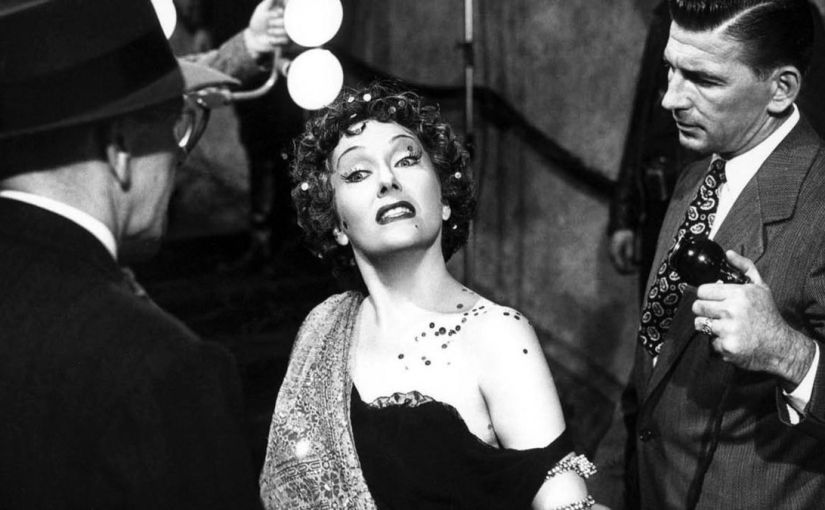
Swanson is unforgettable as Norma; one of the greatest and most memorable film characters to ever grace the screen and the part is drawn out so well within the Oscar winning script from Wilder and his long time collaborator Charles Brackett. Swanson gives honesty to Norma’s madness; look at the famous final stair descending scene. It doesn’t get much better or more impactful than that. Don’t believe me? Go watch Carol Burnett spoof that moment. It’s one of the greatest cinematic moments ever placed on celluloid.

I digress.

Yet, I get Norma’s refusal to accept the changes to Hollywood films. She tells the modern screenwriter, Joe, that back then they had FACES, not dialogue. I get it Norma. I truly get it.

Joe is challenged to maintain his own present state of mind. He’s a writer with ideas like a baseball picture. Only he needs a producer to invest. Sure the money comes to him easy from Norma but it’s conditioned under her rules and unwavering possessiveness. It’s a shame when Joe only gets an opportunity at something following meeting Betty Schaefer (Nancy Olson), a pretty, up and coming writer herself, and engaged to his best friend. Joe is stuck. He has to be covert in sneaking away to write with Betty unbeknownst to Norma. Worse, he has to resist the urge to get intimate with Betty as well. Joe has multiple problems to contend with here all stemming from being stuck in someone else’s past that offers no stimulation sexually or creatively. Wilder and Brackett pen a perfect character conundrum. Joe has no escape.

It may sound silly but I couldn’t help but think of Paris Hilton while watching Sunset Blvd. I’ve never followed the heiress’ comings and goings. However, I recall a time in the early 2000s when Hilton would be all over reality TV. She was in every magazine and on every gossip headline. Not anymore. Reality TV, like network TV, is losing its flame quickly to the newest medium of streaming services. Hilton is now 15 years older. (Desmond is only 50 in the film, when she’s all but washed up.) Could Paris be wondering what’s become of her starlight? Is Paris waiting for the “Joe” who she’ll insist on being her boy toy? My mind actually drifted towards this subject!!!!

If anything, it tells me that Sunset Blvd still holds relevance. Mediums change and those that were once prominent sadly become obsolete. Either we change with the times, or we opt to be abandoned by an ever developing future.

Sunset Blvd should be seen simply as a reminder that our history never stays stagnant. However, a danger lies in refusing to move on or in Norma’s case losing the opportunities to move on. We might all be ready for our close up Mr. DeMille, but doesn’t that mean someone needs to be holding the camera?

ALL ABOUT EVE

By Marc S. Sanders

Today’s actresses can lobby and vie to be Wonder Woman or Black Widow or Jane Bond. Yet, what so many filmmakers and actors fail to recall are the powerhouse performances of yesteryear that didn’t require guns and magic lassos. Movies shouldn’t simply be super heroes and villains in spandex and leather. No movie is a better example of this argument than Joseph L Mankiewicz’ 1950 Best Picture winner All About Eve.

This is also the only film in history to have four actresses nominated for acting awards – Bette Davis, Anne Baxter, Celeste Holm and Thelma Ritter. What an accomplishment!!!

Davis is Broadway legend Margo Channing, a sexy, tough, cigarette smoking broad who grew up and keeps her social life within the limelight. She’s a warrior among the Hollywood and New York elite. When her friend Karen Richards (Holm) welcomes a mousy young girl in a raincoat backstage to meet the famous Miss Channing, it becomes more than just a quick hello. This girl is Eve Harrington who proudly admits to following Margo’s career from San Francisco all the way to Broadway waiting outside the theatre on each performance night for that opportunity to meet the legend in person.

Upon introduction, Eve shares her tragic story of growing up poor and losing her husband in the war. Margo and Karen are taken with Eve, and now the young ingenue has wielded her way into the upper crust life among the pomp and circumstance. Margo’s test of her own celebrity seems to come unexpectedly as it occurs to her and her smarmy personal assistant Birdie (Ritter) that maybe Eve is angling for a way to fill Margo’s big shoes along with her wardrobe and stage costumes.

The elite are intruded upon by this outsider. Karen’s friendship to her playwriting husband Lloyd (Hugh Marlowe) and her friendship to Margo is tested by Eve’s surprising manipulations. As well, Eve is making herself more aware to Margo’s younger lover and stage director Bill (Gary Merrill). Eve also finds ways to build an acting career on the shoulders of these show biz upper class by eventually winning the opportunity to be Margo’s understudy.

The outsider who narrates these developments is the famed theatre critic, Addison DeWitt (a charming and cultured George Sanders who won the Oscar). DeWitt might not get welcomed to every exclusive black tie party in town as he’s “the critic” but that’s fine for it’s how he survives in his career. He’ll recruit a young naive actress like a newcomer played by Marilyn Monroe to maintain a stay within the social circle, and soon he’ll ride along on Eve’s journey for personal gain.

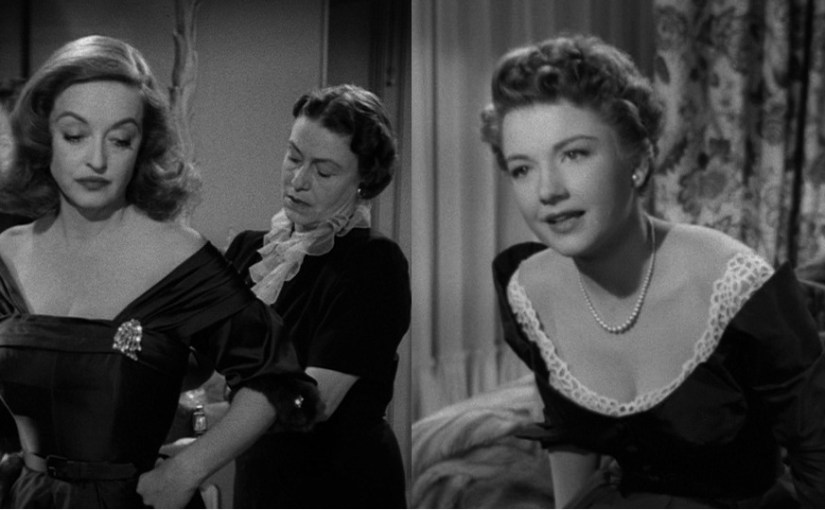
Mankiewicz’ script is brilliantly witty, absolutely biting and sharp. One of the best moments in film belongs to Bette Davis wearing a gorgeous dark evening gown designed by the legendary costumer Edith Head, and used as Margo’s armor ready for social battle. Davis declares “Fasten your seatbelts. It’s going to be a bumpy night.” No line could be so forthright in what to expect of a film like “All About Eve.”

This picture is ranked at the top of many “greatest film” lists. As it should be. This is not a sweeping biographical epic. Rather, it’s a lot of story branches that begin at the introduction of one character and expand in various directions among a handful of others who become disarmed by her ongoing presence. It’s not even that simple as Mankiewicz writes about Eve’s duplicity and how she manages to collide one piece of her destruction with another kind of destruction elsewhere, and the victims are simply blindsided.

Anne Baxter certainly had me fooled as Eve. She’s sweet and innocent on the surface and soon an inner and more evil shell emerges. Bette Davis looks spectacular and delivered one the best female performances of the last hundred years. She can carry herself and keep her guard up and authority in place. There’s a rich and commanding history about Margo that seems easy to believe. She is the queen of Broadway at the film’s beginning. Yet, for a moment her guard is let down and Mankiewicz gives us that window of time for his showcase.

Mankiewicz effectively opens his picture with Eve winning a very exclusive show biz award. She graciously approaches the podium to accept and deliver her speech. However, there are a select handful of individuals who withhold their applause of celebration. Then he flashes back to how we’ve come to this particular moment. It’s a great opening leaving me curious with a bunch of why questions. To watch this sequence the first time leaves you curious. To watch it on a second or third time is to be in on Addison DeWitt’s exclusive story of show biz scheming and diva one-upmanship. I only wonder if Joseph L Mankiewicz was as keen as George Sanders’ character to foresee how much life will come from Eve Harrington’s intrusion upon the lives of Margo & Bill and Karen & Lloyd. Before the age of desperate “if it bleeds, it leads” gossip rags, All About Eve was the real storyteller.