
LEAVE HER TO HEAVEN (1945)

DIRECTOR: John M. Stahl
CAST: Gene Tierney, Cornel Wilde, Jeanne Crain, Vincent Price
MY RATING: 9/10
ROTTEN TOMATOMETER: 85% Certified Fresh

PLOT: A writer falls in love with a young socialite, and they quickly marry, but her obsessive love for him threatens to be the undoing of them both as well as everyone around them.


Leave Her to Heaven is one of the earliest examples in my movie collection of what I call a “head-fake” movie.  There is a tiny bit of foreshadowing in its opening moments, but after that, it appears to fall into the traditional pattern of an old-fashioned, melodramatic potboiler, with a spurned fiancé, lovers in a whirlwind romance, and glorious three-strip Technicolor production design and cinematography that makes everything feel like a Douglas Sirk soap opera.  When it makes its left turn into unanticipated territory, I was on tenterhooks.

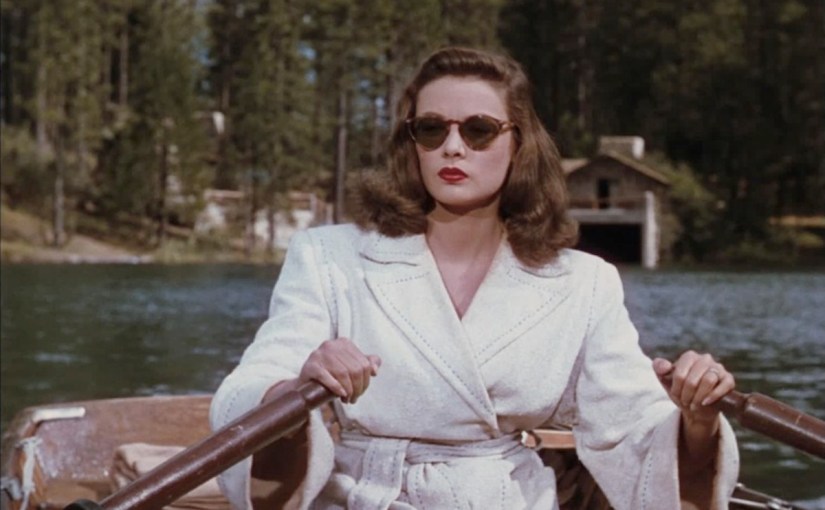
Author Richard Harland (Cornel Wilde) has a classic, almost clichéd meet-cute with the ravishing Ellen Berent (Gene Tierney, who has never looked more beautiful) during a train trip to New Mexico.  He’s visiting friends, she’s there for a funeral, and their circles of friends unexpectedly mesh.  He winds up staying with her family at their ranch house.  She and her family remark how much Richard resembles Ellen’s late father.  He notices her engagement ring, but a few days later he also notices its absence along with her declaration that she’s removed it “forever.”  (I’m REALLY condensing here to get to the point…)

Her fiancé, Russell Quinton (a very young Vincent Price), arrives upon hearing she’s broken off their engagement.  He leaves after a brief conversation, and a few minutes later she literally proposes to Richard.  They marry and enjoy a few scenes of wedded bliss (in separate beds, of course, this is the ‘40s), during which Ellen makes some red-flag-raising statements to the effect of, “I’ll never let you go” and “I want you all to myself.”

During all of this, the filmmakers exhibit terrific restraint.  In some high-tension scenes, there is a notable lack of background score, which is a bit unusual for these kinds of pictures.  You usually get ominous for tension, or pastoral for outdoor scenes, etc.  But Stahl seems determined not to cue the audience for what they’re supposed to feel at any given moment, with one or two exceptions.  This method contributes greatly to not giving away what’s coming.  Ellen’s own words do that all by themselves.

There are other plot developments I could mention: Richard’s brother, Danny, who is disabled and comes to live with them for a while…Ellen’s fixation on how much time Richard spends with her sister, Ruth…Ellen’s attempt to get Danny’s doctor to prescribe more bedrest…these and other signal markers start to twist this apparent soap opera into something else entirely.  It reminded me of the great head-fakery in Woody Allen’s ingenious Match Point [2005], which also started out in soap opera territory and wound up somewhere altogether more sinister.

Much is made of the film’s Oscar-winning cinematography, and rightly so.  In an era when color films were an extravagance for a movie studio, they made the right choice here.  Cinematographer Leon Shamroy and production designer/art director Lyle R. Wheeler create picture-postcard images of a bygone era, lending an air of “vintageness” to the rooms, wardrobe, and makeup of the actors.  Look at Gene Tierney’s marvelous red lips, or the gaudy red of her swimsuit, worn at a time in the film when she probably shouldn’t have been so extravagant.

But I particularly love the music choices, or rather the choices to NOT use music during key sequences.  One in particular stands out.  If you’ve never seen Leave Her to Heaven, I won’t spoil it for you.  It’s the scene with a rowboat and one character’s attempt to swim across a lake.  In many other films of the time, there would almost certainly have been tense strings, low cellos and brass in the background.  For some reason, my mind goes to Miklós Rózsa’s magnificent score for Double Indemnity [1944].  That’s the kind of music normally heard in scenes like this.  But the filmmakers made the canny decision to let us merely listen to the actors and watch as Ellen makes a crucial decision.  That dread silence fairly SCREAMS as the scene progresses.

It’s tempting to look at this movie as a kind of Fatal Attraction [1987] prototype, but that’s not giving either movie its due.  Fatal Attraction is a straight up thriller, and it’s about an unfaithful husband getting what he deserves.  Leave Her to Heaven is also a cautionary tale, but not because the husband did anything wrong, aside from choosing to ignore a lot of red flags in Ellen’s behavior until it was far too late.  It might also be possible to interpret the film as a warning to men against women who think for themselves too much, who are too “take charge”, or would be considered such in the 1940s.  But I would disagree with that interpretation, too.

Look at Leave Her to Heaven as a whole, and I think it most closely resembles Lawrence Kasdan’s Body Heat [1981], or vice versa.  Both feature femme fatales who are not shy about doing what’s necessary to get their way.  The film’s ending even seems about to resemble Body Heat’s ending, but it veers away at the last second from the later film’s bleakness, providing an ending that seems just a little too pat.  I have a sneaking suspicion the filmmakers had a different ending in mind, but were forced to make changes to please the censors.  If there’s anyone out there who knows how the book on which the film is based ends, sing out.

Leave Her to Heaven is a singular experience.  I even knew about the famous boat scene, and I was still on the edge of my seat.  I simply couldn’t believe she was going to go through with it.  That’s the sign of a great film: you know what’s coming, it’s inevitable, but instead of feeling predestined, there is real suspense, a desire to know why this is happening, and what’s going to happen next.
THE LOST WEEKEND (1945)

by Miguel E. Rodriguez

DIRECTOR: Billy Wilder
CAST: Ray Milland, Jane Wyman, Phillip Terry, Howard Da Silva
MY RATING: 8/10
ROTTEN TOMATOMETER: 97% Certified Fresh

PLOT: The desperate life of a chronic alcoholic is followed through a four-day drinking bout.


I don’t drink.  Like, at all.  I’ve never taken drugs, and I’ve never smoked a cigarette.  Luckily, I have never been gripped in the throes of a crippling addiction, unless collecting movies counts as an addiction, in which case I plead the fifth.  I say this, not to brag, but because a lot of my first impressions of Billy Wilder’s The Lost Weekend are tinted by the fact that I don’t know the first thing about being drunk or what it means to suffer from an addiction so crippling that it would force me to hang a liquor bottle outside my window to hide it from my brother.

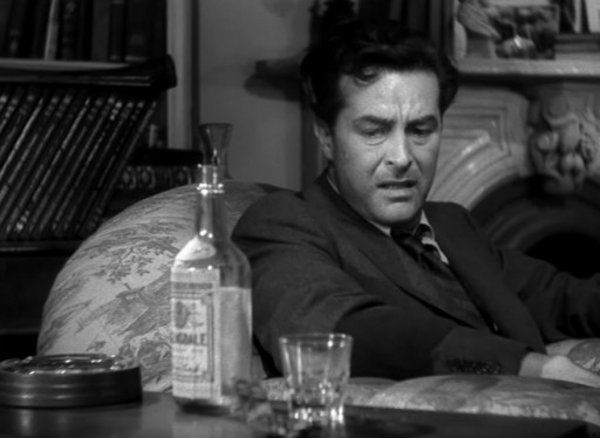
As it happens, Don Birnam (Ray Milland) DOES suffer from this kind of mid-to-late-stage alcoholism.  We first meet Don as he and his brother, Wick (Phillip Terry), are packing for a long weekend to get away from everything and everyone, including alcohol.  Don is a would-be author who needs a break from…something.  (Whatever he went through is never specified, only hinted at: “It’ll be good for you, Don, after what you’ve been through.”)  Don’s plan to surreptitiously pack the hidden bottle of liquor falls through after the arrival of his almost unbelievably good-hearted girlfriend, Helen (Jane Wyman).  No matter.  He still has a plan, which he confides to the long-suffering but increasingly annoyed bartender, Nat (Howard Da Silva).  He’s bought two bottles of rye.  He’ll hide one badly in his own suitcase and another in his brother’s suitcase.  When Wick discovers the badly hidden bottle in Don’s suitcase, he’ll chew Don out, Don will act suitably contrite, and Wick won’t think about searching his OWN suitcase for a second bottle.  What could go wrong?

During these first few scenes, when Don lies and lies and drinks shot after shot in a bar and winds up missing the train for his getaway weekend, I found it difficult to sympathize with him.  Oh, he’s clever and loquacious when he’s either about to drink or while he’s drinking.  He has enough knowledge to quote Shakespeare at the right times and wittily proposes to Nat the bartender: “I wish I could take you along, Nat.  You and all that goes with you.”  Under the right circumstances, Don is a fun guy, always good for a laugh…until his seventh or eight or ninth shot of bourbon.  Then the other Don shows up, Don the drunk, Don the liar, the Don who gets so desperate for cash that he’ll walk 70 or 80 New York City blocks trying to find an open pawn shop so he can hock his typewriter for drinking money.

For some reason, it was harder for me to empathize with Don Birnam than it was to empathize with any of the main characters in Darren Aronofsky’s Requiem for a Dream (2000).  In that film, not a single leading character escapes the ravages of addiction, and yet even as they made their mistakes, I empathized with them and grieved when their bad decisions made things worse and worse.  With Don Birnam, however, every bad decision he made just made me like him less and less.  I remember thinking at one point, “He’s brought this all on himself, he deserves what he gets.”  Not a very Christian attitude, but I’m not gonna lie about it: that’s what I felt.

And his girlfriend, Helen…wow.  It’s almost like she needs as much of an intervention as he does.  She loves Don so unconditionally it’s almost unbelievable.  What’s the attraction?  Perhaps it’s symptomatic of the era in which The Lost Weekend was made.  She discovers Don’s alcoholism late in their 3-year dating relationship.  (What did people think in 1945 of someone who dates a man for 3 years?)  Instead of breaking up with him or giving him ultimatums, she devotes herself to “fixing” Don.  Not precisely the course of action I would recommend myself in today’s world, but there you have it.

Director Billy Wilder presents this first half of the movie in a very uninflected tone with little-to-no comic relief.  This flat tone becomes very effective at simply presenting the information without directly commenting on it one way or the other.  There are moments up to this point where the movie seems to side with Don (his struggle to find a bottle whose hiding place he’s forgotten is particularly pathetic), but it’s still not really passing judgment or giving him a pass.

And then…the turning point.  Don accidentally falls down a flight of stairs and knocks himself out after finagling some drinking money out of a young lady he flirts with at his favorite dive.  When he wakes up, he’s lying in a bed in the Alcoholic Ward of the local hospital, face to face with one of the strangest characters I’ve ever met in a Billy Wilder movie, and that’s saying something.  He’s a nurse.  “Name of Nolan.  They call me Bim.  You…can call me Bim.”  The closest I can get to describing Bim’s weirdness is to imagine an evil Waylon Smithers from The Simpsons as a male nurse.  On quaaludes.  To Don’s slowly increasing discomfort, Bim lovingly describes what Don is in for during his stay on the Alcoholic Ward, giving the inside scoop on the various repeat offenders and what to expect during his D.T.’s: “You know that stuff about pink elephants?  That’s the bunk.  It’s little animals.  Little tiny turkeys in straw hats.  Midget monkeys coming through the keyholes.”  This Bim…he has NO bedside manner, man.  “Prohibition…that’s what started most of these guys off.  Whoopee!”  (Nice little social commentary there…classic Wilder.)

Don manages to find his way home once again, having not had a drink for almost a day-and-a-half, if my memory is correct.  And it’s at this point that the movie, Billy Wilder, and Ray Milland finally got me in Don Birnam’s corner.

SPOILER ALERT, SPOILERS COMING.

Don finally has a bout of the D.T.’s.  It’s not turkeys or monkeys or elephants, though…it’s a rat.  A single rat chewing its way out of the wall in front of him.  Then, out of nowhere…a bat finds its way into the apartment and flutters around the room.  Don is understandably distressed.  But then the capper: the bat swoops down to where the mouse’s head is poking through the hole, there is a terrible squealing sound, the bat sort of trembles and scuffles…and a stream of thick blood starts to dribble out of the hole where the bat is presumably chewing the rat’s head off or something.

To say I was surprised is an understatement.  Don starts screaming his head off…and at long last I finally empathized with Don’s situation, and I no longer wanted him to wind up penniless and/or alone and/or dead.  I wanted the movie to find a way to fix him, like Helen tries desperately to do through the entire picture.  From then on, I was on his side, or Helen’s side, or whoever’s side, it didn’t matter, as long as he figured out a way to get out from under the disease that was slowly killing him.

I would not dream of revealing exactly how the movie ends.  It might go the way of Leaving Las Vegas (1996).  Or it might go the way of the vastly underseen Duane Hopwood (2005), featuring David Schwimmer as an alcoholic father on a path of self-destruction, but who manages to turn things around.  (Sorry if I spoiled that for you, but I’m betting it’s not a movie most people will want to seek out.)  I will say that it’s the ending of The Lost Weekend that really showcases the era in which it was made more than anything else.  But it could just as easily have gone the other way and still been just as successful.

The Lost Weekend cleaned up at the 1945 Oscars, winning awards for Best Picture, Best Director, Best Actor, and Best Adapted Screenplay (it was based on a novel).  At the time, it was the most unglamorous movie ever made about alcoholism.  Up to that point, drinking in movies rarely if ever led to hangovers and the D.T.’s and spending the night in the Alcoholic Ward.  It certainly belongs to be mentioned with Wilder’s greatest films.  But you’re gonna wanna watch something a little lighter afterwards.  Stalag 17, maybe.  Or Some Like It Hot.  A laughter chaser.

THE LOST WEEKEND

By Marc S. Sanders

Ever wonder why I write so many reviews?  It’s because I yearn to be a successful playwright/screenwriter.  I’ve directed three original plays that I’ve written over the years.  I will be directing a fourth for the holiday season later this year.  Had a few short plays I wrote performed locally as well.  Still, I suffer from a terrible ordeal that often grinds me into bouts of depression and internal rage.  Writer’s block! 

My father always told me that he stayed away from gambling and casinos. He said it was because he could have an addictive personality and he was not confident he could stop if he started.  I know what he means.  I have an addiction.  One that’s not commonly recognized, but I obsess over something every single day. Without fail, every damn day.  It’s my weakness.  Sorry.  I must keep that to myself, though.  Yet my pursuit of what preoccupies my mind taxes on my motivations to write and stretch the imagination needed for churning out one script after another.  So, a remedy is to write about movies that speak to me in lieu of my next great play. 

Billy Wilder’s Oscar winning drama The Lost Weekend demonstrates a writer’s inability to exercise his talent when an endless need for alcohol consumes his every waking moment.  Ray Milland delivers an Oscar winning performance as Don Birnam, an alcoholic wannabe writer of the worst kind.  When Wilder’s film opens, Don seems healthy and spry.  He’s clean shaven, well dressed, and ready to pack a bag for a weekend getaway that his brother Wick (Phillip Terry) has arranged for him along with Don’s girlfriend Helen St. James (Jane Wyman).  Wick implies to Don that this trip is just what his brother needs after what he’s recently been through, and he’ll have his typewriter with him to write in calming solitude.  Eventually we get an idea of what Wick has been referring to as Don attempts to sneak a bottle of rye that is strung outside the window of his New York apartment.  Wick catches Don in the act, pours the bottle down the drain and assures him that he won’t find another drop of liquor anywhere.  He doesn’t even have money to go to the corner bar.  So, Wick and Helen leave Don alone for a few hours before it’s time to depart. Don gets ahold of some cash though, and thus begins a spiral into a drunken binge over a four-day weekend.

I read that when this film was released, test audiences laughed at it.  I guess in 1945 people were not attuned or prepared to witness an account of a very real disease like alcoholism.  I’m not certain it was even diagnosed as a disease at that time.  Surely, the addiction was an ailment though, and Billy Wilder uses some effective cinematic devices to demonstrate the journey into madness and desperation for even just a tiny shot glass of gin or rye. 

A repetitive device is to show a tormented performance from Milland within the shadow of bars or fences.  He’s trapped in his own need for swill.  A telling moment occurs when Don is desperately trying to pawn off his typewriter just for some money to buy more alcohol.  Every store in the city is gated and closed on this particular Saturday though.  It’s the Jewish holiday of atonement for past sins, Yom Kippur.  I found that little detail to be interesting.  Surely, it’s a sin to harm yourself whether by alcohol or suicide, for example, and the holiday is a time for speaking to your inner self and Hashem (G-d) for your past transgressions.  Yet, that is no matter to Don.  He’s not ready or wanting to climb out of his dark hole.

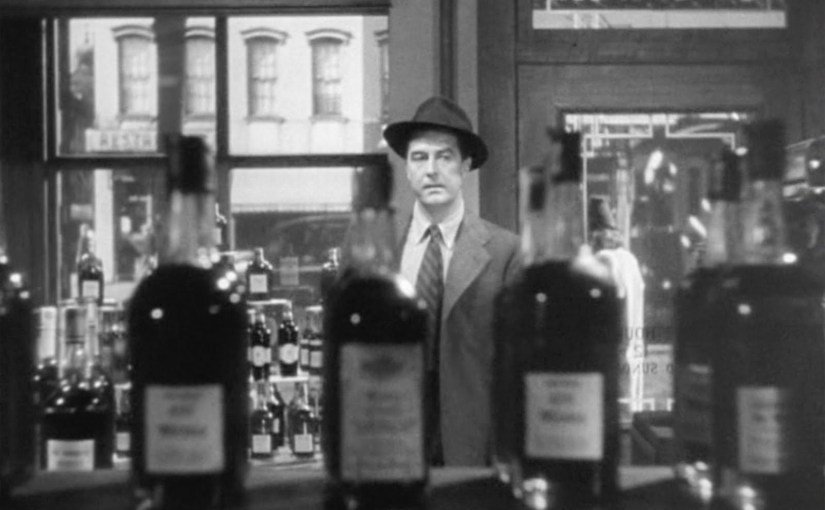
Inanimate objects or props are also given much focus.  Early on, Don is seen at the local bar and Billy Wilder brings an inventive visual to explain just how much this character has consumed in under two hours.  The camera focuses on the wet rings on the bar top left by Don’s shot glass.  First there are two rings, then four and soon, fifteen.  Wilder also zooms his lens into the very bottom of the small glass filled with liquor to show how much the audience will drown in Don’s despair over the course of the film.

Other props also work towards Don’s paranoia such as a ceiling lamp bearing the shadow of a hidden bottle.  Milk bottles left in front of his apartment are not collected from one day to the next showing the passage of time for this weekend, and how even the most basic chore is dismissed so Don can extend his stupor.  A lady’s unguarded purse offers temptation.  A tossed lamp shade seems to glare at Don like a hole that he’s in, as he gets weaker and weaker. 

A magnificent scene, one that I can envision a skilled director doing today with quick cuts on digital film, occurs as Don recalls sitting in a crowded opera house watching the toasting scene of La Triviata; one of the most recognizable operas of all time.  Don is one of many in the audience, and yet he’s the only one alone with the production’s props of various drinking glasses and champagne bottles being used on stage that are mere inches away.  Very quickly into the scene, Billy Wilder skillfully draws focus from the opera singers and diverts towards the immense amount of liquor adorning the stage and the cast with quick cuts of Don salivating and perspiring alone in a chair of a crowded theater.  Everyone else is watching the performance.  Don is gazing at the alcohol.  I wouldn’t be surprised if Martin Scorsese had much admiration for such a sequence.

Phillip Terry is very good in his performance.  I’m surprised he’s not promoted as much as the other two stars of the picture.  Wick cares for his brother, but he’s ready to give up on him after six years of this ordeal, with one more transgression played out. He’s exhausted from lying to cover for Don’s weakness.  He represents the outsider of the dilemma who’s been affected by someone else’s ailment. Jane Wyman as Helen serves a nice purpose as well.  The one last hope for Don.  She’s the only one left who holds on to the faith that she can pull Don out of this nightmare.  Wilder presents these characters as side effects in the Oscar winning script written by him and Charles Brackett. 

Another haunting, but effective dimension comes when Don finds himself in the alcoholics’ ward at Bellevue Hospital, shot on location, and the first film to ever do so.  With an eerie use of a theremin in the soundtrack from Miklós Rózsa, Don is surrounded by dark shadows and tormented victims suffering from drying out just like him.  A nurse explains that he still has the DTs to experience like envisioning being surrounded by horrifying images like bugs crawling on him or something comparatively worse.  I recall from childhood seeing this symptom used on an episode of M*A*S*H.  Wilder invents his own kind of imagery and it’s pretty shocking in its grotesqueness.

I ask for forgiveness when I say that The Lost Weekend seems a little melodramatic. Maybe that’s because movies have built themselves into much more graphic and honest depictions of alcoholism since 1945.  The ending seems to welcome a stringy violin to accompany Ray Milland’s final scene with Jane Wyman.  However, I’m completely impressed with how pioneering this movie must have been for its time.  Billy Wilder didn’t shy away from the dramatic side of drinking. 

The Lost Weekend is certainly an effective and important piece on the study of alcoholism.  I’d recommend it as a visual reference to what can happen to the one who suffers, as well as those around him, including the bartender who deals with the regulars he easily knows by name.  While it’s certainly a movie of its time, the message remains the same.  Though I’m no expert on the effects of alcohol, I’ve seen enough friends who deal with the problem to know that the message in Wilder’s film still rings true.  An addiction to drink will dominate a life.

I always say that movies offer another valuable avenue to learn from.  There’s much to learn from The Lost Weekend.