THE MUMMY (1932)

by Miguel E. Rodriguez

DIRECTOR: Karl Freund
CAST: Boris Karloff, Zita Johann, David Manners, Arthur Byron
MY RATING: 7/10
ROTTEN TOMATOMETER: 89% Certified Fresh

PLOT: A resurrected Egyptian mummy searches Cairo for the girl he believes to be his long-lost princess from ancient Egypt.


The story of The Mummy is good enough to warrant a mostly positive review from me, even though the storytelling itself lacks zing.  Clocking in it a brisk 73 minutes, my girlfriend called it “the longest 73 minutes ever.”  She has a point.  There are long stretches with no dialogue, and while some of those passages are thick with atmosphere, they tend to bring the film’s momentum to a screeching halt.

However, the underlying plot was still interesting enough to keep my attention during those doldrums.  We learn in the opening scenes that a British archaeologist, Sir Joseph Whemple, dug up the sarcophagus of an Egyptian priest named Imhotep, in Cairo in 1921, along with a sealed box bearing a warning and a curse on whomever opens it.  Naturally, the warning is dismissed, the box is opened, and in a genuinely creepy, chilling scene, the cloth-wrapped mummy in the background comes to life.  In a neat bit of trickery, we never, ever see the mummy itself after it spontaneously revives.  We only see its hand as it reaches into the frame and the reaction from Whemple’s poor assistant who goes insane on the spot.  That is admirable restraint.

Ten years later, Whemple’s son, Frank, returns to Cairo in his father’s footsteps.  He is introduced in typical early-Hollywood fashion with a shot highlighting his strong profile as he looks eagerly into the distance.  I mention this detail because, as it happened, both Penni and I thought the exactly same thing in our heads: “And who is THIS handsome fellow?”  It’s corny, but it’s how things were done back then, what are you gonna do.

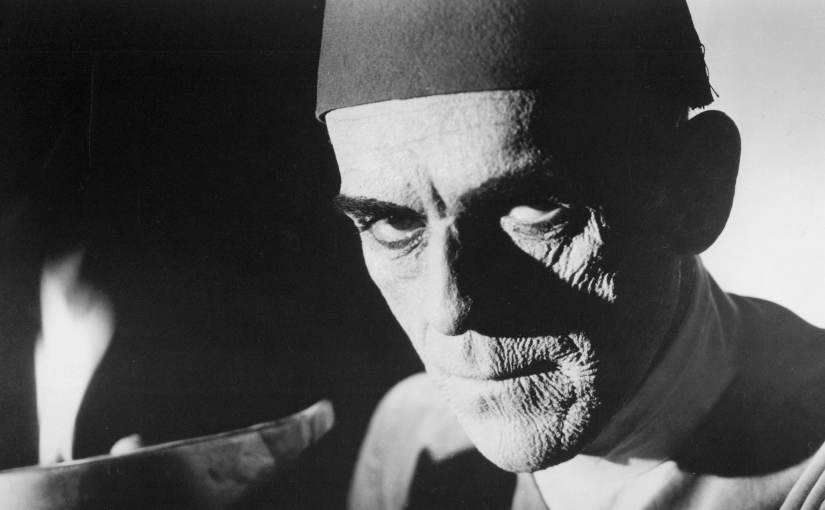
Frank meets a tall, gaunt stranger calling himself Ardath Bey, which as everyone knows is an anagram of “Death by Ra”, so talk about a spoiler alert.  Ardath is, of course, the resurrected corpse of Imhotep from ten years ago, played by the legendary Boris Karloff.  We eventually learn that Imhotep is attempting to resurrect his princess who succumbed to illness thousands of years ago, and whose reincarnated spirit, coincidentally, may reside in the body of the young socialite Helen Grosvenor, vacationing in Cairo this very night, wouldn’t ya know.

That’s the plot in a nutshell.  Imhotep casts various spells and chants various chants and Helen is inexplicably drawn to the mysterious Ardath Bey, and Frank and his father try to unravel everything before poor Helen is killed in a ritual sacrifice.  The story feels admittedly trite, but I tried to imagine what contemporary audiences must have felt when seeing this movie for the very first time, nearly a hundred years ago now.  We don’t get the anticipated scenes of a shuffling, moaning mummy “chasing” its victims in a deserted pyramid.  Instead, Imhotep does most of his damage remotely, via a magical pool of water that works like a CCTV camera.  Maybe that was more disturbing to people, that this malevolent force doesn’t even have to be near his victims to hurt or even kill them.  Come to think of it, that IS a little more disturbing.

I won’t say The Mummy is chock-a-block full of thrills and chills.  It’s not King Kong (1933).  But there is plenty of atmosphere to satisfy the average movie fan; there’s even a “surprise” ending that I did NOT see coming.  But that’s all you’ll get from me.  Mum(my)’s the word.
VAMPYR (Germany, 1932)

by Miguel E. Rodriguez

DIRECTOR: Carl Th. Dreyer
CAST: Julian West, Maurice Schutz, Rena Mandel, Sybille Schmitz
MY RATING: 8/10
ROTTEN TOMATOMETER: 98% Certified Fresh

PLOT: A drifter obsessed with the supernatural stumbles upon an inn where a severely ill adolescent girl is slowly becoming a vampire.


Carl Th. Dreyer’s Vampyr [pronounced “vom-PEER” in this German version] is not the scariest vampire film I’ve ever seen, but it is definitely one of the creepiest.  There’s a difference.  Dreyer’s film doesn’t move with the pacing seen in more standard horror fare.  Instead, it forsakes typical plot development for scenes that linger on the horrific or the unexplained.  In its own way, it is more directly related to the films of David Lynch than to any other contemporary monster movies of the time (Dracula or Frankenstein, for example, both 1931).

The story is fairly simple, but it belies the complex imagery that awaits the viewer.  A young drifter, Allan Grey, happens upon an inn from which he thinks he can hear animal sounds, or perhaps a young woman screaming.  The village doctor, who looks like a bespectacled long-lost relative of Doc Brown from Back to the Future, vehemently denies the presence any animals or young women on the property.  The innkeeper invites Allan to stay the night.  In the middle of the night, Allan’s sleep is interrupted by a mysterious visitor to his room who intones, “The girl must not die!”  The gentleman then leaves a package on Allan’s desk and writes a most portentous message: “TO BE OPENED ONLY UPON MY DEATH.”

What is this book?  What did Allan hear?  And how do you explain the shadows he saw on his way to the inn?  Shadows of people running along the lane – with no corresponding people attached to them?  Wouldn’t YOU like to know.

Vampyr is positively drowning in atmosphere.  Dreyer apparently shot many scenes with a piece of thin gauze over the lens, creating a misty layer that makes everything feel like a dream, even when Allan is awake.  Allan goes on frequent excursions around the inn and the surrounding property, and it’s here where most of the fantastical imagery is seen, especially when it comes to disembodied shadows.  In one mildly unsettling sequence, a shadow of a man with a peg leg descends a ladder and appears to sit on a bench…re-joining itself to a peg-legged man already sitting on the same bench.

There’s a lot more, but I don’t want to just write a list.  However, I am compelled to mention one sequence in particular that exudes as much creepiness as anything I’ve ever seen from this cinematic era.

It turns out there is, not one young woman at the inn, but two: Gisèle and Léone.  Léone is seen early on, confined to her bed with a mysterious illness, which we later learn has been brought on by her contact with a seldom-seen old woman who lurks somewhere on the property.  And there are some odd injuries on her neck…UH oh.

At one point, Léone awakes while Gisèle is alone with her.  I don’t remember what they discuss, but Léone goes into this weird sort of trance.  Without the use of any strange Chaney-esque makeup or camera tricks, Léone’s face becomes an object lesson in creepiness.  Her eyes open wide, her face breaks into a creepy grin, and she slowly moves her head from side to side, while Gisèle backs away in terror.  It might be the scariest sequence in the film, one which could easily compare to any subsequent monster or vampire movie.

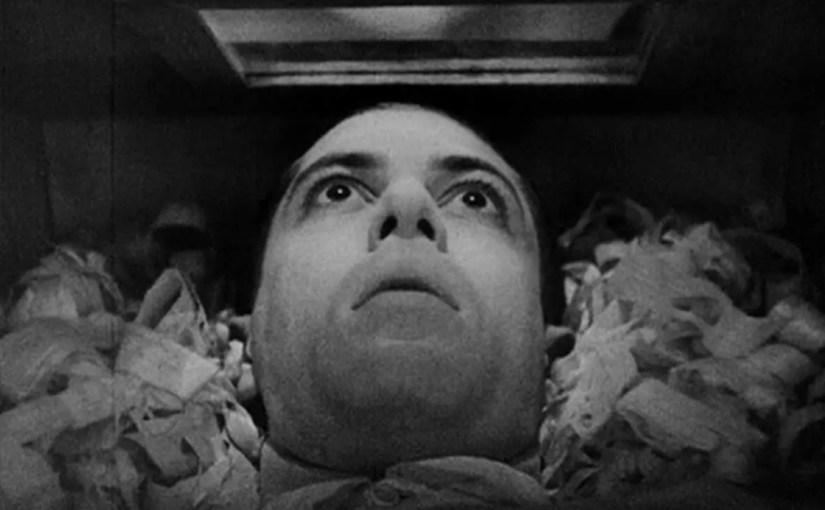
Later, Dreyer throws more camera tricks at us in increasingly imaginative ways.  Allan dreams of a skeleton handing him a bottle of poison.  A dead man’s face appears in the sky during a sudden thunderstorm.  Dreyer includes camera moves that would fit right into any modern film.  And in a sequence that reminded me of Wes Craven’s The Serpent and the Rainbow (1988), Allan watches as his own body is sealed inside a coffin with a tiny square window for his apparently dead eyes to look out of.

If nothing else, Vampyr is an interesting artifact of cinema’s transitional era from silent to sound.  Even though there is a conventional soundtrack and we hear people’s voices as they speak, a lot of expository information is provided via title cards and long looks at passages from a book of vampire lore.  Given that the vampire mythology was then not as popular as it is today, I can forgive these beats that tend to bring the momentum to a halt.

While Nosferatu (1922) and the Bela Lugosi Dracula are much more famous, Vampyr is worth a look if you’re a horror fan.  While it doesn’t involve the kind of fear factor I tend to expect as a child of the 1970s and ‘80s, it is nevertheless creepy as hell. 

THE BITTER TEA OF GENERAL YEN (1932)

by Miguel E. Rodriguez

DIRECTOR: Frank Capra
CAST: Barbara Stanwyck, Nils Asther, Toshia Mori, Walter Connolly
MY RATING: 10/10
ROTTEN TOMATOMETER: 86% Certified Fresh

PLOT: During the Chinese Civil War, an American missionary is gradually seduced by a courtly Chinese warlord holding her captive in Shanghai.


When I hear people talking about the “pre-Hays-Code era” of Hollywood, I conjure up seldom-seen images of nearly-nude starlets bathing or swimming or dancing in unison, as filmmakers and studios took advantage of the proven formula: Sex Sells.  But it never really occurred to me that some filmmakers would be able to use that freedom to make films that not only showed a little bit of skin, but also took the time to tell a story that appealed to mature adults in ways that seem fresh and alive nearly a century later.

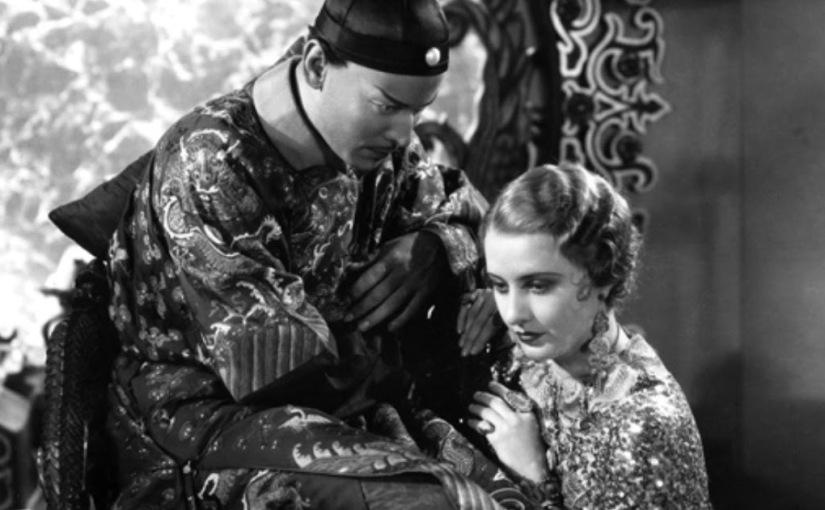
Frank Capra’s The Bitter Tea of General Yen is a contemporary “Beauty-and-the-Beast” tale of an American missionary, Megan (Barbara Stanwyck), who travels halfway around the world to Shanghai to marry her childhood sweetheart, Bob (Gavin Gordon), also a missionary.  It’s set in an unspecified year during the Chinese Civil War [1927-1949] when turmoil rocked the city and hundreds of thousands of refugees filled the streets.  A remarkable opening shot shows hundreds of extras flowing past the camera as Shanghai burns in the background, while a houseful of Americans prepares for Megan’s wedding, untouched and unbothered by the human misery thirty feet from their doorway.  (I was reminded of the idyllic family scenes in Spielberg’s Empire of the Sun where English families held birthday parties oblivious to the impending chaos in Japan leading to World War II.)

Bob insists on postponing his wedding to Megan so he can help rescue some orphans stranded in a burning section of the city.  During the rescue effort, they are separated; in a surprisingly violent scene, Megan is struck on the head by an angry civilian and is knocked unconscious.  She wakes up on a train and finds herself under the care of General Yen (Nils Asther), a famous warlord, reputed to be more bandit than soldier, but who is unfailingly courteous and polite to Megan, even as he informs her that he is unable to return her to Shanghai for security reasons, effectively making her his prisoner.

This scene on the train is a masterpiece of visual storytelling.  Yen sits in a chair and is tended to by Mah-Li (Toshia Mori) who seems to be more than just Yen’s servant.  In an unspoken passage, Mah-Li puts a pillow under Yen’s head, covers his legs with a blanket, and reclines on a chaise.  Megan, with her head bandaged, observes this ritual, then notices Yen staring intently at her.  She becomes acutely aware that she is showing a small patch of bare leg through her covers.  As slowly as possible, she gently pulls the covers up to cover her leg.  Mah-Li observes all of this, Megan watches Mah-Li, and they all go to sleep, each one of them knowing exactly what has been stated without saying a word.  Brilliant.

In a bold move, once Megan is under Yen’s care/protection/whatever, the film never cuts back to her fiancé or to any of the missionaries.  In fact, Yen refers to a Chinese newspaper article which states that Megan is missing and presumed dead.  So that takes care of that.

In another scene of startling violence for its time, Megan wakes up one morning in her private room to the sound of gunfire.  Yen’s soldiers are executing prisoners in a courtyard across the way.  Megan is horrified and complains to General Yen, who promptly orders the soldiers away: “They are taking the rest of them down the road, out of earshot.”  Megan calls him cold-blooded, but he reasonably says he has no rice to feed any prisoners: “…isn’t it better to shoot them quickly than let them starve to death slowly?”

The theme of the film establishes itself in this and other scenes.  Megan, a Christian missionary who believes that people can and must be good for the sake of their souls and their fellow man, finds herself at odds with (and strangely attracted to) a soldier who is brutal by necessity and has no illusions about any innate goodness to be found in any man during a time of war.  There is a powerful scene when she argues with Yen, and in a heated moment utters a racial slur, and as soon as she says it Yen goes silent and squints at her, and she realizes she has crossed a line.

This is not the kind of moral and ethical complexity I expected from a melodrama made only five years after the advent of sound.  I saw the name of Frank Capra and the weirdly evocative title, and I imagined a potboiler with outdated attitudes and cheesy dialogue and racial stereotypes galore.  I could not have been more wrong.  Yes, the title character is played by Nils Asther, a Swedish actor in “yellowface,” but I had to remind myself that, in the time the film was made, this was de rigueur for most films dealing with Asian characters (the highly popular Charlie Chan films starred white actors in the role for years).  I don’t endorse the practice, but it is a fact that must be acknowledged.  And, it must also be said, Nils Asther’s performance as a Chinese man is quite convincing.

The Bitter Tea of General Yen gives us espionage, intrigue, forbidden romance, high melodrama that teeters on the verge of soap opera but never gives in to that temptation (not like Gone with the Wind would do in 1939 with, let’s face it, a rather similar character arc for the two romantic leads).  It’s a film that could be remade today, almost word-for-word, and I have no doubt it would feel right at home with today’s hip audiences.  So many other films of that era feel obviously dated by their dialogue or their performances.  The Bitter Tea of General Yen suffers none of those drawbacks.  It’s a modern classic that just happens to be over 90 years old, that’s all.

[Author’s Note: there is, in fact, one sequence which I’ll call “The Dream Sequence” that feels uncomfortably over-the-top in its depiction of the vilest racial stereotypes associated with Asians.  However, given the context of the scene, who’s having the dream, why they’re having it, and the dream’s resolution, it fits perfectly with the story.  I can’t find it in myself to “cancel” this film based on this sequence.  Just in case anyone was wondering.]