
À NOUS LA LIBERTÉ (1931)

by Miguel E. Rodriguez

DIRECTOR: René Clair
CAST: Henri Marchand, Raymond Cordy, Paul Ollivier, Germaine Aussey
MY RATING: 7/10
ROTTEN TOMATOMETER: 100% Fresh

PLOT: A convict escapes prison and becomes a wealthy industrialist, but his life of leisure is threatened when his former cellmate turns up unexpectedly.


À nous la liberté (rough translation: “freedom for all”) is a charming, if slight, romantic farce from celebrated French director René Clair, who would later make his mark in Hollywood films with I Married a Witch (1942) and And Then There Were None (1945) before returning to French cinema for the rest of his career.  It won’t go down as my favorite French film, or classic film, or anything like that, but as a snippet of cinema’s early years, along with some mildly scandalous history of its own, it’s worth a look for cineastes.

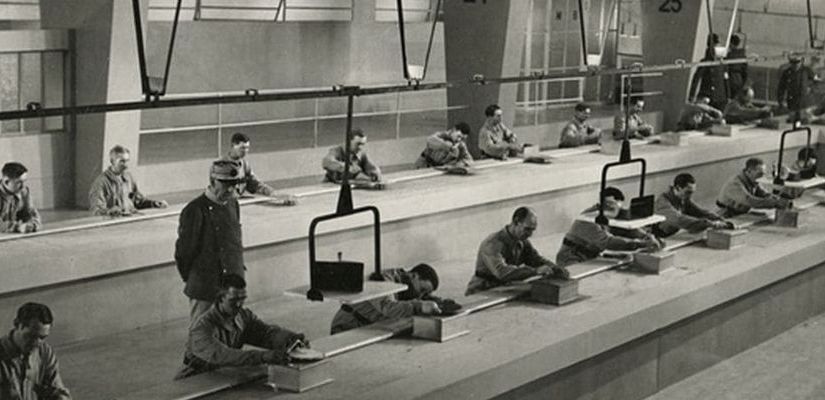
Louis and Émile are cellmates in a French prison.  Their daily routines are marked by hours and hours of assembling children’s toys on an assembly line that looks and feels a lot like the one from Chaplin’s Modern Times (1936) or even that one at a chocolate factory in a famous episode of I Love Lucy – but we’ll come back to that.  They sing, too, while toiling.  There’s a LOT of singing in À nous la liberté, not all of it clearly motivated, but serving as a kind of punctuation mark or accent piece to various scenes.

Émile and Louis attempt to escape their prison, but through no one’s fault, only Louis gets away, while Émile remains behind.  After some amusing episodes involving Louis trying to blend unobtrusively back into society, he lands a job hawking phonographs to pedestrians for a department store.  He gets so good at it that eventually he’s running the store…and eventually, improbably, he becomes the owner of the factory that BUILDS the phonographs, making him rich beyond his wildest dreams.

Trouble arrives in paradise when Louis’ cellmate, Émile, unexpectedly shows up, recently released from prison.  But he’s not looking for a job or to “touch” an old wealthy friend.  He’s in love with a girl who works at Louis’ factory, and getting a job there is the easiest way to stay close to her.  (I don’t THINK her name is ever said aloud, but she’s listed on IMDb as “Maud”, so that’s what I’ll call her.)  If Émile’s behavior sounds mildly stalker-y, well, it is, but what are you gonna do, love is love, and I’m sure I could dig up a modern rom-com or two that feature stalking as a romantic element.  Somehow.

Plus, there’s this whole ironic subtext that shows how the assembly lines at Louis’ phonograph factories are no different from the assembly lines at the prison.  The movie is not subtle about their similarities, but how could it be?  This fluffy material is corny as all hell, but the movie never gets too schmaltzy.  And if you think you know how the romantic subplot plays out in a romantic comedy from the 1930s, check your assumptions.

The centerpiece of the film is an assembly line sequence at the phonograph factory, a scene that has been imitated many times.  More modern movies and TV shows may have improved it, but having seen this movie, it’s clear where their inspiration came from.  In fact, the most interesting backstory of À nous la liberté is the fact that, after Charlie Chaplin released Modern Times in 1936, the producers of the French film sued Chaplin for plagiarism.  Both films feature bumbling but charming protagonists who wind up working on, and screwing up, assembly lines, and both films were making a point about the increased mechanization and dehumanization of the labor force.  After dragging on for ten years, Chaplin ultimately settled (without admitting guilt), but remained friends with René Clair for years afterward.

Having seen both films now, my opinion is that the similarities between the two films are purely incidental.  You might as well say that Star Wars plagiarized Star Trek because they both have “Star” in the title.  Modern Times is funnier and faster-paced, while the most farcical scenes in À nous la liberté are played, not for laughs, but smiles, if that makes sense.  It does to me, so I’m sticking with it.

It’s also interesting to observe how Clair used sound in this film from sound’s early years.  As I said before, there’s a lot of singing, but scenes with dialogue are few and far between.  Ambient sound is almost non-existent.  Where you might expect to hear lots of noises – scenes on the assembly line, for example – we only hear background score.  It’s almost startling when one scene plays street noises during an outdoor shot.  It’s almost as if Clair – like Chaplin – was reluctant to completely abandon silent storytelling in favor of this new sonic “trend.”  As a result, while it’s not a laugh riot, the film does have a quaint likability that is hard for me to describe.

À nous la liberté is an interesting peek backwards in time to when many of the film tropes we take for granted today were shiny and new.  It didn’t get me all “riled up” at an emotional level, but it wasn’t a waste of time.  And, like I said, there are one or two surprises story-wise.  That’s never a bad thing.
THE PUBLIC ENEMY (1931)

by Miguel E. Rodriguez

DIRECTOR: Willam A. Wellman
CAST: James Cagney, Jean Harlow, Edward Woods, Joan Blondell
MY RATING: 10/10
ROTTEN TOMATOMETER: 100% Fresh

PLOT: An Irish-American street punk tries to make it big in organized crime during Prohibition.


Having just finished watching Little Caesar (1931) a few days ago, I popped in The Public Enemy, expecting more of the same, if I’m being honest: a fledgling gangster picture, rough around the edges, not spectacular, but historically important.  I could not have been more wrong.  Where Little Caesar at times seemed to be going through the motions, The Public Enemy crackles and sizzles and pops off the screen, still capable of shocking and surprising me nearly a century after it was released.  If that’s not the definition of a masterpiece, well, it damn sure oughta be.

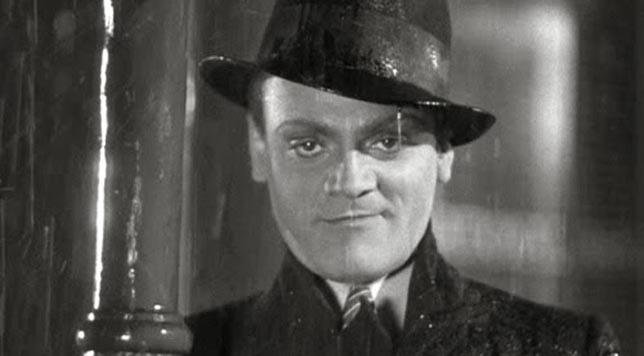
James Cagney gives one of his most indelible performances as Tom Powers, a kid who grew up tough with his best friend, Matt Doyle.  We meet them first as kids in 1909, raising a little hell, teasing Matt’s sister, disdaining Tom’s goody-two-shoes older brother Mike, and learning to treat the law and police officers as a necessary evil.  They supplement their income by stealing watches and giving them to a small-time hood, Putty Nose, who gives them a pittance and treats them like Fagin treated Oliver Twist.  Six years later, they’ve grown into young men (Matt is played as an adult by Edward Woods) who are still in league with Putty Nose, but when a planned theft goes awry, Putty leaves Tom and Matt dangling and wishing only for revenge.

(I enjoyed this back-story approach, as opposed to Little Caesar, which by comparison feels like it plunks us into the middle of a story already in progress and wastes no time waiting for us to catch up.  I know I probably shouldn’t critique a movie by comparing it to another, but I can’t stop myself, sue me.)

It’s during this botched robbery that we get the first glimpses that this movie will pull no punches when it comes to violence, or at least as much as it could in 1931.  A fleeing accomplice is shot at least twice in the back by a patrolman.  He chases Tom and Matt into a dark alley.  We see gunshots flare in the darkness with no clear idea of what’s happening.  Tom and Matt reappear, toss their guns away, and run off…and in a poignant button to the scene, we see a close up of the patrolman’s gun hand lying lifeless under a streetlamp.  We see nothing graphic, but we know exactly what’s happened.  The Public Enemy will use this device many times throughout the picture, to great effect.

Time passes.  Tom’s older brother, Mike, enlists in the Marines for World War I.  No love is lost between the two of them when Mike learns of Tom’s criminal activities.  When Prohibition is enacted, Tom and Matt get even more involved in those activities, working for a sharply dressed mobster, “Nails” Nathan.  They start making more money, buying fancy new cars and clothes.  (One of the funnier scenes occurs when Tom is getting fitted for a custom suit by a tailor who is so far in the closet he’s finding Christmas presents from 1889.)  They meet a couple of molls, which leads to the famous “grapefruit” scene that had women’s groups up in arms…maybe it still does, I couldn’t say.  And they get better at their jobs, in deeper with the mob, and suddenly…

But I’m summarizing again.  That’s how this movie has gotten to me.  I am so enthused about it that I want to shake people by the collar and say, “If you love gangster movies, don’t make the same mistake I did by not seeing The Public Enemy until I was [age deleted]!  It’s sensational!  Here, let me tell you about it…”

Director William A. Wellman (The Ox-Bow Incident, 1942) displays a directorial style that, to my untrained eye, transcends the era in which he was working.  Made in 1931, it feels like it was made ten or fifteen years later, in the vein of the best films of Wilder or Hawks.  Martin Scorsese even calls it “the birth of modern movie acting,” and it’s hard to argue with him when you’re watching Cagney command every single second he’s onscreen, whether he’s whispering sweet nothings into a girl’s ear or playfully chucking his mom on the chin or contemplating gruesome violence as his face twists into an evil grin.

I feel it necessary to mention once more the shocking violent acts perpetrated during the film.  Again, we rarely actually see the violent acts themselves (like the infamous ear scene in Reservoir Dogs [1992]), but that just makes them land even harder.  The camera either tracks off the impending scene or stays behind while gunmen march into another room, leaving us to hear the violence instead of seeing it.  It’s practically Hitchcockian, and it’s perfectly executed.  This method makes the film feel even MORE modern.  Re-shoot this movie, shot for shot, line for line, with all of the tools available to the modern filmmaker, and it would still work, even in a world where Goodfellas and The Untouchables exist.

So, run, don’t walk, to either your friendly local streaming service or to your favorite online retailer and buy or stream The Public Enemy today.  And don’t thank me.  Just promise to tell YOUR friends how awesome it is.  Because it really, really is.

LITTLE CAESAR (1931)

by Miguel E. Rodriguez

DIRECTOR: Mervyn LeRoy
CAST: Edward G. Robinson, Douglas Fairbanks Jr., Glenda Farrell
MY RATING: 7/10
ROTTEN TOMATOMETER: 96% Fresh

PLOT: A small-time hood shoots his way to the top of the mob ring during Prohibition, but how long will he stay there?


Lurking in the DNA of Mervyn LeRoy’s seminal gangster flick Little Caesar are the genetic markers for virtually every mob movie that’s been made ever since.  It helped kick off a trend of gangster films that proliferated in the 1930s: Angels with Dirty Faces, Scarface, The Public Enemy, The Roaring Twenties, et al.  Its themes have been repeated in masterpieces like The Godfather, Bonnie and Clyde, and Brian DePalma’s epic remake of Scarface, and we never seem to tire of it.  If Little Caesar lacks the visual and editorial pizzazz of those later films…well, what are you gonna do, they were pretty much breaking ground on the genre.  Let’s cut them at least a LITTLE slack.

The film tells the story of the rise and fall of Caesar Enrico Bandello, a small-time thug played by Edward G. Robinson in the performance that would follow him for the rest of his career, no matter how many times he tried to shake it off.  His delivery and intonations would become the hallmarks of gangster-speak for decades.  (Even Chief Wiggum’s voice on The Simpsons is an echo of Robinson.)  The movie opens with a scene of sudden and startling violence, even if it’s done in the shadow of darkness.  Afterwards, Rico and his partner in crime, Joe, talk things over in an all-night diner.  The casting of Douglas Fairbanks Jr. as Rico’s partner was a masterstroke, emphasizing their differences in size and demeanor right at the start.  As their career paths diverge, Rico gets a little meaner and “squintier”, while Joe stays as improbably handsome as ever.  Clever visual shorthand.

Little Caesar moves quickly…really quickly.  Think of one of your favorite gangster movies.  Picture it as a big hamburger patty sitting on a bun.  Now trim everything off the edges so nothing spills off the boundaries of the bun, and you’re left with nothing but a lean little circle of meat.  That’s Little Caesar.  Clocking in at a scant 78 minutes, it’s barely longer than Bambi.  This movie exemplifies the get-in-get-out-nobody-gets-hurt school of moviemaking.  We get all the character exposition we need in the opening five minutes.  Villains look like villains, cops look like cops, and you can tell the nice girls from the not-so-nice ones by the way they dress, not by what they say.  Considering Little Caesar was made just a few years after the advent of sound, it’s not too surprising to see these vestiges of silent film lingering on the screen.  (There are even a couple of title cards to indicate the passage of time, so we don’t get bogged down with all that talking…)

There is one scene where director LeRoy and the studio editors tried for an effect and failed.  Rico leads his gangsters to rob a hotel lobby during a big party.  The robbery is edited together in a series of fade-ins and fade-outs, instead of quick cuts from one shot to the other.  In the course of the robbery, an important character is murdered.  But because of the shots fading into each other, the effect is not startling, but dreamlike.  It’s hard to explain.  Was this intended to try to get into Rico’s head, to experience the robbery through his own perception, as if he sort of “goes away” whenever he commits acts of violence?  If so, it never happens during any of the other killings he commits.  I can’t figure out exactly what this effect is supposed to symbolize, and as the great man once said, “If you have to ask what something symbolizes, it doesn’t.”

Aside from that scene, and apart from the occasional overacting by a supporting player who is still getting used to using their voice on camera, Little Caesar is lean and mean, like its title character.  Supposedly, it also features what may be the first drive-by shooting ever put on film.  Kinda neat.  It gave Edward G. Robinson the role of a lifetime, as well as one of the greatest exit lines in the history of cinema.  (If you don’t know what it is, you deserve to hear it from him, not me.)  It doesn’t get my blood racing like, say, Heat or The Untouchables, but as a piece of Hollywood history, I’d call it required viewing for anyone who’s a fan of the genre.  Watching Little Caesar is like participating in cinematic archaeology, discovering the roots of everything that came after it.  I’d try to put it more eloquently than that, but it’s late.  Nyaa…nyaa.

P.S. Even Goodfellas paid homage to Little Caesar…there’s a scene where Rico is being introduced to his new gang, and the camera goes around the room: “There’s Tony Passa. Can drive a car better than any mug in town. Otero…he’s little, but he’s the goods all right.” …and so on. I was waiting for one of the mugs to repeat himself like Jimmy Two-Times…