SCHINDLER’S LIST

By Marc S. Sanders

Oskar Schindler was a handsome, well dressed man. A man of wealth, power, and influence. A successful businessman. He was a womanizer. And Oskar Schindler was a Nazi who saved 1100 Jews from the atrocities of the Holocaust.

On a filmmaking measure alone, Schindler’s List is one of the best pictures to ever be made. Steven Spielberg’s production value is incomparable. Nothing I can recall appears as grand (not sure that’s the appropriate word here???) and authentic as Schindler’s List. How did Spielberg pull off this feat? How did he direct hundreds, thousands maybe, of extras to reenact the vilest human suffering that a generation of people could ever encounter? I’m astounded. Positively astounded.

This evening was only my second time seeing the film. I always put off watching it over the last 30 years; reluctant maybe to see a horrifying truth. The first time I saw the film was on Christmas Day, 1993 at the Hyde Park cinemas in Tampa, Florida with my father. I didn’t realize it at the time, but I was in the beginning stages of the flu with a high fever. Midway through the film, I had to leave the theatre as my illness caught up with me. I mustered the strength to return to watching the remainder of the movie, as I recall I could not go without finishing this masterpiece. I was horrified and yet amazed; amazed that this moment in world history could have ever occurred.

To see a man like Amon Goth (brutally and uncompromisingly played by Ralph Fiennes), a high ranking Nazi, excuse himself from his nude mistress’ bed and perch himself on his balcony to sniper random Jewish prisoners as a means of sport was sickening and twisted to me. Twenty five years later, it is this moment that has always stayed with me, as much of the story and scenes left my memory from so long ago. This moment as well as Spielberg’s choice to highlight a young girl in a red coat amidst a most somber black and white picture have stayed with me all these years. The glimpse of red serves as a truth to Schindler’s naivety. Spielberg is a thinking director. He never follows the manual. He chooses to think outside the box. A glimpse of a child dressed in red in a sea of black and white where mutilated corpses and possessions are aimlessly strewn about. It’s a marvelously telling moment.

Liam Neeson plays Schindler. It will likely be the greatest role of his career. Schindler is a man who even fools the audience until the very end when he reveals that the war has ended and his salvation has rescued these 1100 souls. Finally, his humanity no longer hides and he weeps to his accountant and accomplice, Itzhak Stern (played subtly and beautifully by Ben Kingsley). Schindler weeps for he could have saved more. Neeson is superb in this moment. His commanding stature crumbles, his materialism and wealth have disappeared. Neeson translates all of that clearly, and finally my tears arrive. Prior to this moment, I was numb to the Nazi tactics of gas chambers, careless bloodshed and apathetic separation of families and friends; perhaps because I’ve extensively studied it during my years in Yeshiva. Before Schindler’s List, much of the history on the Holocaust seemed like textbook fare to me. Spielberg made its terrifying and tragic reality real.

Ben Kingsley’s performance is so important as well. The architect behind the list, his portrayal of Stern is countered with contained fear and leveled sensibilities amid the senseless intentions of a dominant force of evil. His instincts kept him alive so that only he could help keep his comrades alive.

Schindler’s List won the Best Picture Oscar for 1993, only 50-52 years following the events of the Holocaust. Many survivors thankfully remained to see Spielberg’s epic premiere. People who I share this planet with experienced the most insane and heinous evil ever encountered. They were well to do people living normally until they were violently pulled from their homes, stripped of their possessions, separated from their families, suffered at the threat of murder, witnesses to other murders and hate crimes, humiliated, beaten, forced into slave labor in tightly contained ghettos and eventually thrust into concentration camps. Yet, these few survivors lived to carry on with their lives and deliver new generations, beyond this morally ugly and evil historic episode.

I’m being redundant as I’ve said it many times before, but isn’t that the point? The Holocaust and the Nazi regime only occurred around 85 years ago. This happened before. This can happen again.

Thank you, Steven Spielberg for Schindler’s List.

I don’t consider myself to be very religious anymore. Because of moments like the Holocaust, I question how a God could ever be possible. Still, for the survivors and those that perished, I can only say Baruch Hashem, and L’Chaim. 

Peace.  Progress.  Love.

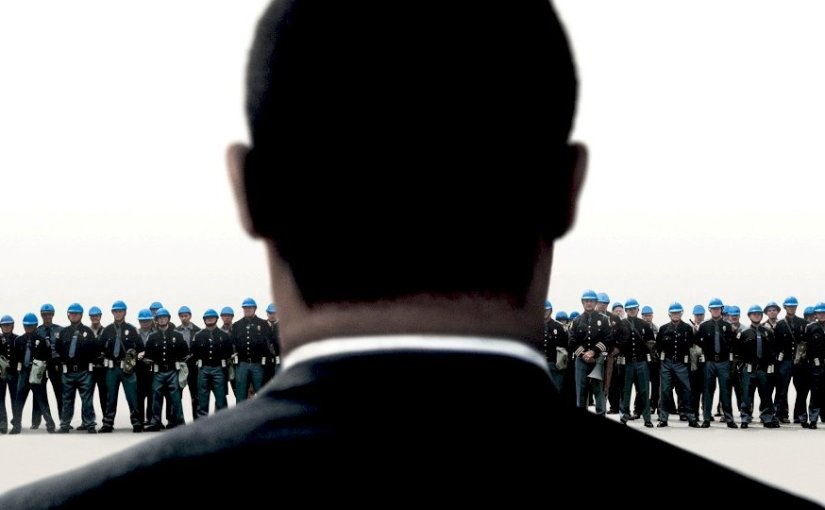
SELMA (2014)

by Miguel E. Rodriguez

Director: Ava DuVernay
Cast: David Oyelowo, Carmen Ejogo, Tom Wilkinson, Common, Tim Roth
My Rating: 8/10
Rotten Tomatometer: 99% Certified Fresh

PLOT: A chronicle of Dr. Martin Luther King, Jr.’s campaign to secure equal voting rights via an epic protest march from Selma to Montgomery, Alabama, in 1965.


In one of the special features on the Selma Blu-ray, Oprah Winfrey, one of the film’s producers and co-stars, says that Selma is the first feature film with Dr. Martin Luther King Jr. as the central figure.  (She is presumably not counting TV movies or miniseries.)  There have been one or two other films where King appears as a “side” character, but never as the star of the film.

I’m not exactly sure what that means, but I found that tidbit of information fascinating, especially after watching Selma, which carries all the cinematic heft of any Oliver Stone biopic.  For example, I never knew there were two previous attempts to make the iconic march from Selma to Birmingham, some fifty miles away.  The first attempt, at which King wasn’t present, was violently turned away by local police with batons, tear gas, and honest-to-God bullwhips.  The second attempt, this time with many white participants, mostly clergy, was aborted by King himself after he had second thoughts about asking people to potentially lay down their lives for the cause.

That right there is indicative of far more conflict than I ever thought existed in the mind of Dr. King, played with poise and pent-up energy by David Oyelowo.  In my mind’s eye, King never wavered.  He was always 100% sure of his actions because his cause was just.  But, surprise, he was also a human being who was clearly affected by the injuries – and fatalities – sustained by the folks who were marching for that cause.  Selma brought that dimension home to me in a potent, well-made film.

The beginning of the movie sets the tone poetically and tragically.  After a scene with Dr. King receiving the Nobel Peace Prize for his civil rights activism, we are shown the truth of the situation in the American South in the mid-60s.  A black woman tries to register to vote in Selma and is turned away by a racist registrar.  In Birmingham, a bomb goes off at the 16th Street Baptist Church, killing four young girls.  When King arrives in Selma to organize a protest, he is greeted in a hotel lobby by a friendly-sounding white man who proceeds to punch him in the face.  King even meets opposition from a separate civil-rights group in Selma who are uncomfortable with how most out-of-state protesters march for King, not necessarily for the issues.

Nor is King portrayed as the perfect husband to his wife, Coretta Scott King (Carmen Ejogo, who incidentally also played Coretta Scott King in a 2001 HBO movie, Boycott).  Their home life is troubled right from the get-go.  That’s a factor that I learned about years and years ago, but it’s still something that takes a little getting used to.

No one likes to hear that great men were human, too.  We want our heroes, whomever they might be, to be spotless.  Selma doesn’t shy away from the less flattering, more human side of Dr. King.  After the FBI taps his phones, they send an audio recording to Coretta with the sounds of two people having sex.  Martin listens in dismay but insists to Coretta that’s not him on the tape.  She agrees with him (“I know what you sound like, Martin.”), but you get the idea that she’s still upset that this kind of thing would be an issue.

I loved the scenes where King is invited to the Oval Office to speak directly to then-president Lyndon B. Johnson, who desperately tries to get King to back off Selma.  Johnson wants what every President in history has always wanted: a second term.  King reminds him that, if he would simply pass a law removing any and all voting restrictions, he would win a second term in a landslide…thanks to the black vote.  Johnson urges King to wait, King urges Johnson to act, and they make little progress for most of the film.


I am no historian, but I have no doubt that Selma is at least as accurate as Nixon or JFK or any other big-budget historical film.  That is, mostly true.  When it comes to film, I’m a big believer in the credo: “Don’t let facts get in the way of the truth.”  If Selma were to show each and every incident that led to that march, I’d still be watching the movie because it would be 10 hours long.  I feel that the movie captures exactly what needed to be captured and did it in such a way that not only was I entertained, but I also learned some things I didn’t know.  (I never knew about the death of a white protester, for example.  Or about the “night march” that occurred somewhere between the first two attempts, and which also resulted in someone’s death.)

After having just watched movies like Whiplash or The Prince of Egypt that got me genuinely emotionally invested, so that their finales had me floating a few inches above my sofa, I must be honest and say that the finale of Selma did not quite inspire that same reaction in me.  It was compelling to see the march finally taking place, especially when intercut with shots of the actual marchers making their way to Birmingham.  I enjoyed King’s speech on the steps of the capital building (although I learn from IMDb trivia that director DuVernay allegedly reworked some of the speeches to make them more cinematic).  I thought it worked well as a climax to the film.  But honestly, I wanted to see a little more of the march itself.

I suppose it could be argued that the march was not quite the point of the film.  Selma highlights the struggle more than the victory.  It demonstrates the terrible hurdles and living conditions faced by black Americans during those dark days.  Have things improved since then?  Well, I’d say things have evolved into something different.  Some things change more easily than others.

The struggle continues.

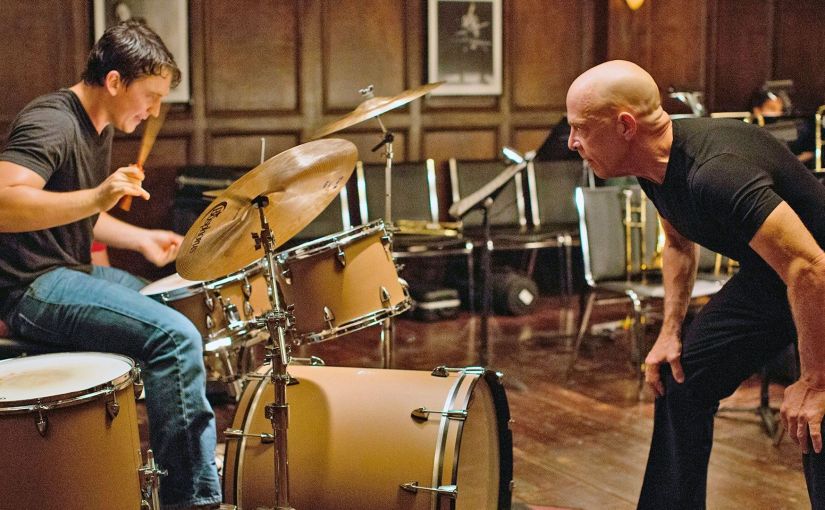
WHIPLASH (2014)

by Miguel E. Rodriguez

Director: Damien Chazelle
Cast: Miles Teller, J.K. Simmons, Paul Reiser, Melissa Benoist
My Rating: 10/10
Rotten Tomatometer: 94% Certified Fresh

PLOT: A promising young drummer at a prestigious music conservatory is mentored by an instructor who will stop at nothing to realize a student’s potential.


That’s right, I finally jumped on the bandwagon and watched Whiplash after no fewer than eight years of prodding by my fellow cinephiles.  Not only can they finally get off my back about it, but they all now owe me one.  Hope you all enjoy Wild Tales when next we meet.

I was hesitant to watch Whiplash because it was released and gained notoriety at a time in my life when I was yearning for some positivity after getting psychically beaten down by some really depressing foreign films.  Why, I asked myself, would I want to subject myself to ninety minutes of watching J.K. Simmons verbally abuse some poor kid just so he could play the drums a little better?  I’ve seen this movie before.  The abusive mentor sees the light, the victimized student either turns his back or excels like never before, etcetera, etcetera, blah blah blah.  I had the whole plot written out in my head from start to finish.  (I used to do that a lot, I’m realizing…kinda stupid, in most cases.)

Having just finished watching it, I can say, without reservation, that Whiplash belongs on the short list of the best films ever made about the drive for artistic perfection along with The Red Shoes, Black Swan, and Amadeus.  And it manages to have its cake and eat it, too, when it comes to the ending.  Tragedy and triumph walk hand in hand, though not necessarily in the way I would have ever imagined it.

Andrew (Miles Teller) is a talented young jazz drummer who has just started his first year at the fictional Shaffer Conservatory of Music.  He is anxious to gain the attention of Terence Fletcher (J.K. Simmons), the leader of the school’s prestigious jazz ensemble, The Studio Band.  Fletcher is a piece of work.  To say he engages in mind games is like saying Bill Gates dabbles in computers.  He recruits Andrew for his own band in the middle of someone else’s music class.  On his first day with the Studio Band, Fletcher berates another musician for playing off key.

Did I say “berates?”  Fletcher belittles, humiliates, and degrades the poor guy with a stream of profanity that would have made the drill sergeant in Full Metal Jacket envious.  He fires the guy on the spot.  When the guy leaves, Fletcher looks around and confesses that he wasn’t really out of tune, but he didn’t know he wasn’t, which is just as bad.  Accurate?  Technically yes.  Does that kind of teaching method belong anywhere outside of a military unit?  I’m going with “no.”

Andrew is willing to go along with this because he doesn’t just want to be good, he wants to be GREAT.  He wants to be remembered in the same breath with Charlie Parker and Buddy Rich, and he believes, like Fletcher, that greatness is not achieved without struggle and sacrifice.  Again, technically true.  Would Rembrandt have painted half as well with both ears?  Would Beethoven’s Ninth be remembered today if Beethoven hadn’t been totally deaf by the time it was finished?  The rolls of the Screen Actors Guild are littered with actors from broken or abusive homes.

There’s a revealing scene when Andrew eats a meal at home with his father and uncle and his two cousins.  The table conversation rings with praise for the two cousins who play football at their school and scored a long touchdown, etcetera.  When Andrew talks about being a “core” member of the best conservatory jazz ensemble in the country, he’s met with polite congratulations and that’s about it.  No one seems to think he’s going to make it as a musician, not even his own father.  “I’d rather die drunk, broke at 34 and have people at a dinner table talk about me than live to be rich and sober at 90 and nobody remembered who I was.”  Like Charlie Parker.  Like Amadeus.  Andrew’s only goal is to be great.  If he has to give up friends, romance, even family to achieve it, so be it.

But at what cost?  Fletcher pushes Andrew so hard that his hands bleed during rehearsals.  He demotes Andrew, then puts him back in the core, demotes him again, then basically makes him re-audition for the core spot against two other alternates until 2 am.  In one excruciating scene, Andrew actually tries to play in a competition after being in a freaking car accident.  It’s a truly desperate act from someone who is so afraid of being anonymous that only a body cast will stop him from taking his shot.

Make no mistake, the rehearsal scenes and the verbal and mental abuse from Fletcher are not pleasant.  They’re emotionally engaging, but they were also off-putting.  In a strange way, I was reminded of Requiem for a Dream and its disturbing subject matter that was nevertheless compelling to watch.  When we get to what happens to Andrew after the car accident, I was getting thoroughly depressed, despite the powerful emotional beats of what came before.

But then the movie enters its final act, and that’s where Whiplash finds another gear story-wise.  Andrew and Fletcher meet in an out-of-school setting, and Fletcher has an interesting speech where he says, among other things, “There are no two words in the English language more harmful than ‘good job.’”  He admits his tactics were brutal, but he devoutly believes in the necessity of pushing people beyond what is expected of them.  “Otherwise, we’re depriving the world of the next Louis Armstrong.”

Fletcher convinces Andrew to play for a new jazz ensemble one last time.  What happens at that concert is so horrifying that I watched most of it through my fingers.  I kid you not.  But then the screenplay transforms that situation into something magical, almost religious.  You get the sense that all of the horrible and despicable things Fletcher did and said during the whole film, all misery we had to endure with Andrew, during which time I wondered, “Why am I watching this??” – all of that unpleasantness was just the setup for the finale.  And that finale only means something because of everything that came before it.

In other words, just like Andrew, I was only able to experience that tremendous cathartic moment at the end because of the suffering I had experienced in the movie’s first 90 minutes.

…which leaves me feeling torn because that’s exactly the kind of thing that Fletcher believes in, but which I feel is unnecessary outside of a boot camp.  Ideally, yeah, I think that you catch more flies with honey than with vinegar.  I’ve directed my fair share of community theatre productions, and I’ve never had to resort to yelling or humiliation as a method to get what I’m looking for.  But then, I’m directing community theatre, not a multi-million-dollar film that may live or die on the performances I’m getting or not getting from my star.  Nor am I a drill sergeant training men to become soldiers.  It seems there is a line, but apparently to get certain kinds of results, it must be crossed.

It’s this dichotomy that will likely keep me awake the next couple of notes.  That and the senses-shattering finale.  I mean…I did not see that coming.  (And man, I am a jazz fan, so to me it was like eating a perfectly-cooked steak.)  It was not a pleasant road to get there, but it had to be unpleasant.  Otherwise, it wouldn’t have been great.

IDA (2013, Poland)

by Miguel E. Rodriguez

Director: Pawel Pawlikowski
Cast: Agata Kulesza, Agata Trzebuchowska, Dawid Ogrodnik
My Rating: 8/10
Rotten Tomatometer: 96% Certified Fresh

PLOT: In 1962, Anna is about to take vows as a nun when she learns a family secret from her only living relative. Both women embark on a journey to discover their family story and where they belong.


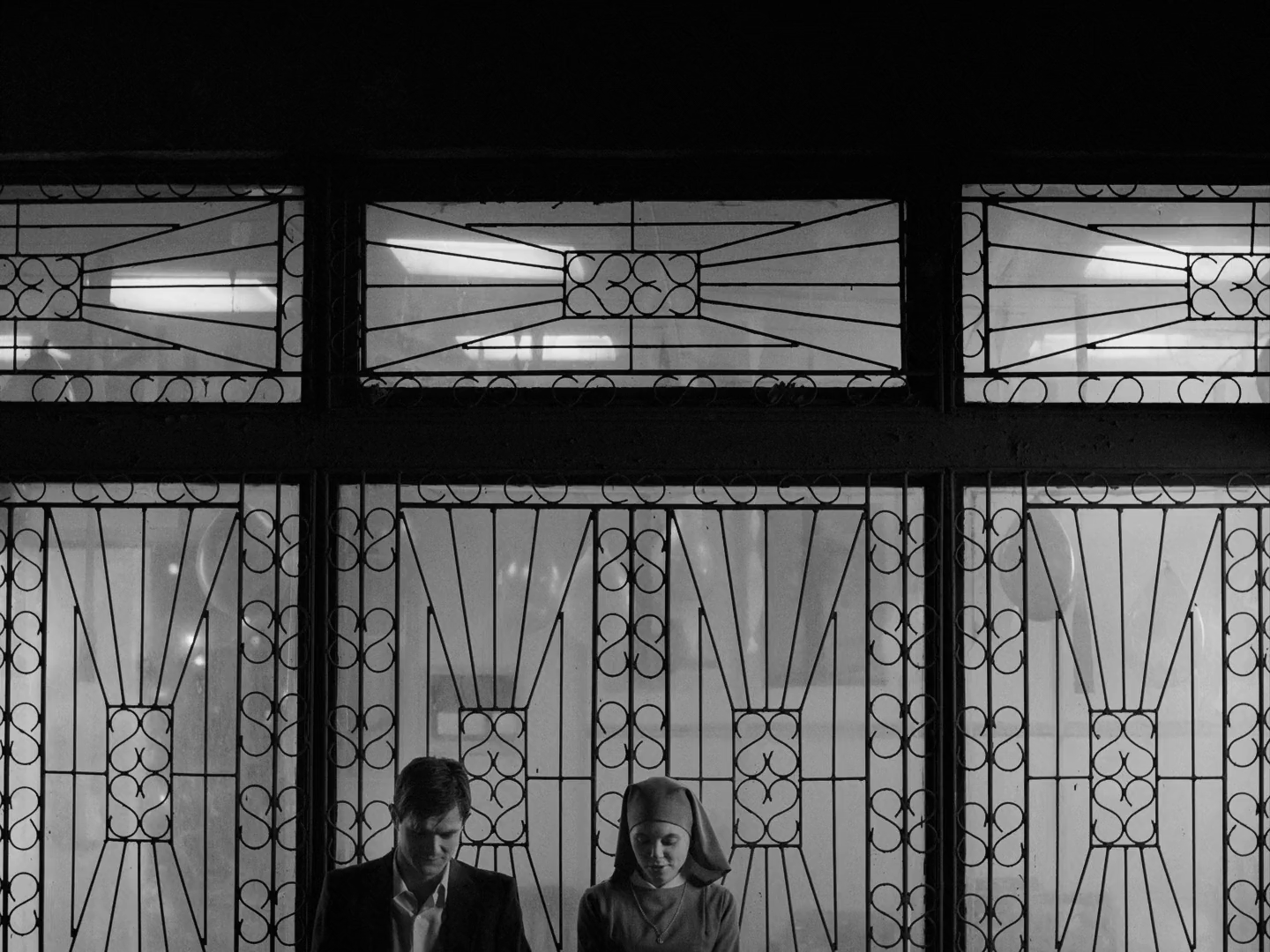
There are countless movies I’ve seen that remind me why I love the movies.  Ida is the first one I’ve seen in a very long time that reminds me why I love Ansel Adams.  Shot in stunning black-and-white and in the old “Academy” format with black bars on both sides – basically a square screen space instead of a rectangle – Ida is composed almost completely of static shots that have been framed in such a way that you could select almost any shot from any scene, frame it, and hang it in a museum.  Frankly, the beauty of the film is breathtaking.  If the story is a tad shallow or cryptic, I can live with it because it was such a pleasure just to drink in the visuals.

Anna is an orphaned novice nun in a convent in Poland in 1962.  She is on the verge of taking her vows when she gets a letter from an aunt she never met or knew existed, but who suddenly wants to meet her.  Anna travels to the city to meet the aunt, Wanda, who rather coldly informs Anna that the parents she never met were Jews who were killed during the war.  Anna is not Anna, but Ida.  Wanda confirms this by noticing Anna/Ida’s red hair and commenting that her parents had red hair.  Ida wants to find her parents’ bodies, so she and Wanda begin a search that will reveal a lot more than just final resting places and familial closure.

At one point, Wanda and Ida have a conversation about the vows Ida is about to take.  Prior to this conversation, Ida has observed that Wanda drinks, smokes, and appears to bring various men home to bed with her on a somewhat regular basis.  Wanda simmers under Ida’s blank but judgmental stare.

Wanda asks her, “Do you have sinful thoughts sometimes?”

“Yes.”
“About carnal love?”
“No.”
“That’s a shame.  You should try.  Otherwise, what sort of sacrifice are these vows of yours?”

My knee-jerk reaction was that Wanda is clearly trying to get a rise out of Ida, but I admire the sentiment and the logic behind that statement.  How does one know what they’re giving up if they’ve never experienced it to begin with?  It’s like a truism: how can you appreciate light if you’ve never been in the dark?  But it’s not that simple.  I do not smoke because I want to be healthy, or at least a little healthier.  You could say that I’ve “given up” smoking, but I’ve never experienced it.  Does it count as giving something up if you never took it up in the first place?  It’s an interesting conundrum, one that Ida has no real response to.

But I want to get back to the imagery.  That is the real draw of this film for me.  The only other film I’ve seen that really captures this same vibe is Alfonso Cuarón’s Roma.  There is one shot that captures Ida and a young musician she and Wanda meet during their journey.  Ida and the young man are having a conversation outside of a small ballroom, sitting in front of doors and windows with some ironwork.  The two of them are framed so they are very small at the bottom center, while the rest of the frame is filled with these black silhouettes, backlit by the ballroom fluorescents.  When they speak, the English subtitles are displayed, not at the bottom of the screen, but near the top across a black bar formed by the dividing line between the window and the transom window above it:

The unexpected placement of the subtitle took me out of the movie, but only momentarily because, again, what a shot.  They are so small in the frame, especially Ida, and the world around her is so huge.  This visual theme is repeated over and over again, and not just with Ida.  When they are driving down a country road, the static shot is not just of the road, but of the trees towering on either side, and the road itself receding into the distance towards the bottom right corner of the screen.  It’s magnificent, and my words are not doing it justice.  You’ll have to see for yourself.

When it comes to the story…to say the dialogue is minimal is, appropriately, an understatement.  The viewer is asked to do some heavy lifting because Ida says very little.  I guess it’s a bit like a Rorschach test.  We observe Ida in a situation, something happens, she says nothing, but proceeds to do something, and we are left to wonder why she does it.

Take that scene with the musician.  Earlier, Ida had been in an argument with Wanda about Wanda’s loose morals.  Wanda asserts that even Jesus loved Mary Magdalene and tries to look up the story in Ida’s Bible, but Ida grabs it from her and storms out of the room.  Later we see she has gone downstairs to the club to meet with the musician in front of those windows.  Why?  It’s up to us to answer the question.  Maybe she’s lived her life believing one thing, and now suddenly her entire belief system is being shaken up, and perhaps this is the only way she can be a rebel before taking her vows.  And she’s just talking to the guy.

The movie is full of moments like that.  An unexpected death occurs.  Ida’s response is to get dressed up and go dancing.  Say what?  When you watch the movie, we’ll discuss what was going in Ida’s head during those moments.  I’m not a hundred percent sure.

By the time the movie’s over, we’ve seen two graves, a suicide, a nun bathing herself, and some of the best cinematography I’ve seen outside of a Kubrick film.  Director Pawel Pawlikowski is virtually unknown to me, although he was up for Best Director in 2019 (losing to, how about that, Alfonso Cuarón for Roma).  His narrative method is a little oblique for my tastes, but his visual style is superb in every way.  I’m glad it’s in my collection.  Whenever I’m in the mood for a visual feast, Ida will do the trick.

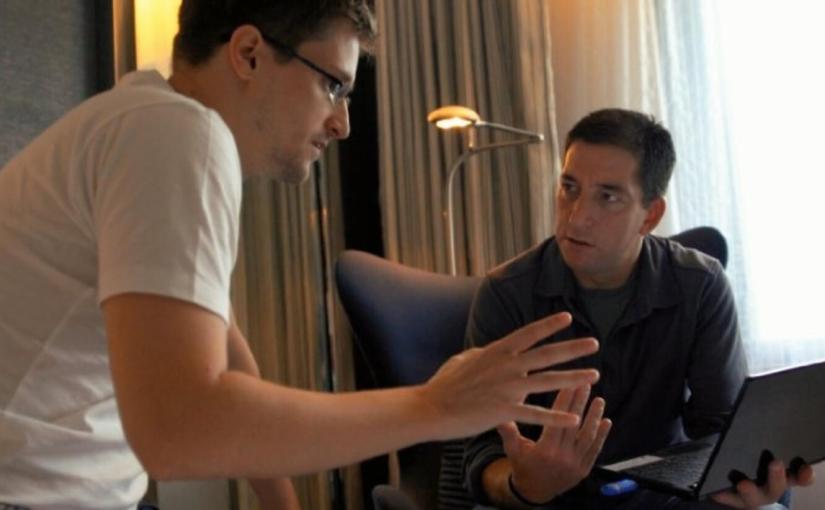
CITIZENFOUR (2014)

by Miguel E. Rodriguez

Director: Laura Poitras
My Rating: 9/10
Rotten Tomatometer: 96% Certified Fresh

PLOT: Documentarian Laura Poitras captures the first week or so of Edward Snowden’s leaks to the press and the ensuing aftermath.


Over the last month or two, I have watched two stirring documentaries (Cave of Forgotten Dreams and Nostalgia for the Light) that redefined my idea of what a “good” documentary should be.  Instead of being passive observers, those filmmakers documented what they saw and then commented on it with definite viewpoints and biases.  Narration was used heavily.  That’s not normally my favorite kind of documentary, but they were clear exceptions to my rule.

Tonight, I finished watching Citizenfour, a documentary about the first week or so of the Edward Snowden whistleblowing controversy.  In direct opposition to the other documentaries I’ve seen recently, this film steadfastly avoids narration and simply presents the facts as they happen.  As I was watching, I was simply absorbed in the storytelling, and after it was over, it occurred to me that this documentary captured something incredibly rare: the first few days of a national scandal, behind the scenes with the actual person blowing the whistle, BEFORE the story breaks.  It was captivating.

But that sense of being a fly on the wall is nothing compared to the revelations Snowden made.  If you’re politically-minded, Citizenfour is not just revelatory; it’s chilling.  If one-tenth of what he discusses just in this film is true, the ramifications are vast.  I don’t want to sound like a conspiracy theorist, but the secret surveillance programs Snowden describes are exactly the kind of tools needed to create a dictatorship.  When a government is using a program/algorithm/whatever that can follow your movements via phone calls, emails, e-payments, cell phones, laptops, etcetera…that’s a police state, empirically.

Snowden’s revelations are so mindblowing and voluminous that paranoia is the rule of the day.  He contacted Poitras and a reporter from The Guardian, Glenn Greenwald, via encrypted emails and air-gapped laptops and arranges to meet them in a Hong Kong hotel.  He makes a quick call to room service, then disconnects the phone.  Why?  Because, according to Snowden, the NSA has technology to listen in on conversations via a telephone handset, even when it’s hung up.  Later, the hotel’s fire alarm starts going off sporadically.  Snowden reconnects the phone and asks the front desk what’s going on, and he’s told it’s a scheduled test.  “Nice of them to let us know,” Snowden says.  Random event?  Who knows?  It’s a mark of how well the movie is constructed that seemingly innocuous events are transformed into, “They’re listening…”

The film follows the story, including the publication of the reports that eventually resulted in Snowden being forced to live in Russia for the better part of a year after his passport was revoked.  We meet Julian Assange as he organizes Snowden’s legal strategy along with a squad of ACLU attorneys, all working pro bono.

The genius of the film is how it simply presents the facts and allows the viewer to draw their own conclusions.  Is Snowden an attention-seeking charlatan?  Or was the US government actively spying – spying – on American citizens without their knowledge?  After a while, without really trying to, the movie takes on the air of one of those classic paranoid thrillers from the 1970s like The Parallax View and Three Days of the Condor.  At one point, Snowden logs into a laptop while covering his upper body with a blanket like a tent, presumably to make sure no one would be able to tell where he was by using the camera on his laptop.  Or something.

(Admittedly, we only hear snippets of opposing viewpoints, one from then-President Obama where he agrees that Snowden created a much-needed discussion but declines to call him a patriot because of his methods.)

But surely some of this stuff is a little too sensational, right?  The cynic in me wants to believe that’s the case.  But consider: The material in Citizenfour was so sensitive at the time that the director, Laura Poitras, had to move to Berlin because she kept getting detained by border authorities when trying to re-enter the US.  All the film footage was kept on encrypted drives to prevent access from…whomever.  In fact, she edited the movie completely in Berlin so the FBI couldn’t serve a search warrant for the drives.  Just in case.

At one point, Snowden and reporter Greenbaum carry on a conversation about another whistleblower, apparently inspired by Snowden, who seems about to release information about drone strikes and watch lists under Obama.  They are careful to censor themselves by not saying certain words and phrases out loud.  Instead, they write key phrases on pieces of paper and hand them back and forth.  And then the paper is torn to pieces.  Normally, this kind of thing would reek of paranoia, but considering what has come before, it seems perfectly reasonable, in light of what they’re discussing.

I gotta say…in all honesty, I may not be the best person to review this movie.  I think it’s well-made and eye-opening and informative, but is it going to make me change my online or cell phone habits?  Probably not.  I’m in my 50s, and I enjoy the convenience of Amazon Prime and paying my bills online and using my phone to pay for things when shopping.  Am I worried I’m being spied upon?  I suppose I should be.  But I’m not.  I guess I’m willfully ignoring facts, at least the ones based on this documentary.  I’m not saying I like it.  I’m definitely against it.  But is it enough to make me change my behavior?  If I’m being honest, no.  (And if I can’t be honest in an online review, where CAN I be honest?)  But, bottom line, Citizenfour is one of the finest documentaries I’ve seen in recent years. If you’re running short of things to be outraged about, look no further.

AMOUR (2012, Austria)

by Miguel E. Rodriguez

Director: Michael Haneke
Cast: Jean-Louis Trintignant, Emmanuelle Riva, Isabelle Huppert
My Rating: 9/10
Rotten Tomatometer: 93% Certified Fresh

PLOT: Georges and Anne have known a lifetime of love within their intimate marriage. Though their bond has survived the test of time, it’s about to meet its greatest challenge.


I’ve only seen three films by famed German director Michael Haneke.  The first was Caché (2005), which some may consider maddening, but which I think is a masterpiece of open-ended storytelling designed specifically to provoke arguments at the nearest Starbucks after the movie is over.  The second was The White Ribbon (2009), a pre-World War I fable about what happens when children give in to their tribal appetites.  I thought it was well made but a little too sedate, but it also won an unheard-of FOUR awards at Cannes that year, so what do I know.  (One day I’ll watch Funny Games [1997], but today is not that day.  Tomorrow is not looking good, either.)

Last night, I finished watching Amour, Haneke’s 2012 film that won Best Foreign Film at the Oscars that year, and the Golden Palm at Cannes.  After seeing three of his films, the one thing I can say about Haneke as a director is that he is apparently a perfectionist, who edits and composes shots as well as Kubrick, and that his subject matter is all over the place…also like Kubrick.  He also does not shy away from shocking the audience by lulling them into a kind of complacency before presenting them with a moment of violence or revelation.  Like Hitchcock, he plays the audience like a grand piano.

Amour tells the story of an octogenarian couple, Georges and Anne, still very much in love with each other.  They are retired music teachers living a quiet life of piano concerts, meals at the kitchen table, and reading the newspaper.  Georges might be a little more straightforward or curt than Anne, but they clearly know each other’s rhythms.  The style of the film clearly indicates their routines with a brilliant economy of editing and camerawork, not to mention the subtle performances from the two main actors.

One day, something happens at the breakfast table.  Anne and Georges are having a conversation over a boiled egg when Anne simply stops and stares into space.  Unable to get a response, even after dabbing a wet towel on her face, Georges prepares to fetch the doctor.  Suddenly Anne snaps out of her trance and wonders where Georges is going.  When he tries to explain what’s happened, she gets confused and angry with him for torturing her.  But when she tries to pour herself a cup of coffee, the coffee goes everywhere except in the cup, and suddenly her right hand seems to be trembling…

At this point, in years past, I would have probably turned this movie off, or returned it to Blockbuster without finishing it.  I can hear my inner monologue now: “Why do I need to watch an ultra-depressing movie about someone who’s dying?  I mean, I can hope that it has a life-affirming message at the end like Philadelphia or Angels in America, but this is a foreign film that won awards at the Oscars AND at Cannes, so chances are it’s going to end on a down note.  Who needs it, am I right?”

Well, Amour may not have the kind of crowd-pleasing finale one might hope for, but it is nevertheless engrossing, quietly devastating, and even a little terrifying.

…you can’t see it, but I’m very frustrated right now.  I’m trying to figure out how to write the rest of this column and it’s eluding me.

With a movie like this, an analysis of its technical prowess seems irrelevant.  I learn from the extras on the Blu ray that the couple’s apartment was constructed entirely on a set with a big green-screen backdrop.  Haneke wrote the script with his parents’ apartment in mind, so it seemed appropriate to just recreate it on a soundstage.  How does this contribute to the story?  I honestly don’t know.  I would imagine it enabled the filmmakers to control every aspect of lighting so that anything involving scenery through the windows felt as if it was real.  So I guess there’s that.

My problem is that this movie is intended very specifically to make you empathize with the characters.  It does this job very well.  It was a pleasure to watch a great film with great characters in the hands of a great director.  But if I’m going to talk about how the movie made me feel…I guess I must be honest and say it didn’t exactly make me feel good.  It didn’t make me feel bad, exactly, just really, really sad.

There is a kind of sadness I can feel at certain kinds of films (The Remains of the Day and Requiem for a Dream come to mind) where the endings are so mind-blowingly sad, and so unexpected, there is a kind of emotional exhilaration that accompanies the sadness.  I am so wrapped up in the story I have left real life behind, but after the movie is over, I am back in the real world, and I am stoked to tell someone about how great the movie is, despite its dark material.

With Amour, though, when the end of the film arrives, and I’m back in the real world…I still felt like I was in the movie.  Because, in a way, the movie is about me.  About all of us.  One day, I will (finally) grow old and eventually die.  Watching the scenes where Georges stares into Anne’s eyes as her body functions waste away and he reluctantly hires a nurse who is stronger than he is because Anne has lost the use of her right side and must be carried out of the wheelchair to be bathed?  Listening to the conversation when Anne says point blank that she sees no point in going on living if she’s going to be such a burden?  Watching Anne’s face when the nurse turns her in her bed to demonstrate to Georges how to put on her diaper?

Watching these scenes, I wondered how I would feel myself if I were to succumb to something similar.  I tell myself I would want to live.  There’s a line in Full Metal Jacket: “The dead know only one thing.  It is better to be alive.”  But what if I got as sick as Anne does?  What if I lost the power of speech?  What if I lost the ability to type with both hands, as I’m doing right now?

I’m not even sure that is the point of the movie, to make me reflect on my own mortality.  It’s said that Haneke made this movie to honor his aunt who suffered a degenerative disease as Anne does.  The title of the movie is Amour, so maybe I should be writing about the great love between Georges and Anne.  But whenever I think about that aspect of the film, I fall back into thinking about myself again.  It’s a vicious cycle, and I’m not sure how to break it.

I’m making this movie sound depressing to the nth degree.  I suppose it is, by default, but it is still definitely worth your while to watch.  It is so well made and so thought-provoking.  It deserves to be seen and discussed, ideally with someone you love.  I don’t agree with every decision made by the characters in this film.  But I understand why they were made, so I do not judge them.  One day, I will get old, and I will think back to this movie and say to myself, “Now I really know how they feel.”


P.S.  The only reason I don’t rate this movie 10/10 is because there’s a brief prologue involving an empty apartment and a bedroom with a single occupant that, to me, telegraphed a key moment that I saw coming a mile away as the scene unfolded.  But that’s just me.

A SEPARATION (2011, Iran)

by Miguel E. Rodriguez

Director: Asghar Farhadi
Cast: Payman Maadi, Leila Hatami, Sareh Bayat, Shahab Hosseini
My Rating: 10/10
Rotten Tomatometer: 99% Certified Fresh

PLOT: A married couple in Tehran are faced with a difficult decision – to improve their daughter’s life by moving to another country or to stay in Iran and look after a deteriorating parent who has Alzheimer’s disease.


The above plot description, paraphrased from IMDb, is rather brilliant because it is misleading in all the right ways.  When I read it, I assumed I would be in for a depressing domestic drama, a la Marriage Story or Kramer vs. Kramer.  It won Best Foreign Film at the Oscars that year, so that only strengthened my belief that it would be a fine film, but also a bit of a slog.

Boy, was I wrong.  That plot description covers just the opening four or five minutes of the movie, an incredibly nuanced, brilliantly acted, uncut take of the two spouses, Nader (husband) and Simin (wife) arguing in front of a judge.  Simin wants to move out of the country so their daughter, Termeh, can have a better quality of life.  Nader has no problem with them leaving, per se, but he cannot go because he must stay and take care of his elderly father who suffers from Alzheimer’s.  If Simin wants to go so bad, let her go, he says, but he won’t give permission for Termeh to go with her.  And Simin won’t leave without Termeh.  It’s a pickle.  (For her part, Termeh wishes to stay with her father, but Simin says that’s only because she doesn’t know any better…how depressingly typical of parents going through a separation.)

After this brilliant scene, I was ready for the movie to settle into a series of one scene after another showing Nader and Simin arguing over custody of Termeh.  Instead, the script ingeniously takes a bit of a left turn and focuses on the woman Nader has hired, Razieh, to be caretaker for his sick father, because Simin, in a move unexpected by me, packs up and moves out.  Razieh wears a traditional chador, and so Nader is unable to tell she is pregnant, which might have affected his decision to hire her.

Razieh does her best with Nader’s father, but the long commute and the difficult work takes its toll.  One day, Nader comes home from work and discovers his father has fallen out of bed, with one hand tied to the bedpost with a piece of cloth, and Razieh is nowhere to be found.  He also discovers some money is missing.  When Razieh returns, she is cagey about why she left, but she insists she stole no money.  Nader is furious and tries to throw her out of his house.  When she insists she be paid for the day’s work and continues to maintain her innocence of the theft of the missing money, Nader loses a little control and pushes her out the front door of their third-floor apartment and onto a staircase.  She walks away, but later winds up in the hospital – she has suffered a miscarriage.

What follows is one of the most engrossing social dramas I’ve ever seen in my life.  I suspect part of my insane interest in the story was the fact that it takes place in a country thousands of miles away, in a culture that is utterly alien to me, and yet the people there are just like any parents and children and husbands and wives we meet every day here in the States.  Razieh’s husband, Hodjat, even has a line: “Why do you think we beat our wives and children like animals?  I swear on this Qur’an, we’re humans just like you!”  He’s talking to his accuser, but he was also talking to me.

The film is shot with mostly handheld cameras, a technique that works extremely well by making everything feel like a documentary.  It makes things feel more real in a story that only works the more you empathize with the characters.  I empathized a great deal, not because I am a husband or a father, but because I recognized their situation, faced with an impossible decision where each person is right and wrong simultaneously.  In the ensuing plot developments, which I will not disclose here, I was so wrapped up in the lives of these people that I found myself reacting the way old school sit-com housewives might respond to watching their favorite soap operas while folding laundry.  “No WAY did he just say that!  …oh my god, lady, you’re just making things WORSE!  …jeez, this guy is CRAZY…!”

This was an unexpected reaction for me.  In years past, I have tended to shy away from foreign dramas after watching one called 4 Months, 3 Weeks, and 2 Days about women in ‘80s-era Romania forced to seek illegal abortions due to their country’s ban on the practice.  I’m not denying that film’s power, but it was so insanely depressing that I swore off foreign films for a while.  It’s only in the last couple of years that I’ve started to come back around to giving films like A Separation a chance.  It hasn’t always paid off, but I’m happy to say it did this time, in spades.

I should note that the story is also extremely revealing in terms of the legal system in Iran.  I can’t vouch for its accuracy, of course, but it all feels very authentic.  In a governmental system so intertwined with religion, it’s easy to see how decisions that are made based on religious statutes may be technically correct without being just.  Just another dimension to the film that makes it even more compelling to watch.

But there is another aspect of A Separation that I believe is even more profound than the engrossing domestic drama.  I’m not even sure if it was intended by the filmmaker.  I’ve read snippets of reviews from other top critics, and none of them seem to have touched on my theory.

[SPOILERS FOLLOW]

In my opinion, A Separation could be interpreted as an allegory of the impossible choices faced by anyone living in such a country or circumstances who yearn for a better (or at least different) life elsewhere, but whose ties to their roots and traditions make such a decision extremely difficult.

Look at the husband in the story, Nader.  He states repeatedly that he has no problem with his wife leaving.  If his father weren’t sick, he would be more than happy to go with her.  But his father needs constant care, and so his familial connection dictates his decision.  There is a telling moment when Nader is bathing his father by hand, while the father sits in a wheelchair, virtually oblivious to his surroundings.  Nader dutifully rinses his father’s body and leans him forward to so he can reach the bottom of his back…and he abruptly stops and starts to weep.  Is he weeping for his father?  Or himself?  It’s one of the film’s many “fill-in-the-blank” moments that we must interpret for ourselves.  For me, I believe it was over the fact that his decision to stay, motivated by love and duty, has resulted in years of caretaking.  He’s committed to it.  But it’s also profoundly sad.

Now look at the wife, Simin.  She believes her daughter, Termeh, will be better off in another country where she doesn’t have to worry that some man might take out his anger on Termeh while at school or walking home from school.  But Termeh insists on staying with her father.  Simin’s choices are to stay and be unhappy, or leave…and be unhappy without her daughter.  She adopts a middle ground by simply moving to her mother’s apartment while she works on convincing Termeh to come with her.  In the grand scheme of things, as a function of the allegory I have in mind, she represents the person who wants to leave and is held back, not by duty, but by the fact she won’t leave her daughter behind.  There’s a piece of her in this place, and she’s free to leave it if she wants, but she’ll never be the same.

How many people in other countries and other circumstances are faced with similar choices?  How many people in our own circles are stuck in marriages or family situations where leaving appears to be the best option on one hand but an impossibility on the other?  I could say that I’ve had similar situations in my own past with such a decision, but it was certainly nothing on the level of leaving my roots behind and moving to another country.  I can’t imagine the struggle and conflict for anyone facing that kind of choice.

A Separation takes that struggle and wraps it up in a movie that, even if it weren’t so perfectly symbolic, could stand on its own with any other film from any other country.  At the end of the film, the daughter is asked, point blank, which parent she would rather live with.  In what would ordinarily be a frustrating moment, we are not shown what she chooses.  It is left to us to imagine her choice.  Or maybe not.  Maybe we are meant to see what it’s like to be faced with an impossible choice, when neither option is better than the other and someone will get hurt either way.

The question isn’t, “What will she choose?”  The question is, “What would you do?”

THE PRINCE OF EGYPT (1998)

by Miguel E. Rodriguez

Directors: Brenda Chapman, Steve Hickner, Simon Wells
Cast: Val Kilmer, Ralph Fiennes, Michelle Pfeiffer, Sandra Bullock, Jeff Goldblum, Danny Glover, Patrick Stewart, Helen Mirren, Steve Martin, Martin Short (whew!)
My Rating: 10/10
Rotten Tomatometer: 80% Certified Fresh

PLOT: Egyptian Prince Moses learns of his identity as a Hebrew and, somewhat reluctantly, realizes his destiny to become the chosen deliverer of his people.


I sat down to watch The Prince of Egypt for the umpteenth time today, ostensibly in honor of Passover, but really it’s just an excuse to watch it again.  In the 24 years since its release, it’s become one of my favorite animated films.  I started out thinking it was a gimmicky cash grab.  Then I realized how majestic the score and songs were (by Hans Zimmer and Stephen Schwartz, respectively).  Then I came to appreciate how effectively it humanizes the Exodus story, so it becomes something more than just an excuse for some crazy visual effects.  Then I looked more closely at those visual effects and realized how magnificent they are, too.

So now it’s a treat when I watch it.  But something rare and unexpected happened to me when I watched it today.  Before I get into that, though, for anyone who may still be unfamiliar with this marvelous film…

Moses (Val Kilmer), a prince of Egypt, younger brother to Rameses (Ralph Fiennes) and son to the great Seti (Patrick Stewart), is comfortable with his place in the world.  One day, he comes across Miriam (Sandra Bullock), a Hebrew slave who boldly informs him he is not Egyptian.  He is, in fact, the son of a Hebrew slave woman who set him adrift on the Nile River to spare him from the bloody purges ordered by Seti, the man he calls father.  Disturbed and conflicted, Moses unthinkingly kills an Egyptian slave driver in a heated moment and leaves behind the only family he’s ever known to face his fate in the desert.

There he meets Tzipporah (Michelle Pfeiffer), a Midianite girl on whom he showed mercy earlier, and her family.  Embracing his new Hebrew identity, he marries Tzipporah and becomes a shepherd.  Time passes.  One day, Moses is searching for a lost sheep when he is confronted with a strange sight: a bush that appears to be, not burning, but covered in cold white flames, nevertheless.  To his shock, a voice speaks from the bush.  It is the God of his ancestors, and He is displeased with how His people are being treated in Egypt.  He commands Moses to go to Egypt and tell the pharaoh to let His people go…

Need I go on?  The staff, the plagues, the blood, the angel of death, the pillar of fire…it’s all presented here in spectacular fashion.

When DreamWorks first announced plans to make what basically amounts to a musical version of The Ten Commandments, I was skeptical to say the least.  I even remember what theatre I saw it in: the Ybor Centro movie theater in 1998.  I sat through the movie, and I allowed my skepticism to color my entire viewing experience, right up until the sensational Red Sea parting, which even now is one of the great animated sequences of all time.  But aside from that, I felt The Prince of Egypt was all flash and no substance, a way for an upstart movie studio to get people into theaters with an overabundance of star power and little else going for it.  But after watching it on home video repeatedly…I mean, REPEATEDLY…I started to analyze it a little more.

The first thing that really renewed my interest and appreciation for the film was the humanization of the main characters, particularly the relationship between Moses and Rameses.  Moses is no movie idol in this film.  He’s just a man.  Kind of a scrawny man, too, not classically handsome like his brother, Rameses.  Where Moses looks a little spindly and frail, Rameses looks like he lifts weights, or whatever folks did back then on “arm day.”  I also like how the movie allows these two men to behave and relate to each other like real brothers might.  They race chariots down city streets, needle each other, call each other names, play pranks on the high priests, the whole nine yards.  It’s a dynamic the two men surely must have shared as brothers growing up, but it never gets addressed in other interpretations of the story.  Because we get to see how much they love each other, the scene where Moses reluctantly turns his back on Rameses carries so much more weight than we might be accustomed to seeing.

This dynamic comes full circle when Moses returns to demand freedom for the Hebrew slaves.  Rameses is now pharaoh, and laughs at Moses’ demands, wondering what his “angle” is.  And then, when the plagues are visited upon Egypt and the city has nearly crumbled, the two men share a scene of astonishing power.  Rameses sees his city in ruins, but ruefully remembers how Moses used to get him out of trouble when they were younger.  It’s a wonderfully human moment.

The second element of the film that sparked my renewed interest was the music.  At the end of the opening number, which is itself emotionally powerful on several levels, a solo female voice sings out, “Deliver us!” right at the end of the song.  I can no longer remember a time when that moment didn’t give me goosebumps.  The score by Hans Zimmer is magnificent.  There is one particular motif of a choir of voices that we hear whenever we are in the presence of something holy or mystical, and even that gives me goosebumps.  Another moment that deservers recognition is during the big number, “When You Believe,” as the Hebrews are flowing out of Egypt.  At one point, the song is replaced by a Hebrew folk song, “Ashira L’Adonai,” sung by a little girl.  Her voice is joined by several others, and then a few more, and then a whole choir, and then the whole orchestra comes in for a reprise of the chorus, and if you don’t get goosebumps at that moment, you need a vacation.

The third element that keeps me coming back to this movie is the visuals.  True, the CGI visuals are relatively primitive compared to what was going on at Pixar around the same time.  The chariot race between Moses and Rameses features CG chariots which you may notice have wheels that don’t always turn while the chariot is moving.  This was an aspect of the film that led to my early dismissal of it.  But then came the Angel of Death scene, with a hole literally torn in the sky and sinister tendrils pouring out of it and into the village streets.  And then came the eye-popping Red Sea sequence.  More so than any other version I’ve seen, The Prince of Egypt made me feel in my bones that, yes, THIS is what it would have looked like if uncountable tons of water were parted down the middle, clearing a path large enough for the entire Hebrew nation to walk across.  (Depending on who you ask, that number could have been up to two million people, so we’re talking about a WIDE path.)  As they walk between the two massive walls of water on either side, lightning flashes illuminate sea life swimming alongside them, including some really large fish.  Now THERE’S something you don’t see every day.

So, yeah, the movie is amazing.  People may quibble about its historical inaccuracy, or the liberties it may take with certain religious beliefs.  But that does not diminish its power in the slightest bit.

Which brings me back to what I mentioned in the opening paragraph:

I sat down to watch the movie today, and for reasons I can’t explain, the opening scenes were bringing a lump to my throat.  That solo female voice singing “Deliver us!” nearly brought a tear to my eye.  And it nearly happened again after a wedding song.  And again, when Moses is leading the Hebrews out of Egypt to the strains of “When You Believe.”  And when Moses slams his staff into the shallow waters on the banks of the Red Sea, and those waters shot up into the air and kept going and going…my God, man, I nearly lost it.  I was one thread of self-control away from going full-on blubber-fest.  I mean, I grabbed my chest like a Victorian lady reading a Jane Austen novel.  In the middle of my emotional experience, I kept asking myself, “What is WRONG with me?!”

The answer is, of course, nothing is wrong with me.  I was just in exactly the right frame of mind to have a borderline religious experience while watching a movie.  It’s the same when I watch the finale of Fantasia 2000, when the sprite erupts from the ground in a gesture of pure joy.  Or when Riley learns the importance of experiencing sadness at the end of Inside Out.  Or any number of other transcendent films that can put me right in the middle of the story emotionally.  The Prince of Egypt does exactly that through a well-managed mixture of story, visuals, and music.  It may not be perfect from a technical standpoint, but it gets me where it counts, and that’s all that matters.

WITNESS

By Marc S. Sanders

Recently, I viewed The Last Emperor and one issue I had was that it was challenging to comprehend the in-depth culture of the people it depicted. I really wanted to learn and pass the final exam with flying colors. Sadly, this was an AP class that I just wasn’t qualified for.

Now that I have watched Witness for the first time in many moons, I can honestly say there is an approach where you can get absorbed in a thrilling crime drama while also appreciating the core values of the community the film focuses on, namely the Amish who reside in the state of Pennsylvania. It’s a much easier film to learn from. That’s for sure.

Peter Weir directed Harrison Ford to his only Oscar nomination to date. Ford plays police officer John Book, opposite Kelly McGillis as Rachel Lapp, a widowed Amish mother traveling by train from home to visit family. At a layover stop in Philadelphia, her young son Samuel (Lukas Haas, in one of the best child performances I’ve ever seen, so bright, observant and wide eyed) witnesses a murder committed by a decorated narcotics police officer (Danny Glover). When Book gets wind of who the cop is, all three of their lives are in danger and they are forced to flee and hide back at the Lapps’ home among the Amish community. Book, however, has taken a gun shot wound following an attempt on his life. The Amish see no choice but to heal him, especially at Rachel’s insistence.

Weir, with a marvelous script by Earl & Pamela Wallace and William Kelley, shows the intersection of two extremely different ways of life where an “Englishman’s” belief in aggressive tactics conflicts with the peaceful nature of people looking to never get involved with any other culture. A romance may seem inevitable between the two leads but it’s a difficult one to embrace. It’s truly forbidden, not simply by the elder Amish and their respective code, but both Book and Rachel know it can’t happen either.

Because we are aware of this forbidden romance that seems to break through anyway, there’s a terrific dance scene at night lit only by headlights within the barn. Ford and McGillis really shine through in this scene as it is the first escape from the fear they have for their lives and the code they honor and are reluctant to violate. It’s the best scene in the whole film. It presents possibilities for different people to interact despite the barriers that prevent such feelings and actions. They laugh and swing naturally. It’s a different kind of moment for Harrison Ford, unconventional when compared to a large majority of the action film roles he’s widely recognized for.

With a biting soundtrack of suspense from Maurice Jarre, Peter Weir also focuses on the theme of intrusion. When the climactic and certainly expected shootout sequence on the farm is to begin, it’s frightening and disturbing to actually see men in suits holding shotguns amid an unarmed society. There’s a masterful shot at dawn of the three men marching down the hill quickly approaching the farm. These aren’t cops being covert. These are cops storming a palace of peace and tranquility. It’s hard to watch because of the stain it leaves.

Josef Sommer is the lead dirty cop and he plays a great villain, truly an uncelebrated bad guy character, as the years have gone on. He’s a decorated officer who comes off with an intent that looks like it’s noble, until nobility will no longer work and intimidation has to set in. Weir shoots Sommer at a lower angle to give him an imposing height.

Ford is terrific. You see some of the Han Solo vibe in the character. He’s a tough cop after all, but then he transitions into an awakened man healed by the more primitive methods of the Amish and their drive to simply build and nurture. Another good moment occurs when Book contributes to building a barn with the other men. He shares lemonade with them. Assists with lifting the framework and hammering along. Two communities are no longer clashing. They are now blending.

McGillis is also very good in her role. She is determined to honor her background, but questions if she is capable of sin and defends her position later.

Witness gives an in depth look into the daily life of the Amish, literally how they farm, build and dress. Book wakes up with them before sunrise to milk the cow and he experiences what they endure from pesky tourists looking for photo ops. It makes for some funny moments as well as an opportunity to cheer for the stand he eventually takes.

Another funny moment is when Ford dons the Amish attire for the first time; it doesn’t exactly compliment him well at first. Book’s adaptability to his new community is awkward to grasp.

Witness presents a bird’s eye view into a very private way of living, and I saw a very large picture.

Beyond that, it’s also a crackling, good thriller.

EVERYTHING EVERYWHERE ALL AT ONCE

By Marc S. Sanders

Exploring the science fictional context of parallel universes can turn your thought process into a tailspin.  It can leave you up at night trying to find the center of a never-ending spiral.  Maybe that is why this gradually more common story line is reviving itself in current films like the next Doctor Strange installment from Marvel, or DC’s The Flash with multiple Batmans, and the unexpected surprise of Everything Everywhere All At Once.

My first experience with a multi-verse concept happened one Saturday morning in the early 1980’s.  At age 7 or 8, my favorite cartoon, Hanna Barbara’s Superfriends, explored a Universe of Evil.  Following a volcanic eruption, an evil Superman exchanged places with the noble Superman that we all know.  They each found themselves in opposite universes.  For the good Batman, there was an evil Batman, dressed in pink.  (Pink is evil????)  Evil Robin had a mustache itching to twirl.  Aquaman had an eyepatch.  Later, I hypothesized that this simple plot catered for kids was likely inspired by the famous Star Trek episode Mirror, Mirror.  (Evil Spock donned the evil goatee. Mwah ha ha ha ha!!!!!) These two storylines, which I highly recommend you seek out and watch, were very cut and dry in the concept of multiple universes.  There was a Yin and Yang structure of just black and white.  Everything Everywhere All At Once welcomes diverse complexity in its storytelling.  In this film, nothing is black and white.  Instead, everything consists of infinite shades of grey and gray.

The Wang family are Chinese immigrants buried in demanding and overwhelming tax obligations from the IRS while trying to manage a California laundromat.  Evelyn (Michelle Yeoh) is the matriarch who is married to Waymond (Ke Huy Quan) and they have a daughter Joy (Stephanie Hsu).  Upon visiting the IRS agent assigned to their case, Deidre (Jamie Lee Curtis, who finally found something else to do besides another Halloween retread), odd occurrences take place.  Evelyn is warned by Waymond with suddenly a strange and very different personality to act upon their current situation, like getting off an elevator and turning to the right, not the left.  Just trust me when I say that while you will likely be bewildered for a while as the exposition unravels itself, it will all pay off satisfyingly.  Somehow in another universe that is performing parallel to the one we first see in the film Joy is a villain bent on destroying Evelyn…and that’s not even half of what’s out of place.

I saw this film directed by the “Daniels” (Dan Kwan and Dan Scheinert) with my Cinephile colleagues, Miguel and Thomas.  After it was over, it was no surprise that they knew what I was talking about when I said this film is the reason why good editing is necessary in a film.  Because the Daniels introduce not one or two parallel universes, but SEVERAL, and there is so much happening…well…all at once.  I’d argue most shots in the film last no longer than an average 8-10 seconds because the multiple universe equivalents of Evelyn, Waymond, Joy and Deidre switch on a blink of your eye.  I warn you not to make a quick bathroom exit.  Quick flashes of scenes are relevant towards something else you may see in the next minute or an hour later.

Anyway, I’ll bet you never realized that there is a universe where the people have raw hot dog like fingers.  There’s also a universe where Evelyn is a street sign twirler, and a good thing there is an Evelyn like that to help another Evelyn fend off of a bunch of attackers in a different universe.  There’s also a world where humanity doesn’t exist.  Yet the equivalent of Evelyn and Joy are represented by two rocks.  That’s right.  Rocks with no limbs, no way of speaking vocally.  Yet, the film cleverly has the characters or products of its earth communicate with one another.  There’s even a different variation of the Pixar creation, Ratatouille.  Replace the rat with a racoon and see what transpires.

So, what does this all lead to?  Fortunately, there is a reason for these different worlds to collide and it leads to a valuable lesson in love and understanding within family.  Now that may sound hokey, but the film demonstrates that none of us are the same in what we are affectionate about, or what’s important to us.  How a daughter considers a girlfriend is not going to be easy for a mother to accept as any more than a friend.  The Daniels’ film carries much profoundness among its silliness depicted on the surface.

Having only seen Everything Everywhere All At Once one time so far, I could not help but laugh often and uncontrollably at what I was looking at, and the laughter becomes contagious when watching the film in a crowded theatre.  What made my movie going experience with this film quite fascinating though is that I responded in tune with the rest of the crowd.  Once you get past looking at Michelle Yeoh and Jamie Lee Curtis (two recognizable and accomplished actors) flap their hot dog fingered hands at each other, eventually you recognize the “normalcy” of that particular universe.  You are no longer laughing with them.  Now you are accepting the people and how they function in that specific environment.  Same goes for the rock universe.  The Daniels are brave enough in their direction to just show two inanimate rocks perched on a ledge and communicating with subtitles of very aware and well written dialogue.  It looks completely crazy at first.  Later, you yearn for the impending destiny of those rocks.

Much symbolism is tucked into the Daniels’ script as well.  The most telling is that it focuses on an Asian immigrant family obligated by law to honor American tax codes.  The Deidre character portrayed by Jamie Lee Curtis is not so empathetic to the Wangs’ comprehension of resolving tax violations.  Basically, two different cultures are butting heads with no progress because they have a different viewpoint on how things function.  Wisely, this serves as a springboard to demonstrate how multiple universes will lack perfect chemistry as well when they collide.  None of this is written off as communication barriers.

I imagine on a second viewing, I likely will look at Everything Everywhere All At Once through a different lens.  I won’t laugh as much because I’ve grown acclimated to what were once very odd and strange environments for these characters that dwell within.  Instead, I’ll be even more observant and appreciative of the film as it presents different behaviors and cultures encountering one another.  This is a very good picture that is worth multiple viewings for sure.

In fact, this film is such a pleasant surprise, that I am comfortable suggesting this early on that I will consider it one of the best films of 2022.  If at least Everything Everywhere All At Once does not receive an Oscar nomination for Best Screenplay, then it would be a terrible disappointment.  The imagination of its endless devices is just so inventive.  Heck, I’ll throw my hat out there and strongly suggest nominations for Michelle Yeoh’s performance, along with Best Editing for Paul Rogers (this guy should win the award) and Best Picture of the year.

See Everything Everywhere All At Once in a movie theatre with a crowd and/or a large group of friends.  You may just have a cathartic experience of how human nature responds when getting acclimated to what at first appears to be so foreign.