SAVING PRIVATE RYAN

By Marc S. Sanders

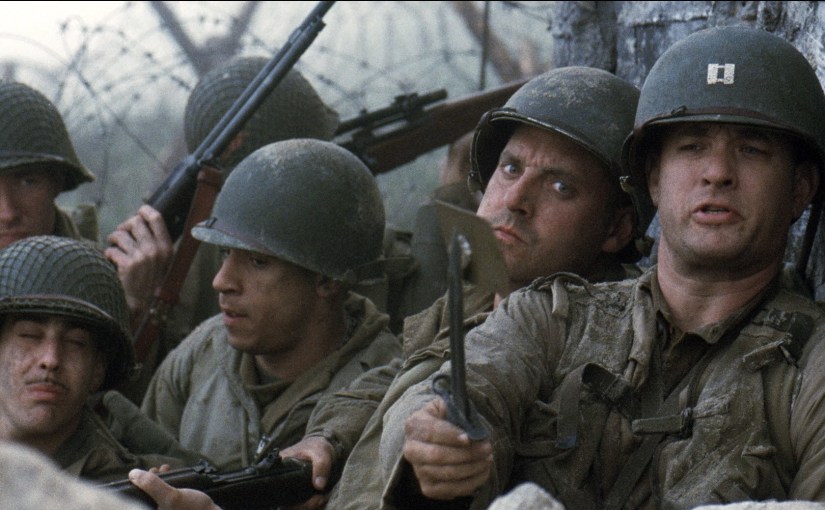
How much blood needs to be spilled to change the color of an ocean red?  The battle of Normandy during World War II showed quite a bit, and Steven Spielberg more than convincingly duplicates that terrible episode in world history with his war picture Saving Private Ryan

Spielberg earned his second Oscar for direction with this film from 1998.  It’s not only a technical marvel, but it’s a story that tests the nature of humanity when a squad of American soldiers ask themselves if saving the life of one man is worth sacrificing themselves.  Tom Hanks leads the team of recruits.

Saving Private Ryan begins on June 6, 1944 when thousands of American soldiers were inevitable sitting ducks as they washed ashore on Normandy Beach to engage in battle with German forces.  Spielberg’s footage is astonishing.  First of note is the cinematography is wisely washed out of color.  The sky is grey.  The ocean water and sand feel frigidly cold.  The most dominant color is blood red.  The fear displayed on the thousands of extras portraying soldiers, who never look mentally ready for battle, is palpable. 

The shots in this roughly thirty-minute opening do not compromise.  A soldier is seen walking around looking for his arm that has been shredded from below his elbow.  Other soldiers will turn over one way out of camera, but when they roll back into frame there’s a smoking hole where their face used to be.  Deadly head shots come out of nowhere.  Army medics have their hands soaked in bright red blood while trying to use scissors and thread to sew up wounds caked in wet sand. 

The action slows down at one point to focus on Hanks.  We haven’t even gotten to know his character yet, but we realize he is exhausted of this violence.  His hearing seems to deafen for a moment while he watches the horror quickly unfold as he puts his helmet back on only to have blood-stained water shower down over his head.  War is not meant for heroics and glamorization.  War only serves chaos and brutal death. 

Following this incredible opening sequence, one of the most impressive ever to start a film, Captain John Miller (Hanks) receives orders to locate the titled character, a paratrooper named Private James Francis Ryan (Matt Damon).  The army insists on sending the young private home to his grief-stricken mother, who has recently lost her other three sons in the conflict.  So, Miller recruits a handful of men consisting of fantastic actors like Tom Sizemore, Edward Burns, Vin Diesel, Adam Goldberg, Barry Pepper, Giovanni Ribisi and Jeremy Davies to make the trek across war torn Europe and rescue Private Ryan before he perishes as well.  How is that really fair though?

Any one of these men are sons to a worried mother back home.  The script for Saving Private Ryan by Robert Rodat has the men question why should they risk their own lives to find this one kid?  What makes him more special than any one of them?  Is the United States Army being fair?  Are they using this special mission as a means of propaganda?  Questions like this are irrelevant to the war department.  Just get him the hell out of there.

The journey of Miller’s squad is not just a simple hike.  At any given moment, they will come across a bombed-out town or another regimen who has just experienced their own kind of hell.  Further questions are asked when Miller recognizes an opportunity to take out an enemy battalion.  His own men suggest circumventing around this potential battle.  Miller won’t hear of it.  He’s a soldier.  Yet, after it is done, there is loss of life.  Should he have listened to their warnings or was he right to engage the enemy to avoid another team of allies suffering a terrible fate? 

Other dilemmas also come into play.  Should they escort a family and their young children who have lost their home?  The brutal dialogue of the script says that’s not their job.  Their goal is to take out the enemy and eventually rescue this one man.  Should an unarmed German prisoner be forced to dig his own grave and later be executed for the atrocities he’s committed?

War tests the ultimate limits of man.  What has to be done to allow us to finally, ultimately and justifiably shed ourselves of our humanity?  A correct answer is never provided in Saving Private Ryan.

Amid a series of astonishing battle scenes and images, two parts of the film stand out for me.  Following the loss of one of their comrades, there is disorder within the ranks.  This is where Tom Hanks takes control of a chaotic scene.  John Miller knows his soldiers have placed bets on what he does for a living back home.  Considering the strategist that Miller shows himself to be, its quite startling to find out what his occupation is.  It’s so surprising that Hanks as Miller uses it to temper his men which segues nicely into why Miller honors the mission assigned to him, even if it means risking his own life.  It’s not the best answer to why one man is more valuable than any other, but it’s the only one we are going to get. 

An even more powerful image comes to mind in the third act.  Jeremy Davies plays a Corporal assigned to the team to be a German and French interpreter.  He’s a soldier in this war, but he’s the last one you would want in combat.  As the American forces await the inevitable arrival of a German tank and a large number of troops to arrive, the men assign Davies to hold on to the long chains of ammunition and artillery.  He is draped in bullets around his neck and shoulders.  As the battle engages, shots are fired in all directions, men are quickly dispatched and Spielberg wisely has his cameras follow a helpless, weeping Davies do nothing but run from one end of the street to the other and up the stairs of a blown-out building.  He has all of the power in the world but he lacks the muster to kill and destroy which is what the nature of war demands.  He can even hear a man slowly die by stabbing in the floor above him. Yet, the Corporal can’t even rush to rescue his friend, and slaughter the enemy.  War destroys, but it also paralyzes man to act beyond an intrinsic nature of peace.  Each time I watch this scene, I can’t get past what this poor young man is truly capable of while being utterly helpless at the same time. 

I found Spielbergian techniques in Saving Private Ryan that hearken back to other celebrated moments in his film repertoire.  Tom Sizemore engages an enemy, only for both of them to run out of ammunition.  So, they wind up clumsily throwing their helmets at each other.  Indiana Jones might have done something like this for the sake of some form of slapstick.  Spielberg applies desperation to this scenario however.

The German tank at the center of the third act is somewhat reminiscent of the shark from Jaws.  Before we get an opportunity to see it, a focused Barry Pepper in a sniper’s bird’s nest gives a visual description of how big it really is and what accompanies it.  Later, Miller and Ryan have taken cover in a trench of rubble only to be overtaken by this beast as it careens over them.  The mouth of its cannon seems to come alive just before it blasts out a tower.  It’s just as scary and shocking as even Spielberg’s pictures of fantasy and adventure came before the release of this picture.  Every shot Steven Spielberg provides in any one of his films build towards an intrinsic and organic response from his viewers.  He always works with that goal in mind.  The tank is the tool used here.

The art direction is fascinating in this film as well.  A knocked over chair is picked up before a soldier stands it up as sturdy as he can on top of splintered wood and crumbled stone.  Sand on the beach is blasted up and out, sometimes splattering the lens of the camera.  Ocean water too.  Pockets of afterburn flames will be seen in the distance of a war-torn area.  The tangibility of these set pieces works cohesively with the distressed colors of a weathered and battle-stricken Europe. 

As chaotic as Spielberg demonstrates war to be, the editing is also commendable.  A war movie like this is not an action picture for the sake of escapism.  We don’t need to see the gun that fired the bullet that pierces the skull of a person.  We just need to see the person get a bullet that penetrates his helmet only to blow his head off to understand the unforgiving nature of war.  A man might be dialing up headquarters requesting air support, but he suddenly will not finish the conversation.  Editing allows the unexpected to become all too common in the midst of battle.

Saving Private Ryan is one of the best films ever directed by Steven Spielberg.  He had already shown real brutality not embedded in fantasy with films like The Color Purple, Empire Of The Sun and especially Schindler’s List.  Yet, with this picture, small factions of men, seeking world conquest, might have started this terrible conflict, but the movie does not concern itself with those instigators.  Instead, we witness the pawns at the disposal of war.  We see the collateral damage that suffer and die at the hands of unseen powers that be.  With Robert Rodat’s script, Steven Spielberg questions the value of one man versus a collection of men, and how any man, who may physically endure this terrible period in time, can also mentally survive long after it is all over. 

THE BLACK STALLION (1979)

by Miguel E. Rodriguez

Director: Carroll Ballard
Cast: Kelly Reno, Mickey Rooney, Teri Garr, Clarence Muse, Hoyt Axton
My Rating: 8/10
Rotten Tomatometer: 90% Fresh
Everybody’s a Critic Category: “Watch a Film Starring Animals”

PLOT: After being shipwrecked off the coast of Africa in the 1940s, a boy bonds with a magnificent Arabian stallion and trains him to race after their rescue.


Horses are great, but they are not my favorite animals.  That honor goes to the great white shark.  (They fear nothing; the only things they are even cautious around are larger great whites…but I digress.)  I always hear and read about how magnificent and majestic and spiritual horses are.  I have never denied their intelligence, but I never jumped on the bandwagon with folks who believe they are angels on four legs.  And I’ve never really gotten into horse racing, at least not on an ongoing basis.

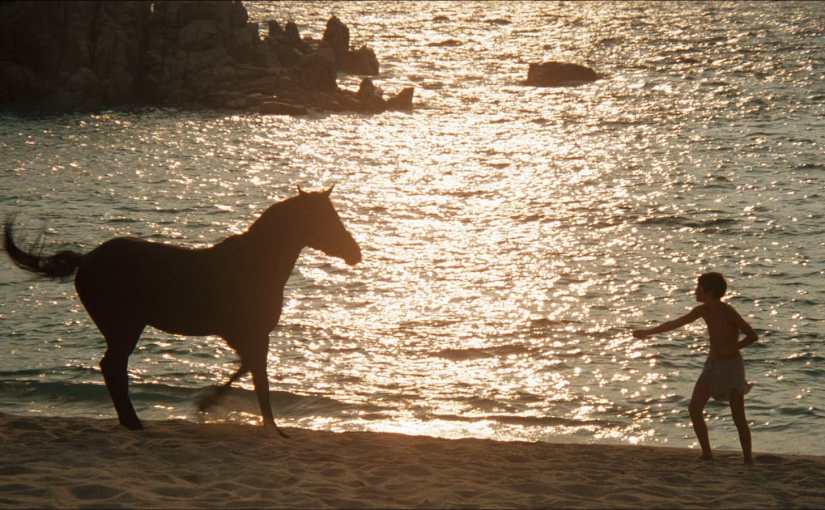
But there is one movie that combines the mystique of horses and horse racing with poetry, grace, and true art.  Carroll Ballard’s The Black Stallion is one of the most beautiful films ever made.  The visuals are so good and well-edited that fully 28 minutes of the movie are presented with zero lines of dialogue spoken.  After a fearsome shipwreck, Alec Ramsay (Kelly Reno) finds himself stranded on a desert island along with a magnificent unnamed black stallion whom he later simply calls the Black.  During this shipwrecked portion of the movie, all dialogue is dropped, and we simply watch as Alec and the Black overcome their initial fear of each other and bond.

It is in these scenes that The Black Stallion truly shines.  There is one particular sequence that will stick in my memory forever.  After some days and weeks alone, Alec tries to get the Black to eat food directly out of his hand.  In a nearly unbroken take, we watch as the Black warily approaches Alec, then turns away, snorting and stomping, then turns back, taking one cautious step after another, getting closer and closer…and it all looks completely organic.  It’s one of the greatest acting performances by any animal in any film I’ve ever seen.  In that scene, the Black exhibits more proficiency at acting on camera than I’ve seen in a few human actors I could name.

When I first saw this movie at 8 years old, I couldn’t fully appreciate the ingenuity of this portion of the film.  All I cared about was how invested I was in seeing Alec bond with the Black.  I didn’t care about cinematic theory and editorial processes and visionary cinematography.  But it’s all there in full view, presenting a visual story clearly and cleanly.  Buster Keaton would have loved this movie, I think.  (At least, the silent portions, I would imagine.)

The Black Stallion piles on one visually exhilarating scene after another involving Alec gradually gaining enough trust from the stallion to the point the Black allows Alec to ride him.  And then they are both rescued and returned home to America, and it’s here the movie seems to stumble just a bit.  After the grand vistas of their desert refuge, the white picket fences and tree-lined avenues of 1940s suburbia is a tad underwhelming.  When the Black gets spooked by garbagemen and runs off, we do get a nice contrast of seeing this semi-mythical creature of a bygone age galloping past storefronts and hurdling fruit crates.

Alec chases the Black and eventually finds him in a seemingly deserted barn owned by one Henry Dailey, an ex-jockey played to utter perfection by Mickey Rooney.  To say Rooney’s performance in The Black Stallion is “natural” is an understatement.  And to older audience members familiar with Rooney’s performance as a jockey in the 1944 film National Velvet, this must have been like seeing the remaining members of the Ghostbusters reunite in Ghostbusters: Afterlife (2021).  When he trains Alec how to ride the Black, you get this incredible sense of a man tapping a massive reservoir of knowledge for the benefit of the next generation.  I don’t know if I’m accurately describing this facet of Rooney’s performance, but if you watch the movie, you’ll see what I mean.

As do so many other movies featuring horses (not all, but many), The Black Stallion culminates with a horse race, this one pitting the Black against the two fastest horses in the country.  As we are fed information about how and why this race comes about, I particularly noticed how one phrase was repeated at least twice: “They’ll never let him run…he doesn’t have any papers.”  No doubt there are horse enthusiasts who know what that means.  I haven’t the foggiest clue what they’re talking about, but the cool thing is…it doesn’t matter.  It doesn’t matter now, and it certainly didn’t matter when I saw it as a kid.  It’s enough to know that “papers” are something other horses have, but the Black doesn’t, and that seems pretty important to some people, no matter how fast he runs.  It’s just another way The Black Stallion is constructed to appeal to audiences of all stripes, be they equestrian aficionados or rank amateurs.  There are not a lot of films that can do that, and I don’t know if The Black Stallion gets recognized enough for that accomplishment.

The climactic horse race ends exactly how you would expect it to end.  Formulaic?  Of course.  But what a race!  The cinematography, editing, Oscar-winning sound design, and carefully restrained use of the musical score all combine to create a moment every bit as thrilling as any NASCAR race.  Even now, watching the movie for this review, I fell into the moment all over again, smiling with delight as Alec and the Black pound their way around the track, hooves thundering on the dirt, pumping my fists when Alec discards that pesky helmet and goggles, and those other horses ahead of them get closer and closer…

Any lover of horses owes it to themselves to find and watch The Black Stallion.  Kids will get a kick out of it, but adults will, too, perhaps on another, more nostalgic level.  (That could just be me projecting based on my own childhood memories, but I stand by it.)


QUESTIONS FROM EVERYONE’S A CRITIC

  1. Which character were you most able to identify with?  In what way?
    Well, for me, there’s no question I identify with Alec.  I still remember how I felt watching this movie for the first time.  I mean, I didn’t necessarily want to BE Alec, but he was my entry into the world of the movie.  I knew how he felt when he was trying to convince his mother to let him ride in a race.  I knew what he must have felt at the very beginning of the movie when his curiosity about the Black overcame his very real fear of such a powerful animal.  And I thrilled when he raised his hands in triumph during the horse race.  (Kind of an easy answer, to be honest, but…there you go.
  2. If you were to make a movie starring animals, what animals would you choose, and why?
    …well, as I mentioned before, great white sharks are my favorite animals, but they are notoriously difficulty to film, as shark cinematographer “Three-Fingers” Joe will tell you.  I’d have to go with dogs.  Much easier to train, plus every day they see you arrive on set, they’ll treat you like they thought you’d be gone forever.  My film would be a comedy/sci-fi story involving a cat’s brain being transplanted into a dog’s body.  Maybe get Paul Rudd to do the voice of the dog.  …it’s a work in progress.

GET OUT (2017)

by Miguel E. Rodriguez

Director: Jordan Peele
Cast: Daniel Kaluuya, Allison Williams, Catherine Keener, Bradley Whitford
My Rating: 10/10
Rotten Tomatometer: 98% Certified Fresh
Everyone’s a Critic Category: “Watch a Low-Budget Blockbuster” [Budget: $4.5 million.  Worldwide Gross: $255 million.]

PLOT: A young African American visits his white girlfriend’s parents for the weekend, where his simmering uneasiness about their reception of him eventually reaches a boiling point.


Many years ago, I attended a wedding in New York.  After the ceremony was over, I stepped outside to watch it snow.  After a couple of minutes of me standing outside alone wearing a tux, a very polite man walked up to me, held out his keys, and said something like, “The blue Buick in the second row, please.”  After I explained to him that I was not, in fact, the valet, he apologized profusely and went back inside, clearly embarrassed.  (I’ve always regretted what I should have done: just taken the keys, gotten in the car, and driven it out of the parking lot while waving goodbye. Yes, I would have returned it, but imagine the look on that guy’s face…!)

I have been lucky and, yes, privileged enough that, in fifty-one-and-a-half years of living on planet Earth, that is only the second time I have ever been the target of overt racism, intentional or not.  I will never ever know what it’s like to have to think twice before walking alone at night while wearing a hoodie.  I’ll never know what it’s like to literally fear for my life when a cop signals me to pull over.  The beauty of Jordan Peele’s Get Out is that it addresses the issue of what it’s like to be African-American today in a way that is so entertaining that the subtlety of the screenplay is only apparent when you watch the movie a second or third time.  Unless you’re African-American, in which case the symbolism and sly satire is not so subtle.

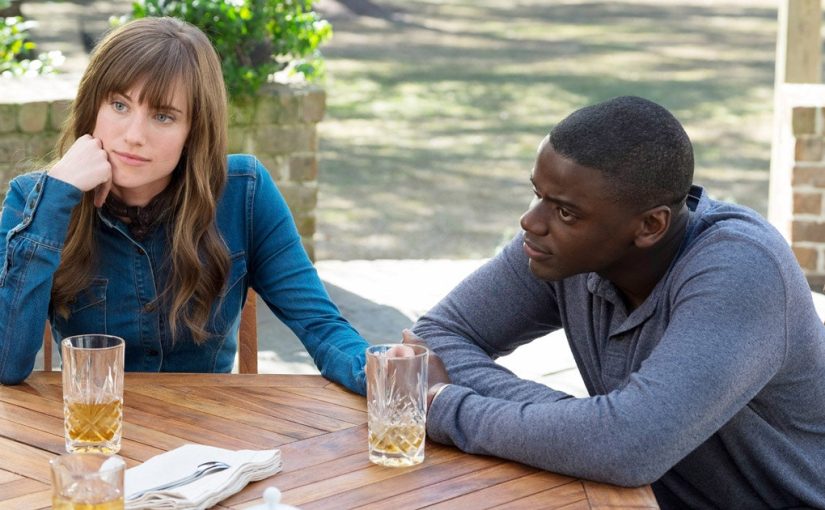
After a brief terrifying prologue, we meet Chris Washington (Daniel Kaluuya in his breakout role) who is about to visit his girlfriend’s parents for the first time.  His girlfriend, Rose (Allison Williams), is white.  He wonders if her parents are aware he’s black: “I don’t wanna get chased off the lawn with a shotgun.”  Rose casually dismisses his concerns: “First of all, my dad would have voted for Obama a third time if he could’ve.”

On the drive to her folks’ house, a startling and intensely creepy incident/accident occurs followed by a tense moment involving a white police officer asking to see Chris’s driver’s license even though he wasn’t driving.  Rose valiantly tells the officer off for profiling, and he lets them off with a warning.  This is just one of the many ways the screenplay probes and exploits the inherent fears of the average viewer.  Even if Chris had been white, it would still be a foreboding scene.  Because of the additional racial tension, the scene crackles with suspense.

Things get progressively weirder from there.  Chris meets Rose’s parents, Missy (Catherine Keener) and Dean (Bradley Whitford), along with their groundskeeper and maid, Walter and Georgina, both of whom are black.  Walter and Georgina’s behavior is just plain odd.  Their sole purpose seems to be to make Chris (and the audience) say, “What the f**k” repeatedly.  Dean directly addresses Chris’s apprehension: “I know what it looks like: a white family with black servants.”  His explanation of why they’re there answers Chris’s questions without really answering them if you follow me.

It would be unfair of me to describe any further plot details.  I’m sure those of you who’ve seen the movie would agree.  But I will issue a SPOILER WARNING for the remainder of the review.  Consider yourself warned.

Get Out is one of the most original, most effective modern horror films I’ve seen since The Descent (2005) and The Babadook (2014).  I have rarely been so glued to a screen.  The way director Jordan Peele ratchets up the creepiness levels is virtually unparalleled.  Here is a first film that rivals M. Night Shyamalan’s The Sixth Sense (1999) in terms of how to manipulate an audience.  Look at the moment when Chris sneaks out of the house for a cigarette, looks around, and suddenly spies Walter, the groundskeeper, running towards him in the night.  No, not running…sprinting.  Silently.  When I watched this for the first time on my own, I literally said, out loud, “What the s**t…???”  I can’t remember when I’ve seen anything like that in a suspense film.

Take the moment when Chris gets involved in a late-night discussion with Missy (Rose’s mom) that turns into an impromptu therapy/hypnosis session.  When Missy calmly says, “Sink,” and Chris actually does, and we see him floating in some kind of limbo, I felt the same kind of transfixed curiosity that I felt while watching Under the Skin (2013).  I had absolutely no clue what was happening or why, and I couldn’t wait until I could get answers.  When those answers come, they are both gratifying and suitably horrific.  Remember those old commercials for the American Negro College Fund?  The tagline was, “A mind is a terrible thing to waste.”  You will never think of that line the same way again after watching Get Out.

Peele was wise enough to include some comic relief in the form of his best friend, Rod (Lil Rel Howery), who works for the TSA and ironically gets closer to the truth of what’s going on at Rose’s house than he or anyone else realizes.  If the movie has a single weak spot, though, this might be it.  Rod is so comic it feels as if he was lifted directly from a romantic comedy.  Sometimes his delivery and dialogue feel a little too much like he’s trying for laughs rather than just being himself.  This is a minor quibble, though…he is funny as hell, especially during a phone conversation between him and Rose.

The bottom line, as if you couldn’t tell, is that Get Out is a sensational movie, containing more levels than “Super Mario Bros.” and more food for thought than a Judd Apatow dramedy.  It’s one of those movies where, if I hear anyone hasn’t seen it, not only do I recommend it unreservedly, but I immediately ask if I can watch it while they watch it for the first time.  Just to see their reactions.


SELECTED QUESTIONS FROM EVERYONE’S A CRITIC

  1. Do you feel a larger budget would make this film better or worse?
    …that’s a tough question.  As you can see from my 10/10 rating, the movie is just about perfect as it is.  What might change with a larger budget?  A more realistic-looking deer corpse?  A wide-angle shot of…something…burning?  Maybe they wouldn’t have gone with Daniel Kaluuya, or maybe Rose would have been played by, I dunno, Emmy Rossum or Lily James.  So, I guess my answer is, a bigger budget would make this film worse.  The filmmakers made the choices they made because of their limitations, and those choices resulted in a masterpiece of the genre.  It’s like Salieri says in Amadeus when describing Mozart’s music: “Displace one note, and there would be diminishment. Displace one phrase, and the structure would fall.”
  2. Were you surprised by the ending?  What would you do differently?
    Because of how the very ending of the film is structured, yes, I was surprised by the ending.  In fact, on the blu-ray, we can see the original filmed ending, and it’s what I feel might have been a more realistic ending.  As it is, the new ending is very satisfying on an emotional level, but I will always wonder how that original ending might have been received by general audiences.  Probably not well.  Imagine putting your hero up a tree, story-wise, then setting the tree on fire…but instead of getting him out of the tree, firemen chop the tree down and the hero is falsely arrested for arson.  Something like that can work – look at Body Heat (1981) and the original director’s cut of The Descent.  But Get Out provides a much more cathartic resolution and gets a smile on your face when you walk out the theater instead of shaking your head ruefully.


On the next “episode” of Everyone’s a Critic: “Watch a Film Starring Animals.”  I’m leaning towards The Black Stallion, but stay tuned…

SHAKESPEARE IN LOVE

By Marc S. Sanders

William Shakespeare’s works will always remain timeless.  His accomplishments are simply magnetic.

If you have any love for live theater, you’ll likely have at least a fondness for John Madden’s Oscar winning film Shakespeare In Love.  I loved the movie.  Perhaps that is because as a moonlighting playwright, myself, I could relate to The Bard’s early dilemma in the film – writer’s block.  It’s a gnawing, aggravating experience to go through.  You have an urge to create.  You just don’t know where to begin.  Believe me Bill, I know what you’re going through.

This likely fictional telling of William Shakespeare’s process of conceiving Romeo & Juliet begins with two competing theaters who have purchased the rights to Shakespeare’s (Joseph Fiennes) newest play that he has titled Romeo & Ethel, The Pirate’s Daughter, a comedy of course.  However, he has not yet written one page.  Not only does he suffer through his writer’s block, but William also has to endure the pressure of the theatre companies to stage and cast the play.  Geoffrey Rush and Martin Clunes are the scene stealing theatre owners who pester poor Bill for his script. 

My experiences in theatre allow me to also relate to the frustrations of staging a play.  Casting can be troubling if you don’t have the right selection of actors for the roles to be filled.  Huge egos can also be an annoyance.  Ben Affleck seems perfectly cast for that. (“What is the play, and what is my part?”)  In Shakespeare’s time, women are absolutely forbidden on the stage. As most theater presentations are intended to be comedic, men occupying the female roles only heightens the humor.  Still, as troubling as it is to cast the supporting roles with the available men of the company, including Ethel and her nurse, no one seems right for the role of Romeo. 

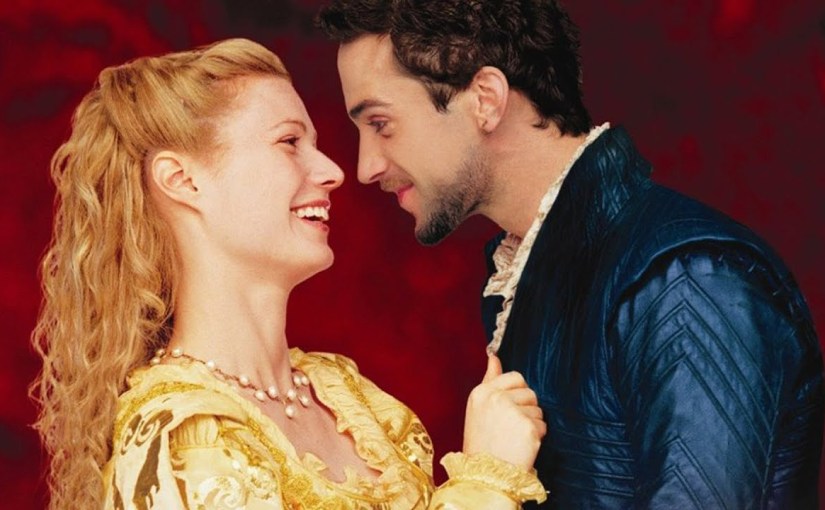
A fan of his, and a lover of theater, is Viola De Lesseps (Gwyneth Paltrow), the daughter of a wealthy merchant.  She musters the courage to disguise herself as a man and attend an audition under the name of “Thomas Kent.”  William is immediately taken with Thomas’ stage presence and upon his pursuit of him, encounters Viola.  They are both immediately stricken with love for one another and soon the writer learns of Viola’s deceit and revels in trysts with her while they maintain the secret for the integrity of the play that he now has inspiration to continue writing to its grand conclusion.  Viola is the muse that William has been seeking.

One problem beyond the usual obstacles in producing a play for performance time comes in the form of Lord Wessex (Colin Firth), a snobby cash poor aristocrat, who claims Viola as his soon to be bride as a means of earning a stature of wealth through her family.  Wessex is a demanding and unreasonable fiend of course, and Firth delivers an effectively cruel villain against the heroism found in Fiennes’ Shakespeare.

As the play is rehearsed and the romance between Viola and William continues to blossom, the drama is not left only on the stage.  A grand scene bordering on slapstick occurs when the competing theaters engage in a swashbuckling dual.  Props are tossed, swords are swung and feathered pillows explode.  Later, adventure on the level of Errol Flynn occurs with swordplay between William and Wessex within the theater and its trappings.  Screenwriters Marc Norman and Tom Stoppard inventively imply that theater, as we know it today, was simply inspired by what Shakespeare encounters in his own life.  When I conduct playwrighting workshops at my local community theater, I always tell the class that you have to “write what you know.”  Shakespeare In Love precisely demonstrates that mantra, even if it is elevated for the theatrics of cinema.  After all, this movie proudly boasts its silly comedy as much as it embraces its romance which thankfully never drowns in sap.

A wonderfully well edited centerpiece cuts between Viola and William’s passion for one another against their stage rehearsals with Viola in her guise as “Thomas Madden.”  In bed, they romance each other with recognizable dialogue, originally written by the real Shakespeare, that then makes its way into William’s pages for his script in progress.  This is where Gwyneth Paltrow really shines as she is momentarily depicted as the lovely Viola and then we see her in the guise of “Thomas,” the naturally gifted actor perfect for William’s Romeo character.  Paltrow’s range with the Oscar winning performance is done so well in this sequence alone.

The final act of the film is joyously assembled.  Behind the scenes, actor and writer William Shakespeare stresses over a stuttering actor who has entered the stage to begin the play.  Can he get through the scene?  What about the poor actor who is stricken with stage fright, and suddenly can’t go on as Juliet?  The audience is left in a rapturous trance with open mouths of silence and tears, following the suicides of the lovers on stage.  Yet, they don’t know if they should applaud at the end of the play.  The actors don’t know how to respond to the applause.  As well, are we given an opportunity to bear witness where the well-known phrase “The show must go on!” originated from?

It’s also necessary to point out one of the most favorite side characters to ever grace a film.  Judi Dench is the staunch and intimidating Queen Elizabeth I.  Arguably, this brief role, that I believe amounts to no more than five and half minutes on screen, carried Dench to not only Oscar glory but a celebrated favorite character actress for years to come.  Dench demonstrates how fun acting can be even if she is wrapped up in layers of 16th century wardrobe and caked on makeup.  Her first scene has her laughing at a poor actor performing with an uncooperative poodle.  Her last scene has her tearing down the romantic gesture of men laying down their coats for her to cross over a mud puddle.  It’s an unforgettable appearance in the film.

I take issue with one element of the picture, however.  Forgive me for going against the opinion of the Academy Awards, but Shakespeare In Love would have been an even grander experience for me had it not been for an overproduced and intrusive original score from Oscar winner Stephen Warbeck.  The music cuts into the film too much.  It borders on obnoxious.  Over and over, I was telling myself, these scenes hold together beautifully without any of the blaring horns and trumpets from Warbeck’s orchestra.  This film has an outstanding cast of actors and often I felt like they were being upstaged by the soundtrack of the film.  There are magnificent scenes with witty dialogue delivered by the likes of Imelda Staunton, Tom Wilkinson, Ben Affleck, along with Dench, Firth, Paltrow, Fiennes and Rush.  I could literally envision these moments working based simply on their performances alone.  Imagine watching a live stage performance, only elevator music cuts in at the most inopportune times. 

Still, I refuse to end on a sour note for Shakespeare In Love.  It is worthy of a standing ovation.  John Madden’s film is a grand production in cast performance, art direction, costume and makeup.  The script by Marc Norman and Tom Stoppard is brilliantly clever and witty as they weave inspired references from Shakespeare’s various sonnets, poems and plays into rich, everyday dialogue. 

Sustaining the value of performing arts can easily begin with a viewing of Shakespeare In Love in a school curriculum.  Even better would be to adapt this film into a stage play.  I think to watch Shakespeare In Love, live on stage, would be a wonderous experience.

THE WAR OF THE WORLDS (1953)

by Miguel E. Rodriguez

Director: Byron Haskin
Cast: Gene Barry, Ann Robinson, Les Tremayne
My Rating: 7/10
Rotten Tomatometer: 89%
Everybody’s a Critic Assignment: Watch a Movie “Classic”

PLOT: A small town in California is attacked by Martians, touching off a worldwide invasion.


I admire the 1953 version of The War of the Worlds most when I try to imagine myself back in that era as someone seeing it for the very first time.  For me, 69 years is still an almost unimaginable gulf of time.  In 1953, TVs were not quite a luxury item anymore, but a color TV definitely was.  Little kids still wore coonskin caps and watched The Howdy Doody Show for fun.  The very concept of UFOs was only six years old.  And the Cold War was a direct threat to our national security and our general peace of mind.

Into this culture came a film that, while thoroughly cheesy by today’s standards, nevertheless captured the paranoia of a nation.  Unstoppable creatures from another planet!  Wreaking havoc wherever they go!  Not even the mighty A-bomb can defeat them!  And who could resist those terrifying movie posters?  “A mighty panorama of earth-shaking fury!”  I would have been BEGGING my parents to give me ticket money.

Is a plot summary even necessary for this classic story?  A fiery meteor plunges to Earth near a small California town, but instead of making a crater, it carves a gully as it slides to a stop.  A scientist hypothesizes it might be hollow inside.  Presently, an alien spacecraft emerges from the meteor, bearing a fearsome weapon that looks like a cobra’s head and rains destruction and death on anything in range.  Forsaking Wells’ original vision of Martian tripods, this version presents sleek, manta-ray-shaped spacecraft supported by nearly-invisible electromagnetic currents.  Or something like that. Reports start coming from around the globe of other meteors and other spacecraft, and it quickly becomes apparent they’re not interested in friendly negotiations.  To paraphrase the stentorian commentary that bridges some scenes, this is the beginning of the end of civilization as we know it.

The heroes of this film are Dr. Clayton Forrester (Gene Barry) and Sylvia van Buren (Ann Robinson).  To put it kindly, their acting skills are…adequate.  To be fair, they weren’t working with a stellar screenplay, but the filmmakers wisely decided the real star of the movie should be the Martians and the Oscar-winning special effects.  As a result, Clayton is reduced to either giving scientific explanations of the Martians, while Sylvia’s main purpose is to look scared, scream loudly, and fry some eggs for Clayton in the middle of a war zone.  (I’m not making that last part up.  It’s not exactly Aliens.)

Regarding those special effects, sure they’re dated, but consider that, at the time, Hollywood studios regarded effects-heavy films as financial losers.  At least, that’s what they thought before The War of the Worlds.  It did so well that one of the head honchos at Paramount – one Cecil B. DeMille – presented the extraordinarily effects-heavy The Ten Commandments (1956) just three years later…and it broke box-office records.  The current trend is to blame Jaws (1975) and Star Wars (1977) for singlehandedly creating our insatiable appetite for special-effects extravaganzas, but look back far enough and there’s plenty of blame to go around, in my opinion.

Full disclosure: I still prefer Spielberg’s whiz-bang 2005 remake of War of the Worlds with its actual tripods and its CGI explosions and its callbacks to the 1953 original, including a cameo by Barry and Robinson, to satisfy cinephiles.  But this version, while dated, still has enough charm to remain effective.  Mostly.  (My favorite part is when the “hatch” on the meteor starts unscrewing; right about then is when I would’ve bought a ticket to Australia.)


QUESTIONS FROM EVERYONE’S A CRITIC

  1. Best line or memorable quote?
    When Dr. Forrester speculates how the Martians’ death ray works: “It neutralizes meson somehow. They’re the atomic glue holding matter together. Cut across their lines of magnetic force and any object will simply cease to exist! Take my word for it, General, this type of defense is useless against that kind of power! You’d better let Washington know, fast!”  It’s formulaic nonsense that’s only once or twice removed from calling an alien mineral “unobtainium”, but it’s delivered with the kind of conviction that only exists in the movies.
  2. What elements of this film do you feel have helped it become a movie classic?
    On a surface level, I’d say the quaintness of its visual effects.  Comparing them to the films of today is like comparing a paper airplane to the space shuttle.  But its also how the film captures the pop culture of the day.  The War of the Worlds fed on the fears and paranoia of a nation and stuck in the minds of millions of moviegoers and continues to do so today.  The 1953 film was influenced by the Cold War.  Spielberg’s remake was at least partially fueled by a nation’s fear of global terrorism.  Perhaps in another 20 or 30 years, some other enterprising filmmaker will once again send Martians to Earth to lay waste to its cities as a commentary on some future phobia or event.  …perhaps a global pandemic…?  Nah, too on the nose…

THE DEER HUNTER (1978)

by Miguel E. Rodriguez

THE DEER HUNTER (1978)
Director: Michael Cimino
Cast: Robert De Niro, John Cazale, John Savage, Christopher Walken, Meryl Streep
My Rating: 10/10
Rotten Tomatometer: 86% Certified Fresh

PLOT: An in-depth examination of the ways in which the Vietnam War impacts and disrupts the lives of several friends in a small steel mill town in Pennsylvania

[Author’s note: This will be the first in an ongoing series of reviews inspired by a book given to me as a birthday present by my long-suffering girlfriend.  Entitled Everyone’s a Critic, it challenges readers to watch a movie a week within a given category, then answer questions like, “Why did you choose this particular film” or “Do you feel this film deserved the award? Why or why not?”  Clearly designed to inspire discussion.  This category was “A Film That Has Won Best Picture.” This format is a work in progress, so I hope you’ll bear with me on future installments.

I am going to assume, for the most part, that most readers will have seen the movies being reviewed in this series.  Therefore, some spoilers may or will follow.  You have been warned.]


Once about every couple of years, I like to pick up and read Stephen King’s The Stand in its original uncut version.  My paperback copy runs to 1,141 pages, not including King’s foreword and a brief prologue.  Even Tolstoy would look at that thing and go, “Dude…edit yourself.”  But having read it numerous times now, I cannot imagine what could possibly have been excised from the edited version of King’s novel.  Every detail of that apocalyptic saga feels necessary.  Reading it is like falling into a fully realized alternate universe.

That’s what watching The Deer Hunter is like.  I can still remember the first time I watched it.  I knew its reputation as one of the greatest Vietnam War movies ever made, had heard of its harrowing Russian Roulette scene, and was intensely curious.  I popped it into the VCR, hit play…and for the first 70 minutes I got a slice-of-life drama about steel workers in a tiny Pittsburgh town (Clairton, for the detail-oriented) where, mere days before three friends ship off to Vietnam, one of them is getting married.  And the centerpiece is the wedding reception.  Ever watch a video of a wedding reception?  How high do you think a young teenager would rate its entertainment value on a scale of 1 to 10? 

I could not appreciate, as I do now, how vital this scene is.  Relationships are stated, expanded upon, and brought to a kind of cliffhanger.  Take the mostly non-verbal interplay between Linda (a luminous young Meryl Streep) and Michael (Robert De Niro).  Linda is clearly in a relationship with Nick (Christopher Walken), but it is painfully obvious that Michael and Linda have eyes for each other.  Mike watches intently from the bar as Linda dances at the reception, and whenever their eyes meet you can almost hear their hearts stop beating.  The oblivious Nick even pairs them on the dance floor while he visits the bar himself.  The awkwardness as Michael forces small talk and Linda shyly reciprocates is palpable.  And…is that Nick giving the two of them the eye at one point…?

As a kid, I wondered why this soap opera nonsense was necessary in a Vietnam film.  Of course, I didn’t know what was coming.  That’s the beauty and wonder of The Deer Hunter.  It challenges you to follow along with this miniature melodrama to give meaning to what comes next.

There is a key moment during the reception when an Army soldier wearing a green beret stops by the reception.  Mike, Nick, and Steven (John Savage), who are gung-ho about serving their country, yell their support and let him know how much they’re looking forward to killing the enemy.  The steely-eyed soldier raises his glass, looks away, and says, “Fuck it.”  It’s not terribly subtle, but the ominous nature of this moment always fills me with a sense of foreboding, even having seen the film many times by now.

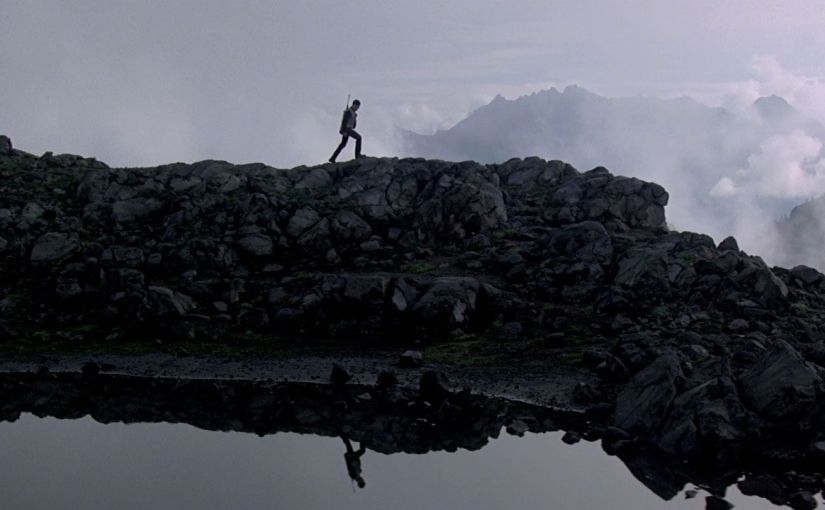
But even after the reception is over, there is one more small-town pit stop to make before the movie gets to Vietnam.  (In fact, The Deer Hunter spends surprisingly little time in Vietnam.)  Michael and a group of friends including Nicky and Stan (John Cazale) go hunting for deer in the mountains as a kind of ritual before Nick, Mike, and Steven are deployed.  It is in this sequence that Oscar-winning cinematographer Vilmos Zsigmond’s talents are put to stunning use.  We are shown vistas of the Allegheny Mountains that are simply breathtaking, with Mike and his friends seen as mere dots in the mountainsides.  Choral music with a men’s choir singing in Russian is heard on the soundtrack, giving the sequence a majestic aura that must be seen and heard to be believed.

Then the hunt is over, and the boys all have one last drunken night at the bar owned by another friend, John (George Dzundza in an under-appreciated, realistic performance).  Here they all sing along to Frankie Valli and listen somberly as John plays a sad classical tune on his piano.  And then, in one of the film’s masterstrokes of editing, we slam-cut immediately to the jungles of Vietnam – no boot camp, no footage of them being trained or flown over there, just suddenly they’re there and the contrast between the carnage we experience in the first few minutes of Vietnam versus the rhythms of their lives in Clairton could not be more extreme.

In a horrific but mercifully brief sequence, we watch as a Viet Cong soldier calmly walks into a burned-out village, discovers a hidden pit holding terrified villagers, and remorselessly tosses a grenade inside.  We then watch as Mike, now a battle-hardened soldier, emerges from a hiding place with a flamethrower and burns the VC soldier alive.

The effect of this scene cannot be understated.  To witness Michael torching a soldier, even after that soldier committed a brutal act himself, is jarring.  And why is it so jarring?  Because we have seen Mike as a civilian, as a friend, as a would-be lover, during that lengthy sequence at the wedding reception and while hunting with his friends.  Admittedly, you got the sense that he could or would get violent if necessary.  (He’s clearly the alpha male of his “clique.”)  But this…I mean, damn.

Then, in one of those Hollywood conveniences that never get old, Mike is unexpectedly reunited with Nick and Steve who just happened to arrive at that very same village with another platoon of US soldiers.  And then, immediately after being reunited, they are captured by enemy forces, imprisoned with several enemy combatants in a riverside compound, and forced by their sadistic keepers to play Russian roulette with each other as the guards bet on the outcome.  Michael comes up with a horrifyingly logical escape plan: convince the guards to put THREE bullets in the chamber instead of one.

Much has been made regarding the historical inaccuracy of this scene.  To those arguments, I say: who cares?  As someone once said, riffing from Mark Twain, “Never let facts get in the way of truth.”  The truth of the matter is, the Vietnam experience was a modern-day horror show, leaving physical and psychic scars on its participants and on our country.  In my opinion, the Russian roulette scene can be interpreted as a symbol of how those soldiers, or ANY soldiers, must have felt every single day.  Going on a routine patrol in the jungle could have potentially lethal circumstances.  They rolled the dice every time they called in an airstrike, betting they didn’t get firebombed themselves.  Booby traps were everywhere.  How is life in a war zone that much different from being given a one-in-six chance at living or dying?

I’ve already gone into far more spoilers than I am accustomed to, so let’s just say this happens and that happens, Michael winds up making it back home, Steven is grievously wounded in the escape attempt, and Nick goes AWOL when, after making it back to a military hospital in Saigon, he wanders the streets at night and discovers an underground ring of lunatics who run a high-stakes game of Russian roulette.  And we’re still just at the mid-point of the film.

When we see Michael back home, the earlier sequences establishing the rhythms of small-town life and his feelings towards Linda, for example, all come into focus.  We need that reception and the hunting scenes so we can see how much Michael has changed.  For example, when Michael is arriving back home by taxi, still in full military dress, he spots a huge banner: “WELCOME HOME MICHAEL”.  He tells the driver to keep going.  In a hotel room later that night, he sits on the edge of his bed and rocks back and forth, winding up crouching against the wall.  He is completely unable to process how to deal with people anymore.  Or, at least, he doesn’t trust what he will or won’t say.  I watch that scene, and I feel such intense sympathy and empathy.  What he’s feeling, what he’s been through, what he’s seen, is so huge that he knows he’ll never be able to explain it to anyone who hasn’t been there.  He knows he’ll get questions like, “What was it like?  Did you kill anyone?  How are you feeling?  Where’s Nicky?”  I’ll never know what it’s like to fight in a war, but if I had gone through what he’d gone through, I wouldn’t have stopped either.

There is a heartbreaking scene where Linda, who is more than a little distraught that Nicky is AWOL, hesitantly suggests to Michael that they go to bed.  “Can’t we just comfort each other?”  Mike rebuffs her, but in a way that makes it clear he’d like to, regardless.  De Niro’s performance here is staggering.  As he walks out, he makes a statement, showcasing how much he is feeling but also how unable he is to articulate it: “I feel a lot of distance, and I feel far away.”  I knew exactly what he was talking about.

The very end of The Deer Hunter is one of the most emotionally shattering finales of any movie I’ve ever seen.  It ends with a simple song, first sung as a solo, then joined by everyone else at the table.  I will not reveal what happens to get us there.  Is it shameless manipulation?  Yes.  Does it work?  Yes, so I can forgive the “shameless” part.

One of the criticisms I’ve read more than once about The Deer Hunter is how “one-sided” it is.  To which I say, “Well, duh.”  The Deer Hunter is not presented as a history lesson or a lecture on the internal politics in the country of Vietnam during the war.  The Deer Hunter is intended to make us feel something.  It wants to show us what happens to a person who is exposed to the very worst side of human behavior and lives to talk about it.  It wants to remind us that a country can wave a flag and stand for what’s right and be willing to sacrifice its best and brightest souls for a righteous cause…but it must also be prepared for the aftermath.  The Deer Hunter is a somber prayer that our country remembers the cost it demands, and that it will take care of its own when the dust settles.

JUDAS AND THE BLACK MESSIAH (2021)

by Miguel E. Rodriguez

Director: Shaka King
Cast: Daniel Kaluuya, LaKeith Stanfield, Jesse Plemons, Martin Sheen
My Rating: 9/10
Rotten Tomatometer: 97% Certified Fresh

PLOT: In the late ‘60s, William O’Neal, offered a plea deal by the FBI, infiltrates the Illinois chapter of the Black Panthers to gather intelligence on party Chairman Fred Hampton.


By the time it was over, Judas and the Black Messiah made me think of that scene in Psycho (1960) where Norman is cleaning up after his mother and the car starts to sink in the swamp and then stops…and Norman gets nervous.  At that moment, I started rooting for Norman, getting in his headspace: “C’mon, car, sink.”  I was empathizing with the bad guy.  Neat trick.

That’s how I felt during Judas and the Black Messiah.  Instinctively, I know I’m supposed to be rooting for one character, but the movie empathizes with the “villain” character so well that I found myself rooting for him, too.

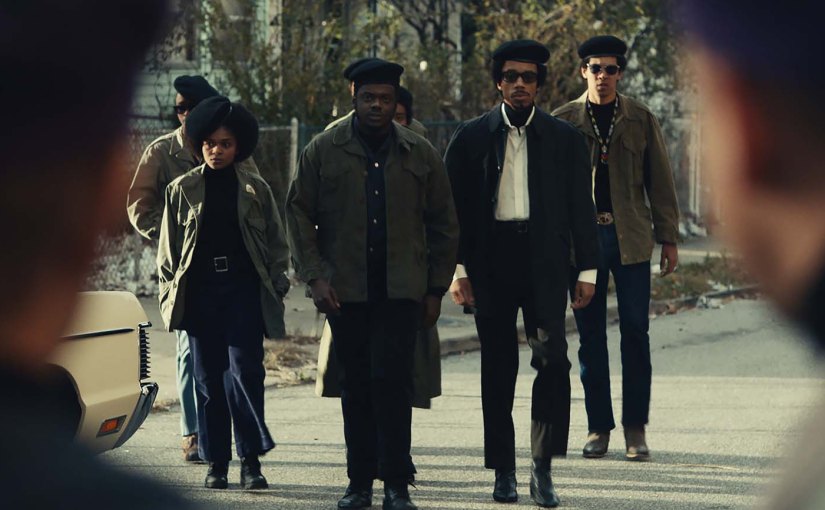
In the late 1960s, Fred Hampton’s star was on the rise in the black community.  As portrayed in a sensational performance by Daniel Kaluuya, Hampton is a fiery, charismatic, passionate public speaker who publicly advocates armed patrols of Black Panthers in black neighborhoods to keep an eye out for harassment from white cops.  When he is made Chairman of the Illinois chapter of the Black Panthers, the FBI takes an interest.  Well…Hoover takes an interest, which pretty much means the FBI followed suit regardless.

Meanwhile, a petty thief named Bill O’Neal (LaKeith Stanfield) is arrested by the FBI, who gives him a choice: serve a 5-year stretch for impersonating an FBI officer, or…go undercover into Fred Hampton’s Black Panther chapter and bring out good intel that will help them arrest Hampton.  O’Neal agrees, and what follows is an exercise in classic cinematic storytelling and misdirection, done up with glossy modern cinematography that looks like the best movie Oliver Stone never made.

(…actually, “misdirection” is not the right word.  I’m not sure what the right word is.  I’ll explain.)

Fred Hampton is clearly meant to be the hero of the film.  Hoover even refers to Hampton as a “messiah” of the black movement.  This all takes place a few years after both Dr. King and Malcolm X had been assassinated.  (If things had turned out differently, Fred Hampton’s name would be synonymous with King and Malcolm X, but it’s not, and based on this movie, that seems distinctly unfortunate and unfair.)  He boldly walks into a local meeting of white supremacists and, incredibly, turns them around to his way of thinking, using a brilliant metaphor of America as a house on fire.  If that moment is not based on fact, it should be.

So, if Hampton is the hero, then O’Neal is clearly meant to be the villain.  Hampton is the messiah of the title, so O’Neal is Judas, the traitor, the informer.  As a direct result of his intel [SPOILER ALERT], the FBI makes several arrests, including Hampton himself, and eventually initiates a raid during which Hampton is killed in his bed with his pregnant wife in the next room.  (This is all a matter of public record, though it’s interesting that it took this movie to really make me aware of it.)

But it’s easy to make a movie with a two-dimensional villain.  Judas and the Black Messiah does something much more difficult.  It asks us to empathize with both Hampton AND O’Neal.  We see the conflict in O’Neal’s face when Hampton promotes him to chief of security for their chapter.  We see O’Neal’s fear when he is recognized by a member of a local gang.  We see how few choices he really has in his various meetings with his FBI handler (Jesse Plemons), who constantly reminds him that, if he runs, they will find him and put him in jail.  Hampton says numerous times in the film that if he were to die for the cause, it would be a life well spent.  O’Neal has no such ideals.  I’d go as far to say that, if that were me in O’Neal’s shoes, I might do the same thing to stay out of jail.  I know my limits.

So, the entire film, I was pulled back and forth between admiration for Hampton and his cause and feeling anger towards O’Neal; and feeling terribly sad for O’Neal and what he’s essentially being forced to do by the FBI.  In other films depicting the Jesus story, I felt no such sympathy for the Judas character.  Director Shaka King accomplishes what so many other films do not: total alignment with one viewpoint while also demonstrating that not everything is so – forgive me – black and white.

Frankly, for me, the movie is worth watching just for the closing epilogue alone.  We get a glimpse of the real Bill O’Neal being interviewed for a real PBS documentary in 1989, and he is asked what he might tell his son about his role in the events surrounding Fred Hampton’s death.  His answer feels like something he’s rehearsed and said all his life.  And then there’s a closing subtitle…and it’s devastating.

I feel like there is more I could say, but it would involve getting into much more detail about several plot points, and I would prefer to leave them for the viewer to discover on their own.  Judas and the Black Messiah is worthy enough to stand with Spike Lee’s Malcolm X (1992), Ava DuVernay’s Selma (2014), and Steve McQueen’s 12 Years a Slave (2013) as one of the best films ever made about the black experience in America.

MANCHESTER BY THE SEA

By Marc S. Sanders

Whether it is Gone Baby Gone, or The Assassination Of Jesse James By The Coward Robert Ford, or even Good Will Hunting, Casey Affleck is an actor who never compromises for glamour or grandeur in his roles. He will look ugly, dress down or be the most unlikable of characters to preserve the authenticity of a movie’s script. I imagine good directors just let him loose and film him with whatever he comes up with on the spot. It would be a tribute to his talent to do so. Here, in this Best Picture nominee, he is incredibly moving and quietly unhinged. He’s excellent.

Manchester By The Sea is a heavy, dramatic script held together by a simple story. Affleck plays Lee Chandler who will probably be destined to endure one unspeakable tragedy after another for the rest of his life; hammered away until it seems there’s no way to ever recover from inner demons of guilt and sadness.

At best, his recently departed brother (the always reliable Kyle Chandler) blesses him with an opportunity by making Lee the guardian to his 16 year old son, Patrick, played by Lucas Heges in one of the best screen debuts I can remember. He’s an eerie doppelgänger for a young Matt Damon.

Patrick needs Lee, and Lee, who doesn’t know it yet needs Patrick.

Manchester By The Sea takes its time to set up story and character, and maybe that is its downfall. People get in their cars, they shovel snow, they get out of their cars, they shovel more snow. All this set up for a 2 hour and 15-minute film might handicap the pacing, but I can’t think of a better way to improve upon its heart wrenchingly real narrative. The tragedy at the center of Lee’s turmoil is difficult to accept.

Michelle Williams as Lee’s wife is proves once again that she is an amazing actor finding her own unique method for a penultimate crying scene. She is underused. I would have liked to see more of her in this film.

Manchester By The Sea was nominated for Best Picture, Actor, Director, Screenplay and Supporting Actress. All well-deserved but maybe not worthy of the awards. (Affleck won the award, actually, and so did Kenneth Lonergan for his screenplay.) I think there were a few better nominees in each of these categories. Still, had it not been for the Oscar nods I probably wouldn’t have watched it. All I can say is, I’m glad I did.

NOMADLAND (2020)

by Miguel E. Rodriguez

Director: Chloé Zhao
Cast: Frances McDormand, David Strathairn, and a cast of non-professionals/actual “nomads”
My Rating: 8/10
Rotten Tomatometer: 93% Certified Fresh

PLOT: A woman in her sixties, after losing everything in the Great Recession, embarks on a journey through the American West, living as a van-dwelling modern-day nomad.


Nomadland is one of the most visually beautiful films I’ve seen recently.  It mostly reminded me of Brokeback Mountain (2005) with its sprawling vistas of distant mountains, lonely country roads against a looming sky, and desert badlands illuminated by that elusive light that appears only during the “magic hour” so coveted by cinematographers and photographers alike.  It’s beautiful and well-made.  As a message film that won the Academy Award for Best Picture of 2020…I mean…it’s good and admirable, but it didn’t quite get to me like it was clearly trying to.

As a piece of propaganda (intentional or not), I can see Nomadland being effective for anyone who has been disillusioned of the American Dream by financial troubles.  Set in 2011, the film follows Fern (McDormand) as she hits the road in a van after the gypsum mining company her deceased husband worked for folded, displacing an entire town, Empire.  Even the town’s zip code was discontinued.  Fern literally lives out of her van, which doubles as living quarters, bedroom, dining room, and (revealed in a shot that I was stunned to learn was real) bathroom.  She works seasonal jobs throughout the American West at various parks, restaurants, and even an Amazon warehouse during the holidays.

On her travels, she encounters a large community of fellow nomads.  Periodically (I think annually), they gather at a location in the middle of the desert to trade goods, share stories and nomadic tips, and basically support each other for a week or a month or whatever…it’s not made clear exactly how long everyone stays before they go their separate ways once more.  On this occasion, she meets a fellow traveler named Dave (Strathairn) who trades her for a can opener.  Over the course of the film, Fern’s and Dave’s paths will intersect again and again.  I thought we were getting the kernel of a corny love story, but not quite.  The purpose of their relationship is pragmatic, not romantic.

Another traveler Fern meets is Swankie, a lively woman in her seventies who hangs a skull-and-crossbones flag from her van when she wants no visitors.  Honestly, it made me wish I had a similar flag to hang from my neck to communicate the same thing in public.  Anyway, Swankie reinforces Fern’s commitment to this way of living by describing trips to Alaska, a visit to a large community of swallows nesting on a cliff while on a canoe trip, and by revealing one of the real reasons Swankie has adopted this lifestyle in the first place.  All with no bills to pay, other than gas, food, and vehicular upkeep.

The movie follows Fern from one place to another over the course of a little over a year.  We see her working, driving, talking with people she meets, cooking on her tiny gas stove inside her van, dealing with the cold in the winter, reminiscing over old photos and slides.  There are two interesting side trips when she can’t avoid reaching out to…well, I guess “civilization” is the right word.  One occurs because her beloved van breaks down and she has to get to her sister’s to ask her for repair money.  Another occurs when she takes Dave up on an offer to…no, won’t spoil it.

At times, I found myself comparing Nomadland to Cast Away, Robert Zemeckis’ 2000 film where Chuck Noland (Tom Hanks) finds himself stranded on a desert island after a plane crash.  In both situations, the heroes find themselves isolated from civilization.  They must both learn to deal with an alternate way of life, and there is no alternative.  Adapt or die.  (When Swankie learns Fern doesn’t even know how to change a tire, she reprimands her.  “You can die out here.  You’re out in the wilderness, far away from anybody.  You can die out here.  Don’t you understand that?  You have to take it seriously.  You have to have a way to get help.  You have to be able to change your own tire!”  It’s a sobering reminder that, even though she has a cell phone (how she pays the bill is a mystery to me), Fern must be self-sufficient in order to survive.)

Furthering the similarities to Cast Away, there’s even a moment where Fern has an opportunity to sleep in a real bed.  We see her crawl underneath the covers…but in the middle of the night, she creeps back out to her faithful van to get a real night’s sleep, just like Chuck Noland sleeping on the floor of his hotel room.

But what does it all mean?  What is Nomadland trying to say?  I couldn’t shake the idea that Zhao’s film, based on a book of the same name, was an attempt, like Into the Wild (2007), to romanticize the concept of shedding our material needs, stripping ourselves down to the necessities, and getting back in touch with nature.  I have no doubt this notion appeals to many people.  Well, that much is clear because nearly everyone in the film besides McDormand and Strathairn are non-actors who are playing themselves, and they’re all nomads, too.  But is the movie simply showing me how and why a person makes this decision?  Or is it trying to convince me that I should do the same thing?  Is this one of Ebert’s “empathy machines” that allows me to live in someone else’s shoes for 107 minutes and experience life through their eyes, or, like Into the Wild, is it making the case that folks who haven’t made this decision themselves are slaves to a corporate system?

At one point, a gentleman named Bob, who is a real person and is one of the main coordinators of the community that meets once a year in the desert, makes a speech to the nomads who have gathered:

I think of an analogy as a work horse. The work horse that is willing to work itself to death, and then be put out to pasture. And that’s what happens to so many of us. If society was throwing us away and sending us as the work horse out to the pasture, we work horses have to gather together and take care of each other. And that’s what this is all about. The way I see it is that the Titanic is sinking, and economic times are changing. And so my goal is to get the lifeboats out and get as many people into the lifeboats as I can.

I’d be lying if I said his notion wasn’t appealing.  Who wouldn’t want to live a life of seeing the country, parts of which many of us may never see in our lifetimes?  Never being tied down to a job, to familial obligations, bills, taxes, the eternal quest for the almighty Dollar?  I get it.  But…if I didn’t have a job, didn’t earn a living, didn’t pay my bills, and have enough left over to buy a home entertainment system including the Blu-ray of Nomadland…I would never have seen this lovely film in the first place.

So, no, the concept of living as a nomad is not something I would seriously embrace…yet.  Life is good.  I have a job.  I have family.  I have friends who are as good as family.  I have the woman I love beside me.  I’ve seen Alaska, England, Greece, New York, Miami, and Key West.  Nomadland argues that, if any of that would ever change, there is an alternative to depression and slaving away and eking out a living in my retirement years in a 1-bedroom apartment.  Perhaps, on that day, I might re-evaluate my opinion of nomadic living.

But that day is not today.

Tomorrow is not looking good, either.

LA STRADA (1954, Italy)

by Miguel E. Rodriguez

Director: Federico Fellini
Cast: Anthony Quinn, Giulietta Masina, Richard Basehart
My Rating: 8/10
Rotten Tomatometer: 98% Certified Fresh

PLOT: A child-like woman is sold to a traveling entertainer, consequently enduring physical and emotional pain along the way.


Fellini’s La strada, the very first film to win the Academy Award for Best Foreign Film, is widely considered to be one of the greatest movies of all time, a touchstone of the Italian neo-realist movement that grew out of Bicycle Thieves (1948) and Umberto D. (1952).  Ask anyone who knows me, and they’ll tell you that, while I appreciate these kinds of films, they are not exactly my bread and butter.  There are some Italian movies that I will probably never watch, and I am quite sure I won’t miss them.  However, I am happy I finally sat and watched La strada.

But why?  La strada is not a happy movie by any stretch of the imagination.  It tells the story of a vaudevillian strongman, Zampanò (Anthony Quinn), who entertains street crowds by stretching a chain across his chest muscles until it breaks.  When the movie opens, he is paying the mother of a large family 10,000 lire for Gelsomina (Giulietta Masina), a child-like woman with a hugely expressive face.  For that princely sum, she will leave her family forever and learn a trade as Zampanò’s assistant.

They hit the road.  Zampanò is not a very nice man.  He teaches Gelsomina the basics but refuses to let her learn any more than is necessary.  When they eat dinner at a restaurant, he picks up a local floozy and ditches Gelsomina for the night.  When she tries to run away, he runs after her and beats her.  When they take up with a traveling circus, he refuses to let her perform with anyone else but him.  Gelsomina despairs of her existence, but she has convinced herself she can’t leave because she can’t think of anywhere else to go.

In a traveling circus, Gelsomina meets a carefree acrobat/clown known only as The Fool (Richard Basehart).  The Fool lives up to his name: performing dangerous high-wire acts and recklessly teasing Zampanò for no apparent reason, even heckling Zampanò during his act.  This is not a smart man, but he manages to steal a quiet moment with Gelsomina where, in his own way, he tries to let her know that her life has a purpose because EVERYTHING has a purpose, even a pebble he picks up off the ground.  “I don’t know what this pebble’s purpose is, but it must have one, because if this pebble has no purpose, then everything is pointless.  Even the stars!”

Examine that statement closely enough and it’s not quite as life-affirming as it seems, but it lights a spark in Gelsomina’s otherwise bleak existence.  From then on, she holds fast to that conversation, referring back to it when new hardships or doubts arise.  Meanwhile, Zampanò remains as cold and ruthless as ever, even trying to steal from a convent.

And then something unexpected happens that seems as if it will finally break Zampanò’s hold on Gelsomina, but no.  Gelsomina clings to the belief that her purpose is to be with Zampanò, no matter what happens or how miserable she might become.

…so, yeah, this isn’t exactly a happy film.  This is not the kind of movie I would normally seek out.  But in its bleakness, it achieves a kind of aching beauty, like Atonement (2007) or The Remains of the Day (1993).

A lot of that beauty is achieved through the must-see performance by Giulietta Masina as Gelsomina.  It’s clear that Gelsomina is stuck in a woman’s body but with the emotional maturity of a child.  Is she developmentally disabled?  The movie never makes it clear.  Perhaps she simply chose to retain her innocence while the rest of the world moved on around her.  In that way, she becomes almost like a character in a fairy tale.  I found myself wondering if the movie would have played the same had Gelsomina been a child rather than a grown woman.  It might have played a lot like the sequence in Pinocchio (1940) when he is captured by Stromboli and forced to perform for street crowds.

Masina’s performance as Gelsomina would be the single best reason I can think of to recommend this movie to anyone who might not otherwise watch it.  Her face and eyes light up like candles on a birthday cake when she smiles.  When she frowns, she puts clown makeup to shame.  And when she dons clown makeup herself and dances and plays the trombone, you can’t help but grin a little.  When she weeps because she can’t see The Fool anymore, she sounds like a little girl who’s lost a pet.  It’s one of the greatest performances I’ve ever seen.

That performance is key to the movie.  Zampanò’s cruelty and dismissive nature masks his own fear of Gelsomina’s innocence.  He keeps her down because he doesn’t dare allow himself to believe he might be in the wrong.  Watching the movie, we allow ourselves to hope that perhaps Zampanò will reach a turning point where he throws himself at Gelsomina’s feet, begging forgiveness for his terrible behavior and past misdeeds.  But will it happen in time to make a difference?

On the Criterion Blu-ray of La strada, director Martin Scorsese states in an interview that, if you’ve never seen a Fellini film in your life, you could watch La strada and 8 ½ (1963) and you’d know all there is to know about Fellini and his films.  I’m certainly no Fellini expert, but that sounds accurate to me.  La strada contains all the seeds – the score, the performances, the circus theme – that come to fruition in 8 ½.  But La strada is the more accessible of those two films, in my opinion.  If you’re going to start somewhere, start here.