INGLOURIOUS BASTERDS

By Marc S. Sanders

If you are going to rewrite history then go crazy.  Go big and bloody.  Go for broke.  Don’t hold back.  Quentin Tarantino didn’t hold back when he penned and directed Inglourious Basterds, my personal favorite of his films.

To date of when this review is published, Tarantino has directed nine films and if ever the maturity of a director is so evident, it really shows with Basterds where three quarters of the picture is performed in either French or German.  English is secondary here, and Italian is limited to only a couple of “Bonjournos!”  and “Gorlamis!”

Tarantino presents early 1940s France when Germany occupied most of the country and practically rounded up all of the Jews.  In 1941, a cunning detective of a Nazi Colonel, Hans Landa (Christoph Waltz performing as one of the greatest villains of all time) visits a French dairy farmer to ensure there are no unaccounted-for Jews scurrying around; scurrying around like their beastly equivalent, the rat.  Landa is the hawk that will most assuredly find them.  This scene is the best written moment within Tarantino’s catalog of various scripts and dialogue exchanges.  The Landa character offers justification as to why a Jew needs to be exterminated to the point that he nearly had me (a conservative practicing Jewish man) believing in his hateful philosophy.  The lines crackle here with Waltz doing most of the talking while the sad dairy farmer can do no more than respond with certifying Landa’s interesting points.  Tarantino closes the peaceful discussion with horrifying violence though.  Hans Landa may be complimentary of a farmer’s milk and his three beautiful daughters.  He may be eloquent in his dialogue albeit French, German or English, but he is a ruthless enforcer of law …of Nazi law at least.  I also would like to note Tarantino’s tactful way of using props like the pipes the characters smoke, the glass of milk that is consumed by Landa and the ink pen and spreadsheet he uses for accounting of the Jews in the area.  There’s an uncomfortable intimidation in all of these items as they are handled by Waltz, the actor.  Later in the film, Waltz will send a chill down your spine as he happily enjoys a delicious strudel with whipped cream.  Inglourious Basterds is a great combination of directing, editing, cinematography and acting.

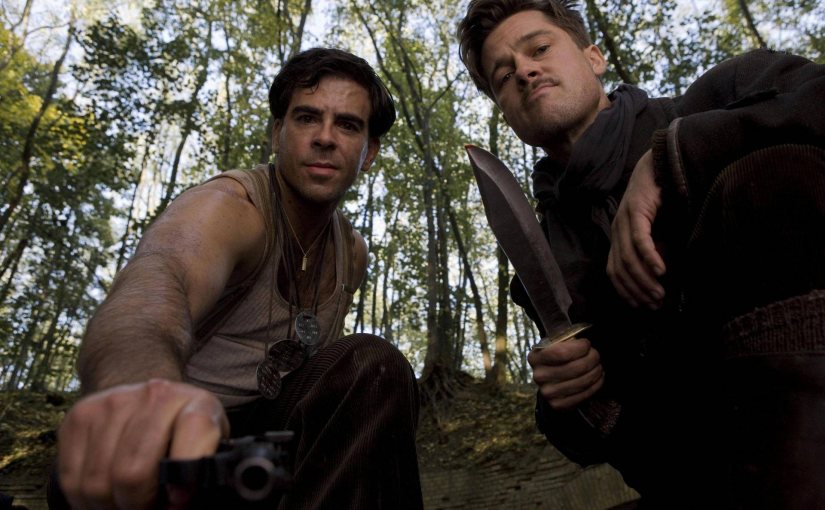
The film diverts into a few separate stories, namely the title characters led by Aldo “The Apache” Raines, played with Tennessee redneck glee by Brad Pitt.  The Basterds consist of mostly Jewish American soldiers tasked with going deep into enemy territory and literally killing and scalping one hundred Nazi soldiers, each.  However, keep at least one alive during each encounter with a carved souvenir on their forehead, to spread the word of the Basterds intent.  This is deliberate B movie Dirty Dozen material and it works because it doesn’t take itself seriously.  Tarantino maintains that pulpy fiction narrative.  A cut to an over-the-top crybaby Adolph Hitler asks, “What is a Hugo Stiglitz?” and then we get a quick pause with big black block letters across the screen spelling out HUGO STIGLITZ.  This guy is a bad ass; a German turncoat who only wants to kill fellow German Nazis.  He’ll shoot them up until they are dead three times over.  He’ll stab them in the face twenty times through a pillow.  He’s not a suave killer.  He likes it violent and bloody messy.  The Basterds are fans.

The heroine of the film is Shoshanna (Melanie Laurent), a Jewish girl who is living undercover as a cinema owner in France.  By implied force she is tasked with presenting Himmler’s proud film of Nazi Germany’s finest war hero, Fredrick Zoller (Daniel Bruhl), recreating his bird’s nest three day sniper battle against an army of three hundred men.  This is where Tarantino does best at writing what he knows, and what he knows best is anything about cinematic film.  He literally uses his knowledge of film and film reels to bridge his story while setting Shoshanna on a mission to actually end World War II in one swift motion.   

In addition, he captures the adoration of film lovers and celebrity status.  Zoller is as heroic a celebrity as John Wayne or Zorro.  When he is recognized in the coffee houses or on the street, he humbly stops his ongoing flirtation with an uninterested Shoshanna, to give an autograph or pose for a picture.

Furthermore, Tarantino applies the scientific knowledge of how 35mm film is more flammable than paper as well as how to edit a film reel to an unexpected moment for Shoshanna’s Nazi audience.  He knows the architecture of a European cinema with its lobby and balconies and seating capacities.  He allows his characters to speak on an intellectual level by discussing great film artists of the time – filmmakers not as well-known as Chaplin here in the United States, but just as great or even artistically better. The art direction of the cinema both inside and out is adorned with washed out, distressed classic noir films.  Shoshanna changes out the lettering of the curved marquee top of the theater as well.  It might sound mundane, but to me it’s all atmospheric.

Beyond the subject of cinematic art, a bad guy will weed out a spy disguised in Nazi garb by recognizing how he signals for three drinks with his hand.  There’s a right way and a wrong way to place an order with a bartender.  Inglourious Basterds may be a fictional historical piece, but it also will give you an education. All of this reminds me that Quentin Tarantino has graduated from the simplicity of Reservoir Dogs to something bigger and grander and glossier.  Production money with a large budget will lend to that status of course, but Tarantino still had to learn to truly know what he was doing.

I will not spoil the ending here.  It’s a bloody blast for sure.  Moreover, it’s shocking.  If anything, Inglourious Basterds introduces an exclusive universe that resides in the mind of Quentin Tarantino where the textbook is thrown away, burned, riddled with bullets and blown up; it is where something else altogether happened, and you know what? I really wish it did actually happen this way.

MICHAEL CLAYTON

By Marc S. Sanders

The corporate world can be murder sometimes.  Just ask a well known “fixer” like Michael Clayton. 

George Clooney plays the title role that’ll leave your head spinning while watching the film, and thereafter keep you thinking about how frighteningly true much of what you’ve seen, in this fictional account from master writer Tony Gilroy, could potentially be all too real.

Michael Clayton is a lawyer who does not practice law but rather “fixes” sticky situations for his law firm.  When the attorneys of the firm don’t have enough imagination to swindle their client from bearing responsibility or surrendering to guilt, they turn to Michael.  Michael will know what to do.  Ironically, Gilroy’s script (which is also his directorial debut) will have you believe that Clayton is at a career midlife crisis moment where he understands that nothing really can be fixed or simply swept under the rug.  Not even money can buy any of us out of a guilty situation when there’s nothing to work with but the black and white facts of actual guilt.  Early on in the film, Michael explains to an aggravated high-priced client that there’s no getting out of the fact that a late-night hit and run is nothing else but a late-night hit and run.  Can’t undent a car.  Can’t bring a bicyclist back to life.  Can’t fix what is permanently broken.

Moving on to the main storyline will demonstrate the same ideal.  If knowing admission of guilt and wrongdoing is documented on paper in plain English, then there’s no getting around this.  Moreover, there’s no getting around the fact that one of the best lawyers in Michael’s firm, played expertly by Tom Wilkinson, is consciously arrested in his own guilt of ethics violation.  To be considered one of the greatest lawyers in the country, would you factor in how to squeak out a win at no costs? Would it be when you can accept that your own client is guilty of wrongdoing and help them from that point?  I don’t know.  I’m not a lawyer.  The point is that Tony Gilroy implies that Wilkinson’s character, Arthur Eden, was once considered among his peers in high esteem in order to earn the reputation he has. Then another way when perhaps that reputation was based on actions not so honorable.  As Arthur struggles with this conundrum, maybe it’s only telling that his wealthy corporate client, an environmental weed killer manufacturer and his law firm colleagues easily think it’s nothing like that.  Arthur must be literally losing his mind.  It’s the only explanation.  He’d have to be crazy to literally strip his clothes off in the middle of a witness deposition, and later run after the witness in a freezing cold parking lot, while stark naked.

The pawn of the corporate client is represented by a shark named Karen Crowder (a brilliant Tilda Swinton, putting on the American Ivy League grad persona).  Karen is only insecure in how capable she’s actually considered when behind her closed doors.  She nervously practices what she will say at presentations for the corporation or interviews that hold her client in the highest regard.  She’s also desperate to maintain a calm and unpanicked appearance of this firm who clearly caused the death of many people that were exposed to their product.  Karen will make certain this knowledge never sees the light of day.  Karen talks to her mirror while stuttering over her lines.  By the way, if Karen was so confident in what her corporate client stands for, then would she even have a stutter to begin with?  This is where Tilda Swinton is great with Gilroy’s script.  What she knows would be the death of her career. Then again, this is her career we are talking about here. 

Tony Gilroy’s script is deliberately muddied in its first act.  Random scenes that carry no relevance to one another occur.  Michael sits at an underground poker table. Arthur spews off endless speeches that give a voice to madness. An army of lawyers led by a shrewd Sydney Pollack are up late at night sifting through piles and piles of documents.  Karen talks to herself while smoothing out the wrinkles of her suit while getting dressed in the morning.  Then a car explodes, and the movie sends us back in time to four days prior.  This might seem frustrating on a first viewing, but I urge anyone interested in seeing the film to be patient.  Gilroy demonstrates that if crime truly occurs within the offices of corporate high-rise buildings, then it’s not going to be anything but complex.  It’s only when it is gradually simplified like a math equation, do we see how justifiable the desperation of these crimes really are.  Murder and attempted murders and violations of law and ethics are committed in the film Michael Clayton, and yet no one is carrying a gun. 

This film boasts a brilliant cast ready for complicated characters.  Clooney is far from his charming other characters that evoke cuteness and handsome tuxedo clad appearances.  He’s a tired professional soul, exhausted on the heavy lifting he does for his firm and their apathetic clients.  He’s failed at his dream of running a New York City restaurant with his recovering alcoholic brother and he’s mounted in debt to loan sharks.  Wilkinson is old and past the age of winning at all costs.  He can’t sleep with the contributions he’s lent to criminals he’s legally served and rescued on paper.  Swinton is the younger one of the trio with a massively rich and successful future ahead of her, while holding on to the same mentality of what Clooney and Wilkinson’s characters once had.  The only issue is that maybe she’s taking a few too many steps way too far. 

Tony Gilroy has written brilliantly faulty characters who must function with strength, but are weakened by their lack in morale or inability to recover from never having morale, and the actors he’s directed in this film deliver the message sensationally.

Michael Clayton is a smart film, and Michael Clayton is a great, great film.

ROMA

By Marc S. Sanders

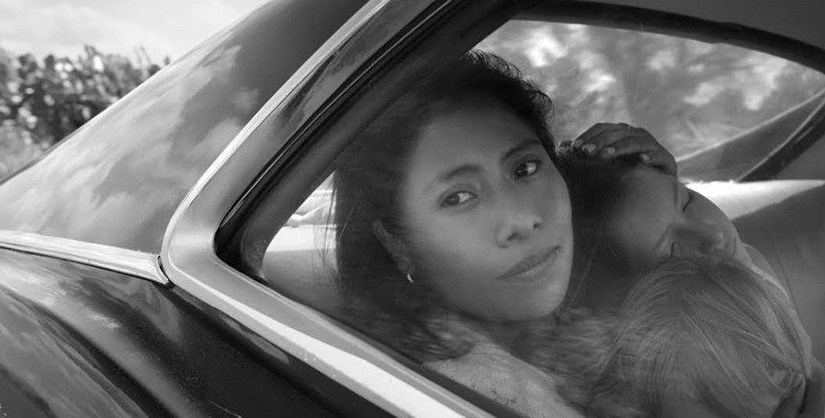
Alfonso Cuaron’s new film, Roma, is a masterpiece in cinematography, sound, and empathetic storytelling. Shot in beautiful, multi-dimensional black & white, it tells the story of a house servant named Cleo who tends to a family living in the city section known as Roma during the year 1970 in Mexico.

Cleo is portrayed beautifully with quiet reservation by Yalitza Aparicio. I imagine this actress is not well known to mainstream audiences. Perhaps she is not well known to Mexican or Hispanic audiences as well. However, it would be so refreshing if the positive response of this film opens up opportunities for her within more widely known fare, much like Precious did for Gabourey Sidibe.

Cleo seems content to cater to the family that contains four young children and their mother. The father appears stern in his mannerisms until one day he leaves for a conference taking place in Quebec. However, allusions to this conference indicate a different story when his absence lingers on longer than expected. During this year, Cleo gets pregnant by Fermin, the cousin of a friend. Fermin leaves Cleo to deal with the pregnancy on her own, and in the moments when he returns to the story, it is not promising that he will commit to fatherhood.

Cuaron writes and directs a relatively simple story amid turmoil in a very confused country that centers on riots among the young citizens and men who are not noble enough to dedicate themselves to the women that cross their lives. Family is not convenient either. When a conclusion dawns upon Cleo near the end of the film, you can’t help but understand her position. What she has seen is gut wrenching.

To further compliment this work is to appreciate the visual sense and sound of the film. This is not a sci fi special effects extravaganza like Cuaron has accomplished with his Oscar winning Gravity, or the dystopian action depicted in his under appreciated Children Of Men (masterful steady cam work in that film, especially). Cuaron takes advantage of a crowded bustling lower middle class city with an overpopulation of dogs, planes flying overhead, music, and crowded streets of different happenings. I watched this film with my new 7 point sound system and this film is perfect proof that I made a smart purchase. Cuaron hooks your senses to engage you in his setting. Therefore, the setting justifiably serves the title of the film.

The photography is sensational as well. Cuaron hardly does a close up on any of the characters. Rather, he opts to go deeper to show there’s more going on in any one given moment than just what is in front of you. The first example of this is during the opening credits that are displayed over the course of several minutes on a tile paved driveway. First you are just looking at tiles. Then you are looking at Cleo’s soapy mop water splash across the tiles. Now you have a reflection of the sky above and you get a sense of how high the sky goes as a passenger jet plane casually flies overhead. Dimension is gradually introduced and the theme of Cuaron’s filmmaking continues on during the course of the picture.

Later, at a pivotal point in the film, when Cleo delivers her child (I don’t think that’s a spoiler), Cuaron puts the silhouetted profile of Cleo close to his lens and then to the right deeper into the room you watch as the hospital staff tend to the newborn; seeing the baby, seeing the towels held by the staff, watching the staff tend to the baby. Cleo is separated from the activity but she remains in the room, exhausted and discombobulated from what she has just experienced. A moment like this, I would imagine, would be good material for film students to examine. Cuaron proves that what you show in a moment can be limitless in the scope of a lens. Nothing is impossible.

Because the film is in black & white, the activity of the hospital staff never appears to upstage or overshadow the experience that Cleo is enduring. Had this been in color, a viewer could have been distracted by the blood and the sweat and lighting in the hospital room. It’s all there. It’s just not as distracting as a colorized moment might have suggested. Cuaron’s choice of black and white permits you to focus on everything. So, a scene like this is so wisely conceived.

Roma will likely be selected as a nominee for Best Picture and Director. It deserves it, much more so than many other films I saw in what I consider 2018 to be a weak year for inventive filmmaking. I highly recommend this film. If you don’t have a good sound system or a high definition TV to watch it currently on Netflix, then find it at a local cinema. To immerse yourself in this film, requires the best in sound and visual quality.

I will admit that it takes some getting used to reading the subtitles translating both Spanish and Mexican, and Cuaron takes his time setting up his story. You have to be patient with the film. However, I watched the film on Saturday, December 28, 2018 and I still can’t stop thinking about it.

Please check out Alfonso Cuaron’s beautiful film, Roma. I think you’ll be glad you did.

THE FAVORITE

By Marc S. Sanders

Director Yorgos Lanthimos’ The Favorite. Wow! This is a weird one.

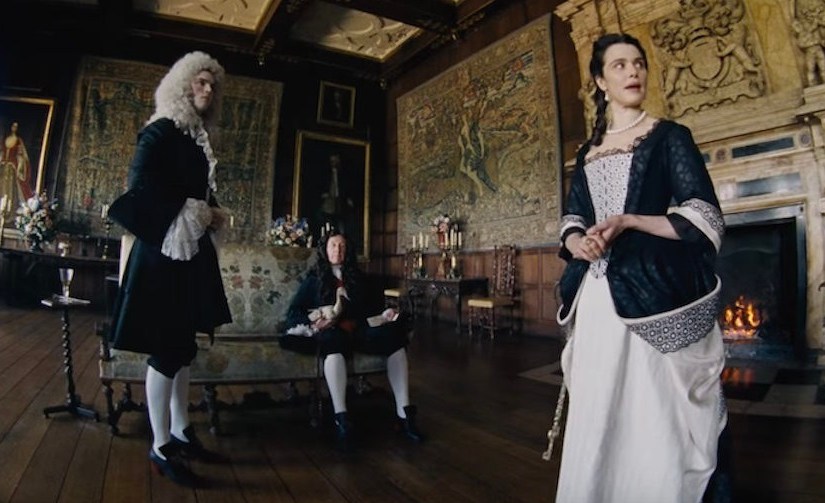
This film focuses on a competition of one-upmanship between two ladies, one a servant named Abigail (Emma Stone); the other a close friend, Lady Sarah (Rachel Weisz) of Queen Anne during 18th Century England. As Queen Anne is frail physically, and often mentally (she insists on keeping 30 rabbits running loose in her bed chamber), Abigail capitalizes on opportunity to win the admiration of the Queen over Lady Sarah, a cruel woman in her own right. The humor is more shocking than overt or witty.

It becomes laughable to witness the shenanigans of the highest of aristocrats from mud baths to duck shooting to naked fruit tossing at one another. Sometimes, you ask why? Then again, it is probably because a lower class, say the majority of the free world, would like to stick it to the upper class and show them as the fools that they are or that we wish them to be. A royal vase is always nearby if a lady feels the need to vomit; not a bucket, a vase.

Olivia Colman is very good as the Queen, seemingly incapable of making decisions and being subtly overruled by the influence that her friend Lady Sarah carries. If the Queen really wants to reduce the taxes imposed to prolong a war with France, Lady Sarah will make certain that just the opposite is done. The Queen will unsurely oblige and back up the message that Sarah makes to the Cabinet. Sarah has no reluctance in abusing and humiliating the servants, the men in the Cabinet or anyone else, including the Queen. She will happily admonish the Queen by criticizing her makeup just as she is to meet with a Russian diplomat, thereby allowing herself to run the meeting while the Queen retreats to her chambers.

Abigail has come from wealth but due to hard times, has become recruited to be a servant destined to take care of menial tasks or be humiliated by being forced to watch an English officer pleasure himself, falling into “mud that stinks,” or taking cruel showers with a rough sponge. An opportunity arises however, when she discovers a natural way to bring relief to the Queen’s frail legs. Soon, Abigail is becoming intimate with the Queen much to the dismay of Sarah and now the cruel games of back and forth begin.

No one is really likable here. It’s a competition in royal politics, and politicians of any nature in any setting are never entirely liked. To hold stature, requires ego. Ego, however, is not a strong enough word for how these three ladies treat each other. The frail Queen is just as guilty. If she feels slighted, she will disregard those that have won her over in prior moments, particularly to her first friend Sarah and later to Abigail. When Sarah goes missing, the Queen declares she better be dead when she eventually begins to worry. If she’s not dead, the Queen will surely slit her throat. Abigail wins the Queen’s affections but will ultimately be used cruelly as well.

Eventually, all of this back and forth has to end of course, and Lanthimos along with screenwriters Deborah Davis and Tony McNamara bring in a sneaky last “stick it to ya” moment.

I’d never seen a film by Yorgos Lanthimos before. I’d heard good things about his other film The Lobster, though. Here, he’s got a camera angle I rarely see in films. There are times when a wide shot of a room, like the Queen’s chambers or outskirts of the palace are shot through the bottom of a glass, where the edges of the caption are curved outward, almost like looking at the film through a view finder or a telescope. Not sure why he opted for this technique. Perhaps it was to up the ante on the strange environment of it all; to offer a discomforting feeling towards watching this community of Establishment behave behind closed doors.

Rachel Weisz and Emma Stone are also very good. A film like this could have played like a bad day time soap opera cat fight. Yet, when you have Academy Award winning actresses like Weisz (The Constant Gardner) and Stone (La La Land), you are watching a period piece that will stand out albeit very strangely.

Yes. Once again, The Favorite is a very strange film. A good film and a weird film that takes some patience and getting used to. Four people walked out of the theatre I was in, but there was still plenty of laughter from the crowd. The best of the year, like most critics claim? Maybe not. Then again, most of the critics’ common choices for best of the year is indicative that 2018 really was not a great year as a whole for movies. I’d argue prior years have offered a better collection of films to treasure, admire, award and salute. In another year, The Favorite would be trumped by many other candidates.

NOMADLAND

By Marc S. Sanders

amazon ( n.) a large strong and aggressive woman; Synonyms: virago. amazon ( n.) mainly green tropical American parrots; 2. Amazon ( n.) (Greek mythology) one of a nation of women warriors of Scythia (who burned off the right breast in order to use a bow and arrow more effectively);

As I reflect on watching the 2020 Best Picture Oscar winning film, Nomadland, I considered the literal translation of the word “amazon.”  To many of us, I would think the word has an entirely different meaning.  Director, writer and editor Chloe Zhao probably considers both the literal definition of the first noun (noted above), as well as the brand name that seemingly runs the world these days.

Fern, played without compromise by Frances McDormand, is likely a strong and aggressive woman, though only subconsciously large.  I’d argue you would have to be in order to survive as a nomad within a pre-Trump era mid-western America with a beat up van as your mobile residence and a deep plastic bucket for a toilet that isn’t hard on your knees when used.  Fern is a former resident of Empire, Nevada.  Empire and its postal zip code no longer exist as of 2011 when the sheetrock factory that sustained the town closed up after 88 years, thus forcing all its residents to give up their homes and relocate elsewhere.  Now that Fern is widowed, she does not see any other way to live other than in the van she calls “Vanguard.”  She lives paycheck to paycheck with seasonal jobs that are hopefully available.  The first of these jobs includes a packing facility for Amazon.  Once the holidays are over, it’s up in the air as to what she’ll come across next.

Zhao is an observational director.  To depict a film about a lonely, uncertain post middle age nomadic widow will require shots of the country like frost on the ground, deep snow, endless roads, hot deserts and moonlit campfires with other nomads who come by Fern’s way.  These people (many of which are real life nomads in the film) might travel individually but they are a community as well.  They teach one another in ways of being resourceful with auto repair or what’s the best bucket for a toilet.  They provide people like Fern with temporary job opportunities.  They also counsel one another with how to deal with grief and share their own health challenges like the various forms of cancer and illnesses they endure and how they plan to live out the remainder of their limited time on earth.  One woman with an inoperable brain tumor is determined to make it back to Alaska.  What drives these people is not necessarily a will to survive.  More importantly, it’s the knowledge that they will cross paths with one another again.  An experienced nomad who lost a son to suicide never considers saying goodbye to anyone he encounters.  Rather, he is staunch in telling others that he’ll “see them down the road,” at another time and place.  He reminds Fern that to live this life is to never close the book or end a chapter, and memories of those we have lost can only stay alive if Fern and others stay alive.

I appreciate a film like Nomadland simply because I’ve never been the brave traveler.  One of my greatest fears is being lost and alone.  It has always terrified me.  I still don’t trust the navigation apps on my cell phone.  I have to see the destination in front of me.  Luckily, my wife keeps me in check.  Yet, Nomadland is a film that gives me an opportunity to explore places I might never arrive at, while I sit safely in front of my flat screen.  Chloe Zhao shoots with wide lenses to take in gorgeous landscapes.  How fortunate for Fern that she can encounter all of this beauty in person.  How fortunate, as a viewer, a film like this allows me to witness what’s out there.  How sad though as well that sometimes this way of life seems treacherous and nonsensical.  Whatever entity created the earth allowed no sympathy for a flat tire or a broken-down engine, when you have no means of paying for replacement parts.  As well, mother nature is not always going to be that companion that holds your hand during lonely times.  Corporate America certainly won’t do that either, but it is a necessary evil.  Thank you, Amazon!

Frances McDormand is perfect for this role as she carries no inhibitions about herself.  She will truly show herself sans makeup or coiffed hairstyles, floating nude in a stream, or go so far as to literally defecate on screen in that practical bucket to demonstrate how truly unglamourous and unforgiving the life of a nomad is. 

Nomadland is not a favorite film of mine, but I can’t help but appreciate its honesty thanks to Zhao, McDormand and the numerous real-life nomads that inhabit the picture.  It’s a sad story; not a triumphant one, but it is also a film that tries to emulate the comfort of being “houseless…not homeless” as Fern describes with absolute certainty.  It might not be the life for many of us, but it is definitely a life meant for Fern.

GREEN BOOK

By Marc S. Sanders

The biggest surprise of Green Book is who its director is, the unlikely Peter Farrelly of The Farrelly Brothers, directors of Dumb & Dumber and There’s Something About Mary. Yet, when I reflect on the film it should not be a surprise. The Farrellys are known for raunchy humor, but often it stems from an honest source. When Viggo Mortensen’s character Tony folds an entire pizza pie in half and then scarfs it down whole, that’s a Farrelly touch but likely also what an Italian club bouncer raised in the Bronx would do without any consideration. He’d also win out in hot dog eating contest. Mortensen’s character is a far cry from his Russian Heyman in Eastern Promises or Stryder in The Lord Of the Rings. The pizza and hot dog scenes are great moments in a film weighted down by the Uncle Tom mentality of Deep South USA in 1962. Peter Farrelly needed to direct this film, and it just might be the best picture of the year.

Tony (or “Tony Lip” as he’s known among his peers) is hired by Dr. Don Shirley played with such eloquence by Mahershala Ali. Dr. Shirley is an African American pianist, arguably the best in the world and ready to embark on a tour of the Midwest to Southeast of the country. It’s not that simple however as Dr. Shirley is all too aware of the racial prejudice that will befall him. Tony is hired to be Dr. Shirley’s driver as he has the toughness to look out for Shirley in the event that it is necessary. Sadly, the film shows that Tony is more than necessary.

There’s much comedy here between Ali, playing the well spoken “Felix” role, against Mortensen in the “Oscar” part. Tony and Don are worlds apart having virtually no understanding how the other half lives or what they are forced to compromise with on a daily basis. The hardships that Green Book offers focus more on Dr. Shirley as he is forced into humiliating circumstances where he is offered only an outhouse to use or denial of entry into a dining room. He could be wearing the sharpest of tuxedos, while Tony is a self aware “goombah” slob with no civility and Dr. Shirley remains the one to be overlooked. His value to Deep South America is to play his Steinway piano like meager jester.

There’s much to learn about our country’s mid 20th century history in Green Book. It’s a film I encourage families with pre-teen children to see. Not only will they learn of disillusioned hatred and treatment of black minority, but they will be entertained as well. References to Robert and John Kennedy are presented as well Aretha Franklin, and a Boston Celtics player (Name I cant recall).

The comedy that Farrelly brings keeps the audience engaged. The best dramas possess great comedy like Steel Magnolias, Terms Of Endearment, The Help, and even Kramer vs Kramer. If we can laugh along with our characters, then we will appreciate them that much more when harm and pain strikes. We want to ease their pain and be angry for them when those moments arrive. Their comedy of natural behaviors breeds affection for them. When they are compromised, we cry for them. Farrelly executes this format perfectly.

Mahershala Ali is a stand out here. He is snobbish at times towards the unmannered Tony but he is never deserving of his dismissiveness. He is a victim of the “colored mentality.” If not for the color of his skin, Dr. Shirley would have been regarded by all as a man of integrity; a hero to the American people. Sadly in 1962, many could not see past skin color. Thankfully, a great moment towards the end reminded me that it was in fact many…but not all. Watch the movie, and then tell me if you know what I’m referring to.

Remember, this is probably the best picture of 2018. Bring your children to see Green Book. Keep your children aware.

BOHEMIAN RHAPSODY

By Marc S. Sanders

The aftermath of Rami Malek’s electrifying performance of Freddie Mercury might just follow the same trajectory of Jessie Eisenberg’s portrayal of Mark Zuckerberg. People will never be able to see past the one accomplishment and every role hereafter will be measured against this moment. Bohemian Rhapsody will likely be Malek’s best film of his career.

Bryan Singer, and more importantly an uncredited director replacement, have assembled a by the numbers music biopic complete with defiance against naysayers, sexual discoveries, band discourse, drugs, booze, illness, a wildly eccentric lead and an altogether sensational soundtrack. This isn’t me complaining however. The film might be formulaic but what else should I expect really?

Though I’m dubious if the compositions really were spawned as depicted, I nevertheless loved every second of Bohemian Rhapsody. Yeah, I doubt “Another One Bites The Dust” finally sprung to life during an in studio scuffle but as soon as the bass began to play, I was in the moment. Movies should always touch you naturally. The emotional response should never feel forced. It should be be triggered. The music of Queen has that effect for me. Not every song. Some lyrics are downright silly. Yet if “We Are The Champions” is going to be re-enacted during a Live Aid concert at Wembley Stadium following a series of setbacks for Mercury, you are going to get caught up in the moment.

The song introductions are the highlights of the film. They carry an energy that leads to lip sync and toe tap. However, the movie doesn’t stop there. I appreciated the strife between Freddie and his disapproving father, his affection for his bandmates and the eventual conflict among them, his struggles with loving Mary, his wife, while coming to grips with his bisexuality, his betrayals among those that used him, and finally his AIDS diagnosis. Every aspect is given enough attention. Still , we are treated to a near full shot for shot re-enactment of Live Aid, one of Freddie’s final performances before his eventual surrender to death.

Called me biased. Yet I’m not a die hard Queen fan. I just found the period set up authentic. The music editing to be well orchestrated and the cast to be spot on. A Mike Myers appearance (look for him but you won’t see how apparent he really is) is inspired.

The film ultimately belongs to Malek. Awards season will be generous to him. He’s comfortable and assured in the attire, the skin, the gravitas and even the teeth of Freddie Mercury. This was a film circulating the press for many years. Everyone seemingly wanted a bio pic. Finally, it has arrived and no one else could have played Freddie Mercury so beautifully as Rami Malek. He’s a miracle!

PARASITE

By Marc S. Sanders

I first discovered director Bong Joon-Ho when I watched his futuristic sci fi adventure Snowpiercer. I loved that film despite how absurd the set up was. Absurdity, though, is a credit to his craft. That’s why his latest film Parasite is a hugely successful interpretation of class warfare within South Korea. It might all appear drastically unlikely. Yet, it’s all absolutely possible when you reflect on the film after you’ve seen it.

Parasite begins almost like a farce and ends in deep, realistic horror that you’d never expect, even after you surpass the films midway surprise.

It’s best I leave much of the film’s details out. The less you know the better. I knew nothing at all about the film beyond the numerous accolades it has received. I was better off for it.

Joon-Ho’s film makes its point quickly that there is always someone better off than us and always someone worse off. (This was a theme carried over from Snowpiercer.). A poor family living off scrap money for folding pizza boxes while living in a cramped, bug ridden basement is still better off than the drunk who pisses on the street, outside their window. Just as an upper class family with all the best things in life are better off than them.

It’s only when this poor family find opportunity to dupe their way into this wealthy home through jobs they are hired for that we eventually see how lighthearted material, compliments of Joon-Ho and his writing collaborator, Jin Wan Han, can convincingly escalate into class warfare politics that even their characters ever hardly acknowledge, or are aware of. Is the wealthy matriarch really aware where her family chauffeur stems from or where he lives? The off putting scent of someone’s presence can quickly turn a tide or an impression.

I might sound vague, but I have no choice. It would be a betrayal to the imagination of the best film of 2019 if I spelled the film out for you.

Simply know that I truly appreciate the symbolic research Parasite presents as it makes note of a Korean child’s fascination with Native Americans, and how their plight parallels the story. Even that drunk taking a piss on someone else’s territory. Even the gift of a stone sculpture told me how one can be crushed or weighted down by his own country.

Parasite begins as one movie and ends as maybe five other different movies. It’s a farce. It’s wry and conveniently ironic; maybe silly at one point. It’s suspenseful and surprising. It’s also shockingly horrific.

I recently declared Clint Eastwood’s film Richard Jewell the best film of year. I stand corrected.

Parasite is the best film of the year.

DRIVING MISS DAISY

By Marc S. Sanders

Mainstream films released by big studios suffer from a major problem these days.  Too often, they don’t allow their characters to breathe.  Films today rush to the climax or the action or the cliffhanger that’ll whet our appetites for a sequel or a crossover or a toy product.  Bruce Beresford’s Driving Miss Daisy escaped all of those conventions.  In fact, I’d argue that Beresford made a buddy picture with his Best Picture Winner based upon Alfred Uhry’s well received play.

Daisy Werthan (Jessica Tandy, who won the Oscar, and held the record for oldest recipient) is an insistently independent old southern Jewish woman living in Georgia.  She drives her car where she wants to and whenever she wants to go somewhere.  However, following an accident in her driveway, her son Boolie (Dan Aykroyd in a very surprisingly good performance) breaks the hard truth to Daisy that her driving days are over since it’s likely no insurance company will ever affordably cover her.  Boolie recruits Hoke Colburn (Morgan Freeman in one of the most gentle and delicate performances of his amazing career) to chauffer the proud woman around her Georgia neighborhood.  Naturally, Daisy does not take well to Hoke at first.

The film begins in the 1950’s and then spans roughly 20 years from that point.  I love how Beresford presents the passage of time.  The cars that Hoke carries Daisy in change as the years go by.  As a new car is shown parked in Daisy’s garage, the relationship and eventual friendship of Hoke and Daisy become stronger and, on some occasions, franker and more honest.  With Hans Zimmer’s energetic score that seems to accelerate the speed of the automobiles Hoke drives, Driving Miss Daisy feels like a very sweet and tender film.  It is.  Moreover, it’s an alive picture.  However, the film does not ignore the prejudiced mentality that’s embedded within the south.  A telling moment occurs when Hoke is driving Daisy to a family gathering in Alabama.  Why would an elderly black man with an elderly Jewish woman sitting in the back seat be met with such disdain by policemen who question their presence while eating lunch on the side of the rode?  I won’t repeat the officer’s comment here, but it is ugly and a sad reflection of how things were.  Are things still that way?

Uhry’s script adaptation from his play does not stop there though.  He questions Daisy’s own stance.  She takes no issue with black people catering to her and her home on regular basis, and she becomes enamored with Martin Luther King’s inspiring wisdom.  So, when she is given the opportunity to see Dr. King speak in person, it only makes sense that Hoke will question why he was invited last minute to join her.  After so many years of servitude, why did Daisy wait until Hoke literally drove up to the location of the speech to invite him in?  I’d argue that it never occurred to Daisy, and I think Alfred Uhry believed that is part of the problem.

Both Daisy and Hoke experience anti-Semitism and racism in the mid twentieth century south.  Ironically, the film demonstrates that common victimization is one reason why they need one another.  I’m thankful that Beresford does not show a burning synagogue for dramatic effect.  Instead, he relies on Uhry’s dialogue as Hoke breaks the news to Daisy when they are on their way for morning Shabbat services.  How does Daisy feel in this circumstance?  The synagogue can be rebuilt.  The horror of knowing this kind of hate exists will never be erased.  That’s the terrible shock.  As well to empathize, Hoke describes how as a child he saw his uncle get lynched and hung from a tree.  Daisy and Hoke unite in the hate that surrounds them.

The performances of Freeman, Tandy and Aykroyd are exquisite.  Their dialect for each of their respective characters rings so true of the Georgian southern regions they stem from.  Freeman has an enunciation that rings of a black man who never learned to read.  He even develops a laugh that seamlessly works into his dialogue and reaction to Daisy’s stubbornness.  His posture is marvelous as an elderly gentleman who will walk slowly while hunched over.  It just looks so natural. Aykroyd is in no way doing one of his comedy characters.  He carries the gut of a well-fed southern man who’s become successful with his family business while not taking every fit that his mother has so seriously.  If any of us have had to tend to an elderly relative, then we can certainly relate to Boolie’s position.  Tandy is wonderful at method acting; it should be studied in performance art classes.  She was an elderly woman already when cast in the role.  Yet, as the years carry on through the story, she changes her gait to how this woman’s bones might become more brittle, or how she might speak slower or smile or frown or chew her food.  She has such a fire in every one of her scenes.  A heartbreaking scene where she appears to be having a frantic form of dementia is very eye opening as she paces her historic two-story home looking for papers she graded years earlier as a teacher.  The younger Freeman (playing a far older man) has to keep up with Tandy in this moment; even Beresford’s steady cam has to move quickly to keep focus.

Recently, I had reviewed Terms Of Endearment, and I alluded to the fact that not enough films about middle age people are focused upon, or at least given the commercial attention that they should be given.  Why is that?  So many middle age and elderly characters are so interesting.  I said it before.  Look at The Golden Girls sitcom.  After all, characters with more years behind them have had more moments to live and breathe. Actually, they have a longer history with more nuances and meaningful events they have already encountered, as opposed to twenty somethings with hot cars, pecs and guns.  Film studios are missing out on a wealth of great storytelling. 

Driving Miss Daisy is well paced story of friendship and fear, and often natural comedic material within its three lead roles.  It’s never boring.  It’s only more and more interesting as the years of the story pass by.  It’s simply an endearing buddy picture of the finest quality. 

JOKER

By Marc S. Sanders

It’s important to understand first and foremost, Todd Phillips’ film Joker is really not a Batman story, a comic book story or even the derivative of a Batman comic book story.

Consider the Martin Scorsese pictures Taxi Driver and The King Of Comedy. Both films focus on two different characters descending into a variation of psychological madness. Yet the the titles of each film are pretty random, generic almost. Joaquin Phoenix plays wannabe comedian Arthur Fleck (to my knowledge never a DC comics character before this film) and this latest release from Warner Bros is billed as the origin of the Joker. Nevertheless, other than calling the setting Gotham City and having a billionaire character named Thomas Wayne with a son named Bruce, there is nary any calling to the mythos that fans are so familiar with. Why not just present this film with a title called “The Comedian” for example and run with it? Calling it Joker feels like a shameless cash grab. This is not a Batman villain tale, folks.

Joaquin Phoenix is astonishing in the lead role. He’s in every scene of the film and the method to own the character of Fleck is shown both physically and mentally. The known method actor must have lost at least 75 pounds to show weird, stretching contortions that easily shown his rib cage and pale complexion. Phillips films Phoenix at times where there is no dialogue either grimacing in a mirror, randomly dancing or simply leaning his head against a cold transit bus window. Surprise moments also come with head slamming against walls or glass doors. This was not all direction by Phillips. Phoenix had to have invented some of these instances.

Robert DeNiro is an obvious nod in casting as a Merv Griffin/Johnny Carson role meant to salute the Scorsese films of his heyday. When he was the man bordering on insanity, DeNiro performed with method material. Think back to when he’s Jake LaMotta in Raging Bull bashing his head against a wall while in solitary confinement.

While Joker certainly offers probably the best performance of the year in any category, it’s not a pleasant film to watch. It lacks any sense of wryness or humor. It’s a very depressing film about a man’s inevitable descent into madness. I couldn’t take my eyes off of Phoenix in the role, but like other comic book based films it didn’t leave me wanting more. I’m not eager for a continuation of this character.

If they wanted to a popular comic character story then I wish there could have been some more slight nods to the ingredients of this pop culture legacy. Couldn’t Arthur Fleck have been mugged by Oswald Cobblepot or sidled up alongside Mr. Zzazzz? How about a quick encounter with Selina Kyle or Edward Nygma? There’s just not enough evidence here for me to accept this is a Batman tale. Again Warner Bros banked on the title and not much else.

I got my money’s worth from Phoenix and I’m gunning for him to win the Oscar (not just nominated), but I can’t help but feel a little let down as well.