THE GODFATHER

By Marc S. Sanders

Probably the greatest character story arc in all of film is of Al Pacino’s portrayal of Michael Corleone in Francis Ford Coppola’s The Godfather based upon Mario Puzo’s best-selling novel. (The film is a thousand times better than the book.)

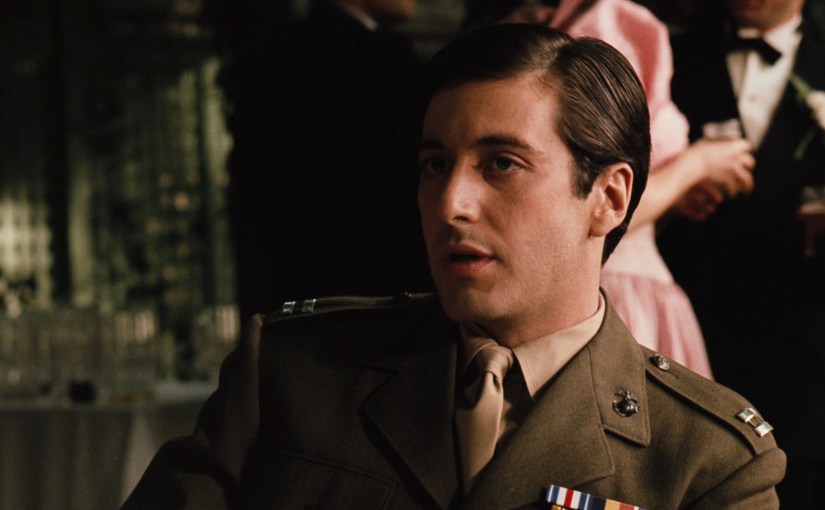
Michael is the youngest of three sons intended for a legitimate life separate from his Mafia family. The masterful opening sequence of his sister’s lavish wedding show him courting his eventual wife, Kay (Diane Keaton), and never feeling proud of the actions of his notorious father, Vito (Marlon Brando), nor his brother Sonny (James Caan) or their consigliere, Tom (Robert Duvall). He’s an innocent war hero in uniform with an open mind of an untarnished future. It is only when bad blood circumstances are tested that he feels forced to strike with the same intent that the Corleone family is infamous for.

Coppola presents quiet, subtle moments of expression in Pacino on camera. You see the change in Michael sneak up on you and you see a character develop into something else entirely. What starts as a false impression to appear as if he’s carrying a gun in his pocket, soon after leads to murder, by means of nothing personal but “strictly business.” From there, he retreats and hides until he is blessed with carrying on an evil legacy.

Yes, the first chapter in the operatic trilogy of crime, is mostly known for a grandstanding performance by Marlon Brando but the story relies on Pacino as Michael. Michael Corleone at least must be one of Al Pacino’s greatest roles. He arguably has one of the most impressive resumes in all of film. Here is where it jump started.

The direction by Coppola is a film student’s required studying. With Puzo’s script, the best idea was to open the film with a wedding. As the film offers so many characters and much back story among all of the guests, the interaction and workings of the family are efficiently condensed into this 25 minute opening sequence. Don Vito meets with people needing favors while outside the home, the crew is dancing, doing their jobs and minding who is watching. By the end of this opening you have a full grasp of the family tree and who works for who and what their characters are like. Sonny is the hot head. Michael is the innocent. Fredo (the middle son played by John Cazale) is not doing much but being a cut up, Momma Corleone is the valued matriarch and Tom is the well managed advisor. You even get a glimpse of some “very scary guys,” some competing hoods, who’s cheating on who, and some people who need help with citizenship and film casting.

Art direction from Alex & Dean Tavoularis is magnificent, depicting a post WWII New York, and a historical Sicily stagnant in open plains, romance and murderous pasts.

The cinematography is better today than it was originally. Gordon Willis returned decades later to (for lack of better word) lighten up the picture. The interiors remain dark in secret and comfort, but the characters are more illuminated. The Blu Ray restoration is a fantastic return to the classic film and its two sequels.

The Godfather is endlessly quotable and never dull no matter how many times you watch it. Puzo’s screenplay plays like the biography of a real person and family, much like his adaptation for the screen of 1978’s Superman: The Movie. It is an American classic rich in a history we believe has been told and carrying on the tradition over the course of a 10-12 year period.

I return to praise Pacino to remind you how his appearance even changes as he gradually builds his strength and accepts his title of Don. I feel like I’m looking at two physically different people from the beginning in his Marine uniform with boyish looks, to his independent walkabout way during his Sicily retreat, to a more broad shouldered, slicked back hair, dark suit tailored appearance during the film’s third act. It’s an uncanny transformation that is built on performance and expert direction and writing from Coppola and Puzo. I still get chills as Michael in his college boy sports jacket volunteers himself to satisfy a family vengeance. Coppola zooms in on him slowly as he sits in a leather arm chair, arms at his side, legs folded. We are seeing a new man in charge for the first time. It’s chilling.

The Godfather is one of the greatest pictures that will ever be made. It’s a perfect chemistry of technical achievement, attentive storytelling and sensitive, yet powerful performances from probably the best cast ever assembled.

I’m amazed that I know of some friends who still have yet to see it.

The Godfather is the film that everyone should see before they die.

PHILADELPHIA

By Marc S. Sanders

Tom Hanks most certainly deserved the first of his two Oscars for his portrayal of Andrew Beckett, one of the first protagonists to be an AIDS victim on screen in Jonathan Demme’s 1993 film, Philadelphia. Its a good film but not a great film.

I recall seeing Philadelphia when it was originally released. Seeing it today, my opinion hasn’t changed. I don’t believe the film takes enough risks and the script from Ron Nyswaner is too cookie cutter and simple. Beckett hires Joe Miller (Denzel Washington) to represent him when he proceeds to sue the law firm who wrongfully fired him for having AIDS, and most likely being gay as well. The argument hinges on proving that having AIDS is a handicap that never interfered with Andrew’s work performance. Andrew is clearly made out to be the firm’s best of the young attorneys when he’s assigned their biggest client. Nine days later he’s sabotaged, and soon after he’s fired for an attitude problem and carelessness. Eventually, Andrew and Joe assemble, despite Joe’s prejudices against homosexuals.

The trial, Andrew’s struggle of living with AIDS, and Joe’s own inner debate with associating and defending a homosexual, AIDS victim are the three main storylines.

The first storyline is the best. Demme does a masterful job of showing the evolution of the disease. Andrew could be looking at papers on a desk and when he turns his head, a lesion appears on his neck. Makeup artists Carl Fullerton and Alan D’Angerio deservedly were Oscar nominated as Hanks’ appearance seems to change from one scene to another and another. He’s thinner in one moment with very fine ash gray hair. In another scene, he’s got a full head of hair with an energetic way about him. I cried for Andrew’s deterioration. Hanks and Demme carry that aspect very, very well. The actor does great work of changing his voice when he’s fighting a cold with a terrible cough or evoking massive weakness. As the film progresses and Andrew gets sicker, he’s incredibly pale with a droopy eye. The makeup artists tell the story with Hanks’ performance and Demme’s direction.

The 2nd and 3rd storylines don’t offer much of a challenge. The law firm primarily represented by head partner Jason Robards is too easily “evil.” There’s no subtlety here. Robards gets right in the face of the film – “Andrew brought AIDS into our office.” A better script would wait for the bad guys’ momentous third act Freudian Slip. This case was unchallenging really. It was too easy to win. Especially true considering this great and powerful law firm hires Mary Steenburgen as defense counsel. Steenburgen plays her part very mousy and unaggressive though. This case is too lopsided and uneven and I just couldn’t get past that.

Joe’s own reservations are too apparent as well. He’s meant to represent those that simply never understood the mentality of gay love, nor the scientific evidence of the AIDS virus. He rushes to his doctor following an initial meeting with Andrew. Demme does an extreme close up of this doctor to teach the audience the basics of AIDS. This guy is right in your face with his dialogue. I didn’t care for moments like this. Too patronizing.

A side story attempts to show the intimate relationship of Andrew with his boyfriend Miguel (Antonio Banderas). I still feel the same about this part. The script holds back. Hanks and Banderas give each other “bro hugs” and kisses are done on the bottom cheek. Back in’93, filmmakers were not prepared to go all the way with depicting the true nature of homosexuality. I found it insulting. You finally want to make a film that shows AIDS and homosexuals at the forefront but you stop short at the finish line.

Ironically, Joe has a repetitive line “Explain this to me like I’m a 4 year old…” Demme adopts that method throughout the film with major “in your face” close ups to glaringly make the beliefs of what any character values or has to say as obvious as possible. I felt as an audience member that Demme didn’t have to take it this far. I get it. You don’t have to be THAT FORTHRIGHT.

Washington is a great actor as always. He’s likable even if he’s tripped by the fault of misunderstanding. His “TV GUY” ambulance chasing lawyer is comic relief at times within a film of very heavy subject matter.

Demme’s filmmaking does make some wise choices despite some of my issues. The opening credits offers a lot of footage of the city with people carrying on their daily lives while waving to the camera, selling fish at the market, street dancing, etc, all accompanied by Bruce Springsteen’s sweet, yet haunting theme “Streets Of Philadelphia.” I like this opening as it shows what we see on the surface of the people we live with does not necessarily reveal the struggle any one of us might be enduring. This is a moment where the script is not so easy to grasp. There’s a challenge to accepting Demme’s footage blended with Springsteen’s overture.

Jonathan Demme is a good director, who is sadly no longer with us. I appreciate Philadelphia for showing the illness but not much else. It’s a film that should be seen. I’d argue most would embrace more of the movie than I did. I just felt the envelope could have been, actually should’ve been, pushed further. It was too careful with its subject matter.

A great observation though was recognizing the many faces that appear in the film from Demme’s other film, The Silence Of The Lambs. As well as naming Joe’s baby daughter “Clarice.” I also recognized an identical tracking shot that Demme offers. When Joe goes to visit Andrew in the hospital, it is a shot for shot remake of the tracking movement when Clarice goes to visit Jack Crawford in his office, at the beginning of Lambs. This might not be original, but I had fun recognizing it, nonetheless.

FORREST GUMP

By Marc S. Sanders

There’s not much that I can say to further praise the merits of Robert Zemekis’ Forrest Gump. It’s a film of legend though it’s a sore spot for die-hard fans of Pulp Fiction, which competed for Best Picture in 1994. Guess which film won. Tom Hanks won the Oscar for the second year in a row, following his outstanding turn in Jonathan Demme’s Philadelphia. Zemekis won Best Director. Eric Roth’s screenplay won as well.

What holds a lasting impression for me about Forrest Gump is the sweeping travel through time of a man with limited intelligence but unlimited willingness to explore and participate, whether it be as a Ping Pong Champion, a Medal of Honor recipient for heroism during the Vietnam War, a millionaire entrepreneur of a shrimping boat business, or a man who just felt like running from one corner to the next of the North American continent. Forrest Gump never knew to compromise a belief he had, probably because he was never aware of the capability to compromise in the first place.

An interesting theme occurs throughout Roth’s screenplay (adapted from the novel by Winston Groom). The people that Forrest encounters are always shouting their ideals and agendas. Yet no one seems to listen. Not just Forrest though. No one at all listens to each other. Lieutenant Dan (Oscar nominee, Gary Sinese) shouts for an immediate evacuation of a hostile territory under attack and no one on the other end of the line, appears to be listening to him. He orders Gump to leave him there, but Forrest does not listen. Forrest only focuses on rescuing his friends, Lt. Dan and Bubba (Mykelti Williamson). What exactly were Americans like the Hippie movements, the War Veterans, the Black Panther party, even the men in the burlesque nightclubs, as well as the various assassinations attempting to accomplish really? Did they accomplish anything? Did any of these parties make an impactful change, or did they just like to hear themselves talk? Did they just want the recognition for only themselves and no one else? When Forrest meets up with his love Jenny (Robin Wright), in a gorgeous caption in front of the Washington Monument (often shown during Oscar film compilations), he has just shared his thoughts over a loudspeaker, unaware that not one of the thousands of war protestors could hear him because the microphone had been unplugged. Later that day, a Black Panther participant only cares to wave his finger and shout his agenda in Forrest’s face. Is Forrest interested? Is he even listening? Is the Jenny, the hippie and her protestor boyfriend listening? Like many Americans, Forrest was only concerned with what was most important to him; Jenny. When Forrest develops a following during his cross country run, everyone is looking for his purpose and his message, and Forrest is unaware that he needed to offer one. Americans are always looking for the next best following. When Forrest passes the Grand Canyon and stops running, the parade of lost souls behind him shouts, “Now what are we supposed to do?” Forrest doesn’t listen. He just walks away and declares he’s tired. America during the mid twentieth century was lost. Forrest was not. Forrest just went in the direction in front of him.

Zemekis pulls an interesting trick of contrasting Forrest against other regulars. The nurse who sits on the bench next to Forrest is more interested in reading a mundane two dimensional issue of “People Magazine.” A man listening to Forrest’s tale of rescue in Vietnam was only concerned with the bullet that struck Forrest in the butt, not the men he saved or the loss of his dear friend Bubba. The old codgers who hang around the local barber shop in Greenbough, Alabama just watch the exploits of Forrest as the years go by. Their hair gets grayer and their skin gets more wrinkled, and life just passes them by while Forrest passes life by. It’s a subtle, yet effective, device that I appreciate on repeat viewings.

Sally Field contributes to the disregard Forrest has for menial issues. If Forrest is going to be denied going to a regular school because his intelligence level falls a few points below average, she will make certain that does not interfere even if it means pleasuring the principal. Mama Gump has the wit and intelligence. Forrest does not. However, their commonality shows in their disregard for what keeps us from living life to the fullest. Without Mama as his influence, Forrest would never have met the President again, and again, and again.

Mama reminds Forrest that “Life is like a box of chocolates…” You know the rest! It doesn’t matter what we get, as long as we get what we pursue.

her

By Marc S. Sanders

Director/Screenwriter Spike Jones is a master at adding multiple dimensions to what we always know exists. It’s been evident in his prior films, Adaptation, Where The Wild Things Are, (which I did not care for personally), and most especially in Being John Malkovich. He plants the seeds of fantasy in what we can normally touch, hear and see. Then his elements of fantasy receive a supportive crutch from what his viewers have always been familiar with.

her is another masterwork; a film that takes place in the not too distant future that expounds on our current digital age. If we can already talk to “Siri” or “Alexa” and trick–umm, excuse me, “her” (I mean “Siri”) into making sophomoric dirty jokes, then of course we are bound to approach the stage where we can literally, truly fall in love with her and then she can reciprocate.

With her raspy yet silky vocals, Scarlett Johansson is inspired casting as the voice of “Samantha.” Had she actually had a physical presence in the film I would have totally fallen for her affections. The film hinges on the performance of Joaquin Phoenix as Theodore. If we can’t believe that he loves “Samantha” more than he loves himself (a surefire test of true love as far I’m concerned) then “her” falls apart. Phoenix passes abundantly. He deserved his Oscar nomination.

From the start, you become very accustomed to the banter between Theodore and his electronic device voiced by “Samantha.” Both have personal feelings. Both have personal longings (more especially “Samantha” the computer, of all things!!!).

Spike Jonze explores all the diameters and dimensions of a loving relationship. The ups, downs, and in betweens. What’s different is how all of these layers of a relationship are received in this currently fictional (bound to come true, one day) dynamic of a relationship. Theodore and “Samantha” are affectionate. They argue, they laugh, they even make love. Watch the movie to understand that last point. It happens, and it is perfectly executed with the residual effects of their lovemaking bringing the film into its next act brilliantly.

Jones won the Oscar for original screenplay simply for how innovative this picture is. I’m not sure it’s the most exciting two hours of film, however. Personally, I think other films in this category back in 2013 had sharper and more interesting scripts. her is practically all talk and when it ended, I was ready for it to be over, and it concluded as I expected.

Still, Jones is fortunate that his cast (Johannsson, Phoenix, Amy Adams and Rooney Mara and Chris Pratt) trusts him. If they hadn’t, this movie would have lost its magic by probably how absurd this script must have originally been perceived on paper. Well done work by all involved but credit has to begin with Jones, the screenwriter.

THE BIG SHORT

By Marc S. Sanders

Ever since Adam McKay’s The Big Short was released in 2015, it has remained a favorite film of mine. I watch it at least once every year. McKay’s script with Charles Randolph, adapted from the book by Michael Lewis, is enormously funny but also realistically frightening.

The film shows how America’s housing market crashed in the first decade of the 21st Century. Mortgage backed securities never failed in history until now, and no one anywhere, especially the banks, ever believed a crash would occur, but it did. Only a select few people like Dr. Michael Burry (Christian Bale) and Jared Vennet (Ryan Gosling) foresaw what no one else could imagine, and thus they took advantage of it by making enormous betting transactions against the housing market. To say you need a strong stomach for this kind of investment is a serious understatement.

Burry is the first one to realize that the country as a whole will default on their mortgages once their interest rates go up in 2007. He represents Scion Capital and invests billions of dollars against the mortgage backed investments. Now he watches for the next two years while the capital at Scion declines into negative digits and drowns out the frustration with death metal music. Bale is fascinating as Burry who has a brilliant mind, but he lacks social skills.

Vennet gets wind of Burry’s discovery and sells the idea to Mark Baum (Steve Carell) and his team of representatives. Vennett narrates how it all played out in the market; how ratings agencies gave triple A rankings to bonds made up of worthless backed securities. McKay wisely has Vennett introduce celebrities like Margot Robbie, Anthony Bourdain and Selena Gomez to break down the vast complexities of everything. Robbie in a bathtub. Gomez playing black jack. It’s hilarious and relatable. Gosling is great. A great scene is his selling presentation which includes a metaphoric prop of a Jenga tower. Vennet has no qualms about collecting premiums as the rest of the country is going down. He’s profiting, and why not? Big banks have been doing it for years.

Carell is spectacular as well as Mark Baum. He has a heart, but he’s an angry individual. It sickens him to make money off this short buy, but it’s the responsible action to take for the benefit of his own clients. Mark also suffers from his brother’s suicide. McKay allows just enough time for this to draw out the misery of this character. Carell should have gotten an Oscar nomination at least. Baum is a guy with no filter as he confronts authoritarian parties throughout the film. He’s a hero really, but he’s not a guy I’d ever want to be left in a room with either.

An additional story arc comes from two young guys (Finn Wittrock & John Magaro) who also uncover this opportunity. They enlist Brad Pitt as a recluse who get them into the arena of big traders. These kids who started their investment company in a garage are great as well. Another party who came out of nowhere to uncover what no one else saw.

McKay assembled a magnificent blend of actors for these unusual characters who always hid behind their computer monitors. He directs with a lighthearted approach having his characters breaking the 4th wall at times to explain what all of this means in the simplest terms.

As simple as McKay makes it with his humor, this was a terrible, terrible tragedy putting millions of people out of work and owners losing their homes. Even renters lost their homes. Pay your rent but it means nothing if your landlord isn’t paying his mortgage. McKay tragically shows this outcome.

It’s terrible to imagine, but it’s a major downfall of the American economy. When the country, is doing well, while paying short term low interest rates, no one concerns themselves with what could all go away in an instant. It’s a vicious cycle, and the only funny thing about it all is that the supposedly most brilliant investors will naively allow this to happen over and over again.

The Big Short is one of the best films made in the last 20 years.

BLACKKKLANSMAN

By Marc S. Sanders

Spike Lee has finally received a Best Director Oscar nomination for his film BlacKkKlansman. It is based on the book by Ron Stallworth. In the 1970s, Stallworth was the only black police officer in the Colorado Springs police department. He was always ready to face the backlash and criticism for his afro and skin color. He also orchestrated an infiltration of the Ku Klux Klan while developing a trust with their Grand Wizard and eventual Presidential candidate David Duke.

John David Washington (son of Denzel) portrays Stallworth with high intelligence, instinct and even tolerance to stay focused on the end goal of incriminating Klan members out to do more than just march. Stallworth partners up with Flipp Zimmerman, a Jewish cop who will make his presence as Stallworth among the ranks of the Klan. Call it a Cyrano set up. Stallworth does the talking over the phone. Flipp stands in their presence.

I’ve usually been hot and cold on Spike Lee. Forgive me but when a “Spike Lee Joint” debuts in theatres, my subconscious immediately expects a very biased and unfair viewpoint of racial tensions in America. I don’t care for Lee’s outspoken statements in the media at times and I shake my head at some of his misguided actions. That’s another conversation that I welcome to have with anyone at another time. However, Lee takes a very aware and balanced approach here. The film opens with Alec Baldwin as an evil messenger of hate attempting to record a sermon for his disciples. Lee films Baldwin very disturbingly among different color hues and jittery close ups and wide angles. It’s nauseating and it should be.

Then Stallworth’s story begins and he is assigned to go undercover at a former Black Panther member’s (played by Corey Hawkins, who I loved in the revival of 24) speaking event on a college campus. The police expect this will be an orchestration of violence among the black community but Stallworth sees it is anything but that. Lee commits a beautiful filmmaking effort as he shows the faces of black people listening to the speech in spotlights as Hawkins continues on. These are college students simply looking for a way to never succumb to anyone who considers them inferior. The speaker does hold the white man accountable, yes, and I don’t care for that as I’m a white man with no instinct of superiority. Therefore, don’t lump me in with a small sect of misguided people, please. Still, the scene is effective and relatable. America has its ugly histories and America is not settling for insensible and uncaring treatment of its people either.

From here, the film takes on a more linear story as Stallworth and Zimmerman build their case.

Lee offers good debates among his cast of characters. Stallworth becomes attracted to an activist named Patrice, played very well by Laura Harrier. Here’s hoping to a long, successful career for her. Patrice believes the police are the enemy and even questions if Stallworth will remain a police officer following this case. Stallworth takes pride in being a cop. Black Life vs Law Enforcement.

Stallworth and Zimmerman bear witness to the mentality of the Klan. Over and over the Klan members suspect Zimmerman of his Judaism. He denies it and goes to great lengths to disprove his heritage and yet the Klan continues to question him, despite some high level members truly believing his guise of white supreme devotion. White Supremicists vs. Judaica & Black Life.

Lee has offered a powerful film that left my wife and I up until two in the morning discussing its dynamics; discussing how many things have changed for the good since the 50s; discussing how many have gotten better, have gotten worse and how some things have sadly resurfaced in recent years.

BlacKkKlansman reminds me that Lee is truly an accomplished filmmaker. Beyond his messages and viewpoints, Lee knows how to edit a scene and offer inventive camera angles and direction. He’s a prize student of film, now a teacher. This latest effort is a reminder of how Lee’s production of Malcolm X in 1991 was robbed of recognition at the Academy Awards, a true injustice.

BlacKkKlansman is Spike Lee’s best film since Malcolm X and one of the best films of 2018.

THE SILENCE OF THE LAMBS

By Marc S. Sanders

Everyone remembers Anthony Hopkins’ memorable turn as the infamous Dr. Hannibal Lecter in The Silence Of Lambs.  He was “Hannibal The Cannibal;” a renowned and brilliant psychiatrist who was eventually captured for being the one who ate his victims with sophisticated glee.  The real attraction, though, is how director Jonathan Demme delivers the film adaptation of Thomas Harris’ best selling novel through a lens that only finds one strong heroine amid a sea of intimidating men.  The heroine is the intuitive, but petite Clarice Starling.  The men are nearly everyone else cast in the film, and I mean everyone all the way down to the extras; the extras, here, are a perfect example how necessary they are towards any film’s palette.

Ever since the film was released in 1991, the dialogue of Ted Tally’s script is worthy of repeating and mimicking in social circles.  Lecter remains spoofed in nearly every pop culture medium.  Hopkins’ character is unforgettable and he’s been ranked among the greatest film villains of all time with the likes of Darth Vader and Harry Lyme.  It’s a worthy honor.  His timing is subtle and mischievous while he remains silently dangerous.  You can’t take your eyes off the actor and you can’t erase the devilishly fun and evil character from your sub conscious.  Opposite this performance though is Jodie Foster in a top billing role as an FBI trainee named Clarice Starling, assigned to interview and maybe study Lecter as a means to a solid lead in finding a serial killer that has been identified in the media as “Buffalo Bill.”  Bill has been skinning and killing girls with large physicalities, around the east to mid-west portion of the United States.

So, there is a detective story at play here as Hannibal aids Clarice in her search for the killer, but only under his rules.  Demme paints the film with Clarice ably performing her job no matter the towering strength or perverted fantasies found in nearly any man.  An outstanding image early on shows her small frame entering an elevator.  She has been summoned to her supervisor’s office from the outdoor obstacle course.  She is sweaty, and looking tired.  The elevator is full of a dozen men in red uniform polo shirts that hug every muscle; they are strong, fit and healthy.  Clarice stands front and center and she has no reluctance to stand among this exclusive group.  Later in the film, Clarice is invited by her supervisor, Jack Crawford (Scott Glenn in a deservedly dark and quiet performance), to investigate one of Bill’s victims that turned up in the swampy waters of West Virginia.  The coroner’s examination room is filled to the max with sheriffs who believe they serve a purpose to stay there to witness what’s uncovered.  The strength of Clarice is really shown here as she shoos them away.  The men’s facial expressions tell us they don’t care for this request, but Clarice isn’t going to allow them to remain.  Most importantly are her encounters with the head of the Baltimore psychiatric ward that houses Lecter.  He is known as Dr. Chilton played by Anthony Heald.  Chilton – a great character name that clearly colors in the twisted perversion of this guy.  Chilton is happy to boast of his prized attraction, Lecter, as if he’s a rare tiger and he has no reluctance to hit on Clarice when she comes to visit with Lecter.  Always, Clarice will not allow herself to be succumbed, patronized or victimized by any of these towering figures of masculinity in what is unfairly regarded as a man’s world in law enforcement, crime or psychiatry.  Starling easily reminds Chilton that she was a student at the University of West Virginia, not a charm school.  With Tally’s script, Jodie Foster uses these deflective techniques of her character without effort.  Her methods of fencing with these men are a natural ability.  Even when she’s in film transition periods of training at the Academy, Clarice can maintain her stance against a hard-hitting male boxer pounding away at her boxing shield.  She just won’t fall over. As well, she doesn’t wince as the male students give her a glance from behind when she’s jogging on the grounds. 

Demme is an outstanding director who uses these interpretations of this woman to drive his film.  This very same year, 1991, Ridley Scott directed Thelma & Louise.  In that film, the title characters had to realize that they didn’t have to take any shit from a man.  They started out weak, though, and had no choice but to eventually get stronger.  Here, it’s already part of the woman’s instinctive nature. 

Hannibal Lecter is shown to be well versed in the finer things of art, literature, music and, forgive me, cuisine.  At one point, Demme focuses on a picture Lecter has sketched depicting Clarice in an almost angelic nature.  I’ve never forgotten that image.  Nearly all of the settings in The Silence Of The Lambs include stairways that always lead us in the down direction, to an assortment of various hells.  Clarice, the pure angel with nary a fault beyond limited experience as an FBI agent peels the onion away on her quest for a killer by entering into the treacherous depths beneath her; pits of hells.  The opening shot of the film has Clarice pulling herself up with a rope on an obstacle course as if she is ready to enter the heavens, ready to stand above everything, but then she is summoned to Crawford’s office located at the Department of Behavioral Sciences at the FBI.  She has to take an elevator down and then various stairways further down into a labyrinth of claustrophobic offices with no windows, surrounded by cinderblock and populated with men in uncharacteristic suits that don’t appear warm or cuddly.  Crawford may seem like her ally, but really, he’s using her as a sacrificial pawn on a chess board putting her in an arena with psychotically dangerous prisoners, in particular, the worst of them all, Hannibal The Cannibal. 

When Clarice goes to visit Hannibal, she is escorted by Dr. Chilton, who relishes in describing how careful he handles his prized thing, and willingly shows what this monster is truly capable of by providing an unwelcome photograph of how Lecter brutalized a female nurse.  This conversation is played upon a much more frightening descent of unlimited stairways and bars that clang loudly and are painted red and rusted, eventually leading to a stone walled dungeon for these unimaginable beings of death and perversion.  Clarice is left all alone to navigate her way down a long corridor until she reaches Lecter’s cell.

Yet, an even more frightening third descent into hell occurs in the final act as Clarice’s pursuit leads to Buffalo Bill.  Bill’s home is dark, lurid, filthy and maze like; but always seeming to go down further and further into one doorway after another and down one staircase after another, including a deep well where his latest victim is kept.  Like the other descents, Clarice uses her femineity as a tool of strength to survive.  I can claim without any hesitation that Clarice Starling is one of the greatest heroines in the history of film. 

The one man who rattles her, and weakens her, though is Hannibal Lecter.  Watch their tete a tete when they meet for the first time.  Starling demonstrates some overconfidence against Lecter’s seemingly polite demeanor.  With her white trash Virginia dialect, she even gets a little smarmy with the Doctor, but then he disarms her immediately with a comeback that shakes her very core.  Demme’s reliance on close ups for both characters serve this scene and others so well.  Clarice’s encounters with Hannibal are the most important and vital moments in the film because they are the only opportunities for Jonathan Demme and Ted Tally to show the main character’s weakness.  Every hero has to have a weakness if they are to remain compelling.  Clarice is not, in fact, undefeatable. 

The film could have simply worked as a basic detective story.  Put up the clues and the narration of the picture will eventually assemble all together for a resolution where the bad guy is captured.  Yet, Thomas Harris’ character creation uses Hannibal as a defiant obstacle blocking the path for Clarice.  Hannibal lacks much stimulation in a cold, specially designed prison cell.  He’s maybe only honored with impenetrable plexiglass to contain him as opposed to traditional bars.  He needs to be enthralled.  On the surface, Clarice appears as a frail prey that he can take his time munching on.  He’s happy to help Clarice catch Buffalo Bill with the case files she provides, but in exchange he wants to uncover what haunts her psyche.  Such a strong character Clarice is, but she has to be willing to weaken and expose herself to desperately find a dangerous killer.  Can she do it?  She’s never allowed herself to do that before.  And thus, we come to comprehend the obscure title of this film and the book it stems from.  (Anthony Hopkins actually thought it was a children’s fantasy when he was sent the script to read over.)

This write up is not necessarily a review, but a means to honor the careful film and storytelling technique that Jonathan Demme strives for with The Silence Of The Lambs.  You might say, yeah, there’s a lot of walking in this picture, but pay attention to the direction of the walking.  Always going down, somewhat reminiscent as Little Red Riding Hood entering a dark and spooky forest and encountering the biggest and baddest wolf.  Jodie Foster might be in a company of men here, but the film works as a dual of femineity vs masculinity.  It’s strange to believe that Demme actually had Michelle Pfeiffer in mind for the Starling role initially, a more than capable actress, but one who at the time was more glamourous (The Fabulous Baker Boys and The Witches Of Eastwick).  Beyond the silly Disney films, Foster was known for lurid pieces like Taxi Driver and her first Oscar winning role as a rape victim in The Accused.  Clarice Starling is a character beyond a pop culture appearance of the time, and Jodie Foster emanates that portrayal.

The writing of The Silence Of The Lambs is so intelligent.  There’s a witty, yet deliberately poor taste, of sarcasm to Hannibal Lecter as he thrives off his superior intellect over Jack Crawford and the FBI.  It’s only enhanced when he’s dealt a lowly, formally white trash female student to play with.  Ted Tally offers precise timing in the dialogue with Clarice and Hannibal.  Thomas Harris’ drive to further a cameo appearance of Lecter in a prior novel (Red Dragon) with this book is a gift to readers and eventually movie watchers.  The Silence Of The Lambs doesn’t follow formula with a Law & Order technique of ballistics and witness interviews.  It drives into other directions to feed its development. 

Jonathan Demme’s film is pioneering.  I recall seeing it in theatres with other high school friends.  I was not enthused to see it.  The title was too odd.  The picture was primarily a talking piece.  There were gross and unwelcome images within the film.  It’s very ugly at times.  I was frankly accustomed to the likes of Dirty Harry and Lethal Weapon films for my cops pursuing the robbers ideals.  I recall not even liking the film when we left, and I couldn’t comprehend its appeal that followed for the remainder of nearly an entire year, all the way up to when it was awarded the five main categories of Oscar wins (Actress, Actor, Screenplay, Director and Picture).  I definitely wasn’t accustomed to a strong character like Clarice.  Later that year, I saw Thelma & Louise and fell in love with their eventual triumph.  I needed to be spoon-fed their initial weaknesses at first.  Who was this Clarice in this picture, though?  I could not identify her strength that displayed right from the get go.  I wasn’t even 18 years old at the time and now I can say I just wasn’t mature enough for this film back in 1991.  Now, it’s thankfully clearer, though I still appreciate its subtlety so much. Jonathan Demme had such a clear vision of where he was taking this film and because it’s not dated, The Silence Of The Lambs stands as thriller, and an intelligent thought provoking piece that stays with you for a long time after each viewing.

WEST SIDE STORY (2021)

By Marc S. Sanders

Okay!  Let’s get the comparison out of the way first.  Steven Spielberg’s interpretation of West Side Story far exceeds the original 1961 version from Robert Wise and Jerome Robbins that won the Best Picture Academy Award.  I strongly encourage you to see this new film in theatres before it’s gone.  If you miss it, be sure that when you watch it at home, you have the highest upgraded flatscreen with the most enhanced sound system imaginable.  West Side Story of 2021 is a gift of sight and sound.

What Spielberg accomplishes with an updated and outstanding script from Tony Kushner is a more fleshed out, grittier and honest account of territorial entitlement and heated prejudice when the west side of New York City was on the brink of catering to a wealthy white populace and the Puerto Rican community had become established as Americans, even if they were never considered equals.  )The best promise the Puerto Ricans have here for a life is to live as doormen and housekeepers.)  The music and lyrics are more meaningful than ever before.  The characters are given more depth.  The settings become characters themselves.

West Side Story is another example of solid evidence that Steven Spielberg is our greatest modern director.  He not only focuses on the positions his characters hold, allowing them to act with passion and humor and heartache and despair, but he also takes advantage of the props and settings allowed to him beyond limits.  To watch classic numbers come alive not just with the outstanding vocals and dancing, but to see everything in the frame serve a purpose is so gratifying. 

When the Jets strut and ballet down the city streets claiming their elite status in song, Spielberg makes sure these guys literally stop traffic.  Unlike the mundane placement of the winning song “Officer Krupke,” in the original film which only happens on a sidewalk, Spielberg place the boys in the police station where the props of papers and office supplies along with the furniture pieces serve to lampoon the city judge, the cops, the psychiatrists and even themselves.  Maria (20-year-old sensation, Rachel Zegler) owns her rendition of “I Feel Pretty” while the picture enhances the performance with a run through the dress department of Gimbell’s.  Clothes and accessories fly off the racks to send Maria’s enthusiasm of love and happiness into the heavens.  Kushner and Spielberg make a very wise modification to have “Cool” performed by the romantic lead Tony (Ansel Elgort) as a means to calm down his buddy, Riff – leader of the Jets (Mike Faist), before going into a head-to-head rumble with Maria’s brother, Bernardo, leader of the Puerto Rican gang known as the Sharks. Spielberg places these guys on a rickety old dock complete with wide gaps in the floor for the boys to leap over along with smooth planks to slide around on while tossing a gun around like it’s a football.  These characters teetering on manhood beautifully display their recklessness for danger and pride.

Rita Moreno is the significant attraction early on as she fills the Doc mentor role in the local drug store.  Wise & Robbins’ film never made Doc into much of a mentor.  Moreno fills that void.  She portrays a new character named Valentina, the widow of Doc, and the film’s tool of sensibility during these troubled times.  Kushner creates a fleshed-out character who explains that while she married a Gringo, she remains a Puerto Rican and there’s no room for bloodshed.  She has learned to live with others, and now Tony and Bernardo and Riff and the rest need to do so as well.  In another writer’s hands, this might come off preachy.  Not with Kushner’s dialogue though.  The background of Valentina is paved out early on and her elderly physicality can only do so much.  She can’t disarm the toughies, but she won’t stand for their stupidity either.  It’s Moreno’s presence that brings the chaos to a halt even if she knows it’ll never end the senseless war.  She is sure to get an Oscar nomination and like her win as Anita in the original film, she’s likely to win the award here as well.  (The only Hispanic woman to win an Oscar since 1961, and she’s likely to repeat that accomplishment again.)

Another fleshed out character that I really appreciated is that of Chino (Josh Andres Rivera), the nerdy student and best friend to Bernardo.  He’s studying accounting and calculator repair, but Chino wants to join the Sharks and fight for their cause. Bernardo, the tough guy boxer, wants none of that for his friend.  He wants Chino to date Maria.  There’s multi dimension to Chino now that I never saw before, and it is so very necessary.  The character puts a heartbreaking seal on the end of the film or play, whichever you are watching.  With Spielberg’s film, we get more of Chino’s motivation.  We now can understand why it is Chino that really delivers the final punch of the show.

Ariana DeBose plays Anita, Bernardo’s wife, and she’s spectacular as well.  I could watch her lead “America” through the colorful, daylight city streets over and over again.  In her yellow dress, with red lace underneath, and her magnificent energy, she’s a powerhouse of magnetism.  She leads a company of dancers with such a drive.  Again, Spielberg uses the environment of these characters to build them up and Anita dueling with Bernardo during this song in broad daylight (as opposed to just an evening rooftop from the original) is sensational.  Clotheslines and soft fabrics of pink, yellow and blue even sway to the pounding drum of the number from Leonard Bernstein, along with Stephen Sondheim’s original lyrics.

Having seen this film twice, I now recall when I watched it the first time how inappropriate it really was to have Natalie Wood cast as Maria in Robert Wise’s film.  Beyond the fact that she was never an accomplished singer or dancer, she is certainly not the correct ethnicity.  Her skin complexion was actually bronzed for the role and she lip synched her dialogue and singing.  Obviously, she was a marquee name at the time and the bills had to be paid while profits were collected.  Still, what an insult to point of the piece.  West Side Story’s conflicts hinge on racial and ethnic divides.  With Spielberg’s film, he went so far as to not even include subtitles for the Spanish dialogue.  I don’t speak Spanish, and yet while I can not translate, I could understand the emotions and motivations among the Puerto Rican populace.  Why should subtitles be provided?  Why should whites play Hispanics?  It’s a disgrace to consider, especially in a film that relies on ethnic identity.  Often, the Puerto Ricans are reminded by the cops or among themselves to speak in English.  Yet they continue on with the primary language.  Bravo.  Just because the soon to be famed Lincoln Center will be erected on these grounds doesn’t erase a heritage.  You can not whitewash a culture within a melting pot, and you cannot change a mentality that really doesn’t need to be altered.  Puerto Rico is America and Puerto Rico, within the confines of this film’s New York is here to stay.  Spielberg, the Jewish, typically non-musical director, ensures an equal playing field among the divided cast.

The chemistry among the cast has to be celebrated.  The Jets and Sharks work in pitch perfect precision with one another.  You only need to watch the high school dance to recognize that.  Moreover, look at the balletic fight scenes among the Jets in blue and the Sharks in red.  Elgort and the physically much shorter Zegler work beautifully as a couple forbidden to love, much less talk with one another.  Spielberg makes up the odd height differential by placing Tony on a ladder below Maria, who stands assuredly on a balcony or simply by seating Tony while Maria stands, thereby allowing their duets to work nicely in sync as they beautifully gaze upon one another.

2021’s version of West Side Story is an absolute masterpiece.  It is one of Steven Spielberg’s best films.  It’s entertaining, funny, celebratory and authentically heartbreaking. It’s the film I never, ever realized was needed to be conceived again.  West Side Story was the very first stage musical – Broadway musical – I ever saw and it always remained my favorite.  Yet, until I finally saw what Steven Spielberg could do with West Side Story, I actually never realized I hadn’t seen all of West Side Story.

GOODFELLAS

By Marc S. Sanders

Goodfellas is my favorite film by Martin Scorsese. It’s a fast-paced roller coaster narrative of Irish street kid Henry Hill’s experience in the mob, dramatized from his real life as part of the Gambino crime family of New York.

“How am I funny?,” the Lufthansa heist, Spider takes it in the foot and then in the chest, Morrie’s Wigs, the piano montage from Derrick And The Dominos, Billy Batt’s demise followed by an early morning breakfast stopover at mom’s, and Henry’s helicopter paranoia. All of these elements are assembled to depict the perceived glamour and undoing of street level hoods, proud to steal and dress in the finest threads while bedding dames behind their wives’ backs.

Scorsese along with Nicholas Pileggi uncovered something special when they adapted Wiseguy (Pileggi’s book) for the screen. I think they struck a nerve because they showed these guys as men doing a routine living. There was a process to their deeds. Give a cut of your theft to the man above and keep the rest for yourself. Above all else, stay off the fucking phone. Get out of line and get whacked, unless you’re a “made guy.” This is all code, normal to Henry and his cohorts (Robert DeNiro as Jimmy Conway; Joe Pesci as Tommy DiSimone).

Moreover, the wives understood this behavior as well. Henry’s wife Karen (Lorraine Bracco) knew these guys were not 9 to 5 husbands and the more it occurred, the more normal it all seemed. Including when the FBI presented a warrant to search the premises. Just let them in and go back to rocking the baby to sleep while watching Al Jolson on the box.

Scorsese took the best approach by not judging the actions of these raw criminals. They dressed well, but they weren’t reluctant to draw blood if an insult was tossed their way. Pesci, in an Oscar winning best performance, represents that philosophy. Scorsese, with his regular editor, Thelma Schoonmaker, are not shy about the violence. Watch how Jimmy and Tommy beat up a “made guy.” DeNiro just stomps his dress shoes into the guy’s face over and over. Pesci pistol whips him, but before he can shoot him, he breaks the gun…on the guy’s face. The romance of gangster life quickly undoes itself in moments like this. As Henry notes, your friends come at you with smiles before they whack you.

Ray Liotta is Henry, the primary narrator and centerpiece of the film. Most of the story is from his perspective. I’m sorry that Liotta didn’t get much award recognition. He really deserved it. His voiceover narration is superb. It gives a feeling like I’m talking to Henry in a bar with his tales of Mafia code and life in the criminal underworld. His voiceover is conversational. He’s also got great expressions of disregard, anger, and intense, raging fear on screen. When Henry is at his worst, his eyes are dry red, and his skin is pale and craggily. None of that is just makeup at work. That’s Ray Liotta performing with an exhausted energy in character. Watch the scene following his 3rd act incarceration where he argues with Karen over the last of their drug supply being flushed down the toilet. It’s not so much a party anymore. The manic response couldn’t feel more real as he slams his hand against the wall and then crouches up into a weeping ball of helplessness in the corner, on the floor.

Liotta and Bracco have sensational chemistry together in scenes of their courting nature when they first meet, followed by the ongoing, bickering abuse that enters their married life. There’s a great hysteria to them. Bracco got a nomination for her role. She deserved it.

Scorsese is a master at filming basic gestures as well to show the nature of these mob guys and their crimes. A key folded in a paper is then inserted into a knob and a stash is walked off with. A blood-soaked revolver is placed in a tin box and then Schoonmaker cuts over to the customary stomping of a glass at a Jewish wedding. Every prop and detail are connected.

Even better is Martin Scorsese depicting the wise guys’ incarceration midway through the film. Watch how the head mob boss Pauly (Paul Sorvino) slices onion with a razor for dinner complete with steaks broiling, pork sauce bubbling and even lobster ready to be boiled. Scorsese and Pileggi found it important to depict how attractive this life could be, despite a stretch in the joint or the violence that might come. Pay off the right guys and you could live like kings.

The master director doesn’t stop there. His selection of doo wop and rock period music paints the historical palette of the 50s through 80s. Music was being played and life was happening all the while an underhanded way of crime and violence occurred.

One of the best blends of film and song occurs during the classic one-shot steady cam where Henry escorts Karen through the back way of the famed nightclub, Copacabana. It’s one of the greatest scenes ever in movies. The walk journeys downstairs, through the kitchen, past wait staff, cooks, bouncers, people necking and to a front and center table to see Henny Youngman’s stand-up routine. The sequence is accompanied by the song “And Then He Kissed Me.” It’s a great character description to display a young guy, proud of his gangster image, with a whole world ahead of him and everyone offering their respects while he hands out twenty-dollar bills like gift coupons. This young guy had power, and the girl holding his hand couldn’t be more impressed.

Goodfellas is one of the greatest mob movies ever made. It’s one of my favorite films. It’s genuine in its grit and language. Every F-word uttered is necessary to translate the regard for code, or the blatant disregard for the law, loyalty within a crew, or even the ethics of marriage. It astounds me that it didn’t win Best Picture in 1990, losing to Dances With Wolves. Perhaps it got cancelled out with fellow mob nominee The Godfather Part III.

Regardless, the film struck a chord and pioneered a new way of showing criminals in celebration of themselves while sometimes encountering the inconvenience of the law or the women in their lives or worse, the betrayals among themselves. At any given moment you might rat on your friend and not keep your mouth shut.

Without Goodfellas, The Sopranos might not have been as welcomed into the pop culture lexicon. Maybe even the films of Quentin Tarantino or Guy Ritchie or Paul Thomas Anderson, or even other Scorsese projects yet to come.

Goodfellas is an electrifying film of unabashed humor, realistic and shocking violence, and authentic culture within a well established crime syndicate.

Goodfellas is a must see film.

ARGO

By Marc S. Sanders

Ben Affleck’s third directorial effort Argo is his best. It makes me wonder why he followed this with playing Batman, a done to death cinematic character.

Argo showed promise of another great actor/director in the same vein as Orson Wells, Woody Allen, Robert Redford and Clint Eastwood. I’m sure Affleck will direct again but a Batman commitment certainly sidelines you. I hope he’ll direct again. I’m a big fan of his previous films, The Town and Gone Baby Gone.

The story tells of one aspect of the Iranian hostage crisis that spanned the end of 1979 through 1980. Six employees of the riot stormed American embassy in Iran manage to escape and hide in the Canadian ambassador’s home. Slowly but surely their hideaway will be revealed and they will inevitably be taken prisoner. Affleck plays CIA operative Tony Mendez who is tasked with getting them out. His plan, with assistance from John Goodman as legendary Hollywood makeup artist, John Chambers, and Alan Arkin as producer Lester Siegel, will make up a cockamamie story about producing a fake science fiction Star Wars rip off film called, you guessed it, Argo. They will do marketing write ups, poster advertising, and even a costumed table read at the Beverly Hills Hotel, all with the intent to just appear authentic as a film studio seeking out production locales in exotic Iran. The six hostages naturally are the film’s crew.

Affleck directs two acts here with two different narratives using both masks of theatre. Namely comedy and tragedy. The pleasure comes in watching Arkin and Goodman pair up to bring the Hollywood flavor that’s necessary. It’s great fun, especially when watching Arkin (in an Oscar nominated role) shyster his way with character actor Richard Kind to buy the Hollywood script-these two guys are like Oscar and Felix. Goodman is great as the been there done that Hollywood insider. He says “You can teach a Rhesus monkey to be a director.”

The drama comes with Affleck’s talent for delivering taut tension from his directing especially but also from his own performance as well as his cast of six hostages consisting of Tate Donovan, Scoot McNairy and Kerry Bishe. Bryan Cranston is also good as Mendez’ comunica from home. Cranston is just good in anything.

The tension builds with intimidating locals screaming of their loyalty to the Ayatollah as well as the eventual airport security. It’s all very nerve racking.

The critique for the the film lies in its own admission of historical inaccuracies. The escape was not as tense as the film suggests. More importantly, the caper was really primarily pulled off by the Canadian Ambassador, Ken Taylor (great actor Victor Garber). No. Canada is not given enough credit in the film. Still, here is a rare exception where I don’t mind. I guess because the suspense Affleck offers up is at its peak. You really shake your head at it all.

Forgive the cliche but Argo is a nail biting, edge of your seat thriller. At best, I can be grateful for learning about the true story following seeing the film. It’s a story that was kept hidden for 17 years. In these times of hardship and turmoil in America, it’s fortunate that a success can finally be celebrated.

Argo was undoubtedly worthy of its Best Picture Oscar win, and Ben Affleck should have at least been nominated for Best Director.

Fun Fact: Argo is produced by two former Batmans: George Clooney and Ben Affleck.