THE LAST PICTURE SHOW

By Marc S. Sanders

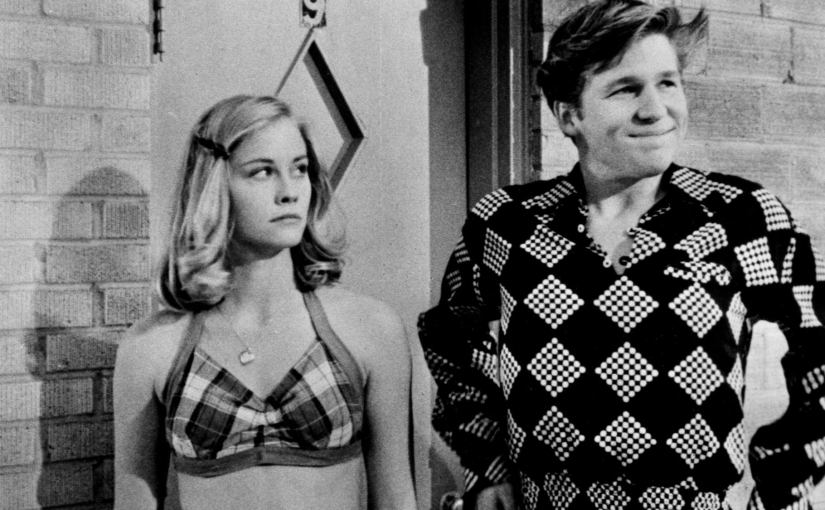
Peter Bogdonovich’s classic adaptation of Larry McMurtry’s The Last Picture Show is a display of the ends of things that perhaps at one time had life.

The film opens on the main street of the fictional town of Anarene, Texas in November 1951, just as the Korean War was occurring.

A strong gust of wind blows while a mute, mentally handicapped boy fruitlessly sweeps a dusty street, and a junky pick up truck careens down carrying Duane Jackson (Jeff Bridges) and Sonny Crawford (Timothy Bottoms); both on the brink of adulthood with no future in sight. Anarene is a town that has a past and only a few remnants of a present represented by a pool hall, a diner and movie house. All three are owned by Sam “The Lion” (Ben Johnson in an Oscar winning performance). Sam is old and wise. The town speaks through Sam, who is well aware nothing of promise is offered here anymore. So it’s no surprise that all the remaining townsfolk can occupy themselves with are their televisions and sexual conquests.

Variations of perspectives that are sexual in nature continue to symbolize what is dying in Anarene. Cybill Shepherd in her very first role portrays Jacy, the pretty girl. Her innocence will be lost as soon as she gives away her virginity. It matters little to her how that happens. Bogdanovich offers a great scene where Jacy attends a swimming pool skinny dip party. Jacy is pressured into standing on a diving board to undress in front of the revelers. I looked at this moment as a teetering balancing act. Jacy is bordering saying goodbye to her youth forever. She does undress all the way only to almost trip off the board. For the moment, Bogdonovich saves the character’s present state as she narrowly avoids falling in the water.

Later, on a whim during New Year’s Eve, Sonny and Jackson go off to Mexico with little money in their pockets and no plan in mind. When they return, an unexpected turn of events has occurred. The fate of this town is withering away with the breeze that’s always intruding. The mute boy will occasionally sweep the street again but accomplish nothing from it.

The films in the movie house represent those that were once celebrated but are now almost never noticed as these families are becoming more glued to the next common household appliance, the television with variety hour shows.

The music never changes or grows up. Hank Williams Sr, occupies the minds of folk who maintained this town at one time and are slowly dying off. The next generation does not have much appreciation for it.

I could go on. Every scene in The Last Picture Show brings about another example of an ending. Bogdonovich was meticulous in his symbolic method of McMurty’s story.

I love that the film, released originally in 1971, was shot in black & white because it shows the story in a historical context; this is what’s left of what once was. The sexual situations don’t hold back in nudity. It’s wise as I thought the nudity clashed with the black & white; it was almost intrusive. The nudity is overcoming the home life heartland that small towns like Anarene used to be remembered for. Sadly, the characters have a hard time accepting this fate.

Cloris Leachman portrays Ruth Popper, the wife of the high school coach who she suspects of being gay. She engages in an affair with young Sonny and her big moment comes when she frustratingly throws a coffee pot at the wall in a rage. She’s terrified that Sonny could never retreat to her pace of life. He’s apt to move on from her. She’ll be stuck with a closeted gay husband in an unstimulating environment. Time has become stagnant for Ruth within the confines of a lifeless marriage and a dead town.

A new way of life awaits. Destiny for Jacy, Sonny and Duane do not include Anarene in their plans.

Eventually Sonny and Duane attend a showing of John Ford’s “Red River” featuring John Wayne. The next morning, after the movie house has closed forever (no one buys tickets anymore), a new fate awaits, maybe even death. Worse yet, maybe for one of them, there is no fate. Maybe, for one of them all that’s offered is an absence of life while residing in Anarene, Texas.

I didn’t realize how much material I absorbed until after The Last Picture Show was over. Peter Bogdonovich provided more for me to think about then I was aware of. The initial slow pace of the film seems mundane at first until you understand that people like Ruth and Sam have memories they experienced but will never carry forward. It’s sad. Their history had meaning at one time. The legacy of their past, however, has no future.

The Last Picture Show is on AFI’s 100 best movies from 2007. It deserves to be as Bogdonovich deftly shows how a past withers away from a nowhere future. His set pieces and direction of characters show the suffering they endure with an unsure end they can not escape.

I haven’t stopped thinking about The Last Picture Show since it ended.

WEST SIDE STORY (1961)

By Marc S. Sanders

The musical answer to Romeo & Juliet will always remain as one of my favorites.

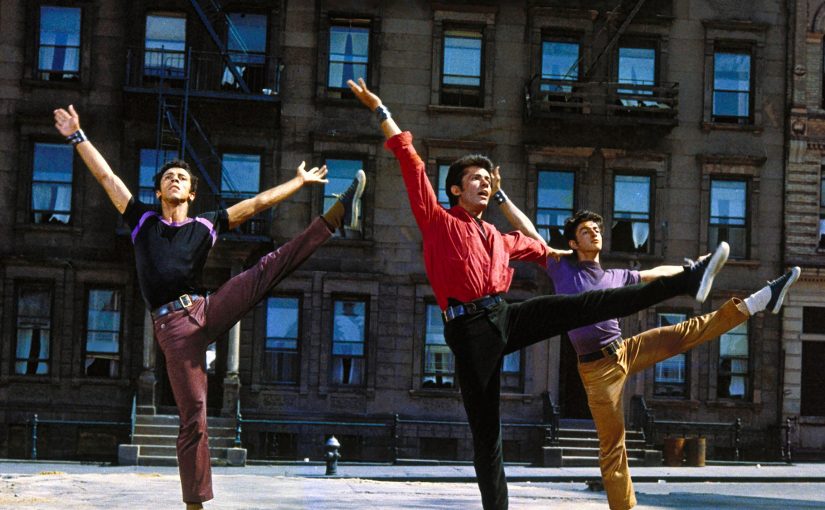
West Side Story crackles with energy as soon as the 6 minute overture begins and segues into overhead shots of New York City accompanied by its frequent whistle calls. Then it zooms in for something new, fresh, and eye popping; precise choreography from Jerome Robbins to represent street fighting by means of heart racing ballet. You simply can’t take your eyes off the screen.

Young love and pride carry Robbins’ film with partnered direction from Robert Wise. It’s sadly amazing that the prejudices that shape the story are arguably more evident and profound nearly 60 years later. Tony & Maria must never be together. Change the names today, and the logic behind the societal law will often mirror the reasoning found in the film.

Am I focusing too much on that message though? There’s so much to cherish in West Side Story. A film that boasts numbers like “America,” “I Feel Pretty,” “Tonight,” “Stay Cool Boy,” “When You’re A Jet,” “Maria,” and my favorite “Officer Krupke.” It does not get much better than this.

The dancing lunges at the camera. The dialogue may be dated, yeah, but the cast is so genuine to the setting (even if Natalie Wood is lip syncing her songs).

Steven Spielberg has remade the film, to be released in December, 2021. I’ll go see it, sure. Yet I don’t believe it’ll compare to the original 1961 winner for Best Picture as well as the other 9 Oscars it was recognized for.

Go back and catch up with West Side Story. It should be seen by anyone who ever wanted to watch a great film.

INGLOURIOUS BASTERDS

By Marc S. Sanders

If you are going to rewrite history then go crazy.  Go big and bloody.  Go for broke.  Don’t hold back.  Quentin Tarantino didn’t hold back when he penned and directed Inglourious Basterds, my personal favorite of his films.

To date of when this review is published, Tarantino has directed nine films and if ever the maturity of a director is so evident, it really shows with Basterds where three quarters of the picture is performed in either French or German.  English is secondary here, and Italian is limited to only a couple of “Bonjournos!”  and “Gorlamis!”

Tarantino presents early 1940s France when Germany occupied most of the country and practically rounded up all of the Jews.  In 1941, a cunning detective of a Nazi Colonel, Hans Landa (Christoph Waltz performing as one of the greatest villains of all time) visits a French dairy farmer to ensure there are no unaccounted-for Jews scurrying around; scurrying around like their beastly equivalent, the rat.  Landa is the hawk that will most assuredly find them.  This scene is the best written moment within Tarantino’s catalog of various scripts and dialogue exchanges.  The Landa character offers justification as to why a Jew needs to be exterminated to the point that he nearly had me (a conservative practicing Jewish man) believing in his hateful philosophy.  The lines crackle here with Waltz doing most of the talking while the sad dairy farmer can do no more than respond with certifying Landa’s interesting points.  Tarantino closes the peaceful discussion with horrifying violence though.  Hans Landa may be complimentary of a farmer’s milk and his three beautiful daughters.  He may be eloquent in his dialogue albeit French, German or English, but he is a ruthless enforcer of law …of Nazi law at least.  I also would like to note Tarantino’s tactful way of using props like the pipes the characters smoke, the glass of milk that is consumed by Landa and the ink pen and spreadsheet he uses for accounting of the Jews in the area.  There’s an uncomfortable intimidation in all of these items as they are handled by Waltz, the actor.  Later in the film, Waltz will send a chill down your spine as he happily enjoys a delicious strudel with whipped cream.  Inglourious Basterds is a great combination of directing, editing, cinematography and acting.

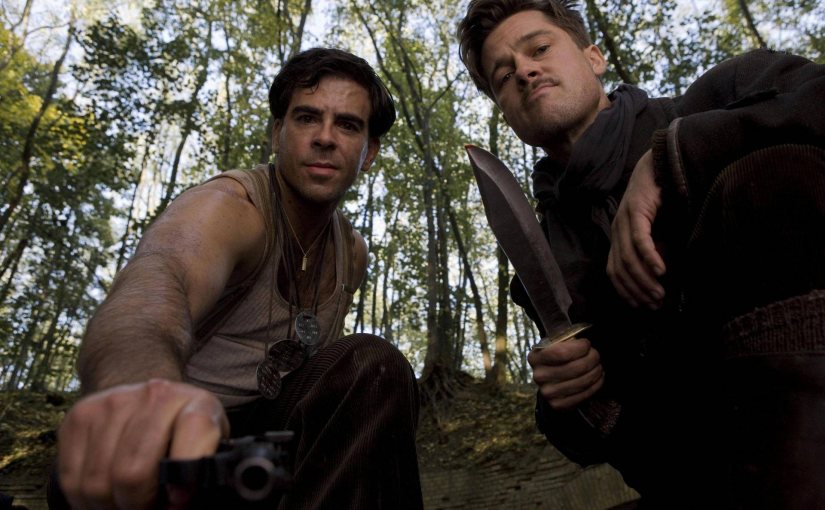
The film diverts into a few separate stories, namely the title characters led by Aldo “The Apache” Raines, played with Tennessee redneck glee by Brad Pitt.  The Basterds consist of mostly Jewish American soldiers tasked with going deep into enemy territory and literally killing and scalping one hundred Nazi soldiers, each.  However, keep at least one alive during each encounter with a carved souvenir on their forehead, to spread the word of the Basterds intent.  This is deliberate B movie Dirty Dozen material and it works because it doesn’t take itself seriously.  Tarantino maintains that pulpy fiction narrative.  A cut to an over-the-top crybaby Adolph Hitler asks, “What is a Hugo Stiglitz?” and then we get a quick pause with big black block letters across the screen spelling out HUGO STIGLITZ.  This guy is a bad ass; a German turncoat who only wants to kill fellow German Nazis.  He’ll shoot them up until they are dead three times over.  He’ll stab them in the face twenty times through a pillow.  He’s not a suave killer.  He likes it violent and bloody messy.  The Basterds are fans.

The heroine of the film is Shoshanna (Melanie Laurent), a Jewish girl who is living undercover as a cinema owner in France.  By implied force she is tasked with presenting Himmler’s proud film of Nazi Germany’s finest war hero, Fredrick Zoller (Daniel Bruhl), recreating his bird’s nest three day sniper battle against an army of three hundred men.  This is where Tarantino does best at writing what he knows, and what he knows best is anything about cinematic film.  He literally uses his knowledge of film and film reels to bridge his story while setting Shoshanna on a mission to actually end World War II in one swift motion.   

In addition, he captures the adoration of film lovers and celebrity status.  Zoller is as heroic a celebrity as John Wayne or Zorro.  When he is recognized in the coffee houses or on the street, he humbly stops his ongoing flirtation with an uninterested Shoshanna, to give an autograph or pose for a picture.

Furthermore, Tarantino applies the scientific knowledge of how 35mm film is more flammable than paper as well as how to edit a film reel to an unexpected moment for Shoshanna’s Nazi audience.  He knows the architecture of a European cinema with its lobby and balconies and seating capacities.  He allows his characters to speak on an intellectual level by discussing great film artists of the time – filmmakers not as well-known as Chaplin here in the United States, but just as great or even artistically better. The art direction of the cinema both inside and out is adorned with washed out, distressed classic noir films.  Shoshanna changes out the lettering of the curved marquee top of the theater as well.  It might sound mundane, but to me it’s all atmospheric.

Beyond the subject of cinematic art, a bad guy will weed out a spy disguised in Nazi garb by recognizing how he signals for three drinks with his hand.  There’s a right way and a wrong way to place an order with a bartender.  Inglourious Basterds may be a fictional historical piece, but it also will give you an education. All of this reminds me that Quentin Tarantino has graduated from the simplicity of Reservoir Dogs to something bigger and grander and glossier.  Production money with a large budget will lend to that status of course, but Tarantino still had to learn to truly know what he was doing.

I will not spoil the ending here.  It’s a bloody blast for sure.  Moreover, it’s shocking.  If anything, Inglourious Basterds introduces an exclusive universe that resides in the mind of Quentin Tarantino where the textbook is thrown away, burned, riddled with bullets and blown up; it is where something else altogether happened, and you know what? I really wish it did actually happen this way.

GREEN BOOK

By Marc S. Sanders

The biggest surprise of Green Book is who its director is, the unlikely Peter Farrelly of The Farrelly Brothers, directors of Dumb & Dumber and There’s Something About Mary. Yet, when I reflect on the film it should not be a surprise. The Farrellys are known for raunchy humor, but often it stems from an honest source. When Viggo Mortensen’s character Tony folds an entire pizza pie in half and then scarfs it down whole, that’s a Farrelly touch but likely also what an Italian club bouncer raised in the Bronx would do without any consideration. He’d also win out in hot dog eating contest. Mortensen’s character is a far cry from his Russian Heyman in Eastern Promises or Stryder in The Lord Of the Rings. The pizza and hot dog scenes are great moments in a film weighted down by the Uncle Tom mentality of Deep South USA in 1962. Peter Farrelly needed to direct this film, and it just might be the best picture of the year.

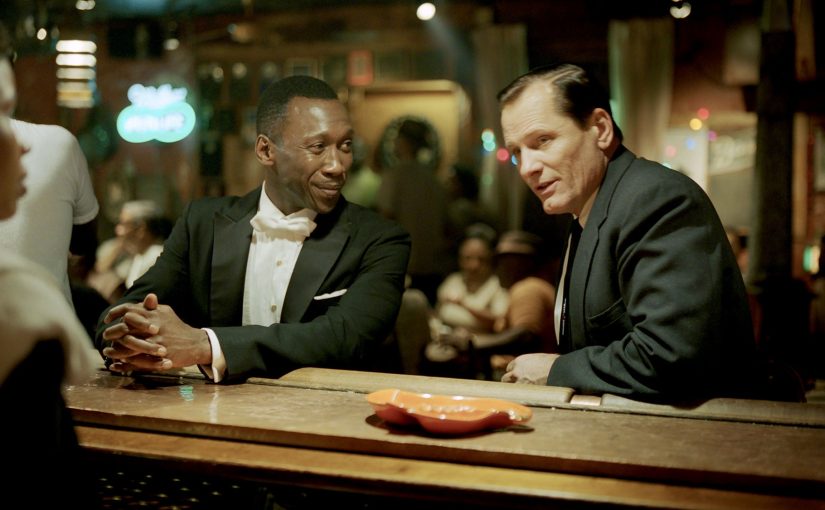
Tony (or “Tony Lip” as he’s known among his peers) is hired by Dr. Don Shirley played with such eloquence by Mahershala Ali. Dr. Shirley is an African American pianist, arguably the best in the world and ready to embark on a tour of the Midwest to Southeast of the country. It’s not that simple however as Dr. Shirley is all too aware of the racial prejudice that will befall him. Tony is hired to be Dr. Shirley’s driver as he has the toughness to look out for Shirley in the event that it is necessary. Sadly, the film shows that Tony is more than necessary.

There’s much comedy here between Ali, playing the well spoken “Felix” role, against Mortensen in the “Oscar” part. Tony and Don are worlds apart having virtually no understanding how the other half lives or what they are forced to compromise with on a daily basis. The hardships that Green Book offers focus more on Dr. Shirley as he is forced into humiliating circumstances where he is offered only an outhouse to use or denial of entry into a dining room. He could be wearing the sharpest of tuxedos, while Tony is a self aware “goombah” slob with no civility and Dr. Shirley remains the one to be overlooked. His value to Deep South America is to play his Steinway piano like meager jester.

There’s much to learn about our country’s mid 20th century history in Green Book. It’s a film I encourage families with pre-teen children to see. Not only will they learn of disillusioned hatred and treatment of black minority, but they will be entertained as well. References to Robert and John Kennedy are presented as well Aretha Franklin, and a Boston Celtics player (Name I cant recall).

The comedy that Farrelly brings keeps the audience engaged. The best dramas possess great comedy like Steel Magnolias, Terms Of Endearment, The Help, and even Kramer vs Kramer. If we can laugh along with our characters, then we will appreciate them that much more when harm and pain strikes. We want to ease their pain and be angry for them when those moments arrive. Their comedy of natural behaviors breeds affection for them. When they are compromised, we cry for them. Farrelly executes this format perfectly.

Mahershala Ali is a stand out here. He is snobbish at times towards the unmannered Tony but he is never deserving of his dismissiveness. He is a victim of the “colored mentality.” If not for the color of his skin, Dr. Shirley would have been regarded by all as a man of integrity; a hero to the American people. Sadly in 1962, many could not see past skin color. Thankfully, a great moment towards the end reminded me that it was in fact many…but not all. Watch the movie, and then tell me if you know what I’m referring to.

Remember, this is probably the best picture of 2018. Bring your children to see Green Book. Keep your children aware.

ONCE UPON A TIME IN…HOLLYWOOD

By Marc S. Sanders

There’s no question the most different of Quentin Tarantino’s directorial efforts is his latest film, Once Upon A Time In… Hollywood. Already described as his “love letter to cinema of the late 60s,” his 9th effort also implies the end of the Hippie Era by devoting a portion of time to B movie actress Sharon Tate, infamously murdered by Charles Manson’s followers when she was 8 months pregnant with Roman Polanski’s child.

Margot Robbie plays a near, gorgeous exact replica of Tate. She’s deliberately short on dialogue and I like to believe it’s because Tarantino treasures her as an innocent angel who was loving the atmosphere of Hollywood. She’s preserved of being nothing but likable. She dances with glee in her bedroom in the Hills or in public at the Playboy Mansion. One day she visits the local cinema to see her performance in “The Wrecking Crew” with Dean Martin. Tarantino shoots close ups of Robbie loving her footage as a pratfall klutz while listening to the audience reaction. She’s loving every second of the experience. People love her and she sees the love she has for people. Critics took issue with Robbie’s lack of dialogue. Not me. The performance is all there. Robbie is wonderful to look at with responses of pure happiness and celebration.

The main focus of the film is on Rick Dalton played by Leonardo DiCaprio with a huge range of drama, comedy and well intentioned over acting when Tarantino is wanting to spoof the TV western for fun. We see a collection of Dalton’s work, most especially on the fictional black and white TV western that airs Sundays at 8:30 on NBC (cue Dalton’s cowboy hat close up accompanied with “BONG, BONG, BONG!).

Rick is realizing he’s becoming past his prime. Marty Schwarz, his agent and a producer, played by Al Pacino warns Rick that he’s at a point where he’s only going to be the villain of the week on The Green Hornet and Batman. Rick does not take this well. Using his stunt double pal, Cliff Booth (Brad Pitt) to talk to, Rick is consumed with insecurity and alcoholism.

Tarantino wants to depict an era in Hollywood on its way out. A fictional character like Rick and the well known fate of Sharon Tate symbolize this turning point.

A third example is with Cliff. Rumored to have killed his wife, Cliff has trouble finding stunt work on a set. So he’s happy enough to just drive Rick around in his Cadillac, and fix his antenna. A great moment occurs when Cliff antagonizes a cocksure fist of fury Bruce Lee to a fight. Bruce doesn’t do so well against Cliff. Bruce Lee maybe not be what he once was, or what audiences ever perceived. Times they a changin’.

This is not the aggressive film that Tarantino is mostly known for. It’s primarily calm as we see these characters navigate around Hollywood locals, listening to The Rolling Stones and the Mamas & The Papas, and various product advertisements. Rick and Cliff are suffering a little. Suffering at the loss of what they were and the world they are forced to enter, nor what they are accustomed to. Sharon is ready for what’s next. Yet, will she get the opportunity to carry on?

The ending is bound to leave people divided. It’s different and very, very unexpected. It makes no difference how you feel about it. What matters is if it generates a response, and based on the theatre where I saw the film, yes! Yes, there is a massive response to what occurs.

Tarantino’s Once Upon A Time In… Hollywood is not his best film. There were moments where I thought it was a little slow and the film lacks the dialogue punch that many know Tarantino for. There’s really not one memorable line that stayed with me. I guess that’s what the trade off is when you finally are served multi dimensional characters that Tarantino has hardly offered before.

It’s the best non Tarantino film that Quentin Tarantino has ever directed.

UNFORGIVEN

By Marc S. Sanders

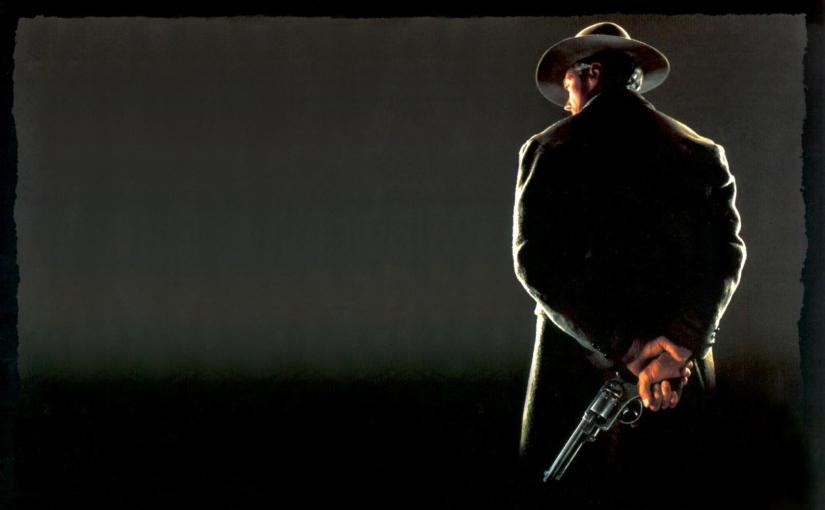
Unforgiven is a crowning achievement for director/actor/producer Clint Eastwood. It’s really a movie and screenplay from David Webb Peoples (the scribe behind Blade Runner) designed only for Clint Eastwood. After a long career of portraying quiet men with violent means, Eastwood transitions to anti-violence that would thematically dominate the next chapter of his filmography with In The Line Of Fire, A Perfect World, Mystic River, Million Dollar Baby, Gran Torino, and Letters From Iwo Jima. (WOW!!!! What a list!!!!!)

The character of William Munny is now a failing pig farmer haunted by a past of gunslinging murder and mayhem. His past returns when he’s offered a large bounty to murder two cowboys who disfigured a prostitute with a knife. He recruits his former partner Ned (another likable character for Morgan Freeman) to accompany him, and they join a kid who presumes he’s ready to kill but is really only fooling himself.

Meanwhile two other stories collide when the cruel, torturous Sheriff Little Bill Dugget (Gene Hackman in an Oscar winning role) meets with a gleeful celebrity in his own mind, gunfighter English Bob played by Richard Harris. Character actor Saul Rubinek plays Beauchamp, a reporter eager to document and dramatize these legends of the quickly expiring period of the Old West. Beauchamp will soon realize the heroes he envisions are nothing but pipe dreams.

Little Bill outlaws weapons in his town, and for the offense? A brutal beating or a painful whipping. Hackman is great at looking like his motivations make sense. Maybe they do. He sets an example and maybe it casts a preventative measure, albeit with a brutal arm of the law. Little Bill is happy to beat someone in the street, only to return happily to building his home along the river.

Unforgiven doesn’t make the violence easy for its characters. It’s harder to kill. It’s harder to listen to a dying victim beg for water. It’s just as hard to mount a horse. Most importantly, it’s hard to accept how cold blooded you can be when pushed to a point.

To watch Unforgiven almost requires at least a little experience of Eastwood’s first half of his career. The Man With No Name and Dirty Harry surmise a history for Munny where it was easy to draw the revolver, point and shoot. This film shows that defiance of scruples doesn’t last forever.

It’s a 1992 Film (Best Picture Oscar Winner) that still carries an important message responding to the questions of bearing arms and Wild West violence that recklessly surfaces in what is expected to be a more civilized society today.

Watch Unforgiven for its many moments of symbolism, changes in attitude among practically every character, and for the well executed direction of another classic from the great filmmaker, Clint Eastwood.

This is one of the best pictures of the last 30 years.

(Would love to hear commentary from others on this film. This is one worthy of extensive discussion. I also recommend you read Roger Ebert’s “Great Movie” review; here – https://www.rogerebert.com/reviews/great-movie-unforgiven-1992Ebert initially gave Unforgiven a thumbs down. This was one of those few instances where he changed his mind.) 

ALL ABOUT EVE

By Marc S. Sanders

Today’s actresses can lobby and vie to be Wonder Woman or Black Widow or Jane Bond. Yet, what so many filmmakers and actors fail to recall are the powerhouse performances of yesteryear that didn’t require guns and magic lassos. Movies shouldn’t simply be super heroes and villains in spandex and leather. No movie is a better example of this argument than Joseph L Mankiewicz’ 1950 Best Picture winner All About Eve.

This is also the only film in history to have four actresses nominated for acting awards – Bette Davis, Anne Baxter, Celeste Holm and Thelma Ritter. What an accomplishment!!!

Davis is Broadway legend Margo Channing, a sexy, tough, cigarette smoking broad who grew up and keeps her social life within the limelight. She’s a warrior among the Hollywood and New York elite. When her friend Karen Richards (Holm) welcomes a mousy young girl in a raincoat backstage to meet the famous Miss Channing, it becomes more than just a quick hello. This girl is Eve Harrington who proudly admits to following Margo’s career from San Francisco all the way to Broadway waiting outside the theatre on each performance night for that opportunity to meet the legend in person.

Upon introduction, Eve shares her tragic story of growing up poor and losing her husband in the war. Margo and Karen are taken with Eve, and now the young ingenue has wielded her way into the upper crust life among the pomp and circumstance. Margo’s test of her own celebrity seems to come unexpectedly as it occurs to her and her smarmy personal assistant Birdie (Ritter) that maybe Eve is angling for a way to fill Margo’s big shoes along with her wardrobe and stage costumes.

The elite are intruded upon by this outsider. Karen’s friendship to her playwriting husband Lloyd (Hugh Marlowe) and her friendship to Margo is tested by Eve’s surprising manipulations. As well, Eve is making herself more aware to Margo’s younger lover and stage director Bill (Gary Merrill). Eve also finds ways to build an acting career on the shoulders of these show biz upper class by eventually winning the opportunity to be Margo’s understudy.

The outsider who narrates these developments is the famed theatre critic, Addison DeWitt (a charming and cultured George Sanders who won the Oscar). DeWitt might not get welcomed to every exclusive black tie party in town as he’s “the critic” but that’s fine for it’s how he survives in his career. He’ll recruit a young naive actress like a newcomer played by Marilyn Monroe to maintain a stay within the social circle, and soon he’ll ride along on Eve’s journey for personal gain.

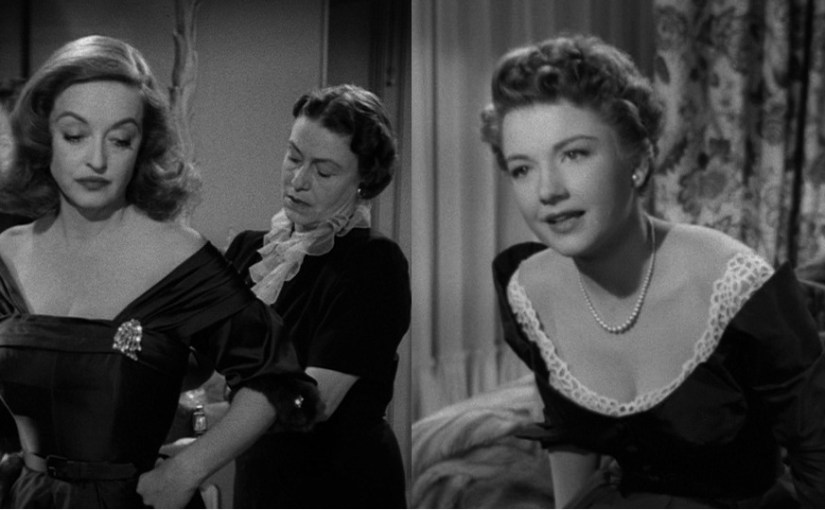
Mankiewicz’ script is brilliantly witty, absolutely biting and sharp. One of the best moments in film belongs to Bette Davis wearing a gorgeous dark evening gown designed by the legendary costumer Edith Head, and used as Margo’s armor ready for social battle. Davis declares “Fasten your seatbelts. It’s going to be a bumpy night.” No line could be so forthright in what to expect of a film like “All About Eve.”

This picture is ranked at the top of many “greatest film” lists. As it should be. This is not a sweeping biographical epic. Rather, it’s a lot of story branches that begin at the introduction of one character and expand in various directions among a handful of others who become disarmed by her ongoing presence. It’s not even that simple as Mankiewicz writes about Eve’s duplicity and how she manages to collide one piece of her destruction with another kind of destruction elsewhere, and the victims are simply blindsided.

Anne Baxter certainly had me fooled as Eve. She’s sweet and innocent on the surface and soon an inner and more evil shell emerges. Bette Davis looks spectacular and delivered one the best female performances of the last hundred years. She can carry herself and keep her guard up and authority in place. There’s a rich and commanding history about Margo that seems easy to believe. She is the queen of Broadway at the film’s beginning. Yet, for a moment her guard is let down and Mankiewicz gives us that window of time for his showcase.

Mankiewicz effectively opens his picture with Eve winning a very exclusive show biz award. She graciously approaches the podium to accept and deliver her speech. However, there are a select handful of individuals who withhold their applause of celebration. Then he flashes back to how we’ve come to this particular moment. It’s a great opening leaving me curious with a bunch of why questions. To watch this sequence the first time leaves you curious. To watch it on a second or third time is to be in on Addison DeWitt’s exclusive story of show biz scheming and diva one-upmanship. I only wonder if Joseph L Mankiewicz was as keen as George Sanders’ character to foresee how much life will come from Eve Harrington’s intrusion upon the lives of Margo & Bill and Karen & Lloyd. Before the age of desperate “if it bleeds, it leads” gossip rags, All About Eve was the real storyteller. 

TERMS OF ENDEARMENT

By Marc S. Sanders

Acclaimed television writer James L Brooks’ first feature film was the 1983 Best Picture Winner Terms of Endearment.  The movie succeeds in more ways than one because of its varied relationships among the characters.  You have Aurora Greenway (Shirley MacLaine) and her daughter Emma Greenway-Horton (Debra Winger).  There’s Emma and her husband Flap Horton (Jeff Daniels).  There’s Aurora and Flap, and then there is Aurora and her neighbor Garrett Breedlove (Jack Nicholson).  Sounds like a lot to take in for a two hour picture, and yet Brooks manages to adapt a script from Larry McMurtry’s novel that smoothly covers realistic depth and dimension among these characters, and how they connect with one another.  Brooks is at least an incredibly efficient writer/director.  Honestly, I’m not complimenting him nearly enough.

Shirley MacLaine provides one of the best female performances to ever grace the silver screen.  She doesn’t have to utter a word of dialogue to say so much about how Aurora feels.  One of her greatest facial expressions is when she is addressed by her grandson as “Grandma!”  This moment is so utterly hilarious that the studio selected it to close out the original theatrical trailer.  If anything is going to get you in the seat at the theatre it’s this moment.  Aurora is a widow who can be difficult to please, judgmental and always conscious of her part in the world-even while she is hosting multiple gentlemen suitors in her Houston, Texas home.  This character is so powerful that it is hard to understand why Hollywood really never followed suit with presenting more films focused on the middle age woman or man.  There are still interesting things to be found in being a widow and dealing with ageism, motherhood and a resurrection of sexuality.  Think about The Golden Girls which dominated television sets on Saturday nights for most of the decade.

Aurora disapproves of Emma marrying Flap.  Flap has no imagination or drive and is as devoid of affection as his name suggests.  Best he can do for Emma and their three children is find whatever college professor job he can muster and uproot his family from one mid-western state to another.  Emma knows of her mother’s disdain for Flap, and can’t disagree with her.  She knows Flap is a loser, but if it means aggravating her mother then it is worth it at least to marry him.  Early in the film it amuses Emma to frustrate her mother a little more and a little more.  Contrary to Aurora’s instincts, Emma is naively unaware that life settles in soon enough and the happy nuptials fade away.

Still, Aurora and Emma have a strong mother/daughter relationship where numerous phone calls each day happen between them.  These conversations consist of Emma reluctantly telling her mother that she may be pregnant, yet again, or that Aurora is proud to let her guard down and approach the boorish, drinking next door neighbor astronaut, Garrett, played with a devil may care seductiveness from Jack Nicholson.  Aurora’s serene peacefulness in her beautiful backyard garden and home is always disrupted by Garrett’s loud bellow before diving into his swimming pool.  Still, she can’t help but be attracted to him while putting on a façade of disapproval in his presence.  The first lunch date that Aurora and Garrett share must be one of the best dates ever depicted on film.  The scene might have been written and staged by Brooks, but it is thankfully hijacked by Nicholson and MacLaine.  One of the funniest moments to ever come out of 1980s cinema for sure.  There’s much reason that MacLaine won Best Actress and Nicholson won Best Supporting Actor.  These actors easily stage a scene of realistic comedic chemistry while later expressing deep rooted drama and affection with one another.  Not easy to do all in one film.

Brooks masterfully writes these characters with such authenticity that you find yourself legitimately laughing at a scene or a piece of dialogue, while the person sitting next to you might embrace the dramatic element of the very same moment.  Both responses to random moments in Terms Of Endearment allow varied reactions like that.  When Emma suspects Flap of committing adultery, pay attention to the dialogue and the performance from Winger and Daniels.  Emma allows Flap to dodge a lie he’s about to tell by warning him that he may have just lost his senses, but if he continues down a wrong path, then he will end up worth less than he already is.  He doesn’t fight her on that observation.  Hard to explain here but listen to the vocabulary Brooks applies to Emma’s dialogue and watch how Winger traps Daniels.  You may nod with a smirk, or you may feel frightened for Emma and her marriage. 

I always say Terms Of Endearment is a comedy first and a drama second.  The film steers towards a frightening fate for the Aurora and Emma.  However, before that third act sequence there is so much to treasure, love and laugh at in the film.  When a cloud of imminent loss feels like it may approach, that is when the dramatic elements step forward.  To truly feel loss, you had to treasure wonderful moments with a loved one or a friend.  You had to value something important in your heart and soul to feel so terribly frightened and mad and hysterical when days might seemingly appear numbered.  James L Brooks and Larry McMurtry remind us of that.  Every person on the planet is destined for this feeling at one point or another.  What happens when the inevitable arrives is what sustains Terms Of Endearment to it’s satisfying end.  A character may appear on a hotel staircase to reconnect with support.  A hug goes a little longer than expected, and for the first time the one who normally lets go first actually tries to keep the moment frozen in time.  A gift from long ago is recovered to touch someone emotionally.  Brooks includes all of these moments in his film and that’s what I embrace most importantly.  Cinematically speaking, these points in the film are heightened by a memorable soundtrack of quirkiness and passage of life from composer Michael Gore.  His music is so effective that it has been used countless times over to enhance trailers for other films marketed at audiences that this picture was catered for.

Yes, after numerous viewings, Terms Of Endearment never fails to me put me in tears.  Like ugly crying!  I prefer to watch it alone actually, because I connect with the characters differently than most people I know, including my wife.  It’s a very personal film for me.  It reminds me of loss that I have felt and experienced.  More importantly though, it reminds me of all I’ve had, and all I continue to hold on to.  Terms Of Endearment is one of my favorite films.